3D PRINTING IN CONSTRUCTION
Submitted by
1. SYED AIMAL ( 30 )
2. ZAIN TARIQ ( 18 )
3. NADAALI ( 32 )
4. HARIS SULTAN (43 )
5. ARSALAN AHMAD ( 34 )
6. HASSAM UD DIN SHAH ( 44 )
3D PRINTING
•3D printing is a process of construction of three
dimensional object from CAD through 3D printer.
•It may also be term as Additive manufacturing.
3D Printing in Construction Industry
• 3D concrete printing (3DCP) refers to the automated process of
manufacturing construction elements or entire structures by
means of a 3D printer ‘Layer by Layer’
• Instead of using ink like the traditional printers , it uses paste like
material for printing .
• The head of 3D printer moves in three direction to form cross-
sectional shapes.
CONVENTIONAL CONSTRUCTION 3D PRINTING CONSTRUCTION
 More Labors  Only skilled labor
 Brick or Blocks  Concrete layer
 Form work  No form work
 More Wastage  No wastage
 Different kind of construction tool
and eqp
 Only 3D printer
Digital
Modeling
Project
Execution
History
• The technology for printing physical 3D structure from digital data was
first develop by Chuck Hull in 1984.
• He was American who studied engineering physics.
• Known ‘The Father of 3D printer’
• First 3D House in world in France. Its length was 95 meter
• Made within 54 hours
• Met the requirement of thermal resistance, air circulation.
First 3D House in world
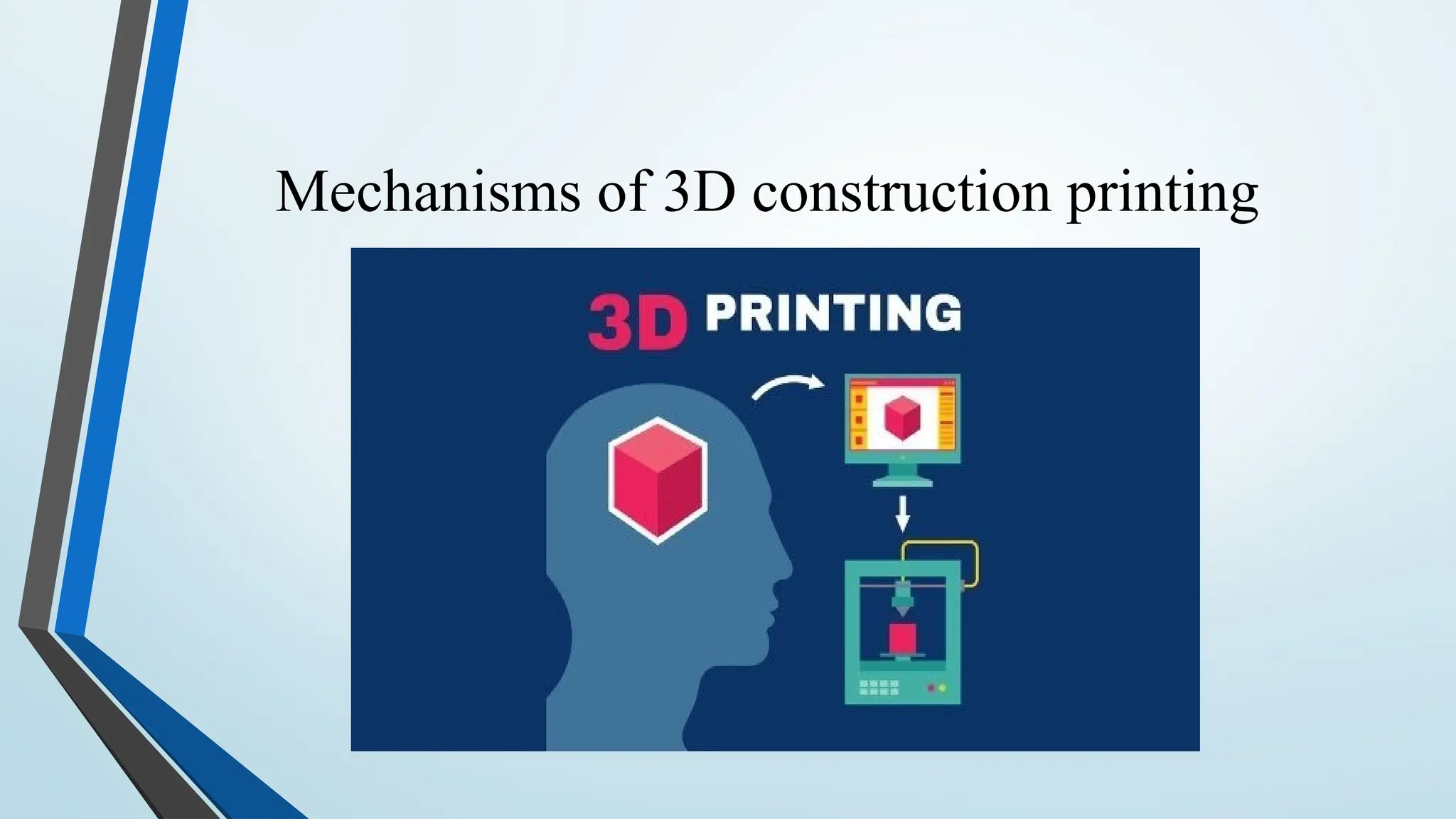
Mechanisms of 3D construction printing
GENERAL PRINCIPLES
•Modeling
•Printing
•Finishing
Mechanisms of 3D construction printing
1-Design phase
2- Material selection
3- Printing process:
a) Material extrusion
b) Material mixing
c) Layer by layer deposition
d) Support structures
4- Curing or solidification.
5-Quality control
6- Finishing and assembly
7-Post processing
3D Printing Construction Application
• Complex Architectural Designs
• Sustainable Construction
• Bridges and Infrastructure
• Building Restoration
• Additive Repair and Maintenance
• Large-Scale Infrastructure
Advantage of 3D Printing in Construction
• Cost Reduction
• Less waste
• Reduce production time
• Reduce error
• Production on demand
Disadvantage of 3D Printing in Construction
• Initial cost of printer
• Printer Time
• Power supply
• Special skill required for 3D model
• Manufacturing job losses
Environmental Impacts of 3D Printing
(POSITIVE IMPACTS)
• Reduction in Water Usage
Some 3D construction printing technologies use materials that require less water during the
printing process compared to traditional construction methods, contributing to water
conservation.
• Lower Carbon Footprint
The ability to create structures with optimized designs and less material waste can result in a
lower overall carbon footprint for construction projects.
• Land Occupation
3D construction printing occupy less place as compared to the traditional method
• Precision and Efficiency
3D printing offers a high level of precision and efficiency, reducing the need for rework
and minimizing errors that can lead to resource-intensive corrections.
• Reduced Material Waste
Traditional construction methods often result in significant material waste due to inaccurate
cutting and excess materials. 3D printing in construction is an additive manufacturing
process, meaning materials are deposited layer by layer, reducing waste to a minimum.
Environmental Impacts of 3D printing
(NEGATIVE IMPACTS)
• Energy Consumption
3D printing in construction typically requires a significant amount of energy, especially for
large-scale projects. The energy used in heating and operating the 3D printing equipment
can contribute to greenhouse gas emissions.
• Carbon Emissions from Equipment Manufacturing
The production of large-scale 3D printing equipment, such as gantry systems and robotic
arms, can contribute to carbon emissions if not manufactured using sustainable practices.
• Transportation
Transporting large 3D-printed components to construction sites can lead to emissions,
especially if the site is far from the manufacturing location.
• End-of-Life Disposal
Disposing of 3D-printed structures at the end of their life cycle can be challenging. Traditional
construction materials can often be recycled, but 3D-printed structures may contain a mix of
materials that are difficult to separate and recycle.
• Noise Pollution
The operation of large-scale 3D printers and construction equipment can generate
significant noise pollution, potentially affecting local ecosystems and communities.
(Article Environmental Footprint and
Economics of a Full-Scale 3D-Printed
3D PRINTING IN CONSTRUCTION IN
PAKISTAN
• NUST Civil Department Research Work
• Over all Cost of 3D printer
• Time of Printing
Challenges of 3D printing in Pakistan
• NO SKILLED LABOUR.
• BAN ON IMPORT.
• INCREASED TAXES ON CONTSRUCTION MACHINERIES
• LACK OF AWARENESS ABOUT LATEST TECHNOLOGY
ANY QUESTION
Thank You

3D printing in Civil Construction engineering.pptx

  • 1.
    3D PRINTING INCONSTRUCTION Submitted by 1. SYED AIMAL ( 30 ) 2. ZAIN TARIQ ( 18 ) 3. NADAALI ( 32 ) 4. HARIS SULTAN (43 ) 5. ARSALAN AHMAD ( 34 ) 6. HASSAM UD DIN SHAH ( 44 )
  • 2.
    3D PRINTING •3D printingis a process of construction of three dimensional object from CAD through 3D printer. •It may also be term as Additive manufacturing.
  • 3.
    3D Printing inConstruction Industry • 3D concrete printing (3DCP) refers to the automated process of manufacturing construction elements or entire structures by means of a 3D printer ‘Layer by Layer’ • Instead of using ink like the traditional printers , it uses paste like material for printing . • The head of 3D printer moves in three direction to form cross- sectional shapes.
  • 4.
    CONVENTIONAL CONSTRUCTION 3DPRINTING CONSTRUCTION  More Labors  Only skilled labor  Brick or Blocks  Concrete layer  Form work  No form work  More Wastage  No wastage  Different kind of construction tool and eqp  Only 3D printer Digital Modeling Project Execution
  • 5.
    History • The technologyfor printing physical 3D structure from digital data was first develop by Chuck Hull in 1984. • He was American who studied engineering physics. • Known ‘The Father of 3D printer’ • First 3D House in world in France. Its length was 95 meter • Made within 54 hours • Met the requirement of thermal resistance, air circulation.
  • 6.
  • 7.
    Mechanisms of 3Dconstruction printing
  • 8.
  • 9.
    Mechanisms of 3Dconstruction printing 1-Design phase 2- Material selection 3- Printing process: a) Material extrusion b) Material mixing c) Layer by layer deposition d) Support structures 4- Curing or solidification. 5-Quality control 6- Finishing and assembly 7-Post processing
  • 11.
    3D Printing ConstructionApplication • Complex Architectural Designs • Sustainable Construction • Bridges and Infrastructure • Building Restoration • Additive Repair and Maintenance • Large-Scale Infrastructure
  • 12.
    Advantage of 3DPrinting in Construction • Cost Reduction • Less waste • Reduce production time • Reduce error • Production on demand
  • 13.
    Disadvantage of 3DPrinting in Construction • Initial cost of printer • Printer Time • Power supply • Special skill required for 3D model • Manufacturing job losses
  • 14.
    Environmental Impacts of3D Printing (POSITIVE IMPACTS) • Reduction in Water Usage Some 3D construction printing technologies use materials that require less water during the printing process compared to traditional construction methods, contributing to water conservation. • Lower Carbon Footprint The ability to create structures with optimized designs and less material waste can result in a lower overall carbon footprint for construction projects. • Land Occupation 3D construction printing occupy less place as compared to the traditional method
  • 15.
    • Precision andEfficiency 3D printing offers a high level of precision and efficiency, reducing the need for rework and minimizing errors that can lead to resource-intensive corrections. • Reduced Material Waste Traditional construction methods often result in significant material waste due to inaccurate cutting and excess materials. 3D printing in construction is an additive manufacturing process, meaning materials are deposited layer by layer, reducing waste to a minimum.
  • 16.
    Environmental Impacts of3D printing (NEGATIVE IMPACTS) • Energy Consumption 3D printing in construction typically requires a significant amount of energy, especially for large-scale projects. The energy used in heating and operating the 3D printing equipment can contribute to greenhouse gas emissions. • Carbon Emissions from Equipment Manufacturing The production of large-scale 3D printing equipment, such as gantry systems and robotic arms, can contribute to carbon emissions if not manufactured using sustainable practices.
  • 17.
    • Transportation Transporting large3D-printed components to construction sites can lead to emissions, especially if the site is far from the manufacturing location. • End-of-Life Disposal Disposing of 3D-printed structures at the end of their life cycle can be challenging. Traditional construction materials can often be recycled, but 3D-printed structures may contain a mix of materials that are difficult to separate and recycle. • Noise Pollution The operation of large-scale 3D printers and construction equipment can generate significant noise pollution, potentially affecting local ecosystems and communities.
  • 18.
    (Article Environmental Footprintand Economics of a Full-Scale 3D-Printed
  • 19.
    3D PRINTING INCONSTRUCTION IN PAKISTAN • NUST Civil Department Research Work • Over all Cost of 3D printer • Time of Printing
  • 20.
    Challenges of 3Dprinting in Pakistan • NO SKILLED LABOUR. • BAN ON IMPORT. • INCREASED TAXES ON CONTSRUCTION MACHINERIES • LACK OF AWARENESS ABOUT LATEST TECHNOLOGY
  • 21.
  • 22.