Adverb
Phrases
LEVEL NUMBER
GRAMMAR
LANGUAGE
Advanced C1_2041G_EN English
2
www.lingoda.com
Goals
■ Review adverbs of manner
and frequency
■ Learn about adverb
phrases and their purpose
■ Practice using adverb
phrases in advanced
language structures
3
www.lingoda.com
We use adverbs to modify meaning. An
adverb phrase is simply two or more
words that work together as an adverb.
In this lesson you will find out more
about adverb phrases, and how to use
them.
4
www.lingoda.com 4
Reviewing adverbs
■ We use adverbs to modify the meaning of other verbs, adjectives, clauses and
other adverbs.
■ Adverbs to help us express place, time, frequency, and the manner of an action.
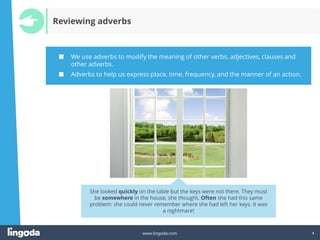
She looked quickly on the table but the keys were not there. They must
be somewhere in the house, she thought. Often she had this same
problem: she could never remember where she had left her keys. It was
a nightmare!
5
www.lingoda.com 5
What is an adverb phrase?
An adverb phrase is simply one or more words that work together as an adverb.
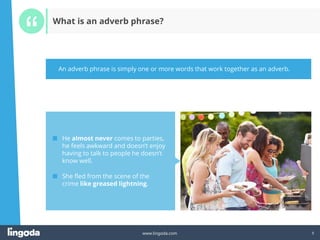
■ He almost never comes to parties,
he feels awkward and doesn’t enjoy
having to talk to people he doesn’t
know well.
■ She fled from the scene of the
crime like greased lightning.
6
www.lingoda.com 6
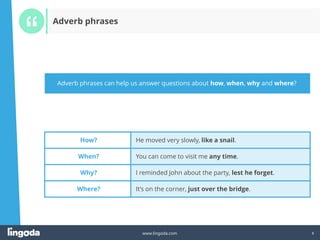
How? He moved very slowly, like a snail.
When? You can come to visit me any time.
Why? I reminded John about the party, lest he forget.
Where? It’s on the corner, just over the bridge.
Adverb phrases can help us answer questions about how, when, why and where?
Adverb phrases
7
www.lingoda.com 7
Adverb phrases – other uses
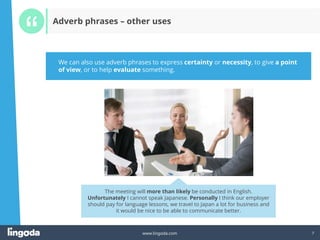
We can also use adverb phrases to express certainty or necessity, to give a point
of view, or to help evaluate something.
The meeting will more than likely be conducted in English.
Unfortunately I cannot speak Japanese. Personally I think our employer
should pay for language lessons, we travel to Japan a lot for business and
it would be nice to be able to communicate better.
8
www.lingoda.com
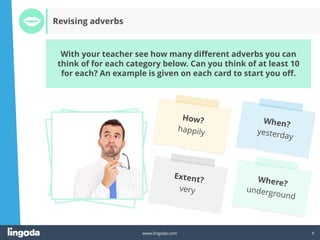
With your teacher see how many different adverbs you can
think of for each category below. Can you think of at least 10
for each? An example is given on each card to start you off.
Revising adverbs
9
www.lingoda.com
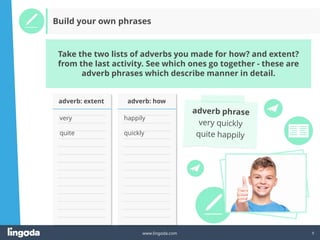
Build your own phrases
adverb: extent adverb: how
Take the two lists of adverbs you made for how? and extent?
from the last activity. See which ones go together - these are
adverb phrases which describe manner in detail.
very
quite
happily
quickly
10
www.lingoda.com
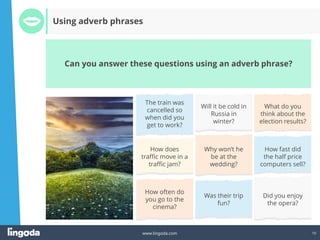
Can you answer these questions using an adverb phrase?
Using adverb phrases
The train was
cancelled so
when did you
get to work?
Will it be cold in
Russia in
winter?
What do you
think about the
election results?
How does
traffic move in a
traffic jam?
Why won’t he
be at the
wedding?
How fast did
the half price
computers sell?
How often do
you go to the
cinema?
Was their trip
fun?
Did you enjoy
the opera?
11
www.lingoda.com
Look at the sentences below. Think of the adverb phrases you
found in the previous slide. Can you now add an adverb phrase
to these sentences?
Using adverb phrases
It will be cold in
Moscow in
December.
Their trip went
well.
She sang the
aria.
The cars were
moving.
I am surprised.
My sister got to
work.
The computers
had
disappeared.
He cannot
attend because
he is sick.
I go to the
cinema.
12
www.lingoda.com 12
Using adverb phrases to modify verbs
■ The most common way we use adverb phrases is to modify verbs.
■ In the examples below, each adverb phrase explains something about the verb.
■ I see my cousin only occasionally.
■ I visit the doctor very regularly.
■ I go to the cinema quite often.
If you ask how often do you see your
cousin, visit the doctor or go to the
cinema, the answer is the adverb
phrase each time.
13
www.lingoda.com 13
Using adverb phrases to modify verbs
Examples of adverb phrases
The post office is over there, by the bank.
It’s ok, the keys are right here in my pocket.
She’s downstairs just now, can I take a
message?
We’re over here, can’t you see us?
■ We also use adverb phrases to modify the verb to be.
■ Often these adverb phrases include adverbs of place.
14
www.lingoda.com 14
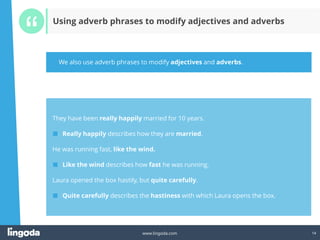
Using adverb phrases to modify adjectives and adverbs
They have been really happily married for 10 years.
■ Really happily describes how they are married.
He was running fast, like the wind.
■ Like the wind describes how fast he was running.
Laura opened the box hastily, but quite carefully.
■ Quite carefully describes the hastiness with which Laura opens the box.
We also use adverb phrases to modify adjectives and adverbs.
15
www.lingoda.com
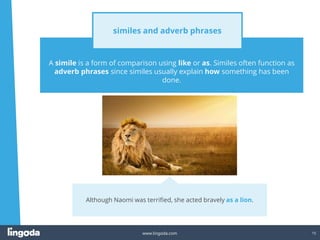
A simile is a form of comparison using like or as. Similes often function as
adverb phrases since similes usually explain how something has been
done.
Although Naomi was terrified, she acted bravely as a lion.
similes and adverb phrases
16
www.lingoda.com
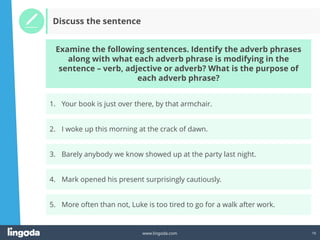
Discuss the sentence
2. I woke up this morning at the crack of dawn.
3. Barely anybody we know showed up at the party last night.
4. Mark opened his present surprisingly cautiously.
1. Your book is just over there, by that armchair.
Examine the following sentences. Identify the adverb phrases
along with what each adverb phrase is modifying in the
sentence – verb, adjective or adverb? What is the purpose of
each adverb phrase?
5. More often than not, Luke is too tired to go for a walk after work.
17
www.lingoda.com
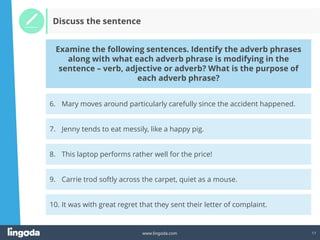
Discuss the sentence
7. Jenny tends to eat messily, like a happy pig.
8. This laptop performs rather well for the price!
9. Carrie trod softly across the carpet, quiet as a mouse.
6. Mary moves around particularly carefully since the accident happened.
Examine the following sentences. Identify the adverb phrases
along with what each adverb phrase is modifying in the
sentence – verb, adjective or adverb? What is the purpose of
each adverb phrase?
10. It was with great regret that they sent their letter of complaint.
18
www.lingoda.com
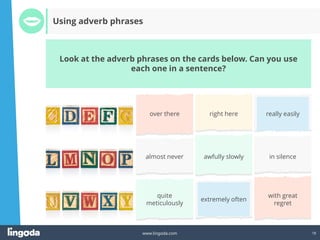
Look at the adverb phrases on the cards below. Can you use
each one in a sentence?
Using adverb phrases
over there right here really easily
almost never awfully slowly in silence
quite
meticulously
extremely often
with great
regret
19
www.lingoda.com
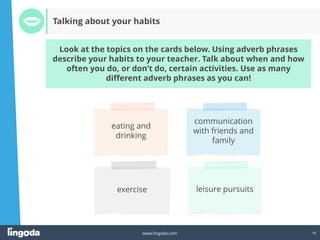
Look at the topics on the cards below. Using adverb phrases
describe your habits to your teacher. Talk about when and how
often you do, or don’t do, certain activities. Use as many
different adverb phrases as you can!
Talking about your habits
20
www.lingoda.com
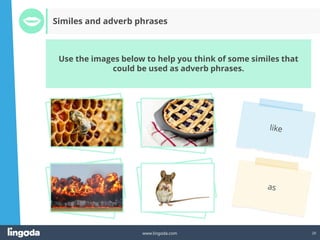
Use the images below to help you think of some similes that
could be used as adverb phrases.
Similes and adverb phrases
21
www.lingoda.com
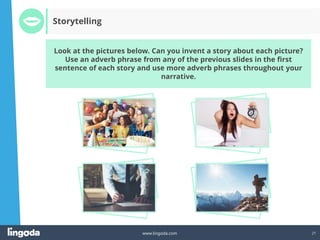
Look at the pictures below. Can you invent a story about each picture?
Use an adverb phrase from any of the previous slides in the first
sentence of each story and use more adverb phrases throughout your
narrative.
Storytelling
22
www.lingoda.com 22
Using adverb phrases
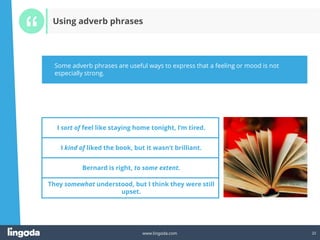
I sort of feel like staying home tonight, I’m tired.
I kind of liked the book, but it wasn’t brilliant.
Bernard is right, to some extent.
They somewhat understood, but I think they were still
upset.
Some adverb phrases are useful ways to express that a feeling or mood is not
especially strong.
23
www.lingoda.com 23
Useful adverb phrases
■ We use adverb phrases very often in English. At an advanced level it‘s a great
idea to incorporate more adverb phrases into your English. There are some
useful examples below.
■ After a while you will get used to
wearing glasses.
■ Before she knew it she was
managing the whole shop.
■ Surprisingly enough he tidied his
room just as he‘d been asked to do.
■ It‘s important to get this job done
by any means possible.
24
www.lingoda.com
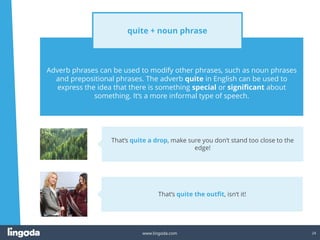
Adverb phrases can be used to modify other phrases, such as noun phrases
and prepositional phrases. The adverb quite in English can be used to
express the idea that there is something special or significant about
something. It‘s a more informal type of speech.
quite + noun phrase
That‘s quite the outfit, isn‘t it!
That‘s quite a drop, make sure you don‘t stand too close to the
edge!
25
www.lingoda.com
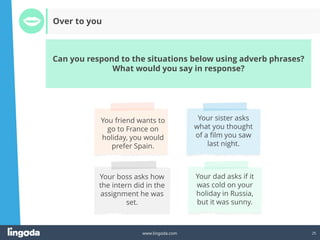
Can you respond to the situations below using adverb phrases?
What would you say in response?
Over to you
26
www.lingoda.com
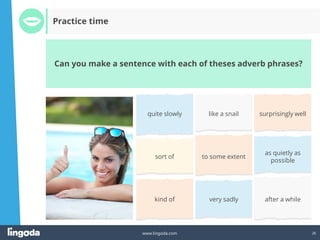
Can you make a sentence with each of theses adverb phrases?
Practice time
quite slowly like a snail surprisingly well
sort of to some extent
as quietly as
possible
kind of very sadly after a while
27
www.lingoda.com
In this class you have learnt a lot
of new adverb phrases. Now
think of your favourite fairytale,
try to retell the story to your
teacher using as many adverb
phrases as you can!
Telling a story
28
www.lingoda.com
Reflect on the lesson
Take a moment to review any new
vocabulary, phrases, language
structures or grammar points you have
come across for the first time in this
lesson.
Review them with your teacher one more
time to make sure you don’t forget!
29
www.lingoda.com
Homework
30
www.lingoda.com
Pick your favourite adverb phrases from this class, or create
some of your own, and write 15 sentences using adverb
phrases. Be as creative as you can be!
Practice time
31
www.lingoda.com
+
–
Which parts of this lesson did you find most challenging, and
which were easiest? Which parts did you enjoy the most, and
the least? Give your feedback here.
Homework evaluation activity
32
www.lingoda.com
Who are we?
Why learn English online?
What kinds of English classes do we offer?
Who are our English teachers?
How do our English certificates work?
We also have a language blog!
This material is proudly provided by
and can be used by anyone for free and
for any purpose.
About this material

388765799-Adverb-Phrases.pdf

  • 1.
  • 2.
    2 www.lingoda.com Goals ■ Review adverbsof manner and frequency ■ Learn about adverb phrases and their purpose ■ Practice using adverb phrases in advanced language structures
  • 3.
    3 www.lingoda.com We use adverbsto modify meaning. An adverb phrase is simply two or more words that work together as an adverb. In this lesson you will find out more about adverb phrases, and how to use them.
  • 4.
    4 www.lingoda.com 4 Reviewing adverbs ■We use adverbs to modify the meaning of other verbs, adjectives, clauses and other adverbs. ■ Adverbs to help us express place, time, frequency, and the manner of an action. She looked quickly on the table but the keys were not there. They must be somewhere in the house, she thought. Often she had this same problem: she could never remember where she had left her keys. It was a nightmare!
  • 5.
    5 www.lingoda.com 5 What isan adverb phrase? An adverb phrase is simply one or more words that work together as an adverb. ■ He almost never comes to parties, he feels awkward and doesn’t enjoy having to talk to people he doesn’t know well. ■ She fled from the scene of the crime like greased lightning.
  • 6.
    6 www.lingoda.com 6 How? Hemoved very slowly, like a snail. When? You can come to visit me any time. Why? I reminded John about the party, lest he forget. Where? It’s on the corner, just over the bridge. Adverb phrases can help us answer questions about how, when, why and where? Adverb phrases
  • 7.
    7 www.lingoda.com 7 Adverb phrases– other uses We can also use adverb phrases to express certainty or necessity, to give a point of view, or to help evaluate something. The meeting will more than likely be conducted in English. Unfortunately I cannot speak Japanese. Personally I think our employer should pay for language lessons, we travel to Japan a lot for business and it would be nice to be able to communicate better.
  • 8.
    8 www.lingoda.com With your teachersee how many different adverbs you can think of for each category below. Can you think of at least 10 for each? An example is given on each card to start you off. Revising adverbs
  • 9.
    9 www.lingoda.com Build your ownphrases adverb: extent adverb: how Take the two lists of adverbs you made for how? and extent? from the last activity. See which ones go together - these are adverb phrases which describe manner in detail. very quite happily quickly
  • 10.
    10 www.lingoda.com Can you answerthese questions using an adverb phrase? Using adverb phrases The train was cancelled so when did you get to work? Will it be cold in Russia in winter? What do you think about the election results? How does traffic move in a traffic jam? Why won’t he be at the wedding? How fast did the half price computers sell? How often do you go to the cinema? Was their trip fun? Did you enjoy the opera?
  • 11.
    11 www.lingoda.com Look at thesentences below. Think of the adverb phrases you found in the previous slide. Can you now add an adverb phrase to these sentences? Using adverb phrases It will be cold in Moscow in December. Their trip went well. She sang the aria. The cars were moving. I am surprised. My sister got to work. The computers had disappeared. He cannot attend because he is sick. I go to the cinema.
  • 12.
    12 www.lingoda.com 12 Using adverbphrases to modify verbs ■ The most common way we use adverb phrases is to modify verbs. ■ In the examples below, each adverb phrase explains something about the verb. ■ I see my cousin only occasionally. ■ I visit the doctor very regularly. ■ I go to the cinema quite often. If you ask how often do you see your cousin, visit the doctor or go to the cinema, the answer is the adverb phrase each time.
  • 13.
    13 www.lingoda.com 13 Using adverbphrases to modify verbs Examples of adverb phrases The post office is over there, by the bank. It’s ok, the keys are right here in my pocket. She’s downstairs just now, can I take a message? We’re over here, can’t you see us? ■ We also use adverb phrases to modify the verb to be. ■ Often these adverb phrases include adverbs of place.
  • 14.
    14 www.lingoda.com 14 Using adverbphrases to modify adjectives and adverbs They have been really happily married for 10 years. ■ Really happily describes how they are married. He was running fast, like the wind. ■ Like the wind describes how fast he was running. Laura opened the box hastily, but quite carefully. ■ Quite carefully describes the hastiness with which Laura opens the box. We also use adverb phrases to modify adjectives and adverbs.
  • 15.
    15 www.lingoda.com A simile isa form of comparison using like or as. Similes often function as adverb phrases since similes usually explain how something has been done. Although Naomi was terrified, she acted bravely as a lion. similes and adverb phrases
  • 16.
    16 www.lingoda.com Discuss the sentence 2.I woke up this morning at the crack of dawn. 3. Barely anybody we know showed up at the party last night. 4. Mark opened his present surprisingly cautiously. 1. Your book is just over there, by that armchair. Examine the following sentences. Identify the adverb phrases along with what each adverb phrase is modifying in the sentence – verb, adjective or adverb? What is the purpose of each adverb phrase? 5. More often than not, Luke is too tired to go for a walk after work.
  • 17.
    17 www.lingoda.com Discuss the sentence 7.Jenny tends to eat messily, like a happy pig. 8. This laptop performs rather well for the price! 9. Carrie trod softly across the carpet, quiet as a mouse. 6. Mary moves around particularly carefully since the accident happened. Examine the following sentences. Identify the adverb phrases along with what each adverb phrase is modifying in the sentence – verb, adjective or adverb? What is the purpose of each adverb phrase? 10. It was with great regret that they sent their letter of complaint.
  • 18.
    18 www.lingoda.com Look at theadverb phrases on the cards below. Can you use each one in a sentence? Using adverb phrases over there right here really easily almost never awfully slowly in silence quite meticulously extremely often with great regret
  • 19.
    19 www.lingoda.com Look at thetopics on the cards below. Using adverb phrases describe your habits to your teacher. Talk about when and how often you do, or don’t do, certain activities. Use as many different adverb phrases as you can! Talking about your habits
  • 20.
    20 www.lingoda.com Use the imagesbelow to help you think of some similes that could be used as adverb phrases. Similes and adverb phrases
  • 21.
    21 www.lingoda.com Look at thepictures below. Can you invent a story about each picture? Use an adverb phrase from any of the previous slides in the first sentence of each story and use more adverb phrases throughout your narrative. Storytelling
  • 22.
    22 www.lingoda.com 22 Using adverbphrases I sort of feel like staying home tonight, I’m tired. I kind of liked the book, but it wasn’t brilliant. Bernard is right, to some extent. They somewhat understood, but I think they were still upset. Some adverb phrases are useful ways to express that a feeling or mood is not especially strong.
  • 23.
    23 www.lingoda.com 23 Useful adverbphrases ■ We use adverb phrases very often in English. At an advanced level it‘s a great idea to incorporate more adverb phrases into your English. There are some useful examples below. ■ After a while you will get used to wearing glasses. ■ Before she knew it she was managing the whole shop. ■ Surprisingly enough he tidied his room just as he‘d been asked to do. ■ It‘s important to get this job done by any means possible.
  • 24.
    24 www.lingoda.com Adverb phrases canbe used to modify other phrases, such as noun phrases and prepositional phrases. The adverb quite in English can be used to express the idea that there is something special or significant about something. It‘s a more informal type of speech. quite + noun phrase That‘s quite the outfit, isn‘t it! That‘s quite a drop, make sure you don‘t stand too close to the edge!
  • 25.
    25 www.lingoda.com Can you respondto the situations below using adverb phrases? What would you say in response? Over to you
  • 26.
    26 www.lingoda.com Can you makea sentence with each of theses adverb phrases? Practice time quite slowly like a snail surprisingly well sort of to some extent as quietly as possible kind of very sadly after a while
  • 27.
    27 www.lingoda.com In this classyou have learnt a lot of new adverb phrases. Now think of your favourite fairytale, try to retell the story to your teacher using as many adverb phrases as you can! Telling a story
  • 28.
    28 www.lingoda.com Reflect on thelesson Take a moment to review any new vocabulary, phrases, language structures or grammar points you have come across for the first time in this lesson. Review them with your teacher one more time to make sure you don’t forget!
  • 29.
  • 30.
    30 www.lingoda.com Pick your favouriteadverb phrases from this class, or create some of your own, and write 15 sentences using adverb phrases. Be as creative as you can be! Practice time
  • 31.
    31 www.lingoda.com + – Which parts ofthis lesson did you find most challenging, and which were easiest? Which parts did you enjoy the most, and the least? Give your feedback here. Homework evaluation activity
  • 32.
    32 www.lingoda.com Who are we? Whylearn English online? What kinds of English classes do we offer? Who are our English teachers? How do our English certificates work? We also have a language blog! This material is proudly provided by and can be used by anyone for free and for any purpose. About this material