The History of Competitive Gaming
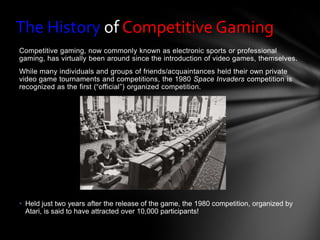
Competitive gaming, now commonly known as electronic sports or professional
gaming, has virtually been around since the introduction of video games, themselves.
While many individuals and groups of friends/acquaintances held their own private
video game tournaments and competitions, the 1980 Space Invaders competition is
recognized as the first (“official”) organized competition.


• Held just two years after the release of the game, the 1980 competition, organized by
  Atari, is said to have attracted over 10,000 participants!
With the success of the 1980 Space Invaders competition, others began taking advantage of
the desire for competitive gaming.
• From its earliest stages, Walter Day was able to recognize the importance of video games, and
  the increased popularity that the industry would soon obtain.
  • With this mindset, Day pitched an idea to ABC – he wanted to televise a video game
    competition on national television. Like many of that era, ABC was also able to understand
    the growing popularity of video games, and agreed to televise the “First Video Game
    Invitational” on its popular series, “That’s Incredible!” in 1983:
    http://www.youtube.com/watch?v=zO3ctKcI8Kg
  • Day later created the United States National Video Game Team in 1983.
                • The team would travel the country in somewhat of a tour bus, visiting arcades
                  and attending various competitions, displaying their dominance and love for
                  video games.
• Hollywood even tapped into this newfound interest in competitive gaming by releasing The
  Wizard in 1989. The movie received over $14 billion in U.S. box office sales alone.
• Since The Wizard featured several Nintendo games and accessories, it was only fitting that
  Nintendo would take advantage of the popularity of the movie.
  • The Nintendo World Championships took place in 1990—about a year after the movie
    released. This particular competition tested gamers’ skills in three popular games of that
    time: Rad Racer, Tetris, and the critically-acclaimed Super Mario Bros. .
• Nintendo continued to dominate the young competitive gaming circuit
   throughout the 1990s.
As the games and game systems evolved, so did the world of competitive gaming.
• The late 1990s and early 2000s saw the introduction of actual organizations that
  represented competitive gamers and established official events within the
  professional/competitive gaming community.
 • The first annual Electronic Sports World Cup took place in France, in 2000.
 • Also in 2000 was the first World Cyber Games (WCG), which took place in Seoul,
   Korea, where video games are immensely popular.
 • In 2002, MLG (short for Major League Gaming) launched and became the largest
   organized professional gaming organization. Since its inception, MLG has proven
   to be one of the most (if not the most) influential group to competitive gaming.
   MLG attempts to operate similarly to real sports – it has a very interactive website
   that features players, results, standings, and photos. Also, MLG conducts player
   interviews, offers professional insight, and often broadcasts their events—either
   on television or the website.
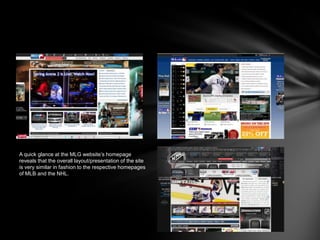
A quick glance at the MLG website’s homepage
reveals that the overall layout/presentation of the site
is very similar in fashion to the respective homepages
of MLB and the NHL.
Current State of Competitive Gaming
Video game competitions and tournaments have certainly changed
drastically since their origins in the 1980s.
The current state of MLG, according to its website: “[MLG] is the
dominant media property exclusively targeting tens of millions of
consumers worldwide who have a passion for playing video games as
a competitive social activity…”
While in the past, prizes might have included a couple hundred
dollars, t-shirts, games, and game accessories, extremely high cash
prizes have become customary at video game competitions, offering
gamers compensation for their elite play.
Notable Prize-Winners
• Johnathan “Fatal1ty” Wendel, considered by many to be the most prominent players in the world of
  professional gaming, has reportedly one over $500,000 worth of prizes from various gaming competitions.
• Manuel “Grubby” Schenkhuizen, over the course of his approximately nine years of professional gaming, has
  reportedly won over $250,000 in prize money from World Cyber Games, as well as other notable
  tournaments.
• Tom “Tsquared” Taylor is currently under contract with MLG, earning him hundreds of thousands of dollars
  per year. He also brings in an additional $100,000 to $250,000 each year, in advertising and endorsement
  deals.


                                        In 2008, Tom Taylor became the
                                        first “professional athlete” to be
                                        promoted on Dr Pepper bottles.
                                        His image was printed on 175
                                        million bottles and distributed
                                        across the nation
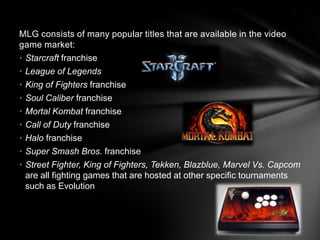
MLG consists of many popular titles that are available in the video
game market:
• Starcraft franchise
• League of Legends
• King of Fighters franchise
• Soul Caliber franchise
• Mortal Kombat franchise
• Call of Duty franchise
• Halo franchise
• Super Smash Bros. franchise
• Street Fighter, King of Fighters, Tekken, Blazblue, Marvel Vs. Capcom
  are all fighting games that are hosted at other specific tournaments
  such as Evolution
The Games
• Many times, these particular games are chosen out of the
  vast array of games available because they are/have been
  very popular with many people.
• Currently MLG uses PCs, PS3 and Xbox 360 as their
  platforms for gaming
• Not only is the constant rotation of games ever changing
  every year, but this also allows for new, up and coming
  players to debut.
• The staple that has established itself in MLG, and also in all
  of competitive gaming, is the Starcraft series.
 •   Since its first expansion of Starcraft: Brood War, the game’s popularity
     amongst players and viewers quickly grew.
 •   The series was most popular in the country of South Korea and was also one
     of the key reasons gaming turned competitive within the Asian gaming
     community.
The Stars of Electronic Sports
•The first official competitive gaming/electronic sports tournament being
that of the World Cyber Games (WCG) started in 2000 with Starcraft:
Brood War as one of the titles
•Such players are BoxeR (Starcraft), IdrA (Starcraft), Naniwa
(Starcraft), Daigo (Street Fighter), GamerBee (Street Fighter)
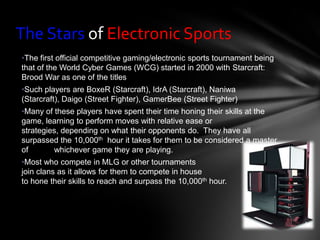
•Many of these players have spent their time honing their skills at the
game, learning to perform moves with relative ease or
strategies, depending on what their opponents do. They have all
surpassed the 10,000th hour it takes for them to be considered a master
of       whichever game they are playing.
•Most who compete in MLG or other tournaments
join clans as it allows for them to compete in house
to hone their skills to reach and surpass the 10,000th hour.
Social Media
                Fan Page made for interaction between interests
                (polls, surveys)


Interaction with MLG as well as live updates from
tournaments for those there (giveaways, upcoming
matchups) and not there (winners).


                  Videos of past competitions as well as exclusive
                  interviews and other extra features.
Continuing Expansion
•The popularity of MLG in countries like
Korea and Japan is comparable to the
popularity of sports like football and
basketball are here in the United States.


•Popular events, like Comic-Con, have
incorporated MLG events that bring
attention to it to an audience that would be
interested.


•An opportunity like this can aid in the
growth of MLG in the United States.

3810 final

  • 2.
    The History ofCompetitive Gaming Competitive gaming, now commonly known as electronic sports or professional gaming, has virtually been around since the introduction of video games, themselves. While many individuals and groups of friends/acquaintances held their own private video game tournaments and competitions, the 1980 Space Invaders competition is recognized as the first (“official”) organized competition. • Held just two years after the release of the game, the 1980 competition, organized by Atari, is said to have attracted over 10,000 participants!
  • 3.
    With the successof the 1980 Space Invaders competition, others began taking advantage of the desire for competitive gaming. • From its earliest stages, Walter Day was able to recognize the importance of video games, and the increased popularity that the industry would soon obtain. • With this mindset, Day pitched an idea to ABC – he wanted to televise a video game competition on national television. Like many of that era, ABC was also able to understand the growing popularity of video games, and agreed to televise the “First Video Game Invitational” on its popular series, “That’s Incredible!” in 1983: http://www.youtube.com/watch?v=zO3ctKcI8Kg • Day later created the United States National Video Game Team in 1983. • The team would travel the country in somewhat of a tour bus, visiting arcades and attending various competitions, displaying their dominance and love for video games. • Hollywood even tapped into this newfound interest in competitive gaming by releasing The Wizard in 1989. The movie received over $14 billion in U.S. box office sales alone. • Since The Wizard featured several Nintendo games and accessories, it was only fitting that Nintendo would take advantage of the popularity of the movie. • The Nintendo World Championships took place in 1990—about a year after the movie released. This particular competition tested gamers’ skills in three popular games of that time: Rad Racer, Tetris, and the critically-acclaimed Super Mario Bros. .
  • 4.
    • Nintendo continuedto dominate the young competitive gaming circuit throughout the 1990s. As the games and game systems evolved, so did the world of competitive gaming. • The late 1990s and early 2000s saw the introduction of actual organizations that represented competitive gamers and established official events within the professional/competitive gaming community. • The first annual Electronic Sports World Cup took place in France, in 2000. • Also in 2000 was the first World Cyber Games (WCG), which took place in Seoul, Korea, where video games are immensely popular. • In 2002, MLG (short for Major League Gaming) launched and became the largest organized professional gaming organization. Since its inception, MLG has proven to be one of the most (if not the most) influential group to competitive gaming. MLG attempts to operate similarly to real sports – it has a very interactive website that features players, results, standings, and photos. Also, MLG conducts player interviews, offers professional insight, and often broadcasts their events—either on television or the website.
  • 5.
    A quick glanceat the MLG website’s homepage reveals that the overall layout/presentation of the site is very similar in fashion to the respective homepages of MLB and the NHL.
  • 6.
    Current State ofCompetitive Gaming Video game competitions and tournaments have certainly changed drastically since their origins in the 1980s. The current state of MLG, according to its website: “[MLG] is the dominant media property exclusively targeting tens of millions of consumers worldwide who have a passion for playing video games as a competitive social activity…” While in the past, prizes might have included a couple hundred dollars, t-shirts, games, and game accessories, extremely high cash prizes have become customary at video game competitions, offering gamers compensation for their elite play.
  • 7.
    Notable Prize-Winners • Johnathan“Fatal1ty” Wendel, considered by many to be the most prominent players in the world of professional gaming, has reportedly one over $500,000 worth of prizes from various gaming competitions. • Manuel “Grubby” Schenkhuizen, over the course of his approximately nine years of professional gaming, has reportedly won over $250,000 in prize money from World Cyber Games, as well as other notable tournaments. • Tom “Tsquared” Taylor is currently under contract with MLG, earning him hundreds of thousands of dollars per year. He also brings in an additional $100,000 to $250,000 each year, in advertising and endorsement deals. In 2008, Tom Taylor became the first “professional athlete” to be promoted on Dr Pepper bottles. His image was printed on 175 million bottles and distributed across the nation
  • 8.
    MLG consists ofmany popular titles that are available in the video game market: • Starcraft franchise • League of Legends • King of Fighters franchise • Soul Caliber franchise • Mortal Kombat franchise • Call of Duty franchise • Halo franchise • Super Smash Bros. franchise • Street Fighter, King of Fighters, Tekken, Blazblue, Marvel Vs. Capcom are all fighting games that are hosted at other specific tournaments such as Evolution
  • 9.
    The Games • Manytimes, these particular games are chosen out of the vast array of games available because they are/have been very popular with many people. • Currently MLG uses PCs, PS3 and Xbox 360 as their platforms for gaming • Not only is the constant rotation of games ever changing every year, but this also allows for new, up and coming players to debut. • The staple that has established itself in MLG, and also in all of competitive gaming, is the Starcraft series. • Since its first expansion of Starcraft: Brood War, the game’s popularity amongst players and viewers quickly grew. • The series was most popular in the country of South Korea and was also one of the key reasons gaming turned competitive within the Asian gaming community.
  • 10.
    The Stars ofElectronic Sports •The first official competitive gaming/electronic sports tournament being that of the World Cyber Games (WCG) started in 2000 with Starcraft: Brood War as one of the titles •Such players are BoxeR (Starcraft), IdrA (Starcraft), Naniwa (Starcraft), Daigo (Street Fighter), GamerBee (Street Fighter) •Many of these players have spent their time honing their skills at the game, learning to perform moves with relative ease or strategies, depending on what their opponents do. They have all surpassed the 10,000th hour it takes for them to be considered a master of whichever game they are playing. •Most who compete in MLG or other tournaments join clans as it allows for them to compete in house to hone their skills to reach and surpass the 10,000th hour.
  • 11.
    Social Media Fan Page made for interaction between interests (polls, surveys) Interaction with MLG as well as live updates from tournaments for those there (giveaways, upcoming matchups) and not there (winners). Videos of past competitions as well as exclusive interviews and other extra features.
  • 12.
    Continuing Expansion •The popularityof MLG in countries like Korea and Japan is comparable to the popularity of sports like football and basketball are here in the United States. •Popular events, like Comic-Con, have incorporated MLG events that bring attention to it to an audience that would be interested. •An opportunity like this can aid in the growth of MLG in the United States.