Functional Esophageal Disorders
   A1. Functional Heartburn                                                         C. Functional Bowel Disorders
   A2. Functional Chest Pain of Presumed Esophageal Origin     = NOT BURNING
                                                                                      C1. Irritable Bowel Syndrome               = OMSET WITH CHANGE IN SHAPE /
   A3. Functional Dysphagia = SENSE OF SOLID / LIQUID ABNORMAL PASSAGE
                                                                                      FREQUENCY OF STOOL – IMPROVEMENT WITH DEFECATION AT LEAST 3 DAYS / MONTH
   A4. Globus = NON PAINFUL SENSE OF FOREIGN BODY TO THROAD BETWEEN MEALS

                                                                                      C2. Functional Bloating            = FEELING OR VISIBLE DISTANTION AT LEAST 3


                                                                                      DAYS/ MONTH NO CRITERIA FOR F.DYSPEPSIA OR IRRITABLE BOWEL

B. Functional Gastroduodenal                                                          C3. Functional Constipation                = AT LEASAT 25% OF DEFECATIONS IN A
Disorders
                                                                                      MONTH – LOOSE STOOL ONLY WITH LKAXATIVES – NO CRITERIA FRO IRRITABLE BOWEL
   B1. FUNCTIONAL DYSPEPSIA                     = BOTHERSOME POSTPRANDIAL
                                                                                      – 3 DEFECATIONS A WEEK – MANUAL MANUVERS – LYMPY – STRAINING – INCOMPLETE
   SATIATION OR FULNESS OR PAIN OR BURNING
                                                                                      EVACUATION SENSE
   B1a. Postprandial Distress Syndrome                       = AFTEN 1 ORDINARY
                                                                                      C4. Functional Diarrhea             = WATERLY / LOOSE 75 % OF DEFECATION WITH

   SIZED MEAL – PREVENTS FINISGINH IT – MAY +NAYSEA / +BELCHING / +PAIN               NO PAIN

                                                                                      C5. Unspecified Functional Bowel Disorder
   – SEVERAL DAYS IN A WEEK


   B1b. Epigastric Pain Syndrome            = PAIN / BURNING [ NOT RETROSTERNAL ]


   INTERMITTENTNT AT LEAST INCE IN A WEEK – NO GENERALIZED – NO LOCALIZED TO


   OTHER REGIONS – NO BLUDDER / ODDO CRITERIA – NO RELIEF WITH DEFECATION –         D. Functional Abdominal Pain
   INDUCED OR RELIEF WITH MEAL – MAY AT FASTING PERIOD – MAY +POSTPRANDIAL
                                                                                    Syndrome
                                                                                           D. Functional Abdominal Pain Syndrome
   DISTRESS


B2. BELCHING DISORDERS

   B2a. Aerophagia
   B2b. Unspecified Excessive Belching                                              E. Functional Gallbladder and
                                                                                    Sphincter of Oddi Disorders
B3. NAUSEA AND VOMITING DISORDERS
                                                                                           E. Functional Gallbladder and Sphincter of Oddi Disorders
   B3a. Chronic Idiopathic Nausea              = MANY TIMES IN WEEK – USUALLY NO
                                                                                           = AT EPIGASTRIUM OR/AND RUQ – LASTS ½ HOUR OR MORE – NOT DAILY

   ASOCIATION WITH VOMITING                                                                INNTERMITTENT - INTERUPTS ACTIVITIES – NIGIT WKE UP – NO CHANGE WITH

                                                                                           BOWL MOVEMENT / POSTURE CHANGE / ANTACIDS – ASOCCIATION WITH NAUSEA
   B3b. Functional Vomiting
   B3c. Cyclic Vomiting Syndrome                                                           / VOMIT – Radiates   to the back and/or right infra subscapular region
                                             = NO ACIDIC BUT PLEASANT TASTE - NOT
   B4. Rumination Syndrome in Adults
                                                                                           E1. Functional Gallbladder          Disorder        = GALLBLADER PRESENT –
   WITH NAUSEA – NOT AFTER RETCHING

                                                                                           Normal liver enzymes, conjugated bilirubin, and amylase/lipase


                                                                                           E2. Functional Biliary Sphincter of Oddi Disorder          = Elevated    serum

                                                                                           transaminases, alkaline phosphatase, or conjugated bilirubin AT

                                                                                           TWO EPISODES – NORMAL LIPASE / AMYLASE

                                                                                           E3. Functional Pancreatic Sphincter of Oddi Disorder           = Elevated


                                                                                           amylase/lipase
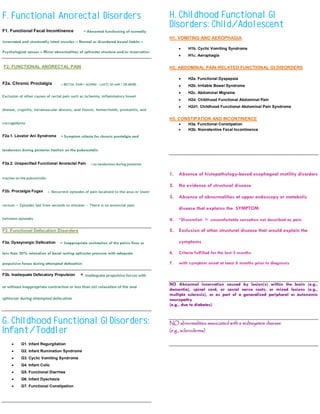
F. Functional Anorectal Disorders                                                            H. Childhood Functional GI
                                                                                             Disorders: Child/Adolescent
F1. Functional Fecal Incontinence                    = Abnormal   functioning of normally
                                                                                             H1. VOMITING AND AEROPHAGIA
innervated and structurally intact muscles – Normal or disordered bowel habits –
                                                                                                       H1b. Cyclic Vomiting Syndrome
Psychological causes – Minor abnormalities of sphincter structure and/or innervation
                                                                                                       H1c. Aerophagia

F2. FUNCTIONAL ANORECTAL PAIN                                                                H2. ABDOMINAL PAIN-RELATED FUNCTIONAL GI DISORDERS

                                                                                                       H2a. Functional Dyspepsia
F2a. Chronic Proctalgia               = RECTAL PAIN / ACHING – LASTS 20 miN / OR MORE –                H2b. Irritable Bowel Syndrome
                                                                                                       H2c. Abdominal Migraine
Exclusion of other causes of rectal pain such as ischemia, inflammatory bowel
                                                                                                       H2d. Childhood Functional Abdominal Pain
                                                                                                       H2d1. Childhood Functional Abdominal Pain Syndrome
disease, cryptitis, intramuscular abscess, anal fissure, hemorrhoids, prostatitis, and

                                                                                             H3. CONSTIPATION AND INCONTINENCE
coccygodynia                                                                                           H3a. Functional Constipation
                                                                                                       H3b. Nonretentive Fecal Incontinence
F2a.1. Levator Ani Syndrome           = Symptom     criteria for chronic proctalgia and


tenderness during posterior traction on the puborectalis


F2a.2. Unspecified Functional Anorectal Pain             = no tenderness during posterior


                                                                                             1.   Absence of histopathology-based esophageal motility disorders
traction on the puborectalis

                                                                                             2.   No evidence of structural disease
F2b. Proctalgia Fugax          = Recurrent episodes of pain localized to the anus or lower
                                                                                             3.   Absence of abnormalities at upper endoscopy or metabolic
rectum -- Episodes last from seconds to minutes -- There is no anorectal pain
                                                                                                  disease that explains the SYMPTOM
between episodes                                                                             4.   “Discomfort = uncomfortable sensation not described as pain

F3. Functional Defecation Disorders                                                          5.   Exclusion of other structural disease that would explain the

F3a. Dyssynergic Defecation           =   Inappropriate contraction of the pelvic floor or        symptoms

less than 20% relaxation of basal resting sphincter pressure with adequate                   6.   Criteria fulfilled for the last 3 months

propulsive forces during attempted defecation                                                7.   with symptom onset at least 6 months prior to diagnosis

F3b. Inadequate Defecatory Propulsion              = Inadequate propulsive forces with

                                                                                             NO Abnormal innervation caused by lesion(s) within the brain (e.g.,
or without inappropriate contraction or less than 20% relaxation of the anal
                                                                                             dementia), spinal cord, or sacral nerve roots, or mixed lesions (e.g.,
                                                                                             multiple sclerosis), or as part of a generalized peripheral or autonomic
sphincter during attempted defecation                                                        neuropathy
                                                                                             (e.g., due to diabetes)


G. Childhood Functional GI Disorders:                                                        NO abnormalities associated with a multisystem disease
Infant/Toddler                                                                               (e.g., scleroderma)

            G1. Infant Regurgitation
            G2. Infant Rumination Syndrome
            G3. Cyclic Vomiting Syndrome
            G4. Infant Colic
            G5. Functional Diarrhea
            G6. Infant Dyschezia
            G7. Functional Constipation

35 G I Functional Dearangements

  • 1.
    Functional Esophageal Disorders A1. Functional Heartburn C. Functional Bowel Disorders A2. Functional Chest Pain of Presumed Esophageal Origin = NOT BURNING C1. Irritable Bowel Syndrome = OMSET WITH CHANGE IN SHAPE / A3. Functional Dysphagia = SENSE OF SOLID / LIQUID ABNORMAL PASSAGE FREQUENCY OF STOOL – IMPROVEMENT WITH DEFECATION AT LEAST 3 DAYS / MONTH A4. Globus = NON PAINFUL SENSE OF FOREIGN BODY TO THROAD BETWEEN MEALS C2. Functional Bloating = FEELING OR VISIBLE DISTANTION AT LEAST 3 DAYS/ MONTH NO CRITERIA FOR F.DYSPEPSIA OR IRRITABLE BOWEL B. Functional Gastroduodenal C3. Functional Constipation = AT LEASAT 25% OF DEFECATIONS IN A Disorders MONTH – LOOSE STOOL ONLY WITH LKAXATIVES – NO CRITERIA FRO IRRITABLE BOWEL B1. FUNCTIONAL DYSPEPSIA = BOTHERSOME POSTPRANDIAL – 3 DEFECATIONS A WEEK – MANUAL MANUVERS – LYMPY – STRAINING – INCOMPLETE SATIATION OR FULNESS OR PAIN OR BURNING EVACUATION SENSE B1a. Postprandial Distress Syndrome = AFTEN 1 ORDINARY C4. Functional Diarrhea = WATERLY / LOOSE 75 % OF DEFECATION WITH SIZED MEAL – PREVENTS FINISGINH IT – MAY +NAYSEA / +BELCHING / +PAIN NO PAIN C5. Unspecified Functional Bowel Disorder – SEVERAL DAYS IN A WEEK B1b. Epigastric Pain Syndrome = PAIN / BURNING [ NOT RETROSTERNAL ] INTERMITTENTNT AT LEAST INCE IN A WEEK – NO GENERALIZED – NO LOCALIZED TO OTHER REGIONS – NO BLUDDER / ODDO CRITERIA – NO RELIEF WITH DEFECATION – D. Functional Abdominal Pain INDUCED OR RELIEF WITH MEAL – MAY AT FASTING PERIOD – MAY +POSTPRANDIAL Syndrome D. Functional Abdominal Pain Syndrome DISTRESS B2. BELCHING DISORDERS B2a. Aerophagia B2b. Unspecified Excessive Belching E. Functional Gallbladder and Sphincter of Oddi Disorders B3. NAUSEA AND VOMITING DISORDERS E. Functional Gallbladder and Sphincter of Oddi Disorders B3a. Chronic Idiopathic Nausea = MANY TIMES IN WEEK – USUALLY NO = AT EPIGASTRIUM OR/AND RUQ – LASTS ½ HOUR OR MORE – NOT DAILY ASOCIATION WITH VOMITING INNTERMITTENT - INTERUPTS ACTIVITIES – NIGIT WKE UP – NO CHANGE WITH BOWL MOVEMENT / POSTURE CHANGE / ANTACIDS – ASOCCIATION WITH NAUSEA B3b. Functional Vomiting B3c. Cyclic Vomiting Syndrome / VOMIT – Radiates to the back and/or right infra subscapular region = NO ACIDIC BUT PLEASANT TASTE - NOT B4. Rumination Syndrome in Adults E1. Functional Gallbladder Disorder = GALLBLADER PRESENT – WITH NAUSEA – NOT AFTER RETCHING Normal liver enzymes, conjugated bilirubin, and amylase/lipase E2. Functional Biliary Sphincter of Oddi Disorder = Elevated serum transaminases, alkaline phosphatase, or conjugated bilirubin AT TWO EPISODES – NORMAL LIPASE / AMYLASE E3. Functional Pancreatic Sphincter of Oddi Disorder = Elevated amylase/lipase
  • 2.
    F. Functional AnorectalDisorders H. Childhood Functional GI Disorders: Child/Adolescent F1. Functional Fecal Incontinence = Abnormal functioning of normally H1. VOMITING AND AEROPHAGIA innervated and structurally intact muscles – Normal or disordered bowel habits – H1b. Cyclic Vomiting Syndrome Psychological causes – Minor abnormalities of sphincter structure and/or innervation H1c. Aerophagia F2. FUNCTIONAL ANORECTAL PAIN H2. ABDOMINAL PAIN-RELATED FUNCTIONAL GI DISORDERS H2a. Functional Dyspepsia F2a. Chronic Proctalgia = RECTAL PAIN / ACHING – LASTS 20 miN / OR MORE – H2b. Irritable Bowel Syndrome H2c. Abdominal Migraine Exclusion of other causes of rectal pain such as ischemia, inflammatory bowel H2d. Childhood Functional Abdominal Pain H2d1. Childhood Functional Abdominal Pain Syndrome disease, cryptitis, intramuscular abscess, anal fissure, hemorrhoids, prostatitis, and H3. CONSTIPATION AND INCONTINENCE coccygodynia H3a. Functional Constipation H3b. Nonretentive Fecal Incontinence F2a.1. Levator Ani Syndrome = Symptom criteria for chronic proctalgia and tenderness during posterior traction on the puborectalis F2a.2. Unspecified Functional Anorectal Pain = no tenderness during posterior 1. Absence of histopathology-based esophageal motility disorders traction on the puborectalis 2. No evidence of structural disease F2b. Proctalgia Fugax = Recurrent episodes of pain localized to the anus or lower 3. Absence of abnormalities at upper endoscopy or metabolic rectum -- Episodes last from seconds to minutes -- There is no anorectal pain disease that explains the SYMPTOM between episodes 4. “Discomfort = uncomfortable sensation not described as pain F3. Functional Defecation Disorders 5. Exclusion of other structural disease that would explain the F3a. Dyssynergic Defecation = Inappropriate contraction of the pelvic floor or symptoms less than 20% relaxation of basal resting sphincter pressure with adequate 6. Criteria fulfilled for the last 3 months propulsive forces during attempted defecation 7. with symptom onset at least 6 months prior to diagnosis F3b. Inadequate Defecatory Propulsion = Inadequate propulsive forces with NO Abnormal innervation caused by lesion(s) within the brain (e.g., or without inappropriate contraction or less than 20% relaxation of the anal dementia), spinal cord, or sacral nerve roots, or mixed lesions (e.g., multiple sclerosis), or as part of a generalized peripheral or autonomic sphincter during attempted defecation neuropathy (e.g., due to diabetes) G. Childhood Functional GI Disorders: NO abnormalities associated with a multisystem disease Infant/Toddler (e.g., scleroderma) G1. Infant Regurgitation G2. Infant Rumination Syndrome G3. Cyclic Vomiting Syndrome G4. Infant Colic G5. Functional Diarrhea G6. Infant Dyschezia G7. Functional Constipation