Key Vocabulary
  Unit 3.4
Key Words               Unit 3 Week 4
                             ●


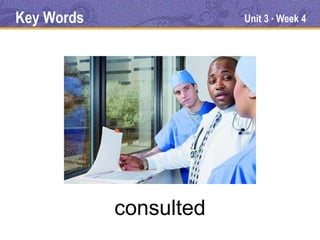
            consulted
Key Words                                                   Unit 3 Week 4
                                                                   ●


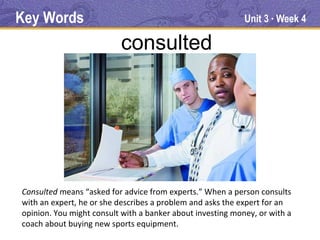
                          consulted


Consulted means “asked for advice from experts.” When a person consults
with an expert, he or she describes a problem and asks the expert for an
opinion. You might consult with a banker about investing money, or with a
coach about buying new sports equipment.
Key Words             Unit 3 Week 4
                           ●


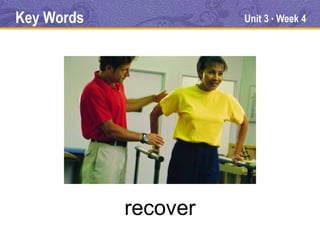
            recover
Key Words                                                Unit 3 Week 4
                                                                   ●


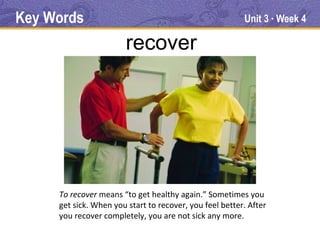
                        recover


     To recover means “to get healthy again.” Sometimes you
     get sick. When you start to recover, you feel better. After
     you recover completely, you are not sick any more.
Key Words           Unit 3 Week 4
                         ●


            tasks
Key Words                                                  Unit 3 Week 4
                                                                    ●


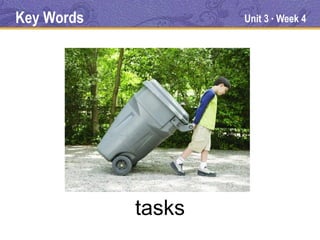
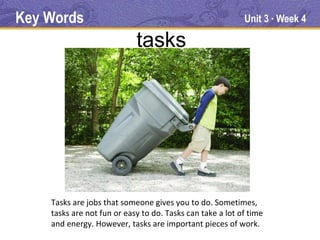
                            tasks


    Tasks are jobs that someone gives you to do. Sometimes,
    tasks are not fun or easy to do. Tasks can take a lot of time
    and energy. However, tasks are important pieces of work.
Key Words              Unit 3 Week 4
                            ●


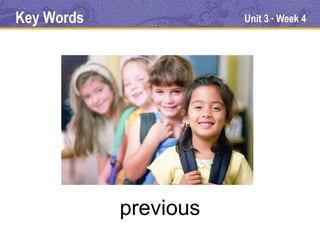
            previous
Key Words                                                 Unit 3 Week 4
                                                                ●


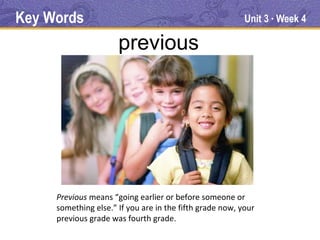
                      previous


     Previous means “going earlier or before someone or
     something else.” If you are in the fifth grade now, your
     previous grade was fourth grade.
Key Words             Unit 3 Week 4
                           ●


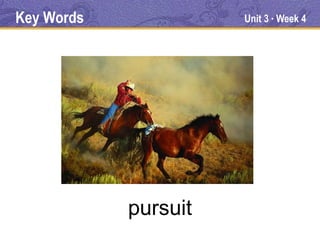
            pursuit
Key Words                                               Unit 3 Week 4
                                                                  ●


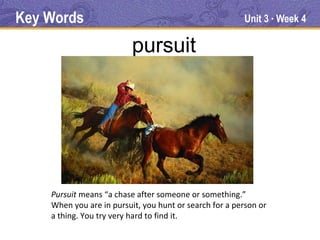
                          pursuit


    Pursuit means “a chase after someone or something.”
    When you are in pursuit, you hunt or search for a person or
    a thing. You try very hard to find it.
Key Words               Unit 3 Week 4
                             ●


            proceeded
Key Words                                                Unit 3 Week 4
                                                                ●


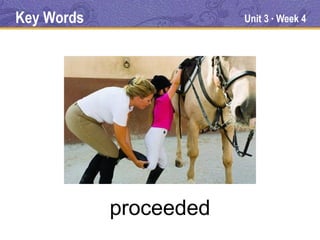
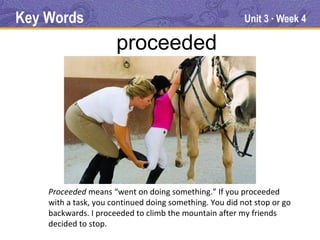
                      proceeded


    Proceeded means “went on doing something.” If you proceeded
    with a task, you continued doing something. You did not stop or go
    backwards. I proceeded to climb the mountain after my friends
    decided to stop.
Key Words             Unit 3 Week 4
                           ●


            urgency
Key Words                                                  Unit 3 Week 4
                                                                   ●


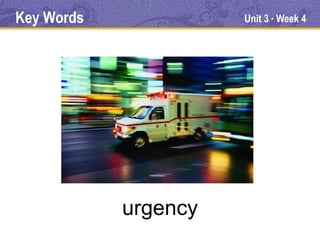
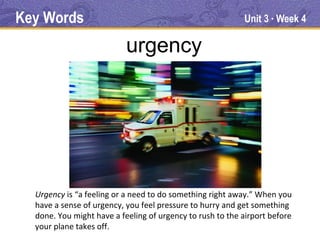
                           urgency


  Urgency is “a feeling or a need to do something right away.” When you
  have a sense of urgency, you feel pressure to hurry and get something
  done. You might have a feeling of urgency to rush to the airport before
  your plane takes off.
Key Words              Unit 3 Week 4
                            ●


            detected
Key Words                                             Unit 3 Week 4
                                                            ●


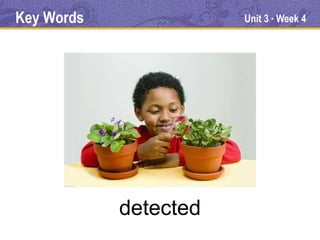
                      detected


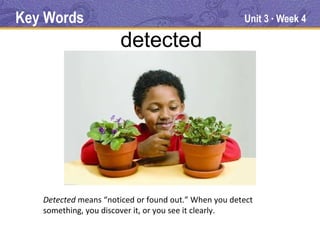
   Detected means “noticed or found out.” When you detect
   something, you discover it, or you see it clearly.
Function Words & Phrases
Assignment:
•Study the Function Words & Phrases.
•Look up any words or phrases you don’t know on
Google or in the dictionary.
•Write a sentence for FOUR of the Function Words or
Phrases in your notes on your iPad.
•When they are done, put them in your DropBox
folder for Mrs. Simonson to correct.
Function Words & Phrases      Unit 3 Week 4
                                   ●


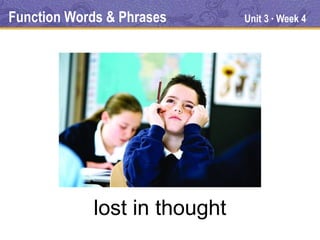
            lost in thought
Function Words & Phrases   Unit 3 Week 4
                                ●


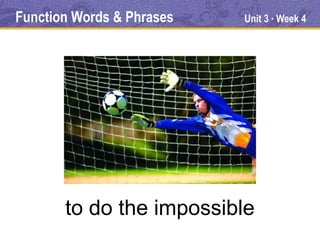
       to do the impossible
Function Words & Phrases     Unit 3 Week 4
                                  ●


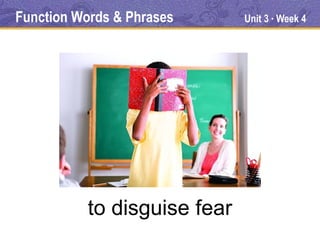
          to disguise fear
Function Words & Phrases     Unit 3 Week 4
                                  ●


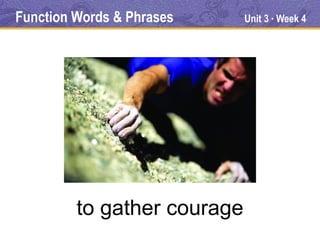
         to gather courage
Basic Words            Unit 3 Week 4
                            ●


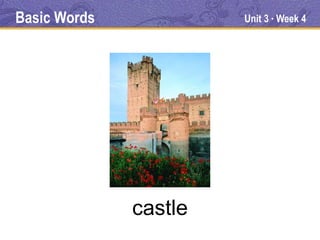
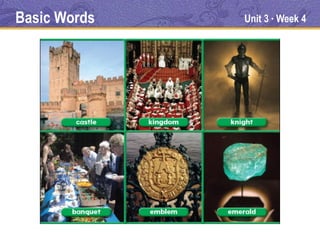
              castle
Basic Words             Unit 3 Week 4
                             ●


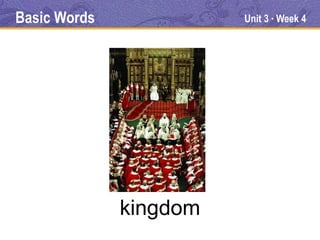
              kingdom
Basic Words            Unit 3 Week 4
                            ●


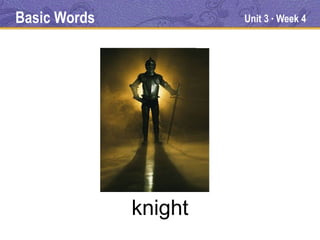
              knight
Basic Words             Unit 3 Week 4
                             ●


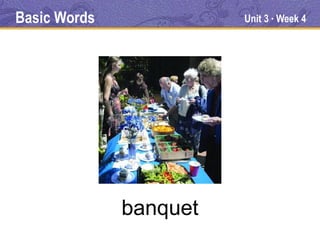
              banquet
Basic Words            Unit 3 Week 4
                            ●


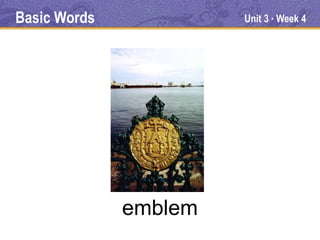
              emblem
Basic Words             Unit 3 Week 4
                             ●


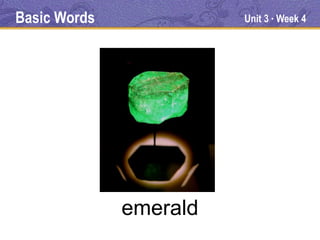
              emerald
Basic Words   Unit 3 Week 4
                   ●

3.4 visual vocabulary cards

  • 1.
  • 2.
    Key Words Unit 3 Week 4 ● consulted
  • 3.
    Key Words Unit 3 Week 4 ● consulted Consulted means “asked for advice from experts.” When a person consults with an expert, he or she describes a problem and asks the expert for an opinion. You might consult with a banker about investing money, or with a coach about buying new sports equipment.
  • 4.
    Key Words Unit 3 Week 4 ● recover
  • 5.
    Key Words Unit 3 Week 4 ● recover To recover means “to get healthy again.” Sometimes you get sick. When you start to recover, you feel better. After you recover completely, you are not sick any more.
  • 6.
    Key Words Unit 3 Week 4 ● tasks
  • 7.
    Key Words Unit 3 Week 4 ● tasks Tasks are jobs that someone gives you to do. Sometimes, tasks are not fun or easy to do. Tasks can take a lot of time and energy. However, tasks are important pieces of work.
  • 8.
    Key Words Unit 3 Week 4 ● previous
  • 9.
    Key Words Unit 3 Week 4 ● previous Previous means “going earlier or before someone or something else.” If you are in the fifth grade now, your previous grade was fourth grade.
  • 10.
    Key Words Unit 3 Week 4 ● pursuit
  • 11.
    Key Words Unit 3 Week 4 ● pursuit Pursuit means “a chase after someone or something.” When you are in pursuit, you hunt or search for a person or a thing. You try very hard to find it.
  • 12.
    Key Words Unit 3 Week 4 ● proceeded
  • 13.
    Key Words Unit 3 Week 4 ● proceeded Proceeded means “went on doing something.” If you proceeded with a task, you continued doing something. You did not stop or go backwards. I proceeded to climb the mountain after my friends decided to stop.
  • 14.
    Key Words Unit 3 Week 4 ● urgency
  • 15.
    Key Words Unit 3 Week 4 ● urgency Urgency is “a feeling or a need to do something right away.” When you have a sense of urgency, you feel pressure to hurry and get something done. You might have a feeling of urgency to rush to the airport before your plane takes off.
  • 16.
    Key Words Unit 3 Week 4 ● detected
  • 17.
    Key Words Unit 3 Week 4 ● detected Detected means “noticed or found out.” When you detect something, you discover it, or you see it clearly.
  • 18.
    Function Words &Phrases Assignment: •Study the Function Words & Phrases. •Look up any words or phrases you don’t know on Google or in the dictionary. •Write a sentence for FOUR of the Function Words or Phrases in your notes on your iPad. •When they are done, put them in your DropBox folder for Mrs. Simonson to correct.
  • 19.
    Function Words &Phrases Unit 3 Week 4 ● lost in thought
  • 20.
    Function Words &Phrases Unit 3 Week 4 ● to do the impossible
  • 21.
    Function Words &Phrases Unit 3 Week 4 ● to disguise fear
  • 22.
    Function Words &Phrases Unit 3 Week 4 ● to gather courage
  • 23.
    Basic Words Unit 3 Week 4 ● castle
  • 24.
    Basic Words Unit 3 Week 4 ● kingdom
  • 25.
    Basic Words Unit 3 Week 4 ● knight
  • 26.
    Basic Words Unit 3 Week 4 ● banquet
  • 27.
    Basic Words Unit 3 Week 4 ● emblem
  • 28.
    Basic Words Unit 3 Week 4 ● emerald
  • 29.
    Basic Words Unit 3 Week 4 ●

Editor's Notes

  • #3 TEACHER TALK Point to the Word 1 image. 1. One word in the selection is consulted . Say it with me: consulted . Consulted means “asked for advice from experts.” When a person consults with an expert, he or she describes a problem and asks the expert for an opinion. You might consult with a banker about investing money, or with a coach about buying new sports equipment. 2. En español, to consult quiere decir “pedir consejos a expertos, consultar.” Tal vez consultes con un banquero sobre cómo inverter tu dinero o con un entrenador sobre qué equipo comprar para practicar un deporte. 3. To consult in English and consultar in Spanish are cognates. They sound almost the same and mean the same thing in both languages.   MOVEMENT 4. Now let ’s look at a picture that demonstrates the word consulted . (Point to the doctor in the center of the photo.) This doctor had a patient who needed surgery. He consulted with the two doctors who performed the surgery. He asked their opinion about the best treatment for his patient. He listened to their ideas and followed their suggestions. 5. Let ’s all show what it was like when the doctor consulted with the other doctors. Let’s look at our patient’s chart. Now let’s ask questions and take notes. 6. Think of a time when you consulted with an expert. You might have asked a librarian for help finding a book or a DVD. Maybe you asked an adult for help finding a Web site. Show us what you did when you consulted with this person. 7. Now let ’s say consulted together three more times: consulted , consulted , consulted .
  • #4 TEACHER TALK Point to the Word 1 image. 1. One word in the selection is consulted . Say it with me: consulted . Consulted means “asked for advice from experts.” When a person consults with an expert, he or she describes a problem and asks the expert for an opinion. You might consult with a banker about investing money, or with a coach about buying new sports equipment. 2. En español, to consult quiere decir “pedir consejos a expertos, consultar.” Tal vez consultes con un banquero sobre cómo inverter tu dinero o con un entrenador sobre qué equipo comprar para practicar un deporte. 3. To consult in English and consultar in Spanish are cognates. They sound almost the same and mean the same thing in both languages.   MOVEMENT 4. Now let ’s look at a picture that demonstrates the word consulted . (Point to the doctor in the center of the photo.) This doctor had a patient who needed surgery. He consulted with the two doctors who performed the surgery. He asked their opinion about the best treatment for his patient. He listened to their ideas and followed their suggestions. 5. Let ’s all show what it was like when the doctor consulted with the other doctors. Let’s look at our patient’s chart. Now let’s ask questions and take notes. 6. Think of a time when you consulted with an expert. You might have asked a librarian for help finding a book or a DVD. Maybe you asked an adult for help finding a Web site. Show us what you did when you consulted with this person. 7. Now let ’s say consulted together three more times: consulted , consulted , consulted .
  • #5 TEACHER TALK Point to the Word 2 image. 1. Another word in the selection is recover . Say it with me: recover . To recover means “to get healthy again.” Sometimes you get sick. When you start to recover, you feel better. After you recover completely, you are not sick any more. 2. En español, to recover quiere decir “recuperar la salud, reponerse.” A veces te enfermas. Te estás reponiendo cuando te empiezas a sentir mejor. Cuando te repones por complete vuelves a estar saludable. 3. Now let ’s look at a picture that demonstrates the word recover . (Point to the woman in the photo.) This woman hurt her legs. She didn’t have a lot of strength. The physical therapist is teaching her some exercises. She works hard and now she is beginning to recover. Soon she will be able to walk by herself again.   MOVEMENT 4. Let ’s all show what it’s like for a person to recover. Let’s stand up slowly, and take a few careful steps. Now let’s show what we look like when we recover even more. Let’s stand up straighter and take a few more steps. 5. Suppose you have a cold, or an injury such as a broken leg. Show us what you would do to recover. 6. Now let ’s say recover together three more times: recover , recover , recover .
  • #6 TEACHER TALK Point to the Word 2 image. 1. Another word in the selection is recover . Say it with me: recover . To recover means “to get healthy again.” Sometimes you get sick. When you start to recover, you feel better. After you recover completely, you are not sick any more. 2. En español, to recover quiere decir “recuperar la salud, reponerse.” A veces te enfermas. Te estás reponiendo cuando te empiezas a sentir mejor. Cuando te repones por complete vuelves a estar saludable. 3. Now let ’s look at a picture that demonstrates the word recover . (Point to the woman in the photo.) This woman hurt her legs. She didn’t have a lot of strength. The physical therapist is teaching her some exercises. She works hard and now she is beginning to recover. Soon she will be able to walk by herself again.   MOVEMENT 4. Let ’s all show what it’s like for a person to recover. Let’s stand up slowly, and take a few careful steps. Now let’s show what we look like when we recover even more. Let’s stand up straighter and take a few more steps. 5. Suppose you have a cold, or an injury such as a broken leg. Show us what you would do to recover. 6. Now let ’s say recover together three more times: recover , recover , recover .
  • #7 TEACHER TALK Point to the Word 3 image. 1. Another word in the selection is tasks . Say it with me: tasks . Tasks are jobs that someone gives you to do. Sometimes, tasks are not fun or easy to do. Tasks can take a lot of time and energy. However, tasks are important pieces of work. 2. En español, tasks quiere decir “trabajos que alguien te pide que hagas, tareas.” A veces las tareas no son fáciles ni divertidas. A veces toman mucho tiempo y esfuerzo. Pero las tareas son trabajos importantes que se deben completar.   PARTNER TALK 3. Now let ’s look at a picture that demonstrates the word tasks . (Point to the boy in the photo.) One of this boy’s tasks at home is putting out the trash can every week. He doesn’t like this task because the trash can is big and heavy to pull. But he does the task because he has to obey his parents. 4. Talk with your partner about tasks that you have to do at your home, and why these tasks are important. Share your ideas with the class. 5. With your partner, make a list of tasks that you and your partner are responsible for. Then complete this sentence frame: One task I am responsible for is __________ . 6. Now let ’s say tasks together three more times: tasks , tasks , tasks .
  • #8 TEACHER TALK Point to the Word 3 image. 1. Another word in the selection is tasks . Say it with me: tasks . Tasks are jobs that someone gives you to do. Sometimes, tasks are not fun or easy to do. Tasks can take a lot of time and energy. However, tasks are important pieces of work. 2. En español, tasks quiere decir “trabajos que alguien te pide que hagas, tareas.” A veces las tareas no son fáciles ni divertidas. A veces toman mucho tiempo y esfuerzo. Pero las tareas son trabajos importantes que se deben completar.   PARTNER TALK 3. Now let ’s look at a picture that demonstrates the word tasks . (Point to the boy in the photo.) One of this boy’s tasks at home is putting out the trash can every week. He doesn’t like this task because the trash can is big and heavy to pull. But he does the task because he has to obey his parents. 4. Talk with your partner about tasks that you have to do at your home, and why these tasks are important. Share your ideas with the class. 5. With your partner, make a list of tasks that you and your partner are responsible for. Then complete this sentence frame: One task I am responsible for is __________ . 6. Now let ’s say tasks together three more times: tasks , tasks , tasks .
  • #9 TEACHER TALK Point to the Word 4 image. 1. Another word in the selection is previous . Say it with me: previous . Previous means “going earlier or before someone or something else.” If you are in the fifth grade now, your previous grade was fourth grade. 2. En español, previous quiere decir “que ocurre o viene antes que otra cosa, previo.” Si estás en quinto de primaria ahora, tu curso previo fue cuarto. 3. Previous in English and previo in Spanish are cognates. They sound almost the same and mean the same thing in both languages.   PARTNER TALK 4. Now let ’s look at a picture that demonstrates the word previous . (Point to the girl in the front of the line in the photo.) These students lined up in perfect alphabetical order just now. They learned how to do this in a previous lesson that took place yesterday. Now their teacher is proud of them. 5. Talk with your partner about things you did on a previous day in this class. Share your ideas with the class. 6. Work with your partner to use the word previous in a sentence. Use the sentence frame: In a previous lesson, I learned how to __________ . 7. Now let ’s say previous together three more times: previous , previous , previous .
  • #10 TEACHER TALK Point to the Word 4 image. 1. Another word in the selection is previous . Say it with me: previous . Previous means “going earlier or before someone or something else.” If you are in the fifth grade now, your previous grade was fourth grade. 2. En español, previous quiere decir “que ocurre o viene antes que otra cosa, previo.” Si estás en quinto de primaria ahora, tu curso previo fue cuarto. 3. Previous in English and previo in Spanish are cognates. They sound almost the same and mean the same thing in both languages.   PARTNER TALK 4. Now let ’s look at a picture that demonstrates the word previous . (Point to the girl in the front of the line in the photo.) These students lined up in perfect alphabetical order just now. They learned how to do this in a previous lesson that took place yesterday. Now their teacher is proud of them. 5. Talk with your partner about things you did on a previous day in this class. Share your ideas with the class. 6. Work with your partner to use the word previous in a sentence. Use the sentence frame: In a previous lesson, I learned how to __________ . 7. Now let ’s say previous together three more times: previous , previous , previous .
  • #11 TEACHER TALK Point to the Word 5 image. 1. Another word in the selection is pursuit . Say it with me: pursuit . Pursuit means “a chase after someone or something.” When you are in pursuit, you hunt or search for a person or a thing. You try very hard to find it. 2. En español, pursuit quiere decir “la búsqueda de algo o alguien, persecución.” Cuando estás en persecución, buscas algo o a alguien hasta que lo encuentras. 3. Now let ’s look at a picture that demonstrates the word pursuit . (Point to the cowboy in the photo.) The cowboy is in pursuit of the wild horse. The horse wants to get away, but the cowboy uses his lasso to try to catch it. The cowboy and his horse will not give up their pursuit of the wild horse.   PARTNER TALK 4. What are some things that you might be in pursuit of during a sports event? Make a list with your partner. Share your ideas with the class. 5. With your partner, draw a picture of something you might be in pursuit of. At the bottom of your picture, complete this sentence frame: We are in pursuit of __________ . 6. Now let ’s say pursuit together three more times: pursuit , pursuit , pursuit .
  • #12 TEACHER TALK Point to the Word 5 image. 1. Another word in the selection is pursuit . Say it with me: pursuit . Pursuit means “a chase after someone or something.” When you are in pursuit, you hunt or search for a person or a thing. You try very hard to find it. 2. En español, pursuit quiere decir “la búsqueda de algo o alguien, persecución.” Cuando estás en persecución, buscas algo o a alguien hasta que lo encuentras. 3. Now let ’s look at a picture that demonstrates the word pursuit . (Point to the cowboy in the photo.) The cowboy is in pursuit of the wild horse. The horse wants to get away, but the cowboy uses his lasso to try to catch it. The cowboy and his horse will not give up their pursuit of the wild horse.   PARTNER TALK 4. What are some things that you might be in pursuit of during a sports event? Make a list with your partner. Share your ideas with the class. 5. With your partner, draw a picture of something you might be in pursuit of. At the bottom of your picture, complete this sentence frame: We are in pursuit of __________ . 6. Now let ’s say pursuit together three more times: pursuit , pursuit , pursuit .
  • #13 TEACHER TALK Point to the Word 6 image. 1. Another word in the selection is proceeded . Say it with me: proceeded . Proceeded means “went on doing something.” If you proceeded with a task, you continued doing something. You did not stop or go backwards. I proceeded to climb the mountain after my friends decided to stop. 2. En español, to proceed quiere decir “avanzar, seguir haciendo algo, proceder.” Procedí a escalar la montaña cuando mis amigos decidieron parar. 3. To proceed in English and proceder in Spanish are cognates. They sound almost the same and mean the same thing in both languages.   MOVEMENT 4. Now let ’s look at a picture that demonstrates the word proceeded . (Point to the young girl in the photo.) This girl is learning to take care of and ride a horse. First she put the saddle on the horse. Then she proceeded to climb up on the horse. Her teacher helped her. 5. Let ’s all show what it was like when the girl proceeded with her lessons. First, she put the saddle on the horse. Then her teacher helped her climb on the horse. After that, she proceeded to ride the horse. 6. Show us how you proceeded with something you started. Show us what you did first, next, and then last. 7. Now let ’s say proceeded together three more times: proceeded , proceeded , proceeded .
  • #14 TEACHER TALK Point to the Word 6 image. 1. Another word in the selection is proceeded . Say it with me: proceeded . Proceeded means “went on doing something.” If you proceeded with a task, you continued doing something. You did not stop or go backwards. I proceeded to climb the mountain after my friends decided to stop. 2. En español, to proceed quiere decir “avanzar, seguir haciendo algo, proceder.” Procedí a escalar la montaña cuando mis amigos decidieron parar. 3. To proceed in English and proceder in Spanish are cognates. They sound almost the same and mean the same thing in both languages.   MOVEMENT 4. Now let ’s look at a picture that demonstrates the word proceeded . (Point to the young girl in the photo.) This girl is learning to take care of and ride a horse. First she put the saddle on the horse. Then she proceeded to climb up on the horse. Her teacher helped her. 5. Let ’s all show what it was like when the girl proceeded with her lessons. First, she put the saddle on the horse. Then her teacher helped her climb on the horse. After that, she proceeded to ride the horse. 6. Show us how you proceeded with something you started. Show us what you did first, next, and then last. 7. Now let ’s say proceeded together three more times: proceeded , proceeded , proceeded .
  • #15 TEACHER TALK Point to the Word 7 image. 1. Another word in the selection is urgency . Say it with me: urgency . Urgency is “a feeling or a need to do something right away.” When you have a sense of urgency, you feel pressure to hurry and get something done. You might have a feeling of urgency to rush to the airport before your plane takes off. 2. En español, urgency quiere decir “sentimiento de tener que actuar de inmediato, urgencia.” Tal vez sientas urgencia por llegar al aeropuerto antes de que tu avión despegue. 3. Urgency in English and urgencia in Spanish are cognates. They sound almost the same and mean the same thing in both languages.   PARTNER TALK 4. Now let ’s look at a picture that demonstrates the word urgency . (Point to the ambulance in the photo.) This ambulance is going from the scene of an accident to the hospital. The driver has a sense of urgency because she knows that the patient’s life depends on getting treated quickly. The driver feels a sense of urgency, and she will get to the hospital as fast as she can. 5. How does an ambulance illustrate a sense of urgency? Talk with your partner about how an ambulance demonstrates a sense of urgency. Share your ideas with the class. 6. Let ’s imagine that your friend had a serious injury. Talk with your partner about the best way to communicate a sense of urgency. Share your ideas with another pair. 7. Now let ’s say urgency together three more times: urgency , urgency , urgency .
  • #16 TEACHER TALK Point to the Word 7 image. 1. Another word in the selection is urgency . Say it with me: urgency . Urgency is “a feeling or a need to do something right away.” When you have a sense of urgency, you feel pressure to hurry and get something done. You might have a feeling of urgency to rush to the airport before your plane takes off. 2. En español, urgency quiere decir “sentimiento de tener que actuar de inmediato, urgencia.” Tal vez sientas urgencia por llegar al aeropuerto antes de que tu avión despegue. 3. Urgency in English and urgencia in Spanish are cognates. They sound almost the same and mean the same thing in both languages.   PARTNER TALK 4. Now let ’s look at a picture that demonstrates the word urgency . (Point to the ambulance in the photo.) This ambulance is going from the scene of an accident to the hospital. The driver has a sense of urgency because she knows that the patient’s life depends on getting treated quickly. The driver feels a sense of urgency, and she will get to the hospital as fast as she can. 5. How does an ambulance illustrate a sense of urgency? Talk with your partner about how an ambulance demonstrates a sense of urgency. Share your ideas with the class. 6. Let ’s imagine that your friend had a serious injury. Talk with your partner about the best way to communicate a sense of urgency. Share your ideas with another pair. 7. Now let ’s say urgency together three more times: urgency , urgency , urgency .
  • #17 TEACHER TALK Point to the Word 8 image. 1. Another word in the selection is detected . Say it with me: detected . Detected means “noticed or found out.” When you detect something, you discover it, or you see it clearly. 2. En español, to detect quiere decir “notar, descubrir o detectar.” Cuando detectas algo, descubres algo que no podías ver o percibir antes. 3. To detect in English and detectar in Spanish are cognates. They sound almost the same and mean the same thing in both languages.   MOVEMENT 4. Now let ’s look at a picture that demonstrates the word detected . (Point to the boy in the photo.) The boy could see the flowers on the plant on the left, but he could not see any on the plant on the right. When he used his magnifying glass, he detected small flowers. He was surprised and happy that he found them. 5. Let ’s all show what the boy did when he detected the flowers. Let’s get our magnifying glasses and look closely at the leaves. Look! We detected flowers! 6. Show us how you detected something that you had not seen before. Tell us what you were looking for and how you felt when you found out. 7. Now let ’s say detected together three more times: detected , detected , detected .
  • #18 TEACHER TALK Point to the Word 8 image. 1. Another word in the selection is detected . Say it with me: detected . Detected means “noticed or found out.” When you detect something, you discover it, or you see it clearly. 2. En español, to detect quiere decir “notar, descubrir o detectar.” Cuando detectas algo, descubres algo que no podías ver o percibir antes. 3. To detect in English and detectar in Spanish are cognates. They sound almost the same and mean the same thing in both languages.   MOVEMENT 4. Now let ’s look at a picture that demonstrates the word detected . (Point to the boy in the photo.) The boy could see the flowers on the plant on the left, but he could not see any on the plant on the right. When he used his magnifying glass, he detected small flowers. He was surprised and happy that he found them. 5. Let ’s all show what the boy did when he detected the flowers. Let’s get our magnifying glasses and look closely at the leaves. Look! We detected flowers! 6. Show us how you detected something that you had not seen before. Tell us what you were looking for and how you felt when you found out. 7. Now let ’s say detected together three more times: detected , detected , detected .
  • #20 TEACHER TALK 1. In English, lost in thought means “to concentrate on only one thing.” Say it with me: lost in thought . If you are lost in thought, you are thinking only of one thing. You are so focused on what you are thinking about that you are not paying attention to the things around you. 2. En español, lost in thought significa “concentrarse en un solo pensamiento.” Si estás concentrado en algo, estás pensando solo en eso. Estás tan enfocado en ese pensamiento, que no prestas atención a las cosas que suceden en torno tuyo. 3. This picture demonstrates the word lost in thought . The boy is trying to come up with a clever title for the story he has just written. He ’s lost in thought about it. He stares at the ceiling. He is not paying any attention to the other students or any noise around him.   CHORAL RESPONSE 4. I am going to describe some situations. If the person is lost in thought, look up at the ceiling and say “lost in thought.” A girl is sitting on the beach staring out at the ocean. A boy is playing tag with his friends. A man is sitting in his back yard looking at the trees. 5. Now I am going read a poem to you. Listen the first time. Then repeat each line after me. Raise your hand each time you hear the phrase lost in thought . Hush, hush, I ’m lost in thought. I ’m thinking of what to do. What ’s the answer? What is right? Oh, I wish I knew. Hush, hush, I ’m lost in thought. 6. Repeat the phrase three times with me: lost in thought, lost in thought, lost in thought.
  • #21 TEACHER TALK 1. In English, we use to do the impossible to describe doing something that is very difficult to do. Say it with me: to do the impossible . Let ’s say a person was in a serious accident and the doctor said he would never walk again. Then one day, the man takes a few steps. He has done the impossible. 2. En español, to do the impossible quiere decir “hacer lo imposible.” Supongamos que una persona tuvo un terrible accidente y el doctor aseguró que no volvería a caminar. Pero, un día, esa persona da unos pasos. Ha hecho lo imposible.   CHORAL RESPONSE 3. This picture demonstrates the phrase to do the impossible . Everyone on both teams thought the player would miss this ball. The player surprised everyone and did the impossible. He blocked it! 4. Help me finish these sentences: When we went hiking I did the impossible. I __________. The baseball player says he will do the impossible. He says he will __________. The swimmer will do the impossible if she __________. 5. Imagine that you could do the impossible. What would you like to do? (Call on a few students to answer.) 6. Repeat the phrase three times with me: to do the impossible, to do the impossible, to do the impossible .
  • #22 TEACHER TALK 1. In English, we use to disguise fear to describe a way that we act when we are scared and don ’t want to show it. Say it with me: to disguise fear . To disguise fear means “to hide our feelings of being afraid.” Some people are afraid of the water. They disguise their fear by saying they don’t like to swim, or the water is too cold, or they don’t feel well. They don’t want to admit that they are afraid. 2. En español, to disguise fear quiere decir “encubrir u ocultar el miedo.” Algunas personas le temen al agua. Ellos ocultan su miedo asegurando que no les gusta nadar, que el agua esta demasiado fría o que no se sienten bien. No quieren admitir que tienen miedo. 3. This picture demonstrates the words to disguise fear . The boy has to give a report to the class. He ’s shy and is afraid to talk in front of the other students. He thinks he might cry. To disguise his fear, he hides his face behind his notebook. He thinks that if the other students can’t see his face, they won’t know that he is afraid.   CHORAL RESPONSE 4. Let ’s think about what you do when you disguise fear. I’m going to describe some actions. If the person is disguising fear, put your hands to your face and say “disguise fear.” If not, don’t say anything. She ’s afraid to jump in the water from the dock, so she sits on the dock and pretends she is fishing. He ’s afraid to ski down the big hill, but he says, “I can do this,” and then he skis down. She ’s afraid of her friend’s big dog, so she says she doesn’t feel well when her friend invites her over to play. 5. Help me finish these sentences. He ’s afraid to go on the big roller coaster. To disguise his fear, he __________. They are afraid to walk through the park in the dark. To disguise their fear, they __________. He ’s afraid to climb the tall ladder. To disguise his fear, he __________. 6. Repeat the phrase three times with me: to disguise fear, to disguise fear, to disguise fear .
  • #23 TEACHER TALK 1. In English, to gather courage means “to look inside yourself for strength.” Say it with me: to gather courage . Let’s say that a girl who is afraid of the water wants to learn to swim. She gathers her courage by telling herself she can do it, and that she is brave. She walks slowly into the water. 2. En español, to gather courage quiere decir “cargarse de valor.” Digamos que una niña que le teme al agua quiere aprender a nadar. Ella se carga de valor diciéndose que sí puede hacerlo y que es muy valiente. Después, se mete lentamente en la piscina. 3. This picture demonstrates the phrase to gather courage. This rock climber is almost at the top of a steep cliff. He ’s scared because it’s a long way down if he falls, and there’s not much above him to hold on to. He gathers his courage. He takes a deep breath, puts more chalk on his fingers, and keeps going.   PARTNER TALK 4. Suppose your partner has to do something hard or scary that he or she has never done before. Tell your partner something that will help him or her gather courage. Then switch roles. (Ask one or two pairs for their response.) 5. Think about someone you know who had to gather courage to do something. This could be a real person or a character in a book or movie. Tell your partner what the person did to gather courage. (Ask one or two pairs for their response.) 6. Repeat the phrase three times with me: to gather courage, to gather courage, to gather courage .
  • #24 ROUTINE 1. Display the card. 2. Define each word in English, referring to the photograph. Incorporate actions where appropriate. 3. Have children say the word three times.
  • #25 ROUTINE 1. Display the card. 2. Define each word in English, referring to the photograph. Incorporate actions where appropriate. 3. Have children say the word three times.
  • #26 ROUTINE 1. Display the card. 2. Define each word in English, referring to the photograph. Incorporate actions where appropriate. 3. Have children say the word three times.
  • #27 ROUTINE 1. Display the card. 2. Define each word in English, referring to the photograph. Incorporate actions where appropriate. 3. Have children say the word three times.
  • #28 ROUTINE 1. Display the card. 2. Define each word in English, referring to the photograph. Incorporate actions where appropriate. 3. Have children say the word three times.
  • #29 ROUTINE 1. Display the card. 2. Define each word in English, referring to the photograph. Incorporate actions where appropriate. 3. Have children say the word three times.
  • #30 ROUTINE Explain how these six words fit into a group, or category. During independent work time, have children write sentences for each word.