The Guest
Albert Camus
What is happening?
Plot
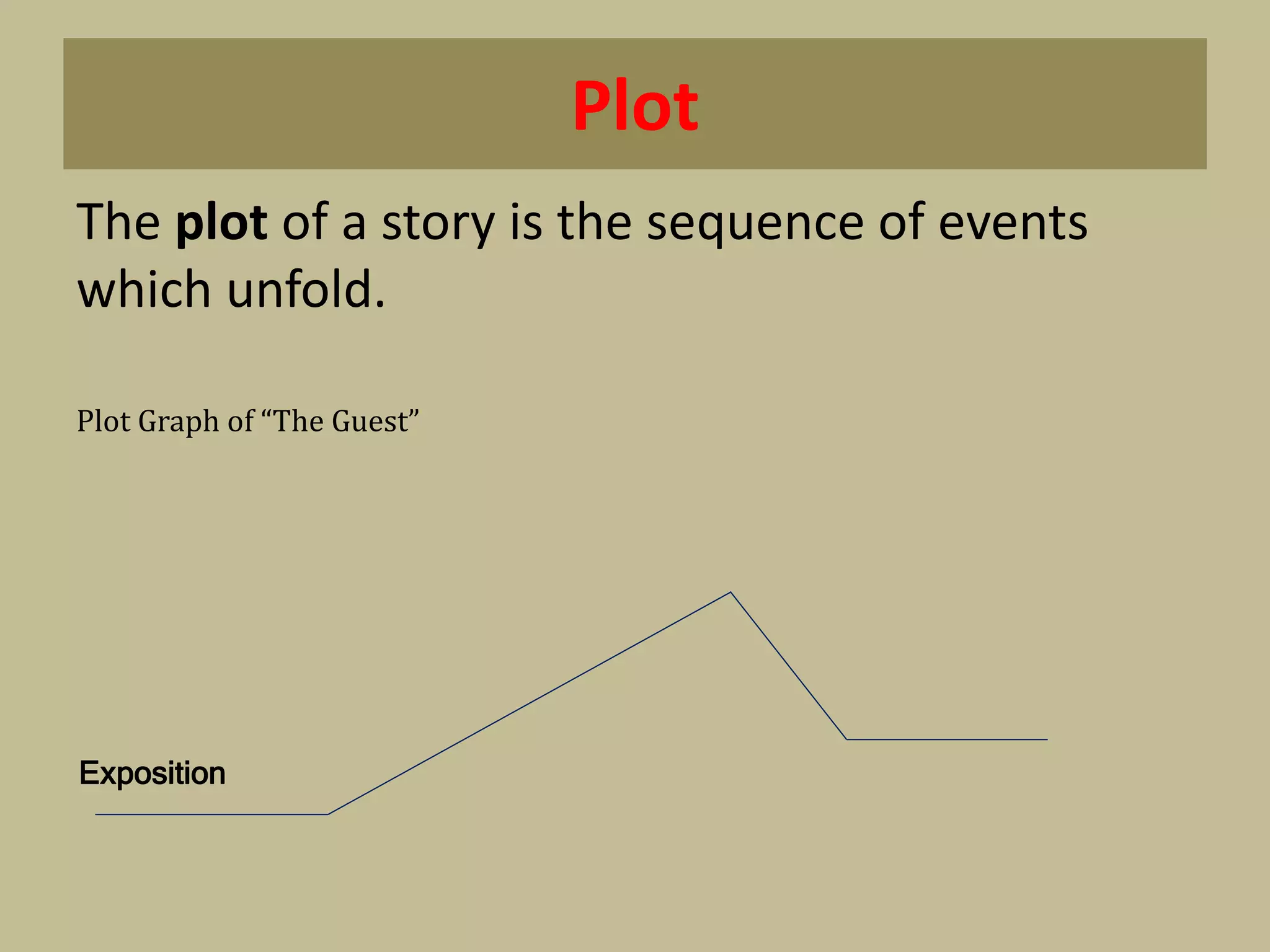
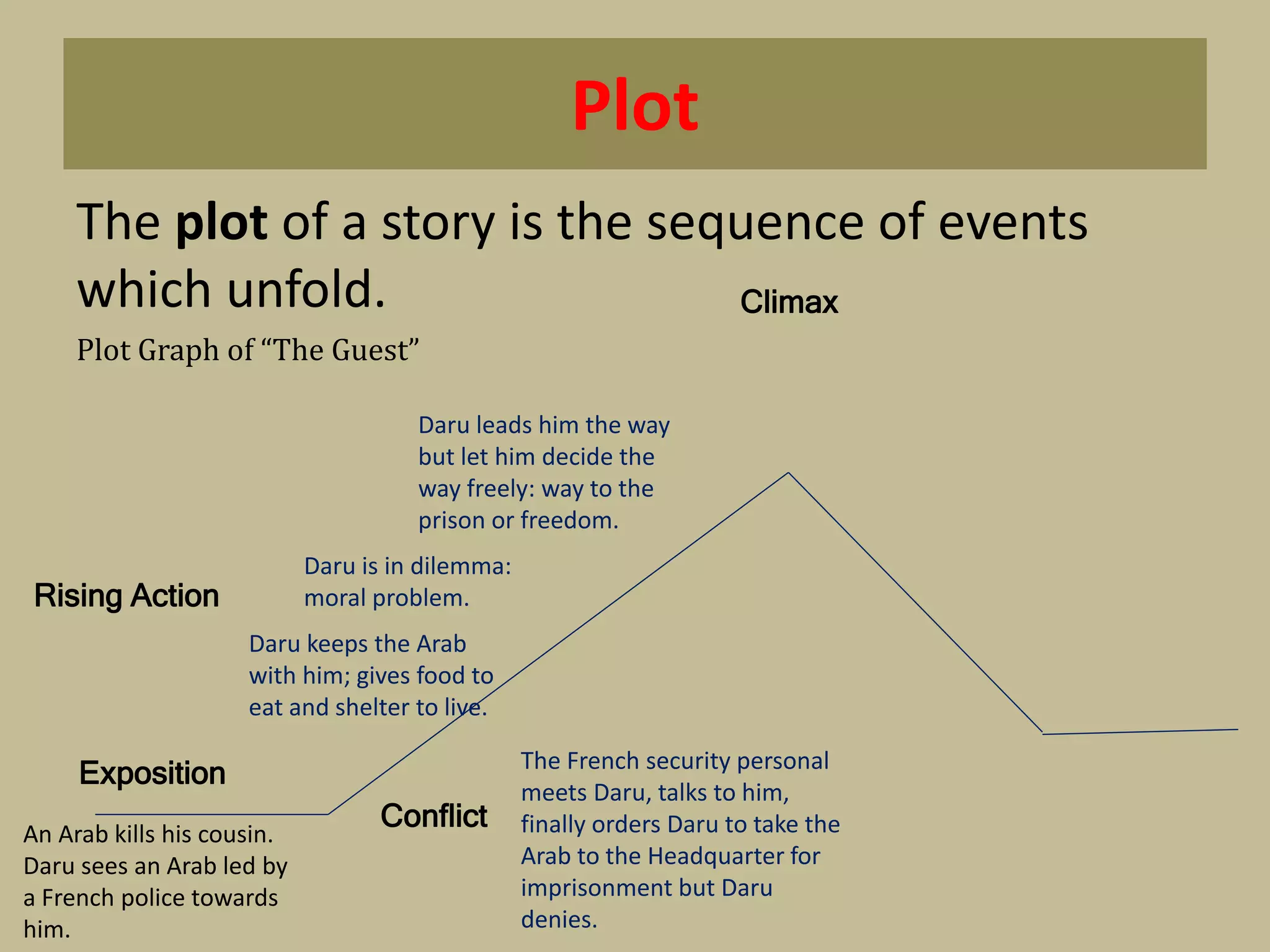
The plot of a story is the sequence of events
which unfold.
Plot Graph of “The Guest”
Exposition
Plot
The plot of a story is the sequence of events
which unfold.
Plot Graph of “The Guest”
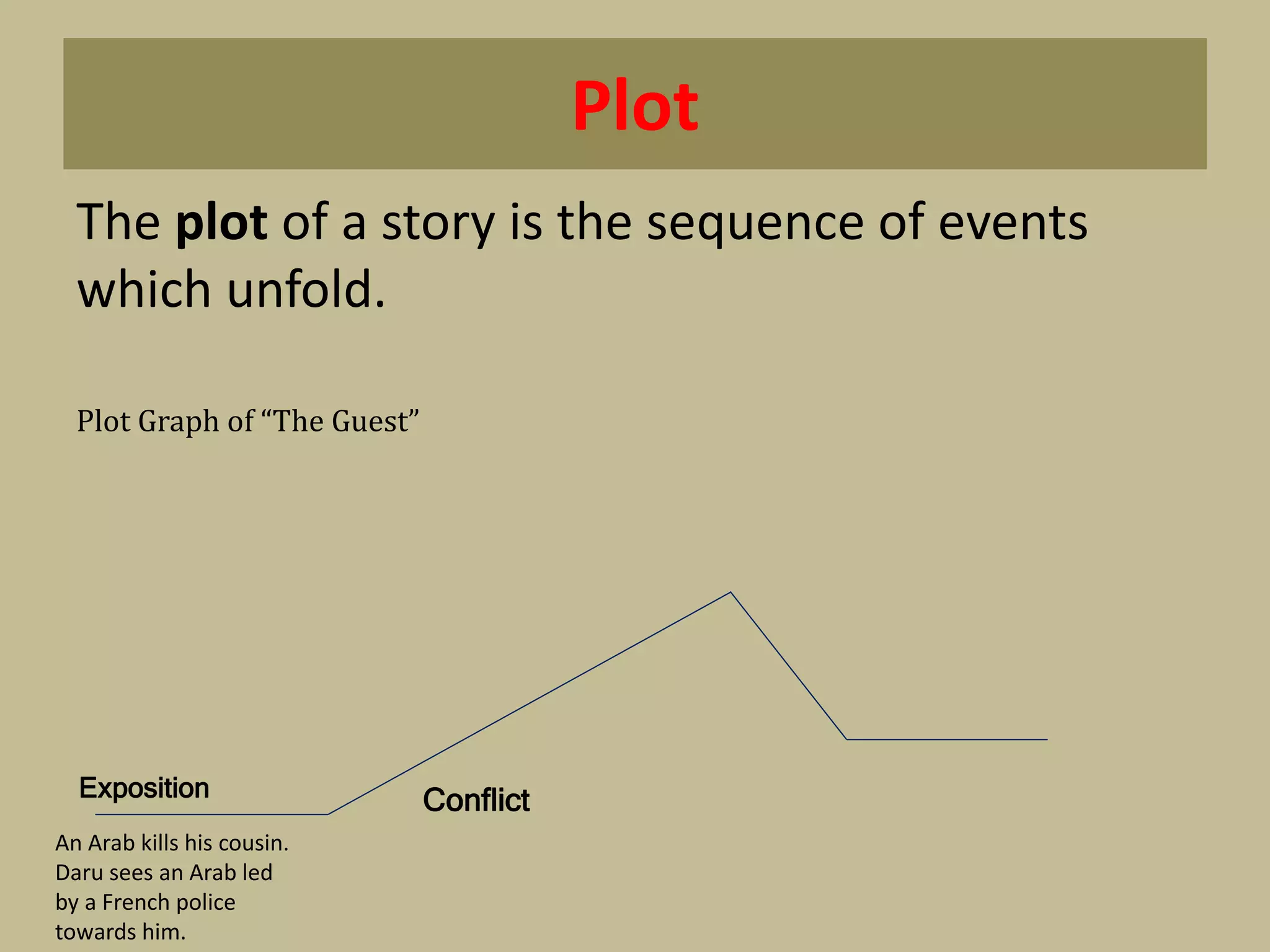
An Arab kills his cousin.
Daru sees an Arab led
by a French police
towards him.
Exposition
Plot
The plot of a story is the sequence of events
which unfold.
Plot Graph of “The Guest”
Exposition Conflict
An Arab kills his cousin.
Daru sees an Arab led
by a French police
towards him.
Plot
The plot of a story is the sequence of events
which unfold.
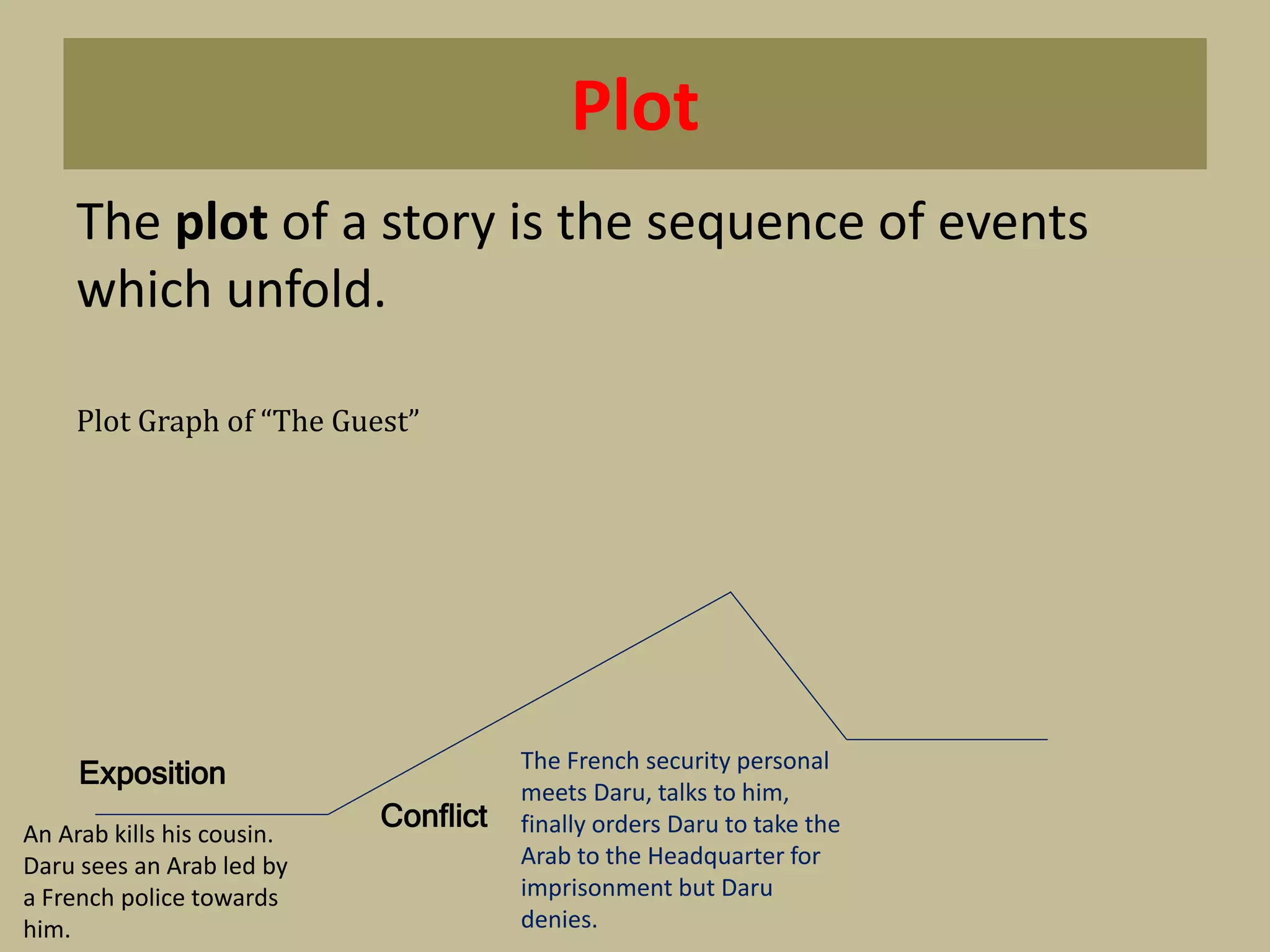
Plot Graph of “The Guest”
An Arab kills his cousin.
Daru sees an Arab led by
a French police towards
him.
Exposition
Conflict
The French security personal
meets Daru, talks to him,
finally orders Daru to take the
Arab to the Headquarter for
imprisonment but Daru
denies.
Plot
The plot of a story is the sequence of events
which unfold.
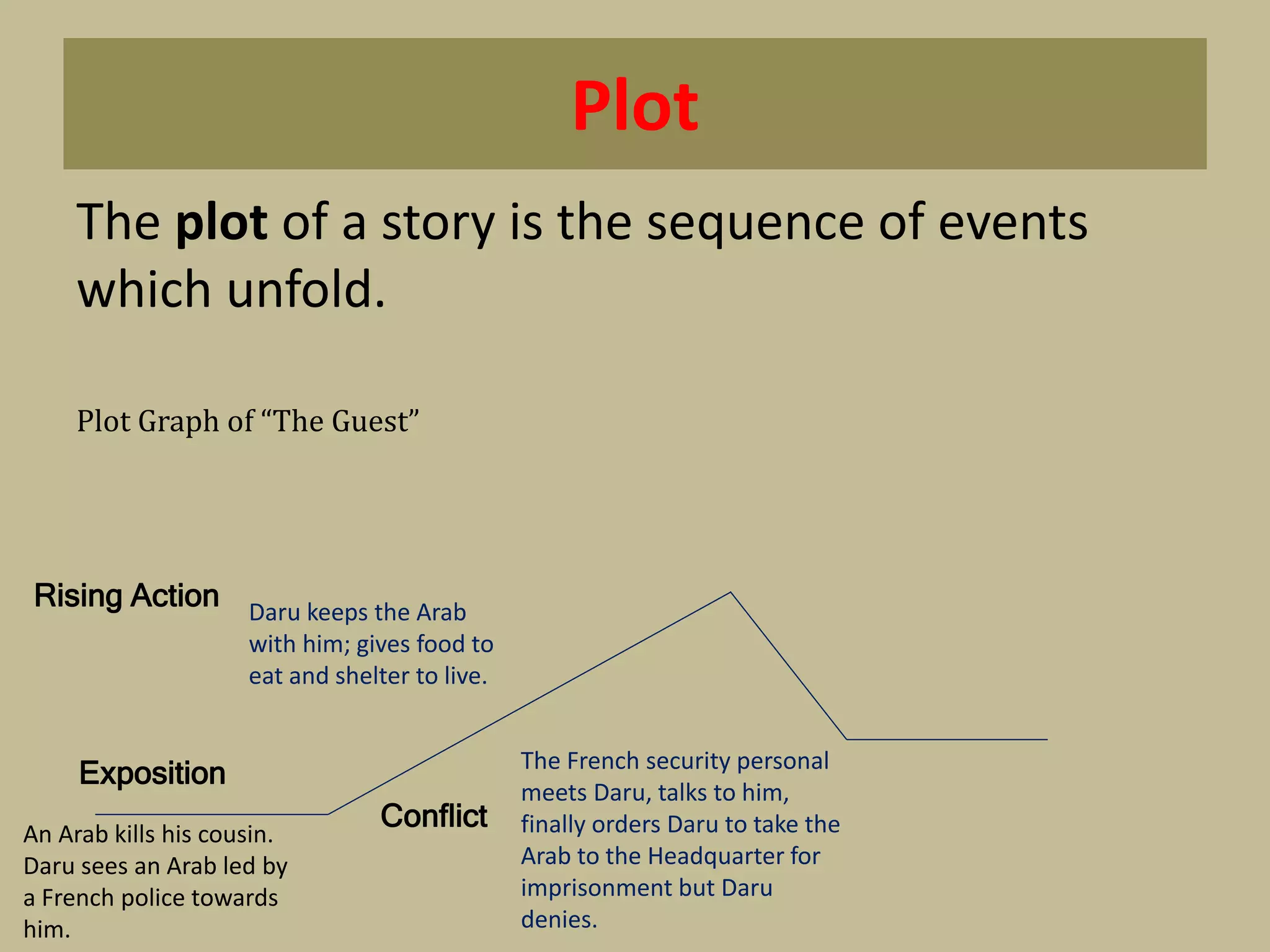
Plot Graph of “The Guest”
An Arab kills his cousin.
Daru sees an Arab led by
a French police towards
him.
Exposition
Rising Action Daru keeps the Arab
with him; gives food to
eat and shelter to live.
Conflict
The French security personal
meets Daru, talks to him,
finally orders Daru to take the
Arab to the Headquarter for
imprisonment but Daru
denies.
Plot
The plot of a story is the sequence of events
which unfold.
Plot Graph of “The Guest”
An Arab kills his cousin.
Daru sees an Arab led by
a French police towards
him.
Exposition
Rising Action Daru keeps the Arab
with him; gives food to
eat and shelter to live.
Conflict
The French security personal
meets Daru, talks to him,
finally orders Daru to take the
Arab to the Headquarter for
imprisonment but Daru
denies.
Daru is in dilemma:
moral problem.
Plot
The plot of a story is the sequence of events
which unfold.
Plot Graph of “The Guest”
An Arab kills his cousin.
Daru sees an Arab led by
a French police towards
him.
Exposition
Rising Action
Daru keeps the Arab
with him; gives food to
eat and shelter to live.
Conflict
The French security personal
meets Daru, talks to him,
finally orders Daru to take the
Arab to the Headquarter for
imprisonment but Daru
denies.
Daru is in dilemma:
moral problem.
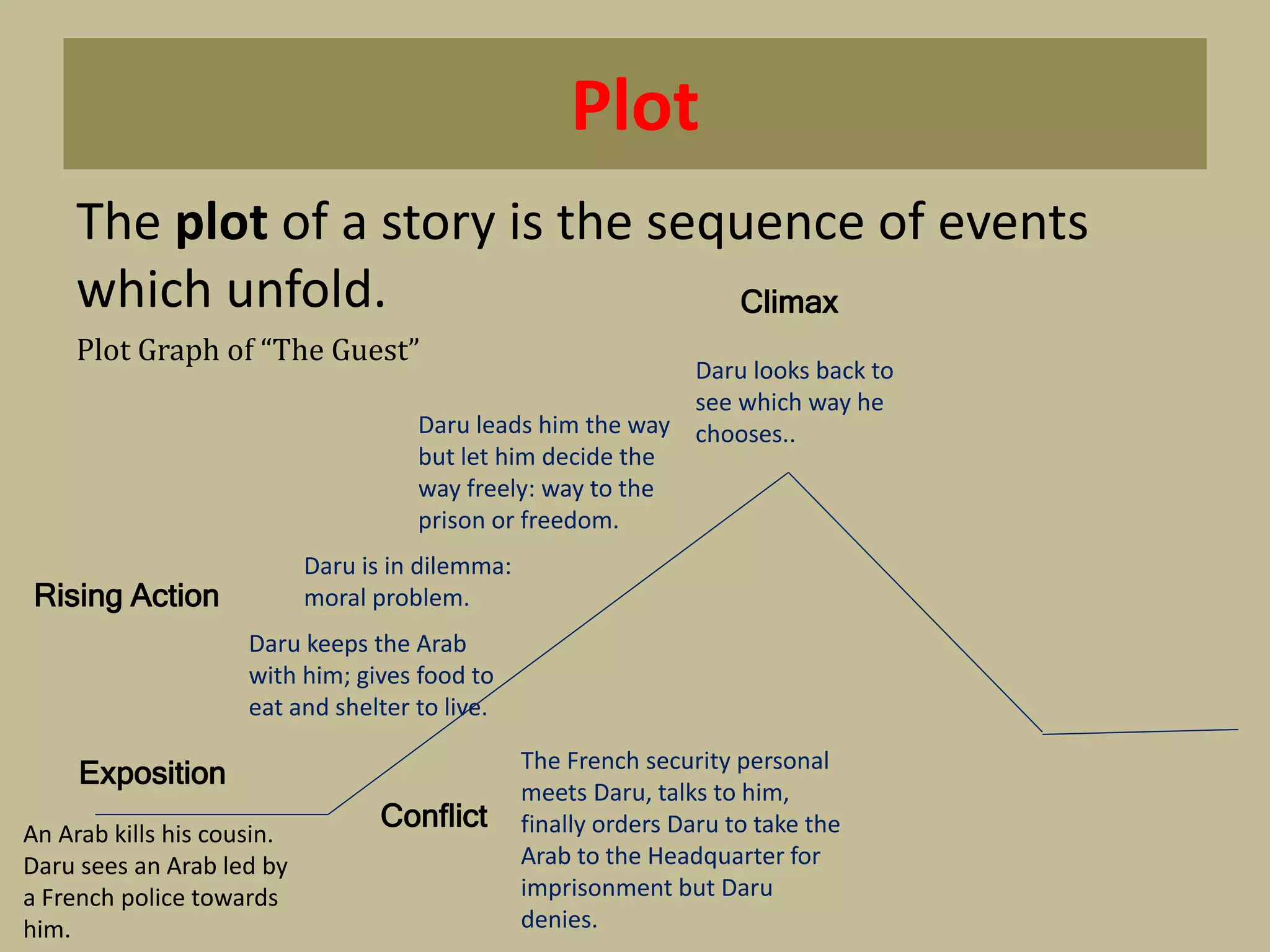
Daru leads him the way
but let him decide the
way freely: way to the
prison or freedom.
Plot
The plot of a story is the sequence of events
which unfold.
Plot Graph of “The Guest”
An Arab kills his cousin.
Daru sees an Arab led by
a French police towards
him.
Exposition
Rising Action
Daru keeps the Arab
with him; gives food to
eat and shelter to live.
Conflict
The French security personal
meets Daru, talks to him,
finally orders Daru to take the
Arab to the Headquarter for
imprisonment but Daru
denies.
Daru is in dilemma:
moral problem.
Daru leads him the way
but let him decide the
way freely: way to the
prison or freedom.
Climax
Plot
The plot of a story is the sequence of events
which unfold.
Plot Graph of “The Guest”
An Arab kills his cousin.
Daru sees an Arab led by
a French police towards
him.
Exposition
Rising Action
Daru keeps the Arab
with him; gives food to
eat and shelter to live.
Conflict
The French security personal
meets Daru, talks to him,
finally orders Daru to take the
Arab to the Headquarter for
imprisonment but Daru
denies.
Daru is in dilemma:
moral problem.
Daru leads him the way
but let him decide the
way freely: way to the
prison or freedom.
Climax
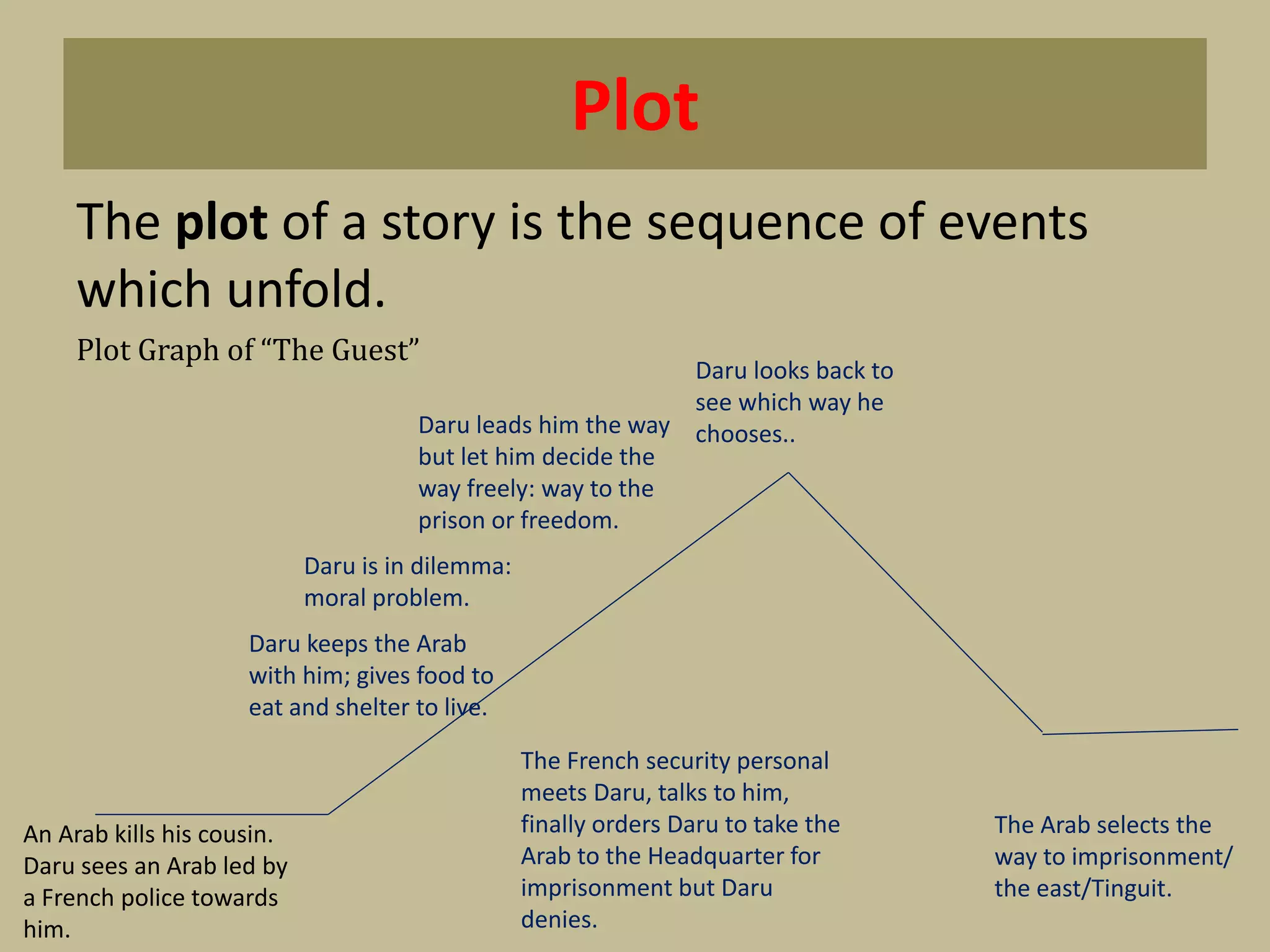
Daru looks back to
see which way he
chooses..
Plot
The plot of a story is the sequence of events
which unfold.
Plot Graph of “The Guest”
An Arab kills his cousin.
Daru sees an Arab led by
a French police towards
him.
Exposition
Rising Action
Daru keeps the Arab
with him; gives food to
eat and shelter to live.
Conflict
The French security personal
meets Daru, talks to him,
finally orders Daru to take the
Arab to the Headquarter for
imprisonment but Daru
denies.
Daru is in dilemma:
moral problem.
Daru leads him the way
but let him decide the
way freely: way to the
prison or freedom.
Climax
Daru looks back to
see which way he
chooses..
Resolution
Plot
The plot of a story is the sequence of events
which unfold.
Plot Graph of “The Guest”
An Arab kills his cousin.
Daru sees an Arab led by
a French police towards
him.
Exposition
Rising Action
Daru keeps the Arab
with him; gives food to
eat and shelter to live.
Conflict
The French security personal
meets Daru, talks to him,
finally orders Daru to take the
Arab to the Headquarter for
imprisonment but Daru
denies.
Daru is in dilemma:
moral problem.
Daru leads him the way
but let him decide the
way freely: way to the
prison or freedom.
Climax
Daru looks back to
see which way he
chooses..
Resolution
The Arab selects the
way to imprisonment.
Plot
The plot of a story is the sequence of events
which unfold.
Plot Graph of “The Guest”
An Arab kills his cousin.
Daru sees an Arab led by
a French police towards
him.
Daru keeps the Arab
with him; gives food to
eat and shelter to live.
The French security personal
meets Daru, talks to him,
finally orders Daru to take the
Arab to the Headquarter for
imprisonment but Daru
denies.
Daru is in dilemma:
moral problem.
Daru leads him the way
but let him decide the
way freely: way to the
prison or freedom.
Daru looks back to
see which way he
chooses..
The Arab selects the
way to imprisonment/
the east/Tinguit.
Conflict
The conflict is the major “problem” that arises in
the story.
• Conflicts are either internal (occur within the character’s
own mind), or external (occur between the protagonist and
an outside force).
Internal Conflicts External Conflicts
“The Guest”
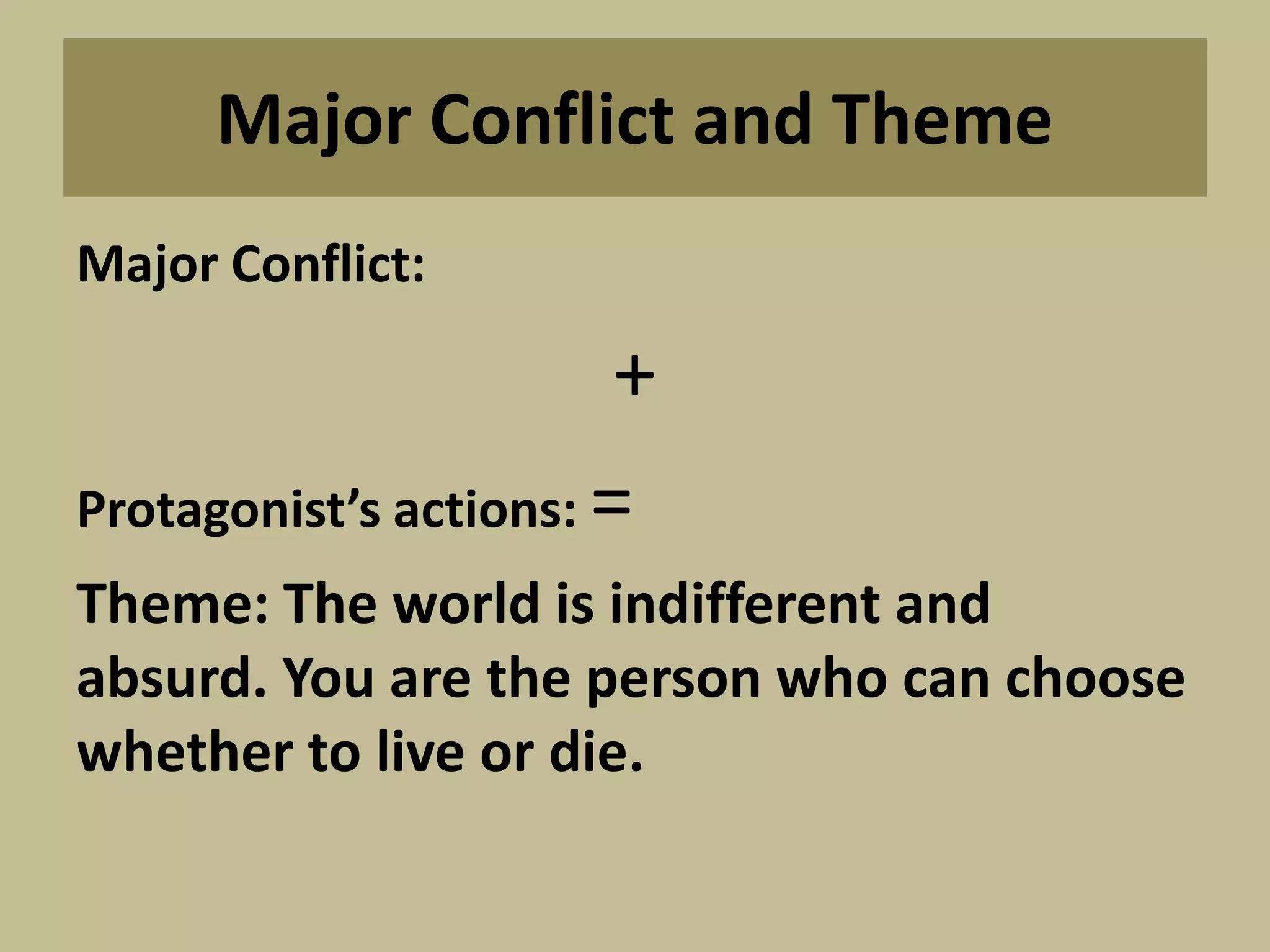
Major Conflict and Theme
Major Conflict:
+
Protagonist’s actions: =
Theme: The world is indifferent and
absurd. You are the person who can choose
whether to live or die.
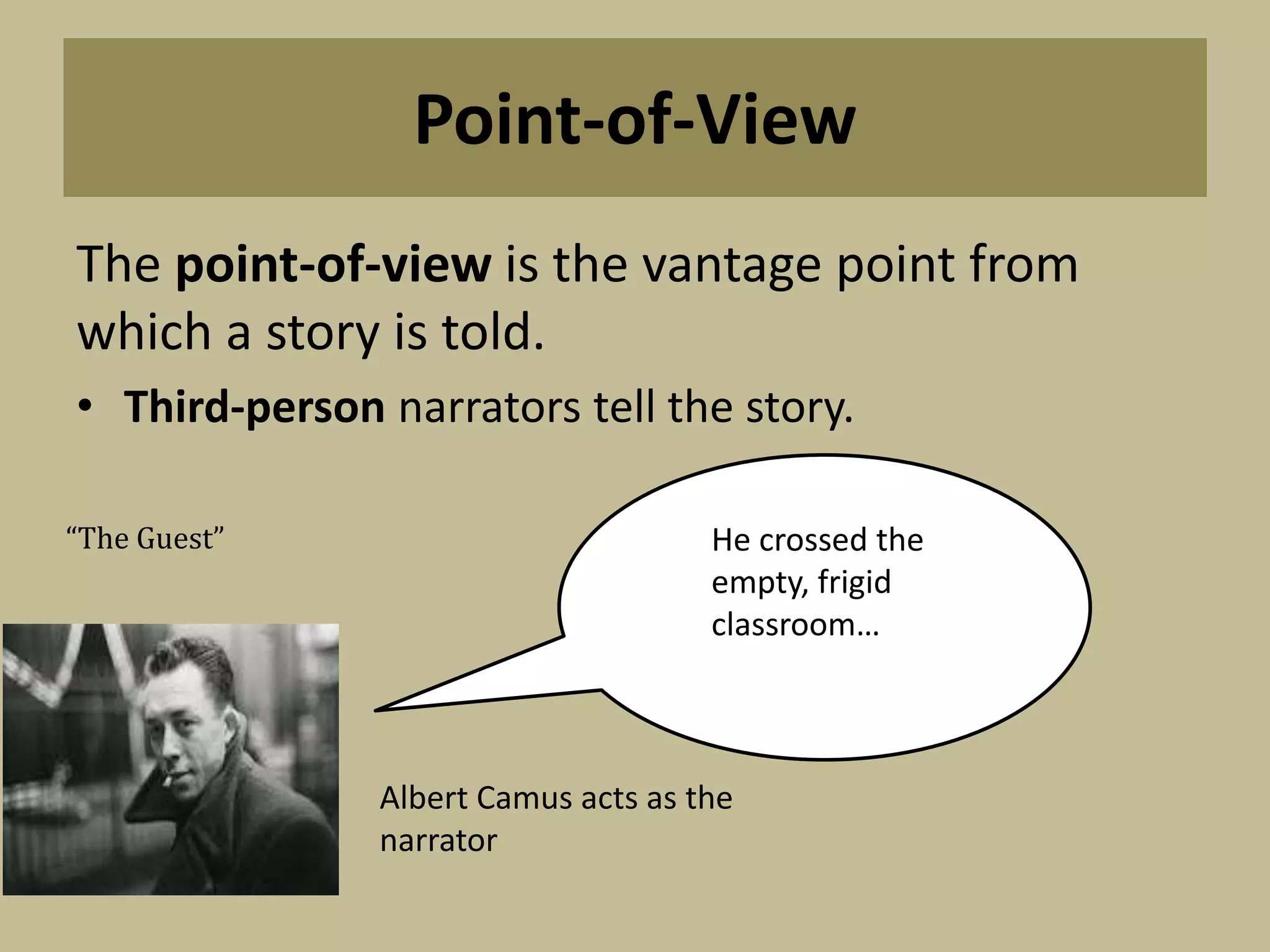
Point-of-View
The point-of-view is the vantage point from
which a story is told.
• Third-person narrators tell the story.
“The Guest” He crossed the
empty, frigid
classroom…
Albert Camus acts as the
narrator
Protagonist
Daru is the protagonist, or main character, in
the story “The Guest.”
Why isn’t Arab considered the protagonist? Isn’t he the
one that most of the action centered around?
While it is true that most of the action centered around
the Arab, Daru is the one who faces the internal conflict
and the dilemma of performing the task of sending the
Arab to police headquarter. He is the character who has
decisive role in the story. The internal conflict that centers
around Daru makes him the protagonist of this story.
Antagonist
The antagonist in “The Guest” is French Political
system and the supporters of it like the Balducci
Author’s Purpose
Absurdism
Author’s Purpose
The author’s purpose supports the theme.
Author’s Purpose
To……….
Theme
……………..
……………………… illustrates
this theme.
The Guest
Albert Camus
Think Seriously
• Is the Arab even guilty?
• Who writes the words on the blackboard?
• Are Daru and the Arab being watched by
his brothers, and if so, why do they decide
not to save him?
• Why does the Arab choose imprisonment?
Camus’ Philosophy
• The world is an illogical place.
• People find meaning through their
freedom to choose despite the absurdity
that surrounds them.
• The Guest: the struggle to choose in
morally ambiguous conditions
• Daru fails to choose whether to turn the Arab over
to authorities or let him go, and this failure results
in moral despair and total isolation.
The Algerian War
• Algeria was an independent state in the Ottoman Empire up until 1830.
• In 1834, France took control of Algeria as a French colony - colonial
government permitted only French citizens to hold skilled jobs
• The events in The Guest take place on the eve of the Algerian War (1954 -
1962).
– multiple small insurrections/ insurgences
– became more heated after World War II.
• 1954 rebellion led by the National Liberation Front (FLN). They used
guerilla warfare tactics, destroying government buildings, communication
centers, and military posts.
• The French government called in 400,000 troops
• Series of massacres began: French soldiers massacred whole villages of
natives, the FLN using terrorism as a weapon against white civilians.
• Fighting stopped In 1962
– At least 100,000 French soldiers and civilians were killed,
– Approximately 1 million Algerian natives and guerillas were dead
– 2 million Algerians were forced to from their homes.
• In July of 1962, Algeria achieved independence.
Context of the Story
• Written at the onset of the Algerian
uprising against the French, the tension
between the Arab culture and the ruling
French creates much distress.
• European Algerians and Arabs share the
same harsh climate, but the political and
cultural tension between them prevents
any feelings of camaraderie/friendship.
Camus’ View of the Human Condition
• Despair is not an act, but a human state.
• This state of despair resulting from
isolation from the rest of the world.
Daru’s Isolation
– He views two stranger’s approaching
dispassionately from his distance atop the
plateau
– Daru has been alone for days; not lonely.
– Grateful for his situation compared with the
poverty and hunger of the natives
– His state of isolation is thus a state of self-
sufficiency - seems capable of carrying on
indefinitely, as long as his basic needs of shelter,
food and warmth are met.
• the story examines each of these needs -- the bags of
grain in the classroom, the warmth of Daru's small
lodgings
Setting
• Inhospitable terrain dominates the plateau.
• Camus's notion of the absurd: the universe is completely silent and
indifferent towards humanity - the land is not giving or forgiving; it is
simply cruel
– i.e. "This is the way the region was, cruel to live in, even without men...”
• Repetition of natural harshness/severity
– the two men are forced to cross the hill without the guide of a path
– nature's ice and snow makes an already difficult trek all the more
treacherous/unfaithful.
• Nature also behaves very irrationally.
– After an eight-month draught, nature finally supplies water in the absurd form of
snow.
– By itself, these weather conditions are simply a fact of nature, but combined with
human need, the extremity represents Camus's idea of the absurd.
• He creates a representation of the absurd by joining extreme physical
conditions with basic human survival needs
– Daru's recollection of the starving people wandering the plateau during the draught.
The plateau will not help them.
Indeterminate Knowledge
• The Arab's motivations
• His past actions
• His guilt or innocence
– Daru will never have enough knowledge about the
Arab to pass judgment on him
– The reader is also allowed only partial knowledge of
the Arab – shares Daru's ensuing moral dilemma
Theme of Freedom
• Integral part of Camus's 'absurdist' philosophy
• Camus sees an individual's freedom to choose as
something that gives value to life.
• Through freedom of action an individual can find
meaning in an otherwise meaningless and indifferent
world.
Point of View
• The narrator's descriptions mingle/ circulate with
Daru's thoughts, at times appearing inseparable.
• Ambiguity keeps the reader from certain knowledge.
• The problem of partial knowledge that covers the story
Freedom
• The freedom to choose and an individual's
experience give meaning to life
– Daru finds meaning in his life through his decision to
live in this cruel landscape, and in this way he has
come to terms with the pervasive silence.
Moral Dilemma
• Daru's fear of making a decision represents his inability
to acknowledge the absurd
• Although there is no good choice, Camus feels that the
act of making a choice and standing by that choice is the
most important thing a human being can do.
Is someone watching?
• Evidence creeps up now and then that Daru and the Arab are
not alone
• Daru hears a rustling around the house during the night and again
when he and the Arab set out in the morning.
• Camus suggests that the Arab's friends are circling the schoolhouse to
see what Daru plans on doing with the prisoner.
• No way to prove this hypothesis with certainty;
• The sounds Daru hears may be those of animals, or simply the result of
his paranoia.
• The feeling that a hidden society is waiting to pass judgment
on Daru haunts the story.
• Those judges, whoever they may be, do not know the whole
story of Daru's moral struggle, just as Daru does not know the
Arab's story, yet (unlike Daru) they will pass judgment
anyway.
Failure
• Daru fails to choose, instead trying to pass
his choice along to the prisoner.
• The Arab's choice does not provide any
answers
– It's ambiguous whether the Arab even
understood Daru's explanation of the
difference between going east and going
south.
The Writing on the Blackboard
• Daru's alimentation from the plateau region
becomes all the more concrete, and all the more
dangerous, with the writing on the blackboard.
– Camus leaves it unclear who wrote the note.
– Perhaps Daru himself wrote it as an expression of his
morally complex state of despair.
– The note may have been written by Daru's friends.
• Though the people who wrote it have no access to
Daru's moral struggle, they are in a position to
pass judgment upon him for it.
• We assume that they will not be as wishy-washy
(weak) as Daru was.
Morality
• Daru faces a moral dilemma when he is ordered to turn in the Arab.
• Daru's course of action leads him into moral trouble: he does not
know whether the Arab deserves to be punished or let go, and he
allows this uncertainty to overwhelm him.
• He fails to choose at all, instead allowing the Arab to choose either
freedom or trial.
• Daru's ensuing moral despair is a reflection of Camus’ philosophy:
(1) once a decision was reached, it should be stuck to
(2) the freedom to choose one's action gives meaning to human
life.
• Daru certainly believes that turning in the Arab was wrong, yet he
fails to simply release the prisoner. He fails to make a decision, and
as a result he is left in complete moral solitude.
Solitude
Two kinds of solitude
1. Daru faces physical isolation on the remote plateau
– not a negative state; Daru has accepted his living conditions and feels at home within
them.
– Though the landscape itself is unfeeling and unforgiving, Daru makes himself
comfortable within it.
2. At the end Daru occupies a state of moral solitude.
- His failure to act with regard to the Arab's fate has left him disconnected from himself.
- He looks at the harsh landscape and sees only his failure to choose.
Moral solitude is clearly symbolized by the mysterious writing on
the blackboard.
- If he wrote it himself, it represents his despair and his alienation from himself -- he has
betrayed his own principles in allowing the Arab to choose punishment.
- If someone else wrote it, it represents a clear threat. Daru, who failed to use judgment,
will now be judged by others who do not understand him.
Thus his situation is one of extreme isolation from human
understanding.
Freedom
• Freedom is connected with the human right to choose a course of
action
• Freedom gives life meaning.
• Camus believed that through independent action one finds value
in life.
– Daru's choice to live in the plateau region is a choice motivated out of what Camus would call an
understanding of the "absurd." Any human needs to belong to a place, and the cruel plateau region
embodies a type of home for him despite its desolate climate.
– Just so, Camus feels, we all need to make a home for ourselves within an essentially uncaring
universe.
– The way we make this home is through individual choice.
• freedom to choose is also paradoxically an obligation.
– When we decide not to choose we fall victim to the essential cruelty and ambiguity of the universe
- we cannot decide not to choose -- we must choose in order to retain freedom.
– Daru attempts to pass along his obligation to choose to the Arab. However, when the Arab decides
to turn himself in, Daru suffers for it. Daru should have made a decision, one way or the other, and
stuck with it. Instead, he finds himself in a state of desperate moral ambiguity.
Limits of Human Knowledge
• Everyone has limited knowledge of the happenings of the story.
– Balducci doesn't know why the Arab killed his cousin, or why Daru must take the
Arab to the police; he simply has his orders and follows them.
– Daru doesn't know whether the Arab should be released or punished, though he
constantly tries to glean information about why the Arab committed murder -- if he
even did.
– Meanwhile, the Arab displays confusion when Daru asks him difficult questions and
when Daru explains his choice to either escape to the south or turn himself into the
police.
• The reader, too, occupies a limited vantage point.
– We never learn whether the Arab deserves punishment or freedom.
– We never learn who wrote the message on the blackboard at the end of the story.
• Camus denies us crucial knowledge, thus putting us in a similar position to
Daru -- or to any individual who must make choices despite his or her
limited perspective.
• Because human knowledge is always subjectively situated -- that is, it
always happens from a particular individual's point-of-view -- it's always
going to be limited
The Absurd
Camus envisions the universe as silent and
indifferent. Despite this indifference, human beings
must survive. They continue to build meaning and
pursue certainty, even though such aims are
impossible. This combination of a godless, uncaring
world and human striving leads to a condition that
Camus dubs "the absurd”
One must continue striving, choosing and pursuing
freedom, even though the universe does not care
whether we live or die.
Some useful links
• https://www.enotes.com/topics/clay-
are/characters
• http://www.supersummary.com/and-of-clay-
are-we-created/summary/
• http://slideplayer.com/slide/267533/

31. the guest

  • 1.
  • 2.
  • 3.
    Plot The plot ofa story is the sequence of events which unfold. Plot Graph of “The Guest” Exposition
  • 4.
    Plot The plot ofa story is the sequence of events which unfold. Plot Graph of “The Guest” An Arab kills his cousin. Daru sees an Arab led by a French police towards him. Exposition
  • 5.
    Plot The plot ofa story is the sequence of events which unfold. Plot Graph of “The Guest” Exposition Conflict An Arab kills his cousin. Daru sees an Arab led by a French police towards him.
  • 6.
    Plot The plot ofa story is the sequence of events which unfold. Plot Graph of “The Guest” An Arab kills his cousin. Daru sees an Arab led by a French police towards him. Exposition Conflict The French security personal meets Daru, talks to him, finally orders Daru to take the Arab to the Headquarter for imprisonment but Daru denies.
  • 7.
    Plot The plot ofa story is the sequence of events which unfold. Plot Graph of “The Guest” An Arab kills his cousin. Daru sees an Arab led by a French police towards him. Exposition Rising Action Daru keeps the Arab with him; gives food to eat and shelter to live. Conflict The French security personal meets Daru, talks to him, finally orders Daru to take the Arab to the Headquarter for imprisonment but Daru denies.
  • 8.
    Plot The plot ofa story is the sequence of events which unfold. Plot Graph of “The Guest” An Arab kills his cousin. Daru sees an Arab led by a French police towards him. Exposition Rising Action Daru keeps the Arab with him; gives food to eat and shelter to live. Conflict The French security personal meets Daru, talks to him, finally orders Daru to take the Arab to the Headquarter for imprisonment but Daru denies. Daru is in dilemma: moral problem.
  • 9.
    Plot The plot ofa story is the sequence of events which unfold. Plot Graph of “The Guest” An Arab kills his cousin. Daru sees an Arab led by a French police towards him. Exposition Rising Action Daru keeps the Arab with him; gives food to eat and shelter to live. Conflict The French security personal meets Daru, talks to him, finally orders Daru to take the Arab to the Headquarter for imprisonment but Daru denies. Daru is in dilemma: moral problem. Daru leads him the way but let him decide the way freely: way to the prison or freedom.
  • 10.
    Plot The plot ofa story is the sequence of events which unfold. Plot Graph of “The Guest” An Arab kills his cousin. Daru sees an Arab led by a French police towards him. Exposition Rising Action Daru keeps the Arab with him; gives food to eat and shelter to live. Conflict The French security personal meets Daru, talks to him, finally orders Daru to take the Arab to the Headquarter for imprisonment but Daru denies. Daru is in dilemma: moral problem. Daru leads him the way but let him decide the way freely: way to the prison or freedom. Climax
  • 11.
    Plot The plot ofa story is the sequence of events which unfold. Plot Graph of “The Guest” An Arab kills his cousin. Daru sees an Arab led by a French police towards him. Exposition Rising Action Daru keeps the Arab with him; gives food to eat and shelter to live. Conflict The French security personal meets Daru, talks to him, finally orders Daru to take the Arab to the Headquarter for imprisonment but Daru denies. Daru is in dilemma: moral problem. Daru leads him the way but let him decide the way freely: way to the prison or freedom. Climax Daru looks back to see which way he chooses..
  • 12.
    Plot The plot ofa story is the sequence of events which unfold. Plot Graph of “The Guest” An Arab kills his cousin. Daru sees an Arab led by a French police towards him. Exposition Rising Action Daru keeps the Arab with him; gives food to eat and shelter to live. Conflict The French security personal meets Daru, talks to him, finally orders Daru to take the Arab to the Headquarter for imprisonment but Daru denies. Daru is in dilemma: moral problem. Daru leads him the way but let him decide the way freely: way to the prison or freedom. Climax Daru looks back to see which way he chooses.. Resolution
  • 13.
    Plot The plot ofa story is the sequence of events which unfold. Plot Graph of “The Guest” An Arab kills his cousin. Daru sees an Arab led by a French police towards him. Exposition Rising Action Daru keeps the Arab with him; gives food to eat and shelter to live. Conflict The French security personal meets Daru, talks to him, finally orders Daru to take the Arab to the Headquarter for imprisonment but Daru denies. Daru is in dilemma: moral problem. Daru leads him the way but let him decide the way freely: way to the prison or freedom. Climax Daru looks back to see which way he chooses.. Resolution The Arab selects the way to imprisonment.
  • 14.
    Plot The plot ofa story is the sequence of events which unfold. Plot Graph of “The Guest” An Arab kills his cousin. Daru sees an Arab led by a French police towards him. Daru keeps the Arab with him; gives food to eat and shelter to live. The French security personal meets Daru, talks to him, finally orders Daru to take the Arab to the Headquarter for imprisonment but Daru denies. Daru is in dilemma: moral problem. Daru leads him the way but let him decide the way freely: way to the prison or freedom. Daru looks back to see which way he chooses.. The Arab selects the way to imprisonment/ the east/Tinguit.
  • 15.
    Conflict The conflict isthe major “problem” that arises in the story. • Conflicts are either internal (occur within the character’s own mind), or external (occur between the protagonist and an outside force). Internal Conflicts External Conflicts “The Guest”
  • 16.
    Major Conflict andTheme Major Conflict: + Protagonist’s actions: = Theme: The world is indifferent and absurd. You are the person who can choose whether to live or die.
  • 17.
    Point-of-View The point-of-view isthe vantage point from which a story is told. • Third-person narrators tell the story. “The Guest” He crossed the empty, frigid classroom… Albert Camus acts as the narrator
  • 18.
    Protagonist Daru is theprotagonist, or main character, in the story “The Guest.” Why isn’t Arab considered the protagonist? Isn’t he the one that most of the action centered around? While it is true that most of the action centered around the Arab, Daru is the one who faces the internal conflict and the dilemma of performing the task of sending the Arab to police headquarter. He is the character who has decisive role in the story. The internal conflict that centers around Daru makes him the protagonist of this story.
  • 19.
    Antagonist The antagonist in“The Guest” is French Political system and the supporters of it like the Balducci
  • 20.
  • 21.
    Author’s Purpose The author’spurpose supports the theme. Author’s Purpose To………. Theme …………….. ……………………… illustrates this theme.
  • 22.
  • 23.
    Think Seriously • Isthe Arab even guilty? • Who writes the words on the blackboard? • Are Daru and the Arab being watched by his brothers, and if so, why do they decide not to save him? • Why does the Arab choose imprisonment?
  • 24.
    Camus’ Philosophy • Theworld is an illogical place. • People find meaning through their freedom to choose despite the absurdity that surrounds them. • The Guest: the struggle to choose in morally ambiguous conditions • Daru fails to choose whether to turn the Arab over to authorities or let him go, and this failure results in moral despair and total isolation.
  • 25.
    The Algerian War •Algeria was an independent state in the Ottoman Empire up until 1830. • In 1834, France took control of Algeria as a French colony - colonial government permitted only French citizens to hold skilled jobs • The events in The Guest take place on the eve of the Algerian War (1954 - 1962). – multiple small insurrections/ insurgences – became more heated after World War II. • 1954 rebellion led by the National Liberation Front (FLN). They used guerilla warfare tactics, destroying government buildings, communication centers, and military posts. • The French government called in 400,000 troops • Series of massacres began: French soldiers massacred whole villages of natives, the FLN using terrorism as a weapon against white civilians. • Fighting stopped In 1962 – At least 100,000 French soldiers and civilians were killed, – Approximately 1 million Algerian natives and guerillas were dead – 2 million Algerians were forced to from their homes. • In July of 1962, Algeria achieved independence.
  • 26.
    Context of theStory • Written at the onset of the Algerian uprising against the French, the tension between the Arab culture and the ruling French creates much distress. • European Algerians and Arabs share the same harsh climate, but the political and cultural tension between them prevents any feelings of camaraderie/friendship.
  • 27.
    Camus’ View ofthe Human Condition • Despair is not an act, but a human state. • This state of despair resulting from isolation from the rest of the world.
  • 28.
    Daru’s Isolation – Heviews two stranger’s approaching dispassionately from his distance atop the plateau – Daru has been alone for days; not lonely. – Grateful for his situation compared with the poverty and hunger of the natives – His state of isolation is thus a state of self- sufficiency - seems capable of carrying on indefinitely, as long as his basic needs of shelter, food and warmth are met. • the story examines each of these needs -- the bags of grain in the classroom, the warmth of Daru's small lodgings
  • 29.
    Setting • Inhospitable terraindominates the plateau. • Camus's notion of the absurd: the universe is completely silent and indifferent towards humanity - the land is not giving or forgiving; it is simply cruel – i.e. "This is the way the region was, cruel to live in, even without men...” • Repetition of natural harshness/severity – the two men are forced to cross the hill without the guide of a path – nature's ice and snow makes an already difficult trek all the more treacherous/unfaithful. • Nature also behaves very irrationally. – After an eight-month draught, nature finally supplies water in the absurd form of snow. – By itself, these weather conditions are simply a fact of nature, but combined with human need, the extremity represents Camus's idea of the absurd. • He creates a representation of the absurd by joining extreme physical conditions with basic human survival needs – Daru's recollection of the starving people wandering the plateau during the draught. The plateau will not help them.
  • 30.
    Indeterminate Knowledge • TheArab's motivations • His past actions • His guilt or innocence – Daru will never have enough knowledge about the Arab to pass judgment on him – The reader is also allowed only partial knowledge of the Arab – shares Daru's ensuing moral dilemma
  • 31.
    Theme of Freedom •Integral part of Camus's 'absurdist' philosophy • Camus sees an individual's freedom to choose as something that gives value to life. • Through freedom of action an individual can find meaning in an otherwise meaningless and indifferent world.
  • 32.
    Point of View •The narrator's descriptions mingle/ circulate with Daru's thoughts, at times appearing inseparable. • Ambiguity keeps the reader from certain knowledge. • The problem of partial knowledge that covers the story
  • 33.
    Freedom • The freedomto choose and an individual's experience give meaning to life – Daru finds meaning in his life through his decision to live in this cruel landscape, and in this way he has come to terms with the pervasive silence.
  • 34.
    Moral Dilemma • Daru'sfear of making a decision represents his inability to acknowledge the absurd • Although there is no good choice, Camus feels that the act of making a choice and standing by that choice is the most important thing a human being can do.
  • 35.
    Is someone watching? •Evidence creeps up now and then that Daru and the Arab are not alone • Daru hears a rustling around the house during the night and again when he and the Arab set out in the morning. • Camus suggests that the Arab's friends are circling the schoolhouse to see what Daru plans on doing with the prisoner. • No way to prove this hypothesis with certainty; • The sounds Daru hears may be those of animals, or simply the result of his paranoia. • The feeling that a hidden society is waiting to pass judgment on Daru haunts the story. • Those judges, whoever they may be, do not know the whole story of Daru's moral struggle, just as Daru does not know the Arab's story, yet (unlike Daru) they will pass judgment anyway.
  • 36.
    Failure • Daru failsto choose, instead trying to pass his choice along to the prisoner. • The Arab's choice does not provide any answers – It's ambiguous whether the Arab even understood Daru's explanation of the difference between going east and going south.
  • 37.
    The Writing onthe Blackboard • Daru's alimentation from the plateau region becomes all the more concrete, and all the more dangerous, with the writing on the blackboard. – Camus leaves it unclear who wrote the note. – Perhaps Daru himself wrote it as an expression of his morally complex state of despair. – The note may have been written by Daru's friends. • Though the people who wrote it have no access to Daru's moral struggle, they are in a position to pass judgment upon him for it. • We assume that they will not be as wishy-washy (weak) as Daru was.
  • 38.
    Morality • Daru facesa moral dilemma when he is ordered to turn in the Arab. • Daru's course of action leads him into moral trouble: he does not know whether the Arab deserves to be punished or let go, and he allows this uncertainty to overwhelm him. • He fails to choose at all, instead allowing the Arab to choose either freedom or trial. • Daru's ensuing moral despair is a reflection of Camus’ philosophy: (1) once a decision was reached, it should be stuck to (2) the freedom to choose one's action gives meaning to human life. • Daru certainly believes that turning in the Arab was wrong, yet he fails to simply release the prisoner. He fails to make a decision, and as a result he is left in complete moral solitude.
  • 39.
    Solitude Two kinds ofsolitude 1. Daru faces physical isolation on the remote plateau – not a negative state; Daru has accepted his living conditions and feels at home within them. – Though the landscape itself is unfeeling and unforgiving, Daru makes himself comfortable within it. 2. At the end Daru occupies a state of moral solitude. - His failure to act with regard to the Arab's fate has left him disconnected from himself. - He looks at the harsh landscape and sees only his failure to choose. Moral solitude is clearly symbolized by the mysterious writing on the blackboard. - If he wrote it himself, it represents his despair and his alienation from himself -- he has betrayed his own principles in allowing the Arab to choose punishment. - If someone else wrote it, it represents a clear threat. Daru, who failed to use judgment, will now be judged by others who do not understand him. Thus his situation is one of extreme isolation from human understanding.
  • 40.
    Freedom • Freedom isconnected with the human right to choose a course of action • Freedom gives life meaning. • Camus believed that through independent action one finds value in life. – Daru's choice to live in the plateau region is a choice motivated out of what Camus would call an understanding of the "absurd." Any human needs to belong to a place, and the cruel plateau region embodies a type of home for him despite its desolate climate. – Just so, Camus feels, we all need to make a home for ourselves within an essentially uncaring universe. – The way we make this home is through individual choice. • freedom to choose is also paradoxically an obligation. – When we decide not to choose we fall victim to the essential cruelty and ambiguity of the universe - we cannot decide not to choose -- we must choose in order to retain freedom. – Daru attempts to pass along his obligation to choose to the Arab. However, when the Arab decides to turn himself in, Daru suffers for it. Daru should have made a decision, one way or the other, and stuck with it. Instead, he finds himself in a state of desperate moral ambiguity.
  • 41.
    Limits of HumanKnowledge • Everyone has limited knowledge of the happenings of the story. – Balducci doesn't know why the Arab killed his cousin, or why Daru must take the Arab to the police; he simply has his orders and follows them. – Daru doesn't know whether the Arab should be released or punished, though he constantly tries to glean information about why the Arab committed murder -- if he even did. – Meanwhile, the Arab displays confusion when Daru asks him difficult questions and when Daru explains his choice to either escape to the south or turn himself into the police. • The reader, too, occupies a limited vantage point. – We never learn whether the Arab deserves punishment or freedom. – We never learn who wrote the message on the blackboard at the end of the story. • Camus denies us crucial knowledge, thus putting us in a similar position to Daru -- or to any individual who must make choices despite his or her limited perspective. • Because human knowledge is always subjectively situated -- that is, it always happens from a particular individual's point-of-view -- it's always going to be limited
  • 42.
    The Absurd Camus envisionsthe universe as silent and indifferent. Despite this indifference, human beings must survive. They continue to build meaning and pursue certainty, even though such aims are impossible. This combination of a godless, uncaring world and human striving leads to a condition that Camus dubs "the absurd” One must continue striving, choosing and pursuing freedom, even though the universe does not care whether we live or die.
  • 43.
    Some useful links •https://www.enotes.com/topics/clay- are/characters • http://www.supersummary.com/and-of-clay- are-we-created/summary/ • http://slideplayer.com/slide/267533/

Editor's Notes

  • #43  Daru's ability to find comfort and within the harsh plateau climate bodes well for his ability to sustain life in absurd conditions; however, his failure to respond to the moral dilemma represented by the Arab ultimately crushes him. In the face of ambiguity and uncertainty, one must act with an absurd confidence. One must choose anyway. Daru fails to do so, and thus falls into despair.