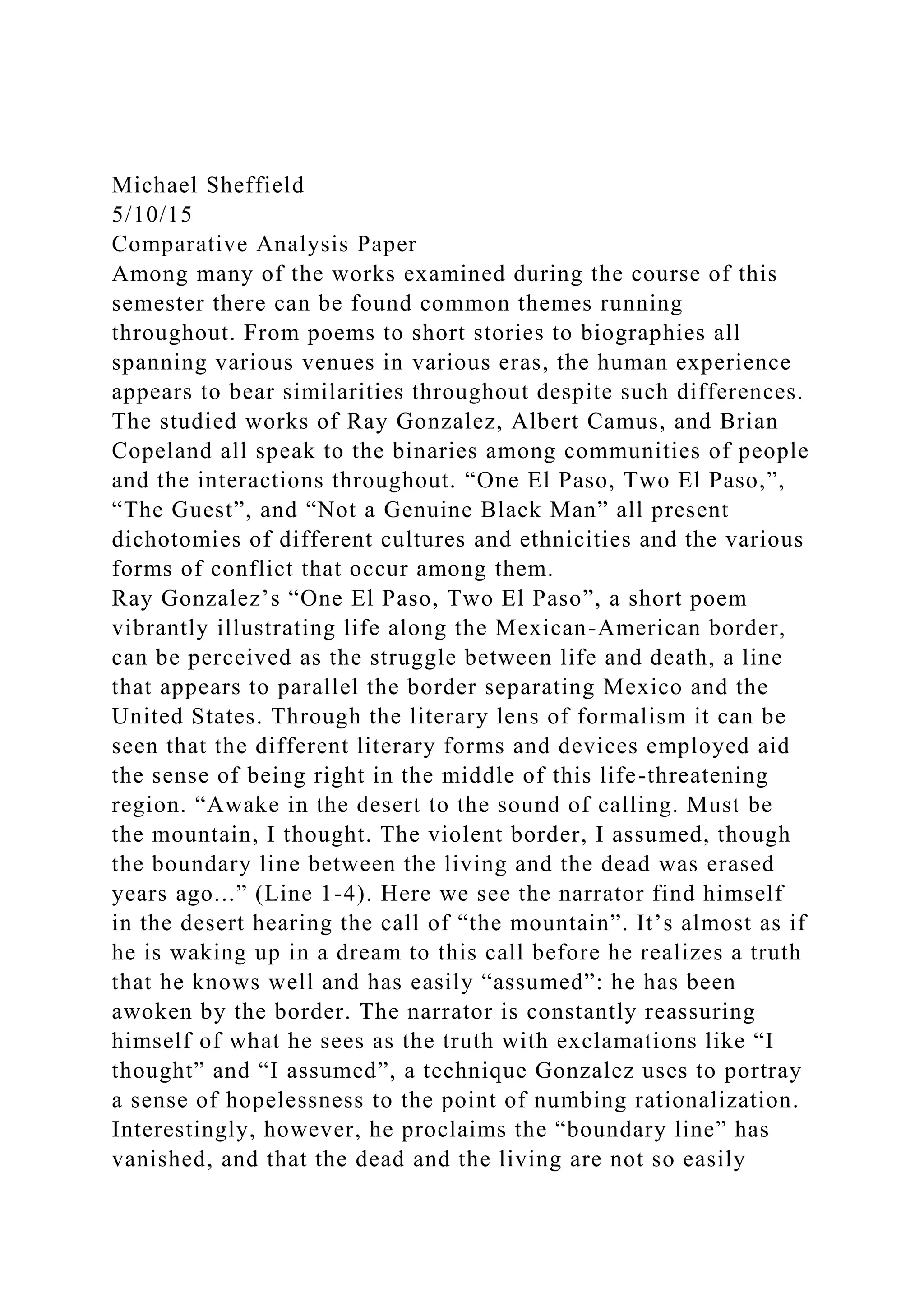
Michael Sheffield
5/10/15
Comparative Analysis Paper
Among many of the works examined during the course of this
semester there can be found common themes running
throughout. From poems to short stories to biographies all
spanning various venues in various eras, the human experience
appears to bear similarities throughout despite such differences.
The studied works of Ray Gonzalez, Albert Camus, and Brian
Copeland all speak to the binaries among communities of people
and the interactions throughout. “One El Paso, Two El Paso,”,
“The Guest”, and “Not a Genuine Black Man” all present
dichotomies of different cultures and ethnicities and the various
forms of conflict that occur among them.
Ray Gonzalez’s “One El Paso, Two El Paso”, a short poem
vibrantly illustrating life along the Mexican-American border,
can be perceived as the struggle between life and death, a line
that appears to parallel the border separating Mexico and the
United States. Through the literary lens of formalism it can be
seen that the different literary forms and devices employed aid
the sense of being right in the middle of this life-threatening
region. “Awake in the desert to the sound of calling. Must be
the mountain, I thought. The violent border, I assumed, though
the boundary line between the living and the dead was erased
years ago...” (Line 1-4). Here we see the narrator find himself
in the desert hearing the call of “the mountain”. It’s almost as if
he is waking up in a dream to this call before he realizes a truth
that he knows well and has easily “assumed”: he has been
awoken by the border. The narrator is constantly reassuring
himself of what he sees as the truth with exclamations like “I
thought” and “I assumed”, a technique Gonzalez uses to portray
a sense of hopelessness to the point of numbing rationalization.
Interestingly, however, he proclaims the “boundary line” has
vanished, and that the dead and the living are not so easily
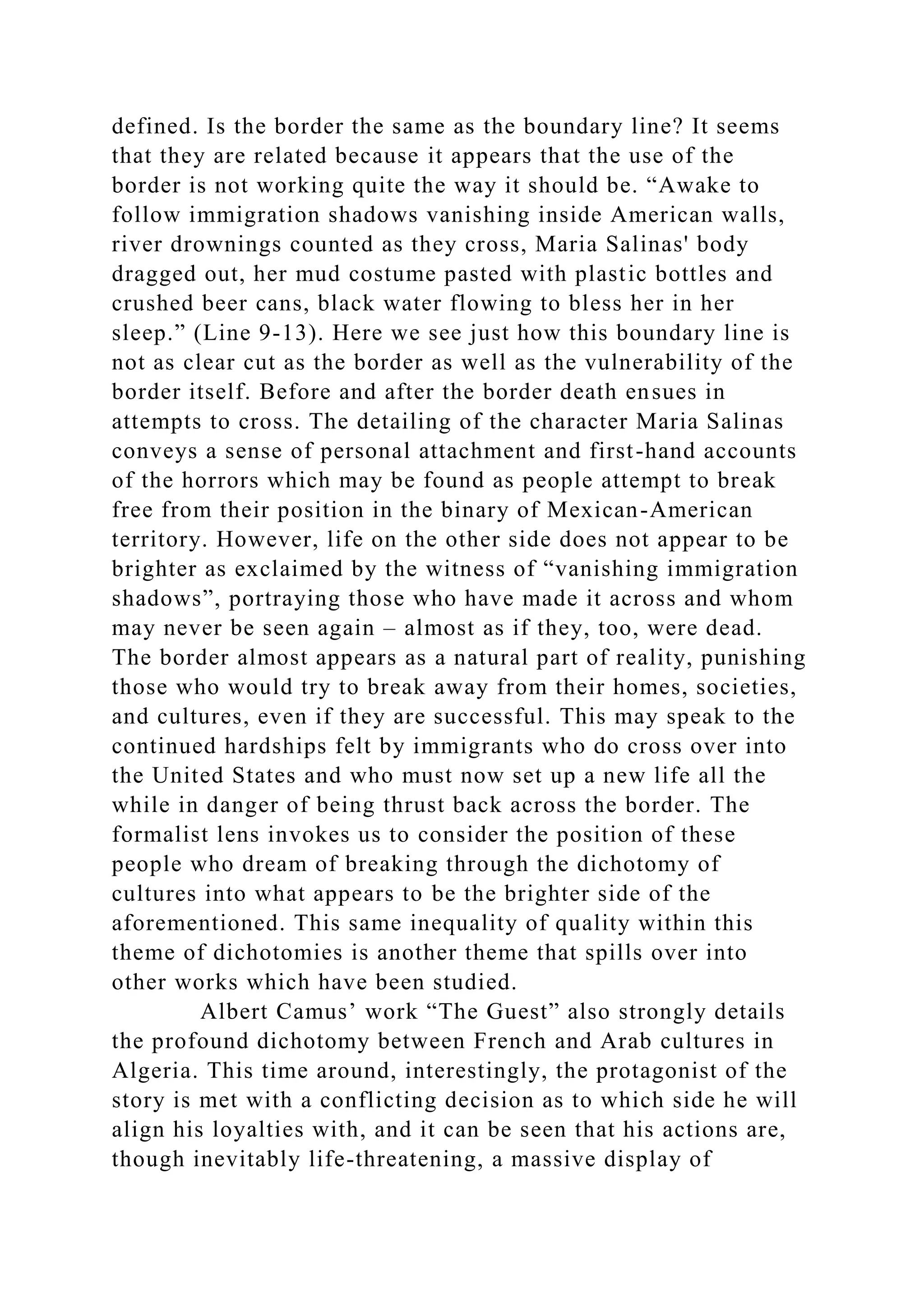
defined. Is the border the same as the boundary line? It seems
that they are related because it appears that the use of the
border is not working quite the way it should be. “Awake to
follow immigration shadows vanishing inside American walls,
river drownings counted as they cross, Maria Salinas' body
dragged out, her mud costume pasted with plastic bottles and
crushed beer cans, black water flowing to bless her in her
sleep.” (Line 9-13). Here we see just how this boundary line is
not as clear cut as the border as well as the vulnerability of the
border itself. Before and after the border death ensues in
attempts to cross. The detailing of the character Maria Salinas
conveys a sense of personal attachment and first-hand accounts
of the horrors which may be found as people attempt to break
free from their position in the binary of Mexican-American
territory. However, life on the other side does not appear to be
brighter as exclaimed by the witness of “vanishing immigration
shadows”, portraying those who have made it across and whom
may never be seen again – almost as if they, too, were dead.
The border almost appears as a natural part of reality, punishing
those who would try to break away from their homes, societies,
and cultures, even if they are successful. This may speak to the
continued hardships felt by immigrants who do cross over into
the United States and who must now set up a new life all the
while in danger of being thrust back across the border. The
formalist lens invokes us to consider the position of these
people who dream of breaking through the dichotomy of
cultures into what appears to be the brighter side of the
aforementioned. This same inequality of quality within this
theme of dichotomies is another theme that spills over into
other works which have been studied.
Albert Camus’ work “The Guest” also strongly details
the profound dichotomy between French and Arab cultures in
Algeria. This time around, interestingly, the protagonist of the
story is met with a conflicting decision as to which side he will
align his loyalties with, and it can be seen that his actions are,
though inevitably life-threatening, a massive display of
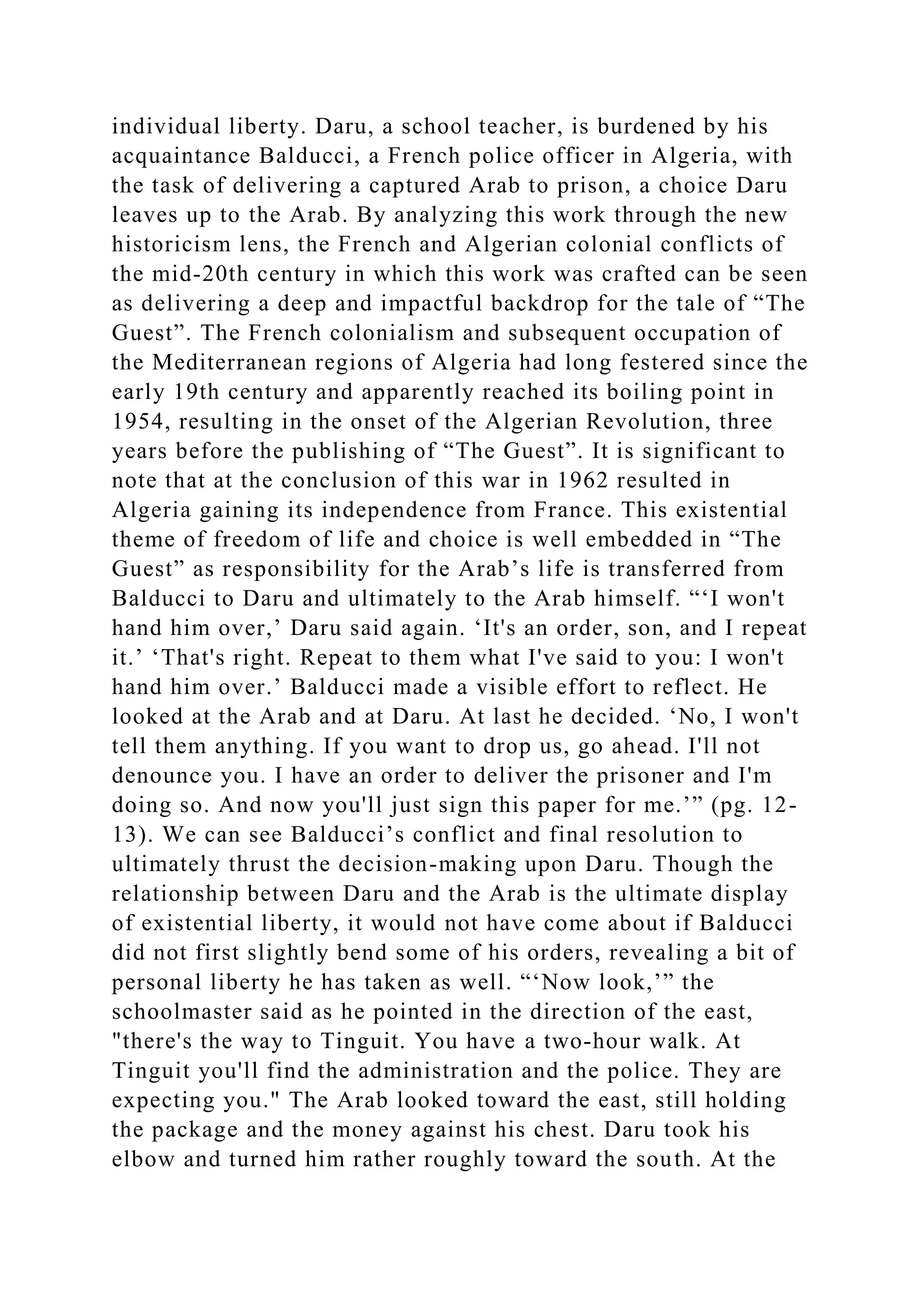
individual liberty. Daru, a school teacher, is burdened by his
acquaintance Balducci, a French police officer in Algeria, with
the task of delivering a captured Arab to prison, a choice Daru
leaves up to the Arab. By analyzing this work through the new
historicism lens, the French and Algerian colonial conflicts of
the mid-20th century in which this work was crafted can be seen
as delivering a deep and impactful backdrop for the tale of “The
Guest”. The French colonialism and subsequent occupation of
the Mediterranean regions of Algeria had long festered since the
early 19th century and apparently reached its boiling point in
1954, resulting in the onset of the Algerian Revolution, three
years before the publishing of “The Guest”. It is significant to
note that at the conclusion of this war in 1962 resulted in
Algeria gaining its independence from France. This existential
theme of freedom of life and choice is well embedded in “The
Guest” as responsibility for the Arab’s life is transferred from
Balducci to Daru and ultimately to the Arab himself. “‘I won't
hand him over,’ Daru said again. ‘It's an order, son, and I repeat
it.’ ‘That's right. Repeat to them what I've said to you: I won't
hand him over.’ Balducci made a visible effort to reflect. He
looked at the Arab and at Daru. At last he decided. ‘No, I won't
tell them anything. If you want to drop us, go ahead. I'll not
denounce you. I have an order to deliver the prisoner and I'm
doing so. And now you'll just sign this paper for me.’” (pg. 12-
13). We can see Balducci’s conflict and final resolution to
ultimately thrust the decision-making upon Daru. Though the
relationship between Daru and the Arab is the ultimate display
of existential liberty, it would not have come about if Balducci
did not first slightly bend some of his orders, revealing a bit of
personal liberty he has taken as well. “‘Now look,’” the
schoolmaster said as he pointed in the direction of the east,
"there's the way to Tinguit. You have a two-hour walk. At
Tinguit you'll find the administration and the police. They are
expecting you." The Arab looked toward the east, still holding
the package and the money against his chest. Daru took his
elbow and turned him rather roughly toward the south. At the
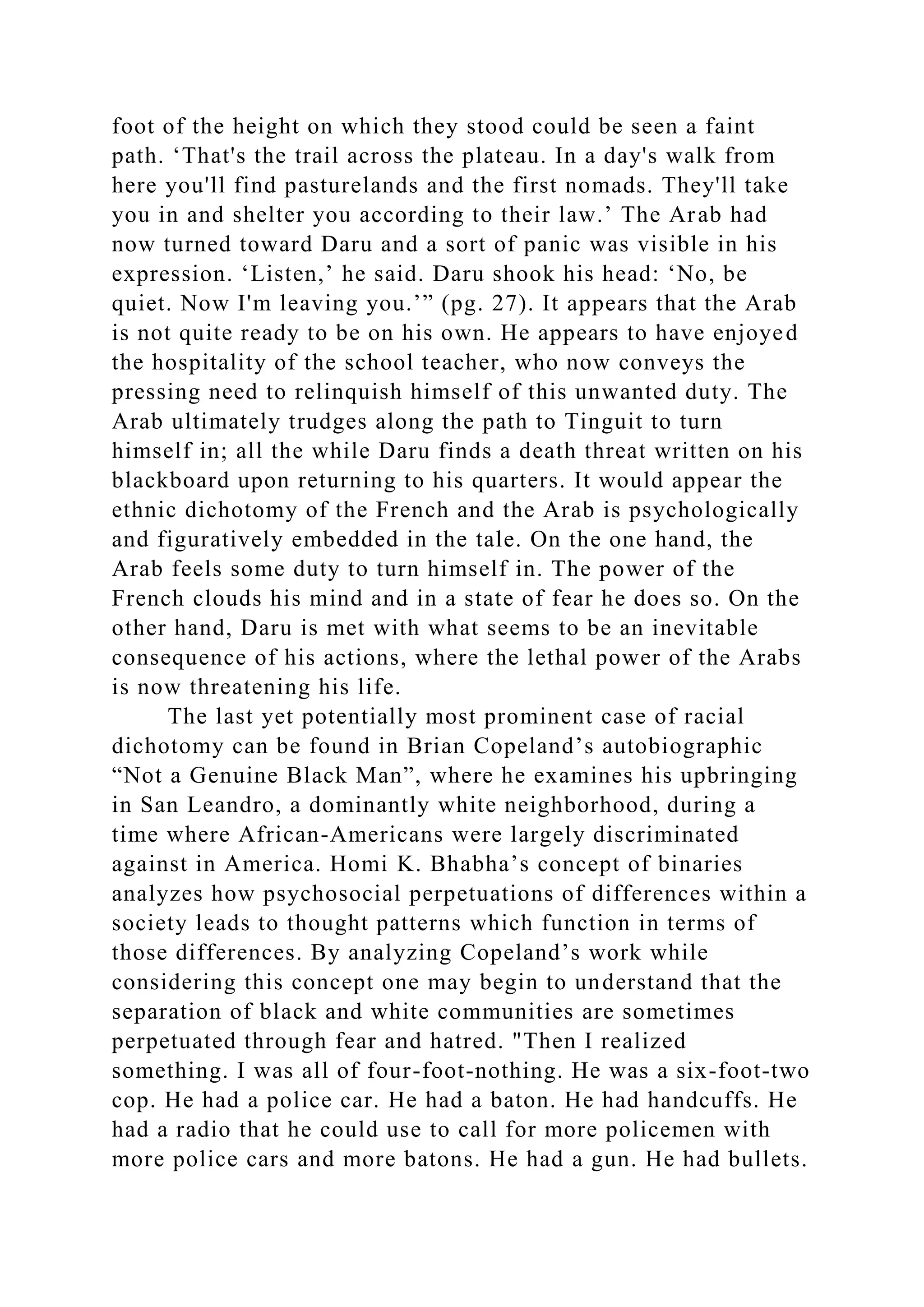
foot of the height on which they stood could be seen a faint
path. ‘That's the trail across the plateau. In a day's walk from
here you'll find pasturelands and the first nomads. They'll take
you in and shelter you according to their law.’ The Arab had
now turned toward Daru and a sort of panic was visible in his
expression. ‘Listen,’ he said. Daru shook his head: ‘No, be
quiet. Now I'm leaving you.’” (pg. 27). It appears that the Arab
is not quite ready to be on his own. He appears to have enjoyed
the hospitality of the school teacher, who now conveys the
pressing need to relinquish himself of this unwanted duty. The
Arab ultimately trudges along the path to Tinguit to turn
himself in; all the while Daru finds a death threat written on his
blackboard upon returning to his quarters. It would appear the
ethnic dichotomy of the French and the Arab is psychologically
and figuratively embedded in the tale. On the one hand, the
Arab feels some duty to turn himself in. The power of the
French clouds his mind and in a state of fear he does so. On the
other hand, Daru is met with what seems to be an inevitable
consequence of his actions, where the lethal power of the Arabs
is now threatening his life.
The last yet potentially most prominent case of racial
dichotomy can be found in Brian Copeland’s autobiographic
“Not a Genuine Black Man”, where he examines his upbringing
in San Leandro, a dominantly white neighborhood, during a
time where African-Americans were largely discriminated
against in America. Homi K. Bhabha’s concept of binaries
analyzes how psychosocial perpetuations of differences within a
society leads to thought patterns which function in terms of
those differences. By analyzing Copeland’s work while
considering this concept one may begin to understand that the
separation of black and white communities are sometimes
perpetuated through fear and hatred. "Then I realized
something. I was all of four-foot-nothing. He was a six-foot-two
cop. He had a police car. He had a baton. He had handcuffs. He
had a radio that he could use to call for more policemen with
more police cars and more batons. He had a gun. He had bullets.
And...he was afraid of me. I could barely make out his words as
his eyes blazed with a strange blend of fury and panic." (Loc
410, 415). This excerpt describes the moment in Copeland’s 8-
year-old life where he was apprehended by a police officer and
taken home to his mother. It seems irrational that a trained
police officer with greater lethal power would crumble at the
sight of a young boy at the park with a baseball bat, even if he
is black. This sense of fear is a common theme running
throughout the book and through Copeland’s life where he is
constantly told that “black is bad” without much of an empirical
basis, only on the basis of word-of-mouth. The generation of
this specific dichotomy arises through the continuation of
taught thought pathways and therefore behaviors. This system
of binaries, like the previous ones spoken of, is unequally
weighted with those of color falling underneath the power of
white communities.
Through these various lenses it can be seen that only one
line is drawn between the given ethnic groups, whether they are
Mexican or American, French or Algerian, or white or black.
The respective authors employ a variety of literary and
historical devices in order to unveil harsh realities of separation
and the even harder choices that must sometimes be made
within them.

Michael Sheffield51015Comparative Analysis PaperAmong many.docx

  • 1.
    Michael Sheffield 5/10/15 Comparative AnalysisPaper Among many of the works examined during the course of this semester there can be found common themes running throughout. From poems to short stories to biographies all spanning various venues in various eras, the human experience appears to bear similarities throughout despite such differences. The studied works of Ray Gonzalez, Albert Camus, and Brian Copeland all speak to the binaries among communities of people and the interactions throughout. “One El Paso, Two El Paso,”, “The Guest”, and “Not a Genuine Black Man” all present dichotomies of different cultures and ethnicities and the various forms of conflict that occur among them. Ray Gonzalez’s “One El Paso, Two El Paso”, a short poem vibrantly illustrating life along the Mexican-American border, can be perceived as the struggle between life and death, a line that appears to parallel the border separating Mexico and the United States. Through the literary lens of formalism it can be seen that the different literary forms and devices employed aid the sense of being right in the middle of this life-threatening region. “Awake in the desert to the sound of calling. Must be the mountain, I thought. The violent border, I assumed, though the boundary line between the living and the dead was erased years ago...” (Line 1-4). Here we see the narrator find himself in the desert hearing the call of “the mountain”. It’s almost as if he is waking up in a dream to this call before he realizes a truth that he knows well and has easily “assumed”: he has been awoken by the border. The narrator is constantly reassuring himself of what he sees as the truth with exclamations like “I thought” and “I assumed”, a technique Gonzalez uses to portray a sense of hopelessness to the point of numbing rationalization. Interestingly, however, he proclaims the “boundary line” has vanished, and that the dead and the living are not so easily
  • 2.
    defined. Is theborder the same as the boundary line? It seems that they are related because it appears that the use of the border is not working quite the way it should be. “Awake to follow immigration shadows vanishing inside American walls, river drownings counted as they cross, Maria Salinas' body dragged out, her mud costume pasted with plastic bottles and crushed beer cans, black water flowing to bless her in her sleep.” (Line 9-13). Here we see just how this boundary line is not as clear cut as the border as well as the vulnerability of the border itself. Before and after the border death ensues in attempts to cross. The detailing of the character Maria Salinas conveys a sense of personal attachment and first-hand accounts of the horrors which may be found as people attempt to break free from their position in the binary of Mexican-American territory. However, life on the other side does not appear to be brighter as exclaimed by the witness of “vanishing immigration shadows”, portraying those who have made it across and whom may never be seen again – almost as if they, too, were dead. The border almost appears as a natural part of reality, punishing those who would try to break away from their homes, societies, and cultures, even if they are successful. This may speak to the continued hardships felt by immigrants who do cross over into the United States and who must now set up a new life all the while in danger of being thrust back across the border. The formalist lens invokes us to consider the position of these people who dream of breaking through the dichotomy of cultures into what appears to be the brighter side of the aforementioned. This same inequality of quality within this theme of dichotomies is another theme that spills over into other works which have been studied. Albert Camus’ work “The Guest” also strongly details the profound dichotomy between French and Arab cultures in Algeria. This time around, interestingly, the protagonist of the story is met with a conflicting decision as to which side he will align his loyalties with, and it can be seen that his actions are, though inevitably life-threatening, a massive display of
  • 3.
    individual liberty. Daru,a school teacher, is burdened by his acquaintance Balducci, a French police officer in Algeria, with the task of delivering a captured Arab to prison, a choice Daru leaves up to the Arab. By analyzing this work through the new historicism lens, the French and Algerian colonial conflicts of the mid-20th century in which this work was crafted can be seen as delivering a deep and impactful backdrop for the tale of “The Guest”. The French colonialism and subsequent occupation of the Mediterranean regions of Algeria had long festered since the early 19th century and apparently reached its boiling point in 1954, resulting in the onset of the Algerian Revolution, three years before the publishing of “The Guest”. It is significant to note that at the conclusion of this war in 1962 resulted in Algeria gaining its independence from France. This existential theme of freedom of life and choice is well embedded in “The Guest” as responsibility for the Arab’s life is transferred from Balducci to Daru and ultimately to the Arab himself. “‘I won't hand him over,’ Daru said again. ‘It's an order, son, and I repeat it.’ ‘That's right. Repeat to them what I've said to you: I won't hand him over.’ Balducci made a visible effort to reflect. He looked at the Arab and at Daru. At last he decided. ‘No, I won't tell them anything. If you want to drop us, go ahead. I'll not denounce you. I have an order to deliver the prisoner and I'm doing so. And now you'll just sign this paper for me.’” (pg. 12- 13). We can see Balducci’s conflict and final resolution to ultimately thrust the decision-making upon Daru. Though the relationship between Daru and the Arab is the ultimate display of existential liberty, it would not have come about if Balducci did not first slightly bend some of his orders, revealing a bit of personal liberty he has taken as well. “‘Now look,’” the schoolmaster said as he pointed in the direction of the east, "there's the way to Tinguit. You have a two-hour walk. At Tinguit you'll find the administration and the police. They are expecting you." The Arab looked toward the east, still holding the package and the money against his chest. Daru took his elbow and turned him rather roughly toward the south. At the
  • 4.
    foot of theheight on which they stood could be seen a faint path. ‘That's the trail across the plateau. In a day's walk from here you'll find pasturelands and the first nomads. They'll take you in and shelter you according to their law.’ The Arab had now turned toward Daru and a sort of panic was visible in his expression. ‘Listen,’ he said. Daru shook his head: ‘No, be quiet. Now I'm leaving you.’” (pg. 27). It appears that the Arab is not quite ready to be on his own. He appears to have enjoyed the hospitality of the school teacher, who now conveys the pressing need to relinquish himself of this unwanted duty. The Arab ultimately trudges along the path to Tinguit to turn himself in; all the while Daru finds a death threat written on his blackboard upon returning to his quarters. It would appear the ethnic dichotomy of the French and the Arab is psychologically and figuratively embedded in the tale. On the one hand, the Arab feels some duty to turn himself in. The power of the French clouds his mind and in a state of fear he does so. On the other hand, Daru is met with what seems to be an inevitable consequence of his actions, where the lethal power of the Arabs is now threatening his life. The last yet potentially most prominent case of racial dichotomy can be found in Brian Copeland’s autobiographic “Not a Genuine Black Man”, where he examines his upbringing in San Leandro, a dominantly white neighborhood, during a time where African-Americans were largely discriminated against in America. Homi K. Bhabha’s concept of binaries analyzes how psychosocial perpetuations of differences within a society leads to thought patterns which function in terms of those differences. By analyzing Copeland’s work while considering this concept one may begin to understand that the separation of black and white communities are sometimes perpetuated through fear and hatred. "Then I realized something. I was all of four-foot-nothing. He was a six-foot-two cop. He had a police car. He had a baton. He had handcuffs. He had a radio that he could use to call for more policemen with more police cars and more batons. He had a gun. He had bullets.
  • 5.
    And...he was afraidof me. I could barely make out his words as his eyes blazed with a strange blend of fury and panic." (Loc 410, 415). This excerpt describes the moment in Copeland’s 8- year-old life where he was apprehended by a police officer and taken home to his mother. It seems irrational that a trained police officer with greater lethal power would crumble at the sight of a young boy at the park with a baseball bat, even if he is black. This sense of fear is a common theme running throughout the book and through Copeland’s life where he is constantly told that “black is bad” without much of an empirical basis, only on the basis of word-of-mouth. The generation of this specific dichotomy arises through the continuation of taught thought pathways and therefore behaviors. This system of binaries, like the previous ones spoken of, is unequally weighted with those of color falling underneath the power of white communities. Through these various lenses it can be seen that only one line is drawn between the given ethnic groups, whether they are Mexican or American, French or Algerian, or white or black. The respective authors employ a variety of literary and historical devices in order to unveil harsh realities of separation and the even harder choices that must sometimes be made within them.