
Plot
What’s Happening?
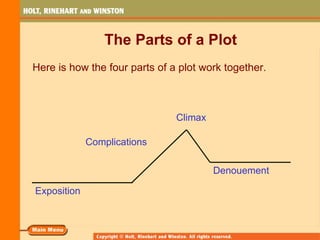
The Parts of a Plot
Here is how the four parts of a plot work together.


                               Climax

             Complications

                                        Denouement

Exposition
What Is Plot?
Plot is the series of related events in a story or play.
•The plot is sometimes called the story line.
•A plot has four main parts:
   • exposition
   • complications
   • climax
   • denouement
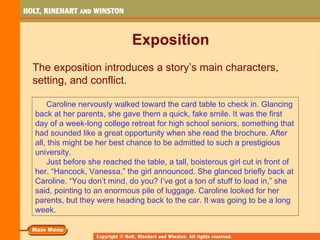
Exposition
The exposition introduces a story’s main characters,
setting, and conflict.

    Caroline nervously walked toward the card table to check in. Glancing
back at her parents, she gave them a quick, fake smile. It was the first
day of a week-long college retreat for high school seniors, something that
had sounded like a great opportunity when she read the brochure. After
all, this might be her best chance to be admitted to such a prestigious
university.
    Just before she reached the table, a tall, boisterous girl cut in front of
her. “Hancock, Vanessa,” the girl announced. She glanced briefly back at
Caroline. “You don’t mind, do you? I’ve got a ton of stuff to load in,” she
said, pointing to an enormous pile of luggage. Caroline looked for her
parents, but they were heading back to the car. It was going to be a long
week.
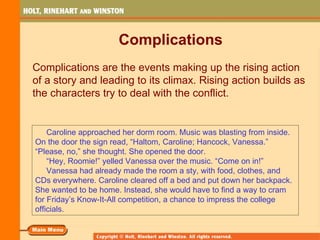
Complications
Complications are the events making up the rising action
of a story and leading to its climax. Rising action builds as
the characters try to deal with the conflict.


    Caroline approached her dorm room. Music was blasting from inside.
On the door the sign read, “Haltom, Caroline; Hancock, Vanessa.”
“Please, no,” she thought. She opened the door.
    “Hey, Roomie!” yelled Vanessa over the music. “Come on in!”
    Vanessa had already made the room a sty, with food, clothes, and
CDs everywhere. Caroline cleared off a bed and put down her backpack.
She wanted to be home. Instead, she would have to find a way to cram
for Friday’s Know-It-All competition, a chance to impress the college
officials.
Climax
The climax is the point in the plot with the greatest
intensity, suspense, or interest. The climax may reveal
how the conflict will turn out.


   This was the last straw. Caroline had lost the competition, she was
embarrassed and exhausted, and now she couldn’t even get the door
open.
   “Vanessa!” she screamed, pounding on the door in frustration.
   She heard Vanessa moving who knows what away from the door.
Then, Vanessa yanked open the door and smiled. “What’s up, Carrie?”
   “What is wrong with you?!” Caroline shrieked. “You haven’t
accomplished a single thing here except for making me miserable! Why
did you even come to this retreat?”
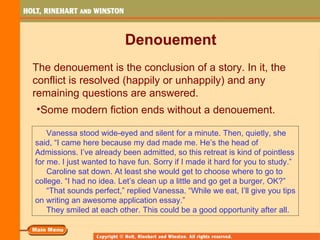
Denouement
The denouement is the conclusion of a story. In it, the
conflict is resolved (happily or unhappily) and any
remaining questions are answered.
•Some modern fiction ends without a denouement.

    Vanessa stood wide-eyed and silent for a minute. Then, quietly, she
said, “I came here because my dad made me. He’s the head of
Admissions. I’ve already been admitted, so this retreat is kind of pointless
for me. I just wanted to have fun. Sorry if I made it hard for you to study.”
    Caroline sat down. At least she would get to choose where to go to
college. “I had no idea. Let’s clean up a little and go get a burger, OK?”
    “That sounds perfect,” replied Vanessa. “While we eat, I’ll give you tips
on writing an awesome application essay.”
    They smiled at each other. This could be a good opportunity after all.
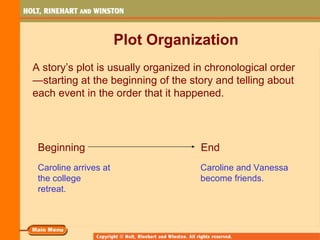
Plot Organization
A story’s plot is usually organized in chronological order
—starting at the beginning of the story and telling about
each event in the order that it happened.


 Beginning                           End
 Caroline arrives at                 Caroline and Vanessa
 the college                         become friends.
 retreat.
Plot Organization
Writers sometimes interrupt the chronological order of
events with flashbacks.
 •A flashback shows a scene from the past that is
  relevant to what is currently happening in the story.


   The whole situation reminded Caroline of when she was seven and
had to share a hotel room with her obnoxious younger cousin. No matter
what Caroline said or did, her cousin ran wild, making noise at all hours,
jumping on her when she was trying to sleep, and leaving food in
Caroline’s bed. Complaining to the adults didn’t help because everyone
thought that four-year-old Ana was adorable. Well, maybe she couldn’t do
anything about it then, but Caroline was determined to do something
about it now.
Plot Organization
Writers may use foreshadowing to hint at events that will
occur later in the plot.
•Foreshadowing gives readers clues in order to arouse
 their curiosity and increase suspense.


     Caroline waited for her turn in the competition. The questions they
were asking Rob Gutierrez seemed so easy. Maybe it would be all right
that she hadn’t been able to study. She glanced at the university officials
making notes. One of them looked up at her, and suddenly Caroline felt a
weight in her stomach. Her brain felt strangely empty. “Haltom, Caroline
. . . Caroline Haltom, please come forward,” the announcer repeated.
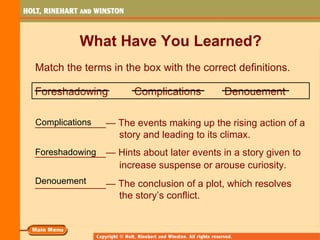
What Have You Learned?
Match the terms in the box with the correct definitions.

Foreshadowing         Complications       Denouement

Complications
_____________— The events making up the rising action of a
               story and leading to its climax.
_____________— Hints about later events in a story given to
Foreshadowing
                  increase suspense or arouse curiosity.
Denouement
_____________— The conclusion of a plot, which resolves
                  the story’s conflict.
The End

11 plot

  • 1.
  • 2.
    The Parts ofa Plot Here is how the four parts of a plot work together. Climax Complications Denouement Exposition
  • 3.
    What Is Plot? Plotis the series of related events in a story or play. •The plot is sometimes called the story line. •A plot has four main parts: • exposition • complications • climax • denouement
  • 4.
    Exposition The exposition introducesa story’s main characters, setting, and conflict. Caroline nervously walked toward the card table to check in. Glancing back at her parents, she gave them a quick, fake smile. It was the first day of a week-long college retreat for high school seniors, something that had sounded like a great opportunity when she read the brochure. After all, this might be her best chance to be admitted to such a prestigious university. Just before she reached the table, a tall, boisterous girl cut in front of her. “Hancock, Vanessa,” the girl announced. She glanced briefly back at Caroline. “You don’t mind, do you? I’ve got a ton of stuff to load in,” she said, pointing to an enormous pile of luggage. Caroline looked for her parents, but they were heading back to the car. It was going to be a long week.
  • 5.
    Complications Complications are theevents making up the rising action of a story and leading to its climax. Rising action builds as the characters try to deal with the conflict. Caroline approached her dorm room. Music was blasting from inside. On the door the sign read, “Haltom, Caroline; Hancock, Vanessa.” “Please, no,” she thought. She opened the door. “Hey, Roomie!” yelled Vanessa over the music. “Come on in!” Vanessa had already made the room a sty, with food, clothes, and CDs everywhere. Caroline cleared off a bed and put down her backpack. She wanted to be home. Instead, she would have to find a way to cram for Friday’s Know-It-All competition, a chance to impress the college officials.
  • 6.
    Climax The climax isthe point in the plot with the greatest intensity, suspense, or interest. The climax may reveal how the conflict will turn out. This was the last straw. Caroline had lost the competition, she was embarrassed and exhausted, and now she couldn’t even get the door open. “Vanessa!” she screamed, pounding on the door in frustration. She heard Vanessa moving who knows what away from the door. Then, Vanessa yanked open the door and smiled. “What’s up, Carrie?” “What is wrong with you?!” Caroline shrieked. “You haven’t accomplished a single thing here except for making me miserable! Why did you even come to this retreat?”
  • 7.
    Denouement The denouement isthe conclusion of a story. In it, the conflict is resolved (happily or unhappily) and any remaining questions are answered. •Some modern fiction ends without a denouement. Vanessa stood wide-eyed and silent for a minute. Then, quietly, she said, “I came here because my dad made me. He’s the head of Admissions. I’ve already been admitted, so this retreat is kind of pointless for me. I just wanted to have fun. Sorry if I made it hard for you to study.” Caroline sat down. At least she would get to choose where to go to college. “I had no idea. Let’s clean up a little and go get a burger, OK?” “That sounds perfect,” replied Vanessa. “While we eat, I’ll give you tips on writing an awesome application essay.” They smiled at each other. This could be a good opportunity after all.
  • 8.
    Plot Organization A story’splot is usually organized in chronological order —starting at the beginning of the story and telling about each event in the order that it happened. Beginning End Caroline arrives at Caroline and Vanessa the college become friends. retreat.
  • 9.
    Plot Organization Writers sometimesinterrupt the chronological order of events with flashbacks. •A flashback shows a scene from the past that is relevant to what is currently happening in the story. The whole situation reminded Caroline of when she was seven and had to share a hotel room with her obnoxious younger cousin. No matter what Caroline said or did, her cousin ran wild, making noise at all hours, jumping on her when she was trying to sleep, and leaving food in Caroline’s bed. Complaining to the adults didn’t help because everyone thought that four-year-old Ana was adorable. Well, maybe she couldn’t do anything about it then, but Caroline was determined to do something about it now.
  • 10.
    Plot Organization Writers mayuse foreshadowing to hint at events that will occur later in the plot. •Foreshadowing gives readers clues in order to arouse their curiosity and increase suspense. Caroline waited for her turn in the competition. The questions they were asking Rob Gutierrez seemed so easy. Maybe it would be all right that she hadn’t been able to study. She glanced at the university officials making notes. One of them looked up at her, and suddenly Caroline felt a weight in her stomach. Her brain felt strangely empty. “Haltom, Caroline . . . Caroline Haltom, please come forward,” the announcer repeated.
  • 11.
    What Have YouLearned? Match the terms in the box with the correct definitions. Foreshadowing Complications Denouement Complications _____________— The events making up the rising action of a story and leading to its climax. _____________— Hints about later events in a story given to Foreshadowing increase suspense or arouse curiosity. Denouement _____________— The conclusion of a plot, which resolves the story’s conflict.
  • 12.