Parathyroid disorders
Embryology and anatomy
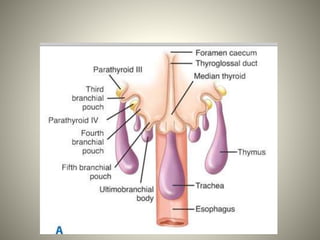
• The superior parathyroid glands are derived from the
fourth branchial pouch and the inferior glands from the
third branchial pouches.
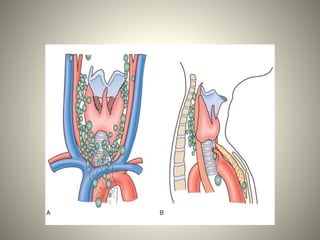
• The position of normal superior parathyroid glands is more
consistent, with 80% of these glands being found near the
posterior aspect of the upper and middle thyroid lobes, at
the level of the cricoid cartilage
• The most common location for inferior glands is within a
distance of 1 cm from a point centered where the inferior
thyroid artery and RLN cross.
• Approximately 15% of inferior glands are found in the
thymus
• The frequency of intrathyroidal glands is about 2%.
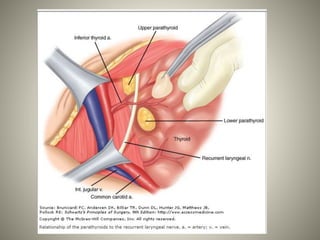
• Most individuals have four parathyroid glands.
• The superior glands usually are dorsal to the RLN at the
level of the cricoid cartilage, whereas the inferior
parathyroid glands are located ventral to the nerve.
• Appear golden yellow to light brown in adults.
• Parathyroid color depends on cellularity, fat content,
and vascularity.
• Normal parathyroid glands are located in loose tissue
or fat and are ovoid.
• They measure up to 7 mm in size
• Arterial supply is mainly by branches from the
inferior thyroid artery, although branches from
the superior thyroid artery supply at least 20% of
upper glands.
• Venous drainage is by ipsilateral superior, middle,
and inferior thyroid veins.
• Histologically, parathyroid glands are composed
of chief cells, oxyphil cells and water-clear cells –
all the three cell types have ability to secret PTH.
PHYSIOLOGY
• Calcium is the most abundant cation in human
beings, and has several crucial functions.
• Extracellular calcium levels are 10,000-fold higher
than intracellular levels, and both are tightly
controlled.
• Extracellular calcium is important for excitation-
contraction coupling in muscle tissues, synaptic
transmission in the nervous system, coagulation,
and secretion of other hormones.
• Intracellular calcium is an important second
messenger regulating cell division, motility,
membrane trafficking, and secretion
• Hypoparathyroidism
– Parathyroid tetany is due to hypocalcaemia
– Etiology
• Thyroidectomy
• Parathyroid surgery
• Maternal hypoparathyroidism -Newborn born to
mother with undiagnosed hypoparathyroidism .
– Symptoms appear in the first few days of life
• Autoimmune disease
– Presentation
• The first symptoms are tingling and numbness in the face, fingers and
toes
• Cramps in the hands a - carpopedal spasm
• Stridor
• Latent tetany may be demonstrated by
– Chvostek’s sign
– Trousseau’s sign
– Diagnosis
• History
• Low serum Ca++ level
– Treatment
• Calcium gluconate
• Vitamin D
• Magnesium supplements
• Hyperparathyroidism
– Primary HPT is the third most common endocrine
disorder, after diabetes mellitus and thyroid
disease
– Middle-aged and elderly women are most
commonly affected by the disease
– Hyperparathyroidism is associated with an
increased secretion of parathyroid hormone
• Classification
1. Primary hyperparathyroidism
– There are elevated serum calcium and intact PTH
(iPTH) levels
– normal or increased urinary calcium
– normal renal function
– is due to parathyroid adenoma or hyperplasia, and
very rarely carcinoma.
– Ionizing radiation and familial predisposition
– Lithium therapy
***In benign familial hypocalciuric hypercalcemia
urinary calcium is low – a hereditary disease that
cannot be corrected by parathyroidectomy
2. Secondary hyperparathyroidism
– is seen in the setting of chronic renal failure
– In renal failure there is chronic hypocalcemia, which
stimulates PTH secretion and parathyroid hyperplasia
– Other less common causes of secondary HPT include
malabsorption syndromes
– All four glands are affected by hyperplasia
3. Tertiary hyperparathyroidism
– in tertiary HPT there is autonomous hyperfunction
and the parathyroids no longer respond to calcium
feedback inhibition, which results in hypercalcemia.
• Acute hyperparathyroidism
– Presents as nausea and abdominal pain followed by
severe vomiting, dehydration, oliguria and finally
coma.
– The serum calcium is very high and leads to
hypercalcemic crisis
– Diagnosis is difficult and too often made after death
– Treatment is urgent
• Rehydration is vital.
• Biphosphonates -(disodium etidronate and pamidronate)
are specific inhibitors of bone resorption
• Clinical features
– Hyperparathyroidism is commoner in women than
men
– Clinical features are enormously variable
– Asymptomatic cases
• The most common presentation is the detection
hypercalcaemia by routine biochemical screening.
– Nonspecific symptoms
• Muscle weakness, thirst, polyuria, anorexia , weight
loss
• Clinical features…
– Bone disease - vague pains
1. Generalised decalcification
2. Single/multiple cysts, pseudotumour
– Renal diseases
1. Renal stones
2. Nephrocalcinosis
3. Hypertension
– Gastrointestinal Complications
1. Peptic ulcer disease
2. Pancreatitis
3. Cholelithiasis
• Clinical features…
– Neuropsychiatric Complications
1. Psychosis, obtundation, or coma
2. Depression, anxiety, and fatigue
3. Electroencephalogram abnormalities
– Other Features
1. muscle weakness
2. Chondrocalcinosis, gout, and pseudogout
3. Tissue calcium deposit (blood vessels, cardiac valves,
and skin)
4. LVH
• Physical Findings
– Palpable neck mass may be thyroid in origin or a
parathyroid cancer
– Corneal calcification
– Band keratopathy
– Fibro-osseous jaw tumors
– Electrocardiographic changes with a shortened
QT interval
• Differential diagnosis
– Secondary cancer in bone (breast, prostate, bronchus,
kidney and thyroid)
– Carcinoma with endocrine secretion (bronchus, kidney and
ovary)
– Multiple myeloma
– Vitamin D intoxication
– Sarcoidosis
– Thyrotoxicosis
– Immobilisation
– Medication: thiazide diuretics, lithium
• Parathormone is not detectable in the blood in the
above-mentioned conditions
• Laboratory Tests
– Serum calcium ↑↑
– PTH assays(immunoradiometric assays) - N or↑
– Serum phosphorus - ↓
– Hyperchloremic metabolic acidosis
– Alkaline phosphatase ↑ in bone diseases
• Imaging tests
– Hand and skull x-rays - may demonstrate osteitis
fibrosa cystica
– Abdominal ultrasound to document renal stones.
• Preoperative localisation
1. Non invasive
– Ultrasound scan
– Computerized tomography
– Thallium-technetium isotope subtraction imaging
– MRI
2. Invasive localization tests
– FNAB
– Angiogram
– Venous sampling
– Intraoperative PTH assay
• Treatment
– Surgery – is the only corrective treatment
– Postoperative vitamin D and calcium replacement
therapy is required for varying periods
• Parathyroid carcinoma
– Rare problem causing hyperparathyroidism
– neck irradiation is a risk factor for the development of
parathyroid adenomas not for carcinoma
– Presents with severe symptoms, serum calcium levels >14
mg/dL, significantly elevated PTH levels (5 x normal) and a
palpable parathyroid gland
– Local invasion is most common
– Tumor is gray-white to gray-brown intraoperatively
• Treatment
– Consists of bilateral neck exploration, with en bloc excision of
the tumor and the ipsilateral thyroid lobe
– Postoperative radiotherapy
3. Parathyroid disorders.pptx

3. Parathyroid disorders.pptx

  • 1.
  • 2.
    Embryology and anatomy •The superior parathyroid glands are derived from the fourth branchial pouch and the inferior glands from the third branchial pouches. • The position of normal superior parathyroid glands is more consistent, with 80% of these glands being found near the posterior aspect of the upper and middle thyroid lobes, at the level of the cricoid cartilage • The most common location for inferior glands is within a distance of 1 cm from a point centered where the inferior thyroid artery and RLN cross. • Approximately 15% of inferior glands are found in the thymus • The frequency of intrathyroidal glands is about 2%.
  • 5.
    • Most individualshave four parathyroid glands. • The superior glands usually are dorsal to the RLN at the level of the cricoid cartilage, whereas the inferior parathyroid glands are located ventral to the nerve. • Appear golden yellow to light brown in adults. • Parathyroid color depends on cellularity, fat content, and vascularity. • Normal parathyroid glands are located in loose tissue or fat and are ovoid. • They measure up to 7 mm in size
  • 7.
    • Arterial supplyis mainly by branches from the inferior thyroid artery, although branches from the superior thyroid artery supply at least 20% of upper glands. • Venous drainage is by ipsilateral superior, middle, and inferior thyroid veins. • Histologically, parathyroid glands are composed of chief cells, oxyphil cells and water-clear cells – all the three cell types have ability to secret PTH.
  • 8.
    PHYSIOLOGY • Calcium isthe most abundant cation in human beings, and has several crucial functions. • Extracellular calcium levels are 10,000-fold higher than intracellular levels, and both are tightly controlled. • Extracellular calcium is important for excitation- contraction coupling in muscle tissues, synaptic transmission in the nervous system, coagulation, and secretion of other hormones. • Intracellular calcium is an important second messenger regulating cell division, motility, membrane trafficking, and secretion
  • 9.
    • Hypoparathyroidism – Parathyroidtetany is due to hypocalcaemia – Etiology • Thyroidectomy • Parathyroid surgery • Maternal hypoparathyroidism -Newborn born to mother with undiagnosed hypoparathyroidism . – Symptoms appear in the first few days of life • Autoimmune disease
  • 10.
    – Presentation • Thefirst symptoms are tingling and numbness in the face, fingers and toes • Cramps in the hands a - carpopedal spasm • Stridor • Latent tetany may be demonstrated by – Chvostek’s sign – Trousseau’s sign – Diagnosis • History • Low serum Ca++ level – Treatment • Calcium gluconate • Vitamin D • Magnesium supplements
  • 11.
    • Hyperparathyroidism – PrimaryHPT is the third most common endocrine disorder, after diabetes mellitus and thyroid disease – Middle-aged and elderly women are most commonly affected by the disease – Hyperparathyroidism is associated with an increased secretion of parathyroid hormone
  • 12.
    • Classification 1. Primaryhyperparathyroidism – There are elevated serum calcium and intact PTH (iPTH) levels – normal or increased urinary calcium – normal renal function – is due to parathyroid adenoma or hyperplasia, and very rarely carcinoma. – Ionizing radiation and familial predisposition – Lithium therapy ***In benign familial hypocalciuric hypercalcemia urinary calcium is low – a hereditary disease that cannot be corrected by parathyroidectomy
  • 13.
    2. Secondary hyperparathyroidism –is seen in the setting of chronic renal failure – In renal failure there is chronic hypocalcemia, which stimulates PTH secretion and parathyroid hyperplasia – Other less common causes of secondary HPT include malabsorption syndromes – All four glands are affected by hyperplasia 3. Tertiary hyperparathyroidism – in tertiary HPT there is autonomous hyperfunction and the parathyroids no longer respond to calcium feedback inhibition, which results in hypercalcemia.
  • 14.
    • Acute hyperparathyroidism –Presents as nausea and abdominal pain followed by severe vomiting, dehydration, oliguria and finally coma. – The serum calcium is very high and leads to hypercalcemic crisis – Diagnosis is difficult and too often made after death – Treatment is urgent • Rehydration is vital. • Biphosphonates -(disodium etidronate and pamidronate) are specific inhibitors of bone resorption
  • 15.
    • Clinical features –Hyperparathyroidism is commoner in women than men – Clinical features are enormously variable – Asymptomatic cases • The most common presentation is the detection hypercalcaemia by routine biochemical screening. – Nonspecific symptoms • Muscle weakness, thirst, polyuria, anorexia , weight loss
  • 16.
    • Clinical features… –Bone disease - vague pains 1. Generalised decalcification 2. Single/multiple cysts, pseudotumour – Renal diseases 1. Renal stones 2. Nephrocalcinosis 3. Hypertension – Gastrointestinal Complications 1. Peptic ulcer disease 2. Pancreatitis 3. Cholelithiasis
  • 17.
    • Clinical features… –Neuropsychiatric Complications 1. Psychosis, obtundation, or coma 2. Depression, anxiety, and fatigue 3. Electroencephalogram abnormalities – Other Features 1. muscle weakness 2. Chondrocalcinosis, gout, and pseudogout 3. Tissue calcium deposit (blood vessels, cardiac valves, and skin) 4. LVH
  • 18.
    • Physical Findings –Palpable neck mass may be thyroid in origin or a parathyroid cancer – Corneal calcification – Band keratopathy – Fibro-osseous jaw tumors – Electrocardiographic changes with a shortened QT interval
  • 19.
    • Differential diagnosis –Secondary cancer in bone (breast, prostate, bronchus, kidney and thyroid) – Carcinoma with endocrine secretion (bronchus, kidney and ovary) – Multiple myeloma – Vitamin D intoxication – Sarcoidosis – Thyrotoxicosis – Immobilisation – Medication: thiazide diuretics, lithium • Parathormone is not detectable in the blood in the above-mentioned conditions
  • 20.
    • Laboratory Tests –Serum calcium ↑↑ – PTH assays(immunoradiometric assays) - N or↑ – Serum phosphorus - ↓ – Hyperchloremic metabolic acidosis – Alkaline phosphatase ↑ in bone diseases • Imaging tests – Hand and skull x-rays - may demonstrate osteitis fibrosa cystica – Abdominal ultrasound to document renal stones.
  • 21.
    • Preoperative localisation 1.Non invasive – Ultrasound scan – Computerized tomography – Thallium-technetium isotope subtraction imaging – MRI 2. Invasive localization tests – FNAB – Angiogram – Venous sampling – Intraoperative PTH assay
  • 22.
    • Treatment – Surgery– is the only corrective treatment – Postoperative vitamin D and calcium replacement therapy is required for varying periods
  • 23.
    • Parathyroid carcinoma –Rare problem causing hyperparathyroidism – neck irradiation is a risk factor for the development of parathyroid adenomas not for carcinoma – Presents with severe symptoms, serum calcium levels >14 mg/dL, significantly elevated PTH levels (5 x normal) and a palpable parathyroid gland – Local invasion is most common – Tumor is gray-white to gray-brown intraoperatively • Treatment – Consists of bilateral neck exploration, with en bloc excision of the tumor and the ipsilateral thyroid lobe – Postoperative radiotherapy