Microbiology
AN INTRODUCTION
EIGHTH EDITION
TORTORA • FUNKE • CASE
Observing Microorganisms
Through a Microscope
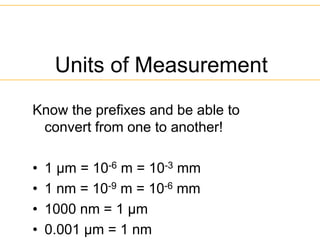
Units of Measurement
Know the prefixes and be able to
convert from one to another!
• 1 µm = 10-6 m = 10-3 mm
• 1 nm = 10-9 m = 10-6 mm
• 1000 nm = 1 µm
• 0.001 µm = 1 nm
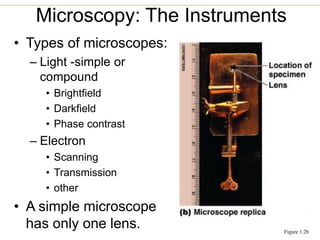
• Types of microscopes:
– Light -simple or
compound
• Brightfield
• Darkfield
• Phase contrast
– Electron
• Scanning
• Transmission
• other
• A simple microscope
has only one lens.
Microscopy: The Instruments
Figure 1.2b
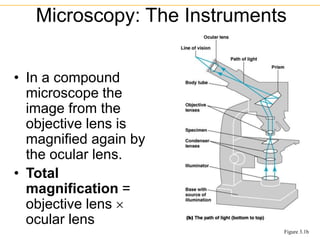
• In a compound
microscope the
image from the
objective lens is
magnified again by
the ocular lens.
• Total
magnification =
objective lens 
ocular lens
Microscopy: The Instruments
Figure 3.1b
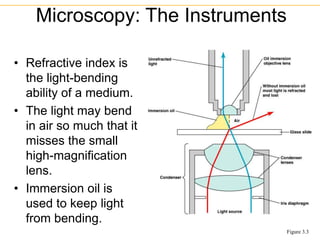
• Refractive index is
the light-bending
ability of a medium.
• The light may bend
in air so much that it
misses the small
high-magnification
lens.
• Immersion oil is
used to keep light
from bending.
Microscopy: The Instruments
Figure 3.3
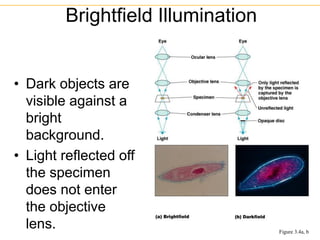
• Dark objects are
visible against a
bright
background.
• Light reflected off
the specimen
does not enter
the objective
lens.
Brightfield Illumination
Figure 3.4a, b
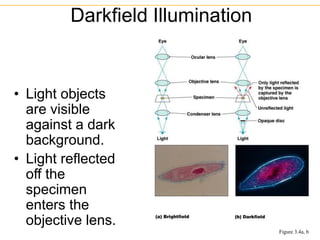
• Light objects
are visible
against a dark
background.
• Light reflected
off the
specimen
enters the
objective lens.
Darkfield Illumination
Figure 3.4a, b
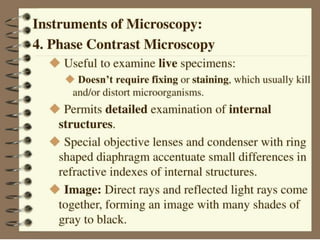
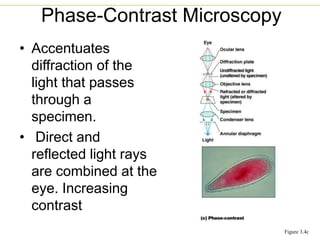
• Accentuates
diffraction of the
light that passes
through a
specimen.
• Direct and
reflected light rays
are combined at the
eye. Increasing
contrast
Phase-Contrast Microscopy
Figure 3.4c
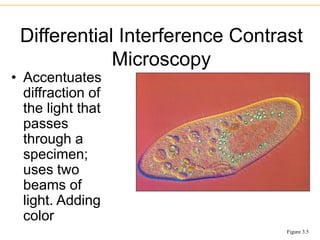
• Accentuates
diffraction of
the light that
passes
through a
specimen;
uses two
beams of
light. Adding
color
Differential Interference Contrast
Microscopy
Figure 3.5
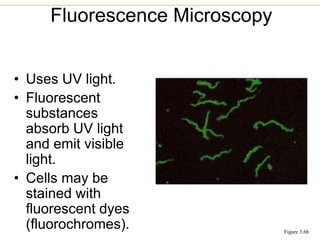
• Uses UV light.
• Fluorescent
substances
absorb UV light
and emit visible
light.
• Cells may be
stained with
fluorescent dyes
(fluorochromes).
Fluorescence Microscopy
Figure 3.6b
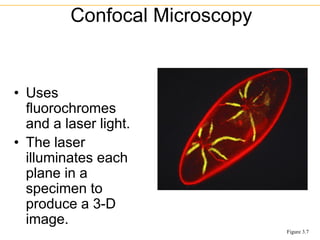
• Uses
fluorochromes
and a laser light.
• The laser
illuminates each
plane in a
specimen to
produce a 3-D
image.
Confocal Microscopy
Figure 3.7
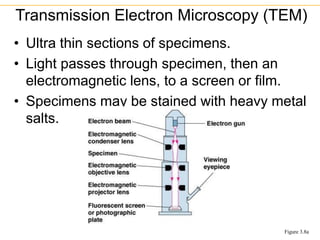
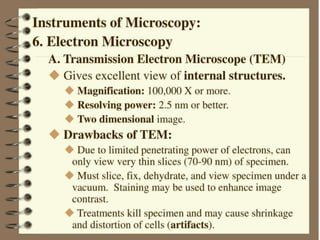
• Ultra thin sections of specimens.
• Light passes through specimen, then an
electromagnetic lens, to a screen or film.
• Specimens may be stained with heavy metal
salts.
Transmission Electron Microscopy (TEM)
Figure 3.8a
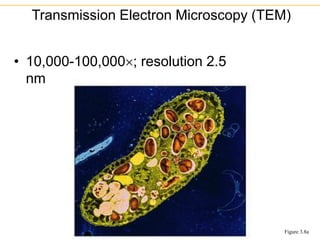
• 10,000-100,000; resolution 2.5
nm
Transmission Electron Microscopy (TEM)
Figure 3.8a
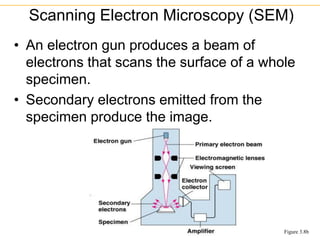
• An electron gun produces a beam of
electrons that scans the surface of a whole
specimen.
• Secondary electrons emitted from the
specimen produce the image.
Scanning Electron Microscopy (SEM)
Figure 3.8b
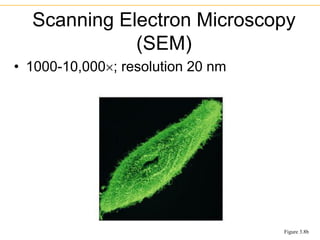
• 1000-10,000; resolution 20 nm
Scanning Electron Microscopy
(SEM)
Figure 3.8b
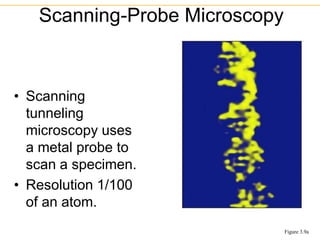
• Scanning
tunneling
microscopy uses
a metal probe to
scan a specimen.
• Resolution 1/100
of an atom.
Scanning-Probe Microscopy
Figure 3.9a
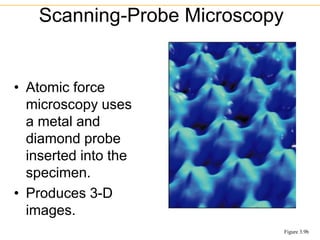
• Atomic force
microscopy uses
a metal and
diamond probe
inserted into the
specimen.
• Produces 3-D
images.
Scanning-Probe Microscopy
Figure 3.9b
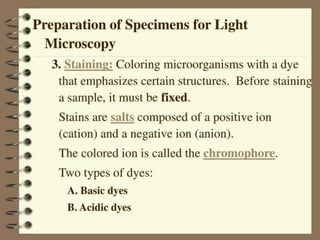
Preparation of Specimens for
Light Microscopy
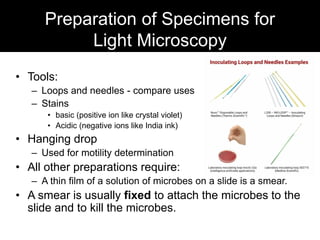
• Tools:
– Loops and needles - compare uses
– Stains
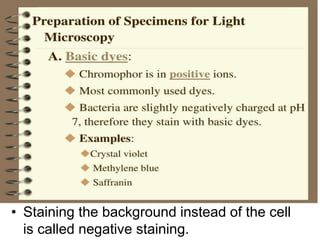
• basic (positive ion like crystal violet)
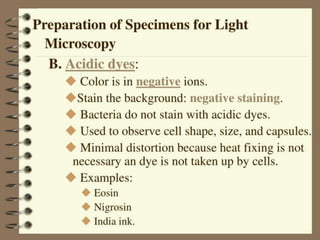
• Acidic (negative ions like India ink)
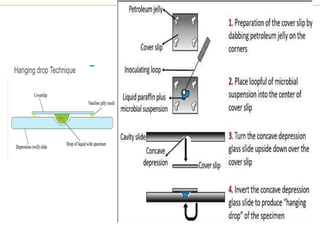
• Hanging drop
– Used for motility determination
• All other preparations require:
– A thin film of a solution of microbes on a slide is a smear.
• A smear is usually fixed to attach the microbes to the
slide and to kill the microbes.
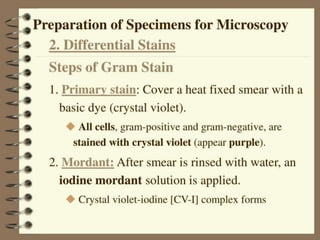
• Stains consist of a positive and negative
ion.
• In a basic dye, the chromophore is a cation
(+).
• In an acidic dye, the chromophore is an
anion (-).
• Staining the background instead of the cell
is called negative staining.
Preparing Smears for Staining
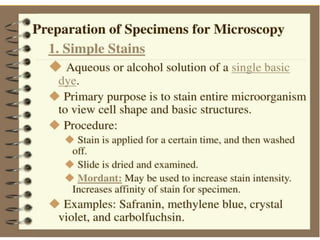
• Use of a single basic dye is called a
simple stain.
• A mordant may be used to hold the
stain or coat the specimen to enlarge it.
Simple Stains
• Differential stains are used to differentiate
between types of bacteria
– Gram
– Acid fast
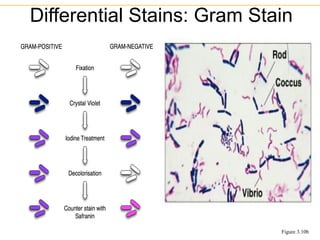
• The Gram stain classifies bacteria into
gram-positive and gram-negative.
• Gram-positive bacteria tend to be killed by
penicillin and detergents.
• Gram-negative bacteria are more resistant
to antibiotics.
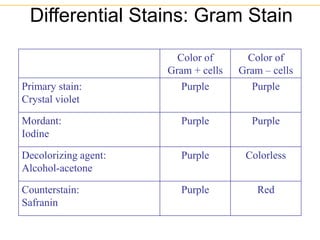
Differential Stains: Gram Stain
Color of
Gram + cells
Color of
Gram – cells
Primary stain:
Crystal violet
Purple Purple
Mordant:
Iodine
Purple Purple
Decolorizing agent:
Alcohol-acetone
Purple Colorless
Counterstain:
Safranin
Purple Red
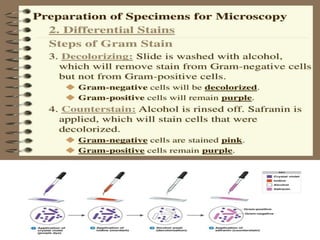
Differential Stains: Gram Stain
Figure 3.10b
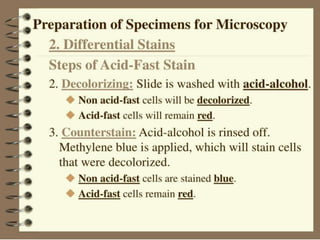
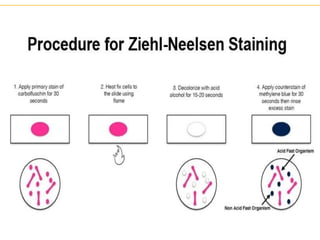
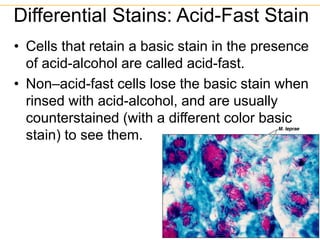
• Cells that retain a basic stain in the presence
of acid-alcohol are called acid-fast.
• Non–acid-fast cells lose the basic stain when
rinsed with acid-alcohol, and are usually
counterstained (with a different color basic
stain) to see them.
Differential Stains: Acid-Fast Stain
Figure 3.11
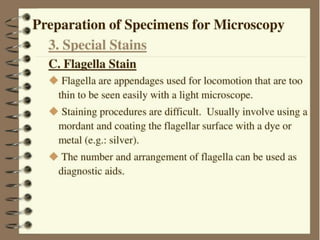
• The most common mordant used is
tannic acid, which enhances the
thickness of the flagella.
• Dyes like carbolfuchsin or Leifson's dye
solution are then used to stain the
thickened flagella.
• A common procedure involves applying
the mordant, rinsing, and then staining
with the dye
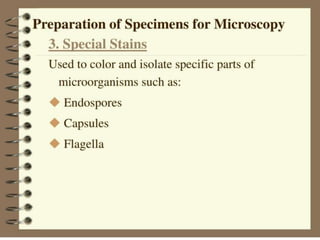
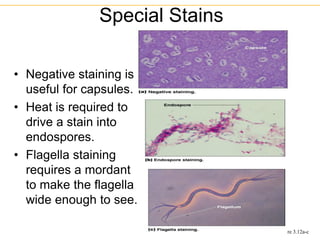
• Negative staining is
useful for capsules.
• Heat is required to
drive a stain into
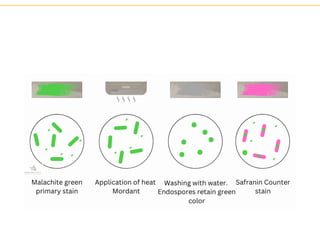
endospores.
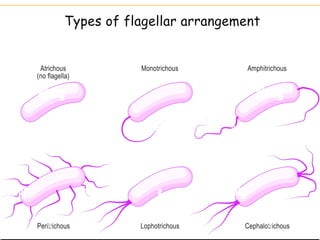
• Flagella staining
requires a mordant
to make the flagella
wide enough to see.
Special Stains
Figure 3.12a-c
3.observing micro organism.pdf microbiology

3.observing micro organism.pdf microbiology

  • 1.
    Microbiology AN INTRODUCTION EIGHTH EDITION TORTORA• FUNKE • CASE Observing Microorganisms Through a Microscope
  • 2.
    Units of Measurement Knowthe prefixes and be able to convert from one to another! • 1 µm = 10-6 m = 10-3 mm • 1 nm = 10-9 m = 10-6 mm • 1000 nm = 1 µm • 0.001 µm = 1 nm
  • 3.
    • Types ofmicroscopes: – Light -simple or compound • Brightfield • Darkfield • Phase contrast – Electron • Scanning • Transmission • other • A simple microscope has only one lens. Microscopy: The Instruments Figure 1.2b
  • 7.
    • In acompound microscope the image from the objective lens is magnified again by the ocular lens. • Total magnification = objective lens  ocular lens Microscopy: The Instruments Figure 3.1b
  • 9.
    • Refractive indexis the light-bending ability of a medium. • The light may bend in air so much that it misses the small high-magnification lens. • Immersion oil is used to keep light from bending. Microscopy: The Instruments Figure 3.3
  • 10.
    • Dark objectsare visible against a bright background. • Light reflected off the specimen does not enter the objective lens. Brightfield Illumination Figure 3.4a, b
  • 12.
    • Light objects arevisible against a dark background. • Light reflected off the specimen enters the objective lens. Darkfield Illumination Figure 3.4a, b
  • 14.
    • Accentuates diffraction ofthe light that passes through a specimen. • Direct and reflected light rays are combined at the eye. Increasing contrast Phase-Contrast Microscopy Figure 3.4c
  • 15.
    • Accentuates diffraction of thelight that passes through a specimen; uses two beams of light. Adding color Differential Interference Contrast Microscopy Figure 3.5
  • 18.
    • Uses UVlight. • Fluorescent substances absorb UV light and emit visible light. • Cells may be stained with fluorescent dyes (fluorochromes). Fluorescence Microscopy Figure 3.6b
  • 19.
    • Uses fluorochromes and alaser light. • The laser illuminates each plane in a specimen to produce a 3-D image. Confocal Microscopy Figure 3.7
  • 21.
    • Ultra thinsections of specimens. • Light passes through specimen, then an electromagnetic lens, to a screen or film. • Specimens may be stained with heavy metal salts. Transmission Electron Microscopy (TEM) Figure 3.8a
  • 22.
    • 10,000-100,000; resolution2.5 nm Transmission Electron Microscopy (TEM) Figure 3.8a
  • 24.
    • An electrongun produces a beam of electrons that scans the surface of a whole specimen. • Secondary electrons emitted from the specimen produce the image. Scanning Electron Microscopy (SEM) Figure 3.8b
  • 26.
    • 1000-10,000; resolution20 nm Scanning Electron Microscopy (SEM) Figure 3.8b
  • 28.
    • Scanning tunneling microscopy uses ametal probe to scan a specimen. • Resolution 1/100 of an atom. Scanning-Probe Microscopy Figure 3.9a
  • 29.
    • Atomic force microscopyuses a metal and diamond probe inserted into the specimen. • Produces 3-D images. Scanning-Probe Microscopy Figure 3.9b
  • 30.
    Preparation of Specimensfor Light Microscopy • Tools: – Loops and needles - compare uses – Stains • basic (positive ion like crystal violet) • Acidic (negative ions like India ink) • Hanging drop – Used for motility determination • All other preparations require: – A thin film of a solution of microbes on a slide is a smear. • A smear is usually fixed to attach the microbes to the slide and to kill the microbes.
  • 34.
    • Stains consistof a positive and negative ion. • In a basic dye, the chromophore is a cation (+). • In an acidic dye, the chromophore is an anion (-). • Staining the background instead of the cell is called negative staining. Preparing Smears for Staining
  • 36.
    • Use ofa single basic dye is called a simple stain. • A mordant may be used to hold the stain or coat the specimen to enlarge it. Simple Stains
  • 37.
    • Differential stainsare used to differentiate between types of bacteria – Gram – Acid fast • The Gram stain classifies bacteria into gram-positive and gram-negative. • Gram-positive bacteria tend to be killed by penicillin and detergents. • Gram-negative bacteria are more resistant to antibiotics. Differential Stains: Gram Stain
  • 42.
    Differential Stains: GramStain Color of Gram + cells Color of Gram – cells Primary stain: Crystal violet Purple Purple Mordant: Iodine Purple Purple Decolorizing agent: Alcohol-acetone Purple Colorless Counterstain: Safranin Purple Red
  • 43.
    Differential Stains: GramStain Figure 3.10b
  • 48.
    • Cells thatretain a basic stain in the presence of acid-alcohol are called acid-fast. • Non–acid-fast cells lose the basic stain when rinsed with acid-alcohol, and are usually counterstained (with a different color basic stain) to see them. Differential Stains: Acid-Fast Stain Figure 3.11
  • 55.
    • The mostcommon mordant used is tannic acid, which enhances the thickness of the flagella. • Dyes like carbolfuchsin or Leifson's dye solution are then used to stain the thickened flagella. • A common procedure involves applying the mordant, rinsing, and then staining with the dye
  • 56.
    • Negative stainingis useful for capsules. • Heat is required to drive a stain into endospores. • Flagella staining requires a mordant to make the flagella wide enough to see. Special Stains Figure 3.12a-c