1 
 
 
MAPEH
Learner’s Material
Unit 2
Melody and Form
3
  This instructional material was collaboratively developed
and reviewed by educators from public and private schools,
colleges, and/or universities. We encourage teachers and other
education stakeholders to email their feedback, comments, and
recommendations to the Department of Education at
action@deped.gov.ph.
2 
 
MAPEH – Grade 3
Learner’s Material
First Edition, 2013
ISBN:
Republic Act 8293, section 176 states that: No copyright shall subsist in any work
of the Government of the Philippines. However, prior approval of the government agency or
office wherein the work is created shall be necessary for exploitation of such work for profit.
Such agency or office may, among other things, impose as a condition the payment of
royalties.
Borrowed materials (i.e., songs, stories, poems, pictures, photos, brand names,
trademarks, etc.) included in this book are owned by their respective copyright holders.
Every effort has been exerted to locate and seek permission to use these materials from
their respective copyright owners. The publisher and authors do not represent nor claim
ownership over them.
Published by the Department of Education
Secretary: Br. Armin A. Luistro FSC
Undersecretary: Dina S. Ocampo, Ph.D.
Printed in the Philippines by ____________
Department of Education-Instructional Materials Council Secretariat (DepEd-IMCS)
Office Address: 2nd Floor Dorm G, PSC Complex
Meralco Avenue, Pasig City
Philippines 1600
Telefax: (02) 634-1054, 634-1072
E-mail Address: imcsetd@yahoo.com
Development Team of the Learner’s Material
3 
 
Table of Contents
Second Quarter
Lesson 1
Pitch…………………………………………… 4
Lesson 2
Melodic Contour……………………………. 8
Lesson 3
Perfect Pitch…………………………………. 11
Lesson 4
Musical Form……………………………….. 15
Lesson 5
Repetitions in Music………………………. 18
Lesson 6
Musical Lines………………………………. 20
Lesson 7
Beginning and Ending…………………… 23
Lesson 8
Singing in Tune……………………………. 25
4 
 
Melody is composed of tones that vary in pitch.
Pitch can be of low, moderate, and high tone. These
tones move in different directions.
 
Second Quarter
Lesson 1: Pitch
Week I
Introduction
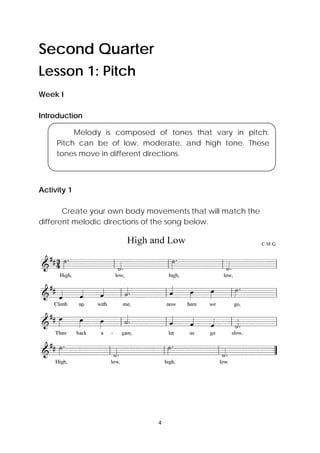
Activity 1
Create your own body movements that will match the
different melodic directions of the song below.
5 
 
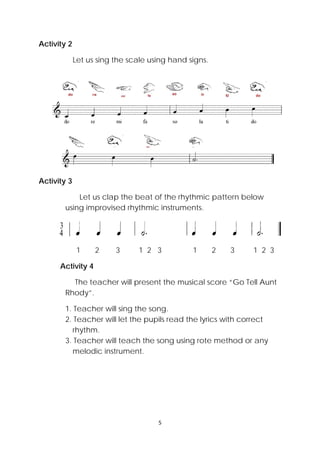
Activity 2
Let us sing the scale using hand signs.
Activity 3
Let us clap the beat of the rhythmic pattern below
using improvised rhythmic instruments.
1 2 3 1 2 3 1 2 3 1 2 3
Activity 4
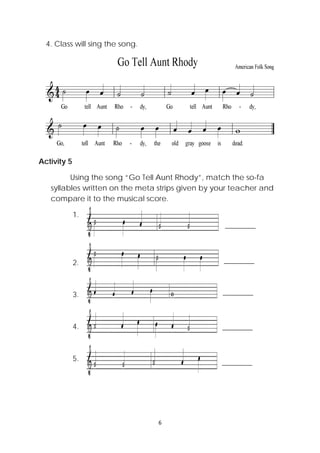
The teacher will present the musical score “Go Tell Aunt
Rhody”.
1. Teacher will sing the song.
2. Teacher will let the pupils read the lyrics with correct
rhythm.
3. Teacher will teach the song using rote method or any
melodic instrument.
6 
 
4. Class will sing the song.
Activity 5
Using the song “Go Tell Aunt Rhody”, match the so-fa
syllables written on the meta strips given by your teacher and
compare it to the musical score.
1.
2.
3.
4.
5.
7 
 
Activity 6
Create any body movement that will show the following
pitch:
1. high
2. moderately high
3. moderately low
4. low
 Have the pupils sing “Go Tell Aunt Rhody”. Using
flaglets of different colors, do the following body
movements:
high – hands upward
mid – hands sideward
low – hands downward
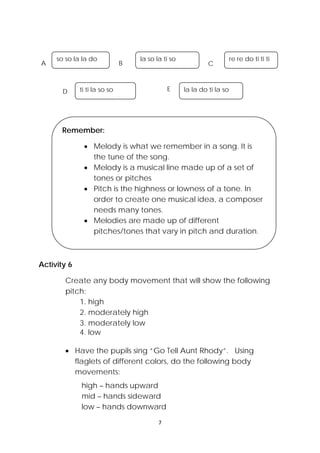
Remember:
 Melody is what we remember in a song. It is
the tune of the song.
 Melody is a musical line made up of a set of
tones or pitches
 Pitch is the highness or lowness of a tone. In
order to create one musical idea, a composer
needs many tones.
 Melodies are made up of different
pitches/tones that vary in pitch and duration.
so so la la do
A
la so la ti so re re do ti ti ti
B C
D ti ti la so so 
D
E la la do ti la so
8 
 
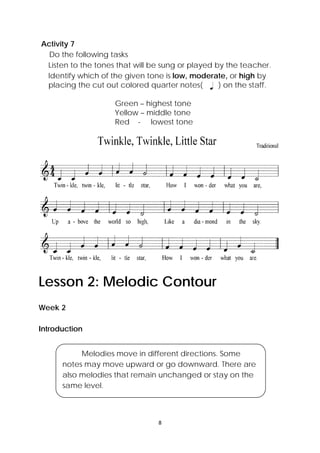
Activity 7
Do the following tasks
Listen to the tones that will be sung or played by the teacher.
Identify which of the given tone is low, moderate, or high by
placing the cut out colored quarter notes( ) on the staff.
Green – highest tone
Yellow – middle tone
Red - lowest tone
Lesson 2: Melodic Contour
Week 2
Introduction
Melodies move in different directions. Some
notes may move upward or go downward. There are
also melodies that remain unchanged or stay on the
same level.
9 
 
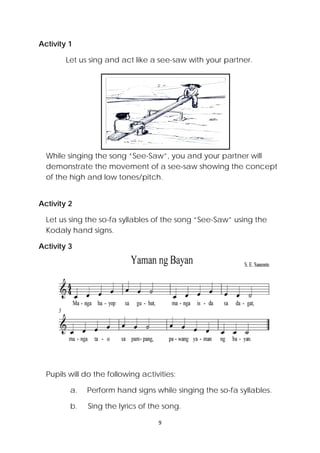
Activity 1
Let us sing and act like a see-saw with your partner.
While singing the song “See-Saw”, you and your partner will
demonstrate the movement of a see-saw showing the concept
of the high and low tones/pitch.
Activity 2
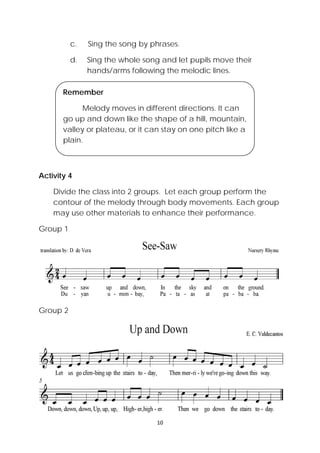
Let us sing the so-fa syllables of the song “See-Saw” using the
Kodaly hand signs.
Activity 3
Pupils will do the following activities:
a. Perform hand signs while singing the so-fa syllables.
b. Sing the lyrics of the song.
10 
 
c. Sing the song by phrases.
d. Sing the whole song and let pupils move their
hands/arms following the melodic lines.
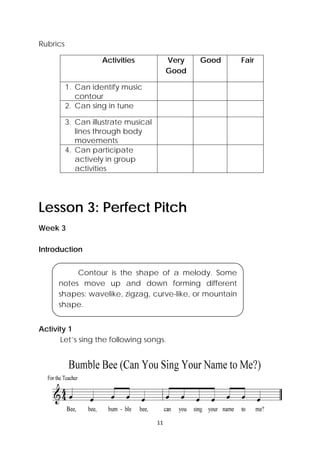
Activity 4
Divide the class into 2 groups. Let each group perform the
contour of the melody through body movements. Each group
may use other materials to enhance their performance.
Group 1
Group 2
Remember
Melody moves in different directions. It can
go up and down like the shape of a hill, mountain,
valley or plateau, or it can stay on one pitch like a
plain.
11 
 
Rubrics
Activities Very
Good
Good Fair
1. Can identify music
contour
2. Can sing in tune
3. Can illustrate musical
lines through body
movements
4. Can participate
actively in group
activities
Lesson 3: Perfect Pitch
Week 3
Introduction
Activity 1
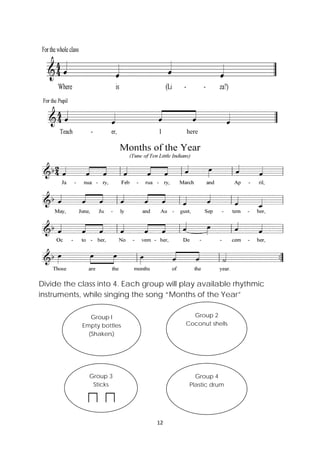
Let’s sing the following songs.
Contour is the shape of a melody. Some
notes move up and down forming different
shapes: wavelike, zigzag, curve-like, or mountain
shape.
12 
 
Divide the class into 4. Each group will play available rhythmic
instruments, while singing the song “Months of the Year”
Group I
Empty bottles
(Shakers)
Group 2
Coconut shells
Group 3
Sticks
Group 4
Plastic drum
here
13 
 
Activity 2
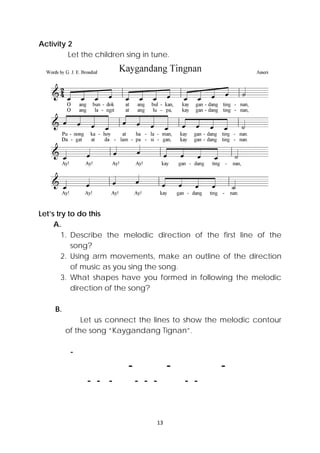
Let the children sing in tune.
Let’s try to do this
A.
1. Describe the melodic direction of the first line of the
song?
2. Using arm movements, make an outline of the direction
of music as you sing the song.
3. What shapes have you formed in following the melodic
direction of the song?
B.
Let us connect the lines to show the melodic contour
of the song “Kaygandang Tignan”.
-
- - -
- - - - - - - -
adapted
14 
 
Activity 3
Using crayons let the pupils draw on their notebooks the
melodic directions they hear. The teacher will play or sing the
following:
1. Happy Birthday Song
2. Rain, Rain, Go Away
Evaluation
Divide the class into 4 groups. The leader of each group will draw
lots where the directions of the melodies are written. Each group
is expected to perform each melodic contour using body
movements, drawing, singing or writing on meta strips.
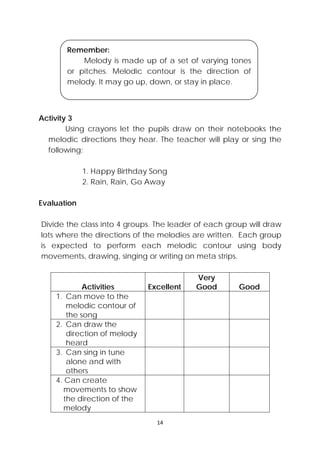
Activities Excellent
Very
Good Good
1. Can move to the
melodic contour of
the song
2. Can draw the
direction of melody
heard
3. Can sing in tune
alone and with
others
4. Can create
movements to show
the direction of the
melody
Remember:
Melody is made up of a set of varying tones
or pitches. Melodic contour is the direction of
melody. It may go up, down, or stay in place.
15 
 
5. Can participate
actively in all group
activities
 
Lesson 4: Musical Form
Week 4
Introduction
Activity 1
Pupils will identify the title of the following songs.
a. …ang mamatay ng dahil sa‘yo.
b. Ang bayan ko’y tanging ikaw
c. …dala-dala’y buslo
d. …sa paligid-ligid ay maraming linga.
Activity 2
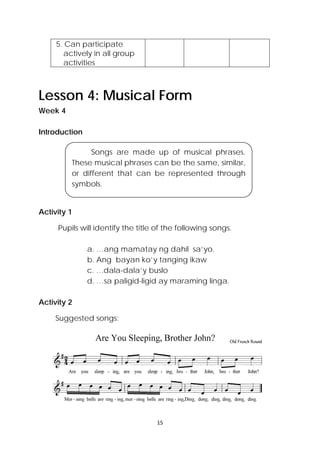
Suggested songs:
Songs are made up of musical phrases.
These musical phrases can be the same, similar,
or different that can be represented through
symbols.
16 
 
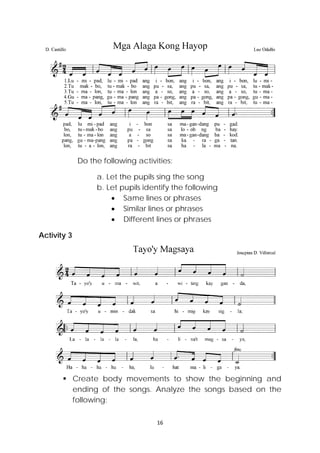
Do the following activities:
a. Let the pupils sing the song
b. Let pupils identify the following
 Same lines or phrases
 Similar lines or phrases
 Different lines or phrases
Activity 3
 Create body movements to show the beginning and
ending of the songs. Analyze the songs based on the
following:
17 
 
a. same (melody and rhythm)
b. different (melody and rhythm)
c. similar (melody and rhythm)
 Draw a star on same melodic lines, a circle on different
melodic lines, and a triangle on similar melodic lines.
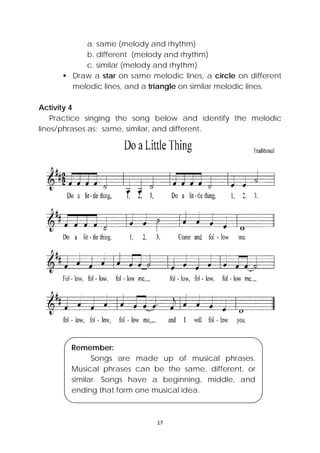
Activity 4
Practice singing the song below and identify the melodic
lines/phrases as: same, similar, and different.
Remember:
Songs are made up of musical phrases.
Musical phrases can be the same, different, or
similar. Songs have a beginning, middle, and
ending that form one musical idea.
18 
 
Evaluation
Rubrics
Activities Excellent Very Good Good
Needs
help from
doing the
task
1. Can identify the
beginning, middle and
ending of the song
2. Can identify same,
similar and different
musical lines or phrases
in the song
3. Can sing same, similar
and different phrases in
the song
4. Can show musical lines
or phrases through
body movements and
geometric shapes or
objects
5. Can participate
actively in the group
activity
Lesson 5: Repetitions in Music
Week 5
Introduction
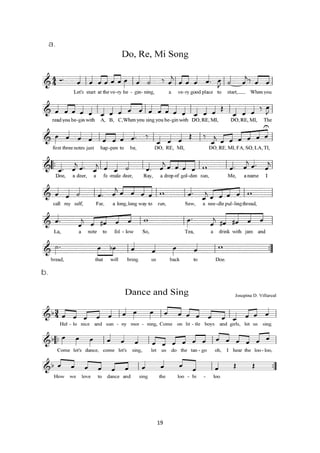
Activity 1
Sing the song following the repeat mark.
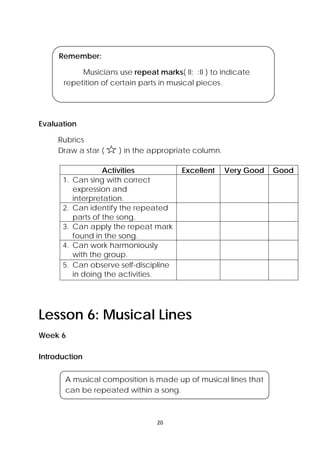
The repeat mark ( II: :II ) is used to show repetition in music.
19 
 
a.
b.
20 
 
Evaluation
Rubrics
Draw a star ( ) in the appropriate column.
Lesson 6: Musical Lines
Week 6
Introduction
Activities Excellent Very Good Good
1. Can sing with correct
expression and
interpretation.
2. Can identify the repeated
parts of the song.
3. Can apply the repeat mark
found in the song.
4. Can work harmoniously
with the group.
5. Can observe self-discipline
in doing the activities.
Remember:
Musicians use repeat marks( II: :II ) to indicate
repetition of certain parts in musical pieces.
A musical composition is made up of musical lines that
can be repeated within a song.
21 
 
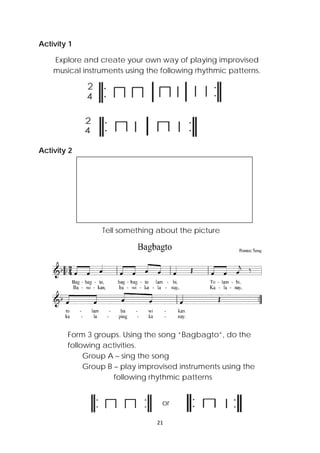
Activity 1
Explore and create your own way of playing improvised
musical instruments using the following rhythmic patterns.
Activity 2
Tell something about the picture
Form 3 groups. Using the song “Bagbagto”, do the
following activities.
Group A – sing the song
Group B – play improvised instruments using the
following rhythmic patterns
                                         
 
or
22 
 
Group C – create dance steps to the beat of the song
Activity 3
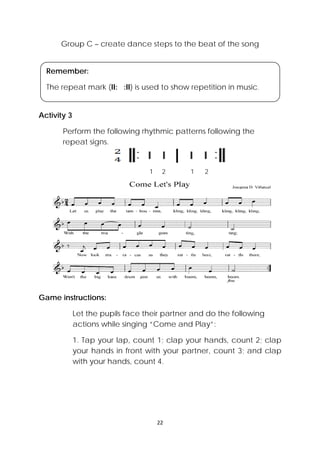
Perform the following rhythmic patterns following the
repeat signs.
1 2 1 2
Game instructions:
Let the pupils face their partner and do the following
actions while singing “Come and Play”:
1. Tap your lap, count 1; clap your hands, count 2; clap
your hands in front with your partner, count 3; and clap
with your hands, count 4.
Remember:
The repeat mark (II: :II) is used to show repetition in music.
23 
 
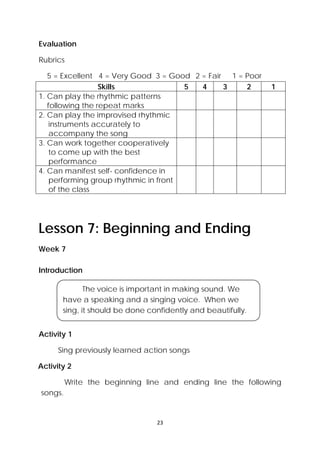
Evaluation
Rubrics
5 = Excellent 4 = Very Good 3 = Good 2 = Fair 1 = Poor
Skills 5 4 3 2 1
1. Can play the rhythmic patterns
following the repeat marks
2. Can play the improvised rhythmic
instruments accurately to
accompany the song
3. Can work together cooperatively
to come up with the best
performance
4. Can manifest self- confidence in
performing group rhythmic in front
of the class
Lesson 7: Beginning and Ending
Week 7
Introduction
Activity 1
Sing previously learned action songs
Activity 2
Write the beginning line and ending line the following
songs.
The voice is important in making sound. We
have a speaking and a singing voice. When we
sing, it should be done confidently and beautifully.  
24 
 
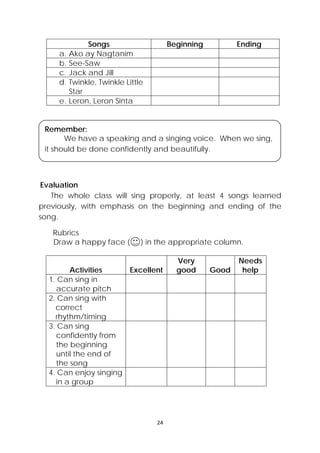
Songs Beginning Ending
a. Ako ay Nagtanim
b. See-Saw
c. Jack and Jill
d. Twinkle, Twinkle Little
Star
e. Leron, Leron Sinta
Evaluation
The whole class will sing properly, at least 4 songs learned
previously, with emphasis on the beginning and ending of the
song.
Rubrics
Draw a happy face ( ) in the appropriate column.
Activities Excellent
Very
good Good
Needs
help
1. Can sing in
accurate pitch
2. Can sing with
correct
rhythm/timing
3. Can sing
confidently from
the beginning
until the end of
the song
4. Can enjoy singing
in a group
Remember:
We have a speaking and a singing voice. When we sing,
it should be done confidently and beautifully.  
25 
 
Lesson 8: Singing in Tune
Week 8
Introduction
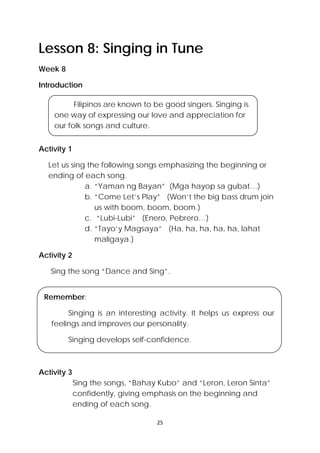
Activity 1
Let us sing the following songs emphasizing the beginning or
ending of each song.
a. “Yaman ng Bayan” (Mga hayop sa gubat…)
b. “Come Let’s Play” (Won’t the big bass drum join
us with boom, boom, boom.)
c. “Lubi-Lubi” (Enero, Pebrero…)
d. “Tayo’y Magsaya” (Ha, ha, ha, ha, ha, lahat
maligaya.)
Activity 2
Sing the song “Dance and Sing”.
Activity 3
Sing the songs, “Bahay Kubo” and “Leron, Leron Sinta”
confidently, giving emphasis on the beginning and
ending of each song.
Filipinos are known to be good singers. Singing is
one way of expressing our love and appreciation for
our folk songs and culture.
Remember:
Singing is an interesting activity. It helps us express our
feelings and improves our personality.
Singing develops self-confidence.
26 
 
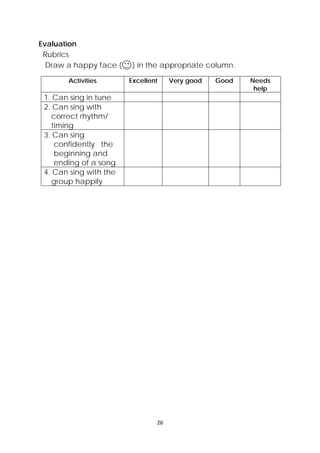
Evaluation
Rubrics
Draw a happy face ( ) in the appropriate column.
Activities Excellent Very good Good Needs
help
1. Can sing in tune
2. Can sing with
correct rhythm/
timing
3. Can sing
confidently the
beginning and
ending of a song
4. Can sing with the
group happily
 

3 music lm q2

  • 1.
    1      MAPEH Learner’s Material Unit 2 Melodyand Form 3   This instructional material was collaboratively developed and reviewed by educators from public and private schools, colleges, and/or universities. We encourage teachers and other education stakeholders to email their feedback, comments, and recommendations to the Department of Education at action@deped.gov.ph.
  • 2.
    2    MAPEH – Grade3 Learner’s Material First Edition, 2013 ISBN: Republic Act 8293, section 176 states that: No copyright shall subsist in any work of the Government of the Philippines. However, prior approval of the government agency or office wherein the work is created shall be necessary for exploitation of such work for profit. Such agency or office may, among other things, impose as a condition the payment of royalties. Borrowed materials (i.e., songs, stories, poems, pictures, photos, brand names, trademarks, etc.) included in this book are owned by their respective copyright holders. Every effort has been exerted to locate and seek permission to use these materials from their respective copyright owners. The publisher and authors do not represent nor claim ownership over them. Published by the Department of Education Secretary: Br. Armin A. Luistro FSC Undersecretary: Dina S. Ocampo, Ph.D. Printed in the Philippines by ____________ Department of Education-Instructional Materials Council Secretariat (DepEd-IMCS) Office Address: 2nd Floor Dorm G, PSC Complex Meralco Avenue, Pasig City Philippines 1600 Telefax: (02) 634-1054, 634-1072 E-mail Address: imcsetd@yahoo.com Development Team of the Learner’s Material
  • 3.
    3    Table of Contents SecondQuarter Lesson 1 Pitch…………………………………………… 4 Lesson 2 Melodic Contour……………………………. 8 Lesson 3 Perfect Pitch…………………………………. 11 Lesson 4 Musical Form……………………………….. 15 Lesson 5 Repetitions in Music………………………. 18 Lesson 6 Musical Lines………………………………. 20 Lesson 7 Beginning and Ending…………………… 23 Lesson 8 Singing in Tune……………………………. 25
  • 4.
    4    Melody is composedof tones that vary in pitch. Pitch can be of low, moderate, and high tone. These tones move in different directions.   Second Quarter Lesson 1: Pitch Week I Introduction Activity 1 Create your own body movements that will match the different melodic directions of the song below.
  • 5.
    5    Activity 2 Let ussing the scale using hand signs. Activity 3 Let us clap the beat of the rhythmic pattern below using improvised rhythmic instruments. 1 2 3 1 2 3 1 2 3 1 2 3 Activity 4 The teacher will present the musical score “Go Tell Aunt Rhody”. 1. Teacher will sing the song. 2. Teacher will let the pupils read the lyrics with correct rhythm. 3. Teacher will teach the song using rote method or any melodic instrument.
  • 6.
    6    4. Class willsing the song. Activity 5 Using the song “Go Tell Aunt Rhody”, match the so-fa syllables written on the meta strips given by your teacher and compare it to the musical score. 1. 2. 3. 4. 5.
  • 7.
    7    Activity 6 Create anybody movement that will show the following pitch: 1. high 2. moderately high 3. moderately low 4. low  Have the pupils sing “Go Tell Aunt Rhody”. Using flaglets of different colors, do the following body movements: high – hands upward mid – hands sideward low – hands downward Remember:  Melody is what we remember in a song. It is the tune of the song.  Melody is a musical line made up of a set of tones or pitches  Pitch is the highness or lowness of a tone. In order to create one musical idea, a composer needs many tones.  Melodies are made up of different pitches/tones that vary in pitch and duration. so so la la do A la so la ti so re re do ti ti ti B C D ti ti la so so  D E la la do ti la so
  • 8.
    8    Activity 7 Do thefollowing tasks Listen to the tones that will be sung or played by the teacher. Identify which of the given tone is low, moderate, or high by placing the cut out colored quarter notes( ) on the staff. Green – highest tone Yellow – middle tone Red - lowest tone Lesson 2: Melodic Contour Week 2 Introduction Melodies move in different directions. Some notes may move upward or go downward. There are also melodies that remain unchanged or stay on the same level.
  • 9.
    9    Activity 1 Let ussing and act like a see-saw with your partner. While singing the song “See-Saw”, you and your partner will demonstrate the movement of a see-saw showing the concept of the high and low tones/pitch. Activity 2 Let us sing the so-fa syllables of the song “See-Saw” using the Kodaly hand signs. Activity 3 Pupils will do the following activities: a. Perform hand signs while singing the so-fa syllables. b. Sing the lyrics of the song.
  • 10.
    10    c. Sing thesong by phrases. d. Sing the whole song and let pupils move their hands/arms following the melodic lines. Activity 4 Divide the class into 2 groups. Let each group perform the contour of the melody through body movements. Each group may use other materials to enhance their performance. Group 1 Group 2 Remember Melody moves in different directions. It can go up and down like the shape of a hill, mountain, valley or plateau, or it can stay on one pitch like a plain.
  • 11.
    11    Rubrics Activities Very Good Good Fair 1.Can identify music contour 2. Can sing in tune 3. Can illustrate musical lines through body movements 4. Can participate actively in group activities Lesson 3: Perfect Pitch Week 3 Introduction Activity 1 Let’s sing the following songs. Contour is the shape of a melody. Some notes move up and down forming different shapes: wavelike, zigzag, curve-like, or mountain shape.
  • 12.
    12    Divide the classinto 4. Each group will play available rhythmic instruments, while singing the song “Months of the Year” Group I Empty bottles (Shakers) Group 2 Coconut shells Group 3 Sticks Group 4 Plastic drum here
  • 13.
    13    Activity 2 Let thechildren sing in tune. Let’s try to do this A. 1. Describe the melodic direction of the first line of the song? 2. Using arm movements, make an outline of the direction of music as you sing the song. 3. What shapes have you formed in following the melodic direction of the song? B. Let us connect the lines to show the melodic contour of the song “Kaygandang Tignan”. - - - - - - - - - - - - adapted
  • 14.
    14    Activity 3 Using crayonslet the pupils draw on their notebooks the melodic directions they hear. The teacher will play or sing the following: 1. Happy Birthday Song 2. Rain, Rain, Go Away Evaluation Divide the class into 4 groups. The leader of each group will draw lots where the directions of the melodies are written. Each group is expected to perform each melodic contour using body movements, drawing, singing or writing on meta strips. Activities Excellent Very Good Good 1. Can move to the melodic contour of the song 2. Can draw the direction of melody heard 3. Can sing in tune alone and with others 4. Can create movements to show the direction of the melody Remember: Melody is made up of a set of varying tones or pitches. Melodic contour is the direction of melody. It may go up, down, or stay in place.
  • 15.
    15    5. Can participate activelyin all group activities   Lesson 4: Musical Form Week 4 Introduction Activity 1 Pupils will identify the title of the following songs. a. …ang mamatay ng dahil sa‘yo. b. Ang bayan ko’y tanging ikaw c. …dala-dala’y buslo d. …sa paligid-ligid ay maraming linga. Activity 2 Suggested songs: Songs are made up of musical phrases. These musical phrases can be the same, similar, or different that can be represented through symbols.
  • 16.
    16    Do the followingactivities: a. Let the pupils sing the song b. Let pupils identify the following  Same lines or phrases  Similar lines or phrases  Different lines or phrases Activity 3  Create body movements to show the beginning and ending of the songs. Analyze the songs based on the following:
  • 17.
    17    a. same (melodyand rhythm) b. different (melody and rhythm) c. similar (melody and rhythm)  Draw a star on same melodic lines, a circle on different melodic lines, and a triangle on similar melodic lines. Activity 4 Practice singing the song below and identify the melodic lines/phrases as: same, similar, and different. Remember: Songs are made up of musical phrases. Musical phrases can be the same, different, or similar. Songs have a beginning, middle, and ending that form one musical idea.
  • 18.
    18    Evaluation Rubrics Activities Excellent VeryGood Good Needs help from doing the task 1. Can identify the beginning, middle and ending of the song 2. Can identify same, similar and different musical lines or phrases in the song 3. Can sing same, similar and different phrases in the song 4. Can show musical lines or phrases through body movements and geometric shapes or objects 5. Can participate actively in the group activity Lesson 5: Repetitions in Music Week 5 Introduction Activity 1 Sing the song following the repeat mark. The repeat mark ( II: :II ) is used to show repetition in music.
  • 19.
  • 20.
    20    Evaluation Rubrics Draw a star( ) in the appropriate column. Lesson 6: Musical Lines Week 6 Introduction Activities Excellent Very Good Good 1. Can sing with correct expression and interpretation. 2. Can identify the repeated parts of the song. 3. Can apply the repeat mark found in the song. 4. Can work harmoniously with the group. 5. Can observe self-discipline in doing the activities. Remember: Musicians use repeat marks( II: :II ) to indicate repetition of certain parts in musical pieces. A musical composition is made up of musical lines that can be repeated within a song.
  • 21.
    21    Activity 1 Explore andcreate your own way of playing improvised musical instruments using the following rhythmic patterns. Activity 2 Tell something about the picture Form 3 groups. Using the song “Bagbagto”, do the following activities. Group A – sing the song Group B – play improvised instruments using the following rhythmic patterns                                             or
  • 22.
    22    Group C –create dance steps to the beat of the song Activity 3 Perform the following rhythmic patterns following the repeat signs. 1 2 1 2 Game instructions: Let the pupils face their partner and do the following actions while singing “Come and Play”: 1. Tap your lap, count 1; clap your hands, count 2; clap your hands in front with your partner, count 3; and clap with your hands, count 4. Remember: The repeat mark (II: :II) is used to show repetition in music.
  • 23.
    23    Evaluation Rubrics 5 = Excellent4 = Very Good 3 = Good 2 = Fair 1 = Poor Skills 5 4 3 2 1 1. Can play the rhythmic patterns following the repeat marks 2. Can play the improvised rhythmic instruments accurately to accompany the song 3. Can work together cooperatively to come up with the best performance 4. Can manifest self- confidence in performing group rhythmic in front of the class Lesson 7: Beginning and Ending Week 7 Introduction Activity 1 Sing previously learned action songs Activity 2 Write the beginning line and ending line the following songs. The voice is important in making sound. We have a speaking and a singing voice. When we sing, it should be done confidently and beautifully.  
  • 24.
    24    Songs Beginning Ending a.Ako ay Nagtanim b. See-Saw c. Jack and Jill d. Twinkle, Twinkle Little Star e. Leron, Leron Sinta Evaluation The whole class will sing properly, at least 4 songs learned previously, with emphasis on the beginning and ending of the song. Rubrics Draw a happy face ( ) in the appropriate column. Activities Excellent Very good Good Needs help 1. Can sing in accurate pitch 2. Can sing with correct rhythm/timing 3. Can sing confidently from the beginning until the end of the song 4. Can enjoy singing in a group Remember: We have a speaking and a singing voice. When we sing, it should be done confidently and beautifully.  
  • 25.
    25    Lesson 8: Singingin Tune Week 8 Introduction Activity 1 Let us sing the following songs emphasizing the beginning or ending of each song. a. “Yaman ng Bayan” (Mga hayop sa gubat…) b. “Come Let’s Play” (Won’t the big bass drum join us with boom, boom, boom.) c. “Lubi-Lubi” (Enero, Pebrero…) d. “Tayo’y Magsaya” (Ha, ha, ha, ha, ha, lahat maligaya.) Activity 2 Sing the song “Dance and Sing”. Activity 3 Sing the songs, “Bahay Kubo” and “Leron, Leron Sinta” confidently, giving emphasis on the beginning and ending of each song. Filipinos are known to be good singers. Singing is one way of expressing our love and appreciation for our folk songs and culture. Remember: Singing is an interesting activity. It helps us express our feelings and improves our personality. Singing develops self-confidence.
  • 26.
    26    Evaluation Rubrics Draw a happyface ( ) in the appropriate column. Activities Excellent Very good Good Needs help 1. Can sing in tune 2. Can sing with correct rhythm/ timing 3. Can sing confidently the beginning and ending of a song 4. Can sing with the group happily