By
Sadia Farhan Khan
Thursday, February 10,2022
At the end of this unit each learners will be able to:
1. Differentiate between Genetic & Congenital disorder
2. Define the following terminologies related to genetic
disorders:
 Trisomy
 Monosomy
 Polysomy
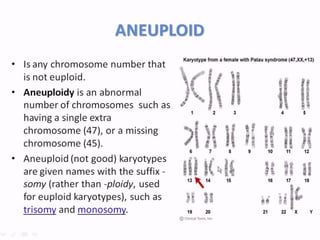
3. Discuss the Chromosomal defects with special emphasis on
aneuploidy
4. Describe the pathophysiology and the clinical manifestation
of the following genetics disorders.
 Down’s syndrome
 Turner’s syndrome
 Kleinfelters syndrome
 A genetic disorder is a disease that is caused
by an abnormality in an individual's DNA.
 Abnormalities can be as small as a single-
base mutation in just one gene, or they can
involve the addition or subtraction of entire
chromosomes.
 Congenital disorder, also known
as congenital disease, birth defector
anomaly
 Is a condition existing at or before birth
regardless of cause.
 Of these diseases, those characterized by
structural deformities are termed
"congenital anomalies" and
involve defects in a developing fetus.
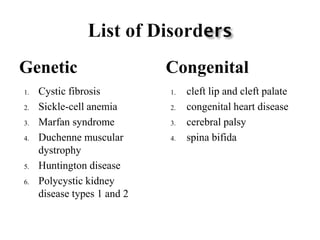
Genetic Congenital
1. Cystic fibrosis
2. Sickle-cell anemia
3. Marfan syndrome
4. Duchenne muscular
dystrophy
5. Huntington disease
6. Polycystic kidney
disease types 1 and 2
1. cleft lip and cleft palate
2. congenital heart disease
3. cerebral palsy
4. spina bifida
 A condition in which an extra copy of a
chromosome is present in the cell nuclei, causing
developmental abnormalities is called Trisomy
 The condition of having a diploid chromosome
complement in which one chromosome lacks its
homologous partner is called Monosomy
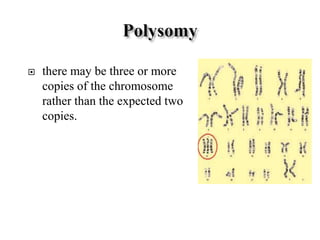
 there may be three or more
copies of the chromosome
rather than the expected two
copies.
 A congenital disorder arising from a chromosome
defect, causing intellectual impairment and physical
abnormalities including short stature and a broad
facial profile.
 It arises from a defect involving chromosome 21,
usually an extra copy (trisomy-21)
https://youtu.be/neXnaj4bInI
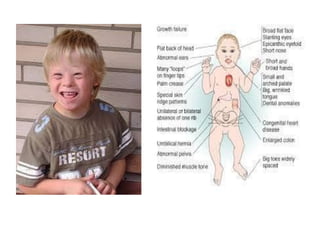
 Down syndrome, causes a combination of
birth defects including some degree of mental
retardation, characteristic facial features, and
other health problems
 A small and rather square head. There is
upward slanting of the eyes; small, low-set,
and malformed ears; a fat pad at the back of
the neck; an open mouth; and a large,
protruding tongue
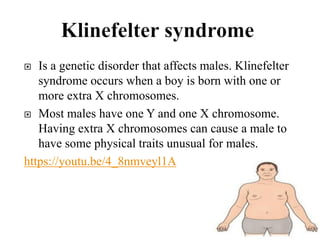
 Is a genetic disorder that affects males. Klinefelter
syndrome occurs when a boy is born with one or
more extra X chromosomes.
 Most males have one Y and one X chromosome.
Having extra X chromosomes can cause a male to
have some physical traits unusual for males.
https://youtu.be/4_8nmveyl1A
Is characterized by
 enlarged breasts,
 sparse facial and body hair, small testes, and
the inability to produce sperm.
 Regardless of the number of X chromosomes
present, the male phenotype is retained.
 The condition often goes undetected at birth.
The infant usually has normal male genitalia,
with a small penis and small, firm testicles.
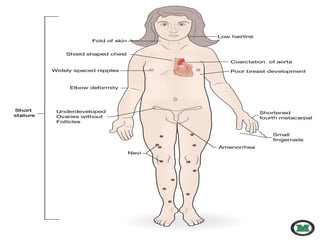
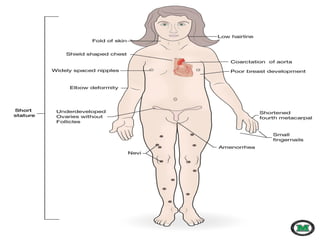
 A condition in which a female is partly or
completely missing an X chromosome
 Women with this condition tend to be shorter
than average and are usually unable to
conceive a child (infertile) because of an
absence of ovarian function.
 Characteristically, the female with Turner’s
syndrome is short in stature, but her body
proportions are normal
 She does not menstruate and shows no signs of
secondary sex characteristics. Variations in the
syndrome range from essentially none to webbing of
the neck with redundant skin folds.
Different types of genetic testing are done for different
reasons:
Diagnostic testing. For example, genetic testing may
be used to confirm a diagnosis of cystic fibrosis or
Huntington's disease.
Pre-symptomatic and predictive testing.
For example, this type of test may be useful for
identifying your risk of certain types of colorectal
cancer.
Carrier testing:
An expanded carrier screening test can detect genes associated
with a wide variety of genetic diseases and mutations and can
identify if you and your partner are carriers for the same
conditions.
Pharmacogenetics:
This type of genetic testing may help determine what
medication and dosage will be most effective and beneficial for
you.
Prenatal testing.
Traditionally this is done looking at markers in blood or by
invasive testing such as amniocentesis.
 Newborn screening.
This type of genetic testing is important because if results show
there's a disorder such as congenital hypothyroidism, sickle cell
disease or phenylketonuria (PKU), care and treatment can begin
right away.
 Preimplantation testing
The embryos are screened for genetic abnormalities. Embryos
without abnormalities are implanted in the uterus in hopes of
achieving pregnancy.
( WHO, 2019)
 Waugh, A., & Grant, A. (2014). Ross & Wilson Anatomy
and physiology in health and illness. Elsevier Health
Sciences. Chapter-17. page 438-447
 Grossman.S, Porth.M.C. (2009). Porth Pathophysiology
concept of altered health states (9th.ed). Philadelphia:
Lippincott. Unit -II, Chapter-06. page 118-136
 Porth, M. C. (2009). Essential of Pathophysiology (3rd.ed).
Philadelphia: Lippincott. Unit –I, Chapter 5,6, Page 89-
126.
Acknowledgement
 Sir hafiz IRFAN
 Ms. Saira Manzoor

Complete Genetic Disorders PRN.pdf

  • 1.
  • 2.
    At the endof this unit each learners will be able to: 1. Differentiate between Genetic & Congenital disorder 2. Define the following terminologies related to genetic disorders:  Trisomy  Monosomy  Polysomy 3. Discuss the Chromosomal defects with special emphasis on aneuploidy 4. Describe the pathophysiology and the clinical manifestation of the following genetics disorders.  Down’s syndrome  Turner’s syndrome  Kleinfelters syndrome
  • 4.
     A geneticdisorder is a disease that is caused by an abnormality in an individual's DNA.  Abnormalities can be as small as a single- base mutation in just one gene, or they can involve the addition or subtraction of entire chromosomes.
  • 5.
     Congenital disorder,also known as congenital disease, birth defector anomaly  Is a condition existing at or before birth regardless of cause.  Of these diseases, those characterized by structural deformities are termed "congenital anomalies" and involve defects in a developing fetus.
  • 6.
    Genetic Congenital 1. Cysticfibrosis 2. Sickle-cell anemia 3. Marfan syndrome 4. Duchenne muscular dystrophy 5. Huntington disease 6. Polycystic kidney disease types 1 and 2 1. cleft lip and cleft palate 2. congenital heart disease 3. cerebral palsy 4. spina bifida
  • 8.
     A conditionin which an extra copy of a chromosome is present in the cell nuclei, causing developmental abnormalities is called Trisomy  The condition of having a diploid chromosome complement in which one chromosome lacks its homologous partner is called Monosomy
  • 9.
     there maybe three or more copies of the chromosome rather than the expected two copies.
  • 10.
     A congenitaldisorder arising from a chromosome defect, causing intellectual impairment and physical abnormalities including short stature and a broad facial profile.  It arises from a defect involving chromosome 21, usually an extra copy (trisomy-21) https://youtu.be/neXnaj4bInI
  • 12.
     Down syndrome,causes a combination of birth defects including some degree of mental retardation, characteristic facial features, and other health problems  A small and rather square head. There is upward slanting of the eyes; small, low-set, and malformed ears; a fat pad at the back of the neck; an open mouth; and a large, protruding tongue
  • 13.
     Is agenetic disorder that affects males. Klinefelter syndrome occurs when a boy is born with one or more extra X chromosomes.  Most males have one Y and one X chromosome. Having extra X chromosomes can cause a male to have some physical traits unusual for males. https://youtu.be/4_8nmveyl1A
  • 14.
    Is characterized by enlarged breasts,  sparse facial and body hair, small testes, and the inability to produce sperm.  Regardless of the number of X chromosomes present, the male phenotype is retained.  The condition often goes undetected at birth. The infant usually has normal male genitalia, with a small penis and small, firm testicles.
  • 15.
     A conditionin which a female is partly or completely missing an X chromosome  Women with this condition tend to be shorter than average and are usually unable to conceive a child (infertile) because of an absence of ovarian function.
  • 17.
     Characteristically, thefemale with Turner’s syndrome is short in stature, but her body proportions are normal  She does not menstruate and shows no signs of secondary sex characteristics. Variations in the syndrome range from essentially none to webbing of the neck with redundant skin folds.
  • 19.
    Different types ofgenetic testing are done for different reasons: Diagnostic testing. For example, genetic testing may be used to confirm a diagnosis of cystic fibrosis or Huntington's disease. Pre-symptomatic and predictive testing. For example, this type of test may be useful for identifying your risk of certain types of colorectal cancer.
  • 20.
    Carrier testing: An expandedcarrier screening test can detect genes associated with a wide variety of genetic diseases and mutations and can identify if you and your partner are carriers for the same conditions. Pharmacogenetics: This type of genetic testing may help determine what medication and dosage will be most effective and beneficial for you. Prenatal testing. Traditionally this is done looking at markers in blood or by invasive testing such as amniocentesis.
  • 21.
     Newborn screening. Thistype of genetic testing is important because if results show there's a disorder such as congenital hypothyroidism, sickle cell disease or phenylketonuria (PKU), care and treatment can begin right away.  Preimplantation testing The embryos are screened for genetic abnormalities. Embryos without abnormalities are implanted in the uterus in hopes of achieving pregnancy. ( WHO, 2019)
  • 22.
     Waugh, A.,& Grant, A. (2014). Ross & Wilson Anatomy and physiology in health and illness. Elsevier Health Sciences. Chapter-17. page 438-447  Grossman.S, Porth.M.C. (2009). Porth Pathophysiology concept of altered health states (9th.ed). Philadelphia: Lippincott. Unit -II, Chapter-06. page 118-136  Porth, M. C. (2009). Essential of Pathophysiology (3rd.ed). Philadelphia: Lippincott. Unit –I, Chapter 5,6, Page 89- 126. Acknowledgement  Sir hafiz IRFAN  Ms. Saira Manzoor