
GUIDELINES ON MAKING A CHOICE
I. Five A’s 1. Attainable 2. Affordable 3. Available 4. Accessible 5. Acceptable
II. Reverence for GOD and HIS great works III. Respect for LIFE (Safe, healthy and nutritious) IV. for the good of the greater majority, earth friendly V. Economic Significance VI. Originality, Ingenuity, Creativity VII. Impact of your work to the present situation
HELPFUL TIPS - GETTING STARTED: Pick Your Topic:   Get an idea of what you want to study. Research Your Topic:   Go to the library or internet and learn everything you can on your topic.  Gather existing information on your topic. Organize:   Organize everything you have learned about your topic.
Make a Timetable:   Choose a topic that not only interest you, but can be done in the amount of time you have.  Use a calendar to identify important dates. Plan Your Experiments:   Once you have a feasible project idea, write the research plan. This plan should explain how you will do your experiments and exactly what it will involve. Consult Your Adviser:   You are required to discuss your research plan with your adviser and other adults to be involved in experimentation.
Conduct Your Experiments:   Give careful thought to experimental design.  During experimentation, keep detailed notes of every step of the experiment, measurements and observations . Examine Your Results:   Upon completion of the experiments, examine and organize your findings.  Did your experiments give you the expected results? If possible, statistically analyze your data. Draw Conclusions:   Which variables are important? Did you collect enough data? Do you need to conduct more experimentation? If your results do not support your original hypothesis, you still have accomplished successful scientific research.
Take Photographs:   Take photos of the important part / phases of your experiment to be used in your display.  Visual presentations should depict proper handling methods and proper housing conditions. Make A Good Title:   Your title is an extremely important attention-grabber.  A good title should simply and accurately present your research.
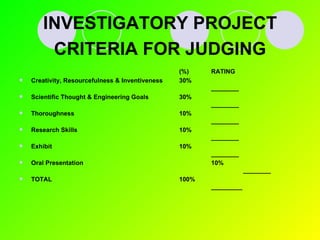
INVESTIGATORY PROJECT CRITERIA FOR JUDGING (%) RATING Creativity, Resourcefulness & Inventiveness 30% ________ Scientific Thought & Engineering Goals 30% ________ Thoroughness 10% ________ Research Skills 10% ________ Exhibit 10% ________ Oral Presentation 10% ________ TOTAL 100% _________
JUDGING TIPS Judges evaluate and focus on the following measures when they see your write-up and exhibit: How well and confident you can talk about your work.  Reading the project write-up or memorizing the text during the interview and science congress is both a disadvantage. What you did in the current year How well did you follow the scientific methodologies and how much innovation was contributed How detailed and accurate was your research What is the impact of your project
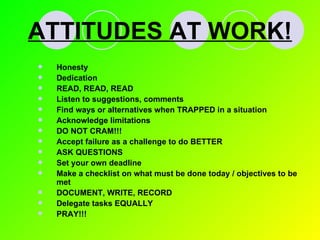
ATTITUDES AT WORK! Honesty Dedication READ, READ, READ Listen to suggestions, comments Find ways or alternatives when TRAPPED in a situation Acknowledge limitations DO NOT CRAM!!! Accept failure as a challenge to do BETTER ASK QUESTIONS Set your own deadline Make a checklist on what must be done today / objectives to be met DOCUMENT, WRITE, RECORD Delegate tasks EQUALLY PRAY!!!

3 guidelines on making a choice review additional tips

  • 1.
  • 2.
    I. Five A’s1. Attainable 2. Affordable 3. Available 4. Accessible 5. Acceptable
  • 3.
    II. Reverence forGOD and HIS great works III. Respect for LIFE (Safe, healthy and nutritious) IV. for the good of the greater majority, earth friendly V. Economic Significance VI. Originality, Ingenuity, Creativity VII. Impact of your work to the present situation
  • 4.
    HELPFUL TIPS -GETTING STARTED: Pick Your Topic: Get an idea of what you want to study. Research Your Topic: Go to the library or internet and learn everything you can on your topic. Gather existing information on your topic. Organize: Organize everything you have learned about your topic.
  • 5.
    Make a Timetable: Choose a topic that not only interest you, but can be done in the amount of time you have. Use a calendar to identify important dates. Plan Your Experiments: Once you have a feasible project idea, write the research plan. This plan should explain how you will do your experiments and exactly what it will involve. Consult Your Adviser: You are required to discuss your research plan with your adviser and other adults to be involved in experimentation.
  • 6.
    Conduct Your Experiments: Give careful thought to experimental design. During experimentation, keep detailed notes of every step of the experiment, measurements and observations . Examine Your Results: Upon completion of the experiments, examine and organize your findings. Did your experiments give you the expected results? If possible, statistically analyze your data. Draw Conclusions: Which variables are important? Did you collect enough data? Do you need to conduct more experimentation? If your results do not support your original hypothesis, you still have accomplished successful scientific research.
  • 7.
    Take Photographs: Take photos of the important part / phases of your experiment to be used in your display. Visual presentations should depict proper handling methods and proper housing conditions. Make A Good Title: Your title is an extremely important attention-grabber. A good title should simply and accurately present your research.
  • 8.
    INVESTIGATORY PROJECT CRITERIAFOR JUDGING (%) RATING Creativity, Resourcefulness & Inventiveness 30% ________ Scientific Thought & Engineering Goals 30% ________ Thoroughness 10% ________ Research Skills 10% ________ Exhibit 10% ________ Oral Presentation 10% ________ TOTAL 100% _________
  • 9.
    JUDGING TIPS Judgesevaluate and focus on the following measures when they see your write-up and exhibit: How well and confident you can talk about your work. Reading the project write-up or memorizing the text during the interview and science congress is both a disadvantage. What you did in the current year How well did you follow the scientific methodologies and how much innovation was contributed How detailed and accurate was your research What is the impact of your project
  • 10.
    ATTITUDES AT WORK!Honesty Dedication READ, READ, READ Listen to suggestions, comments Find ways or alternatives when TRAPPED in a situation Acknowledge limitations DO NOT CRAM!!! Accept failure as a challenge to do BETTER ASK QUESTIONS Set your own deadline Make a checklist on what must be done today / objectives to be met DOCUMENT, WRITE, RECORD Delegate tasks EQUALLY PRAY!!!