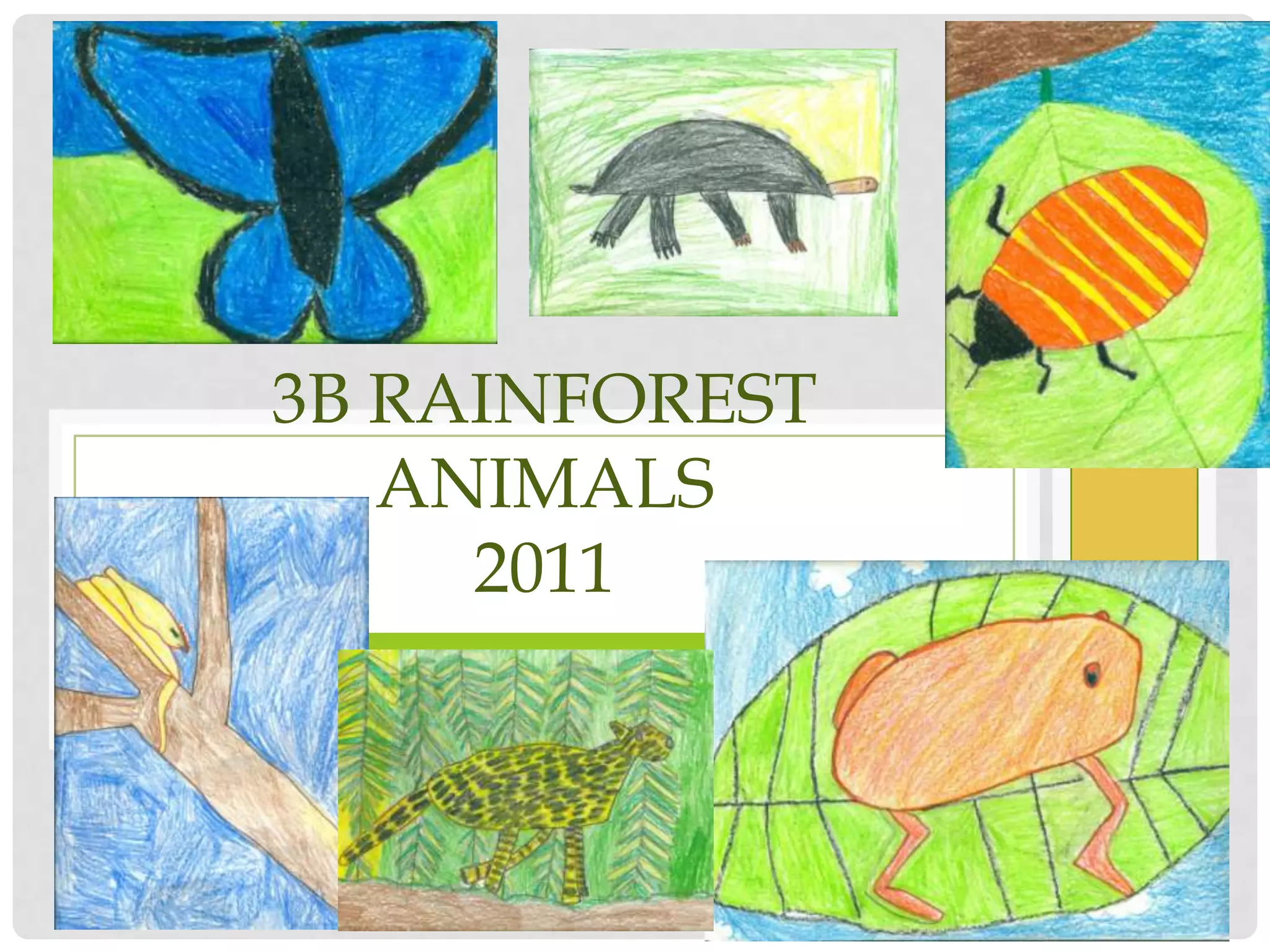
3B Rainforest Animals2011
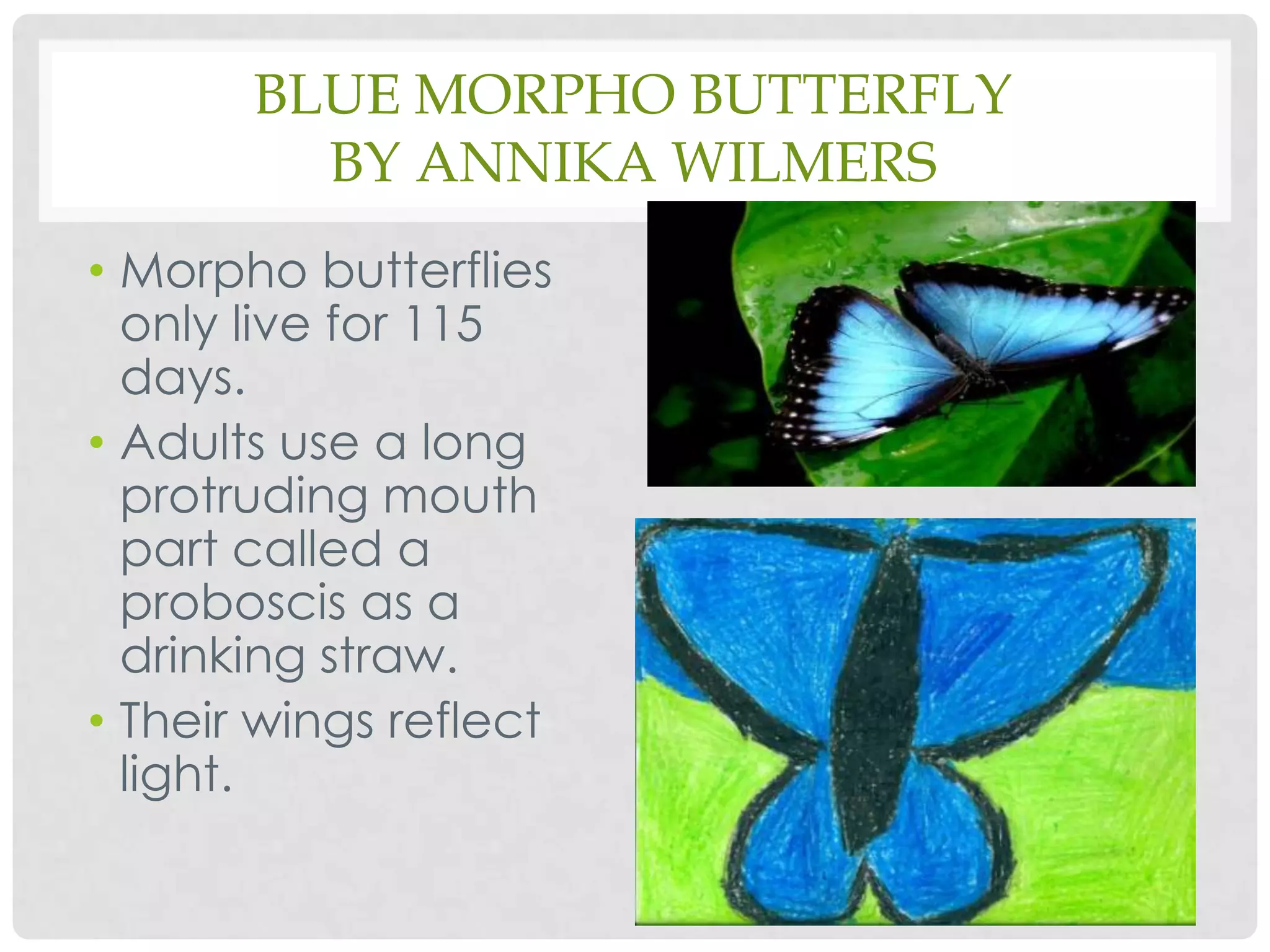
Blue Morpho Butterflyby Annika WilmersMorpho butterflies only live for 115 days.Adults use a long  protruding mouth part called a proboscis as a drinking straw.Their wings reflect light.
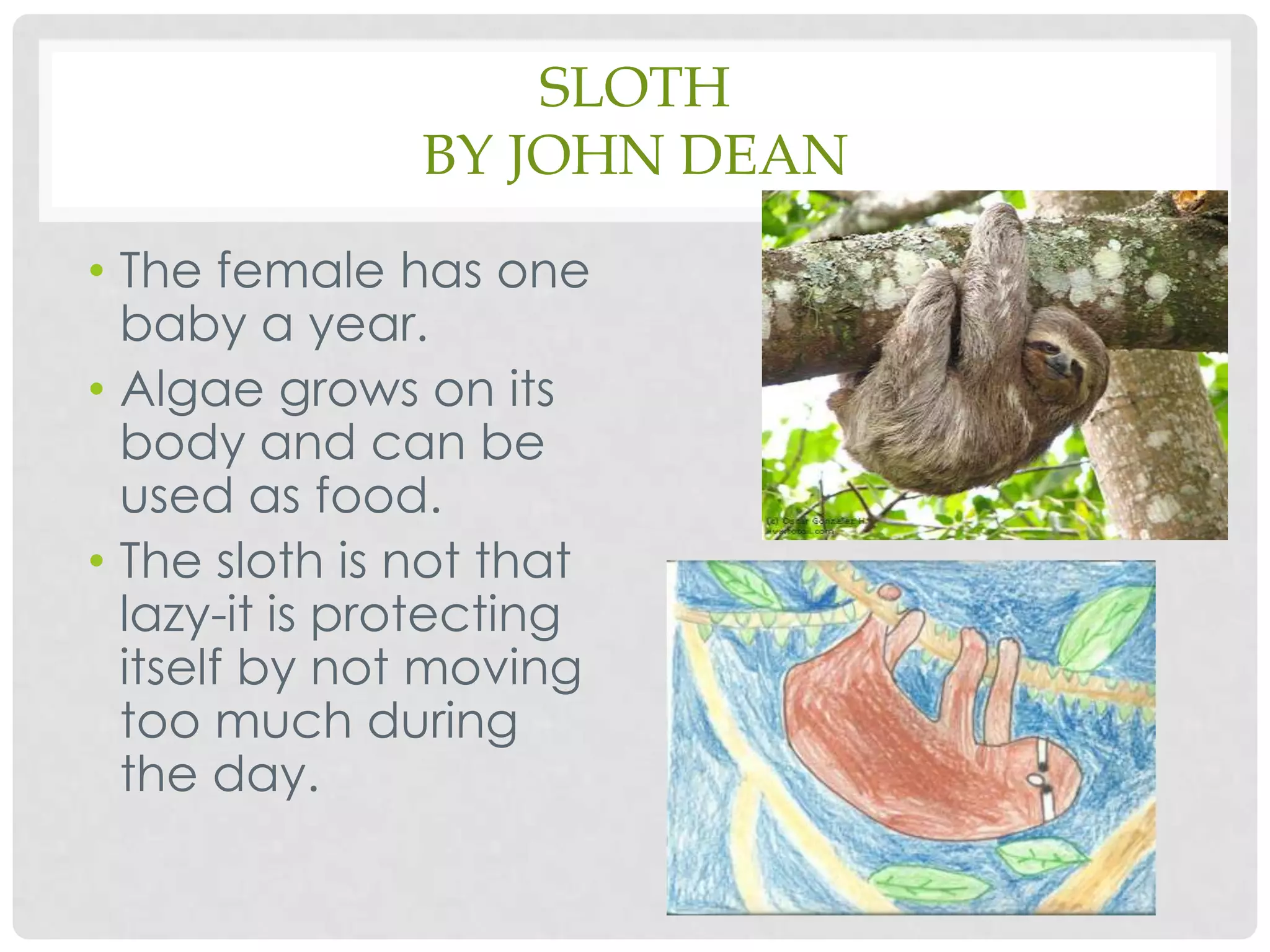
SlothBy John DeanThe female has one baby a year.Algae grows on its body and can be used as food.The sloth is not that lazy-it is protecting itself by not moving too much during the day.
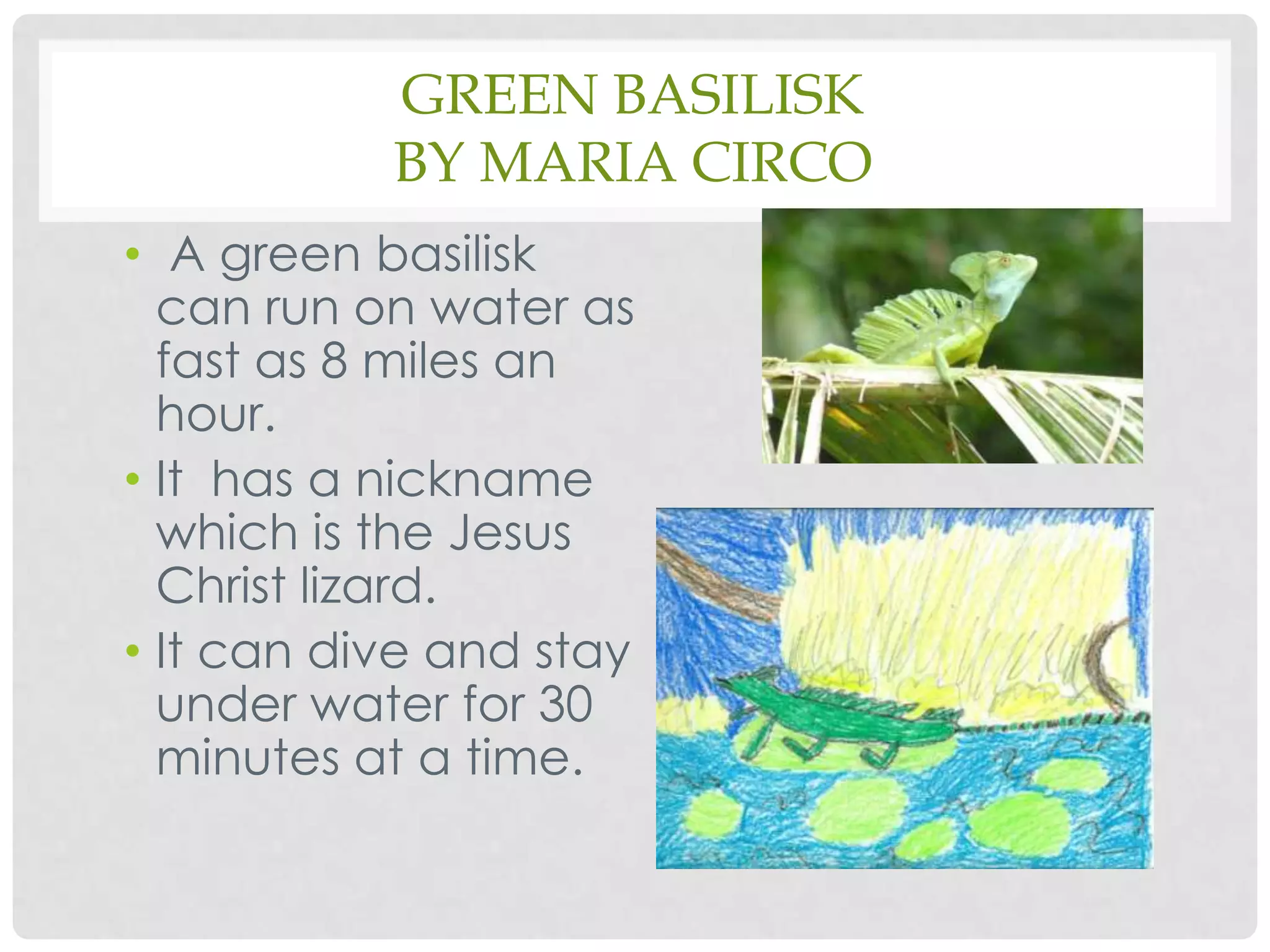
Green Basilisk    by Maria Circo A green basilisk can run on water as fast as 8 miles an hour.It  has a nickname which is the Jesus Christ lizard.It can dive and stay under water for 30 minutes at a time.
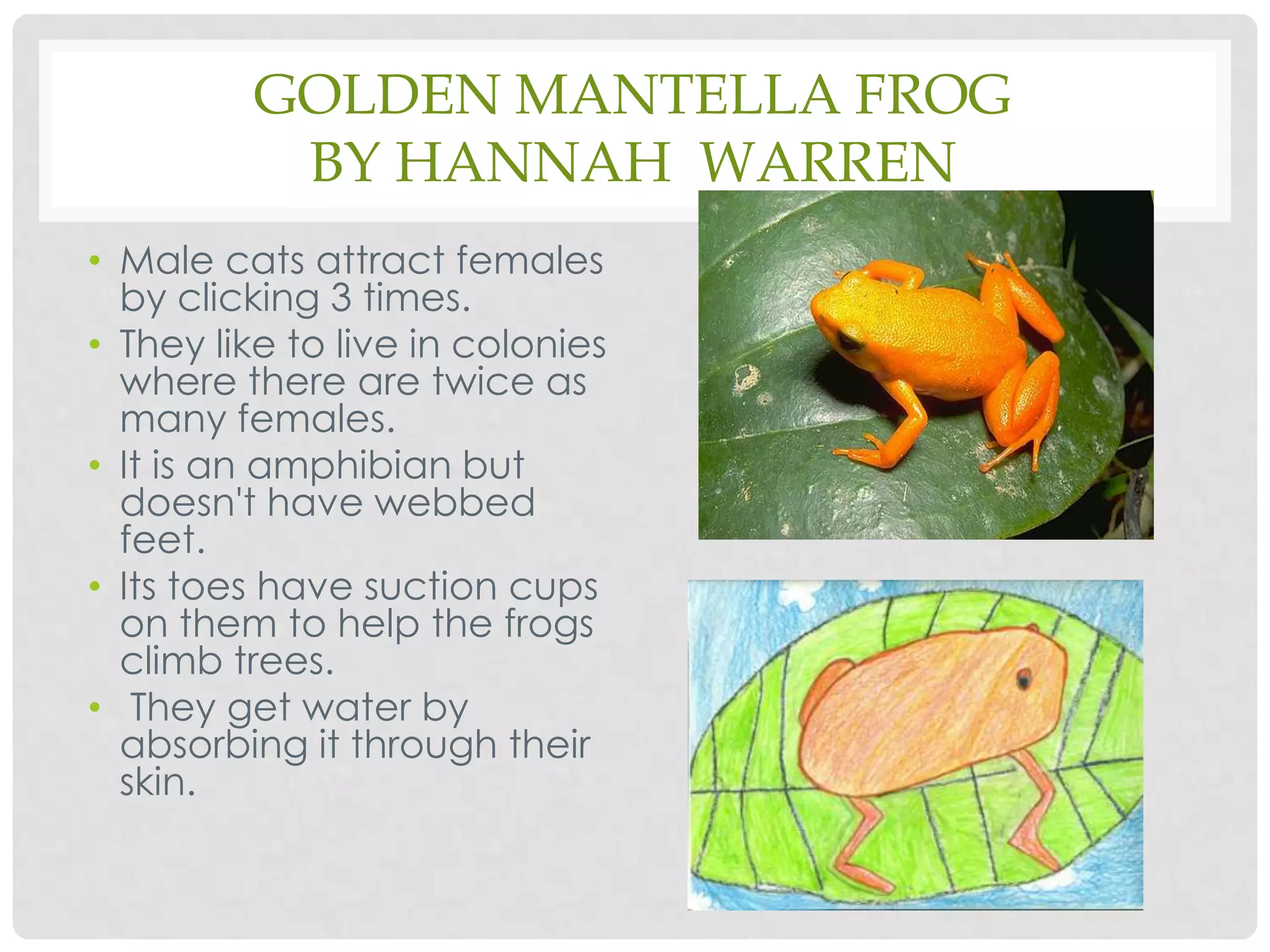
Golden Mantella Frogby Hannah  WarrenMale cats attract females by clicking 3 times.They like to live in colonies where there are twice as many females.It is an amphibian but doesn't have webbed feet.Its toes have suction cups on them to help the frogs climb trees.They get water by absorbing it through their skin.
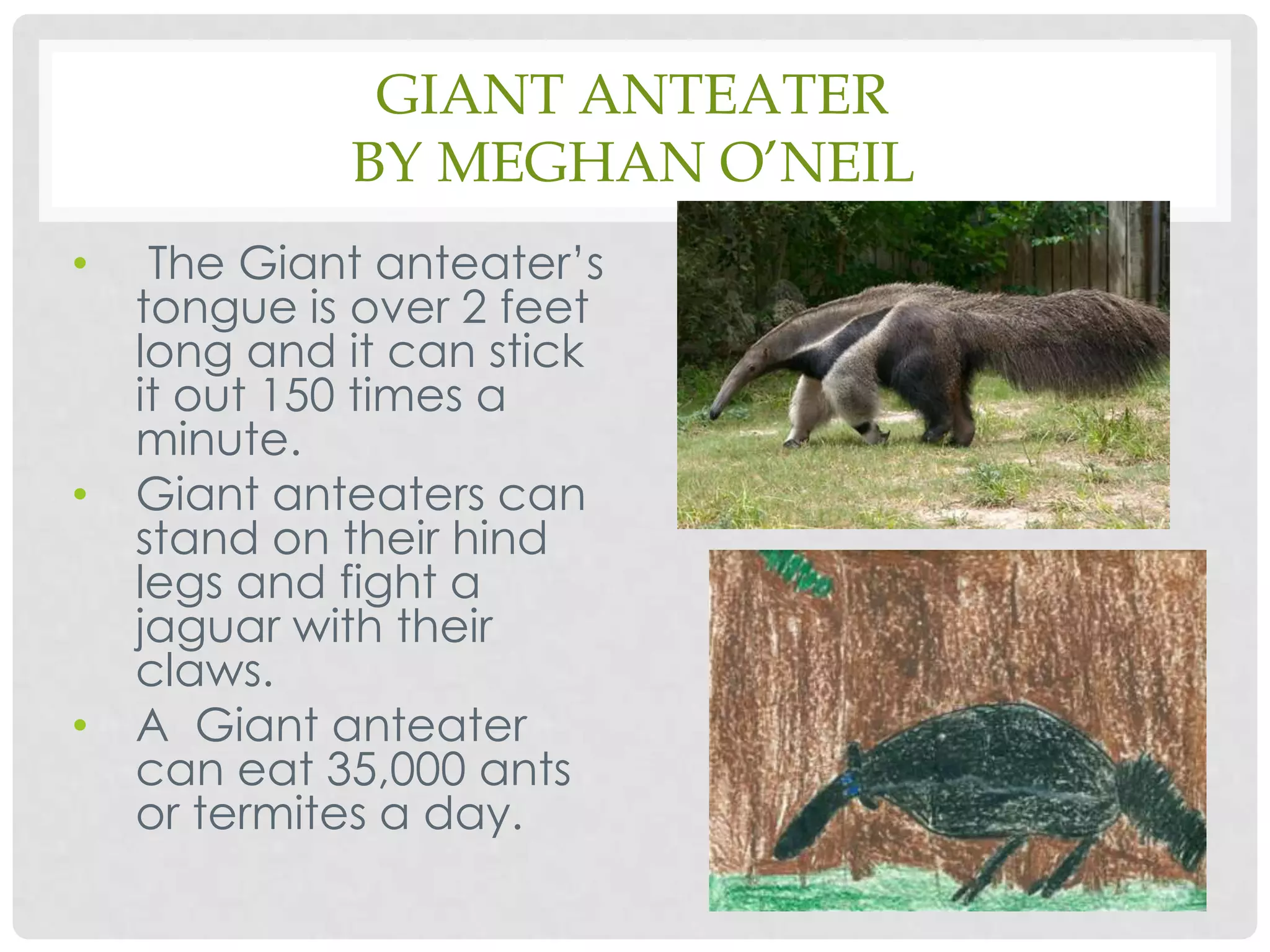
Giant Anteaterby Meghan O’NeilThe Giant anteater’s tongue is over 2 feet long and it can stick it out 150 times a minute.Giant anteaters can stand on their hind legs and fight a jaguar with their claws. A  Giant anteater can eat 35,000 ants or termites a day.
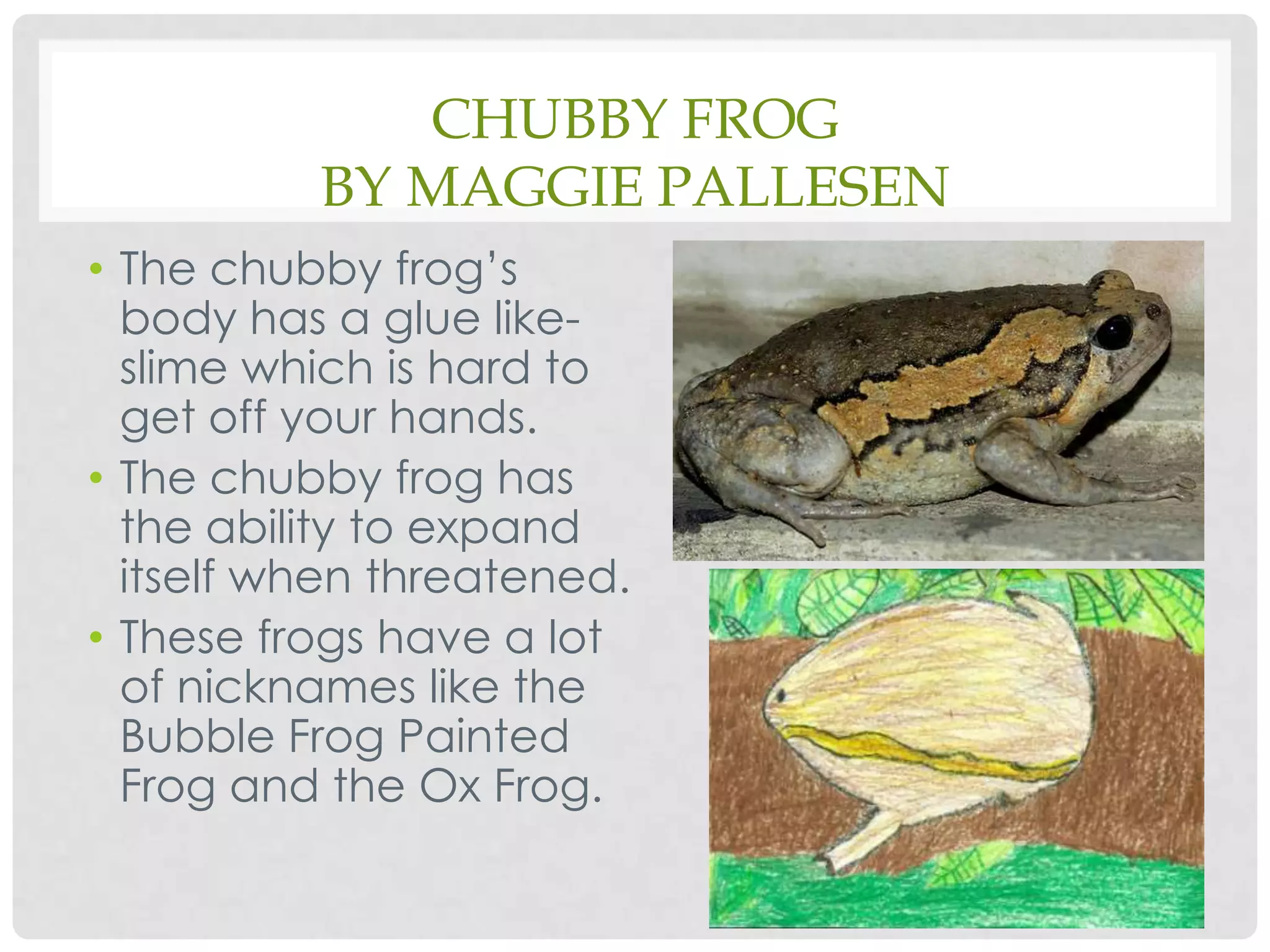
Chubby Frogby Maggie PallesenThe chubby frog’s body has a glue like-slime which is hard to get off your hands.The chubby frog has the ability to expand itself when threatened.These frogs have a lot of nicknames like the Bubble Frog Painted Frog and the Ox Frog.
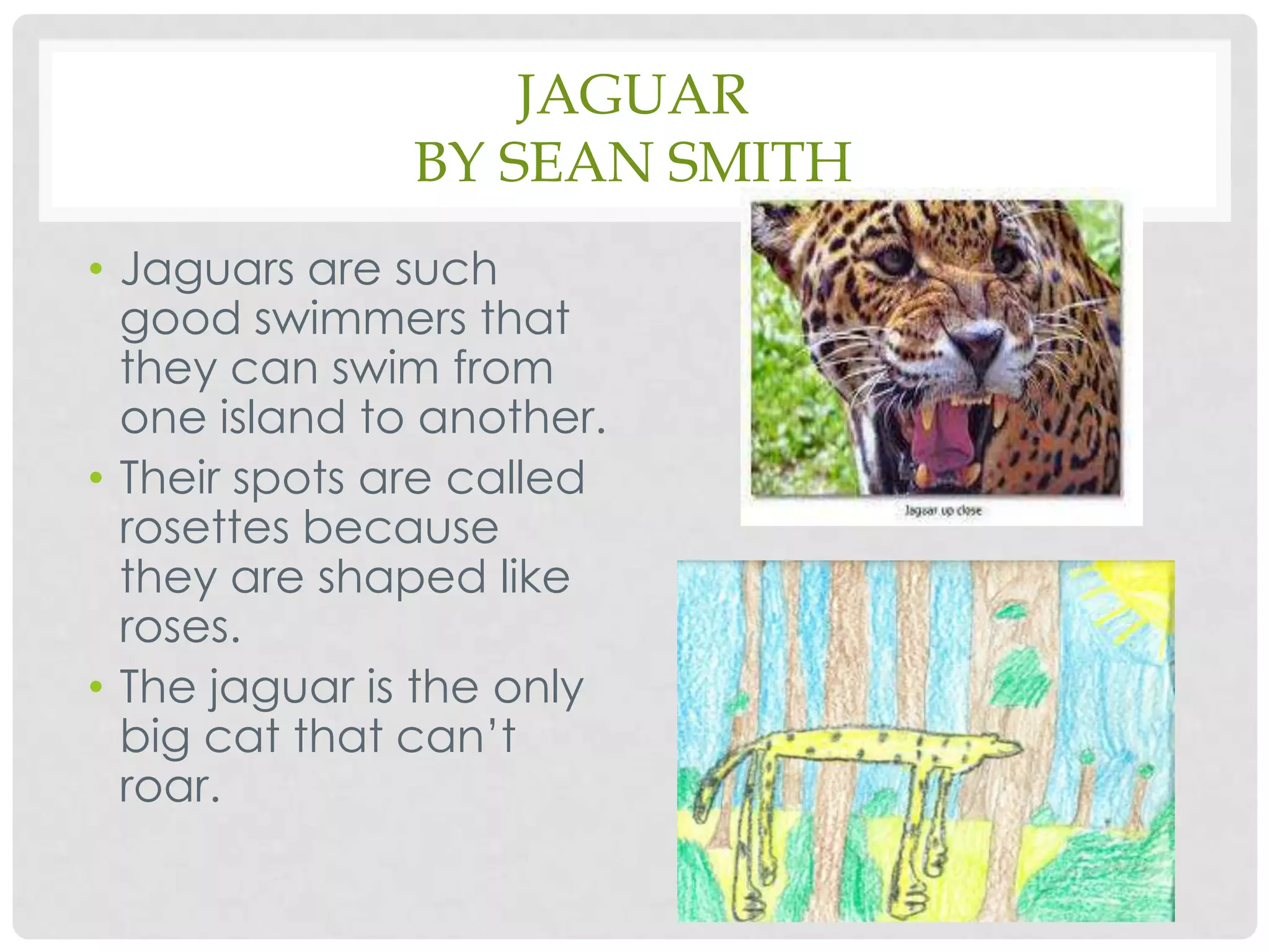
Jaguarby Sean SmithJaguars are such good swimmers that they can swim from one island to another.Their spots are called rosettes because they are shaped like roses.The jaguar is the only big cat that can’t roar.
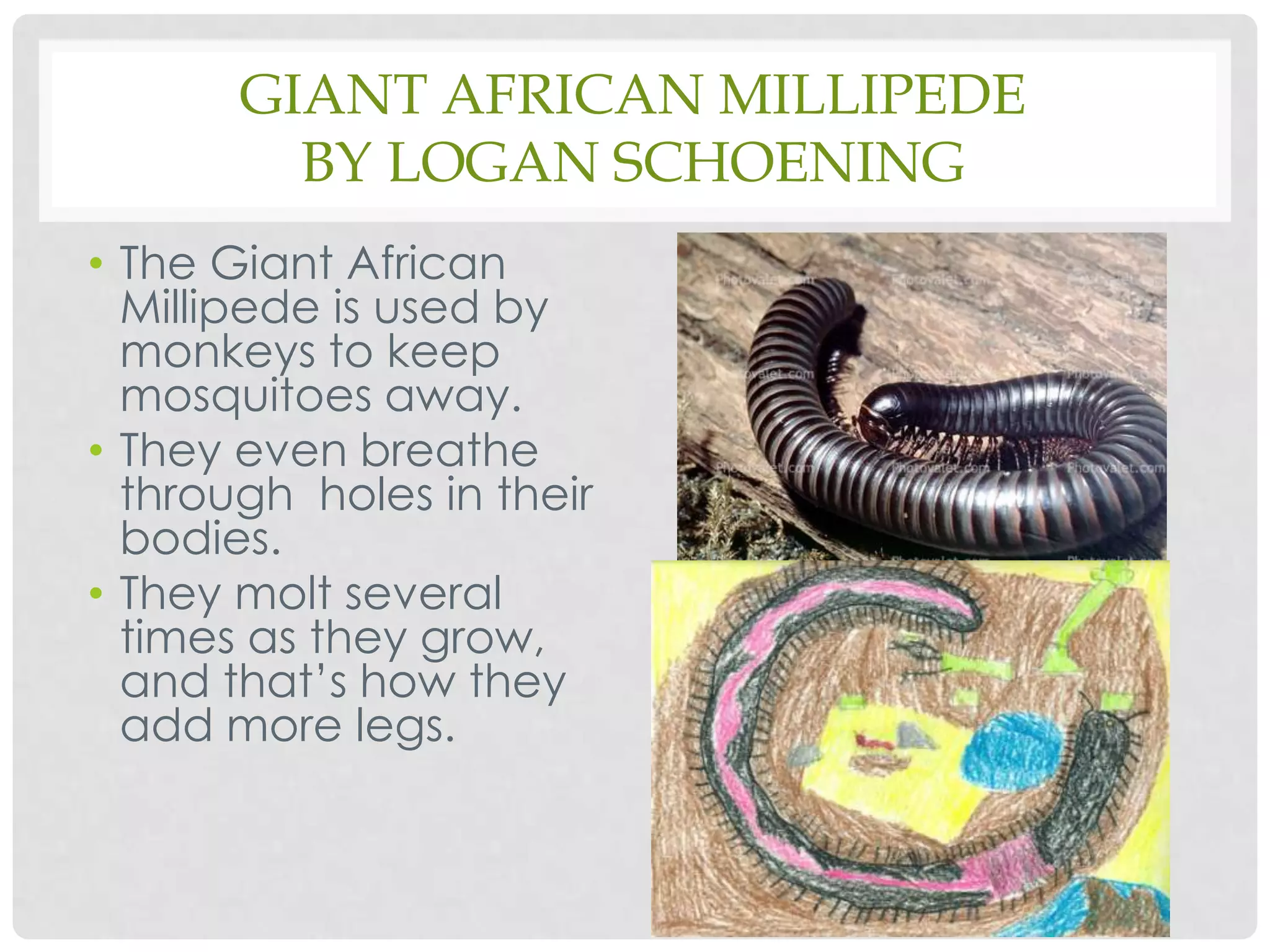
Giant African Millipedeby Logan SchoeningThe Giant African Millipede is used by monkeys to keep mosquitoes away.They even breathe through  holes in their bodies.They molt several times as they grow, and that’s how they add more legs.
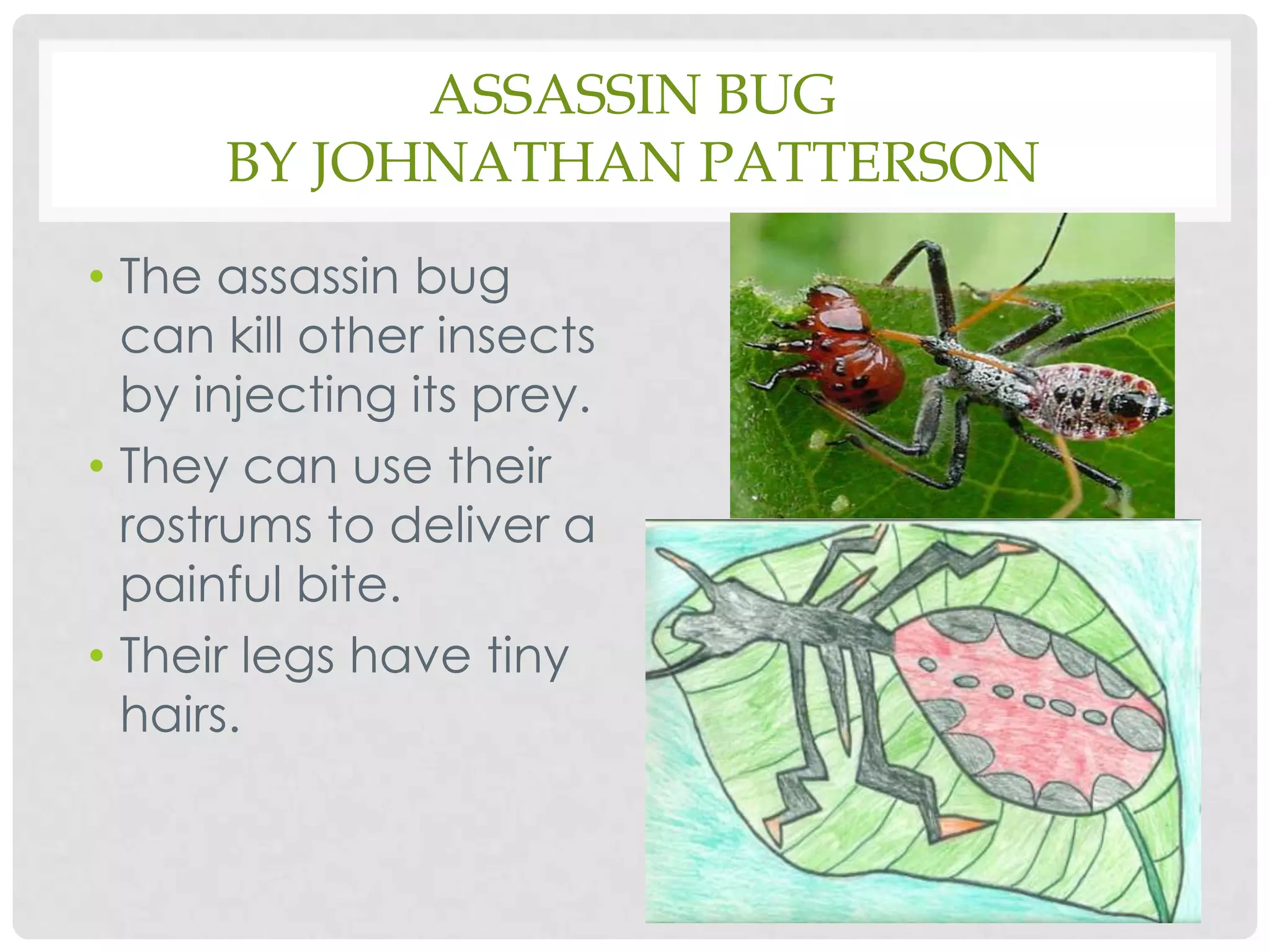
Assassin bugby Johnathan PattersonThe assassin bug can kill other insects by injecting its prey.They can use their rostrums to deliver a painful bite.Their legs have tiny hairs.
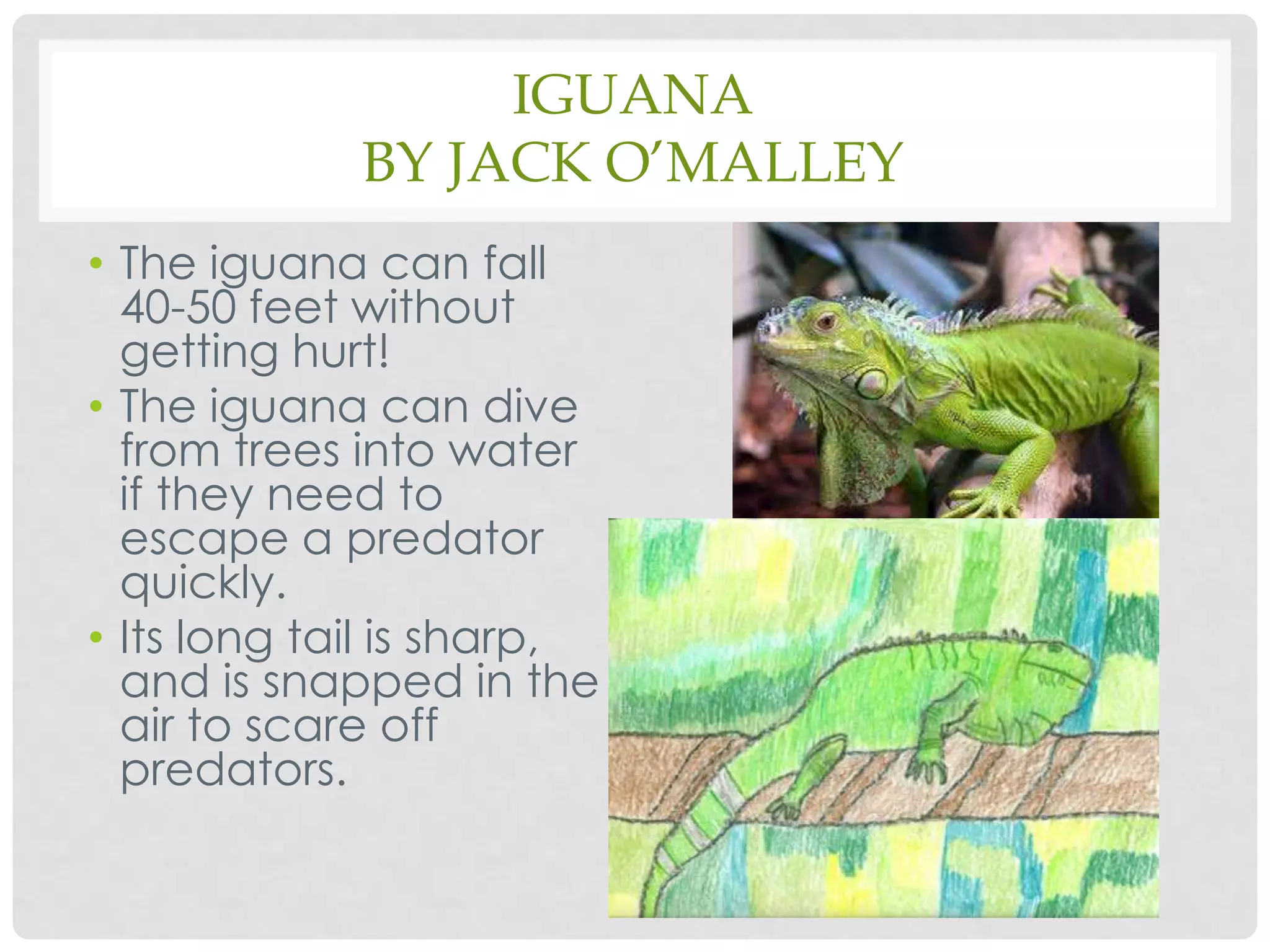
Iguanaby Jack O’MalleyThe iguana can fall 40-50 feet without getting hurt!The iguana can dive from trees into water if they need to escape a predator quickly.Its long tail is sharp, and is snapped in the air to scare off predators.
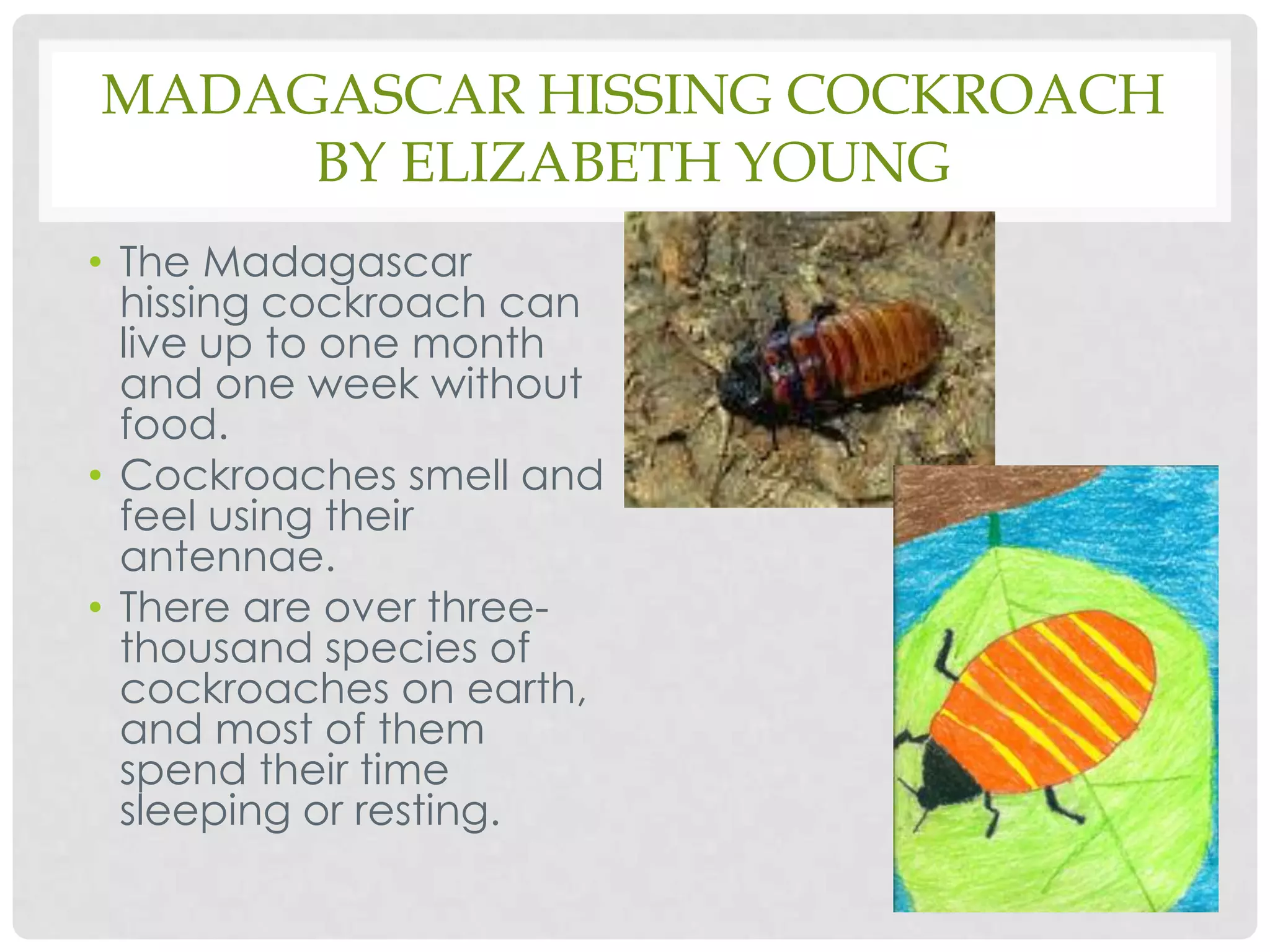
Madagascar Hissing CockroachBy Elizabeth YoungThe Madagascar hissing cockroach can live up to one month and one week without food.Cockroaches smell and feel using their antennae.There are over three-thousand species of cockroaches on earth, and most of them spend their time sleeping or resting.
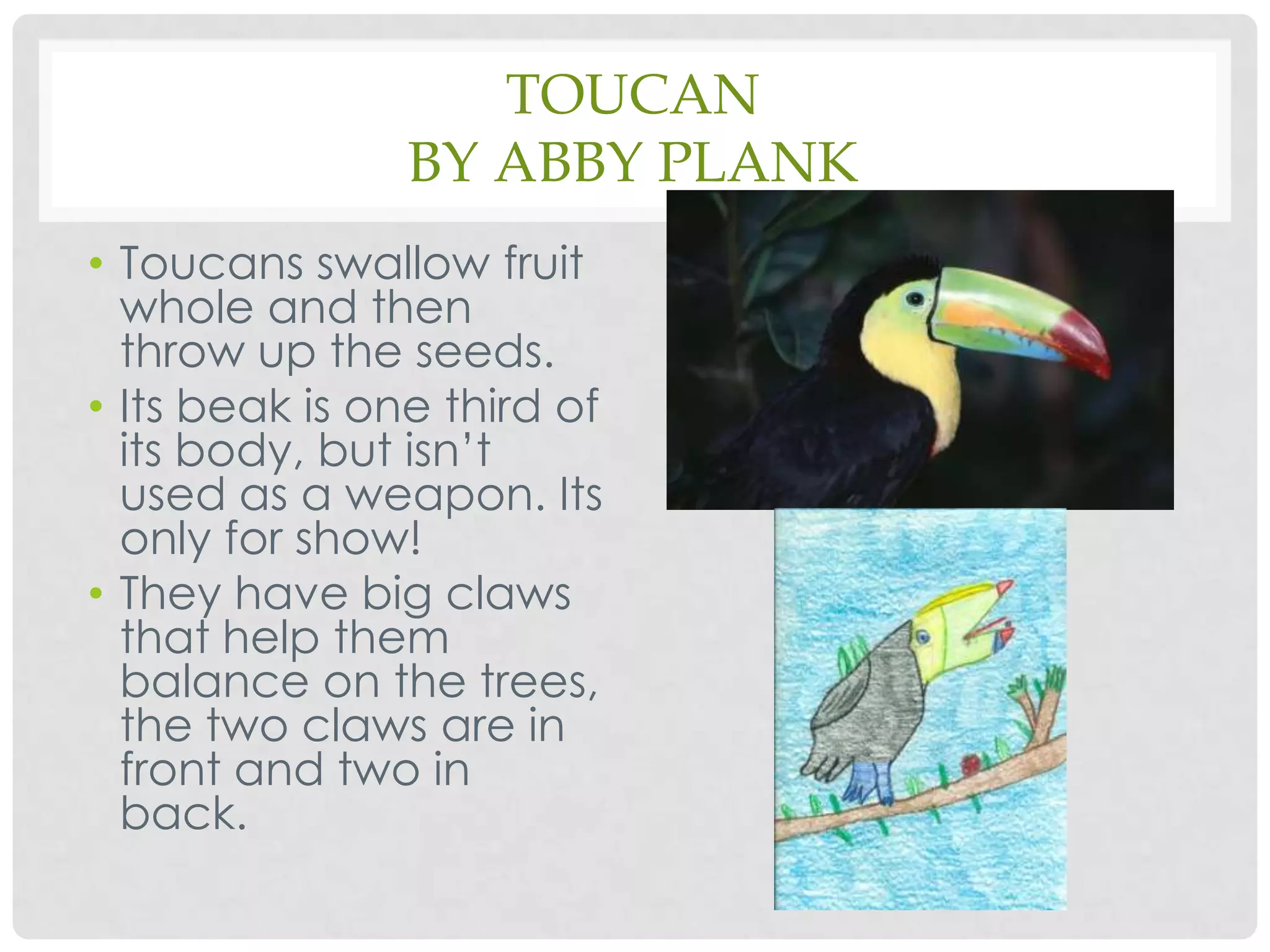
Toucanby Abby PlankToucans swallow fruit whole and then throw up the seeds.Its beak is one third of its body, but isn’t used as a weapon. Its only for show!They have big claws that help them balance on the trees, the two claws are in front and two in back.
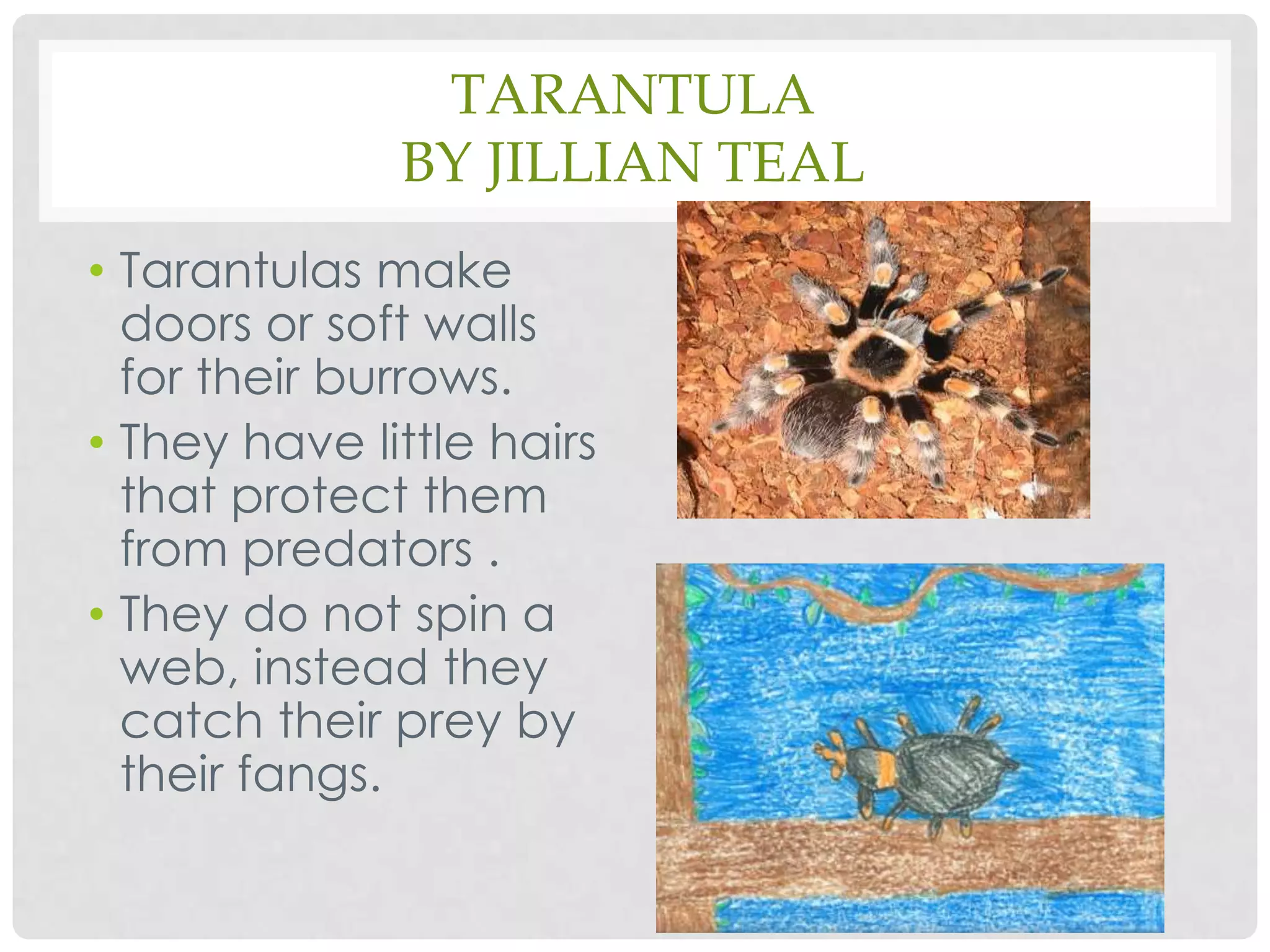
Tarantulaby Jillian TealTarantulas make doors or soft walls for their burrows.They have little hairs that protect them from predators .They do not spin a web, instead they catch their prey by their fangs.
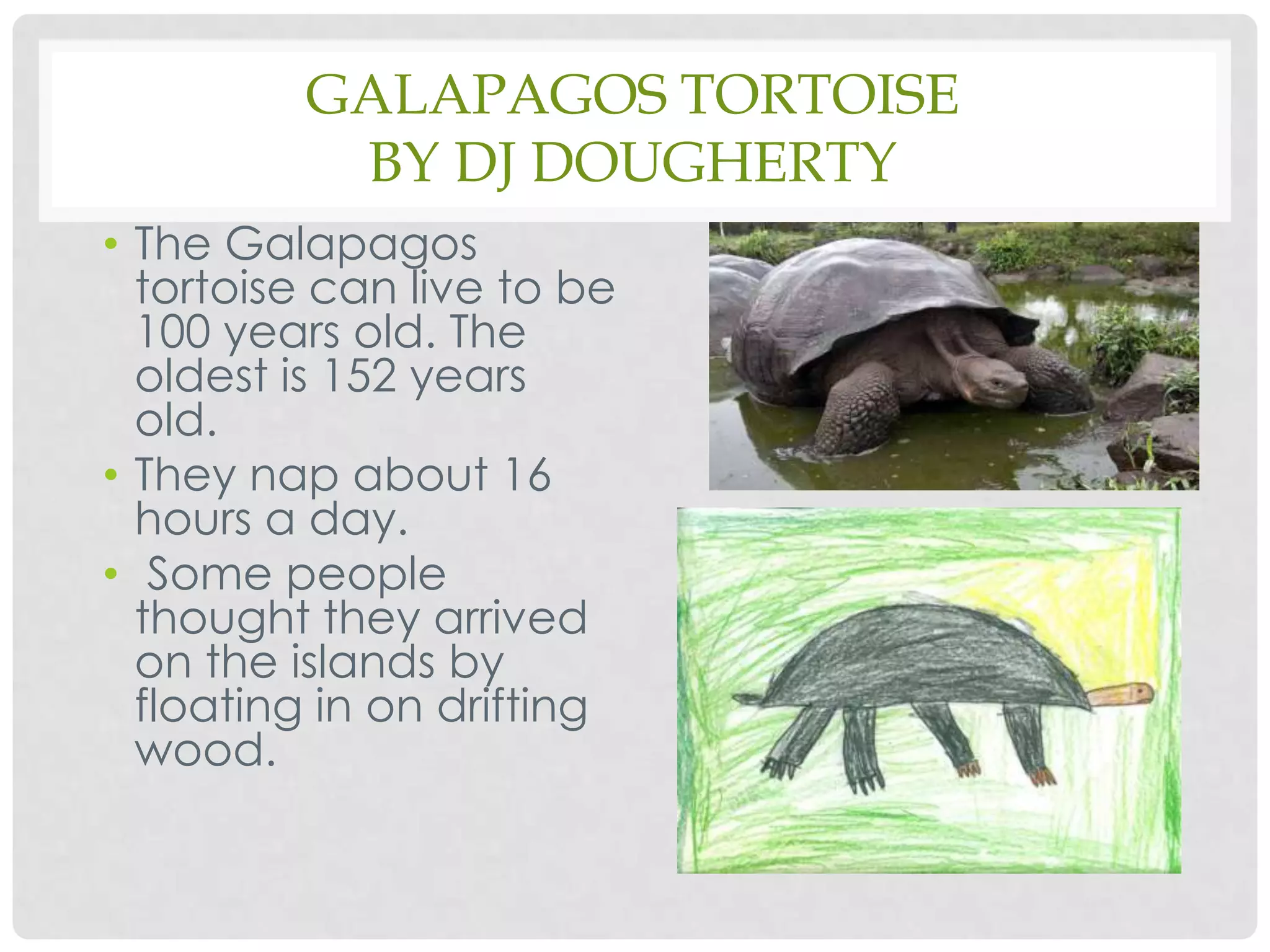
Galapagos Tortoiseby DJ DoughertyThe Galapagos tortoise can live to be 100 years old. The oldest is 152 years old.They nap about 16 hours a day.  Some people thought they arrived on the islands by floating in on drifting wood.
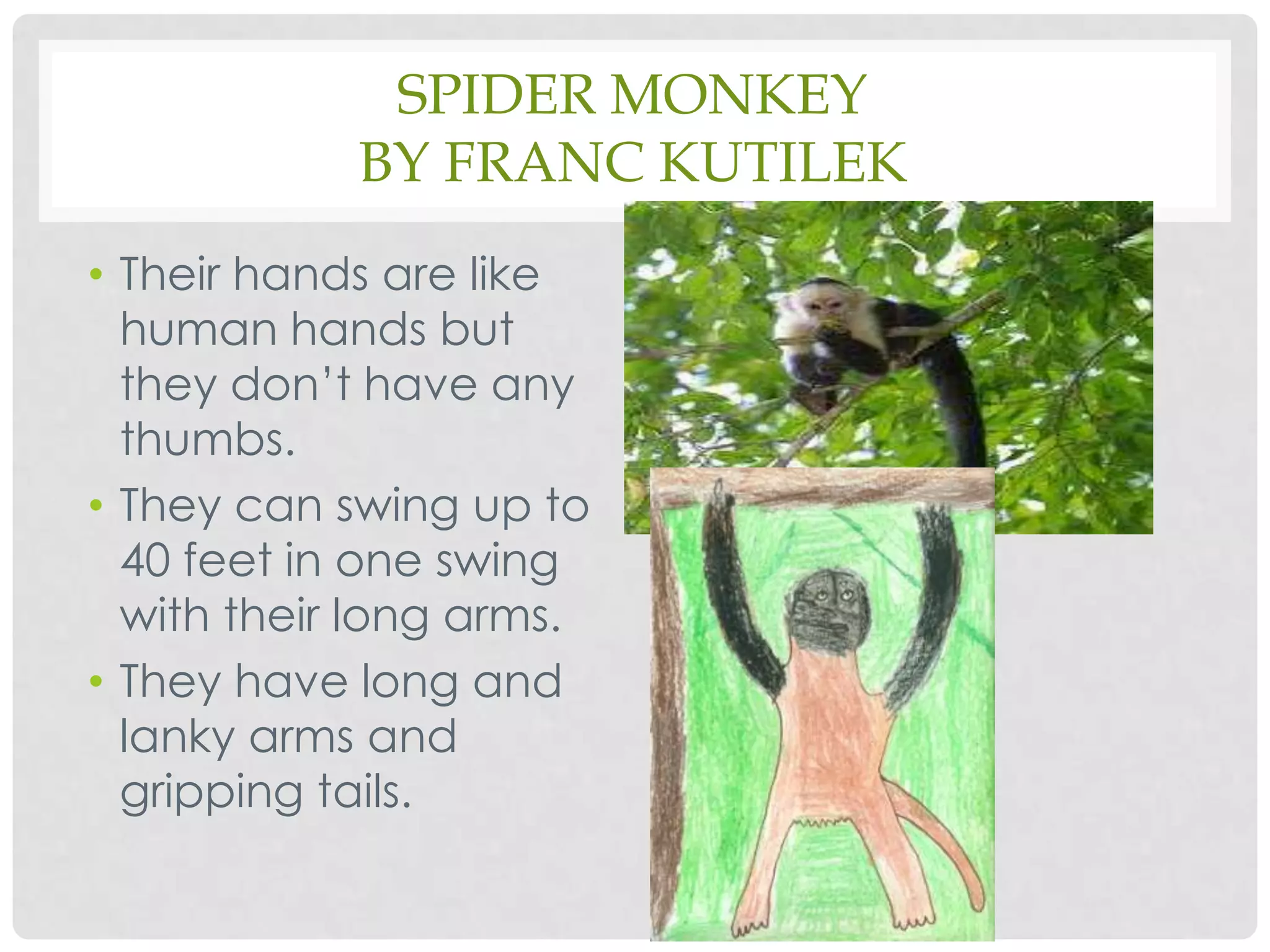
Spider Monkeyby Franc KutilekTheir hands are like human hands but they don’t have any thumbs.They can swing up to 40 feet in one swing with their long arms. They have long and lanky arms and gripping tails.
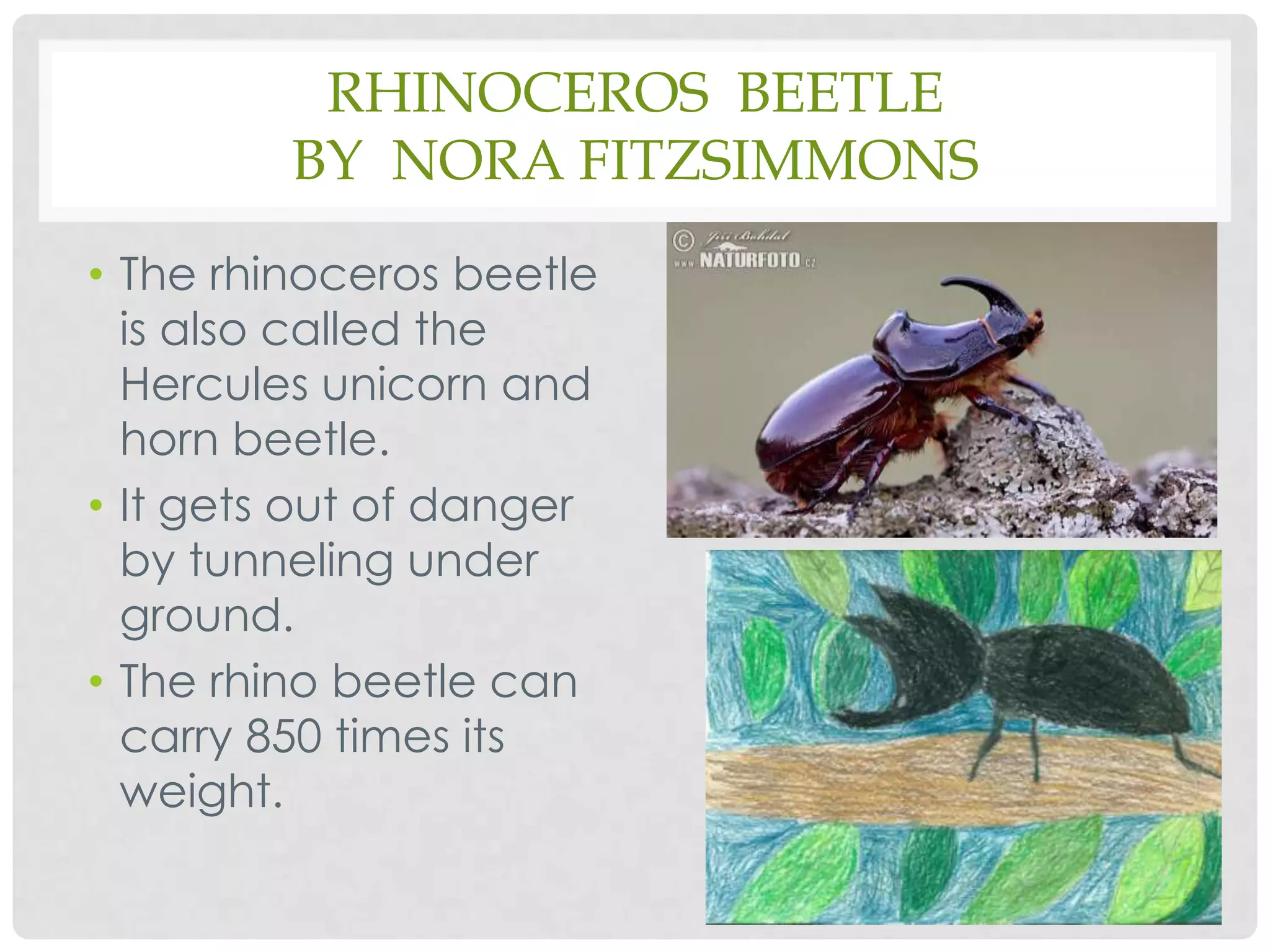
Rhinoceros  Beetleby  Nora Fitzsimmons The rhinoceros beetle is also called the Hercules unicorn and horn beetle.It gets out of danger by tunneling under ground.The rhino beetle can carry 850 times its weight.
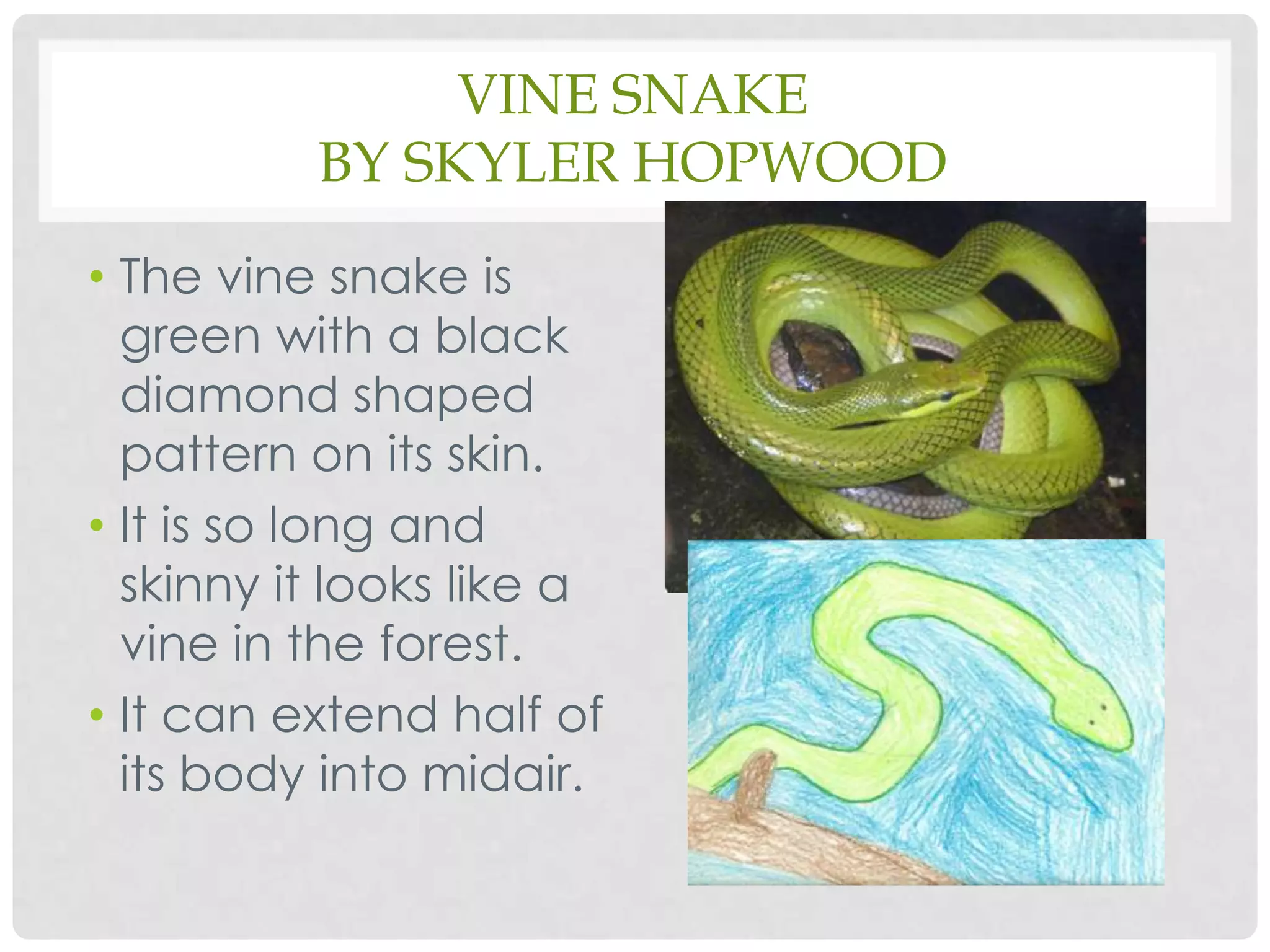
Vine Snakeby Skyler HopwoodThe vine snake is green with a black diamond shaped pattern on its skin.It is so long and skinny it looks like a vine in the forest.It can extend half of its body into midair.
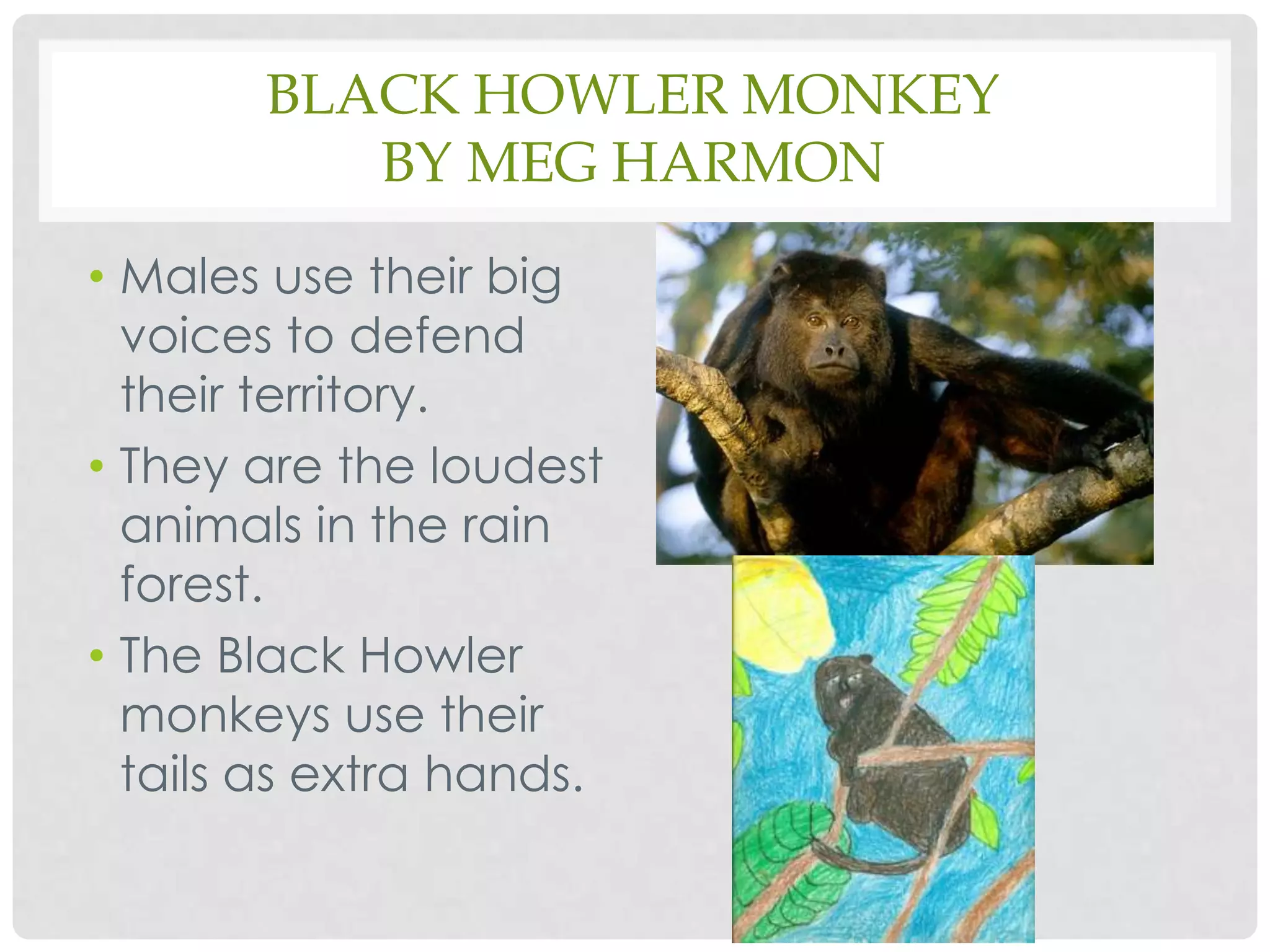
Black Howler MonkeyBy Meg HarmonMales use their big voices to defend their territory.They are the loudest animals in the rain forest.The Black Howler monkeys use their tails as extra hands.
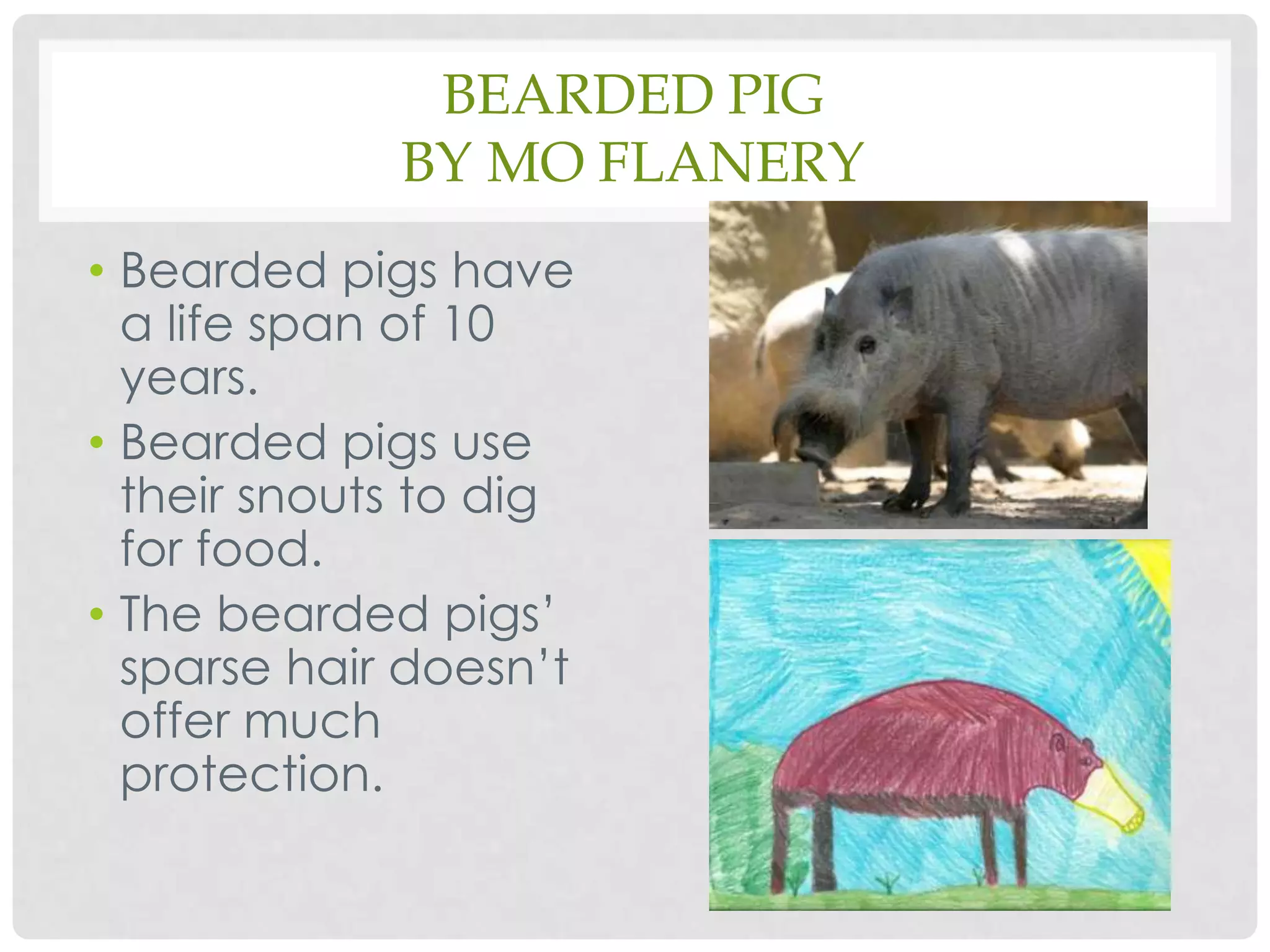
Bearded Pigby Mo FlaneryBearded pigs have a life span of 10 years.Bearded pigs use their snouts to dig for food.The bearded pigs’ sparse hair doesn’t offer much protection.
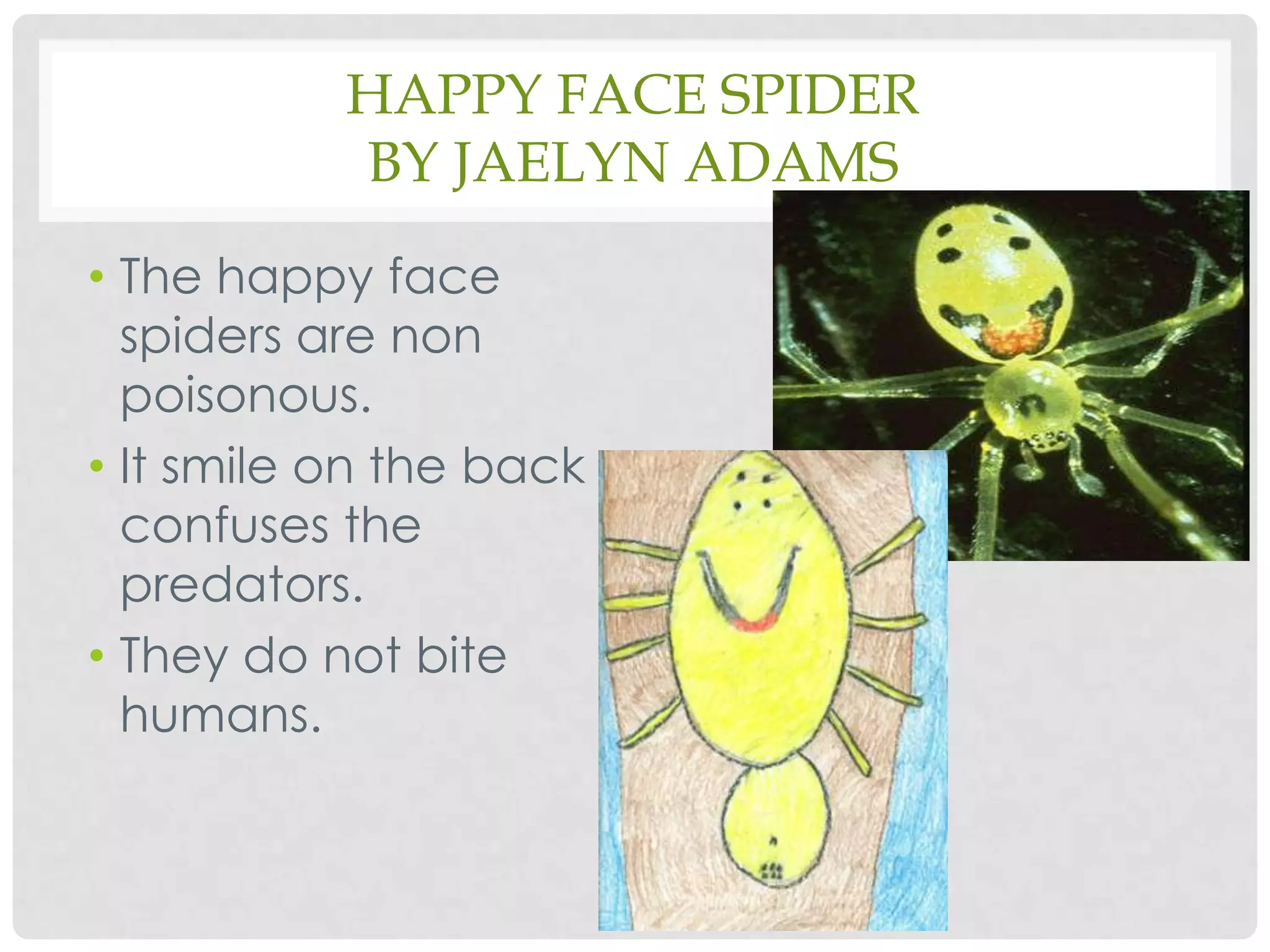
Happy Face Spiderby Jaelyn AdamsThe happy face spiders are non poisonous. It smile on the back confuses the predators.They do not bite humans.
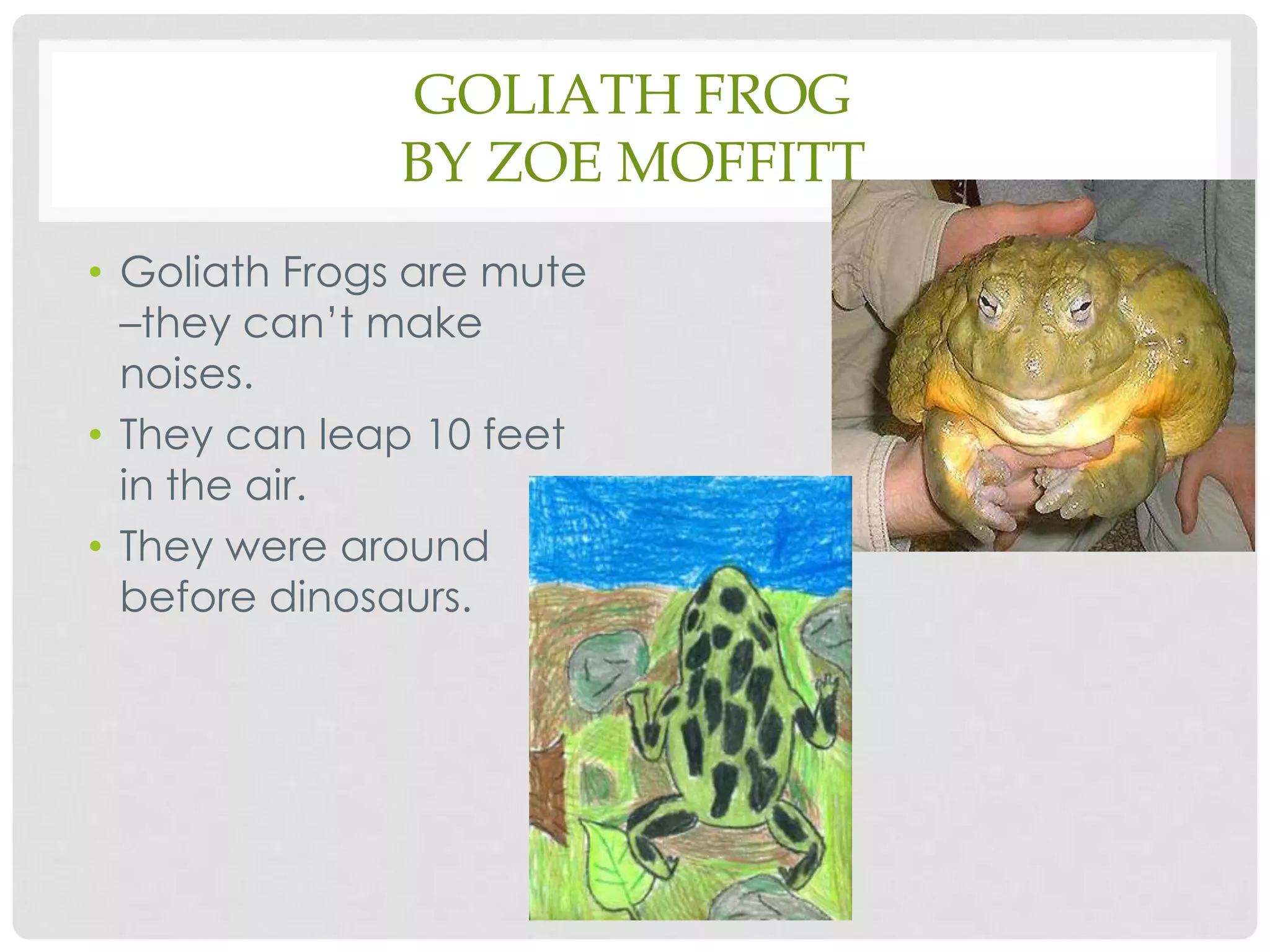
Goliath Frogby Zoe MoffittGoliath Frogs are mute –they can’t make noises.They can leap 10 feet in the air.They were around before dinosaurs.
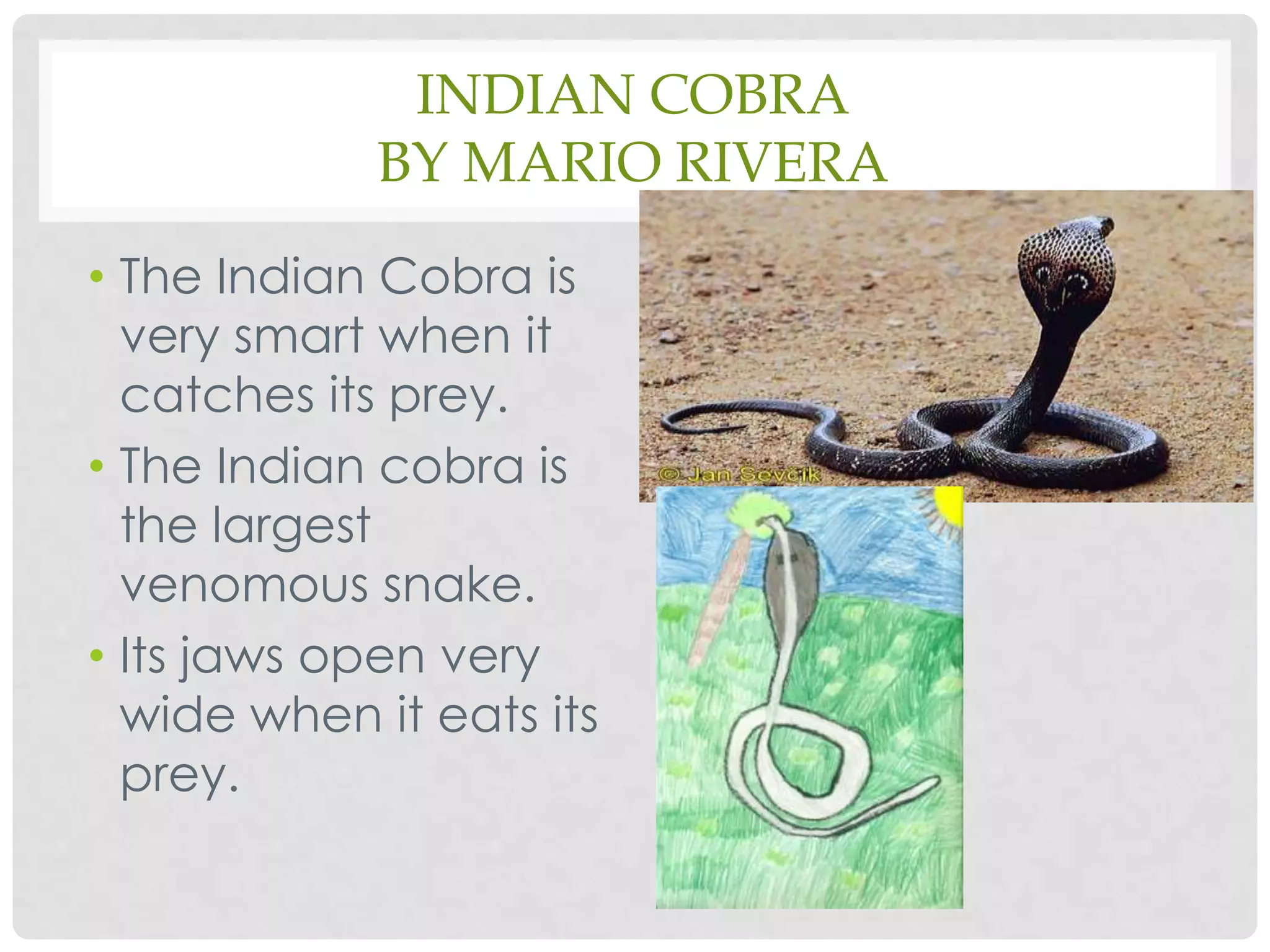
Indian Cobraby Mario RiveraThe Indian Cobra is very smart when it catches its prey.  The Indian cobra is the largest venomous snake.Its jaws open very wide when it eats its prey.
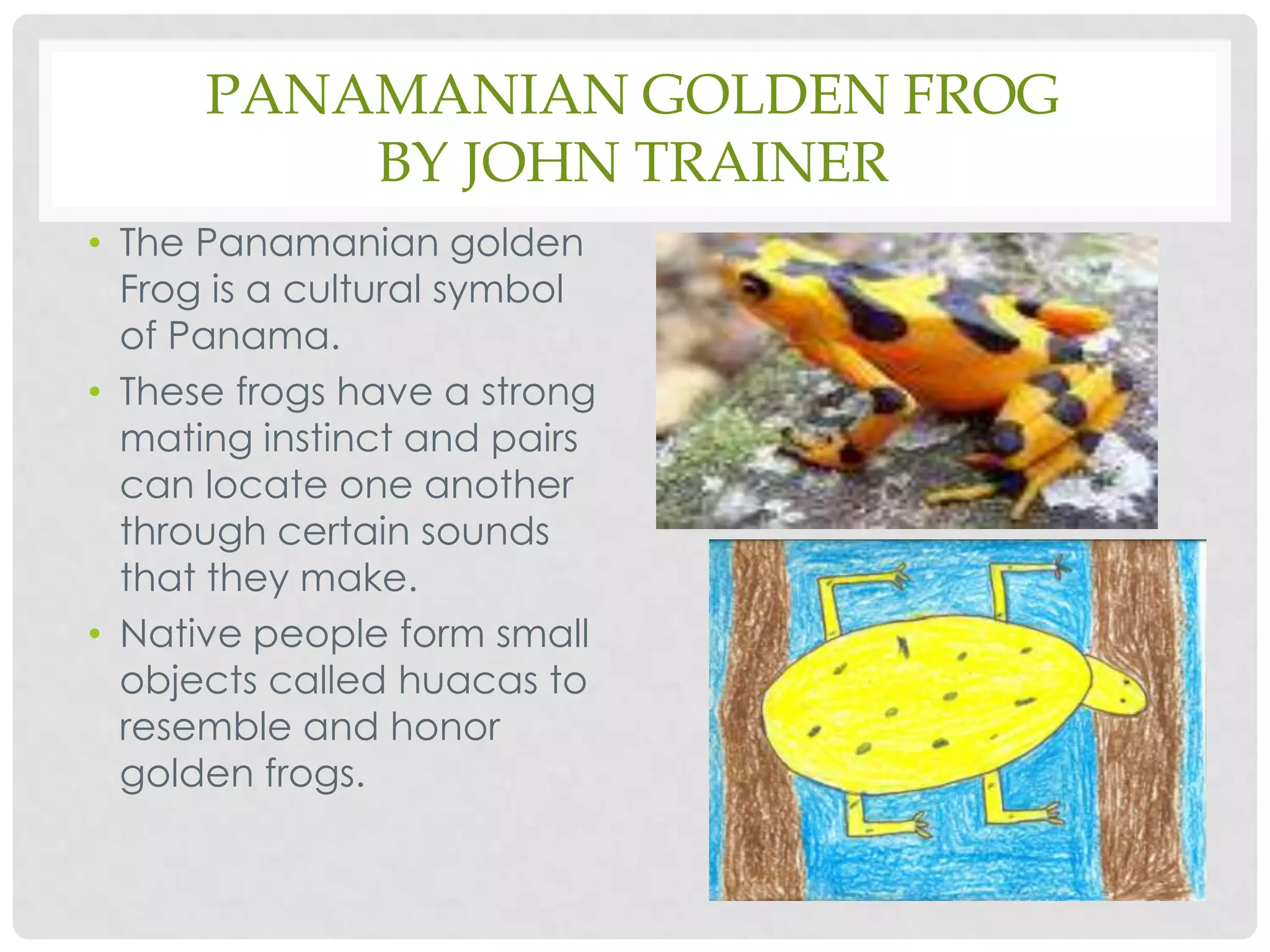
Panamanian Golden FrogBy John TrainerThe Panamanian golden Frog is a cultural symbol of Panama.These frogs have a strong mating instinct and pairs can locate one another through certain sounds that they make.Native people form small objects called huacas to resemble and honor golden frogs.
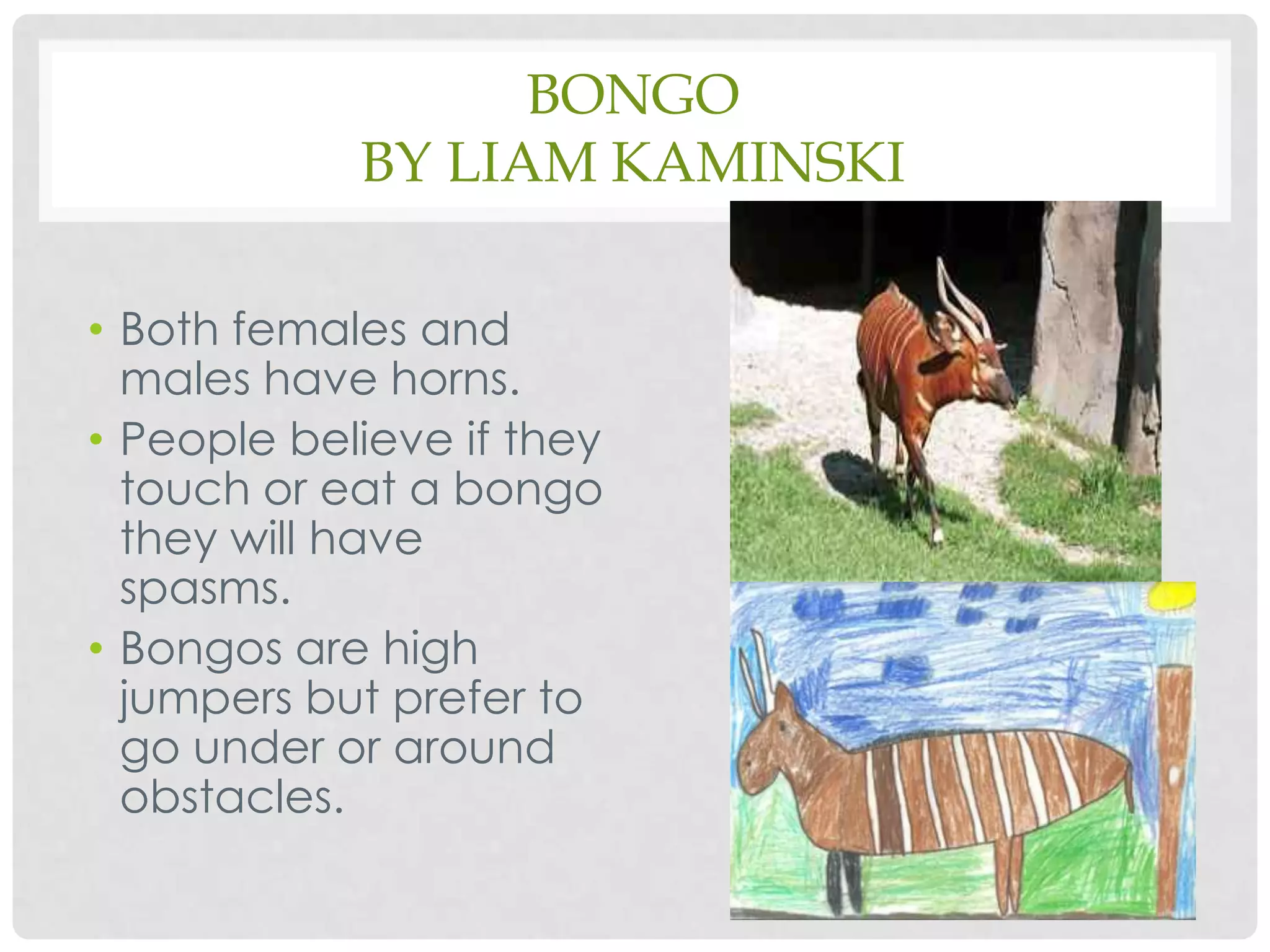
Bongoby Liam KaminskiBoth females and males have horns.People believe if they touch or eat a bongo they will have spasms.Bongos are high jumpers but prefer to go under or around obstacles.
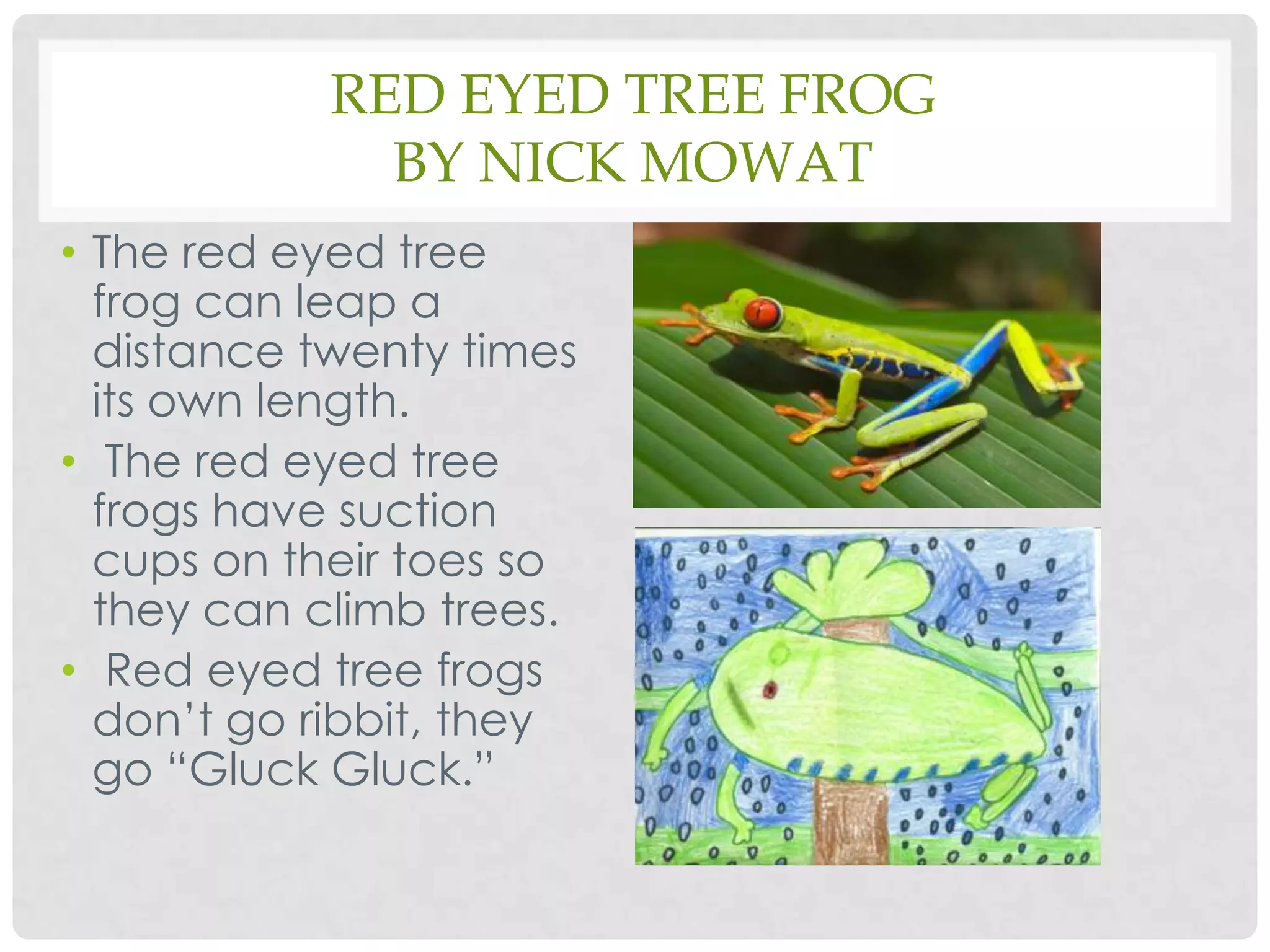
Red Eyed Tree FrogBy Nick MowatThe red eyed tree frog can leap a distance twenty times its own length. The red eyed tree frogs have suction cups on their toes so they can climb trees. Red eyed tree frogs don’t go ribbit, they go “Gluck Gluck.”
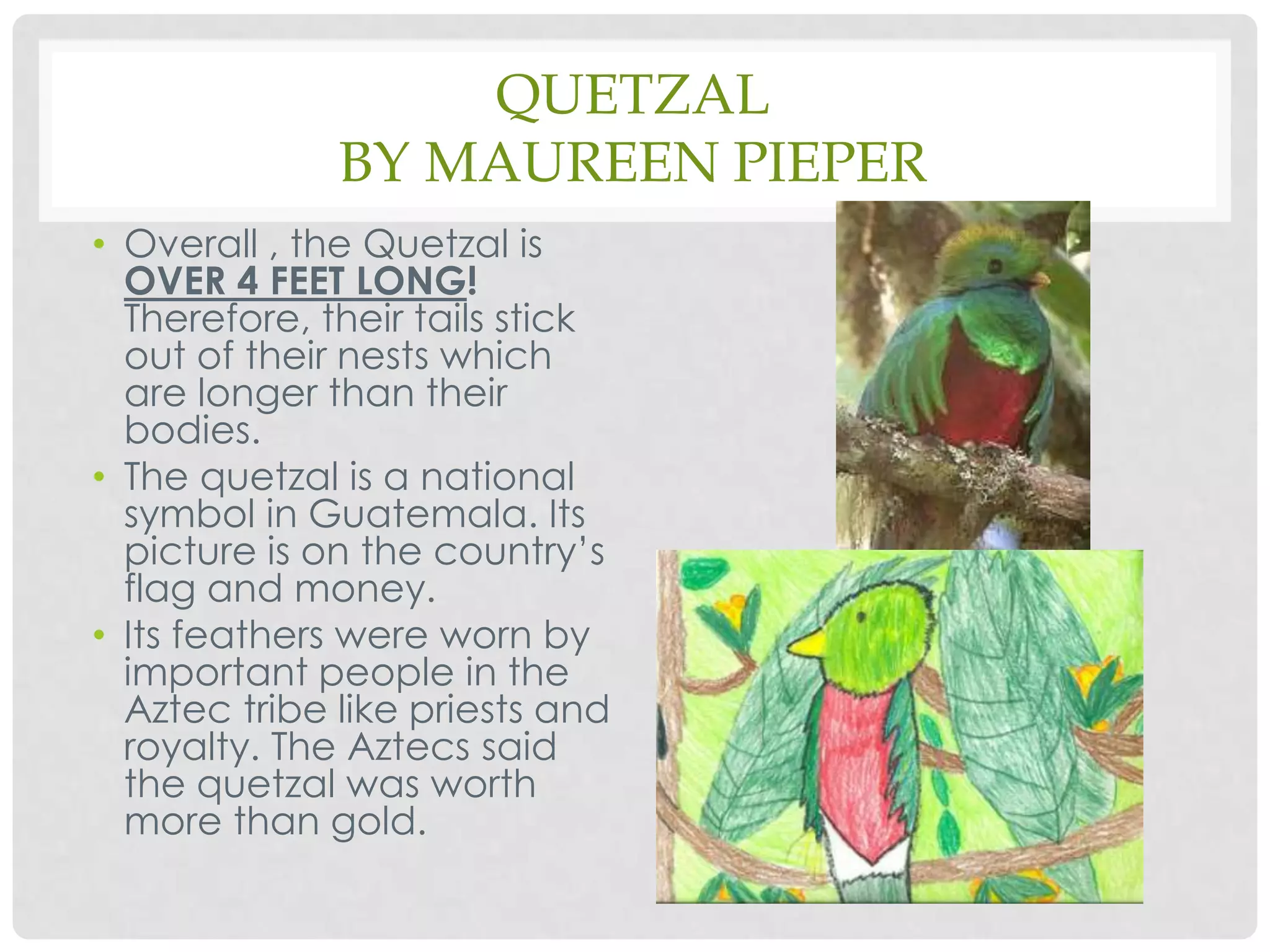
Quetzalby Maureen PieperOverall , the Quetzal is  OVER 4 FEET LONG! Therefore, their tails stick out of their nests which are longer than their bodies.The quetzal is a national symbol in Guatemala. Its picture is on the country’s flag and money.Its feathers were worn by important people in the Aztec tribe like priests and royalty. The Aztecs said the quetzal was worth more than gold.
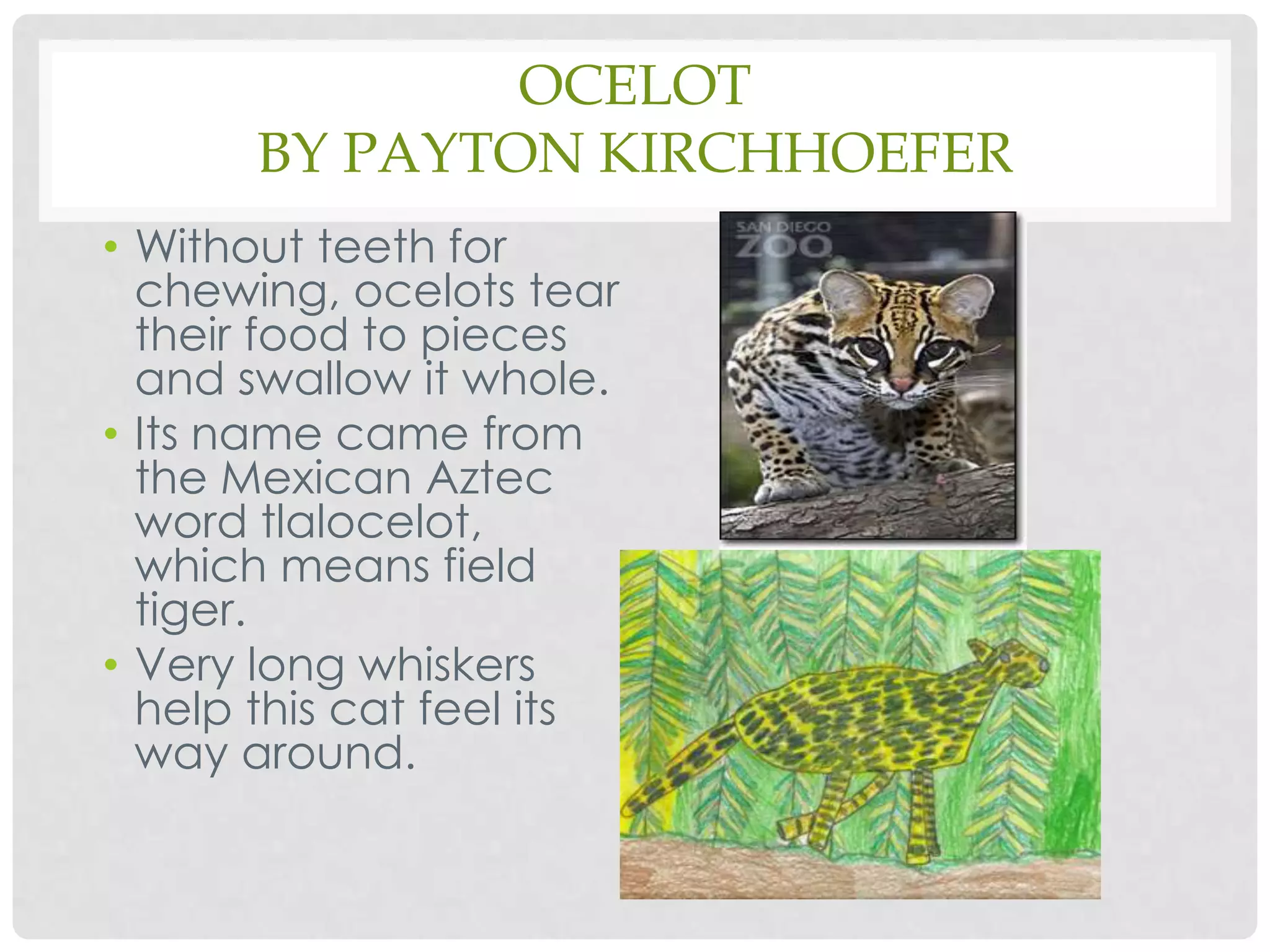
Ocelotby Payton KirchhoeferWithout teeth for chewing, ocelots tear their food to pieces and swallow it whole.Its name came from the Mexican Aztec word tlalocelot, which means field tiger.Very long whiskers help this cat feel its way around.
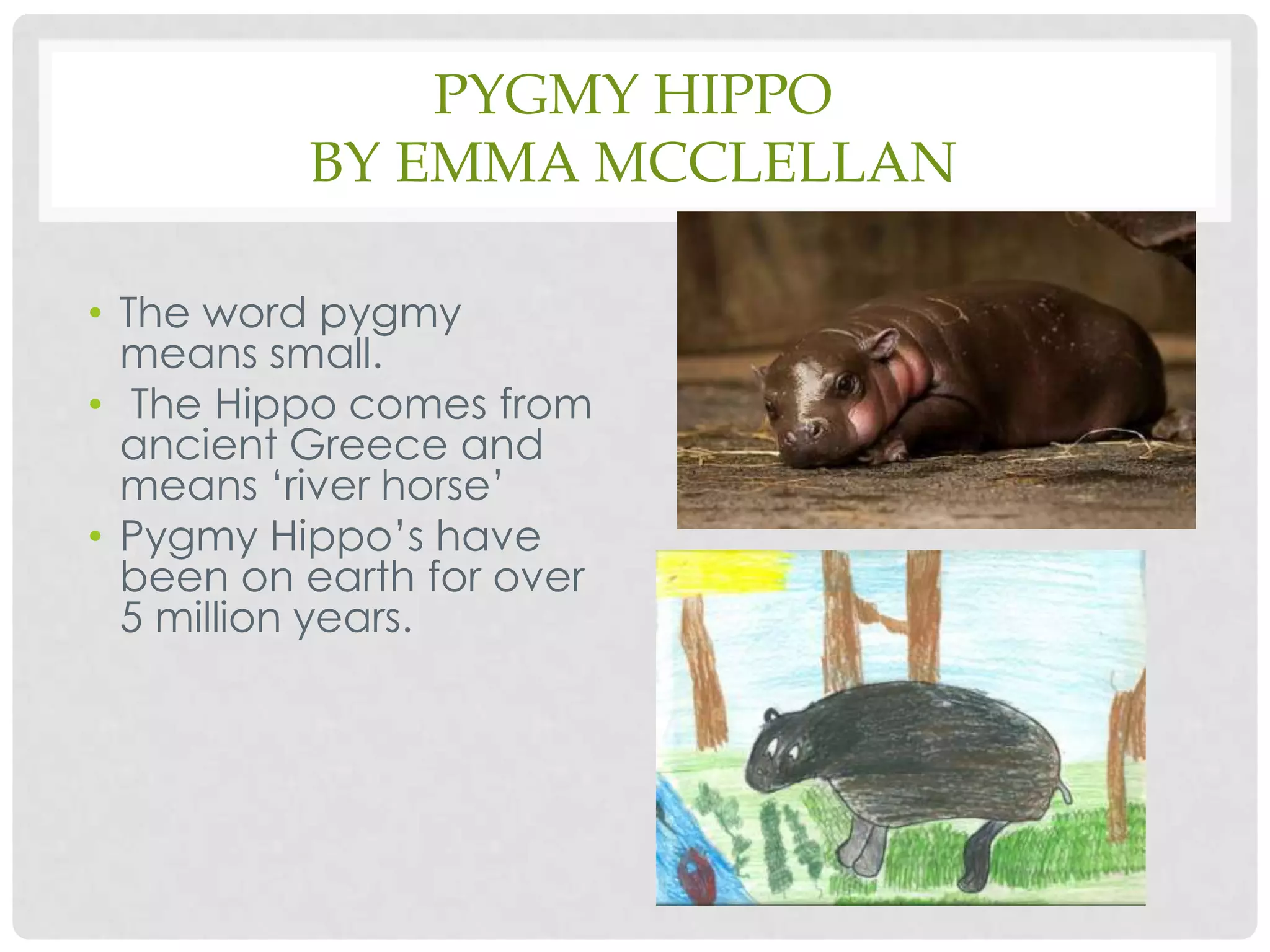
Pygmy Hippoby Emma McClellanThe word pygmy means small.The Hippo comes from ancient Greece and means ‘river horse’Pygmy Hippo’s have been on earth for over 5 million years.
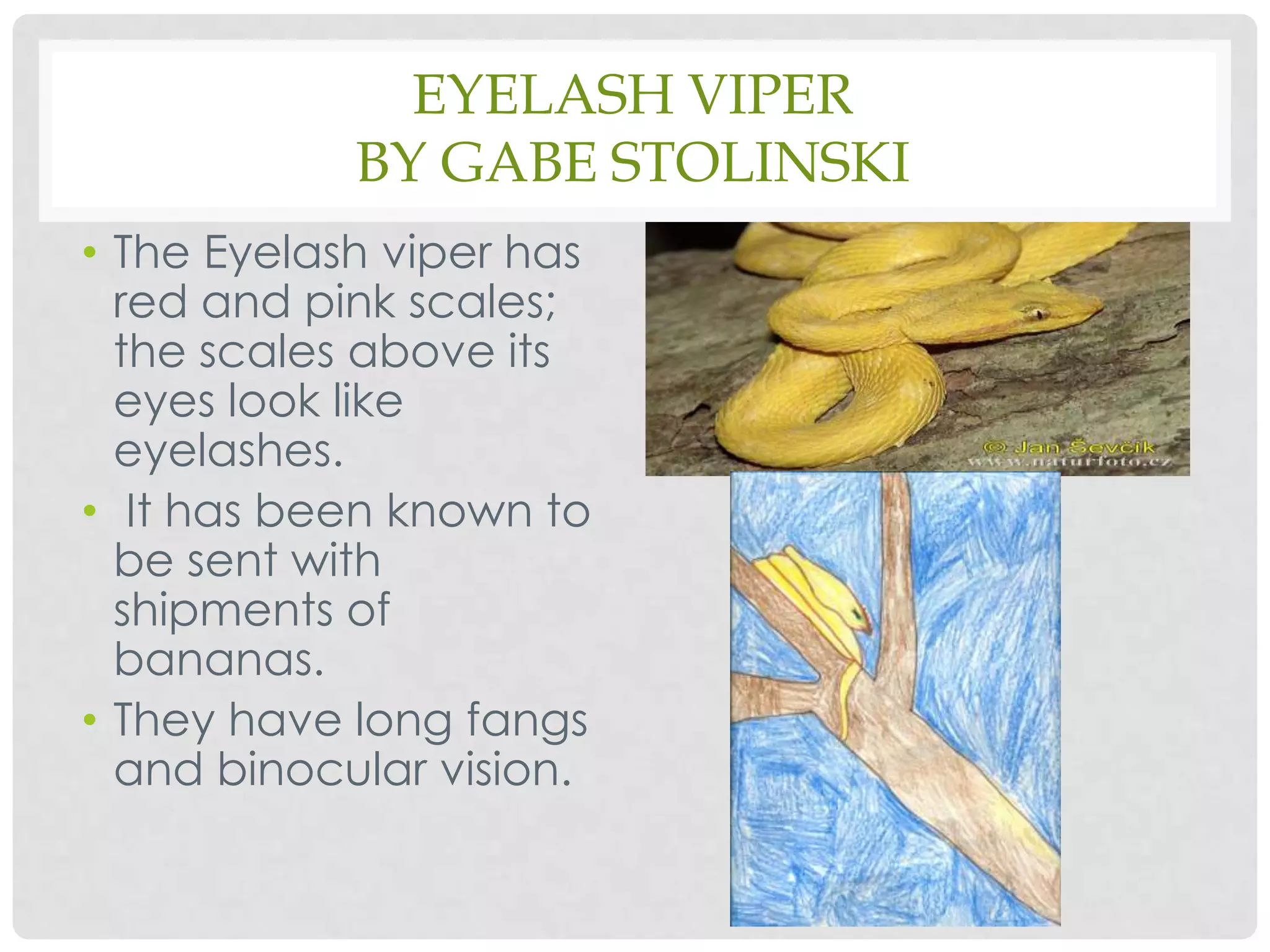
Eyelash Viperby Gabe StolinskiThe Eyelash viper has red and pink scales; the scales above its eyes look like eyelashes. It has been known to be sent with shipments of bananas.They have long fangs and binocular vision.
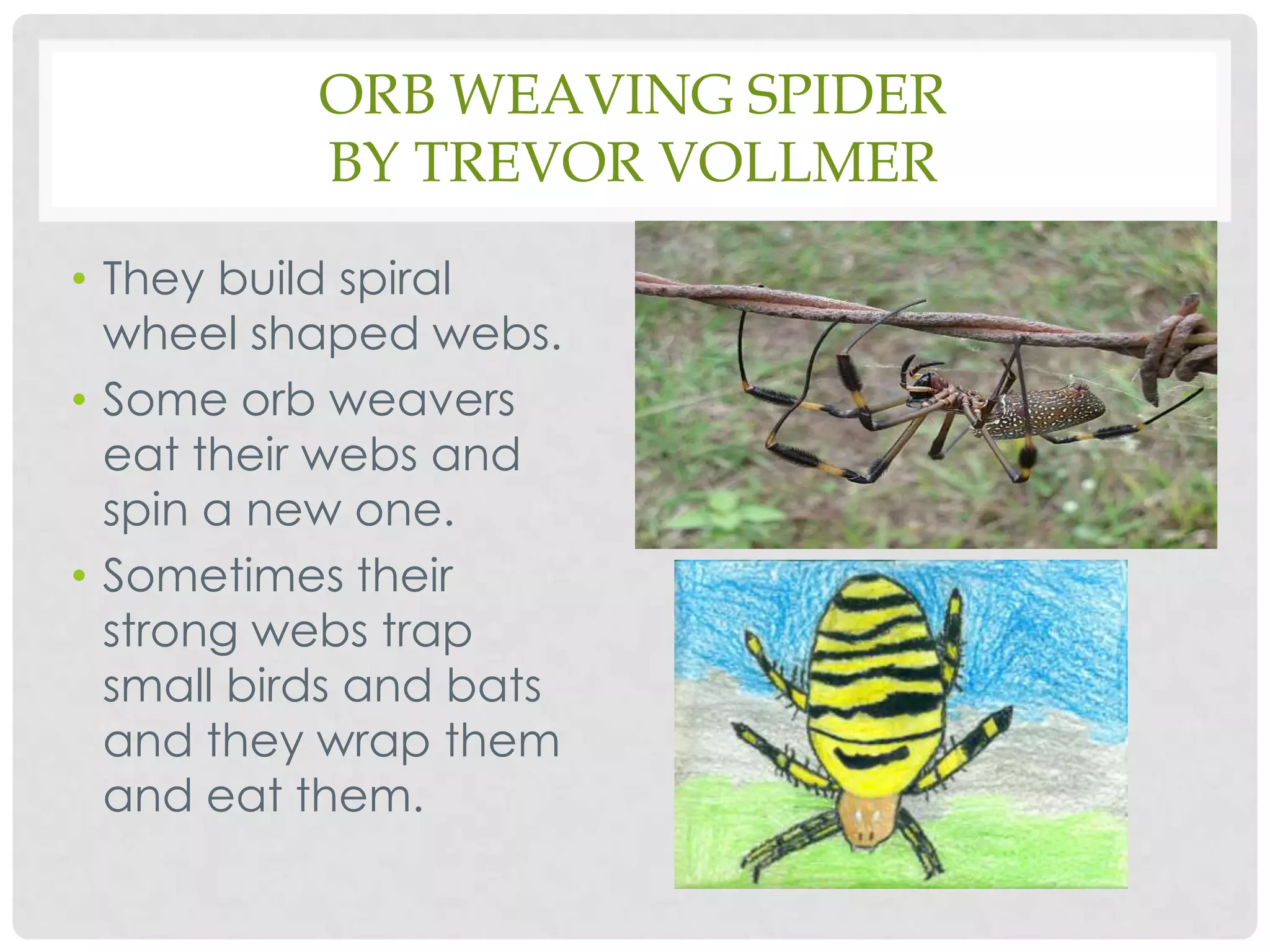
Orb Weaving Spiderby Trevor VollmerThey build spiral wheel shaped webs.Some orb weavers eat their webs and spin a new one.Sometimes their strong webs trap small birds and bats and they wrap them and eat them.
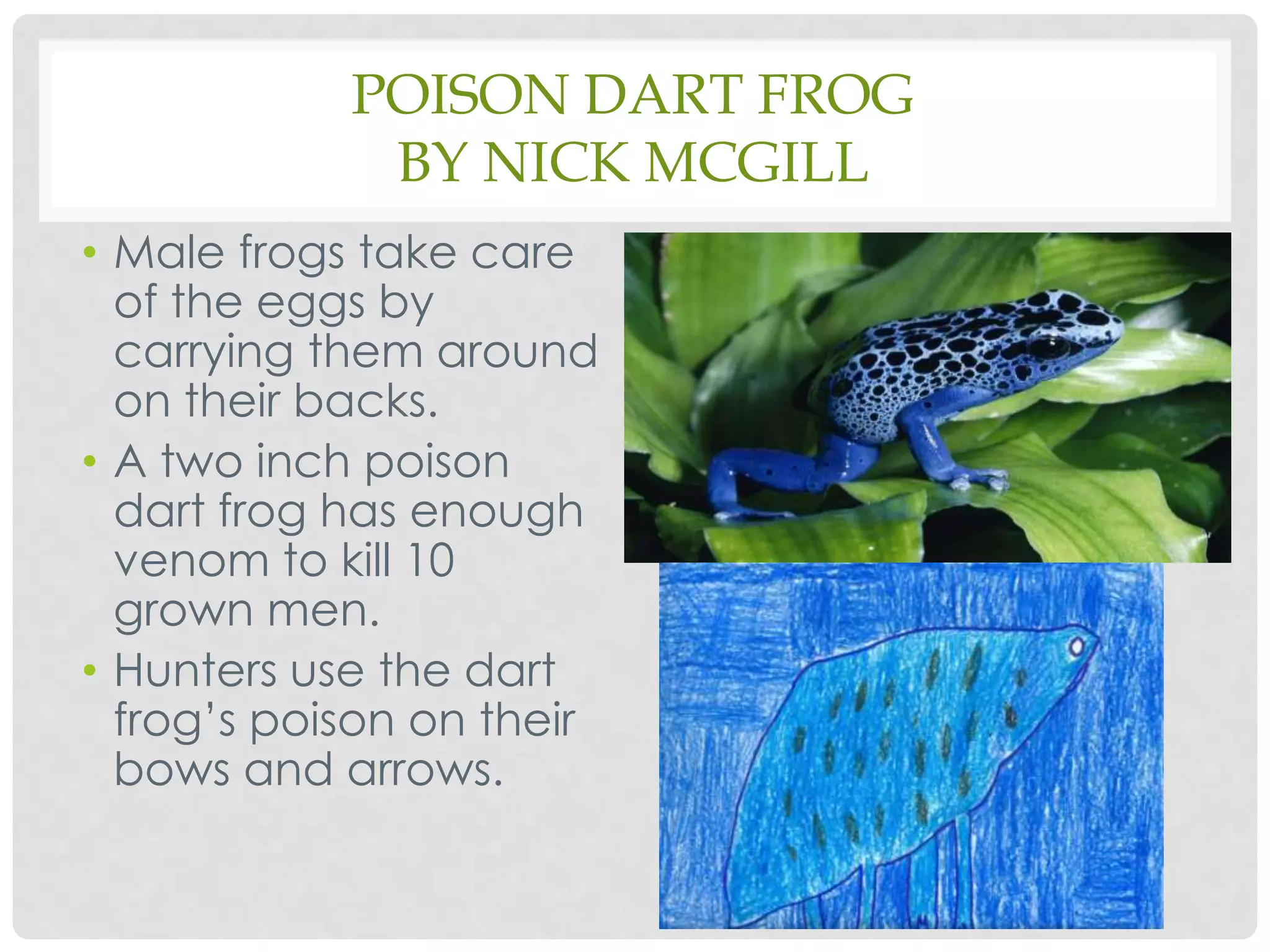
Male frogs take care of the eggs by carrying them around on their backs.A two inch poison dart frog has enough venom to kill 10 grown men.Hunters use the dart frog’s poison on their bows and arrows.Poison Dart Frogby Nick McGill
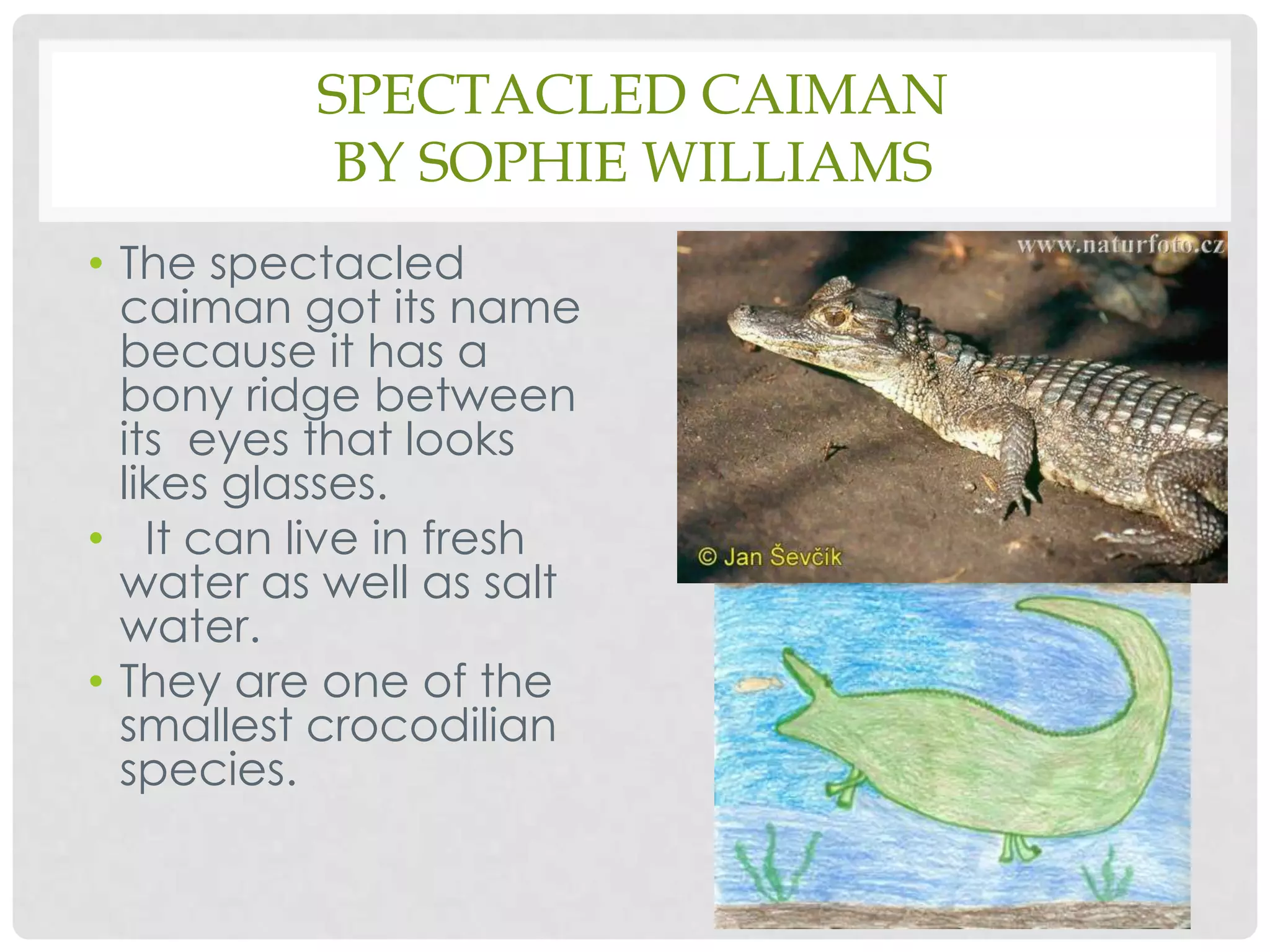
Spectacled Caimanby Sophie WilliamsThe spectacled caiman got its name because it has a bony ridge between  its  eyes that looks likes glasses.  It can live in fresh water as well as salt water.They are one of the smallest crocodilian species.

3 b 2011 rainforest powerpoint final

  • 1.
  • 2.
    Blue Morpho ButterflybyAnnika WilmersMorpho butterflies only live for 115 days.Adults use a long protruding mouth part called a proboscis as a drinking straw.Their wings reflect light.
  • 3.
    SlothBy John DeanThefemale has one baby a year.Algae grows on its body and can be used as food.The sloth is not that lazy-it is protecting itself by not moving too much during the day.
  • 4.
    Green Basilisk by Maria Circo A green basilisk can run on water as fast as 8 miles an hour.It has a nickname which is the Jesus Christ lizard.It can dive and stay under water for 30 minutes at a time.
  • 5.
    Golden Mantella FrogbyHannah WarrenMale cats attract females by clicking 3 times.They like to live in colonies where there are twice as many females.It is an amphibian but doesn't have webbed feet.Its toes have suction cups on them to help the frogs climb trees.They get water by absorbing it through their skin.
  • 6.
    Giant Anteaterby MeghanO’NeilThe Giant anteater’s tongue is over 2 feet long and it can stick it out 150 times a minute.Giant anteaters can stand on their hind legs and fight a jaguar with their claws. A Giant anteater can eat 35,000 ants or termites a day.
  • 7.
    Chubby Frogby MaggiePallesenThe chubby frog’s body has a glue like-slime which is hard to get off your hands.The chubby frog has the ability to expand itself when threatened.These frogs have a lot of nicknames like the Bubble Frog Painted Frog and the Ox Frog.
  • 8.
    Jaguarby Sean SmithJaguarsare such good swimmers that they can swim from one island to another.Their spots are called rosettes because they are shaped like roses.The jaguar is the only big cat that can’t roar.
  • 9.
    Giant African MillipedebyLogan SchoeningThe Giant African Millipede is used by monkeys to keep mosquitoes away.They even breathe through holes in their bodies.They molt several times as they grow, and that’s how they add more legs.
  • 10.
    Assassin bugby JohnathanPattersonThe assassin bug can kill other insects by injecting its prey.They can use their rostrums to deliver a painful bite.Their legs have tiny hairs.
  • 11.
    Iguanaby Jack O’MalleyTheiguana can fall 40-50 feet without getting hurt!The iguana can dive from trees into water if they need to escape a predator quickly.Its long tail is sharp, and is snapped in the air to scare off predators.
  • 12.
    Madagascar Hissing CockroachByElizabeth YoungThe Madagascar hissing cockroach can live up to one month and one week without food.Cockroaches smell and feel using their antennae.There are over three-thousand species of cockroaches on earth, and most of them spend their time sleeping or resting.
  • 13.
    Toucanby Abby PlankToucansswallow fruit whole and then throw up the seeds.Its beak is one third of its body, but isn’t used as a weapon. Its only for show!They have big claws that help them balance on the trees, the two claws are in front and two in back.
  • 14.
    Tarantulaby Jillian TealTarantulasmake doors or soft walls for their burrows.They have little hairs that protect them from predators .They do not spin a web, instead they catch their prey by their fangs.
  • 15.
    Galapagos Tortoiseby DJDoughertyThe Galapagos tortoise can live to be 100 years old. The oldest is 152 years old.They nap about 16 hours a day. Some people thought they arrived on the islands by floating in on drifting wood.
  • 16.
    Spider Monkeyby FrancKutilekTheir hands are like human hands but they don’t have any thumbs.They can swing up to 40 feet in one swing with their long arms. They have long and lanky arms and gripping tails.
  • 17.
    Rhinoceros Beetleby Nora Fitzsimmons The rhinoceros beetle is also called the Hercules unicorn and horn beetle.It gets out of danger by tunneling under ground.The rhino beetle can carry 850 times its weight.
  • 18.
    Vine Snakeby SkylerHopwoodThe vine snake is green with a black diamond shaped pattern on its skin.It is so long and skinny it looks like a vine in the forest.It can extend half of its body into midair.
  • 19.
    Black Howler MonkeyByMeg HarmonMales use their big voices to defend their territory.They are the loudest animals in the rain forest.The Black Howler monkeys use their tails as extra hands.
  • 20.
    Bearded Pigby MoFlaneryBearded pigs have a life span of 10 years.Bearded pigs use their snouts to dig for food.The bearded pigs’ sparse hair doesn’t offer much protection.
  • 21.
    Happy Face SpiderbyJaelyn AdamsThe happy face spiders are non poisonous. It smile on the back confuses the predators.They do not bite humans.
  • 22.
    Goliath Frogby ZoeMoffittGoliath Frogs are mute –they can’t make noises.They can leap 10 feet in the air.They were around before dinosaurs.
  • 23.
    Indian Cobraby MarioRiveraThe Indian Cobra is very smart when it catches its prey. The Indian cobra is the largest venomous snake.Its jaws open very wide when it eats its prey.
  • 24.
    Panamanian Golden FrogByJohn TrainerThe Panamanian golden Frog is a cultural symbol of Panama.These frogs have a strong mating instinct and pairs can locate one another through certain sounds that they make.Native people form small objects called huacas to resemble and honor golden frogs.
  • 25.
    Bongoby Liam KaminskiBothfemales and males have horns.People believe if they touch or eat a bongo they will have spasms.Bongos are high jumpers but prefer to go under or around obstacles.
  • 26.
    Red Eyed TreeFrogBy Nick MowatThe red eyed tree frog can leap a distance twenty times its own length. The red eyed tree frogs have suction cups on their toes so they can climb trees. Red eyed tree frogs don’t go ribbit, they go “Gluck Gluck.”
  • 27.
    Quetzalby Maureen PieperOverall, the Quetzal is OVER 4 FEET LONG! Therefore, their tails stick out of their nests which are longer than their bodies.The quetzal is a national symbol in Guatemala. Its picture is on the country’s flag and money.Its feathers were worn by important people in the Aztec tribe like priests and royalty. The Aztecs said the quetzal was worth more than gold.
  • 28.
    Ocelotby Payton KirchhoeferWithoutteeth for chewing, ocelots tear their food to pieces and swallow it whole.Its name came from the Mexican Aztec word tlalocelot, which means field tiger.Very long whiskers help this cat feel its way around.
  • 29.
    Pygmy Hippoby EmmaMcClellanThe word pygmy means small.The Hippo comes from ancient Greece and means ‘river horse’Pygmy Hippo’s have been on earth for over 5 million years.
  • 30.
    Eyelash Viperby GabeStolinskiThe Eyelash viper has red and pink scales; the scales above its eyes look like eyelashes. It has been known to be sent with shipments of bananas.They have long fangs and binocular vision.
  • 31.
    Orb Weaving SpiderbyTrevor VollmerThey build spiral wheel shaped webs.Some orb weavers eat their webs and spin a new one.Sometimes their strong webs trap small birds and bats and they wrap them and eat them.
  • 32.
    Male frogs takecare of the eggs by carrying them around on their backs.A two inch poison dart frog has enough venom to kill 10 grown men.Hunters use the dart frog’s poison on their bows and arrows.Poison Dart Frogby Nick McGill
  • 33.
    Spectacled Caimanby SophieWilliamsThe spectacled caiman got its name because it has a bony ridge between its eyes that looks likes glasses. It can live in fresh water as well as salt water.They are one of the smallest crocodilian species.