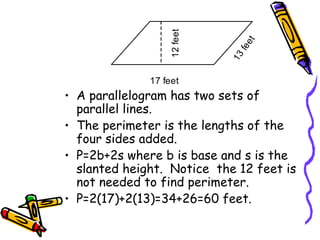
• A parallelogramhas two sets of
parallel lines.
• The perimeter is the lengths of the
four sides added.
• P=2b+2s where b is base and s is the
slanted height. Notice the 12 feet is
not needed to find perimeter.
• P=2(17)+2(13)=34+26=60 feet.
17 feet
12
feet
1
3
f
e
e
t
3.
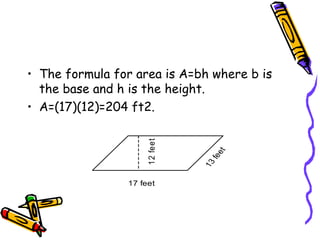
• The formulafor area is A=bh where b is
the base and h is the height.
• A=(17)(12)=204 ft2.
17 feet
1
2
fe
e
t
4.
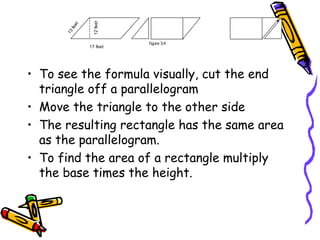
• To seethe formula visually, cut the end
triangle off a parallelogram
• Move the triangle to the other side
• The resulting rectangle has the same area
as the parallelogram.
• To find the area of a rectangle multiply
the base times the height.
17 feet
12
feet
1
3
f
e
e
t
figure 3.4
5.
Trapezoids
• Trapezoids haveone set of parallel lines
and one set of lines that are not parallel.
• The parallel lines are the bases.
• The height is perpendicular between the
bases.
• The slant heights may be the same or they
may be different.
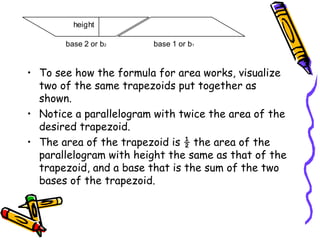
• To seehow the formula for area works, visualize
two of the same trapezoids put together as
shown.
• Notice a parallelogram with twice the area of the
desired trapezoid.
• The area of the trapezoid is ½ the area of the
parallelogram with height the same as that of the
trapezoid, and a base that is the sum of the two
bases of the trapezoid.
base 1 or b1
base 2 or b2
height
8.
Triangles
• To findthe perimeter of a triangle
add all three sides.
• P= a+b+c where a, b and c are the
lengths of the sides.
• The area of a triangle is A= ½ bh
where b is the base and h is the
height perpendicular to the base.
9.
• To illustratewhy the area formula works,
make a parallelogram out of two identical
triangles.
• The height and base of the parallelogram
is the same as that of the triangle. The
area of the parallelogram is base times
height and is twice the desired area of the
triangle.