Pharmaceutical powder
By
Muhannad O. Taher
 Powders are mixtures of dry, finely divided drugs and/or chemicals
that may be intended for internal or external use.
Definition !?
Oral Powder
Advantages Disadvantages
- Unpleasant tasting of drugs
- More stable than liquid
-More convenient to swallow than tablet or
capsules
- Used in blending with medicated application as
ointments, suppositories and pastes
-Can be prepared into granules for use in
preparing tablets and or reconstituted to liquid
form
- Rapid therapeutic effect due to large surface area
- Useful for bulky drugs with large dose
- It is difficult to protect powders containing
hygroscopic, deliquescent (tending to melt or
dissolve in humid environment), or aromatic
materials from decomposition.
- Time and expenses require in the preparation
of uniform powders are great
- Patient may misunderstand the correct method
of use. Without clear instruction, patients may
inhale through the nose a drug intended for oral
administration.
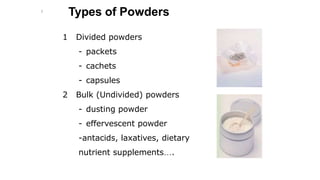
Types of Powders
1 Divided powders
- packets
- cachets
- capsules
2 Bulk (Undivided) powders
- dusting powder
- effervescent powder
-antacids, laxatives, dietary
nutrient supplements….
5
Preparation of Powders
6
1. Reduction of particle size of all
ingredients to the same range to
prevent stratification.
2. Sieving.
3. Weighing of each ingredient.
4. Mixing.
5. Packaging.
54
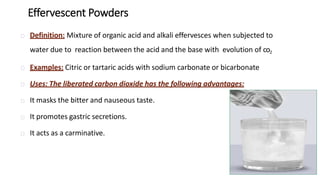
Effervescent Powders
 Definition: Mixture of organic acid and alkali effervesces when subjected to
water due to reaction between the acid and the base with evolution of co2
 Examples: Citric or tartaric acids with sodium carbonate or bicarbonate
 Uses: The liberated carbon dioxide has the following advantages:
 It masks the bitter and nauseous taste.
 It promotes gastric secretions.
 It acts as a carminative.
Effervescent Powders
8
 Formulation:
- Bulk powders or divided powders
-Packed in separate packages of contrasting colors.
-The contents are mixed in a quantity of water at the time of
dosing.
-The liquid is consumed just after the reaction begin to subside.

2nd lab.pptx

  • 1.
  • 2.
     Powders aremixtures of dry, finely divided drugs and/or chemicals that may be intended for internal or external use. Definition !?
  • 3.
  • 4.
    Advantages Disadvantages - Unpleasanttasting of drugs - More stable than liquid -More convenient to swallow than tablet or capsules - Used in blending with medicated application as ointments, suppositories and pastes -Can be prepared into granules for use in preparing tablets and or reconstituted to liquid form - Rapid therapeutic effect due to large surface area - Useful for bulky drugs with large dose - It is difficult to protect powders containing hygroscopic, deliquescent (tending to melt or dissolve in humid environment), or aromatic materials from decomposition. - Time and expenses require in the preparation of uniform powders are great - Patient may misunderstand the correct method of use. Without clear instruction, patients may inhale through the nose a drug intended for oral administration.
  • 5.
    Types of Powders 1Divided powders - packets - cachets - capsules 2 Bulk (Undivided) powders - dusting powder - effervescent powder -antacids, laxatives, dietary nutrient supplements…. 5
  • 6.
    Preparation of Powders 6 1.Reduction of particle size of all ingredients to the same range to prevent stratification. 2. Sieving. 3. Weighing of each ingredient. 4. Mixing. 5. Packaging.
  • 7.
    54 Effervescent Powders  Definition:Mixture of organic acid and alkali effervesces when subjected to water due to reaction between the acid and the base with evolution of co2  Examples: Citric or tartaric acids with sodium carbonate or bicarbonate  Uses: The liberated carbon dioxide has the following advantages:  It masks the bitter and nauseous taste.  It promotes gastric secretions.  It acts as a carminative.
  • 8.
    Effervescent Powders 8  Formulation: -Bulk powders or divided powders -Packed in separate packages of contrasting colors. -The contents are mixed in a quantity of water at the time of dosing. -The liquid is consumed just after the reaction begin to subside.