National Artists of the Philippines
in the Field of Visual Arts
 To get to know some of the national artists
of the Philippines in the visual arts field of
painting and sculpture and become familiar
with some of their works
 To gain appreciation on how their
masterpieces depicted Philippine history and
culture
Learning Objectives
 Students will learn about the works of the
national artists of the Philippines in the field of
visual arts that can help them better appreciate
the cultural heritage of our country.
Key Understanding
Key Question
 How did the works of these national artists
reflect the history, culture, tradition and
geography of the Philippine islands?
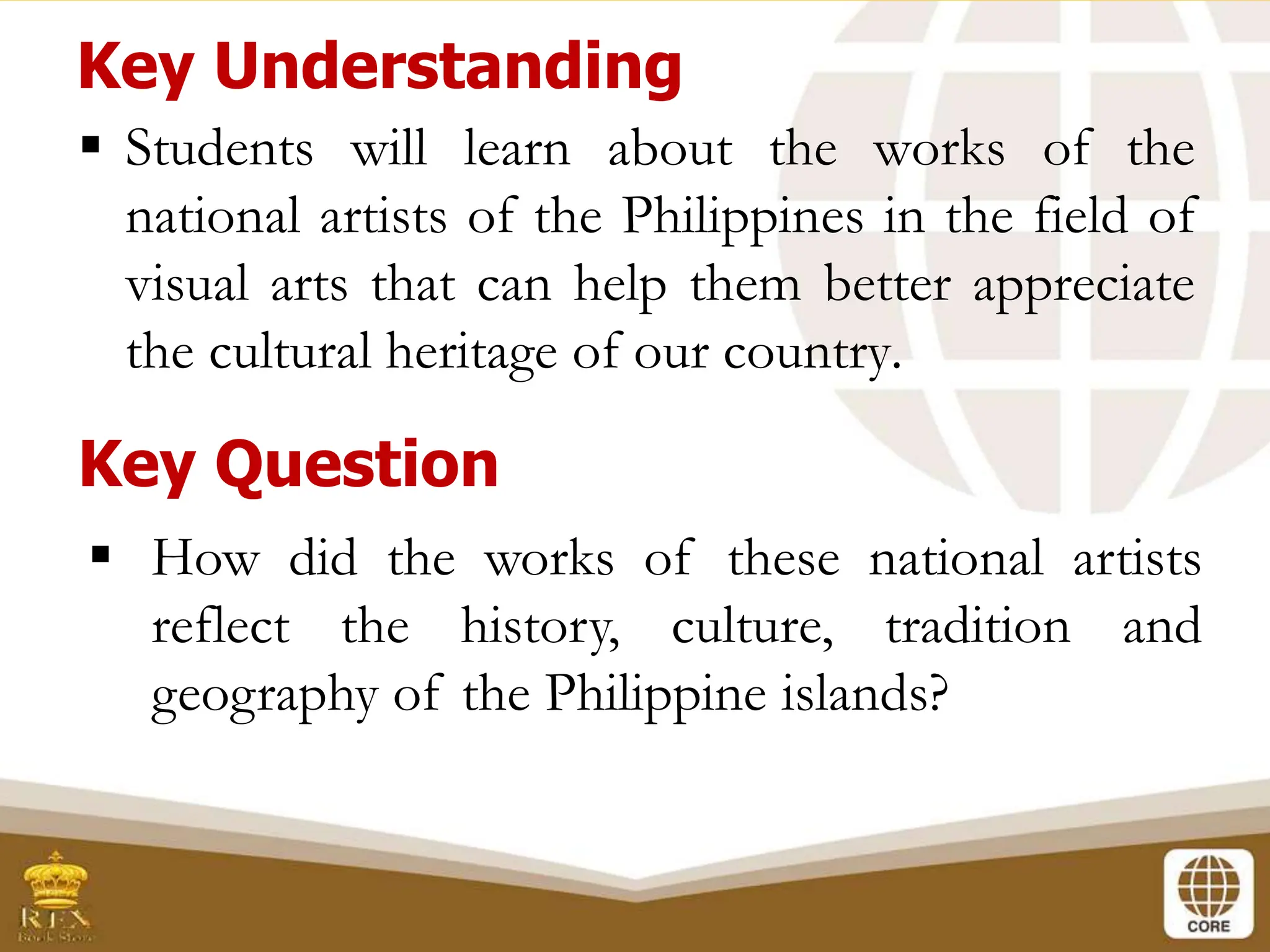
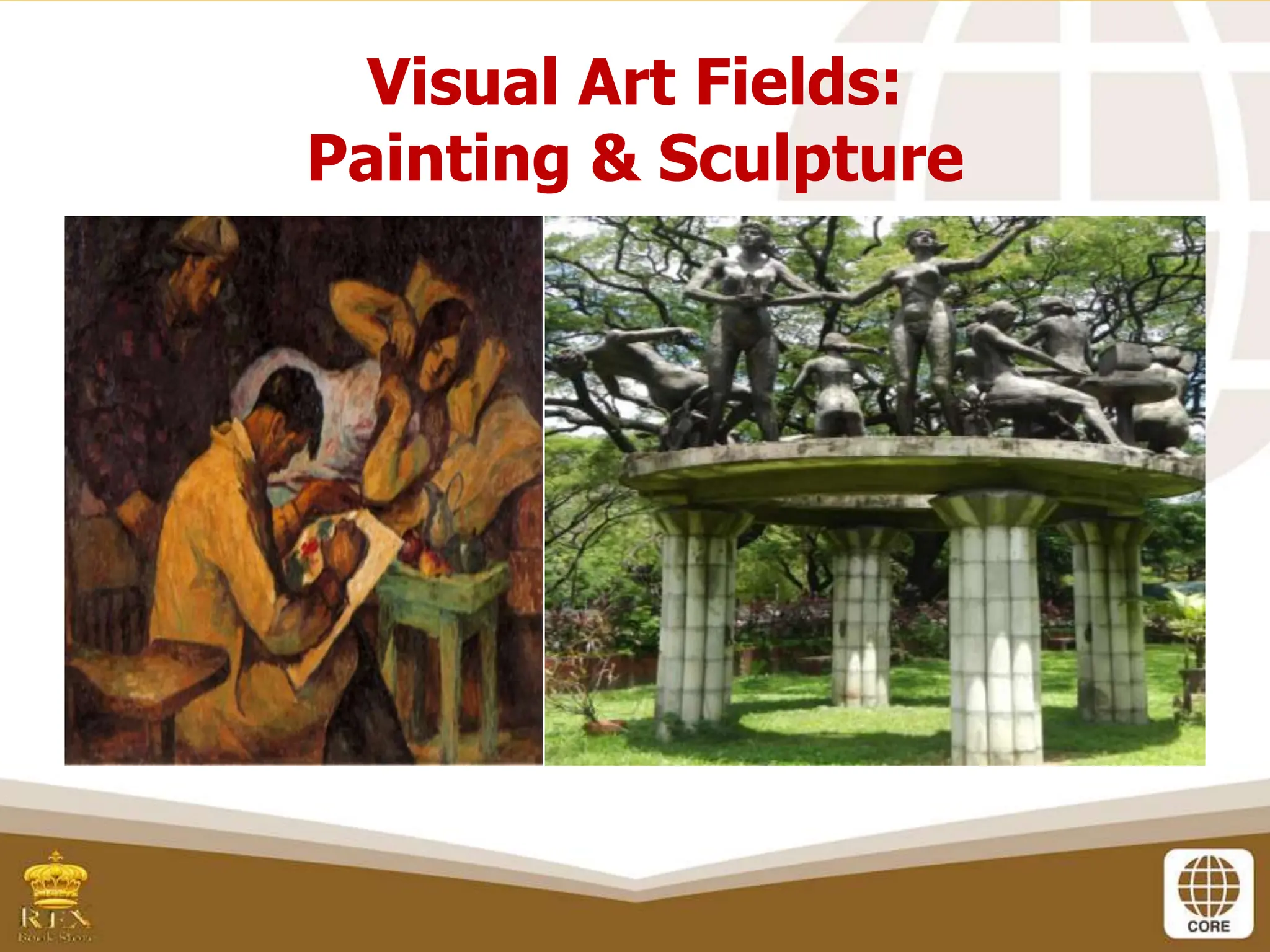
Visual Art Fields:
Painting & Sculpture
Visual Art Fields:
Painting & Sculpture
 Painting emphasizes form achieved through color ―
intensity, saturation, brightness, contrast, and the
use of combinations in conveying the subject.
 Sculpture focuses on form achieved through texture
and dimension. They are never flat in dimension
and could be smooth, rough, soft, hard, shiny,
pointed, etc. depending on the texture of materials
used.
Filipino National Artists in the
Visual Arts
1. Fernando Amorsolo
Born in 1892, his artworks serve as
relics of the country’s history (eras
covering the Spanish, American, and
Japanese rules, up to the 1970s). His
masterpieces showcase rural
landscapes which applied light
techniques (chiaroscuro) and
impressionistic brush strokes. One
of this is the now world-famous
Planting Rice series depicter here.
Filipino National Artists in the
Visual Arts
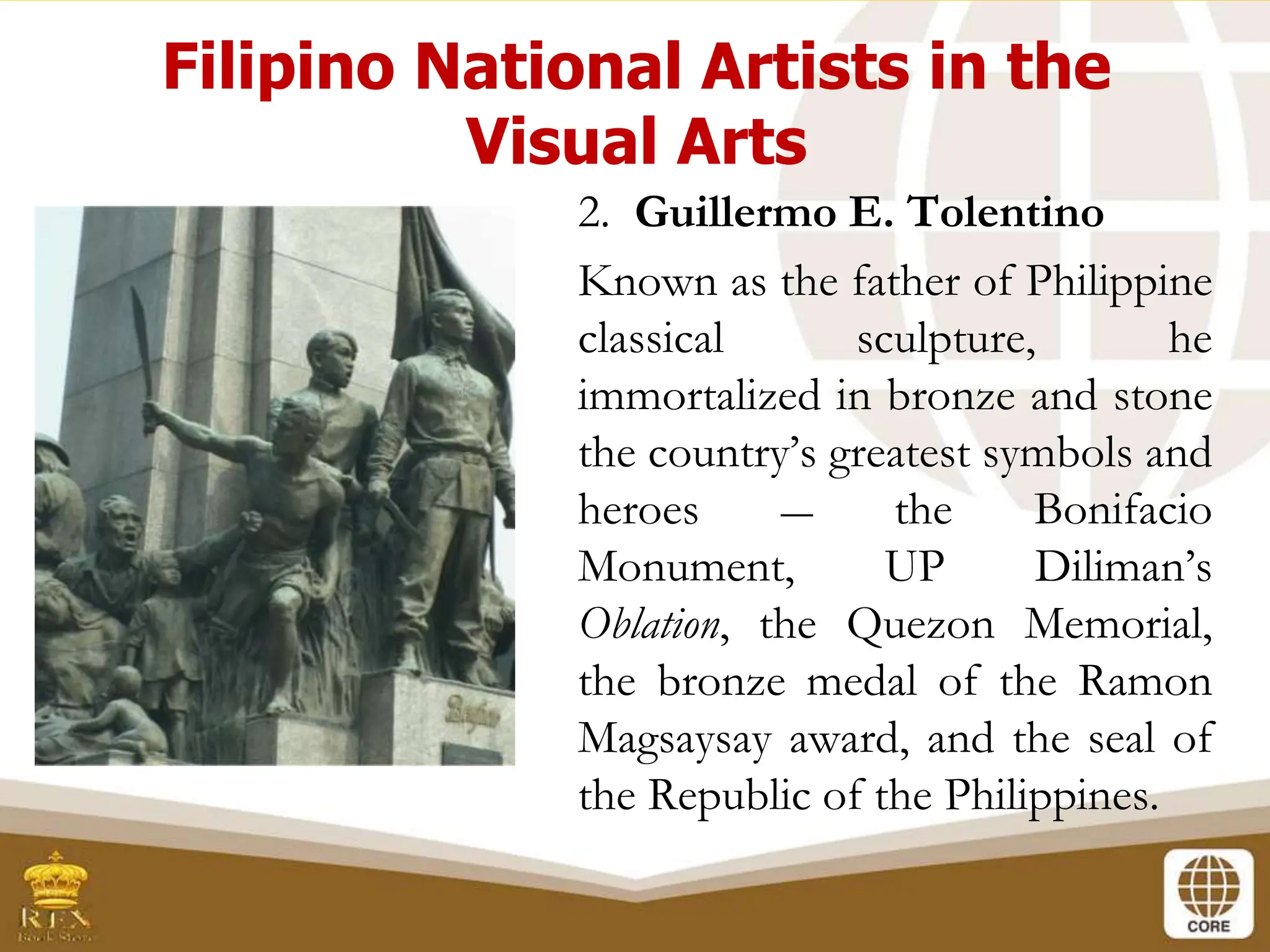
2. Guillermo E. Tolentino
Known as the father of Philippine
classical sculpture, he
immortalized in bronze and stone
the country’s greatest symbols and
heroes ― the Bonifacio
Monument, UP Diliman’s
Oblation, the Quezon Memorial,
the bronze medal of the Ramon
Magsaysay award, and the seal of
the Republic of the Philippines.
Filipino National Artists in the
Visual Arts
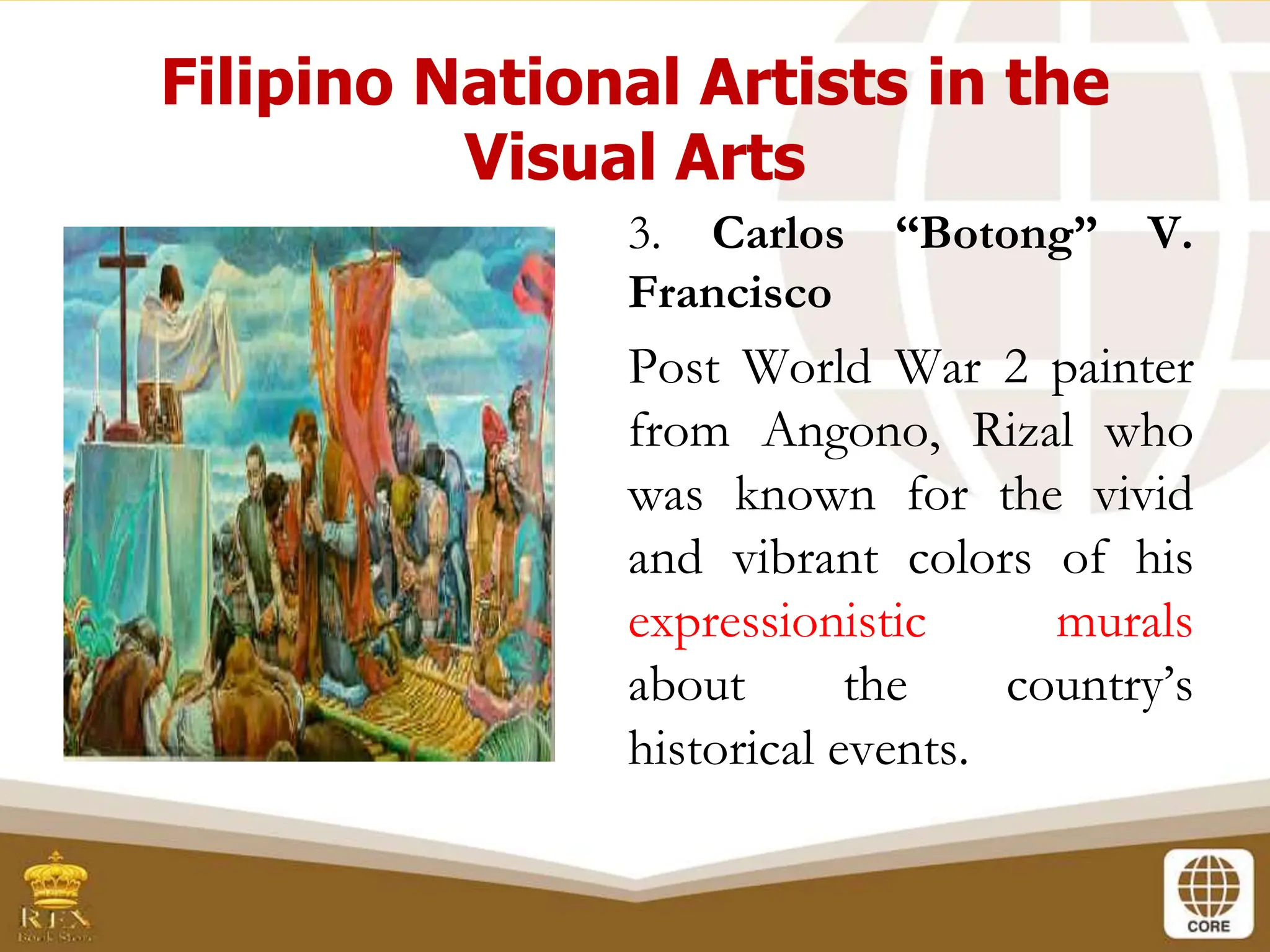
3. Carlos “Botong” V.
Francisco
Post World War 2 painter
from Angono, Rizal who
was known for the vivid
and vibrant colors of his
expressionistic murals
about the country’s
historical events.
Filipino National Artists in the
Visual Arts
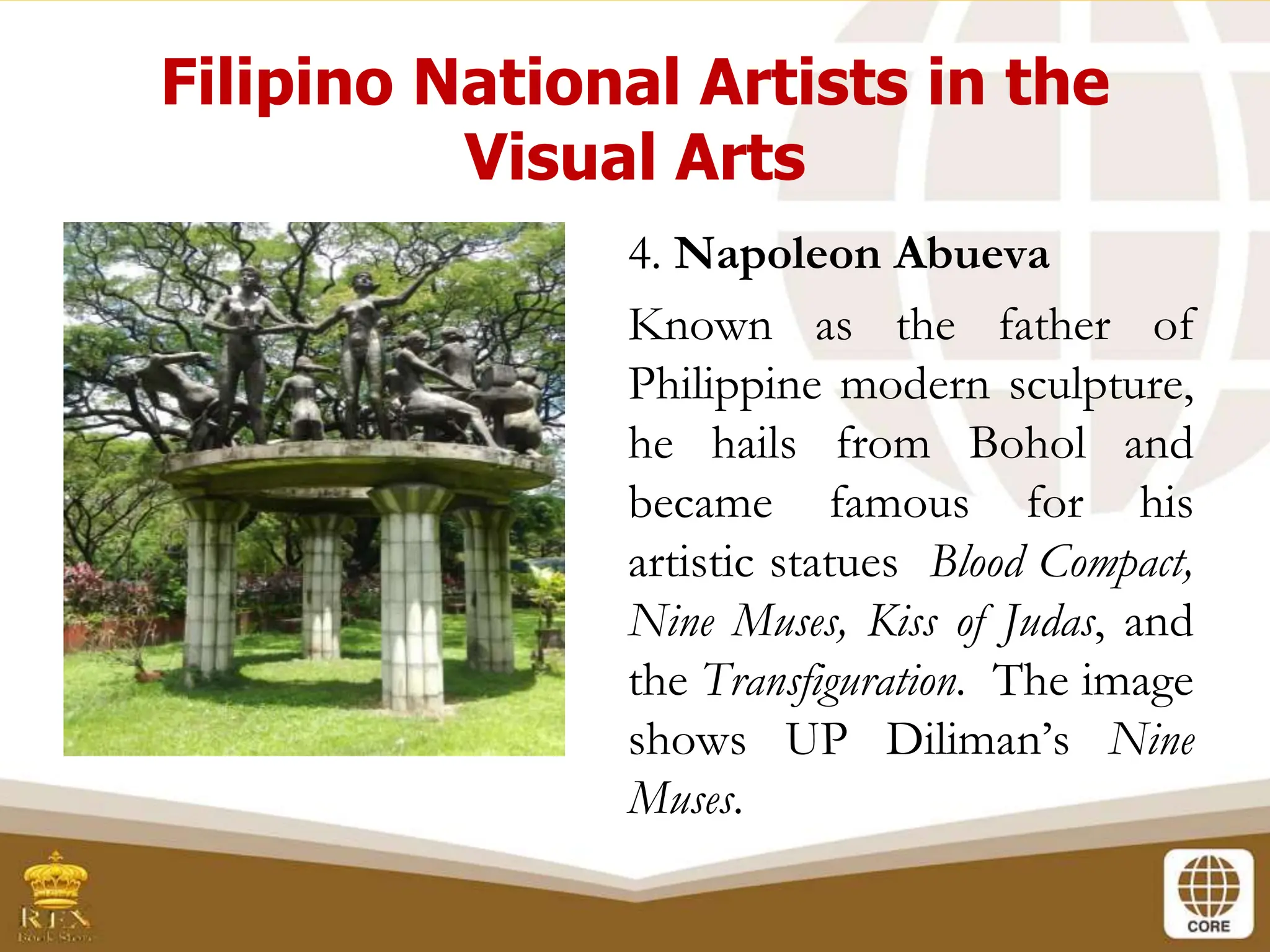
4. Napoleon Abueva
Known as the father of
Philippine modern sculpture,
he hails from Bohol and
became famous for his
artistic statues Blood Compact,
Nine Muses, Kiss of Judas, and
the Transfiguration. The image
shows UP Diliman’s Nine
Muses.
Filipino National Artists in the
Visual Arts
5. Ben Cabrera
He is a mixed media
artist. A native of
Malabon, but an
adopted son of Baguio
and the Cordillera
region, he is famous for
the whimsical and
folksy quality of his
works.
Opinion Essay and Painting Activity
1. Write an opinion essay (300 to 500 words)
answering the following questions: Which
do you prefer, classical painting or modern
painting? Why do you prefer this over the
other?
2. Then draw and paint an artwork illustrative
of the qualities of classical or modern
painting.
Culminating Activity

2_National_Artists_of_the_Philippines_in_the_Field_of_Visual_Arts.pptx

  • 1.
    National Artists ofthe Philippines in the Field of Visual Arts
  • 2.
     To getto know some of the national artists of the Philippines in the visual arts field of painting and sculpture and become familiar with some of their works  To gain appreciation on how their masterpieces depicted Philippine history and culture Learning Objectives
  • 3.
     Students willlearn about the works of the national artists of the Philippines in the field of visual arts that can help them better appreciate the cultural heritage of our country. Key Understanding Key Question  How did the works of these national artists reflect the history, culture, tradition and geography of the Philippine islands?
  • 4.
  • 5.
    Visual Art Fields: Painting& Sculpture  Painting emphasizes form achieved through color ― intensity, saturation, brightness, contrast, and the use of combinations in conveying the subject.  Sculpture focuses on form achieved through texture and dimension. They are never flat in dimension and could be smooth, rough, soft, hard, shiny, pointed, etc. depending on the texture of materials used.
  • 6.
    Filipino National Artistsin the Visual Arts 1. Fernando Amorsolo Born in 1892, his artworks serve as relics of the country’s history (eras covering the Spanish, American, and Japanese rules, up to the 1970s). His masterpieces showcase rural landscapes which applied light techniques (chiaroscuro) and impressionistic brush strokes. One of this is the now world-famous Planting Rice series depicter here.
  • 7.
    Filipino National Artistsin the Visual Arts 2. Guillermo E. Tolentino Known as the father of Philippine classical sculpture, he immortalized in bronze and stone the country’s greatest symbols and heroes ― the Bonifacio Monument, UP Diliman’s Oblation, the Quezon Memorial, the bronze medal of the Ramon Magsaysay award, and the seal of the Republic of the Philippines.
  • 8.
    Filipino National Artistsin the Visual Arts 3. Carlos “Botong” V. Francisco Post World War 2 painter from Angono, Rizal who was known for the vivid and vibrant colors of his expressionistic murals about the country’s historical events.
  • 9.
    Filipino National Artistsin the Visual Arts 4. Napoleon Abueva Known as the father of Philippine modern sculpture, he hails from Bohol and became famous for his artistic statues Blood Compact, Nine Muses, Kiss of Judas, and the Transfiguration. The image shows UP Diliman’s Nine Muses.
  • 10.
    Filipino National Artistsin the Visual Arts 5. Ben Cabrera He is a mixed media artist. A native of Malabon, but an adopted son of Baguio and the Cordillera region, he is famous for the whimsical and folksy quality of his works.
  • 11.
    Opinion Essay andPainting Activity 1. Write an opinion essay (300 to 500 words) answering the following questions: Which do you prefer, classical painting or modern painting? Why do you prefer this over the other? 2. Then draw and paint an artwork illustrative of the qualities of classical or modern painting. Culminating Activity

Editor's Notes

  • #2 Tell the students that they can read more about this topic in Lesson 5: NATIONAL ARTISTS OF THE PHILIPPINES and Lesson 8: ELEMENTS OF ART AND PRINCIPLES OF COMPOSITION of Rex Book Store’s Contemporary Arts from the Regions by Flaudette May Datuin, Roberto G. Paulino, Eileen Legazpi-Ramirez and Louise Marcelino.