Skeletal
System
By: Group 5 Atom
Introduction
The term "skeletal" generally
relates to the skeleton,
which is the internal
framework of bones in
vertebrates.
The skeletal system consists of
several key parts:
1. Bones: The rigid structures
that form the skeleton,
providing support and
protection.
2. Cartilage: Flexible tissue found
in joints, the nose, and ears,
which cushions bones and aids
in movement.
SKELETAL
SYSTEM
SKELETAL SYSTEM
3. Ligaments: Strong connective
tissues that connect bones to
other bones, stabilizing joints.
4. Tendons: Connective tissues that
attach muscles to bones,
enabling movement.
5. Joints: Areas where two or more
bones meet, allowing for various
ranges of motion.
These components work together to
support the body, protect vital organs,
and enable movement.
PARTS OF THE
SKELETON
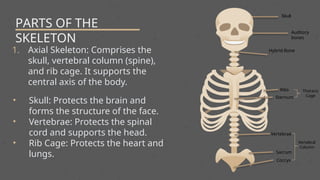
1. Axial Skeleton: Comprises the
skull, vertebral column (spine),
and rib cage. It supports the
central axis of the body.
• Skull: Protects the brain and
forms the structure of the face.
• Vertebrae: Protects the spinal
cord and supports the head.
• Rib Cage: Protects the heart and
lungs.
Skull
Auditory
bones
Hybrid Bone
Ribs
Sternum
Vertebrae
Sacrum
Coccyx
Thoracic
Cage
Vertebral
Column
PARTS OF THE
SKELETON
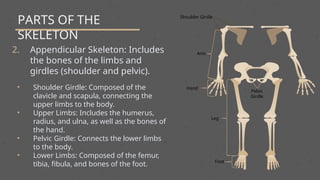
2. Appendicular Skeleton: Includes
the bones of the limbs and
girdles (shoulder and pelvic).
• Shoulder Girdle: Composed of the
clavicle and scapula, connecting the
upper limbs to the body.
• Upper Limbs: Includes the humerus,
radius, and ulna, as well as the bones of
the hand.
• Pelvic Girdle: Connects the lower limbs
to the body.
• Lower Limbs: Composed of the femur,
tibia, fibula, and bones of the foot.
Shoulder Girdle
Arm
Hand
Leg
Foot
Pelvic
Girdle
FUNCTIONS OF THE
SKELETON
FUNCTIONS OF THE
SKELETON
• Support: Provides structure and support for
the body.
• Protection: Shields vital organs (e.g., brain,
heart).
• Movement: Works with muscles to facilitate
movement.
• Mineral Storage: Stores minerals like calcium
and phosphorus.
• Blood Cell Production: Bone marrow
produces red and white blood cells.
THANK YOU!!
GROUP 5 ATOM

SKELETAL system-earth and life science.pptx

  • 1.
  • 2.
    Introduction The term "skeletal"generally relates to the skeleton, which is the internal framework of bones in vertebrates.
  • 3.
    The skeletal systemconsists of several key parts: 1. Bones: The rigid structures that form the skeleton, providing support and protection. 2. Cartilage: Flexible tissue found in joints, the nose, and ears, which cushions bones and aids in movement. SKELETAL SYSTEM
  • 4.
    SKELETAL SYSTEM 3. Ligaments:Strong connective tissues that connect bones to other bones, stabilizing joints. 4. Tendons: Connective tissues that attach muscles to bones, enabling movement. 5. Joints: Areas where two or more bones meet, allowing for various ranges of motion. These components work together to support the body, protect vital organs, and enable movement.
  • 5.
    PARTS OF THE SKELETON 1.Axial Skeleton: Comprises the skull, vertebral column (spine), and rib cage. It supports the central axis of the body. • Skull: Protects the brain and forms the structure of the face. • Vertebrae: Protects the spinal cord and supports the head. • Rib Cage: Protects the heart and lungs. Skull Auditory bones Hybrid Bone Ribs Sternum Vertebrae Sacrum Coccyx Thoracic Cage Vertebral Column
  • 6.
    PARTS OF THE SKELETON 2.Appendicular Skeleton: Includes the bones of the limbs and girdles (shoulder and pelvic). • Shoulder Girdle: Composed of the clavicle and scapula, connecting the upper limbs to the body. • Upper Limbs: Includes the humerus, radius, and ulna, as well as the bones of the hand. • Pelvic Girdle: Connects the lower limbs to the body. • Lower Limbs: Composed of the femur, tibia, fibula, and bones of the foot. Shoulder Girdle Arm Hand Leg Foot Pelvic Girdle
  • 7.
  • 8.
    FUNCTIONS OF THE SKELETON •Support: Provides structure and support for the body. • Protection: Shields vital organs (e.g., brain, heart). • Movement: Works with muscles to facilitate movement. • Mineral Storage: Stores minerals like calcium and phosphorus. • Blood Cell Production: Bone marrow produces red and white blood cells.
  • 9.