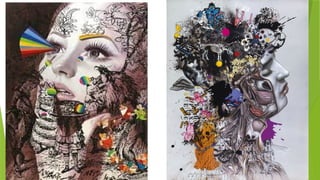
To familiarize yourself with the
modern art scene in the country,
we will study
about Filipino contemporary
artists and their works
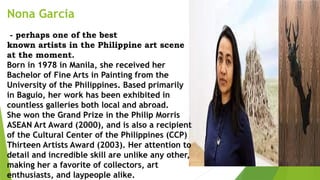
Nona Garcia
- perhaps one of the best
known artists in the Philippine art scene
at the moment.
Born in 1978 in Manila, she received her
Bachelor of Fine Arts in Painting from the
University of the Philippines. Based primarily
in Baguio, her work has been exhibited in
countless galleries both local and abroad.
She won the Grand Prize in the Philip Morris
ASEAN Art Award (2000), and is also a recipient
of the Cultural Center of the Philippines (CCP)
Thirteen Artists Award (2003). Her attention to
detail and incredible skill are unlike any other,
making her a favorite of collectors, art
enthusiasts, and laypeople alike.
Among her solo shows are False Apparitions (Singapore,
2012), Before the Sea (Manila, 2012), Unearth (Berlin,
2015), and Before the Sky (Manila, 2016). Nona Garcia is
known for employing the use of stark realism to bring into
question what the true meaning of representation
is. Her use of photorealism centers everyday
objects, cultural artifacts, or people, inviting the
viewers to explore the environmental, sociopolitical,
and personal histories of her subjects. Although
famous for her paintings, she also employs the
use of paper cutouts, x-rays, and lightboxes in her
works.
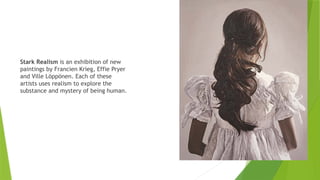
Stark Realism is an exhibition of new
paintings by Francien Krieg, Effie Pryer
and Ville Löppönen. Each of these
artists uses realism to explore the
substance and mystery of being human.
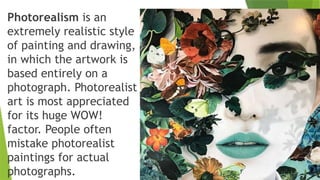
Photorealism is an
extremely realistic style
of painting and drawing,
in which the artwork is
based entirely on a
photograph. Photorealist
art is most appreciated
for its huge WOW!
factor. People often
mistake photorealist
paintings for actual
photographs.
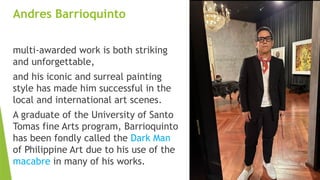
Andres Barrioquinto
multi-awarded work is both striking
and unforgettable,
and his iconic and surreal painting
style has made him successful in the
local and international art scenes.
A graduate of the University of Santo
Tomas fine Arts program, Barrioquinto
has been fondly called the Dark Man
of Philippine Art due to his use of the
macabre in many of his works.
He has participated in shows both in
the country and abroad, including
Singapore and Taipei. In addition to this,
he alsohad a recent major showcase of
portraits at the National Museum in
November.
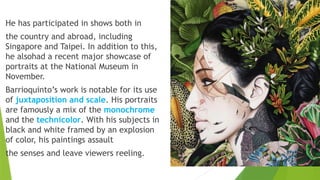
Barrioquinto’s work is notable for its use
of juxtaposition and scale. His portraits
are famously a mix of the monochrome
and the technicolor. With his subjects in
black and white framed by an explosion
of color, his paintings assault
the senses and leave viewers reeling.
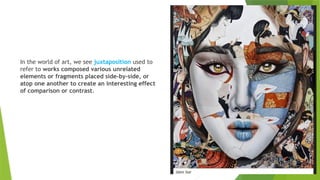
In the world of art, we see juxtaposition used to
refer to works composed various unrelated
elements or fragments placed side-by-side, or
atop one another to create an interesting effect
of comparison or contrast.
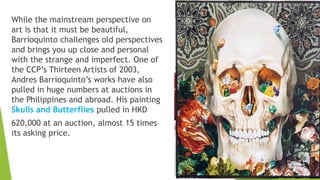
While the mainstream perspective on
art is that it must be beautiful,
Barrioquinto challenges old perspectives
and brings you up close and personal
with the strange and imperfect. One of
the CCP’s Thirteen Artists of 2003,
Andres Barrioquinto’s works have also
pulled in huge numbers at auctions in
the Philippines and abroad. His painting
Skulls and Butterflies pulled in HKD
620,000 at an auction, almost 15 times
its asking price.
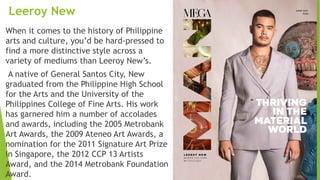
Leeroy New
When it comes to the history of Philippine
arts and culture, you’d be hard-pressed to
find a more distinctive style across a
variety of mediums than Leeroy New’s.
A native of General Santos City, New
graduated from the Philippine High School
for the Arts and the University of the
Philippines College of Fine Arts. His work
has garnered him a number of accolades
and awards, including the 2005 Metrobank
Art Awards, the 2009 Ateneo Art Awards, a
nomination for the 2011 Signature Art Prize
in Singapore, the 2012 CCP 13 Artists
Award, and the 2014 Metrobank Foundation
Award.
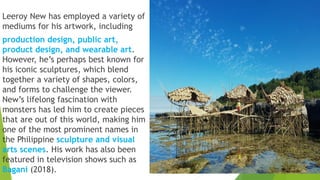
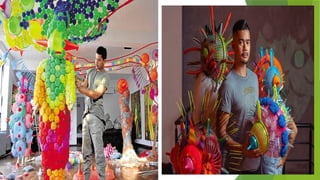
Leeroy New has employed a variety of
mediums for his artwork, including
production design, public art,
product design, and wearable art.
However, he’s perhaps best known for
his iconic sculptures, which blend
together a variety of shapes, colors,
and forms to challenge the viewer.
New’s lifelong fascination with
monsters has led him to create pieces
that are out of this world, making him
one of the most prominent names in
the Philippine sculpture and visual
arts scenes. His work has also been
featured in television shows such as
Bagani (2018).
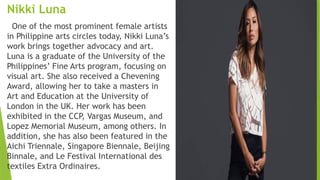
Nikki Luna
One of the most prominent female artists
in Philippine arts circles today, Nikki Luna’s
work brings together advocacy and art.
Luna is a graduate of the University of the
Philippines’ Fine Arts program, focusing on
visual art. She also received a Chevening
Award, allowing her to take a masters in
Art and Education at the University of
London in the UK. Her work has been
exhibited in the CCP, Vargas Museum, and
Lopez Memorial Museum, among others. In
addition, she has also been featured in the
Aichi Triennale, Singapore Biennale, Beijing
Binnale, and Le Festival International des
textiles Extra Ordinaires.
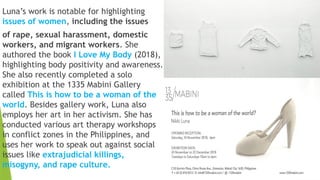
Luna’s work is notable for highlighting
issues of women, including the issues
of rape, sexual harassment, domestic
workers, and migrant workers. She
authored the book I Love My Body (2018),
highlighting body positivity and awareness.
She also recently completed a solo
exhibition at the 1335 Mabini Gallery
called This is how to be a woman of the
world. Besides gallery work, Luna also
employs her art in her activism. She has
conducted various art therapy workshops
in conflict zones in the Philippines, and
uses her work to speak out against social
issues like extrajudicial killings,
misogyny, and rape culture.
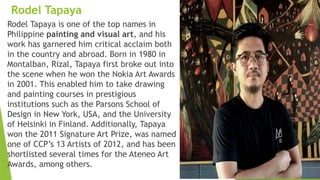
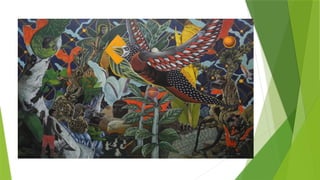
Rodel Tapaya
Rodel Tapaya is one of the top names in
Philippine painting and visual art, and his
work has garnered him critical acclaim both
in the country and abroad. Born in 1980 in
Montalban, Rizal, Tapaya first broke out into
the scene when he won the Nokia Art Awards
in 2001. This enabled him to take drawing
and painting courses in prestigious
institutions such as the Parsons School of
Design in New York, USA, and the University
of Helsinki in Finland. Additionally, Tapaya
won the 2011 Signature Art Prize, was named
one of CCP’s 13 Artists of 2012, and has been
shortlisted several times for the Ateneo Art
Awards, among others.
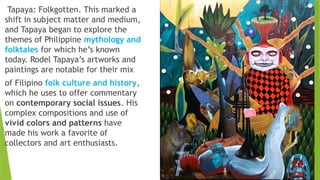
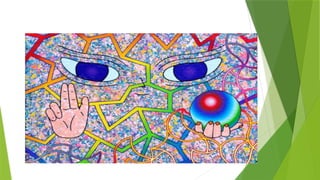
Tapaya: Folkgotten. This marked a
shift in subject matter and medium,
and Tapaya began to explore the
themes of Philippine mythology and
folktales for which he’s known
today. Rodel Tapaya’s artworks and
paintings are notable for their mix
of Filipino folk culture and history,
which he uses to offer commentary
on contemporary social issues. His
complex compositions and use of
vivid colors and patterns have
made his work a favorite of
collectors and art enthusiasts.
Ernest Concepcion
Ernest Concepcion is well known for his
highly complex and experimental
paintings, which play with texture and color
to create images that arrest the viewer’s
eyes. Born in 1977, he graduated from the
University of the Philippines with a Bachelor
of Fine Arts. He has participated in a
number of art residences in New York,
where he stayed for several years.
Concepcion has exhibited in galleries both
in the Philippines and in the United States,
including solo exhibitions and group shows.
He as also received the CCP’s 13 Artists of
2015 award, among others.
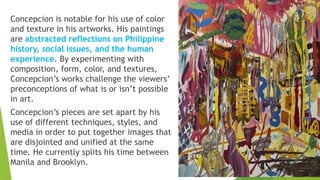
Concepcion is notable for his use of color
and texture in his artworks. His paintings
are abstracted reflections on Philippine
history, social issues, and the human
experience. By experimenting with
composition, form, color, and textures,
Concepcion’s works challenge the viewers’
preconceptions of what is or isn’t possible
in art.
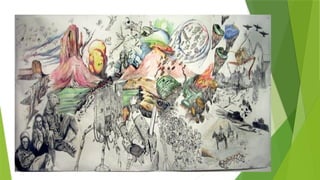
Concepcion’s pieces are set apart by his
use of different techniques, styles, and
media in order to put together images that
are disjointed and unified at the same
time. He currently splits his time between
Manila and Brooklyn.
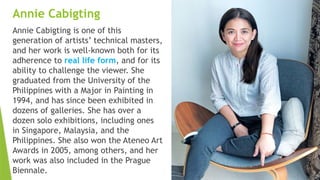
Annie Cabigting
Annie Cabigting is one of this
generation of artists’ technical masters,
and her work is well-known both for its
adherence to real life form, and for its
ability to challenge the viewer. She
graduated from the University of the
Philippines with a Major in Painting in
1994, and has since been exhibited in
dozens of galleries. She has over a
dozen solo exhibitions, including ones
in Singapore, Malaysia, and the
Philippines. She also won the Ateneo Art
Awards in 2005, among others, and her
work was also included in the Prague
Biennale.
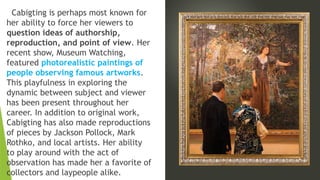
Cabigting is perhaps most known for
her ability to force her viewers to
question ideas of authorship,
reproduction, and point of view. Her
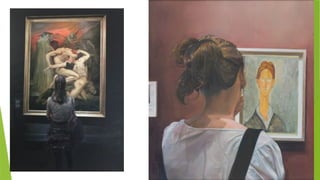
recent show, Museum Watching,
featured photorealistic paintings of
people observing famous artworks.
This playfulness in exploring the
dynamic between subject and viewer
has been present throughout her
career. In addition to original work,
Cabigting has also made reproductions
of pieces by Jackson Pollock, Mark
Rothko, and local artists. Her ability
to play around with the act of
observation has made her a favorite of
collectors and laypeople alike.
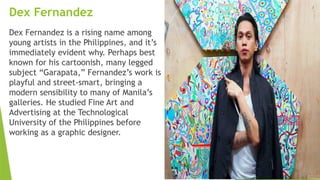
Dex Fernandez
Dex Fernandez is a rising name among
young artists in the Philippines, and it’s
immediately evident why. Perhaps best
known for his cartoonish, many legged
subject “Garapata,” Fernandez’s work is
playful and street-smart, bringing a
modern sensibility to many of Manila’s
galleries. He studied Fine Art and
Advertising at the Technological
University of the Philippines before
working as a graphic designer.
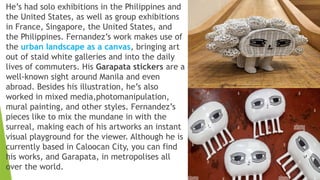
He’s had solo exhibitions in the Philippines and
the United States, as well as group exhibitions
in France, Singapore, the United States, and
the Philippines. Fernandez’s work makes use of
the urban landscape as a canvas, bringing art
out of staid white galleries and into the daily
lives of commuters. His Garapata stickers are a
well-known sight around Manila and even
abroad. Besides his illustration, he’s also
worked in mixed media,photomanipulation,
mural painting, and other styles. Fernandez’s
pieces like to mix the mundane in with the
surreal, making each of his artworks an instant
visual playground for the viewer. Although he is
currently based in Caloocan City, you can find
his works, and Garapata, in metropolises all
over the world.
Oscar Villamiel
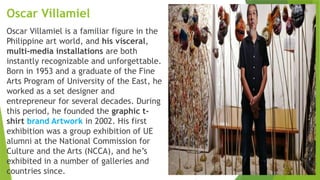
Oscar Villamiel is a familiar figure in the
Philippine art world, and his visceral,
multi-media installations are both
instantly recognizable and unforgettable.
Born in 1953 and a graduate of the Fine
Arts Program of University of the East, he
worked as a set designer and
entrepreneur for several decades. During
this period, he founded the graphic t-
shirt brand Artwork in 2002. His first
exhibition was a group exhibition of UE
alumni at the National Commission for
Culture and the Arts (NCCA), and he’s
exhibited in a number of galleries and
countries since.
Villamiel’s work is well-known for
its use of salvaging, with the artist
using found materials or old,
recycled parts to create entirely
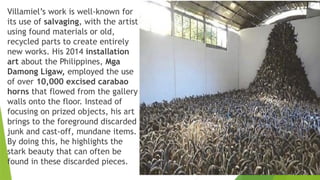
new works. His 2014 installation
art about the Philippines, Mga
Damong Ligaw, employed the use
of over 10,000 excised carabao
horns that flowed from the gallery
walls onto the floor. Instead of
focusing on prized objects, his art
brings to the foreground discarded
junk and cast-off, mundane items.
By doing this, he highlights the
stark beauty that can often be
found in these discarded pieces.
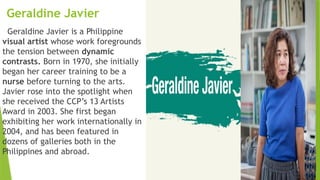
Geraldine Javier
Geraldine Javier is a Philippine
visual artist whose work foregrounds
the tension between dynamic
contrasts. Born in 1970, she initially
began her career training to be a
nurse before turning to the arts.
Javier rose into the spotlight when
she received the CCP’s 13 Artists
Award in 2003. She first began
exhibiting her work internationally in
2004, and has been featured in
dozens of galleries both in the
Philippines and abroad.
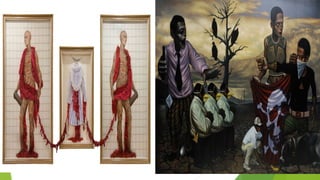
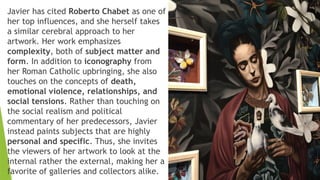
Javier has cited Roberto Chabet as one of
her top influences, and she herself takes
a similar cerebral approach to her
artwork. Her work emphasizes
complexity, both of subject matter and
form. In addition to iconography from
her Roman Catholic upbringing, she also
touches on the concepts of death,
emotional violence, relationships, and
social tensions. Rather than touching on
the social realism and political
commentary of her predecessors, Javier
instead paints subjects that are highly
personal and specific. Thus, she invites
the viewers of her artwork to look at the
internal rather the external, making her a
favorite of galleries and collectors alike.
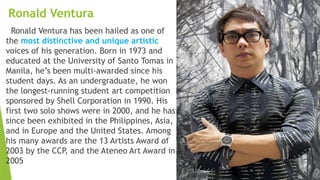
Ronald Ventura
Ronald Ventura has been hailed as one of
the most distinctive and unique artistic
voices of his generation. Born in 1973 and
educated at the University of Santo Tomas in
Manila, he’s been multi-awarded since his
student days. As an undergraduate, he won
the longest-running student art competition
sponsored by Shell Corporation in 1990. His
first two solo shows were in 2000, and he has
since been exhibited in the Philippines, Asia,
and in Europe and the United States. Among
his many awards are the 13 Artists Award of
2003 by the CCP, and the Ateneo Art Award in
2005
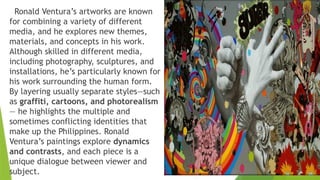
Ronald Ventura’s artworks are known
for combining a variety of different
media, and he explores new themes,
materials, and concepts in his work.
Although skilled in different media,
including photography, sculptures, and
installations, he’s particularly known for
his work surrounding the human form.
By layering usually separate styles—such
as graffiti, cartoons, and photorealism
— he highlights the multiple and
sometimes conflicting identities that
make up the Philippines. Ronald
Ventura’s paintings explore dynamics
and contrasts, and each piece is a
unique dialogue between viewer and
subject.
Gary-Ross Pastrana
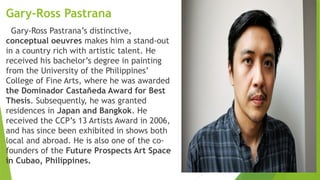
Gary-Ross Pastrana’s distinctive,
conceptual oeuvres makes him a stand-out
in a country rich with artistic talent. He
received his bachelor’s degree in painting
from the University of the Philippines’
College of Fine Arts, where he was awarded
the Dominador Castañeda Award for Best
Thesis. Subsequently, he was granted
residences in Japan and Bangkok. He
received the CCP’s 13 Artists Award in 2006,
and has since been exhibited in shows both
local and abroad. He is also one of the co-
founders of the Future Prospects Art Space
in Cubao, Philippines.
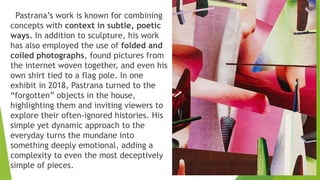
Pastrana’s work is known for combining
concepts with context in subtle, poetic
ways. In addition to sculpture, his work
has also employed the use of folded and
coiled photographs, found pictures from
the internet woven together, and even his
own shirt tied to a flag pole. In one
exhibit in 2018, Pastrana turned to the
“forgotten” objects in the house,
highlighting them and inviting viewers to
explore their often-ignored histories. His
simple yet dynamic approach to the
everyday turns the mundane into
something deeply emotional, adding a
complexity to even the most deceptively
simple of pieces.
module 3 module 3 module 3 module 3 module 3

module 3 module 3 module 3 module 3 module 3

  • 1.
    To familiarize yourselfwith the modern art scene in the country, we will study about Filipino contemporary artists and their works
  • 2.
    Nona Garcia - perhapsone of the best known artists in the Philippine art scene at the moment. Born in 1978 in Manila, she received her Bachelor of Fine Arts in Painting from the University of the Philippines. Based primarily in Baguio, her work has been exhibited in countless galleries both local and abroad. She won the Grand Prize in the Philip Morris ASEAN Art Award (2000), and is also a recipient of the Cultural Center of the Philippines (CCP) Thirteen Artists Award (2003). Her attention to detail and incredible skill are unlike any other, making her a favorite of collectors, art enthusiasts, and laypeople alike.
  • 3.
    Among her soloshows are False Apparitions (Singapore, 2012), Before the Sea (Manila, 2012), Unearth (Berlin, 2015), and Before the Sky (Manila, 2016). Nona Garcia is known for employing the use of stark realism to bring into question what the true meaning of representation is. Her use of photorealism centers everyday objects, cultural artifacts, or people, inviting the viewers to explore the environmental, sociopolitical, and personal histories of her subjects. Although famous for her paintings, she also employs the use of paper cutouts, x-rays, and lightboxes in her works.
  • 4.
    Stark Realism isan exhibition of new paintings by Francien Krieg, Effie Pryer and Ville Löppönen. Each of these artists uses realism to explore the substance and mystery of being human.
  • 5.
    Photorealism is an extremelyrealistic style of painting and drawing, in which the artwork is based entirely on a photograph. Photorealist art is most appreciated for its huge WOW! factor. People often mistake photorealist paintings for actual photographs.
  • 6.
    Andres Barrioquinto multi-awarded workis both striking and unforgettable, and his iconic and surreal painting style has made him successful in the local and international art scenes. A graduate of the University of Santo Tomas fine Arts program, Barrioquinto has been fondly called the Dark Man of Philippine Art due to his use of the macabre in many of his works.
  • 7.
    He has participatedin shows both in the country and abroad, including Singapore and Taipei. In addition to this, he alsohad a recent major showcase of portraits at the National Museum in November. Barrioquinto’s work is notable for its use of juxtaposition and scale. His portraits are famously a mix of the monochrome and the technicolor. With his subjects in black and white framed by an explosion of color, his paintings assault the senses and leave viewers reeling.
  • 8.
    In the worldof art, we see juxtaposition used to refer to works composed various unrelated elements or fragments placed side-by-side, or atop one another to create an interesting effect of comparison or contrast.
  • 9.
    While the mainstreamperspective on art is that it must be beautiful, Barrioquinto challenges old perspectives and brings you up close and personal with the strange and imperfect. One of the CCP’s Thirteen Artists of 2003, Andres Barrioquinto’s works have also pulled in huge numbers at auctions in the Philippines and abroad. His painting Skulls and Butterflies pulled in HKD 620,000 at an auction, almost 15 times its asking price.
  • 10.
    Leeroy New When itcomes to the history of Philippine arts and culture, you’d be hard-pressed to find a more distinctive style across a variety of mediums than Leeroy New’s. A native of General Santos City, New graduated from the Philippine High School for the Arts and the University of the Philippines College of Fine Arts. His work has garnered him a number of accolades and awards, including the 2005 Metrobank Art Awards, the 2009 Ateneo Art Awards, a nomination for the 2011 Signature Art Prize in Singapore, the 2012 CCP 13 Artists Award, and the 2014 Metrobank Foundation Award.
  • 11.
    Leeroy New hasemployed a variety of mediums for his artwork, including production design, public art, product design, and wearable art. However, he’s perhaps best known for his iconic sculptures, which blend together a variety of shapes, colors, and forms to challenge the viewer. New’s lifelong fascination with monsters has led him to create pieces that are out of this world, making him one of the most prominent names in the Philippine sculpture and visual arts scenes. His work has also been featured in television shows such as Bagani (2018).
  • 13.
    Nikki Luna One ofthe most prominent female artists in Philippine arts circles today, Nikki Luna’s work brings together advocacy and art. Luna is a graduate of the University of the Philippines’ Fine Arts program, focusing on visual art. She also received a Chevening Award, allowing her to take a masters in Art and Education at the University of London in the UK. Her work has been exhibited in the CCP, Vargas Museum, and Lopez Memorial Museum, among others. In addition, she has also been featured in the Aichi Triennale, Singapore Biennale, Beijing Binnale, and Le Festival International des textiles Extra Ordinaires.
  • 14.
    Luna’s work isnotable for highlighting issues of women, including the issues of rape, sexual harassment, domestic workers, and migrant workers. She authored the book I Love My Body (2018), highlighting body positivity and awareness. She also recently completed a solo exhibition at the 1335 Mabini Gallery called This is how to be a woman of the world. Besides gallery work, Luna also employs her art in her activism. She has conducted various art therapy workshops in conflict zones in the Philippines, and uses her work to speak out against social issues like extrajudicial killings, misogyny, and rape culture.
  • 15.
    Rodel Tapaya Rodel Tapayais one of the top names in Philippine painting and visual art, and his work has garnered him critical acclaim both in the country and abroad. Born in 1980 in Montalban, Rizal, Tapaya first broke out into the scene when he won the Nokia Art Awards in 2001. This enabled him to take drawing and painting courses in prestigious institutions such as the Parsons School of Design in New York, USA, and the University of Helsinki in Finland. Additionally, Tapaya won the 2011 Signature Art Prize, was named one of CCP’s 13 Artists of 2012, and has been shortlisted several times for the Ateneo Art Awards, among others.
  • 16.
    Tapaya: Folkgotten. Thismarked a shift in subject matter and medium, and Tapaya began to explore the themes of Philippine mythology and folktales for which he’s known today. Rodel Tapaya’s artworks and paintings are notable for their mix of Filipino folk culture and history, which he uses to offer commentary on contemporary social issues. His complex compositions and use of vivid colors and patterns have made his work a favorite of collectors and art enthusiasts.
  • 18.
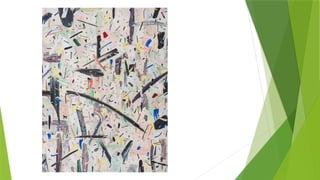
    Ernest Concepcion Ernest Concepcionis well known for his highly complex and experimental paintings, which play with texture and color to create images that arrest the viewer’s eyes. Born in 1977, he graduated from the University of the Philippines with a Bachelor of Fine Arts. He has participated in a number of art residences in New York, where he stayed for several years. Concepcion has exhibited in galleries both in the Philippines and in the United States, including solo exhibitions and group shows. He as also received the CCP’s 13 Artists of 2015 award, among others.
  • 19.
    Concepcion is notablefor his use of color and texture in his artworks. His paintings are abstracted reflections on Philippine history, social issues, and the human experience. By experimenting with composition, form, color, and textures, Concepcion’s works challenge the viewers’ preconceptions of what is or isn’t possible in art. Concepcion’s pieces are set apart by his use of different techniques, styles, and media in order to put together images that are disjointed and unified at the same time. He currently splits his time between Manila and Brooklyn.
  • 21.
    Annie Cabigting Annie Cabigtingis one of this generation of artists’ technical masters, and her work is well-known both for its adherence to real life form, and for its ability to challenge the viewer. She graduated from the University of the Philippines with a Major in Painting in 1994, and has since been exhibited in dozens of galleries. She has over a dozen solo exhibitions, including ones in Singapore, Malaysia, and the Philippines. She also won the Ateneo Art Awards in 2005, among others, and her work was also included in the Prague Biennale.
  • 22.
    Cabigting is perhapsmost known for her ability to force her viewers to question ideas of authorship, reproduction, and point of view. Her recent show, Museum Watching, featured photorealistic paintings of people observing famous artworks. This playfulness in exploring the dynamic between subject and viewer has been present throughout her career. In addition to original work, Cabigting has also made reproductions of pieces by Jackson Pollock, Mark Rothko, and local artists. Her ability to play around with the act of observation has made her a favorite of collectors and laypeople alike.
  • 24.
    Dex Fernandez Dex Fernandezis a rising name among young artists in the Philippines, and it’s immediately evident why. Perhaps best known for his cartoonish, many legged subject “Garapata,” Fernandez’s work is playful and street-smart, bringing a modern sensibility to many of Manila’s galleries. He studied Fine Art and Advertising at the Technological University of the Philippines before working as a graphic designer.
  • 25.
    He’s had soloexhibitions in the Philippines and the United States, as well as group exhibitions in France, Singapore, the United States, and the Philippines. Fernandez’s work makes use of the urban landscape as a canvas, bringing art out of staid white galleries and into the daily lives of commuters. His Garapata stickers are a well-known sight around Manila and even abroad. Besides his illustration, he’s also worked in mixed media,photomanipulation, mural painting, and other styles. Fernandez’s pieces like to mix the mundane in with the surreal, making each of his artworks an instant visual playground for the viewer. Although he is currently based in Caloocan City, you can find his works, and Garapata, in metropolises all over the world.
  • 27.
    Oscar Villamiel Oscar Villamielis a familiar figure in the Philippine art world, and his visceral, multi-media installations are both instantly recognizable and unforgettable. Born in 1953 and a graduate of the Fine Arts Program of University of the East, he worked as a set designer and entrepreneur for several decades. During this period, he founded the graphic t- shirt brand Artwork in 2002. His first exhibition was a group exhibition of UE alumni at the National Commission for Culture and the Arts (NCCA), and he’s exhibited in a number of galleries and countries since.
  • 29.
    Villamiel’s work iswell-known for its use of salvaging, with the artist using found materials or old, recycled parts to create entirely new works. His 2014 installation art about the Philippines, Mga Damong Ligaw, employed the use of over 10,000 excised carabao horns that flowed from the gallery walls onto the floor. Instead of focusing on prized objects, his art brings to the foreground discarded junk and cast-off, mundane items. By doing this, he highlights the stark beauty that can often be found in these discarded pieces.
  • 30.
    Geraldine Javier Geraldine Javieris a Philippine visual artist whose work foregrounds the tension between dynamic contrasts. Born in 1970, she initially began her career training to be a nurse before turning to the arts. Javier rose into the spotlight when she received the CCP’s 13 Artists Award in 2003. She first began exhibiting her work internationally in 2004, and has been featured in dozens of galleries both in the Philippines and abroad.
  • 31.
    Javier has citedRoberto Chabet as one of her top influences, and she herself takes a similar cerebral approach to her artwork. Her work emphasizes complexity, both of subject matter and form. In addition to iconography from her Roman Catholic upbringing, she also touches on the concepts of death, emotional violence, relationships, and social tensions. Rather than touching on the social realism and political commentary of her predecessors, Javier instead paints subjects that are highly personal and specific. Thus, she invites the viewers of her artwork to look at the internal rather the external, making her a favorite of galleries and collectors alike.
  • 33.
    Ronald Ventura Ronald Venturahas been hailed as one of the most distinctive and unique artistic voices of his generation. Born in 1973 and educated at the University of Santo Tomas in Manila, he’s been multi-awarded since his student days. As an undergraduate, he won the longest-running student art competition sponsored by Shell Corporation in 1990. His first two solo shows were in 2000, and he has since been exhibited in the Philippines, Asia, and in Europe and the United States. Among his many awards are the 13 Artists Award of 2003 by the CCP, and the Ateneo Art Award in 2005
  • 34.
    Ronald Ventura’s artworksare known for combining a variety of different media, and he explores new themes, materials, and concepts in his work. Although skilled in different media, including photography, sculptures, and installations, he’s particularly known for his work surrounding the human form. By layering usually separate styles—such as graffiti, cartoons, and photorealism — he highlights the multiple and sometimes conflicting identities that make up the Philippines. Ronald Ventura’s paintings explore dynamics and contrasts, and each piece is a unique dialogue between viewer and subject.
  • 36.
    Gary-Ross Pastrana Gary-Ross Pastrana’sdistinctive, conceptual oeuvres makes him a stand-out in a country rich with artistic talent. He received his bachelor’s degree in painting from the University of the Philippines’ College of Fine Arts, where he was awarded the Dominador Castañeda Award for Best Thesis. Subsequently, he was granted residences in Japan and Bangkok. He received the CCP’s 13 Artists Award in 2006, and has since been exhibited in shows both local and abroad. He is also one of the co- founders of the Future Prospects Art Space in Cubao, Philippines.
  • 37.
    Pastrana’s work isknown for combining concepts with context in subtle, poetic ways. In addition to sculpture, his work has also employed the use of folded and coiled photographs, found pictures from the internet woven together, and even his own shirt tied to a flag pole. In one exhibit in 2018, Pastrana turned to the “forgotten” objects in the house, highlighting them and inviting viewers to explore their often-ignored histories. His simple yet dynamic approach to the everyday turns the mundane into something deeply emotional, adding a complexity to even the most deceptively simple of pieces.