The National Curriculum Framework (NCF) for the Foundational Stage is developed based on the vision of the National Education Policy (NEP) 2020, and to enable its
implementation.
NATIONAL CURRICULUM FRAMEWORK
FOR FOUNDATIONAL STAGE (NCF-FS)
2022
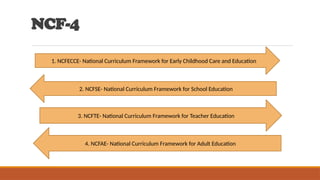
NCF-4
1. NCFECCE- National Curriculum Framework for Early Childhood Care and Education
2. NCFSE- National Curriculum Framework for School Education
3. NCFTE- National Curriculum Framework for Teacher Education
4. NCFAE- National Curriculum Framework for Adult Education
NCF-Foundational Stage
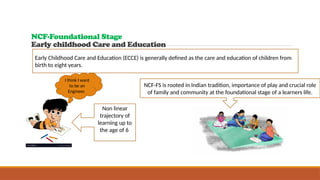
Early childhood Care and Education
Early Childhood Care and Education (ECCE) is generally defined as the care and education of children from
birth to eight years. and Education (ECCE) m birth to eight years.
I think I want
to be an
Engineer.
NCF-FS is rooted in Indian tradition, importance of play and crucial role
of family and community at the foundational stage of a learners life.
Non linear
trajectory of
learning up to
the age of 6
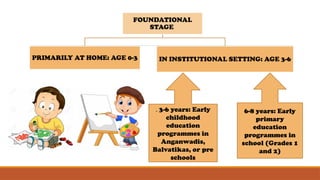
FOUNDATIONAL
STAGE
PRIMARILY AT HOME: AGE 0-3 IN INSTITUTIONAL SETTING: AGE 3-6
. 3-6 years: Early
childhood
education
programmes in
Anganwadis,
Balvatikas, or pre
schools
6-8 years: Early
primary
education
programmes in
school (Grades 1
and 2)
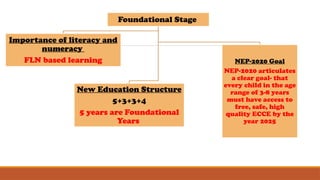
Foundational Stage
Importance of literacy and
numeracy
FLN based learning
New Education Structure
5+3+3+4
5 years are Foundational
Years
NEP-2020 Goal
NEP-2020 articulates
a clear goal- that
every child in the age
range of 3-8 years
must have access to
free, safe, high
quality ECCE by the
year 2025
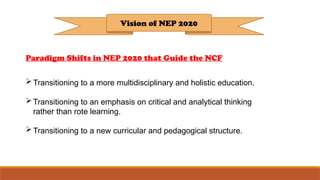
Vision of NEP 2020
Paradigm Shifts in NEP 2020 that Guide the NCF
Transitioning to a more multidisciplinary and holistic education.
Transitioning to an emphasis on critical and analytical thinking
rather than rote learning.
Transitioning to a new curricular and pedagogical structure.
Guiding Principles for the Foundational Stage based on NEP
2020
1. Every child is capable
2. Each child learns and grows at their own pace.
3. Children are natural researchers.
4. Children are social being.
5. Children should be acknowledged and valued.
6. Play and activity are the primary ways of learning and development.
7. Content should be drawn from the experiences and the needs of children.
8. Teachers should facilitate and mediate the learning of the children.
9. Family and community are partners in this process and are involved in multiple
ways.
10. Care is central to learning.
Key Recent Initiatives on NEP Priorities
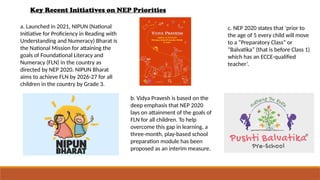
a. Launched in 2021, NIPUN (National
Initiative for Proficiency in Reading with
Understanding and Numeracy) Bharat is
the National Mission for attaining the
goals of Foundational Literacy and
Numeracy (FLN) in the country as
directed by NEP 2020. NIPUN Bharat
aims to achieve FLN by 2026-27 for all
children in the country by Grade 3.
b. Vidya Pravesh is based on the
deep emphasis that NEP 2020
lays on attainment of the goals of
FLN for all children. To help
overcome this gap in learning, a
three-month, play-based school
preparation module has been
proposed as an interim measure.
c. NEP 2020 states that ‘prior to
the age of 5 every child will move
to a “Preparatory Class” or
“Balvatika” (that is before Class 1)
which has an ECCE-qualified
teacher’.
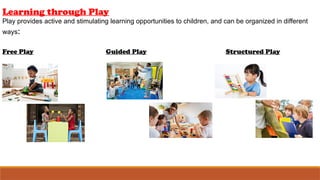
Learning through Play
Play provides active and stimulating learning opportunities to children, and can be organized in different
ways:
Free Play Guided Play Structured Play
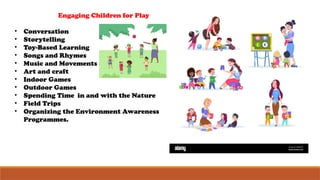
Engaging Children for Play
• Conversation
• Storytelling
• Toy-Based Learning
• Songs and Rhymes
• Music and Movements
• Art and craft
• Indoor Games
• Outdoor Games
• Spending Time in and with the Nature
• Field Trips
• Organizing the Environment Awareness
Programmes.
The National Curriculum Framework (NCF).pptx

  • 1.
    The National CurriculumFramework (NCF) for the Foundational Stage is developed based on the vision of the National Education Policy (NEP) 2020, and to enable its implementation. NATIONAL CURRICULUM FRAMEWORK FOR FOUNDATIONAL STAGE (NCF-FS) 2022
  • 2.
    NCF-4 1. NCFECCE- NationalCurriculum Framework for Early Childhood Care and Education 2. NCFSE- National Curriculum Framework for School Education 3. NCFTE- National Curriculum Framework for Teacher Education 4. NCFAE- National Curriculum Framework for Adult Education
  • 3.
    NCF-Foundational Stage Early childhoodCare and Education Early Childhood Care and Education (ECCE) is generally defined as the care and education of children from birth to eight years. and Education (ECCE) m birth to eight years. I think I want to be an Engineer. NCF-FS is rooted in Indian tradition, importance of play and crucial role of family and community at the foundational stage of a learners life. Non linear trajectory of learning up to the age of 6
  • 4.
    FOUNDATIONAL STAGE PRIMARILY AT HOME:AGE 0-3 IN INSTITUTIONAL SETTING: AGE 3-6 . 3-6 years: Early childhood education programmes in Anganwadis, Balvatikas, or pre schools 6-8 years: Early primary education programmes in school (Grades 1 and 2)
  • 5.
    Foundational Stage Importance ofliteracy and numeracy FLN based learning New Education Structure 5+3+3+4 5 years are Foundational Years NEP-2020 Goal NEP-2020 articulates a clear goal- that every child in the age range of 3-8 years must have access to free, safe, high quality ECCE by the year 2025
  • 6.
    Vision of NEP2020 Paradigm Shifts in NEP 2020 that Guide the NCF Transitioning to a more multidisciplinary and holistic education. Transitioning to an emphasis on critical and analytical thinking rather than rote learning. Transitioning to a new curricular and pedagogical structure.
  • 7.
    Guiding Principles forthe Foundational Stage based on NEP 2020 1. Every child is capable 2. Each child learns and grows at their own pace. 3. Children are natural researchers. 4. Children are social being. 5. Children should be acknowledged and valued. 6. Play and activity are the primary ways of learning and development. 7. Content should be drawn from the experiences and the needs of children. 8. Teachers should facilitate and mediate the learning of the children. 9. Family and community are partners in this process and are involved in multiple ways. 10. Care is central to learning.
  • 8.
    Key Recent Initiativeson NEP Priorities a. Launched in 2021, NIPUN (National Initiative for Proficiency in Reading with Understanding and Numeracy) Bharat is the National Mission for attaining the goals of Foundational Literacy and Numeracy (FLN) in the country as directed by NEP 2020. NIPUN Bharat aims to achieve FLN by 2026-27 for all children in the country by Grade 3. b. Vidya Pravesh is based on the deep emphasis that NEP 2020 lays on attainment of the goals of FLN for all children. To help overcome this gap in learning, a three-month, play-based school preparation module has been proposed as an interim measure. c. NEP 2020 states that ‘prior to the age of 5 every child will move to a “Preparatory Class” or “Balvatika” (that is before Class 1) which has an ECCE-qualified teacher’.
  • 9.
    Learning through Play Playprovides active and stimulating learning opportunities to children, and can be organized in different ways: Free Play Guided Play Structured Play
  • 10.
    Engaging Children forPlay • Conversation • Storytelling • Toy-Based Learning • Songs and Rhymes • Music and Movements • Art and craft • Indoor Games • Outdoor Games • Spending Time in and with the Nature • Field Trips • Organizing the Environment Awareness Programmes.