Power System:
Technical Aspects
Dr. Ashok Pendse, Consumer Representative, MERC
Dr. Sachin Warghade, Assistant Professor, TISS
Contents
1. Energy & Electricity
2. Power System
3. Power Grid
1. Features of Energy & Electricity
What is electricity?
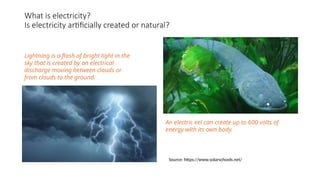
Is electricity artificially created or natural?
What is electricity?
Is electricity artificially created or natural?
An electric eel can create up to 600 volts of
energy with its own body.
Lightning is a flash of bright light in the
sky that is created by an electrical
discharge moving between clouds or
from clouds to the ground.
Source: https://www.solarschools.net/
What is electricity?
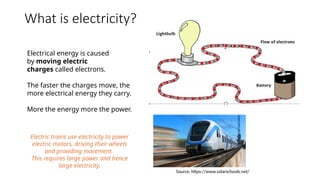
Electrical energy is caused
by moving electric
charges called electrons.
The faster the charges move, the
more electrical energy they carry.
More the energy more the power.
Electric trains use electricity to power
electric motors, driving their wheels
and providing movement.
This requires large power and hence
large electricity.
Source: https://www.solarschools.net/
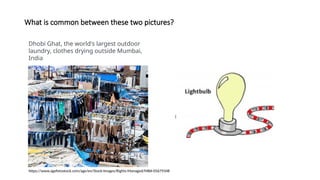
What is common between these two pictures?
Dhobi Ghat, the world's largest outdoor
laundry, clothes drying outside Mumbai,
India
https://www.agefotostock.com/age/en/Stock-Images/Rights-Managed/MBA-05679348
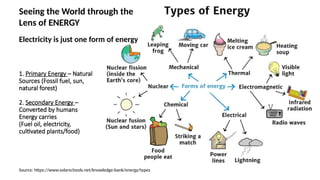
1. Primary Energy – Natural
Sources (Fossil fuel, sun,
natural forest)
2. Secondary Energy –
Converted by humans
Energy carries
(Fuel oil, electricity,
cultivated plants/food)
Source: https://www.solarschools.net/knowledge-bank/energy/types
Seeing the World through the
Lens of ENERGY
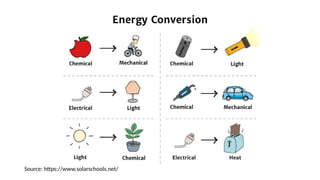
Electricity is just one form of energy
Source: https://www.solarschools.net/
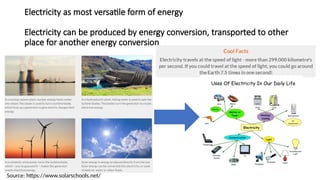
Electricity as most versatile form of energy
Electricity can be produced by energy conversion, transported to other
place for another energy conversion
Source: https://www.solarschools.net/
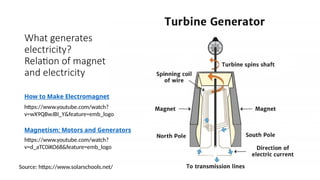
What generates electricity?
Relation of magnet and electricity
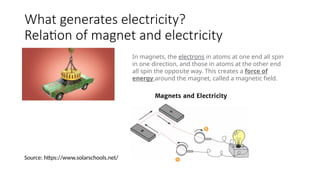
In magnets, the electrons in atoms at one end all spin
in one direction, and those in atoms at the other end
all spin the opposite way. This creates a force of
energy around the magnet, called a magnetic field.
Source: https://www.solarschools.net/
What generates electricity?
Relation of magnet and electricity
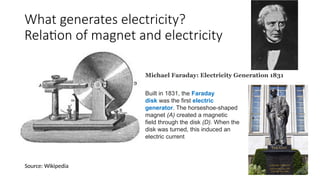
Built in 1831, the Faraday
disk was the first electric
generator. The horseshoe-shaped
magnet (A) created a magnetic
field through the disk (D). When the
disk was turned, this induced an
electric current
Michael Faraday: Electricity Generation 1831
Source: Wikipedia
What generates
electricity?
Relation of magnet
and electricity
https://www.youtube.com/watch?
v=d_aTC0iKO68&feature=emb_logo
https://www.youtube.com/watch?
v=wX9QBwJBI_Y&feature=emb_logo
How to Make Electromagnet
Magnetism: Motors and Generators
Source: https://www.solarschools.net/
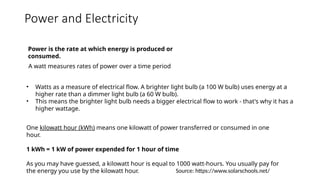
Power and Electricity
Power is the rate at which energy is produced or
consumed.
A watt measures rates of power over a time period
• Watts as a measure of electrical flow. A brighter light bulb (a 100 W bulb) uses energy at a
higher rate than a dimmer light bulb (a 60 W bulb).
• This means the brighter light bulb needs a bigger electrical flow to work - that's why it has a
higher wattage.
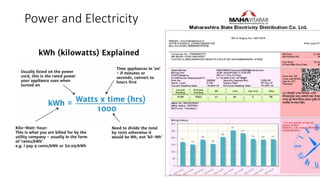
One kilowatt hour (kWh) means one kilowatt of power transferred or consumed in one
hour.
1 kWh = 1 kW of power expended for 1 hour of time
As you may have guessed, a kilowatt hour is equal to 1000 watt-hours. You usually pay for
the energy you use by the kilowatt hour. Source: https://www.solarschools.net/
Power and Electricity
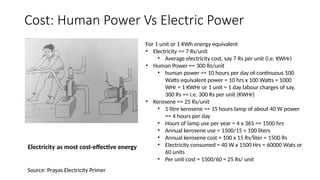
Cost: Human Power Vs Electric Power
For 1 unit or 1 KWh energy equivalent
• Electricity == 7 Rs/unit
• Average electricity cost, say 7 Rs per unit (i.e. KWHr)
• Human Power == 300 Rs/unit
• human power == 10 hours per day of continuous 100
Watts equivalent power = 10 hrs x 100 Watts = 1000
WHr = 1 KWHr or 1 unit = 1 day labour charges of say,
300 Rs == i.e. 300 Rs per unit (KWHr)
• Kerosene == 25 Rs/unit
• 1 litre kerosene == 15 hours lamp of about 40 W power
== 4 hours per day
• Hours of lamp use per year = 4 x 365 == 1500 hrs
• Annual kerosene use = 1500/15 = 100 liters
• Annual kerosene cost = 100 x 15 Rs/liter = 1500 Rs
• Electricity consumed = 40 W x 1500 Hrs = 60000 Wats or
60 units
• Per unit cost = 1500/60 = 25 Rs/ unit
Electricity as most cost-effective energy
Source: Prayas Electricity Primer
Measuring Electricity:
Power, Voltage, Current, & Resistance
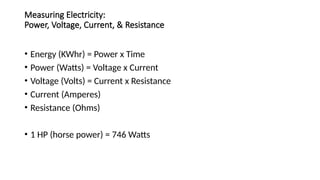
• Energy (KWhr) = Power x Time
• Power (Watts) = Voltage x Current
• Voltage (Volts) = Current x Resistance
• Current (Amperes)
• Resistance (Ohms)
• 1 HP (horse power) = 746 Watts
Measuring Electricity:
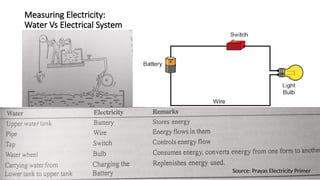
Water Vs Electrical System
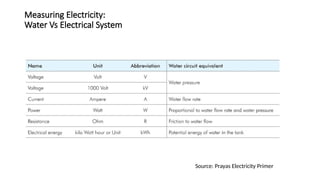
Source: Prayas Electricity Primer
Measuring Electricity:
Water Vs Electrical System
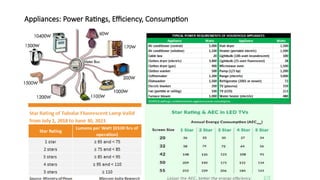
Appliances: Power Ratings, Efficiency, Consumption
2. Power System
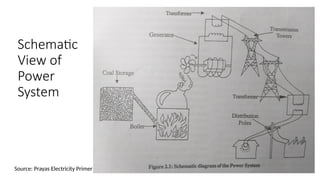
Schematic
View of
Power
System
Source: Prayas Electricity Primer
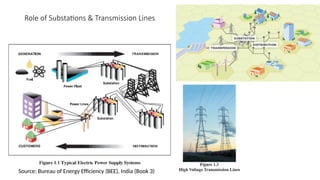
Role of Substations & Transmission Lines
Source: Bureau of Energy Efficiency (BEE), India (Book 3)
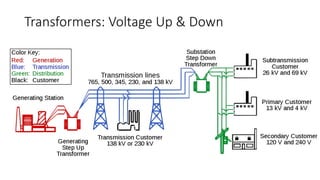
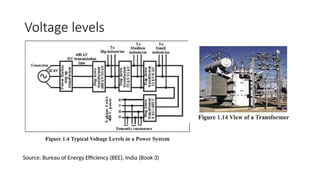
Transformers: Voltage Up & Down
Voltage levels
Source: Bureau of Energy Efficiency (BEE), India (Book 3)
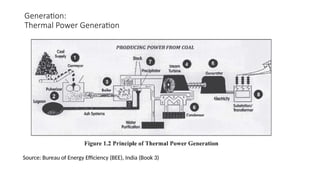
Generation:
Thermal Power Generation
Source: Bureau of Energy Efficiency (BEE), India (Book 3)
3. Power Grid
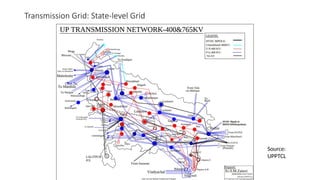
Transmission Grid: State-level Grid
Source:
UPPTCL
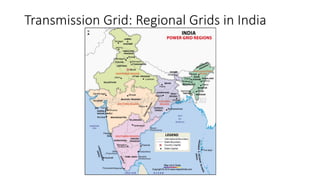
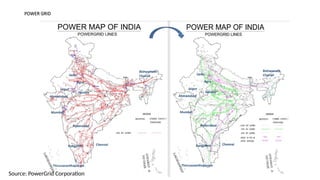
Transmission Grid: Regional Grids in India
POWER GRID
Source: PowerGrid Corporation
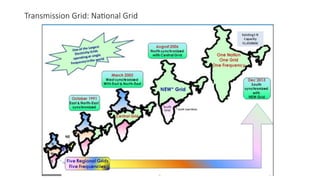
Transmission Grid: National Grid
Thanks

2_Power System_Technical_Pendse & Warghade.pptx

  • 1.
    Power System: Technical Aspects Dr.Ashok Pendse, Consumer Representative, MERC Dr. Sachin Warghade, Assistant Professor, TISS
  • 2.
    Contents 1. Energy &Electricity 2. Power System 3. Power Grid
  • 3.
    1. Features ofEnergy & Electricity
  • 4.
    What is electricity? Iselectricity artificially created or natural?
  • 5.
    What is electricity? Iselectricity artificially created or natural? An electric eel can create up to 600 volts of energy with its own body. Lightning is a flash of bright light in the sky that is created by an electrical discharge moving between clouds or from clouds to the ground. Source: https://www.solarschools.net/
  • 6.
    What is electricity? Electricalenergy is caused by moving electric charges called electrons. The faster the charges move, the more electrical energy they carry. More the energy more the power. Electric trains use electricity to power electric motors, driving their wheels and providing movement. This requires large power and hence large electricity. Source: https://www.solarschools.net/
  • 7.
    What is commonbetween these two pictures? Dhobi Ghat, the world's largest outdoor laundry, clothes drying outside Mumbai, India https://www.agefotostock.com/age/en/Stock-Images/Rights-Managed/MBA-05679348
  • 8.
    1. Primary Energy– Natural Sources (Fossil fuel, sun, natural forest) 2. Secondary Energy – Converted by humans Energy carries (Fuel oil, electricity, cultivated plants/food) Source: https://www.solarschools.net/knowledge-bank/energy/types Seeing the World through the Lens of ENERGY Electricity is just one form of energy
  • 9.
  • 10.
    Electricity as mostversatile form of energy Electricity can be produced by energy conversion, transported to other place for another energy conversion Source: https://www.solarschools.net/
  • 11.
    What generates electricity? Relationof magnet and electricity In magnets, the electrons in atoms at one end all spin in one direction, and those in atoms at the other end all spin the opposite way. This creates a force of energy around the magnet, called a magnetic field. Source: https://www.solarschools.net/
  • 12.
    What generates electricity? Relationof magnet and electricity Built in 1831, the Faraday disk was the first electric generator. The horseshoe-shaped magnet (A) created a magnetic field through the disk (D). When the disk was turned, this induced an electric current Michael Faraday: Electricity Generation 1831 Source: Wikipedia
  • 13.
    What generates electricity? Relation ofmagnet and electricity https://www.youtube.com/watch? v=d_aTC0iKO68&feature=emb_logo https://www.youtube.com/watch? v=wX9QBwJBI_Y&feature=emb_logo How to Make Electromagnet Magnetism: Motors and Generators Source: https://www.solarschools.net/
  • 14.
    Power and Electricity Poweris the rate at which energy is produced or consumed. A watt measures rates of power over a time period • Watts as a measure of electrical flow. A brighter light bulb (a 100 W bulb) uses energy at a higher rate than a dimmer light bulb (a 60 W bulb). • This means the brighter light bulb needs a bigger electrical flow to work - that's why it has a higher wattage. One kilowatt hour (kWh) means one kilowatt of power transferred or consumed in one hour. 1 kWh = 1 kW of power expended for 1 hour of time As you may have guessed, a kilowatt hour is equal to 1000 watt-hours. You usually pay for the energy you use by the kilowatt hour. Source: https://www.solarschools.net/
  • 15.
  • 16.
    Cost: Human PowerVs Electric Power For 1 unit or 1 KWh energy equivalent • Electricity == 7 Rs/unit • Average electricity cost, say 7 Rs per unit (i.e. KWHr) • Human Power == 300 Rs/unit • human power == 10 hours per day of continuous 100 Watts equivalent power = 10 hrs x 100 Watts = 1000 WHr = 1 KWHr or 1 unit = 1 day labour charges of say, 300 Rs == i.e. 300 Rs per unit (KWHr) • Kerosene == 25 Rs/unit • 1 litre kerosene == 15 hours lamp of about 40 W power == 4 hours per day • Hours of lamp use per year = 4 x 365 == 1500 hrs • Annual kerosene use = 1500/15 = 100 liters • Annual kerosene cost = 100 x 15 Rs/liter = 1500 Rs • Electricity consumed = 40 W x 1500 Hrs = 60000 Wats or 60 units • Per unit cost = 1500/60 = 25 Rs/ unit Electricity as most cost-effective energy Source: Prayas Electricity Primer
  • 17.
    Measuring Electricity: Power, Voltage,Current, & Resistance • Energy (KWhr) = Power x Time • Power (Watts) = Voltage x Current • Voltage (Volts) = Current x Resistance • Current (Amperes) • Resistance (Ohms) • 1 HP (horse power) = 746 Watts
  • 18.
    Measuring Electricity: Water VsElectrical System Source: Prayas Electricity Primer
  • 19.
    Source: Prayas ElectricityPrimer Measuring Electricity: Water Vs Electrical System
  • 20.
    Appliances: Power Ratings,Efficiency, Consumption
  • 21.
  • 22.
  • 23.
    Role of Substations& Transmission Lines Source: Bureau of Energy Efficiency (BEE), India (Book 3)
  • 24.
  • 25.
    Voltage levels Source: Bureauof Energy Efficiency (BEE), India (Book 3)
  • 26.
    Generation: Thermal Power Generation Source:Bureau of Energy Efficiency (BEE), India (Book 3)
  • 27.
  • 28.
    Transmission Grid: State-levelGrid Source: UPPTCL
  • 29.
  • 30.
  • 31.
  • 32.