Software ideals and history
Bjarne Stroustrup
www.stroustrup.com/Programming
Overview
 Ideals
 Aims, heroes, techniques
 Languages and language designers
 Early languages to C++
(There is so much more than
what we can cover)
3
Stroustrup/Programming
History and ideas
 One opinion
 “History is bunk”
 Another opinion
 “He who does not know history is condemned to repeat it”
 Our view
 There can be no professionalism without history
 If you know too little of the background of your field you are gullible
 History is littered with plausible ideas that didn’t work
 “I have a bridge I’d like to sell you”
 Ideas and ideals are crucial for practical use
 And they are the real “meat” of history
4
Stroustrup/Programming
What is a programming language?
 A tool for instructing machines
 A notation for algorithms
 A means for communication among programmers
 A tool for experimentation
 A means for controlling computer-controlled gadgets
 A means for controlling computerized devices
 A way of expressing relationships among concepts
 A means for expressing high-level designs
 All of the above!
 And more
5
Stroustrup/Programming
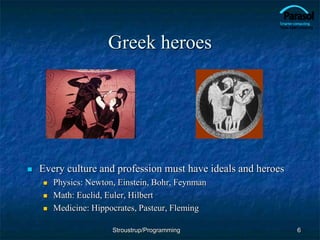
Greek heroes
 Every culture and profession must have ideals and heroes
 Physics: Newton, Einstein, Bohr, Feynman
 Math: Euclid, Euler, Hilbert
 Medicine: Hippocrates, Pasteur, Fleming
6
Stroustrup/Programming
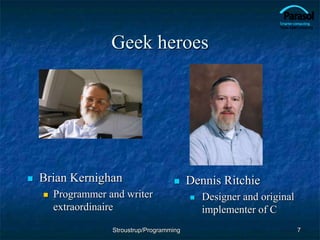
Geek heroes
 Brian Kernighan
 Programmer and writer
extraordinaire
7
 Dennis Ritchie
 Designer and original
implementer of C
Stroustrup/Programming
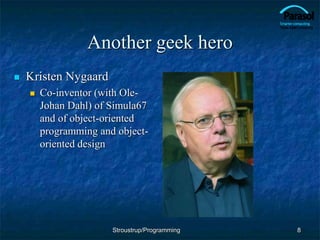
Another geek hero
 Kristen Nygaard
 Co-inventor (with Ole-
Johan Dahl) of Simula67
and of object-oriented
programming and object-
oriented design
8
Stroustrup/Programming
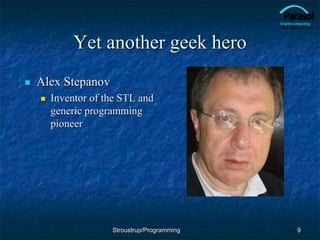
Yet another geek hero
 Alex Stepanov
 Inventor of the STL and
generic programming
pioneer
9
Stroustrup/Programming
Two extremes
 Academic beauty/perfection/purity
 Commercial expediency
 The pressures towards both are immense
 Both extremes must be avoided for serious progress to occur
 Both extremes encourage overstatement of results (hype) and
understatement (or worse) of alternatives and ancestor languages
10
Stroustrup/Programming
Ideals
 The fundamental aims of good design
 Represent ideas directly in code
 Represent independent ideas independently in code
 Represent relationships among ideas directly in code
 Combine ideas expressed in code freely
 where and only where combinations make sense
 From these follow
 Correctness
 Maintainability
 Performance
 Apply these to the widest possible range of applications
11
Stroustrup/Programming
Ideals have practical uses
 During the start of a project, reviews them to get ideas
 When you are stuck late at night, step back and see
where your code has most departed from the ideals –
this is where the bugs are most likely to lurk and the
design problems are most likely to occur
 Don’t just keep looking in the same place and trying the
same techniques to find the bug
 “The bug is always where you are not looking – or you would have
found it already”
12
Stroustrup/Programming
Ideals are personal
 Chose yours well
13
Stroustrup/Programming
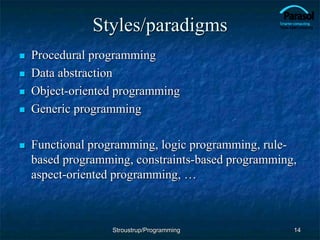
Styles/paradigms
 Procedural programming
 Data abstraction
 Object-oriented programming
 Generic programming
 Functional programming, logic programming, rule-
based programming, constraints-based programming,
aspect-oriented programming, …
14
Stroustrup/Programming
Styles/paradigms
template<class Iter> void draw_all(Iter b, Iter e)
{
for_each(b,e,mem_fun(&Shape::draw)); // draw all shapes in [b:e)
}
Point p(100,100);
Shape* a[] = { new Circle(p,50), new Rectangle(p, 250, 250) };
draw_all(a,a+2);
 Which programming styles/paradigms did we use here?
 Procedural, data abstractions, OOP, and GP
15
Stroustrup/Programming
Styles/paradigms
template<class Cont> void draw_all(Cont& c) // C++11
{
for_each(Shape* p : c) p->draw(); // draw all shapes in c
}
void draw_all(Container& c) // C++14
{
for_each(Shape* p : c) p->draw(); // draw all shapes in c
}
 It’s all just programming!
16
Stroustrup/Programming
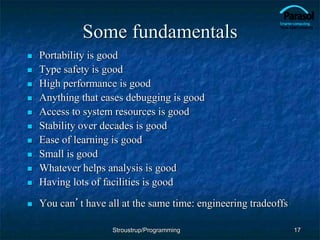
Some fundamentals
 Portability is good
 Type safety is good
 High performance is good
 Anything that eases debugging is good
 Access to system resources is good
 Stability over decades is good
 Ease of learning is good
 Small is good
 Whatever helps analysis is good
 Having lots of facilities is good
 You can’t have all at the same time: engineering tradeoffs
17
Stroustrup/Programming
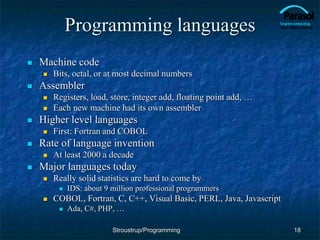
Programming languages
 Machine code
 Bits, octal, or at most decimal numbers
 Assembler
 Registers, load, store, integer add, floating point add, …
 Each new machine had its own assembler
 Higher level languages
 First: Fortran and COBOL
 Rate of language invention
 At least 2000 a decade
 Major languages today
 Really solid statistics are hard to come by
 IDS: about 9 million professional programmers
 COBOL, Fortran, C, C++, Visual Basic, PERL, Java, Javascript
 Ada, C#, PHP, …
18
Stroustrup/Programming
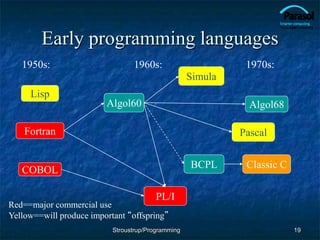
Early programming languages
19
Classic C
Simula
Pascal
Algol68
BCPL
Fortran
Lisp
COBOL
Algol60
PL/I
1950s: 1960s: 1970s:
Red==major commercial use
Yellow==will produce important “offspring”
Stroustrup/Programming
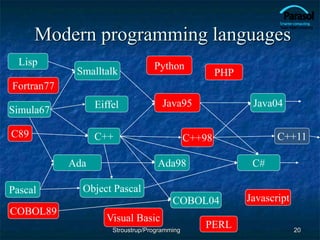
Modern programming languages
20
Object Pascal
C++
Java95
C#
Ada98
C++98
Java04
C++11
Python
Lisp
Smalltalk
Fortran77
Ada
Eiffel
Simula67
COBOL89
PHP
C89
Pascal
PERL
Visual Basic
COBOL04 Javascript
Stroustrup/Programming
Why do we design and evolve languages?
 There are many diverse applications areas
 No one language can be the best for everything
 Programmers have diverse backgrounds and skills
 No one language can be best for everybody
 Problems change
 Over the years, computers are applied in new areas and to new problems
 Computers change
 Over the decades, hardware characteristics and tradeoffs change
 Progress happens
 Over the decades, we learn better ways to design and implement languages
21
Stroustrup/Programming
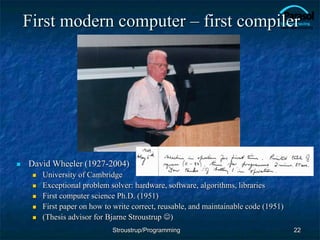
First modern computer – first compiler
 David Wheeler (1927-2004)
 University of Cambridge
 Exceptional problem solver: hardware, software, algorithms, libraries
 First computer science Ph.D. (1951)
 First paper on how to write correct, reusable, and maintainable code (1951)
 (Thesis advisor for Bjarne Stroustrup )
22
Stroustrup/Programming
Early languages – 1952
 One language for each machine
 Special features for processor
 Special features for “operating system”
 Most had very assembler-like facilities
 It was easy to understand which instructions would be generated
 No portability of code
23
Stroustrup/Programming
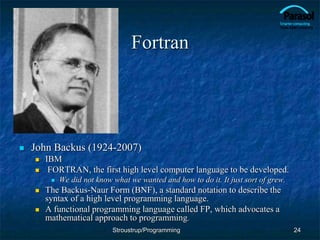
Fortran
 John Backus (1924-2007)
 IBM
 FORTRAN, the first high level computer language to be developed.
 We did not know what we wanted and how to do it. It just sort of grew.
 The Backus-Naur Form (BNF), a standard notation to describe the
syntax of a high level programming language.
 A functional programming language called FP, which advocates a
mathematical approach to programming.
24
Stroustrup/Programming
Fortran – 1956
 Allowed programmers to write linear algebra much as they
found it in textbooks
 Arrays and loops
 Standard mathematical functions
 libraries
 Users’ own functions
 The notation was largely machine independent
 Fortran code could often be moved from computer to computer with
only minor modification
 This was a huge improvement
 Arguably the largest single improvement in the history of programming
languages
 Continuous evolution: II, IV, 77, 90, 95, 03, 08, [15]
25
Stroustrup/Programming
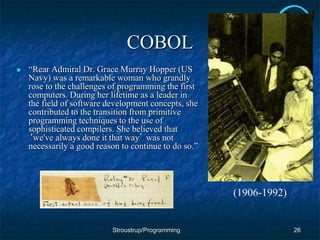
COBOL
 “Rear Admiral Dr. Grace Murray Hopper (US
Navy) was a remarkable woman who grandly
rose to the challenges of programming the first
computers. During her lifetime as a leader in
the field of software development concepts, she
contributed to the transition from primitive
programming techniques to the use of
sophisticated compilers. She believed that
‘we've always done it that way’ was not
necessarily a good reason to continue to do so.”
26
Stroustrup/Programming
(1906-1992)
Cobol – 1960
 Cobol was (and sometimes still is) for business programmers
what Fortran was (and sometimes still is) for scientific
programmers
 The emphasis was on data manipulation
 Copying
 Storing and retrieving (record keeping)
 Printing (reports)
 Calculation/computation was seen as a minor matter
 It was hoped/claimed that Cobol was so close to business
English that managers could program and programmers would
soon become redundant
 Continuous evolution: 60, 61, 65, 68, 74, 85, 02
27
Stroustrup/Programming
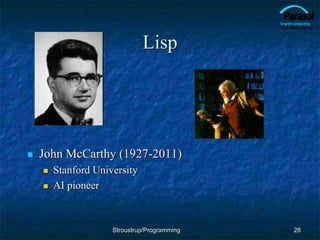
Lisp
 John McCarthy (1927-2011)
 Stanford University
 AI pioneer
28
Stroustrup/Programming
Lisp – 1960
 List/symbolic processing
 Initially (and often still) interpreted
 Dozens (most likely hundreds) of dialects
 “Lisp has an implied plural”
 Common Lisp
 Scheme
 This family of languages has been (and is) the
mainstay of artificial intelligence (AI) research
 though delivered products have often been in C or C++
29
Stroustrup/Programming
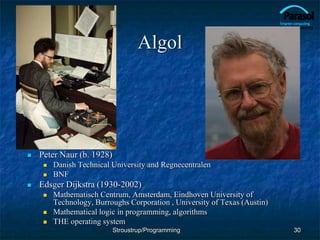
Algol
 Peter Naur (b. 1928)
 Danish Technical University and Regnecentralen
 BNF
 Edsger Dijkstra (1930-2002)
 Mathematisch Centrum, Amsterdam, Eindhoven University of
Technology, Burroughs Corporation , University of Texas (Austin)
 Mathematical logic in programming, algorithms
 THE operating system
30
Stroustrup/Programming
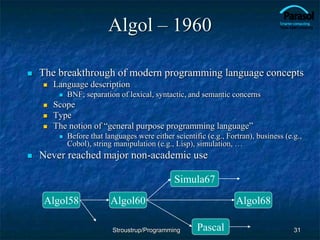
Algol – 1960
 The breakthrough of modern programming language concepts
 Language description
 BNF; separation of lexical, syntactic, and semantic concerns
 Scope
 Type
 The notion of “general purpose programming language”
 Before that languages were either scientific (e.g., Fortran), business (e.g.,
Cobol), string manipulation (e.g., Lisp), simulation, …
 Never reached major non-academic use
31
Algol58 Algol60
Simula67
Algol68
Pascal
Stroustrup/Programming
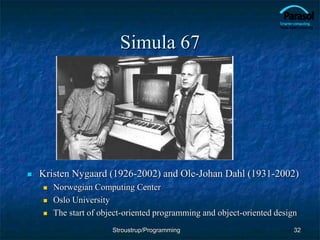
Simula 67
 Kristen Nygaard (1926-2002) and Ole-Johan Dahl (1931-2002)
 Norwegian Computing Center
 Oslo University
 The start of object-oriented programming and object-oriented design
32
Stroustrup/Programming
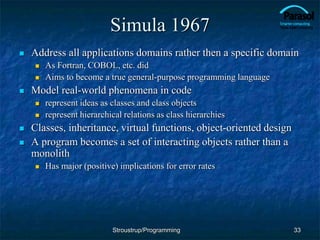
Simula 1967
 Address all applications domains rather then a specific domain
 As Fortran, COBOL, etc. did
 Aims to become a true general-purpose programming language
 Model real-world phenomena in code
 represent ideas as classes and class objects
 represent hierarchical relations as class hierarchies
 Classes, inheritance, virtual functions, object-oriented design
 A program becomes a set of interacting objects rather than a
monolith
 Has major (positive) implications for error rates
33
Stroustrup/Programming
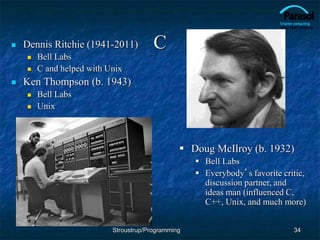
C
 Dennis Ritchie (1941-2011)
 Bell Labs
 C and helped with Unix
 Ken Thompson (b. 1943)
 Bell Labs
 Unix
34
 Doug McIlroy (b. 1932)
 Bell Labs
 Everybody’s favorite critic,
discussion partner, and
ideas man (influenced C,
C++, Unix, and much more)
Stroustrup/Programming
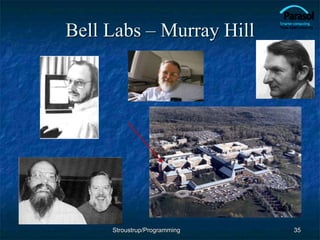
Bell Labs – Murray Hill
35
Stroustrup/Programming
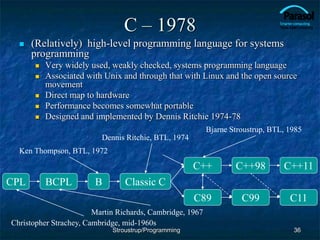
C – 1978
 (Relatively) high-level programming language for systems
programming
 Very widely used, weakly checked, systems programming language
 Associated with Unix and through that with Linux and the open source
movement
 Direct map to hardware
 Performance becomes somewhat portable
 Designed and implemented by Dennis Ritchie 1974-78
36
CPL BCPL B
C99
C++
C89
Classic C
C++98
Christopher Strachey, Cambridge, mid-1960s
Martin Richards, Cambridge, 1967
Ken Thompson, BTL, 1972
Stroustrup/Programming
Dennis Ritchie, BTL, 1974
C++11
Bjarne Stroustrup, BTL, 1985
C11
C++
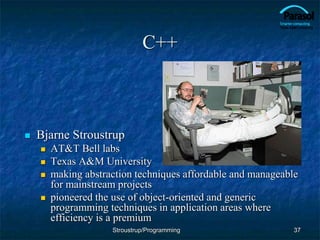
 Bjarne Stroustrup
 AT&T Bell labs
 Texas A&M University
 making abstraction techniques affordable and manageable
for mainstream projects
 pioneered the use of object-oriented and generic
programming techniques in application areas where
efficiency is a premium
37
Stroustrup/Programming
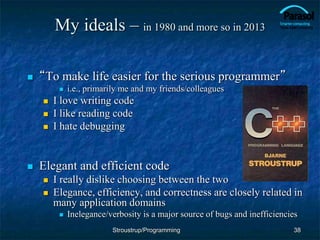
My ideals – in 1980 and more so in 2013
 “To make life easier for the serious programmer”
 i.e., primarily me and my friends/colleagues
 I love writing code
 I like reading code
 I hate debugging
 Elegant and efficient code
 I really dislike choosing between the two
 Elegance, efficiency, and correctness are closely related in
many application domains
 Inelegance/verbosity is a major source of bugs and inefficiencies
38
Stroustrup/Programming
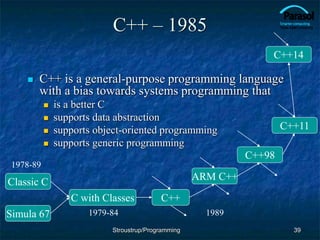
C++ – 1985
 C++ is a general-purpose programming language
with a bias towards systems programming that
 is a better C
 supports data abstraction
 supports object-oriented programming
 supports generic programming
39
Classic C
Simula 67
C++
C with Classes
C++98
ARM C++
1979-84
1978-89
1989
Stroustrup/Programming
C++11
C++14
More information
 More language designer links/photos
 http://www.angelfire.com/tx4/cus/people/
 A few examples of languages:
 http://dmoz.org/Computers/Programming/Languages/
 Textbooks
 Michael L. Scott, Programming Language Pragmatics, Morgan
Kaufmann, 2000, ISBN 1-55860-442-1
 Robert W. Sebesta, Concepts of programming languages,
Addison-Wesley, 2003, ISBN 0-321-19362-8
 History books
 Jean Sammet, Programming Languages: History and
Fundamentals, Prentice-Hall, 1969, ISBN 0-13-729988-5
 Richard L. Wexelblat, History of Programming Languages,
Academic Press, 1981, ISBN 0-12-745040-8
 T. J. Bergin and R. G. Gibson, History of Programming
Languages – II, Addison-Wesley, 1996, ISBN 0-201-89502-1
40
Stroustrup/Programming

22_ideals (1).ppt

  • 1.
    Software ideals andhistory Bjarne Stroustrup www.stroustrup.com/Programming
  • 2.
    Overview  Ideals  Aims,heroes, techniques  Languages and language designers  Early languages to C++ (There is so much more than what we can cover) 3 Stroustrup/Programming
  • 3.
    History and ideas One opinion  “History is bunk”  Another opinion  “He who does not know history is condemned to repeat it”  Our view  There can be no professionalism without history  If you know too little of the background of your field you are gullible  History is littered with plausible ideas that didn’t work  “I have a bridge I’d like to sell you”  Ideas and ideals are crucial for practical use  And they are the real “meat” of history 4 Stroustrup/Programming
  • 4.
    What is aprogramming language?  A tool for instructing machines  A notation for algorithms  A means for communication among programmers  A tool for experimentation  A means for controlling computer-controlled gadgets  A means for controlling computerized devices  A way of expressing relationships among concepts  A means for expressing high-level designs  All of the above!  And more 5 Stroustrup/Programming
  • 5.
    Greek heroes  Everyculture and profession must have ideals and heroes  Physics: Newton, Einstein, Bohr, Feynman  Math: Euclid, Euler, Hilbert  Medicine: Hippocrates, Pasteur, Fleming 6 Stroustrup/Programming
  • 6.
    Geek heroes  BrianKernighan  Programmer and writer extraordinaire 7  Dennis Ritchie  Designer and original implementer of C Stroustrup/Programming
  • 7.
    Another geek hero Kristen Nygaard  Co-inventor (with Ole- Johan Dahl) of Simula67 and of object-oriented programming and object- oriented design 8 Stroustrup/Programming
  • 8.
    Yet another geekhero  Alex Stepanov  Inventor of the STL and generic programming pioneer 9 Stroustrup/Programming
  • 9.
    Two extremes  Academicbeauty/perfection/purity  Commercial expediency  The pressures towards both are immense  Both extremes must be avoided for serious progress to occur  Both extremes encourage overstatement of results (hype) and understatement (or worse) of alternatives and ancestor languages 10 Stroustrup/Programming
  • 10.
    Ideals  The fundamentalaims of good design  Represent ideas directly in code  Represent independent ideas independently in code  Represent relationships among ideas directly in code  Combine ideas expressed in code freely  where and only where combinations make sense  From these follow  Correctness  Maintainability  Performance  Apply these to the widest possible range of applications 11 Stroustrup/Programming
  • 11.
    Ideals have practicaluses  During the start of a project, reviews them to get ideas  When you are stuck late at night, step back and see where your code has most departed from the ideals – this is where the bugs are most likely to lurk and the design problems are most likely to occur  Don’t just keep looking in the same place and trying the same techniques to find the bug  “The bug is always where you are not looking – or you would have found it already” 12 Stroustrup/Programming
  • 12.
    Ideals are personal Chose yours well 13 Stroustrup/Programming
  • 13.
    Styles/paradigms  Procedural programming Data abstraction  Object-oriented programming  Generic programming  Functional programming, logic programming, rule- based programming, constraints-based programming, aspect-oriented programming, … 14 Stroustrup/Programming
  • 14.
    Styles/paradigms template<class Iter> voiddraw_all(Iter b, Iter e) { for_each(b,e,mem_fun(&Shape::draw)); // draw all shapes in [b:e) } Point p(100,100); Shape* a[] = { new Circle(p,50), new Rectangle(p, 250, 250) }; draw_all(a,a+2);  Which programming styles/paradigms did we use here?  Procedural, data abstractions, OOP, and GP 15 Stroustrup/Programming
  • 15.
    Styles/paradigms template<class Cont> voiddraw_all(Cont& c) // C++11 { for_each(Shape* p : c) p->draw(); // draw all shapes in c } void draw_all(Container& c) // C++14 { for_each(Shape* p : c) p->draw(); // draw all shapes in c }  It’s all just programming! 16 Stroustrup/Programming
  • 16.
    Some fundamentals  Portabilityis good  Type safety is good  High performance is good  Anything that eases debugging is good  Access to system resources is good  Stability over decades is good  Ease of learning is good  Small is good  Whatever helps analysis is good  Having lots of facilities is good  You can’t have all at the same time: engineering tradeoffs 17 Stroustrup/Programming
  • 17.
    Programming languages  Machinecode  Bits, octal, or at most decimal numbers  Assembler  Registers, load, store, integer add, floating point add, …  Each new machine had its own assembler  Higher level languages  First: Fortran and COBOL  Rate of language invention  At least 2000 a decade  Major languages today  Really solid statistics are hard to come by  IDS: about 9 million professional programmers  COBOL, Fortran, C, C++, Visual Basic, PERL, Java, Javascript  Ada, C#, PHP, … 18 Stroustrup/Programming
  • 18.
    Early programming languages 19 ClassicC Simula Pascal Algol68 BCPL Fortran Lisp COBOL Algol60 PL/I 1950s: 1960s: 1970s: Red==major commercial use Yellow==will produce important “offspring” Stroustrup/Programming
  • 19.
    Modern programming languages 20 ObjectPascal C++ Java95 C# Ada98 C++98 Java04 C++11 Python Lisp Smalltalk Fortran77 Ada Eiffel Simula67 COBOL89 PHP C89 Pascal PERL Visual Basic COBOL04 Javascript Stroustrup/Programming
  • 20.
    Why do wedesign and evolve languages?  There are many diverse applications areas  No one language can be the best for everything  Programmers have diverse backgrounds and skills  No one language can be best for everybody  Problems change  Over the years, computers are applied in new areas and to new problems  Computers change  Over the decades, hardware characteristics and tradeoffs change  Progress happens  Over the decades, we learn better ways to design and implement languages 21 Stroustrup/Programming
  • 21.
    First modern computer– first compiler  David Wheeler (1927-2004)  University of Cambridge  Exceptional problem solver: hardware, software, algorithms, libraries  First computer science Ph.D. (1951)  First paper on how to write correct, reusable, and maintainable code (1951)  (Thesis advisor for Bjarne Stroustrup ) 22 Stroustrup/Programming
  • 22.
    Early languages –1952  One language for each machine  Special features for processor  Special features for “operating system”  Most had very assembler-like facilities  It was easy to understand which instructions would be generated  No portability of code 23 Stroustrup/Programming
  • 23.
    Fortran  John Backus(1924-2007)  IBM  FORTRAN, the first high level computer language to be developed.  We did not know what we wanted and how to do it. It just sort of grew.  The Backus-Naur Form (BNF), a standard notation to describe the syntax of a high level programming language.  A functional programming language called FP, which advocates a mathematical approach to programming. 24 Stroustrup/Programming
  • 24.
    Fortran – 1956 Allowed programmers to write linear algebra much as they found it in textbooks  Arrays and loops  Standard mathematical functions  libraries  Users’ own functions  The notation was largely machine independent  Fortran code could often be moved from computer to computer with only minor modification  This was a huge improvement  Arguably the largest single improvement in the history of programming languages  Continuous evolution: II, IV, 77, 90, 95, 03, 08, [15] 25 Stroustrup/Programming
  • 25.
    COBOL  “Rear AdmiralDr. Grace Murray Hopper (US Navy) was a remarkable woman who grandly rose to the challenges of programming the first computers. During her lifetime as a leader in the field of software development concepts, she contributed to the transition from primitive programming techniques to the use of sophisticated compilers. She believed that ‘we've always done it that way’ was not necessarily a good reason to continue to do so.” 26 Stroustrup/Programming (1906-1992)
  • 26.
    Cobol – 1960 Cobol was (and sometimes still is) for business programmers what Fortran was (and sometimes still is) for scientific programmers  The emphasis was on data manipulation  Copying  Storing and retrieving (record keeping)  Printing (reports)  Calculation/computation was seen as a minor matter  It was hoped/claimed that Cobol was so close to business English that managers could program and programmers would soon become redundant  Continuous evolution: 60, 61, 65, 68, 74, 85, 02 27 Stroustrup/Programming
  • 27.
    Lisp  John McCarthy(1927-2011)  Stanford University  AI pioneer 28 Stroustrup/Programming
  • 28.
    Lisp – 1960 List/symbolic processing  Initially (and often still) interpreted  Dozens (most likely hundreds) of dialects  “Lisp has an implied plural”  Common Lisp  Scheme  This family of languages has been (and is) the mainstay of artificial intelligence (AI) research  though delivered products have often been in C or C++ 29 Stroustrup/Programming
  • 29.
    Algol  Peter Naur(b. 1928)  Danish Technical University and Regnecentralen  BNF  Edsger Dijkstra (1930-2002)  Mathematisch Centrum, Amsterdam, Eindhoven University of Technology, Burroughs Corporation , University of Texas (Austin)  Mathematical logic in programming, algorithms  THE operating system 30 Stroustrup/Programming
  • 30.
    Algol – 1960 The breakthrough of modern programming language concepts  Language description  BNF; separation of lexical, syntactic, and semantic concerns  Scope  Type  The notion of “general purpose programming language”  Before that languages were either scientific (e.g., Fortran), business (e.g., Cobol), string manipulation (e.g., Lisp), simulation, …  Never reached major non-academic use 31 Algol58 Algol60 Simula67 Algol68 Pascal Stroustrup/Programming
  • 31.
    Simula 67  KristenNygaard (1926-2002) and Ole-Johan Dahl (1931-2002)  Norwegian Computing Center  Oslo University  The start of object-oriented programming and object-oriented design 32 Stroustrup/Programming
  • 32.
    Simula 1967  Addressall applications domains rather then a specific domain  As Fortran, COBOL, etc. did  Aims to become a true general-purpose programming language  Model real-world phenomena in code  represent ideas as classes and class objects  represent hierarchical relations as class hierarchies  Classes, inheritance, virtual functions, object-oriented design  A program becomes a set of interacting objects rather than a monolith  Has major (positive) implications for error rates 33 Stroustrup/Programming
  • 33.
    C  Dennis Ritchie(1941-2011)  Bell Labs  C and helped with Unix  Ken Thompson (b. 1943)  Bell Labs  Unix 34  Doug McIlroy (b. 1932)  Bell Labs  Everybody’s favorite critic, discussion partner, and ideas man (influenced C, C++, Unix, and much more) Stroustrup/Programming
  • 34.
    Bell Labs –Murray Hill 35 Stroustrup/Programming
  • 35.
    C – 1978 (Relatively) high-level programming language for systems programming  Very widely used, weakly checked, systems programming language  Associated with Unix and through that with Linux and the open source movement  Direct map to hardware  Performance becomes somewhat portable  Designed and implemented by Dennis Ritchie 1974-78 36 CPL BCPL B C99 C++ C89 Classic C C++98 Christopher Strachey, Cambridge, mid-1960s Martin Richards, Cambridge, 1967 Ken Thompson, BTL, 1972 Stroustrup/Programming Dennis Ritchie, BTL, 1974 C++11 Bjarne Stroustrup, BTL, 1985 C11
  • 36.
    C++  Bjarne Stroustrup AT&T Bell labs  Texas A&M University  making abstraction techniques affordable and manageable for mainstream projects  pioneered the use of object-oriented and generic programming techniques in application areas where efficiency is a premium 37 Stroustrup/Programming
  • 37.
    My ideals –in 1980 and more so in 2013  “To make life easier for the serious programmer”  i.e., primarily me and my friends/colleagues  I love writing code  I like reading code  I hate debugging  Elegant and efficient code  I really dislike choosing between the two  Elegance, efficiency, and correctness are closely related in many application domains  Inelegance/verbosity is a major source of bugs and inefficiencies 38 Stroustrup/Programming
  • 38.
    C++ – 1985 C++ is a general-purpose programming language with a bias towards systems programming that  is a better C  supports data abstraction  supports object-oriented programming  supports generic programming 39 Classic C Simula 67 C++ C with Classes C++98 ARM C++ 1979-84 1978-89 1989 Stroustrup/Programming C++11 C++14
  • 39.
    More information  Morelanguage designer links/photos  http://www.angelfire.com/tx4/cus/people/  A few examples of languages:  http://dmoz.org/Computers/Programming/Languages/  Textbooks  Michael L. Scott, Programming Language Pragmatics, Morgan Kaufmann, 2000, ISBN 1-55860-442-1  Robert W. Sebesta, Concepts of programming languages, Addison-Wesley, 2003, ISBN 0-321-19362-8  History books  Jean Sammet, Programming Languages: History and Fundamentals, Prentice-Hall, 1969, ISBN 0-13-729988-5  Richard L. Wexelblat, History of Programming Languages, Academic Press, 1981, ISBN 0-12-745040-8  T. J. Bergin and R. G. Gibson, History of Programming Languages – II, Addison-Wesley, 1996, ISBN 0-201-89502-1 40 Stroustrup/Programming