Chapter 2.2
Game Design
CS 4455 2
Overview
 This introduction covers:
– Terms
– Concepts
– Approach
 All from a workaday viewpoint
CS 4455 3
The Language of Games
 Debate continues over high-level views
 Lack of standard (concrete) definitions
– Game (Interactions to elicit emotions?)
– Play (Object of rule-bound play?)
– Aesthetics (Emotional responses during play?)
 High-level concepts tricky to articulate
CS 4455 4
The Language of Games
 Why do we play?
 What is the nature of games?
– Not our focus in this class
 How is a game formed of parts?
– That’s what we care about here!
 Computer games are an art form
– The art of making interactive dynamic models!
CS 4455 5
Games Exist in a Frame
 The border of a game’s context
– Inside the frame is in the game
– Outside the frame is real life
 The world of the interactive dynamic model
 Choices have outcomes in the frame
– Varying consequences/weights
– Meaningful choices!
CS 4455 6
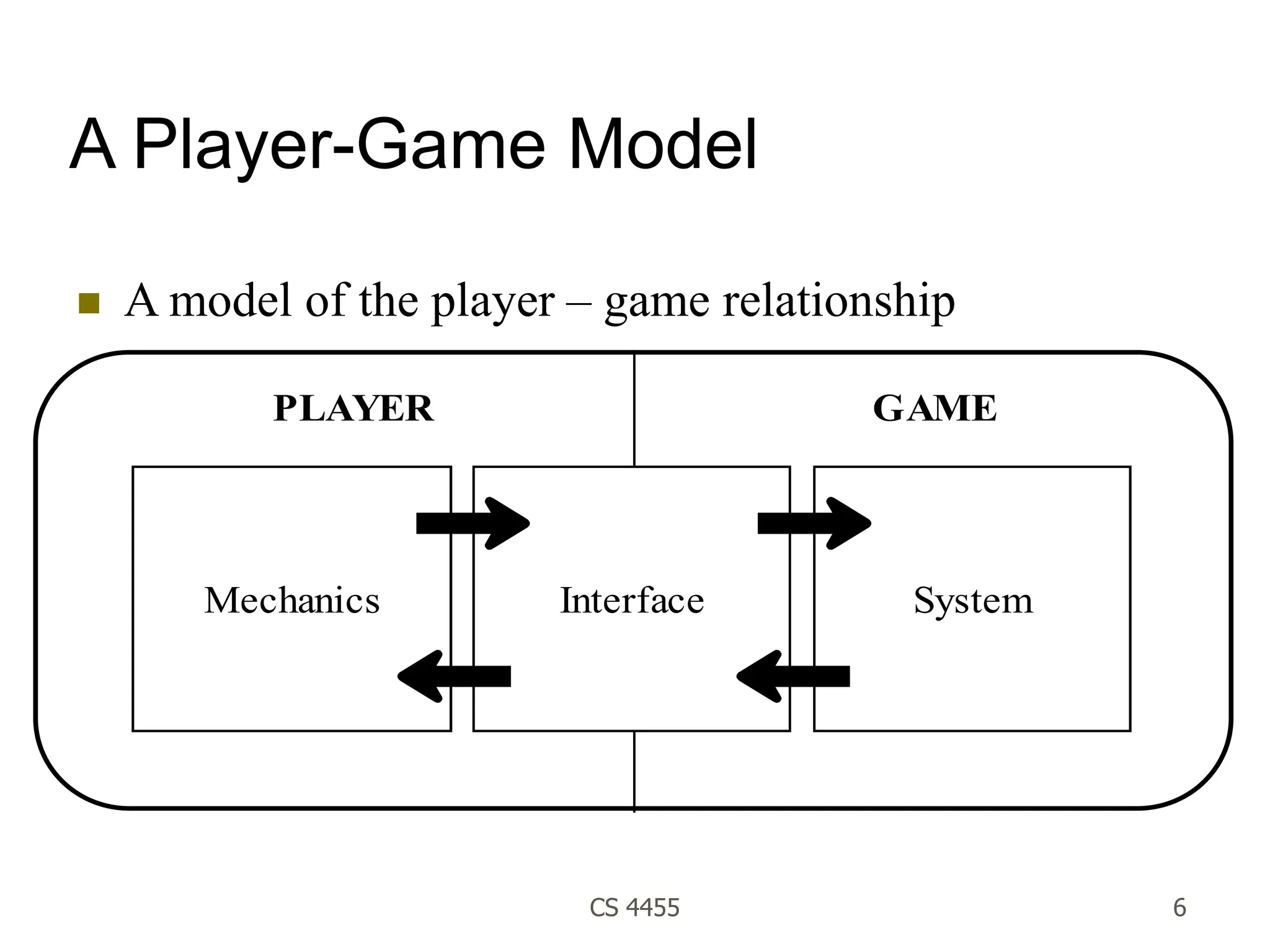
A Player-Game Model
 A model of the player – game relationship
Mechanics Interface System
PLAYER GAME
CS 4455 7
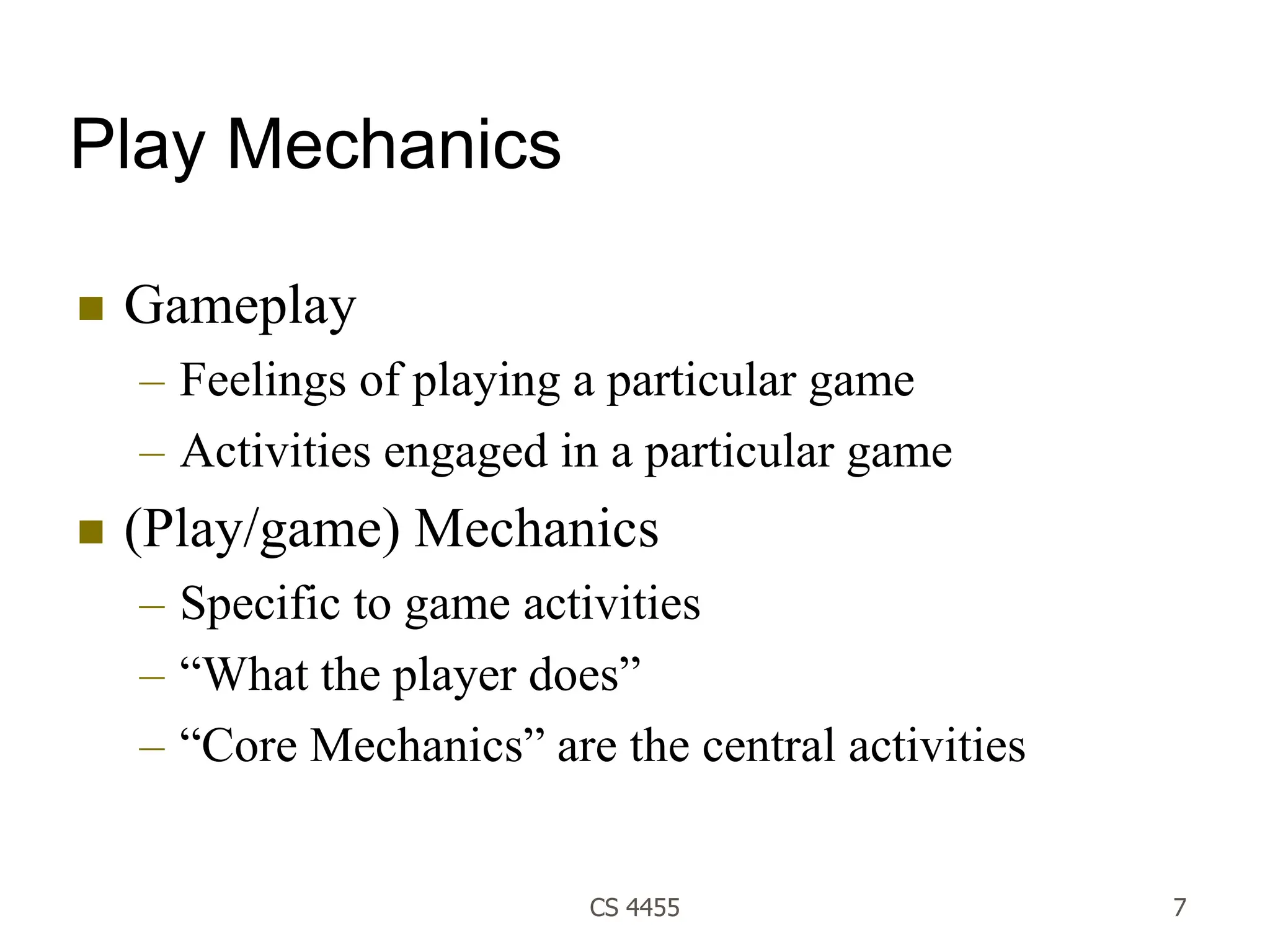
Play Mechanics
 Gameplay
– Feelings of playing a particular game
– Activities engaged in a particular game
 (Play/game) Mechanics
– Specific to game activities
– “What the player does”
– “Core Mechanics” are the central activities
CS 4455 8
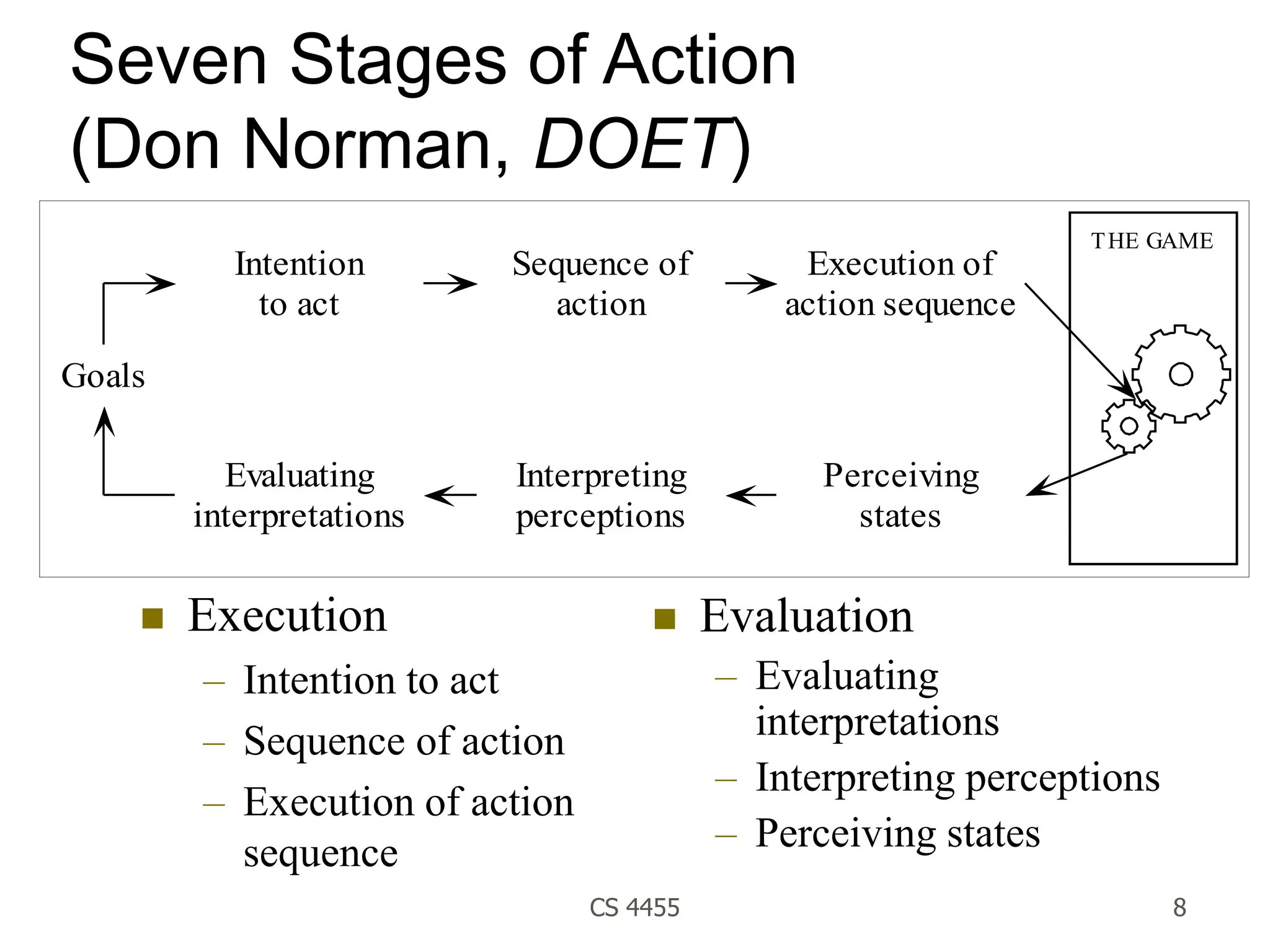
Seven Stages of Action
(Don Norman, DOET)
 Execution
– Intention to act
– Sequence of action
– Execution of action
sequence
 Evaluation
– Evaluating
interpretations
– Interpreting perceptions
– Perceiving states
Perceiving
states
Interpreting
perceptions
Evaluating
interpretations
Execution of
action sequence
Sequence of
action
Intention
to act
Goals
THE GAME
CS 4455 9
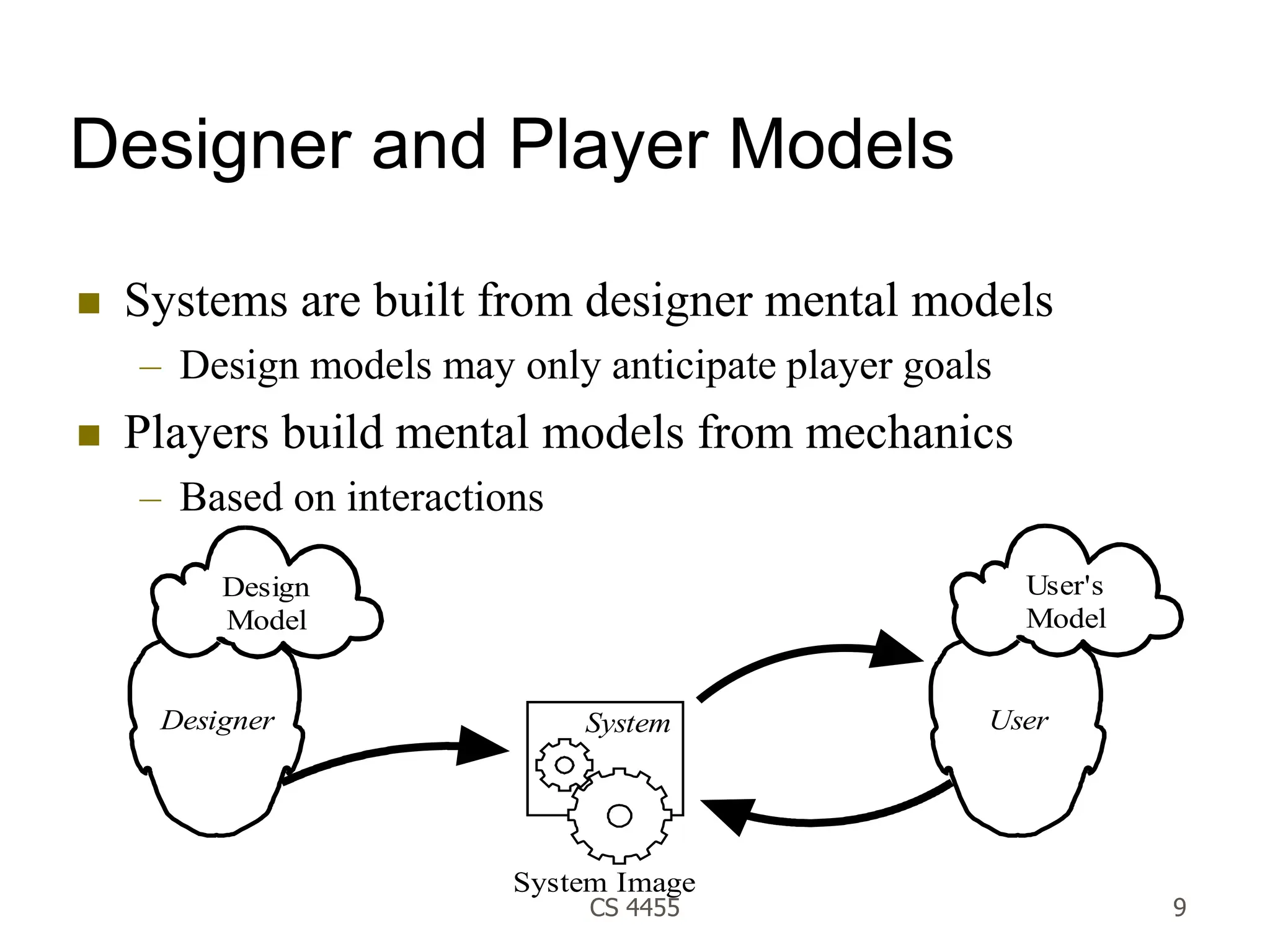
Designer and Player Models
 Systems are built from designer mental models
– Design models may only anticipate player goals
 Players build mental models from mechanics
– Based on interactions
Designer User
User's
Model
Design
Model
System Image
System
CS 4455 10
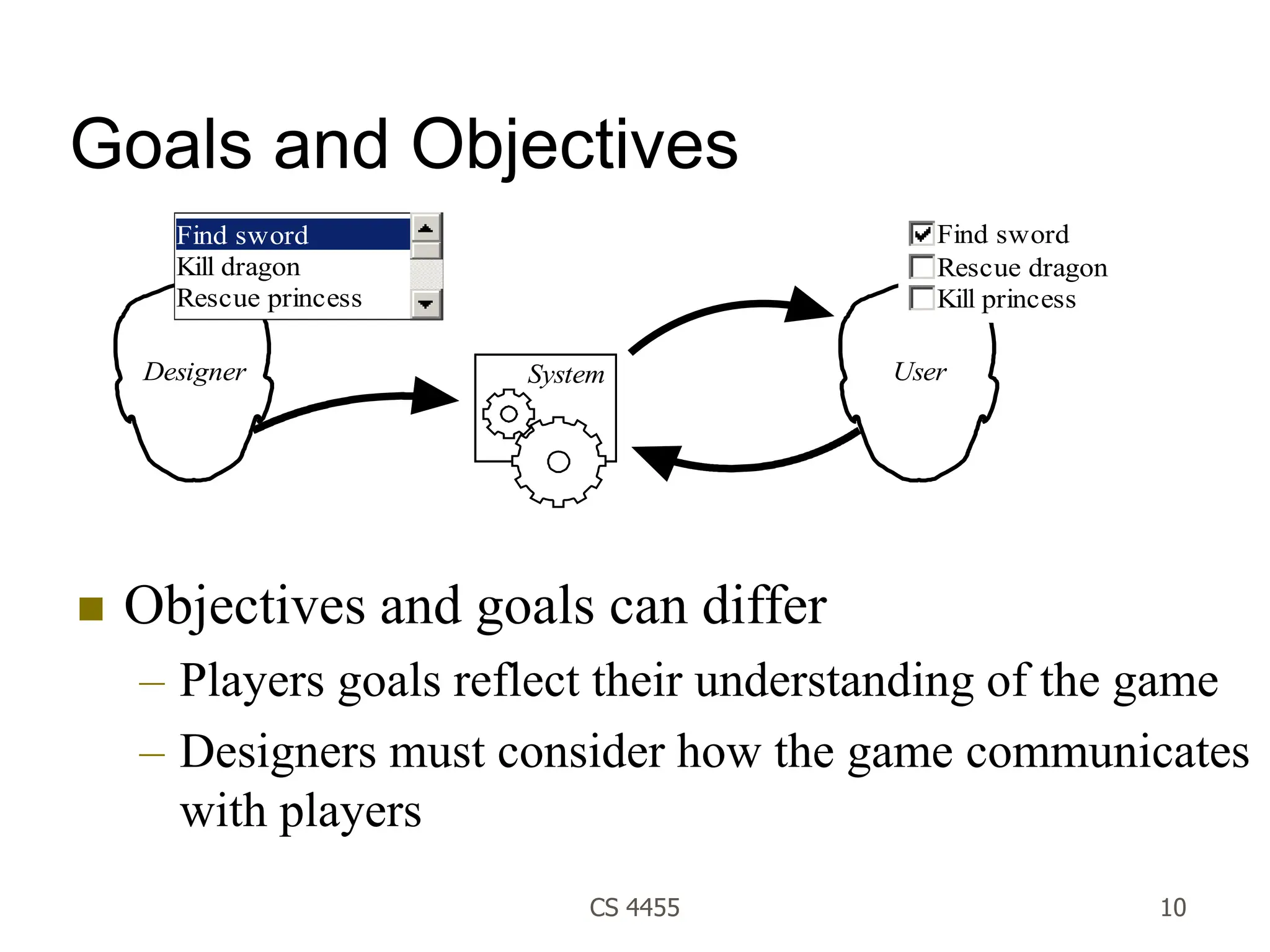
Goals and Objectives
 Objectives and goals can differ
– Players goals reflect their understanding of the game
– Designers must consider how the game communicates
with players
Designer User
System
Find sword
Kill dragon
Rescue princess
Find sword
Rescue dragon
Kill princess
CS 4455 11
Aside: Resources
 Things used by agents to reach goals
 To be meaningful, they must be…
– Useful – provide some value
– Limited – in total or rate of supply
 KEY: Needed, but limited!
CS 4455 12
Premise Sets Context for Model
 The metaphors of action and setting
– Concrete (e.g., Halo back-story)
– Activity based (e.g., Madden)
– Abstract (e.g., Tetris)
 Directs the player experience
– Provides a context in which mechanics fit
– Players map game states to the premise
CS 4455 13
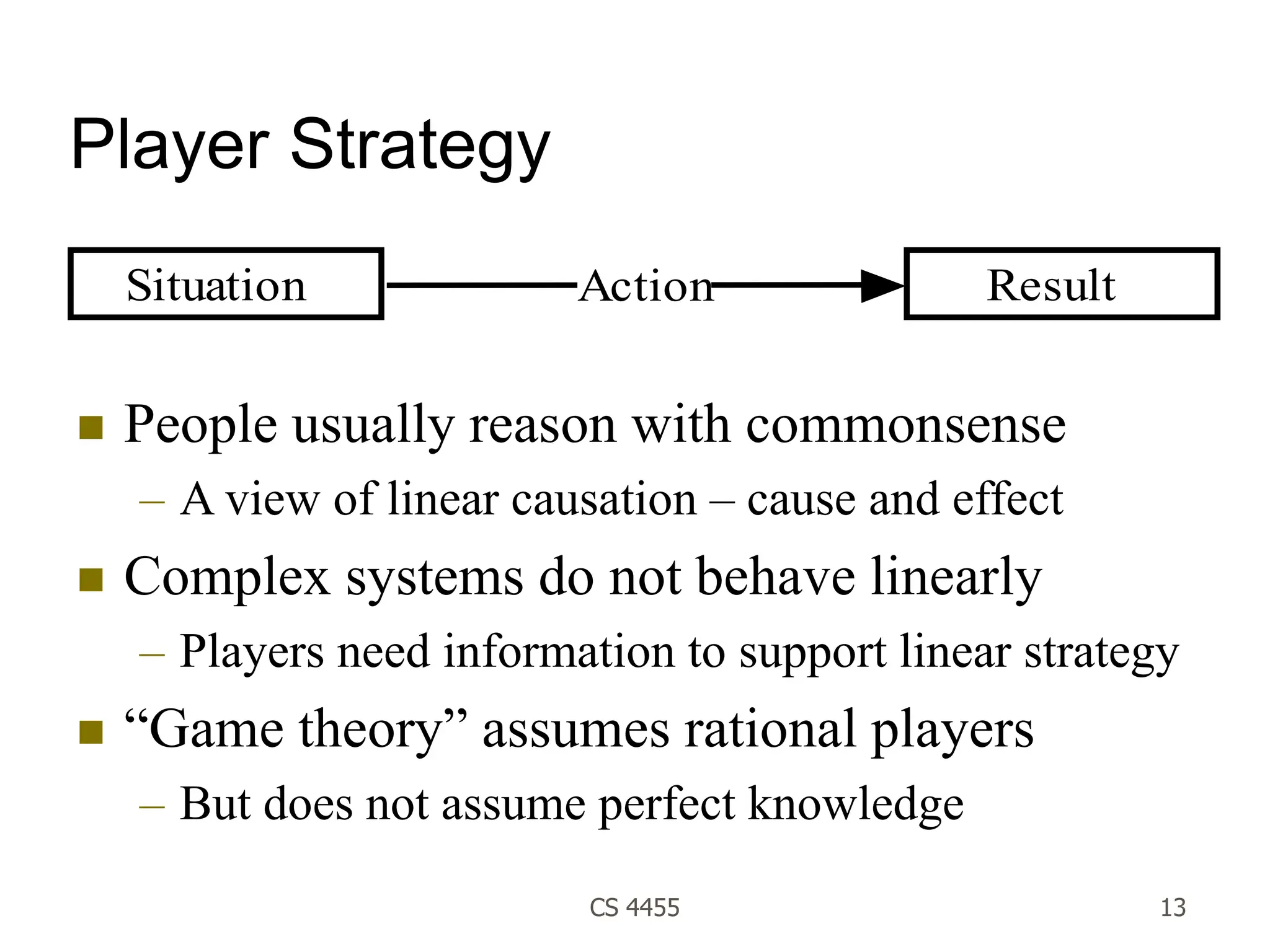
Player Strategy
 People usually reason with commonsense
– A view of linear causation – cause and effect
 Complex systems do not behave linearly
– Players need information to support linear strategy
 “Game theory” assumes rational players
– But does not assume perfect knowledge
Situation Result
Action
CS 4455 14
Aside: HCI and
Cognitive Ergonomics
 HCI – Human-Computer Interaction
– Study of…
• Communication between users and computers
• How people design, build, and use interfaces
• Better support for cooperative work
 Cognitive Ergonomics
– Analyzes the cognitive representations and
processes involved with performing tasks
CS 4455 15
Norman, again (DOET = Design
of Everyday Things)
 Norman’s five principles of design
– Visibility
• Making the parts visible
– Mappings
• Understandable relationships between controls and actions
– Affordances
• The perceived uses of an object
– Constraints
• Prevent the user from doing things they shouldn’t
– Feedback
• Reporting what has been done and accomplished
CS 4455 16
Systems Design
 Two general approaches to design
– Special case
• Experiences built one scene/level at a time
• Anticipate states while pre-scripting events
• Solved by discovering the intentions of the designer
– Systemic
• General behaviors are designed
• Scenes/Levels are specific configurations
• Some events may still be pre-scripted
• Solved by understanding the system
CS 4455 17
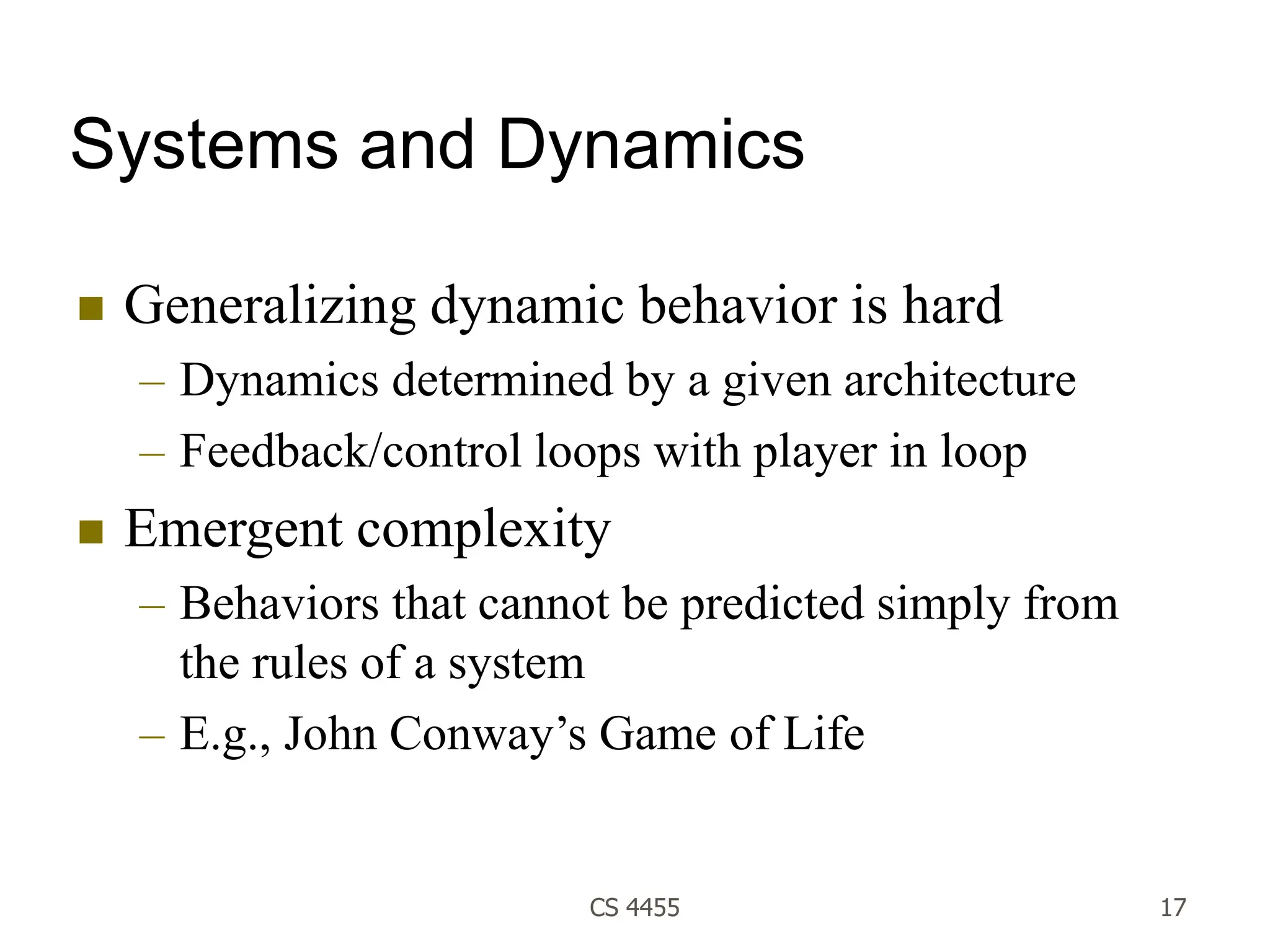
Systems and Dynamics
 Generalizing dynamic behavior is hard
– Dynamics determined by a given architecture
– Feedback/control loops with player in loop
 Emergent complexity
– Behaviors that cannot be predicted simply from
the rules of a system
– E.g., John Conway’s Game of Life
CS 4455 18
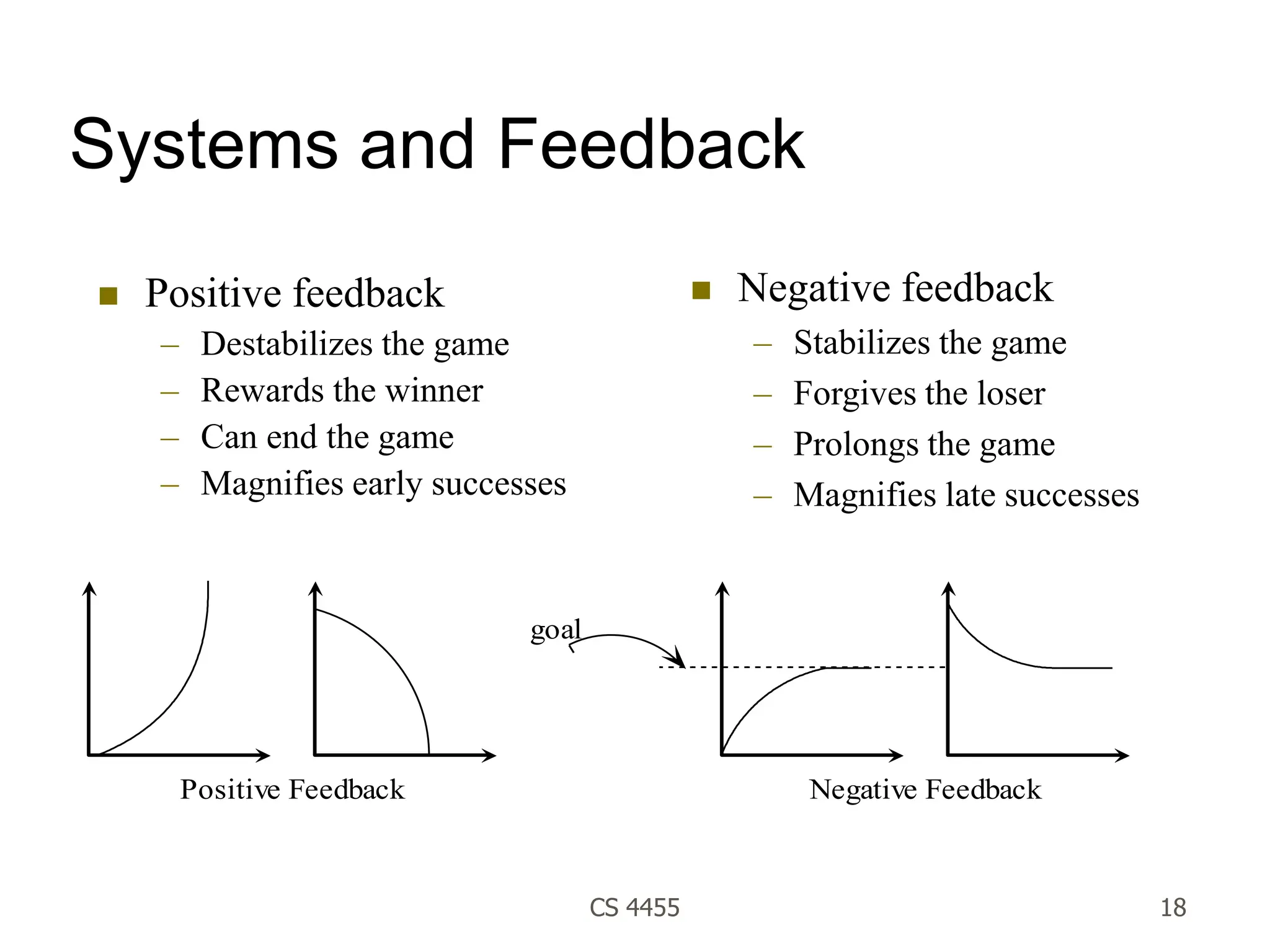
Systems and Feedback
 Negative feedback
– Stabilizes the game
– Forgives the loser
– Prolongs the game
– Magnifies late successes
 Positive feedback
– Destabilizes the game
– Rewards the winner
– Can end the game
– Magnifies early successes
Positive Feedback Negative Feedback
goal
CS 4455 19
Design is all about Working within
Constraints!
 E.g., Platform
– General description of hardware and software
 E.g., Game Saves
– Save triggers
– Save-anywhere
– Save points
– Coded text saves
CS 4455 20
Design to Different Audiences
 Why We Play Games – Nicole Lazzaro
– Internal experience
• Enjoyment from visceral activities
– Hard fun
• Challenge of strategy and problem solving
– Easy fun
• Intrigue and curiosity – exploration and adventure
– Social experience
• Stimulating social faculties – competition, teamwork, bonding, and
recognition
CS 4455 21
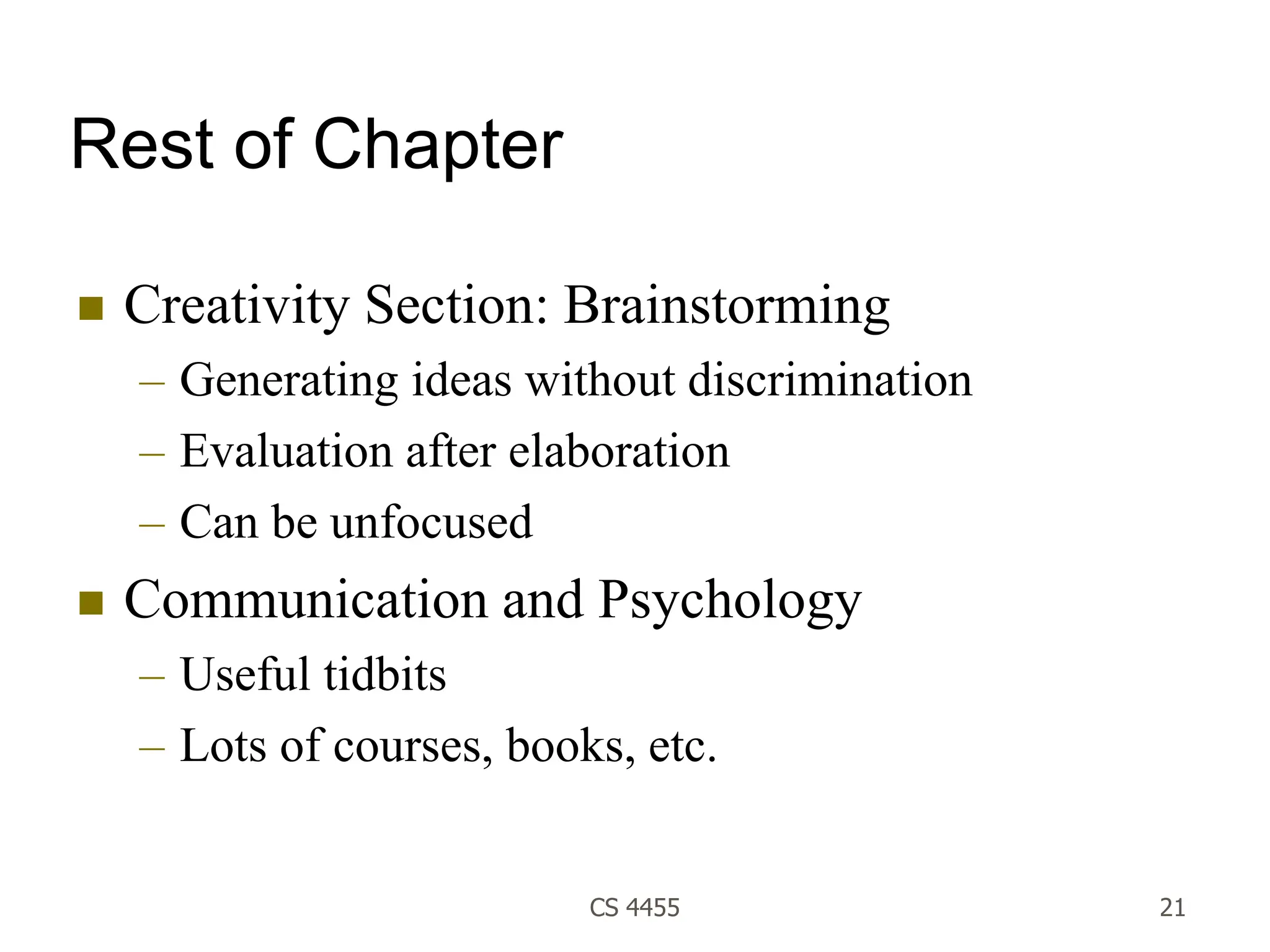
Rest of Chapter
 Creativity Section: Brainstorming
– Generating ideas without discrimination
– Evaluation after elaboration
– Can be unfocused
 Communication and Psychology
– Useful tidbits
– Lots of courses, books, etc.

22-GameDesign.ppt

  • 1.
  • 2.
    CS 4455 2 Overview This introduction covers: – Terms – Concepts – Approach  All from a workaday viewpoint
  • 3.
    CS 4455 3 TheLanguage of Games  Debate continues over high-level views  Lack of standard (concrete) definitions – Game (Interactions to elicit emotions?) – Play (Object of rule-bound play?) – Aesthetics (Emotional responses during play?)  High-level concepts tricky to articulate
  • 4.
    CS 4455 4 TheLanguage of Games  Why do we play?  What is the nature of games? – Not our focus in this class  How is a game formed of parts? – That’s what we care about here!  Computer games are an art form – The art of making interactive dynamic models!
  • 5.
    CS 4455 5 GamesExist in a Frame  The border of a game’s context – Inside the frame is in the game – Outside the frame is real life  The world of the interactive dynamic model  Choices have outcomes in the frame – Varying consequences/weights – Meaningful choices!
  • 6.
    CS 4455 6 APlayer-Game Model  A model of the player – game relationship Mechanics Interface System PLAYER GAME
  • 7.
    CS 4455 7 PlayMechanics  Gameplay – Feelings of playing a particular game – Activities engaged in a particular game  (Play/game) Mechanics – Specific to game activities – “What the player does” – “Core Mechanics” are the central activities
  • 8.
    CS 4455 8 SevenStages of Action (Don Norman, DOET)  Execution – Intention to act – Sequence of action – Execution of action sequence  Evaluation – Evaluating interpretations – Interpreting perceptions – Perceiving states Perceiving states Interpreting perceptions Evaluating interpretations Execution of action sequence Sequence of action Intention to act Goals THE GAME
  • 9.
    CS 4455 9 Designerand Player Models  Systems are built from designer mental models – Design models may only anticipate player goals  Players build mental models from mechanics – Based on interactions Designer User User's Model Design Model System Image System
  • 10.
    CS 4455 10 Goalsand Objectives  Objectives and goals can differ – Players goals reflect their understanding of the game – Designers must consider how the game communicates with players Designer User System Find sword Kill dragon Rescue princess Find sword Rescue dragon Kill princess
  • 11.
    CS 4455 11 Aside:Resources  Things used by agents to reach goals  To be meaningful, they must be… – Useful – provide some value – Limited – in total or rate of supply  KEY: Needed, but limited!
  • 12.
    CS 4455 12 PremiseSets Context for Model  The metaphors of action and setting – Concrete (e.g., Halo back-story) – Activity based (e.g., Madden) – Abstract (e.g., Tetris)  Directs the player experience – Provides a context in which mechanics fit – Players map game states to the premise
  • 13.
    CS 4455 13 PlayerStrategy  People usually reason with commonsense – A view of linear causation – cause and effect  Complex systems do not behave linearly – Players need information to support linear strategy  “Game theory” assumes rational players – But does not assume perfect knowledge Situation Result Action
  • 14.
    CS 4455 14 Aside:HCI and Cognitive Ergonomics  HCI – Human-Computer Interaction – Study of… • Communication between users and computers • How people design, build, and use interfaces • Better support for cooperative work  Cognitive Ergonomics – Analyzes the cognitive representations and processes involved with performing tasks
  • 15.
    CS 4455 15 Norman,again (DOET = Design of Everyday Things)  Norman’s five principles of design – Visibility • Making the parts visible – Mappings • Understandable relationships between controls and actions – Affordances • The perceived uses of an object – Constraints • Prevent the user from doing things they shouldn’t – Feedback • Reporting what has been done and accomplished
  • 16.
    CS 4455 16 SystemsDesign  Two general approaches to design – Special case • Experiences built one scene/level at a time • Anticipate states while pre-scripting events • Solved by discovering the intentions of the designer – Systemic • General behaviors are designed • Scenes/Levels are specific configurations • Some events may still be pre-scripted • Solved by understanding the system
  • 17.
    CS 4455 17 Systemsand Dynamics  Generalizing dynamic behavior is hard – Dynamics determined by a given architecture – Feedback/control loops with player in loop  Emergent complexity – Behaviors that cannot be predicted simply from the rules of a system – E.g., John Conway’s Game of Life
  • 18.
    CS 4455 18 Systemsand Feedback  Negative feedback – Stabilizes the game – Forgives the loser – Prolongs the game – Magnifies late successes  Positive feedback – Destabilizes the game – Rewards the winner – Can end the game – Magnifies early successes Positive Feedback Negative Feedback goal
  • 19.
    CS 4455 19 Designis all about Working within Constraints!  E.g., Platform – General description of hardware and software  E.g., Game Saves – Save triggers – Save-anywhere – Save points – Coded text saves
  • 20.
    CS 4455 20 Designto Different Audiences  Why We Play Games – Nicole Lazzaro – Internal experience • Enjoyment from visceral activities – Hard fun • Challenge of strategy and problem solving – Easy fun • Intrigue and curiosity – exploration and adventure – Social experience • Stimulating social faculties – competition, teamwork, bonding, and recognition
  • 21.
    CS 4455 21 Restof Chapter  Creativity Section: Brainstorming – Generating ideas without discrimination – Evaluation after elaboration – Can be unfocused  Communication and Psychology – Useful tidbits – Lots of courses, books, etc.