Tools & Methodology
for Profit Improvement
Session 2:2
The Planning Process
Tools & Methodology for Profit Improvement
Planning Process
2
Petroleum Supply Chain
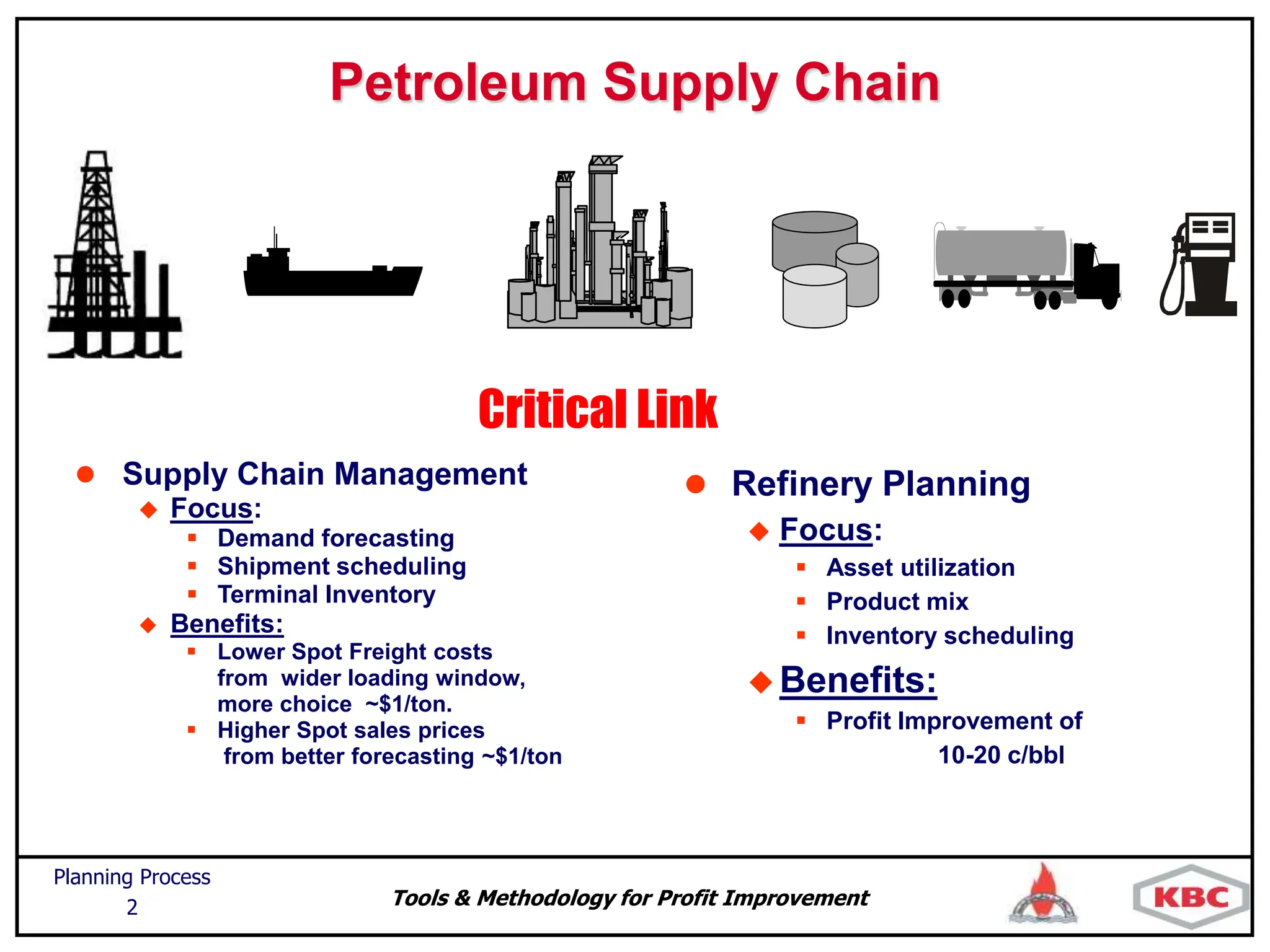
 Supply Chain Management
 Focus:
 Demand forecasting
 Shipment scheduling
 Terminal Inventory
 Benefits:
 Lower Spot Freight costs
from wider loading window,
more choice ~$1/ton.
 Higher Spot sales prices
from better forecasting ~$1/ton
 Refinery Planning
 Focus:
 Asset utilization
 Product mix
 Inventory scheduling
 Benefits:
 Profit Improvement of
10-20 c/bbl
Critical Link
Tools & Methodology for Profit Improvement
Planning Process
3
Petroleum Supply Chain
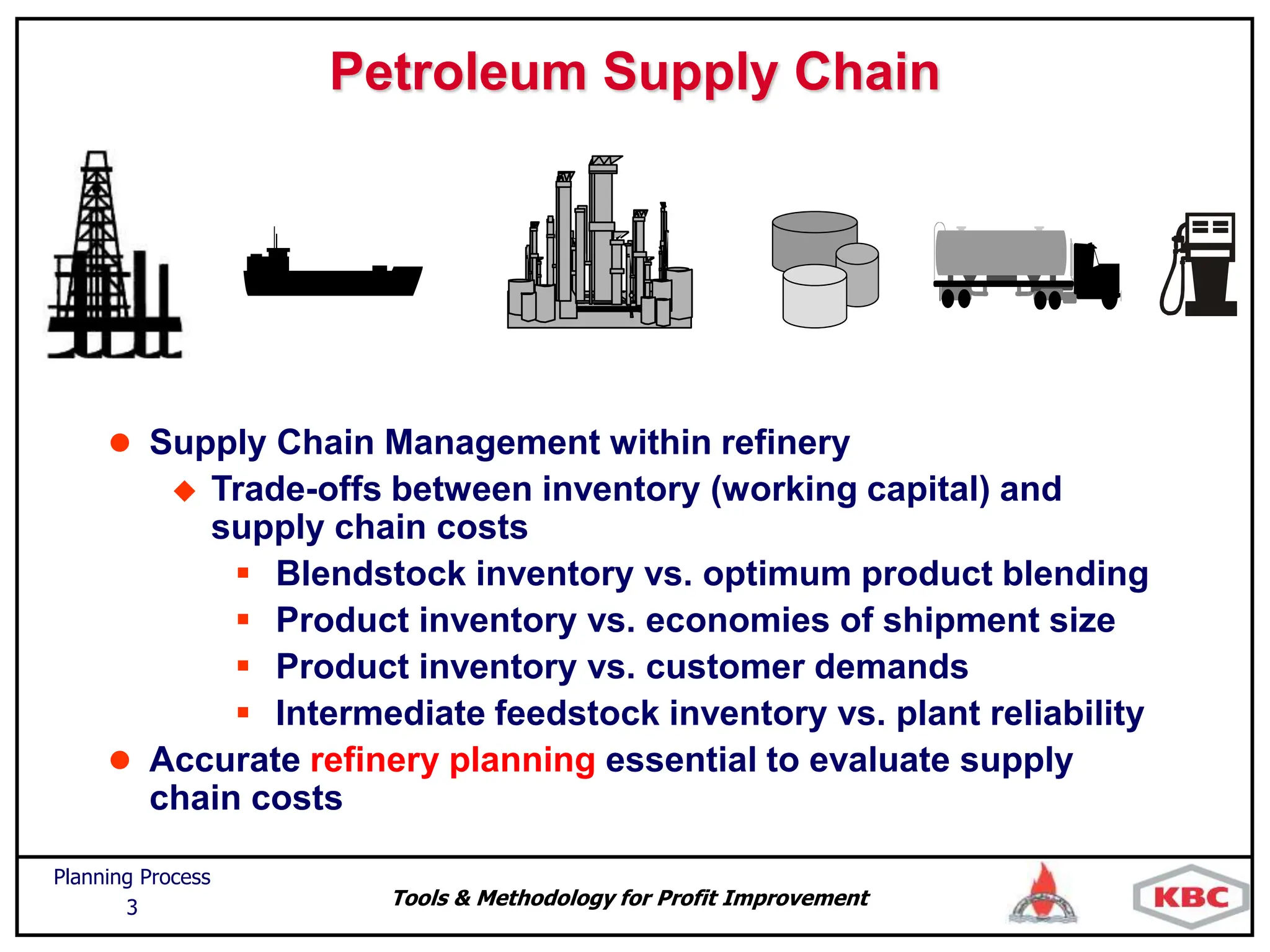
 Supply Chain Management within refinery
 Trade-offs between inventory (working capital) and
supply chain costs
 Blendstock inventory vs. optimum product blending
 Product inventory vs. economies of shipment size
 Product inventory vs. customer demands
 Intermediate feedstock inventory vs. plant reliability
 Accurate refinery planning essential to evaluate supply
chain costs
Tools & Methodology for Profit Improvement
Planning Process
4
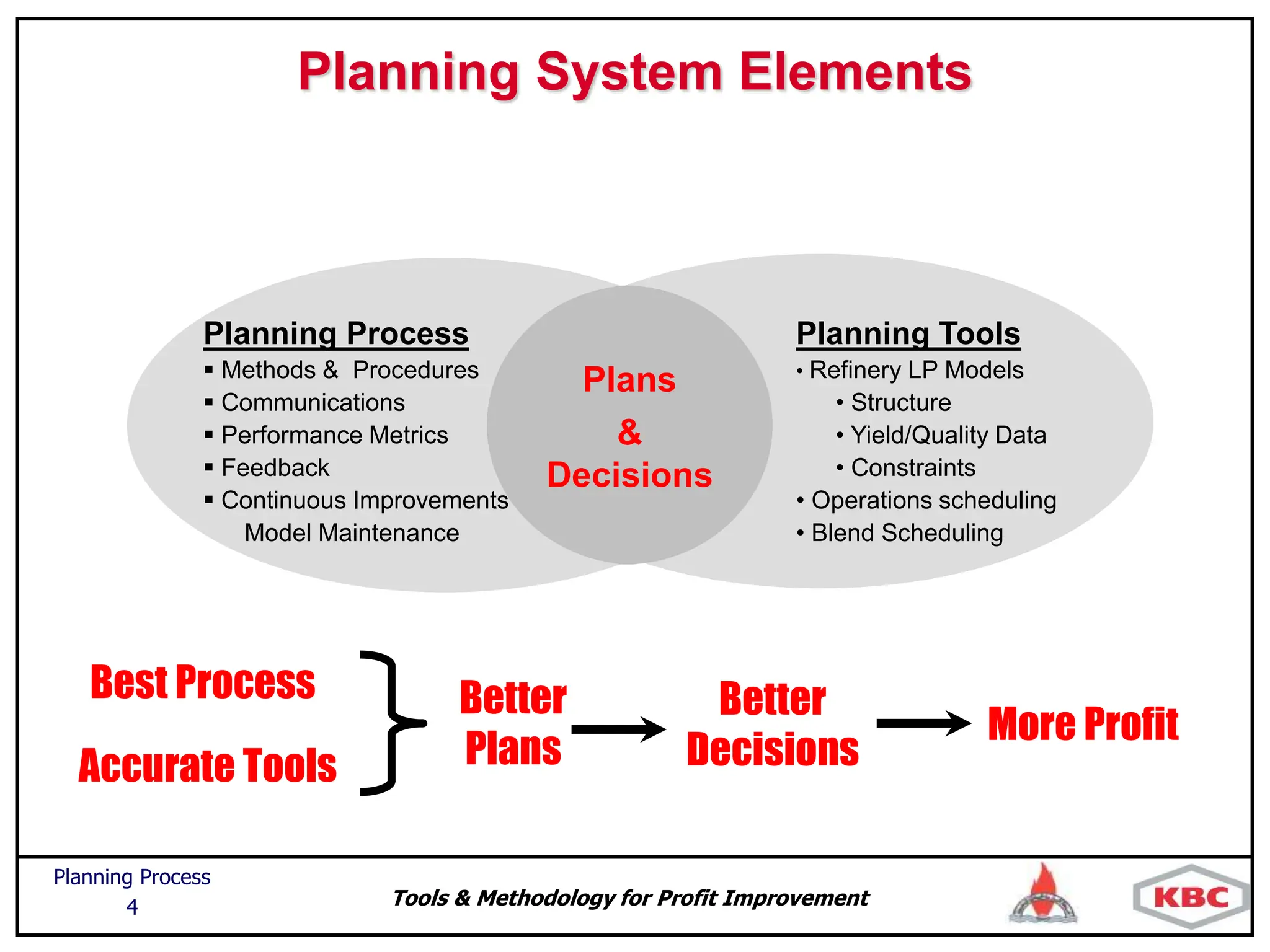
Planning Process
 Methods & Procedures
 Communications
 Performance Metrics
 Feedback
 Continuous Improvements
Model Maintenance
Planning Tools
• Refinery LP Models
• Structure
• Yield/Quality Data
• Constraints
• Operations scheduling
• Blend Scheduling
Plans
&
Decisions
Accurate Tools
Best Process Better
Plans
Better
Decisions
More Profit
Planning System Elements
Tools & Methodology for Profit Improvement
Planning Process
5
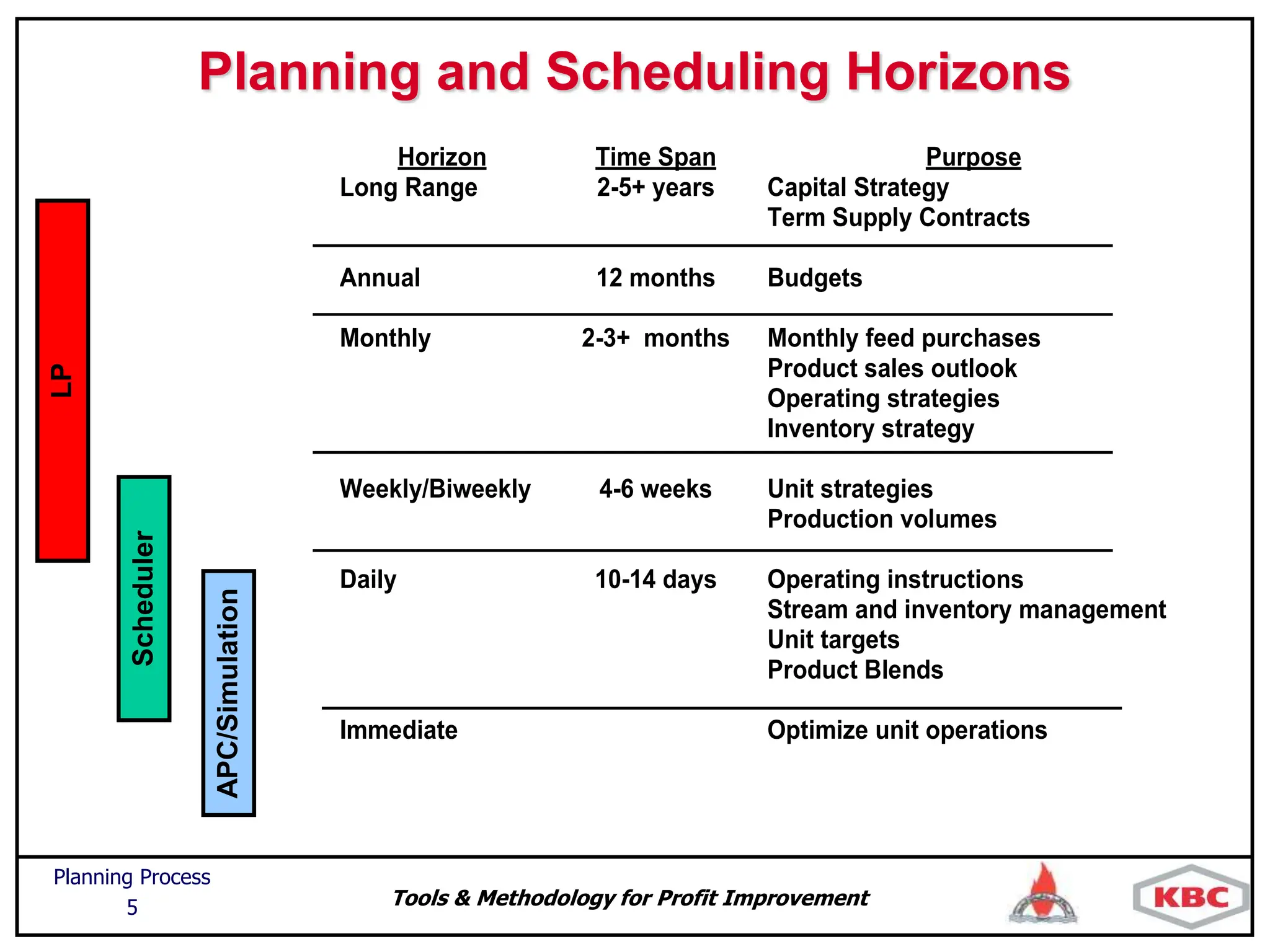
Planning and Scheduling Horizons
Horizon Time Span Purpose
Long Range 2-5+ years Capital Strategy
Term Supply Contracts
Annual 12 months Budgets
Monthly 2-3+ months Monthly feed purchases
Product sales outlook
Operating strategies
Inventory strategy
Weekly/Biweekly 4-6 weeks Unit strategies
Production volumes
Daily 10-14 days Operating instructions
Stream and inventory management
Unit targets
Product Blends
Immediate Optimize unit operations
LP
Scheduler
APC/Simulation
Tools & Methodology for Profit Improvement
Planning Process
6
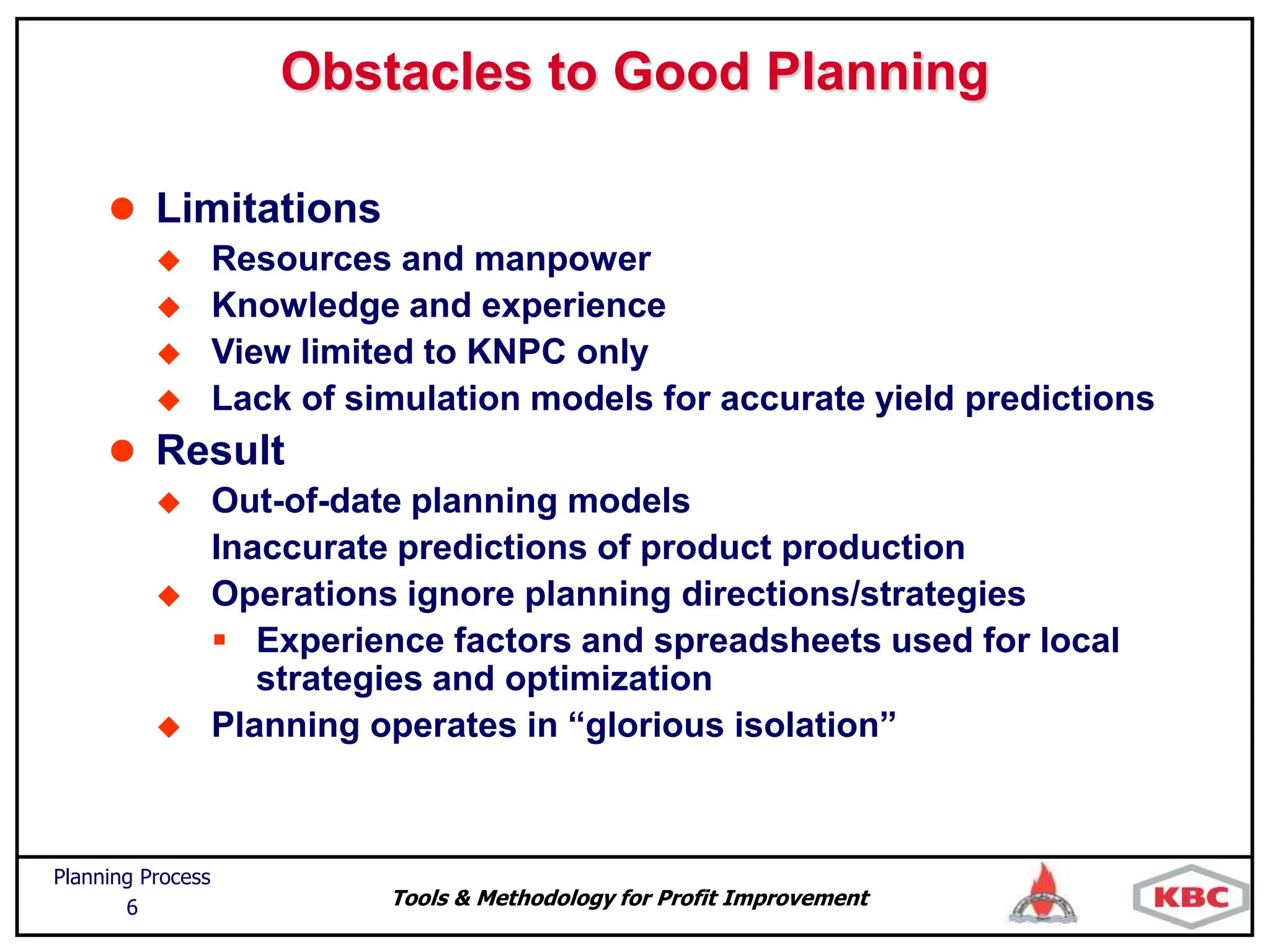
Obstacles to Good Planning
 Limitations
 Resources and manpower
 Knowledge and experience
 View limited to KNPC only
 Lack of simulation models for accurate yield predictions
 Result
 Out-of-date planning models
Inaccurate predictions of product production
 Operations ignore planning directions/strategies
 Experience factors and spreadsheets used for local
strategies and optimization
 Planning operates in “glorious isolation”
Tools & Methodology for Profit Improvement
Planning Process
7
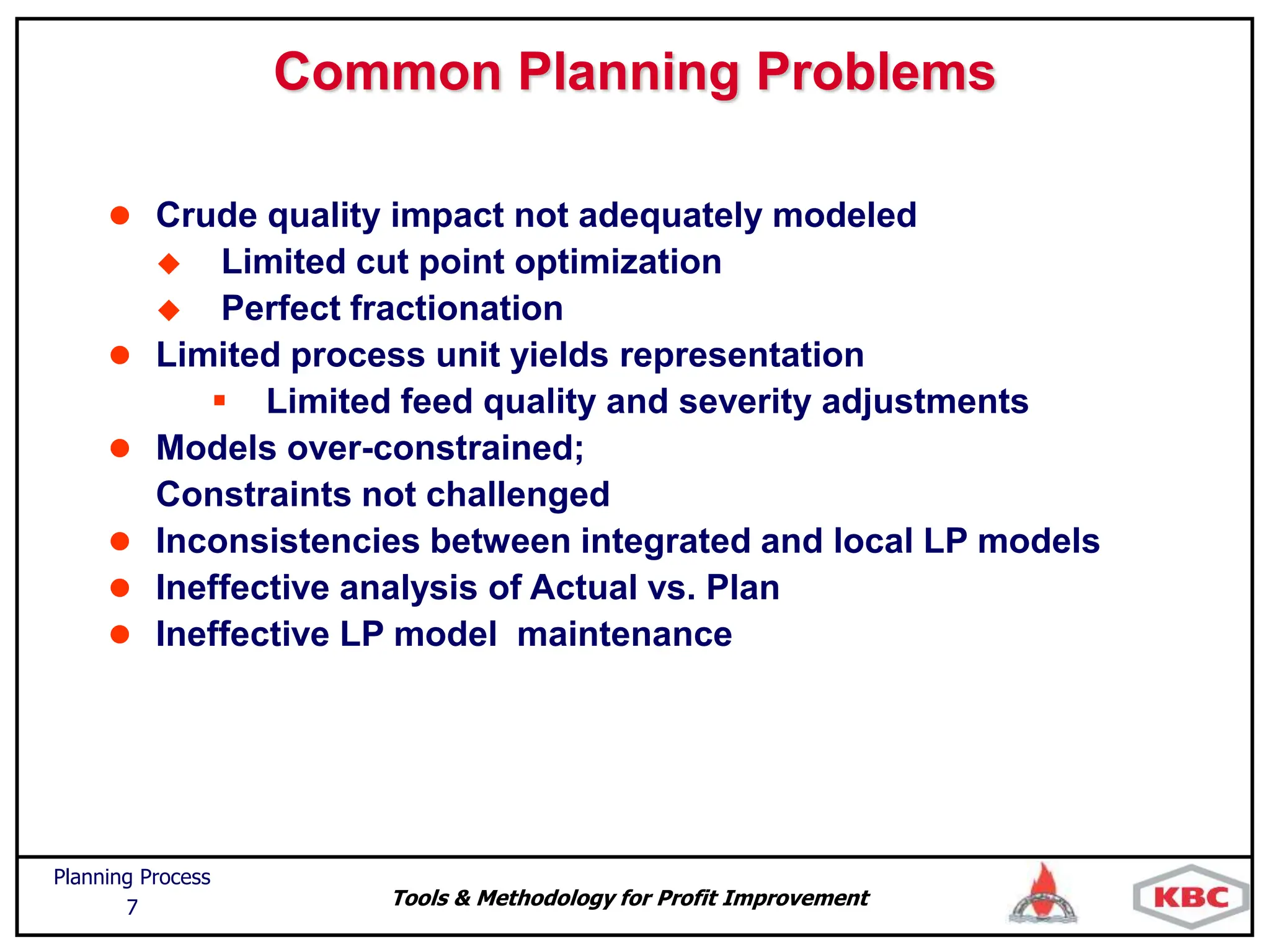
Common Planning Problems
 Crude quality impact not adequately modeled
 Limited cut point optimization
 Perfect fractionation
 Limited process unit yields representation
 Limited feed quality and severity adjustments
 Models over-constrained;
Constraints not challenged
 Inconsistencies between integrated and local LP models
 Ineffective analysis of Actual vs. Plan
 Ineffective LP model maintenance
Tools & Methodology for Profit Improvement
Planning Process
8
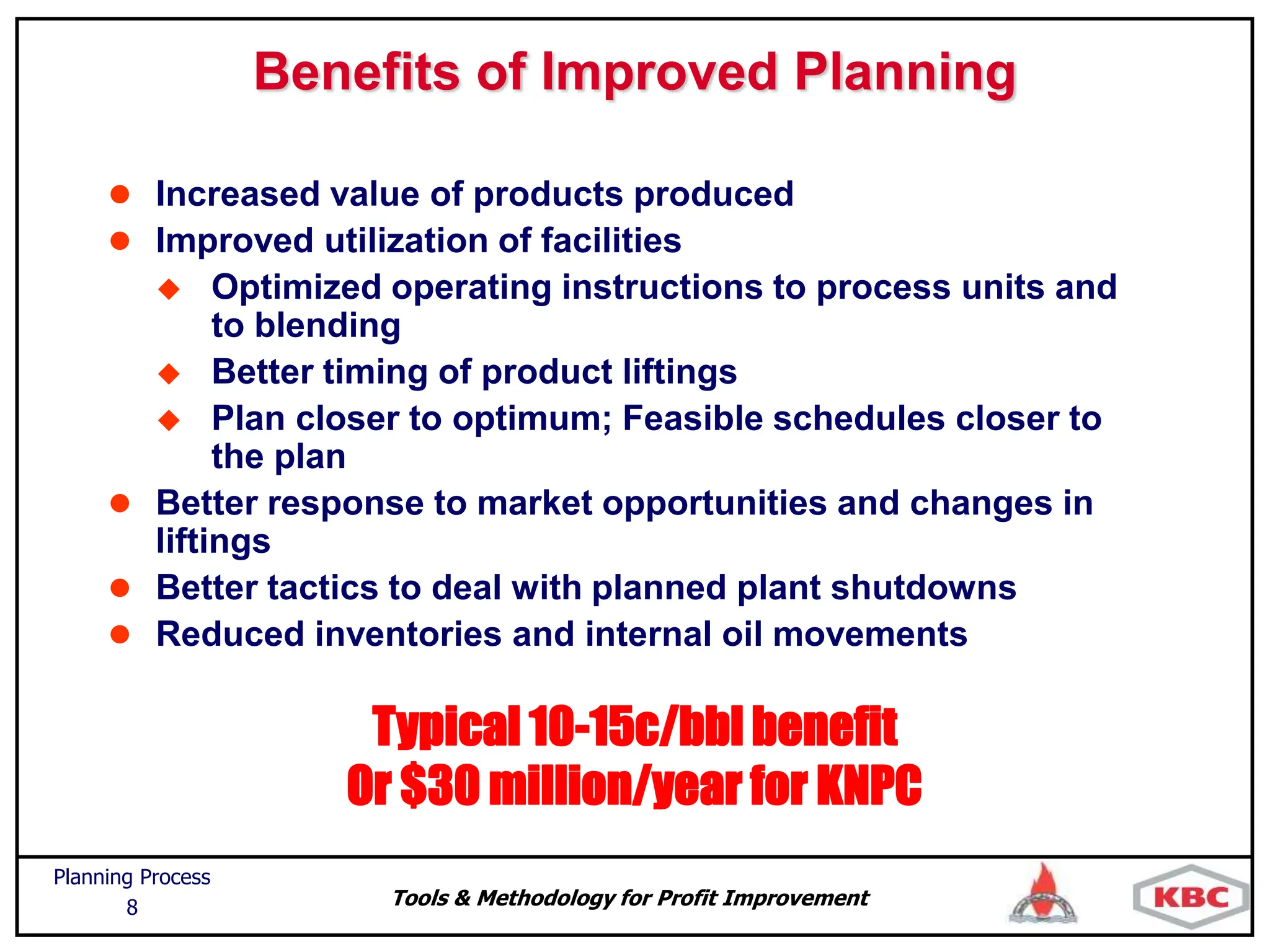
Typical 10-15c/bbl benefit
Or $30 million/year for KNPC
Benefits of Improved Planning
 Increased value of products produced
 Improved utilization of facilities
 Optimized operating instructions to process units and
to blending
 Better timing of product liftings
 Plan closer to optimum; Feasible schedules closer to
the plan
 Better response to market opportunities and changes in
liftings
 Better tactics to deal with planned plant shutdowns
 Reduced inventories and internal oil movements
Tools & Methodology for Profit Improvement
Planning Process
9
Best Practices
Planning Processes
And
Planning Tools
Tools & Methodology for Profit Improvement
Planning Process
10
Best Practice Planning Process Features
Supply Plans for Asset Optimization.
 Multi-refinery LP (M-PIMS) model of refineries
with common crude supply and product markets.
 Optimum allocation of products to refineries
based on refinery capabilities.
 Optimize use of intermediates and blend
components between refineries.
 Long-term crude supply forecast.
Tools & Methodology for Profit Improvement
Planning Process
11
Best Practice Planning Process Features
Operating Plans by Individual Refinery
 Overall feed supply & product demands from
supply plan.
 Fine-tune product slate by refinery.
 Optimize operations with current operating
constraints.
 Interim plan updates.
Tools & Methodology for Profit Improvement
Planning Process
12
Best Practice Planning Process Features
Accurate LP Models.
 Multi-refinery model = combined individual
refinery models with intermediate stock transfers.
 Individual Refinery responsible for configuration,
data, and constraints.
Tools & Methodology for Profit Improvement
Planning Process
13
Best Practice Planning Process Features
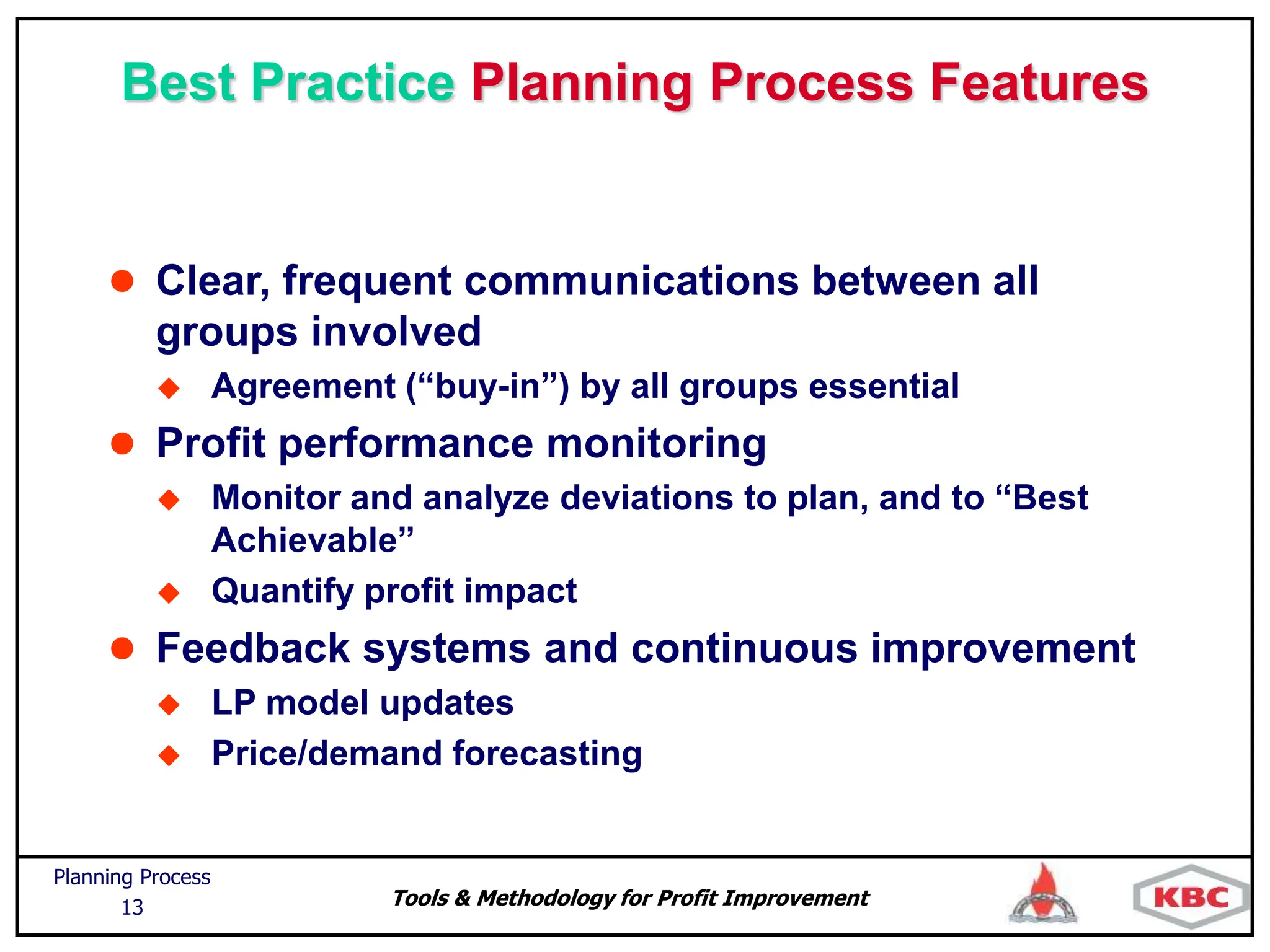
 Clear, frequent communications between all
groups involved
 Agreement (“buy-in”) by all groups essential
 Profit performance monitoring
 Monitor and analyze deviations to plan, and to “Best
Achievable”
 Quantify profit impact
 Feedback systems and continuous improvement
 LP model updates
 Price/demand forecasting
Tools & Methodology for Profit Improvement
Planning Process
14
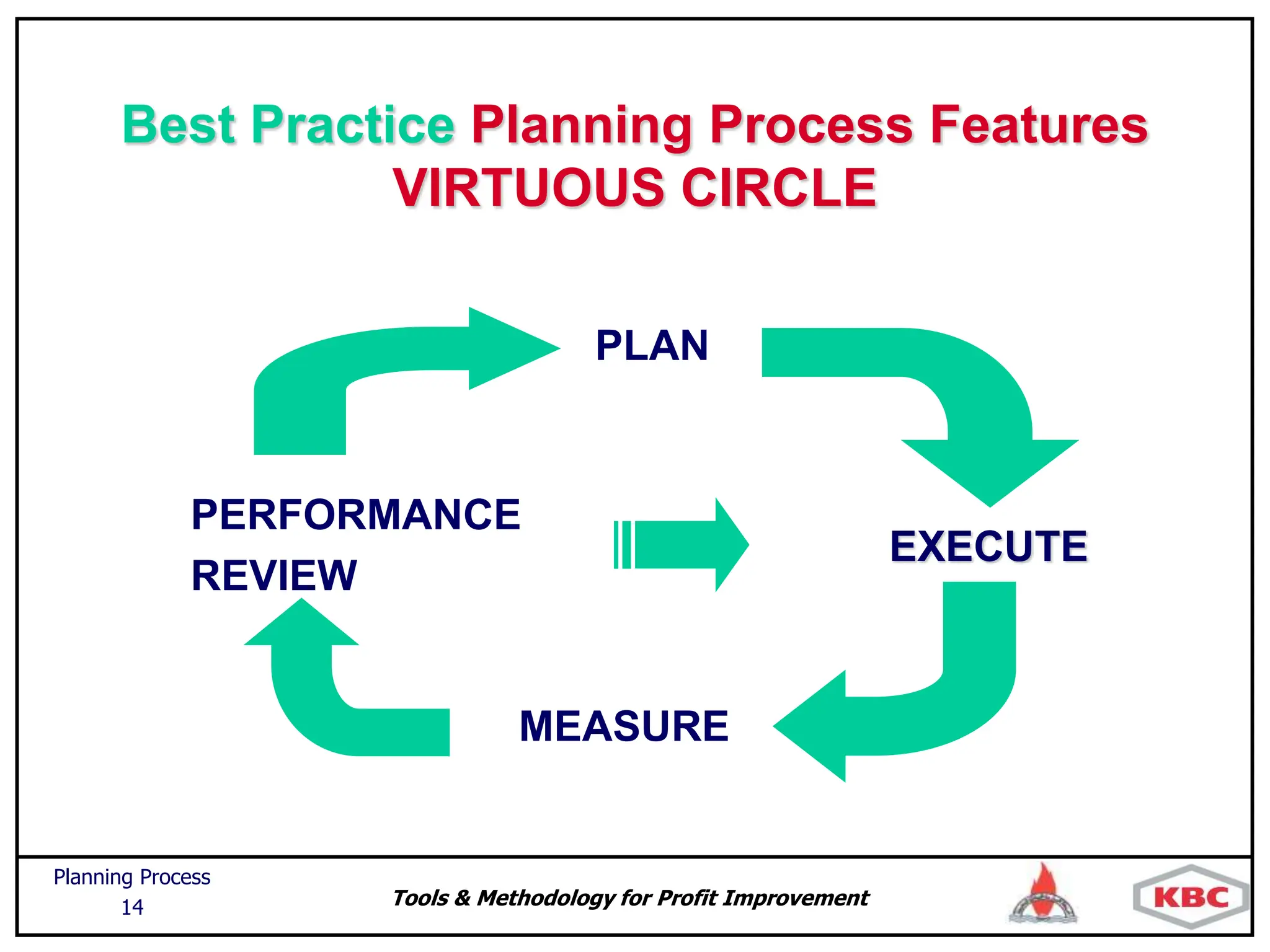
Best Practice Planning Process Features
VIRTUOUS CIRCLE
EXECUTE
PLAN
MEASURE
PERFORMANCE
REVIEW
Tools & Methodology for Profit Improvement
Planning Process
15
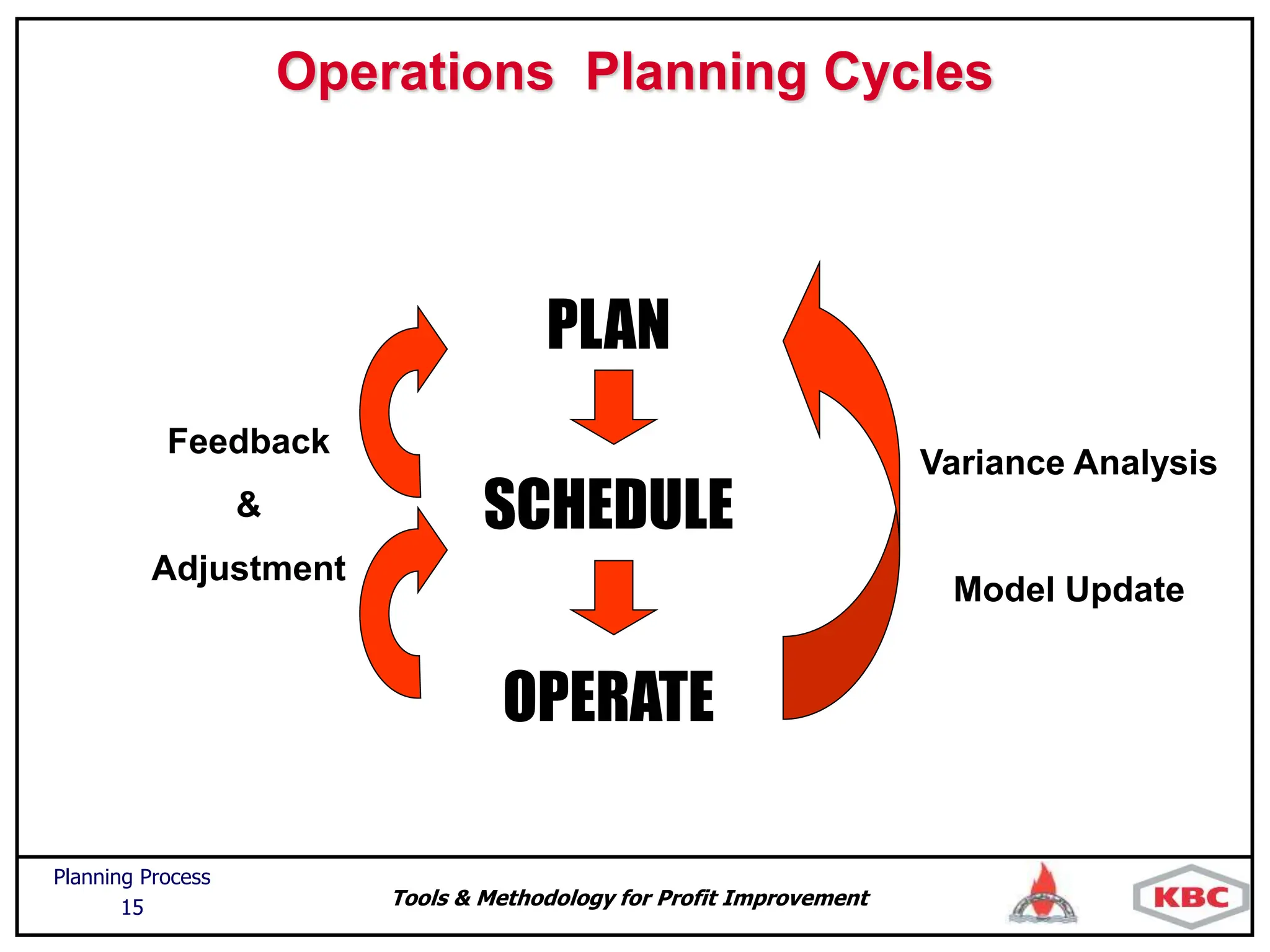
Operations Planning Cycles
PLAN
SCHEDULE
OPERATE
Variance Analysis
Model Update
Feedback
&
Adjustment
Tools & Methodology for Profit Improvement
Planning Process
16
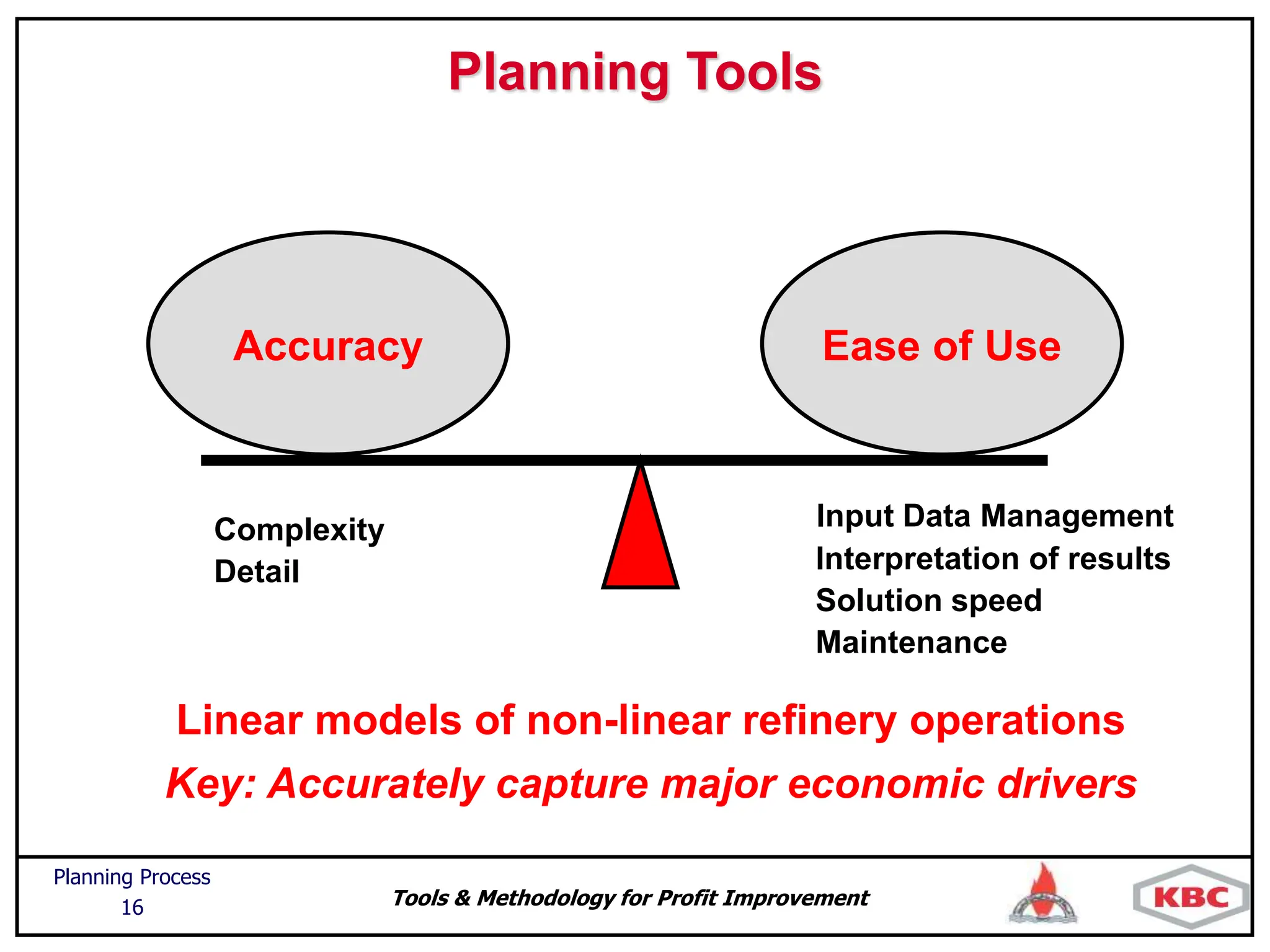
Complexity
Detail
Accuracy Ease of Use
Input Data Management
Interpretation of results
Solution speed
Maintenance
Linear models of non-linear refinery operations
Key: Accurately capture major economic drivers
Planning Tools
Tools & Methodology for Profit Improvement
Planning Process
17
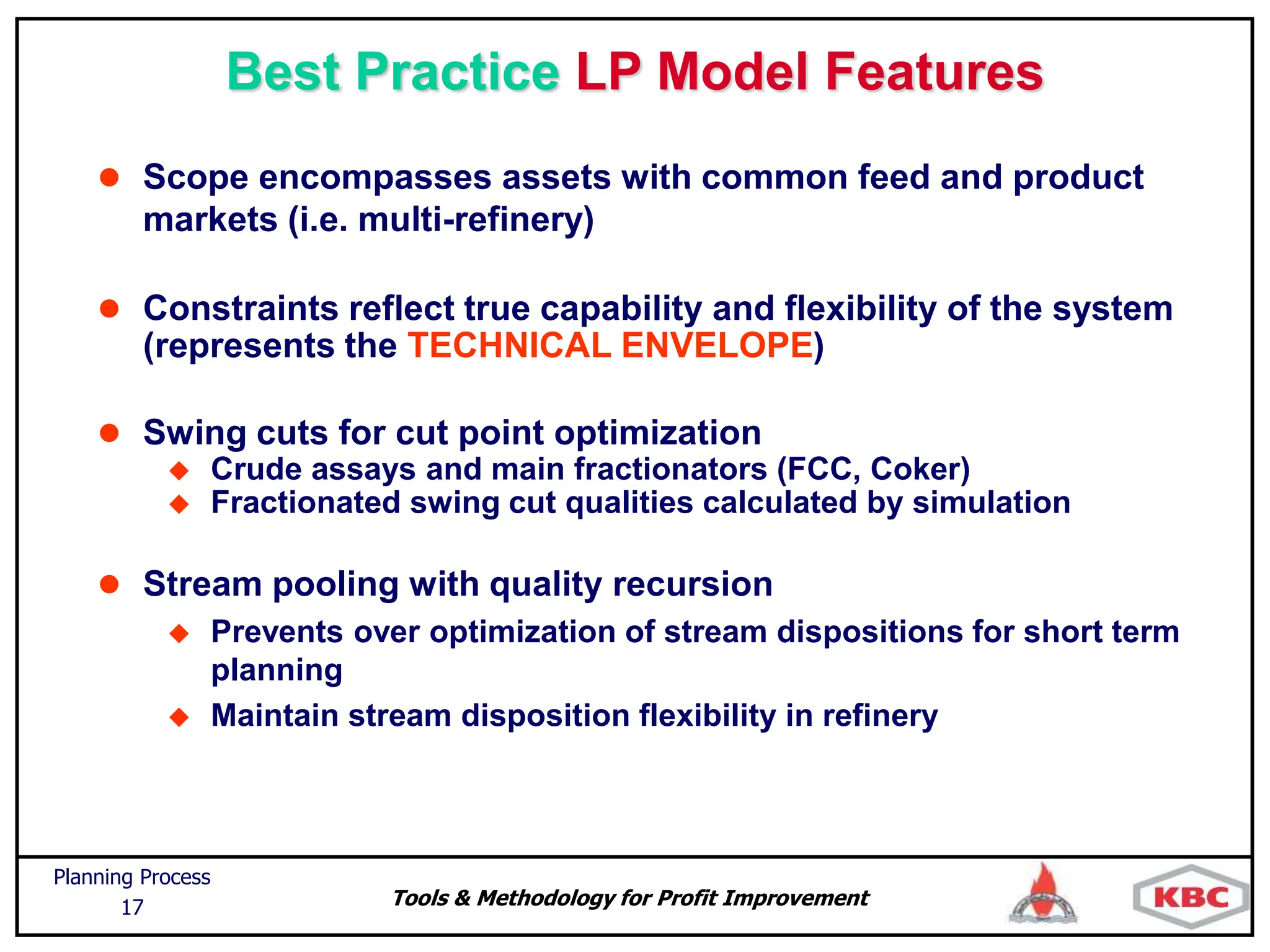
Best Practice LP Model Features
 Scope encompasses assets with common feed and product
markets (i.e. multi-refinery)
 Constraints reflect true capability and flexibility of the system
(represents the TECHNICAL ENVELOPE)
 Swing cuts for cut point optimization
 Crude assays and main fractionators (FCC, Coker)
 Fractionated swing cut qualities calculated by simulation
 Stream pooling with quality recursion
 Prevents over optimization of stream dispositions for short term
planning
 Maintain stream disposition flexibility in refinery
Tools & Methodology for Profit Improvement
Planning Process
18
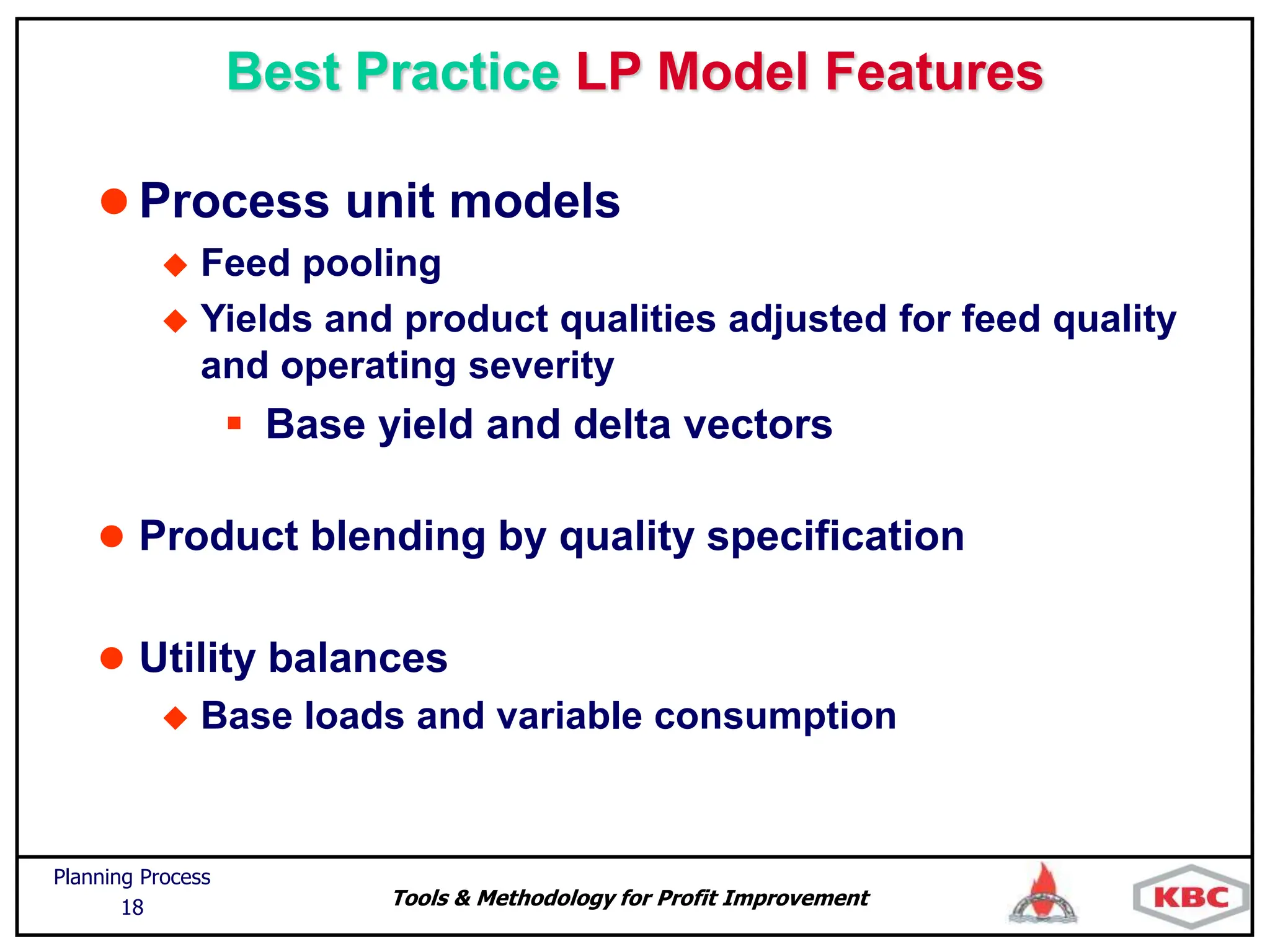
Best Practice LP Model Features
 Process unit models
 Feed pooling
 Yields and product qualities adjusted for feed quality
and operating severity
 Base yield and delta vectors
 Product blending by quality specification
 Utility balances
 Base loads and variable consumption
Tools & Methodology for Profit Improvement
Planning Process
19
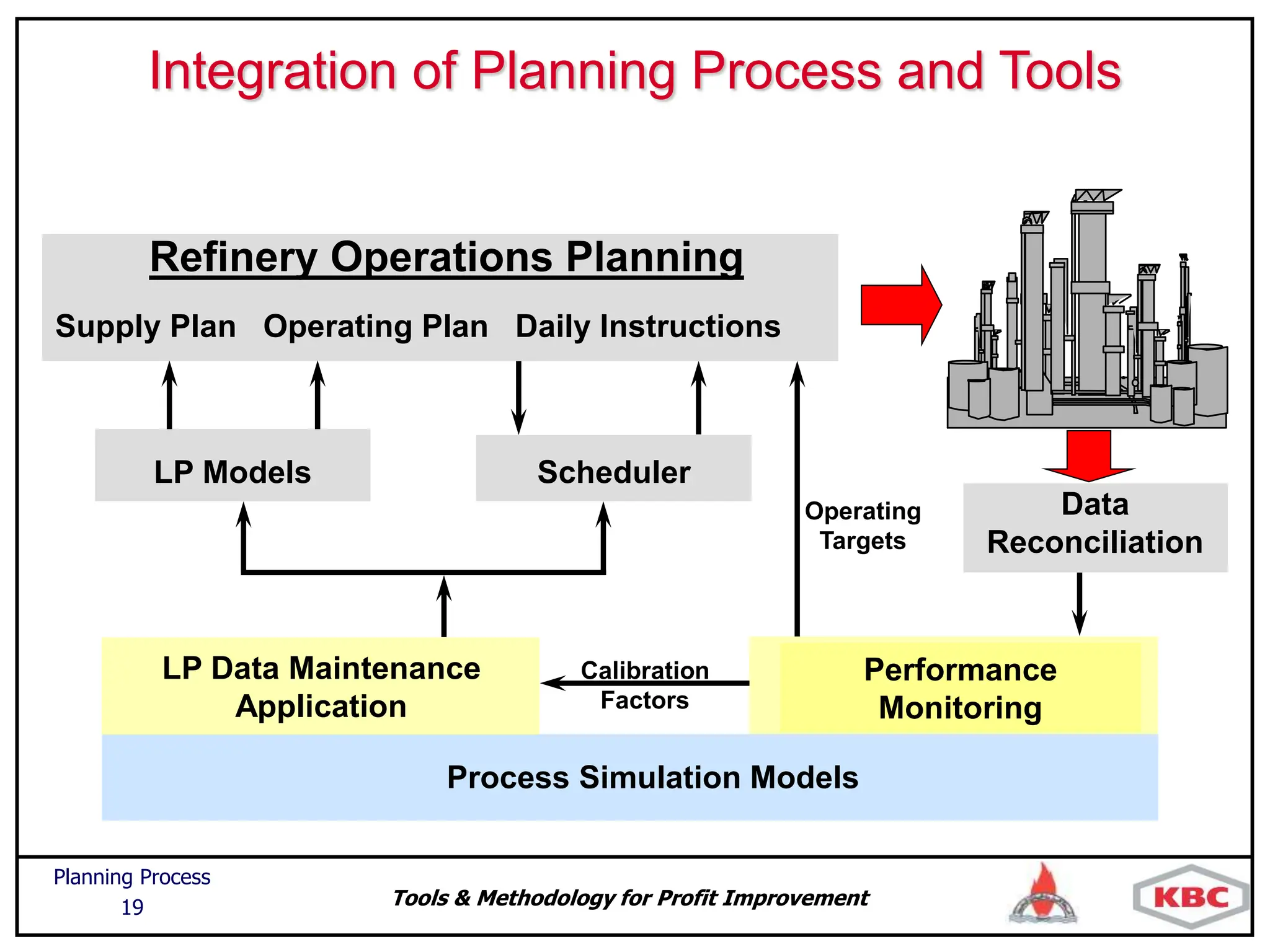
LP Models Scheduler
Refinery Operations Planning
Supply Plan Operating Plan Daily Instructions
Process Simulation Models
LP Data Maintenance
Application
Calibration
Factors
Performance
Monitoring
Data
Reconciliation
Operating
Targets
Integration of Planning Process and Tools
Tools & Methodology for Profit Improvement
Planning Process
20
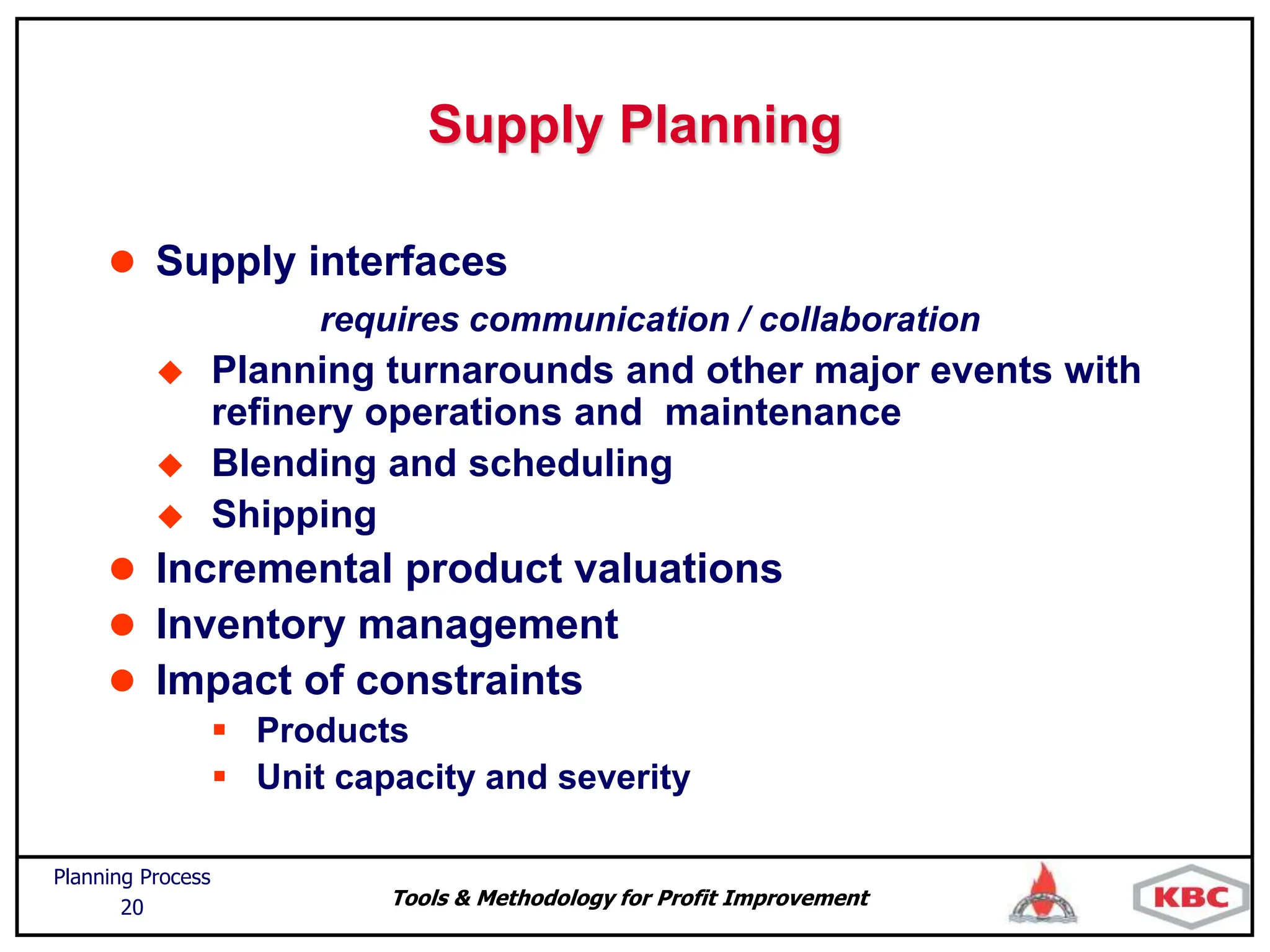
Supply Planning
 Supply interfaces
requires communication / collaboration
 Planning turnarounds and other major events with
refinery operations and maintenance
 Blending and scheduling
 Shipping
 Incremental product valuations
 Inventory management
 Impact of constraints
 Products
 Unit capacity and severity
Tools & Methodology for Profit Improvement
Planning Process
21
Product Blending
 Inventory management
 Blendstock and finished product
 Shipment schedule coordination
 Product quality giveaway
 Tracking and reporting
 Economic and operational impacts
Tools & Methodology for Profit Improvement
Planning Process
22
Operations Planning
 Typically 1 month time horizon.
 Monthly operating plan.
 Optimum asset utilization, and product production.
 Spot sales opportunities for products, intermediates and
blend components.
 Valuations and impact on plan.
 Unit shutdown planning.
 Planned and unplanned maintenance and Turnarounds.
 Inventory management.
 Outages, overfills.
 Interface with scheduling, operations, maintenance.
Tools & Methodology for Profit Improvement
Planning Process
23
Refinery Scheduling
 Scheduling does not optimise, but sequences
operations
 Methodology for translating plan into operating
orders
 Interfaces with planning / operations / process engineers /
maintenance
 Updating operating instructions
 Frequency
 Methodology / techniques
 Communication techniques
 Written / electronic
 Daily meetings
Tools & Methodology for Profit Improvement
Planning Process
24
Performance Measurement
 What was the actual operation?
 Record flows in volume, convert to weight.
 Record lab tests for critical qualities.
 Cumulative Month to date Mass Balances on
critical process using sensible method for
accounting for missing data.
 Volume and weight average of product
dispatched * critical quality giveaway.
ANYTHING UNMEASURED CANNOT BE
CONTROLLED
Tools & Methodology for Profit Improvement
Planning Process
25
Performance Review Aims
 Ensure that refinery always operates at
optimum as defined by LP model plan.
 NOT to allocate BLAME.
 Constructive, NOT Destructive, criticism.
 NOT to figure out how much profit was lost
because no human can forecast future.
 Update plan with better data, more realistic
constraints, technical envelope.
 Ensure operations are always at current
optimum.
Tools & Methodology for Profit Improvement
Planning Process
26
Back-casting
 A method of measuring the planned vs. actual
profit deviation, and identifying the causes.
 Profit deviation need not be a loss. Can be extra
profit because plan was too pessimistic.
 Backcasting uses the LP model (using cases) to
calculate profit.
 Compare Backcast solutions to help understand
the cause of profit differences.
Tools & Methodology for Profit Improvement
Planning Process
27
Using Back-casting Cases in
Performance Review
 Are deviations “one-off” or part of a trend?
 Are measurements of actual performance
believable and accurate?
 Decide what actions required to avoid negative
(or positive) deviations in future.
Tools & Methodology for Profit Improvement
Planning Process
28
Actions From Performance Review
 Do more research into cause by process engineers,
including simulation model runs, plant test runs, lab
testing.
 Change the LP model data.
 Add, tighten, or free up, constraints in the LP model.
 Change Process operations and product blending to make
more profit at no cost.
 Persuade management to accept costs for items like extra
demurrage and maintenance using Backcasting results.
 Make case to Corporate Planning for extra investments
using Backcasting results.
Tools & Methodology for Profit Improvement
Planning Process
29
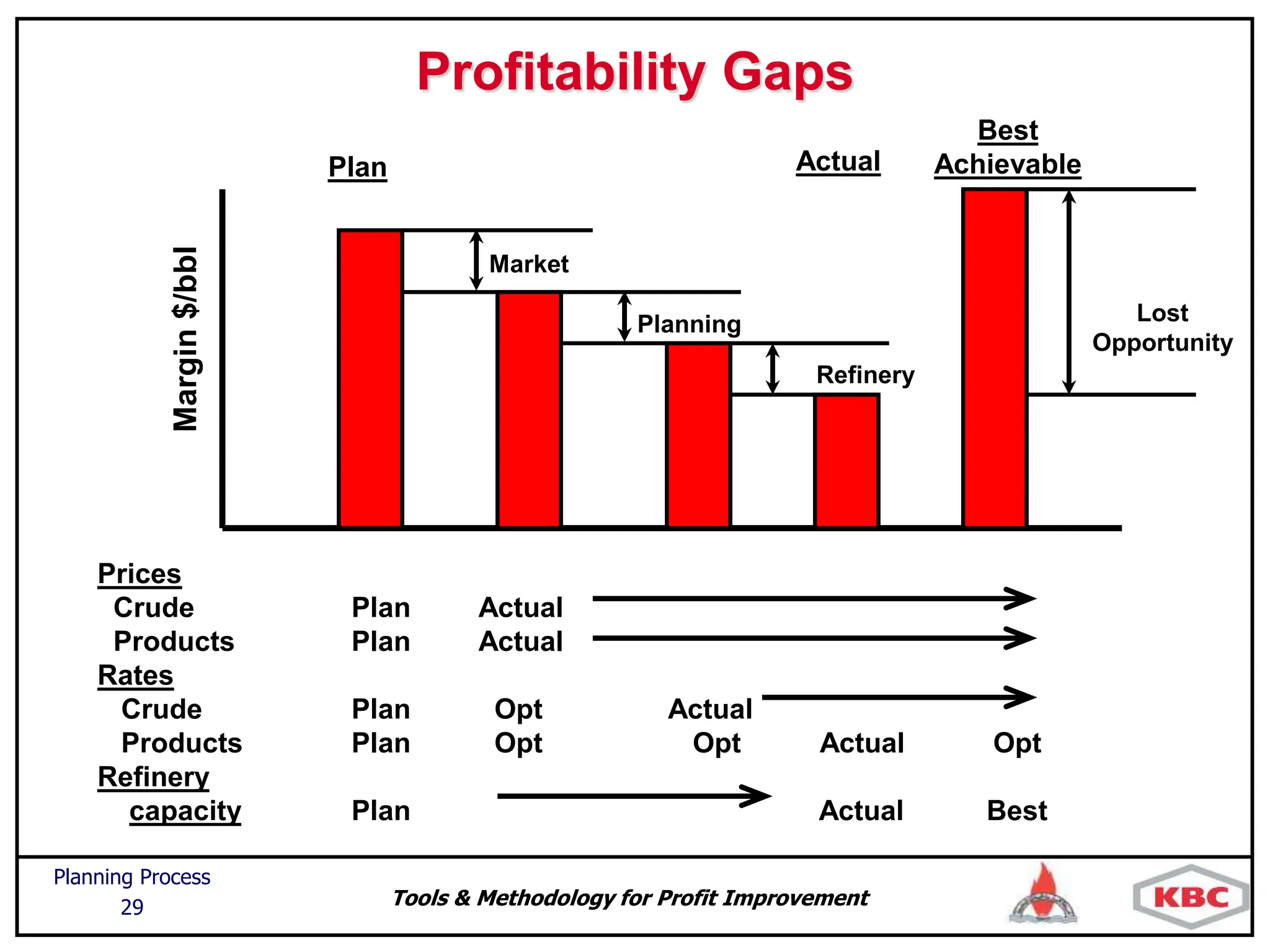
Profitability Gaps
Prices
Crude Plan Actual
Products Plan Actual
Rates
Crude Plan Opt Actual
Products Plan Opt Opt Actual Opt
Refinery
capacity Plan Actual Best
Lost
Opportunity
Margin
$/bbl
Plan Actual
Best
Achievable
Market
Planning
Refinery

22 The Planning Process.ppt

  • 1.
    Tools & Methodology forProfit Improvement Session 2:2 The Planning Process
  • 2.
    Tools & Methodologyfor Profit Improvement Planning Process 2 Petroleum Supply Chain  Supply Chain Management  Focus:  Demand forecasting  Shipment scheduling  Terminal Inventory  Benefits:  Lower Spot Freight costs from wider loading window, more choice ~$1/ton.  Higher Spot sales prices from better forecasting ~$1/ton  Refinery Planning  Focus:  Asset utilization  Product mix  Inventory scheduling  Benefits:  Profit Improvement of 10-20 c/bbl Critical Link
  • 3.
    Tools & Methodologyfor Profit Improvement Planning Process 3 Petroleum Supply Chain  Supply Chain Management within refinery  Trade-offs between inventory (working capital) and supply chain costs  Blendstock inventory vs. optimum product blending  Product inventory vs. economies of shipment size  Product inventory vs. customer demands  Intermediate feedstock inventory vs. plant reliability  Accurate refinery planning essential to evaluate supply chain costs
  • 4.
    Tools & Methodologyfor Profit Improvement Planning Process 4 Planning Process  Methods & Procedures  Communications  Performance Metrics  Feedback  Continuous Improvements Model Maintenance Planning Tools • Refinery LP Models • Structure • Yield/Quality Data • Constraints • Operations scheduling • Blend Scheduling Plans & Decisions Accurate Tools Best Process Better Plans Better Decisions More Profit Planning System Elements
  • 5.
    Tools & Methodologyfor Profit Improvement Planning Process 5 Planning and Scheduling Horizons Horizon Time Span Purpose Long Range 2-5+ years Capital Strategy Term Supply Contracts Annual 12 months Budgets Monthly 2-3+ months Monthly feed purchases Product sales outlook Operating strategies Inventory strategy Weekly/Biweekly 4-6 weeks Unit strategies Production volumes Daily 10-14 days Operating instructions Stream and inventory management Unit targets Product Blends Immediate Optimize unit operations LP Scheduler APC/Simulation
  • 6.
    Tools & Methodologyfor Profit Improvement Planning Process 6 Obstacles to Good Planning  Limitations  Resources and manpower  Knowledge and experience  View limited to KNPC only  Lack of simulation models for accurate yield predictions  Result  Out-of-date planning models Inaccurate predictions of product production  Operations ignore planning directions/strategies  Experience factors and spreadsheets used for local strategies and optimization  Planning operates in “glorious isolation”
  • 7.
    Tools & Methodologyfor Profit Improvement Planning Process 7 Common Planning Problems  Crude quality impact not adequately modeled  Limited cut point optimization  Perfect fractionation  Limited process unit yields representation  Limited feed quality and severity adjustments  Models over-constrained; Constraints not challenged  Inconsistencies between integrated and local LP models  Ineffective analysis of Actual vs. Plan  Ineffective LP model maintenance
  • 8.
    Tools & Methodologyfor Profit Improvement Planning Process 8 Typical 10-15c/bbl benefit Or $30 million/year for KNPC Benefits of Improved Planning  Increased value of products produced  Improved utilization of facilities  Optimized operating instructions to process units and to blending  Better timing of product liftings  Plan closer to optimum; Feasible schedules closer to the plan  Better response to market opportunities and changes in liftings  Better tactics to deal with planned plant shutdowns  Reduced inventories and internal oil movements
  • 9.
    Tools & Methodologyfor Profit Improvement Planning Process 9 Best Practices Planning Processes And Planning Tools
  • 10.
    Tools & Methodologyfor Profit Improvement Planning Process 10 Best Practice Planning Process Features Supply Plans for Asset Optimization.  Multi-refinery LP (M-PIMS) model of refineries with common crude supply and product markets.  Optimum allocation of products to refineries based on refinery capabilities.  Optimize use of intermediates and blend components between refineries.  Long-term crude supply forecast.
  • 11.
    Tools & Methodologyfor Profit Improvement Planning Process 11 Best Practice Planning Process Features Operating Plans by Individual Refinery  Overall feed supply & product demands from supply plan.  Fine-tune product slate by refinery.  Optimize operations with current operating constraints.  Interim plan updates.
  • 12.
    Tools & Methodologyfor Profit Improvement Planning Process 12 Best Practice Planning Process Features Accurate LP Models.  Multi-refinery model = combined individual refinery models with intermediate stock transfers.  Individual Refinery responsible for configuration, data, and constraints.
  • 13.
    Tools & Methodologyfor Profit Improvement Planning Process 13 Best Practice Planning Process Features  Clear, frequent communications between all groups involved  Agreement (“buy-in”) by all groups essential  Profit performance monitoring  Monitor and analyze deviations to plan, and to “Best Achievable”  Quantify profit impact  Feedback systems and continuous improvement  LP model updates  Price/demand forecasting
  • 14.
    Tools & Methodologyfor Profit Improvement Planning Process 14 Best Practice Planning Process Features VIRTUOUS CIRCLE EXECUTE PLAN MEASURE PERFORMANCE REVIEW
  • 15.
    Tools & Methodologyfor Profit Improvement Planning Process 15 Operations Planning Cycles PLAN SCHEDULE OPERATE Variance Analysis Model Update Feedback & Adjustment
  • 16.
    Tools & Methodologyfor Profit Improvement Planning Process 16 Complexity Detail Accuracy Ease of Use Input Data Management Interpretation of results Solution speed Maintenance Linear models of non-linear refinery operations Key: Accurately capture major economic drivers Planning Tools
  • 17.
    Tools & Methodologyfor Profit Improvement Planning Process 17 Best Practice LP Model Features  Scope encompasses assets with common feed and product markets (i.e. multi-refinery)  Constraints reflect true capability and flexibility of the system (represents the TECHNICAL ENVELOPE)  Swing cuts for cut point optimization  Crude assays and main fractionators (FCC, Coker)  Fractionated swing cut qualities calculated by simulation  Stream pooling with quality recursion  Prevents over optimization of stream dispositions for short term planning  Maintain stream disposition flexibility in refinery
  • 18.
    Tools & Methodologyfor Profit Improvement Planning Process 18 Best Practice LP Model Features  Process unit models  Feed pooling  Yields and product qualities adjusted for feed quality and operating severity  Base yield and delta vectors  Product blending by quality specification  Utility balances  Base loads and variable consumption
  • 19.
    Tools & Methodologyfor Profit Improvement Planning Process 19 LP Models Scheduler Refinery Operations Planning Supply Plan Operating Plan Daily Instructions Process Simulation Models LP Data Maintenance Application Calibration Factors Performance Monitoring Data Reconciliation Operating Targets Integration of Planning Process and Tools
  • 20.
    Tools & Methodologyfor Profit Improvement Planning Process 20 Supply Planning  Supply interfaces requires communication / collaboration  Planning turnarounds and other major events with refinery operations and maintenance  Blending and scheduling  Shipping  Incremental product valuations  Inventory management  Impact of constraints  Products  Unit capacity and severity
  • 21.
    Tools & Methodologyfor Profit Improvement Planning Process 21 Product Blending  Inventory management  Blendstock and finished product  Shipment schedule coordination  Product quality giveaway  Tracking and reporting  Economic and operational impacts
  • 22.
    Tools & Methodologyfor Profit Improvement Planning Process 22 Operations Planning  Typically 1 month time horizon.  Monthly operating plan.  Optimum asset utilization, and product production.  Spot sales opportunities for products, intermediates and blend components.  Valuations and impact on plan.  Unit shutdown planning.  Planned and unplanned maintenance and Turnarounds.  Inventory management.  Outages, overfills.  Interface with scheduling, operations, maintenance.
  • 23.
    Tools & Methodologyfor Profit Improvement Planning Process 23 Refinery Scheduling  Scheduling does not optimise, but sequences operations  Methodology for translating plan into operating orders  Interfaces with planning / operations / process engineers / maintenance  Updating operating instructions  Frequency  Methodology / techniques  Communication techniques  Written / electronic  Daily meetings
  • 24.
    Tools & Methodologyfor Profit Improvement Planning Process 24 Performance Measurement  What was the actual operation?  Record flows in volume, convert to weight.  Record lab tests for critical qualities.  Cumulative Month to date Mass Balances on critical process using sensible method for accounting for missing data.  Volume and weight average of product dispatched * critical quality giveaway. ANYTHING UNMEASURED CANNOT BE CONTROLLED
  • 25.
    Tools & Methodologyfor Profit Improvement Planning Process 25 Performance Review Aims  Ensure that refinery always operates at optimum as defined by LP model plan.  NOT to allocate BLAME.  Constructive, NOT Destructive, criticism.  NOT to figure out how much profit was lost because no human can forecast future.  Update plan with better data, more realistic constraints, technical envelope.  Ensure operations are always at current optimum.
  • 26.
    Tools & Methodologyfor Profit Improvement Planning Process 26 Back-casting  A method of measuring the planned vs. actual profit deviation, and identifying the causes.  Profit deviation need not be a loss. Can be extra profit because plan was too pessimistic.  Backcasting uses the LP model (using cases) to calculate profit.  Compare Backcast solutions to help understand the cause of profit differences.
  • 27.
    Tools & Methodologyfor Profit Improvement Planning Process 27 Using Back-casting Cases in Performance Review  Are deviations “one-off” or part of a trend?  Are measurements of actual performance believable and accurate?  Decide what actions required to avoid negative (or positive) deviations in future.
  • 28.
    Tools & Methodologyfor Profit Improvement Planning Process 28 Actions From Performance Review  Do more research into cause by process engineers, including simulation model runs, plant test runs, lab testing.  Change the LP model data.  Add, tighten, or free up, constraints in the LP model.  Change Process operations and product blending to make more profit at no cost.  Persuade management to accept costs for items like extra demurrage and maintenance using Backcasting results.  Make case to Corporate Planning for extra investments using Backcasting results.
  • 29.
    Tools & Methodologyfor Profit Improvement Planning Process 29 Profitability Gaps Prices Crude Plan Actual Products Plan Actual Rates Crude Plan Opt Actual Products Plan Opt Opt Actual Opt Refinery capacity Plan Actual Best Lost Opportunity Margin $/bbl Plan Actual Best Achievable Market Planning Refinery