PRODUCER RESPONSES TO
  CHANGING AGRI-ENVIRONMENTAL
  POLICIES

Dr. Karina Schoengold
Transatlantic Conference
October 17-18, 2011
Outline of Talk
   Producer decisions about input use and technology
    depend on:
       Prices
         Average price
         Price variability

   Decisions affected include:
       Water
         Total water use
         Precision irrigation technology
       Land use
           Irrigated land
Policy changes and water use
   Greater use of water trading
   Limited water allocations
   Government land purchases for water rights (e.g.,
    New Mexico, Oregon, Kansas)
   Groundwater/surface water connection recognized
    in policy decisions
   Subsidies for precision irrigation technology
     Need to consider recharge and consumptive use
      measures
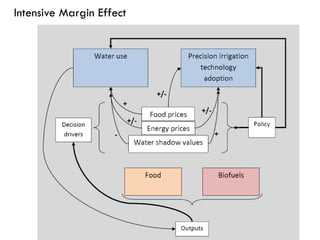
Intensive Margin Effect
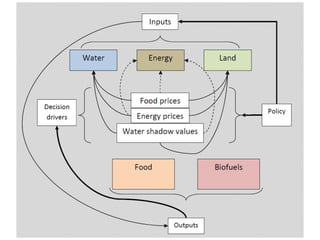
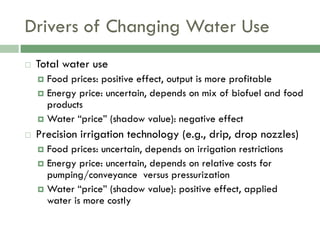
Drivers of Changing Water Use
   Total water use
     Food prices: positive effect, output is more profitable
     Energy price: uncertain, depends on mix of biofuel and food
      products
     Water “price” (shadow value): negative effect

   Precision irrigation technology (e.g., drip, drop nozzles)
     Food prices: uncertain, depends on irrigation restrictions
     Energy price: uncertain, depends on relative costs for
      pumping/conveyance versus pressurization
     Water “price” (shadow value): positive effect, applied
      water is more costly
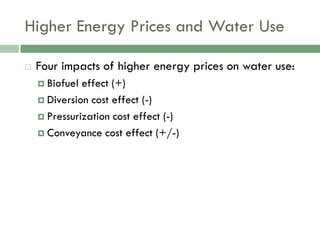
Higher Energy Prices and Water Use

   Four impacts of higher energy prices on water use:
     Biofuel effect (+)
     Diversion cost effect (-)

     Pressurization cost effect (-)

     Conveyance cost effect (+/-)
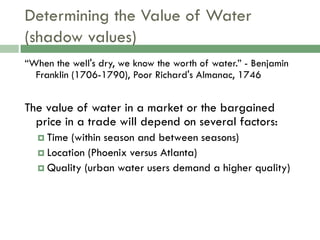
Determining the Value of Water
(shadow values)
“When the well's dry, we know the worth of water.” - Benjamin
  Franklin (1706-1790), Poor Richard's Almanac, 1746


The value of water in a market or the bargained
  price in a trade will depend on several factors:
   Time (within season and between seasons)
   Location (Phoenix versus Atlanta)
   Quality (urban water users demand a higher quality)
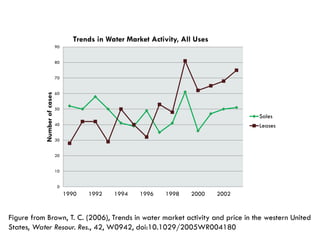
Trends in Water Market Activity, All Uses
                             90


                             80


                             70


                             60
           Number of cases


                             50
                                                                                       Sales
                             40                                                        Leases

                             30


                             20


                             10


                              0
                                  1990   1992   1994    1996    1998   2000     2002


Figure from Brown, T. C. (2006), Trends in water market activity and price in the western United
States, Water Resour. Res., 42, W0942, doi:10.1029/2005WR004180
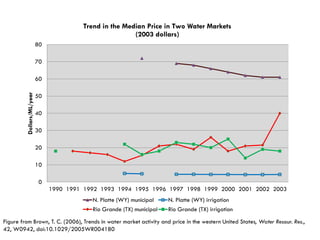
Trend in the Median Price in Two Water Markets
                                                         (2003 dollars)
                           80

                           70

                           60
         Dollars/ML/year


                           50

                           40

                           30

                           20

                           10

                            0
                                1990 1991 1992 1993 1994 1995 1996 1997 1998 1999 2000 2001 2002 2003
                                            N. Platte (WY) municipal    N. Platte (WY) irrigation
                                            Rio Grande (TX) municipal   Rio Grande (TX) irrigation
Figure from Brown, T. C. (2006), Trends in water market activity and price in the western United States, Water Resour. Res.,
42, W0942, doi:10.1029/2005WR004180
Implications of Water Trading for Irrigation Water Usage

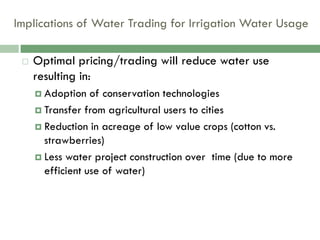
    Optimal pricing/trading will reduce water use
     resulting in:
      Adoption   of conservation technologies
      Transfer from agricultural users to cities

      Reduction in acreage of low value crops (cotton vs.
       strawberries)
      Less water project construction over time (due to more
       efficient use of water)
Trading and the Adoption of Water-Conserving
Technologies

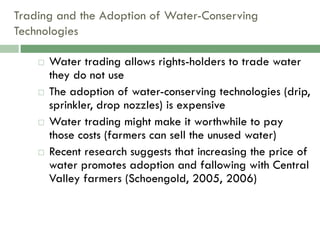
       Water trading allows rights-holders to trade water
        they do not use
       The adoption of water-conserving technologies (drip,
        sprinkler, drop nozzles) is expensive
       Water trading might make it worthwhile to pay
        those costs (farmers can sell the unused water)
       Recent research suggests that increasing the price of
        water promotes adoption and fallowing with Central
        Valley farmers (Schoengold, 2005, 2006)
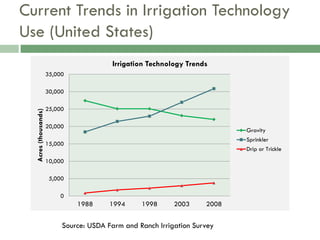
Current Trends in Irrigation Technology
Use (United States)
                                         Irrigation Technology Trends
                      35,000

                      30,000

                      25,000
  Acres (thousands)


                      20,000
                                                                            Gravity
                                                                            Sprinkler
                      15,000
                                                                            Drip or Trickle
                      10,000

                       5,000

                          0
                               1988      1994     1998      2003     2008


                           Source: USDA Farm and Ranch Irrigation Survey
Estimates of Water Price Impacts (Central
Valley, California)
    Previous research (Schoengold, 2006) shows:
      Direct response = 0.38 (reducing applied water while
       keeping the same crop)
      Indirect response = 0.54 (changes in crop choice and/or
       irrigation technology)
    Translation:
        An price increase of 100% for irrigation water:
          Reduces applied water on existing crops by 38%
          Reduces applied water due to shifts in crop/irrigation
           technology by 54%
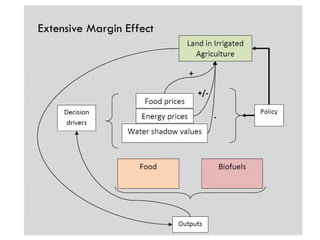
Extensive Margin Effect
Policy changes and land use
   Land in irrigated agriculture
     Food  prices: positive effect, production is more
      profitable
     Energy prices: uncertain effect, depends on mix of food
      and biofuel crops
     Water “prices” (shadow values): negative effect, shift to
      more land fallow or dryland farming
Current Research at UNL
   Risk and production decisions
     Water/irrigationtechnology
     Weather and climate risk - land use/tillage practices

   Design of groundwater trading programs
     Inter-   and intra-seasonal requirements
Questions?
Contact information:
Karina Schoengold
kschoengold2@unl.edu

22 karina schoengold

  • 1.
    PRODUCER RESPONSES TO CHANGING AGRI-ENVIRONMENTAL POLICIES Dr. Karina Schoengold Transatlantic Conference October 17-18, 2011
  • 3.
    Outline of Talk  Producer decisions about input use and technology depend on:  Prices  Average price  Price variability  Decisions affected include:  Water  Total water use  Precision irrigation technology  Land use  Irrigated land
  • 4.
    Policy changes andwater use  Greater use of water trading  Limited water allocations  Government land purchases for water rights (e.g., New Mexico, Oregon, Kansas)  Groundwater/surface water connection recognized in policy decisions  Subsidies for precision irrigation technology  Need to consider recharge and consumptive use measures
  • 5.
  • 6.
    Drivers of ChangingWater Use  Total water use  Food prices: positive effect, output is more profitable  Energy price: uncertain, depends on mix of biofuel and food products  Water “price” (shadow value): negative effect  Precision irrigation technology (e.g., drip, drop nozzles)  Food prices: uncertain, depends on irrigation restrictions  Energy price: uncertain, depends on relative costs for pumping/conveyance versus pressurization  Water “price” (shadow value): positive effect, applied water is more costly
  • 7.
    Higher Energy Pricesand Water Use  Four impacts of higher energy prices on water use:  Biofuel effect (+)  Diversion cost effect (-)  Pressurization cost effect (-)  Conveyance cost effect (+/-)
  • 8.
    Determining the Valueof Water (shadow values) “When the well's dry, we know the worth of water.” - Benjamin Franklin (1706-1790), Poor Richard's Almanac, 1746 The value of water in a market or the bargained price in a trade will depend on several factors:  Time (within season and between seasons)  Location (Phoenix versus Atlanta)  Quality (urban water users demand a higher quality)
  • 9.
    Trends in WaterMarket Activity, All Uses 90 80 70 60 Number of cases 50 Sales 40 Leases 30 20 10 0 1990 1992 1994 1996 1998 2000 2002 Figure from Brown, T. C. (2006), Trends in water market activity and price in the western United States, Water Resour. Res., 42, W0942, doi:10.1029/2005WR004180
  • 10.
    Trend in theMedian Price in Two Water Markets (2003 dollars) 80 70 60 Dollars/ML/year 50 40 30 20 10 0 1990 1991 1992 1993 1994 1995 1996 1997 1998 1999 2000 2001 2002 2003 N. Platte (WY) municipal N. Platte (WY) irrigation Rio Grande (TX) municipal Rio Grande (TX) irrigation Figure from Brown, T. C. (2006), Trends in water market activity and price in the western United States, Water Resour. Res., 42, W0942, doi:10.1029/2005WR004180
  • 11.
    Implications of WaterTrading for Irrigation Water Usage  Optimal pricing/trading will reduce water use resulting in:  Adoption of conservation technologies  Transfer from agricultural users to cities  Reduction in acreage of low value crops (cotton vs. strawberries)  Less water project construction over time (due to more efficient use of water)
  • 12.
    Trading and theAdoption of Water-Conserving Technologies  Water trading allows rights-holders to trade water they do not use  The adoption of water-conserving technologies (drip, sprinkler, drop nozzles) is expensive  Water trading might make it worthwhile to pay those costs (farmers can sell the unused water)  Recent research suggests that increasing the price of water promotes adoption and fallowing with Central Valley farmers (Schoengold, 2005, 2006)
  • 13.
    Current Trends inIrrigation Technology Use (United States) Irrigation Technology Trends 35,000 30,000 25,000 Acres (thousands) 20,000 Gravity Sprinkler 15,000 Drip or Trickle 10,000 5,000 0 1988 1994 1998 2003 2008 Source: USDA Farm and Ranch Irrigation Survey
  • 14.
    Estimates of WaterPrice Impacts (Central Valley, California)  Previous research (Schoengold, 2006) shows:  Direct response = 0.38 (reducing applied water while keeping the same crop)  Indirect response = 0.54 (changes in crop choice and/or irrigation technology)  Translation:  An price increase of 100% for irrigation water:  Reduces applied water on existing crops by 38%  Reduces applied water due to shifts in crop/irrigation technology by 54%
  • 15.
  • 16.
    Policy changes andland use  Land in irrigated agriculture  Food prices: positive effect, production is more profitable  Energy prices: uncertain effect, depends on mix of food and biofuel crops  Water “prices” (shadow values): negative effect, shift to more land fallow or dryland farming
  • 17.
    Current Research atUNL  Risk and production decisions  Water/irrigationtechnology  Weather and climate risk - land use/tillage practices  Design of groundwater trading programs  Inter- and intra-seasonal requirements
  • 18.