Marketing Trends June 7, 2007
Marketing “… identifying and meeting human and social needs.”  Philip Kotler
Marketing Myths The same marketing techniques work every time You need a multimillion budget to create a commercial Marketing is all about advertising Marketing is simply an operational expense A perfectly executed marketing plan will guarantee success Marketing’s goal is to increase sales Marketing starts when you’re ready to launch Marketing is a function. “Marketing owns it” Innovation comes from inside Never give the product / service away You must position and identify with an industry & competition Target the broadest customer segment
Crisis In Mass Marketing 18%: Proportion of TV advertising campaigns generating positive ROI 54 cents: Average return in sales for every $1 spent on advertising 256%: The increase in TV advertising costs (CPM) in the past decade 84%: Proportion of B2B marketing campaigns resulting in falling sales 100%: The increase needed in advertising spend to add 1-2% in sales 14%: Proportion of people who trust advertising information 90%: Proportion of people who can skip TV ads who do skip TV ads 80%: Market share of video recorders with ad skipping technology in 2008 95%: The failure rate for new product introductions 117: The number of prime time TV spots in 2002 needed to reach 80% of adult population – up from just 3 in 1965 3000: Number of advertising messages people are exposed to per day 56%: Proportion of people who avoid buying products from companies who they think advertise too much 65%: Proportion of people who believe that they are constantly bombarded with too much advertising 69%: Proportion of people interested in technology or devices that enable them to skip or block advertising Source: Justin Kirby & Paul Marsden (2006).  Connected marketing .  Oxford, UK:  Butterworth-Heinemann. xix
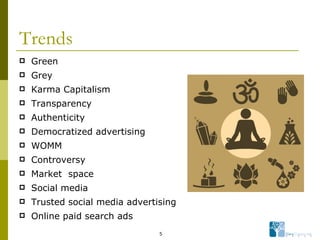
Green Grey Karma Capitalism Transparency Authenticity Democratized advertising WOMM Controversy Market  space Social media Trusted social media advertising Online paid search ads Trends
Out Traditional advertising Monologue Market place Classical 4Ps paradigm
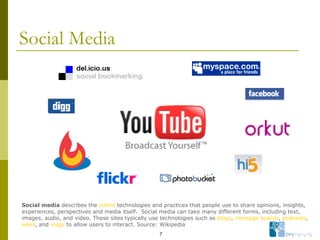
Social Media Social media  describes the  online  technologies and practices that people use to share opinions, insights, experiences, perspectives and media itself.  Social media can take many different forms, including text, images, audio, and video. These sites typically use technologies such as  blogs ,  message boards ,  podcasts ,  wikis , and  vlogs  to allow users to interact. Source: Wikipedia
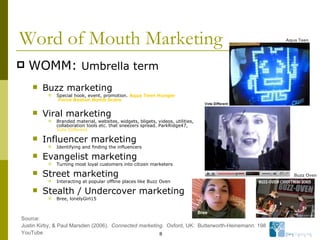
Word of Mouth Marketing WOMM:  Umbrella term Buzz marketing   Special hook, event, promotion.  Aqua   Teen   Hunger  Force Boston Bomb Scare Viral marketing Branded material, websites, widgets, bligets, videos, utilities, collaboration tools etc. that sneezers spread. ParkRidge47,  Vote Different   Influencer marketing Identifying and finding the influencers Evangelist marketing Turning most loyal customers into citizen marketers Street marketing Interacting at popular offline places like Buzz Oven Stealth / Undercover marketing Bree, lonelyGirl15 Source: Justin Kirby, & Paul Marsden (2006).  Connected marketing .  Oxford, UK:  Butterworth-Heinemann. 198 YouTube Aqua Teen Buzz Oven Bree
New Paradigm Sell your idea first Find your actors (audience) first Size does not matter -  PlentyOfFish Reduce risk by pushing control out Value creation increases at the edge Decentralize authority, process, and IP Transparency creates value Truth travels fast Price alone is not sustainable Reengineer your value chain Skip intermediaries wherever possible Reinvent your business models Change the status quo
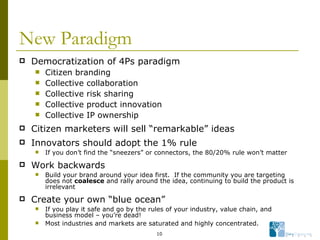
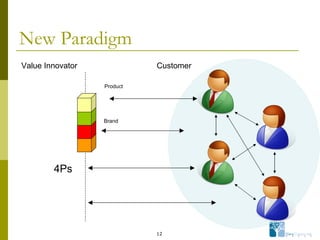
New Paradigm Democratization of 4Ps paradigm Citizen branding Collective collaboration Collective risk sharing Collective product innovation Collective IP ownership Citizen marketers will sell “remarkable” ideas  Innovators should adopt the 1% rule If you don’t find the “sneezers” or connectors, the 80/20% rule won’t matter Work backwards Build your brand around your idea first.  If the community you are targeting does not  coalesce  and rally around the idea, continuing to build the product is irrelevant Create your own “blue ocean” If you play it safe and go by the rules of your industry, value chain, and business model – you’re dead! Most industries and markets are saturated and highly concentrated.
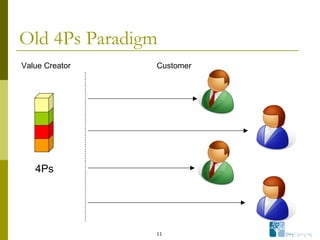
Old 4Ps Paradigm 4Ps Value Creator Customer
New Paradigm 4Ps Value Innovator Customer Product Brand
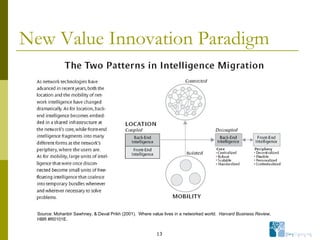
New Value Innovation Paradigm Source: Mohanbir Sawhney, & Deval Prikh (2001).  Where value lives in a networked world.  Harvard Business Review ,  HBR #R0101E.
It’s About Social Behavior It’s not about a cheaper product or your idea.  Try to change customer behavior. It’s not about better coffee – it’s about the place I am not looking for a ¼” drill bit – I need to make a hole  It’s not about the hog, it’s about a lifestyle It’s not about the sound – it’s about how it makes me feel It’s not about the sound – it’s about being hip It’s about my space It’s about my video It’s about my opinion It’s about the experience It’s about your choices, places, and time Examples Apple, Starbucks, JetBlue, MySpace, Harley-Davidson, Tivo, Stew Leonard’s, Threadless
Implications Reached the tipping point The static web maturing Monologue marketing out Live Web (a/k/a Blogosphere) is making information transparent Word travels fast People are more likely to act on a peer’s recommendation by factor X Marketing is a reflection of social paradigms The new social media and networks changing customer expectation and behavior

22

  • 1.
  • 2.
    Marketing “… identifyingand meeting human and social needs.” Philip Kotler
  • 3.
    Marketing Myths Thesame marketing techniques work every time You need a multimillion budget to create a commercial Marketing is all about advertising Marketing is simply an operational expense A perfectly executed marketing plan will guarantee success Marketing’s goal is to increase sales Marketing starts when you’re ready to launch Marketing is a function. “Marketing owns it” Innovation comes from inside Never give the product / service away You must position and identify with an industry & competition Target the broadest customer segment
  • 4.
    Crisis In MassMarketing 18%: Proportion of TV advertising campaigns generating positive ROI 54 cents: Average return in sales for every $1 spent on advertising 256%: The increase in TV advertising costs (CPM) in the past decade 84%: Proportion of B2B marketing campaigns resulting in falling sales 100%: The increase needed in advertising spend to add 1-2% in sales 14%: Proportion of people who trust advertising information 90%: Proportion of people who can skip TV ads who do skip TV ads 80%: Market share of video recorders with ad skipping technology in 2008 95%: The failure rate for new product introductions 117: The number of prime time TV spots in 2002 needed to reach 80% of adult population – up from just 3 in 1965 3000: Number of advertising messages people are exposed to per day 56%: Proportion of people who avoid buying products from companies who they think advertise too much 65%: Proportion of people who believe that they are constantly bombarded with too much advertising 69%: Proportion of people interested in technology or devices that enable them to skip or block advertising Source: Justin Kirby & Paul Marsden (2006). Connected marketing . Oxford, UK: Butterworth-Heinemann. xix
  • 5.
    Green Grey KarmaCapitalism Transparency Authenticity Democratized advertising WOMM Controversy Market space Social media Trusted social media advertising Online paid search ads Trends
  • 6.
    Out Traditional advertisingMonologue Market place Classical 4Ps paradigm
  • 7.
    Social Media Socialmedia describes the online technologies and practices that people use to share opinions, insights, experiences, perspectives and media itself. Social media can take many different forms, including text, images, audio, and video. These sites typically use technologies such as blogs , message boards , podcasts , wikis , and vlogs to allow users to interact. Source: Wikipedia
  • 8.
    Word of MouthMarketing WOMM: Umbrella term Buzz marketing Special hook, event, promotion. Aqua Teen Hunger Force Boston Bomb Scare Viral marketing Branded material, websites, widgets, bligets, videos, utilities, collaboration tools etc. that sneezers spread. ParkRidge47, Vote Different Influencer marketing Identifying and finding the influencers Evangelist marketing Turning most loyal customers into citizen marketers Street marketing Interacting at popular offline places like Buzz Oven Stealth / Undercover marketing Bree, lonelyGirl15 Source: Justin Kirby, & Paul Marsden (2006). Connected marketing . Oxford, UK: Butterworth-Heinemann. 198 YouTube Aqua Teen Buzz Oven Bree
  • 9.
    New Paradigm Sellyour idea first Find your actors (audience) first Size does not matter - PlentyOfFish Reduce risk by pushing control out Value creation increases at the edge Decentralize authority, process, and IP Transparency creates value Truth travels fast Price alone is not sustainable Reengineer your value chain Skip intermediaries wherever possible Reinvent your business models Change the status quo
  • 10.
    New Paradigm Democratizationof 4Ps paradigm Citizen branding Collective collaboration Collective risk sharing Collective product innovation Collective IP ownership Citizen marketers will sell “remarkable” ideas Innovators should adopt the 1% rule If you don’t find the “sneezers” or connectors, the 80/20% rule won’t matter Work backwards Build your brand around your idea first. If the community you are targeting does not coalesce and rally around the idea, continuing to build the product is irrelevant Create your own “blue ocean” If you play it safe and go by the rules of your industry, value chain, and business model – you’re dead! Most industries and markets are saturated and highly concentrated.
  • 11.
    Old 4Ps Paradigm4Ps Value Creator Customer
  • 12.
    New Paradigm 4PsValue Innovator Customer Product Brand
  • 13.
    New Value InnovationParadigm Source: Mohanbir Sawhney, & Deval Prikh (2001). Where value lives in a networked world. Harvard Business Review , HBR #R0101E.
  • 14.
    It’s About SocialBehavior It’s not about a cheaper product or your idea. Try to change customer behavior. It’s not about better coffee – it’s about the place I am not looking for a ¼” drill bit – I need to make a hole It’s not about the hog, it’s about a lifestyle It’s not about the sound – it’s about how it makes me feel It’s not about the sound – it’s about being hip It’s about my space It’s about my video It’s about my opinion It’s about the experience It’s about your choices, places, and time Examples Apple, Starbucks, JetBlue, MySpace, Harley-Davidson, Tivo, Stew Leonard’s, Threadless
  • 15.
    Implications Reached thetipping point The static web maturing Monologue marketing out Live Web (a/k/a Blogosphere) is making information transparent Word travels fast People are more likely to act on a peer’s recommendation by factor X Marketing is a reflection of social paradigms The new social media and networks changing customer expectation and behavior