~~ Real Lives ~~
Human Aspirations
Common to All Americans
Massachusetts Families Organizing for Change
Implementing a 21st Century Disability Policy
The mission of the
Massachusetts Alliance for 21st Century Disability Policy (MA21)
is to advance full community participation
for individuals with disabilities.
MA21 Partnership
Massachusetts Families Organizing for Change (MFOFC)
The Arc of Massachusetts (Arcmass)
Massachusetts Advocates Standing Strong (M.A.S.S.)
 Massachusetts Developmental Disabilities Council (MDDC)
Advocates for Autism of Massachusetts (AFAM)
Massachusetts Down Syndrome Congress (MDSC)
Disability Law Center (DLC)
Massachusetts Sibling Support Network
Federation for Children with Special Needs (FCSN)
More partners joining every day…
MASSACHUSETTS HISTORY
OF ACCOMPLISHMENTS
IN THE FIELD OF DISABILITIES
• THE 50’S: The Dawn of Hope
• The 60’s: Parents find their Voice through the Arc
• The 70’s: Humanity Prevails
• The 80’s: Great Strides Forward
• The 90’s: Family to Family
• The 2000’s: Family Support
MA21 Policy is intended for:
• Individuals
• Families
• Elected officials
• Other policy makers
Intent is to create a consensus on a unified
framework to view and improve public policy for
individuals with disabilities and their families
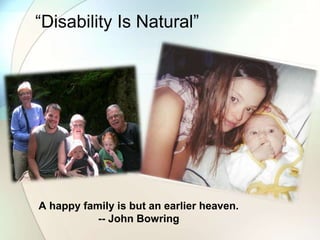
“Disability Is Natural”
A happy family is but an earlier heaven.
-- John Bowring
“Disability is Natural”
• More than a saying
• Guide to how people with disabilities and their families
would like to interact with the world
• How we would like the world to interact with us
• Same opportunities as anyone else
o Access to education
o Medical care
o Social activities
o Employment opportunities
o Transportation options
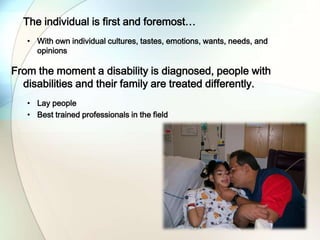
The individual is first and foremost…
• With own individual cultures, tastes, emotions, wants, needs, and
opinions
From the moment a disability is diagnosed, people with
disabilities and their family are treated differently.
• Lay people
• Best trained professionals in the field
Disability ….
is Natural
We have no doubt society will one day
appreciate this, but we intend to make
it happen sooner rather than later.
Guiding Principles
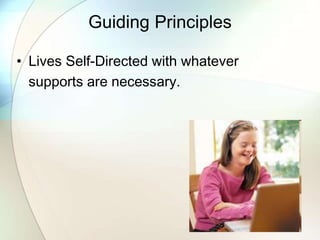
• Lives Self-Directed with whatever
supports are necessary.
Guiding Principles
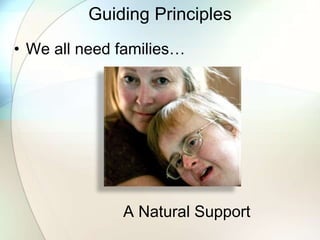
• We all need families…
A Natural Support
Guiding Principles
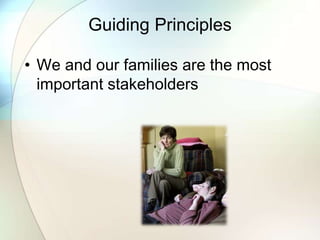
• We and our families are the most
important stakeholders
Guiding Principles
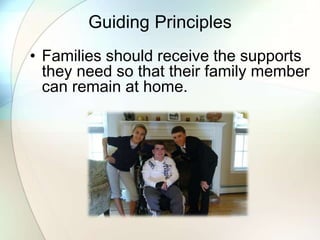
• Families should receive the supports
they need so that their family member
can remain at home.
Guiding Principles
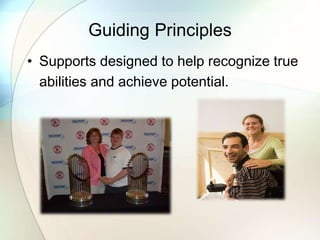
• Supports designed to help recognize true
abilities and achieve potential.
Guiding Principles
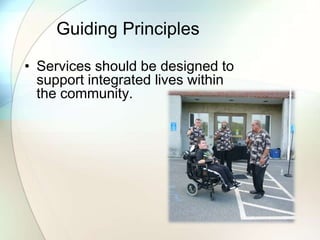
• Services should be designed to
support integrated lives within
the community.
System Barriers
• Investment
• Bureaucracy
• “They-ism”
• “Us-ism”
System Barriers
• Investment
• Essential services require significant
investment.
• Payoff outweighs the financial cost.
• Bureaucracy
• Transparent
• Flexible
• Supportive
• Innovative
• Straight-forward
• Collaborative
System Barriers
“Us vs. Them”
• ‘Us-ism’
• Must learn not to be ashamed of who we are
and of our appearance, communication, or
behaviors.
• ‘They-ism’
• Through public education, society will recognize
the valued roles of people with disabilities and
realize there is much more that connects us
than separates us.
MA21 Policy Foundations
 Individuals and families must be involved in:
● Planning
● Development
● Implementation of supports
 Supports are:
● Flexible
● Individual/family friendly
● Easy to access
● Culturally sensitive
● Multilingual
Chapter 171 - Passed in July 2002
An Act providing support to individuals with disabilities and their families.
MA21 Policy Foundations
 System is transparent
• Access to amount allocated and actual cost
 Funding is personalized, not “cookie cutter”
• Ability to shop around for supports and/or
providers
Real Lives Bill
HB151 - An Act Relative to Real Lives
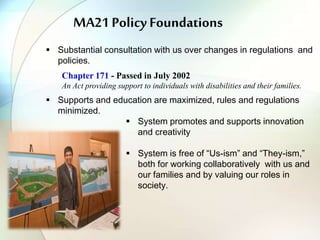
MA21 Policy Foundations
 Substantial consultation with us over changes in regulations and
policies.
Chapter 171 - Passed in July 2002
An Act providing support to individuals with disabilities and their families.
 Supports and education are maximized, rules and regulations
minimized.
 System promotes and supports innovation
and creativity
 System is free of “Us-ism” and “They-ism,”
both for working collaboratively with us and
our families and by valuing our roles in
society.
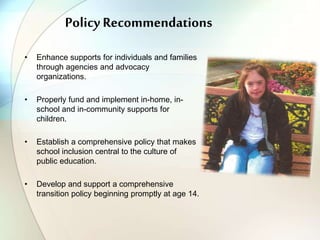
Policy Recommendations
• Enhance supports for individuals and families
through agencies and advocacy
organizations.
• Properly fund and implement in-home, in-
school and in-community supports for
children.
• Establish a comprehensive policy that makes
school inclusion central to the culture of
public education.
• Develop and support a comprehensive
transition policy beginning promptly at age 14.
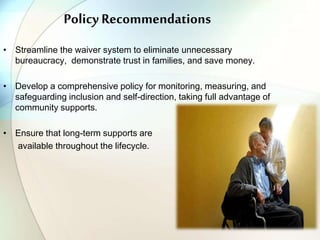
Policy Recommendations
• Streamline the waiver system to eliminate unnecessary
bureaucracy, demonstrate trust in families, and save money.
• Develop a comprehensive policy for monitoring, measuring, and
safeguarding inclusion and self-direction, taking full advantage of
community supports.
• Ensure that long-term supports are
available throughout the lifecycle.
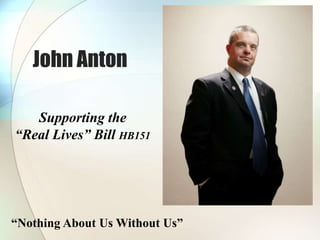
John Anton
Supporting the
“Real Lives” Bill HB151
“Nothing About Us Without Us”
“Real Lives”
• HB151: An Act Relative to Real Lives
 The Real Lives Bill is about options.
 The Real Lives Bill is cost effective.
 The Real Lives Bill empowers people to make
decisions to how they live their lives.
 The Real Lives Bill increases consumer
satisfaction and reduces unmet need.
 The Real Lives Bill is a “win-win” situation.
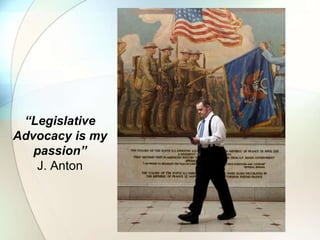
“Legislative
Advocacy is my
passion”
J. Anton
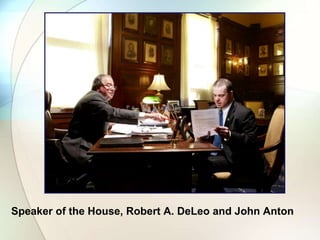
Speaker of the House, Robert A. DeLeo and John Anton
“A Place to Call
Home”
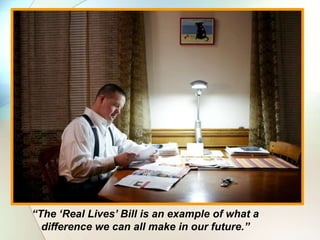
“The ‘Real Lives’ Bill is an example of what a
difference we can all make in our future.”
Strategies
1. Bring other groups into the fold to solicit
endorsement of this document and garner
participation to go forward.
● Disability-specific groups
● Disability providers
● Department of Developmental Services
● Other state agencies
Strategies
2. Build on existing outreach and educational programs with
successful records to train and develop leaders.
● MDDC/MASS Self-Advocacy Leadership Series
● MFOFC’s Family Leadership Series
● The Arc’s training series and educational conferences
● Continuing education
● Parent group programs
Strategies
3. Take full advantage of marketing/media
strategies
● Success stories
● Demonstrate needs
● Increase community supports and services
Strategies
4. Ensure that schools have necessary tools to fully and
effectively practice inclusion and transition planning
● Need for accountability and consistency
● Take full advantage of outside expertise and local family
organizing efforts
● Transition assessments
Strategies
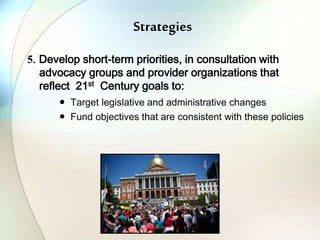
5. Develop short-term priorities, in consultation with
advocacy groups and provider organizations that
reflect 21st Century goals to:
● Target legislative and administrative changes
● Fund objectives that are consistent with these policies
IN APPRECIATION
• This project is funded by a grant from the
Massachusetts Developmental Disabilities
Council, U. S. Department of Health and Human
Services, Administration on Developmental
Disabilities. Federal Award No. 93.630
LET’S WORK TOGETHER TO
EFFECT CHANGE
IN ALL OF OUR LIVES

MA21 - Real Lives

  • 1.
    ~~ Real Lives~~ Human Aspirations Common to All Americans Massachusetts Families Organizing for Change
  • 2.
    Implementing a 21stCentury Disability Policy The mission of the Massachusetts Alliance for 21st Century Disability Policy (MA21) is to advance full community participation for individuals with disabilities.
  • 3.
    MA21 Partnership Massachusetts FamiliesOrganizing for Change (MFOFC) The Arc of Massachusetts (Arcmass) Massachusetts Advocates Standing Strong (M.A.S.S.)  Massachusetts Developmental Disabilities Council (MDDC) Advocates for Autism of Massachusetts (AFAM) Massachusetts Down Syndrome Congress (MDSC) Disability Law Center (DLC) Massachusetts Sibling Support Network Federation for Children with Special Needs (FCSN) More partners joining every day…
  • 4.
    MASSACHUSETTS HISTORY OF ACCOMPLISHMENTS INTHE FIELD OF DISABILITIES • THE 50’S: The Dawn of Hope • The 60’s: Parents find their Voice through the Arc • The 70’s: Humanity Prevails • The 80’s: Great Strides Forward • The 90’s: Family to Family • The 2000’s: Family Support
  • 5.
    MA21 Policy isintended for: • Individuals • Families • Elected officials • Other policy makers Intent is to create a consensus on a unified framework to view and improve public policy for individuals with disabilities and their families
  • 6.
    “Disability Is Natural” Ahappy family is but an earlier heaven. -- John Bowring
  • 7.
    “Disability is Natural” •More than a saying • Guide to how people with disabilities and their families would like to interact with the world • How we would like the world to interact with us • Same opportunities as anyone else o Access to education o Medical care o Social activities o Employment opportunities o Transportation options
  • 8.
    The individual isfirst and foremost… • With own individual cultures, tastes, emotions, wants, needs, and opinions From the moment a disability is diagnosed, people with disabilities and their family are treated differently. • Lay people • Best trained professionals in the field
  • 9.
    Disability …. is Natural Wehave no doubt society will one day appreciate this, but we intend to make it happen sooner rather than later.
  • 12.
    Guiding Principles • LivesSelf-Directed with whatever supports are necessary.
  • 13.
    Guiding Principles • Weall need families… A Natural Support
  • 14.
    Guiding Principles • Weand our families are the most important stakeholders
  • 15.
    Guiding Principles • Familiesshould receive the supports they need so that their family member can remain at home.
  • 16.
    Guiding Principles • Supportsdesigned to help recognize true abilities and achieve potential.
  • 17.
    Guiding Principles • Servicesshould be designed to support integrated lives within the community.
  • 18.
    System Barriers • Investment •Bureaucracy • “They-ism” • “Us-ism”
  • 19.
    System Barriers • Investment •Essential services require significant investment. • Payoff outweighs the financial cost. • Bureaucracy • Transparent • Flexible • Supportive • Innovative • Straight-forward • Collaborative
  • 20.
    System Barriers “Us vs.Them” • ‘Us-ism’ • Must learn not to be ashamed of who we are and of our appearance, communication, or behaviors. • ‘They-ism’ • Through public education, society will recognize the valued roles of people with disabilities and realize there is much more that connects us than separates us.
  • 21.
    MA21 Policy Foundations Individuals and families must be involved in: ● Planning ● Development ● Implementation of supports  Supports are: ● Flexible ● Individual/family friendly ● Easy to access ● Culturally sensitive ● Multilingual Chapter 171 - Passed in July 2002 An Act providing support to individuals with disabilities and their families.
  • 22.
    MA21 Policy Foundations System is transparent • Access to amount allocated and actual cost  Funding is personalized, not “cookie cutter” • Ability to shop around for supports and/or providers Real Lives Bill HB151 - An Act Relative to Real Lives
  • 23.
    MA21 Policy Foundations Substantial consultation with us over changes in regulations and policies. Chapter 171 - Passed in July 2002 An Act providing support to individuals with disabilities and their families.  Supports and education are maximized, rules and regulations minimized.  System promotes and supports innovation and creativity  System is free of “Us-ism” and “They-ism,” both for working collaboratively with us and our families and by valuing our roles in society.
  • 24.
    Policy Recommendations • Enhancesupports for individuals and families through agencies and advocacy organizations. • Properly fund and implement in-home, in- school and in-community supports for children. • Establish a comprehensive policy that makes school inclusion central to the culture of public education. • Develop and support a comprehensive transition policy beginning promptly at age 14.
  • 25.
    Policy Recommendations • Streamlinethe waiver system to eliminate unnecessary bureaucracy, demonstrate trust in families, and save money. • Develop a comprehensive policy for monitoring, measuring, and safeguarding inclusion and self-direction, taking full advantage of community supports. • Ensure that long-term supports are available throughout the lifecycle.
  • 26.
    John Anton Supporting the “RealLives” Bill HB151 “Nothing About Us Without Us”
  • 28.
    “Real Lives” • HB151:An Act Relative to Real Lives  The Real Lives Bill is about options.  The Real Lives Bill is cost effective.  The Real Lives Bill empowers people to make decisions to how they live their lives.  The Real Lives Bill increases consumer satisfaction and reduces unmet need.  The Real Lives Bill is a “win-win” situation.
  • 29.
  • 30.
    Speaker of theHouse, Robert A. DeLeo and John Anton
  • 31.
    “A Place toCall Home”
  • 32.
    “The ‘Real Lives’Bill is an example of what a difference we can all make in our future.”
  • 33.
    Strategies 1. Bring othergroups into the fold to solicit endorsement of this document and garner participation to go forward. ● Disability-specific groups ● Disability providers ● Department of Developmental Services ● Other state agencies
  • 34.
    Strategies 2. Build onexisting outreach and educational programs with successful records to train and develop leaders. ● MDDC/MASS Self-Advocacy Leadership Series ● MFOFC’s Family Leadership Series ● The Arc’s training series and educational conferences ● Continuing education ● Parent group programs
  • 35.
    Strategies 3. Take fulladvantage of marketing/media strategies ● Success stories ● Demonstrate needs ● Increase community supports and services
  • 36.
    Strategies 4. Ensure thatschools have necessary tools to fully and effectively practice inclusion and transition planning ● Need for accountability and consistency ● Take full advantage of outside expertise and local family organizing efforts ● Transition assessments
  • 37.
    Strategies 5. Develop short-termpriorities, in consultation with advocacy groups and provider organizations that reflect 21st Century goals to: ● Target legislative and administrative changes ● Fund objectives that are consistent with these policies
  • 38.
    IN APPRECIATION • Thisproject is funded by a grant from the Massachusetts Developmental Disabilities Council, U. S. Department of Health and Human Services, Administration on Developmental Disabilities. Federal Award No. 93.630
  • 39.
    LET’S WORK TOGETHERTO EFFECT CHANGE IN ALL OF OUR LIVES