This document is a comprehensive survey of advancements in automatic dysarthric speech recognition (DSR) utilizing machine learning (ML) and deep learning (DL) methodologies. It emphasizes the impact of dysarthric speech, caused by various neurological disorders, on communication and explores the methodologies, databases, evaluation metrics, and findings of existing research in DSR, revealing that DL techniques generally outperform traditional ML methods. The paper identifies gaps in current research and suggests future directions for enhancing DSR effectiveness.
![International Journal of Informatics and Communication Technology (IJ-ICT)
Vol. 12, No. 3, December 2023, pp. 242~250
ISSN: 2252-8776, DOI: 10.11591/ijict.v12i3.pp242-250 242
Journal homepage: http://ijict.iaescore.com
A comprehensive survey of automatic dysarthric speech
recognition
Shailaja Yadav1
, Dinkar Manik Yadav2
, Kamalakar Ravindra Desai3
1
Department of Electronics and Telecommunication, G.H. Raisoni College of Engineering and Management, Pune, India
2
Department of Electronics and Telecommunication, Faculty of Engineering, S.N.D College of Engineering and Research Center,
Yeola, India
3
Department of Electronics and Telecommunication, Faculty of Engineering, Bharati Vidyapeeth College of Engineering,
Kolhapur, India
Article Info ABSTRACT
Article history:
Received Nov 19, 2022
Revised Mar 9, 2023
Accepted Apr 24, 2023
The need for automated speech recognition has expanded as a result of
significant industrial expansion for a variety of automation and human-
machine interface applications. The speech impairment brought on by
communication disorders, neurogenic speech disorders, or psychological
speech disorders limits the performance of different artificial intelligence-
based systems. The dysarthric condition is a neurogenic speech disease that
restricts the capacity of the human voice to articulate. This article presents a
comprehensive survey of the recent advances in the automatic dysarthric
speech recognition (DSR) using machine learning (ML) and deep learning
(DL) paradigms. It focuses on the methodology, database, evaluation
metrics, and major findings from the study of previous approaches. From the
literature survey it provides the gaps between exiting work and previous
work on DSR and provides the future direction for improvement of DSR.
The performance of the various machine and DL schemes is evaluated for
the DSR on UASpeech dataset based on accuracy, precision, recall, and F1-
score. It is observed that the DL based DSR schems outperforms the ML
based DSR schemes.
Keywords:
Dysarthric speech recognition
Speech intelligibility
Speech recognition
Voice pathology
This is an open access article under the CC BY-SA license.
Corresponding Author:
Shailaja Yadav
Department of Electronics and Telecommunication, Faculty of Engineering
G.H. Raisoni College of Engineering and Management
Flat No.302, Aditya Malhar, Pipeline Road, Ravet-Pune, Maharashtra, India
Email: shailaja.yadav123@gmail.com
1. INTRODUCTION
Dysarthria is a speech disorder generated due to weakness in speed production muscle or when an
individual is unable to control them. It frequently causes slow or slurred speech which is difficult to
understand. Dysarthria can be caused due to neural disorder, troat or tongue muscle weakness, or facial
paralysis [1], [2]. The muscle used for speed production is controlled by the nervous system and brain.
Mostly dysarthria is caused due to damage to these muscles. Dysarthria is grouped into developmental and
acquired dysarthria. The developmental dysarthria normally found in children is occurred due to brain
damage during or before birth. The acquired dysarthria generally occurred due to brain damage in adulthood
or later in life such as brain tumors, stroke, head injury, motor neuron disease, or Parkinson's disease [3]–[5].
The term "dysarthria" refers to a variety of neurological speech abnormalities caused by injury to the
central or peripheral nerve systems. Reduced stress, sluggish speech pace, hyper-nasality, muscular stiffness,
spasticity, monopitch, and a limited range of speech motions are all signs of dysarthric speech. It can impact](https://image.slidesharecdn.com/20628-39029-2-pb-230714075846-40bf7621/85/20628-39029-2-PB-pdf-1-320.jpg)
![Int J Inf & Commun Technol ISSN: 2252-8776
A comprehensive survey of automatic dysarthric speech recognition (Shailaja Yadav)
243
the subglottal, laryngeal, and articulatory systems, which can make speech production difficult. Stroke,
Parkinson's disease, and cerebral palsys are the most common roots of motor speech difficulties. According
to reports, improving human-machine interaction for persons with dysarthria is becoming increasingly
important in order to boost overall wellness and independence. Physical impairments are common in people
with dysarthria, making common input methods (typing and touch screen) difficult to use [6], [7].
Traditionally, the language or speech therapist diagnosed dysarthria disorder by asking people to read
passages loudly, recite numbers or weekdays, make various sounds or talk about any familiar topic. The traditional
techniques performance is limited due to various factors such as inadequate knowledge of experts, tiredness, and
fatigue. Dysarthria may affect phonation, breathing, prosody, articulation, resonance, and lip movement. It shows a
larger variation in speech intelligibility. The scope of intelligibility is huge and may depend upon the extent of
nervous system damage. The typical symptoms of the dysarthria are listed in Figure 1. Because of articulatory
difficulties, there is no uniformity in articulation. Pronunciation changes and speaking pace slows as a result of
exhaustion. All of these distinctiveness impair the dysarthric speaker's intelligibility (the degree to which others can
understand their speech) and limit verbal interactions, reducing their quality of life [8], [9].
Figure 1. Typical symptoms of dysarthria
The classification system helps to narrow down the dimension of perceptual analysis of dysarthric
speech. The classification of dysarthric speech is given in Figure 2. Most clinicians find this useful to correct
or reduce the deficit found in dysarthric speech production. Normal speakers typically communicate at rates
between 150 to 200 words per minute. The speech is clear, timely, and contextually relevant. Speakers with
severe impairments communicate at a rate of fewer than 15 words per minute. This reduction in the rate of
communications has implications in the quantity and the quality. People suffering from dysarthria are
generally physically challenged. It is difficult for them to handle the conventional keyboard or mouse
interfaces. Dysarthric speakers experience difficulty to contribute enough samples of speech data. Some
dysarthric speakers get tired soon which may lead to distress. They often fall short to utter certain sounds,
which results in phonetic variation [10], [11].
Figure 2. Types and features of dysarthria
Typical symptoms of dysarthria
• Slurred, breathy speech or nasal sounding
• Very quiet or loud speech
• Monotonous speech
• Wilson's disease
• Difficulty in lip and tongue movement
• Resonance
• Constant drooling due to difficulty in swallowing
• Cerebral palsy
• Lyme disease
• Unable to whisper
• Myasthenia gravis
• Hoarse or strained voice
• Breathing problem
• Phonation
Flaccid
• Resonatory incompetence
• Phonatory incompetence
• Phonatory-prosodic
insufficiency
Spastics
• Prosodic excess
• Phonatory stenosis
• Articulatory-resonatory
incompetence
• Prosodic insufficiency
Ataxic
• Articulatory inaccuracy
• Phonatory- prosodic
insufficiency
• Prosodic excess
Hypo kinetic
• Prosodic
insufficiency
Hyper kinetic
• Prosodic insufficiency
• Phonatory stenosis
• Resonatory incompetence
• Prosodic excess
• Articulatory-resonatory
incompetence
• Articulatory inaccuracy](https://image.slidesharecdn.com/20628-39029-2-pb-230714075846-40bf7621/85/20628-39029-2-PB-pdf-2-320.jpg)
![ ISSN: 2252-8776
Int J Inf & Commun Technol, Vol. 12, No. 3, December 2023: 242-250
244
The generalized process of dysarthric speech recognition (DSR) is shown in Figure 3 that
encompasses the pre-processing, feature representation, classification, and DSR. The pre-processing phase
deals with the primary processing on the dysarthric speech to improve the quality of features and
performance of the classifiers. It encompasses framing, cropping, speech separation, noise suppression,
windowing, normalization, speech enhancement, and data augmentation. The dysarthric speech contains
different types of the reverberations, silent regions, stops, wide variety in pitch, and energy of the signal
which tends to use speech enhancement to enhance DSR effectiveness. The feature extraction is important
phase to collect the distinctive and unique characteristics of the normal and dysarthric speech. The features
are generally grouped into spectral, prosodic, voice quality, and teager-energy operator features. Traditional
machine learning (ML) based DSR includes feature extraction followed by classification whereas in deep
learning (DL) the feature extraction may not be used as DL techniques often refers to combination of hidden
feature extraction layers and classification layer. However, many hybrid DL algorithms uses the traditional
features as the input to boost the speech intelligibility, feature representation, and DSR accuracy.
Figure 3. Generalized process of DSR
Various DSR strategies have been presented in last two decades. This section gives a quick
overview of recent DSR approaches. Voice tremor has been quantified using phonation parameters that
define disordered voice, such as jitter and fundamental frequency [9], [12]. To avoid the gender and acoustic
environment dependence of these parameters, a pitch period entropy-based evaluation was developed [13].
Hypophonia has also been described using fluctuation of energy and short-time energy [14]. The
Teager-Kaiser energy operator which provides the speech intensity measure is utilized to adjust for signal
frequency [15]. To explore the influence on articulatory dynamics and speech intelligibility, acoustic cues
based on the first three formants and their respective bandwidths can be studied [16]. Vowel space area
(VSA) has been investigated for assessing speech intelligibility [17]. A support vector machine (SVM)
classifier was used to investigate a method for distinguishing dysarthric speech from healthy speech using a
collection of glottal and openSMILE characteristics [18]. Gurugubelli and Vuppala [19] investigated analytic
phase characteristics generated from voice signals using the single frequency filtering (SFF) approach. Audio
descriptor information used for determining musical instrument timbre were combined with an artificial
neural network (ANN) model to classify dysarthric speech severity levels [20]. For dysarthria classification,
multi-tapered spectral estimation was used to extract audio descriptor features.
Research by Johnson et al. [21] evaluate recognition performance for dysarthric speech compared
with automatic speech recognition (ASR) systems based on Gaussian mixture model (GMM) hidden Markov
models (HMMs) and SVMs [22]. The experimental results showed that the HMM-based model may provide
robustness against large-scale word-length variances. Meanwhile, the SVM-based model can alleviate the
effect of deletion of or reduction in consonants. Rudzicz [23] investigated acoustic models of GMM–HMM,
conditional random field, SVM, and ANNs [24]. The results showed that the ANNs provided higher accuracy](https://image.slidesharecdn.com/20628-39029-2-pb-230714075846-40bf7621/85/20628-39029-2-PB-pdf-3-320.jpg)
![Int J Inf & Commun Technol ISSN: 2252-8776
A comprehensive survey of automatic dysarthric speech recognition (Shailaja Yadav)
245
than other models. Revathi et al. [25] presented multiple such as Gamma tone energy (GFE), modified group
delay function cepstrum (MGDFC), and stock well features for isolated DSR. It used decision level fusion
with the help of vector quantization (VQ) classifier. It used speech enhancement scheme to minimize the
distortions and improve the speech intelligibility. It resulted in word error rate (WER) of 4% for the
dysarthric subjects with 6% intelligibility. Qatab and Mustafa [26] used four types of features such as
spectral, cepstral, voice quality, prosodic, and overall speech features along with SVM, ANN, linear
discriminent analysis (LDA), classification and regression tree (CART), Naïve Bayes (NB), and random
forest (RF) classifier for DSR. Seven feature selection algorithms have been presented for the feature
selection to select the dominant features such as conditional information feature extraction (CIFE), double
input symmetrical relevance (DISR), interaction capping (ICAP), conditional mutual information
maximization (CMIM), conditional redundancy (Condred), joint mutual information (JMI), and relief. It
provided average ranking score of 4.88 for RF and relief feature selection. Janbakhshi et al. [27] presented
singular value decomposition (SVD) for the spectro-temporal representation of the dysarthric speech and
temporal grassmann discriminant analysis (T-GDA) for the DSR. It outperformed the traditional mel
frequency cepstral coefficient (MFCC)-SVM based DSR. The subspace based learning shows superior
discrimination between normal and dysarthric speech. The temporal subspace gives enhanced performance
compared with spectral subspace.
Recently, DL technology has been widely used in many voiced based automation systems and has
proven it can provide better performance than conventional ML based methods [28], [29]. Fathima et al. [30]
applied a multilingual time delay neural network (TDNN) system that combined acoustic modeling and language
specific information to increase ASR performance. The experimental results showed that the TDNN-based ASR
system achieved suitable performance, as the WER was 16.07% in this study. Yue et al. [31] investigated
convolutional and light gated recurrent unit (LiGRU) based multi-spectra acoustic model for DSR. It used data
augmentation to minimize the data scarcity problem using speed perturbation which has given 11% and 40.6%
WER for normal and dysarthric speech. Yue et al. [32] developed multi-stream acoustic model based on
convolutional neural network (CNN), LiGRU, and fully connected multi layer perceptron (MLP) and optimal
fusion technique for DSR. The proposed model provided a WER of 4.6% for the pre-processed data using
electromagnetic articulography (EMA). The EMA pre-processing includes Butterworth filter for measurement
noise minimization and down-sampling for synchronization of MFCC features.
The data efficiency is major obstacle in the DSR. Soleymanpour et al. [33] proposed text to speech
(TTS) synthesizer for the data augmentation based on FastSpeech model. The augmented data provided to
deep neural network (DNN)-HMM with light bidirectional GRU that has given a WER improvement of
12.2% over the baseline model. Traditional data augmentation approaches majorly focuses on the temporal
variations of the signal however spectral envelope remains same. Liu et al. [34] presented vocal tract length
perturbation (VTLP), tempo perturbation and speed perturbation for the data augmentation that concentrates
on temporal as well as spectral transformations of the dysarthric speech signal. The DNN and Neural
architecture search (NAS) based DSR provides WER of 25.21 % and 5.4% for UASpeech and CUHK dataset
respectively. Shahamiri [35] used voicegram to provide the correlation between phonemes and the dysarthric
speech. The visual data augmentation model is used for the data augmentation to minimize data scarcity
problem in DSR. The spatial-convolutional neural network (S-CNN) provides an accuracy of 67% on
UASpeech dataset. The proposed S-CNN some time causes vanishing gradient problem and provides poor
results for the moderate dysarthria. The intelligibility of the speech is hugely affected due to time domain
variance of dysarthric speech and background noise. Lin et al. [36] suggested that the DL based voice
conversion (DVC) using phonetic posteriorgram (PPG) provides stable performance compared with DVC-
mel under noisy condition.
Kodrasi and Bourlard [37] suggested that spectro-temporal sparsity using the Gini index provided
better performance than shimmer, jitter, fundamental frequency, harmonics to noise ratio (HNR), and MFCC
for the DSR. It is observed that spectral sparsity has proven better performance than temporal sparsity.
Kodrasi [38] used CNN for learning the temporal spectral characteristics obtained using temporal envelope
and fine structure (TEFS). The TEFS outperformed the traditional short-time fourier transform (SIFT) based
speech signal spectrogram. The TEFS-CNN provides 85.72% accuracy for DSR whereas SIFT-CNN provides
69.76% accuracy for DSR. Chandrashekar et al. [39] investigated the time–frequency CNN for capturing the
temporal as well as spectral properties of the dysarthric speech. The spectro-temporal properties of the speech
signals are obtained using SIFT, spectrograms using SFF, and constant Q-transform (CQT). The DSR
performance has shown higher accuracy for the female subjects compared with the male subject. The training
data deficiency resulted in class imbalance problem. The time-frequency based CNN provides better spectro-
temporal variation of the dysarthric speech which has shown significant improvement in DSR accuracy over
the traditional ANNs [40]. Fritsch and Doss [41] presented recurrent neural network (RNN) based binary and
CNN based multi-feature classifier. It provided high correlation for synthesized speech generated using TTS.
Table 1 provides the summary of various DSR techniques based on ML and DL approaches.](https://image.slidesharecdn.com/20628-39029-2-pb-230714075846-40bf7621/85/20628-39029-2-PB-pdf-4-320.jpg)
![ ISSN: 2252-8776
Int J Inf & Commun Technol, Vol. 12, No. 3, December 2023: 242-250
246
Table 1. Summary of ML and DL based DSR
Ref.
Speech
enhancement
Data
augmentation
Feature
extraction
Classifier Database
Performance
metrics
Remark
[31] Cepstral
processing to
separate filter
and speech
element
Speed
perturbation
CNN-
LiGRU
Softmax TORGO WER -40.6%
(dysarthric),
11% (normal)
Combination of excitation
and vocal tract component
can be used for speaking
stylemodelling
[32] EMA - CNN-
LiGRU-
FCMLP
Softmax TORGO WER -4.6% Over-fitting problem for
high level articulatory
feature fusion
[33] - TTS DNN-
HMM-
BLiGRU
Softmax TORGO WER -41.6% The severity of dysarthric
speech depeds upon
energy, duration and pitch
of the signal.
[34] - VTLP, tempo
perturbation
and speed
perturbation
Model based
speaker
adaptation
and cross-
domain
generation of
visual features
DNN-NAS UASpeech
and
Chinese
University
of Hong
Kong
(CUHK)
- WER=25.21%
(UASpeech)
- WER=5.4%
(CUHK)
High WER for low
intelligibility speaker
[35] - Visual data
augmentation
Voicegram S-CNN UASpeech Accuracy=
67%
- Provides less temporal
representation of speech
- May cause vanishing
gradient problem
[36] - - - CNN with a
PPG
10 samples
of 19
Chinese
commands
for 3 users
CNN–PPG-
93.49%,
CNN-MFFC-
65.67%, ASR
based system-
89.59%
Class imbalance problem
issue due to uneven
dataset size
[37] - - Spectro-
temporal
sparsity
using the
Gini index
SVM Spanish
database
(PC-GITA
database)
Accuracy=
83.30%
(GST), 76.7%
(MFCC),
60% (HNR),
57%
(Shimmer),
52% (Jitter),
54.40% (Fo)
- Less recognition rate due
to less number of features
- Not suitable for larger
dataset
[38] - - TEFS CNN PC-GITA
database
Accuracy
=85.75,
AUC=0.93
Less feature
discrimination due to
higher intra-class and
lower interclass variability
- Can not handle complex
auditory models
[39] - - SIFT,
spectrogram
s using SFF,
CQT
Time-
Frequency
CNN
Universal
Access and
TORGO
Accuracy=
98.00%
(female),
95.80%
(male)
- Class imbalance problem
- Complexity of network
- High computation time
[26] - - Spectral,
cepstral,
voice
quality,
prosodic,
overall
speech
features
LDA,
CART, NB,
ANN,
SVM, and
RF
NEMOUR
S database
Average
ranking score
for RF and
relief feature
selection
(4.88)
- Ability to classify speech
based on severity level
- Feature selection is
important for DSR
- Not applicable for larger
dataset
- Less performance than
DL approaches
[27] - - SVD T-GDA PC-GITA,
MoSpeeDi,
UASpeech
Accuracy-
82.0±3.5%
(PC-GITA),
80.5±4.7%
(MoSpeeDi),
96.30% (UA)
Temporal subspaces
provide better
representation of normal
and dysarthric speech
compared with spectral
subspaces
[41] - - Pearson’s
correlation
coefficient
and
Spearman’s
correlation
coefficient
RNN UASpeech
database
PCC (0.950),
SCC (0.957)
Provides high correlation
for synthesized speech
generated using TTS](https://image.slidesharecdn.com/20628-39029-2-pb-230714075846-40bf7621/85/20628-39029-2-PB-pdf-5-320.jpg)
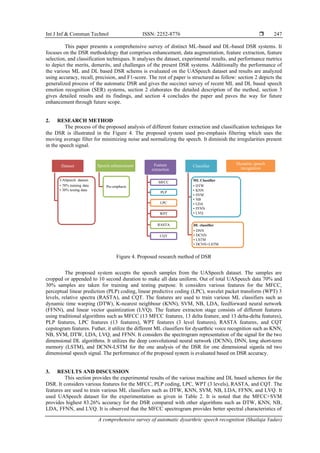
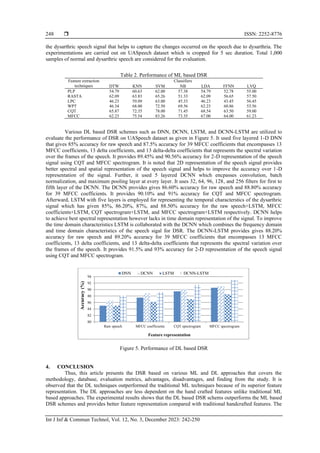
![Int J Inf & Commun Technol ISSN: 2252-8776
A comprehensive survey of automatic dysarthric speech recognition (Shailaja Yadav)
249
performance of DL framework is better for 2-D representation of the speech signal compared with 1-D signal
because of higher representation capability in spectral and spatial domin. Also, combination DCNN and
LSTM provides superiority over DNN, DCBB, and LSTM which has better feature representation capability
in spectral and temporal domain. Database generation is challenging task because of unavailability of
theproper resources and proper ground truth. The DSR is very challenging due to variability in the speech
intelligibility because of various attributes such as language, age, gender, region, and noise.
REFERENCES
[1] F. Abakarim and A. Abenaou, “Comparative study to realize an automatic speaker recognition system,” International Journal of
Electrical and Computer Engineering, vol. 12, no. 1, pp. 376–382, 2022, doi: 10.11591/ijece.v12i1.pp376-382.
[2] K. B. Bhangale and K. Mohanaprasad, “A review on speech processing using machine learning paradigm,” International Journal
of Speech Technology, vol. 24, no. 2, pp. 367–388, 2021, doi: 10.1007/s10772-021-09808-0.
[3] Z. J. M. Ameen and A. A. Kadhim, “Machine learning for Arabic phonemes recognition using electrolarynx speech,” International
Journal of Electrical and Computer Engineering, vol. 13, no. 1, pp. 400–412, 2023, doi: 10.11591/ijece.v13i1.pp400-412.
[4] A. Sonawane, M. U. Inamdar, and K. B. Bhangale, “Sound based human emotion recognition using MFCC & multiple SVM,” in
2017 International Conference on Information, Communication, Instrumentation and Control (ICICIC), 2017, pp. 1–4, doi:
10.1109/ICOMICON.2017.8279046.
[5] K. B. Bhangale and M. Kothandaraman, “Survey of Deep Learning Paradigms for Speech Processing,” Wireless Personal
Communications, vol. 125, no. 2, pp. 1913–1949, 2022, doi: 10.1007/s11277-022-09640-y.
[6] K. L. Ong, C. P. Lee, H. S. Lim, and K. M. Lim, “Speech emotion recognition with light gradient boosting decision trees machine,”
International Journal of Electrical and Computer Engineering, vol. 13, no. 4, pp. 4020–4028, 2023, doi: 10.11591/ijece.v13i4.pp4020-4028.
[7] K. Bhangale and M. Kothandaraman, “Speech emotion recognition based on multiple acoustic features and deep convolutional
neural network,” Electronics, vol. 12, no. 4, pp. 1–17, 2023, doi: 10.3390/electronics12040839.
[8] M. Kim, B. Cao, K. An, and J. Wang, “Dysarthric speech recognition using convolutional LSTM neural network,” in Interspeech
2018, 2018, pp. 2948–2952, doi: 10.21437/Interspeech.2018-2250.
[9] M. Vasilakis and Y. Stylianou, “Voice pathology detection based eon short-term jitter estimations in running speech,” Folia
Phoniatrica et Logopaedica, vol. 61, no. 3, pp. 153–170, 2009, doi: 10.1159/000219951.
[10] K. B. Bhangale, P. Desai, S. Banne, and U. Rajput, “Neural Style Transfer: Reliving art through Artificial Intelligence,” in 2022
3rd International Conference for Emerging Technology (INCET), 2022, pp. 1–6, doi: 10.1109/INCET54531.2022.9825254.
[11] R. Takashima, T. Takiguchi, and Y. Ariki, “Two-step acoustic model adaptation for dysarthric speech recognition,” in ICASSP
2020-2020 IEEE International Conference on Acoustic s, Speech and Signal Processing (ICASSP), 2020, pp. 6104–6108, doi:
10.1109/ICASSP40776.2020.9053725.
[12] S. Skodda, W. Visser, and U. Schlegel, “Short- and long-term dopaminergic effects on dysarthria in early Parkinson’s disease,”
Journal of Neural Transmission, vol. 117, no. 2, pp. 197–205, 2010, doi: 10.1007/s00702-009-0351-5.
[13] M. A. Little, P. E. McSharry, E. J. Hunter, J. Spielman, and L. O. Ramig, “Suitability of dysphonia measurements for
telemonitoring of Parkinson’s disease,” IEEE Transactions on Biomedical Engineering, vol. 56, no. 4, pp. 1015–1022, 2009, doi:
10.1109/TBME.2008.2005954.
[14] J. Shao, J. K. MacCallum, Y. Zhang, A. Sprecher, and J. J. Jiang, “Acoustic analysis of the tremulous voice: assessing the utility
of the correlation dimension and perturbation parameters,” Journal of Communication Disorders, vol. 43, no. 1, pp. 35–44, 2010,
doi: 10.1016/j.jcomdis.2009.09.001.
[15] D. Dimitriadis, A. Potamianos, and P. Maragos, “A comparison of the squared energy and teager-kaiser operators for short-term
energy estimation in additive noise,” IEEE Transactions on Signal Processing, vol. 57, no. 7, pp. 2569–2581, 2009, doi:
10.1109/TSP.2009.2019299.
[16] K. M. Allison, L. Annear, M. Policicchio, and K. C. Hustad, “Range and precision of formant movement in pediatric dysarthria,”
Journal of Speech, Language, and Hearing Research, vol. 60, no. 7, pp. 1864–1876, 2017, doi: 10.1044/2017_JSLHR-S-15-0438.
[17] K. L. Lansford and J. M. Liss, “Vowel acoustics in dysarthria: Speech disorder diagnosis and classification,” Journal of Speech,
Language, and Hearing Research, vol. 57, no. 1, pp. 57–67, 2014, doi: 10.1044/1092-4388(2013/12-0262).
[18] N. P. Narendra and P. Alku, “Glottal source information for pathological voice detection,” IEEE Access, vol. 8, pp. 67745–67755,
2020, doi: 10.1109/ACCESS.2020.2986171.
[19] K. Gurugubelli and A. K. Vuppala, “Analytic phase features for dysarthric speech detection and intelligibility assessment,”
Speech Communication, vol. 121, pp. 1–15, 2020, doi: 10.1016/j.specom.2020.04.006.
[20] C. Bhat, B. Vachhani, and S. K. Kopparapu, “Automatic assessment of dysarthria severity level using audio descriptors,” in 2017 IEEE
International Conference on Acoustics, Speech and Signal Processing (ICASSP), 2017, pp. 5070–5074, doi: 10.1109/ICASSP.2017.7953122.
[21] M. Hasegawa-Johnson, J. Gunderson, A. Perlman, and T. Huang, “HMM-based and SVM-based recognition of the speech of
talkers with spastic dysarthria,” in 2006 IEEE International Conference on Acoustics Speed and Signal Processing Proceedings,
2006, vol. 3, pp. 1060–1063, doi: 10.1109/ICASSP.2006.1660840.
[22] K. B. Bhangale, “Human Body Detection in Static Images Using HOG & Piecewise Linear SVM,” International Journal of
Innovative Research and Development, vol. 3, no. 6, pp. 179–184, 2014.
[23] F. Rudzicz, “Phonological features in discriminative classification of dysarthric speech,” in 2009 IEEE International Conference
on Acoustics, Speech and Signal Processing, 2009, pp. 4605–4608, doi: 10.1109/ICASSP.2009.4960656.
[24] F. Rudzicz, “Articulatory knowledge in the recognition of dysarthric speech,” IEEE Transactions on Audio, Speech and Language
Processing, vol. 19, no. 4, pp. 947–960, 2011, doi: 10.1109/TASL.2010.2072499.
[25] A. Revathi, R. Nagakrishnan, and N. Sasikaladevi, “Comparative analysis of Dysarthric speech recognition: multiple features and
robust templates,” Multimedia Tools and Applications, vol. 81, no. 22, pp. 31245–31259, 2022, doi: 10.1007/s11042-022-12937-6.
[26] B. A. A.-Qatab and M. B. Mustafa, “Classification of Dysarthric Speech According to the Severity of Impairment: An Analysis of
Acoustic Features,” IEEE Access, vol. 9, pp. 18183–18194, 2021, doi: 10.1109/ACCESS.2021.3053335.
[27] P. Janbakhshi, I. Kodrasi, and H. Bourlard, “Subspace-Based Learning for Automatic Dysarthric Speech Detection,” IEEE Signal
Processing Letters, vol. 28, pp. 96–100, 2021, doi: 10.1109/LSP.2020.3044503.
[28] K. B. Bhangale, P. Titare, R. Pawar, and S. Bhavsar, “Synthetic Speech Spoofing Detection Using MFCC and Radial Basis
Function SVM,” IOSR Journal of Engineering (IOSRJEN), vol. 8, no. 6, pp. 55–62, 2018.
[29] K. Bhangale and K. Mohanaprasad, “Speech Emotion Recognition Using Mel Frequency Log Spectrogram and Deep Convolutional](https://image.slidesharecdn.com/20628-39029-2-pb-230714075846-40bf7621/85/20628-39029-2-PB-pdf-8-320.jpg)
![ ISSN: 2252-8776
Int J Inf & Commun Technol, Vol. 12, No. 3, December 2023: 242-250
250
Neural Network,” Lecture Notes in Electrical Engineering, vol. 792, pp. 241–250, 2022, doi: 10.1007/978-981-16-4625-6_24.
[30] N. Fathima, T. Patel, M. C, and A. Iyengar, “TDNN-based multilingual speech recognition system for low resource Indian
languages,” in Interspeech 2018, 2018, pp. 3197–3201, doi: 10.21437/Interspeech.2018-2117.
[31] Z. Yue, E. Loweimi, and Z. Cvetkovic, “Raw Source and Filter Modelling for Dysarthric Speech Recognition,” in ICASSP 2022 -
2022 IEEE International Conference on Acoustics, Speech and Signal Processing (ICASSP), 2022, pp. 7377–7381, doi:
10.1109/ICASSP43922.2022.9746553.
[32] Z. Yue, E. Loweimi, Z. Cvetkovic, H. Christensen, and J. Barker, “Multi-modal acoustic-articulatory feature fusion for dysarthric
speech recognition,” in ICASSP 2022 - 2022 IEEE International Conference on Acoustics, Speech and Signal Processing
(ICASSP), 2022, pp. 7372–7376, doi: 10.1109/ICASSP43922.2022.9746855.
[33] M. Soleymanpour, M. T. Johnson, R. Soleymanpour, and J. Berry, “Synthesizing dysarthric speech using multi-speaker Tts for
dysarthric speech recognition,” in ICASSP 2022 - 2022 IEEE International Conference on Acoustics, Speech and Signal
Processing (ICASSP), 2022, pp. 7382–7386, doi: 10.1109/ICASSP43922.2022.9746585.
[34] S. Liu et al., “Recent Progress in the CUHK Dysarthric Speech Recognition System,” IEEE/ACM Transactions on Audio Speech
and Language Processing, vol. 29, pp. 2267–2281, 2021, doi: 10.1109/TASLP.2021.3091805.
[35] S. R. Shahamiri, “Speech Vision: An End-to-End Deep Learning-Based Dysarthric Automatic Speech Recognition System,” IEEE
Transactions on Neural Systems and Rehabilitation Engineering, vol. 29, pp. 852–861, 2021, doi: 10.1109/TNSRE.2021.3076778.
[36] Y. Y. Lin et al., “A speech command control-based recognition system for dysarthric patients based on deep learning
technology,” Applied Sciences, vol. 11, no. 6, pp. 1–16, 2021, doi: 10.3390/app11062477.
[37] I. Kodrasi and H. Bourlard, “Spectro-Temporal Sparsity Characterization for Dysarthric Speech Detection,” IEEE/ACM
Transactions on Audio Speech and Language Processing, vol. 28, pp. 1210–1222, 2020, doi: 10.1109/TASLP.2020.2985066.
[38] I. Kodrasi, “Temporal Envelope and Fine Structure Cues for Dysarthric Speech Detection Using CNNs,” IEEE Signal Processing
Letters, vol. 28, pp. 1853–1857, 2021, doi: 10.1109/LSP.2021.3108509.
[39] H. M. Chandrashekar, V. Karjigi, and N. Sreedevi, “Investigation of Different Time-Frequency Representations for Intelligibility
Assessment of Dysarthric Speech,” IEEE Transactions on Neural Systems and Rehabilitation Engineering, vol. 28, no. 12, pp.
2880–2889, 2020, doi: 10.1109/TNSRE.2020.3035392.
[40] H. M. Chandrashekar, V. Karjigi, and N. Sreedevi, “Spectro-Temporal Representation of Speech for Intelligibility Assessment of
Dysarthria,” IEEE Journal of Selected Topics in Signal Processing, vol. 14, no. 2, pp. 390–399, 2020, doi: 10.1109/JSTSP.2019.2949912.
[41] J. Fritsch and M. Magimai-Doss, “Utterance Verification-Based Dysarthric Speech Intelligibility Assessment Using Phonetic
Posterior Features,” IEEE Signal Processing Letters, vol. 28, pp. 224–228, 2021, doi: 10.1109/LSP.2021.3050362.
BIOGRAPHIES OF AUTHORS
Shailaja Yadav received M.E. in digital system from Savitribai Phule Pune
University, Pune, Maharashtra, India in 2015. She is currently pursuing the Ph.D. degree with
G.H. Raisoni College of Engineering and Management, Wagholi-Pune, Maharashtra, India.
She is currently working as an assistant professor in the Department of Electronics and
Telecommunication at D.Y. Patil College of Engineering, Akurdi-Pune, Maharashtra, India
since 2018. She has 16 years of teaching experience in various reputed colleges in India. Her
main research interests focus on speech processing, machine learning, artificial intelligence,
and deep learning. She is a life member of the Institution of Electronics and
Telecommunication Engineers (IETE), India. She can be contacted at email:
shailaja.yadav123@gmail.com.
Dinkar Manik Yadav received his bachelor degree from Dr. B.A.M University,
Aurangabad, India in 1994. The Ph.D. degree from Bharati Vidyapeeth, Pune, Maharashtra,
India in 2009. Under his guidance 11 research scholars were awarded Ph.D. degree. His areas
of research interests are image processing, signal processing and medical imaging. He is
currently working as principal at S.N.D. College of Engineering and Research Center, Yeola,
Nasik-Maharashtra, India. He can be contacted at email: dineshyadav800@gmail.com.
Dr. Kamalakar Ravindra Desai received his first degree from Shivaji
University, Electronics, Kolhapur in June 1998. He also has a master’s degree from Shivaji
University, Electronics and Telecommunication, Kolhapur in June 2006. Received the Ph.D.
from Shivaji University for "Error computation in GPS signals" in 2016. He is currently a
Professor in Bharati Vidyapeeth’s College of Engineering Kolhapur. His main interest focuses
on satellite and telecomunication, networking, embedded system. He can be contacted at
email: krdesai2013@gmail.com.](https://image.slidesharecdn.com/20628-39029-2-pb-230714075846-40bf7621/85/20628-39029-2-PB-pdf-9-320.jpg)


