Leonardo	Energy	Webinar
The	2030	Climate	&	Energy	Framework
Aleš	Šinkovec
03	June	2016
22
Content
I. Context	of	EU	climate	&	energy	policy
II. The	2030	framework	in	brief
III. Binding	or	not	binding	[national	targets]?	
IV. The	implementation	challenge
V. Governance	and	next	steps
33
Context of EU climate & energy policy
§ Why an EU climate & energy policy?
§ Tackle	challenges:
• Fight	against	anthropogenic	climate	change	(Kyoto	protocol	&	Paris	agreement	when	
ratified)
• Ensure	security	of	supply	&	reduce	dependencies	to	energy	imports	
• Stimulate	growth	and	jobs	
§ Lisbon	Treaty	gives	competence	to	the	EU	institutions	to	legislate	on	energy	matters
§ EU	level	action	took	off	with	the	2020	package	and	the	2050	low	carbon	roadmap
44
Context of EU climate & energy policy
§ With the view to achieve the long term goal of 80-95% GHG emissions reduction by 2050,
interim targets and plans are needed for their implementation
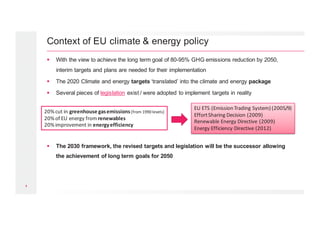
§ The 2020 Climate and energy targets ‘translated’ into the climate and energy package
§ Several pieces of legislation exist / were adopted to implement targets in reality
§ The 2030 framework, the revised targets and legislation will be the successor allowing
the achievement of long term goals for 2050
20%	cut	in	greenhouse	gas	emissions	(from	1990	levels)
20%	of	EU	energy	from	renewables
20%	improvement	in	energy	efficiency
EU	ETS	(Emission	Trading	System)	(2005/9)
Effort	Sharing	Decision	(2009)
Renewable	Energy	Directive	(2009)
Energy	Efficiency	Directive	(2012)
55
The 2030 Framework in brief
§ In 2014 the European Commission proposed a new 2030 Climate and Energy Policy
Framework, which was endorsed – with changes – by EU leaders in October 2014
§ It builds on the 2020 climate and energy package
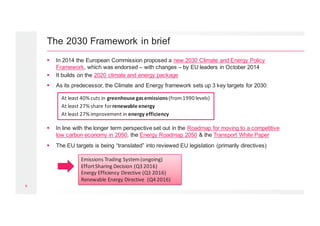
§ As its predecessor, the Climate and Energy framework sets up 3 key targets for 2030:
At	least	40%	cuts	in	greenhouse	gas	emissions(from	1990	levels)
At	least	27%	share	for	renewable	energy
At	least	27%	improvement	in	energy	efficiency
§ In line with the longer term perspective set out in the Roadmap for moving to a competitive
low carbon economy in 2050, the Energy Roadmap 2050 & the Transport White Paper
§ The EU targets is being “translated” into reviewed EU legislation (primarily directives)
Emissions	Trading	System	(ongoing)
Effort	Sharing	Decision	(Q3	2016)
Energy	Efficiency	Directive	(Q3	2016)
Renewable	Energy	Directive		(Q4	2016)
66
Highlights from the Council’s perspective
§ “All Member States participate, balancing fairness and solidarity”
§ Continuation	due	to	different	levels	of	development	(GDP,	existing	installed	base)
§ Binding EU level targets, not to be translated into binding national targets
§ Full freedom to determine energy mix
77
2020 vs 2030 divergence
§ 2020 targets, while binding, were lenient enough not to be too disruptive
§ 2030 targets are a compromise (“at least”) due to their potential for disruption; two examples:
§ 27%	renewables	means	just	over	50%	of	gross	final	consumption	of	electricity	 will	come	from	
renewables
§ 43%	reduction	in	emission	from	ETS	sector	presents	the	limit	of	today’s	technology	in	many	
industrial	processes
§ 2030 targets are also taking into account national level divergences:
§ By	2014,	Sweden	achieved	over	50%	renewables,	Finland	and	Austria	over	30%,	Ireland	under	
8%,	whereas	Luxembourg	and	Malta	under	4%.
88
Increasing flexibility
2020	
Package
20%	cut	in	
greenhouse	gas	
emissions	(from	
1990	levels)
20%	of	EU	energy	
from	renewables
20%	improvement	
in	energy	
efficiency
2030
Framework
At	least	40%	cuts	
in	greenhouse	gas	
emissions (from	
1990	levels)
At	least	27%	share	
for	renewable	
energy
At	least	27%	
improvement	in	
energy	efficiency
Binding	
through	
ETS	and	ESD
Binding	
at	EU	level
Only	
Binding	
through	
ETS	and	ESD
Binding	
Through	RED
Binding	
Through	EED
99
Binding or not binding [national targets]?
§ Controversial aspect of 2030 Framework → National targets
§ Council of the EU decided in favour of ‘Flexible Targets’ in October 2014 (Council Conclusions)
§ It means that the new EU targets will not be translated into national binding targets (unlike in
the previous 2020 Package)
§ Why?
§ Officially	due	to	the	willingness	to	leave	“greater	flexibility	for	member	states”	in	line	with	Article	
194(2)	of	the	Treaty	on	the	Functioning	of	the	European	Union	(TFEU)	on	the	issue	of	national	
control	over	the	energy	mix.
§ In	reality,	absence	of	common	vision on	how	the	EU	energy	market	should	be	organized,	Member	
States	want	to	retain	the	power	to	determine	their	national	energy	policies
§ Challenges arising from the absence of national targets
§ Free-loading:	risk	that	national	efforts	will	not	add	up	to	the	EU	aggregate	commitments
§ Fragmentation:	Lack	of	strong	EU	policies	could	allow	member	states	to	pursue	policies	that	
fragment	the	internal	energy	market
1010
The implementation challenge: governance is key
§ The absence of national binding targets raises question on the implementation of the 2030
Framework and consequently brings the issue of governance into the spotlight.
§ A Governance structure could ensure the achievement of targets and bring certainty to investors
§ Anticipating the issue that could arise from the absence of national binding targets, the
Commission proposed a potential governance scheme based on national plans for
competitive, secure and sustainable energy
§ Adoption of Council Conclusion on the governance system of the Energy Union, in November
2015, three main elements:
1. Integrated	national	energy	and	climate	plans	for	the	period	2021	to	2030
2. Transparent	reporting	system	will	be	put	in	place,	based	on	streamlined	progress	reports	by	
Member	States	assessing	the	implementation	of	national	plans	and	on	key	energy	and	climate	
indicators
3. Commission	to	monitor	collective	progress	made	in	its	annual	State	of	the	Energy	Union	and,	if	
necessary,	propose	policy	measures	to	ensure	the	delivery	of	the	Energy	Union	objectives
1111
Governance continued
§ By the end of 2016, Commission will present a legislative proposal on Energy Union governance:
§ Specify	the	political	process	between	Member	States	and	the	Commission	
§ Address	the	need	to	streamline	planning,	reporting	and	monitoring	requirements	without	adding	
administrative	burden	
§ Ensure	consistency	between	the	various	planning	and	reporting	streams	in	the	energy	and	climate	
field	(ongoing	stakeholder	consultation).
§ Governance structure based cooperative approach?
§ Possible	“first	past	the	post”	approach
§ What about consequences of a lack of compliance of Member States? Policy measures to step
up implementation but will there be sanctions?
§ Loose governance and excessive flexibility is not without danger, it can lead to a
fragmentation of national policies and impede the construction of a single market for energy
1212
Examples of flexibility leading to fragmentation
§ The following are just a few examples of how flexibility can lead to fragmented
implementation, which does little to promote the internal energy market and the fulfillment of
the Energy Union goals.
§ ETS	– cost	pass	through
§ Energy	Efficiency	– Obligation	Schemes
§ Renewables	– State	Aid	issues
1313
Next Steps for 2030
§ ETS post-2020 (phase 4) revision has started, deliberations expected to end some time in
2017
§ Non-ETS (effort sharing decision) expected to launch before Summer (June 2016)
§ Energy Efficiency Directive and Energy Performance of Buildings Directive proposals
expected to launch after Summer (September 2016)
§ Renewables and Market Design proposals expected to launch before the end of the year
(November 2016)
Contact us
Office Address
Office PhoneNumber
Office Email
Contact us
Office Address
Office PhoneNumber
Office Email
Thank you!
c c

2030 climate & energy framework

  • 1.
  • 2.
    22 Content I. Context of EU climate & energy policy II. The 2030 framework in brief III.Binding or not binding [national targets]? IV. The implementation challenge V. Governance and next steps
  • 3.
    33 Context of EUclimate & energy policy § Why an EU climate & energy policy? § Tackle challenges: • Fight against anthropogenic climate change (Kyoto protocol & Paris agreement when ratified) • Ensure security of supply & reduce dependencies to energy imports • Stimulate growth and jobs § Lisbon Treaty gives competence to the EU institutions to legislate on energy matters § EU level action took off with the 2020 package and the 2050 low carbon roadmap
  • 4.
    44 Context of EUclimate & energy policy § With the view to achieve the long term goal of 80-95% GHG emissions reduction by 2050, interim targets and plans are needed for their implementation § The 2020 Climate and energy targets ‘translated’ into the climate and energy package § Several pieces of legislation exist / were adopted to implement targets in reality § The 2030 framework, the revised targets and legislation will be the successor allowing the achievement of long term goals for 2050 20% cut in greenhouse gas emissions (from 1990 levels) 20% of EU energy from renewables 20% improvement in energy efficiency EU ETS (Emission Trading System) (2005/9) Effort Sharing Decision (2009) Renewable Energy Directive (2009) Energy Efficiency Directive (2012)
  • 5.
    55 The 2030 Frameworkin brief § In 2014 the European Commission proposed a new 2030 Climate and Energy Policy Framework, which was endorsed – with changes – by EU leaders in October 2014 § It builds on the 2020 climate and energy package § As its predecessor, the Climate and Energy framework sets up 3 key targets for 2030: At least 40% cuts in greenhouse gas emissions(from 1990 levels) At least 27% share for renewable energy At least 27% improvement in energy efficiency § In line with the longer term perspective set out in the Roadmap for moving to a competitive low carbon economy in 2050, the Energy Roadmap 2050 & the Transport White Paper § The EU targets is being “translated” into reviewed EU legislation (primarily directives) Emissions Trading System (ongoing) Effort Sharing Decision (Q3 2016) Energy Efficiency Directive (Q3 2016) Renewable Energy Directive (Q4 2016)
  • 6.
    66 Highlights from theCouncil’s perspective § “All Member States participate, balancing fairness and solidarity” § Continuation due to different levels of development (GDP, existing installed base) § Binding EU level targets, not to be translated into binding national targets § Full freedom to determine energy mix
  • 7.
    77 2020 vs 2030divergence § 2020 targets, while binding, were lenient enough not to be too disruptive § 2030 targets are a compromise (“at least”) due to their potential for disruption; two examples: § 27% renewables means just over 50% of gross final consumption of electricity will come from renewables § 43% reduction in emission from ETS sector presents the limit of today’s technology in many industrial processes § 2030 targets are also taking into account national level divergences: § By 2014, Sweden achieved over 50% renewables, Finland and Austria over 30%, Ireland under 8%, whereas Luxembourg and Malta under 4%.
  • 8.
  • 9.
    99 Binding or notbinding [national targets]? § Controversial aspect of 2030 Framework → National targets § Council of the EU decided in favour of ‘Flexible Targets’ in October 2014 (Council Conclusions) § It means that the new EU targets will not be translated into national binding targets (unlike in the previous 2020 Package) § Why? § Officially due to the willingness to leave “greater flexibility for member states” in line with Article 194(2) of the Treaty on the Functioning of the European Union (TFEU) on the issue of national control over the energy mix. § In reality, absence of common vision on how the EU energy market should be organized, Member States want to retain the power to determine their national energy policies § Challenges arising from the absence of national targets § Free-loading: risk that national efforts will not add up to the EU aggregate commitments § Fragmentation: Lack of strong EU policies could allow member states to pursue policies that fragment the internal energy market
  • 10.
    1010 The implementation challenge:governance is key § The absence of national binding targets raises question on the implementation of the 2030 Framework and consequently brings the issue of governance into the spotlight. § A Governance structure could ensure the achievement of targets and bring certainty to investors § Anticipating the issue that could arise from the absence of national binding targets, the Commission proposed a potential governance scheme based on national plans for competitive, secure and sustainable energy § Adoption of Council Conclusion on the governance system of the Energy Union, in November 2015, three main elements: 1. Integrated national energy and climate plans for the period 2021 to 2030 2. Transparent reporting system will be put in place, based on streamlined progress reports by Member States assessing the implementation of national plans and on key energy and climate indicators 3. Commission to monitor collective progress made in its annual State of the Energy Union and, if necessary, propose policy measures to ensure the delivery of the Energy Union objectives
  • 11.
    1111 Governance continued § Bythe end of 2016, Commission will present a legislative proposal on Energy Union governance: § Specify the political process between Member States and the Commission § Address the need to streamline planning, reporting and monitoring requirements without adding administrative burden § Ensure consistency between the various planning and reporting streams in the energy and climate field (ongoing stakeholder consultation). § Governance structure based cooperative approach? § Possible “first past the post” approach § What about consequences of a lack of compliance of Member States? Policy measures to step up implementation but will there be sanctions? § Loose governance and excessive flexibility is not without danger, it can lead to a fragmentation of national policies and impede the construction of a single market for energy
  • 12.
    1212 Examples of flexibilityleading to fragmentation § The following are just a few examples of how flexibility can lead to fragmented implementation, which does little to promote the internal energy market and the fulfillment of the Energy Union goals. § ETS – cost pass through § Energy Efficiency – Obligation Schemes § Renewables – State Aid issues
  • 13.
    1313 Next Steps for2030 § ETS post-2020 (phase 4) revision has started, deliberations expected to end some time in 2017 § Non-ETS (effort sharing decision) expected to launch before Summer (June 2016) § Energy Efficiency Directive and Energy Performance of Buildings Directive proposals expected to launch after Summer (September 2016) § Renewables and Market Design proposals expected to launch before the end of the year (November 2016)
  • 14.
    Contact us Office Address OfficePhoneNumber Office Email Contact us Office Address Office PhoneNumber Office Email Thank you! c c