Rewriting
the
Global
Capability
Center
playbook
Scaling
Maturity
with
AI
3
Boston Consulting Grouppartners with leaders in business and society
to tackle their most important challenges and capture their greatest
opportunities. BCG was the pioneer in business strategy when it was
founded in 1963. Today, we work closely with clients to embrace a
transformational approach aimed at benefiting all stakeholders—
empowering organizations to grow, build sustainable competitive
advantage, and drive positive societal impact.
Our diverse, global teams bring deep industry and functional expertise
and a range of perspectives that question the status quo and spark change.
BCG delivers solutions through leading–edge management consulting,
technology and design, and corporate and digital ventures. We work in a
uniquely collaborative model across the firm and throughout all levels of
the client organization, fueled by the goal of helping our clients thrive and
enabling them to make the world a better place.
ABOUT BCG
Rewriting
the
Global
Capability
Center
playbook
Scaling
Maturity
with
AI
5
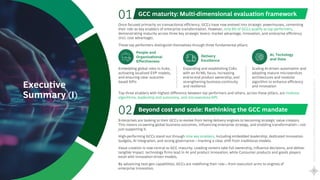
Once focused primarilyon transactional efficiency, GCCs have now evolved into strategic powerhouses, cementing
their role as key enablers of enterprise transformation. However, only 8% of GCCs qualify as top performers,
demonstrating maturity across three key strategic levers: market advantage, innovation, and enterprise efficiency
(incl. cost advantage).
These top performers distinguish themselves through three fundamental pillars:
GCC maturity: Multi-dimensional evaluation framework
Enterprises are looking to their GCCs to evolve from being delivery engines to becoming strategic value creators.
This means co-owning global business outcomes, influencing enterprise strategy, and enabling transformation—not
just supporting it.
High-performing GCCs stand out through nine key enablers, including embedded leadership, dedicated innovation
budgets, AI integration, and strong governance—marking a clear shift from traditional models.
Value creation is now central to GCC maturity. Leading centers take full ownership, influence decisions, and deliver
tangible impact. technology firms lead in AI and product innovation, while Consumer products and goods players
excel with innovation-driven models.
By advancing next-gen capabilities, GCCs are redefining their role—from execution arms to engines of
enterprise innovation.
Beyond cost and scale: Rethinking the GCC mandate
01
Scaling AI-driven automation and
adopting mature microservices
architectures and modular
algorithm to enhance efficiency
and innovation
AI, Techology
and Data
Expanding and establishing CoEs
with an AI/ML focus, increasing
end-to-end product ownership, and
strengthening business continuity
and resilience
Delivery
Excellence
Embedding global roles in hubs,
activating localized EVP models,
and ensuring clear outcome-
based KPIs
People and
Organizational
Effectiveness
02
Top three enablers with highest difference between top performers and others, across these pillars, are modular
algorithms, leadership and autonomy, and microservices/API.
Executive
Summary (I)
6.
Rewriting
the
Global
Capability
Center
playbook
Scaling
Maturity
with
AI
6
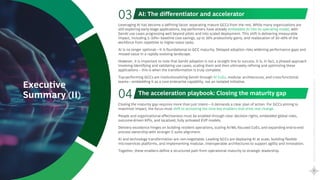
Leveraging AI hasbecome a defining factor separating mature GCCs from the rest. While many organizations are
still exploring early-stage applications, top-performers have already embedded AI into its operating model, with
GenAI use cases progressing well beyond pilots and into scaled deployment. This shift is delivering measurable
impact, including 5–10%+ baseline cost savings, up to 30% productivity gains, and reallocation of 30–40% of the
workforce from repetitive to higher-value tasks.
AI is no longer optional—it is foundational to GCC maturity. Delayed adoption risks widening performance gaps and
missed value in a rapidly evolving landscape.
However, it is important to note that GenAI adoption is not a straight line to success. It is, in fact, a phased approach
involving identifying and validating use cases, scaling them and then ultimately refining and optimizing these
applications – this is when the transformation is truly complete.
Top-performing GCCs are institutionalizing GenAI through AI CoEs, modular architectures, and cross-functional
teams—embedding it as a core enterprise capability, not an isolated initiative.
Closing the maturity gap requires more than just intent—it demands a clear plan of action. For GCCs aiming to
maximize impact, the focus must shift to activating the nine key enablers that drive real change.
People and organizational effectiveness must be enabled through clear decision rights, embedded global roles,
outcome-driven KPIs, and localized, fully activated EVP models.
Delivery excellence hinges on building resilient operations, scaling AI/ML-focused CoEs, and expanding end-to-end
process ownership with stronger C-suite alignment.
AI and technology transformation are non-negotiable. Leading GCCs are deploying AI at scale, building flexible
microservices platforms, and implementing modular, interoperable architectures to support agility and innovation.
Together, these enablers define a structured path from operational maturity to strategic leadership.
The acceleration playbook: Closing the maturity gap
04
Executive
Summary (II)
03 AI: The differentiator and accelerator
8
Rewriting
the
Global
Capability
Center
playbook
Scaling
Maturity
with
AI
Survey approach andrespondents' profile
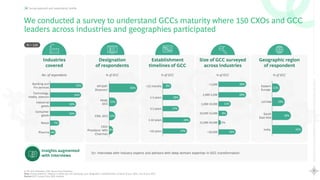
We conducted a survey to understand GCCs maturity where 150 CXOs and GCC
leaders across industries and geographies participated
Insights augmented
with interviews
No. of respondents % of GCC % of GCC % of GCC % of GCC
62%
VP/SVP/
Directors1
Head,
GCC
CXO, GCC
CEO/
President/ MD/
Chairman
17%
<12 months
1-3 years
3-5 years
5-10 years
>10 years
9%
18%
17%
27%
11%
18%
28%
43%
Eastern
Europe
LATAM
South
East Asia
India
Designation
of respondents
Establishment
timelines of GCC
Size of GCC surveyed
across industries
Industries
covered
Geographic region
of respondent
N = 150
<1,000
1,000-5,000
5,000-10,000
10,000-15,000
15,000-20,000
>20,000
29%
19%
13%
29%
29%
9%
3%
11%
8%
Banking and
Fin services
Consumer
goods
Retail
Pharma
25%
24%
20%
7%
4%
20%
Industrial
goods
Technology,
media, telecom
1. VP: Vice President; SVP: Senior Vice President
Note: Survey question: Industry in which you are operating; your designation; establishment timeline of your GCC, size of your GCC
Source: GCC Survey 2024, BCG Analysis
25+ interviews with industry experts and advisors with deep domain expertise in GCC transformation
9.
9
Rewriting
the
Global
Capability
Center
playbook
Scaling
Maturity
with
AI
Survey approach andrespondents' profile
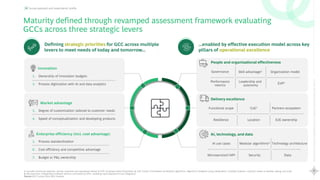
Defining strategic priorities for GCC across multiple
levers to meet needs of today and tomorrow...
...enabled by effective execution model across key
pillars of operational excellence
Enterprise efficiency (incl. cost advantage)
5. Process standardization
6. Cost efficiency and competitive advantage
7. Budget or P&L ownership
People and organizational effectiveness
Delivery excellence
AI, technology, and data
Functional scope CoE3 Partners ecosystem
Resilience Location E2E ownership
AI use cases Modular algorithms4 Technology architecture
Microservices5/API Security Data
Maturity defined through revamped assessment framework evaluating
GCCs across three strategic levers
Governance Skill advantage1 Organization model
Performance
metrics
Leadership and
autonomy
EVP2
1. Includes functional expertise, domain expertise and specialized skillset 2. EVP: Employee Value Proposition 3. CoE: Center of Excellence 4. Modular algorithms: Algorithms designed using independent, reusable modules, making it easier to develop, debug, and scale
5. Microservices: Independent software services connected by APIs—enabling rapid deployment and integration
Source: GCC Survey 2024, BCG Analysis
Market advantage
3. Degree of customization tailored to customer needs
4. Speed of conceptualization and developing products
Innovation
1. Ownership of innovation budgets
2. Process digitization with AI and data analytics
11
Rewriting
the
Global
Capability
Center
playbook
Scaling
Maturity
with
AI
GCC maturity: Multi-dimensionalevaluation framework
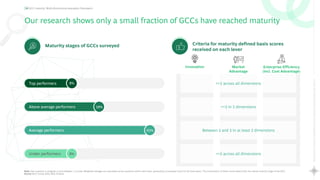
Our research shows only a small fraction of GCCs have reached maturity
Top performers
Above average performers
Average performers
Under performers
Criteria for maturity defined basis scores
received on each lever
>=3 across all dimensions
>=3 in 2 dimensions
Between 2 and 3 in at least 2 dimensions
<=2 across all dimensions
Enterprise Efficiency
(incl. Cost Advantage)
Market
Advantage
Innovation
65%
8%
19%
8%
Note: Each question is assigned a score between 1–4 scale. Weighted averages are calculated across questions within each lever, generating a composite score for all three levers. The combination of these scores determines the overall maturity stage of the GCC.
Source: GCC Survey 2024, BCG Analysis
Maturity stages of GCCs surveyed
12.
12
Rewriting
the
Global
Capability
Center
playbook
Scaling
Maturity
with
AI
GCC maturity: Multi-dimensionalevaluation framework
Top performers Above average performers Average performers Under performer
Technology, media, telecom leads
in overall maturity with ~35% of
hubs performing above average
or top performers and lowest
share of underperformers at 3%
Consumer goods and Banking and
financial services are anchored in
the middle—with ~70% average
performing GCCs; indicating a
need to accelerate their maturity
Industrial goods has the highest
share of above-average performers
(27%)—but only 3% reach top-tier,
highlighting opportunity for targeted
improvement
GCC maturity varies sharply across 6 key industries
Source: GCC Survey 2024, BCG Analysis
Consumer
goods
Retail
Pharma
Technology,
media, telecom
3%
27%
18% 55%
17%
17% 66%
8% 25% 3%
5% 22% 68% 5%
64%
3%
13% 7% 77%
13%
27% 57%
Industrial
goods
Banking and
Fin services
Maturity of GCCs across industries
z
13.
13
Rewriting
the
Global
Capability
Center
playbook
Scaling
Maturity
with
AI
GCC maturity: Multi-dimensionalevaluation framework
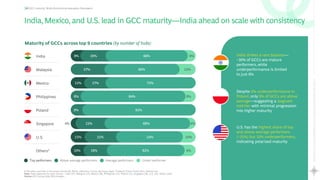
Maturity of GCCs across top 9 countries (by number of hubs)
1.The other countries in the survey include UK, Brazil, Indonesia, France, Germany, Spain, Thailand, China, Puerto Rico, Vietnam etc.
Note: Total responses for each country – India (77), Malaysia (15), Mexico (18), Philippines (12), Poland (11), Singapore (26), U.S. (52), Others (195)
Source: GCC Survey 2024, BCG Analysis
India strikes a rare balance—
~30% of GCCs are mature
performers, while
underperformance is limited
to just 6%
Despite 0% underperformance in
Poland, only 9% of GCCs are above
average—suggesting a stagnant
mid-tier with minimal progression
into higher maturity
U.S. has the highest share of top
and above average performers
(~35%) but 10% underperformers,
indicating polarized maturity
India,Mexico,and U.S.lead in GCC maturity—India ahead on scale with consistency
India
Malaysia
Mexico
Philippines
Poland
Singapore
Others1
4%
4% 23% 69%
6%
8% 20% 66%
9%
19% 62%
27% 60% 13%
8% 84% 8%
U.S. 10%
11% 25% 54%
17% 72%
11%
10%
Top performers Above average performers Average performers Under performer
9% 91%
14.
14
Rewriting
the
Global
Capability
Center
playbook
Scaling
Maturity
with
AI
GCC maturity: Multi-dimensionalevaluation framework
Note: Overall scores assigned by allocating weightages to different responses from 1 to 4
Source: GCC Survey 2024, BCG Analysis
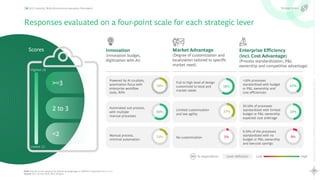
Responses evaluated on a four-point scale for each strategic lever
>=3
2 to 3
<2
Scores
Lowest (1)
Highest (4)
Enterprise Efficiency
(incl. Cost Advantage)
(Process standardization, P&L
ownership and competitive advantage)
>50% processes
standardized with budget
or P&L ownership and
cost efficiencies
20-50% of processes
standardized with limited
budget or P&L ownership
expected cost arbitrage
0-20% of the processes
standardized with no
budget or P&L ownership
and low-cost savings
41%
50%
Innovation
(Innovation budget,
digitization with AI)
Powered by AI co-pilots,
automation focus with
enterprise workflow
tools, RPA
Automated sub process,
with multiple
manual processes
Manual process,
minimal automation
19%
60%
21%
Market Advantage
(Degree of customization and
localization tailored to specific
market need)
Full to high level of design
customized to local and
market needs
Limited customization
and low agility
No customization
58%
37%
5% 9%
Low High
Lever definition
% respondents
Strategic levers
xx
15.
15
Rewriting
the
Global
Capability
Center
playbook
Scaling
Maturity
with
AI
GCC maturity: Multi-dimensionalevaluation framework
Industry Exemplar:
Global consumer company
Achieved best-in-class process
standardization by empowering
GPOs1, eliminating non-value
steps, optimizing global models,
and automating workflows—
delivering 25%+ productivity gains,
faster PR-to-PO cycles, and 99%+
payroll accuracy
Average score of industries in the three strategic pillars
2.5
2.3
2.4
2.3
2.2
1.9
2.3
Innovation
2.7
Market
Advantage
2.8
2.7
2.7
2.7
2.7
3.0
2.7
2.4
2.7
2.6
2.2
2.0
2.6
Enterprise Efficiency
(incl. Cost Advantage)
Industrial
goods
Retail
Pharma
Technology,
media, telecom
Consumer
goods
Banking and
Fin services
Strategic levers
Overall
Average score
Above average score Below average score
1. Global Process Owners
Source: GCC Survey 2024, BCG Analysis, Expert Interviews
Industry Exemplar:
Leading pharma company
R&D hubs established across
multiple locations, focused on
developing personalized healthcare
solutions tailored to local market
needs—such as cancer treatments
adapted to regional genetic profiles
Majority industries showcase average performance across the three maturity
levers, except for technology, media, telecom which outperforms in all
16.
16
Rewriting
the
Global
Capability
Center
playbook
Scaling
Maturity
with
AI
GCC maturity: Multi-dimensionalevaluation framework
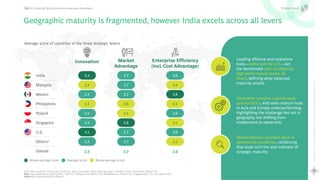
Geographic maturity is fragmented, however India excels across all levers
1.The other countries in the survey include UK, Brazil, Indonesia, France, Germany, Spain, Thailand, China, Puerto Rico, Vietnam etc.
Note: Total responses for each country – India (77), Malaysia (15), Mexico (18), Philippines (12), Poland (11), Singapore (26), U.S. (52), Others (195)
Source: GCC Survey 2024, BCG Analysis
Average score of countries in the three strategic levers
Mexico delivers outsized value in
operational excellence, reinforcing
that scale isn’t the sole indicator of
strategic maturity
Innovation remains a global weak
spot for GCCs, with even mature hubs
in Asia and Europe underperforming-
highlighting the challenge lies not in
geography, but shifting from
enablement to ownership
Leading offshore and nearshore
hubs—India and the U.S.—set
the benchmark with consistently
high performance across all
levers, defining what balanced
maturity entails
India
Malaysia
Mexico
Philippines
Poland
Singapore
U.S.
Overall
Enterprise Efficiency
(incl. Cost Advantage)
2.6
2.6
2.4
2.8
2.5
2.6
2.5
2.6
2.5
Innovation
2.4
2.1
2.3
2.1
2.3
2.3
2.5
2.3
2.3
Market
Advantage
2.7
2.7
2.7
2.7
2.6
2.5
2.8
2.7
2.7
Others1
Strategic levers
Average score
Above average score Below average score
17.
17
Rewriting
the
Global
Capability
Center
playbook
Scaling
Maturity
with
AI
GCC maturity: Multi-dimensionalevaluation framework
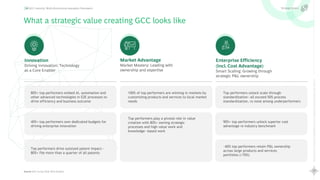
What a strategic value creating GCC looks like
Strategic levers
Enterprise Efficiency
(incl. Cost Advantage)
Smart Scaling: Growing through
strategic P&L ownership
Top performers unlock scale through
standardization—all exceed 50% process
standardization, vs none among underperformers
90%+ top performers unlock superior cost
advantage vs industry benchmark
~60% top performers retain P&L ownership
across large products and services
portfolios (>70%)
Innovation
Driving Innovation: Technology
as a Core Enabler
80%+ top performers embed AI, automation and
other advanced technologies in E2E processes to
drive efficiency and business outcome
40%+ top performers own dedicated budgets for
driving enterprise innovation
Top performers drive outsized patent impact—
80%+ file more than a quarter of all patents
Market Advantage
Market Mastery: Leading with
ownership and expertise
100% of top performers are winning in markets by
customizing products and services to local market
needs
Top performers play a pivotal role in value
creation with 80%+ owning strategic
processes and high value work and
knowledge—based work
Source: GCC Survey 2024, BCG Analysis
18.
18
Rewriting
the
Global
Capability
Center
playbook
Scaling
Maturity
with
AI
GCC maturity: Multi-dimensionalevaluation framework
1. EVP: Employee Value Proposition 2. Includes functional expertise, domain expertise and specialized skillset 3. CoE: Center of Excellence 4. Modular algorithms: Algorithms designed using independent, reusable modules, making it easier to develop, debug, and scale
5. Microservices: Independent software services connected by APIs—enabling rapid deployment and integration
Source: GCC Survey 2024, BCG Analysis
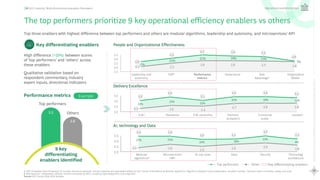
The top performers prioritize 9 key operational efficiency enablers vs others
High difference (>20%) between scores
of ‘top performers’ and ‘others’ across
these enablers
Qualitative validation based on
respondent commentary, industry
expert inputs, directional indicators
9 key
differentiating
enablers identified
Performance metrics Example
Top performers
Others
3.5
2.8
Top performers Other Key differentiating enablers
Key differentiating enablers People and Organizational Effectiveness
AI, technology and Data
1.5
2.0
2.5
3.0
3.5
Leadership and
autonomy
EVP1 Performance
metrics
Governance Skill
Advantage2
Organization
Model
25%
21%
21% 15%
7%
3.2
2.5
2.8 2.8
3.4
2.7
3.2
2.8
2.6
2.1
2.8
3.5
19%
Operational excellence pillars
Top three enablers with highest difference between top performers and others are modular algorithms, leadership and autonomy, and microservices/ API
Microservices5
/API
AI use cases Data Security Technology
architecture
2.0
2.5
3.0
3.5
27% 25%
20% 18%
13%
8%
Modular
algorithms4
3.4 3.4
3.1
3.4
3.1
2.8
2.9
2.6
2.6
2.5
3.0
2.4
Functional
scope
Location
2.0
2.5
3.0
3.5
CoE3 Resilience E2E ownership Partners
ecosystem
23%
22%
20% 18% 12%
2.7 2.8 2.8
2.4
2.6
3.4 3.2
2.3
23%
3.1
3.0
3.4 3.4
Delivery Excellence
19.
19
Rewriting
the
Global
Capability
Center
playbook
Scaling
Maturity
with
AI
GCC maturity: Multi-dimensionalevaluation framework
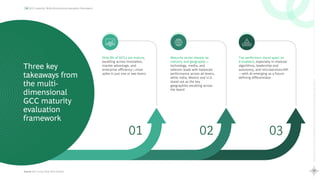
Only 8% of GCCs are mature,
excelling across innovation,
market advantage, and
enterprise efficiency—most
spike in just one or two levers
Maturity varies sharply by
industry and geography—
technology, media, and
telecom leads with balanced
performance across all levers,
while India, Mexico and U.S.
stand out as the key
geographies excelling across
the board
Top performers stand apart on
9 enablers, especially in modular
algorithms, leadership and
autonomy, and microservices/API
—with AI emerging as a future-
defining differentiator
Three key
takeaways from
the multi-
dimensional
GCC maturity
evaluation
framework
01 02 03
Source: GCC Survey 2024, BCG Analysis
21
Rewriting
the
Global
Capability
Center
playbook
Scaling
Maturity
with
AI
Beyond cost andscale: Rethinking the GCC mandate
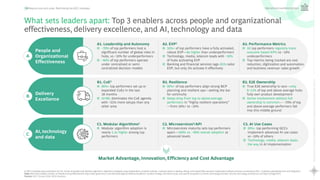
People and
Organizational
Effectiveness
A1. Leadership and Autonomy
● ~70% of top performers host a
significant number of global roles in
hubs, vs ~10% for underperformers
● ~60% of top performers operate
under centralized or semi-
centralized decision models
A2. EVP1
● 50%+ of top performers have a fully activated,
robust EVP—6x higher than underperformers
● Technology, media, telecom leads with ~30%
of hubs activating EVP
● Banking and financial services lags–65% tailor
EVP, but only 5% activate it effectively
A3. Performance Metrics
● All top performers regularly track
outcome based KPIs vs ~10%
underperformers
● Top metrics being tracked are cost
reduction, digitization and automation,
and business revenue/ sales growth
Delivery
Excellence
B1. CoE2
● 90%+ top performers set up or
expanded CoEs in the last
18 months
● AI/ML dominates the CoE agenda
with ~25% more setups than any
other area
B2. Resilience
● 90%+ of top performers align strong BCP
planning and resilient ops—setting the bar
for continuity
● Steep drop from top to above-average
performers in “highly resilient operations”
—from 50%+ to ~10%
B3. E2E Ownership
● True E2E ownership is rare—only
8–11% of top and above average hubs
fully own product development
● Active involvement without full
ownership is common— ~70% of top
and above-average performers fall
into this middle ground
AI, technology
and data
C3. AI Use Cases
● 90%+ top performing GCCs
implement advanced AI use cases
vs ~50% of others
● Technology, media, telecom leads
the way in AI implementation
C2. Microservices4/API
● Microservices maturity sets top performers
apart—100% vs. ~60% overall adoption at
advanced levels
C1. Modular Algorithms3
● Modular algorithm adoption is
nearly 1.5x higher among top
performers
What sets leaders apart: Top 3 enablers across people and organizational
effectiveness, delivery excellence, and AI, technology and data
Market Advantage, Innovation, Efficiency and Cost Advantage
Operational excellence pillars
A
B
C
1. EVP: Employee value proposition 2.CoE: Center of excellence 3. Modular algorithms: Algorithmsdesignedusing independent,reusable modules, making it easier to develop, debug, and scale 4. Microservices: Independentsoftware servicesconnectedby APIs—enabling rapiddeployment and integration
Note:Other key enablers include: (a) Peopleand org Effectiveness: Org model, governance, and skill advantage (b) Deliveryexcellence: Locationstrategy, functional scope, and partner ecosystem (c) GenAI, technology and data: security, technology architecture,and data management
Source: GCC Survey 2024, BCG Analysis
22.
22
Rewriting
the
Global
Capability
Center
playbook
Scaling
Maturity
with
AI
Beyond cost andscale: Rethinking the GCC mandate
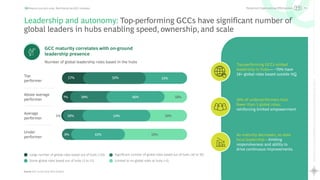
Leadership and autonomy: Top-performing GCCs have significant number of
global leaders in hubs enabling speed, ownership, and scale
GCC maturity correlates with on-ground
leadership presence
Number of global leadership roles based in the hubs
Large number of global roles based out of hubs (>30) Significant number of global roles based out of hubs (16 to 30)
Some global roles based out of hubs (5 to 15) Limited to no global roles at hubs (<5)
Top
performer
Above average
performer
Average
performer
Under
performer
As maturity decreases, so does
local leadership—limiting
responsiveness and ability to
drive continuous improvements.
Top-performing GCCs embed
leadership in hubs— ~70% have
16+ global roles based outside HQ
50% of underperformers host
fewer than 5 global roles,
reinforcing limited empowerment
People and Organizational Effectiveness A1
33%
50%
17%
7% 29% 46% 18%
16%
1%
50%
42%
8%
Source: GCC Survey 2024, BCG Analysis
29%
54%
23.
23
Rewriting
the
Global
Capability
Center
playbook
Scaling
Maturity
with
AI
Beyond cost andscale: Rethinking the GCC mandate
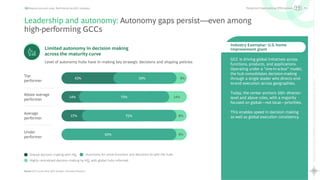
Leadership and autonomy: Autonomy gaps persist—even among
high-performing GCCs
Limited autonomy in decision making
across the maturity curve
Level of autonomy hubs have in making key strategic decisions and shaping policies
Shared decision making with HQ Autonomy for some functions and decisions lie with the hubs
Highly centralized decision making by HQ, with global hubs informed
A1
Industry Exemplar: U.S. home
improvement giant
GCC is driving global initiatives across
functions, products, and applications.
Operating under a “one-in-a-box” model,
the hub consolidates decision-making
through a single leader who directs end-
to-end execution across geographies.
Today, the center anchors 100+ director-
level and above roles, with a majority
focused on global—not local—priorities.
This enables speed in decision making
as well as global execution consistency.
Source: GCC Survey 2024, BCG Analysis, Secondary Research
Top
performer
Above average
performer
Average
performer
Under
performer
50%
42%
14%
72%
14%
17% 75%
92%
8%
8%
8%
People and Organizational Effectiveness
24.
24
Rewriting
the
Global
Capability
Center
playbook
Scaling
Maturity
with
AI
Beyond cost andscale: Rethinking the GCC mandate
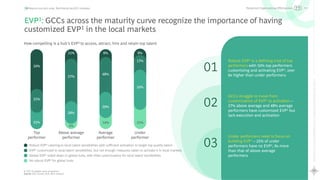
EVP1: GCCs across the maturity curve recognize the importance of having
customized EVP1 in the local markets
Robust EVP1 is a defining trait of top
performers with 50% top performers
customizing and activating EVP1, over
6x higher than under performers
GCCs struggle to move from
customization of EVP1 to activation –
57% above average and 48% average
performers have customized EVP1 but
lack execution and activation
Under performers need to focus on
building EVP1 – 25% of under
performers have no EVP1, 6x more
than that of above average
performers
Top
performer
Above average
performer
Average
performer
Under
performer
How compelling is a hub's EVP1 to access, attract, hire and retain top talent
Robust EVP1 catering to local talent sensibilities with sufficient activation to target top quality talent
EVP1 customized to local talent sensibilities, but not enough measures taken to activate it in local markets
Global EVP1 rolled down to global hubs, with little customization for local talent sensibilities
No robust EVP1 for global hubs
25%
25%
50%
4%
28%
57%
11% 9%
48%
29%
14% 25%
50%
17%
8%
01
02
03
1. EVP: Employee value proposition
Source: GCC Survey 2024, BCG Analysis
A2
People and Organizational Effectiveness
25.
25
Rewriting
the
Global
Capability
Center
playbook
Scaling
Maturity
with
AI
Beyond cost andscale: Rethinking the GCC mandate
Good relationship with colleagues
Good relationship with superior
Good work-life balance
Financial compensation
Financial stability of employer
Appreciation for work
Job security
Learning and skills training
Career development possibilities
Interesting job content
01
02
03
04
05
06
07
08
09
10
Good relationship with colleagues
Good relationship with superior
Opportunities to lead
Good work-life balance
Company values
Learning and skills training
Job security
Creative and innovative
environment
Career development possibilities
Collaborative working approach
-
-
-1
+2
-
-
Good relationship with colleagues
Learning and skills training
Good relationship with superior
Employer Reputation
Good work-life balance
Appreciation for work
Financial stability of employer
Appreciation for work
Career development possibilities
Company Values
-
+6
-1
-2
-
-2
-2
-
1. EVP: Employee Value Proposition
Source: BCG/The Network Proprietary Web Survey and Analysis
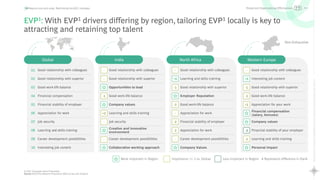
Global India North Africa
Good relationship with colleagues
Interesting job content
Good relationship with superior
Good work-life balance
Appreciation for your work
Financial compensation
(salary, bonuses)
Company values
Financial stability of your employer
Learning and skills training
Personal impact
-
+8
-1
-1
+1
-3
-1
Non-Exhaustive
More important in Region Importance +/- 2 vs. Global Less important in Region # Represents difference in Rank
Western Europe
EVP1: With EVP1 drivers differing by region, tailoring EVP1 locally is key to
attracting and retaining top talent
A2
People and Organizational Effectiveness
26.
26
Rewriting
the
Global
Capability
Center
playbook
Scaling
Maturity
with
AI
Beyond cost andscale: Rethinking the GCC mandate
Banking and
Fin services
14%
16%
65%
5%
Technology,
media, telecom
8%
28%
36%
28%
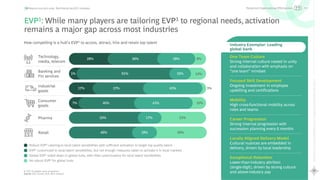
EVP1: While many players are tailoring EVP1 to regional needs, activation
remains a major gap across most industries
How compelling is a hub's EVP1 to access, attract, hire and retain top talent
Robust EVP1 catering to local talent sensibilities with sufficient activation to target top quality talent
EVP1 customized to local talent sensibilities, but not enough measures taken to activate it in local markets
Global EVP1 rolled down to global hubs, with little customization for local talent sensibilities
No robust EVP1 for global hubs
Pharma 33%
17%
50%
Retail 36%
18%
46%
Industrial
goods
43%
37%
17% 3%
10%
43%
40%
7%
Consumer
goods
A2
One Team Culture
Strong internal culture rooted in unity
and collaboration with emphasis on
“one team” mindset
Focused Skill Development
Ongoing investment in employee
upskilling and certifications
Mobility
High cross-functional mobility across
roles and teams
Career Progression
Strong internal progression with
succession planning every 6 months
Locally Aligned Delivery Model
Cultural nuances are embedded in
delivery, driven by local leadership
Exceptional Retention
Lower-than-industry attrition
(single-digit), driven by strong culture
and above-industry pay
Industry Exemplar: Leading
global bank
1. EVP: Employee value proposition
Source: GCC Survey 2024, BCG Analysis
People and Organizational Effectiveness
27.
27
Rewriting
the
Global
Capability
Center
playbook
Scaling
Maturity
with
AI
Beyond cost andscale: Rethinking the GCC mandate
Top
performer
50%
50%
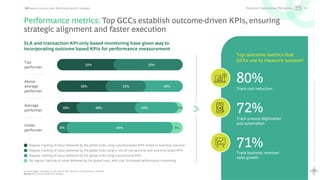
Performance metrics: Top GCCs establish outcome-driven KPIs, ensuring
strategic alignment and faster execution
SLA and transaction KPI-only based monitoring have given way to
incorporating outcome based KPIs for performance measurement
Top outcome metrics that
GCCs use to measure success1
1. Percentages calculated on the base of 102 responses to the question received
Source: GCC Survey 2024, BCG Analysis
Regular tracking of value delivered by the global hubs using outcome-based KPIs linked to business outcome
Regular tracking of value delivered by the global hubs using a mix of transactional and outcome based KPIs
Regular tracking of value delivered by the global hubs using transactional KPIs
No regular tracking of value delivered by the global hubs, with only SLA-based performance monitoring
Track cost reduction
80%
Track process digitization
and automation
72%
Track business revenue/
sales growth
71%
Average
performer
4%
34%
46%
16%
Under
performer
8%
84%
8%
Above
average
performer
39% 32% 29%
A3
People and Organizational Effectiveness
28.
28
Rewriting
the
Global
Capability
Center
playbook
Scaling
Maturity
with
AI
Beyond cost andscale: Rethinking the GCC mandate
CoE1: GCCs continue setting up CoEs1, marking shift from delivery to
value creation
>90% of top performers have set up or expanded a CoE1 in the last 18 months
Top performing GCC Overall
No expansion or
set up of CoEs1
CoEs1 expanded in
existing topic. No
new CoEs1 set up
New CoEs1 set up with
little to no expansion
of existing CoEs1
New CoEs1 set up
and existing CoEs1
expanded
CoEs1 set-up in the last 18 months
23%
8%
17%
34%
42%
26%
17%
33%
Delivery Excellence B1
Established Global AI Innovation Center,
designed to accelerate research,
development, and deployment of
AI-driven solutions—equipped with high-
performance compute infrastructure,
secure networks, and purpose-built labs.
The center is positioned to grow to a
250+ expert team in 18 month-period
post set up.
Strategic focus areas:
Real-time model training and
enterprise-scale analytics
Deployment of AI accelerators for
banking, sustainability, and supply
chain optimization
Industry Exemplar: Global
technology services firm
1. CoE: Center of Excellence
Source: GCC Survey 2024, BCG Analysis, Secondary Research
29.
29
Rewriting
the
Global
Capability
Center
playbook
Scaling
Maturity
with
AI
Beyond cost andscale: Rethinking the GCC mandate
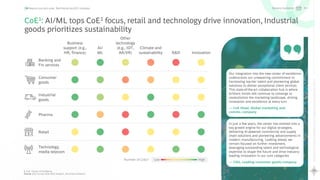
CoE1: AI/ML tops CoE1 focus, retail and technology drive innovation, Industrial
goods prioritizes sustainability
Business
support (e.g.,
HR, finance)
AI/
ML
Other
technology
(e.g., IOT,
AR/VR)
Climate and
sustainability R&D Innovation
Banking and
Fin services
Consumer
goods
Industrial
goods
Pharma
Retail
Technology,
media telecom
Low High
Number of CoEs1:
Delivery Excellence B1
4
Our integration into the new center of excellence
underscores our unwavering commitment to
harnessing top-tier talent and pioneering global
solutions to deliver exceptional client services.
This state-of-the-art collaboration hub is where
brilliant minds will continue to converge to
revolutionize the marketing landscape, driving
innovation and excellence at every turn
— CoE Head, Global marketing and
comms. company
In just a few years, the center has evolved into a
key growth engine for our digital strategies,
delivering AI-powered commercial and supply
chain solutions and pioneering advancements in
modern manufacturing. Looking ahead, we
remain focused on further investment,
leveraging outstanding talent and technological
expertise to shape the future and drive industry-
leading innovation in our core categories
— CXO, Leading consumer goods company
1. CoE: Center of Excellence
Source: GCC Survey 2024, BCG Analysis, Secondary Research
30.
30
Rewriting
the
Global
Capability
Center
playbook
Scaling
Maturity
with
AI
Beyond cost andscale: Rethinking the GCC mandate
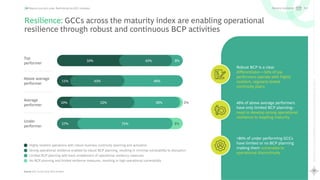
Resilience: GCCs across the maturity index are enabling operational
resilience through robust and continuous BCP activities
Robust BCP is a clear
differentiator—50% of top
performers operate with highly
resilient, regularly tested
continuity plans
46% of above average performers
have only limited BCP planning–
need to develop strong operational
resilience to leapfrog maturity
>80% of under performing GCCs
have limited or no BCP planning
making them vulnerable to
operational discontinuity
11% 43% 46%
10% 52% 36% 2%
17% 75% 8%
Highly resilient operations with robust business continuity planning and activation
Strong operational resilience enabled by robust BCP planning, resulting in minimal vulnerability to disruption
Limited BCP planning with basic enablement of operational resiliency measures
No BCP planning and limited resilience measures, resulting in high operational vulnerability
Top
performer
Above average
performer
Average
performer
Under
performer
Delivery Excellence B2
Source: GCC Survey 2024, BCG Analysis
42%
50% 8%
31.
31
Rewriting
the
Global
Capability
Center
playbook
Scaling
Maturity
with
AI
Beyond cost andscale: Rethinking the GCC mandate
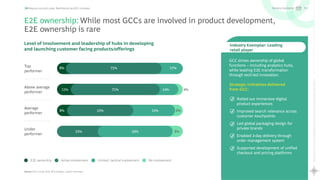
E2E ownership: While most GCCs are involved in product development,
E2E ownership is rare
Level of involvement and leadership of hubs in developing
and launching customer facing products/offerings
Source: GCC Survey 2024, BCG Analysis, Expert Interviews
E2E ownership Active involvement Limited, tactical involvement No involvement
Top
performer
Above average
performer
Average
performer
Under
performer
75% 17%
11% 14%
8% 33% 6%
33% 59% 8%
8%
4%
Delivery Excellence B3
GCC drives ownership of global
functions – including analytics hubs,
while leading E2E transformation
through tech-led innovation.
Strategic initiatives delivered
from GCC:
Rolled out immersive digital
product experiences
Improved search relevance across
customer touchpoints
Led global packaging design for
private brands
Enabled 2-day delivery through
order management system
Supported development of unified
checkout and pricing platforms
Industry Exemplar: Leading
retail player
71%
53%
32.
32
Rewriting
the
Global
Capability
Center
playbook
Scaling
Maturity
with
AI
Beyond cost andscale: Rethinking the GCC mandate
1. Microservices: Independent software services connected by APIs—enabling rapid deployment and integration 2. Modular algorithms: Algorithms designed using
independent, reusable modules, making it easier to develop, debug, and scale
Source: GCC Survey 2024, BCG Analysis, Expert Interviews
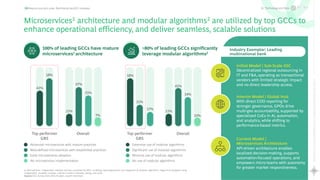
100% of leading GCCs have mature
microservices1 architecture
>80% of leading GCCs significantly
leverage modular algorithms2
Early microservices adoption
Well-defined microservices with established practices
Advanced microservices with mature practices
No microservices implementation
Overall Overall
42%
58%
11%
47%
35%
7%
11%
45%
34%
10%
Minimal use of modular algorithms
Significant use of modular algorithms
Extensive use of modular algorithms
No use of modular algorithms
17%
58%
25%
Decentralized regional outsourcing in
IT and F&A, operating as transactional
vendors with limited strategic impact
and no direct leadership access.
Initial Model | Sub-Scale SSC
With direct COO reporting for
stronger governance, GPOs drive
multi-geo accountability, supported by
specialized CoEs in AI, automation,
and analytics, while shifting to
performance-based metrics.
Interim Model | Global Hub
API-driven architecture enables
localized decision-making, supports
automation-focused operations, and
empowers micro-teams with autonomy
for greater market responsiveness.
Current Model |
Microservices Architecture
AI, Technology and Data
Industry Exemplar: Leading
multinational bank
C2
Microservices1 architecture and modular algorithms2 are utilized by top GCCs to
enhance operational efficiency, and deliver seamless, scalable solutions
C1
Top performer
GBS
Top performer
GBS
33.
33
Rewriting
the
Global
Capability
Center
playbook
Scaling
Maturity
with
AI
Beyond cost andscale: Rethinking the GCC mandate
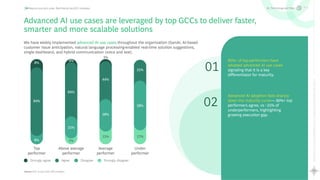
Advanced AI use cases are leveraged by top GCCs to deliver faster,
smarter and more scalable solutions
Source: GCC Survey 2024, BCG Analysis
We have widely implemented advanced AI use cases throughout the organization (GenAI, AI-based
customer issue anticipation, natural language processing-enabled real-time solution suggestions,
single dashboard, and hybrid communication (voice and text)
90%+ of top-performers have
adopted advanced AI use cases
signaling that it is a key
differentiator for maturity.
Advanced AI adoption falls sharply
down the maturity curve— 90%+ top
performers agree, vs ~25% of
underperformers, highlighting
growing execution gap.
Top
performer
Above average
performer
Average
performer
Under
performer
8%
84%
8%
7%
25%
64%
4%
3%
44%
38%
15% 17%
58%
25%
Strongly agree Agree Disagree Strongly disagree
01
02
AI, Technology and Data C3
34.
34
Rewriting
the
Global
Capability
Center
playbook
Scaling
Maturity
with
AI
Beyond cost andscale: Rethinking the GCC mandate
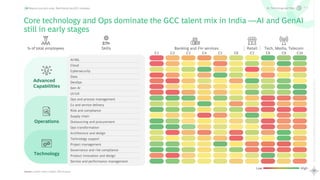
Core technology and Ops dominate the GCC talent mix in India —AI and GenAI
still in early stages
Source: LinkedIn talent insights, BCG Analysis
Low High
% of total employees Skills Banking and Fin services Retail Tech, Media, Telecom
C1 C2 C3 C4 C5 C6 C7 C8 C9 C10
AI/ML
Cloud
Cybersecurity
Data
DevOps
Gen AI
UI/UX
Ops and process management
Cx and service delivery
Risk and compliance
Supply chain
Outsourcing and procurement
Ops transformation
Architecture and design
Technology support
Project management
Governance and risk compliance
Product innovation and design
Service and performance management
Advanced
Capabilities
Operations
Technology
C3
AI, Technology and Data
36
Rewriting
the
Global
Capability
Center
playbook
Scaling
Maturity
with
AI
AI: The differentiatorand accelerator
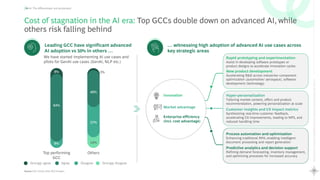
Cost of stagnation in the AI era: Top GCCs double down on advanced AI, while
others risk falling behind
… witnessing high adoption of advanced AI use cases across
key strategic areas
Source: GCC Survey 2024, BCG Analysis
Strongly agree Agree Disagree Strongly disagree
Top performing
GCC
Others
Leading GCC have significant advanced
AI adoption vs 50% in others …
We have started implementing AI use cases and
pilots for GenAI use cases (GenAI, NLP etc.)
8%
46%
37%
14%
3%
84%
8%
Process automation and optimization
Enhancing traditional RPA, enabling intelligent
document processing and report generation
Predictive analytics and decision support
Refining demand forecasting, inventory management,
and optimizing processes for increased accuracy
Hyper-personalization
Tailoring market content, offers and product
recommendation, powering personalization at scale
Customer insights and CX impact metrics
Synthesizing real-time customer feedback,
accelerating CX improvements, leading to NPS, and
reduced handling time
Rapid prototyping and experimentation
Assist in developing software prototypes or
product designs to accelerate innovation cycles
New product development
Accelerating R&D across industries–component
optimization (automotive/ aerospace), software
development (technology)
Innovation
Market advantage
Enterprise efficiency
(incl. cost advantage)
37.
37
Rewriting
the
Global
Capability
Center
playbook
Scaling
Maturity
with
AI
AI: The differentiatorand accelerator
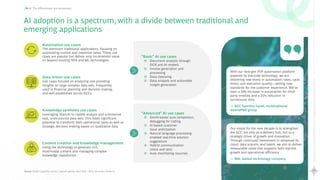
Automation use cases
The dominant traditional applications, focusing on
automating routine and repetitive tasks. These use
cases are popular but deliver only incremental value
on beyond existing RPA and ML technologies
Data driven use cases
Use cases focused on analyzing and providing
insights on large complex data sets. Frequently
used in financial planning and decision-making,
and well-established across GCCs
Knowledge synthesis use cases
Leveraging (Gen)AI to rapidly analyze and summarize
vast, unstructured data sets. This holds significant
potential to transform both operational tasks as well as
strategic decision making based on qualitative data
Content creation and knowledge management
Using the technology to generate rich,
multimodal content and managing complex
knowledge repositories
"Basic" AI use cases
● Document analysis through
OCR and AI models
● Invoice generation and
processing
● Data cleansing
● Data analysis and actionable
insight generation
"Advanced" AI use cases
● GenAI-based auto completion,
debugging for coding
● AI-based customer
issue anticipation
● Natural language processing
enabled real-time solution
suggestions
● Hybrid communication
(voice and text)
● Auto shortlisting resumes
AI adoption is a spectrum, with a divide between traditional and
emerging applications
Source: Global Capability Centers’ (Gen)AI agenda, April 2025 – BCG, Secondary Research
4
With our next-gen P2P automation platform
powered by low-code technology, we are
delivering new levels in automation rates, cycle
times, and execution quality—setting new
standards for the customer experience. We've
seen a 20% increase in automation for third-
party invoices and a 25% reduction in
turnaround time
— GCC function head, multinational
diversified group
Our vision for the next decade is to strengthen
the GCC not only as a delivery hub, but as a
strategic driver of growth and innovation.
Through continued investment in advanced AI,
cloud, data science, and talent, we aim to deliver
measurable value that supports both top-line
growth and operational efficiency
— MD, Global technology company
38.
38
Rewriting
the
Global
Capability
Center
playbook
Scaling
Maturity
with
AI
AI: The differentiatorand accelerator
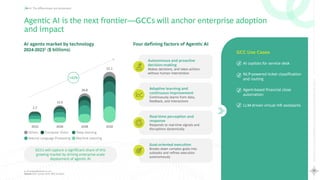
Agentic AI is the next frontier—GCCs will anchor enterprise adoption
and impact
GCCs will capture a significant share of this
growing market by driving enterprise-scale
deployment of agentic AI
2024 2026 2028 2030
5.7
12.0
26.8
52.1
AI agents market by technology
2024-20231 ($ billions)
Others Computer Vision Deep learning
Natural Language Processing Machine Learning
+45%
AI copilots for service desk
NLP-powered ticket classification
and routing
Agent-based financial close
automation
LLM-driven virtual HR assistants
GCC Use Cases
Autonomous and proactive
decision-making
Makes decisions, and takes actions
without human intervention
Adaptive learning and
continuous improvement
Continuously learns from data,
feedback, and interactions
Goal-oriented execution
Breaks down complex goals into
subtasks and refines execution
autonomously
Real-time perception and
response
Responds to real-time signals and
disruptions dynamically
1. GrandviewResearch.com
Source: GCC Survey 2024, BCG Analysis
Four defining factors of Agentic AI
39.
39
Rewriting
the
Global
Capability
Center
playbook
Scaling
Maturity
with
AI
AI: The differentiatorand accelerator
1.The other countries in the survey include UK, Brazil, Indonesia, France, Germany, Spain, Thailand, China, Puerto Rico, Vietnam etc.
Note: Total responses for each country – India (77), Malaysia (15), Mexico (18), Philippines (12), Poland (11), Singapore (26), U.S. (52), Others (195)
Source: GCC Survey 2024, BCG Analysis
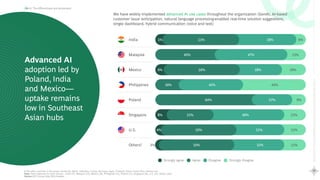
We have widely implemented advanced AI use cases throughout the organization (GenAI, AI-based
customer issue anticipation, natural language processing-enabled real-time solution suggestions,
single dashboard, hybrid communication (voice and text)
Advanced AI
adoption led by
Poland, India
and Mexico—
uptake remains
low in Southeast
Asian hubs
Strongly agree Agree Disagree Strongly disagree
Others1
13%
47%
40%
Malaysia
6% 16%
28%
50%
Mexico
16% 42%
42%
Philippines
9%
27%
64%
Poland
8% 15%
46%
31%
Singapore
India 5% 6%
38%
51%
4% 15%
31%
50%
U.S.
15%
32%
50%
3%
40.
40
Rewriting
the
Global
Capability
Center
playbook
Scaling
Maturity
with
AI
AI: The differentiatorand accelerator
Note: Total respondents – Banking and Fin services (37), technology, media, telecom (36), Industrial goods (30), Consumer products (30), Retail (11) and Pharma (6)
Source: GCC Survey 2024, BCG Analysis
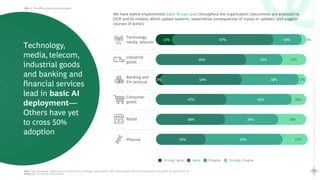
Technology,
media, telecom,
industrial goods
and banking and
financial services
lead in basic AI
deployment—
Others have yet
to cross 50%
adoption
Industrial
goods
17%
23%
60%
Banking and
Fin services
5%
38%
54%
We have widely implemented basic AI use cases throughout the organization (documents are analyzed by
OCR and AI models, which update systems, systematize consequences of inputs or updates, and suggest
courses of action)
Consumer
goods
10%
43%
47%
Technology,
media, telecom
3%
19%
67%
11%
Retail 18%
46% 36%
Pharma 17%
50%
33%
Strongly agree Agree Disagree Strongly disagree
3%
41.
41
Rewriting
the
Global
Capability
Center
playbook
Scaling
Maturity
with
AI
AI: The differentiatorand accelerator
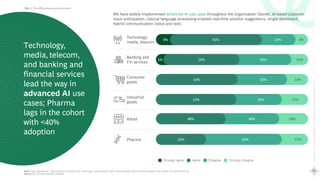
We have widely implemented advanced AI use cases throughout the organization (GenAI, AI-based customer
issue anticipation, natural language processing-enabled real-time solution suggestions, single dashboard,
hybrid communication (voice and text)
8%
22%
61%
9%
Technology,
media, telecom
17%
30%
53%
Industrial
goods
13%
33%
54%
Consumer
goods
11%
34%
50%
5%
Banking and
Fin services
18%
46% 36%
Retail
17%
50%
33%
Pharma
Technology,
media, telecom,
and banking and
financial services
lead the way in
advanced AI use
cases; Pharma
lags in the cohort
with <40%
adoption
Strongly agree Agree Disagree Strongly disagree
Note: Total respondents – Banking and Fin services (37), technology, media, telecom (36), Industrial goods (30), Consumer products (30), Retail (11) and Pharma (6)
Source: GCC Survey 2024, BCG Analysis
42.
42
Rewriting
the
Global
Capability
Center
playbook
Scaling
Maturity
with
AI
AI: The differentiatorand accelerator
Technology and data
Encompasses cloud architecture, GenAI
platforms, development lifecycle, data
ownership, and security policies
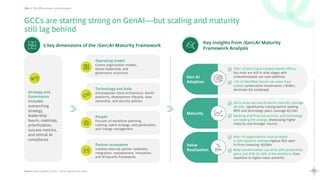
GCCs are starting strong on GenAI—but scaling and maturity
still lag behind
Source: Global Capability Centers’ (Gen)AI agenda white paper
5 key dimensions of the (Gen)AI Maturity Framework
Key insights from (Gen)AI Maturity
Framework Analysis
70%+ of GCCs have initiated GenAI efforts,
but most are still in pilot stages with
underdeveloped use case pipelines
~5% of identified GenAI use cases have
scaled; conservative investments (<$5Mn)
dominate the landscape
GCCs show low overall GenAI maturity (average
46/100), significantly trailing behind leading
BPO and technology peers (average 62/100)
Banking and financial services, and technology
are leading the change, showcasing higher
maturity and stronger returns.
40%+ of organizations have achieved
5–10% baseline savings; highest ROI seen
in firms investing >$15Mn
Bold transformation can drive 30% productivity
gains and shift 30–40% of the workforce from
repetitive to higher-value activities
Value
Realization
Gen AI
Adoption
Maturity
Operating model
Covers organization models,
GenAI leadership, and
governance structures
People
Focuses on workforce planning,
training, talent strategy, skill penetration,
and change management
Partner ecosystem
Involves external partner readiness,
integration, reassessment, innovation,
and IP/security frameworks
Strategy and
Governance
Includes
overarching
strategy,
leadership
buy-in, roadmap,
prioritization,
success metrics,
and ethical AI
compliance
44
Rewriting
the
Global
Capability
Center
playbook
Scaling
Maturity
with
AI
The acceleration playbook:Closing the maturity gap
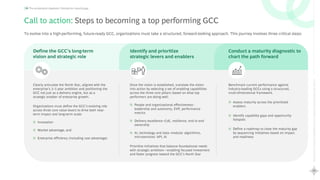
Call to action: Steps to becoming a top performing GCC
To evolve into a high-performing, future-ready GCC, organizations must take a structured, forward-looking approach. This journey involves three critical steps:
Clearly articulate the North Star, aligned with the
enterprise’s 3–5 year ambition and positioning the
GCC not just as a delivery engine, but as a
strategic enabler of enterprise growth.
Organizations must define the GCC’s evolving role
across three core value levers to drive both near-
term impact and long-term scale:
● Innovation
● Market advantage, and
● Enterprise efficiency (including cost advantage)
Once the vision is established, translate the vision
into action by selecting a set of enabling capabilities
across the three core pillars–based on what top
performers are doing well:
● People and organizational effectiveness–
leadership and autonomy, EVP, performance
metrics
● Delivery excellence–CoE, resilience, end to end
ownership
● AI, technology and data–modular algorithms,
microservices/ API, AI
Prioritize initiatives that balance foundational needs
with strategic ambition—enabling focused investment
and faster progress toward the GCC’s North Star
Benchmark current performance against
industry-leading GCCs using a structured,
multi-dimensional framework.
● Assess maturity across the prioritized
enablers
● Identify capability gaps and opportunity
hotspots
● Define a roadmap to close the maturity gap
by sequencing initiatives based on impact
and readiness
Conduct a maturity diagnostic to
chart the path forward
Identify and prioritize
strategic levers and enablers
Define the GCC’s long-term
vision and strategic role
45.
45
Rewriting
the
Global
Capability
Center
playbook
Scaling
Maturity
with
AI
The acceleration playbook:Closing the maturity gap
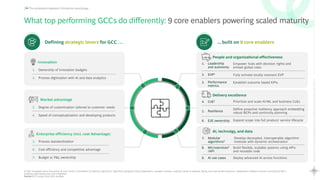
What top performing GCCs do differently: 9 core enablers powering scaled maturity
Defining strategic levers for GCC … ... built on 9 core enablers
Develop decoupled, interoperable algorithm
modules with dynamic orchestration
Build flexible, scalable systems using APIs
and reusable code
Deploy advanced AI across functions
People and organizational effectiveness
1. Leadership
and autonomy
2. EVP1
3. Performance
metrics
Empower hubs with decision rights and
embed global roles
Fully activate locally resonant EVP
Establish outcome based KPIs
AI, technolgy, and data
7. Modular
algorithms3
8. Microservices4
/API
9. AI use cases
1. EVP: Employee Value Proposition 2. CoE: Center of Excellence 3. Modular algorithms: Algorithms designed using independent, reusable modules, making it easier to develop, debug, and scale 4. Microservices: Independent software services connected by APIs—
enabling rapid deployment and integration
Source: GCC survey 2024, BCG Analysis
Enterprise efficiency (incl. cost Advantage)
5. Process standardization
6. Cost efficiency and competitive advantage
7. Budget or P&L ownership
Market advantage
3. Degree of customization tailored to customer needs
4. Speed of conceptualization and developing products
Innovation
1. Ownership of innovation budgets
2. Process digitization with AI and data analytics
Delivery excellence
4. CoE2
5. Resilience
6. E2E ownership
Prioritize and scale AI/ML and business CoEs
Define proactive resiliency approach embedding
robust BCPs and continuity planning
Expand scope into full product/ service lifecycle
46.
46
Rewriting
the
Global
Capability
Center
playbook
Scaling
Maturity
with
AI
The acceleration playbook:Closing the maturity gap
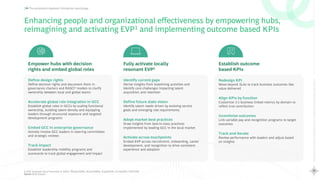
Enhancing people and organizational effectiveness by empowering hubs,
reimagining and activating EVP1 and implementing outcome based KPIs
Empower hubs with decision
rights and embed global roles
Fully activate locally
resonant EVP1
Establish outcome
based KPIs
Define design rights
Define decision rights and document them in
governance charters and RASCI2 models to clarify
ownership between local and global teams
Accelerate global role integration in GCC
Establish global roles in GCCs by scaling functional
ownership, building talent density and equipping
leaders through structured exposure and targeted
development programs
Embed GCC in enterprise governance
Actively involve GCC leaders in steering committees
and strategic reviews
Track impact
Establish leadership mobility programs and
scorecards to track global engagement and impact
Identify current gaps
Derive insights from baselining activities and
identify core challenges impacting talent
acquisition and retention
Define future state vision
Identify talent needs driven by evolving service
goals and emerging role requirements
Adopt market best practices
Draw insights from best-in-class practices
implemented by leading GCC in the local market
Activate across touchpoints
Embed EVP across recruitment, onboarding, career
development, and recognition to drive consistent
experience and adoption
Redesign KPI
Move beyond SLAs to track business outcomes like
value delivered
Align KPIs by function
Customize 3-5 business linked metrics by domain to
reflect true contribution
Incentivize outcomes
Link variable pay and recognition programs to target
outcomes
Track and iterate
Review performance with leaders and adjust based
on insights
1. EVP: Employee Value Proposition 2. RASCI: Responsible, Accountable, Supportive, Consulted, Informed
Source: BCG Analysis
47.
47
Rewriting
the
Global
Capability
Center
playbook
Scaling
Maturity
with
AI
The acceleration playbook:Closing the maturity gap
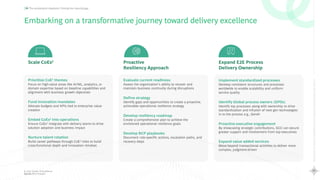
Embarking on a transformative journey toward delivery excellence
Expand E2E Process
Delivery Ownership
Scale CoEs1
Prioritize CoE1 themes
Focus on high-value areas like AI/ML, analytics, or
domain expertise based on baseline capabilities and
alignment with business growth objectives
Fund innovation mandates
Allocate budgets and KPIs tied to enterprise value
creation
Embed CoEs1 into operations
Ensure CoEs1 integrate with delivery teams to drive
solution adoption and business impact
Nurture talent rotation
Build career pathways through CoE1 roles to build
cross-functional depth and innovation mindset
Proactive
Resiliency Approach
Evaluate current readiness
Assess the organization’s ability to recover and
maintain business continuity during disruptions
Define strategy
Identify gaps and opportunities to create a proactive,
actionable operational resilience strategy
Develop resiliency roadmap
Create a comprehensive plan to achieve the
envisioned operational resilience goals
Develop BCP playbooks
Document role-specific actions, escalation paths, and
recovery steps
Implement standardized processes
Develop consistent structures and processes
worldwide to enable scalability and uniform
service quality
Identify Global process owners (GPOs)
Identify top processes along with ownership to drive
standardization and infusion of next gen technologies
in to the process e.g., GenAI
Proactive executive engagement
By showcasing strategic contributions, GCC can secure
greater support and involvement from top executives
Expand value added services
Move beyond transactional activities to deliver more
complex, judgment-driven
1. CoE: Center of Excellence
Source: BCG Analysis
48.
48
Rewriting
the
Global
Capability
Center
playbook
Scaling
Maturity
with
AI
The acceleration playbook:Closing the maturity gap
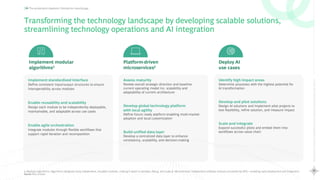
Transforming the technology landscape by developing scalable solutions,
streamlining technology operations and AI integration
Platform-driven
microservices2
Assess maturity
Review overall strategic direction and baseline
current operating model inc. scalability and
adaptability of current architecture
Develop global technology platform
with local agility
Define future ready platform enabling multi-market
adoption and local customization
Build unified data layer
Develop a centralized data layer to enhance
consistency, scalability, and decision-making
Implement modular
algorithms1
Implement standardized interface
Define consistent input/output structures to ensure
interoperability across modules
Enable reusability and scalability
Design each module to be independently deployable,
maintainable, and adaptable across use cases
Enable agile orchestration
Integrate modules through flexible workflows that
support rapid iteration and recomposition
Deploy AI
use cases
Identify high impact areas
Determine processes with the highest potential for
AI transformation
Develop and pilot solutions
Design AI solutions and implement pilot projects to
test feasibility, refine solution, and measure impact
Scale and Integrate
Expand successful pilots and embed them into
workflows across value chain
1. Modular algorithms: Algorithms designed using independent, reusable modules, making it easier to develop, debug, and scale 2. Microservices: Independent software services connected by APIs—enabling rapid deployment and integration
Source: BCG Analysis
Rewriting
the
Global
Capability
Center
playbook
Scaling
Maturity
with
AI
50
Glossary
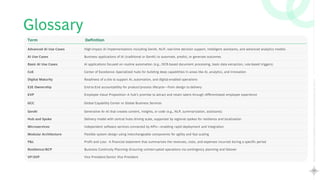
Advanced AI UseCases High-impact AI implementations including GenAI, NLP, real-time decision support, intelligent assistants, and advanced analytics models
AI Use Cases Business applications of AI (traditional or GenAI) to automate, predict, or generate outcomes
Basic AI Use Cases AI applications focused on routine automation (e.g., OCR-based document processing, basic data extraction, rule-based triggers)
CoE Center of Excellence–Specialized hubs for building deep capabilities in areas like AI, analytics, and innovation
Digital Maturity Readiness of a site to support AI, automation, and digital-enabled operations
E2E Ownership End-to-End accountability for product/process lifecycle—from design to delivery
EVP Employee Value Proposition–A hub’s promise to attract and retain talent through differentiated employee experience
GCC Global Capability Center or Global Business Services
GenAI Generative AI–AI that creates content, insights, or code (e.g., NLP, summarization, assistants)
Hub and Spoke Delivery model with central hubs driving scale, supported by regional spokes for resilience and localization
Microservices Independent software services connected by APIs—enabling rapid deployment and integration
Modular Architecture Flexible system design using interchangeable components for agility and fast scaling
P&L Profit and Loss - A financial statement that summarizes the revenues, costs, and expenses incurred during a specific period
Resilience/BCP Business Continuity Planning–Ensuring uninterrupted operations via contingency planning and failover
VP/SVP Vice President/Senior Vice President
Term Definition
51.
Rewriting
the
Global
Capability
Center
playbook
Scaling
Maturity
with
AI
51
Rajiv Gupta isa Managing Director and Senior Partner, in the New Delhi office
of BCG and leads the TMT practice area.
Sreyssha George is a Managing Director and Partner, in the Bengaluru office
of BCG and leads the GBS topic.
Sayan Majumdar is a Principal in BCG’s New Delhi office and is a member
of BCG’s Platinion team.
Romil Kulkarni is a Project Leader in BCG’s Bengaluru office and is a member
of BCG’s TMT practice.
Geetika Kaur is a Consultant in BCG’s New Delhi office and is a member of
BCG’s Platinion team.
We would like to acknowledge the support provided by Anuj Mandal
(Project Leader), Anannya Singhal (Consultant), Riddhi Sharma (Senior
Associate), Megha Jain (Senior Associate), Pranjali Rastogi (Senior Associate)
and Prerna Srivastav (Senior Associate) in preparing this report.
About the Authors
Acknowledgements
This study was undertaken by
Boston Consulting Group (BCG).
We thank all the participants of
the GCC survey and 1-on-1
discussions for their valuable
contributions towards the
enrichment of the report.
A special thanks to Nidhi Yadav
and Nopur for managing the
marketing process and to
Saroj Singh, Ratna Soni,
Soumya Garg, Pavithran NS, and
Seshachalam Marella for their
contribution towards design and
production of this report.


















![[DSC DACH 23] Scaling & Industrialization of AI - Lukas Kölbl](https://cdn.slidesharecdn.com/ss_thumbnails/lukaskoelblready-230424075135-42c35132-thumbnail.jpg?width=640&height=640&fit=bounds)


