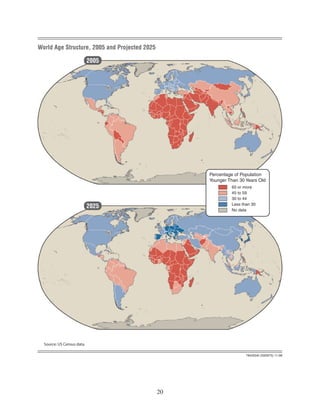
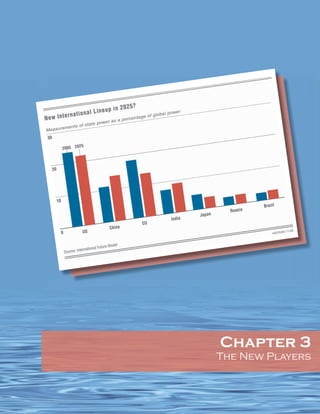
O N AL I N
     TI


NA
                     TE


.
IL
                     LLIG EN


 C
                 C
     E C UN
        O
This page left intentionally blank.
Global Trends 2025:
A Transformed World


For sale by the Superintendent of Documents, US Government Printing Office
Internet: bookstore.gpo.gov
Phone: toll free (866) 512-1800; DC area (202) 512-1800;
Fax: (202) 512-2104; Mail: Stop IDCC, Washington DC 20402-0001
ISBN 978-0-16-081834-9

To view electronic version:
www.dni.gov/nic/NIC_2025_project.html


                                                                 November 2008
                                                                  NIC 2008-003
We prepared Global Trends 2025: A Transformed World to stimulate strategic
thinking about the future by identifying key trends, the factors that drive them, where
they seem to be headed, and how they might interact. It uses scenarios to illustrate some
of the many ways in which the drivers examined in the study (e.g., globalization,
demography, the rise of new powers, the decay of international institutions, climate
change, and the geopolitics of energy) may interact to generate challenges and
opportunities for future decisionmakers. The study as a whole is more a description of
the factors likely to shape events than a prediction of what will actually happen.

        By examining a small number of variables that we judge probably will have a
disproportionate influence on future events and possibilities, the study seeks to help
readers to recognize signposts indicating where events are headed and to identify
opportunities for policy intervention to change or lock in the trajectories of specific
developments. Among the messages we hope to convey are: “If you like where events
seem to be headed, you may want to take timely action to preserve their positive
trajectory. If you do not like where they appear to be going, you will have to develop and
implement policies to change their trajectory.” For example, the report’s examination of
the transition out of dependence on fossil fuels illustrates how different trajectories will
entail different consequences for specific countries. An even more important message is
that leadership matters, no trends are immutable, and that timely and well-informed
intervention can decrease the likelihood and severity of negative developments and
increase the likelihood of positive ones.

        Global Trends 2025 is the fourth installment in the National Intelligence Council-
led effort to identify key drivers and developments likely to shape world events a decade
or more in the future. Both the product and the process used to produce it benefited from
lessons learned in previous iterations. Each edition of Global Trends has tapped larger
and more diverse communities of experts. Our first effort, which looked out to 2010,
relied primarily on expertise within the US Intelligence Community. There was some
outreach to other elements of the United States Government and the American academic
community. For Global Trends 2015, we engaged more numerous and more varied
groups of non-US Government experts, most of whom were American citizens.

        For the third iteration, Global Trends 2020, we greatly expanded the participation
of non-American specialists by convening six seminars on five continents. We also
increased the number and varied the format of meetings in the United States. These
sessions enhanced our understanding of both specific trends and drivers and the ways
these factors were perceived by experts in different regions of the world.
Each past iteration produced an even more interesting and influential report.
Indeed, the worldwide response to Global Trends 2020 was extraordinary. The report
has been translated into several languages, debated in government offices, discussed in
university courses, and used as a point of departure in community meetings on
international affairs. The report was closely read and constructively criticized by myriad
experts and members of the public.

        Seeking to capitalize on the interest generated by previous reports and to capture
even wider circles of expertise, we modified our processes yet again to produce Global
Trends 2025. In addition to increasing still more the participation of non-USG experts
from the United States and abroad to develop the framework for the current study, we
shared several drafts with participants via the Internet and a series of discussion sessions
across the US and in several other countries. This iteration of Global Trends is the most
collaborative yet produced; that collaboration has made it a better product and we are
extremely grateful for the time and intellectual energy that literally hundreds of people
have devoted to this effort.

        As was the case with our previous looks at global trends that will shape the future,
the process and spin-off benefits of preparing Global Trends 2025 were as important as
the final product. The ideas generated and insights gained during the preparation of the
accompanying report have enriched the work of countless analysts and been incorporated
into numerous analytic products published by the National Intelligence Council and other
Intelligence Community agencies. Anecdotal evidence indicates they have also
influenced the thinking and work of many participants in the process who do not work for
the United States Government. We are pleased by and proud of these ancillary benefits
and look forward to reaping many more when others have a chance to read and react to
this edition of Global Trends.

         Many people contributed to the preparation of Global Trends 2025, but no one
contributed more than did Mathew Burrows. His intellectual gifts and managerial
abilities were critical to the production of this report and everyone involved owes him a
huge debt of gratitude. Mat’s own note of appreciation on the following page lists others
who made especially noteworthy contributions. Many others also made important
contributions. We could not have produced this edition of Global Trends without the
support of everyone who participated and we are deeply grateful for the partnerships and
the friendships that facilitated and resulted from this collaborative effort.


                                                C. Thomas Fingar
                                       Chairman, National Intelligence Council
Acknowledgements

In preparing this work the National Intelligence Council received immeasurable help
from numerous think tanks, consulting firms, academic institutions, and literally
hundreds of experts inside and outside governments here in the United States and
overseas. We cannot possibly name all the institutions and individuals we consulted but
would like to acknowledge a number for their important contributions.

The Atlantic Council of the United States and the Stimson Center were both important for
opening doors to institutions abroad and viewpoints that we would not easily have
gathered for this project. Dr. William Ralston, Dr. Nick Evans and their team at SRI
Consulting Business Intelligence provided needed S & T expertise and guidance.
Dr. Alexander Van de Putte of PFC Energy International put together a series of meetings
in three regional hubs across the globe to help us begin the process of conceiving and
constructing the scenarios. Others involved in that effort include Professor Jean-Pierre
Lehmann of the Evian Group at IMD in Lausanne and Peter Schwartz and Doug Randall
at the Monitor Group’s Global Business Network in San Francisco. Professor Barry
Hughes of the University of Denver contributed notably in the scenario construction
process and in plotting out the possible trajectories of major powers. Dr. Jacqueline
Newmyer and Dr. Stephen Rosen from the Long Term Strategy Group organized three
workshops that were critical to advancing our thinking on the complexities of the future
security environment and the changing character of conflict. Several individuals and
institutions helped organize roundtables to critique drafts or delve deeply into various
aspects, including Dr. Geoff Dabelko at the Wilson Center; Dr. Greg Treverton of
RAND; Sebastian Mallaby at the Council on Foreign Relations; Carlos Pascual at
Brookings; Dr. Michael Auslin at AEI; Professor Christopher Layne at Texas A&M
University; Professor Sumit Ganguly at Indiana University and Dr. Robin Niblett and
Jonathan Paris at Chatham House in London. Professor John Ikenberry from Princeton’s
Woodrow Wilson School organized several workshops of prominent international
relations scholars, helping us with changing geopolitical trends. Two workshops—one
organized by Professor Lanxin Xiang and hosted by CICIR in Beijing, the other
organized and hosted by Dr. Bates Gill at SIPRI in Stockholm—were particularly
instrumental in gathering international perspectives on strategic challenges facing the
world.

Within the United States government, special thanks goes to Julianne Paunescu from the
State Department’s Bureau of Intelligence and Research (INR). In helping us at every
step of the way, she and her team fulfilled their mandate spearheading intelligence
community outreach to nongovernmental experts in an outstanding manner. Marilyn
Maines and her experts at NSA provided essential expertise on S&T and organized
workshops with Toffler Associates to delve more deeply into future trends. The NIC’s
Analysis and Production staff, including Elizabeth Arens’ deft editorial hand, provided
essential support.
Contents
                                                                               Page

 Executive Summary                                                              vi
 Introduction: A Transformed World                                              1
    More Change than Continuity                                                 3
    Alternative Futures                                                         3
 Chapter 1: The Globalizing Economy                                             6
   Back to the Future                                                           7
   Growing Middle Class                                                         8
   State Capitalism: A Post-Democratic Marketplace Rising in the East?          8
   Bumpy Ride in Correcting Current Global Imbalances                          11
   Multiple Financial Nodes                                                    12
   Diverging Development Models, but for How Long?                             13
 Chapter 2: The Demographics of Discord                                        18
   Populations Growing, Declining, and Diversifying—at the Same Time           19
   The Pensioner Boom: Challenges of Aging Populations                         21
   Persistent Youth Bulges                                                     21
   Changing Places: Migration, Urbanization, and Ethnic Shifts                 23
   Demographic Portraits: Russia, China, India, and Iran                       24
 Chapter 3: The New Players                                                    28
   Rising Heavyweights: China and India                                        29
   Other Key Players                                                           31
   Up-and-Coming Powers                                                        35

    Global Scenario I: A World Without the West                                37
 Chapter 4: Scarcity in the Midst of Plenty?                                   40
   The Dawning of a Post-Petroleum Age?                                        41
   The Geopolitics of Energy                                                   45
   Water, Food, and Climate Change                                             51

    Global Scenario II: October Surprise                                       57
 Chapter 5: Growing Potential for Conflict                                     60
   A Shrinking Arc of Instability by 2025?                                     61
   Growing Risk of a Nuclear Arms Race in the Middle East                      61
   New Conflicts Over Resources?                                               63
   Terrorism: Good and Bad News                                                68
   Afghanistan, Pakistan, and Iraq: Local Trajectories and Outside Interests   72

    Global Scenario III: BRICs’ Bust-Up                                        76


                                            i
Chapter 6: Will the International System Be Up to the Challenges?            80
  Multipolarity without Multilateralism                                      81
  How Many International Systems?                                            82
  A World of Networks                                                        84

   Global Scenario IV: Politics is Not Always Local                          89
Chapter 7: Power-Sharing in a Multipolar World                               92
  Demand for US Leadership Likely to Remain Strong, Capacities Will Shrink   93
  New Relationships and Recalibrated Old Partnerships                        93
  Less Financial Margin of Error                                             94
  More Limited Military Superiority                                          97
  Surprises and Unintended Consequences                                      98
  Leadership Will Be Key                                                     98


                                         ii
Textboxes:

      The 2025 Global Landscape                                                  iv
      Comparison Between Mapping the Global Future: Report of the Intelligence   2
       Council’s 2020 Project and Global Trends 2025: A Transformed World
      Long-Range Projections: A Cautionary Tale                                  5
      Globalization at Risk with the 2008 Financial Crisis?                      10
      Science and Technology Leadership: A Test for the Emerging Powers          13
      Latin America: Moderate Economic Growth, Continued Urban Violence          15
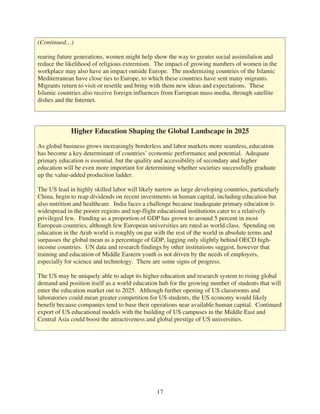
      Women as Agents of Geopolitical Change                                     16
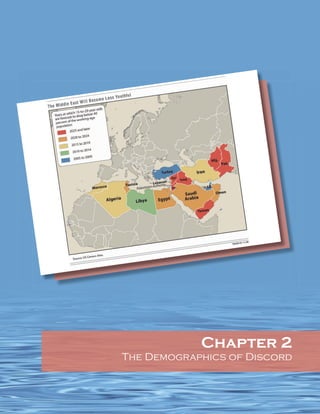
      Higher Education Shaping the Global Landscape in 2025                      17
      The Impact of HIV/AIDS                                                     23
      Muslims in Western Europe                                                  25
      Timing is Everything                                                       44
      Winners and Losers in a Post-Petroleum World                               46
      Technology Breakthroughs by 2025                                           47
      Two Climate Change Winners                                                 52
      Strategic Implications of an Opening Arctic                                53
      Sub-Saharan Africa: More Interactions with the World and More Troubled     56
      A Non-nuclear Korea?                                                       62
      Middle East/North Africa: Economics Drives Change, but with Major Risk     65
       of Turmoil
      Energy Security                                                            66
      Another Use of Nuclear Weapons?                                            67
      Why al-Qa’ida’s “Terrorist Wave” Might Be Breaking Up                      69
      The Changing Character of Conflict                                         71
      End of Ideology?                                                           73
      Potential Emergence of a Global Pandemic                                   75
      Greater Regionalism—Plus or Minus for Global Governance?                   83
      Proliferating Identities and Growing Intolerance?                          86
      Future of Democracy: Backsliding More Likely than Another Wave             87
      Anti-Americanism on the Wane?                                              95


                                              iii
The 2025 Global Landscape

    Relative Certainties                           Likely Impact

    A global multipolar system is emerging         By 2025 a single “international community”
    with the rise of China, India, and others.     composed of nation-states will no longer exist.
    The relative power of nonstate actors—         Power will be more dispersed with the newer
    businesses, tribes, religious                  players bringing new rules of the game while risks
    organizations, and even criminal               will increase that the traditional Western alliances
    networks—also will increase.                   will weaken. Rather than emulating Western
                                                   models of political and economic development,
                                                   more countries may be attracted to China’s
                                                   alternative development model.
    The unprecedented shift in relative            As some countries become more invested in their
    wealth and economic power roughly              economic well-being, incentives toward
    from West to East now under way will           geopolitical stability could increase. However, the
    continue.                                      transfer is strengthening states like Russia that want
                                                   to challenge the Western order.
    The United States will remain the single       Shrinking economic and military capabilities may
    most powerful country but will be less         force the US into a difficult set of tradeoffs
    dominant.                                      between domestic versus foreign policy priorities.
    Continued economic growth—coupled              The pace of technological innovation will be key to
    with 1.2 billion more people by 2025—          outcomes during this period. All current
    will put pressure on energy, food, and         technologies are inadequate for replacing
    water resources.                               traditional energy architecture on the scale needed.
    The number of countries with youthful          Unless employment conditions change dramatically
    populations in the “arc of instability”1       in parlous youth-bulge states such as Afghanistan,
    will decrease, but the populations of          Nigeria, Pakistan, and Yemen, these countries will
    several youth-bulge states are projected       remain ripe for continued instability and state
    to remain on rapid growth trajectories.        failure.
    The potential for conflict will increase       The need for the US to act as regional balancer in
    owing to rapid changes in parts of the         the Middle East will increase, although other
    greater Middle East and the spread of          outside powers—Russia, China and India—will
    lethal capabilities.                           play greater roles than today.
    Terrorism is unlikely to disappear by          Opportunities for mass-casualty terrorist attacks
    2025, but its appeal could lessen if           using chemical, biological, or less likely, nuclear
    economic growth continues in the               weapons will increase as technology diffuses and
    Middle East and youth unemployment is          nuclear power (and possibly weapons) programs
    reduced. For those terrorists that are         expand. The practical and psychological
    active the diffusion of technologies will      consequences of such attacks will intensify in an
    put dangerous capabilities within their        increasingly globalized world.
    reach.
1
  Countries with youthful age structures and rapidly growing populations mark a crescent or “arc of instability”
stretching from the Andean region of Latin America across Sub-Saharan Africa, the Middle East and the Caucasus,
and through the northern parts of South Asia.


                                                       iv
Key Uncertainties                          Potential Consequences

Whether an energy transition away from     With high oil and gas prices, major exporters such
oil and gas—supported by improved          as Russia and Iran will substantially augment their
energy storage, biofuels, and clean        levels of national power, with Russia’s GDP
coal—is completed during the 2025          potentially approaching that of the UK and France.
time frame.                                A sustained plunge in prices, perhaps underpinned
                                           by a fundamental switch to new energy sources,
                                           could trigger a long-term decline for producers as
                                           global and regional players.
How quickly climate change occurs and      Climate change is likely to exacerbate resource
the locations where its impact is most     scarcities, particularly water scarcities.
pronounced.
Whether mercantilism stages a              Descending into a world of resource nationalism
comeback and global markets recede.        increases the risk of great power confrontations.
Whether advances toward democracy          Political pluralism seems less likely in Russia in the
occur in China and Russia.                 absence of economic diversification. A growing
                                           middle class increases the chances of political
                                           liberalization and potentially greater nationalism in
                                           China.
Whether regional fears about a nuclear-    Episodes of low-intensity conflict and terrorism
armed Iran trigger an arms race and        taking place under a nuclear umbrella could lead to
greater militarization.                    an unintended escalation and broader conflict.
Whether the greater Middle East            Turbulence is likely to increase under most
becomes more stable, especially            scenarios. Revival of economic growth, a more
whether Iraq stabilizes, and whether the   prosperous Iraq, and resolution of the Israeli-
Arab-Israeli conflict is resolved          Palestinian dispute could engender some stability as
peacefully.                                the region deals with a strengthening Iran and
                                           global transition away from oil and gas.
Whether Europe and Japan overcome          Successful integration of Muslim minorities in
economic and social challenges caused      Europe could expand the size of the productive
or compounded by demography.               work forces and avert social crisis. Lack of efforts
                                           by Europe and Japan to mitigate demographic
                                           challenges could lead to long-term declines.
Whether global powers work with            Emerging powers show ambivalence toward global
multilateral institutions to adapt their   institutions like the UN and IMF, but this could
structure and performance to the           change as they become bigger players on the global
transformed geopolitical landscape.        stage. Asian integration could lead to more
                                           powerful regional institutions. NATO faces stiff
                                           challenges in meeting growing out-of-area
                                           responsibilities with declining European military
                                           capabilities. Traditional alliances will weaken.


                                               v
Executive Summary
The international system—as constructed following the Second World War—will be almost
unrecognizable by 2025 owing to the rise of emerging powers, a globalizing economy, an
historic transfer of relative wealth and economic power from West to East, and the growing
influence of nonstate actors. By 2025, the international system will be a global multipolar one
with gaps in national power2 continuing to narrow between developed and developing countries.
Concurrent with the shift in power among nation-states, the relative power of various nonstate
actors—including businesses, tribes, religious organizations, and criminal networks—is
increasing. The players are changing, but so too are the scope and breadth of transnational issues
important for continued global prosperity. Aging populations in the developed world; growing
energy, food, and water constraints; and worries about climate change will limit and diminish
what will still be an historically unprecedented age of prosperity.

Historically, emerging multipolar systems have been more unstable than bipolar or unipolar
ones. Despite the recent financial volatility—which could end up accelerating many ongoing
trends—we do not believe that we are headed toward a complete breakdown of the international
system, as occurred in 1914-1918 when an earlier phase of globalization came to a halt.
However, the next 20 years of transition to a new system are fraught with risks. Strategic
rivalries are most likely to revolve around trade, investments, and technological innovation and
acquisition, but we cannot rule out a 19th century-like scenario of arms races, territorial
expansion, and military rivalries.

This is a story with no clear outcome, as illustrated by a series of vignettes we use to map out
divergent futures. Although the United States is likely to remain the single most powerful actor,
the United States’ relative strength—even in the military realm—will decline and US leverage
will become more constrained. At the same time, the extent to which other actors—both state
and nonstate—will be willing or able to shoulder increased burdens is unclear. Policymakers
and publics will have to cope with a growing demand for multilateral cooperation when the
international system will be stressed by the incomplete transition from the old to a still-forming
new order.

Economic Growth Fueling Rise of Emerging Players
In terms of size, speed, and directional flow, the transfer of global wealth and economic power
now under way—roughly from West to East—is without precedent in modern history. This shift
derives from two sources. First, increases in oil and commodity prices have generated windfall
profits for the Gulf states and Russia. Second, lower costs combined with government policies
have shifted the locus of manufacturing and some service industries to Asia.

Growth projections for Brazil, Russia, India, and China (the BRICs) indicate they will
collectively match the original G-7’s share of global GDP by 2040-2050. China is poised to
have more impact on the world over the next 20 years than any other country. If current trends
persist, by 2025 China will have the world’s second largest economy and will be a leading

2
 National power scores, computed by the International Futures computer model, are the product of an index
combining the weighted factors of GDP, defense spending, population, and technology.


                                                       vi
military power. It also could be the largest importer of natural resources and the biggest polluter.
India probably will continue to enjoy relatively rapid economic growth and will strive for a
multipolar world in which New Delhi is one of the poles. China and India must decide the extent
to which they are willing and capable of playing increasing global roles and how each will relate
to the other. Russia has the potential to be richer, more powerful, and more self-assured in 2025
if it invests in human capital, expands and diversifies its economy, and integrates with global
markets. On the other hand, Russia could experience a significant decline if it fails to take these
steps and oil and gas prices remain in the $50-70 per barrel range. No other countries are
projected to rise to the level of China, India, or Russia, and none is likely to match their
individual global clout. We expect, however, to see the political and economic power of other
countries—such as Indonesia, Iran, and Turkey—increase.

For the most part, China, India, and Russia are not following the Western liberal model for self-
development but instead are using a different model, “state capitalism.” State capitalism is a
loose term used to describe a system of economic management that gives a prominent role to the
state. Other rising powers—South Korea, Taiwan, and Singapore—also used state capitalism to
develop their economies. However, the impact of Russia, and particularly China, following this
path is potentially much greater owing to their size and approach to “democratization.” We
remain optimistic about the long-term prospects for greater democratization, even though
advances are likely to be slow and globalization is subjecting many recently democratized
countries to increasing social and economic pressures with the potential to undermine liberal
institutions.

Many other countries will fall further behind economically. Sub-Saharan Africa will remain
the region most vulnerable to economic disruption, population stresses, civil conflict, and
political instability. Despite increased global demand for commodities for which Sub-Saharan
Africa will be a major supplier, local populations are unlikely to experience significant economic
gain. Windfall profits arising from sustained increases in commodity prices might further
entrench corrupt or otherwise ill-equipped governments in several regions, diminishing the
prospects for democratic and market-based reforms. Although many of Latin America’s major
countries will have become middle income powers by 2025, others, particularly those such as
Venezuela and Bolivia that have embraced populist policies for a protracted period, will lag
behind—and some, such as Haiti, will have become even poorer and less governable. Overall,
Latin America will continue to lag behind Asia and other fast-growing areas in terms of
economic competitiveness.

Asia, Africa, and Latin America will account for virtually all population growth over the next
20 years; less than 3 percent of the growth will occur in the West. Europe and Japan will
continue to far outdistance the emerging powers of China and India in per capita wealth, but they
will struggle to maintain robust growth rates because the size of their working-age populations
will decrease. The US will be a partial exception to the aging of populations in the developed
world because it will experience higher birth rates and more immigration. The number of
migrants seeking to move from disadvantaged to relatively privileged countries is likely to
increase.


                                                vii
The number of countries with youthful age structures in the current “arc of instability” is
projected to decline by as much as 40 percent. Three of every four youth-bulge countries that
remain will be located in Sub-Saharan Africa; nearly all of the remainder will be located in the
core of the Middle East, scattered through southern and central Asia, and in the Pacific Islands.

New Transnational Agenda
Resource issues will gain prominence on the international agenda. Unprecedented global
economic growth—positive in so many other regards—will continue to put pressure on a number
of highly strategic resources, including energy, food, and water, and demand is projected to
outstrip easily available supplies over the next decade or so. For example, non-OPEC liquid
hydrocarbon production—crude oil, natural gas liquids, and unconventionals such as tar sands—
will not grow commensurate with demand. Oil and gas production of many traditional energy
producers already is declining. Elsewhere—in China, India, and Mexico—production has
flattened. Countries capable of significantly expanding production will dwindle; oil and gas
production will be concentrated in unstable areas. As a result of this and other factors, the world
will be in the midst of a fundamental energy transition away from oil toward natural gas, coal
and other alternatives.

The World Bank estimates that demand for food will rise by 50 percent by 2030, as a result of
growing world population, rising affluence, and the shift to Western dietary preferences by a
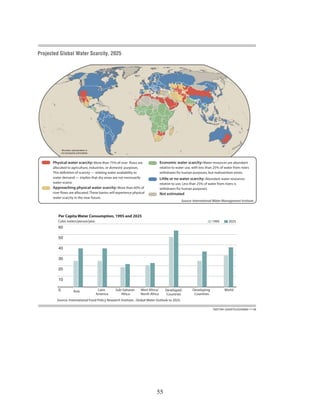
larger middle class. Lack of access to stable supplies of water is reaching critical proportions,
particularly for agricultural purposes, and the problem will worsen because of rapid urbanization
worldwide and the roughly 1.2 billion persons to be added over the next 20 years. Today,
experts consider 21 countries, with a combined population of about 600 million, to be either
cropland or freshwater scarce. Owing to continuing population growth, 36 countries, with about
1.4 billion people, are projected to fall into this category by 2025.

Climate change is expected to exacerbate resource scarcities. Although the impact of climate
change will vary by region, a number of regions will begin to suffer harmful effects, particularly
water scarcity and loss of agricultural production. Regional differences in agricultural
production are likely to become more pronounced over time with declines disproportionately
concentrated in developing countries, particularly those in Sub-Saharan Africa. Agricultural
losses are expected to mount with substantial impacts forecast by most economists by late this
century. For many developing countries, decreased agricultural output will be devastating
because agriculture accounts for a large share of their economies and many of their citizens live
close to subsistence levels.

New technologies could again provide solutions, such as viable alternatives to fossil fuels or
means to overcome food and water constraints. However, all current technologies are inadequate
for replacing the traditional energy architecture on the scale needed, and new energy
technologies probably will not be commercially viable and widespread by 2025. The pace of
technological innovation will be key. Even with a favorable policy and funding environment for
biofuels, clean coal, or hydrogen, the transition to new fuels will be slow. Major technologies
historically have had an “adoption lag.” In the energy sector, a recent study found that it takes an
average of 25 years for a new production technology to become widely adopted.


                                                viii
Despite what are seen as long odds now, we cannot rule out the possibility of an energy
transition by 2025 that would avoid the costs of an energy infrastructure overhaul. The greatest
possibility for a relatively quick and inexpensive transition during the period comes from better
renewable generation sources (photovoltaic and wind) and improvements in battery technology.
With many of these technologies, the infrastructure cost hurdle for individual projects would be
lower, enabling many small economic actors to develop their own energy transformation projects
that directly serve their interests—e.g., stationary fuel cells powering homes and offices,
recharging plug-in hybrid autos, and selling energy back to the grid. Also, energy conversion
schemes—such as plans to generate hydrogen for automotive fuel cells from electricity in the
homeowner’s garage—could avoid the need to develop complex hydrogen transportation
infrastructure.

Prospects for Terrorism, Conflict, and Proliferation
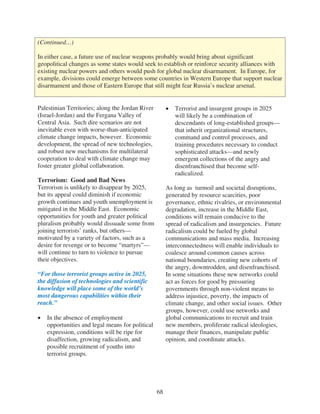
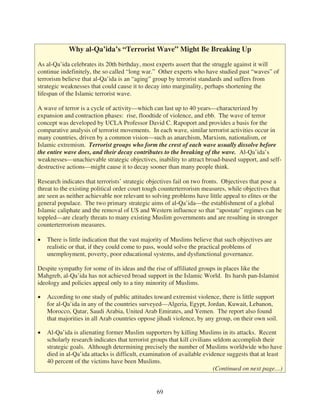
Terrorism, proliferation, and conflict will remain key concerns even as resource issues move up
on the international agenda. Terrorism is unlikely to disappear by 2025, but its appeal could
diminish if economic growth continues and youth unemployment is mitigated in the Middle East.
Economic opportunities for youth and greater political pluralism probably would dissuade some
from joining terrorists’ ranks, but others—motivated by a variety of factors, such as a desire for
revenge or to become “martyrs”—will continue to turn to violence to pursue their objectives.

In the absence of employment opportunities and legal means for political expression, conditions
will be ripe for disaffection, growing radicalism, and possible recruitment of youths into
terrorist groups. Terrorist groups in 2025 will likely be a combination of descendants of long-
established groups—that inherit organizational structures, command and control processes, and
training procedures necessary to conduct sophisticated attacks—and newly emergent collections
of the angry and disenfranchised that become self-radicalized. For those terrorist groups that are
active in 2025, the diffusion of technologies and scientific knowledge will place some of the
world’s most dangerous capabilities within their reach. One of our greatest concerns continues
to be that terrorist or other malevolent groups might acquire and employ biological agents, or
less likely, a nuclear device, to create mass casualties.

Although Iran’s acquisition of nuclear weapons is not inevitable, other countries’ worries about
a nuclear-armed Iran could lead states in the region to develop new security arrangements with
external powers, acquire additional weapons, and consider pursuing their own nuclear ambitions.
It is not clear that the type of stable deterrent relationship that existed between the great powers
for most of the Cold War would emerge naturally in the Middle East with a nuclear-weapons
capable Iran. Episodes of low-intensity conflict taking place under a nuclear umbrella could lead
to an unintended escalation and broader conflict if clear red lines between those states involved
are not well established.

We believe ideological conflicts akin to the Cold War are unlikely to take root in a world in
which most states will be preoccupied with the pragmatic challenges of globalization and
shifting global power alignments. The force of ideology is likely to be strongest in the Muslim
world—particularly the Arab core. In those countries that are likely to struggle with youth
bulges and weak economic underpinnings—such as Pakistan, Afghanistan, Nigeria, and
Yemen—the radical Salafi trend of Islam is likely to gain traction.


                                                 ix
Types of conflict we have not seen for awhile—such as over resources—could reemerge.
Perceptions of energy scarcity will drive countries to take actions to assure their future access to
energy supplies. In the worst case, this could result in interstate conflicts if government leaders
deem assured access to energy resources, for example, to be essential for maintaining domestic
stability and the survival of their regimes. However, even actions short of war will have
important geopolitical consequences. Maritime security concerns are providing a rationale for
naval buildups and modernization efforts, such as China’s and India’s development of blue-water
naval capabilities. The buildup of regional naval capabilities could lead to increased tensions,
rivalries, and counterbalancing moves but it also will create opportunities for multinational
cooperation in protecting critical sea lanes. With water becoming more scarce in Asia and the
Middle East, cooperation to manage changing water resources is likely to become more difficult
within and between states.

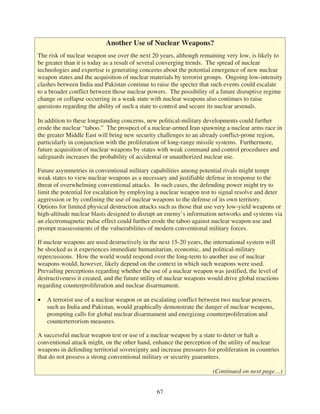
The risk of nuclear weapon use over the next 20 years, although remaining very low, is likely to
be greater than it is today as a result of several converging trends. The spread of nuclear
technologies and expertise is generating concerns about the potential emergence of new nuclear
weapon states and the acquisition of nuclear materials by terrorist groups. Ongoing low-intensity
clashes between India and Pakistan continue to raise the specter that such events could escalate
to a broader conflict between those nuclear powers. The possibility of a future disruptive regime
change or collapse occurring in a weak state with nuclear weapons also continues to raise
questions regarding the ability of such a state to control and secure its nuclear arsenals.

If nuclear weapons are used in the next 15-20 years, the international system will be shocked as
it experiences immediate humanitarian, economic, and political-military repercussions. A future
use of nuclear weapons probably would bring about significant geopolitical changes as some
states would seek to establish or reinforce security alliances with existing nuclear powers and
others would push for global nuclear disarmament.

A More Complex International System
The trend toward greater diffusion of authority and power that has been occurring for a couple
decades is likely to accelerate because of the emergence of new global players, the worsening
institutional deficit, potential expansion of regional blocs, and enhanced strength of nonstate
actors and networks. The multiplicity of actors on the international scene could add strength—
in terms of filling gaps left by aging post-World War II institutions—or further fragment the
international system and incapacitate international cooperation. The diversity in type of actor
raises the likelihood of fragmentation occurring over the next two decades, particularly given the
wide array of transnational challenges facing the international community.

The rising BRIC powers are unlikely to challenge the international system as did Germany and
Japan in the 19th and 20th centuries, but because of their growing geopolitical and economic clout,
they will have a high degree of freedom to customize their political and economic policies rather
than fully adopting Western norms. They also are likely to want to preserve their policy freedom
to maneuver, allowing others to carry the primary burden for dealing with such issues as
terrorism, climate change, proliferation, and energy security.


                                                 x
Existing multilateral institutions—which are large and cumbersome and were designed for a
different geopolitical order—will have difficulty adapting quickly to undertake new missions,
accommodate changing memberships, and augment their resources.
Nongovernmental organizations (NGOs)—concentrating on specific issues—increasingly will
be a part of the landscape, but NGO networks are likely to be limited in their ability to effect
change in the absence of concerted efforts by multilateral institutions or governments. Efforts at
greater inclusiveness—to reflect the emergence of the newer powers—may make it harder for
international organizations to tackle transnational challenges. Respect for the dissenting views
of member nations will continue to shape the agenda of organizations and limit the kinds of
solutions that can be attempted.

Greater Asian regionalism—possible by 2025—would have global implications, sparking or
reinforcing a trend toward three trade and financial clusters that could become quasi-blocs:
North America, Europe, and East Asia. Establishment of such quasi-blocs would have
implications for the ability to achieve future global World Trade Organization (WTO)
agreements. Regional clusters could compete in setting trans-regional product standards for
information technology, biotechnology, nanotechnology, intellectual property rights, and other
aspects of the “new economy.” On the other hand, an absence of regional cooperation in Asia
could help spur competition among China, India, and Japan over resources such as energy.

Intrinsic to the growing complexity of the overlapping roles of states, institutions, and nonstate
actors is the proliferation of political identities, which is leading to establishment of new
networks and rediscovered communities. No one political identity is likely to be dominant in
most societies by 2025. Religion-based networks may be quintessential issue networks and
overall may play a more powerful role on many transnational issues such as the environment and
inequalities than secular groupings.

The United States: Less Dominant Power
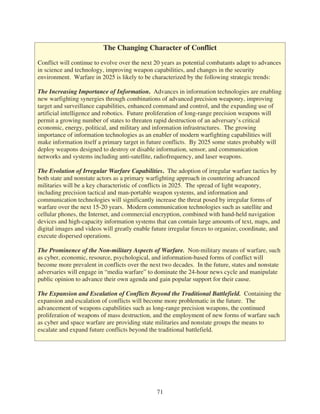
By 2025 the US will find itself as one of a number of important actors on the world stage, albeit
still the most powerful one. Even in the military realm, where the US will continue to possess
considerable advantages in 2025, advances by others in science and technology, expanded
adoption of irregular warfare tactics by both state and nonstate actors, proliferation of long-range
precision weapons, and growing use of cyber warfare attacks increasingly will constrict US
freedom of action. A more constrained US role has implications for others and the likelihood of
new agenda issues being tackled effectively. Despite the recent rise in anti-Americanism, the US
probably will continue to be seen as a much-needed regional balancer in the Middle East and
Asia. The US will continue to be expected to play a significant role in using its military power to
counter global terrorism. On newer security issues like climate change, US leadership will be
widely perceived as critical to leveraging competing and divisive views to find solutions. At the
same time, the multiplicity of influential actors and distrust of vast power means less room for
the US to call the shots without the support of strong partnerships. Developments in the rest of
the world, including internal developments in a number of key states—particularly China and
Russia—are also likely to be crucial determinants of US policy.


                                                 xi
2025—What Kind of Future?
The above trends suggest major discontinuities, shocks, and surprises, which we highlight
throughout the text. Examples include nuclear weapons use or a pandemic. In some cases, the
surprise element is only a matter of timing: an energy transition, for example is inevitable; the
only questions are when and how abruptly or smoothly such a transition occurs. An energy
transition from one type of fuel (fossil fuels) to another (alternative) is an event that historically
has only happened once a century at most with momentous consequences. The transition from
wood to coal helped trigger industrialization. In this case, a transition—particularly an abrupt
one—out of fossil fuels would have major repercussions for energy producers in the Middle East
and Eurasia, potentially causing permanent decline of some states as global and regional powers.

Other discontinuities are less predictable. They are likely to result from an interaction of several
trends and depend on the quality of leadership. We put uncertainties such as whether China or
Russia becomes a democracy in this category. China’s growing middle class increases the
chances but does not make such a development inevitable. Political pluralism seems less likely
in Russia in the absence of economic diversification. Pressure from below may force the issue,
or a leader might begin or enhance the democratization process to sustain the economy or spur
economic growth. A sustained plunge in the price of oil and gas would alter the outlook and
increase prospects for greater political and economic liberalization in Russia. If either country
were to democratize, it would represent another wave of democratization with wide significance
for many other developing states.

Also uncertain are the outcomes of demographic challenges facing Europe, Japan, and even
Russia. In none of these cases does demography have to spell destiny with less regional and
global power an inevitable outcome. Technology, the role of immigration, public health
improvements, and laws encouraging greater female participation in the economy are some of
the measures that could change the trajectory of current trends pointing toward less economic
growth, increased social tensions, and possible decline.

Whether global institutions adapt and revive—another key uncertainty—also is a function of
leadership. Current trends suggest a dispersion of power and authority will create a global
governance deficit. Reversing those trend lines would require strong leadership in the
international community by a number of powers, including the emerging ones.

Some uncertainties would have greater consequences—should they occur—than would others.
In this work, we emphasize the overall potential for greater conflict—some forms of which could
threaten globalization. We put WMD terrorism and a Middle East nuclear arms race in this
category. The key uncertainties and possible impacts are discussed in the text and summarized
in the textbox on page vii. In the four fictionalized scenarios, we have highlighted new
challenges that could emerge as a result of the ongoing global transformation. They present new
situations, dilemmas, or predicaments that represent departures from recent developments. As a
set, they do not cover all possible futures. None of these is inevitable or even necessarily likely;
but, as with many other uncertainties, the scenarios are potential game-changers.

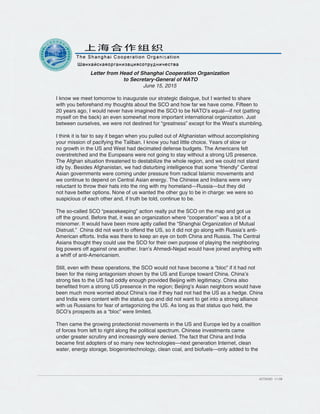
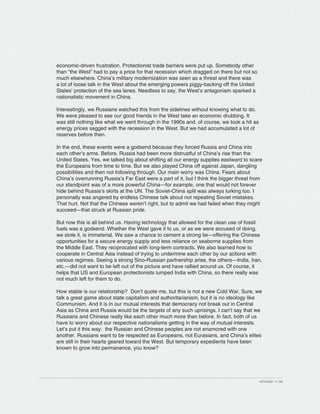
   In A World Without the West, the new powers supplant the West as the leaders on the world
   stage.


                                                 xii
October Surprise illustrates the impact of inattention to global climate change; unexpected
major impacts narrow the world’s range of options.

In BRICs’ Bust-Up, disputes over vital resources emerge as a source of conflict between
major powers—in this case two emerging heavyweights—India and China.

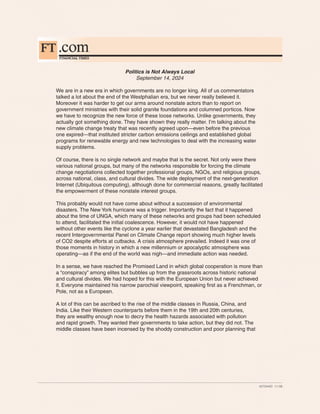
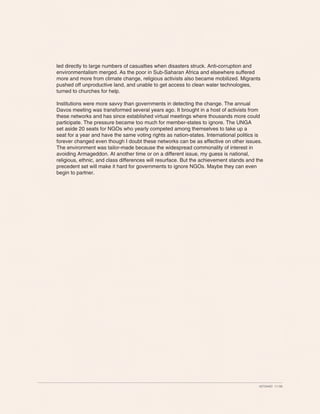
In Politics is Not Always Local, nonstate networks emerge to set the international agenda on
the environment, eclipsing governments.


                                           xiii
nonstate actors that are not grouped into rival
The international system—as constructed                camps of roughly equal weight. The most
following the Second World War—will be                 salient characteristics of the “new order” will
almost unrecognizable by 2025. Indeed,                 be the shift from a unipolar world dominated
“international system” is a misnomer as it is          by the United States to a relatively
likely to be more ramshackle than orderly, its         unstructured hierarchy of old powers and
composition hybrid and heterogeneous as                rising nations, and the diffusion of power
befits a transition that will still be a work in       from state to nonstate actors.
progress in 2025. The transformation is being
fueled by a globalizing economy, marked by             “…we do not believe that we are headed
an historic shift of relative wealth and               toward a complete breakdown [of the
economic power from West to East, and by               international system]…However, the next 20
the increasing weight of new players—                  years of transition toward a new
especially China and India. The US will                international system are fraught with
remain the single most important actor but             risks…”
will be less dominant. As was true of the
United States in the 19th and 20th centuries,          History tells us that rapid change brings many
China and India will at times be reticent and          dangers. Despite the recent financial
at other times impatient to assume larger roles        volatility, which could end up accelerating
on the world stage. In 2025, both will still be        many ongoing trends, we do not believe that
more concerned about their own internal                we are headed toward a complete
development than changing the international            breakdown—as occurred in 1914-1918 when
system.                                                an earlier phase of globalization came to a
                                                       halt. However, the next 20 years of transition
Concurrent with the shift in power among               toward a new international system are fraught
nation-states, the relative power of various           with risks—more than we envisaged when we
nonstate actors—including businesses, tribes,          published Mapping the Global Future3 in
religious organizations, and even criminal             2004. These risks include the growing
networks—will continue to increase. Several            prospect of a nuclear arms race in the Middle
countries could even be “taken over” and run           East and possible interstate conflicts over
by criminal networks. In areas of Africa or            resources. The breadth of transnational
South Asia, states as we know them might               issues requiring attention also is increasing to
wither away, owing to the inability of                 include issues connected with resource
governments to provide for basic needs,                constraints in energy, food, and water; and
including security.                                    worries about climate change. Global
                                                       institutions that could help the world deal
By 2025, the international community will be           with these transnational issues and, more
composed of many actors in addition to                 generally, mitigate the risks of rapid change
nation-states and will lack an overarching             currently appear incapable of rising to the
approach to global governance. The “system”
will be multipolar with many clusters of both
state and nonstate actors. Multipolar                  3
                                                        See Mapping the Global Future: Report of the
international systems—like the Concert of              National Intelligence Council’s 2020 Project,
Europe—have existed in the past, but the one           National Intelligence Council, December 2004, which
that is emerging is unprecedented because it is        can be found at:
                                                       www.dni.gov/nic/NIC_2020_project.html.
global and encompasses a mix of state and


                                                   1
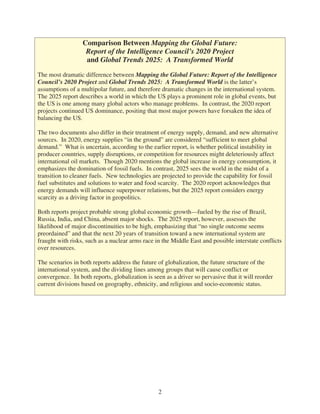
Comparison Between Mapping the Global Future:
                   Report of the Intelligence Council’s 2020 Project
                   and Global Trends 2025: A Transformed World

The most dramatic difference between Mapping the Global Future: Report of the Intelligence
Council’s 2020 Project and Global Trends 2025: A Transformed World is the latter’s
assumptions of a multipolar future, and therefore dramatic changes in the international system.
The 2025 report describes a world in which the US plays a prominent role in global events, but
the US is one among many global actors who manage problems. In contrast, the 2020 report
projects continued US dominance, positing that most major powers have forsaken the idea of
balancing the US.

The two documents also differ in their treatment of energy supply, demand, and new alternative
sources. In 2020, energy supplies “in the ground” are considered “sufficient to meet global
demand.” What is uncertain, according to the earlier report, is whether political instability in
producer countries, supply disruptions, or competition for resources might deleteriously affect
international oil markets. Though 2020 mentions the global increase in energy consumption, it
emphasizes the domination of fossil fuels. In contrast, 2025 sees the world in the midst of a
transition to cleaner fuels. New technologies are projected to provide the capability for fossil
fuel substitutes and solutions to water and food scarcity. The 2020 report acknowledges that
energy demands will influence superpower relations, but the 2025 report considers energy
scarcity as a driving factor in geopolitics.

Both reports project probable strong global economic growth—fueled by the rise of Brazil,
Russia, India, and China, absent major shocks. The 2025 report, however, assesses the
likelihood of major discontinuities to be high, emphasizing that “no single outcome seems
preordained” and that the next 20 years of transition toward a new international system are
fraught with risks, such as a nuclear arms race in the Middle East and possible interstate conflicts
over resources.

The scenarios in both reports address the future of globalization, the future structure of the
international system, and the dividing lines among groups that will cause conflict or
convergence. In both reports, globalization is seen as a driver so pervasive that it will reorder
current divisions based on geography, ethnicity, and religious and socio-economic status.


                                                 2
challenges without concerted efforts by their        Alternative Futures
leaders.                                             This study is organized into seven sections
                                                     that examine:
More Change than Continuity
The rapidly changing international order at a            The Globalizing Economy.
time of growing geopolitical challenges
increases the likelihood of discontinuities,             Demographics of Discord.
shocks, and surprises. No single outcome
seems preordained: the Western model of                  The New Players.
economic liberalism, democracy, and
secularism, for example, which many                      Scarcity in the Midst of Plenty.
assumed to be inevitable, may lose its
luster—at least in the medium term.                      Growing Potential for Conflict.
In some cases, the surprise element is only a            Will the International System Be Up to
matter of timing: an energy transition, for              the Challenges?
example, is inevitable; the only questions are
when and how abruptly or smoothly such a
                                                         Power-Sharing in a Multipolar World.
transition occurs. Other discontinuities are
less predictable. Recognizing that what may
                                                     As with our previous works, we will describe
seem implausible today could become
                                                     possible alternative futures that could result
feasible or even likely by 2025, we have
                                                     from the trends we discuss.4 We see the next
looked at a number of single development
                                                     15-20 years as one of those great historical
“shocks.” Examples include the global
                                                     turning points where multiple factors are
impact of a nuclear arms exchange, a rapid
                                                     likely to be in play. How such factors
replacement for fossil fuels, and a
                                                     intersect with one another and the role of
“democratic” China.
                                                     leadership will be crucial to the outcome.
New technologies could provide solutions,
                                                     In constructing these scenarios, we focused on
such as viable alternatives to fossil fuel or
                                                     critical uncertainties regarding the relative
means to overcome food and water
                                                     importance of the nation-state as compared
constraints. A critical uncertainty is whether
                                                     with nonstate actors, and the level of global
new technologies will be developed and
                                                     cooperation. In some of the scenarios, states
commercialized in time to avert a significant
                                                     are more dominant and drive global
slowdown in economic growth owing to
                                                     dynamics; in others, nonstate actors, including
resource constraints. Such a slowdown would
                                                     religious movements, nongovernmental
jeopardize the rise of new powers and deal a
                                                     organizations (NGOs), and super-empowered
serious blow to the aspirations of those
countries not yet fully in the globalization
game. A world in which shortages                     4
                                                       See Global Trends 2015, A Dialogue About the
predominate could trigger behaviors different        Future with Nongovernment Experts, National
from one in which scarcities are overcome            Intelligence Council, December 2000; and Mapping
through technology or other means.                   the Global Future: Report of the National
                                                     Intelligence Council’s 2020 Project, National
                                                     Intelligence Council, December 2004. The reports can
                                                     be found at
                                                     www.dni.gov/nic/NIC_global trends 2015.html and
                                                     www.dni.gov/nic/NIC_2020_project.html respectively.


                                                 3
individuals play more important roles. In              community has not been able to issue specific
some of the scenarios, key players interact in         warnings, but worries increase that a tipping
competing groups, through partnerships and             point has been reached in which climate
cross-border affiliations. Other scenarios             change has accelerated and possible impacts
envision more interaction as autonomous                will be very destructive. New York City is hit
players operate independently and sometimes            by a major hurricane linked to global climate
conflict with one another.                             change; the NY Stock Exchange is severely
                                                       damaged and, in the face of such destruction,
In all the fictionalized scenarios, we highlight       world leaders must begin to think about
challenges that could emerge as a result of the        taking drastic measures, such as relocating
ongoing global transformation. The scenarios           parts of coastal cities.
present new situations, dilemmas, or
predicaments that would cause upheavals in             BRICs’ Bust-Up. In this world, conflict
the global landscape, leading to very different        breaks out between China and India over
“worlds.” None of these is inevitable or even          access to vital resources. Outside powers
necessarily likely; but, as with many other            intervene before the conflict escalates and
uncertainties, they are potential game-                expands into a global conflagration. The
changers.                                              clash is triggered by Chinese suspicion of
                                                       efforts by others to threaten Beijing’s energy
A World Without the West. In this world,               supplies. Misperceptions and miscalculations
described in a fictional letter from a future          lead to the clash. The scenario highlights the
head of the Shanghai Cooperation                       importance of energy and other resources to
Organization (SCO), new powers supplant the            continued growth and development as a great
West as the leaders on the world stage. The            power. It shows the extent to which conflict
US feels overburdened and withdraws from               in a multipolar world is just as likely to occur
Central Asia, including Afghanistan; Europe            between rising states as between older and
will not step up to the plate and take the lead.       newer powers.
Russia, China, and others are forced to deal
with the potential for spillover and instability       Politics is Not Always Local. In this world,
in Central Asia. The SCO gains ascendance              outlined in an article by a fictional Financial
while NATO’s status declines. Anti-China               Times reporter, various nonstate networks—
antagonism in the US and Europe reaches a              NGOs, religious groups, business leaders, and
crescendo; protectionist trade barriers are put        local activists—combine to set the
in place. Russia and China enter a marriage            international agenda on the environment and
of convenience; other countries—India and              use their clout to elect the UN Secretary
Iran—rally around them. The lack of any                General. The global political coalition of
stable bloc—whether in the West or the non-            nonstate actors plays a crucial role in securing
Western world—adds to growing instability              a new worldwide climate change agreement.
and disorder, potentially threatening                  In this new connected world of digital
globalization.                                         communications, growing middle classes, and
                                                       transnational interest groups, politics is no
October Surprise. In this world, depicted in a         longer local and domestic and international
diary entry of a future US President, many             agendas become increasingly interchangeable.
countries have been preoccupied with
achieving economic growth at the expense of
safeguarding the environment. The scientific


                                                   4
Long-Range Projections: A Cautionary Tale

In the 20th century, experts forecasting the next 20 years—roughly the time frame of this study—
often missed major geopolitical events, basing their predictions largely on linear projections
without exploring possibilities that could cause discontinuities. Before WW I, while tensions
between European “great powers” were on the rise, few had an inkling of major changes in the
offing, from the extent of mutual slaughter to the downfall of age-old empires. In the early
1920s, few envisioned the lethal situation about to unfold, ushered in by the Great Depression,
Stalin’s gulags, and an even more bloody world war encompassing multiple genocides. The
postwar period saw the establishment of a new international system—many of whose
institutions—the UN and Bretton Woods—remain with us. Although the bipolar and nuclear age
did not lack war and conflict, it did provide a stable framework until the collapse of the Soviet
Union. The development of a globalized economy in which China and India play major roles
has opened a new era without clear outcomes.

Lessons from the last century, however, appear to suggest:

   Leaders and their ideas matter. No history of the past hundred years can be told without
   delving into the roles and thinking of such leaders as Vladimir Lenin, Josef Stalin, Adolf
   Hitler or Mao Zedong. The actions of dominating leaders are the hardest element to
   anticipate. At several junctures in the 20th century, Western experts thought liberal and
   market ideas had triumphed. As demonstrated by the impacts of Churchill, Roosevelt, and
   Truman, leadership is key even in societies where institutions are strong and the maneuvering
   room for wielding personal power is more constrained.

   Economic volatility introduces a major risk factor. Historians and social scientists have
   discovered a strong correlation between rapid economic change—both positive and
   negative—and political instability. The massive dislocation and economic volatility
   introduced by the end of the “first” globalization in 1914-1918 and the rise of protectionist
   barriers in the 1920s and 1930s, combined with the lingering resentments over the Versailles
   peace settlement, laid the groundwork for WW II. The collapse of multinational and ethnic
   empires—begun after WW I and continuing with the end of the colonial empires in the post-
   WW II period—also unleashed a long series of national and ethnic conflicts that reverberates
   today. Today’s globalization also has spurred the movement of people, disrupting traditional
   social and geographic boundaries.

   Geopolitical rivalries trigger discontinuities more than does technological change.
   Many stress the role of technology in bringing about radical change and there is no question
   it has been a major driver. We—as others—have oftentimes underestimated its impact.
   However, over the past century, geopolitical rivalries and their consequences have been more
   significant causes of the multiple wars, collapse of empires, and rise of new powers than
   technology alone.


                                               5
several factors, including the ability of
In terms of size, speed, and directional flow,       Western countries to reduce oil consumption
the global shift in relative wealth and              and demand, the ability of these states to
economic power now under way—roughly                 capitalize on a favorable export climate in
from West to East—is without precedent in            sectors of comparative strength, such as
modern history. This shift derives from two          technology and services, and the domestic
key sources. First, sustained increases in oil       policies of recipient states, particularly on
and commodity prices have generated                  issues of monetary policy and openness to
windfall profits for the Gulf states and             foreign investment.
Russia.. Second, relatively low labor costs
combined with certain government policies            Back to the Future
have shifted the locus of manufacturing and          Asia’s economic powerhouses—China and
some service industries to Asia. Strong              India—are restoring the positions they held
global demand for these products has made            two centuries ago when China produced
for wide economies of scale margins across           approximately 30 percent and India 15
Asia, particularly in China and India. These         percent of the world’s wealth. China and
shifts in demand and supply are deep and             India, for the first time since the 18th century,
structural, which suggests that the resulting        are set to be the largest contributors to
transfer of economic power we are witnessing         worldwide economic growth. These two
is likely to endure. These shifts are the            countries will likely surpass the GDP of all
driving force behind globalization that—as           other economies except the US and Japan by
we underlined in our Mapping the Global              2025, but they will continue to lag in per
Future report—is a meta-trend, transforming          capita income for decades. The years around
historic patterns of economic flows and              2025 will be characterized by the “dual
underlying stocks, creating pressures for            identity” of these Asian giants: powerful, but
rebalancing that are painful for both rich and       many individual Chinese or Indians feeling
poor countries.                                      relatively poor compared to Westerners.
“In terms of size, speed, and directional            Growth projections for Brazil, Russia, India,
flow, the global shift in relative wealth and        and China have them collectively matching
economic power now under way—roughly                 the original G-7’s share of global GDP by
from West to East—is without precedent in            2040-2050. According to these same
modern history.”                                     projections, the eight largest economies in
                                                     2025 will be, in descending order: the US,
Although this transfer is not zero-sum, early        China, India, Japan, Germany, the UK, and
losers such as most of Latin America (with           France, and Russia.
the exception of Brazil and a few others) and
Africa are receiving neither a stake in the          China, especially, has emerged as a new
initial asset transfer nor any significant           financial heavyweight, claiming $2 trillion in
inbound investment from the recipient                foreign exchange reserves in 2008. Rapidly
countries. Certain industrialized states such        developing countries, including China and
as Japan also appear increasingly challenged         Russia, have created sovereign wealth funds
by inchoate financial links among these              (SWFs)5 with the aim of using their hundreds
emerging markets. The US and Eurozone are
receiving much of this emerging market               5
liquidity, but whether they will benefit              Sovereign wealth funds (SWFs) constitute capital
                                                     generated from government surpluses and invested in
relative to their current position depends on        private markets abroad. Since 2005, the number of


                                                 7
of billions of dollars’ worth of assets to                       Over the next several decades the number of
achieve higher returns to help them weather                      people considered to be in the “global middle
economic storms. Some of these funds will                        class” is projected to swell from 440 million
return to the West in the form of investments,                   to 1.2 billion or from 7.6 percent of the
thereby promoting greater productivity and                       world’s population to 16.1 percent, according
economic competitiveness. However, foreign                       to the World Bank. Most of the new entrants
direct investment (FDI) by emerging powers                       will come from China and India.
in the developing world is increasing
significantly.                                                      However, there is a dark side to the global
                                                                    middle class coin: continued divergence
A generation of globally competitive                                at the extremes. Many countries—
companies is emerging from the new powers,                          especially the landlocked and resource-
helping to further solidify their position in the                   poor ones in Sub Saharan Africa—lack
global marketplace; from Brazil in                                  the fundamentals for entering the
agribusiness and offshore energy exploration;                       globalization game. By 2025-2030, the
Russia in energy and metals; India in IT                            portion of the world considered poor will
services, pharmaceuticals, and auto parts; and                      shrink by about 23 percent, but the
China in steel, home appliances, and                                world’s poor—still 63 percent of the
telecommunications equipment. Of the top                            globe’s population—stand to become
100 new global corporate leaders from the                           relatively poorer, according to the World
non-OECD world listed in a 2006 report from                         Bank.
The Boston Consulting Group, 84 were
headquartered in Brazil, Russia, China and                       State Capitalism: A Post-Democratic
India.                                                           Marketplace Rising in the East?
                                                                 The monumental achievement of millions
Growing Middle Class                                             escaping extreme poverty underpins the rise
We are witnessing an unprecedented moment                        of new powers—especially China and India—
in human history: never before have so many                      on the international scene but does not tell the
been lifted out of extreme poverty as is                         whole story. Today wealth is moving not just
happening today. A stunning 135 million                          from West to East but is concentrating more
people escaped dire poverty between 1999                         under state control. In the wake of the 2008
and 2004 alone—more than the population of                       global financial crisis, the state’s role in the
Japan and almost as many as live in Russia                       economy may be gaining more appeal
today.                                                           throughout the world.

                                                                 With some notable exceptions like India, the
                                                                 states that are beneficiaries of the massive
states with SWFs has grown from three to over 40, and            shift of wealth—China, Russia, and Gulf
the aggregate sum under their control from around
$700 billion to $3 trillion. The range of functions
                                                                 states—are non-democratic and their
served by SWFs also has expanded, as many of the                 economic policies blur distinctions between
states that created them recently have done so out of a          public and private. These states are not
desire to perpetuate current account surpluses, or to            following the Western liberal model for self-
cultivate intergenerational savings, rather than to buffer       development but are using a different
commodity market volatility. Should current trends
hold, SWFs will swell to over $6.5 trillion within five
                                                                 model—“state capitalism.” State capitalism
years, and to $12-15 trillion within a decade, exceeding         is a loose term to describe a system of
total fiscal reserves and comprising some 20 percent of
all global capitalization.


                                                             8
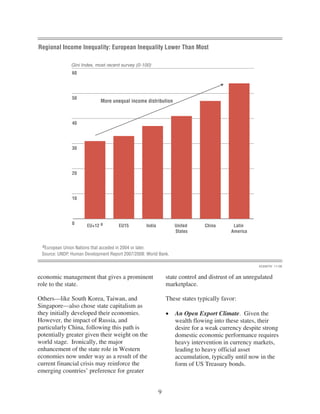
Regional Income Inequality: European Inequality Lower Than Most

               Gini Index, most recent survey (0-100)
               60


               50
                             More unequal income distribution


               40


               30


               20


               10


               0      EU+12 a        EU15          India          United       China      Latin
                                                                  States                 America


 aEuropean Union Nations that acceded in 2004 or later.
 Source: UNDP, Human Development Report 2007/2008: World Bank.

                                                                                                     423587AI 11-08


economic management that gives a prominent                     state control and distrust of an unregulated
role to the state.                                             marketplace.

Others—like South Korea, Taiwan, and                           These states typically favor:
Singapore—also chose state capitalism as
they initially developed their economies.                         An Open Export Climate. Given the
However, the impact of Russia, and                                wealth flowing into these states, their
particularly China, following this path is                        desire for a weak currency despite strong
potentially greater given their weight on the                     domestic economic performance requires
world stage. Ironically, the major                                heavy intervention in currency markets,
enhancement of the state role in Western                          leading to heavy official asset
economies now under way as a result of the                        accumulation, typically until now in the
current financial crisis may reinforce the                        form of US Treasury bonds.
emerging countries’ preference for greater


                                                           9
Globalization at Risk with the 2008 Financial Crisis?

As with most of the trends discussed in this report, the impacts from the financial crisis will
depend heavily on government leadership. Proactive fiscal and monetary policies probably will
ensure the current panic and likely deep national recessions will not turn into an extended
depression, although reduced economic growth could slow globalization’s pace, increasing
protectionist pressures and financial fragmentation.

The crisis is accelerating the global economic rebalancing. Developing countries have been hurt;
several, such as Pakistan with its large current account deficit, are at considerable risk. Even
those with cash reserves—such as South Korea and Russia—have been severely buffeted; steep
rises in unemployment and inflation could trigger widespread political instability and throw
emerging powers off course. However, if China, Russia, and Mideast oil exporters can avoid
internal crises, they will be in a position to leverage their likely still sizeable reserves, buying
foreign assets and providing direct financial assistance to still-struggling countries for political
favors or to seed new regional initiatives. In the West, the biggest change—not anticipated
before the crisis—is the increase in state power. Western governments now own large swaths of
their financial sectors and must manage them, potentially politicizing markets.

The crisis has increased calls for a new “Bretton Woods” to better regulate the global economy.
World leaders, however, will be challenged to renovate the IMF and devise a globally
transparent and effective set of rules that apply to differing capitalisms and levels of financial
institutional development. Failure to construct a new all-embracing architecture could lead
countries to seek security through competitive monetary policies and new investment barriers,
increasing the potential for market segmentation.


   Sovereign Wealth Funds (SWFs) and                    their economies and climb the value-
   Other State Investment Vehicles. Having              added ladder into high technology and
   amassed huge assets, Gulf Cooperation                service sectors. The significant difference
   Council (GCC) and Chinese officials have             between today’s efforts and those of
   increasingly used various forms of                   earlier periods, however, is that these
   sovereign investment. States entering                states now directly own the economic
   private markets are doing so partly for the          wherewithal to implement their plans and
   prospect of higher return. SWFs are the              need not rely on incentivizing parties or
   most widely publicized                               luring foreign capital.
   but only one of many sovereign
   investment vehicles.                                 Rollback of Privatization and the
                                                        Resurgence of State-Owned Enterprises
   Renewed Efforts Toward Industrial                    (SOEs). In the early 1990s, many
   Policy. Governments that highly manage               economists predicted that SOEs would be
   their economies often have an interest in            a relic of the 20th century. They were
   industrial policy. China, Russia, and the            wrong. SOEs are far from extinction, are
   Gulf states have state plans to diversify            thriving, and in many cases seek to


                                                 10
expand beyond their own borders,                    Indeed, the Wall Street events of 2008 mark
   particularly in the commodities and                 the opening chapters of a larger story of
   energy sectors. SOEs, especially national           rebalancing and course correction from these
   oil companies, are likely to attract                imbalances. The righting of these imbalances
   investment for the surfeit of ready capital         will be bumpy as the global economy moves
   that these states are accumulating. Much            into realignment. The difficulties of global
   like SWFs, SOEs serve a secondary                   economic policy coordination—in part a
   function as pressure valves, helping to             byproduct of the growing political and
   relieve inflation and currency appreciation         financial multipolarity—increase the chances
   pressures. They also can act as vehicles            of a bumpy ride.
   for increased political control. To the
   extent state-owned firms reach across               One of the following developments or a
   state borders, they may become vehicles             combination could cause an adjustment: a
   for geopolitical influence, particularly            slowdown in US consumption and an
   those dealing in key strategic resources            attendant increase in the US savings rate, and
   such as energy.                                     an increase in demand from emerging Asian
                                                       markets, particularly China and India.
The increasing role of the state as a player in        Whether imbalances stabilize or rebound out
emerging markets has contrasted until                  to 2025 depends in part on the particular
recently with nearly opposite trends in the            lessons that the emerging powers choose to
West, where the state has struggled to keep            draw from the financial crisis. Some may
pace with private financial engineering, such          interpret the crisis as a rationale for hoarding
as derivatives and credit swaps. The seeds of          yet more in the way of a cushion, while
this capital market’s depth and complexity             others—in understanding that few if any
date to the 1980s but grew with rising asset           emerging economies were immune from the
prices and bull markets from the 1990s until           widespread downturn—could come to regard
recently. The financial engineering—based              the stockpiling of reserves as less of a
upon a magnitude of leverage unthinkable               priority.
even a decade ago—in turn has injected an
unprecedented degree of risk and volatility            Major financial disruptions and the needed
into global markets. Greater controls and              economic and political readjustments have
international regulation—a possible outcome            often spread beyond the financial arena.
of the current financial crisis—could change           History suggests that this rebalancing will
this trajectory, although a gap on the role of         require long-term efforts to establish a new
the state in the economy is likely to remain           international system. Specific problems to be
between the West and the rapidly emerging              overcome include:
economic powers.
                                                          Greater Trade and Investment
Bumpy Ride in Correcting Current Global                   Protectionism. Increasingly aggressive
Imbalances                                                foreign acquisitions by corporations based
The refusal of emerging markets to allow                  in the rapidly emerging economies—
currency appreciation despite booming                     many will be state-owned—will raise
economies, together with the willingness of               political tensions, potentially creating a
the US to incur greater sums of debt, has                 public backlash in countries against
created a mutually supporting, albeit                     foreign trade and investment. The
ultimately unsustainable cycle of imbalances.             perception of uneven benefits from


                                                  11
globalization in the US may fuel                      unparalleled global reserve currency by
protectionist forces.                                 2025, and become a first among equals in
                                                      a market basket of currencies. This may
An Accelerated Resource Grab. The new                 force the US to consider more carefully
powers increasingly will have the means               how the conduct of its foreign policy
to acquire commodities in an effort to                affects the dollar. Without a steady
ensure continued development. Russia,                 source of external demand for dollars, US
China, and India have linked their national           foreign policy actions might bring
security to increased state control of and            exposure to currency shock and higher
access to energy resources and markets                interest rates for Americans.
through their state-owned energy firms.
Gulf states are interested in land leases          Growing use of the euro is already evident,
and purchases elsewhere to ensure                  potentially making it harder for the US in the
adequate food supplies.                            future to exploit the unique role of the dollar
                                                   in international trade and investment to freeze
Slowing Democratization. China,                    assets and disrupt the financial flows of its
particularly, offers an alternative model          adversaries, such as it recently has
for political development in addition to           accomplished with financial sanctions against
demonstrating a different economic                 the leadership in North Korea and Iran.
pathway. This model may prove                      Incentives and inclinations to move away
attractive to under-performing                     from the dollar will be tempered, however, by
authoritarian regimes, in addition to weak         uncertainties and instabilities in the
democracies frustrated by years of                 international financial system.
economic underperformance.
                                                   Multiple Financial Nodes
The Overshadowing of International                 Anchored by the US and EU in the West,
Financial Institutions. Sovereign wealth           Russia and the GCC states in Central Asia
funds have injected more capital into              and the Middle East, and China and
emerging markets than the IMF and                  eventually India in the East, the financial
World Bank combined, and this trend                landscape for the first time will be genuinely
could even continue with unwinding                 global and multipolar. Insomuch as the recent
global imbalances. China already is                financial crisis heightens interest in less
beginning to couple SWF investment with            leveraged finance, Islamic finance may also
direct aid and foreign assistance, often           see a boost. While such a global and
directly outbidding the World Bank on              multipolar financial order signals a relative
development projects. Such foreign                 decline for US power and a likely increase in
investment by newly rich states such as            market competition and complexity, these
China, Russia, and the GCC states will             downsides are likely to be accompanied by
lead to diplomatic realignments and new            many positives. Over time, and as they
relationships between these states and the         develop, these multiple financial centers may
developing world.                                  create redundancies that help insulate markets
                                                   against financial shocks and currency crises,
A Decline in the Dollar’s International            quelling their effects before global contagion
Role. Despite recent inflows into dollar           takes hold. Similarly, as regions become
assets and the appreciation of the dollar,         more invested in their financial epicenters,
the dollar could lose its status as an             incentives to preserve geopolitical stability to


                                              12
Science and Technology Leadership: A Test for the Emerging Powers

The relationship between achievements in science and technology and economic growth has
been long established, but the path is not always predictable. More significant is the overall
effectiveness of a nation’s National Innovation System (NIS)—the process by which intellectual
concepts are moved toward commercialization for the benefit of a national economy. According
to a NIC-contracted global survey of scientific experts, the United States currently boasts a
stronger innovation system than the developing economies of China and India.

   The idea of an NIS was first developed in the 1980s as an aid to understanding how some
   countries were proving better than others at turning intellectual concepts into commercial
   products that would boost their economies. The NIS model is evolving as information
   technology and the effect of increased globalization (and multinational corporations)
   influence national economies.
According to the NIC-commissioned study, nine factors can contribute to a modern NIS: fluidity
of capital, flexibility of the labor pool, government receptivity to business, information
communication technologies, private sector development infrastructure, legal systems to protect
intellectual property rights, available scientific and human capital, marketing skills, and cultural
propensity to encourage creativity.
China and India are expected in 10 years to achieve near parity with the US in two different
areas: scientific and human capital (India) and government receptivity to business innovation
(China). China and India will narrow significantly but not close the gap in all remaining factors.
The United States is expected to remain dominant in three areas: protection for intellectual
property rights, business sophistication to mature innovation, and encouragement of creativity.

Companies in China, India, and other major developing countries have unique opportunities to
be the first to develop a host of emerging technologies. This is especially the case in those
instances where companies are building new infrastructure and not burdened by historical
patterns of development. Such opportunities include distributed electrical power generation,
development of clean water sources, and the next generation of Internet and new information
technologies (such as ubiquitous computing and the Internet of Things—see the foldout). Early
and significant adoption of these technologies could provide considerable economic advantage.


shelter these financial flows will increase.          complicating Western efforts to lead and
History suggests, however, that such a                jointly grow the global economy.
redirection toward regional financial centers
could soon spill over into other areas of             Diverging Development Models, but for
power. Rarely, if ever, have such “financiers         How Long?
of last resort” been content to limit their           The state-centric model in which the state
influence to strictly financial realms. Inter-        makes the key economic decisions and, in the
regional tensions could divide the West with          case of China and increasingly Russia,
the US and EU having increasingly divergent           democracy is restricted, raises questions about
economic and monetary priorities,                     the inevitability of the traditional Western
                                                      recipe—roughly liberal economics and


                                                 13
democracy—for development. Over the next              over the next two decades is a particularly
15-20 years, more developing countries may            critical test for the long-term sustainability of
gravitate toward Beijing’s state-centric model        an alternative to the traditional Western
rather than the traditional Western model of          model. Although democratization probably
markets and democratic political systems to           will be slow and may have its own Chinese
increase the chances of rapid development             character, we believe the emerging middle
and perceived political stability. While we           class will press for greater political influence
believe a gap will remain, the enhanced role          and accountability of those in charge,
of the state in Western economies may also            particularly if the central government falters
lessen the contrast between the two models.           in its ability to sustain economic growth or is
                                                      unresponsive to growing “quality of life”
In the Middle East, secularism, which also has        issues such as increasing pollution or the need
been considered an integral part of the               for health and education services. The
Western model, increasingly may be seen as            government’s own efforts to boost S&T and
out of place as Islamic parties come into             establish a “high tech” economy will increase
prominence and possibly begin to run                  incentives for greater openness to develop
governments. As in today’s Turkey, we could           human capital at home and attract expertise
see both increased Islamization and greater           and ideas from outside.
emphasis on economic growth and
modernization.                                        Historical patterns evinced by other energy
                                                      producers suggest deflecting pressures for
“China, particularly, offers an alternative           liberalization will be easier for Russian
model for political development in addition           authorities. Traditionally, energy producers
to demonstrating a different economic                 also have been able to use revenues to buy off
pathway.”                                             political opponents; few have made the
                                                      transition to democracy while their energy
The lack of any overarching ideology and the          revenues remain strong.
mix-and-match of some of the elements—for
example Brazil and India are vibrant market           A sustained plunge in the price of oil and gas
democracies—means the state-centric model             would alter the outlook and increase prospects
does not yet constitute anything like an              for greater political and economic
alternative system and, in our view, is               liberalization in Russia.
unlikely ever to be one. Whether China
liberalizes both politically and economically


                                                 14
Latin America: Moderate Economic Growth, Continued Urban Violence

Many Latin American countries will have achieved marked progress in democratic consolidation
by 2025, and some of these countries will have become middle income powers. Others,
particularly those that have embraced populist policies, will lag behind—and some, such as
Haiti, will have become even poorer and still less governable. Public security problems will
continue to be intractable—and in some cases unmanageable. Brazil will become the leading
regional power, but its efforts to promote South American integration will be realized only in
part. Venezuela and Cuba will have some form of vestigial influence in the region in 2025, but
their economic problems will limit their appeal. Unless the United States is able to deliver
market access on a permanent and meaningful basis, the US could lose its traditionally privileged
position in the region, with a concomitant decline in political influence.

Steady economic growth between now and 2025—perhaps as high as 4 percent—will fuel
modest decreases in poverty levels in some countries and a gradual reduction of the informal
sector. Progress on critical secondary reforms, such as education, regressive tax systems, weak
property rights, and inadequate law enforcement will remain incremental and spotty. The
relative growing importance of the region as a producer of oil, natural gas, biofuels, and other
alternative energy sources will spur growth in Brazil, Chile, Colombia, and Mexico, but state
ownership and political turmoil will impede efficient development of energy resources. The
economic competitiveness of Latin America will continue to lag behind Asia and some other fast
growing areas.

Population growth in the region will be relatively moderate, but the rural poor and indigenous
populations will continue to grow at a faster rate. Latin America will have a graying population
as the growth rate of adults aged 60 and over rises.

Parts of Latin America will continue to be among the world’s most violent areas. Drug
trafficking organizations, sustained in part by increased local drug consumption, transnational
criminal cartels, and local crime rings and gangs, will continue to undermine public security.
These factors, and persistent weaknesses in the rule of law, will mean that a few small countries,
especially in Central America and the Caribbean, will verge on becoming failed states.

Latin America will continue to play a marginal role in the international system, except for its
participation in international trade and some peacekeeping efforts.

US influence in the region will diminish somewhat, in part because of Latin America’s
broadening economic and commercial relations with Asia, Europe, and other blocs. Latins, in
general, will look to the United States for guidance both globally and for relations with the
region. An increasingly numerous Hispanic population will ensure greater US attention to, and
involvement in, the culture, religion, economics, and politics of the region.


                                                15
Women as Agents of Geopolitical Change

Economic and political empowerment of women could transform the global landscape over the
next 20 years. This trend already is evident in the area of economics: The explosion in global
economic productivity in recent years has been driven as much by fostering human
resources—particularly through improvements in health, education, and employment
opportunities for women and girls—as by technological advances.

   The predominance of women in Southeast Asia’s export manufacturing sector is a likely key
   driver of that region’s economic success; women agricultural workers account for half the
   world’s food production—even without reliable access to land, credit, equipment, and
   markets.

   Over the next 20 years the increased entry and retention of women in the workplace may
   continue to mitigate the economic impacts of global aging.

Women in much of Asia and Latin America are achieving higher levels of education than
men, a trend that is particularly significant in a human capital-intensive global economy.

   Demographic data indicate a significant correlation between a higher level of female literacy
   and more robust GDP growth within a region (e.g., the Americas, Europe, and East Asia).
   Conversely, those regions with the lowest female literacy rates (southern and western Asia;
   the Arab world; and Sub-Saharan Africa) are the poorest in the world.

   Improved educational opportunities for girls and women also are a contributing factor to
   falling birth rates worldwide—and by extension better maternal health. The long-term
   implications of this trend likely include fewer orphans, less malnutrition, more children in
   school, and other contributions to societal stability.

Although data on women’s political involvement are less conclusive than those regarding
economic participation, political empowerment of women appears to change governmental
priorities. Examples as disparate as Sweden and Rwanda indicate that countries with
relatively large numbers of politically active women place greater importance on societal
issues such as healthcare, the environment, and economic development. If this trend continues
over the next 15-20 years, as is likely, an increasing number of countries could favor social
programs over military ones. Better governance also could be a spinoff benefit, as a high
number of women in parliament or senior government positions correlates with lower corruption.

Nowhere is the role of women potentially more important for geopolitical change than in the
Muslim World. Muslim women do far better assimilating in Europe than their male relatives,
partly because they flourish in the educational system, which facilitates their entry into jobs in
information or service industries. Sharply declining fertility rates among Muslims in Europe
demonstrate this willingness to accept jobs outside the home and a growing refusal to conform to
traditional norms. In the short term, the decline of traditional Muslim family structures may help
explain the openness of many young Muslim men to radical Islamic messages. However, in

                                                                      (Continued on next page…)


                                               16
(Continued…)

rearing future generations, women might help show the way to greater social assimilation and
reduce the likelihood of religious extremism. The impact of growing numbers of women in the
workplace may also have an impact outside Europe. The modernizing countries of the Islamic
Mediterranean have close ties to Europe, to which these countries have sent many migrants.
Migrants return to visit or resettle and bring with them new ideas and expectations. These
Islamic countries also receive foreign influences from European mass media, through satellite
dishes and the Internet.


             Higher Education Shaping the Global Landscape in 2025

As global business grows increasingly borderless and labor markets more seamless, education
has become a key determinant of countries’ economic performance and potential. Adequate
primary education is essential, but the quality and accessibility of secondary and higher
education will be even more important for determining whether societies successfully graduate
up the value-added production ladder.

The US lead in highly skilled labor will likely narrow as large developing countries, particularly
China, begin to reap dividends on recent investments in human capital, including education but
also nutrition and healthcare. India faces a challenge because inadequate primary education is
widespread in the poorer regions and top-flight educational institutions cater to a relatively
privileged few. Funding as a proportion of GDP has grown to around 5 percent in most
European countries, although few European universities are rated as world class. Spending on
education in the Arab world is roughly on par with the rest of the world in absolute terms and
surpasses the global mean as a percentage of GDP, lagging only slightly behind OECD high-
income countries. UN data and research findings by other institutions suggest, however that
training and education of Middle Eastern youth is not driven by the needs of employers,
especially for science and technology. There are some signs of progress.

The US may be uniquely able to adapt its higher education and research system to rising global
demand and position itself as a world education hub for the growing number of students that will
enter the education market out to 2025. Although further opening of US classrooms and
laboratories could mean greater competition for US students, the US economy would likely
benefit because companies tend to base their operations near available human capital. Continued
export of US educational models with the building of US campuses in the Middle East and
Central Asia could boost the attractiveness and global prestige of US universities.


                                                17
its current population of over 1.3 billion.
Trends in birth, death, and migration are                (See graphic on page 22.)
changing the absolute and relative size of
young and old, rural and urban, and ethnic               In aggregate, the countries of Sub-Saharan
majority and minority populations within and             Africa are projected to add about 350
among emerging and established powers.                   million people during the same period,
These demographic reconfigurations will                  while those in Latin America and the
offer social and economic opportunities for              Caribbean will increase by about 100
some powers and severely challenge                       million.
established arrangements in others. The
populations of more than 50 countries will
                                                         Between now and 2025, Russia, Ukraine,
increase by more than a third (some by more
                                                         Italy, almost all countries in Eastern
than two-thirds) by 2025, placing additional
                                                         Europe, and Japan are expected to see
stresses on vital natural resources, services,
                                                         their populations decline by several
and infrastructure. Two-thirds of these
                                                         percent. These declines could approach or
countries are in Sub-Saharan Africa; most of
                                                         exceed 10 percent of the current
the remaining fast-growing countries are in
                                                         populations in Russia, Ukraine, and a few
the Middle East and South Asia.
                                                         other Eastern European countries.
Populations Growing, Declining, and
                                                         The populations of the US, Canada,
Diversifying—at the Same Time
                                                         Australia, and a few other industrial states
World population is projected to grow by
                                                         with relatively high immigration rates will
about 1.2 billion between 2009 and 2025—
                                                         continue to grow—the US by more than
from 6.8 billion to around 8 billion people.
                                                         40 million, Canada by 4.5 million, and
Although the global population increase is
                                                         Australia by more than 3 million.
substantial—with concomitant effects on
resources—the rate of growth will be slower
                                                      By 2025, the already diverse array of national
than it was, down from levels that added 2.4
                                                      population age structures promises to be more
billion persons between 1980 and today.
                                                      varied than ever, and the gap between the
Demographers project that Asia and Africa
                                                      youngest and oldest profiles will continue to
will account for most of the population
                                                      widen. The “oldest” countries—those in
growth out to 2025 while less than 3 percent
                                                      which people under age 30 form less than
of the growth will occur in the “West”—
                                                      one-third of the population—will mark a band
Europe, Japan, the United States, Canada,
                                                      across the northern edge of the world map. In
Australia, and New Zealand. In 2025,
                                                      contrast, the “youngest” countries, where the
roughly 16 percent of humanity will live in
                                                      under-30 group represents 60 percent of the
the West, down from the 18 percent in 2009
                                                      population or more, will nearly all be located
and 24 percent in 1980.
                                                      in Sub-Saharan Africa. (See maps on page
                                                      20.)
   The largest increase will occur in India,
   representing about one-fifth of all growth.
   India’s population is projected to climb by
   around 240 million by 2025, reaching
   approximately 1.45 billion people. From
   2009 to 2025, Asia’s other giant, China, is
   projected to add more than 100 million to


                                                 19
World Age Structure, 2005 and Projected 2025

                            2005


                                                    Percentage of Population
                                                    Younger Than 30 Years Old
                                                             60 or more
                                                             45 to 59
                                                             30 to 44
                                                             Less than 30
                            2025
                                                             No data


  Source: US Census data.

                                                                    784355AI (G00975) 11-08


                                               20
The Pensioner Boom: Challenges of Aging                replacement level in Western Europe, the
Populations                                            ratio of seniors to people in their working
Population aging has brought today’s                   years would continue to rise steadily through
developed countries—with a few exceptions              the late 2030s. In Japan, it would continue to
such as the US—to a demographic “tipping               rise through the late 2040s.
point.” Today, nearly 7 out of every 10
people in the developed world are in the               The annual level of net immigration would
traditional working years (ages 15 to 64)—a            have to double or triple to keep working-age
high-tide mark. This number has never                  populations from shrinking in Western
before been so high and, according to experts,         Europe. By 2025, non-European minority
in all likelihood will never be so high again.         populations could reach significant
                                                       proportions—15 percent or more—in nearly
In almost every developed country, the period          all Western European countries and will have
of most rapid growth in the ratio of seniors           a substantially younger age structure than the
(age 65 and older) to the working-age                  native population (see page 20). Given
population will occur during the 2010s and             growing discontent with current levels of
2020s, boosting the fiscal burden of old-age           immigrants among native Europeans, such
benefit programs. By 2010, there will be               steep increases are likely to heighten tensions.
about one senior for every four working-age
people in the developed world. By 2025, this           The aging of societies will have economic
ratio will have climbed to one to three, and           consequences. Even with productivity
possibly higher.                                       increases, slower employment growth from a
                                                       shrinking work force probably will reduce
   Japan is in a difficult position: its               Europe’s already tepid GDP growth by 1
   working-age population has been                     percent. By the 2030s, Japan’s GDP growth
   contracting since the mid-1990s and its             is projected to drop to near zero according to
   overall population since 2005. Today’s              some models. The cost of trying to maintain
   projections envision a society in which, by         pensions and health coverage will squeeze out
   2025, there will be one senior for every            expenditures on other priorities, such as
   two working-age Japanese.                           defense.

   The picture for Western Europe is more              Persistent Youth Bulges
   mixed. The UK, France, Belgium, the                 Countries with youthful age structures and
   Netherlands, and the Nordics will likely            rapidly growing populations form a crescent
   maintain the highest fertility rates in             stretching from the Andean region of Latin
   Europe but will remain below two                    America across Sub-Saharan Africa, the
   children per woman. In the rest of the              Middle East and the Caucasus, and then
   region, fertility probably will stay below          through the northern parts of South Asia. By
   1.5 children per woman, on par with Japan           2025, the number of countries in this “arc of
   (and well below the replacement level of            instability” will have decreased by 35 to 40
   2.1 children per woman).                            percent owing to declining fertility and
                                                       maturing populations. Three quarters of the
Large and sustained increases in the fertility         three dozen “youth bulge countries” projected
rate, even if they began now, would not                to linger beyond 2025 will be located in Sub-
reverse the aging trend for decades in Europe          Saharan Africa. The remainder will be
and Japan. If fertility rose immediately to the


                                                  21
Total Population

Billion people
                          Now       2025
2.0


1.5


1.0


0.5


0         China          India      Iran          Japan       Russia   Western Europe    US


Source: US Census Data

                                                                                          423712ID 11-08


located in the Middle East and scattered                  and adjacent Afghanistan and Pakistan
across Asia and among the Pacific Islands.                will persist through 2025. Unless
                                                          employment conditions change
      The emergence of new economic tigers by             dramatically, youth in weak states will
      2025 could occur where youth bulges                 continue to go elsewhere—externalizing
      mature into “worker bulges.” Experts                volatility and violence.
      argue that this demographic bonus is most
      advantageous when the country provides           The populations of already parlous youth-
      an educated work force and a business-           bulge states—such as Afghanistan,
      friendly environment for investment.             Democratic Republic of Congo (DROC),
      Potential beneficiaries include Turkey,          Ethiopia, Nigeria, Pakistan, and Yemen—are
      Lebanon, Iran, and the Maghreb states of         projected to remain on rapid-growth
      North Africa (Morocco, Algeria and               trajectories. Pakistan’s and Nigeria’s
      Tunisia), Colombia, Costa Rica, Chile,           populations are each projected to grow by
      Vietnam, Indonesia, and Malaysia.                about 55 million people. Ethiopia and DROC
                                                       will likely add about 40 million each, while
      The current youth bulges in the Maghreb          the populations of Afghanistan and Yemen
      states, Turkey, Lebanon, and Iran will           are projected to grow more than 50 percent
      diminish rapidly but those in the West           larger than today’s. All will retain age
      Bank/Gaza, Iraq, Yemen, Saudi Arabia             structures with large proportions of young


                                                  22
The Impact of HIV/AIDS                             Europe will continue to attract migrants
                                                          from younger, less developed, and faster
Neither an effective HIV vaccine nor a self-              growing African and Asian regions
administered microbicide, even if developed               nearby. However, other emerging centers
and tested before 2025, will likely be widely             of industrialization—China and southern
disseminated by then. Although prevention                 India and possibly Turkey and Iran—
efforts and local behavioral changes will                 could attract some of this labor migration
depress infection rates globally, experts                 as growth among their working-age
expect HIV/AIDS to remain a global                        populations slows and wages rise.
pandemic through 2025 with its epicenter of
infection in Sub-Saharan Africa. Unlike                   Labor migration to the United States
today, the vast majority of people living with            probably will slow as Mexico’s industrial
HIV will have access to life-extending anti-              base grows and its population ages—a
retroviral therapies.                                     response to rapid fertility declines in the
                                                          1980s and 1990s—and as competing
   If prevention efforts and effectiveness                centers of development arise in Brazil and
   remain at current levels, the HIV-positive             the southern cone of South America.
   population is expected to climb to around
   50 million by 2025—up from 33 million               Urbanization. If current trends persist, by
   today (22 million in Sub-Saharan Africa).           2025 about 57 percent of the world’s
   In this scenario, 25 million to 30 million          population will live in urban areas, up from
   people would need anti-retroviral therapy           about 50 percent today. By 2025, the world
   to survive during 2025.                             will add another eight megacities to the
                                                       current list of 19—all except one of these
   In another scenario assuming fully scaled-          eight will be in Asia and Sub-Saharan Africa.
   up prevention by 2015, the HIV-infected             Most urban growth, however, will occur in
   population would peak and then fall to              smaller cities of these regions, which are
   near 25 million worldwide by 2025,                  expanding along highways and coalescing
   bringing the number needing anti-                   near crossroads and coastlines, often without
   retroviral therapy to between 15 and 20             formal sector job growth and without
   million people.                                     adequate services.

                                                       Identity Demography. Where ethno-religious
adults, a demographic feature that is                  groups have experienced their transition to
associated with the emergence of political             lower birth rates at varying paces, lingering
violence and civil conflict.                           ethnic youth bulges and shifts in group
                                                       proportions could trigger significant political
Changing Places: Migration, Urbanization               changes. Shifts in ethno-religious
and Ethnic Shifts                                      composition resulting from migration also
Moving Experiences. The net migration of               could fuel political change, particularly where
people from rural to urban areas and from              immigrants settle in low-fertility
poorer to richer countries likely will continue        industrialized countries.
apace in 2025, fueled by a widening gap in
economic and physical security between                    Differing rates of growth among Israel’s
adjacent regions.                                         ethnic communities could abet political
                                                          shifts in the Knesset (Israel’s parliament).


                                                  23
By 2025, Israeli Arabs, who currently              East, and South Asia (see box on page 25).
   comprise a fifth of the population, will           Immigration and integration politics, and
   comprise about a quarter of Israel’s               confrontations with Muslim conservatives
   expected population of nearly 9 million.           over education, women’s rights, and the
   Over the same period, Israel’s ultra-              relationship between the state and religion are
   orthodox Jewish community could nearly             likely to strengthen right-of-center political
   double, becoming larger than 10 percent            organizations and splinter the left-of-center
   of the population.                                 political coalitions that were instrumental in
                                                      building and maintaining Europe’s welfare
   Irrespective of their political status in          states.
   2025, the populations of the West Bank,
   currently about 2.6 million people, and            By 2025, international migration’s human
   Gaza, now at 1.5 million, will have grown          capital and technological transfer effects will
   substantially: the West Bank by nearly 40          begin to favor the most stable Asian and Latin
   percent; Gaza by almost 60 percent. Their          American countries. Although the emigration
   combined population in 2025—still                  of professionals probably will continue to
   youthful, growing, and approaching 6               deprive poor and unstable countries across
   million (or exceeding that figure,                 Africa and parts of the Middle East of talent,
   according to some projections)—promises            the likely return of many wealthy and
   to introduce further challenges to                 educated Asian and Latin Americans from the
   institutions hoping to generate adequate           US and Europe will help boost the
   employment and public services, maintain           competitiveness of China, Brazil, India, and
   sufficient availability of fresh water and         Mexico.
   food, and achieve political stability.
                                                      Demographic Portraits: Russia, China,
A number of other ethnic shifts between now           India, and Iran
and 2025 will have regional implications. For         Russia: A Growing Multiethnic State?
example, growing proportions of Native                Currently a country with around 141 million
Americans in several Andean and Central               people, Russia’s demographically aging and
American democracies are likely to continue           declining population is projected to drop
to push governments in those countries                below 130 million by 2025. The chances of
toward populism. In Lebanon, ongoing                  stemming such a steep decline over this
fertility decline in the Shiite population,           period are slim: the population of women in
which currently lags ethnic neighbors in              their 20s—their prime childbearing years—
income and exceeds them in family size, will          will be declining rapidly, numbering around
bring about a more mature age structure in            55 percent of today’s count by 2025.
this community—and could deepen Shiite
integration into the mainstream of Lebanese           Russia’s high rate of male middle-age
economic and political life, easing communal          mortality is unlikely to change dramatically.
tensions.                                             Muslim minorities that have maintained
                                                      higher fertility will comprise larger
Western Europe has become the destination             proportions of the Russian population, as will
of choice for more than one million                   Turkic and Chinese immigrants. According
immigrants annually and home for more than            to some more conservative projections, the
35 million foreign born—many from Muslim-             Muslim minority share of Russia’s population
majority countries in North Africa, the Middle        will rise from 14 percent in 2005 to 19


                                                 24
Muslims in Western Europe

Western Europe’s Muslim population currently totals between 15 and 18 million. The largest
proportions of Muslims—between 6 and 8 percent—are in France (5 million) and the
Netherlands (nearly 1 million), followed by countries with 4 to 6 percent: Germany (3.5 million),
Denmark (300,000), Austria (500,000), and Switzerland (350,000). The UK and Italy also have
relatively large Muslim populations, 1.8 million and 1 million respectively, though constituting
less overall proportions (3 percent and 1.7 percent respectively). If current patterns of
immigration and Muslim residents’ above-average fertility continue, Western Europe could have
25 to 30 million Muslims by 2025.

Countries with growing numbers of Muslims will experience a rapid shift in ethnic composition,
particularly around urban areas, potentially complicating efforts to facilitate assimilation and
integration. Economic opportunities are likely to be greater in urban areas, but, in the absence of
growth in suitable jobs, the increasing concentration could lead to more tense and unstable
situations, such as occurred with the 2005 Paris surburban riots.

Slow overall growth rates, highly regulated labor markets, and workplace policies, if maintained,
will make it difficult to increase job opportunities, despite Europe’s need to stem the decline of
its working-age population. When coupled with job discrimination and educational
disadvantage, these factors are likely to confine many Muslims to low-status, low-wage jobs,
deepening ethnic cleavages. Despite a sizeable stratum of integrated Muslims, a growing
number—driven by a sense of alienation, grievance, and injustice—are increasingly likely to
value separation in areas with Muslim-specific cultural and religious practices.

Although immigrant communities are unlikely to gain sufficient parliamentary representation to
dictate either domestic or foreign policy agendas by 2025, Muslim-related issues will be a
growing focus and shaper of the European political scene. Ongoing societal and political tension
over integration of Muslims is likely to make European policymakers increasingly sensitive to
the potential domestic repercussions of any foreign policies for the Middle East, including
aligning too closely with the US on policies seen as pro-Israeli.


percent in 2030, and 23 percent in 2050. In a        population. The advantageous condition of
shrinking population, the growing proportion         having a relatively large working population
that are not Orthodox Slavs will likely              and small proportions of both old-age and
provoke a nationalist backlash. Because              childhood dependents will begin to fade
Russia’s fertility and mortality problems are        around 2015, when the size of China’s
likely to persist through 2025, Russia’s             working-age population will start to decline.
economy—unlike Europe’s and Japan’s—will             Demographic aging—the onset of larger
have to support the large proportion of              proportions of retirees and relatively fewer
dependents.                                          workers—is being accelerated by decades of
                                                     policies that have limited childbirth and by a
Antique China? By 2025, demographers                 tradition of early retirement. By opting to
expect China to have almost 1.4 billion              slow population growth dramatically in order
people, nearly 100 million above its current         to dampen growing demand for energy, water,


                                                25
and food, China is hastening the aging of its           will largely dissipate over the next decade,
population. By 2025, a large proportion of              yielding more mature population and work
China’s population will be retired or entering          force growth rates comparable to current rates
retirement. Although China may over time                in the US and China (near 1 percent per year).
reverse its restrictive policies on childbearing        In this time frame, the working-age
to achieve birth cohorts more closely                   population will grow large relative to
balancing infant girls and boys, marriage-age           children, creating opportunities to accumulate
adults in 2025 will still experience a                  savings, better educate, and eventually to shift
significant male-dominated imbalance that               to more technical industries and raise living
will create a large pool of unmarried males.            standards. Whether Iran capitalizes on this
                                                        demographic bonus depends on the country’s
Two Indias. India’s current fertility rate of           political leadership, which at present is
2.8 children per woman masks vast                       unfriendly to markets and private businesses,
differences between the low-fertility states of         unsettling for investors, and more focused on
South India and the commercial hubs of                  oil revenues than on broader job creation.
Mumbai, Delhi, and Kolkata on the one hand,
and the higher rates of populous states in the          Two additional demographic near-certainties
so-called Hindi-speaking belt across the                are apparent: first, despite low fertility, Iran’s
north, where women’s status is low and                  population of 66 million will grow to around
services lag. Largely owing to growth in                77 million by 2025. Second, by then, a new
India’s densely populated northern states, its          youth bulge (an echo produced by births
population is projected to overtake China’s             during the current one) will be ascending—
around 2025—just as China’s population is               but in this one, 15-to-24 year olds will
projected to peak and begin a slow decline.             account for just one-sixth of those in the
                                                        working age group compared to one third
By then, India’s demographic duality will               today. Some experts believe this echo bulge
have widened the gap between north and                  signals a resurgence of revolutionary politics.
south. By 2025, much of India’s work force              Others speculate that, in the more educated
growth will come from the most poorly                   and developed Iran of 2025, young adults will
educated, impoverished, and crowded districts           find career and consumption more attractive
of rural northern India. Although North                 than extremist politics. Only one aspect of
Indian entrepreneurial families have lived for          Iran’s future is sure: its society will be more
decades in southern cities, the arrival of              demographically mature than ever before and
whole communities of Hindi-speaking                     strikingly different than its neighbors.
unskilled laborers looking for work could
rekindle dormant animosities between India’s
central government and ethno-nationalist
parties in the South.

Iran’s Unique Trajectory. Having
experienced one of the most rapid fertility
declines in history—from more than six
children per woman in 1985 to less than two
today—Iran’s population is destined for
dramatic changes by 2025. The country’s
politically restless, job-hungry youth bulge


                                                   26
This page left intentionally blank.


                27
difficult. Demography is not always destiny,
By 2025, the United States will find itself in                but diversifying the economy so that Russia
the position of being one of a number of                      can maintain its standing after the world
important actors on the world stage, albeit                   transitions away from dependence on fossil
still the most powerful one. The relative                     fuel will be central to its long-term prospects.
political and economic clout of many                          Europe and Japan also will be confronting
countries will shift by 2025, according to an                 demographic challenges; decisions taken now
International Futures model measuring GDP,                    are likely to determine their long-term
defense spending, population, and technology                  trajectories.
for individual states (see graphic on page
28).6 Historically, emerging multipolar                       Although the rise of no other state can equal
systems have been more unstable than bipolar                  the impact of the rise of such populous states
or even unipolar ones; the greater diversity                  as China and India, other countries with
and growing power of more countries                           potentially high-performing economies—Iran,
portends less cohesiveness and effectiveness                  Indonesia, and Turkey, for example—could
for the international system. Most emerging                   play increasingly important roles on the world
powers already want a greater say and, along                  stage and especially for establishing new
with many Europeans, dispute the notion of                    patterns in the Muslim world.
any one power having the right to be a
hegemon. The potential for less cohesiveness                  “Few countries are poised to have more
and more instability also is suggested by the                 impact on the world over the next 15-20
relatively steeper declines in national power                 years than China.”
of Europe and Japan.
                                                              Rising Heavyweights: China and India
Although we believe chances are good that                     China: Facing Potential Bumps in the
China and India will continue to rise, their                  Road. Few countries are poised to have more
ascent is not guaranteed and will require                     impact on the world over the next 15-20 years
overcoming high economic and social                           than China. If current trends persist, by 2025
hurdles. Because of this, both countries are                  China will have the world’s second largest
likely to remain inwardly focused and per                     economy and will be a leading military
capita wealth will lag substantially behind                   power. It could also be the largest importer of
Western economies throughout the period to                    natural resources and an even greater polluter
2025 and beyond. Individuals in these                         than it is now.
emerging economic powerhouses are likely to
feel still poor in relation to Westerners even                   US security and economic interests could
though their collective GDP increasingly will                    face new challenges if China becomes a
outdistance those of individual Western                          peer competitor that is militarily strong as
states. For Russia, remaining in the top tier                    well as economically dynamic and energy
where it has been since its remarkable                           hungry.
resurgence during the late 1990s and early
part of the 21st century may be extremely                     The pace of China’s economic growth almost
                                                              certainly will slow, or even recede, even with
6
 National Power scores are the product of an index            additional reforms to address mounting social
combining the weighted factors of GDP, defense
spending, population, and technology. Scores are
                                                              pressures arising from growing income
calculated by the International Futures computer model        disparities, a fraying social safety net, poor
and are expressed as a state’s relative share                 business regulation, hunger for foreign
(percentage) of all global power.


                                                         29
energy, enduring corruption, and                      criticism by blaming China’s woes on foreign
environmental devastation. Any of these               interference, stoking the more virulent and
problems might be soluble in isolation, but           xenophobic forms of Chinese nationalism.
the country could be hit by a “perfect storm”
if many of them demand attention at the same             Historically, people who become
time. Even if the Chinese Government can                 accustomed to rising living standards react
manage to address these issues, it will not              angrily when their expectations are no
have the ability to assure high levels of                longer met, and few people have had
economic performance. Most of China’s                    grounds for such high expectations as do
economic growth will continue to be                      the Chinese.
domestically driven, but key sectors rely on
foreign markets, resources, and technology as            China’s international standing is based
well as globalized production networks. As a             partly on foreigners’ calculations that it is
result, China’s economic health will be                  “the country of the future.” If foreigners
affected by that of other economies—                     treat the country less deferentially,
particularly the United States and the EU.               nationalistic Chinese could respond
                                                         angrily.
In addressing these challenges, Chinese
leaders must balance the openness necessary           India: A Complicated Rise. Over the next
to sustain economic growth—essential to               15-20 years, Indian leaders will strive for a
public tolerance for the Communist Party’s            multipolar international system, with New
monopoly of political power—against the               Delhi as one of the poles and serving as a
restrictions necessary to protect that                political and cultural bridge between a rising
monopoly. Facing so many social and                   China and the United States. India’s growing
economic changes, the Communist Party and             international confidence, derived primarily
its position are likely to undergo further            from its economic growth and its successful
transformations. Indeed, Communist Party              democratic record, now drives New Delhi
leaders themselves talk openly about the need         toward partnerships with many countries.
to find new ways to retain public acceptance          However, these partnerships are aimed at
of the Party’s dominant role. So far, however,        maximizing India’s autonomy, not at aligning
these efforts do not appear to include opening        India with any country or international
the system to free elections and a free press.        coalition.
Moreover, barring the “perfect storm”
described above, we do not foresee social             India probably will continue to enjoy
pressures forcing real democracy in China by          relatively rapid economic growth. Although
2025. That said, the country could be moving          India faces lingering deficiencies in its
toward greater political pluralism and more           domestic infrastructure, skilled labor, and
accountable governance.                               energy production, we expect the nation’s
                                                      rapidly expanding middle class, youthful
Chinese leaders could, however, continue              population, reduced reliance on agriculture,
managing tensions by achieving significant            and high domestic savings and investment
growth without jeopardizing the Party’s               rates to propel continued economic growth.
political monopoly, as they have for the past         India’s impressive economic growth over the
three decades. Although a protracted slump            past 15 years has reduced the number of
could pose a serious political threat, the            people living in absolute poverty, but the
regime would be tempted to deflect public


                                                 30
growing gap between rich and poor will                   military also will be eager to benefit from
become a more important political issue.                 expanded defense ties with Washington.
                                                         Indian leaders, however, probably will avoid
We believe Indians will remain strongly                  ties that could resemble an alliance
committed to democracy, but the polity could             relationship.
become more fragmented and fractious, with
national power being shared across successive            “Russia has the potential to be richer, more
political coalitions. Future elections are likely        powerful, and more self-assured in
to be multi-sided affairs yielding awkward               2025….[but] multiple constraints could limit
coalitions with unclear mandates. The                    Russia’s ability to achieve its full economic
general direction of India’s economic                    potential.”
policymaking is unlikely to be reversed, but
the pace and scale of reform will fluctuate.             Other Key Players
                                                         Russia’s Path: Boom or Bust. Russia has the
Regional and ethnic insurgencies that have               potential to be richer, more powerful, and
plagued India since independence are likely to           more self-assured in 2025 if it invests in
persist, but they will not threaten India’s              human capital, expands and diversifies its
unity. We assess New Delhi will remain                   economy, and integrates with global markets.
confident that it can contain the Kashmiri               On the other hand, multiple constraints could
separatist movement. However, India is                   limit Russia’s ability to achieve its full
likely to experience heightened violence and             economic potential. Chief among them are a
instability in several parts of the country              shortfall in energy investment, key
because of the growing reach of the Maoist               infrastructure bottlenecks, decaying education
Naxalite movement.                                       and public health sectors, an underdeveloped
                                                         banking sector, and crime and corruption. A
Indian leaders do not see Washington as a                sooner-than-expected conversion to
military or economic patron and now believe              alternative fuels or a sustained plunge in
the international situation has made such a              global energy prices before Russia has the
benefactor unnecessary. New Delhi will,                  chance to develop a more diversified
however, pursue the benefits of favorable US             economy probably would constrain economic
ties, partly, too, as a hedge against any                growth.
development of hostile ties with China.
Indian policymakers are convinced that US                Russia’s population decline by 2025 will
capital, technology, and goodwill are essential          force hard policy choices. By 2017, for
to India’s continued rise as a global power.             example, Russia is likely to have only
The United States will remain one of India’s             650,000 18-year-old males from which to
largest export destinations, the key to                  maintain an army that today relies on 750,000
international financial institutions such as the         conscripts. Population decline also could take
World Bank and foreign commercial lending,               an economic toll with severe labor force
and the largest source of remittances. The               shortages, particularly if Russia does not
Indian diaspora—composed largely of highly               invest more in its existing human capital,
skilled professionals—will remain a key                  rebuild its S&T base, and employ foreign
element in deepening US-Indian ties. The                 labor migrants.
Indian market for US goods will grow
substantially as New Delhi reduces                       If Russia diversifies its economy, it could
restrictions on trade and investment. India’s            develop a more pluralistic, albeit not


                                                    31
democratic, political system—the result of              resolve a perceived democracy gap dividing
institutional consolidation, a rising middle            Brussels from European voters and move past
class, and the emergence of new stakeholders            the protracted debate about its institutional
demanding a greater voice.                              structures.

A more proactive and influential foreign                The EU will be in a position to bolster
policy seems likely, reflecting Moscow’s                political stability and democratization on
reemergence as a major player on the world              Europe’s periphery by taking in additional
stage; an important partner for Western,                new members in the Balkans, and perhaps
Asian, and Middle East capitals; and a leading          Ukraine and Turkey. However, continued
force in opposition to US global dominance.             failure to convince skeptical publics of the
Controlling key energy nodes and links in the           benefits of deeper economic, political, and
Caucasus and Central Asia—vital to its                  social integration and to grasp the nettle of a
ambitions as an energy superpower—will be a             shrinking and aging population by enacting
driving force in reestablishing a sphere of             painful reforms could leave the EU a hobbled
influence in its Near Abroad. Shared                    giant distracted by internal bickering and
perceptions regarding threats from terrorism            competing national agendas, and less able to
and Islamic radicalism could align Russian              translate its economic clout into global
and Western security policies more tightly,             influence.
notwithstanding disagreements on other
issues and a persisting “values gap.”                   The drop-off in working-age populations will
                                                        prove a severe test for Europe’s social welfare
The range of possible futures for Russia                model, a foundation stone of Western
remains wide because of starkly divergent               Europe’s political cohesion since World
forces—liberal economic trends and illiberal            War II. Progress on economic liberalization
political trends. The tension between the two           is likely to continue only in gradual steps until
trends—together with Russia’s sensitivity to            aging populations or prolonged economic
potential discontinuities sparked by political          stagnation force more dramatic changes—a
instability, a major foreign policy crisis, or          crisis point that may not hit before some time
other wild cards—makes it impossible to                 in the next decade and might be pushed off
exclude alternative futures such as a                   even further. There are no easy fixes for
nationalistic, authoritarian petro-state or even        Europe’s demographic deficits except likely
a full dictatorship, which is an unlikely but           cutbacks in health and retirement benefits,
nevertheless plausible future. Less likely,             which most states have not begun to
Russia could become a significantly more                implement or even to contemplate. Defense
open and progressive country by 2025.                   expenditures are likely to be cut further to
                                                        stave off the need for serious restructuring of
Europe: Losing Clout in 2025. We believe                social benefits programs. The challenge of
Europe by 2025 will have made slow progress             integrating immigrant, especially Muslim,
toward achieving the vision of current leaders          communities will become acute if citizens
and elites: a cohesive, integrated, and                 faced with a sudden lowering of expectations
influential global actor able to employ                 resort to more narrow nationalism and
independently a full spectrum of political,             concentrate on parochial interests, as
economic, and military tools in support of              happened in the past.
European and Western interests and universal
ideals. The European Union would need to


                                                   32
Europe’s strategic perspective is likely to           attentiveness to Moscow’s interests by key
remain narrower than Washington’s, even if            countries, including Germany and Italy, who
the EU succeeds in making reforms that                see Russia as a reliable supplier. Europe
create a “European President” and “European           could pay a price for its heavy dependence,
Foreign Minister” and develops greater                especially if Russian firms are unable to fulfill
institutional capacity for crisis management.         contract commitments because of
Divergent threat perceptions within Europe            underinvestment in their natural gas fields or
and the likelihood that defense spending will         if growing corruption and organized criminal
remain uncoordinated suggest the EU will not          involvement in the Eurasian energy sector
be a major military power by 2025. The                spill over to infect Western business interests.
national interests of the bigger powers will
continue to complicate EU foreign and                 Japan: Caught Between the US and China.
security policy and European support for              Japan will face a major reorientation of its
NATO could erode.                                     domestic and foreign policies by 2025 yet
                                                      maintain its status as an upper middle rank
The question of Turkey’s EU membership                power. Domestically, Japan’s political,
will be a test of Europe’s outward focus              social, and economic systems will likely be
between now and 2025. Increasing doubts               restructured to address its demographic
about Turkey’s chances are likely to slow its         decline, an aging industrial base, and a more
implementation of political and human rights          volatile political situation. Japan’s decreasing
reforms. Any outright rejection risks wider           population may force authorities to consider
repercussions, reinforcing arguments in the           new immigration policies like a long-term
Muslim world—including among Europe’s                 visa option for visiting workers. The
Muslim minorities—about the incompatibility           Japanese, however, will have difficulty
of the West and Islam. Crime could be the             overcoming their reluctance to naturalize
gravest threat inside Europe as Eurasian              foreigners. The aging of the population also
transnational organizations—flush from                will spur development in Japan’s healthcare
involvement in energy and mineral                     and housing systems to accommodate large
concerns—become more powerful and                     numbers of dependent elderly.
broaden their scope. One or more
governments in Eastern or Central Europe              The shrinking work force—and Japan’s
could fall prey to their domination.                  cultural aversion to substantial immigrant
                                                      labor—will put a major strain on Japan’s
Europe will remain heavily dependent on               social services and tax revenues, leading to
Russia for energy in 2025, despite efforts to         tax increases and calls for more competition
promote energy efficiency and renewable               in the domestic sector to lower the price of
energy and lower greenhouse gas emissions.            consumer goods. We anticipate continued
Varying levels of dependence, differing               restructuring of Japan’s export industries,
perspectives on Russia’s democratic maturity          with increased emphasis on high technology
and economic intentions, and failure to               products, value-added production, and
achieve consensus on Brussels’ role are               information technologies. The shrinking of
hampering nascent efforts to develop common           Japan’s agricultural sector will continue,
EU polices on energy diversification and              perhaps down to just 2 percent of the labor
security. In the absence of a collective              force, with a corresponding increase in
approach that would reduce Russia’s                   payments for food imports. The working-age
leverage, this dependence will foster constant        population, declining in absolute numbers,


                                                 33
includes a large number of unemployed and              its own national power through advanced
untrained citizens in their late teens and 20s.        military hardware. Tokyo would assume
This could lead to a shortage of white collar          strong support from Washington in this
workers.                                               circumstance and would move to shape
                                                       political and economic forums in the
With increasing electoral competition, Japan’s         region to isolate or limit Chinese
one-party political system probably will fully         influence. This would cause states in the
disintegrate by 2025. The Liberal Democratic           region to make a difficult choice between
Party may split into a number of contending            their continued unease with Japanese
parties, but it is more likely that Japan will         military strength and a China that has the
witness a continual splitting and merging of           potential to dominate nearly all nations
competing political parties, leading to policy         near its borders. As a result, Japan might
paralysis.                                             find itself dealing with an ad-hoc non-
                                                       aligned movement of East Asian states
On the foreign front, Japan’s policies will be         seeking to avoid being entrapped by either
influenced most by the policies of China and           Tokyo or Beijing.
the United States, where four scenarios are
possible.                                              In a third scenario, should the United
                                                       States’ security commitment to Japan
   In the first scenario, a China that                 weaken or be perceived by Tokyo as
   continues its current economic growth               weakening, Japan may decide to move
   pattern will be increasingly important to           closer to Beijing on regional issues and
   Japan’s economic growth, and Tokyo will             ultimately consider security arrangements
   work to maintain good political relations           that give China a de facto role in
   and increase market access for Japanese             maintaining stability in ocean areas near
   goods. Tokyo may seek a free trade                  Japan. Tokyo is highly unlikely to
   agreement with Beijing well before 2025.            respond to a loss of the US security
   At the same time, China’s military power            umbrella by developing a nuclear
   and influence in the region will be of              weapons program, short of clearly
   increasing concern to Japanese                      aggressive intent by China toward Japan.
   policymakers. Their likely response will
   be to draw closer to the United States,             A fourth scenario would see the United
   increase their missile defense and anti-            States and China move significantly
   submarine warfare capabilities, seek to             toward political and security cooperation
   develop regional allies such as South               in the region, leading to US
   Korea, and push for greater development             accommodation of a Chinese military
   of international multilateral organizations         presence in the region and a
   in East Asia, including an East Asian               corresponding realignment or drawdown
   Summit.                                             of US forces there. In this case, Tokyo
                                                       almost certainly would follow the
   In a second scenario, China’s economic              prevailing trend and move closer to
   growth falters or its policies become               Beijing to be included in regional security
   openly hostile toward countries in the              and political arrangements. Similarly,
   region. In response, Tokyo would likely             others in the region, including South
   move to assert its influence, in part by            Korea, Taiwan, and ASEAN members
   seeking to rally democratic states in East          likely would follow such a US lead,
   Asia, and in part by continuing to develop          putting further pressure on Tokyo to align


                                                  34
its policies with those of the other actors         diversified economy and put Brazil on a more
   in the region.                                      rapid economic growth path. The oil
                                                       discoveries in the Santos Basin—potentially
Brazil: Solid Foundation for an Enhanced               holding tens of billions of barrels of
Leadership Role. By 2025 Brazil probably               reserves—could make Brazil after 2020 a
will be exercising greater regional leadership,        major oil exporter when these fields are fully
as first among equals in South American fora,          exploited. Optimistic scenarios, which
but aside from its growing role as an energy           assume a legal and regulatory framework
producer and its role in trade talks, it will          attractive to foreign investment, project oil
demonstrate limited ability to project beyond          rising to a 15 percent share of GDP by 2025;
the continent as a major player in world               even then, petroleum would only complement
affairs. Its progress in consolidating                 existing sources of national wealth.
democracy and diversifying its economy will
serve as a positive regional model.                    “The oil discoveries in the Santos Basin—
                                                       potentially holding tens of billions of barrels
The country’s maturing commitment to                   of reserves—could make Brazil after 2020 a
democracy is on a secure footing with fair and         major oil exporter…”
open electoral processes and smooth
transitions having become routine. The                 Progress on social issues, such as reducing
current President, Lula da Silva, has a strong         crime and poverty, will likely play a decisive
socialist orientation and has pursued a                role in determining Brazil’s future leadership
moderate policy course domestically and                status. Without advances in the rule of law,
internationally, setting a positive precedent          even rapid economic growth will be undercut
for his successors. Brazilian views about the          by the instability that results from pervasive
importance of playing a key role as both a             crime and corruption. Mechanisms to
regional and world leader have largely                 incorporate a growing share of the population
become ingrained in the national                       into the formal economy also will be needed
consciousness and transcend party politics.            to buttress Brazil’s status as a modernizing
                                                       world power.
Economically, Brazil has established a solid
foundation for steady growth based on                  Up-and-Coming Powers
political stability and an incremental reform          Owing to the large populations and expansive
process. The growing consensus for                     landmasses of the new powers like India and
responsible fiscal and monetary policy is              China, another constellation of powerhouses
likely to lessen the disruptions from crises           is unlikely to erupt on the world scene over
that have plagued the country in the past.             the next decade or two. However, up-and-
Dramatic departures from the current                   coming developing states could account for
economic consensus in Brazil, either a radical         an increasing proportion of the world’s
turn toward a free-market and free trade-              economic growth by 2025. Others also will
oriented economic model or a heavy-handed              play a dynamic role in their own
statist orientation, appear to be unlikely by          neighborhoods.
2025.
                                                       Indonesia, Turkey and a post-clerically run
Brazil’s recent preliminary finds of new,              Iran—states that are predominantly Islamic,
possibly large offshore oil deposits have the          but which fall outside the Arab core—appear
potential to add another dynamic to an already         well-situated for growing international roles.
                                                       A growth-friendly macro-economic policy


                                                  35
climate would allow their natural economic                Looking at Iran—a state rich in natural gas
endowments to flourish. In the case of Iran,              and other resources and high in human
radical political reform will be necessary.               capital—political and economic reform in
                                                          addition to a stable investment climate could
Indonesia’s performance will depend upon                  fundamentally redraw both the way the world
whether it can replicate its success at political         perceives the country and also the way in
reform with measures to spur the economy.                 which Iranians view themselves. Under those
In the past decade, Indonesians have                      circumstances, economic resurgence could
transformed their once-authoritarian country              take place quickly in Iran and embolden a
into a democracy, turning the vast archipelago            latent cosmopolitan, educated, at times
into a place of relative calm where support for           secular Iranian middle-class. If empowered,
moderate political solutions is strong,                   this portion of the population could broaden
separatist movements are largely fading away,             the country’s horizons, particularly eastward
and terrorists, finding little public support, are        and away from decades of being mired in the
increasingly found and arrested. With                     Arab conflicts of the Middle East.
abundant natural resources and a large
population of potential consumers (it is the              Turkey’s recent economic track record of
world’s fourth most populous country),                    increased growth, the vitality of Turkey’s
Indonesia could rise economically if its                  emerging middle class and its geostrategic
elected leaders take steps to improve the                 locale raise the prospect of a growing regional
investment climate, including strengthening               role in the Middle East. Economic
the legal system, improving the regulatory                weaknesses such as its heavy dependence on
framework, reforming the financial sector,                external energy sources may help to spur it
reducing fuel and food subsidies, and                     toward a greater international role as Turkish
generally lowering the cost of doing business.            authorities seek to develop their ties with
                                                          energy suppliers—including close neighbors
                                                          Russia and Iran—and bolster its position as a
                                                          transit hub. Over the next 15 years, Turkey’s
                                                          most likely course involves a blending of
                                                          Islamic and nationalist strains, which could
                                                          serve as a model for other rapidly
                                                          modernizing countries in the Middle East.


                                                     36
Global Scenario I: A World                           Preconditions for this scenario include:
   Without the West
                                                           Lagging Western growth prompts the US
In this fictionalized account, the new powers              and Europe to begin taking protectionist
supplant the West as leaders on the world                  measures against the faster-growing
stage. This is not inevitable nor the only                 emerging powers.
possible outcome of the rise of new states.
Historically the rise of new powers—such as                Different models of state-society
Japan and Germany in the late 19th and early               relationships help underpin the powerful
20th centuries—presented stiff challenges to               (albeit fragile) Sino-Russia coalition.
the existing international system, all of which
ended in worldwide conflict. More plausible                Tensions between the principal actors in
in our minds than a direct challenge to the                the multipolar world are high as states
international system is the possibility that the           seek energy security and strengthened
emerging powers will assume a greater role in              spheres of influence. The Shanghai
areas affecting their vital interests,                     Cooperation Organization (SCO),
particularly in view of what may be growing                especially, seeks reliable and dependable
burden fatigue for Western countries.                      clients in strategic regions—and Central
                                                           Asia is in both Russia’s and China’s
Such a coalition of forces could be a                      backyards.
competitor to institutions like NATO, offering
others an alternative to the West. As detailed,
we do not see these alternative coalitions as
necessarily permanent fixtures of the new
landscape. Indeed, given their diverse
interests and competition over resources, the
newer powers could as easily distance
themselves from each other as come together.
Although the emerging powers are likely to
be preoccupied with domestic issues and
sustaining their economic development,
increasingly, as outlined in this chapter, they
will have the capacity to be global players.


                                                   37
Letter from Head of Shanghai Cooperation Organization
                            to Secretary-General of NATO
                                    June 15, 2015

I know we meet tomorrow to inaugurate our strategic dialogue, but I wanted to share
with you beforehand my thoughts about the SCO and how far we have come. Fifteen to
20 years ago, I would never have imagined the SCO to be NATO’s equal—if not (patting
myself on the back) an even somewhat more important international organization. Just
between ourselves, we were not destined for “greatness” except for the West’s stumbling.

I think it is fair to say it began when you pulled out of Afghanistan without accomplishing
your mission of pacifying the Taliban. I know you had little choice. Years of slow or
no growth in the US and West had decimated defense budgets. The Americans felt
overstretched and the Europeans were not going to stay without a strong US presence.
The Afghan situation threatened to destabilize the whole region, and we could not stand
idly by. Besides Afghanistan, we had disturbing intelligence that some “friendly” Central
Asian governments were coming under pressure from radical Islamic movements and
we continue to depend on Central Asian energy. The Chinese and Indians were very
reluctant to throw their hats into the ring with my homeland—Russia—but they did
not have better options. None of us wanted the other guy to be in charge: we were so
suspicious of each other and, if truth be told, continue to be.

The so-called SCO “peacekeeping” action really put the SCO on the map and got us
off the ground. Before that, it was an organization where “cooperation” was a bit of a
misnomer. It would have been more aptly called the “Shanghai Organization of Mutual
Distrust.” China did not want to offend the US, so it did not go along with Russia’s anti-
American efforts. India was there to keep an eye on both China and Russia. The Central
Asians thought they could use the SCO for their own purpose of playing the neighboring
big powers off against one another. Iran’s Ahmedi-Nejad would have joined anything with
a whiff of anti-Americanism.

Still, even with these operations, the SCO would not have become a “bloc” if it had not
been for the rising antagonism shown by the US and Europe toward China. China’s
strong ties to the US had oddly enough provided Beijing with legitimacy. China also
benefited from a strong US presence in the region; Beijing’s Asian neighbors would have
been much more worried about China’s rise if they had not had the US as a hedge. China
and India were content with the status quo and did not want to get into a strong alliance
with us Russians for fear of antagonizing the US. As long as that status quo held, the
SCO’s prospects as a “bloc” were limited.

Then came the growing protectionist movements in the US and Europe led by a coalition
of forces from left to right along the political spectrum. Chinese investments came
under greater scrutiny and increasingly were denied. The fact that China and India
became first adopters of so many new technologies—next generation Internet, clean
water, energy storage, biogerontechnology, clean coal, and biofuels—only added to the


                                                                                              427343ID 11-08
economic-driven frustration. Protectionist trade barriers were put up. Somebody other
than “the West” had to pay a price for that recession which dragged on there but not so
much elsewhere. China’s military modernization was seen as a threat and there was
a lot of loose talk in the West about the emerging powers piggy-backing off the United
States’ protection of the sea lanes. Needless to say, the West’s antagonism sparked a
nationalistic movement in China.

Interestingly, we Russians watched this from the sidelines without knowing what to do.
We were pleased to see our good friends in the West take an economic drubbing. It
was still nothing like what we went through in the 1990s and, of course, we took a hit as
energy prices sagged with the recession in the West. But we had accumulated a lot of
reserves before then.

In the end, these events were a godsend because they forced Russia and China into
each other’s arms. Before, Russia had been more distrustful of China’s rise than the
United States. Yes, we talked big about shifting all our energy supplies eastward to scare
the Europeans from time to time. But we also played China off against Japan, dangling
possibilities and then not following through. Our main worry was China. Fears about
China’s overrunning Russia’s Far East were a part of it, but I think the bigger threat from
our standpoint was of a more powerful China—for example, one that would not forever
hide behind Russia’s skirts at the UN. The Soviet-China split was always lurking too. I
personally was angered by endless Chinese talk about not repeating Soviet mistakes.
That hurt. Not that the Chinese weren’t right, but to admit we had failed when they might
succeed—that struck at Russian pride.

But now this is all behind us. Having technology that allowed for the clean use of fossil
fuels was a godsend. Whether the West gave it to us, or as we were accused of doing,
we stole it, is immaterial. We saw a chance to cement a strong tie—offering the Chinese
opportunities for a secure energy supply and less reliance on seaborne supplies from
the Middle East. They reciprocated with long-term contracts. We also learned how to
cooperate in Central Asia instead of trying to undermine each other by our actions with
various regimes. Seeing a strong Sino-Russian partnership arise, the others—India, Iran,
etc.—did not want to be left out of the picture and have rallied around us. Of course, it
helps that US and European protectionists lumped India with China, so there really was
not much left for them to do.

How stable is our relationship? Don’t quote me, but this is not a new Cold War. Sure, we
talk a great game about state capitalism and authoritarianism, but it is no ideology like
Communism. And it is in our mutual interests that democracy not break out in Central
Asia as China and Russia would be the targets of any such uprisings. I can’t say that we
Russians and Chinese really like each other much more than before. In fact, both of us
have to worry about our respective nationalisms getting in the way of mutual interests.
Let’s put it this way: the Russian and Chinese peoples are not enamored with one
another. Russians want to be respected as Europeans, not Eurasians, and China’s elites
are still in their hearts geared toward the West. But temporary expedients have been
known to grow into permanence, you know?


                                                                                            427343ID 11-08
than 2 degree centigrade—the threshold at
The international system will be challenged           which effects are thought to be no longer
by growing resource constraints at the same           manageable.
time that it is coping with the impact of new
players. Access to relatively secure and clean        Food and water also are intertwined with
energy sources and management of chronic              climate change, energy, and demography.
food and water shortages will assume                  Rising energy prices increase the cost for
increasing importance for a growing number            consumers and the environment of industrial-
of countries during the next 15-20 years.             scale agriculture and application of
Adding well over a billion people to the              petrochemical fertilizers. A switch from use
world’s population by 2025 will itself put            of arable land for food to fuel crops provides
pressure on these vital resources. An                 a limited solution and could exacerbate both
increasing percentage of the world’s                  the energy and food situations. Climatically,
population will be moving from rural areas to         rainfall anomalies and constricted seasonal
urban and developed ones to seek greater              flows of snow and glacial melts are
personal security and economic opportunity.           aggravating water scarcities, harming
Many—particularly in Asia—will be joining             agriculture in many parts of the globe.
the middle class and will be seeking to               Energy and climate dynamics also combine to
emulate Western lifestyles, which involve             amplify a number of other ills such as health
greater per capita consumption of all these           problems, agricultural losses to pests, and
resources. Unlike earlier periods when                storm damage. The greatest danger may arise
resource scarcities loomed large, the                 from the convergence and interaction of many
significant growth in demand from emerging            stresses simultaneously. Such a complex and
markets, combined with constraints on new             unprecedented syndrome of problems could
production—such as the control exerted now            overload decisionmakers, making it difficult
by state-run companies in the global energy           for them to take actions in time to enhance
market—limits the likelihood that market              good outcomes or avoid bad ones.
forces alone will rectify the supply-and-
demand imbalance.                                     The Dawning of a Post-Petroleum Age?
                                                      By 2025 the world will be in the midst of a
The already stressed resource sector will be          fundamental energy transition—in terms of
further complicated and, in most cases,               both fuel types and sources. Non-OPEC
exacerbated by climate change, whose                  liquid hydrocarbon production (i.e., crude oil,
physical effects will worsen throughout this          natural gas liquids, and unconventionals such
period. Continued escalation of energy                as tar sands) will not be able to grow
demand will hasten the impacts of climate             commensurate with demand. The production
change. On the other hand, forcibly cutting           levels of many traditional energy producers—
back on fossil fuel use before substitutes are        Yemen, Norway, Oman, Colombia, the UK,
widely available could threaten continued             Indonesia, Argentina, Syria, Egypt, Peru,
economic development, particularly for                Tunisia—are already in decline. Others’
countries like China whose industries have            production levels—Mexico, Brunei,
not yet achieved high levels of energy                Malaysia, China, India, Qatar—have
efficiency. Technological advances and                flattened. The number of countries capable of
policy decisions around the world germane to          meaningfully expanding production will
greenhouse gas emissions over the next 15             decline. Only six countries—Saudi Arabia,
years are likely to determine whether the             Iran, Kuwait, the UAE, Iraq (potentially), and
globe’s temperature ultimately rises more


                                                 41
Russia—are projected to account for 39                       highly concentrated. Three countries—
percent of total world oil production in 2025.               Russia, Iran, and Qatar—hold over 57 percent
The major producers increasingly will be                     of the world’s natural gas reserves.
located in the Middle East, which contains                   Considering oil and natural gas together, two
some two-thirds of world reserves. OPEC                      countries—Russia and Iran—emerge as
production in the Persian Gulf countries is                  energy kingpins. Nevertheless, North
projected to grow by 43 percent during 2003-                 America (the US, Canada, and Mexico) is
2025. Saudi Arabia alone will account for                    expected to produce an appreciable
almost half of all Gulf production, an amount                proportion—18 percent—of total world
greater than that expected from Africa and the               production by 2025.
Caspian area combined.
                                                             “Aging populations in the developed world;
A partial consequence of this growing                        growing resource constraints in energy,
concentration has been increased control of                  food, and water; and worries about climate
oil and gas resources by national oil                        change are likely to color what will continue
companies. When the Club of Rome made its                    to be an historically unprecedented age of
famous forecast of looming energy scarcities,                prosperity.”
the “Seven Sisters” still had a strong influence
on global oil markets and production.7                       Even though the use of natural gas is likely to
Driven by shareholders, they responded to                    grow steadily in absolute terms, coal may be
price signals to explore, invest, and promote                the fastest growing energy source despite
technologies necessary to increase production.               being the “dirtiest.” Rising prices for oil and
By contrast, national oil companies have                     natural gas would put a new premium on
strong economic and political incentives to                  energy sources that are cheap, abundant, and
limit investment in order to prolong the                     close to markets. Three of the largest and
production horizon. Keeping oil in the                       fastest-growing energy consumers—the US,
ground provides resources for future                         China, and India—and Russia possess the
generations in oil states that have limited their            four largest recoverable coal reserves,
economic options.                                            representing 67 percent of known global
                                                             reserves. Increased coal production could
The number and geographic distribution of oil                extend non-renewable carbon-based energy
producers will decrease concurrent with                      systems for one or even two centuries. China
another energy transition: the move to                       will still be very dependent on coal in 2025
cleaner fuels. The prized fuel in the shorter                and Beijing is likely to be under increasing
term likely will be natural gas. By 2025,                    international pressure to use clean
consumption of natural gas is expected to                    technologies to burn it. China is overtaking
grow by about 60 percent, according to                       the US in the amount of carbon emissions it
DoE/Energy Information Agency projections.                   puts in the atmosphere despite its much
Although natural gas deposits are not                        smaller GDP.
necessarily co-located with oil, they are
                                                             The use of nuclear fuel for electrical power
                                                             generation is expected to expand, but the
7
 The “Seven Sisters” refers to seven Western oil             increase will not be sufficient to fill growing
companies that dominated mid-20th century oil                demand for electricity. Third-generation
production, refining, and distribution. With the
formation and establishment of OPEC in the 1960s and         nuclear reactors have lower costs of power
1970s, the Western oil companies’ influence and clout
declined.


                                                        42
Breakdown of Likely Energy Sources

                                                Coal            Gas               Hydro      Other Renewables
                                                Oil             Nuclear           Biomass

        Millions of barrels per day
        18


        16

        14


        12

        10

        8

        6


        4

        2

        0
               1980                   90                   2000                   10          20                30

Note: Global demand grows by more than half over the next quarter of a century,
with coal use rising in absolute terms.
Source: PFC Energy International.

                                                                                                                     423711AI 11-08


generation, improved safety characteristics,                               limit the future deployment of nuclear power.
and better waste and proliferation                                         Available uranium is likely to be sufficient to
management features than previous reactor                                  support the expansion of nuclear energy
designs. Third-generation nuclear reactors                                 without reprocessing well into the second half
are economically competitive at present                                    of the century. If uranium should prove to be
electricity prices and are beginning to be                                 in short supply, reactors capable of breeding
deployed around the world. Although most                                   nuclear fuels, along with recycling of used
nuclear power plants are currently in                                      fuels, could continue to support the global
industrialized countries, growing demand for                               expansion of nuclear energy.
electricity in China, India, South Africa and
other rapidly growing countries will increase                              However, because of its infrastructure
the demand for nuclear power.                                              requirements, concern over proliferation of
                                                                           nuclear expertise and material, and
The supply of uranium, which is the principal                              uncertainty over licensing and spent fuel
feedstock for nuclear power, is unlikely to


                                                                      43
Timing is Everything
All current technologies are inadequate for replacing traditional energy architectures on the scale
needed, and new energy technologies probably will not be commercially viable and widespread by
2025 (see foldout). The present generation of biofuels is too expensive to grow, would further boost
food prices, and their manufacture consumes essentially the same amount of energy they produce.
Other ways of converting nonfood biomass resources to fuels and chemical products should be more
promising, such as those based on high-growth algae or agricultural waste products, especially
cellulosic biomass. Development of clean coal technologies and carbon capture and storage is
gaining momentum and—if such technologies were cost-competitive by 2025—would enable coal to
generate more electricity in a carbon-constrained regulatory environment. Long-lasting hydrogen
fuel cells have potential, but they remain in their infancy and are at least a decade away from
commercial production. Enormous infrastructure investment might be required to support a
“hydrogen economy.” An Argonne National Laboratory study found that hydrogen, from well to
tank, is likely to be at least twice as costly as gasoline.

Even with the favorable policy and funding environment that would be needed for biofuels, clean
coal, or hydrogen, major technologies historically have had an “adoption lag.” A recent study found
that in the energy sector, it takes an average of 25 years for a new production technology to become
widely adopted. A major reason for this lag is the need for new infrastructure to handle major
innovation. For energy in particular, massive and sustained infrastructure investments made for
almost 150 years encompass production, transportation, refining, marketing, and retail activities.
Adoption of natural gas, a fuel superior to oil in many respects, illustrates the difficulty of a transition
to something new. Technologies to use natural gas have been widely available since at least the
1970s, yet natural gas still lags crude oil in the global market because the technical and investment
requirements for producing and transporting it are greater than they are for oil-based fuels.

Simply meeting baseline energy demand over the next two decades is estimated to require more than
$3 trillion of investment in traditional hydrocarbons by companies built up over more than a century
and with market capitalizations in the hundreds of billions of dollars. Because a new form of energy
is highly unlikely to use existing infrastructure without modifications, we expect any new form of
energy to demand similarly massive investment.

Despite what are seen as long odds now, we cannot rule out the possibility of a transition by 2025
that would avoid the costs of an infrastructure overhaul. The greatest possibility for a relatively
quick and inexpensive transition during that period comes from better renewable generation sources
(photovoltaic and wind) and improvements in battery technology. With many of these technologies,
the infrastructure cost hurdle for individual projects would be lower, enabling many small economic
actors to develop their own energy transformation projects that directly serve their interests—e.g.,
stationary fuel cells powering homes and offices, recharging plug-in hybrid autos, and selling energy
back to the grid. Also, energy conversion schemes—such as plans to generate hydrogen for
automotive fuel cells from electricity in a homeowner’s garage—could avoid the need to develop
complex hydrogen transportation infrastructure. Similarly, non-ethanol biofuels derived from
genetically modified feed stocks may be able to leverage the considerable investment in liquid
petroleum transport and distribution infrastructure.


                                                    44
processing, expansion of nuclear power                  prices. A number of these states have been
generation by 2025 to cover anywhere near               identified by outside experts as at risk of state
the increasing demand would be virtually                failure—the Central African Republic,
impossible. The infrastructure (human and               DROC, Nepal, and Laos, for example. States
physical), legal (permitting), and construction         characterized by high import dependence, low
hurdles are just too big. Only at the end of            GDP per capita, high current account deficits,
our 15-20 year period are we likely to see a            and heavy international indebtedness form a
serious ramp up of nuclear technologies.                particularly perilous state profile. Such a
                                                        profile includes most of East Africa and the
The Geopolitics of Energy                               Horn. Pivotal yet problem-beset countries,
Both high and low energy price levels would             such as Pakistan, will be at risk of state
have major geopolitical implications and,               failure.
over the course of 20 years, periods of both
could occur. DoE’s Energy Information                   With higher prices, more stable countries fare
Administration and several leading energy               better but their prospects for economic growth
consultants believe higher price levels are             would drop somewhat and political turbulence
likely, at least to 2015, because of plateauing         could occur. Efficient, service-sector oriented
supply and growing demand. These causes                 OECD economies are not immune but are
are unlike the case in 1970s and early 1980s            harmed the least. China, though cushioned by
when high oil prices were caused by an                  its massive financial reserves, would be hit by
intentional restriction in supply. Even with            higher oil prices, which would make lifting
the overall secular rise in energy costs, prices        millions more out of poverty more difficult.
well below $100 a barrel are periodically               China also would need to mine and transport
likely with the expected increased volatility           more domestic coal, build more nuclear
and need not come about as a result of                  power plants, and seek to improve energy
technological breakthroughs and rapid                   end-use efficiencies to offset the higher priced
commercialization of a substitute fuel.                 imports.
Plausible scenarios for a downward shift and
change in market psychology include slowing             With high prices, major exporters such as
global growth; increased production in Iraq,            Russia and Iran would have the financial
Angola, Central Asia, and elsewhere; and                resources to increase their national power.
greater energy efficiencies with currently              The extent and modalities of steps to increase
available technology.                                   their power and influence would depend on
                                                        how they used their profits to invest in human
“With high prices, major exporters such as              capital, financial stabilization, and economic
Russia and Iran would have the financial                infrastructure. Judicious application of
resources to increase their national                    Russia’s increased revenues to the economy,
power…”                                                 social needs, and foreign policy instruments
                                                        would likely more than double Russia’s
Even at prices below $100 a barrel, financial           standing as measured by an academic national
transfers connected with the energy trade               power index.
produce clear winners and losers. Most of the
32 states that import 80 percent or more of             A sustained plunge in oil prices would have
their energy needs are likely to experience             significant implications for countries relying
significantly slower economic growth than               on robust oil revenues to balance the budget
they might have achieved with lower oil                 or build up domestic investment. For Iran, a


                                                   45
Winners and Losers in a Post-Petroleum World

We believe the most likely occurrence by 2025 is a technological breakthrough that will provide
an alternative to oil and natural gas, but implementation will lag because of the necessary
infrastructure costs and need for longer replacement time. However, whether the breakthrough
occurs within the 2025 time frame or later, the geopolitical implications of a shift away from oil
and natural gas will be immense.

   Saudi Arabia will absorb the biggest shock, as its leaders will be forced to tighten up on the
   costs of the royal establishment. The regime could face new tensions with the Wahabi
   establishment as Riyadh seeks to promote a series of major economic reforms—including
   women’s full participation in the economy—and a new social contract with its public as it
   tries to institute a work ethic to accelerate development plans and diversify the economy.

   In Iran, the drop in oil and gas prices will undermine any populist economic policies.
   Pressure for economic reform will increase, potentially putting pressure on the clerical
   governing elite to loosen its grip. Incentives to open up to the West in a bid for greater
   foreign investment, establishing or strengthening ties with Western partners—including with
   the US—will increase. Iranian leaders might be more willing to trade their nuclear policies
   for aid and trade.

For Iraq, emphasis on investing in non-oil sectors of its economy will increase. The smaller Gulf
states, which have been making massive investments designed to transform themselves into
global tourist and transport hubs, are likely to manage the transition well, bolstered by their
robust sovereign wealth funds (SWFs). Across the Arab world, SWFs are being deployed to
develop non-oil sectors of the economy in a race against oil as a diminishing asset.

Outside the Middle East, Russia will potentially be the biggest loser, particularly if its economy
remains heavily tied to energy exports, and could be reduced to middle power status. Venezuela,
Bolivia, and other petro-populist regimes could unravel completely, if that has not occurred
beforehand because of already growing discontent and decreasing production. Absent support
from Venezuela, Cuba might be forced to begin China-like market reforms.

Early oil decline states—those exporters which had peaked or were declining as is currently the
case with Indonesia and Mexico—may be better prepared to shift the focus of their economic
activities and diversify into non-energy sectors.


                                                46
Page 1 of 2


Technology Breakthroughs a by 2025                                                                                                                                                                                                              Probable      Possible       Plausible

    What Is the                Ubiquitous computing will be enabled                Clean water technologies comprise a range of                   Energy storage technology encompasses              “Biogerontechnology” is the science         Clean coal technologies include various
    Technology?                by widespread tagging and networking                technologies that enable faster and more energy                a wide range of materials and                      related to the study of the cellular and    combinations of carbon capture
                               of mundane objects (the Internet                    efficient treatment of fresh water and waste                   techniques for storing energy, a                   molecular basis of disease and aging        sequestration (CCS) to prohibit
                               of Things) such as food packages,                   water, and desalination of brackish and sea                    necessity for the viability of many                applied to the development of new           CO2—a byproduct of burning coal—
                               furniture, room sensors, and paper                  water, to provide sustainable and diverse water                alternatives to fossil-fuel energy                 technological means for identifying         from entering the atmosphere; coal
                               documents. Such items will be                       sources useable for domestic, agricultural, and                sources. Included are battery materials,           and treating diseases and disabilities      conversion into syngas (gasification);
                               located and identified, monitored, and              industrial purposes. The technologies include                  ultracapacitors and hydrogen storage               associated with old age. Supporting         and processes to convert syngas to
                               remotely controlled through enabling                advances in existing technologies such as                      materials (particularly for fuel cells).           technologies include improvements           hydrocarbons. CCS can reduce or
                               technologies—including Radio                        membrane bioreactors and a range of materials’                 Efficient energy storage will enable the           in biosensors for real-time                 possibly eliminate greenhouse gas
                               Frequency Identifications, sensor                   substitutions and advances in other separation                 on-demand energy component of                      monitoring of human health, robust          emissions from a coal plant. Coal
                               networks, tiny embedded servers,                    and purification technologies driven by the                    a variety of systems such as hydrogen-             information technology, ubiquitous          gasification improves efficiency when
                               and energy harvesters—connected                     unique chemical and physical properties of                     based energy systems, a host of                    DNA sequencing and DNA-specific             generating electricity and emits fewer
                               via the next-generation Internet using              nanoparticles and nanofibers.                                  renewable (but intermittent) energy                medicine, and fully targeted drug-          pollutants relative to coal burning plants.
                               abundant, low cost, and high-power                                                                                 sources such as wind and solar, and                delivery mechanisms.                        The syngas also can be a feedstock
                               computing.                                                                                                         low-emission transport vehicles.                                                               for transportation fuels and industrial
                                                                                                                                                                                                                                                 chemicals that replace petroleum-
                                                                                                                                                                                                                                                 derived products.
    What Are Drivers           Key Drivers: Demand for greater                     Key Drivers: Clean water is set to become the                  Key Drivers: High fossil fuel energy               Key Drivers: Aging populations,             Key Drivers: The desire to reduce
    and Barriers?              efficiency in a wide variety of                     world’s scarcest but most-needed natural                       prices, the desire to reduce dependency            increasingly expensive medical              dependence on foreign energy sources
                               applications from food safety to more               resource because of new demands resulting                      on foreign energy sources, and                     costs, and the desire to keep older         drives interest in expanding the use of
                               efficient supply chains and logistics.              from population increases and expectations that                pressure to increase renewable energy              workers in the work force drive the         available coal reserves, while pressure
                               Corporations, governments, and                      climate changes will reduce natural fresh water                sources drive the development of                   development of these technologies.          for clean energy production requires
                               individuals will benefit in areas such as           sources in some areas. Demand will increase for                these technologies.                                                                            development of CCS methods.
                               energy efficiency and security, quality             water for domestic use, as well as for agriculture
                               of life, and early warning of equipment             (including new biopharma and biofuel crops) and
                               maintenance needs.                                  industry processes.

                               Key Barriers: Implementation depends                Key Barriers: The demand for sustainable                       Key Barriers: Development and                      Key Barriers: Cost of development,          Key Barriers: Substantial technology and
                               on availability of power for small,                 clean water supplies will only be met if both                  deployment of the technologies                     lengthy human trials, privacy               cost barriers exist for CCS scale-up and
                               maintenance-free devices, development               large- and small-scale systems can overcome                    are restricted by material science,                concerns, possible difficulties             implementation for coal power plants,
                               of profitable business models, and                  cost constraints—both in terms of energy                       the unknown cost of large-scale                    of insurance, and religious and             while uncertainties in both the oil market
                               addressing likely major privacy and                 requirements and infrastructure costs.                         manufacturing, and infrastructure                  social concerns will inhibit their          and environmental regulatory landscape
                               security concerns.                                                                                                 investment costs.                                  development.                                preclude investment in expensive coal
                                                                                                                                                                                                                                                 gasification plants (even without CCS).

    Why Is the Technology These technologies could radically                       Although the Earth contains a plentiful supply                 The ability to store and use energy                Deployment would shift the cost,            A successful accelerated and rapid
    a Game-Changer?       accelerate a range of enhanced                           of water, only 1 percent is fit or available for               on demand from a combination of                    allocation, and use of healthcare           deployment of clean coal technology
                               efficiencies, leading to integration of             human consumption and some 20 percent of                       alternative energy sources offers a                resources. Nations will be challenged       could pose a major challenge to other
                               closed societies into the information               the world’s population does not have access to                 significant potential to lead a paradigm           as a result of the changing                 hydrocarbon (predominately oil) energy
                               age and security monitoring of almost               fresh drinking water. Regions experiencing water               shift away from fossil fuels, resulting in         demographic structures and new              markets and nascent renewable
                               all places. Supply chains would be                  scarcity will increase as the global population                significant global economic and social             psychologies, behaviors and activity        energy markets. This would change the
                               streamlined with savings in costs                   increases and as climate change induced                        advantages to first commercializers.               patterns of aging yet healthy citizens      dependency of coal rich/oil poor nations
                               and efficiencies that would reduce                  droughts occur. Both developing and developed                  With widespread deployment, the                    and the concomitant need to                 on imported oil/gas with a resulting
                               dependence upon human labor.                        countries will be affected. Various industries                 result could be destabilizing to rentier           formulate new national economic             significant shift in national interests.
                                                                                   increasingly will compete for water, including                 economies dependant upon fossil fuels.             and social policies.
                                                                                   agriculture, food, and beverage processing
                                                                                   plants as well as chemical, pharmaceutical,
                                                                                   and semiconductor industries. First movers
                                                                                   to develop and deploy cheap energy-efficient
                                                                                   clean-water technologies could gain huge
                                                                                   geopolitical advantage.
a
 These breakthroughs are categorized based upon the development and initial deployment of the technology. In some cases, full deployment may lag significantly due to infrastructure requirements.
Source: SRI Consulting Business Intelligence and Toffler Associates.

                                                                                                                                                                                                                                                                                 427436ID 11-08
                                                                                                                                                 47
Page 2 of 2


Technology Breakthroughs a by 2025                                                                                                                                                                                                        Probable       Possible       Plausible

    What Is the                    Human strength augmentation technologies involve                   Biofuels technology is used to produce ethanol from                   Service robotics comprise robots and unmanned        Human cognitive augmentation technologies include
    Technology?                    mechanical and electronic systems that supplement                  crops such as corn and sugarcane and biodiesel from                   vehicles for non-manufacturing applications, using   drugs, implants, virtual learning environments,
                                   human physical capabilities. They include wearable                 crops such as grapeseed and soy. Next-generation                      a large number of enabling technologies including    and wearable devices to enhance human
                                   exoskeletons with mechanical actuators at hips,                    processes will convert lignocellulosic materials to                   hardware (e.g. sensors, actuators, power systems)    cognitive abilities. Training software exploits
                                   elbows, and other skeletal joints. At the extreme an               fuels. Significant potential also exists to cultivate                 and software platforms (advanced systems might       neuroplasticity to improve a person’s natural
                                   exoskeleton could resemble a wearable humanoid                     high-growth microalgae for conversion to biodiesel and                incorporate behavioral algorithms and artificial     abilities, and wearable and implantable devices
                                   robot that uses sensors, interfaces, power systems,                other biofuels.                                                       intelligence). These technologies would enable a     promise to improve vision, hearing, and even
                                   and actuators to monitor and respond to arm                                                                                              wide variety of remote controlled, semiautonomous    memory. Bio and information technologies
                                   and leg movements, providing the wearer with                                                                                             (with human intervention), and completely            promise enhanced human mental performance
                                   increased strength and control.                                                                                                          autonomous robotic systems.                          at every life stage.


    What Are Drivers               Key Drivers: Demand for enhanced strength,                         Key Drivers: High crude oil prices, the desire to reduce              Key Drivers: Security and safety applications,       Key Drivers: Desires for improved military planning,
    and Barriers?                  endurance, and physical security for assisting the                 dependency on foreign oil sources, and government                     healthcare or home care for aging populations,       combatant performance, treatment of Alzheimer’s
                                   handicapped and elderly, and for reducing reliance                 policies to increase renewable energy sources drive                   and the desire to improve manufacturing              disease, increasing education effectiveness,
                                   on manual labor drive these technologies.                          these technologies.                                                   productivity and reduce demand for service           enhanced personal entertainment, and improving
                                                                                                                                                                            labor drive these technologies.                      job performance could spur the development of
                                                                                                                                                                                                                                 these technologies.

                                   Key Barriers: The cost of manufacturing and the                    Key Barriers: Development and deployment of the                       Key Barriers: Development of viable business         Key Barriers: Cultural hesitancy to go down an
                                   uncertain economic payoff, challenges with portable                technologies are restricted by land use, water                        models, cost, uncertain technology reach             “unnatural” path of human development, and fears
                                   power sources, and humans’ ability to accept and                   availability, competition from food applications, and                 (portable power sources and especially artificial    of unknown effects could slow down development
                                   use the technology all constrain development and                   the challenge of scaling up for large-scale production.               intelligence), and integration issues (e.g. IT,      and deployment. Major scientific and medical
                                   deployment of the technologies.                                    Biofuels under development today are more                             robot standards), inhibit the deployment of          research challenges would need to be overcome.
                                                                                                      sustainable, but production costs are still too high.                 service robots.


    Why Is the Technology          Biomechanical devices promise to give a person                     A large-scale move to energy-efficient biofuels                       In domestic settings, widespread use of the          The uneven deployment of these technologies
    a Game-Changer?                superhuman strength and endurance or restore                       could reduce demand for oil and ease international                    technology could leverage manpower, disrupt          could quickly reshape economic and military
                                   a disabled person’s capabilities. The widespread                   competition for world oil supplies and reserves.                      unskilled labor markets and immigration patterns,    advantages between nations. Early and robust
                                   use of the technology would greatly improve labor                  In addition, widespread use of biofuels would                         and change care for a growing elderly population.    adopters could see significant benefits, while
                                   productivity by reducing the number of humans                      fundamentally alter the energy dependence of some                     As early adopters, governments could provide         nations and societies hesitant to employ the
                                   needed for a task or increasing the amount of work                 nations upon imported fossil fuels thereby shifting                   increased security and project combat power          technologies may find themselves disadvantaged.
                                   a single human can accomplish, while enabling                      national interests. Emerging biofuels technologies that               with reduced levels of manpower and system           International pressure to regulate the technologies
                                   unassisted activity by the disabled or elderly. Such               avoid significant land-use changes—using feedstocks                   life-cycle costs.                                    could likewise be disruptive as some cultures may
                                   technologies also could greatly improve the combat                 such as agricultural waste products, native grasses,                                                                       welcome the changes to obtain quick benefits,
                                   effectiveness of ground combat forces.                             and biofuels from algae, could significantly reduce net                                                                    while others loathe their “un-human” character.
                                                                                                      CO2 emissions to the atmosphere.


a
    These breakthroughs are categorized based upon the development and initial deployment of the technology. In some cases, full deployment may lag significantly due to infrastructure requirements.
Source: SRI Consulting Business Intelligence and Toffler Associates.

                                                                                                                                                                                                                                                                           427346ID 11-08


                                                                                                                                                    49
drop in oil prices to the $55-60 range or                 We believe India will scramble to ensure
below would put significant pressure on the               access to energy by making overtures to
regime to make painful choices between                    Burma, Iran, and Central Asia. Pipelines
subsidizing populist economic programs and                to India transiting restive regions may
sustaining funding for intelligence and                   connect New Delhi to local instabilities.
security operations and other programs
designed to extend its regional power. The             Water, Food, and Climate Change
notion that state-dominated economies,                 Experts currently consider 21 countries with a
apparently able to achieve economic growth             combined population of about 600 million to
absent political freedoms or a fully free              be either cropland or freshwater scarce.
market, are a credible alternative to Western          Owing to continuing population growth, 36
notions of free markets and liberal democracy          countries, home to about 1.4 billion people,
could be badly dented, particularly since              are projected to fall into this category by
history suggests the US and other Western              2025. Among the new entrants will be
states adapt more quickly and effectively to           Burundi, Colombia, Ethiopia, Eritrea,
unexpected changes in energy markets.                  Malawi, Pakistan, and Syria. Lack of access
                                                       to stable supplies of water is reaching
Under any scenario energy dynamics could               unprecedented proportions in many areas of
produce a number of new alignments or                  the world (see map on page 55) and is likely
groupings with geopolitical significance:              to grow worse owing to rapid urbanization
                                                       and population growth. Demand for water for
   Russia, needing Caspian area natural gas            agricultural purposes and hydroelectric power
   in order to satisfy European and other              generation also will expand. Use of water for
   contracts, is likely to be forceful in              irrigation is far greater than for household
   keeping Central Asian countries within              consumption. In developing countries,
   Moscow’s sphere, and, absent a non-                 agriculture currently consumes over 70
   Russia-controlled outlet, has a good                percent of the world’s water. The
   chance of succeeding.                               construction of hydroelectric power stations
                                                       on major rivers may improve flood control,
   China will continue to seek to buttress its         but it might also cause considerable anxiety to
   market power by cultivating political               downstream users of the river who expect
   relationships designed to safeguard its             continued access to water.
   access to oil and gas. Beijing’s ties with
   Saudi Arabia will strengthen, as the                “Experts currently consider 21 countries,
   Kingdom is the only supplier capable of             with a combined population of about 600
   responding in a big way to China’s                  million, to be either cropland or freshwater
   petroleum thirst.                                   scarce. Owing to continuing population
                                                       growth, 36 countries, home to about 1.4
   Beijing will want to offset its growing             billion people, are projected to fall into this
   reliance on Riyadh by strengthening ties            category by 2025.”
   to other producers. Iran will see this as an
   opportunity to solidify China’s support for         The World Bank estimates that demand for
   Tehran, which probably would strain                 food will rise by 50 percent by 2030, as a
   Beijing’s ties to Riyadh. Tehran may also           result of growing world population, rising
   be able to forge even closer ties with              affluence, and shifts to Western dietary
   Russia.                                             preferences by a larger middle class. The


                                                  51
Two Climate Change Winners                         investment has distorted agricultural prices in
                                                       the past. If political elites are more worried
Russia has the potential to gain the most from         about urban instability than rural incomes—a
increasingly temperate weather. Russia has             safe bet in many countries—these policies are
vast untapped reserves of natural gas and oil          likely to persist, increasing the risk of tight
in Siberia and also offshore in the Arctic, and        supplies in the future. The demographic trend
warmer temperatures should make the                    for increased urbanization—particularly in
reserves considerably more accessible. This            developing states—underscores the likelihood
would be a huge boon to the Russian                    that failed policies will continue.
economy, as presently 80 percent of the
country’s exports and 32 percent of                    Between now and 2025, the world will have
government revenues derive from the                    to juggle competing and conflicting energy
production of energy and raw materials. In             security and food security concerns, yielding
addition, the opening of an Arctic waterway            a tangle of difficult-to-manage consequences.
could provide economic and commercial                  In the major grain exporters (the US, Canada,
advantages. However, Russia could be hurt              Argentina, and Australia), demand for
by damaged infrastructure as the Arctic                biofuels—enhanced by government
tundra melts and will need new technology to           subsidies—will claim larger areas of cropland
develop the region’s fossil energy.                    and greater volumes of irrigation water, even
Canada will be spared several serious North            as biofuel production and processing
American climate-related developments—                 technologies are made more efficient. This
intense hurricanes and withering heat                  “fuel farming” tradeoff, coupled with periodic
waves—and climate change could open up                 export controls among Asian producers and
millions of square miles to development.               rising demand for protein among growing
Access to the resource-rich Hudson Bay                 middle classes worldwide, will force grain
would be improved, and being a circumpolar             prices in the global market to fluctuate at
power ringing a major portion of a warming             levels above today’s highs. Some economists
Arctic could be a geopolitical and economic            argue that, with international markets settling
bonus. Additionally, agricultural growing              at lower grain volumes, speculation—invited
seasons will lengthen, net energy demand for           by expectations of rising fuel costs and more
heating/cooling will likely drop, and forests          erratic, climate change-induced weather
will expand somewhat into the tundra.                  patterns—could play a greater role in food
However, not all soil in Canada can take               prices.
advantage of the change in growing season,
and some forest products are already                   A consortium of large agricultural
experiencing damage due to changes in pest             producers—including India and China, along
infestation enabled by warmer climates.                with the US and EU partners—is likely to
                                                       work to launch a second Green Revolution,
                                                       this time in Sub-Saharan Africa, which could
global food sector has been highly responsive          help dampen price volatility in worldwide
to market forces, but farm production                  grain markets. By 2025, increases in African
probably will continue to be hampered by               grain yields probably will be substantial, but
misguided agriculture policies that limit              the increases will be confined principally to
investment and distort critical price signals.         states in the southern and eastern regions of
Keeping food prices down to placate the                the continent, which will have deepened trade
urban poor and spur savings for industrial             and security relations with East and South


                                                  52
Strategic Implications of an Opening Arctic
Estimates vary as to when the Arctic is likely to be ice free during the summer. The National
Snow and Ice Data Center suggests a seasonally ice-free Arctic by 2060; more current research
suggests the date could be as soon as 2013. The two most important implications of an opening
Arctic are improved access to likely vast energy and mineral resources and potentially shorter
maritime shipping routes.
Transiting the Northern Sea Route above Russia between the North Atlantic and the North
Pacific would trim about 5,000 nautical miles and a week’s sailing time off a trip compared with
use of the Suez Canal. Voyaging between Europe and Asia through Canada’s Northwest
Passage would trim some 4,000 nautical miles off of a trip using the Panama Canal.
Resource and shipping benefits are unlikely to materialize by 2025. The US National Petroleum
Council has said that some of the technology to exploit oil from the heart of the Arctic region
may not be ready until as late as 2050. Nonetheless, these potential riches and advantages are
already perceptible to the United States, Canada, Russia, Denmark, and Norway—as evidenced
by the emergence of competing territorial claims, such as between Russia and Norway, and
Canada and Denmark.
Although serious near-term tension could result in small-scale confrontations over contested
claims, the Arctic is unlikely to spawn major armed conflict. Circumpolar states have other
major ports on other bodies of water, so the Arctic does not pose any lifeblood blockade dangers.
Additionally, these states share a common interest in regulating access to the Arctic by hostile
powers, states of concern, or dangerous nonstate actors; and by their shared need for assistance
from high-tech companies to exploit the Arctic’s resources.
The greatest strategic consequence over the next couple of decades may be that relatively large,
wealthy, resource-deficient trading states such as China, Japan, and Korea will benefit from
increased energy resources provided by any Arctic opening and shorter shipping distances.


Asian states. Elsewhere south of the Sahara,          populations. Although this is considered high
civil conflict and the political and economic         by many experts, broad agreement exists
focus on mining and petroleum extraction are          about the risks of large scale migration and
likely to foil most of the consortium’s               the need for better preparation. Most
attempts to upgrade irrigation and rural              displaced persons traditionally relocate within
transportation networks and to extend credit          their home countries, but in the future many
and investment, allowing population growth            are likely to find their home countries have
to outpace gains in agricultural productivity.        diminishing capabilities to accommodate
                                                      them. Thus the number of migrants seeking
In addition to the currently projected                to move from disadvantaged into relatively
scarcities of freshwater and cropland, the UK         privileged countries is likely to increase. The
Treasury-commissioned Stern Report                    largest inflows will mirror many current
estimates that by the middle of the century           migratory patterns—from North Africa and
200 million people may be permanently                 Western Asia into Europe, Latin America into
displaced “climate migrants”—representing a           the US, and Southeast Asia into Australia.
ten-fold increase over today’s entire
documented refugee and internally displaced


                                                 53
Over the next 20 years, worries about climate          Many scientists worry that recent assessments
change effects may be more significant than            underestimate the impact of climate change
any physical changes linked to climate                 and misjudge the likely time when effects will
change. Perceptions of a rapidly changing              be felt. Scientists currently have limited
environment may cause nations to take                  capability to predict the likelihood or
unilateral actions to secure resources,                magnitude of extreme climate shifts but
territory, and other interests. Willingness to         believe—based on historic precedents—that it
engage in greater multilateral cooperation will        will not occur gradually or smoothly. Drastic
depend on a number of factors, such as the             cutbacks in allowable CO2 emissions
behavior of other countries, the economic              probably would disadvantage the rapidly
context, or the importance of the interests to         emerging economies that are still low on the
be defended or won.                                    efficiency curve, but large-scale users in the
                                                       developed world—such as the US—also
                                                       would be shaken and the global economy
                                                       could be plunged into a recession or worse.


                                                  54
Projected Global Water Scarcity, 2025


             Boundary representation is
             not necessarily authoritative.


      Physical water scarcity: More than 75% of river flows are                       Economic water scarcity: Water resources are abundant
      allocated to agriculture, industries, or domestic purposes.                    relative to water use, with less than 25% of water from rivers
      This definition of scarcity — relating water availability to                    withdrawn for human purposes, but malnutrition exists.
      water demand — implies that dry areas are not necessarily                      Little or no water scarcity: Abundant water resources
      water-scarce.                                                                  relative to use. Less than 25% of water from rivers is
      Approaching physical water scarcity: More than 60% of                          withdrawn for human purposes.
      river flows are allocated. These basins will experience physical                Not estimated
      water scarcity in the near future.
                                                                                                    Source: International Water Management Institute.


         Per Capita Water Consumption, 1995 and 2025
         Cubic meters/person/year                                                                                         1995       2025
         60

         50

         40

         30

         20

         10

         0                Asia                 Latin    Sub-Saharan   West Africa/      Developed           Developing            World
                                              America      Africa     North Africa       Countries           Countries
        Source: International Food Policy Research Institute , Global Water Outlook to 2025.

                                                                                                                          782579AI (G00975)/423588AI 11-08


                                                                                55
Sub-Saharan Africa: More Interactions with the World and More Troubled

In 2025, Sub-Saharan Africa will remain the most vulnerable region on Earth in terms of
economic challenges, population stresses, civil conflict, and political instability. The weakness
of states and troubled relations between states and societies probably will slow major
improvements in the region’s prospects over the next 20 years unless there is sustained
international engagement and, at times, intervention. Southern Africa will continue to be the
most stable and promising sub-region politically and economically.

Sub-Saharan Africa will continue to be a major supplier of oil, gas, and metals to world markets
and increasingly will attract the attention of Asian states seeking access to commodities,
including China and India. However, despite increased global demand for commodities,
increased resource income may not benefit the majority of the population or result in significant
economic gains. Poor economic policies—rooted in patrimonial interests and incomplete
economic reform—will likely exacerbate ethnic and religious divides as well as crime and
corruption in many countries. Ruling elites are likely to continue to accrue greater income and
wealth, while poverty will persist or worsen in rural areas and sprawling urban centers. The
divide between elite and non-elite populations is likely to widen, reinforcing conditions that
could generate divisive political and religious extremism.

By 2025, the region’s population is expected to reach over one billion, notwithstanding the
effects of HIV/AIDS. Over one-half of the population will be under age 24, and many will be
seeking economic opportunity or physical safety via out-migration owing to conflict, climate
change, or widespread unemployment. The earliest global effects of climate change, including
water stress and scarcity, will begin to occur in Sub-Saharan Africa by 2025.

Today almost one-half (23 of 48) of the countries in Sub-Saharan Africa are classed as
democracies, and the majority of African states are on a democratic path, but the most populous
states in the region and those with high population growth could backslide.

Although Africa is already assuming more of its own peacekeeping responsibilities, the region
will be vulnerable to civil conflict and complex forms of interstate conflict—with militaries
fragmented along ethnic or other divides, limited control of border areas, and insurgents and
criminal groups preying on unarmed civilians in neighboring countries. Central Africa contains
the most troubling of these cases, including Congo-Kinshasa, Congo-Brazzaville, Central
African Republic, and Chad.

In contrast to other regions of the world, African attitudes toward the US will remain positive,
although many African governments will remain critical of US policies on issues like the Middle
East, Cuba, and global trade. Africa will continue to push for UN reform and for permanent
representation on the UN Security Council.


                                                56
Global Scenario II: October                          Preconditions assumed in this scenario
   Surprise                                             include:

In the following fictionalized account, global             Nations adopt a “growth-first” mentality
inattention to climate change leads to major               leading to widespread environmental
unexpected impacts, thrusting the world into a             neglect and degradation.
new level of vulnerability. Scientists are
currently uncertain whether we already have                Governments, particularly those lacking
hit a tipping point at which climate change                transparency, lose legitimacy as they fail
has accelerated and whether there is little we             to cope with environmental and other
can do—including reducing emissions—that                   disasters.
will mitigate effects even over the longer
term. Most scientists believe we will not                  Despite significant technological progress,
know whether we have hit a tipping point                   no technological “silver bullet” is found to
until it is too late. Uncertainties about the              halt the effects of climate change.
pace and specific vulnerabilities or impacts
from climate change are likely to persist over             National solutions to environmental
the next 15-20 years even if our knowledge                 problems are short term and inadequate.
about climate change deepens, according to
many scientists.

An extreme weather event—as described in
this scenario—could occur. Coping with the
greater frequency of such events, coupled
with other physical impacts of climate change
such as growing water scarcities and more
food crises, may preoccupy policymakers
even while options for solving such problems
dwindle. In this example, relocating the New
York Stock Exchange to a less vulnerable
location is considered, but serious
consideration also would be given to
relocating other institutions to ensure
continuity of operations. Although this
scenario focuses on an event that occurs in the
US, other governments have been caught by
surprise with different types of environmental
disasters and have suffered a loss of standing.
Mitigation efforts—further cutbacks in carbon
emissions—are unlikely to make any
difference, at least in the short run, according
to this account. Such a world involving
potentially major dislocations could threaten
both developed and developing countries.


                                                   57
Presidential Diary Entry
                                     October 1, 2020

The term “October Surprise” keeps recurring in my mind…I guess we had it coming,
but it was a rude shock. Some of the scenes were like the stuff from the World War II
newsreels, only this time it was not Europe but Manhattan. Those images of the US
aircraft carriers and transport ships evacuating thousands in the wake of the flooding still
stick in my mind. Why does hurricane season have to coincide with the UNGA in New
York? It’s bad enough that this had to happen; it was doubly embarrassing that half the
world’s leaders were here to witness it—and a fair number of them had to be specially
airlifted or spirited away for their safety.

I guess the problem was that we counted on this not happening, at least not yet. Most
scientists assumed the worst effects of climate change would occur later in the century.
Still, enough warned there was always a chance of an extreme weather event coming
sooner and, if it hit just right, one of our big urban centers could be knocked out. As I
remember, most of my advisors thought the chances were pretty low after the last briefing
we got on climate change. But we were warned that we needed to decentralize our
energy generation and improve the robustness of our infrastructure to withstand extreme
weather events. Tragically, we did not heed this advice.

We’ll survive, but Wall Street really has taken a blow and I don’t think we will get the NY
Stock Exchange back up and running as quickly as we did after 9/11. There is a question
whether it will continue to be the NY Stock Exchange to begin with; it might have to
change its name to the “Garden State (New Jersey) Stock Exchange”—wouldn’t that be
a blow to New Yorkers’ pride!

It’s not as if this is just happening to us. Truth be told, the problem has been our whole
attitude about globalization. When I say “our,” I really mean in this context the elite or
even the little knot of leaders around the world. We all have been focused on boosting or
maintaining greater economic growth. We have a lot to be proud of too in that regard. We
have avoided giving in to protectionist urges and managed to reenergize the trade rounds.
But we have not prepared sufficiently for the toll that irresponsible growth is having on the
environment. The New York disaster may not have been preventable with any measures
we could have taken 20 years ago, but what are we laying in store for future generations
by ignoring the signs? We all assume technology will come to the rescue, but so far we
have not found the silver bullet and carbon emissions continue to climb.

What we did not understand is that the general publics in several countries appear to be
ahead of leaders in understanding the urgency or at least they have had a better sense
of the need for trade-offs. They have become early adopters for energy generation from
renewables, the use of clean water technologies, and using improved Internet connectivity
to avoid the concentration of people that make them vulnerable to extreme weather
events. The Europeans, of course, have been out in the lead on energy efficiency, but
they have been too ready to sacrifice growth, and without economic growth, they have not
been able to generate high-paying jobs.


                                                                                           427342ID 11-08
In China, it’s the opposite—too much crony capitalism. It’s not clear, for example, that China’s
Communist Party (CCP) will survive the scandal over burst dams and the devastation that
followed. A couple of decades ago, I would have thought it possible. At that time, the public
there was so grateful for the material benefits accruing from China’s hell-bent efforts to
modernize that the Chinese people forgave the leaders almost everything. Now it is different.
The middle class wants clean air and water. They don’t like the environmental devastation that
was the price of rapid modernization or corruption that winks at the turning off of US provided
carbon capture equipment in their coal fired electrical plants. The Party is split too. Half worry
about a slowdown from more sustainable, environmentally prudent growth that could be
politically devastating if jobs are not generated to the same degree. The other half understands
the hardships and is more attuned to changing middle class priorities. I would not be surprised
if the 100,000 who perished in the recent dam disaster turn out to be the straw that breaks the
CCP’s legitimacy, coming as it does on the heels of those corruption allegations against high
party officials.

The poorest countries have suffered the most from our hands-off approach to globalization.
I know we have talked for some time about not all boats being lifted and the need to do
something about it. But I think we thought it best that Bill Gates, NGOs, and others handle
the problem. Of course, everyone has to get involved. NGOs can’t mount peacekeeping
operations. States at some point have to take responsibility. Most of these countries did
not have a chance without strong outside intervention. The fact that we had clean water
technology and could not find a way to get it delivered to the most needy only made the bad
impacts of climate change worse.

With the climate changing rapidly, we are facing more problems—though not insuperable—in
maintaining adequate agricultural production. More challenging than boosting agricultural
yields overall is that changing weather patterns mean certain areas can’t sustain themselves.
People migrate to the cities but the infrastructure is insufficient to support such burgeoning
populations. This in turn sows the seeds for social conflict which impedes any steps toward
good governance and actually digging out from a long downward cycle. I count about 20
countries in this condition.

The problem is that some of these are not small, geopolitically insignificant countries.
Some—like Nigeria—we in the developed world rely on for needed resources. Because of the
encroaching desertification in the north, the religious clash between Muslims and Christians
is heating up. Another Biafra-like civil war—only this time along North-South lines—is not
inconceivable.

We talk a lot about these problems at the G-14 summits and in fact have started to engage
in joint scenario exercises, but doing anything about an impending storm cloud is still
beyond us. My last thought for the diary before I have to greet the dignitaries being airlifted
onto the aircraft carrier for the UNGA reception: the growth projection figures are really
bad. The cumulation of disasters, needed cleanups, permafrost melting, lower agricultural
yields, growing health problems, and the like are taking a terrible toll, much greater than we
anticipated 20 years ago.


                                                                                                  427342ID 11-08
vulnerability to systemic changes in world
We now assess the potential for conflict—                energy markets also may act as a goad to
both interstate and intrastate—over the next             further economic reform, including greater
15-20 years to be greater than we anticipated            diversification in energy-rich states.
in Mapping the Global Future, particularly in
the greater Middle East. Large parts of the              For regimes, managing economic change will
region will become less volatile than today              involve a delicate balancing act between the
and more like other parts of world, such as              imperatives of fostering economic growth and
East Asia, where economic goals                          maintaining authoritarian rule. Although
predominate, but other portions of the region            some regimes may succeed, the odds are that
remain ripe for conflict. The combination of             only one or two will become genuine
increasingly open economies and persistently             democracies and one or two will end up with
authoritarian politics creates the potential for         civil disorder and conflict because rulers
insurgencies, civil war, and interstate conflict.        miscalculate the tradeoffs or take gambles
By 2025, Iran’s nuclear ambitions are likely             that don’t pay off.
to be clear in one way or the other and the
region will either be swept up in an arms race           Growing Risk of a Nuclear Arms Race in
or have found another way to try to establish            the Middle East
regional security. Although we believe the               A number of states in the region are already
appeal of al-Qa’ida and other international              thinking about developing or acquiring
terrorist groups will diminish over the next             nuclear technology useful for development of
15-20 years, pockets of support will remain,             nuclear weaponry. Over the next 15-20 years,
ensuring a continuing threat, particularly as            reactions to the decisions Iran makes about its
lethal technology is expected to become more             nuclear program could cause a number of
accessible.                                              regional states to intensify these efforts and
                                                         consider actively pursuing nuclear weapons.
A Shrinking Arc of Instability by 2025?                  This will add a new and more dangerous
In our previous study, Mapping the Global                dimension to what is likely to be increasing
Future, we assessed that those states most               competition for influence within the region,
susceptible to conflict are in a great arc of            including via proxies—Shia in Iran’s case and
instability stretching from Sub-Saharan Africa           Sunnis for most of its neighbors—and a
through North Africa, into the Middle East,              competition among outside powers anxious to
the Balkans, the Caucasus, and South and                 preserve their access to energy supplies and to
Central Asia, and parts of Southeast Asia.               sell sophisticated conventional weaponry in
Today, parts of this arc are experiencing                exchange for greater political influence and
increasing economic activity, including                  energy agreements.
moderate to high levels of GDP growth, slow
but perceptible economic reform, improved                Not Inevitable… Historically, many states
regulatory performance, deepening financial              have had nuclear weapons ambitions but have
markets, high levels of outside and intra-               not gone the distance. States may prefer to
regional investment and related technology               retain the technological ability to produce
transfers, and development of new trade                  nuclear weapons rather than to develop actual
corridors. In the medium-to-longterm,                    weapons. Technological impediments and a
increased rates of growth are likely to be               desire to avoid political isolation and seek
sustained if energy prices remain high, but not          greater integration into the global economy
so high that they depress growth in other
regions. Awareness of increasing


                                                    61
A Non-nuclear Korea?                          be regarded by them as a sufficient offset to
                                                       an Iranian nuclear weapons capability, but it
We see a unified Korea as likely by 2025—if            could be a tall order to expect such guarantees
not as a unitary state, then in some form of           to satisfy all of those concerned about a
North-South confederation. While diplomacy             nuclear Iran.
working to end North Korea’s nuclear
weapons program continues, the final                   …But Potentially More Dangerous than the
disposition of the North’s nuclear                     Cold War. The prospect that nuclear
infrastructure and capabilities at the time of         weapons will embolden Iran, lead to greater
reunification remain uncertain. A new,                 instability, and trigger shifts in the balance of
reunified Korea struggling with the large              power in the Middle East appears to be the
financial burden of reconstruction will,               key concern of the Arab states in the region
however, be more likely to find international          and may drive some to consider acquiring
acceptance and economic assistance by                  their own nuclear deterrent. Iran’s growing
ensuring the denuclearization of the                   nuclear capabilities are already partly
Peninsula, perhaps in a manner similar to              responsible for the surge of interest in nuclear
what occurred in Ukraine post-1991. A                  energy in the Middle East, fueling concern
loosely confederated Korea might complicate            about the potential for a nuclear arms race.
denuclearization efforts. Other strategic              Turkey, United Arab Emirates, Bahrain,
consequences are likely to flow from Korean            Saudi Arabia, Egypt, and Libya are or have
unification, including prospects for new levels        expressed interest in building new nuclear
of major power cooperation to manage new               power facilities. Future Iranian
and enduring challenges, such as                       demonstrations of its nuclear capabilities that
denuclearization, demilitarization, refugee            reinforce perceptions of its intent and ability
flows, and financing reconstruction.                   to develop nuclear weapons potentially would
                                                       prompt additional states in the region to
                                                       pursue their own nuclear weapons programs.
could motivate Tehran to forego nuclear
weaponization. However, even an Iranian                “We see a unified Korea as likely by 2025—
capacity to develop nuclear weapons might              if not as a unitary state, than in some form
prompt regional responses that could be                of North-South confederation.”
destabilizing.
                                                       It is not certain that the type of stable
If Iran does develop nuclear weapons, or is            deterrent relationship that existed for most of
seen in the region as having acquired a latent         the Cold War would emerge naturally in the
nuclear weapons capability, other countries in         Middle East with multiple nuclear-weapons
the region may decide not to seek a                    capable states. Rather than episodes of
corresponding capability. It is more likely,           suppressing or shortening low-intensity
however, that a few of Iran’s neighbors will           conflicts and terrorism, the possession of
see Iran’s development of nuclear weapons or           nuclear weapons may be perceived as making
a latent weapons capability as an existential          it “safe” to engage in such activities, or even
threat or as resulting in an unacceptable,             larger conventional attacks, provided that
fundamental shift of power in the region, and          certain redlines are not crossed. Each such
therefore will seek offsetting capabilities.           incident between nuclear-armed states,
Security guarantees from existing nuclear              however, would hold the potential for nuclear
powers that regional states find credible may          escalation.


                                                  62
The continued spread of nuclear capabilities            geopolitical implications as states undertake
in the greater Middle East, where several               strategies to hedge against the possibility that
states will be facing succession challenges             existing energy supplies will not meet rising
over the next 20 years, also will raise new             demands. Energy security considerations are
concerns over the capacity of weak states to            already driving countries such as China and
maintain control over their nuclear                     India to purchase equity stakes in energy
technologies and arsenals. If the number of             fields, and evolving competitions are
nuclear-capable states increases, so will the           increasingly being supported by military
number of countries potentially willing to              capabilities leading to the potential for
provide nuclear assistance to other countries           heightened tensions and even conflict.
or to terrorists. The potential for theft or            Energy-deficient states may employ transfers
diversion of nuclear weapons, materials, and            of arms and sensitive technologies and the
technology—and the potential for                        promise of a political and military alliance as
unauthorized nuclear use—also would rise.               inducements to establish strategic
Finally, enough countries might decide to               relationships with energy-producing states.
seek nuclear weapons capabilities in reaction
to an Iranian capability that countries beyond             Central Asia has become an area of
the region would begin pursuing their own                  intense international competition for
nuclear weapons programs.                                  access to energy. Although Russia and
                                                           China currently are working cooperatively
New Conflicts Over Resources?                              to reduce the leverage of outside powers,
The rising energy demands of growing                       especially the United States, competition
populations and economies may bring into                   between the two in Central Asia could
question the availability, reliability, and                escalate if in the future Russia seeks to
affordability of energy supplies. Such a                   interfere with China’s relations in the
situation would heighten tensions between                  region or China becomes more aggressive
states competing for limited resources,                    in obtaining its access to energy supplies
especially if accompanied by increased                     in parts of the former Soviet Union.
political turbulence in the Middle East and a
general loss of confidence in the ability of the           The future development of novel drilling
marketplace to satisfy rising demands.                     techniques may create new opportunities
National companies could control the lion’s                to find and exploit previously unexplored
share of the world’s hydrocarbon resources,                ultra-deep oil fields. Such fields,
leading to a further blending of energy-state              however, may be located in areas of
relationships and geopolitical concerns.                   contested ownership, such as Asia or the
                                                           Arctic, creating the potential for conflict.
Perceptions of energy scarcity will drive
countries to take actions to assure their future
access to energy supplies. In the worst case
this could lead to interstate conflicts if
government leaders deem assured access to
energy resources to be essential to
maintaining domestic stability and the
survival of their regime. However, even
actions short of war will have important


                                                   63
Middle East/North Africa:
           Economics Drives Change, but with Major Risk of Turmoil

The Middle East and North Africa (MENA) will remain a geopolitically significant region in
2025, based on the importance of oil to the world economy and the threat of instability. The
region’s future will depend on how leaders manage oil windfalls, demographic changes, pressure
for political change, and regional conflicts.

In a positive scenario in which economic growth becomes increasingly rooted and sustained,
regional leaders will choose to invest in the region; implement economic, educational, and social
policies that encourage more growth; move forward with political reform that empowers
moderate—and probably Islamic—political parties; work to settle regional conflicts; and
implement security agreements that help prevent future instability.

   In a more negative scenario, leaders will fail to prepare their growing populations to
   participate productively in the global economy, authoritarian regimes will hold tightly to
   power and become more repressive, and regional conflicts will remain unresolved as
   population growth strains resources.

Demographically, a number of Middle Eastern and North African countries are positioned where
Taiwan and South Korea were before their takeoff in the 1960s and 1970s. Over the next 15 or
so years, the proportion of the economically active populations (ages 15-64) in countries like
Egypt will exceed that of the economically dependent population by a much greater amount than
in any other region. This differential provides an opportunity to accelerate economic growth if
governments put appropriate economic and social policies in place. Prospects are best in the
North African and Gulf states.

   Foreign investment—much of it originating from within the region—will increase integration
   between Arab economies and drive private-sector development. The most promising
   industries for job growth are likely to be in services, putting the region on a different
   developmental path than East Asia.

   To maximize growth potential, MENA governments will need to improve their educational
   systems to produce a more technically skilled work force and encourage citizens accustomed
   to public sector jobs to accept the demands and volatility of the private sector. (East Asian
   economies prospered because of sustained government efforts to improve rapidly the quality
   of the work force through universal education and by developing export industries.)

In other regions, integrating young adults into the work force—coupled with a declining birth
rate and shrinking youth bulge—has provided an opening for democratization. Social scientists
have found that, as an increasing proportion of the population had a stake in the system, formerly
authoritarian states like South Korea and Taiwan felt they could experiment with political
liberalization. An important cluster of North African countries—Algeria, Libya, Morocco,
Egypt, and Tunisia—has the potential to realize such a demographic-democratic nexus in the
period to 2025, but it is unclear whether these authoritarian regimes will exploit these
opportunities to liberalize.                                           (Continued on next page…)


                                               64
(Continued…)

A Two-Tier Muslim World? Although the Western paradigm separating religious and secular
authority may still be less compelling to Muslim publics, a greater emphasis on economics and,
most importantly, greater participation of women in the work force may spur new forms of
progressive Islam. This does not mean that extremist strands will disappear; in the short term
they might benefit from unease over the changing role of women and alternative family models.
But over time, lower fertility promotes religious and political stability and, if secularization in
southern Europe is a guide, modernized versions of Islam could take root by 2025.

The channeling of political dissent into Islamic discourse—a variant of the global revival of
religious identity in the aftermath of the Cold War—and states’ efforts to manipulate Islamic
currents will reinforce the dominance of Islam in Middle Eastern politics and society in 2025.
As a result, pressures for greater political pluralism are likely to produce a bigger role for Islamic
political parties and a re-thinking of how Islam and politics should interact and influence each
other, with considerable political and social turmoil generated in the process.

Even as some states may liberalize, others may fail: youth bulges, deeply rooted conflicts, and
limited economic prospects are likely to keep Palestine, Yemen, Afghanistan, Pakistan, and
others in the high-risk category. Spillover from turmoil in these states and potentially others
increases the chance that moves elsewhere in the region toward greater prosperity and political
stability will be rocky. The success of efforts to manage and resolve regional conflicts and to
develop security architectures that help stabilize the region will be a major determinant of the
ability of states to grow their economies and pursue political reform.

Resolution of the Syrian and Palestinian conflicts with Israel, in particular, would broaden the
ideological and political discourse within secular and Islamic circles, undermine a traditional
pretext for maintaining large militaries and curtailing freedoms, and help defuse sectarian and
ethnic tensions in the region.

Iran’s trajectory is also likely to have lasting regional impacts—for good or ill. Iran’s fractious
regime, nationalist identity, and ambivalence toward the United States will make any transition
from regional dissenter toward stakeholder perilous and uneven. Although Iran’s aims for
regional leadership—including its nuclear ambitions—are unlikely to abate, its regional
orientation will have difficulty discounting external and internal pressures for reform. An
Iranian perception of greater shared interests with the West in Iraq and Afghanistan, for example,
and sustained progress on Arab-Israeli peace that weakens Iranian-Syrian ties and accommodates
or sidelines Iran’s sub-state allies would provide security incentives and pressures on Iran to
adjust its regional role. A political consensus within Iran to develop further its significant
economic potential—fueled potentially by a sustained popular backlash against corruption and
economic mismanagement and a fall in energy rents—could provide an additional push to shift
Iran’s factional politics to the left and an incentive for Iran to adjust its policies with a view
toward easing US and international sanctions.


                                                 65
Energy Security                            the region, such as China’s and India’s
                                                        development of “blue-water” naval
Other possible examples of the militarization of        capabilities, to protect critical economic
energy security include:                                assets and secure access to energy resources.
                                                        Other national navies in the Middle East and
States using their control of energy                    Asia will not be able to replace the US Navy’s
resources as weapons of political coercion              role in protecting strategic sea lines of
and influence. Russia is seeking to position            communication in 2025, but the buildup of
itself to control energy supply and related             regional naval capabilities could lead to
transportation networks from Europe to East             increased tensions, rivalries, and
Asia. This would enable Moscow to use its               counterbalancing.
control over energy flows to promote Russian
interests and influence.                                   Growing concerns over maritime security
                                                           may create opportunities for multinational
Threats posed by terrorism and piracy to                   cooperation in protecting critical sea
energy production and transit. Public                      lanes. Mutual suspicions regarding the
statements by al-Qa’ida leaders indicate                   intentions behind naval build-ups by
terrorists are interested in striking Persian              potential regional rivals or the
Gulf oil facilities. The protection of energy              establishment of alliances that exclude
pipelines, facilities, and shipping from                   key players would, however, undermine
terrorist attacks will be a key security concern           efforts for international cooperation.
and mission for military forces.
                                                           A naval arms race in Asia may emerge in
Domestic instability, insurgencies, and                    response to China’s further development
conflict within strategic energy-producing                 of naval power projection. A naval arms
and exporting states. Ethnic and political                 race might also be spurred by “anti-
violence and criminal activity currently                   access” capabilities—such as attack
threaten a large portion of Nigeria’s oil                  submarines and long-range antiship
production. State failure in a key energy                  missiles—that become widely viewed as
producing country may require military                     efforts by Beijing to extend its political
intervention by outside powers to stabilize                influence in the region and to deter
energy flows.                                              attempts to cut off China’s seaborne
                                                           energy supplies by threatening mutual
                                                           disruption of sea trade.
Concerns about assuring future access to
energy supplies also are fostering increased            Climate change is unlikely to trigger
naval competition. Despite the growing                  interstate war, but it could lead to increasingly
number of pipeline projects, in 2025 Asian              heated interstate recriminations and possibly
countries will remain dependent on sea                  to low-level armed conflicts. With water
transfers of energy from suppliers in the               becoming more scarce in several regions,
Middle East. This is raising concerns about             cooperation over changing water resources is
the future of maritime security in a zone               likely to be increasingly difficult within and
extending from the Persian Gulf to East and             between states, straining regional relations.
Southeast Asia. Maritime security concerns              Such regions include the Himalayan region,
are providing the rationale for a series of             which feeds the major rivers of China,
naval buildups and modernization efforts in             Pakistan, India, and Bangladesh; Israel-


                                                   66
Another Use of Nuclear Weapons?
The risk of nuclear weapon use over the next 20 years, although remaining very low, is likely to
be greater than it is today as a result of several converging trends. The spread of nuclear
technologies and expertise is generating concerns about the potential emergence of new nuclear
weapon states and the acquisition of nuclear materials by terrorist groups. Ongoing low-intensity
clashes between India and Pakistan continue to raise the specter that such events could escalate
to a broader conflict between those nuclear powers. The possibility of a future disruptive regime
change or collapse occurring in a weak state with nuclear weapons also continues to raise
questions regarding the ability of such a state to control and secure its nuclear arsenals.

In addition to these longstanding concerns, new political-military developments could further
erode the nuclear “taboo.” The prospect of a nuclear-armed Iran spawning a nuclear arms race in
the greater Middle East will bring new security challenges to an already conflict-prone region,
particularly in conjunction with the proliferation of long-range missile systems. Furthermore,
future acquisition of nuclear weapons by states with weak command and control procedures and
safeguards increases the probability of accidental or unauthorized nuclear use.

Future asymmetries in conventional military capabilities among potential rivals might tempt
weak states to view nuclear weapons as a necessary and justifiable defense in response to the
threat of overwhelming conventional attacks. In such cases, the defending power might try to
limit the potential for escalation by employing a nuclear weapon test to signal resolve and deter
aggression or by confining the use of nuclear weapons to the defense of its own territory.
Options for limited physical destruction attacks such as those that use very low-yield weapons or
high-altitude nuclear blasts designed to disrupt an enemy’s information networks and systems via
an electromagnetic pulse effect could further erode the taboo against nuclear weapon use and
prompt reassessments of the vulnerabilities of modern conventional military forces.

If nuclear weapons are used destructively in the next 15-20 years, the international system will
be shocked as it experiences immediate humanitarian, economic, and political-military
repercussions. How the world would respond over the long-term to another use of nuclear
weapons would, however, likely depend on the context in which such weapons were used.
Prevailing perceptions regarding whether the use of a nuclear weapon was justified, the level of
destructiveness it created, and the future utility of nuclear weapons would drive global reactions
regarding counterproliferation and nuclear disarmament.

   A terrorist use of a nuclear weapon or an escalating conflict between two nuclear powers,
   such as India and Pakistan, would graphically demonstrate the danger of nuclear weapons,
   prompting calls for global nuclear disarmament and energizing counterproliferation and
   counterterrorism measures.

A successful nuclear weapon test or use of a nuclear weapon by a state to deter or halt a
conventional attack might, on the other hand, enhance the perception of the utility of nuclear
weapons in defending territorial sovereignty and increase pressures for proliferation in countries
that do not possess a strong conventional military or security guarantees.

                                                                       (Continued on next page…)


                                                67
(Continued…)

In either case, a future use of nuclear weapons probably would bring about significant
geopolitical changes as some states would seek to establish or reinforce security alliances with
existing nuclear powers and others would push for global nuclear disarmament. In Europe, for
example, divisions could emerge between some countries in Western Europe that support nuclear
disarmament and those of Eastern Europe that still might fear Russia’s nuclear arsenal.


Palestinian Territories; along the Jordan River           Terrorist and insurgent groups in 2025
(Israel-Jordan) and the Fergana Valley of                 will likely be a combination of
Central Asia. Such dire scenarios are not                 descendants of long-established groups—
inevitable even with worse-than-anticipated               that inherit organizational structures,
climate change impacts, however. Economic                 command and control processes, and
development, the spread of new technologies,              training procedures necessary to conduct
and robust new mechanisms for multilateral                sophisticated attacks—and newly
cooperation to deal with climate change may               emergent collections of the angry and
foster greater global collaboration.                      disenfranchised that become self-
                                                          radicalized.
Terrorism: Good and Bad News
Terrorism is unlikely to disappear by 2025,            As long as turmoil and societal disruptions,
but its appeal could diminish if economic              generated by resource scarcities, poor
growth continues and youth unemployment is             governance, ethnic rivalries, or environmental
mitigated in the Middle East. Economic                 degradation, increase in the Middle East,
opportunities for youth and greater political          conditions will remain conducive to the
pluralism probably would dissuade some from            spread of radicalism and insurgencies. Future
joining terrorists’ ranks, but others—                 radicalism could be fueled by global
motivated by a variety of factors, such as a           communications and mass media. Increasing
desire for revenge or to become “martyrs”—             interconnectedness will enable individuals to
will continue to turn to violence to pursue            coalesce around common causes across
their objectives.                                      national boundaries, creating new cohorts of
                                                       the angry, downtrodden, and disenfranchised.
“For those terrorist groups active in 2025,            In some situations these new networks could
the diffusion of technologies and scientific           act as forces for good by pressuring
knowledge will place some of the world’s               governments through non-violent means to
most dangerous capabilities within their               address injustice, poverty, the impacts of
reach.”                                                climate change, and other social issues. Other
                                                       groups, however, could use networks and
   In the absence of employment                        global communications to recruit and train
   opportunities and legal means for political         new members, proliferate radical ideologies,
   expression, conditions will be ripe for             manage their finances, manipulate public
   disaffection, growing radicalism, and               opinion, and coordinate attacks.
   possible recruitment of youths into
   terrorist groups.


                                                  68
Why al-Qa’ida’s “Terrorist Wave” Might Be Breaking Up

As al-Qa’ida celebrates its 20th birthday, most experts assert that the struggle against it will
continue indefinitely, the so called “long war.” Other experts who have studied past “waves” of
terrorism believe that al-Qa’ida is an “aging” group by terrorist standards and suffers from
strategic weaknesses that could cause it to decay into marginality, perhaps shortening the
lifespan of the Islamic terrorist wave.

A wave of terror is a cycle of activity—which can last up to 40 years—characterized by
expansion and contraction phases: rise, floodtide of violence, and ebb. The wave of terror
concept was developed by UCLA Professor David C. Rapoport and provides a basis for the
comparative analysis of terrorist movements. In each wave, similar terrorist activities occur in
many countries, driven by a common vision—such as anarchism, Marxism, nationalism, or
Islamic extremism. Terrorist groups who form the crest of each wave usually dissolve before
the entire wave does, and their decay contributes to the breaking of the wave. Al-Qa’ida’s
weaknesses—unachievable strategic objectives, inability to attract broad-based support, and self-
destructive actions—might cause it to decay sooner than many people think.

Research indicates that terrorists’ strategic objectives fail on two fronts. Objectives that pose a
threat to the existing political order court tough counterterrorism measures, while objectives that
are seen as neither achievable nor relevant to solving problems have little appeal to elites or the
general populace. The two primary strategic aims of al-Qa’ida—the establishment of a global
Islamic caliphate and the removal of US and Western influence so that “apostate” regimes can be
toppled—are clearly threats to many existing Muslim governments and are resulting in stronger
counterterrorism measures.

   There is little indication that the vast majority of Muslims believe that such objectives are
   realistic or that, if they could come to pass, would solve the practical problems of
   unemployment, poverty, poor educational systems, and dysfunctional governance.

Despite sympathy for some of its ideas and the rise of affiliated groups in places like the
Mahgreb, al-Qa’ida has not achieved broad support in the Islamic World. Its harsh pan-Islamist
ideology and policies appeal only to a tiny minority of Muslims.

   According to one study of public attitudes toward extremist violence, there is little support
   for al-Qa’ida in any of the countries surveyed—Algeria, Egypt, Jordan, Kuwait, Lebanon,
   Morocco, Qatar, Saudi Arabia, United Arab Emirates, and Yemen. The report also found
   that majorities in all Arab countries oppose jihadi violence, by any group, on their own soil.

   Al-Qa’ida is alienating former Muslim supporters by killing Muslims in its attacks. Recent
   scholarly research indicates that terrorist groups that kill civilians seldom accomplish their
   strategic goals. Although determining precisely the number of Muslims worldwide who have
   died in al-Qa’ida attacks is difficult, examination of available evidence suggests that at least
   40 percent of the victims have been Muslims.
                                                                          (Continued on next page…)


                                                69
(Continued...)

The roughly 40-year cycle of terrorist waves suggests that the dreams that inspire terrorist group
members’ fathers to join particular groups are not attractive to succeeding generations. The
prospect that al-Qa’ida will be among the small number of groups able to transcend the
generational timeline is not high, given its harsh ideology, unachievable strategic objectives, and
inability to become a mass movement.

In relying almost exclusively on terrorism as a means to achieve its strategic objectives, rather
than transforming into a political movement like Hizbollah or Hamas, al-Qa’ida is using a
stratagem that rarely is successful. Recent academic research indicates that only 6 percent of
terrorist groups active in the last 40 years have achieved their proclaimed strategic objectives.
Al-Qa’ida’s lack of success in executing attacks against the “far enemy” could portend a period
of operational futility leading to increased frustration, decreased organizational élan, and
inability to attract new members.

Because history suggests that the global Islamic terrorist movement will outlast al-Qa’ida as a
group, strategic counterterrorism efforts will need to focus on how and why a successor
terrorist group might evolve during the remaining years of the “Islamic terrorist wave.”


On a positive note, support for terrorist               security or military forces and to create mass
networks in the Muslim world appears to be              casualties. The proliferation of advanced
declining. To succeed, terrorist groups need a          tactical weapons will increase the potential
large number of passive supporters who                  that they will be used by terrorists. Improved
sympathize with terrorists’ objectives.                 anti-tank guided missiles and other man-
Reducing those numbers is key to lessening              portable weapon systems, thermobaric and
the appeal within societies. Analysis of                other advanced explosives, and the spread of
terrorists’ communications among themselves             cheap sensors and robotics that could be used
indicates they see themselves in a “losing”             to create more capable improvised explosive
battle with Western materialistic values.               devices illustrate this danger.
Surveys and analysis of jihadist websites
indicate growing popular dissatisfaction with           Some governments will likely respond to
civilian casualties—particularly of fellow              increasing terrorism and internal threats by
Muslims—caused by terrorist actions.                    expanding domestic security forces,
                                                        surveillance capabilities, and the employment
For those terrorist groups active in 2025, the          of special operations-type forces.
diffusion of technologies and scientific                Counterterrorism and counterinsurgency
knowledge will place some of the world’s                missions increasingly will involve urban
most dangerous capabilities within their                operations as a result of greater urbanization.
reach. The globalization of biotechnology               Governments, citing the need for enhanced
industries is spreading expertise and                   internal security and their desire to control the
capabilities and increasing the accessibility of        influx of unwanted refugees and immigrants,
biological pathogens suitable for disruptive            may increasingly erect barricades and fences
attacks. Radiological and chemical weapons              around their territories to inhibit access.
may also be used by terrorists or insurgents            Gated communities will continue to spring up
seeking an advantage against opposing


                                                   70
The Changing Character of Conflict

Conflict will continue to evolve over the next 20 years as potential combatants adapt to advances
in science and technology, improving weapon capabilities, and changes in the security
environment. Warfare in 2025 is likely to be characterized by the following strategic trends:

The Increasing Importance of Information. Advances in information technologies are enabling
new warfighting synergies through combinations of advanced precision weaponry, improving
target and surveillance capabilities, enhanced command and control, and the expanding use of
artificial intelligence and robotics. Future proliferation of long-range precision weapons will
permit a growing number of states to threaten rapid destruction of an adversary’s critical
economic, energy, political, and military and information infrastructures. The growing
importance of information technologies as an enabler of modern warfighting capabilities will
make information itself a primary target in future conflicts. By 2025 some states probably will
deploy weapons designed to destroy or disable information, sensor, and communication
networks and systems including anti-satellite, radiofrequency, and laser weapons.

The Evolution of Irregular Warfare Capabilities. The adoption of irregular warfare tactics by
both state and nonstate actors as a primary warfighting approach in countering advanced
militaries will be a key characteristic of conflicts in 2025. The spread of light weaponry,
including precision tactical and man-portable weapon systems, and information and
communication technologies will significantly increase the threat posed by irregular forms of
warfare over the next 15-20 years. Modern communication technologies such as satellite and
cellular phones, the Internet, and commercial encryption, combined with hand-held navigation
devices and high-capacity information systems that can contain large amounts of text, maps, and
digital images and videos will greatly enable future irregular forces to organize, coordinate, and
execute dispersed operations.

The Prominence of the Non-military Aspects of Warfare. Non-military means of warfare, such
as cyber, economic, resource, psychological, and information-based forms of conflict will
become more prevalent in conflicts over the next two decades. In the future, states and nonstate
adversaries will engage in “media warfare” to dominate the 24-hour news cycle and manipulate
public opinion to advance their own agenda and gain popular support for their cause.

The Expansion and Escalation of Conflicts Beyond the Traditional Battlefield. Containing the
expansion and escalation of conflicts will become more problematic in the future. The
advancement of weapons capabilities such as long-range precision weapons, the continued
proliferation of weapons of mass destruction, and the employment of new forms of warfare such
as cyber and space warfare are providing state militaries and nonstate groups the means to
escalate and expand future conflicts beyond the traditional battlefield.


                                                71
within many societies as elites seek to insulate          The future of Pakistan is a wildcard in
themselves from domestic threats.                         considering the trajectory of neighboring
                                                          Afghanistan. Pakistan’s Northwest Frontier
Afghanistan, Pakistan, and Iraq: Local                    Province and tribal areas probably will
Trajectories and Outside Interests                        continue to be poorly governed and the source
Developments in Afghanistan, Pakistan, and                or supporter of cross-border instability. If
Iraq will critically affect regional stability, if        Pakistan is unable to hold together until 2025,
not the global order. By 2025, the trajectories           a broader coalescence of Pashtun tribes is
of these three states probably will have                  likely to emerge and act together to erase the
diverged sharply.                                         Durand Line,8 maximizing Pashtun space at
                                                          the expense of Punjabis in Pakistan and Tajiks
In 2025, Afghanistan may still evince                     and others in Afghanistan. Alternatively, the
significant patterns of tribal interaction and            Taliban and other Islamist activists might
conflict. With the exception of the Taliban               prove able to overawe at least some tribal
interlude, Afghanistan has not experienced                politics.
strong central authority; centrifugal forces are
likely to remain strong even if Kabul                     In Iraq, numerous ethnic, sectarian, tribal,
increases its sway.                                       and local notables will compete to establish
                                                          and maximize areas of political and social
    Western-driven infrastructure, economic               authority, access to resources, and to control
    assistance, and construction are likely to            the distribution of those resources through
    provide new stakes for local rivalries                their patronage networks.
    rather than the basis for a cohesive
    Western-style economic and social unity.                  By 2025 the government in Baghdad
                                                              could still be an object of competition
    Globalization has made opium                              among the various factions seeking
    Afghanistan’s major cash crop; the                        foreign aid and pride of place, rather than
    country will have difficulty developing                   a self-standing agent of political authority,
    alternatives, particularly as long as                     legitimacy, and economic policy.
    economic links for trade with Central
    Asia, Pakistan, and India are not further             What happens in Iraq will affect neighbors as
    developed.                                            well as internal contestants. Iran, Syria,
                                                          Turkey, and Saudi Arabia will have
Tribal and sectarian disputes probably will               increasing difficulty staying aloof. An Iraq
continue to arise, be fought out, and shift               unable to maintain internal stability could
constantly in Afghanistan as the various                  continue to roil the region. If conflict there
players realign themselves. Outsiders will                breaks into civil war, Iraq could continue to
choose between making temporary alliances                 provide a strong demonstration of the adverse
to destroy terrorist enemies, gain access to
local resources, and advance other immediate
interests or more ambitious—and costly—
goals.


                                                          8
                                                            The Durand Line is the border between Pakistan and
                                                          Afghanistan—an artificial division that the Afghan
                                                          Government does not recognize.


                                                     72
End of Ideology?

We judge that ideological conflicts akin to the Cold War are unlikely to take root in a world
where most states will be preoccupied with the pragmatic challenges of globalization and
shifting global power alignments. The force of ideology is likely to be strongest in the Muslim
world—particularly the Arab core where Islam’s diverse expressions will continue to influence
deeply social norms and politics as well as serve as a prism through which individuals will
absorb the economic and cultural forces of globalization. Increasing religious observance and
the failures of secular Arab nationalism will leave Islamic political and social movements best
positioned to assert ideological influence over governments and publics in much of the Muslim
world over the next 15-20 years.

The ensuing Islamic discourse will be increasingly fluid as the clerical leadership detaches from
established seats of learning and traditions of jurisprudence and asserts its own interpretations of
the Quran and the Hadith (oral tradition). The trend toward bypassing tradition, aided by the
spread of media technologies, will encourage the spread of Salafism (reverence for the earliest
period in Islam), including its most radical forms, which risks undermining Western allies in the
Muslim world, especially in the Middle East. Nonetheless, the dispersal of religious authority
into networks of like-minded thinkers also could set the stage for a revival of innovative
perspectives on Islam’s relationship to the modern world and provide a counterweight to the
radical trend.

The direction of Islam’s internal ideological struggle will be determined primarily by local
conditions. In countries where economic and demographic trends are favorable and publics and
governments opt for the benefits of globalization, there will be strong incentives to revive and
broaden Islamic teachings that promote a culture of innovation, scientific learning, political
experimentation, and respect for religious pluralism. In those countries that are likely to struggle
with youth bulges and weak economic underpinnings—such as in Afghanistan, Nigeria,
Pakistan, and Yemen—the radical Salafi trend is likely to gain traction.


consequences of sectarianism to other                   Public opinion polls likely will continue
countries in the region. Alternatively, a stable        to suggest popular adherence to being
Iraq could provide a positive example of                “Iraqi,” but the persistence of competing
economic growth and political development.              security systems, social organizations, and
                                                        economic subsistence networks will
   All players will look to the United States           animate robust local and sectarian
   to guarantee stability, but Tehran will              identities.
   continue to fear US designs for Iran’s own
   regime and sovereignty.


                                                   73
The Sunnis will have an interest in the central        Development of a well-integrated national
state only if it provides them with what they          army would be an important factor in
judge to be an adequate share of resources             maximizing prospects for a more
largely generated outside their areas of               functional Iraqi state. This would require
control. Absent this satisfaction, agitation by        replacing the current tribal and sectarian
Sunni jihadists, tribal leaders, and other             loyalties of officers and troops with a
notables could remain a destabilizing factor.          much more robust sense of corporate élan
In addition, any significant increase in the           and national purpose.
number of Iraqi Sunnis emigrating to Jordan
and Syria could jeopardize the stability of
those countries.

Shi’a, flush with their newfound primacy,
have historically been divided, and personal
rivalries among the Sadrs, Hakims, and other
Shi’a notables are likely to continue to color
politics in this community. Tribes of mixed
Sunni-Shi’a ethnicity could serve as an
integrating intercommunal glue, but only if
economic development leads to a more
transparent and trustworthy central
administration and national system for
material production and distribution.


                                                  74
Potential Emergence of a Global Pandemic

The emergence of a novel, highly transmissible, and virulent human respiratory illness for which
there are no adequate countermeasures could initiate a global pandemic. If a pandemic disease
emerges by 2025, internal and cross-border tension and conflict will become more likely as
nations struggle—with degraded capabilities—to control the movement of populations seeking to
avoid infection or maintain access to resources.

The emergence of a pandemic disease depends upon the natural genetic mutation or reassortment
of currently circulating disease strains or the emergence of a new pathogen into the human
population. Experts consider highly pathogenic avian influenza (HPAI) strains, such as H5N1,
to be likely candidates for such a transformation, but other pathogens—such as the SARS
coronavirus or other influenza strains—also have this potential.

If a pandemic disease emerges, it probably will first occur in an area marked by high population
density and close association between humans and animals, such as many areas of China and
Southeast Asia, where human populations live in close proximity to livestock. Unregulated
animal husbandry practices could allow a zoonotic disease such as H5N1 to circulate in livestock
populations—increasing the opportunity for mutation into a strain with pandemic potential. To
propagate effectively, a disease would have to be transmitted to areas of higher population
density.

Under such a scenario, inadequate health-monitoring capability within the nation of origin
probably would prevent early identification of the disease. Slow public health response would
delay the realization that a highly transmissible pathogen had emerged. Weeks might pass
before definitive laboratory results could be obtained confirming the existence of a disease with
pandemic potential. In the interim, clusters of the disease would begin to appear in towns and
cities within Southeast Asia. Despite limits imposed on international travel, travelers with mild
symptoms or who were asymptomatic could carry the disease to other continents.

Waves of new cases would occur every few months. The absence of an effective vaccine and
near universal lack of immunity would render populations vulnerable to infection.a In this worst-
case, tens to hundreds of millions of Americans within the US Homeland would become ill and
deaths would mount into the tens of millions.b Outside the US, critical infrastructure degradation
and economic loss on a global scale would result as approximately a third of the worldwide
population became ill and hundreds of millions died.

_____________________________
a
  US and global health organizations currently are working to develop vaccines that may prevent or
mitigate influenza pandemics. A breakthrough in the next several years could reduce the risk posed by
pandemic influenza during upcoming decades.
b
  How fast a disease spreads, how many people become sick, how long they stay sick, the mortality rate,
and the symptoms and after-effects will vary according to the specific characteristics of whatever
pathogen is responsible for a pandemic. This scenario posits plausible characteristics that fall within a
range of possibilities for these variables.


                                                   75
Global Scenario III: BRICs’                          Preconditions underpinning this scenario
   Bust-Up                                              include:

In this fictionalized scenario, Chinese fears of           A steady period of growth has slowed as
disruption of China’s energy supplies spark a              states struggle to cope with energy and
clash with India. With increasing resource                 resource shortages, which are particularly
constraints likely out to 2025, disputes over              acute in the Asian economies.
resources appear to us to be a growing
potential source of conflict. The sense of                 A rise in nationalist sentiments occurs
vulnerability is heightened by the dwindling               with the intense energy competition in this
number of energy producers and increasing                  zero-sum world.
concentration in unstable regions such as the
Middle East. A world in which there are                    A balance of power emerges that
more confrontations over other issues—such                 resembles a 21st century replay of the
as new trade barriers—is likely to increase the            years before 1914.
potential for any dispute to escalate into
conflict. As outlined in this scenario,
misperceptions—along with miscom-
munications—could play as important a role
as any actual threats. Also illustrated by this
scenario is the competition by rising powers
for resources. Both China and India—though
rich in coal—have limited and dwindling oil
and gas reserves and must rely on foreign
sources. In thinking about the increased
potential for conflict in this multipolar world,
we need to keep in mind the scope for the
emerging powers to clash with one another.


                                                   76
Letter by current Foreign Minister to former Brazilian President
                                   February 1, 2021

I once heard a story—though I don’t know whether it is true—that Goldman Sachs added
Brazil as an afterthought to the now-famous grouping of emerging powers or BRICs.
Rumor has it that they needed a fourth country, preferably from the southern hemisphere
since the others were in the north. It also helped that Brazil began with a B.

True or not, Brazil has pulled its weight over the past six months, performing feats of
diplomacy that even the US could not equal in present circumstances.

Let me go back to the beginning even though a lot of this you probably know. In fact, to
get to the root of the Sino-Indian clash one has to go back to before there was any news
coverage of the events. A lot of little incidents led to the Chinese attack on two Indian
warships near the Gulf of Oman, which in turn triggered the US attack disabling the
Chinese ships as they tried to withdraw from the area.

For a couple years, the Chinese had been watching what from their standpoint was a
dangerous confluence of events that could jeopardize their economic, and therefore
political survival. First, the Japanese had been making considerable progress in
increasing their sea control capabilities in contested ocean areas that looked promising
for producing oil and gas.

Second, there had been a notable acceleration in Indian military modernization as well as
Indian attempts to erode Chinese gains in influence in Southeast Asia, increasing India’s
sea denial capabilities in the areas through which oil and gas move to China from the
Middle East. China responded, extending its naval presence in the region by establishing
naval basing rights in Pakistan. It became clear that Beijing’s strategy was to deter any
attempts by India to cut off China’s sea access to energy resources by creating a threat
to India’s sea lanes in return. Tensions between India and China increased sharply when
a Chinese submarine disappeared without explanation while monitoring an Indian naval
exercise.

Third, Sino-Russian ties were simultaneously taking a tumble despite earlier cooperation
in the Shanghai Cooperation Organization. Beijing detected increasing signs of Russia
undercutting Chinese relations with Central Asian energy producers. This stoked Chinese
energy insecurity. The fact that emerging alternative energy technologies—clean coal,
solar, wind, and geothermal—did not materialize after heavy Chinese and US investments
did not help.

As you know, even before the Sino-Indian incident, there had been a skirmish or two last
year between the Chinese and Russians in Russia’s Far East. If the Chinese had feared
Russian double-dealing in Central Asia, the Russians were just as paranoid about what
the Chinese were up to in Russia’s Far East. Russia’s accusation of spying by a group of
students from Beijing and their subsequent imprisonment in Vladivostok occasioned, as


                                                                                           427345ID 11-08
you well remember, the spectacular Chinese rescue effort which thoroughly humiliated
the Russians. Some called it a second Port Arthur in reference to the Japanese sinking
the Russian fleet in 1905.

Finally, the strategic competition for influence and access to energy that emerged in the
Middle East provided a new backdrop for the increasing rivalry among China, India, and
Russia. As the United States reduced its military forces in the Middle East following its
involvement in Iraq, the other great powers sought to fill the vacuum. The Gulf Arab states
in particular sought to strengthen their relationships with other powers to compensate for
what they perceived as a weakened US security commitment post Iraq.

Tensions in the Middle East meanwhile were building as Iran continued to exert its
growing power. A crisis erupted after a series of naval incidents between Iranian and
Arab naval forces in the Persian Gulf and the Iranian threat to close off access to the
Persian Gulf to all naval forces from outside the region except those of “friendly” powers.
In response the United States introduced new economic sanctions against Tehran
and sought to conduct an embargo of arms shipments to Iran. Tehran countered by
threatening to disrupt oil traffic through the Gulf if Washington did not back down.

US pressure on the Chinese, Indians, and others to reject Iranian blandishments and
eschew trade with the Iranians was intense. Beijing, fearing a disruption of its energy
supplies, sought to play both sides, maintaining good relations with the Saudis while also
promising Iran its support. China had established years back a strategic reserve, but that
would last only so long and the uncertainty about what happened after a couple months
was putting political pressure on the government. New Delhi also sought to nuance its
response noting its need for natural gas from Iran but also seeking to maintain its good
relationships with the United States and the Arab states. As a result, India declined to
participate in economic sanctions that were deemed to be most harmful to ordinary
Iranian citizens but agreed to help the United States enforce an arms embargo of Iran.

You can see how this set the stage for the incident at sea. Chinese nerves were on edge,
but the Chinese were feeling very confident after the Russian Far East affair. The Indian
attempt to stop a Chinese vessel believed to be carrying new antiship cruise missiles
to Iran was resisted by Chinese naval forces in the area. The Chinese saw the Indian
warships as surrogates for the United States. The US attack confirmed it. The original
crisis in the Middle East—which really pitted the US and Europe against Iran—was
suddenly transformed into a serious global one.

Fortunately over the past few weeks, unlike 1914, all the powers drew back from the
brink. But oil is now over $300 a barrel and stock markets are tanking everywhere. That
gets me to the Brazilian angle. We were the only country of any stature that had the trust
of all the others. Even the Europeans were discredited because of their links to the US
in the Iranian crisis. China was desperate to find a way out of what could have been an
even worse position if a full-scale conflict with the Indians and the United States had
ensued. The US too wanted a face-saving way out of the impasse since it looked like
the only victor would be the Iranians and to an extent the Russians who sat smugly on


                                                                                          427345ID 11-08
the sidelines, reaping a fortune from the spike in energy prices. Of course, our continued
development of biofuels in a responsible way only added to our credibility.

In the negotiations, I have tried to do more than just get all sides to back off and pay
compensation to one another for the damages to each others’ fleets. China needs to be
assured about energy flows from the Gulf—at least once they resume.

I’m not sure that I have succeeded in building up mutual confidence and trust. I sense that
the militaries in all three places—the US, China, and India—will use the incident to push
for greater militarization of energy security. We could experience a new naval arms race.

In China, the government still fears public retribution because of the humiliation suffered
by the US attack. Of course, for the moment, the US is the target of the nationalistic
outburst—the United States’ new embassy is a charred ruin. The Iranians have let up
some, particularly as the US and its European partners made some concessions to get
the oil flowing again and defuse the crisis with China and India.

I’ve told the three—the US, India, and China—that the next round of talks has to be held
here in Rio. I’m hoping a more convivial atmosphere will do the trick. Rio Carnival is
around the corner…


                                                                                              427345ID 11-08
social movements, NGOs, philanthropic
The trend toward greater diffusion of                  foundations, and companies.
authority and power occurring for a couple
decades is likely to accelerate because of the            This fragmentation of interests and actors
emergence of new global players, increas-                 will further erode prospects for the United
ingly ineffective institutions, growth in                 Nations to strengthen consensus among its
regional blocs, advanced communications                   members for effective multilateral
technologies, and enhanced strength of                    action—particularly within the current or
nonstate actors and networks.                             an expanded Security Council—or for
                                                          sustaining broader reforms of the UN
   By 2025, nation-states will no longer be               system.
   the only—and often not the most
   important—actors on the world stage and                This multipolarity is also unlikely to
   the “international system” will have                   include a single dominant nation-state
   morphed to accommodate the new reality.                with the overwhelming power and
   But the transformation will be incomplete              legitimacy to act as the agent of
   and uneven. Although states will not                   institutional overhaul. (See below for
   disappear from the international scene, the            discussion of the role of the US.)
   relative power of various nonstate
   actors—including businesses, tribes,                Most of the pressing transnational problems—
   religious organizations, and even criminal          including climate change, regulation of
   networks—will grow as these groups                  globalized financial markets, migration,
   influence decisions on a widening range             failing states, crime networks, etc.—are
   of social, economic, and political issues.          unlikely to be effectively resolved by the
                                                       actions of individual nation-states. The need
The growing multiplicity of actors could               for effective global governance will increase
strengthen the international system by filling         faster than existing mechanisms can respond.
gaps left by aging post-World War II                   Leaders will pursue alternative approaches to
institutions, but it also has the potential to         solving transnational problems—with new
further fragment the existing system and to            institutions, or more likely, many informal
impede international cooperation. The                  groupings. Recent trends suggest that
diversity in both types and kinds of actor             existing multilateral institutions—which are
increases the likelihood of fragmentation over         large and cumbersome—will have difficulty
the next two decades given the apparently              adapting quickly enough to undertake new
waning ability of legacy international                 missions, accommodate changing
institutions to address new transnational              memberships, and obtain necessary resources.
challenges.                                            NGOs and philanthropist foundations—
                                                       concentrating on specific issues—increasingly
Multipolarity without Multilateralism                  will be a part of the landscape but are likely to
In such a world, we are unlikely to see an             be limited in their ability to effect change in
overarching, comprehensive, unitary approach           the absence of concerted efforts by
to global governance. Current trends suggest           multilateral institutions or governments.
that global governance in 2025 will be a
patchwork of overlapping, often ad hoc and             Quests for greater inclusiveness—to reflect
fragmented efforts, with shifting coalitions of        the emergence of newer powers—may make
member nations, international organizations,           it harder for international organizations to


                                                  81
tackle transnational challenges. Respect for             may seek outsiders’ protection or intervention
the dissenting views of member nations will              in a balancing effort.
continue to shape the agenda of organizations
and limit the kinds of solutions possible.               How Many International Systems?
Large and enlarging organizations—from the               The emerging powers, particularly China and
UN General Assembly to NATO and the                      India, have a shared interest in maintaining a
EU—may find the challenges to be                         stable and open order, but they espouse
particularly difficult. There is unlikely to be          different “means.” Their spectacular
any effort to “zero base” the international              economic success has been achieved with an
organizational structure such that some                  economic model that is at odds with the
organizations go away or are reinvented.                 West’s traditional laissez faire recipe for
                                                         economic development. As we have seen,
Effective action also may be impeded by the              climate change, energy, and other resource
existence of too many institutions—many of               needs are likely to be more problematic for
which have declining purpose—with limited                what many see as their primary goal of
legitimacy and effectiveness. This is likely to          continued economic development. Given
apply across the board, from Western-driven              these differing perspectives, the question
institutions to those of the historic Third              arises as to whether the new players—and
World.                                                   their alternative approaches—can be melded
                                                         with the traditional Western ones to form a
We anticipate that arms races, territorial               cohesive international system able to tackle
expansion, and military rivalries that                   the increasing number of transnational issues.
characterized late 19th century multipolarity
will be less significant in the emerging one,            While sharing a more state-centric view, the
but we cannot rule out such possibilities. For           national interests of the emerging powers are
most countries, strategic rivalries are likely to        diverse enough, and their dependence on
revolve around trade, investment, technology             globalization compelling enough, that there
innovation, and acquisition. However,                    appears little chance of an alternative bloc
increasing worries about resources—such as               forming among them to directly confront the
energy or even water—could easily put the                more established Western order. The existing
focus back on territorial disputes or                    international organizations—such as the UN,
unresolved border issues.                                WTO, IMF, and World Bank—may prove
                                                         sufficiently responsive and adaptive to
Asia is one region where the number of such              accommodate the views of emerging powers,
border issues is particularly noteworthy or, in          but whether the emerging powers will be
the case of Central Asia, where large deposits           given—or will want—additional power and
of energy resources increase the potential for           responsibilities is a separate question. Indeed
a repeat of the 19th century’s “Great Game”              some or all of the rising powers may be
with outsiders contending for the exclusive              content to take advantage of the institutions
right to control market access. The fact that a          without assuming leadership burdens
number of countries may experience a sharp               commensurate with their status. At the same
fall in national power if alternatives for fossil        time, their membership does not necessarily
fuel are developed quickly injects a                     have to involve heavy responsibilities or
potentially dangerous risk of instability. As            burden-sharing, allowing them to pursue their
the national power of China, India, and others           goals of economic development. For some,
grows, smaller countries in the neighborhood             the fact that agreement on new permanent


                                                    82
Greater Regionalism—Plus or Minus for Global Governance?

One exception to the trend toward greater multipolarity with less multilateralism may occur on a
regional level in Asia. Greater Asian integration, if it occurs, could fill the vacuum left by a
weakening multilaterally based international order but could also further undermine that order.
In the aftermath of the 1997 Asian financial crisis, a remarkable series of pan-Asian ventures—
the most significant being ASEAN + 3—began to take root. Although few would argue that an
Asian counterpart to the EU is a likely outcome even by 2025, if 1997 is taken as a starting point,
Asia arguably has evolved more rapidly over the last decade than the European integration did in
its first decade(s). In the economic realm, extra-regional players such as the US will continue to
be a significant part of the 2025 Asian economic equation. However, movement over the next 15
years toward an Asian basket of currencies—if not an Asian currency unit as a third reserve—is
more than a theoretical possibility.

   Such a development would be in part an effort by Asians to insulate themselves from
   financial volatility outside their region, facilitate economic integration, and to achieve greater
   representation at the global table.

   Aspects of Asian regionalism that are difficult to quantify include the growing habits of
   cooperation, buoyant confidence, frequency of encounters by a host of high-level officials
   and the cultural diffusion that is bridging historical and political differences and is
   engendering a new sense of community.

Asian regionalism would have global implications, possibly sparking or reinforcing a trend
toward three trade and financial clusters that could become quasi-blocs (North America, Europe,
and East Asia).

Establishment of such quasi-blocs also would have implications for the ability to achieve future
global World Trade Organization agreements and regional clusters could compete in the setting
of trans-regional product standards for IT, biotech, nanotech, intellectual property rights, and
other “new economy” products.

An Asian regional energy posture could set the terms for the rest of the world. Some two-thirds
of Mideast oil exports go to Asia, and some 70 percent of Asian imports are from the Middle
East. This pattern is likely to intensify. Whether this nexus is primarily commercial—
complementary investments and military sales—or acquires an increasingly political/strategic
character could determine the character of the international system.

   As stated, in the worst case—absent greater regional cooperation—concern over oil supply
   routes could lead to a China-Japan-India naval arms race.

Developments in the security realm—where Asian integration is currently weakest and where
trends toward competition and hedging persist—could dilute regionalism. Whether and how
Korea is reunified and the status of its nuclear program, and whether Taiwan’s relationship to the
Mainland moves toward conflict or is resolved peacefully, will be key factors shaping regional
                                                                      (Continued on next page…)


                                                83
(Continued…)

dynamics. Current trends suggest traditional security concerns are declining in importance but
may be replaced by new issues, such as competition over resources. Managing and adjusting to a
transition to a reunified Korea could expand the Six-Party talks into a mechanism that features
new levels of cooperation among the US, Japan, and China.

Whether greater or lesser integration occurs also depends largely on the future character of Sino-
Japanese ties. This is the first time in modern history that China and Japan have been major
regional and global actors at the same time. A key question is whether they can transcend
historical suspicions and compete peacefully. Peaceful resolution of the Korea and Taiwan
disputes and a Franco-German type entente between China and Japan would sharply diminish the
regional desire for a US “offshore” balancer role. However, US allies and security partners in
the region will not trade in the US balancing role for any collective regional security
arrangement until the political and economic consequences of China’s rise become better known.


members of the Security Council appears                 as terrorism, climate change, proliferation,
remote even over the next 15-20 years                   and energy security. Russia’s and China’s
provides an additional excuse to forego a               resource nationalism and state capitalism
global role which could come at the expense             underpin, for example, their elite-based
of domestic goals. One large uncertainty is             politics and limit their willingness to
whether the political will exists to reshape the        compromise on major international economic
international system to offer the emerging              issues such as trade, energy, finance, or
powers enough responsibility for them to                climate change.
shoulder more global burdens.
                                                           Others, such as India, lack strategic
“Most experts…do not expect the rising                     economic and political visions and do not
powers to challenge or radically alter the                 possess domestic grassroots support for
international system…”                                     deep economic liberalization. Many
                                                           global issues require sacrifices or abrupt
Most experts—US and foreign—we consulted                   changes to these countries’ development
do not expect the rising powers to challenge               plans, another reason for them to prefer to
or radically alter the international system as             be bystanders rather than leaders in a
did Germany and Japan in the 19th and early                multilateral system.
20th centuries. The emerging powers will
have a high degree of freedom to “customize”            A World of Networks
their political and economic policies rather            In response to likely deficits in global
than fully adopting Western norms. Because              governance, networks will form among states
of their growing geopolitical clout, domestic           and nonstate actors focused on specific issues.
markets, and roles in global resource                   These networks will operate to pursue
extraction, manufacturing, finance, and                 convergent goals and interests, including a
technology, the rising powers are also likely           genuine intent to solve problems, business
to want to preserve their policy freedom to             self-interest, moral grounds, and the desire of
maneuver and will want others to carry the
burden of dealing with global challenges such


                                                   84
international organizations and NGOs to be              “Although religious groups have been a
relevant to the problems facing a changing              great beneficiary of globalization, religion
world. In some cases, the nucleus of an issue           also has the potential to be a primary vehicle
network will be a national or international             for opposition to that same modernizing
commission or body of experts—unelected                 process.”
but with substantial clout—to report on or
oversee some aspects of governance, trade, or           A Growing Role for Religion. Religion-
other issues. Current examples of such                  based networks may be quintessential issue
networks include the Financial Stability                networks and overall may play a more
Forum, the Carbon Sequestration Leadership              powerful role than secular transnational
Forum, and the International Partnership for            groupings in exerting influence and shaping
the Hydrogen Economy.                                   outcomes in the period out to 2025. Indeed,
                                                        we could be entering a new age of clerical
Issue groups likely will help develop and               leadership in which religious leaders become
diffuse standards and regulations for various           major power brokers in resolving future
realms, including information technology                international disputes and conflicts.
(IT), regulatory regimes, and management of
the “new post-industrial economy.” For some                Rich rewards in power and influence
kinds of issues, the networks likely will                  already fall to those religious
provide the basis for agreement among                      entrepreneurs and televangelists who span
nation-states. With the groundwork done in                 the two hemispheres, the Global South
informal contexts, nation-states will be able to           and North—Amir Khalede for Muslims
adopt problem-solving measures, gaining                    and Matthew Ashimolowo or Sunday
legitimacy and sometimes taking credit for                 Adelaja for Christians. Khalede’s website
initiatives, while avoiding the stigma of                  is the third most popular Arabic website in
solutions being imposed by external                        the world (al-Jazeera’s is number one).
international organizations. The numbers and
types of NGOs could well explode by 2025.               Within the Christian tradition, the emergence
Low entry costs, low overhead, and the                  of whole new patterns of authority and
capacity of individuals and groups to affiliate         leadership across the Global South entails
with each other using the Internet will                 autonomous ministers and religious
facilitate such collectives.                            entrepreneurs, whose activities reap high
                                                        status and great wealth. Before 2025, some
In addition to such issue groups, a new set of          evangelists and megachurch preachers
social actors—super-empowered individuals               probably will seek to become the leaders of
and even criminal networks—increasingly                 nations, especially if those countries have
will influence outcomes. These elites are               been economically devastated during a global
empowered by their wealth and an array of               downturn.
national and transnational contacts—
oftentimes spanning businesses, governments,            Although religious groups have been a great
international organizations, and NGOs. Using            beneficiary of globalization, religion also has
their broad contacts and multiple national              the potential to be a primary vehicle for
identities, they help leverage “transnational”          opposition to that same modernizing process.
outcomes across national and organizational             Religious structures can channel social and
boundaries.                                             political protest, especially for those who lack
                                                        the means of communication and influence


                                                   85
Proliferating Identities and Growing                     available to social elites. This is relevant
Intolerance?                                             because many of the economic trends that will
                                                         dominate the next two decades have the
                                                         potential to drive social fragmentation and
One aspect of the growing complexity of the
                                                         popular resentment, including the growing
international system is that no single political
                                                         gaps between rich and poor, the urban and
identity—such as the conflation of citizenship
                                                         rural gulfs in India and China, the vast
and nationality—is likely to be dominant in
                                                         disparities between nations and regions
most societies by 2025. Class struggles will
                                                         advantaged or left behind by modernization,
matter as much as religion and ethnicity. The
                                                         and between states able to manage the
Internet and other multi-media will enable the
                                                         consequences of globalization and those with
revitalization of the reach of tribes, clans, and
                                                         governments unable to do so. Religious
other fealty-driven communities. Explosive
                                                         activists can draw on sacred texts and long
urbanization will facilitate the spread of these
                                                         historical tradition to frame popular
identities and increase the likelihood of
                                                         grievances in terms of social justice rhetoric
clashes between groups. The increasing
                                                         and egalitarianism.
numbers of migrants moving to cities from
rural areas will coalesce in neighborhoods
                                                         If global economic growth did suffer a severe
settled by previous co-ethnics or will find
                                                         reverse—akin to the Indonesian crisis of the
themselves targeted for recruitment by gangs
                                                         late 1990s but on a worldwide scale—
and more complex criminal structures. As
                                                         religiously based rural insurgencies and ethnic
these communities coalesce and become
                                                         struggles probably would ensue in a number
“self-governing” or sometimes co-opted by
                                                         of countries including Brazil, India, China,
organized crime groups, state and local
                                                         and in much of Africa. If even the
government will face “no-go” areas in many
                                                         moderately severe projections of climate
large cities as has already happened in cities
                                                         change are correct, the impacts could spur
like Sao Paulo and Rio de Janeiro.
                                                         religious conflict through large sections of
                                                         Africa and Asia. Among the countries at
Although inherited and chosen layers of
                                                         greatest risk of such conflict and scapegoating
identity will be as “authentic” as conventional
                                                         of minority communities are a number of
categories of citizenship and nationality, one
                                                         predominantly Muslim countries with
category possibly will continue to stand out.
                                                         significant Christian minorities (Egypt,
Islam will remain a robust identity. Sectarian
                                                         Indonesia, and Sudan); predominately
and other differences within Islam will be a
                                                         Christian states with substantial Muslim
source of tension or worse. The challenge of
                                                         minorities (e.g., DROC, Philippines, and
Islamic activism could produce a more
                                                         Uganda) or finely balanced between Christian
intense backlash of Christian activism.
                                                         and Muslim (Ethiopia, Nigeria, and
Nigeria, Ethiopia, and other places in Africa
                                                         Tanzania).
will remain battlegrounds in this sectarian
struggle. In 2025, notions of multiethnic
                                                         If religious structures offer vehicles to resist
integration and the value of “diversity” could
                                                         globalization, they also help people cope with
face a combination of challenges from
                                                         those same forces, enhancing social stability
nationalists, religious zealots, and perhaps
                                                         and economic development. Without
some version of a revived Marxist and other
                                                         religious safety nets, the degree of chaos and
class-based or secular ideology.
                                                         fragmentation in developing nations would be


                                                    86
Future of Democracy: Backsliding More Likely than Another Wave

We remain optimistic about the long-term prospects for greater democratization, but advances
are likely to slow and globalization will subject many recently democratized countries to
increasing social and economic pressures that could undermine liberal institutions.

   Ironically, economic setbacks could enhance prospects for movement toward pluralism and
   greater democratization in China and Russia. The Chinese Communist Party’s legitimacy
   increasingly rests on its ability to ensure greater material wealth for Chinese society.
   Resentment of elite corruption is already on the rise but may overwhelm the regime in event
   of a serious economic crisis. The government’s standing in Russia would be similarly
   challenged if living standards fell dramatically.

   Elsewhere surveys have shown democracy having taken root, particularly in Sub-Saharan
   Africa and Latin America, where opinion views it positively independent of any material
   benefits. Still, nascent democracies have historically been shown to be unstable to the extent
   that they lack strong liberal institutions—especially rule of law—which can help support
   democracy during economic downturns. Case studies suggest widespread corruption is
   especially threatening because it undermines faith in democratic institutions.

   As we have suggested elsewhere in the text, the better economic performance of many
   authoritarian governments could sow doubts among some about democracy as the best form
   of government. The surveys we consulted indicated that many East Asians put greater
   emphasis on good management, including increasing standards of livings, than democracy.
   Elsewhere even in many well-established democracies, surveys show growing frustration
   with the current workings of democratic government and questioning among elites over the
   ability of democratic governments to take the bold actions necessary to deal rapidly and
   effectively with the growing number of transnational challenges.


far worse. As predominantly rural societies         The weaker the state and its mechanisms, the
have become more urban over the last 30 or          more critical the role of religious institutions
40 years, millions of migrants have been            and the stronger the appeal of religious
attracted to larger urban complexes without         ideologies, usually of a fundamentalist or
the resources or infrastructures to provide         theocratic nature.
adequate healthcare, welfare, and education.
The alternative social system provided by
religious organizations has been a potent
factor in winning mass support for religion.
This holds across faiths.


                                               87
A “Shadow” International System by 2025?               Over time, given their far-reaching
Further fragmenting the international system           tentacles into government offices and
is the threat posed by growing transnational           corporate board rooms, criminals may be
criminal networks in managing the world’s              in a position to control states and
resources—especially global energy,                    influence market actions, if not foreign
minerals, and other strategic markets—in               policies. For many resource-rich
addition to their traditional involvement in           countries, energy revenues provide the
international narcotics trafficking. Increased         basis for the whole economy and energy
demand for energy worldwide provides                   policies are a key consideration in foreign
opportunities for criminals to expand their            policy decisions.
activities through direct ties to energy
suppliers and leaders of countries where               The likelihood of penetration by criminal
suppliers are located. With energy supplies            networks is probably greatest in Eurasian
increasingly concentrated in countries with            markets where organized crime has been
poor governance, longstanding practices of             an institutionalized part of the political
corruption, and an absence of the rule of law,         and economic environment and where
the potential for penetration by organized             over time organized crime figures have
crime is high.                                         evolved into influential businessmen and
                                                       become valuable partners for corrupt
   The illicit activities of organized crime in        officials.
   the energy sector provide affiliated
   companies with an unfair competitive                As Russian and Eurasian suppliers capture
   advantage in the global energy market.              a larger and larger portion of the energy
                                                       markets in Europe and Asia, we expect
                                                       these organized crime networks to expand
                                                       their operations, fostering greater
                                                       corruption and manipulation of foreign
                                                       policies to their advantage.


                                                  88
Global Scenario IV: Politics Is                     Preconditions for this scenario include:
   Not Always Local
                                                          National governments’ relevance and
In this fictionalized scenario, a new world               power lessens in an increasingly
emerges in which nation-states are not in                 decentralized world.
charge of setting the international agenda.
The dispersion of power and authority away                Diasporas, labor unions, NGOs, ethnic
from nation-states has fostered the growth of             groups, religious organizations, and others
sub-national and transnational entities                   acquire significant power and establish
including social and political movements.                 formal and informal relationships with
Growing public concerns about                             states.
environmental degradation and government
inaction come together in this example to                 Communications technology permits
“empower” a network of political activists to             ubiquitous and constant integration into
wrest control of the issue out of country-level           identity networks.
officials in capitals. Global communications
technology enables individuals to affiliate
directly with identity-driven groups and
networks that transcend geographic
boundaries. Environmentalism is an issue for
which there is a widespread confluence of
interests and desires.


                                                  89
Politics is Not Always Local
                                   September 14, 2024

We are in a new era in which governments are no longer king. All of us commentators
talked a lot about the end of the Westphalian era, but we never really believed it.
Moreover it was harder to get our arms around nonstate actors than to report on
government ministries with their solid granite foundations and columned porticos. Now
we have to recognize the new force of these loose networks. Unlike governments, they
actually got something done. They have shown they really matter. I’m talking about the
new climate change treaty that was recently agreed upon—even before the previous
one expired—that instituted stricter carbon emissions ceilings and established global
programs for renewable energy and new technologies to deal with the increasing water
supply problems.

Of course, there is no single network and maybe that is the secret. Not only were there
various national groups, but many of the networks responsible for forcing the climate
change negotiations collected together professional groups, NGOs, and religious groups,
across national, class, and cultural divides. The wide deployment of the next-generation
Internet (Ubiquitous computing), although done for commercial reasons, greatly facilitated
the empowerment of these nonstate interest groups.

This probably would not have come about without a succession of environmental
disasters. The New York hurricane was a trigger. Importantly the fact that it happened
about the time of UNGA, which many of these networks and groups had been scheduled
to attend, facilitated the initial coalescence. However, it would not have happened
without other events like the cyclone a year earlier that devastated Bangladesh and the
recent Intergovernmental Panel on Climate Change report showing much higher levels
of CO2 despite efforts at cutbacks. A crisis atmosphere prevailed. Indeed it was one of
those moments in history in which a new millennium or apocalyptic atmosphere was
operating—as if the end of the world was nigh—and immediate action was needed.

In a sense, we have reached the Promised Land in which global cooperation is more than
a “conspiracy” among elites but bubbles up from the grassroots across historic national
and cultural divides. We had hoped for this with the European Union but never achieved
it. Everyone maintained his narrow parochial viewpoint, speaking first as a Frenchman, or
Pole, not as a European.

A lot of this can be ascribed to the rise of the middle classes in Russia, China, and
India. Like their Western counterparts before them in the 19th and 20th centuries,
they are wealthy enough now to decry the health hazards associated with pollution
and rapid growth. They wanted their governments to take action, but they did not. The
middle classes have been incensed by the shoddy construction and poor planning that


                                                                                         427344ID 11-08
led directly to large numbers of casualties when disasters struck. Anti-corruption and
environmentalism merged. As the poor in Sub-Saharan Africa and elsewhere suffered
more and more from climate change, religious activists also became mobilized. Migrants
pushed off unproductive land, and unable to get access to clean water technologies,
turned to churches for help.

Institutions were more savvy than governments in detecting the change. The annual
Davos meeting was transformed several years ago. It brought in a host of activists from
these networks and has since established virtual meetings where thousands more could
participate. The pressure became too much for member-states to ignore. The UNGA
set aside 20 seats for NGOs who yearly competed among themselves to take up a
seat for a year and have the same voting rights as nation-states. International politics is
forever changed even though I doubt these networks can be as effective on other issues.
The environment was tailor-made because the widespread commonality of interest in
avoiding Armageddon. At another time or on a different issue, my guess is national,
religious, ethnic, and class differences will resurface. But the achievement stands and the
precedent set will make it hard for governments to ignore NGOs. Maybe they can even
begin to partner.


                                                                                         427344ID 11-08
growing source of concern to its neighbors.
The United States will have greater impact              The level of concern may rise even if Asia’s
on how the international system evolves over            security improves, for example, with a PRC-
the next 15-20 years than any other                     Taiwan accommodation, though in such an
international actor, but it will have less power        eventuality the opposite reaction is also
in a multipolar world than it has enjoyed for           possible. In the Middle East, a nuclear Iran
many decades. Owing to the relative decline             would increase pressure for extension of a US
of its economic, and to a lesser extent,                security umbrella to Israel and other states.
military power, the US will no longer have
the same flexibility in choosing among as               “Developments in the rest of the
many policy options. We believe that US                 world…particularly [in] China and Russia—
interest and willingness to play a leadership           are also likely to be crucial determinants of
role also may be more constrained as the                US policy.”
economic, military, and opportunity costs of
being the world’s leader are reassessed by              Other states will continue to seek US
American voters. Economic and opportunity               leadership on the newer “security” issues,
costs in particular may cause the US public to          such as climate change. For example, many
favor new tradeoffs.                                    countries view US leadership as critical to
                                                        encouraging major developing countries like
Developments in the rest of the world,                  China and India that are emitters of
including internal developments in a number             greenhouse gasses to take on serious
of key states—particularly China and                    commitments to reduce carbon emissions in a
Russia—are also likely to be crucial                    post-2012 emissions control regime. Most
determinants of US policy. A world of                   G-77 countries realize they are absorbing
relatively few conflicts with other major               environmental harm from polluters and are
powers would smooth the way toward                      not averse to the US intervening with Beijing.
development of a multipolar system in which
the US is “first” among equals. In the end,             Further, others will seek US leadership on
events will shape the parameters of US                  countering WMD proliferation by taking steps
foreign policy. Contingencies—such as the               to dissuade interest in WMD, strengthening
use of nuclear weapons or WMD terrorism—                nonproliferation regimes, preventing
could convulse the entire international system          acquisition of WMD and associated expertise
and refocus the US role.                                and technology, rolling back or eliminating
                                                        WMD in countries of concern, fostering
Demand for US Leadership Likely to                      deterrence in the use of WMD, and mitigating
Remain Strong, Capacities will Shrink                   the consequences of WMD use.
Despite the rise in anti-Americanism over the
past decade, the US is still likely to continue         New Relationships and Recalibrated Old
to be seen as a much-needed regional balancer           Partnerships
in the Middle East and in Asia. A recent                An increasingly multipolar world suggests a
survey (see box on pages 95-96) indicates               greater number of actors—including
growing unease with China’s rise among its              influential nonstate ones—with whom the US
neighbors and, in many regions, a leveling off          and other powers will have to contend.
of antagonism, if not some improvement in               Descent into a world in which mercantilism
attitudes toward the United States. In                  and resource nationalism become the
addition to its increasing economic power,              overriding modus operandi for others
China’s military modernization program is a


                                                   93
probably would narrow the number of US                   roles and to increase their involvement on
partners, increasing the risks of tensions, if           certain key global issues such as trade and
not confrontation among the powers in such a             climate change.
zero-sum world. On the other hand, a world
of continuing prosperity would enhance                   Current trends suggest Russia has a more
prospects for greater burden-sharing and steps           immediate interest in directly challenging
towards revitalization of multilateralism and            what it sees as a US-dominated international
global institutions.                                     system than do other rising powers. A more
                                                         diversified economy, development of an
During the period out to 2025, China and                 independent middle class, and reliance on
India are likely to remain status quo powers             foreign technological expertise and
focused on their own development, drawing                investment for development of its energy
benefits from the current system and not too             resources could change that trajectory,
eager for the US or others to seek radical               however. An earlier-than-anticipated move
changes to the international order until                 away from fossil fuels also could undercut
Beijing and New Delhi judge that they are in             Russia’s recent resurgence.
a better position to help set the new rules of
the road.                                                In the Middle East, where the US is likely to
                                                         remain the dominant external actor, current
Although the emerging powers will want to                trends suggest a greater role for Asian states
preserve ample leeway and autonomy to exert              which are reinforcing their growing economic
regional influence independent of the United             links with stronger political ties. Asian
States, their relationships with the US are              powers—in addition to European ones—
likely to deepen if their plans for greater              could seek or be drawn into roles in any
economic development remain on track.                    future international security effort in the
Economic collapse, especially in China’s                 Middle East. The role of NGOs will grow
case, could lead to a nationalistic upsurge and          commensurate with the increase of
increased tensions with foreign powers,                  humanitarian needs owing to climate change.
including the United States.                             In turn, the international community,
                                                         including the US, will become more
Europe will face difficult domestic challenges           dependent on NGOs to shoulder the burden of
that could constrain its ability to play a larger        humanitarian relief.
global role, especially in the security realm.
A sense of increased threat—whether from                 Less Financial Margin of Error
terrorism or a resurgent Russia—could                    The dollar is vulnerable to a major financial
change the European calculus on the need for             crisis and the dollar’s international role is
more defense spending and greater capacity               likely to decline from that of the unparalleled
for unified action. Growing interest in                  “global reserve currency,” to something of a
Maghreb and Middle East economic and                     first among equals in a basket of currencies
social developments increases the potential              by 2025. This could occur suddenly in the
for Europe to play a stabilizing role similar to         wake of a crisis, or gradually with global
what it accomplished with enlargement to the             rebalancing. This decline will entail real
East. Japan, to keep pace with China, may                tradeoffs and force new, difficult choices in
increase its political and security role in the          the conduct of American foreign policy.
region. We expect other countries, such as
Brazil, to assume more expansive regional


                                                    94
Anti-Americanism on the Wane?

America’s reputation abroad has fluctuated over the decades—from the Ugly American of the
1950s to the widespread international protests over Vietnam in the 1960s and 1970s to anti-
nuclear activism in Europe in the 1980s. Anti-Americanism has experienced an upsurge during
this decade. Between 2002 and 2007, the US image became less favorable in 27 of 33 countries
polled. Attitudes critical of the United States can be parsed into two basic categories:

   “Transitory criticism” fueled by disagreements with specific aspects of the United States that
   can change with time, such as its foreign policies.

   “Anti-Americanism” reflecting deep and undifferentiated antipathy toward most aspects of
   the United States.

To the extent that certain aspects of American life—for example, its political system, people,
culture, S&T, education, and business practices—are seen abroad as admirable, perceptions of
the United States will be complex, keeping views flexible and open to revision. The downward
trajectory of America’s reputation suggested above may have bottomed out. Polling in 2008 by
Pew’s Global Attitudes Project found US favorability ratings up in 10 of the 21 countries for
which trend data are available. Looking ahead, what regional drivers and dynamics might be
pivotal for encouraging such a turnaround?

Europe/Eurasia. In contrast to regions more uniformly pro- or anti-American, Europe/Eurasia
tends to hold more volatile views of the US. The views of Western Europeans appear to be
buoyed to the extent that the United States, its key allies, NATO, and the EU deepen practical
multilateral approaches to international problems. The views of Central and East Europeans,
who are traditionally favorable toward the United States, probably will recede over time to the
West European norm. No single set of US actions will reassure all states of the former Soviet
Union, but avoiding a heavy movement of military assets into Moscow’s perceived Near Abroad
would stave off the tensest of relations with Russia.

Near East/South Asia. Societies most hostile to the United States are found in the Islamic
Middle East, as well as Pakistan and North Africa. India is an important exception. Drivers for
turning around the US image include a strong commitment to significant progress on
Israel/Palestine, disentangling anti-terrorism from a perceived war on Islam, and seeking to
provide aid to needy citizens in addition to military-security elites. To the extent Iran is
perceived to be a dangerous revisionist power, people and states in the region will tend to view
US military capability positively.

Sub-Saharan Africa. Africa continues to harbor goodwill toward the United States. Publics in
Sub-Saharan Africa tend to find American lifestyles and standards of living enviable. If
AFRICOM, the new US military command, does not present an overly militarized face to
citizens in African countries, and humanitarian and economic developmental aid continues, the
surveys suggest African opinion about the United States will remain favorable.

                                                                     (Continued on next page…)


                                               95
(Continued…)

East/Southeast Asia: Views of the United States in this region are relatively positive. Despite
China’s economic growth, and nascent Asian integration, US “soft power” still eclipses China’s.
The United States will continue to be looked to as a reliable security partner in Northeast Asia,
and to a lesser extent in Southeast Asia. Public perceptions are at risk of downward swings in
China, depending on portrayals of the United States in the country’s official media.

Latin America: On balance, views of the United States are fairly favorable and stable, much
more so in Central America, but less so in the Andean region. Some level of migration to the
United States for jobs and subsequent remittance of earnings back to Latin America will be a
key. Also important will be the degree to which US and Latin interests are viewed as shared,
especially on multilateral tasks such as interdicting illegal drug supplies and combating
organized crime and gangs.

Aggregating across regions, what does the tally sheet of factors affecting anti-Americanism look
like out to 2025? First, factors favorable to the United States:

   Many state leaders and publics are distrustful of vast power itself, independent of the owner.
   As China becomes more powerful, some wariness will be displaced onto Beijing, and the
   United States’ own function as a counterweight will become more appreciated.

   The US is benefiting from a likely turn in the battle of ideas. First, and foremost, support for
   terrorism has declined dramatically over the last few years in many Muslim countries. Fewer
   Muslims now consider suicide bombing justifiable, and confidence in Usama Bin Ladin has
   waned.

   As big emerging markets in Asia and elsewhere grow, globalization will less often be
   equated with Americanization. As traditional ways of life are upset around the globe,
   unwanted foreign ideas and customs will appear more the product of modernity than of
   American sprawl.

Potentially unfavorable would be perceived slowness in tackling pressing transnational problems
such as global climate change, food security, and energy security. A currently indeterminate
factor will be the effect of increasingly pervasive mobile telephony, Internet connectivity, and
direct satellite media on how individuals around the world receive their images of the United
States. On balance, however, major trends suggest that anti-Americanism is declining.


                                               96
The dollar’s global reserve status confers           deterring openly aggressive behavior on the
   privileges on the US including insulation            part of any new nuclear states. The US will
   from risk of currency shocks, which                  also be expected to play a significant role in
   enables lower interest rates, while a steady         using its military power to counter global
   source of outside demand for US dollars              terrorism.
   affords the US a unique ability to run
   large fiscal account deficits without                 “Anticipated developments in the security
   reproach from the global economy.                    environment leading to 2025 may raise
                                                        questions about traditional US advantages in
Enjoyed by the US for more than 60 years,               conventional military power.”
these privileges have perhaps so permeated
US thinking as to go unnoticed. While total             However, potential US adversaries will
loss of reserve status is unlikely, the dollar’s        continue to try to level the playing field by
decline may force the US into difficult                 pursuing asymmetrical strategies designed to
tradeoffs between achieving ambitious                   exploit perceived US military and political
foreign policy goals and the high domestic              vulnerabilities. In the future, advanced states
costs of supporting those objectives. In the            might engage in counterspace strikes, network
face of higher interest rates, higher taxes, and        attacks, and information warfare to disrupt US
potential oil shocks, the US public would               military operations on the eve of a conflict.
have to weigh the economic consequences of              Cyber and sabotage attacks on critical US
taking strong military action, for example.             economic, energy, and transportation
The impact on others desirous of a stronger             infrastructures might be viewed by some
US role could be equally great if the US                adversaries as a way to circumvent US
would decline or be unwilling to take action.           strengths on the battlefield and attack directly
In addition, US financial dependence on                 US interests at home. In addition, the
external powers for fiscal stability may curtail        continued proliferation of long-range missile
US freedom of action in unanticipated ways.             systems, anti-access capabilities, and nuclear
                                                        weapons and other forms of WMD might be
More Limited Military Superiority                       perceived by potential adversaries and US
In 2025, the US will still retain unique                allies alike as increasingly constraining US
military capabilities, especially its ability to        freedom of action in time of crisis despite US
project military power globally, that other             conventional military superiority.
nations will continue to envy and rely on to
secure a safer world. The United States’                   Traditional US allies, particularly Israel
ability to protect the “global commons” and                and Japan, could come to feel less secure
ensure the free flow of energy could gain                  in 2025 than they do today as a result of
greater prominence as concerns over energy                 emerging unfavorable demographic trends
security grow. The US also will continue to                within their respective countries, resource
be viewed as the security partner of choice by             scarcities, and more intensive military
many states confronted with the rise of                    competitions in the Middle East and East
potential hostile nuclear powers. Although                 Asia, especially if there is also doubt
the emergence of new nuclear-weapon states                 about the vitality of US security
may constrain US freedom of action, US                     guarantees.
military superiority in both conventional and
nuclear weapons and missile defense
capabilities will be a critical element in


                                                   97
Surprises and Unintended                                devastating crises. The results of
Consequences                                            miscalculation on the part of others—such as
As we have made clear throughout this                   the Chinese—have significant political costs,
volume, the next 15-20 years contain more               which probably would make it more difficult
contingencies than certainties. All actors—             for the US and others to put together a plan
not just the United States—will be affected by          for more sustainable economic development,
unforeseen “shocks.” For various reasons the            including conflicts among the major powers.
US appears better able than most to absorb
those shocks, but US fortunes also ride on the          BRICs’ Bust-Up. In this scenario, growing
strength and resiliency of the entire                   great power rivalries and increasing energy
international system, which we judge to be              insecurity lead to a military confrontation
more fragile and less prepared for the                  between India and China. The US is
implications of obvious trends like energy              perceived by Beijing as favoring India to
security, climate change, and increased                 China’s detriment. Great power war is
conflict, let alone surprises.                          averted, but the protagonists must rely on a
                                                        third party—in this case Brazil—to help
While, by their nature, surprises are not easily        reconstitute the international fabric. Given
anticipated, we have tried through the                  the BRICs’ disarray, the United States’ power
scenarios to lay out possible alternative               is greatly enhanced, but the international
futures and each is suggestive of possible              system is in for a bumpy ride as the military
changes in the US role.                                 clash leads to internal upheavals increasing
                                                        nationalist fervor.
A World Without the West. In this scenario
the US withdraws and its role is diminished.            Politics Is Not Always Local. On some
In dealing with unstable parts of the world in          issues, such as the environment, a seismic
its neighborhood like Afghanistan, China, and           shift in government versus nonstate actor
India, the Central Asians must form or bolster          authorities has occurred. For the first time, a
other partnerships—in this case the Shanghai            coalition of nonstate actors is seen by a large
Cooperation Organization. The fragmentation             number of electorates as better representing
and breakdown of the global order into                  “planetary” interests and, in this scenario,
regional and other blocs—while not on the               governments must heed their advice or face
scale of US-Soviet bipolar split—probably               serious political costs. This may not always
would usher in an era of slower economic                be the case since on other more traditional
growth and globalization, less effective action         national security issues, national, ethnic, class
on transnational issues like climate change             and other differences are likely to re-emerge,
and energy security, and the potential for              undercutting the clout of transnational
increased political instability.                        political movements. The US, like other
                                                        governments, must adapt to the changing
October Surprise. The lack of effective                 political landscape.
management of the tradeoffs among
globalization, economic growth, and                     Leadership Will Be Key
environmental damage is shared widely                   As we indicated at the beginning of the study,
among more players than the US. Implicit in             human actions are likely to be the crucial
the scenario is the need for better US                  determinant of the outcomes. Historically, as
leadership and stronger multilateral                    we have pointed out, leaders and their ideas—
institutions if the world is to avoid even more         positive and negative—were among the


                                                   98
biggest game-changers during the last
century. Individually and collectively over
the next 15-20 years, leaders are likely to be
crucial to how developments turn out,
particularly in terms of ensuring a more
positive outcome. As we have emphasized,
today’s trends appear to be heading toward a
potentially more fragmented and conflicted
world over the next 15-20 years, but bad
outcomes are not inevitable. International
leadership and cooperation will be necessary
to solve the global challenges and to
understand the complexities surrounding
them. This study is meant as an aid in that
process: by laying out some of the alternative
possibilities we hope to help policymakers
steer us toward positive solutions.


                                                 99
2025 global trends_final_report

2025 global trends_final_report

  • 1.
    O N ALI N TI NA TE . IL LLIG EN C C E C UN O
  • 2.
    This page leftintentionally blank.
  • 3.
    Global Trends 2025: ATransformed World For sale by the Superintendent of Documents, US Government Printing Office Internet: bookstore.gpo.gov Phone: toll free (866) 512-1800; DC area (202) 512-1800; Fax: (202) 512-2104; Mail: Stop IDCC, Washington DC 20402-0001 ISBN 978-0-16-081834-9 To view electronic version: www.dni.gov/nic/NIC_2025_project.html November 2008 NIC 2008-003
  • 4.
    We prepared GlobalTrends 2025: A Transformed World to stimulate strategic thinking about the future by identifying key trends, the factors that drive them, where they seem to be headed, and how they might interact. It uses scenarios to illustrate some of the many ways in which the drivers examined in the study (e.g., globalization, demography, the rise of new powers, the decay of international institutions, climate change, and the geopolitics of energy) may interact to generate challenges and opportunities for future decisionmakers. The study as a whole is more a description of the factors likely to shape events than a prediction of what will actually happen. By examining a small number of variables that we judge probably will have a disproportionate influence on future events and possibilities, the study seeks to help readers to recognize signposts indicating where events are headed and to identify opportunities for policy intervention to change or lock in the trajectories of specific developments. Among the messages we hope to convey are: “If you like where events seem to be headed, you may want to take timely action to preserve their positive trajectory. If you do not like where they appear to be going, you will have to develop and implement policies to change their trajectory.” For example, the report’s examination of the transition out of dependence on fossil fuels illustrates how different trajectories will entail different consequences for specific countries. An even more important message is that leadership matters, no trends are immutable, and that timely and well-informed intervention can decrease the likelihood and severity of negative developments and increase the likelihood of positive ones. Global Trends 2025 is the fourth installment in the National Intelligence Council- led effort to identify key drivers and developments likely to shape world events a decade or more in the future. Both the product and the process used to produce it benefited from lessons learned in previous iterations. Each edition of Global Trends has tapped larger and more diverse communities of experts. Our first effort, which looked out to 2010, relied primarily on expertise within the US Intelligence Community. There was some outreach to other elements of the United States Government and the American academic community. For Global Trends 2015, we engaged more numerous and more varied groups of non-US Government experts, most of whom were American citizens. For the third iteration, Global Trends 2020, we greatly expanded the participation of non-American specialists by convening six seminars on five continents. We also increased the number and varied the format of meetings in the United States. These sessions enhanced our understanding of both specific trends and drivers and the ways these factors were perceived by experts in different regions of the world.
  • 5.
    Each past iterationproduced an even more interesting and influential report. Indeed, the worldwide response to Global Trends 2020 was extraordinary. The report has been translated into several languages, debated in government offices, discussed in university courses, and used as a point of departure in community meetings on international affairs. The report was closely read and constructively criticized by myriad experts and members of the public. Seeking to capitalize on the interest generated by previous reports and to capture even wider circles of expertise, we modified our processes yet again to produce Global Trends 2025. In addition to increasing still more the participation of non-USG experts from the United States and abroad to develop the framework for the current study, we shared several drafts with participants via the Internet and a series of discussion sessions across the US and in several other countries. This iteration of Global Trends is the most collaborative yet produced; that collaboration has made it a better product and we are extremely grateful for the time and intellectual energy that literally hundreds of people have devoted to this effort. As was the case with our previous looks at global trends that will shape the future, the process and spin-off benefits of preparing Global Trends 2025 were as important as the final product. The ideas generated and insights gained during the preparation of the accompanying report have enriched the work of countless analysts and been incorporated into numerous analytic products published by the National Intelligence Council and other Intelligence Community agencies. Anecdotal evidence indicates they have also influenced the thinking and work of many participants in the process who do not work for the United States Government. We are pleased by and proud of these ancillary benefits and look forward to reaping many more when others have a chance to read and react to this edition of Global Trends. Many people contributed to the preparation of Global Trends 2025, but no one contributed more than did Mathew Burrows. His intellectual gifts and managerial abilities were critical to the production of this report and everyone involved owes him a huge debt of gratitude. Mat’s own note of appreciation on the following page lists others who made especially noteworthy contributions. Many others also made important contributions. We could not have produced this edition of Global Trends without the support of everyone who participated and we are deeply grateful for the partnerships and the friendships that facilitated and resulted from this collaborative effort. C. Thomas Fingar Chairman, National Intelligence Council
  • 6.
    Acknowledgements In preparing thiswork the National Intelligence Council received immeasurable help from numerous think tanks, consulting firms, academic institutions, and literally hundreds of experts inside and outside governments here in the United States and overseas. We cannot possibly name all the institutions and individuals we consulted but would like to acknowledge a number for their important contributions. The Atlantic Council of the United States and the Stimson Center were both important for opening doors to institutions abroad and viewpoints that we would not easily have gathered for this project. Dr. William Ralston, Dr. Nick Evans and their team at SRI Consulting Business Intelligence provided needed S & T expertise and guidance. Dr. Alexander Van de Putte of PFC Energy International put together a series of meetings in three regional hubs across the globe to help us begin the process of conceiving and constructing the scenarios. Others involved in that effort include Professor Jean-Pierre Lehmann of the Evian Group at IMD in Lausanne and Peter Schwartz and Doug Randall at the Monitor Group’s Global Business Network in San Francisco. Professor Barry Hughes of the University of Denver contributed notably in the scenario construction process and in plotting out the possible trajectories of major powers. Dr. Jacqueline Newmyer and Dr. Stephen Rosen from the Long Term Strategy Group organized three workshops that were critical to advancing our thinking on the complexities of the future security environment and the changing character of conflict. Several individuals and institutions helped organize roundtables to critique drafts or delve deeply into various aspects, including Dr. Geoff Dabelko at the Wilson Center; Dr. Greg Treverton of RAND; Sebastian Mallaby at the Council on Foreign Relations; Carlos Pascual at Brookings; Dr. Michael Auslin at AEI; Professor Christopher Layne at Texas A&M University; Professor Sumit Ganguly at Indiana University and Dr. Robin Niblett and Jonathan Paris at Chatham House in London. Professor John Ikenberry from Princeton’s Woodrow Wilson School organized several workshops of prominent international relations scholars, helping us with changing geopolitical trends. Two workshops—one organized by Professor Lanxin Xiang and hosted by CICIR in Beijing, the other organized and hosted by Dr. Bates Gill at SIPRI in Stockholm—were particularly instrumental in gathering international perspectives on strategic challenges facing the world. Within the United States government, special thanks goes to Julianne Paunescu from the State Department’s Bureau of Intelligence and Research (INR). In helping us at every step of the way, she and her team fulfilled their mandate spearheading intelligence community outreach to nongovernmental experts in an outstanding manner. Marilyn Maines and her experts at NSA provided essential expertise on S&T and organized workshops with Toffler Associates to delve more deeply into future trends. The NIC’s Analysis and Production staff, including Elizabeth Arens’ deft editorial hand, provided essential support.
  • 7.
    Contents Page Executive Summary vi Introduction: A Transformed World 1 More Change than Continuity 3 Alternative Futures 3 Chapter 1: The Globalizing Economy 6 Back to the Future 7 Growing Middle Class 8 State Capitalism: A Post-Democratic Marketplace Rising in the East? 8 Bumpy Ride in Correcting Current Global Imbalances 11 Multiple Financial Nodes 12 Diverging Development Models, but for How Long? 13 Chapter 2: The Demographics of Discord 18 Populations Growing, Declining, and Diversifying—at the Same Time 19 The Pensioner Boom: Challenges of Aging Populations 21 Persistent Youth Bulges 21 Changing Places: Migration, Urbanization, and Ethnic Shifts 23 Demographic Portraits: Russia, China, India, and Iran 24 Chapter 3: The New Players 28 Rising Heavyweights: China and India 29 Other Key Players 31 Up-and-Coming Powers 35 Global Scenario I: A World Without the West 37 Chapter 4: Scarcity in the Midst of Plenty? 40 The Dawning of a Post-Petroleum Age? 41 The Geopolitics of Energy 45 Water, Food, and Climate Change 51 Global Scenario II: October Surprise 57 Chapter 5: Growing Potential for Conflict 60 A Shrinking Arc of Instability by 2025? 61 Growing Risk of a Nuclear Arms Race in the Middle East 61 New Conflicts Over Resources? 63 Terrorism: Good and Bad News 68 Afghanistan, Pakistan, and Iraq: Local Trajectories and Outside Interests 72 Global Scenario III: BRICs’ Bust-Up 76 i
  • 8.
    Chapter 6: Willthe International System Be Up to the Challenges? 80 Multipolarity without Multilateralism 81 How Many International Systems? 82 A World of Networks 84 Global Scenario IV: Politics is Not Always Local 89 Chapter 7: Power-Sharing in a Multipolar World 92 Demand for US Leadership Likely to Remain Strong, Capacities Will Shrink 93 New Relationships and Recalibrated Old Partnerships 93 Less Financial Margin of Error 94 More Limited Military Superiority 97 Surprises and Unintended Consequences 98 Leadership Will Be Key 98 ii
  • 9.
    Textboxes: The 2025 Global Landscape iv Comparison Between Mapping the Global Future: Report of the Intelligence 2 Council’s 2020 Project and Global Trends 2025: A Transformed World Long-Range Projections: A Cautionary Tale 5 Globalization at Risk with the 2008 Financial Crisis? 10 Science and Technology Leadership: A Test for the Emerging Powers 13 Latin America: Moderate Economic Growth, Continued Urban Violence 15 Women as Agents of Geopolitical Change 16 Higher Education Shaping the Global Landscape in 2025 17 The Impact of HIV/AIDS 23 Muslims in Western Europe 25 Timing is Everything 44 Winners and Losers in a Post-Petroleum World 46 Technology Breakthroughs by 2025 47 Two Climate Change Winners 52 Strategic Implications of an Opening Arctic 53 Sub-Saharan Africa: More Interactions with the World and More Troubled 56 A Non-nuclear Korea? 62 Middle East/North Africa: Economics Drives Change, but with Major Risk 65 of Turmoil Energy Security 66 Another Use of Nuclear Weapons? 67 Why al-Qa’ida’s “Terrorist Wave” Might Be Breaking Up 69 The Changing Character of Conflict 71 End of Ideology? 73 Potential Emergence of a Global Pandemic 75 Greater Regionalism—Plus or Minus for Global Governance? 83 Proliferating Identities and Growing Intolerance? 86 Future of Democracy: Backsliding More Likely than Another Wave 87 Anti-Americanism on the Wane? 95 iii
  • 10.
    The 2025 GlobalLandscape Relative Certainties Likely Impact A global multipolar system is emerging By 2025 a single “international community” with the rise of China, India, and others. composed of nation-states will no longer exist. The relative power of nonstate actors— Power will be more dispersed with the newer businesses, tribes, religious players bringing new rules of the game while risks organizations, and even criminal will increase that the traditional Western alliances networks—also will increase. will weaken. Rather than emulating Western models of political and economic development, more countries may be attracted to China’s alternative development model. The unprecedented shift in relative As some countries become more invested in their wealth and economic power roughly economic well-being, incentives toward from West to East now under way will geopolitical stability could increase. However, the continue. transfer is strengthening states like Russia that want to challenge the Western order. The United States will remain the single Shrinking economic and military capabilities may most powerful country but will be less force the US into a difficult set of tradeoffs dominant. between domestic versus foreign policy priorities. Continued economic growth—coupled The pace of technological innovation will be key to with 1.2 billion more people by 2025— outcomes during this period. All current will put pressure on energy, food, and technologies are inadequate for replacing water resources. traditional energy architecture on the scale needed. The number of countries with youthful Unless employment conditions change dramatically populations in the “arc of instability”1 in parlous youth-bulge states such as Afghanistan, will decrease, but the populations of Nigeria, Pakistan, and Yemen, these countries will several youth-bulge states are projected remain ripe for continued instability and state to remain on rapid growth trajectories. failure. The potential for conflict will increase The need for the US to act as regional balancer in owing to rapid changes in parts of the the Middle East will increase, although other greater Middle East and the spread of outside powers—Russia, China and India—will lethal capabilities. play greater roles than today. Terrorism is unlikely to disappear by Opportunities for mass-casualty terrorist attacks 2025, but its appeal could lessen if using chemical, biological, or less likely, nuclear economic growth continues in the weapons will increase as technology diffuses and Middle East and youth unemployment is nuclear power (and possibly weapons) programs reduced. For those terrorists that are expand. The practical and psychological active the diffusion of technologies will consequences of such attacks will intensify in an put dangerous capabilities within their increasingly globalized world. reach. 1 Countries with youthful age structures and rapidly growing populations mark a crescent or “arc of instability” stretching from the Andean region of Latin America across Sub-Saharan Africa, the Middle East and the Caucasus, and through the northern parts of South Asia. iv
  • 11.
    Key Uncertainties Potential Consequences Whether an energy transition away from With high oil and gas prices, major exporters such oil and gas—supported by improved as Russia and Iran will substantially augment their energy storage, biofuels, and clean levels of national power, with Russia’s GDP coal—is completed during the 2025 potentially approaching that of the UK and France. time frame. A sustained plunge in prices, perhaps underpinned by a fundamental switch to new energy sources, could trigger a long-term decline for producers as global and regional players. How quickly climate change occurs and Climate change is likely to exacerbate resource the locations where its impact is most scarcities, particularly water scarcities. pronounced. Whether mercantilism stages a Descending into a world of resource nationalism comeback and global markets recede. increases the risk of great power confrontations. Whether advances toward democracy Political pluralism seems less likely in Russia in the occur in China and Russia. absence of economic diversification. A growing middle class increases the chances of political liberalization and potentially greater nationalism in China. Whether regional fears about a nuclear- Episodes of low-intensity conflict and terrorism armed Iran trigger an arms race and taking place under a nuclear umbrella could lead to greater militarization. an unintended escalation and broader conflict. Whether the greater Middle East Turbulence is likely to increase under most becomes more stable, especially scenarios. Revival of economic growth, a more whether Iraq stabilizes, and whether the prosperous Iraq, and resolution of the Israeli- Arab-Israeli conflict is resolved Palestinian dispute could engender some stability as peacefully. the region deals with a strengthening Iran and global transition away from oil and gas. Whether Europe and Japan overcome Successful integration of Muslim minorities in economic and social challenges caused Europe could expand the size of the productive or compounded by demography. work forces and avert social crisis. Lack of efforts by Europe and Japan to mitigate demographic challenges could lead to long-term declines. Whether global powers work with Emerging powers show ambivalence toward global multilateral institutions to adapt their institutions like the UN and IMF, but this could structure and performance to the change as they become bigger players on the global transformed geopolitical landscape. stage. Asian integration could lead to more powerful regional institutions. NATO faces stiff challenges in meeting growing out-of-area responsibilities with declining European military capabilities. Traditional alliances will weaken. v
  • 12.
    Executive Summary The internationalsystem—as constructed following the Second World War—will be almost unrecognizable by 2025 owing to the rise of emerging powers, a globalizing economy, an historic transfer of relative wealth and economic power from West to East, and the growing influence of nonstate actors. By 2025, the international system will be a global multipolar one with gaps in national power2 continuing to narrow between developed and developing countries. Concurrent with the shift in power among nation-states, the relative power of various nonstate actors—including businesses, tribes, religious organizations, and criminal networks—is increasing. The players are changing, but so too are the scope and breadth of transnational issues important for continued global prosperity. Aging populations in the developed world; growing energy, food, and water constraints; and worries about climate change will limit and diminish what will still be an historically unprecedented age of prosperity. Historically, emerging multipolar systems have been more unstable than bipolar or unipolar ones. Despite the recent financial volatility—which could end up accelerating many ongoing trends—we do not believe that we are headed toward a complete breakdown of the international system, as occurred in 1914-1918 when an earlier phase of globalization came to a halt. However, the next 20 years of transition to a new system are fraught with risks. Strategic rivalries are most likely to revolve around trade, investments, and technological innovation and acquisition, but we cannot rule out a 19th century-like scenario of arms races, territorial expansion, and military rivalries. This is a story with no clear outcome, as illustrated by a series of vignettes we use to map out divergent futures. Although the United States is likely to remain the single most powerful actor, the United States’ relative strength—even in the military realm—will decline and US leverage will become more constrained. At the same time, the extent to which other actors—both state and nonstate—will be willing or able to shoulder increased burdens is unclear. Policymakers and publics will have to cope with a growing demand for multilateral cooperation when the international system will be stressed by the incomplete transition from the old to a still-forming new order. Economic Growth Fueling Rise of Emerging Players In terms of size, speed, and directional flow, the transfer of global wealth and economic power now under way—roughly from West to East—is without precedent in modern history. This shift derives from two sources. First, increases in oil and commodity prices have generated windfall profits for the Gulf states and Russia. Second, lower costs combined with government policies have shifted the locus of manufacturing and some service industries to Asia. Growth projections for Brazil, Russia, India, and China (the BRICs) indicate they will collectively match the original G-7’s share of global GDP by 2040-2050. China is poised to have more impact on the world over the next 20 years than any other country. If current trends persist, by 2025 China will have the world’s second largest economy and will be a leading 2 National power scores, computed by the International Futures computer model, are the product of an index combining the weighted factors of GDP, defense spending, population, and technology. vi
  • 13.
    military power. Italso could be the largest importer of natural resources and the biggest polluter. India probably will continue to enjoy relatively rapid economic growth and will strive for a multipolar world in which New Delhi is one of the poles. China and India must decide the extent to which they are willing and capable of playing increasing global roles and how each will relate to the other. Russia has the potential to be richer, more powerful, and more self-assured in 2025 if it invests in human capital, expands and diversifies its economy, and integrates with global markets. On the other hand, Russia could experience a significant decline if it fails to take these steps and oil and gas prices remain in the $50-70 per barrel range. No other countries are projected to rise to the level of China, India, or Russia, and none is likely to match their individual global clout. We expect, however, to see the political and economic power of other countries—such as Indonesia, Iran, and Turkey—increase. For the most part, China, India, and Russia are not following the Western liberal model for self- development but instead are using a different model, “state capitalism.” State capitalism is a loose term used to describe a system of economic management that gives a prominent role to the state. Other rising powers—South Korea, Taiwan, and Singapore—also used state capitalism to develop their economies. However, the impact of Russia, and particularly China, following this path is potentially much greater owing to their size and approach to “democratization.” We remain optimistic about the long-term prospects for greater democratization, even though advances are likely to be slow and globalization is subjecting many recently democratized countries to increasing social and economic pressures with the potential to undermine liberal institutions. Many other countries will fall further behind economically. Sub-Saharan Africa will remain the region most vulnerable to economic disruption, population stresses, civil conflict, and political instability. Despite increased global demand for commodities for which Sub-Saharan Africa will be a major supplier, local populations are unlikely to experience significant economic gain. Windfall profits arising from sustained increases in commodity prices might further entrench corrupt or otherwise ill-equipped governments in several regions, diminishing the prospects for democratic and market-based reforms. Although many of Latin America’s major countries will have become middle income powers by 2025, others, particularly those such as Venezuela and Bolivia that have embraced populist policies for a protracted period, will lag behind—and some, such as Haiti, will have become even poorer and less governable. Overall, Latin America will continue to lag behind Asia and other fast-growing areas in terms of economic competitiveness. Asia, Africa, and Latin America will account for virtually all population growth over the next 20 years; less than 3 percent of the growth will occur in the West. Europe and Japan will continue to far outdistance the emerging powers of China and India in per capita wealth, but they will struggle to maintain robust growth rates because the size of their working-age populations will decrease. The US will be a partial exception to the aging of populations in the developed world because it will experience higher birth rates and more immigration. The number of migrants seeking to move from disadvantaged to relatively privileged countries is likely to increase. vii
  • 14.
    The number ofcountries with youthful age structures in the current “arc of instability” is projected to decline by as much as 40 percent. Three of every four youth-bulge countries that remain will be located in Sub-Saharan Africa; nearly all of the remainder will be located in the core of the Middle East, scattered through southern and central Asia, and in the Pacific Islands. New Transnational Agenda Resource issues will gain prominence on the international agenda. Unprecedented global economic growth—positive in so many other regards—will continue to put pressure on a number of highly strategic resources, including energy, food, and water, and demand is projected to outstrip easily available supplies over the next decade or so. For example, non-OPEC liquid hydrocarbon production—crude oil, natural gas liquids, and unconventionals such as tar sands— will not grow commensurate with demand. Oil and gas production of many traditional energy producers already is declining. Elsewhere—in China, India, and Mexico—production has flattened. Countries capable of significantly expanding production will dwindle; oil and gas production will be concentrated in unstable areas. As a result of this and other factors, the world will be in the midst of a fundamental energy transition away from oil toward natural gas, coal and other alternatives. The World Bank estimates that demand for food will rise by 50 percent by 2030, as a result of growing world population, rising affluence, and the shift to Western dietary preferences by a larger middle class. Lack of access to stable supplies of water is reaching critical proportions, particularly for agricultural purposes, and the problem will worsen because of rapid urbanization worldwide and the roughly 1.2 billion persons to be added over the next 20 years. Today, experts consider 21 countries, with a combined population of about 600 million, to be either cropland or freshwater scarce. Owing to continuing population growth, 36 countries, with about 1.4 billion people, are projected to fall into this category by 2025. Climate change is expected to exacerbate resource scarcities. Although the impact of climate change will vary by region, a number of regions will begin to suffer harmful effects, particularly water scarcity and loss of agricultural production. Regional differences in agricultural production are likely to become more pronounced over time with declines disproportionately concentrated in developing countries, particularly those in Sub-Saharan Africa. Agricultural losses are expected to mount with substantial impacts forecast by most economists by late this century. For many developing countries, decreased agricultural output will be devastating because agriculture accounts for a large share of their economies and many of their citizens live close to subsistence levels. New technologies could again provide solutions, such as viable alternatives to fossil fuels or means to overcome food and water constraints. However, all current technologies are inadequate for replacing the traditional energy architecture on the scale needed, and new energy technologies probably will not be commercially viable and widespread by 2025. The pace of technological innovation will be key. Even with a favorable policy and funding environment for biofuels, clean coal, or hydrogen, the transition to new fuels will be slow. Major technologies historically have had an “adoption lag.” In the energy sector, a recent study found that it takes an average of 25 years for a new production technology to become widely adopted. viii
  • 15.
    Despite what areseen as long odds now, we cannot rule out the possibility of an energy transition by 2025 that would avoid the costs of an energy infrastructure overhaul. The greatest possibility for a relatively quick and inexpensive transition during the period comes from better renewable generation sources (photovoltaic and wind) and improvements in battery technology. With many of these technologies, the infrastructure cost hurdle for individual projects would be lower, enabling many small economic actors to develop their own energy transformation projects that directly serve their interests—e.g., stationary fuel cells powering homes and offices, recharging plug-in hybrid autos, and selling energy back to the grid. Also, energy conversion schemes—such as plans to generate hydrogen for automotive fuel cells from electricity in the homeowner’s garage—could avoid the need to develop complex hydrogen transportation infrastructure. Prospects for Terrorism, Conflict, and Proliferation Terrorism, proliferation, and conflict will remain key concerns even as resource issues move up on the international agenda. Terrorism is unlikely to disappear by 2025, but its appeal could diminish if economic growth continues and youth unemployment is mitigated in the Middle East. Economic opportunities for youth and greater political pluralism probably would dissuade some from joining terrorists’ ranks, but others—motivated by a variety of factors, such as a desire for revenge or to become “martyrs”—will continue to turn to violence to pursue their objectives. In the absence of employment opportunities and legal means for political expression, conditions will be ripe for disaffection, growing radicalism, and possible recruitment of youths into terrorist groups. Terrorist groups in 2025 will likely be a combination of descendants of long- established groups—that inherit organizational structures, command and control processes, and training procedures necessary to conduct sophisticated attacks—and newly emergent collections of the angry and disenfranchised that become self-radicalized. For those terrorist groups that are active in 2025, the diffusion of technologies and scientific knowledge will place some of the world’s most dangerous capabilities within their reach. One of our greatest concerns continues to be that terrorist or other malevolent groups might acquire and employ biological agents, or less likely, a nuclear device, to create mass casualties. Although Iran’s acquisition of nuclear weapons is not inevitable, other countries’ worries about a nuclear-armed Iran could lead states in the region to develop new security arrangements with external powers, acquire additional weapons, and consider pursuing their own nuclear ambitions. It is not clear that the type of stable deterrent relationship that existed between the great powers for most of the Cold War would emerge naturally in the Middle East with a nuclear-weapons capable Iran. Episodes of low-intensity conflict taking place under a nuclear umbrella could lead to an unintended escalation and broader conflict if clear red lines between those states involved are not well established. We believe ideological conflicts akin to the Cold War are unlikely to take root in a world in which most states will be preoccupied with the pragmatic challenges of globalization and shifting global power alignments. The force of ideology is likely to be strongest in the Muslim world—particularly the Arab core. In those countries that are likely to struggle with youth bulges and weak economic underpinnings—such as Pakistan, Afghanistan, Nigeria, and Yemen—the radical Salafi trend of Islam is likely to gain traction. ix
  • 16.
    Types of conflictwe have not seen for awhile—such as over resources—could reemerge. Perceptions of energy scarcity will drive countries to take actions to assure their future access to energy supplies. In the worst case, this could result in interstate conflicts if government leaders deem assured access to energy resources, for example, to be essential for maintaining domestic stability and the survival of their regimes. However, even actions short of war will have important geopolitical consequences. Maritime security concerns are providing a rationale for naval buildups and modernization efforts, such as China’s and India’s development of blue-water naval capabilities. The buildup of regional naval capabilities could lead to increased tensions, rivalries, and counterbalancing moves but it also will create opportunities for multinational cooperation in protecting critical sea lanes. With water becoming more scarce in Asia and the Middle East, cooperation to manage changing water resources is likely to become more difficult within and between states. The risk of nuclear weapon use over the next 20 years, although remaining very low, is likely to be greater than it is today as a result of several converging trends. The spread of nuclear technologies and expertise is generating concerns about the potential emergence of new nuclear weapon states and the acquisition of nuclear materials by terrorist groups. Ongoing low-intensity clashes between India and Pakistan continue to raise the specter that such events could escalate to a broader conflict between those nuclear powers. The possibility of a future disruptive regime change or collapse occurring in a weak state with nuclear weapons also continues to raise questions regarding the ability of such a state to control and secure its nuclear arsenals. If nuclear weapons are used in the next 15-20 years, the international system will be shocked as it experiences immediate humanitarian, economic, and political-military repercussions. A future use of nuclear weapons probably would bring about significant geopolitical changes as some states would seek to establish or reinforce security alliances with existing nuclear powers and others would push for global nuclear disarmament. A More Complex International System The trend toward greater diffusion of authority and power that has been occurring for a couple decades is likely to accelerate because of the emergence of new global players, the worsening institutional deficit, potential expansion of regional blocs, and enhanced strength of nonstate actors and networks. The multiplicity of actors on the international scene could add strength— in terms of filling gaps left by aging post-World War II institutions—or further fragment the international system and incapacitate international cooperation. The diversity in type of actor raises the likelihood of fragmentation occurring over the next two decades, particularly given the wide array of transnational challenges facing the international community. The rising BRIC powers are unlikely to challenge the international system as did Germany and Japan in the 19th and 20th centuries, but because of their growing geopolitical and economic clout, they will have a high degree of freedom to customize their political and economic policies rather than fully adopting Western norms. They also are likely to want to preserve their policy freedom to maneuver, allowing others to carry the primary burden for dealing with such issues as terrorism, climate change, proliferation, and energy security. x
  • 17.
    Existing multilateral institutions—whichare large and cumbersome and were designed for a different geopolitical order—will have difficulty adapting quickly to undertake new missions, accommodate changing memberships, and augment their resources. Nongovernmental organizations (NGOs)—concentrating on specific issues—increasingly will be a part of the landscape, but NGO networks are likely to be limited in their ability to effect change in the absence of concerted efforts by multilateral institutions or governments. Efforts at greater inclusiveness—to reflect the emergence of the newer powers—may make it harder for international organizations to tackle transnational challenges. Respect for the dissenting views of member nations will continue to shape the agenda of organizations and limit the kinds of solutions that can be attempted. Greater Asian regionalism—possible by 2025—would have global implications, sparking or reinforcing a trend toward three trade and financial clusters that could become quasi-blocs: North America, Europe, and East Asia. Establishment of such quasi-blocs would have implications for the ability to achieve future global World Trade Organization (WTO) agreements. Regional clusters could compete in setting trans-regional product standards for information technology, biotechnology, nanotechnology, intellectual property rights, and other aspects of the “new economy.” On the other hand, an absence of regional cooperation in Asia could help spur competition among China, India, and Japan over resources such as energy. Intrinsic to the growing complexity of the overlapping roles of states, institutions, and nonstate actors is the proliferation of political identities, which is leading to establishment of new networks and rediscovered communities. No one political identity is likely to be dominant in most societies by 2025. Religion-based networks may be quintessential issue networks and overall may play a more powerful role on many transnational issues such as the environment and inequalities than secular groupings. The United States: Less Dominant Power By 2025 the US will find itself as one of a number of important actors on the world stage, albeit still the most powerful one. Even in the military realm, where the US will continue to possess considerable advantages in 2025, advances by others in science and technology, expanded adoption of irregular warfare tactics by both state and nonstate actors, proliferation of long-range precision weapons, and growing use of cyber warfare attacks increasingly will constrict US freedom of action. A more constrained US role has implications for others and the likelihood of new agenda issues being tackled effectively. Despite the recent rise in anti-Americanism, the US probably will continue to be seen as a much-needed regional balancer in the Middle East and Asia. The US will continue to be expected to play a significant role in using its military power to counter global terrorism. On newer security issues like climate change, US leadership will be widely perceived as critical to leveraging competing and divisive views to find solutions. At the same time, the multiplicity of influential actors and distrust of vast power means less room for the US to call the shots without the support of strong partnerships. Developments in the rest of the world, including internal developments in a number of key states—particularly China and Russia—are also likely to be crucial determinants of US policy. xi
  • 18.
    2025—What Kind ofFuture? The above trends suggest major discontinuities, shocks, and surprises, which we highlight throughout the text. Examples include nuclear weapons use or a pandemic. In some cases, the surprise element is only a matter of timing: an energy transition, for example is inevitable; the only questions are when and how abruptly or smoothly such a transition occurs. An energy transition from one type of fuel (fossil fuels) to another (alternative) is an event that historically has only happened once a century at most with momentous consequences. The transition from wood to coal helped trigger industrialization. In this case, a transition—particularly an abrupt one—out of fossil fuels would have major repercussions for energy producers in the Middle East and Eurasia, potentially causing permanent decline of some states as global and regional powers. Other discontinuities are less predictable. They are likely to result from an interaction of several trends and depend on the quality of leadership. We put uncertainties such as whether China or Russia becomes a democracy in this category. China’s growing middle class increases the chances but does not make such a development inevitable. Political pluralism seems less likely in Russia in the absence of economic diversification. Pressure from below may force the issue, or a leader might begin or enhance the democratization process to sustain the economy or spur economic growth. A sustained plunge in the price of oil and gas would alter the outlook and increase prospects for greater political and economic liberalization in Russia. If either country were to democratize, it would represent another wave of democratization with wide significance for many other developing states. Also uncertain are the outcomes of demographic challenges facing Europe, Japan, and even Russia. In none of these cases does demography have to spell destiny with less regional and global power an inevitable outcome. Technology, the role of immigration, public health improvements, and laws encouraging greater female participation in the economy are some of the measures that could change the trajectory of current trends pointing toward less economic growth, increased social tensions, and possible decline. Whether global institutions adapt and revive—another key uncertainty—also is a function of leadership. Current trends suggest a dispersion of power and authority will create a global governance deficit. Reversing those trend lines would require strong leadership in the international community by a number of powers, including the emerging ones. Some uncertainties would have greater consequences—should they occur—than would others. In this work, we emphasize the overall potential for greater conflict—some forms of which could threaten globalization. We put WMD terrorism and a Middle East nuclear arms race in this category. The key uncertainties and possible impacts are discussed in the text and summarized in the textbox on page vii. In the four fictionalized scenarios, we have highlighted new challenges that could emerge as a result of the ongoing global transformation. They present new situations, dilemmas, or predicaments that represent departures from recent developments. As a set, they do not cover all possible futures. None of these is inevitable or even necessarily likely; but, as with many other uncertainties, the scenarios are potential game-changers. In A World Without the West, the new powers supplant the West as the leaders on the world stage. xii
  • 19.
    October Surprise illustratesthe impact of inattention to global climate change; unexpected major impacts narrow the world’s range of options. In BRICs’ Bust-Up, disputes over vital resources emerge as a source of conflict between major powers—in this case two emerging heavyweights—India and China. In Politics is Not Always Local, nonstate networks emerge to set the international agenda on the environment, eclipsing governments. xiii
  • 21.
    nonstate actors thatare not grouped into rival The international system—as constructed camps of roughly equal weight. The most following the Second World War—will be salient characteristics of the “new order” will almost unrecognizable by 2025. Indeed, be the shift from a unipolar world dominated “international system” is a misnomer as it is by the United States to a relatively likely to be more ramshackle than orderly, its unstructured hierarchy of old powers and composition hybrid and heterogeneous as rising nations, and the diffusion of power befits a transition that will still be a work in from state to nonstate actors. progress in 2025. The transformation is being fueled by a globalizing economy, marked by “…we do not believe that we are headed an historic shift of relative wealth and toward a complete breakdown [of the economic power from West to East, and by international system]…However, the next 20 the increasing weight of new players— years of transition toward a new especially China and India. The US will international system are fraught with remain the single most important actor but risks…” will be less dominant. As was true of the United States in the 19th and 20th centuries, History tells us that rapid change brings many China and India will at times be reticent and dangers. Despite the recent financial at other times impatient to assume larger roles volatility, which could end up accelerating on the world stage. In 2025, both will still be many ongoing trends, we do not believe that more concerned about their own internal we are headed toward a complete development than changing the international breakdown—as occurred in 1914-1918 when system. an earlier phase of globalization came to a halt. However, the next 20 years of transition Concurrent with the shift in power among toward a new international system are fraught nation-states, the relative power of various with risks—more than we envisaged when we nonstate actors—including businesses, tribes, published Mapping the Global Future3 in religious organizations, and even criminal 2004. These risks include the growing networks—will continue to increase. Several prospect of a nuclear arms race in the Middle countries could even be “taken over” and run East and possible interstate conflicts over by criminal networks. In areas of Africa or resources. The breadth of transnational South Asia, states as we know them might issues requiring attention also is increasing to wither away, owing to the inability of include issues connected with resource governments to provide for basic needs, constraints in energy, food, and water; and including security. worries about climate change. Global institutions that could help the world deal By 2025, the international community will be with these transnational issues and, more composed of many actors in addition to generally, mitigate the risks of rapid change nation-states and will lack an overarching currently appear incapable of rising to the approach to global governance. The “system” will be multipolar with many clusters of both state and nonstate actors. Multipolar 3 See Mapping the Global Future: Report of the international systems—like the Concert of National Intelligence Council’s 2020 Project, Europe—have existed in the past, but the one National Intelligence Council, December 2004, which that is emerging is unprecedented because it is can be found at: www.dni.gov/nic/NIC_2020_project.html. global and encompasses a mix of state and 1
  • 22.
    Comparison Between Mappingthe Global Future: Report of the Intelligence Council’s 2020 Project and Global Trends 2025: A Transformed World The most dramatic difference between Mapping the Global Future: Report of the Intelligence Council’s 2020 Project and Global Trends 2025: A Transformed World is the latter’s assumptions of a multipolar future, and therefore dramatic changes in the international system. The 2025 report describes a world in which the US plays a prominent role in global events, but the US is one among many global actors who manage problems. In contrast, the 2020 report projects continued US dominance, positing that most major powers have forsaken the idea of balancing the US. The two documents also differ in their treatment of energy supply, demand, and new alternative sources. In 2020, energy supplies “in the ground” are considered “sufficient to meet global demand.” What is uncertain, according to the earlier report, is whether political instability in producer countries, supply disruptions, or competition for resources might deleteriously affect international oil markets. Though 2020 mentions the global increase in energy consumption, it emphasizes the domination of fossil fuels. In contrast, 2025 sees the world in the midst of a transition to cleaner fuels. New technologies are projected to provide the capability for fossil fuel substitutes and solutions to water and food scarcity. The 2020 report acknowledges that energy demands will influence superpower relations, but the 2025 report considers energy scarcity as a driving factor in geopolitics. Both reports project probable strong global economic growth—fueled by the rise of Brazil, Russia, India, and China, absent major shocks. The 2025 report, however, assesses the likelihood of major discontinuities to be high, emphasizing that “no single outcome seems preordained” and that the next 20 years of transition toward a new international system are fraught with risks, such as a nuclear arms race in the Middle East and possible interstate conflicts over resources. The scenarios in both reports address the future of globalization, the future structure of the international system, and the dividing lines among groups that will cause conflict or convergence. In both reports, globalization is seen as a driver so pervasive that it will reorder current divisions based on geography, ethnicity, and religious and socio-economic status. 2
  • 23.
    challenges without concertedefforts by their Alternative Futures leaders. This study is organized into seven sections that examine: More Change than Continuity The rapidly changing international order at a The Globalizing Economy. time of growing geopolitical challenges increases the likelihood of discontinuities, Demographics of Discord. shocks, and surprises. No single outcome seems preordained: the Western model of The New Players. economic liberalism, democracy, and secularism, for example, which many Scarcity in the Midst of Plenty. assumed to be inevitable, may lose its luster—at least in the medium term. Growing Potential for Conflict. In some cases, the surprise element is only a Will the International System Be Up to matter of timing: an energy transition, for the Challenges? example, is inevitable; the only questions are when and how abruptly or smoothly such a Power-Sharing in a Multipolar World. transition occurs. Other discontinuities are less predictable. Recognizing that what may As with our previous works, we will describe seem implausible today could become possible alternative futures that could result feasible or even likely by 2025, we have from the trends we discuss.4 We see the next looked at a number of single development 15-20 years as one of those great historical “shocks.” Examples include the global turning points where multiple factors are impact of a nuclear arms exchange, a rapid likely to be in play. How such factors replacement for fossil fuels, and a intersect with one another and the role of “democratic” China. leadership will be crucial to the outcome. New technologies could provide solutions, In constructing these scenarios, we focused on such as viable alternatives to fossil fuel or critical uncertainties regarding the relative means to overcome food and water importance of the nation-state as compared constraints. A critical uncertainty is whether with nonstate actors, and the level of global new technologies will be developed and cooperation. In some of the scenarios, states commercialized in time to avert a significant are more dominant and drive global slowdown in economic growth owing to dynamics; in others, nonstate actors, including resource constraints. Such a slowdown would religious movements, nongovernmental jeopardize the rise of new powers and deal a organizations (NGOs), and super-empowered serious blow to the aspirations of those countries not yet fully in the globalization game. A world in which shortages 4 See Global Trends 2015, A Dialogue About the predominate could trigger behaviors different Future with Nongovernment Experts, National from one in which scarcities are overcome Intelligence Council, December 2000; and Mapping through technology or other means. the Global Future: Report of the National Intelligence Council’s 2020 Project, National Intelligence Council, December 2004. The reports can be found at www.dni.gov/nic/NIC_global trends 2015.html and www.dni.gov/nic/NIC_2020_project.html respectively. 3
  • 24.
    individuals play moreimportant roles. In community has not been able to issue specific some of the scenarios, key players interact in warnings, but worries increase that a tipping competing groups, through partnerships and point has been reached in which climate cross-border affiliations. Other scenarios change has accelerated and possible impacts envision more interaction as autonomous will be very destructive. New York City is hit players operate independently and sometimes by a major hurricane linked to global climate conflict with one another. change; the NY Stock Exchange is severely damaged and, in the face of such destruction, In all the fictionalized scenarios, we highlight world leaders must begin to think about challenges that could emerge as a result of the taking drastic measures, such as relocating ongoing global transformation. The scenarios parts of coastal cities. present new situations, dilemmas, or predicaments that would cause upheavals in BRICs’ Bust-Up. In this world, conflict the global landscape, leading to very different breaks out between China and India over “worlds.” None of these is inevitable or even access to vital resources. Outside powers necessarily likely; but, as with many other intervene before the conflict escalates and uncertainties, they are potential game- expands into a global conflagration. The changers. clash is triggered by Chinese suspicion of efforts by others to threaten Beijing’s energy A World Without the West. In this world, supplies. Misperceptions and miscalculations described in a fictional letter from a future lead to the clash. The scenario highlights the head of the Shanghai Cooperation importance of energy and other resources to Organization (SCO), new powers supplant the continued growth and development as a great West as the leaders on the world stage. The power. It shows the extent to which conflict US feels overburdened and withdraws from in a multipolar world is just as likely to occur Central Asia, including Afghanistan; Europe between rising states as between older and will not step up to the plate and take the lead. newer powers. Russia, China, and others are forced to deal with the potential for spillover and instability Politics is Not Always Local. In this world, in Central Asia. The SCO gains ascendance outlined in an article by a fictional Financial while NATO’s status declines. Anti-China Times reporter, various nonstate networks— antagonism in the US and Europe reaches a NGOs, religious groups, business leaders, and crescendo; protectionist trade barriers are put local activists—combine to set the in place. Russia and China enter a marriage international agenda on the environment and of convenience; other countries—India and use their clout to elect the UN Secretary Iran—rally around them. The lack of any General. The global political coalition of stable bloc—whether in the West or the non- nonstate actors plays a crucial role in securing Western world—adds to growing instability a new worldwide climate change agreement. and disorder, potentially threatening In this new connected world of digital globalization. communications, growing middle classes, and transnational interest groups, politics is no October Surprise. In this world, depicted in a longer local and domestic and international diary entry of a future US President, many agendas become increasingly interchangeable. countries have been preoccupied with achieving economic growth at the expense of safeguarding the environment. The scientific 4
  • 25.
    Long-Range Projections: ACautionary Tale In the 20th century, experts forecasting the next 20 years—roughly the time frame of this study— often missed major geopolitical events, basing their predictions largely on linear projections without exploring possibilities that could cause discontinuities. Before WW I, while tensions between European “great powers” were on the rise, few had an inkling of major changes in the offing, from the extent of mutual slaughter to the downfall of age-old empires. In the early 1920s, few envisioned the lethal situation about to unfold, ushered in by the Great Depression, Stalin’s gulags, and an even more bloody world war encompassing multiple genocides. The postwar period saw the establishment of a new international system—many of whose institutions—the UN and Bretton Woods—remain with us. Although the bipolar and nuclear age did not lack war and conflict, it did provide a stable framework until the collapse of the Soviet Union. The development of a globalized economy in which China and India play major roles has opened a new era without clear outcomes. Lessons from the last century, however, appear to suggest: Leaders and their ideas matter. No history of the past hundred years can be told without delving into the roles and thinking of such leaders as Vladimir Lenin, Josef Stalin, Adolf Hitler or Mao Zedong. The actions of dominating leaders are the hardest element to anticipate. At several junctures in the 20th century, Western experts thought liberal and market ideas had triumphed. As demonstrated by the impacts of Churchill, Roosevelt, and Truman, leadership is key even in societies where institutions are strong and the maneuvering room for wielding personal power is more constrained. Economic volatility introduces a major risk factor. Historians and social scientists have discovered a strong correlation between rapid economic change—both positive and negative—and political instability. The massive dislocation and economic volatility introduced by the end of the “first” globalization in 1914-1918 and the rise of protectionist barriers in the 1920s and 1930s, combined with the lingering resentments over the Versailles peace settlement, laid the groundwork for WW II. The collapse of multinational and ethnic empires—begun after WW I and continuing with the end of the colonial empires in the post- WW II period—also unleashed a long series of national and ethnic conflicts that reverberates today. Today’s globalization also has spurred the movement of people, disrupting traditional social and geographic boundaries. Geopolitical rivalries trigger discontinuities more than does technological change. Many stress the role of technology in bringing about radical change and there is no question it has been a major driver. We—as others—have oftentimes underestimated its impact. However, over the past century, geopolitical rivalries and their consequences have been more significant causes of the multiple wars, collapse of empires, and rise of new powers than technology alone. 5
  • 27.
    several factors, includingthe ability of In terms of size, speed, and directional flow, Western countries to reduce oil consumption the global shift in relative wealth and and demand, the ability of these states to economic power now under way—roughly capitalize on a favorable export climate in from West to East—is without precedent in sectors of comparative strength, such as modern history. This shift derives from two technology and services, and the domestic key sources. First, sustained increases in oil policies of recipient states, particularly on and commodity prices have generated issues of monetary policy and openness to windfall profits for the Gulf states and foreign investment. Russia.. Second, relatively low labor costs combined with certain government policies Back to the Future have shifted the locus of manufacturing and Asia’s economic powerhouses—China and some service industries to Asia. Strong India—are restoring the positions they held global demand for these products has made two centuries ago when China produced for wide economies of scale margins across approximately 30 percent and India 15 Asia, particularly in China and India. These percent of the world’s wealth. China and shifts in demand and supply are deep and India, for the first time since the 18th century, structural, which suggests that the resulting are set to be the largest contributors to transfer of economic power we are witnessing worldwide economic growth. These two is likely to endure. These shifts are the countries will likely surpass the GDP of all driving force behind globalization that—as other economies except the US and Japan by we underlined in our Mapping the Global 2025, but they will continue to lag in per Future report—is a meta-trend, transforming capita income for decades. The years around historic patterns of economic flows and 2025 will be characterized by the “dual underlying stocks, creating pressures for identity” of these Asian giants: powerful, but rebalancing that are painful for both rich and many individual Chinese or Indians feeling poor countries. relatively poor compared to Westerners. “In terms of size, speed, and directional Growth projections for Brazil, Russia, India, flow, the global shift in relative wealth and and China have them collectively matching economic power now under way—roughly the original G-7’s share of global GDP by from West to East—is without precedent in 2040-2050. According to these same modern history.” projections, the eight largest economies in 2025 will be, in descending order: the US, Although this transfer is not zero-sum, early China, India, Japan, Germany, the UK, and losers such as most of Latin America (with France, and Russia. the exception of Brazil and a few others) and Africa are receiving neither a stake in the China, especially, has emerged as a new initial asset transfer nor any significant financial heavyweight, claiming $2 trillion in inbound investment from the recipient foreign exchange reserves in 2008. Rapidly countries. Certain industrialized states such developing countries, including China and as Japan also appear increasingly challenged Russia, have created sovereign wealth funds by inchoate financial links among these (SWFs)5 with the aim of using their hundreds emerging markets. The US and Eurozone are receiving much of this emerging market 5 liquidity, but whether they will benefit Sovereign wealth funds (SWFs) constitute capital generated from government surpluses and invested in relative to their current position depends on private markets abroad. Since 2005, the number of 7
  • 28.
    of billions ofdollars’ worth of assets to Over the next several decades the number of achieve higher returns to help them weather people considered to be in the “global middle economic storms. Some of these funds will class” is projected to swell from 440 million return to the West in the form of investments, to 1.2 billion or from 7.6 percent of the thereby promoting greater productivity and world’s population to 16.1 percent, according economic competitiveness. However, foreign to the World Bank. Most of the new entrants direct investment (FDI) by emerging powers will come from China and India. in the developing world is increasing significantly. However, there is a dark side to the global middle class coin: continued divergence A generation of globally competitive at the extremes. Many countries— companies is emerging from the new powers, especially the landlocked and resource- helping to further solidify their position in the poor ones in Sub Saharan Africa—lack global marketplace; from Brazil in the fundamentals for entering the agribusiness and offshore energy exploration; globalization game. By 2025-2030, the Russia in energy and metals; India in IT portion of the world considered poor will services, pharmaceuticals, and auto parts; and shrink by about 23 percent, but the China in steel, home appliances, and world’s poor—still 63 percent of the telecommunications equipment. Of the top globe’s population—stand to become 100 new global corporate leaders from the relatively poorer, according to the World non-OECD world listed in a 2006 report from Bank. The Boston Consulting Group, 84 were headquartered in Brazil, Russia, China and State Capitalism: A Post-Democratic India. Marketplace Rising in the East? The monumental achievement of millions Growing Middle Class escaping extreme poverty underpins the rise We are witnessing an unprecedented moment of new powers—especially China and India— in human history: never before have so many on the international scene but does not tell the been lifted out of extreme poverty as is whole story. Today wealth is moving not just happening today. A stunning 135 million from West to East but is concentrating more people escaped dire poverty between 1999 under state control. In the wake of the 2008 and 2004 alone—more than the population of global financial crisis, the state’s role in the Japan and almost as many as live in Russia economy may be gaining more appeal today. throughout the world. With some notable exceptions like India, the states that are beneficiaries of the massive states with SWFs has grown from three to over 40, and shift of wealth—China, Russia, and Gulf the aggregate sum under their control from around $700 billion to $3 trillion. The range of functions states—are non-democratic and their served by SWFs also has expanded, as many of the economic policies blur distinctions between states that created them recently have done so out of a public and private. These states are not desire to perpetuate current account surpluses, or to following the Western liberal model for self- cultivate intergenerational savings, rather than to buffer development but are using a different commodity market volatility. Should current trends hold, SWFs will swell to over $6.5 trillion within five model—“state capitalism.” State capitalism years, and to $12-15 trillion within a decade, exceeding is a loose term to describe a system of total fiscal reserves and comprising some 20 percent of all global capitalization. 8
  • 29.
    Regional Income Inequality:European Inequality Lower Than Most Gini Index, most recent survey (0-100) 60 50 More unequal income distribution 40 30 20 10 0 EU+12 a EU15 India United China Latin States America aEuropean Union Nations that acceded in 2004 or later. Source: UNDP, Human Development Report 2007/2008: World Bank. 423587AI 11-08 economic management that gives a prominent state control and distrust of an unregulated role to the state. marketplace. Others—like South Korea, Taiwan, and These states typically favor: Singapore—also chose state capitalism as they initially developed their economies. An Open Export Climate. Given the However, the impact of Russia, and wealth flowing into these states, their particularly China, following this path is desire for a weak currency despite strong potentially greater given their weight on the domestic economic performance requires world stage. Ironically, the major heavy intervention in currency markets, enhancement of the state role in Western leading to heavy official asset economies now under way as a result of the accumulation, typically until now in the current financial crisis may reinforce the form of US Treasury bonds. emerging countries’ preference for greater 9
  • 30.
    Globalization at Riskwith the 2008 Financial Crisis? As with most of the trends discussed in this report, the impacts from the financial crisis will depend heavily on government leadership. Proactive fiscal and monetary policies probably will ensure the current panic and likely deep national recessions will not turn into an extended depression, although reduced economic growth could slow globalization’s pace, increasing protectionist pressures and financial fragmentation. The crisis is accelerating the global economic rebalancing. Developing countries have been hurt; several, such as Pakistan with its large current account deficit, are at considerable risk. Even those with cash reserves—such as South Korea and Russia—have been severely buffeted; steep rises in unemployment and inflation could trigger widespread political instability and throw emerging powers off course. However, if China, Russia, and Mideast oil exporters can avoid internal crises, they will be in a position to leverage their likely still sizeable reserves, buying foreign assets and providing direct financial assistance to still-struggling countries for political favors or to seed new regional initiatives. In the West, the biggest change—not anticipated before the crisis—is the increase in state power. Western governments now own large swaths of their financial sectors and must manage them, potentially politicizing markets. The crisis has increased calls for a new “Bretton Woods” to better regulate the global economy. World leaders, however, will be challenged to renovate the IMF and devise a globally transparent and effective set of rules that apply to differing capitalisms and levels of financial institutional development. Failure to construct a new all-embracing architecture could lead countries to seek security through competitive monetary policies and new investment barriers, increasing the potential for market segmentation. Sovereign Wealth Funds (SWFs) and their economies and climb the value- Other State Investment Vehicles. Having added ladder into high technology and amassed huge assets, Gulf Cooperation service sectors. The significant difference Council (GCC) and Chinese officials have between today’s efforts and those of increasingly used various forms of earlier periods, however, is that these sovereign investment. States entering states now directly own the economic private markets are doing so partly for the wherewithal to implement their plans and prospect of higher return. SWFs are the need not rely on incentivizing parties or most widely publicized luring foreign capital. but only one of many sovereign investment vehicles. Rollback of Privatization and the Resurgence of State-Owned Enterprises Renewed Efforts Toward Industrial (SOEs). In the early 1990s, many Policy. Governments that highly manage economists predicted that SOEs would be their economies often have an interest in a relic of the 20th century. They were industrial policy. China, Russia, and the wrong. SOEs are far from extinction, are Gulf states have state plans to diversify thriving, and in many cases seek to 10
  • 31.
    expand beyond theirown borders, Indeed, the Wall Street events of 2008 mark particularly in the commodities and the opening chapters of a larger story of energy sectors. SOEs, especially national rebalancing and course correction from these oil companies, are likely to attract imbalances. The righting of these imbalances investment for the surfeit of ready capital will be bumpy as the global economy moves that these states are accumulating. Much into realignment. The difficulties of global like SWFs, SOEs serve a secondary economic policy coordination—in part a function as pressure valves, helping to byproduct of the growing political and relieve inflation and currency appreciation financial multipolarity—increase the chances pressures. They also can act as vehicles of a bumpy ride. for increased political control. To the extent state-owned firms reach across One of the following developments or a state borders, they may become vehicles combination could cause an adjustment: a for geopolitical influence, particularly slowdown in US consumption and an those dealing in key strategic resources attendant increase in the US savings rate, and such as energy. an increase in demand from emerging Asian markets, particularly China and India. The increasing role of the state as a player in Whether imbalances stabilize or rebound out emerging markets has contrasted until to 2025 depends in part on the particular recently with nearly opposite trends in the lessons that the emerging powers choose to West, where the state has struggled to keep draw from the financial crisis. Some may pace with private financial engineering, such interpret the crisis as a rationale for hoarding as derivatives and credit swaps. The seeds of yet more in the way of a cushion, while this capital market’s depth and complexity others—in understanding that few if any date to the 1980s but grew with rising asset emerging economies were immune from the prices and bull markets from the 1990s until widespread downturn—could come to regard recently. The financial engineering—based the stockpiling of reserves as less of a upon a magnitude of leverage unthinkable priority. even a decade ago—in turn has injected an unprecedented degree of risk and volatility Major financial disruptions and the needed into global markets. Greater controls and economic and political readjustments have international regulation—a possible outcome often spread beyond the financial arena. of the current financial crisis—could change History suggests that this rebalancing will this trajectory, although a gap on the role of require long-term efforts to establish a new the state in the economy is likely to remain international system. Specific problems to be between the West and the rapidly emerging overcome include: economic powers. Greater Trade and Investment Bumpy Ride in Correcting Current Global Protectionism. Increasingly aggressive Imbalances foreign acquisitions by corporations based The refusal of emerging markets to allow in the rapidly emerging economies— currency appreciation despite booming many will be state-owned—will raise economies, together with the willingness of political tensions, potentially creating a the US to incur greater sums of debt, has public backlash in countries against created a mutually supporting, albeit foreign trade and investment. The ultimately unsustainable cycle of imbalances. perception of uneven benefits from 11
  • 32.
    globalization in theUS may fuel unparalleled global reserve currency by protectionist forces. 2025, and become a first among equals in a market basket of currencies. This may An Accelerated Resource Grab. The new force the US to consider more carefully powers increasingly will have the means how the conduct of its foreign policy to acquire commodities in an effort to affects the dollar. Without a steady ensure continued development. Russia, source of external demand for dollars, US China, and India have linked their national foreign policy actions might bring security to increased state control of and exposure to currency shock and higher access to energy resources and markets interest rates for Americans. through their state-owned energy firms. Gulf states are interested in land leases Growing use of the euro is already evident, and purchases elsewhere to ensure potentially making it harder for the US in the adequate food supplies. future to exploit the unique role of the dollar in international trade and investment to freeze Slowing Democratization. China, assets and disrupt the financial flows of its particularly, offers an alternative model adversaries, such as it recently has for political development in addition to accomplished with financial sanctions against demonstrating a different economic the leadership in North Korea and Iran. pathway. This model may prove Incentives and inclinations to move away attractive to under-performing from the dollar will be tempered, however, by authoritarian regimes, in addition to weak uncertainties and instabilities in the democracies frustrated by years of international financial system. economic underperformance. Multiple Financial Nodes The Overshadowing of International Anchored by the US and EU in the West, Financial Institutions. Sovereign wealth Russia and the GCC states in Central Asia funds have injected more capital into and the Middle East, and China and emerging markets than the IMF and eventually India in the East, the financial World Bank combined, and this trend landscape for the first time will be genuinely could even continue with unwinding global and multipolar. Insomuch as the recent global imbalances. China already is financial crisis heightens interest in less beginning to couple SWF investment with leveraged finance, Islamic finance may also direct aid and foreign assistance, often see a boost. While such a global and directly outbidding the World Bank on multipolar financial order signals a relative development projects. Such foreign decline for US power and a likely increase in investment by newly rich states such as market competition and complexity, these China, Russia, and the GCC states will downsides are likely to be accompanied by lead to diplomatic realignments and new many positives. Over time, and as they relationships between these states and the develop, these multiple financial centers may developing world. create redundancies that help insulate markets against financial shocks and currency crises, A Decline in the Dollar’s International quelling their effects before global contagion Role. Despite recent inflows into dollar takes hold. Similarly, as regions become assets and the appreciation of the dollar, more invested in their financial epicenters, the dollar could lose its status as an incentives to preserve geopolitical stability to 12
  • 33.
    Science and TechnologyLeadership: A Test for the Emerging Powers The relationship between achievements in science and technology and economic growth has been long established, but the path is not always predictable. More significant is the overall effectiveness of a nation’s National Innovation System (NIS)—the process by which intellectual concepts are moved toward commercialization for the benefit of a national economy. According to a NIC-contracted global survey of scientific experts, the United States currently boasts a stronger innovation system than the developing economies of China and India. The idea of an NIS was first developed in the 1980s as an aid to understanding how some countries were proving better than others at turning intellectual concepts into commercial products that would boost their economies. The NIS model is evolving as information technology and the effect of increased globalization (and multinational corporations) influence national economies. According to the NIC-commissioned study, nine factors can contribute to a modern NIS: fluidity of capital, flexibility of the labor pool, government receptivity to business, information communication technologies, private sector development infrastructure, legal systems to protect intellectual property rights, available scientific and human capital, marketing skills, and cultural propensity to encourage creativity. China and India are expected in 10 years to achieve near parity with the US in two different areas: scientific and human capital (India) and government receptivity to business innovation (China). China and India will narrow significantly but not close the gap in all remaining factors. The United States is expected to remain dominant in three areas: protection for intellectual property rights, business sophistication to mature innovation, and encouragement of creativity. Companies in China, India, and other major developing countries have unique opportunities to be the first to develop a host of emerging technologies. This is especially the case in those instances where companies are building new infrastructure and not burdened by historical patterns of development. Such opportunities include distributed electrical power generation, development of clean water sources, and the next generation of Internet and new information technologies (such as ubiquitous computing and the Internet of Things—see the foldout). Early and significant adoption of these technologies could provide considerable economic advantage. shelter these financial flows will increase. complicating Western efforts to lead and History suggests, however, that such a jointly grow the global economy. redirection toward regional financial centers could soon spill over into other areas of Diverging Development Models, but for power. Rarely, if ever, have such “financiers How Long? of last resort” been content to limit their The state-centric model in which the state influence to strictly financial realms. Inter- makes the key economic decisions and, in the regional tensions could divide the West with case of China and increasingly Russia, the US and EU having increasingly divergent democracy is restricted, raises questions about economic and monetary priorities, the inevitability of the traditional Western recipe—roughly liberal economics and 13
  • 34.
    democracy—for development. Overthe next over the next two decades is a particularly 15-20 years, more developing countries may critical test for the long-term sustainability of gravitate toward Beijing’s state-centric model an alternative to the traditional Western rather than the traditional Western model of model. Although democratization probably markets and democratic political systems to will be slow and may have its own Chinese increase the chances of rapid development character, we believe the emerging middle and perceived political stability. While we class will press for greater political influence believe a gap will remain, the enhanced role and accountability of those in charge, of the state in Western economies may also particularly if the central government falters lessen the contrast between the two models. in its ability to sustain economic growth or is unresponsive to growing “quality of life” In the Middle East, secularism, which also has issues such as increasing pollution or the need been considered an integral part of the for health and education services. The Western model, increasingly may be seen as government’s own efforts to boost S&T and out of place as Islamic parties come into establish a “high tech” economy will increase prominence and possibly begin to run incentives for greater openness to develop governments. As in today’s Turkey, we could human capital at home and attract expertise see both increased Islamization and greater and ideas from outside. emphasis on economic growth and modernization. Historical patterns evinced by other energy producers suggest deflecting pressures for “China, particularly, offers an alternative liberalization will be easier for Russian model for political development in addition authorities. Traditionally, energy producers to demonstrating a different economic also have been able to use revenues to buy off pathway.” political opponents; few have made the transition to democracy while their energy The lack of any overarching ideology and the revenues remain strong. mix-and-match of some of the elements—for example Brazil and India are vibrant market A sustained plunge in the price of oil and gas democracies—means the state-centric model would alter the outlook and increase prospects does not yet constitute anything like an for greater political and economic alternative system and, in our view, is liberalization in Russia. unlikely ever to be one. Whether China liberalizes both politically and economically 14
  • 35.
    Latin America: ModerateEconomic Growth, Continued Urban Violence Many Latin American countries will have achieved marked progress in democratic consolidation by 2025, and some of these countries will have become middle income powers. Others, particularly those that have embraced populist policies, will lag behind—and some, such as Haiti, will have become even poorer and still less governable. Public security problems will continue to be intractable—and in some cases unmanageable. Brazil will become the leading regional power, but its efforts to promote South American integration will be realized only in part. Venezuela and Cuba will have some form of vestigial influence in the region in 2025, but their economic problems will limit their appeal. Unless the United States is able to deliver market access on a permanent and meaningful basis, the US could lose its traditionally privileged position in the region, with a concomitant decline in political influence. Steady economic growth between now and 2025—perhaps as high as 4 percent—will fuel modest decreases in poverty levels in some countries and a gradual reduction of the informal sector. Progress on critical secondary reforms, such as education, regressive tax systems, weak property rights, and inadequate law enforcement will remain incremental and spotty. The relative growing importance of the region as a producer of oil, natural gas, biofuels, and other alternative energy sources will spur growth in Brazil, Chile, Colombia, and Mexico, but state ownership and political turmoil will impede efficient development of energy resources. The economic competitiveness of Latin America will continue to lag behind Asia and some other fast growing areas. Population growth in the region will be relatively moderate, but the rural poor and indigenous populations will continue to grow at a faster rate. Latin America will have a graying population as the growth rate of adults aged 60 and over rises. Parts of Latin America will continue to be among the world’s most violent areas. Drug trafficking organizations, sustained in part by increased local drug consumption, transnational criminal cartels, and local crime rings and gangs, will continue to undermine public security. These factors, and persistent weaknesses in the rule of law, will mean that a few small countries, especially in Central America and the Caribbean, will verge on becoming failed states. Latin America will continue to play a marginal role in the international system, except for its participation in international trade and some peacekeeping efforts. US influence in the region will diminish somewhat, in part because of Latin America’s broadening economic and commercial relations with Asia, Europe, and other blocs. Latins, in general, will look to the United States for guidance both globally and for relations with the region. An increasingly numerous Hispanic population will ensure greater US attention to, and involvement in, the culture, religion, economics, and politics of the region. 15
  • 36.
    Women as Agentsof Geopolitical Change Economic and political empowerment of women could transform the global landscape over the next 20 years. This trend already is evident in the area of economics: The explosion in global economic productivity in recent years has been driven as much by fostering human resources—particularly through improvements in health, education, and employment opportunities for women and girls—as by technological advances. The predominance of women in Southeast Asia’s export manufacturing sector is a likely key driver of that region’s economic success; women agricultural workers account for half the world’s food production—even without reliable access to land, credit, equipment, and markets. Over the next 20 years the increased entry and retention of women in the workplace may continue to mitigate the economic impacts of global aging. Women in much of Asia and Latin America are achieving higher levels of education than men, a trend that is particularly significant in a human capital-intensive global economy. Demographic data indicate a significant correlation between a higher level of female literacy and more robust GDP growth within a region (e.g., the Americas, Europe, and East Asia). Conversely, those regions with the lowest female literacy rates (southern and western Asia; the Arab world; and Sub-Saharan Africa) are the poorest in the world. Improved educational opportunities for girls and women also are a contributing factor to falling birth rates worldwide—and by extension better maternal health. The long-term implications of this trend likely include fewer orphans, less malnutrition, more children in school, and other contributions to societal stability. Although data on women’s political involvement are less conclusive than those regarding economic participation, political empowerment of women appears to change governmental priorities. Examples as disparate as Sweden and Rwanda indicate that countries with relatively large numbers of politically active women place greater importance on societal issues such as healthcare, the environment, and economic development. If this trend continues over the next 15-20 years, as is likely, an increasing number of countries could favor social programs over military ones. Better governance also could be a spinoff benefit, as a high number of women in parliament or senior government positions correlates with lower corruption. Nowhere is the role of women potentially more important for geopolitical change than in the Muslim World. Muslim women do far better assimilating in Europe than their male relatives, partly because they flourish in the educational system, which facilitates their entry into jobs in information or service industries. Sharply declining fertility rates among Muslims in Europe demonstrate this willingness to accept jobs outside the home and a growing refusal to conform to traditional norms. In the short term, the decline of traditional Muslim family structures may help explain the openness of many young Muslim men to radical Islamic messages. However, in (Continued on next page…) 16
  • 37.
    (Continued…) rearing future generations,women might help show the way to greater social assimilation and reduce the likelihood of religious extremism. The impact of growing numbers of women in the workplace may also have an impact outside Europe. The modernizing countries of the Islamic Mediterranean have close ties to Europe, to which these countries have sent many migrants. Migrants return to visit or resettle and bring with them new ideas and expectations. These Islamic countries also receive foreign influences from European mass media, through satellite dishes and the Internet. Higher Education Shaping the Global Landscape in 2025 As global business grows increasingly borderless and labor markets more seamless, education has become a key determinant of countries’ economic performance and potential. Adequate primary education is essential, but the quality and accessibility of secondary and higher education will be even more important for determining whether societies successfully graduate up the value-added production ladder. The US lead in highly skilled labor will likely narrow as large developing countries, particularly China, begin to reap dividends on recent investments in human capital, including education but also nutrition and healthcare. India faces a challenge because inadequate primary education is widespread in the poorer regions and top-flight educational institutions cater to a relatively privileged few. Funding as a proportion of GDP has grown to around 5 percent in most European countries, although few European universities are rated as world class. Spending on education in the Arab world is roughly on par with the rest of the world in absolute terms and surpasses the global mean as a percentage of GDP, lagging only slightly behind OECD high- income countries. UN data and research findings by other institutions suggest, however that training and education of Middle Eastern youth is not driven by the needs of employers, especially for science and technology. There are some signs of progress. The US may be uniquely able to adapt its higher education and research system to rising global demand and position itself as a world education hub for the growing number of students that will enter the education market out to 2025. Although further opening of US classrooms and laboratories could mean greater competition for US students, the US economy would likely benefit because companies tend to base their operations near available human capital. Continued export of US educational models with the building of US campuses in the Middle East and Central Asia could boost the attractiveness and global prestige of US universities. 17
  • 39.
    its current populationof over 1.3 billion. Trends in birth, death, and migration are (See graphic on page 22.) changing the absolute and relative size of young and old, rural and urban, and ethnic In aggregate, the countries of Sub-Saharan majority and minority populations within and Africa are projected to add about 350 among emerging and established powers. million people during the same period, These demographic reconfigurations will while those in Latin America and the offer social and economic opportunities for Caribbean will increase by about 100 some powers and severely challenge million. established arrangements in others. The populations of more than 50 countries will Between now and 2025, Russia, Ukraine, increase by more than a third (some by more Italy, almost all countries in Eastern than two-thirds) by 2025, placing additional Europe, and Japan are expected to see stresses on vital natural resources, services, their populations decline by several and infrastructure. Two-thirds of these percent. These declines could approach or countries are in Sub-Saharan Africa; most of exceed 10 percent of the current the remaining fast-growing countries are in populations in Russia, Ukraine, and a few the Middle East and South Asia. other Eastern European countries. Populations Growing, Declining, and The populations of the US, Canada, Diversifying—at the Same Time Australia, and a few other industrial states World population is projected to grow by with relatively high immigration rates will about 1.2 billion between 2009 and 2025— continue to grow—the US by more than from 6.8 billion to around 8 billion people. 40 million, Canada by 4.5 million, and Although the global population increase is Australia by more than 3 million. substantial—with concomitant effects on resources—the rate of growth will be slower By 2025, the already diverse array of national than it was, down from levels that added 2.4 population age structures promises to be more billion persons between 1980 and today. varied than ever, and the gap between the Demographers project that Asia and Africa youngest and oldest profiles will continue to will account for most of the population widen. The “oldest” countries—those in growth out to 2025 while less than 3 percent which people under age 30 form less than of the growth will occur in the “West”— one-third of the population—will mark a band Europe, Japan, the United States, Canada, across the northern edge of the world map. In Australia, and New Zealand. In 2025, contrast, the “youngest” countries, where the roughly 16 percent of humanity will live in under-30 group represents 60 percent of the the West, down from the 18 percent in 2009 population or more, will nearly all be located and 24 percent in 1980. in Sub-Saharan Africa. (See maps on page 20.) The largest increase will occur in India, representing about one-fifth of all growth. India’s population is projected to climb by around 240 million by 2025, reaching approximately 1.45 billion people. From 2009 to 2025, Asia’s other giant, China, is projected to add more than 100 million to 19
  • 40.
    World Age Structure,2005 and Projected 2025 2005 Percentage of Population Younger Than 30 Years Old 60 or more 45 to 59 30 to 44 Less than 30 2025 No data Source: US Census data. 784355AI (G00975) 11-08 20
  • 41.
    The Pensioner Boom:Challenges of Aging replacement level in Western Europe, the Populations ratio of seniors to people in their working Population aging has brought today’s years would continue to rise steadily through developed countries—with a few exceptions the late 2030s. In Japan, it would continue to such as the US—to a demographic “tipping rise through the late 2040s. point.” Today, nearly 7 out of every 10 people in the developed world are in the The annual level of net immigration would traditional working years (ages 15 to 64)—a have to double or triple to keep working-age high-tide mark. This number has never populations from shrinking in Western before been so high and, according to experts, Europe. By 2025, non-European minority in all likelihood will never be so high again. populations could reach significant proportions—15 percent or more—in nearly In almost every developed country, the period all Western European countries and will have of most rapid growth in the ratio of seniors a substantially younger age structure than the (age 65 and older) to the working-age native population (see page 20). Given population will occur during the 2010s and growing discontent with current levels of 2020s, boosting the fiscal burden of old-age immigrants among native Europeans, such benefit programs. By 2010, there will be steep increases are likely to heighten tensions. about one senior for every four working-age people in the developed world. By 2025, this The aging of societies will have economic ratio will have climbed to one to three, and consequences. Even with productivity possibly higher. increases, slower employment growth from a shrinking work force probably will reduce Japan is in a difficult position: its Europe’s already tepid GDP growth by 1 working-age population has been percent. By the 2030s, Japan’s GDP growth contracting since the mid-1990s and its is projected to drop to near zero according to overall population since 2005. Today’s some models. The cost of trying to maintain projections envision a society in which, by pensions and health coverage will squeeze out 2025, there will be one senior for every expenditures on other priorities, such as two working-age Japanese. defense. The picture for Western Europe is more Persistent Youth Bulges mixed. The UK, France, Belgium, the Countries with youthful age structures and Netherlands, and the Nordics will likely rapidly growing populations form a crescent maintain the highest fertility rates in stretching from the Andean region of Latin Europe but will remain below two America across Sub-Saharan Africa, the children per woman. In the rest of the Middle East and the Caucasus, and then region, fertility probably will stay below through the northern parts of South Asia. By 1.5 children per woman, on par with Japan 2025, the number of countries in this “arc of (and well below the replacement level of instability” will have decreased by 35 to 40 2.1 children per woman). percent owing to declining fertility and maturing populations. Three quarters of the Large and sustained increases in the fertility three dozen “youth bulge countries” projected rate, even if they began now, would not to linger beyond 2025 will be located in Sub- reverse the aging trend for decades in Europe Saharan Africa. The remainder will be and Japan. If fertility rose immediately to the 21
  • 42.
    Total Population Billion people Now 2025 2.0 1.5 1.0 0.5 0 China India Iran Japan Russia Western Europe US Source: US Census Data 423712ID 11-08 located in the Middle East and scattered and adjacent Afghanistan and Pakistan across Asia and among the Pacific Islands. will persist through 2025. Unless employment conditions change The emergence of new economic tigers by dramatically, youth in weak states will 2025 could occur where youth bulges continue to go elsewhere—externalizing mature into “worker bulges.” Experts volatility and violence. argue that this demographic bonus is most advantageous when the country provides The populations of already parlous youth- an educated work force and a business- bulge states—such as Afghanistan, friendly environment for investment. Democratic Republic of Congo (DROC), Potential beneficiaries include Turkey, Ethiopia, Nigeria, Pakistan, and Yemen—are Lebanon, Iran, and the Maghreb states of projected to remain on rapid-growth North Africa (Morocco, Algeria and trajectories. Pakistan’s and Nigeria’s Tunisia), Colombia, Costa Rica, Chile, populations are each projected to grow by Vietnam, Indonesia, and Malaysia. about 55 million people. Ethiopia and DROC will likely add about 40 million each, while The current youth bulges in the Maghreb the populations of Afghanistan and Yemen states, Turkey, Lebanon, and Iran will are projected to grow more than 50 percent diminish rapidly but those in the West larger than today’s. All will retain age Bank/Gaza, Iraq, Yemen, Saudi Arabia structures with large proportions of young 22
  • 43.
    The Impact ofHIV/AIDS Europe will continue to attract migrants from younger, less developed, and faster Neither an effective HIV vaccine nor a self- growing African and Asian regions administered microbicide, even if developed nearby. However, other emerging centers and tested before 2025, will likely be widely of industrialization—China and southern disseminated by then. Although prevention India and possibly Turkey and Iran— efforts and local behavioral changes will could attract some of this labor migration depress infection rates globally, experts as growth among their working-age expect HIV/AIDS to remain a global populations slows and wages rise. pandemic through 2025 with its epicenter of infection in Sub-Saharan Africa. Unlike Labor migration to the United States today, the vast majority of people living with probably will slow as Mexico’s industrial HIV will have access to life-extending anti- base grows and its population ages—a retroviral therapies. response to rapid fertility declines in the 1980s and 1990s—and as competing If prevention efforts and effectiveness centers of development arise in Brazil and remain at current levels, the HIV-positive the southern cone of South America. population is expected to climb to around 50 million by 2025—up from 33 million Urbanization. If current trends persist, by today (22 million in Sub-Saharan Africa). 2025 about 57 percent of the world’s In this scenario, 25 million to 30 million population will live in urban areas, up from people would need anti-retroviral therapy about 50 percent today. By 2025, the world to survive during 2025. will add another eight megacities to the current list of 19—all except one of these In another scenario assuming fully scaled- eight will be in Asia and Sub-Saharan Africa. up prevention by 2015, the HIV-infected Most urban growth, however, will occur in population would peak and then fall to smaller cities of these regions, which are near 25 million worldwide by 2025, expanding along highways and coalescing bringing the number needing anti- near crossroads and coastlines, often without retroviral therapy to between 15 and 20 formal sector job growth and without million people. adequate services. Identity Demography. Where ethno-religious adults, a demographic feature that is groups have experienced their transition to associated with the emergence of political lower birth rates at varying paces, lingering violence and civil conflict. ethnic youth bulges and shifts in group proportions could trigger significant political Changing Places: Migration, Urbanization changes. Shifts in ethno-religious and Ethnic Shifts composition resulting from migration also Moving Experiences. The net migration of could fuel political change, particularly where people from rural to urban areas and from immigrants settle in low-fertility poorer to richer countries likely will continue industrialized countries. apace in 2025, fueled by a widening gap in economic and physical security between Differing rates of growth among Israel’s adjacent regions. ethnic communities could abet political shifts in the Knesset (Israel’s parliament). 23
  • 44.
    By 2025, IsraeliArabs, who currently East, and South Asia (see box on page 25). comprise a fifth of the population, will Immigration and integration politics, and comprise about a quarter of Israel’s confrontations with Muslim conservatives expected population of nearly 9 million. over education, women’s rights, and the Over the same period, Israel’s ultra- relationship between the state and religion are orthodox Jewish community could nearly likely to strengthen right-of-center political double, becoming larger than 10 percent organizations and splinter the left-of-center of the population. political coalitions that were instrumental in building and maintaining Europe’s welfare Irrespective of their political status in states. 2025, the populations of the West Bank, currently about 2.6 million people, and By 2025, international migration’s human Gaza, now at 1.5 million, will have grown capital and technological transfer effects will substantially: the West Bank by nearly 40 begin to favor the most stable Asian and Latin percent; Gaza by almost 60 percent. Their American countries. Although the emigration combined population in 2025—still of professionals probably will continue to youthful, growing, and approaching 6 deprive poor and unstable countries across million (or exceeding that figure, Africa and parts of the Middle East of talent, according to some projections)—promises the likely return of many wealthy and to introduce further challenges to educated Asian and Latin Americans from the institutions hoping to generate adequate US and Europe will help boost the employment and public services, maintain competitiveness of China, Brazil, India, and sufficient availability of fresh water and Mexico. food, and achieve political stability. Demographic Portraits: Russia, China, A number of other ethnic shifts between now India, and Iran and 2025 will have regional implications. For Russia: A Growing Multiethnic State? example, growing proportions of Native Currently a country with around 141 million Americans in several Andean and Central people, Russia’s demographically aging and American democracies are likely to continue declining population is projected to drop to push governments in those countries below 130 million by 2025. The chances of toward populism. In Lebanon, ongoing stemming such a steep decline over this fertility decline in the Shiite population, period are slim: the population of women in which currently lags ethnic neighbors in their 20s—their prime childbearing years— income and exceeds them in family size, will will be declining rapidly, numbering around bring about a more mature age structure in 55 percent of today’s count by 2025. this community—and could deepen Shiite integration into the mainstream of Lebanese Russia’s high rate of male middle-age economic and political life, easing communal mortality is unlikely to change dramatically. tensions. Muslim minorities that have maintained higher fertility will comprise larger Western Europe has become the destination proportions of the Russian population, as will of choice for more than one million Turkic and Chinese immigrants. According immigrants annually and home for more than to some more conservative projections, the 35 million foreign born—many from Muslim- Muslim minority share of Russia’s population majority countries in North Africa, the Middle will rise from 14 percent in 2005 to 19 24
  • 45.
    Muslims in WesternEurope Western Europe’s Muslim population currently totals between 15 and 18 million. The largest proportions of Muslims—between 6 and 8 percent—are in France (5 million) and the Netherlands (nearly 1 million), followed by countries with 4 to 6 percent: Germany (3.5 million), Denmark (300,000), Austria (500,000), and Switzerland (350,000). The UK and Italy also have relatively large Muslim populations, 1.8 million and 1 million respectively, though constituting less overall proportions (3 percent and 1.7 percent respectively). If current patterns of immigration and Muslim residents’ above-average fertility continue, Western Europe could have 25 to 30 million Muslims by 2025. Countries with growing numbers of Muslims will experience a rapid shift in ethnic composition, particularly around urban areas, potentially complicating efforts to facilitate assimilation and integration. Economic opportunities are likely to be greater in urban areas, but, in the absence of growth in suitable jobs, the increasing concentration could lead to more tense and unstable situations, such as occurred with the 2005 Paris surburban riots. Slow overall growth rates, highly regulated labor markets, and workplace policies, if maintained, will make it difficult to increase job opportunities, despite Europe’s need to stem the decline of its working-age population. When coupled with job discrimination and educational disadvantage, these factors are likely to confine many Muslims to low-status, low-wage jobs, deepening ethnic cleavages. Despite a sizeable stratum of integrated Muslims, a growing number—driven by a sense of alienation, grievance, and injustice—are increasingly likely to value separation in areas with Muslim-specific cultural and religious practices. Although immigrant communities are unlikely to gain sufficient parliamentary representation to dictate either domestic or foreign policy agendas by 2025, Muslim-related issues will be a growing focus and shaper of the European political scene. Ongoing societal and political tension over integration of Muslims is likely to make European policymakers increasingly sensitive to the potential domestic repercussions of any foreign policies for the Middle East, including aligning too closely with the US on policies seen as pro-Israeli. percent in 2030, and 23 percent in 2050. In a population. The advantageous condition of shrinking population, the growing proportion having a relatively large working population that are not Orthodox Slavs will likely and small proportions of both old-age and provoke a nationalist backlash. Because childhood dependents will begin to fade Russia’s fertility and mortality problems are around 2015, when the size of China’s likely to persist through 2025, Russia’s working-age population will start to decline. economy—unlike Europe’s and Japan’s—will Demographic aging—the onset of larger have to support the large proportion of proportions of retirees and relatively fewer dependents. workers—is being accelerated by decades of policies that have limited childbirth and by a Antique China? By 2025, demographers tradition of early retirement. By opting to expect China to have almost 1.4 billion slow population growth dramatically in order people, nearly 100 million above its current to dampen growing demand for energy, water, 25
  • 46.
    and food, Chinais hastening the aging of its will largely dissipate over the next decade, population. By 2025, a large proportion of yielding more mature population and work China’s population will be retired or entering force growth rates comparable to current rates retirement. Although China may over time in the US and China (near 1 percent per year). reverse its restrictive policies on childbearing In this time frame, the working-age to achieve birth cohorts more closely population will grow large relative to balancing infant girls and boys, marriage-age children, creating opportunities to accumulate adults in 2025 will still experience a savings, better educate, and eventually to shift significant male-dominated imbalance that to more technical industries and raise living will create a large pool of unmarried males. standards. Whether Iran capitalizes on this demographic bonus depends on the country’s Two Indias. India’s current fertility rate of political leadership, which at present is 2.8 children per woman masks vast unfriendly to markets and private businesses, differences between the low-fertility states of unsettling for investors, and more focused on South India and the commercial hubs of oil revenues than on broader job creation. Mumbai, Delhi, and Kolkata on the one hand, and the higher rates of populous states in the Two additional demographic near-certainties so-called Hindi-speaking belt across the are apparent: first, despite low fertility, Iran’s north, where women’s status is low and population of 66 million will grow to around services lag. Largely owing to growth in 77 million by 2025. Second, by then, a new India’s densely populated northern states, its youth bulge (an echo produced by births population is projected to overtake China’s during the current one) will be ascending— around 2025—just as China’s population is but in this one, 15-to-24 year olds will projected to peak and begin a slow decline. account for just one-sixth of those in the working age group compared to one third By then, India’s demographic duality will today. Some experts believe this echo bulge have widened the gap between north and signals a resurgence of revolutionary politics. south. By 2025, much of India’s work force Others speculate that, in the more educated growth will come from the most poorly and developed Iran of 2025, young adults will educated, impoverished, and crowded districts find career and consumption more attractive of rural northern India. Although North than extremist politics. Only one aspect of Indian entrepreneurial families have lived for Iran’s future is sure: its society will be more decades in southern cities, the arrival of demographically mature than ever before and whole communities of Hindi-speaking strikingly different than its neighbors. unskilled laborers looking for work could rekindle dormant animosities between India’s central government and ethno-nationalist parties in the South. Iran’s Unique Trajectory. Having experienced one of the most rapid fertility declines in history—from more than six children per woman in 1985 to less than two today—Iran’s population is destined for dramatic changes by 2025. The country’s politically restless, job-hungry youth bulge 26
  • 47.
    This page leftintentionally blank. 27
  • 49.
    difficult. Demography isnot always destiny, By 2025, the United States will find itself in but diversifying the economy so that Russia the position of being one of a number of can maintain its standing after the world important actors on the world stage, albeit transitions away from dependence on fossil still the most powerful one. The relative fuel will be central to its long-term prospects. political and economic clout of many Europe and Japan also will be confronting countries will shift by 2025, according to an demographic challenges; decisions taken now International Futures model measuring GDP, are likely to determine their long-term defense spending, population, and technology trajectories. for individual states (see graphic on page 28).6 Historically, emerging multipolar Although the rise of no other state can equal systems have been more unstable than bipolar the impact of the rise of such populous states or even unipolar ones; the greater diversity as China and India, other countries with and growing power of more countries potentially high-performing economies—Iran, portends less cohesiveness and effectiveness Indonesia, and Turkey, for example—could for the international system. Most emerging play increasingly important roles on the world powers already want a greater say and, along stage and especially for establishing new with many Europeans, dispute the notion of patterns in the Muslim world. any one power having the right to be a hegemon. The potential for less cohesiveness “Few countries are poised to have more and more instability also is suggested by the impact on the world over the next 15-20 relatively steeper declines in national power years than China.” of Europe and Japan. Rising Heavyweights: China and India Although we believe chances are good that China: Facing Potential Bumps in the China and India will continue to rise, their Road. Few countries are poised to have more ascent is not guaranteed and will require impact on the world over the next 15-20 years overcoming high economic and social than China. If current trends persist, by 2025 hurdles. Because of this, both countries are China will have the world’s second largest likely to remain inwardly focused and per economy and will be a leading military capita wealth will lag substantially behind power. It could also be the largest importer of Western economies throughout the period to natural resources and an even greater polluter 2025 and beyond. Individuals in these than it is now. emerging economic powerhouses are likely to feel still poor in relation to Westerners even US security and economic interests could though their collective GDP increasingly will face new challenges if China becomes a outdistance those of individual Western peer competitor that is militarily strong as states. For Russia, remaining in the top tier well as economically dynamic and energy where it has been since its remarkable hungry. resurgence during the late 1990s and early part of the 21st century may be extremely The pace of China’s economic growth almost certainly will slow, or even recede, even with 6 National Power scores are the product of an index additional reforms to address mounting social combining the weighted factors of GDP, defense spending, population, and technology. Scores are pressures arising from growing income calculated by the International Futures computer model disparities, a fraying social safety net, poor and are expressed as a state’s relative share business regulation, hunger for foreign (percentage) of all global power. 29
  • 50.
    energy, enduring corruption,and criticism by blaming China’s woes on foreign environmental devastation. Any of these interference, stoking the more virulent and problems might be soluble in isolation, but xenophobic forms of Chinese nationalism. the country could be hit by a “perfect storm” if many of them demand attention at the same Historically, people who become time. Even if the Chinese Government can accustomed to rising living standards react manage to address these issues, it will not angrily when their expectations are no have the ability to assure high levels of longer met, and few people have had economic performance. Most of China’s grounds for such high expectations as do economic growth will continue to be the Chinese. domestically driven, but key sectors rely on foreign markets, resources, and technology as China’s international standing is based well as globalized production networks. As a partly on foreigners’ calculations that it is result, China’s economic health will be “the country of the future.” If foreigners affected by that of other economies— treat the country less deferentially, particularly the United States and the EU. nationalistic Chinese could respond angrily. In addressing these challenges, Chinese leaders must balance the openness necessary India: A Complicated Rise. Over the next to sustain economic growth—essential to 15-20 years, Indian leaders will strive for a public tolerance for the Communist Party’s multipolar international system, with New monopoly of political power—against the Delhi as one of the poles and serving as a restrictions necessary to protect that political and cultural bridge between a rising monopoly. Facing so many social and China and the United States. India’s growing economic changes, the Communist Party and international confidence, derived primarily its position are likely to undergo further from its economic growth and its successful transformations. Indeed, Communist Party democratic record, now drives New Delhi leaders themselves talk openly about the need toward partnerships with many countries. to find new ways to retain public acceptance However, these partnerships are aimed at of the Party’s dominant role. So far, however, maximizing India’s autonomy, not at aligning these efforts do not appear to include opening India with any country or international the system to free elections and a free press. coalition. Moreover, barring the “perfect storm” described above, we do not foresee social India probably will continue to enjoy pressures forcing real democracy in China by relatively rapid economic growth. Although 2025. That said, the country could be moving India faces lingering deficiencies in its toward greater political pluralism and more domestic infrastructure, skilled labor, and accountable governance. energy production, we expect the nation’s rapidly expanding middle class, youthful Chinese leaders could, however, continue population, reduced reliance on agriculture, managing tensions by achieving significant and high domestic savings and investment growth without jeopardizing the Party’s rates to propel continued economic growth. political monopoly, as they have for the past India’s impressive economic growth over the three decades. Although a protracted slump past 15 years has reduced the number of could pose a serious political threat, the people living in absolute poverty, but the regime would be tempted to deflect public 30
  • 51.
    growing gap betweenrich and poor will military also will be eager to benefit from become a more important political issue. expanded defense ties with Washington. Indian leaders, however, probably will avoid We believe Indians will remain strongly ties that could resemble an alliance committed to democracy, but the polity could relationship. become more fragmented and fractious, with national power being shared across successive “Russia has the potential to be richer, more political coalitions. Future elections are likely powerful, and more self-assured in to be multi-sided affairs yielding awkward 2025….[but] multiple constraints could limit coalitions with unclear mandates. The Russia’s ability to achieve its full economic general direction of India’s economic potential.” policymaking is unlikely to be reversed, but the pace and scale of reform will fluctuate. Other Key Players Russia’s Path: Boom or Bust. Russia has the Regional and ethnic insurgencies that have potential to be richer, more powerful, and plagued India since independence are likely to more self-assured in 2025 if it invests in persist, but they will not threaten India’s human capital, expands and diversifies its unity. We assess New Delhi will remain economy, and integrates with global markets. confident that it can contain the Kashmiri On the other hand, multiple constraints could separatist movement. However, India is limit Russia’s ability to achieve its full likely to experience heightened violence and economic potential. Chief among them are a instability in several parts of the country shortfall in energy investment, key because of the growing reach of the Maoist infrastructure bottlenecks, decaying education Naxalite movement. and public health sectors, an underdeveloped banking sector, and crime and corruption. A Indian leaders do not see Washington as a sooner-than-expected conversion to military or economic patron and now believe alternative fuels or a sustained plunge in the international situation has made such a global energy prices before Russia has the benefactor unnecessary. New Delhi will, chance to develop a more diversified however, pursue the benefits of favorable US economy probably would constrain economic ties, partly, too, as a hedge against any growth. development of hostile ties with China. Indian policymakers are convinced that US Russia’s population decline by 2025 will capital, technology, and goodwill are essential force hard policy choices. By 2017, for to India’s continued rise as a global power. example, Russia is likely to have only The United States will remain one of India’s 650,000 18-year-old males from which to largest export destinations, the key to maintain an army that today relies on 750,000 international financial institutions such as the conscripts. Population decline also could take World Bank and foreign commercial lending, an economic toll with severe labor force and the largest source of remittances. The shortages, particularly if Russia does not Indian diaspora—composed largely of highly invest more in its existing human capital, skilled professionals—will remain a key rebuild its S&T base, and employ foreign element in deepening US-Indian ties. The labor migrants. Indian market for US goods will grow substantially as New Delhi reduces If Russia diversifies its economy, it could restrictions on trade and investment. India’s develop a more pluralistic, albeit not 31
  • 52.
    democratic, political system—theresult of resolve a perceived democracy gap dividing institutional consolidation, a rising middle Brussels from European voters and move past class, and the emergence of new stakeholders the protracted debate about its institutional demanding a greater voice. structures. A more proactive and influential foreign The EU will be in a position to bolster policy seems likely, reflecting Moscow’s political stability and democratization on reemergence as a major player on the world Europe’s periphery by taking in additional stage; an important partner for Western, new members in the Balkans, and perhaps Asian, and Middle East capitals; and a leading Ukraine and Turkey. However, continued force in opposition to US global dominance. failure to convince skeptical publics of the Controlling key energy nodes and links in the benefits of deeper economic, political, and Caucasus and Central Asia—vital to its social integration and to grasp the nettle of a ambitions as an energy superpower—will be a shrinking and aging population by enacting driving force in reestablishing a sphere of painful reforms could leave the EU a hobbled influence in its Near Abroad. Shared giant distracted by internal bickering and perceptions regarding threats from terrorism competing national agendas, and less able to and Islamic radicalism could align Russian translate its economic clout into global and Western security policies more tightly, influence. notwithstanding disagreements on other issues and a persisting “values gap.” The drop-off in working-age populations will prove a severe test for Europe’s social welfare The range of possible futures for Russia model, a foundation stone of Western remains wide because of starkly divergent Europe’s political cohesion since World forces—liberal economic trends and illiberal War II. Progress on economic liberalization political trends. The tension between the two is likely to continue only in gradual steps until trends—together with Russia’s sensitivity to aging populations or prolonged economic potential discontinuities sparked by political stagnation force more dramatic changes—a instability, a major foreign policy crisis, or crisis point that may not hit before some time other wild cards—makes it impossible to in the next decade and might be pushed off exclude alternative futures such as a even further. There are no easy fixes for nationalistic, authoritarian petro-state or even Europe’s demographic deficits except likely a full dictatorship, which is an unlikely but cutbacks in health and retirement benefits, nevertheless plausible future. Less likely, which most states have not begun to Russia could become a significantly more implement or even to contemplate. Defense open and progressive country by 2025. expenditures are likely to be cut further to stave off the need for serious restructuring of Europe: Losing Clout in 2025. We believe social benefits programs. The challenge of Europe by 2025 will have made slow progress integrating immigrant, especially Muslim, toward achieving the vision of current leaders communities will become acute if citizens and elites: a cohesive, integrated, and faced with a sudden lowering of expectations influential global actor able to employ resort to more narrow nationalism and independently a full spectrum of political, concentrate on parochial interests, as economic, and military tools in support of happened in the past. European and Western interests and universal ideals. The European Union would need to 32
  • 53.
    Europe’s strategic perspectiveis likely to attentiveness to Moscow’s interests by key remain narrower than Washington’s, even if countries, including Germany and Italy, who the EU succeeds in making reforms that see Russia as a reliable supplier. Europe create a “European President” and “European could pay a price for its heavy dependence, Foreign Minister” and develops greater especially if Russian firms are unable to fulfill institutional capacity for crisis management. contract commitments because of Divergent threat perceptions within Europe underinvestment in their natural gas fields or and the likelihood that defense spending will if growing corruption and organized criminal remain uncoordinated suggest the EU will not involvement in the Eurasian energy sector be a major military power by 2025. The spill over to infect Western business interests. national interests of the bigger powers will continue to complicate EU foreign and Japan: Caught Between the US and China. security policy and European support for Japan will face a major reorientation of its NATO could erode. domestic and foreign policies by 2025 yet maintain its status as an upper middle rank The question of Turkey’s EU membership power. Domestically, Japan’s political, will be a test of Europe’s outward focus social, and economic systems will likely be between now and 2025. Increasing doubts restructured to address its demographic about Turkey’s chances are likely to slow its decline, an aging industrial base, and a more implementation of political and human rights volatile political situation. Japan’s decreasing reforms. Any outright rejection risks wider population may force authorities to consider repercussions, reinforcing arguments in the new immigration policies like a long-term Muslim world—including among Europe’s visa option for visiting workers. The Muslim minorities—about the incompatibility Japanese, however, will have difficulty of the West and Islam. Crime could be the overcoming their reluctance to naturalize gravest threat inside Europe as Eurasian foreigners. The aging of the population also transnational organizations—flush from will spur development in Japan’s healthcare involvement in energy and mineral and housing systems to accommodate large concerns—become more powerful and numbers of dependent elderly. broaden their scope. One or more governments in Eastern or Central Europe The shrinking work force—and Japan’s could fall prey to their domination. cultural aversion to substantial immigrant labor—will put a major strain on Japan’s Europe will remain heavily dependent on social services and tax revenues, leading to Russia for energy in 2025, despite efforts to tax increases and calls for more competition promote energy efficiency and renewable in the domestic sector to lower the price of energy and lower greenhouse gas emissions. consumer goods. We anticipate continued Varying levels of dependence, differing restructuring of Japan’s export industries, perspectives on Russia’s democratic maturity with increased emphasis on high technology and economic intentions, and failure to products, value-added production, and achieve consensus on Brussels’ role are information technologies. The shrinking of hampering nascent efforts to develop common Japan’s agricultural sector will continue, EU polices on energy diversification and perhaps down to just 2 percent of the labor security. In the absence of a collective force, with a corresponding increase in approach that would reduce Russia’s payments for food imports. The working-age leverage, this dependence will foster constant population, declining in absolute numbers, 33
  • 54.
    includes a largenumber of unemployed and its own national power through advanced untrained citizens in their late teens and 20s. military hardware. Tokyo would assume This could lead to a shortage of white collar strong support from Washington in this workers. circumstance and would move to shape political and economic forums in the With increasing electoral competition, Japan’s region to isolate or limit Chinese one-party political system probably will fully influence. This would cause states in the disintegrate by 2025. The Liberal Democratic region to make a difficult choice between Party may split into a number of contending their continued unease with Japanese parties, but it is more likely that Japan will military strength and a China that has the witness a continual splitting and merging of potential to dominate nearly all nations competing political parties, leading to policy near its borders. As a result, Japan might paralysis. find itself dealing with an ad-hoc non- aligned movement of East Asian states On the foreign front, Japan’s policies will be seeking to avoid being entrapped by either influenced most by the policies of China and Tokyo or Beijing. the United States, where four scenarios are possible. In a third scenario, should the United States’ security commitment to Japan In the first scenario, a China that weaken or be perceived by Tokyo as continues its current economic growth weakening, Japan may decide to move pattern will be increasingly important to closer to Beijing on regional issues and Japan’s economic growth, and Tokyo will ultimately consider security arrangements work to maintain good political relations that give China a de facto role in and increase market access for Japanese maintaining stability in ocean areas near goods. Tokyo may seek a free trade Japan. Tokyo is highly unlikely to agreement with Beijing well before 2025. respond to a loss of the US security At the same time, China’s military power umbrella by developing a nuclear and influence in the region will be of weapons program, short of clearly increasing concern to Japanese aggressive intent by China toward Japan. policymakers. Their likely response will be to draw closer to the United States, A fourth scenario would see the United increase their missile defense and anti- States and China move significantly submarine warfare capabilities, seek to toward political and security cooperation develop regional allies such as South in the region, leading to US Korea, and push for greater development accommodation of a Chinese military of international multilateral organizations presence in the region and a in East Asia, including an East Asian corresponding realignment or drawdown Summit. of US forces there. In this case, Tokyo almost certainly would follow the In a second scenario, China’s economic prevailing trend and move closer to growth falters or its policies become Beijing to be included in regional security openly hostile toward countries in the and political arrangements. Similarly, region. In response, Tokyo would likely others in the region, including South move to assert its influence, in part by Korea, Taiwan, and ASEAN members seeking to rally democratic states in East likely would follow such a US lead, Asia, and in part by continuing to develop putting further pressure on Tokyo to align 34
  • 55.
    its policies withthose of the other actors diversified economy and put Brazil on a more in the region. rapid economic growth path. The oil discoveries in the Santos Basin—potentially Brazil: Solid Foundation for an Enhanced holding tens of billions of barrels of Leadership Role. By 2025 Brazil probably reserves—could make Brazil after 2020 a will be exercising greater regional leadership, major oil exporter when these fields are fully as first among equals in South American fora, exploited. Optimistic scenarios, which but aside from its growing role as an energy assume a legal and regulatory framework producer and its role in trade talks, it will attractive to foreign investment, project oil demonstrate limited ability to project beyond rising to a 15 percent share of GDP by 2025; the continent as a major player in world even then, petroleum would only complement affairs. Its progress in consolidating existing sources of national wealth. democracy and diversifying its economy will serve as a positive regional model. “The oil discoveries in the Santos Basin— potentially holding tens of billions of barrels The country’s maturing commitment to of reserves—could make Brazil after 2020 a democracy is on a secure footing with fair and major oil exporter…” open electoral processes and smooth transitions having become routine. The Progress on social issues, such as reducing current President, Lula da Silva, has a strong crime and poverty, will likely play a decisive socialist orientation and has pursued a role in determining Brazil’s future leadership moderate policy course domestically and status. Without advances in the rule of law, internationally, setting a positive precedent even rapid economic growth will be undercut for his successors. Brazilian views about the by the instability that results from pervasive importance of playing a key role as both a crime and corruption. Mechanisms to regional and world leader have largely incorporate a growing share of the population become ingrained in the national into the formal economy also will be needed consciousness and transcend party politics. to buttress Brazil’s status as a modernizing world power. Economically, Brazil has established a solid foundation for steady growth based on Up-and-Coming Powers political stability and an incremental reform Owing to the large populations and expansive process. The growing consensus for landmasses of the new powers like India and responsible fiscal and monetary policy is China, another constellation of powerhouses likely to lessen the disruptions from crises is unlikely to erupt on the world scene over that have plagued the country in the past. the next decade or two. However, up-and- Dramatic departures from the current coming developing states could account for economic consensus in Brazil, either a radical an increasing proportion of the world’s turn toward a free-market and free trade- economic growth by 2025. Others also will oriented economic model or a heavy-handed play a dynamic role in their own statist orientation, appear to be unlikely by neighborhoods. 2025. Indonesia, Turkey and a post-clerically run Brazil’s recent preliminary finds of new, Iran—states that are predominantly Islamic, possibly large offshore oil deposits have the but which fall outside the Arab core—appear potential to add another dynamic to an already well-situated for growing international roles. A growth-friendly macro-economic policy 35
  • 56.
    climate would allowtheir natural economic Looking at Iran—a state rich in natural gas endowments to flourish. In the case of Iran, and other resources and high in human radical political reform will be necessary. capital—political and economic reform in addition to a stable investment climate could Indonesia’s performance will depend upon fundamentally redraw both the way the world whether it can replicate its success at political perceives the country and also the way in reform with measures to spur the economy. which Iranians view themselves. Under those In the past decade, Indonesians have circumstances, economic resurgence could transformed their once-authoritarian country take place quickly in Iran and embolden a into a democracy, turning the vast archipelago latent cosmopolitan, educated, at times into a place of relative calm where support for secular Iranian middle-class. If empowered, moderate political solutions is strong, this portion of the population could broaden separatist movements are largely fading away, the country’s horizons, particularly eastward and terrorists, finding little public support, are and away from decades of being mired in the increasingly found and arrested. With Arab conflicts of the Middle East. abundant natural resources and a large population of potential consumers (it is the Turkey’s recent economic track record of world’s fourth most populous country), increased growth, the vitality of Turkey’s Indonesia could rise economically if its emerging middle class and its geostrategic elected leaders take steps to improve the locale raise the prospect of a growing regional investment climate, including strengthening role in the Middle East. Economic the legal system, improving the regulatory weaknesses such as its heavy dependence on framework, reforming the financial sector, external energy sources may help to spur it reducing fuel and food subsidies, and toward a greater international role as Turkish generally lowering the cost of doing business. authorities seek to develop their ties with energy suppliers—including close neighbors Russia and Iran—and bolster its position as a transit hub. Over the next 15 years, Turkey’s most likely course involves a blending of Islamic and nationalist strains, which could serve as a model for other rapidly modernizing countries in the Middle East. 36
  • 57.
    Global Scenario I:A World Preconditions for this scenario include: Without the West Lagging Western growth prompts the US In this fictionalized account, the new powers and Europe to begin taking protectionist supplant the West as leaders on the world measures against the faster-growing stage. This is not inevitable nor the only emerging powers. possible outcome of the rise of new states. Historically the rise of new powers—such as Different models of state-society Japan and Germany in the late 19th and early relationships help underpin the powerful 20th centuries—presented stiff challenges to (albeit fragile) Sino-Russia coalition. the existing international system, all of which ended in worldwide conflict. More plausible Tensions between the principal actors in in our minds than a direct challenge to the the multipolar world are high as states international system is the possibility that the seek energy security and strengthened emerging powers will assume a greater role in spheres of influence. The Shanghai areas affecting their vital interests, Cooperation Organization (SCO), particularly in view of what may be growing especially, seeks reliable and dependable burden fatigue for Western countries. clients in strategic regions—and Central Asia is in both Russia’s and China’s Such a coalition of forces could be a backyards. competitor to institutions like NATO, offering others an alternative to the West. As detailed, we do not see these alternative coalitions as necessarily permanent fixtures of the new landscape. Indeed, given their diverse interests and competition over resources, the newer powers could as easily distance themselves from each other as come together. Although the emerging powers are likely to be preoccupied with domestic issues and sustaining their economic development, increasingly, as outlined in this chapter, they will have the capacity to be global players. 37
  • 58.
    Letter from Headof Shanghai Cooperation Organization to Secretary-General of NATO June 15, 2015 I know we meet tomorrow to inaugurate our strategic dialogue, but I wanted to share with you beforehand my thoughts about the SCO and how far we have come. Fifteen to 20 years ago, I would never have imagined the SCO to be NATO’s equal—if not (patting myself on the back) an even somewhat more important international organization. Just between ourselves, we were not destined for “greatness” except for the West’s stumbling. I think it is fair to say it began when you pulled out of Afghanistan without accomplishing your mission of pacifying the Taliban. I know you had little choice. Years of slow or no growth in the US and West had decimated defense budgets. The Americans felt overstretched and the Europeans were not going to stay without a strong US presence. The Afghan situation threatened to destabilize the whole region, and we could not stand idly by. Besides Afghanistan, we had disturbing intelligence that some “friendly” Central Asian governments were coming under pressure from radical Islamic movements and we continue to depend on Central Asian energy. The Chinese and Indians were very reluctant to throw their hats into the ring with my homeland—Russia—but they did not have better options. None of us wanted the other guy to be in charge: we were so suspicious of each other and, if truth be told, continue to be. The so-called SCO “peacekeeping” action really put the SCO on the map and got us off the ground. Before that, it was an organization where “cooperation” was a bit of a misnomer. It would have been more aptly called the “Shanghai Organization of Mutual Distrust.” China did not want to offend the US, so it did not go along with Russia’s anti- American efforts. India was there to keep an eye on both China and Russia. The Central Asians thought they could use the SCO for their own purpose of playing the neighboring big powers off against one another. Iran’s Ahmedi-Nejad would have joined anything with a whiff of anti-Americanism. Still, even with these operations, the SCO would not have become a “bloc” if it had not been for the rising antagonism shown by the US and Europe toward China. China’s strong ties to the US had oddly enough provided Beijing with legitimacy. China also benefited from a strong US presence in the region; Beijing’s Asian neighbors would have been much more worried about China’s rise if they had not had the US as a hedge. China and India were content with the status quo and did not want to get into a strong alliance with us Russians for fear of antagonizing the US. As long as that status quo held, the SCO’s prospects as a “bloc” were limited. Then came the growing protectionist movements in the US and Europe led by a coalition of forces from left to right along the political spectrum. Chinese investments came under greater scrutiny and increasingly were denied. The fact that China and India became first adopters of so many new technologies—next generation Internet, clean water, energy storage, biogerontechnology, clean coal, and biofuels—only added to the 427343ID 11-08
  • 59.
    economic-driven frustration. Protectionisttrade barriers were put up. Somebody other than “the West” had to pay a price for that recession which dragged on there but not so much elsewhere. China’s military modernization was seen as a threat and there was a lot of loose talk in the West about the emerging powers piggy-backing off the United States’ protection of the sea lanes. Needless to say, the West’s antagonism sparked a nationalistic movement in China. Interestingly, we Russians watched this from the sidelines without knowing what to do. We were pleased to see our good friends in the West take an economic drubbing. It was still nothing like what we went through in the 1990s and, of course, we took a hit as energy prices sagged with the recession in the West. But we had accumulated a lot of reserves before then. In the end, these events were a godsend because they forced Russia and China into each other’s arms. Before, Russia had been more distrustful of China’s rise than the United States. Yes, we talked big about shifting all our energy supplies eastward to scare the Europeans from time to time. But we also played China off against Japan, dangling possibilities and then not following through. Our main worry was China. Fears about China’s overrunning Russia’s Far East were a part of it, but I think the bigger threat from our standpoint was of a more powerful China—for example, one that would not forever hide behind Russia’s skirts at the UN. The Soviet-China split was always lurking too. I personally was angered by endless Chinese talk about not repeating Soviet mistakes. That hurt. Not that the Chinese weren’t right, but to admit we had failed when they might succeed—that struck at Russian pride. But now this is all behind us. Having technology that allowed for the clean use of fossil fuels was a godsend. Whether the West gave it to us, or as we were accused of doing, we stole it, is immaterial. We saw a chance to cement a strong tie—offering the Chinese opportunities for a secure energy supply and less reliance on seaborne supplies from the Middle East. They reciprocated with long-term contracts. We also learned how to cooperate in Central Asia instead of trying to undermine each other by our actions with various regimes. Seeing a strong Sino-Russian partnership arise, the others—India, Iran, etc.—did not want to be left out of the picture and have rallied around us. Of course, it helps that US and European protectionists lumped India with China, so there really was not much left for them to do. How stable is our relationship? Don’t quote me, but this is not a new Cold War. Sure, we talk a great game about state capitalism and authoritarianism, but it is no ideology like Communism. And it is in our mutual interests that democracy not break out in Central Asia as China and Russia would be the targets of any such uprisings. I can’t say that we Russians and Chinese really like each other much more than before. In fact, both of us have to worry about our respective nationalisms getting in the way of mutual interests. Let’s put it this way: the Russian and Chinese peoples are not enamored with one another. Russians want to be respected as Europeans, not Eurasians, and China’s elites are still in their hearts geared toward the West. But temporary expedients have been known to grow into permanence, you know? 427343ID 11-08
  • 61.
    than 2 degreecentigrade—the threshold at The international system will be challenged which effects are thought to be no longer by growing resource constraints at the same manageable. time that it is coping with the impact of new players. Access to relatively secure and clean Food and water also are intertwined with energy sources and management of chronic climate change, energy, and demography. food and water shortages will assume Rising energy prices increase the cost for increasing importance for a growing number consumers and the environment of industrial- of countries during the next 15-20 years. scale agriculture and application of Adding well over a billion people to the petrochemical fertilizers. A switch from use world’s population by 2025 will itself put of arable land for food to fuel crops provides pressure on these vital resources. An a limited solution and could exacerbate both increasing percentage of the world’s the energy and food situations. Climatically, population will be moving from rural areas to rainfall anomalies and constricted seasonal urban and developed ones to seek greater flows of snow and glacial melts are personal security and economic opportunity. aggravating water scarcities, harming Many—particularly in Asia—will be joining agriculture in many parts of the globe. the middle class and will be seeking to Energy and climate dynamics also combine to emulate Western lifestyles, which involve amplify a number of other ills such as health greater per capita consumption of all these problems, agricultural losses to pests, and resources. Unlike earlier periods when storm damage. The greatest danger may arise resource scarcities loomed large, the from the convergence and interaction of many significant growth in demand from emerging stresses simultaneously. Such a complex and markets, combined with constraints on new unprecedented syndrome of problems could production—such as the control exerted now overload decisionmakers, making it difficult by state-run companies in the global energy for them to take actions in time to enhance market—limits the likelihood that market good outcomes or avoid bad ones. forces alone will rectify the supply-and- demand imbalance. The Dawning of a Post-Petroleum Age? By 2025 the world will be in the midst of a The already stressed resource sector will be fundamental energy transition—in terms of further complicated and, in most cases, both fuel types and sources. Non-OPEC exacerbated by climate change, whose liquid hydrocarbon production (i.e., crude oil, physical effects will worsen throughout this natural gas liquids, and unconventionals such period. Continued escalation of energy as tar sands) will not be able to grow demand will hasten the impacts of climate commensurate with demand. The production change. On the other hand, forcibly cutting levels of many traditional energy producers— back on fossil fuel use before substitutes are Yemen, Norway, Oman, Colombia, the UK, widely available could threaten continued Indonesia, Argentina, Syria, Egypt, Peru, economic development, particularly for Tunisia—are already in decline. Others’ countries like China whose industries have production levels—Mexico, Brunei, not yet achieved high levels of energy Malaysia, China, India, Qatar—have efficiency. Technological advances and flattened. The number of countries capable of policy decisions around the world germane to meaningfully expanding production will greenhouse gas emissions over the next 15 decline. Only six countries—Saudi Arabia, years are likely to determine whether the Iran, Kuwait, the UAE, Iraq (potentially), and globe’s temperature ultimately rises more 41
  • 62.
    Russia—are projected toaccount for 39 highly concentrated. Three countries— percent of total world oil production in 2025. Russia, Iran, and Qatar—hold over 57 percent The major producers increasingly will be of the world’s natural gas reserves. located in the Middle East, which contains Considering oil and natural gas together, two some two-thirds of world reserves. OPEC countries—Russia and Iran—emerge as production in the Persian Gulf countries is energy kingpins. Nevertheless, North projected to grow by 43 percent during 2003- America (the US, Canada, and Mexico) is 2025. Saudi Arabia alone will account for expected to produce an appreciable almost half of all Gulf production, an amount proportion—18 percent—of total world greater than that expected from Africa and the production by 2025. Caspian area combined. “Aging populations in the developed world; A partial consequence of this growing growing resource constraints in energy, concentration has been increased control of food, and water; and worries about climate oil and gas resources by national oil change are likely to color what will continue companies. When the Club of Rome made its to be an historically unprecedented age of famous forecast of looming energy scarcities, prosperity.” the “Seven Sisters” still had a strong influence on global oil markets and production.7 Even though the use of natural gas is likely to Driven by shareholders, they responded to grow steadily in absolute terms, coal may be price signals to explore, invest, and promote the fastest growing energy source despite technologies necessary to increase production. being the “dirtiest.” Rising prices for oil and By contrast, national oil companies have natural gas would put a new premium on strong economic and political incentives to energy sources that are cheap, abundant, and limit investment in order to prolong the close to markets. Three of the largest and production horizon. Keeping oil in the fastest-growing energy consumers—the US, ground provides resources for future China, and India—and Russia possess the generations in oil states that have limited their four largest recoverable coal reserves, economic options. representing 67 percent of known global reserves. Increased coal production could The number and geographic distribution of oil extend non-renewable carbon-based energy producers will decrease concurrent with systems for one or even two centuries. China another energy transition: the move to will still be very dependent on coal in 2025 cleaner fuels. The prized fuel in the shorter and Beijing is likely to be under increasing term likely will be natural gas. By 2025, international pressure to use clean consumption of natural gas is expected to technologies to burn it. China is overtaking grow by about 60 percent, according to the US in the amount of carbon emissions it DoE/Energy Information Agency projections. puts in the atmosphere despite its much Although natural gas deposits are not smaller GDP. necessarily co-located with oil, they are The use of nuclear fuel for electrical power generation is expected to expand, but the 7 The “Seven Sisters” refers to seven Western oil increase will not be sufficient to fill growing companies that dominated mid-20th century oil demand for electricity. Third-generation production, refining, and distribution. With the formation and establishment of OPEC in the 1960s and nuclear reactors have lower costs of power 1970s, the Western oil companies’ influence and clout declined. 42
  • 63.
    Breakdown of LikelyEnergy Sources Coal Gas Hydro Other Renewables Oil Nuclear Biomass Millions of barrels per day 18 16 14 12 10 8 6 4 2 0 1980 90 2000 10 20 30 Note: Global demand grows by more than half over the next quarter of a century, with coal use rising in absolute terms. Source: PFC Energy International. 423711AI 11-08 generation, improved safety characteristics, limit the future deployment of nuclear power. and better waste and proliferation Available uranium is likely to be sufficient to management features than previous reactor support the expansion of nuclear energy designs. Third-generation nuclear reactors without reprocessing well into the second half are economically competitive at present of the century. If uranium should prove to be electricity prices and are beginning to be in short supply, reactors capable of breeding deployed around the world. Although most nuclear fuels, along with recycling of used nuclear power plants are currently in fuels, could continue to support the global industrialized countries, growing demand for expansion of nuclear energy. electricity in China, India, South Africa and other rapidly growing countries will increase However, because of its infrastructure the demand for nuclear power. requirements, concern over proliferation of nuclear expertise and material, and The supply of uranium, which is the principal uncertainty over licensing and spent fuel feedstock for nuclear power, is unlikely to 43
  • 64.
    Timing is Everything Allcurrent technologies are inadequate for replacing traditional energy architectures on the scale needed, and new energy technologies probably will not be commercially viable and widespread by 2025 (see foldout). The present generation of biofuels is too expensive to grow, would further boost food prices, and their manufacture consumes essentially the same amount of energy they produce. Other ways of converting nonfood biomass resources to fuels and chemical products should be more promising, such as those based on high-growth algae or agricultural waste products, especially cellulosic biomass. Development of clean coal technologies and carbon capture and storage is gaining momentum and—if such technologies were cost-competitive by 2025—would enable coal to generate more electricity in a carbon-constrained regulatory environment. Long-lasting hydrogen fuel cells have potential, but they remain in their infancy and are at least a decade away from commercial production. Enormous infrastructure investment might be required to support a “hydrogen economy.” An Argonne National Laboratory study found that hydrogen, from well to tank, is likely to be at least twice as costly as gasoline. Even with the favorable policy and funding environment that would be needed for biofuels, clean coal, or hydrogen, major technologies historically have had an “adoption lag.” A recent study found that in the energy sector, it takes an average of 25 years for a new production technology to become widely adopted. A major reason for this lag is the need for new infrastructure to handle major innovation. For energy in particular, massive and sustained infrastructure investments made for almost 150 years encompass production, transportation, refining, marketing, and retail activities. Adoption of natural gas, a fuel superior to oil in many respects, illustrates the difficulty of a transition to something new. Technologies to use natural gas have been widely available since at least the 1970s, yet natural gas still lags crude oil in the global market because the technical and investment requirements for producing and transporting it are greater than they are for oil-based fuels. Simply meeting baseline energy demand over the next two decades is estimated to require more than $3 trillion of investment in traditional hydrocarbons by companies built up over more than a century and with market capitalizations in the hundreds of billions of dollars. Because a new form of energy is highly unlikely to use existing infrastructure without modifications, we expect any new form of energy to demand similarly massive investment. Despite what are seen as long odds now, we cannot rule out the possibility of a transition by 2025 that would avoid the costs of an infrastructure overhaul. The greatest possibility for a relatively quick and inexpensive transition during that period comes from better renewable generation sources (photovoltaic and wind) and improvements in battery technology. With many of these technologies, the infrastructure cost hurdle for individual projects would be lower, enabling many small economic actors to develop their own energy transformation projects that directly serve their interests—e.g., stationary fuel cells powering homes and offices, recharging plug-in hybrid autos, and selling energy back to the grid. Also, energy conversion schemes—such as plans to generate hydrogen for automotive fuel cells from electricity in a homeowner’s garage—could avoid the need to develop complex hydrogen transportation infrastructure. Similarly, non-ethanol biofuels derived from genetically modified feed stocks may be able to leverage the considerable investment in liquid petroleum transport and distribution infrastructure. 44
  • 65.
    processing, expansion ofnuclear power prices. A number of these states have been generation by 2025 to cover anywhere near identified by outside experts as at risk of state the increasing demand would be virtually failure—the Central African Republic, impossible. The infrastructure (human and DROC, Nepal, and Laos, for example. States physical), legal (permitting), and construction characterized by high import dependence, low hurdles are just too big. Only at the end of GDP per capita, high current account deficits, our 15-20 year period are we likely to see a and heavy international indebtedness form a serious ramp up of nuclear technologies. particularly perilous state profile. Such a profile includes most of East Africa and the The Geopolitics of Energy Horn. Pivotal yet problem-beset countries, Both high and low energy price levels would such as Pakistan, will be at risk of state have major geopolitical implications and, failure. over the course of 20 years, periods of both could occur. DoE’s Energy Information With higher prices, more stable countries fare Administration and several leading energy better but their prospects for economic growth consultants believe higher price levels are would drop somewhat and political turbulence likely, at least to 2015, because of plateauing could occur. Efficient, service-sector oriented supply and growing demand. These causes OECD economies are not immune but are are unlike the case in 1970s and early 1980s harmed the least. China, though cushioned by when high oil prices were caused by an its massive financial reserves, would be hit by intentional restriction in supply. Even with higher oil prices, which would make lifting the overall secular rise in energy costs, prices millions more out of poverty more difficult. well below $100 a barrel are periodically China also would need to mine and transport likely with the expected increased volatility more domestic coal, build more nuclear and need not come about as a result of power plants, and seek to improve energy technological breakthroughs and rapid end-use efficiencies to offset the higher priced commercialization of a substitute fuel. imports. Plausible scenarios for a downward shift and change in market psychology include slowing With high prices, major exporters such as global growth; increased production in Iraq, Russia and Iran would have the financial Angola, Central Asia, and elsewhere; and resources to increase their national power. greater energy efficiencies with currently The extent and modalities of steps to increase available technology. their power and influence would depend on how they used their profits to invest in human “With high prices, major exporters such as capital, financial stabilization, and economic Russia and Iran would have the financial infrastructure. Judicious application of resources to increase their national Russia’s increased revenues to the economy, power…” social needs, and foreign policy instruments would likely more than double Russia’s Even at prices below $100 a barrel, financial standing as measured by an academic national transfers connected with the energy trade power index. produce clear winners and losers. Most of the 32 states that import 80 percent or more of A sustained plunge in oil prices would have their energy needs are likely to experience significant implications for countries relying significantly slower economic growth than on robust oil revenues to balance the budget they might have achieved with lower oil or build up domestic investment. For Iran, a 45
  • 66.
    Winners and Losersin a Post-Petroleum World We believe the most likely occurrence by 2025 is a technological breakthrough that will provide an alternative to oil and natural gas, but implementation will lag because of the necessary infrastructure costs and need for longer replacement time. However, whether the breakthrough occurs within the 2025 time frame or later, the geopolitical implications of a shift away from oil and natural gas will be immense. Saudi Arabia will absorb the biggest shock, as its leaders will be forced to tighten up on the costs of the royal establishment. The regime could face new tensions with the Wahabi establishment as Riyadh seeks to promote a series of major economic reforms—including women’s full participation in the economy—and a new social contract with its public as it tries to institute a work ethic to accelerate development plans and diversify the economy. In Iran, the drop in oil and gas prices will undermine any populist economic policies. Pressure for economic reform will increase, potentially putting pressure on the clerical governing elite to loosen its grip. Incentives to open up to the West in a bid for greater foreign investment, establishing or strengthening ties with Western partners—including with the US—will increase. Iranian leaders might be more willing to trade their nuclear policies for aid and trade. For Iraq, emphasis on investing in non-oil sectors of its economy will increase. The smaller Gulf states, which have been making massive investments designed to transform themselves into global tourist and transport hubs, are likely to manage the transition well, bolstered by their robust sovereign wealth funds (SWFs). Across the Arab world, SWFs are being deployed to develop non-oil sectors of the economy in a race against oil as a diminishing asset. Outside the Middle East, Russia will potentially be the biggest loser, particularly if its economy remains heavily tied to energy exports, and could be reduced to middle power status. Venezuela, Bolivia, and other petro-populist regimes could unravel completely, if that has not occurred beforehand because of already growing discontent and decreasing production. Absent support from Venezuela, Cuba might be forced to begin China-like market reforms. Early oil decline states—those exporters which had peaked or were declining as is currently the case with Indonesia and Mexico—may be better prepared to shift the focus of their economic activities and diversify into non-energy sectors. 46
  • 67.
    Page 1 of2 Technology Breakthroughs a by 2025 Probable Possible Plausible What Is the Ubiquitous computing will be enabled Clean water technologies comprise a range of Energy storage technology encompasses “Biogerontechnology” is the science Clean coal technologies include various Technology? by widespread tagging and networking technologies that enable faster and more energy a wide range of materials and related to the study of the cellular and combinations of carbon capture of mundane objects (the Internet efficient treatment of fresh water and waste techniques for storing energy, a molecular basis of disease and aging sequestration (CCS) to prohibit of Things) such as food packages, water, and desalination of brackish and sea necessity for the viability of many applied to the development of new CO2—a byproduct of burning coal— furniture, room sensors, and paper water, to provide sustainable and diverse water alternatives to fossil-fuel energy technological means for identifying from entering the atmosphere; coal documents. Such items will be sources useable for domestic, agricultural, and sources. Included are battery materials, and treating diseases and disabilities conversion into syngas (gasification); located and identified, monitored, and industrial purposes. The technologies include ultracapacitors and hydrogen storage associated with old age. Supporting and processes to convert syngas to remotely controlled through enabling advances in existing technologies such as materials (particularly for fuel cells). technologies include improvements hydrocarbons. CCS can reduce or technologies—including Radio membrane bioreactors and a range of materials’ Efficient energy storage will enable the in biosensors for real-time possibly eliminate greenhouse gas Frequency Identifications, sensor substitutions and advances in other separation on-demand energy component of monitoring of human health, robust emissions from a coal plant. Coal networks, tiny embedded servers, and purification technologies driven by the a variety of systems such as hydrogen- information technology, ubiquitous gasification improves efficiency when and energy harvesters—connected unique chemical and physical properties of based energy systems, a host of DNA sequencing and DNA-specific generating electricity and emits fewer via the next-generation Internet using nanoparticles and nanofibers. renewable (but intermittent) energy medicine, and fully targeted drug- pollutants relative to coal burning plants. abundant, low cost, and high-power sources such as wind and solar, and delivery mechanisms. The syngas also can be a feedstock computing. low-emission transport vehicles. for transportation fuels and industrial chemicals that replace petroleum- derived products. What Are Drivers Key Drivers: Demand for greater Key Drivers: Clean water is set to become the Key Drivers: High fossil fuel energy Key Drivers: Aging populations, Key Drivers: The desire to reduce and Barriers? efficiency in a wide variety of world’s scarcest but most-needed natural prices, the desire to reduce dependency increasingly expensive medical dependence on foreign energy sources applications from food safety to more resource because of new demands resulting on foreign energy sources, and costs, and the desire to keep older drives interest in expanding the use of efficient supply chains and logistics. from population increases and expectations that pressure to increase renewable energy workers in the work force drive the available coal reserves, while pressure Corporations, governments, and climate changes will reduce natural fresh water sources drive the development of development of these technologies. for clean energy production requires individuals will benefit in areas such as sources in some areas. Demand will increase for these technologies. development of CCS methods. energy efficiency and security, quality water for domestic use, as well as for agriculture of life, and early warning of equipment (including new biopharma and biofuel crops) and maintenance needs. industry processes. Key Barriers: Implementation depends Key Barriers: The demand for sustainable Key Barriers: Development and Key Barriers: Cost of development, Key Barriers: Substantial technology and on availability of power for small, clean water supplies will only be met if both deployment of the technologies lengthy human trials, privacy cost barriers exist for CCS scale-up and maintenance-free devices, development large- and small-scale systems can overcome are restricted by material science, concerns, possible difficulties implementation for coal power plants, of profitable business models, and cost constraints—both in terms of energy the unknown cost of large-scale of insurance, and religious and while uncertainties in both the oil market addressing likely major privacy and requirements and infrastructure costs. manufacturing, and infrastructure social concerns will inhibit their and environmental regulatory landscape security concerns. investment costs. development. preclude investment in expensive coal gasification plants (even without CCS). Why Is the Technology These technologies could radically Although the Earth contains a plentiful supply The ability to store and use energy Deployment would shift the cost, A successful accelerated and rapid a Game-Changer? accelerate a range of enhanced of water, only 1 percent is fit or available for on demand from a combination of allocation, and use of healthcare deployment of clean coal technology efficiencies, leading to integration of human consumption and some 20 percent of alternative energy sources offers a resources. Nations will be challenged could pose a major challenge to other closed societies into the information the world’s population does not have access to significant potential to lead a paradigm as a result of the changing hydrocarbon (predominately oil) energy age and security monitoring of almost fresh drinking water. Regions experiencing water shift away from fossil fuels, resulting in demographic structures and new markets and nascent renewable all places. Supply chains would be scarcity will increase as the global population significant global economic and social psychologies, behaviors and activity energy markets. This would change the streamlined with savings in costs increases and as climate change induced advantages to first commercializers. patterns of aging yet healthy citizens dependency of coal rich/oil poor nations and efficiencies that would reduce droughts occur. Both developing and developed With widespread deployment, the and the concomitant need to on imported oil/gas with a resulting dependence upon human labor. countries will be affected. Various industries result could be destabilizing to rentier formulate new national economic significant shift in national interests. increasingly will compete for water, including economies dependant upon fossil fuels. and social policies. agriculture, food, and beverage processing plants as well as chemical, pharmaceutical, and semiconductor industries. First movers to develop and deploy cheap energy-efficient clean-water technologies could gain huge geopolitical advantage. a These breakthroughs are categorized based upon the development and initial deployment of the technology. In some cases, full deployment may lag significantly due to infrastructure requirements. Source: SRI Consulting Business Intelligence and Toffler Associates. 427436ID 11-08 47
  • 69.
    Page 2 of2 Technology Breakthroughs a by 2025 Probable Possible Plausible What Is the Human strength augmentation technologies involve Biofuels technology is used to produce ethanol from Service robotics comprise robots and unmanned Human cognitive augmentation technologies include Technology? mechanical and electronic systems that supplement crops such as corn and sugarcane and biodiesel from vehicles for non-manufacturing applications, using drugs, implants, virtual learning environments, human physical capabilities. They include wearable crops such as grapeseed and soy. Next-generation a large number of enabling technologies including and wearable devices to enhance human exoskeletons with mechanical actuators at hips, processes will convert lignocellulosic materials to hardware (e.g. sensors, actuators, power systems) cognitive abilities. Training software exploits elbows, and other skeletal joints. At the extreme an fuels. Significant potential also exists to cultivate and software platforms (advanced systems might neuroplasticity to improve a person’s natural exoskeleton could resemble a wearable humanoid high-growth microalgae for conversion to biodiesel and incorporate behavioral algorithms and artificial abilities, and wearable and implantable devices robot that uses sensors, interfaces, power systems, other biofuels. intelligence). These technologies would enable a promise to improve vision, hearing, and even and actuators to monitor and respond to arm wide variety of remote controlled, semiautonomous memory. Bio and information technologies and leg movements, providing the wearer with (with human intervention), and completely promise enhanced human mental performance increased strength and control. autonomous robotic systems. at every life stage. What Are Drivers Key Drivers: Demand for enhanced strength, Key Drivers: High crude oil prices, the desire to reduce Key Drivers: Security and safety applications, Key Drivers: Desires for improved military planning, and Barriers? endurance, and physical security for assisting the dependency on foreign oil sources, and government healthcare or home care for aging populations, combatant performance, treatment of Alzheimer’s handicapped and elderly, and for reducing reliance policies to increase renewable energy sources drive and the desire to improve manufacturing disease, increasing education effectiveness, on manual labor drive these technologies. these technologies. productivity and reduce demand for service enhanced personal entertainment, and improving labor drive these technologies. job performance could spur the development of these technologies. Key Barriers: The cost of manufacturing and the Key Barriers: Development and deployment of the Key Barriers: Development of viable business Key Barriers: Cultural hesitancy to go down an uncertain economic payoff, challenges with portable technologies are restricted by land use, water models, cost, uncertain technology reach “unnatural” path of human development, and fears power sources, and humans’ ability to accept and availability, competition from food applications, and (portable power sources and especially artificial of unknown effects could slow down development use the technology all constrain development and the challenge of scaling up for large-scale production. intelligence), and integration issues (e.g. IT, and deployment. Major scientific and medical deployment of the technologies. Biofuels under development today are more robot standards), inhibit the deployment of research challenges would need to be overcome. sustainable, but production costs are still too high. service robots. Why Is the Technology Biomechanical devices promise to give a person A large-scale move to energy-efficient biofuels In domestic settings, widespread use of the The uneven deployment of these technologies a Game-Changer? superhuman strength and endurance or restore could reduce demand for oil and ease international technology could leverage manpower, disrupt could quickly reshape economic and military a disabled person’s capabilities. The widespread competition for world oil supplies and reserves. unskilled labor markets and immigration patterns, advantages between nations. Early and robust use of the technology would greatly improve labor In addition, widespread use of biofuels would and change care for a growing elderly population. adopters could see significant benefits, while productivity by reducing the number of humans fundamentally alter the energy dependence of some As early adopters, governments could provide nations and societies hesitant to employ the needed for a task or increasing the amount of work nations upon imported fossil fuels thereby shifting increased security and project combat power technologies may find themselves disadvantaged. a single human can accomplish, while enabling national interests. Emerging biofuels technologies that with reduced levels of manpower and system International pressure to regulate the technologies unassisted activity by the disabled or elderly. Such avoid significant land-use changes—using feedstocks life-cycle costs. could likewise be disruptive as some cultures may technologies also could greatly improve the combat such as agricultural waste products, native grasses, welcome the changes to obtain quick benefits, effectiveness of ground combat forces. and biofuels from algae, could significantly reduce net while others loathe their “un-human” character. CO2 emissions to the atmosphere. a These breakthroughs are categorized based upon the development and initial deployment of the technology. In some cases, full deployment may lag significantly due to infrastructure requirements. Source: SRI Consulting Business Intelligence and Toffler Associates. 427346ID 11-08 49
  • 71.
    drop in oilprices to the $55-60 range or We believe India will scramble to ensure below would put significant pressure on the access to energy by making overtures to regime to make painful choices between Burma, Iran, and Central Asia. Pipelines subsidizing populist economic programs and to India transiting restive regions may sustaining funding for intelligence and connect New Delhi to local instabilities. security operations and other programs designed to extend its regional power. The Water, Food, and Climate Change notion that state-dominated economies, Experts currently consider 21 countries with a apparently able to achieve economic growth combined population of about 600 million to absent political freedoms or a fully free be either cropland or freshwater scarce. market, are a credible alternative to Western Owing to continuing population growth, 36 notions of free markets and liberal democracy countries, home to about 1.4 billion people, could be badly dented, particularly since are projected to fall into this category by history suggests the US and other Western 2025. Among the new entrants will be states adapt more quickly and effectively to Burundi, Colombia, Ethiopia, Eritrea, unexpected changes in energy markets. Malawi, Pakistan, and Syria. Lack of access to stable supplies of water is reaching Under any scenario energy dynamics could unprecedented proportions in many areas of produce a number of new alignments or the world (see map on page 55) and is likely groupings with geopolitical significance: to grow worse owing to rapid urbanization and population growth. Demand for water for Russia, needing Caspian area natural gas agricultural purposes and hydroelectric power in order to satisfy European and other generation also will expand. Use of water for contracts, is likely to be forceful in irrigation is far greater than for household keeping Central Asian countries within consumption. In developing countries, Moscow’s sphere, and, absent a non- agriculture currently consumes over 70 Russia-controlled outlet, has a good percent of the world’s water. The chance of succeeding. construction of hydroelectric power stations on major rivers may improve flood control, China will continue to seek to buttress its but it might also cause considerable anxiety to market power by cultivating political downstream users of the river who expect relationships designed to safeguard its continued access to water. access to oil and gas. Beijing’s ties with Saudi Arabia will strengthen, as the “Experts currently consider 21 countries, Kingdom is the only supplier capable of with a combined population of about 600 responding in a big way to China’s million, to be either cropland or freshwater petroleum thirst. scarce. Owing to continuing population growth, 36 countries, home to about 1.4 Beijing will want to offset its growing billion people, are projected to fall into this reliance on Riyadh by strengthening ties category by 2025.” to other producers. Iran will see this as an opportunity to solidify China’s support for The World Bank estimates that demand for Tehran, which probably would strain food will rise by 50 percent by 2030, as a Beijing’s ties to Riyadh. Tehran may also result of growing world population, rising be able to forge even closer ties with affluence, and shifts to Western dietary Russia. preferences by a larger middle class. The 51
  • 72.
    Two Climate ChangeWinners investment has distorted agricultural prices in the past. If political elites are more worried Russia has the potential to gain the most from about urban instability than rural incomes—a increasingly temperate weather. Russia has safe bet in many countries—these policies are vast untapped reserves of natural gas and oil likely to persist, increasing the risk of tight in Siberia and also offshore in the Arctic, and supplies in the future. The demographic trend warmer temperatures should make the for increased urbanization—particularly in reserves considerably more accessible. This developing states—underscores the likelihood would be a huge boon to the Russian that failed policies will continue. economy, as presently 80 percent of the country’s exports and 32 percent of Between now and 2025, the world will have government revenues derive from the to juggle competing and conflicting energy production of energy and raw materials. In security and food security concerns, yielding addition, the opening of an Arctic waterway a tangle of difficult-to-manage consequences. could provide economic and commercial In the major grain exporters (the US, Canada, advantages. However, Russia could be hurt Argentina, and Australia), demand for by damaged infrastructure as the Arctic biofuels—enhanced by government tundra melts and will need new technology to subsidies—will claim larger areas of cropland develop the region’s fossil energy. and greater volumes of irrigation water, even Canada will be spared several serious North as biofuel production and processing American climate-related developments— technologies are made more efficient. This intense hurricanes and withering heat “fuel farming” tradeoff, coupled with periodic waves—and climate change could open up export controls among Asian producers and millions of square miles to development. rising demand for protein among growing Access to the resource-rich Hudson Bay middle classes worldwide, will force grain would be improved, and being a circumpolar prices in the global market to fluctuate at power ringing a major portion of a warming levels above today’s highs. Some economists Arctic could be a geopolitical and economic argue that, with international markets settling bonus. Additionally, agricultural growing at lower grain volumes, speculation—invited seasons will lengthen, net energy demand for by expectations of rising fuel costs and more heating/cooling will likely drop, and forests erratic, climate change-induced weather will expand somewhat into the tundra. patterns—could play a greater role in food However, not all soil in Canada can take prices. advantage of the change in growing season, and some forest products are already A consortium of large agricultural experiencing damage due to changes in pest producers—including India and China, along infestation enabled by warmer climates. with the US and EU partners—is likely to work to launch a second Green Revolution, this time in Sub-Saharan Africa, which could global food sector has been highly responsive help dampen price volatility in worldwide to market forces, but farm production grain markets. By 2025, increases in African probably will continue to be hampered by grain yields probably will be substantial, but misguided agriculture policies that limit the increases will be confined principally to investment and distort critical price signals. states in the southern and eastern regions of Keeping food prices down to placate the the continent, which will have deepened trade urban poor and spur savings for industrial and security relations with East and South 52
  • 73.
    Strategic Implications ofan Opening Arctic Estimates vary as to when the Arctic is likely to be ice free during the summer. The National Snow and Ice Data Center suggests a seasonally ice-free Arctic by 2060; more current research suggests the date could be as soon as 2013. The two most important implications of an opening Arctic are improved access to likely vast energy and mineral resources and potentially shorter maritime shipping routes. Transiting the Northern Sea Route above Russia between the North Atlantic and the North Pacific would trim about 5,000 nautical miles and a week’s sailing time off a trip compared with use of the Suez Canal. Voyaging between Europe and Asia through Canada’s Northwest Passage would trim some 4,000 nautical miles off of a trip using the Panama Canal. Resource and shipping benefits are unlikely to materialize by 2025. The US National Petroleum Council has said that some of the technology to exploit oil from the heart of the Arctic region may not be ready until as late as 2050. Nonetheless, these potential riches and advantages are already perceptible to the United States, Canada, Russia, Denmark, and Norway—as evidenced by the emergence of competing territorial claims, such as between Russia and Norway, and Canada and Denmark. Although serious near-term tension could result in small-scale confrontations over contested claims, the Arctic is unlikely to spawn major armed conflict. Circumpolar states have other major ports on other bodies of water, so the Arctic does not pose any lifeblood blockade dangers. Additionally, these states share a common interest in regulating access to the Arctic by hostile powers, states of concern, or dangerous nonstate actors; and by their shared need for assistance from high-tech companies to exploit the Arctic’s resources. The greatest strategic consequence over the next couple of decades may be that relatively large, wealthy, resource-deficient trading states such as China, Japan, and Korea will benefit from increased energy resources provided by any Arctic opening and shorter shipping distances. Asian states. Elsewhere south of the Sahara, populations. Although this is considered high civil conflict and the political and economic by many experts, broad agreement exists focus on mining and petroleum extraction are about the risks of large scale migration and likely to foil most of the consortium’s the need for better preparation. Most attempts to upgrade irrigation and rural displaced persons traditionally relocate within transportation networks and to extend credit their home countries, but in the future many and investment, allowing population growth are likely to find their home countries have to outpace gains in agricultural productivity. diminishing capabilities to accommodate them. Thus the number of migrants seeking In addition to the currently projected to move from disadvantaged into relatively scarcities of freshwater and cropland, the UK privileged countries is likely to increase. The Treasury-commissioned Stern Report largest inflows will mirror many current estimates that by the middle of the century migratory patterns—from North Africa and 200 million people may be permanently Western Asia into Europe, Latin America into displaced “climate migrants”—representing a the US, and Southeast Asia into Australia. ten-fold increase over today’s entire documented refugee and internally displaced 53
  • 74.
    Over the next20 years, worries about climate Many scientists worry that recent assessments change effects may be more significant than underestimate the impact of climate change any physical changes linked to climate and misjudge the likely time when effects will change. Perceptions of a rapidly changing be felt. Scientists currently have limited environment may cause nations to take capability to predict the likelihood or unilateral actions to secure resources, magnitude of extreme climate shifts but territory, and other interests. Willingness to believe—based on historic precedents—that it engage in greater multilateral cooperation will will not occur gradually or smoothly. Drastic depend on a number of factors, such as the cutbacks in allowable CO2 emissions behavior of other countries, the economic probably would disadvantage the rapidly context, or the importance of the interests to emerging economies that are still low on the be defended or won. efficiency curve, but large-scale users in the developed world—such as the US—also would be shaken and the global economy could be plunged into a recession or worse. 54
  • 75.
    Projected Global WaterScarcity, 2025 Boundary representation is not necessarily authoritative. Physical water scarcity: More than 75% of river flows are Economic water scarcity: Water resources are abundant allocated to agriculture, industries, or domestic purposes. relative to water use, with less than 25% of water from rivers This definition of scarcity — relating water availability to withdrawn for human purposes, but malnutrition exists. water demand — implies that dry areas are not necessarily Little or no water scarcity: Abundant water resources water-scarce. relative to use. Less than 25% of water from rivers is Approaching physical water scarcity: More than 60% of withdrawn for human purposes. river flows are allocated. These basins will experience physical Not estimated water scarcity in the near future. Source: International Water Management Institute. Per Capita Water Consumption, 1995 and 2025 Cubic meters/person/year 1995 2025 60 50 40 30 20 10 0 Asia Latin Sub-Saharan West Africa/ Developed Developing World America Africa North Africa Countries Countries Source: International Food Policy Research Institute , Global Water Outlook to 2025. 782579AI (G00975)/423588AI 11-08 55
  • 76.
    Sub-Saharan Africa: MoreInteractions with the World and More Troubled In 2025, Sub-Saharan Africa will remain the most vulnerable region on Earth in terms of economic challenges, population stresses, civil conflict, and political instability. The weakness of states and troubled relations between states and societies probably will slow major improvements in the region’s prospects over the next 20 years unless there is sustained international engagement and, at times, intervention. Southern Africa will continue to be the most stable and promising sub-region politically and economically. Sub-Saharan Africa will continue to be a major supplier of oil, gas, and metals to world markets and increasingly will attract the attention of Asian states seeking access to commodities, including China and India. However, despite increased global demand for commodities, increased resource income may not benefit the majority of the population or result in significant economic gains. Poor economic policies—rooted in patrimonial interests and incomplete economic reform—will likely exacerbate ethnic and religious divides as well as crime and corruption in many countries. Ruling elites are likely to continue to accrue greater income and wealth, while poverty will persist or worsen in rural areas and sprawling urban centers. The divide between elite and non-elite populations is likely to widen, reinforcing conditions that could generate divisive political and religious extremism. By 2025, the region’s population is expected to reach over one billion, notwithstanding the effects of HIV/AIDS. Over one-half of the population will be under age 24, and many will be seeking economic opportunity or physical safety via out-migration owing to conflict, climate change, or widespread unemployment. The earliest global effects of climate change, including water stress and scarcity, will begin to occur in Sub-Saharan Africa by 2025. Today almost one-half (23 of 48) of the countries in Sub-Saharan Africa are classed as democracies, and the majority of African states are on a democratic path, but the most populous states in the region and those with high population growth could backslide. Although Africa is already assuming more of its own peacekeeping responsibilities, the region will be vulnerable to civil conflict and complex forms of interstate conflict—with militaries fragmented along ethnic or other divides, limited control of border areas, and insurgents and criminal groups preying on unarmed civilians in neighboring countries. Central Africa contains the most troubling of these cases, including Congo-Kinshasa, Congo-Brazzaville, Central African Republic, and Chad. In contrast to other regions of the world, African attitudes toward the US will remain positive, although many African governments will remain critical of US policies on issues like the Middle East, Cuba, and global trade. Africa will continue to push for UN reform and for permanent representation on the UN Security Council. 56
  • 77.
    Global Scenario II:October Preconditions assumed in this scenario Surprise include: In the following fictionalized account, global Nations adopt a “growth-first” mentality inattention to climate change leads to major leading to widespread environmental unexpected impacts, thrusting the world into a neglect and degradation. new level of vulnerability. Scientists are currently uncertain whether we already have Governments, particularly those lacking hit a tipping point at which climate change transparency, lose legitimacy as they fail has accelerated and whether there is little we to cope with environmental and other can do—including reducing emissions—that disasters. will mitigate effects even over the longer term. Most scientists believe we will not Despite significant technological progress, know whether we have hit a tipping point no technological “silver bullet” is found to until it is too late. Uncertainties about the halt the effects of climate change. pace and specific vulnerabilities or impacts from climate change are likely to persist over National solutions to environmental the next 15-20 years even if our knowledge problems are short term and inadequate. about climate change deepens, according to many scientists. An extreme weather event—as described in this scenario—could occur. Coping with the greater frequency of such events, coupled with other physical impacts of climate change such as growing water scarcities and more food crises, may preoccupy policymakers even while options for solving such problems dwindle. In this example, relocating the New York Stock Exchange to a less vulnerable location is considered, but serious consideration also would be given to relocating other institutions to ensure continuity of operations. Although this scenario focuses on an event that occurs in the US, other governments have been caught by surprise with different types of environmental disasters and have suffered a loss of standing. Mitigation efforts—further cutbacks in carbon emissions—are unlikely to make any difference, at least in the short run, according to this account. Such a world involving potentially major dislocations could threaten both developed and developing countries. 57
  • 78.
    Presidential Diary Entry October 1, 2020 The term “October Surprise” keeps recurring in my mind…I guess we had it coming, but it was a rude shock. Some of the scenes were like the stuff from the World War II newsreels, only this time it was not Europe but Manhattan. Those images of the US aircraft carriers and transport ships evacuating thousands in the wake of the flooding still stick in my mind. Why does hurricane season have to coincide with the UNGA in New York? It’s bad enough that this had to happen; it was doubly embarrassing that half the world’s leaders were here to witness it—and a fair number of them had to be specially airlifted or spirited away for their safety. I guess the problem was that we counted on this not happening, at least not yet. Most scientists assumed the worst effects of climate change would occur later in the century. Still, enough warned there was always a chance of an extreme weather event coming sooner and, if it hit just right, one of our big urban centers could be knocked out. As I remember, most of my advisors thought the chances were pretty low after the last briefing we got on climate change. But we were warned that we needed to decentralize our energy generation and improve the robustness of our infrastructure to withstand extreme weather events. Tragically, we did not heed this advice. We’ll survive, but Wall Street really has taken a blow and I don’t think we will get the NY Stock Exchange back up and running as quickly as we did after 9/11. There is a question whether it will continue to be the NY Stock Exchange to begin with; it might have to change its name to the “Garden State (New Jersey) Stock Exchange”—wouldn’t that be a blow to New Yorkers’ pride! It’s not as if this is just happening to us. Truth be told, the problem has been our whole attitude about globalization. When I say “our,” I really mean in this context the elite or even the little knot of leaders around the world. We all have been focused on boosting or maintaining greater economic growth. We have a lot to be proud of too in that regard. We have avoided giving in to protectionist urges and managed to reenergize the trade rounds. But we have not prepared sufficiently for the toll that irresponsible growth is having on the environment. The New York disaster may not have been preventable with any measures we could have taken 20 years ago, but what are we laying in store for future generations by ignoring the signs? We all assume technology will come to the rescue, but so far we have not found the silver bullet and carbon emissions continue to climb. What we did not understand is that the general publics in several countries appear to be ahead of leaders in understanding the urgency or at least they have had a better sense of the need for trade-offs. They have become early adopters for energy generation from renewables, the use of clean water technologies, and using improved Internet connectivity to avoid the concentration of people that make them vulnerable to extreme weather events. The Europeans, of course, have been out in the lead on energy efficiency, but they have been too ready to sacrifice growth, and without economic growth, they have not been able to generate high-paying jobs. 427342ID 11-08
  • 79.
    In China, it’sthe opposite—too much crony capitalism. It’s not clear, for example, that China’s Communist Party (CCP) will survive the scandal over burst dams and the devastation that followed. A couple of decades ago, I would have thought it possible. At that time, the public there was so grateful for the material benefits accruing from China’s hell-bent efforts to modernize that the Chinese people forgave the leaders almost everything. Now it is different. The middle class wants clean air and water. They don’t like the environmental devastation that was the price of rapid modernization or corruption that winks at the turning off of US provided carbon capture equipment in their coal fired electrical plants. The Party is split too. Half worry about a slowdown from more sustainable, environmentally prudent growth that could be politically devastating if jobs are not generated to the same degree. The other half understands the hardships and is more attuned to changing middle class priorities. I would not be surprised if the 100,000 who perished in the recent dam disaster turn out to be the straw that breaks the CCP’s legitimacy, coming as it does on the heels of those corruption allegations against high party officials. The poorest countries have suffered the most from our hands-off approach to globalization. I know we have talked for some time about not all boats being lifted and the need to do something about it. But I think we thought it best that Bill Gates, NGOs, and others handle the problem. Of course, everyone has to get involved. NGOs can’t mount peacekeeping operations. States at some point have to take responsibility. Most of these countries did not have a chance without strong outside intervention. The fact that we had clean water technology and could not find a way to get it delivered to the most needy only made the bad impacts of climate change worse. With the climate changing rapidly, we are facing more problems—though not insuperable—in maintaining adequate agricultural production. More challenging than boosting agricultural yields overall is that changing weather patterns mean certain areas can’t sustain themselves. People migrate to the cities but the infrastructure is insufficient to support such burgeoning populations. This in turn sows the seeds for social conflict which impedes any steps toward good governance and actually digging out from a long downward cycle. I count about 20 countries in this condition. The problem is that some of these are not small, geopolitically insignificant countries. Some—like Nigeria—we in the developed world rely on for needed resources. Because of the encroaching desertification in the north, the religious clash between Muslims and Christians is heating up. Another Biafra-like civil war—only this time along North-South lines—is not inconceivable. We talk a lot about these problems at the G-14 summits and in fact have started to engage in joint scenario exercises, but doing anything about an impending storm cloud is still beyond us. My last thought for the diary before I have to greet the dignitaries being airlifted onto the aircraft carrier for the UNGA reception: the growth projection figures are really bad. The cumulation of disasters, needed cleanups, permafrost melting, lower agricultural yields, growing health problems, and the like are taking a terrible toll, much greater than we anticipated 20 years ago. 427342ID 11-08
  • 81.
    vulnerability to systemicchanges in world We now assess the potential for conflict— energy markets also may act as a goad to both interstate and intrastate—over the next further economic reform, including greater 15-20 years to be greater than we anticipated diversification in energy-rich states. in Mapping the Global Future, particularly in the greater Middle East. Large parts of the For regimes, managing economic change will region will become less volatile than today involve a delicate balancing act between the and more like other parts of world, such as imperatives of fostering economic growth and East Asia, where economic goals maintaining authoritarian rule. Although predominate, but other portions of the region some regimes may succeed, the odds are that remain ripe for conflict. The combination of only one or two will become genuine increasingly open economies and persistently democracies and one or two will end up with authoritarian politics creates the potential for civil disorder and conflict because rulers insurgencies, civil war, and interstate conflict. miscalculate the tradeoffs or take gambles By 2025, Iran’s nuclear ambitions are likely that don’t pay off. to be clear in one way or the other and the region will either be swept up in an arms race Growing Risk of a Nuclear Arms Race in or have found another way to try to establish the Middle East regional security. Although we believe the A number of states in the region are already appeal of al-Qa’ida and other international thinking about developing or acquiring terrorist groups will diminish over the next nuclear technology useful for development of 15-20 years, pockets of support will remain, nuclear weaponry. Over the next 15-20 years, ensuring a continuing threat, particularly as reactions to the decisions Iran makes about its lethal technology is expected to become more nuclear program could cause a number of accessible. regional states to intensify these efforts and consider actively pursuing nuclear weapons. A Shrinking Arc of Instability by 2025? This will add a new and more dangerous In our previous study, Mapping the Global dimension to what is likely to be increasing Future, we assessed that those states most competition for influence within the region, susceptible to conflict are in a great arc of including via proxies—Shia in Iran’s case and instability stretching from Sub-Saharan Africa Sunnis for most of its neighbors—and a through North Africa, into the Middle East, competition among outside powers anxious to the Balkans, the Caucasus, and South and preserve their access to energy supplies and to Central Asia, and parts of Southeast Asia. sell sophisticated conventional weaponry in Today, parts of this arc are experiencing exchange for greater political influence and increasing economic activity, including energy agreements. moderate to high levels of GDP growth, slow but perceptible economic reform, improved Not Inevitable… Historically, many states regulatory performance, deepening financial have had nuclear weapons ambitions but have markets, high levels of outside and intra- not gone the distance. States may prefer to regional investment and related technology retain the technological ability to produce transfers, and development of new trade nuclear weapons rather than to develop actual corridors. In the medium-to-longterm, weapons. Technological impediments and a increased rates of growth are likely to be desire to avoid political isolation and seek sustained if energy prices remain high, but not greater integration into the global economy so high that they depress growth in other regions. Awareness of increasing 61
  • 82.
    A Non-nuclear Korea? be regarded by them as a sufficient offset to an Iranian nuclear weapons capability, but it We see a unified Korea as likely by 2025—if could be a tall order to expect such guarantees not as a unitary state, then in some form of to satisfy all of those concerned about a North-South confederation. While diplomacy nuclear Iran. working to end North Korea’s nuclear weapons program continues, the final …But Potentially More Dangerous than the disposition of the North’s nuclear Cold War. The prospect that nuclear infrastructure and capabilities at the time of weapons will embolden Iran, lead to greater reunification remain uncertain. A new, instability, and trigger shifts in the balance of reunified Korea struggling with the large power in the Middle East appears to be the financial burden of reconstruction will, key concern of the Arab states in the region however, be more likely to find international and may drive some to consider acquiring acceptance and economic assistance by their own nuclear deterrent. Iran’s growing ensuring the denuclearization of the nuclear capabilities are already partly Peninsula, perhaps in a manner similar to responsible for the surge of interest in nuclear what occurred in Ukraine post-1991. A energy in the Middle East, fueling concern loosely confederated Korea might complicate about the potential for a nuclear arms race. denuclearization efforts. Other strategic Turkey, United Arab Emirates, Bahrain, consequences are likely to flow from Korean Saudi Arabia, Egypt, and Libya are or have unification, including prospects for new levels expressed interest in building new nuclear of major power cooperation to manage new power facilities. Future Iranian and enduring challenges, such as demonstrations of its nuclear capabilities that denuclearization, demilitarization, refugee reinforce perceptions of its intent and ability flows, and financing reconstruction. to develop nuclear weapons potentially would prompt additional states in the region to pursue their own nuclear weapons programs. could motivate Tehran to forego nuclear weaponization. However, even an Iranian “We see a unified Korea as likely by 2025— capacity to develop nuclear weapons might if not as a unitary state, than in some form prompt regional responses that could be of North-South confederation.” destabilizing. It is not certain that the type of stable If Iran does develop nuclear weapons, or is deterrent relationship that existed for most of seen in the region as having acquired a latent the Cold War would emerge naturally in the nuclear weapons capability, other countries in Middle East with multiple nuclear-weapons the region may decide not to seek a capable states. Rather than episodes of corresponding capability. It is more likely, suppressing or shortening low-intensity however, that a few of Iran’s neighbors will conflicts and terrorism, the possession of see Iran’s development of nuclear weapons or nuclear weapons may be perceived as making a latent weapons capability as an existential it “safe” to engage in such activities, or even threat or as resulting in an unacceptable, larger conventional attacks, provided that fundamental shift of power in the region, and certain redlines are not crossed. Each such therefore will seek offsetting capabilities. incident between nuclear-armed states, Security guarantees from existing nuclear however, would hold the potential for nuclear powers that regional states find credible may escalation. 62
  • 83.
    The continued spreadof nuclear capabilities geopolitical implications as states undertake in the greater Middle East, where several strategies to hedge against the possibility that states will be facing succession challenges existing energy supplies will not meet rising over the next 20 years, also will raise new demands. Energy security considerations are concerns over the capacity of weak states to already driving countries such as China and maintain control over their nuclear India to purchase equity stakes in energy technologies and arsenals. If the number of fields, and evolving competitions are nuclear-capable states increases, so will the increasingly being supported by military number of countries potentially willing to capabilities leading to the potential for provide nuclear assistance to other countries heightened tensions and even conflict. or to terrorists. The potential for theft or Energy-deficient states may employ transfers diversion of nuclear weapons, materials, and of arms and sensitive technologies and the technology—and the potential for promise of a political and military alliance as unauthorized nuclear use—also would rise. inducements to establish strategic Finally, enough countries might decide to relationships with energy-producing states. seek nuclear weapons capabilities in reaction to an Iranian capability that countries beyond Central Asia has become an area of the region would begin pursuing their own intense international competition for nuclear weapons programs. access to energy. Although Russia and China currently are working cooperatively New Conflicts Over Resources? to reduce the leverage of outside powers, The rising energy demands of growing especially the United States, competition populations and economies may bring into between the two in Central Asia could question the availability, reliability, and escalate if in the future Russia seeks to affordability of energy supplies. Such a interfere with China’s relations in the situation would heighten tensions between region or China becomes more aggressive states competing for limited resources, in obtaining its access to energy supplies especially if accompanied by increased in parts of the former Soviet Union. political turbulence in the Middle East and a general loss of confidence in the ability of the The future development of novel drilling marketplace to satisfy rising demands. techniques may create new opportunities National companies could control the lion’s to find and exploit previously unexplored share of the world’s hydrocarbon resources, ultra-deep oil fields. Such fields, leading to a further blending of energy-state however, may be located in areas of relationships and geopolitical concerns. contested ownership, such as Asia or the Arctic, creating the potential for conflict. Perceptions of energy scarcity will drive countries to take actions to assure their future access to energy supplies. In the worst case this could lead to interstate conflicts if government leaders deem assured access to energy resources to be essential to maintaining domestic stability and the survival of their regime. However, even actions short of war will have important 63
  • 84.
    Middle East/North Africa: Economics Drives Change, but with Major Risk of Turmoil The Middle East and North Africa (MENA) will remain a geopolitically significant region in 2025, based on the importance of oil to the world economy and the threat of instability. The region’s future will depend on how leaders manage oil windfalls, demographic changes, pressure for political change, and regional conflicts. In a positive scenario in which economic growth becomes increasingly rooted and sustained, regional leaders will choose to invest in the region; implement economic, educational, and social policies that encourage more growth; move forward with political reform that empowers moderate—and probably Islamic—political parties; work to settle regional conflicts; and implement security agreements that help prevent future instability. In a more negative scenario, leaders will fail to prepare their growing populations to participate productively in the global economy, authoritarian regimes will hold tightly to power and become more repressive, and regional conflicts will remain unresolved as population growth strains resources. Demographically, a number of Middle Eastern and North African countries are positioned where Taiwan and South Korea were before their takeoff in the 1960s and 1970s. Over the next 15 or so years, the proportion of the economically active populations (ages 15-64) in countries like Egypt will exceed that of the economically dependent population by a much greater amount than in any other region. This differential provides an opportunity to accelerate economic growth if governments put appropriate economic and social policies in place. Prospects are best in the North African and Gulf states. Foreign investment—much of it originating from within the region—will increase integration between Arab economies and drive private-sector development. The most promising industries for job growth are likely to be in services, putting the region on a different developmental path than East Asia. To maximize growth potential, MENA governments will need to improve their educational systems to produce a more technically skilled work force and encourage citizens accustomed to public sector jobs to accept the demands and volatility of the private sector. (East Asian economies prospered because of sustained government efforts to improve rapidly the quality of the work force through universal education and by developing export industries.) In other regions, integrating young adults into the work force—coupled with a declining birth rate and shrinking youth bulge—has provided an opening for democratization. Social scientists have found that, as an increasing proportion of the population had a stake in the system, formerly authoritarian states like South Korea and Taiwan felt they could experiment with political liberalization. An important cluster of North African countries—Algeria, Libya, Morocco, Egypt, and Tunisia—has the potential to realize such a demographic-democratic nexus in the period to 2025, but it is unclear whether these authoritarian regimes will exploit these opportunities to liberalize. (Continued on next page…) 64
  • 85.
    (Continued…) A Two-Tier MuslimWorld? Although the Western paradigm separating religious and secular authority may still be less compelling to Muslim publics, a greater emphasis on economics and, most importantly, greater participation of women in the work force may spur new forms of progressive Islam. This does not mean that extremist strands will disappear; in the short term they might benefit from unease over the changing role of women and alternative family models. But over time, lower fertility promotes religious and political stability and, if secularization in southern Europe is a guide, modernized versions of Islam could take root by 2025. The channeling of political dissent into Islamic discourse—a variant of the global revival of religious identity in the aftermath of the Cold War—and states’ efforts to manipulate Islamic currents will reinforce the dominance of Islam in Middle Eastern politics and society in 2025. As a result, pressures for greater political pluralism are likely to produce a bigger role for Islamic political parties and a re-thinking of how Islam and politics should interact and influence each other, with considerable political and social turmoil generated in the process. Even as some states may liberalize, others may fail: youth bulges, deeply rooted conflicts, and limited economic prospects are likely to keep Palestine, Yemen, Afghanistan, Pakistan, and others in the high-risk category. Spillover from turmoil in these states and potentially others increases the chance that moves elsewhere in the region toward greater prosperity and political stability will be rocky. The success of efforts to manage and resolve regional conflicts and to develop security architectures that help stabilize the region will be a major determinant of the ability of states to grow their economies and pursue political reform. Resolution of the Syrian and Palestinian conflicts with Israel, in particular, would broaden the ideological and political discourse within secular and Islamic circles, undermine a traditional pretext for maintaining large militaries and curtailing freedoms, and help defuse sectarian and ethnic tensions in the region. Iran’s trajectory is also likely to have lasting regional impacts—for good or ill. Iran’s fractious regime, nationalist identity, and ambivalence toward the United States will make any transition from regional dissenter toward stakeholder perilous and uneven. Although Iran’s aims for regional leadership—including its nuclear ambitions—are unlikely to abate, its regional orientation will have difficulty discounting external and internal pressures for reform. An Iranian perception of greater shared interests with the West in Iraq and Afghanistan, for example, and sustained progress on Arab-Israeli peace that weakens Iranian-Syrian ties and accommodates or sidelines Iran’s sub-state allies would provide security incentives and pressures on Iran to adjust its regional role. A political consensus within Iran to develop further its significant economic potential—fueled potentially by a sustained popular backlash against corruption and economic mismanagement and a fall in energy rents—could provide an additional push to shift Iran’s factional politics to the left and an incentive for Iran to adjust its policies with a view toward easing US and international sanctions. 65
  • 86.
    Energy Security the region, such as China’s and India’s development of “blue-water” naval Other possible examples of the militarization of capabilities, to protect critical economic energy security include: assets and secure access to energy resources. Other national navies in the Middle East and States using their control of energy Asia will not be able to replace the US Navy’s resources as weapons of political coercion role in protecting strategic sea lines of and influence. Russia is seeking to position communication in 2025, but the buildup of itself to control energy supply and related regional naval capabilities could lead to transportation networks from Europe to East increased tensions, rivalries, and Asia. This would enable Moscow to use its counterbalancing. control over energy flows to promote Russian interests and influence. Growing concerns over maritime security may create opportunities for multinational Threats posed by terrorism and piracy to cooperation in protecting critical sea energy production and transit. Public lanes. Mutual suspicions regarding the statements by al-Qa’ida leaders indicate intentions behind naval build-ups by terrorists are interested in striking Persian potential regional rivals or the Gulf oil facilities. The protection of energy establishment of alliances that exclude pipelines, facilities, and shipping from key players would, however, undermine terrorist attacks will be a key security concern efforts for international cooperation. and mission for military forces. A naval arms race in Asia may emerge in Domestic instability, insurgencies, and response to China’s further development conflict within strategic energy-producing of naval power projection. A naval arms and exporting states. Ethnic and political race might also be spurred by “anti- violence and criminal activity currently access” capabilities—such as attack threaten a large portion of Nigeria’s oil submarines and long-range antiship production. State failure in a key energy missiles—that become widely viewed as producing country may require military efforts by Beijing to extend its political intervention by outside powers to stabilize influence in the region and to deter energy flows. attempts to cut off China’s seaborne energy supplies by threatening mutual disruption of sea trade. Concerns about assuring future access to energy supplies also are fostering increased Climate change is unlikely to trigger naval competition. Despite the growing interstate war, but it could lead to increasingly number of pipeline projects, in 2025 Asian heated interstate recriminations and possibly countries will remain dependent on sea to low-level armed conflicts. With water transfers of energy from suppliers in the becoming more scarce in several regions, Middle East. This is raising concerns about cooperation over changing water resources is the future of maritime security in a zone likely to be increasingly difficult within and extending from the Persian Gulf to East and between states, straining regional relations. Southeast Asia. Maritime security concerns Such regions include the Himalayan region, are providing the rationale for a series of which feeds the major rivers of China, naval buildups and modernization efforts in Pakistan, India, and Bangladesh; Israel- 66
  • 87.
    Another Use ofNuclear Weapons? The risk of nuclear weapon use over the next 20 years, although remaining very low, is likely to be greater than it is today as a result of several converging trends. The spread of nuclear technologies and expertise is generating concerns about the potential emergence of new nuclear weapon states and the acquisition of nuclear materials by terrorist groups. Ongoing low-intensity clashes between India and Pakistan continue to raise the specter that such events could escalate to a broader conflict between those nuclear powers. The possibility of a future disruptive regime change or collapse occurring in a weak state with nuclear weapons also continues to raise questions regarding the ability of such a state to control and secure its nuclear arsenals. In addition to these longstanding concerns, new political-military developments could further erode the nuclear “taboo.” The prospect of a nuclear-armed Iran spawning a nuclear arms race in the greater Middle East will bring new security challenges to an already conflict-prone region, particularly in conjunction with the proliferation of long-range missile systems. Furthermore, future acquisition of nuclear weapons by states with weak command and control procedures and safeguards increases the probability of accidental or unauthorized nuclear use. Future asymmetries in conventional military capabilities among potential rivals might tempt weak states to view nuclear weapons as a necessary and justifiable defense in response to the threat of overwhelming conventional attacks. In such cases, the defending power might try to limit the potential for escalation by employing a nuclear weapon test to signal resolve and deter aggression or by confining the use of nuclear weapons to the defense of its own territory. Options for limited physical destruction attacks such as those that use very low-yield weapons or high-altitude nuclear blasts designed to disrupt an enemy’s information networks and systems via an electromagnetic pulse effect could further erode the taboo against nuclear weapon use and prompt reassessments of the vulnerabilities of modern conventional military forces. If nuclear weapons are used destructively in the next 15-20 years, the international system will be shocked as it experiences immediate humanitarian, economic, and political-military repercussions. How the world would respond over the long-term to another use of nuclear weapons would, however, likely depend on the context in which such weapons were used. Prevailing perceptions regarding whether the use of a nuclear weapon was justified, the level of destructiveness it created, and the future utility of nuclear weapons would drive global reactions regarding counterproliferation and nuclear disarmament. A terrorist use of a nuclear weapon or an escalating conflict between two nuclear powers, such as India and Pakistan, would graphically demonstrate the danger of nuclear weapons, prompting calls for global nuclear disarmament and energizing counterproliferation and counterterrorism measures. A successful nuclear weapon test or use of a nuclear weapon by a state to deter or halt a conventional attack might, on the other hand, enhance the perception of the utility of nuclear weapons in defending territorial sovereignty and increase pressures for proliferation in countries that do not possess a strong conventional military or security guarantees. (Continued on next page…) 67
  • 88.
    (Continued…) In either case,a future use of nuclear weapons probably would bring about significant geopolitical changes as some states would seek to establish or reinforce security alliances with existing nuclear powers and others would push for global nuclear disarmament. In Europe, for example, divisions could emerge between some countries in Western Europe that support nuclear disarmament and those of Eastern Europe that still might fear Russia’s nuclear arsenal. Palestinian Territories; along the Jordan River Terrorist and insurgent groups in 2025 (Israel-Jordan) and the Fergana Valley of will likely be a combination of Central Asia. Such dire scenarios are not descendants of long-established groups— inevitable even with worse-than-anticipated that inherit organizational structures, climate change impacts, however. Economic command and control processes, and development, the spread of new technologies, training procedures necessary to conduct and robust new mechanisms for multilateral sophisticated attacks—and newly cooperation to deal with climate change may emergent collections of the angry and foster greater global collaboration. disenfranchised that become self- radicalized. Terrorism: Good and Bad News Terrorism is unlikely to disappear by 2025, As long as turmoil and societal disruptions, but its appeal could diminish if economic generated by resource scarcities, poor growth continues and youth unemployment is governance, ethnic rivalries, or environmental mitigated in the Middle East. Economic degradation, increase in the Middle East, opportunities for youth and greater political conditions will remain conducive to the pluralism probably would dissuade some from spread of radicalism and insurgencies. Future joining terrorists’ ranks, but others— radicalism could be fueled by global motivated by a variety of factors, such as a communications and mass media. Increasing desire for revenge or to become “martyrs”— interconnectedness will enable individuals to will continue to turn to violence to pursue coalesce around common causes across their objectives. national boundaries, creating new cohorts of the angry, downtrodden, and disenfranchised. “For those terrorist groups active in 2025, In some situations these new networks could the diffusion of technologies and scientific act as forces for good by pressuring knowledge will place some of the world’s governments through non-violent means to most dangerous capabilities within their address injustice, poverty, the impacts of reach.” climate change, and other social issues. Other groups, however, could use networks and In the absence of employment global communications to recruit and train opportunities and legal means for political new members, proliferate radical ideologies, expression, conditions will be ripe for manage their finances, manipulate public disaffection, growing radicalism, and opinion, and coordinate attacks. possible recruitment of youths into terrorist groups. 68
  • 89.
    Why al-Qa’ida’s “TerroristWave” Might Be Breaking Up As al-Qa’ida celebrates its 20th birthday, most experts assert that the struggle against it will continue indefinitely, the so called “long war.” Other experts who have studied past “waves” of terrorism believe that al-Qa’ida is an “aging” group by terrorist standards and suffers from strategic weaknesses that could cause it to decay into marginality, perhaps shortening the lifespan of the Islamic terrorist wave. A wave of terror is a cycle of activity—which can last up to 40 years—characterized by expansion and contraction phases: rise, floodtide of violence, and ebb. The wave of terror concept was developed by UCLA Professor David C. Rapoport and provides a basis for the comparative analysis of terrorist movements. In each wave, similar terrorist activities occur in many countries, driven by a common vision—such as anarchism, Marxism, nationalism, or Islamic extremism. Terrorist groups who form the crest of each wave usually dissolve before the entire wave does, and their decay contributes to the breaking of the wave. Al-Qa’ida’s weaknesses—unachievable strategic objectives, inability to attract broad-based support, and self- destructive actions—might cause it to decay sooner than many people think. Research indicates that terrorists’ strategic objectives fail on two fronts. Objectives that pose a threat to the existing political order court tough counterterrorism measures, while objectives that are seen as neither achievable nor relevant to solving problems have little appeal to elites or the general populace. The two primary strategic aims of al-Qa’ida—the establishment of a global Islamic caliphate and the removal of US and Western influence so that “apostate” regimes can be toppled—are clearly threats to many existing Muslim governments and are resulting in stronger counterterrorism measures. There is little indication that the vast majority of Muslims believe that such objectives are realistic or that, if they could come to pass, would solve the practical problems of unemployment, poverty, poor educational systems, and dysfunctional governance. Despite sympathy for some of its ideas and the rise of affiliated groups in places like the Mahgreb, al-Qa’ida has not achieved broad support in the Islamic World. Its harsh pan-Islamist ideology and policies appeal only to a tiny minority of Muslims. According to one study of public attitudes toward extremist violence, there is little support for al-Qa’ida in any of the countries surveyed—Algeria, Egypt, Jordan, Kuwait, Lebanon, Morocco, Qatar, Saudi Arabia, United Arab Emirates, and Yemen. The report also found that majorities in all Arab countries oppose jihadi violence, by any group, on their own soil. Al-Qa’ida is alienating former Muslim supporters by killing Muslims in its attacks. Recent scholarly research indicates that terrorist groups that kill civilians seldom accomplish their strategic goals. Although determining precisely the number of Muslims worldwide who have died in al-Qa’ida attacks is difficult, examination of available evidence suggests that at least 40 percent of the victims have been Muslims. (Continued on next page…) 69
  • 90.
    (Continued...) The roughly 40-yearcycle of terrorist waves suggests that the dreams that inspire terrorist group members’ fathers to join particular groups are not attractive to succeeding generations. The prospect that al-Qa’ida will be among the small number of groups able to transcend the generational timeline is not high, given its harsh ideology, unachievable strategic objectives, and inability to become a mass movement. In relying almost exclusively on terrorism as a means to achieve its strategic objectives, rather than transforming into a political movement like Hizbollah or Hamas, al-Qa’ida is using a stratagem that rarely is successful. Recent academic research indicates that only 6 percent of terrorist groups active in the last 40 years have achieved their proclaimed strategic objectives. Al-Qa’ida’s lack of success in executing attacks against the “far enemy” could portend a period of operational futility leading to increased frustration, decreased organizational élan, and inability to attract new members. Because history suggests that the global Islamic terrorist movement will outlast al-Qa’ida as a group, strategic counterterrorism efforts will need to focus on how and why a successor terrorist group might evolve during the remaining years of the “Islamic terrorist wave.” On a positive note, support for terrorist security or military forces and to create mass networks in the Muslim world appears to be casualties. The proliferation of advanced declining. To succeed, terrorist groups need a tactical weapons will increase the potential large number of passive supporters who that they will be used by terrorists. Improved sympathize with terrorists’ objectives. anti-tank guided missiles and other man- Reducing those numbers is key to lessening portable weapon systems, thermobaric and the appeal within societies. Analysis of other advanced explosives, and the spread of terrorists’ communications among themselves cheap sensors and robotics that could be used indicates they see themselves in a “losing” to create more capable improvised explosive battle with Western materialistic values. devices illustrate this danger. Surveys and analysis of jihadist websites indicate growing popular dissatisfaction with Some governments will likely respond to civilian casualties—particularly of fellow increasing terrorism and internal threats by Muslims—caused by terrorist actions. expanding domestic security forces, surveillance capabilities, and the employment For those terrorist groups active in 2025, the of special operations-type forces. diffusion of technologies and scientific Counterterrorism and counterinsurgency knowledge will place some of the world’s missions increasingly will involve urban most dangerous capabilities within their operations as a result of greater urbanization. reach. The globalization of biotechnology Governments, citing the need for enhanced industries is spreading expertise and internal security and their desire to control the capabilities and increasing the accessibility of influx of unwanted refugees and immigrants, biological pathogens suitable for disruptive may increasingly erect barricades and fences attacks. Radiological and chemical weapons around their territories to inhibit access. may also be used by terrorists or insurgents Gated communities will continue to spring up seeking an advantage against opposing 70
  • 91.
    The Changing Characterof Conflict Conflict will continue to evolve over the next 20 years as potential combatants adapt to advances in science and technology, improving weapon capabilities, and changes in the security environment. Warfare in 2025 is likely to be characterized by the following strategic trends: The Increasing Importance of Information. Advances in information technologies are enabling new warfighting synergies through combinations of advanced precision weaponry, improving target and surveillance capabilities, enhanced command and control, and the expanding use of artificial intelligence and robotics. Future proliferation of long-range precision weapons will permit a growing number of states to threaten rapid destruction of an adversary’s critical economic, energy, political, and military and information infrastructures. The growing importance of information technologies as an enabler of modern warfighting capabilities will make information itself a primary target in future conflicts. By 2025 some states probably will deploy weapons designed to destroy or disable information, sensor, and communication networks and systems including anti-satellite, radiofrequency, and laser weapons. The Evolution of Irregular Warfare Capabilities. The adoption of irregular warfare tactics by both state and nonstate actors as a primary warfighting approach in countering advanced militaries will be a key characteristic of conflicts in 2025. The spread of light weaponry, including precision tactical and man-portable weapon systems, and information and communication technologies will significantly increase the threat posed by irregular forms of warfare over the next 15-20 years. Modern communication technologies such as satellite and cellular phones, the Internet, and commercial encryption, combined with hand-held navigation devices and high-capacity information systems that can contain large amounts of text, maps, and digital images and videos will greatly enable future irregular forces to organize, coordinate, and execute dispersed operations. The Prominence of the Non-military Aspects of Warfare. Non-military means of warfare, such as cyber, economic, resource, psychological, and information-based forms of conflict will become more prevalent in conflicts over the next two decades. In the future, states and nonstate adversaries will engage in “media warfare” to dominate the 24-hour news cycle and manipulate public opinion to advance their own agenda and gain popular support for their cause. The Expansion and Escalation of Conflicts Beyond the Traditional Battlefield. Containing the expansion and escalation of conflicts will become more problematic in the future. The advancement of weapons capabilities such as long-range precision weapons, the continued proliferation of weapons of mass destruction, and the employment of new forms of warfare such as cyber and space warfare are providing state militaries and nonstate groups the means to escalate and expand future conflicts beyond the traditional battlefield. 71
  • 92.
    within many societiesas elites seek to insulate The future of Pakistan is a wildcard in themselves from domestic threats. considering the trajectory of neighboring Afghanistan. Pakistan’s Northwest Frontier Afghanistan, Pakistan, and Iraq: Local Province and tribal areas probably will Trajectories and Outside Interests continue to be poorly governed and the source Developments in Afghanistan, Pakistan, and or supporter of cross-border instability. If Iraq will critically affect regional stability, if Pakistan is unable to hold together until 2025, not the global order. By 2025, the trajectories a broader coalescence of Pashtun tribes is of these three states probably will have likely to emerge and act together to erase the diverged sharply. Durand Line,8 maximizing Pashtun space at the expense of Punjabis in Pakistan and Tajiks In 2025, Afghanistan may still evince and others in Afghanistan. Alternatively, the significant patterns of tribal interaction and Taliban and other Islamist activists might conflict. With the exception of the Taliban prove able to overawe at least some tribal interlude, Afghanistan has not experienced politics. strong central authority; centrifugal forces are likely to remain strong even if Kabul In Iraq, numerous ethnic, sectarian, tribal, increases its sway. and local notables will compete to establish and maximize areas of political and social Western-driven infrastructure, economic authority, access to resources, and to control assistance, and construction are likely to the distribution of those resources through provide new stakes for local rivalries their patronage networks. rather than the basis for a cohesive Western-style economic and social unity. By 2025 the government in Baghdad could still be an object of competition Globalization has made opium among the various factions seeking Afghanistan’s major cash crop; the foreign aid and pride of place, rather than country will have difficulty developing a self-standing agent of political authority, alternatives, particularly as long as legitimacy, and economic policy. economic links for trade with Central Asia, Pakistan, and India are not further What happens in Iraq will affect neighbors as developed. well as internal contestants. Iran, Syria, Turkey, and Saudi Arabia will have Tribal and sectarian disputes probably will increasing difficulty staying aloof. An Iraq continue to arise, be fought out, and shift unable to maintain internal stability could constantly in Afghanistan as the various continue to roil the region. If conflict there players realign themselves. Outsiders will breaks into civil war, Iraq could continue to choose between making temporary alliances provide a strong demonstration of the adverse to destroy terrorist enemies, gain access to local resources, and advance other immediate interests or more ambitious—and costly— goals. 8 The Durand Line is the border between Pakistan and Afghanistan—an artificial division that the Afghan Government does not recognize. 72
  • 93.
    End of Ideology? Wejudge that ideological conflicts akin to the Cold War are unlikely to take root in a world where most states will be preoccupied with the pragmatic challenges of globalization and shifting global power alignments. The force of ideology is likely to be strongest in the Muslim world—particularly the Arab core where Islam’s diverse expressions will continue to influence deeply social norms and politics as well as serve as a prism through which individuals will absorb the economic and cultural forces of globalization. Increasing religious observance and the failures of secular Arab nationalism will leave Islamic political and social movements best positioned to assert ideological influence over governments and publics in much of the Muslim world over the next 15-20 years. The ensuing Islamic discourse will be increasingly fluid as the clerical leadership detaches from established seats of learning and traditions of jurisprudence and asserts its own interpretations of the Quran and the Hadith (oral tradition). The trend toward bypassing tradition, aided by the spread of media technologies, will encourage the spread of Salafism (reverence for the earliest period in Islam), including its most radical forms, which risks undermining Western allies in the Muslim world, especially in the Middle East. Nonetheless, the dispersal of religious authority into networks of like-minded thinkers also could set the stage for a revival of innovative perspectives on Islam’s relationship to the modern world and provide a counterweight to the radical trend. The direction of Islam’s internal ideological struggle will be determined primarily by local conditions. In countries where economic and demographic trends are favorable and publics and governments opt for the benefits of globalization, there will be strong incentives to revive and broaden Islamic teachings that promote a culture of innovation, scientific learning, political experimentation, and respect for religious pluralism. In those countries that are likely to struggle with youth bulges and weak economic underpinnings—such as in Afghanistan, Nigeria, Pakistan, and Yemen—the radical Salafi trend is likely to gain traction. consequences of sectarianism to other Public opinion polls likely will continue countries in the region. Alternatively, a stable to suggest popular adherence to being Iraq could provide a positive example of “Iraqi,” but the persistence of competing economic growth and political development. security systems, social organizations, and economic subsistence networks will All players will look to the United States animate robust local and sectarian to guarantee stability, but Tehran will identities. continue to fear US designs for Iran’s own regime and sovereignty. 73
  • 94.
    The Sunnis willhave an interest in the central Development of a well-integrated national state only if it provides them with what they army would be an important factor in judge to be an adequate share of resources maximizing prospects for a more largely generated outside their areas of functional Iraqi state. This would require control. Absent this satisfaction, agitation by replacing the current tribal and sectarian Sunni jihadists, tribal leaders, and other loyalties of officers and troops with a notables could remain a destabilizing factor. much more robust sense of corporate élan In addition, any significant increase in the and national purpose. number of Iraqi Sunnis emigrating to Jordan and Syria could jeopardize the stability of those countries. Shi’a, flush with their newfound primacy, have historically been divided, and personal rivalries among the Sadrs, Hakims, and other Shi’a notables are likely to continue to color politics in this community. Tribes of mixed Sunni-Shi’a ethnicity could serve as an integrating intercommunal glue, but only if economic development leads to a more transparent and trustworthy central administration and national system for material production and distribution. 74
  • 95.
    Potential Emergence ofa Global Pandemic The emergence of a novel, highly transmissible, and virulent human respiratory illness for which there are no adequate countermeasures could initiate a global pandemic. If a pandemic disease emerges by 2025, internal and cross-border tension and conflict will become more likely as nations struggle—with degraded capabilities—to control the movement of populations seeking to avoid infection or maintain access to resources. The emergence of a pandemic disease depends upon the natural genetic mutation or reassortment of currently circulating disease strains or the emergence of a new pathogen into the human population. Experts consider highly pathogenic avian influenza (HPAI) strains, such as H5N1, to be likely candidates for such a transformation, but other pathogens—such as the SARS coronavirus or other influenza strains—also have this potential. If a pandemic disease emerges, it probably will first occur in an area marked by high population density and close association between humans and animals, such as many areas of China and Southeast Asia, where human populations live in close proximity to livestock. Unregulated animal husbandry practices could allow a zoonotic disease such as H5N1 to circulate in livestock populations—increasing the opportunity for mutation into a strain with pandemic potential. To propagate effectively, a disease would have to be transmitted to areas of higher population density. Under such a scenario, inadequate health-monitoring capability within the nation of origin probably would prevent early identification of the disease. Slow public health response would delay the realization that a highly transmissible pathogen had emerged. Weeks might pass before definitive laboratory results could be obtained confirming the existence of a disease with pandemic potential. In the interim, clusters of the disease would begin to appear in towns and cities within Southeast Asia. Despite limits imposed on international travel, travelers with mild symptoms or who were asymptomatic could carry the disease to other continents. Waves of new cases would occur every few months. The absence of an effective vaccine and near universal lack of immunity would render populations vulnerable to infection.a In this worst- case, tens to hundreds of millions of Americans within the US Homeland would become ill and deaths would mount into the tens of millions.b Outside the US, critical infrastructure degradation and economic loss on a global scale would result as approximately a third of the worldwide population became ill and hundreds of millions died. _____________________________ a US and global health organizations currently are working to develop vaccines that may prevent or mitigate influenza pandemics. A breakthrough in the next several years could reduce the risk posed by pandemic influenza during upcoming decades. b How fast a disease spreads, how many people become sick, how long they stay sick, the mortality rate, and the symptoms and after-effects will vary according to the specific characteristics of whatever pathogen is responsible for a pandemic. This scenario posits plausible characteristics that fall within a range of possibilities for these variables. 75
  • 96.
    Global Scenario III:BRICs’ Preconditions underpinning this scenario Bust-Up include: In this fictionalized scenario, Chinese fears of A steady period of growth has slowed as disruption of China’s energy supplies spark a states struggle to cope with energy and clash with India. With increasing resource resource shortages, which are particularly constraints likely out to 2025, disputes over acute in the Asian economies. resources appear to us to be a growing potential source of conflict. The sense of A rise in nationalist sentiments occurs vulnerability is heightened by the dwindling with the intense energy competition in this number of energy producers and increasing zero-sum world. concentration in unstable regions such as the Middle East. A world in which there are A balance of power emerges that more confrontations over other issues—such resembles a 21st century replay of the as new trade barriers—is likely to increase the years before 1914. potential for any dispute to escalate into conflict. As outlined in this scenario, misperceptions—along with miscom- munications—could play as important a role as any actual threats. Also illustrated by this scenario is the competition by rising powers for resources. Both China and India—though rich in coal—have limited and dwindling oil and gas reserves and must rely on foreign sources. In thinking about the increased potential for conflict in this multipolar world, we need to keep in mind the scope for the emerging powers to clash with one another. 76
  • 97.
    Letter by currentForeign Minister to former Brazilian President February 1, 2021 I once heard a story—though I don’t know whether it is true—that Goldman Sachs added Brazil as an afterthought to the now-famous grouping of emerging powers or BRICs. Rumor has it that they needed a fourth country, preferably from the southern hemisphere since the others were in the north. It also helped that Brazil began with a B. True or not, Brazil has pulled its weight over the past six months, performing feats of diplomacy that even the US could not equal in present circumstances. Let me go back to the beginning even though a lot of this you probably know. In fact, to get to the root of the Sino-Indian clash one has to go back to before there was any news coverage of the events. A lot of little incidents led to the Chinese attack on two Indian warships near the Gulf of Oman, which in turn triggered the US attack disabling the Chinese ships as they tried to withdraw from the area. For a couple years, the Chinese had been watching what from their standpoint was a dangerous confluence of events that could jeopardize their economic, and therefore political survival. First, the Japanese had been making considerable progress in increasing their sea control capabilities in contested ocean areas that looked promising for producing oil and gas. Second, there had been a notable acceleration in Indian military modernization as well as Indian attempts to erode Chinese gains in influence in Southeast Asia, increasing India’s sea denial capabilities in the areas through which oil and gas move to China from the Middle East. China responded, extending its naval presence in the region by establishing naval basing rights in Pakistan. It became clear that Beijing’s strategy was to deter any attempts by India to cut off China’s sea access to energy resources by creating a threat to India’s sea lanes in return. Tensions between India and China increased sharply when a Chinese submarine disappeared without explanation while monitoring an Indian naval exercise. Third, Sino-Russian ties were simultaneously taking a tumble despite earlier cooperation in the Shanghai Cooperation Organization. Beijing detected increasing signs of Russia undercutting Chinese relations with Central Asian energy producers. This stoked Chinese energy insecurity. The fact that emerging alternative energy technologies—clean coal, solar, wind, and geothermal—did not materialize after heavy Chinese and US investments did not help. As you know, even before the Sino-Indian incident, there had been a skirmish or two last year between the Chinese and Russians in Russia’s Far East. If the Chinese had feared Russian double-dealing in Central Asia, the Russians were just as paranoid about what the Chinese were up to in Russia’s Far East. Russia’s accusation of spying by a group of students from Beijing and their subsequent imprisonment in Vladivostok occasioned, as 427345ID 11-08
  • 98.
    you well remember,the spectacular Chinese rescue effort which thoroughly humiliated the Russians. Some called it a second Port Arthur in reference to the Japanese sinking the Russian fleet in 1905. Finally, the strategic competition for influence and access to energy that emerged in the Middle East provided a new backdrop for the increasing rivalry among China, India, and Russia. As the United States reduced its military forces in the Middle East following its involvement in Iraq, the other great powers sought to fill the vacuum. The Gulf Arab states in particular sought to strengthen their relationships with other powers to compensate for what they perceived as a weakened US security commitment post Iraq. Tensions in the Middle East meanwhile were building as Iran continued to exert its growing power. A crisis erupted after a series of naval incidents between Iranian and Arab naval forces in the Persian Gulf and the Iranian threat to close off access to the Persian Gulf to all naval forces from outside the region except those of “friendly” powers. In response the United States introduced new economic sanctions against Tehran and sought to conduct an embargo of arms shipments to Iran. Tehran countered by threatening to disrupt oil traffic through the Gulf if Washington did not back down. US pressure on the Chinese, Indians, and others to reject Iranian blandishments and eschew trade with the Iranians was intense. Beijing, fearing a disruption of its energy supplies, sought to play both sides, maintaining good relations with the Saudis while also promising Iran its support. China had established years back a strategic reserve, but that would last only so long and the uncertainty about what happened after a couple months was putting political pressure on the government. New Delhi also sought to nuance its response noting its need for natural gas from Iran but also seeking to maintain its good relationships with the United States and the Arab states. As a result, India declined to participate in economic sanctions that were deemed to be most harmful to ordinary Iranian citizens but agreed to help the United States enforce an arms embargo of Iran. You can see how this set the stage for the incident at sea. Chinese nerves were on edge, but the Chinese were feeling very confident after the Russian Far East affair. The Indian attempt to stop a Chinese vessel believed to be carrying new antiship cruise missiles to Iran was resisted by Chinese naval forces in the area. The Chinese saw the Indian warships as surrogates for the United States. The US attack confirmed it. The original crisis in the Middle East—which really pitted the US and Europe against Iran—was suddenly transformed into a serious global one. Fortunately over the past few weeks, unlike 1914, all the powers drew back from the brink. But oil is now over $300 a barrel and stock markets are tanking everywhere. That gets me to the Brazilian angle. We were the only country of any stature that had the trust of all the others. Even the Europeans were discredited because of their links to the US in the Iranian crisis. China was desperate to find a way out of what could have been an even worse position if a full-scale conflict with the Indians and the United States had ensued. The US too wanted a face-saving way out of the impasse since it looked like the only victor would be the Iranians and to an extent the Russians who sat smugly on 427345ID 11-08
  • 99.
    the sidelines, reapinga fortune from the spike in energy prices. Of course, our continued development of biofuels in a responsible way only added to our credibility. In the negotiations, I have tried to do more than just get all sides to back off and pay compensation to one another for the damages to each others’ fleets. China needs to be assured about energy flows from the Gulf—at least once they resume. I’m not sure that I have succeeded in building up mutual confidence and trust. I sense that the militaries in all three places—the US, China, and India—will use the incident to push for greater militarization of energy security. We could experience a new naval arms race. In China, the government still fears public retribution because of the humiliation suffered by the US attack. Of course, for the moment, the US is the target of the nationalistic outburst—the United States’ new embassy is a charred ruin. The Iranians have let up some, particularly as the US and its European partners made some concessions to get the oil flowing again and defuse the crisis with China and India. I’ve told the three—the US, India, and China—that the next round of talks has to be held here in Rio. I’m hoping a more convivial atmosphere will do the trick. Rio Carnival is around the corner… 427345ID 11-08
  • 101.
    social movements, NGOs,philanthropic The trend toward greater diffusion of foundations, and companies. authority and power occurring for a couple decades is likely to accelerate because of the This fragmentation of interests and actors emergence of new global players, increas- will further erode prospects for the United ingly ineffective institutions, growth in Nations to strengthen consensus among its regional blocs, advanced communications members for effective multilateral technologies, and enhanced strength of action—particularly within the current or nonstate actors and networks. an expanded Security Council—or for sustaining broader reforms of the UN By 2025, nation-states will no longer be system. the only—and often not the most important—actors on the world stage and This multipolarity is also unlikely to the “international system” will have include a single dominant nation-state morphed to accommodate the new reality. with the overwhelming power and But the transformation will be incomplete legitimacy to act as the agent of and uneven. Although states will not institutional overhaul. (See below for disappear from the international scene, the discussion of the role of the US.) relative power of various nonstate actors—including businesses, tribes, Most of the pressing transnational problems— religious organizations, and even criminal including climate change, regulation of networks—will grow as these groups globalized financial markets, migration, influence decisions on a widening range failing states, crime networks, etc.—are of social, economic, and political issues. unlikely to be effectively resolved by the actions of individual nation-states. The need The growing multiplicity of actors could for effective global governance will increase strengthen the international system by filling faster than existing mechanisms can respond. gaps left by aging post-World War II Leaders will pursue alternative approaches to institutions, but it also has the potential to solving transnational problems—with new further fragment the existing system and to institutions, or more likely, many informal impede international cooperation. The groupings. Recent trends suggest that diversity in both types and kinds of actor existing multilateral institutions—which are increases the likelihood of fragmentation over large and cumbersome—will have difficulty the next two decades given the apparently adapting quickly enough to undertake new waning ability of legacy international missions, accommodate changing institutions to address new transnational memberships, and obtain necessary resources. challenges. NGOs and philanthropist foundations— concentrating on specific issues—increasingly Multipolarity without Multilateralism will be a part of the landscape but are likely to In such a world, we are unlikely to see an be limited in their ability to effect change in overarching, comprehensive, unitary approach the absence of concerted efforts by to global governance. Current trends suggest multilateral institutions or governments. that global governance in 2025 will be a patchwork of overlapping, often ad hoc and Quests for greater inclusiveness—to reflect fragmented efforts, with shifting coalitions of the emergence of newer powers—may make member nations, international organizations, it harder for international organizations to 81
  • 102.
    tackle transnational challenges.Respect for may seek outsiders’ protection or intervention the dissenting views of member nations will in a balancing effort. continue to shape the agenda of organizations and limit the kinds of solutions possible. How Many International Systems? Large and enlarging organizations—from the The emerging powers, particularly China and UN General Assembly to NATO and the India, have a shared interest in maintaining a EU—may find the challenges to be stable and open order, but they espouse particularly difficult. There is unlikely to be different “means.” Their spectacular any effort to “zero base” the international economic success has been achieved with an organizational structure such that some economic model that is at odds with the organizations go away or are reinvented. West’s traditional laissez faire recipe for economic development. As we have seen, Effective action also may be impeded by the climate change, energy, and other resource existence of too many institutions—many of needs are likely to be more problematic for which have declining purpose—with limited what many see as their primary goal of legitimacy and effectiveness. This is likely to continued economic development. Given apply across the board, from Western-driven these differing perspectives, the question institutions to those of the historic Third arises as to whether the new players—and World. their alternative approaches—can be melded with the traditional Western ones to form a We anticipate that arms races, territorial cohesive international system able to tackle expansion, and military rivalries that the increasing number of transnational issues. characterized late 19th century multipolarity will be less significant in the emerging one, While sharing a more state-centric view, the but we cannot rule out such possibilities. For national interests of the emerging powers are most countries, strategic rivalries are likely to diverse enough, and their dependence on revolve around trade, investment, technology globalization compelling enough, that there innovation, and acquisition. However, appears little chance of an alternative bloc increasing worries about resources—such as forming among them to directly confront the energy or even water—could easily put the more established Western order. The existing focus back on territorial disputes or international organizations—such as the UN, unresolved border issues. WTO, IMF, and World Bank—may prove sufficiently responsive and adaptive to Asia is one region where the number of such accommodate the views of emerging powers, border issues is particularly noteworthy or, in but whether the emerging powers will be the case of Central Asia, where large deposits given—or will want—additional power and of energy resources increase the potential for responsibilities is a separate question. Indeed a repeat of the 19th century’s “Great Game” some or all of the rising powers may be with outsiders contending for the exclusive content to take advantage of the institutions right to control market access. The fact that a without assuming leadership burdens number of countries may experience a sharp commensurate with their status. At the same fall in national power if alternatives for fossil time, their membership does not necessarily fuel are developed quickly injects a have to involve heavy responsibilities or potentially dangerous risk of instability. As burden-sharing, allowing them to pursue their the national power of China, India, and others goals of economic development. For some, grows, smaller countries in the neighborhood the fact that agreement on new permanent 82
  • 103.
    Greater Regionalism—Plus orMinus for Global Governance? One exception to the trend toward greater multipolarity with less multilateralism may occur on a regional level in Asia. Greater Asian integration, if it occurs, could fill the vacuum left by a weakening multilaterally based international order but could also further undermine that order. In the aftermath of the 1997 Asian financial crisis, a remarkable series of pan-Asian ventures— the most significant being ASEAN + 3—began to take root. Although few would argue that an Asian counterpart to the EU is a likely outcome even by 2025, if 1997 is taken as a starting point, Asia arguably has evolved more rapidly over the last decade than the European integration did in its first decade(s). In the economic realm, extra-regional players such as the US will continue to be a significant part of the 2025 Asian economic equation. However, movement over the next 15 years toward an Asian basket of currencies—if not an Asian currency unit as a third reserve—is more than a theoretical possibility. Such a development would be in part an effort by Asians to insulate themselves from financial volatility outside their region, facilitate economic integration, and to achieve greater representation at the global table. Aspects of Asian regionalism that are difficult to quantify include the growing habits of cooperation, buoyant confidence, frequency of encounters by a host of high-level officials and the cultural diffusion that is bridging historical and political differences and is engendering a new sense of community. Asian regionalism would have global implications, possibly sparking or reinforcing a trend toward three trade and financial clusters that could become quasi-blocs (North America, Europe, and East Asia). Establishment of such quasi-blocs also would have implications for the ability to achieve future global World Trade Organization agreements and regional clusters could compete in the setting of trans-regional product standards for IT, biotech, nanotech, intellectual property rights, and other “new economy” products. An Asian regional energy posture could set the terms for the rest of the world. Some two-thirds of Mideast oil exports go to Asia, and some 70 percent of Asian imports are from the Middle East. This pattern is likely to intensify. Whether this nexus is primarily commercial— complementary investments and military sales—or acquires an increasingly political/strategic character could determine the character of the international system. As stated, in the worst case—absent greater regional cooperation—concern over oil supply routes could lead to a China-Japan-India naval arms race. Developments in the security realm—where Asian integration is currently weakest and where trends toward competition and hedging persist—could dilute regionalism. Whether and how Korea is reunified and the status of its nuclear program, and whether Taiwan’s relationship to the Mainland moves toward conflict or is resolved peacefully, will be key factors shaping regional (Continued on next page…) 83
  • 104.
    (Continued…) dynamics. Current trendssuggest traditional security concerns are declining in importance but may be replaced by new issues, such as competition over resources. Managing and adjusting to a transition to a reunified Korea could expand the Six-Party talks into a mechanism that features new levels of cooperation among the US, Japan, and China. Whether greater or lesser integration occurs also depends largely on the future character of Sino- Japanese ties. This is the first time in modern history that China and Japan have been major regional and global actors at the same time. A key question is whether they can transcend historical suspicions and compete peacefully. Peaceful resolution of the Korea and Taiwan disputes and a Franco-German type entente between China and Japan would sharply diminish the regional desire for a US “offshore” balancer role. However, US allies and security partners in the region will not trade in the US balancing role for any collective regional security arrangement until the political and economic consequences of China’s rise become better known. members of the Security Council appears as terrorism, climate change, proliferation, remote even over the next 15-20 years and energy security. Russia’s and China’s provides an additional excuse to forego a resource nationalism and state capitalism global role which could come at the expense underpin, for example, their elite-based of domestic goals. One large uncertainty is politics and limit their willingness to whether the political will exists to reshape the compromise on major international economic international system to offer the emerging issues such as trade, energy, finance, or powers enough responsibility for them to climate change. shoulder more global burdens. Others, such as India, lack strategic “Most experts…do not expect the rising economic and political visions and do not powers to challenge or radically alter the possess domestic grassroots support for international system…” deep economic liberalization. Many global issues require sacrifices or abrupt Most experts—US and foreign—we consulted changes to these countries’ development do not expect the rising powers to challenge plans, another reason for them to prefer to or radically alter the international system as be bystanders rather than leaders in a did Germany and Japan in the 19th and early multilateral system. 20th centuries. The emerging powers will have a high degree of freedom to “customize” A World of Networks their political and economic policies rather In response to likely deficits in global than fully adopting Western norms. Because governance, networks will form among states of their growing geopolitical clout, domestic and nonstate actors focused on specific issues. markets, and roles in global resource These networks will operate to pursue extraction, manufacturing, finance, and convergent goals and interests, including a technology, the rising powers are also likely genuine intent to solve problems, business to want to preserve their policy freedom to self-interest, moral grounds, and the desire of maneuver and will want others to carry the burden of dealing with global challenges such 84
  • 105.
    international organizations andNGOs to be “Although religious groups have been a relevant to the problems facing a changing great beneficiary of globalization, religion world. In some cases, the nucleus of an issue also has the potential to be a primary vehicle network will be a national or international for opposition to that same modernizing commission or body of experts—unelected process.” but with substantial clout—to report on or oversee some aspects of governance, trade, or A Growing Role for Religion. Religion- other issues. Current examples of such based networks may be quintessential issue networks include the Financial Stability networks and overall may play a more Forum, the Carbon Sequestration Leadership powerful role than secular transnational Forum, and the International Partnership for groupings in exerting influence and shaping the Hydrogen Economy. outcomes in the period out to 2025. Indeed, we could be entering a new age of clerical Issue groups likely will help develop and leadership in which religious leaders become diffuse standards and regulations for various major power brokers in resolving future realms, including information technology international disputes and conflicts. (IT), regulatory regimes, and management of the “new post-industrial economy.” For some Rich rewards in power and influence kinds of issues, the networks likely will already fall to those religious provide the basis for agreement among entrepreneurs and televangelists who span nation-states. With the groundwork done in the two hemispheres, the Global South informal contexts, nation-states will be able to and North—Amir Khalede for Muslims adopt problem-solving measures, gaining and Matthew Ashimolowo or Sunday legitimacy and sometimes taking credit for Adelaja for Christians. Khalede’s website initiatives, while avoiding the stigma of is the third most popular Arabic website in solutions being imposed by external the world (al-Jazeera’s is number one). international organizations. The numbers and types of NGOs could well explode by 2025. Within the Christian tradition, the emergence Low entry costs, low overhead, and the of whole new patterns of authority and capacity of individuals and groups to affiliate leadership across the Global South entails with each other using the Internet will autonomous ministers and religious facilitate such collectives. entrepreneurs, whose activities reap high status and great wealth. Before 2025, some In addition to such issue groups, a new set of evangelists and megachurch preachers social actors—super-empowered individuals probably will seek to become the leaders of and even criminal networks—increasingly nations, especially if those countries have will influence outcomes. These elites are been economically devastated during a global empowered by their wealth and an array of downturn. national and transnational contacts— oftentimes spanning businesses, governments, Although religious groups have been a great international organizations, and NGOs. Using beneficiary of globalization, religion also has their broad contacts and multiple national the potential to be a primary vehicle for identities, they help leverage “transnational” opposition to that same modernizing process. outcomes across national and organizational Religious structures can channel social and boundaries. political protest, especially for those who lack the means of communication and influence 85
  • 106.
    Proliferating Identities andGrowing available to social elites. This is relevant Intolerance? because many of the economic trends that will dominate the next two decades have the potential to drive social fragmentation and One aspect of the growing complexity of the popular resentment, including the growing international system is that no single political gaps between rich and poor, the urban and identity—such as the conflation of citizenship rural gulfs in India and China, the vast and nationality—is likely to be dominant in disparities between nations and regions most societies by 2025. Class struggles will advantaged or left behind by modernization, matter as much as religion and ethnicity. The and between states able to manage the Internet and other multi-media will enable the consequences of globalization and those with revitalization of the reach of tribes, clans, and governments unable to do so. Religious other fealty-driven communities. Explosive activists can draw on sacred texts and long urbanization will facilitate the spread of these historical tradition to frame popular identities and increase the likelihood of grievances in terms of social justice rhetoric clashes between groups. The increasing and egalitarianism. numbers of migrants moving to cities from rural areas will coalesce in neighborhoods If global economic growth did suffer a severe settled by previous co-ethnics or will find reverse—akin to the Indonesian crisis of the themselves targeted for recruitment by gangs late 1990s but on a worldwide scale— and more complex criminal structures. As religiously based rural insurgencies and ethnic these communities coalesce and become struggles probably would ensue in a number “self-governing” or sometimes co-opted by of countries including Brazil, India, China, organized crime groups, state and local and in much of Africa. If even the government will face “no-go” areas in many moderately severe projections of climate large cities as has already happened in cities change are correct, the impacts could spur like Sao Paulo and Rio de Janeiro. religious conflict through large sections of Africa and Asia. Among the countries at Although inherited and chosen layers of greatest risk of such conflict and scapegoating identity will be as “authentic” as conventional of minority communities are a number of categories of citizenship and nationality, one predominantly Muslim countries with category possibly will continue to stand out. significant Christian minorities (Egypt, Islam will remain a robust identity. Sectarian Indonesia, and Sudan); predominately and other differences within Islam will be a Christian states with substantial Muslim source of tension or worse. The challenge of minorities (e.g., DROC, Philippines, and Islamic activism could produce a more Uganda) or finely balanced between Christian intense backlash of Christian activism. and Muslim (Ethiopia, Nigeria, and Nigeria, Ethiopia, and other places in Africa Tanzania). will remain battlegrounds in this sectarian struggle. In 2025, notions of multiethnic If religious structures offer vehicles to resist integration and the value of “diversity” could globalization, they also help people cope with face a combination of challenges from those same forces, enhancing social stability nationalists, religious zealots, and perhaps and economic development. Without some version of a revived Marxist and other religious safety nets, the degree of chaos and class-based or secular ideology. fragmentation in developing nations would be 86
  • 107.
    Future of Democracy:Backsliding More Likely than Another Wave We remain optimistic about the long-term prospects for greater democratization, but advances are likely to slow and globalization will subject many recently democratized countries to increasing social and economic pressures that could undermine liberal institutions. Ironically, economic setbacks could enhance prospects for movement toward pluralism and greater democratization in China and Russia. The Chinese Communist Party’s legitimacy increasingly rests on its ability to ensure greater material wealth for Chinese society. Resentment of elite corruption is already on the rise but may overwhelm the regime in event of a serious economic crisis. The government’s standing in Russia would be similarly challenged if living standards fell dramatically. Elsewhere surveys have shown democracy having taken root, particularly in Sub-Saharan Africa and Latin America, where opinion views it positively independent of any material benefits. Still, nascent democracies have historically been shown to be unstable to the extent that they lack strong liberal institutions—especially rule of law—which can help support democracy during economic downturns. Case studies suggest widespread corruption is especially threatening because it undermines faith in democratic institutions. As we have suggested elsewhere in the text, the better economic performance of many authoritarian governments could sow doubts among some about democracy as the best form of government. The surveys we consulted indicated that many East Asians put greater emphasis on good management, including increasing standards of livings, than democracy. Elsewhere even in many well-established democracies, surveys show growing frustration with the current workings of democratic government and questioning among elites over the ability of democratic governments to take the bold actions necessary to deal rapidly and effectively with the growing number of transnational challenges. far worse. As predominantly rural societies The weaker the state and its mechanisms, the have become more urban over the last 30 or more critical the role of religious institutions 40 years, millions of migrants have been and the stronger the appeal of religious attracted to larger urban complexes without ideologies, usually of a fundamentalist or the resources or infrastructures to provide theocratic nature. adequate healthcare, welfare, and education. The alternative social system provided by religious organizations has been a potent factor in winning mass support for religion. This holds across faiths. 87
  • 108.
    A “Shadow” InternationalSystem by 2025? Over time, given their far-reaching Further fragmenting the international system tentacles into government offices and is the threat posed by growing transnational corporate board rooms, criminals may be criminal networks in managing the world’s in a position to control states and resources—especially global energy, influence market actions, if not foreign minerals, and other strategic markets—in policies. For many resource-rich addition to their traditional involvement in countries, energy revenues provide the international narcotics trafficking. Increased basis for the whole economy and energy demand for energy worldwide provides policies are a key consideration in foreign opportunities for criminals to expand their policy decisions. activities through direct ties to energy suppliers and leaders of countries where The likelihood of penetration by criminal suppliers are located. With energy supplies networks is probably greatest in Eurasian increasingly concentrated in countries with markets where organized crime has been poor governance, longstanding practices of an institutionalized part of the political corruption, and an absence of the rule of law, and economic environment and where the potential for penetration by organized over time organized crime figures have crime is high. evolved into influential businessmen and become valuable partners for corrupt The illicit activities of organized crime in officials. the energy sector provide affiliated companies with an unfair competitive As Russian and Eurasian suppliers capture advantage in the global energy market. a larger and larger portion of the energy markets in Europe and Asia, we expect these organized crime networks to expand their operations, fostering greater corruption and manipulation of foreign policies to their advantage. 88
  • 109.
    Global Scenario IV:Politics Is Preconditions for this scenario include: Not Always Local National governments’ relevance and In this fictionalized scenario, a new world power lessens in an increasingly emerges in which nation-states are not in decentralized world. charge of setting the international agenda. The dispersion of power and authority away Diasporas, labor unions, NGOs, ethnic from nation-states has fostered the growth of groups, religious organizations, and others sub-national and transnational entities acquire significant power and establish including social and political movements. formal and informal relationships with Growing public concerns about states. environmental degradation and government inaction come together in this example to Communications technology permits “empower” a network of political activists to ubiquitous and constant integration into wrest control of the issue out of country-level identity networks. officials in capitals. Global communications technology enables individuals to affiliate directly with identity-driven groups and networks that transcend geographic boundaries. Environmentalism is an issue for which there is a widespread confluence of interests and desires. 89
  • 110.
    Politics is NotAlways Local September 14, 2024 We are in a new era in which governments are no longer king. All of us commentators talked a lot about the end of the Westphalian era, but we never really believed it. Moreover it was harder to get our arms around nonstate actors than to report on government ministries with their solid granite foundations and columned porticos. Now we have to recognize the new force of these loose networks. Unlike governments, they actually got something done. They have shown they really matter. I’m talking about the new climate change treaty that was recently agreed upon—even before the previous one expired—that instituted stricter carbon emissions ceilings and established global programs for renewable energy and new technologies to deal with the increasing water supply problems. Of course, there is no single network and maybe that is the secret. Not only were there various national groups, but many of the networks responsible for forcing the climate change negotiations collected together professional groups, NGOs, and religious groups, across national, class, and cultural divides. The wide deployment of the next-generation Internet (Ubiquitous computing), although done for commercial reasons, greatly facilitated the empowerment of these nonstate interest groups. This probably would not have come about without a succession of environmental disasters. The New York hurricane was a trigger. Importantly the fact that it happened about the time of UNGA, which many of these networks and groups had been scheduled to attend, facilitated the initial coalescence. However, it would not have happened without other events like the cyclone a year earlier that devastated Bangladesh and the recent Intergovernmental Panel on Climate Change report showing much higher levels of CO2 despite efforts at cutbacks. A crisis atmosphere prevailed. Indeed it was one of those moments in history in which a new millennium or apocalyptic atmosphere was operating—as if the end of the world was nigh—and immediate action was needed. In a sense, we have reached the Promised Land in which global cooperation is more than a “conspiracy” among elites but bubbles up from the grassroots across historic national and cultural divides. We had hoped for this with the European Union but never achieved it. Everyone maintained his narrow parochial viewpoint, speaking first as a Frenchman, or Pole, not as a European. A lot of this can be ascribed to the rise of the middle classes in Russia, China, and India. Like their Western counterparts before them in the 19th and 20th centuries, they are wealthy enough now to decry the health hazards associated with pollution and rapid growth. They wanted their governments to take action, but they did not. The middle classes have been incensed by the shoddy construction and poor planning that 427344ID 11-08
  • 111.
    led directly tolarge numbers of casualties when disasters struck. Anti-corruption and environmentalism merged. As the poor in Sub-Saharan Africa and elsewhere suffered more and more from climate change, religious activists also became mobilized. Migrants pushed off unproductive land, and unable to get access to clean water technologies, turned to churches for help. Institutions were more savvy than governments in detecting the change. The annual Davos meeting was transformed several years ago. It brought in a host of activists from these networks and has since established virtual meetings where thousands more could participate. The pressure became too much for member-states to ignore. The UNGA set aside 20 seats for NGOs who yearly competed among themselves to take up a seat for a year and have the same voting rights as nation-states. International politics is forever changed even though I doubt these networks can be as effective on other issues. The environment was tailor-made because the widespread commonality of interest in avoiding Armageddon. At another time or on a different issue, my guess is national, religious, ethnic, and class differences will resurface. But the achievement stands and the precedent set will make it hard for governments to ignore NGOs. Maybe they can even begin to partner. 427344ID 11-08
  • 113.
    growing source ofconcern to its neighbors. The United States will have greater impact The level of concern may rise even if Asia’s on how the international system evolves over security improves, for example, with a PRC- the next 15-20 years than any other Taiwan accommodation, though in such an international actor, but it will have less power eventuality the opposite reaction is also in a multipolar world than it has enjoyed for possible. In the Middle East, a nuclear Iran many decades. Owing to the relative decline would increase pressure for extension of a US of its economic, and to a lesser extent, security umbrella to Israel and other states. military power, the US will no longer have the same flexibility in choosing among as “Developments in the rest of the many policy options. We believe that US world…particularly [in] China and Russia— interest and willingness to play a leadership are also likely to be crucial determinants of role also may be more constrained as the US policy.” economic, military, and opportunity costs of being the world’s leader are reassessed by Other states will continue to seek US American voters. Economic and opportunity leadership on the newer “security” issues, costs in particular may cause the US public to such as climate change. For example, many favor new tradeoffs. countries view US leadership as critical to encouraging major developing countries like Developments in the rest of the world, China and India that are emitters of including internal developments in a number greenhouse gasses to take on serious of key states—particularly China and commitments to reduce carbon emissions in a Russia—are also likely to be crucial post-2012 emissions control regime. Most determinants of US policy. A world of G-77 countries realize they are absorbing relatively few conflicts with other major environmental harm from polluters and are powers would smooth the way toward not averse to the US intervening with Beijing. development of a multipolar system in which the US is “first” among equals. In the end, Further, others will seek US leadership on events will shape the parameters of US countering WMD proliferation by taking steps foreign policy. Contingencies—such as the to dissuade interest in WMD, strengthening use of nuclear weapons or WMD terrorism— nonproliferation regimes, preventing could convulse the entire international system acquisition of WMD and associated expertise and refocus the US role. and technology, rolling back or eliminating WMD in countries of concern, fostering Demand for US Leadership Likely to deterrence in the use of WMD, and mitigating Remain Strong, Capacities will Shrink the consequences of WMD use. Despite the rise in anti-Americanism over the past decade, the US is still likely to continue New Relationships and Recalibrated Old to be seen as a much-needed regional balancer Partnerships in the Middle East and in Asia. A recent An increasingly multipolar world suggests a survey (see box on pages 95-96) indicates greater number of actors—including growing unease with China’s rise among its influential nonstate ones—with whom the US neighbors and, in many regions, a leveling off and other powers will have to contend. of antagonism, if not some improvement in Descent into a world in which mercantilism attitudes toward the United States. In and resource nationalism become the addition to its increasing economic power, overriding modus operandi for others China’s military modernization program is a 93
  • 114.
    probably would narrowthe number of US roles and to increase their involvement on partners, increasing the risks of tensions, if certain key global issues such as trade and not confrontation among the powers in such a climate change. zero-sum world. On the other hand, a world of continuing prosperity would enhance Current trends suggest Russia has a more prospects for greater burden-sharing and steps immediate interest in directly challenging towards revitalization of multilateralism and what it sees as a US-dominated international global institutions. system than do other rising powers. A more diversified economy, development of an During the period out to 2025, China and independent middle class, and reliance on India are likely to remain status quo powers foreign technological expertise and focused on their own development, drawing investment for development of its energy benefits from the current system and not too resources could change that trajectory, eager for the US or others to seek radical however. An earlier-than-anticipated move changes to the international order until away from fossil fuels also could undercut Beijing and New Delhi judge that they are in Russia’s recent resurgence. a better position to help set the new rules of the road. In the Middle East, where the US is likely to remain the dominant external actor, current Although the emerging powers will want to trends suggest a greater role for Asian states preserve ample leeway and autonomy to exert which are reinforcing their growing economic regional influence independent of the United links with stronger political ties. Asian States, their relationships with the US are powers—in addition to European ones— likely to deepen if their plans for greater could seek or be drawn into roles in any economic development remain on track. future international security effort in the Economic collapse, especially in China’s Middle East. The role of NGOs will grow case, could lead to a nationalistic upsurge and commensurate with the increase of increased tensions with foreign powers, humanitarian needs owing to climate change. including the United States. In turn, the international community, including the US, will become more Europe will face difficult domestic challenges dependent on NGOs to shoulder the burden of that could constrain its ability to play a larger humanitarian relief. global role, especially in the security realm. A sense of increased threat—whether from Less Financial Margin of Error terrorism or a resurgent Russia—could The dollar is vulnerable to a major financial change the European calculus on the need for crisis and the dollar’s international role is more defense spending and greater capacity likely to decline from that of the unparalleled for unified action. Growing interest in “global reserve currency,” to something of a Maghreb and Middle East economic and first among equals in a basket of currencies social developments increases the potential by 2025. This could occur suddenly in the for Europe to play a stabilizing role similar to wake of a crisis, or gradually with global what it accomplished with enlargement to the rebalancing. This decline will entail real East. Japan, to keep pace with China, may tradeoffs and force new, difficult choices in increase its political and security role in the the conduct of American foreign policy. region. We expect other countries, such as Brazil, to assume more expansive regional 94
  • 115.
    Anti-Americanism on theWane? America’s reputation abroad has fluctuated over the decades—from the Ugly American of the 1950s to the widespread international protests over Vietnam in the 1960s and 1970s to anti- nuclear activism in Europe in the 1980s. Anti-Americanism has experienced an upsurge during this decade. Between 2002 and 2007, the US image became less favorable in 27 of 33 countries polled. Attitudes critical of the United States can be parsed into two basic categories: “Transitory criticism” fueled by disagreements with specific aspects of the United States that can change with time, such as its foreign policies. “Anti-Americanism” reflecting deep and undifferentiated antipathy toward most aspects of the United States. To the extent that certain aspects of American life—for example, its political system, people, culture, S&T, education, and business practices—are seen abroad as admirable, perceptions of the United States will be complex, keeping views flexible and open to revision. The downward trajectory of America’s reputation suggested above may have bottomed out. Polling in 2008 by Pew’s Global Attitudes Project found US favorability ratings up in 10 of the 21 countries for which trend data are available. Looking ahead, what regional drivers and dynamics might be pivotal for encouraging such a turnaround? Europe/Eurasia. In contrast to regions more uniformly pro- or anti-American, Europe/Eurasia tends to hold more volatile views of the US. The views of Western Europeans appear to be buoyed to the extent that the United States, its key allies, NATO, and the EU deepen practical multilateral approaches to international problems. The views of Central and East Europeans, who are traditionally favorable toward the United States, probably will recede over time to the West European norm. No single set of US actions will reassure all states of the former Soviet Union, but avoiding a heavy movement of military assets into Moscow’s perceived Near Abroad would stave off the tensest of relations with Russia. Near East/South Asia. Societies most hostile to the United States are found in the Islamic Middle East, as well as Pakistan and North Africa. India is an important exception. Drivers for turning around the US image include a strong commitment to significant progress on Israel/Palestine, disentangling anti-terrorism from a perceived war on Islam, and seeking to provide aid to needy citizens in addition to military-security elites. To the extent Iran is perceived to be a dangerous revisionist power, people and states in the region will tend to view US military capability positively. Sub-Saharan Africa. Africa continues to harbor goodwill toward the United States. Publics in Sub-Saharan Africa tend to find American lifestyles and standards of living enviable. If AFRICOM, the new US military command, does not present an overly militarized face to citizens in African countries, and humanitarian and economic developmental aid continues, the surveys suggest African opinion about the United States will remain favorable. (Continued on next page…) 95
  • 116.
    (Continued…) East/Southeast Asia: Viewsof the United States in this region are relatively positive. Despite China’s economic growth, and nascent Asian integration, US “soft power” still eclipses China’s. The United States will continue to be looked to as a reliable security partner in Northeast Asia, and to a lesser extent in Southeast Asia. Public perceptions are at risk of downward swings in China, depending on portrayals of the United States in the country’s official media. Latin America: On balance, views of the United States are fairly favorable and stable, much more so in Central America, but less so in the Andean region. Some level of migration to the United States for jobs and subsequent remittance of earnings back to Latin America will be a key. Also important will be the degree to which US and Latin interests are viewed as shared, especially on multilateral tasks such as interdicting illegal drug supplies and combating organized crime and gangs. Aggregating across regions, what does the tally sheet of factors affecting anti-Americanism look like out to 2025? First, factors favorable to the United States: Many state leaders and publics are distrustful of vast power itself, independent of the owner. As China becomes more powerful, some wariness will be displaced onto Beijing, and the United States’ own function as a counterweight will become more appreciated. The US is benefiting from a likely turn in the battle of ideas. First, and foremost, support for terrorism has declined dramatically over the last few years in many Muslim countries. Fewer Muslims now consider suicide bombing justifiable, and confidence in Usama Bin Ladin has waned. As big emerging markets in Asia and elsewhere grow, globalization will less often be equated with Americanization. As traditional ways of life are upset around the globe, unwanted foreign ideas and customs will appear more the product of modernity than of American sprawl. Potentially unfavorable would be perceived slowness in tackling pressing transnational problems such as global climate change, food security, and energy security. A currently indeterminate factor will be the effect of increasingly pervasive mobile telephony, Internet connectivity, and direct satellite media on how individuals around the world receive their images of the United States. On balance, however, major trends suggest that anti-Americanism is declining. 96
  • 117.
    The dollar’s globalreserve status confers deterring openly aggressive behavior on the privileges on the US including insulation part of any new nuclear states. The US will from risk of currency shocks, which also be expected to play a significant role in enables lower interest rates, while a steady using its military power to counter global source of outside demand for US dollars terrorism. affords the US a unique ability to run large fiscal account deficits without “Anticipated developments in the security reproach from the global economy. environment leading to 2025 may raise questions about traditional US advantages in Enjoyed by the US for more than 60 years, conventional military power.” these privileges have perhaps so permeated US thinking as to go unnoticed. While total However, potential US adversaries will loss of reserve status is unlikely, the dollar’s continue to try to level the playing field by decline may force the US into difficult pursuing asymmetrical strategies designed to tradeoffs between achieving ambitious exploit perceived US military and political foreign policy goals and the high domestic vulnerabilities. In the future, advanced states costs of supporting those objectives. In the might engage in counterspace strikes, network face of higher interest rates, higher taxes, and attacks, and information warfare to disrupt US potential oil shocks, the US public would military operations on the eve of a conflict. have to weigh the economic consequences of Cyber and sabotage attacks on critical US taking strong military action, for example. economic, energy, and transportation The impact on others desirous of a stronger infrastructures might be viewed by some US role could be equally great if the US adversaries as a way to circumvent US would decline or be unwilling to take action. strengths on the battlefield and attack directly In addition, US financial dependence on US interests at home. In addition, the external powers for fiscal stability may curtail continued proliferation of long-range missile US freedom of action in unanticipated ways. systems, anti-access capabilities, and nuclear weapons and other forms of WMD might be More Limited Military Superiority perceived by potential adversaries and US In 2025, the US will still retain unique allies alike as increasingly constraining US military capabilities, especially its ability to freedom of action in time of crisis despite US project military power globally, that other conventional military superiority. nations will continue to envy and rely on to secure a safer world. The United States’ Traditional US allies, particularly Israel ability to protect the “global commons” and and Japan, could come to feel less secure ensure the free flow of energy could gain in 2025 than they do today as a result of greater prominence as concerns over energy emerging unfavorable demographic trends security grow. The US also will continue to within their respective countries, resource be viewed as the security partner of choice by scarcities, and more intensive military many states confronted with the rise of competitions in the Middle East and East potential hostile nuclear powers. Although Asia, especially if there is also doubt the emergence of new nuclear-weapon states about the vitality of US security may constrain US freedom of action, US guarantees. military superiority in both conventional and nuclear weapons and missile defense capabilities will be a critical element in 97
  • 118.
    Surprises and Unintended devastating crises. The results of Consequences miscalculation on the part of others—such as As we have made clear throughout this the Chinese—have significant political costs, volume, the next 15-20 years contain more which probably would make it more difficult contingencies than certainties. All actors— for the US and others to put together a plan not just the United States—will be affected by for more sustainable economic development, unforeseen “shocks.” For various reasons the including conflicts among the major powers. US appears better able than most to absorb those shocks, but US fortunes also ride on the BRICs’ Bust-Up. In this scenario, growing strength and resiliency of the entire great power rivalries and increasing energy international system, which we judge to be insecurity lead to a military confrontation more fragile and less prepared for the between India and China. The US is implications of obvious trends like energy perceived by Beijing as favoring India to security, climate change, and increased China’s detriment. Great power war is conflict, let alone surprises. averted, but the protagonists must rely on a third party—in this case Brazil—to help While, by their nature, surprises are not easily reconstitute the international fabric. Given anticipated, we have tried through the the BRICs’ disarray, the United States’ power scenarios to lay out possible alternative is greatly enhanced, but the international futures and each is suggestive of possible system is in for a bumpy ride as the military changes in the US role. clash leads to internal upheavals increasing nationalist fervor. A World Without the West. In this scenario the US withdraws and its role is diminished. Politics Is Not Always Local. On some In dealing with unstable parts of the world in issues, such as the environment, a seismic its neighborhood like Afghanistan, China, and shift in government versus nonstate actor India, the Central Asians must form or bolster authorities has occurred. For the first time, a other partnerships—in this case the Shanghai coalition of nonstate actors is seen by a large Cooperation Organization. The fragmentation number of electorates as better representing and breakdown of the global order into “planetary” interests and, in this scenario, regional and other blocs—while not on the governments must heed their advice or face scale of US-Soviet bipolar split—probably serious political costs. This may not always would usher in an era of slower economic be the case since on other more traditional growth and globalization, less effective action national security issues, national, ethnic, class on transnational issues like climate change and other differences are likely to re-emerge, and energy security, and the potential for undercutting the clout of transnational increased political instability. political movements. The US, like other governments, must adapt to the changing October Surprise. The lack of effective political landscape. management of the tradeoffs among globalization, economic growth, and Leadership Will Be Key environmental damage is shared widely As we indicated at the beginning of the study, among more players than the US. Implicit in human actions are likely to be the crucial the scenario is the need for better US determinant of the outcomes. Historically, as leadership and stronger multilateral we have pointed out, leaders and their ideas— institutions if the world is to avoid even more positive and negative—were among the 98
  • 119.
    biggest game-changers duringthe last century. Individually and collectively over the next 15-20 years, leaders are likely to be crucial to how developments turn out, particularly in terms of ensuring a more positive outcome. As we have emphasized, today’s trends appear to be heading toward a potentially more fragmented and conflicted world over the next 15-20 years, but bad outcomes are not inevitable. International leadership and cooperation will be necessary to solve the global challenges and to understand the complexities surrounding them. This study is meant as an aid in that process: by laying out some of the alternative possibilities we hope to help policymakers steer us toward positive solutions. 99