

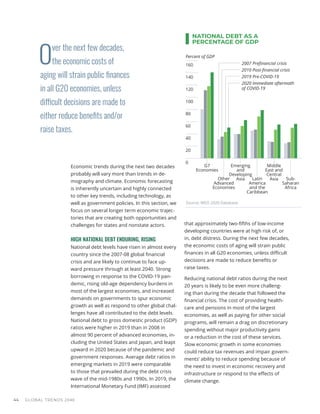
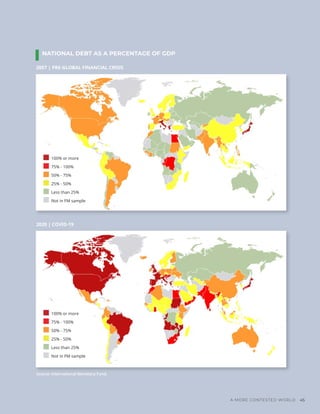



A MORE CONTESTED WORLD a
A PUBLICATION
OF THE NATIONAL
INTELLIGENCE COUNCIL
A M O R E C O N T E S T E D W O R L D
2040
TRENDS
GLOBAL
MARCH 2021
Image
/
Bigstock
“Intelligence does not claim infallibility for its
prophecies. Intelligence merely holds that the answer
which it gives is the most deeply and objectively
based and carefully considered estimate.”
Sherman Kent
Founder of the Office of National Estimates
Bastien
Herve
/
Unsplash
GLOBAL TRENDS 2040
ii
Pierre-Chatel-Innocenti
/
Unsplash
A PUBLICATION OF TH E NA TI ONA L I NTELLI G ENCE COU NCI L
A M O R E C O N T E S T E D W O R L D
2040
TRENDS
GLOBAL
MARCH 2021
NIC 2021-02339
ISBN 978-1-929667-33-8
To view digital version:
www.dni.gov/nic/globaltrends
GLOBAL TRENDS 2040
iv
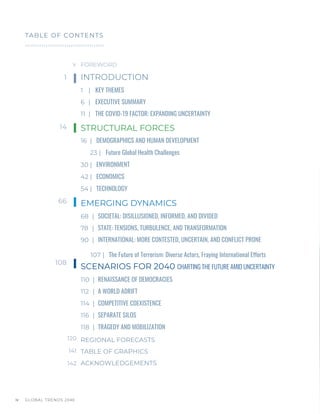
TABLE OF CONTENTS
FOREWORD
INTRODUCTION
1 | KEY THEMES
6 | EXECUTIVE SUMMARY
11 | THE COVID-19 FACTOR: EXPANDING UNCERTAINTY
STRUCTURAL FORCES
16 | DEMOGRAPHICS AND HUMAN DEVELOPMENT
23 | Future Global Health Challenges
30 | ENVIRONMENT
42 | ECONOMICS
54 | TECHNOLOGY
EMERGING DYNAMICS
68 | SOCIETAL: DISILLUSIONED, INFORMED, AND DIVIDED
78 | STATE: TENSIONS, TURBULENCE, AND TRANSFORMATION
90 | INTERNATIONAL: MORE CONTESTED, UNCERTAIN, AND CONFLICT PRONE
107 | The Future of Terrorism: Diverse Actors, Fraying International Efforts
SCENARIOS FOR 2040 CHARTING THE FUTURE AMID UNCERTAINTY
110 | RENAISSANCE OF DEMOCRACIES
112 | A WORLD ADRIFT
114 | COMPETITIVE COEXISTENCE
116 | SEPARATE SILOS
118 | TRAGEDY AND MOBILIZATION
1
14
v
120
141
142
66
108
REGIONAL FORECASTS
TABLE OF GRAPHICS
ACKNOWLEDGEMENTS
A MORE CONTESTED WORLD v
FOREWORD
W
elcome to the 7th edition of the National Intelligence Council’s Global Trends
report. Published every four years since 1997, Global Trends assesses the key
trends and uncertainties that will shape the strategic environment for the
United States during the next two decades.
Global Trends is designed to provide an analytic framework for policymakers early in each
administration as they craft national security strategy and navigate an uncertain future. The
goal is not to offer a specific prediction of the world in 2040; instead, our intent is to help
policymakers and citizens see what may lie beyond the horizon and prepare for an array of
possible futures.
Each edition of Global Trends is a unique undertaking, as its authors on the National Intel-
ligence Council develop a methodology and formulate the analysis. This process involved
numerous steps: examining and evaluating previous editions of Global Trends for lessons
learned; research and discovery involving widespread consultations, data collection, and
commissioned research; synthesizing, outlining, and drafting; and soliciting internal and ex-
ternal feedback to revise and sharpen the analysis.
A central component of the project has been our conversations with the world outside our
security gates. We benefited greatly from ongoing conversations with esteemed academ-
ics and researchers across a range of disciplines, anchoring our study in the latest theories
and data. We also broadened our contacts to hear diverse perspectives, ranging from high
school students in Washington DC, to civil society organizations in Africa, to business lead-
ers in Asia, to foresight practitioners in Europe and Asia, to environmental groups in South
America. These discussions offered us new ideas and expertise, challenged our assump-
tions, and helped us to identify and understand our biases and blind spots.
One of the key challenges with a project of this breadth and magnitude is how to organize
all the analysis into a story that is coherent, integrated, and forward looking. We constructed
this report around two central organizing principles: identifying and assessing broad forces
that are shaping the future strategic environment, and then exploring how populations and
leaders will act on and respond to the forces.
Based on those organizing principles, we built the analysis in three general sections. First,
we explore structural forces in four core areas: demographics, environment, economics,
and technology. We selected these areas because they are foundational in shaping future
FOREWORD
Image
/
Bigstock
GLOBAL TRENDS 2040
vi
dynamics and relatively universal in scope, and because we can offer projections with a
reasonable degree of confidence based on available data and evidence. The second sec-
tion examines how these structural forces interact and intersect with other factors to affect
emerging dynamics at three levels of analysis: individuals and society, states, and the inter-
national system. The analysis in this section involves a higher degree of uncertainty because
of the variability of human choices that will be made in the future. We focus on identifying
and describing the key emerging dynamics at each level, including what is driving them
and how they might evolve over time. Finally, the third section identifies several key uncer-
tainties and uses these to create five future scenarios for the world in 2040. These scenarios
are not intended to be predictions but to widen the aperture as to the possibilities, exploring
various combinations of how the structural forces, emerging dynamics, and key uncertain-
ties could play out.
When exploring the long-term future, another challenge is choosing which issues to cov-
er and emphasize, and which ones to leave out. We focused on global, long-term trends
and dynamics that are likely to shape communities, states, and the international system for
decades and to present them in a broader context. Accordingly, there is less on other near-
term issues and crises.
We offer this analysis with humility, knowing that invariably the future will unfold in ways
that we have not foreseen. Although Global Trends is necessarily more speculative than
most intelligence assessments, we rely on the fundamentals of our analytic tradecraft: we
construct arguments that are grounded in data and appropriately caveated; we show our
work and explain what we know and do not know; we consider alternative hypotheses and
how we could be wrong; and we do not advocate policy positions or preferences. Global
Trends reflects the National Intelligence Council’s perspective on these future trends; it does
not represent the official, coordinated view of the US Intelligence Community nor US policy.
We are proud to publish this report publicly for audiences around the world to read and
consider. We hope that it serves as a useful resource and provokes a conversation about our
collective future.
Finally, a note of gratitude to colleagues on the National Intelligence Council and the wider
Intelligence Community who joined in this journey to understand our world, explore the
future, and draft this report.
					The Strategic Futures Group
					National Intelligence Council
					March 2021
A MORE CONTESTED WORLD 1
Key Themes
INTRODUCTION
D
URING THE PAST YEAR, THE COVID-19 PANDEMIC HAS REMINDED THE WORLD OF
ITS FRAGILITY AND DEMONSTRATED THE INHERENT RISKS OF HIGH LEVELS OF IN-
TERDEPENDENCE. IN COMING YEARS AND DECADES, THE WORLD WILL FACE MORE
INTENSE AND CASCADING GLOBAL CHALLENGES RANGING FROM DISEASE TO CLIMATE
CHANGE TO THE DISRUPTIONS FROM NEW TECHNOLOGIES AND FINANCIAL CRISES.
These challenges will repeatedly test the resilience and adaptability of communities, states, and
the international system, often exceeding the capacity of existing systems and models. This
looming disequilibrium between existing and future challenges and the ability of institutions and
systems to respond is likely to grow and produce greater contestation at every level.
In this more contested world, communities are increasingly fractured as people seek security with
like-minded groups based on established and newly prominent identities; states of all types and
in all regions are struggling to meet the needs and expectations of more connected, more urban,
and more empowered populations; and the international system is more competitive—shaped
in part by challenges from a rising China—and at greater risk of conflict as states and nonstate
actors exploit new sources of power and erode longstanding norms and institutions that have
provided some stability in past decades. These dynamics are not fixed in perpetuity, however,
and we envision a variety of plausible scenarios for the world of 2040—from a democratic renais-
sance to a transformation in global cooperation spurred by shared tragedy—depending on how
these dynamics interact and human choices along the way.
Image
/
Bigstock
GLOBAL TRENDS 2040
2
FIVE THEMES APPEAR THROUGHOUT
THIS REPORT AND UNDERPIN THIS
OVERALL THESIS.
GLOBAL CHALLENGES
First, shared global challenges—in-
cluding climate change, disease, financial
crises, and technology disruptions—are likely
to manifest more frequently and intensely
in almost every region and country. These
challenges—which often lack a direct human
agent or perpetrator—will produce wide-
spread strains on states and societies as well
as shocks that could be catastrophic. The
ongoing COVID-19 pandemic marks the most
significant, singular global disruption since
World War II, with health, economic, political,
and security implications that will ripple for
years to come. The effects of climate change
and environmental degradation are likely to
exacerbate food and water insecurity for poor
countries, increase migration, precipitate new
health challenges, and contribute to biodi-
versity losses. Novel technologies will appear
and diffuse faster and faster, disrupting jobs,
industries, communities, the nature of power,
and what it means to be human. Continued
pressure for global migration—as of 2020
more than 270 million persons were living in
a country to which they have migrated, 100
million more than in 2000—will strain both
origin and destination countries to manage the
flow and effects. These challenges will intersect
and cascade, including in ways that are difficult
to anticipate. National security will require not
only defending against armies and arsenals but
also withstanding and adapting to these shared
global challenges.
FRAGMENTATION
Second, the difficulty of addressing
these transnational challenges is compounded
in part by increasing fragmentation within
communities, states, and the international
system. Paradoxically, as the world has grown
more connected through communications
technology, trade, and the movement of
people, that very connectivity has divided and
fragmented people and countries. The hyper-
connected information environment, greater
urbanization, and interdependent economies
mean that most aspects of daily life, including
finances, health, and housing, will be more
connected all the time. The Internet of Things
encompassed 10 billion devices in 2018 and
is projected to reach 64 billion by 2025 and
possibly many trillions by 2040, all monitored
in real time. In turn, this connectivity will help
produce new efficiencies, conveniences, and
advances in living standards. However, it will
also create and exacerbate tensions at all lev-
els, from societies divided over core values and
goals to regimes that employ digital repression
to control populations. As these connections
deepen and spread, they are likely to grow in-
creasingly fragmented along national, cultural,
or political preferences. In addition, people are
likely to gravitate to information silos of people
who share similar views, reinforcing beliefs
and understanding of the truth. Meanwhile,
globalization is likely to endure but transform
as economic and production networks shift
and diversify. All together, these forces por-
tend a world that is both inextricably bound
by connectivity and fragmenting in different
directions.
DISEQUILIBRIUM
The scale of transnational challenges,
and the emerging implications of fragmen-
tation, are exceeding the capacity of existing
systems and structures, highlighting the third
theme: disequilibrium. There is an increasing
mismatch at all levels between challenges and
needs with the systems and organizations to
deal with them. The international system—in-
cluding the organizations, alliances, rules, and
norms—is poorly set up to address the com-
pounding global challenges facing populations.
Images
/
Bigstock
A MORE CONTESTED WORLD 3
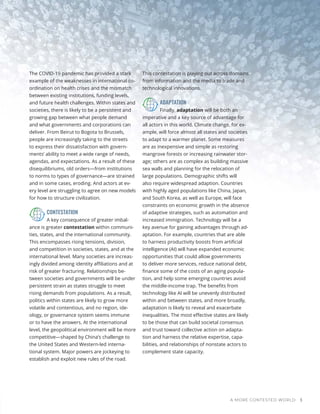
The COVID-19 pandemic has provided a stark
example of the weaknesses in international co-
ordination on health crises and the mismatch
between existing institutions, funding levels,
and future health challenges. Within states and
societies, there is likely to be a persistent and
growing gap between what people demand
and what governments and corporations can
deliver. From Beirut to Bogota to Brussels,
people are increasingly taking to the streets
to express their dissatisfaction with govern-
ments’ ability to meet a wide range of needs,
agendas, and expectations. As a result of these
disequilibriums, old orders—from institutions
to norms to types of governance—are strained
and in some cases, eroding. And actors at ev-
ery level are struggling to agree on new models
for how to structure civilization.
CONTESTATION
A key consequence of greater imbal-
ance is greater contestation within communi-
ties, states, and the international community.
This encompasses rising tensions, division,
and competition in societies, states, and at the
international level. Many societies are increas-
ingly divided among identity affiliations and at
risk of greater fracturing. Relationships be-
tween societies and governments will be under
persistent strain as states struggle to meet
rising demands from populations. As a result,
politics within states are likely to grow more
volatile and contentious, and no region, ide-
ology, or governance system seems immune
or to have the answers. At the international
level, the geopolitical environment will be more
competitive—shaped by China’s challenge to
the United States and Western-led interna-
tional system. Major powers are jockeying to
establish and exploit new rules of the road.
This contestation is playing out across domains
from information and the media to trade and
technological innovations.
ADAPTATION
Finally, adaptation will be both an
imperative and a key source of advantage for
all actors in this world. Climate change, for ex-
ample, will force almost all states and societies
to adapt to a warmer planet. Some measures
are as inexpensive and simple as restoring
mangrove forests or increasing rainwater stor-
age; others are as complex as building massive
sea walls and planning for the relocation of
large populations. Demographic shifts will
also require widespread adaption. Countries
with highly aged populations like China, Japan,
and South Korea, as well as Europe, will face
constraints on economic growth in the absence
of adaptive strategies, such as automation and
increased immigration. Technology will be a
key avenue for gaining advantages through ad-
aptation. For example, countries that are able
to harness productivity boosts from artificial
intelligence (AI) will have expanded economic
opportunities that could allow governments
to deliver more services, reduce national debt,
finance some of the costs of an aging popula-
tion, and help some emerging countries avoid
the middle-income trap. The benefits from
technology like AI will be unevenly distributed
within and between states, and more broadly,
adaptation is likely to reveal and exacerbate
inequalities. The most effective states are likely
to be those that can build societal consensus
and trust toward collective action on adapta-
tion and harness the relative expertise, capa-
bilities, and relationships of nonstate actors to
complement state capacity.
GLOBAL TRENDS 2040
4
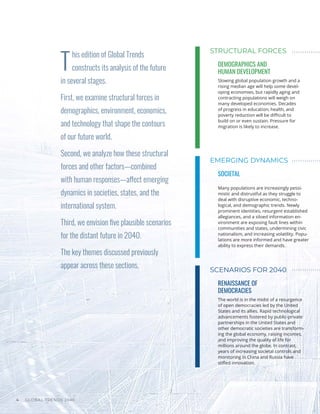
T
his edition of Global Trends
constructs its analysis of the future
in several stages.
First, we examine structural forces in
demographics, environment, economics,
and technology that shape the contours
of our future world.
Second, we analyze how these structural
forces and other factors—combined
with human responses—affect emerging
dynamics in societies, states, and the
international system.
Third, we envision five plausible scenarios
for the distant future in 2040.
The key themes discussed previously
appear across these sections.
STRUCTURAL FORCES
EMERGING DYNAMICS
SCENARIOS FOR 2040
DEMOGRAPHICS AND
HUMAN DEVELOPMENT
SOCIETAL
RENAISSANCE OF
DEMOCRACIES
Slowing global population growth and a
rising median age will help some devel-
oping economies, but rapidly aging and
contracting populations will weigh on
many developed economies. Decades
of progress in education, health, and
poverty reduction will be difficult to
build on or even sustain. Pressure for
migration is likely to increase.
Many populations are increasingly pessi-
mistic and distrustful as they struggle to
deal with disruptive economic, techno-
logical, and demographic trends. Newly
prominent identities, resurgent established
allegiances, and a siloed information en-
vironment are exposing fault lines within
communities and states, undermining civic
nationalism, and increasing volatility. Popu-
lations are more informed and have greater
ability to express their demands.
The world is in the midst of a resurgence
of open democracies led by the United
States and its allies. Rapid technological
advancements fostered by public-private
partnerships in the United States and
other democratic societies are transform-
ing the global economy, raising incomes,
and improving the quality of life for
millions around the globe. In contrast,
years of increasing societal controls and
monitoring in China and Russia have
stifled innovation.
A MORE CONTESTED WORLD 5
A WORLD ADRIFT COMPETITIVE
COEXISTENCE
SEPARATE SILOS TRAGEDY AND
MOBILIZATION
ENVIRONMENT
STATE
TECHNOLOGY
INTERNATIONAL
ECONOMICS
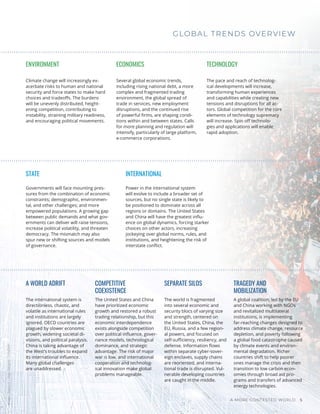
GLOBAL TRENDS OVERVIEW
The international system is
directionless, chaotic, and
volatile as international rules
and institutions are largely
ignored. OECD countries are
plagued by slower economic
growth, widening societal di-
visions, and political paralysis.
China is taking advantage of
the West’s troubles to expand
its international influence.
Many global challenges
are unaddressed.
The United States and China
have prioritized economic
growth and restored a robust
trading relationship, but this
economic interdependence
exists alongside competition
over political influence, gover-
nance models, technological
dominance, and strategic
advantage. The risk of major
war is low, and international
cooperation and technolog-
ical innovation make global
problems manageable.
The world is fragmented
into several economic and
security blocs of varying size
and strength, centered on
the United States, China, the
EU, Russia, and a few region-
al powers, and focused on
self-sufficiency, resiliency, and
defense. Information flows
within separate cyber-sover-
eign enclaves, supply chains
are reoriented, and interna-
tional trade is disrupted. Vul-
nerable developing countries
are caught in the middle.
A global coalition, led by the EU
and China working with NGOs
and revitalized multilateral
institutions, is implementing
far-reaching changes designed to
address climate change, resource
depletion, and poverty following
a global food catastrophe caused
by climate events and environ-
mental degradation. Richer
countries shift to help poorer
ones manage the crisis and then
transition to low carbon econ-
omies through broad aid pro-
grams and transfers of advanced
energy technologies.
Climate change will increasingly ex-
acerbate risks to human and national
security and force states to make hard
choices and tradeoffs. The burdens
will be unevenly distributed, height-
ening competition, contributing to
instability, straining military readiness,
and encouraging political movements.
Governments will face mounting pres-
sures from the combination of economic
constraints; demographic, environmen-
tal, and other challenges; and more
empowered populations. A growing gap
between public demands and what gov-
ernments can deliver will raise tensions,
increase political volatility, and threaten
democracy. The mismatch may also
spur new or shifting sources and models
of governance.
The pace and reach of technolog-
ical developments will increase,
transforming human experiences
and capabilities while creating new
tensions and disruptions for all ac-
tors. Global competition for the core
elements of technology supremacy
will increase. Spin off technolo-
gies and applications will enable
rapid adoption.
Power in the international system
will evolve to include a broader set of
sources, but no single state is likely to
be positioned to dominate across all
regions or domains. The United States
and China will have the greatest influ-
ence on global dynamics, forcing starker
choices on other actors, increasing
jockeying over global norms, rules, and
institutions, and heightening the risk of
interstate conflict.
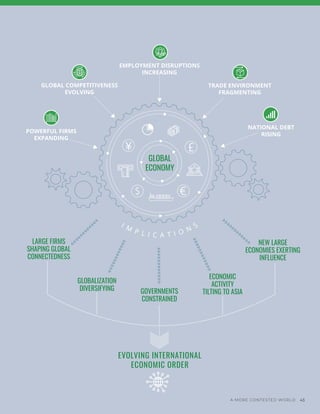
Several global economic trends,
including rising national debt, a more
complex and fragmented trading
environment, the global spread of
trade in services, new employment
disruptions, and the continued rise
of powerful firms, are shaping condi-
tions within and between states. Calls
for more planning and regulation will
intensify, particularly of large platform,
e-commerce corporations.
Image
/
Bigstock
|
Bagir
Bahana
/
Unsplash
GLOBAL TRENDS 2040
6
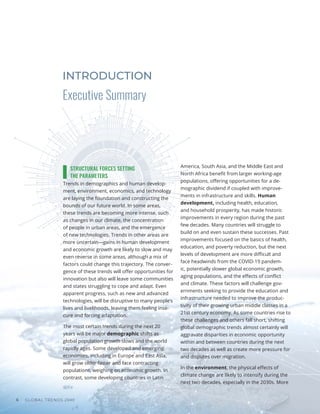
STRUCTURAL FORCES SETTING
THE PARAMETERS
Trends in demographics and human develop-
ment, environment, economics, and technology
are laying the foundation and constructing the
bounds of our future world. In some areas,
these trends are becoming more intense, such
as changes in our climate, the concentration
of people in urban areas, and the emergence
of new technologies. Trends in other areas are
more uncertain—gains in human development
and economic growth are likely to slow and may
even reverse in some areas, although a mix of
factors could change this trajectory. The conver-
gence of these trends will offer opportunities for
innovation but also will leave some communities
and states struggling to cope and adapt. Even
apparent progress, such as new and advanced
technologies, will be disruptive to many people’s
lives and livelihoods, leaving them feeling inse-
cure and forcing adaptation.
The most certain trends during the next 20
years will be major demographic shifts as
global population growth slows and the world
rapidly ages. Some developed and emerging
economies, including in Europe and East Asia,
will grow older faster and face contracting
populations, weighing on economic growth. In
contrast, some developing countries in Latin
America, South Asia, and the Middle East and
North Africa benefit from larger working-age
populations, offering opportunities for a de-
mographic dividend if coupled with improve-
ments in infrastructure and skills. Human
development, including health, education,
and household prosperity, has made historic
improvements in every region during the past
few decades. Many countries will struggle to
build on and even sustain these successes. Past
improvements focused on the basics of health,
education, and poverty reduction, but the next
levels of development are more difficult and
face headwinds from the COVID-19 pandem-
ic, potentially slower global economic growth,
aging populations, and the effects of conflict
and climate. These factors will challenge gov-
ernments seeking to provide the education and
infrastructure needed to improve the produc-
tivity of their growing urban middle classes in a
21st century economy. As some countries rise to
these challenges and others fall short, shifting
global demographic trends almost certainly will
aggravate disparities in economic opportunity
within and between countries during the next
two decades as well as create more pressure for
and disputes over migration.
In the environment, the physical effects of
climate change are likely to intensify during the
next two decades, especially in the 2030s. More
Executive Summary
INTRODUCTION
A MORE CONTESTED WORLD 7
extreme storms, droughts, and floods; melting
glaciers and ice caps; and rising sea levels will
accompany rising temperatures. The impact
will disproportionately fall on the developing
world and poorer regions and intersect with
environmental degradation to create new
vulnerabilities and exacerbate existing risks
to economic prosperity, food, water, health,
and energy security. Governments, societies,
and the private sector are likely to expand
adaptation and resilience measures to man-
age existing threats, but these measures are
unlikely to be evenly distributed, leaving some
populations behind. Debates will grow over
how and how quickly to reach net zero green-
house gas emissions.
During the next two decades, several global
economic trends, including rising national
debt, a more complex and fragmented trading
environment, a shift in trade, and new employ-
ment disruptions are likely to shape conditions
within and between states. Many governments
may find they have reduced flexibility as they
navigate greater debt burdens, diverse trading
rules, and a broader array of powerful state
and corporate actors exerting influence. Large
platform corporations—which provide online
markets for large numbers of buyers and sell-
er—could drive continued trade globalization
and help smaller firms grow and gain access
to international markets. These powerful firms
are likely to try to exert influence in political
and social arenas, efforts that may lead gov-
ernments to impose new restrictions. Asian
economies appear poised to continue decades
of growth through at least 2030, although po-
tentially slower. They are unlikely to reach the
per capita gross domestic product (GDP) or
economic influence of existing advanced econ-
omies, including the United States and Europe.
Productivity growth remains a key variable; an
increase in the rate of growth could alleviate
many economic, human development, and
other challenges.
Technology will offer the potential to mitigate
problems, such as climate change and disease,
and to create new challenges, such as job
displacement. Technologies are being invent-
ed, used, spread, and then discarded at ever
increasing speeds around the world, and new
centers of innovation are emerging. During
the next two decades, the pace and reach
of technological developments are likely to
increase ever faster, transforming a range of
human experiences and capabilities while also
creating new tensions and disruptions within
and between societies, industries, and states.
State and nonstate rivals will vie for leadership
and dominance in science and technology with
potentially cascading risks and implications for
economic, military, and societal security.
EMERGING DYNAMICS
These structural forces, along with other
factors, will intersect and interact at the levels
of societies, states, and the international
system, creating opportunities as well as chal-
lenges for communities, institutions, corpo-
rations, and governments. These interactions
are also likely to produce greater contestation
at all levels than has been seen since the end
of the Cold War, reflecting differing ideolo-
gies as well as contrasting views on the most
effective way to organize society and tackle
emerging challenges.
Within societies, there is increasing fragmen-
tation and contestation over economic, cultur-
al, and political issues. Decades of steady gains
in prosperity and other aspects of human de-
velopment have improved lives in every region
and raised peoples’ expectations for a better
future. As these trends plateau and combine
with rapid social and technological changes,
Image
/
Bigstock
GLOBAL TRENDS 2040
8
large segments of the global population are
becoming wary of institutions and govern-
ments that they see as unwilling or unable to
address their needs. People are gravitating to
familiar and like-minded groups for communi-
ty and security, including ethnic, religious, and
cultural identities as well as groupings around
interests and causes, such as environmental-
ism. The combination of newly prominent and
diverse identity allegiances and a more siloed
information environment is exposing and ag-
gravating fault lines within states, undermining
civic nationalism, and increasing volatility.
At the state level, the relationships between
societies and their governments in every
region are likely to face persistent strains and
tensions because of a growing mismatch be-
tween what publics need and expect and what
governments can and will deliver. Populations
in every region are increasingly equipped with
the tools, capacity, and incentive to agitate
for their preferred social and political goals
and to place more demands on their govern-
ments to find solutions. At the same time that
populations are increasingly empowered and
demanding more, governments are coming
under greater pressure from new challenges
and more limited resources. This widening
gap portends more political volatility, erosion
of democracy, and expanding roles for alter-
native providers of governance. Over time,
these dynamics might open the door to more
significant shifts in how people govern.
In the international system, no single state
is likely to be positioned to dominate across
all regions or domains, and a broader range of
actors will compete to shape the international
system and achieve narrower goals. Acceler-
ating shifts in military power, demographics,
economic growth, environmental conditions,
and technology, as well as hardening divisions
over governance models, are likely to further
ratchet up competition between China and
a Western coalition led by the United States.
Rival powers will jockey to shape global norms,
rules, and institutions, while regional powers
and nonstate actors may exert more influence
and lead on issues left unattended by the
major powers. These highly varied interactions
are likely to produce a more conflict-prone
and volatile geopolitical environment, under-
mine global multilateralism, and broaden the
mismatch between transnational challenges
and institutional arrangements to tackle them.
ALTERNATIVE SCENARIOS FOR 2040
Human responses to these core drivers and
emerging dynamics will determine how the
world evolves during the next two decades. Of
the many uncertainties about the future, we
explored three key questions around condi-
tions within specific regions and countries and
the policy choices of populations and leaders
that will shape the global environment. From
these questions, we constructed five scenarios
for alternative worlds in the year 2040.
•	 How severe are the looming global
challenges?
•	 How do states and nonstate actors en-
gage in the world, including focus and
type of engagement?
•	 Finally, what do states prioritize for
the future?
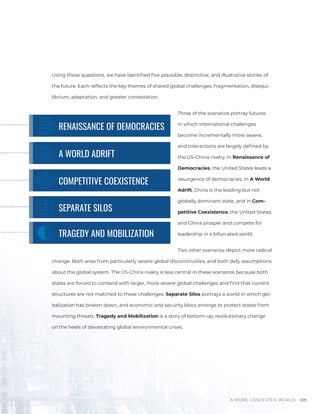
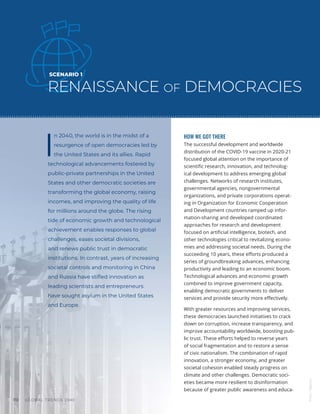
In Renaissance of Democracies, the world is
in the midst of a resurgence of open democ-
racies led by the United States and its allies.
Rapid technological advancements fostered
A MORE CONTESTED WORLD 9
by public-private partnerships in the United
States and other democratic societies are
transforming the global economy, raising
incomes, and improving the quality of life for
millions around the globe. The rising tide of
economic growth and technological achieve-
ment enables responses to global challenges,
eases societal divisions, and renews public
trust in democratic institutions. In contrast,
years of increasing societal controls and
monitoring in China and Russia have stifled
innovation as leading scientists and entrepre-
neurs have sought asylum in the United States
and Europe.
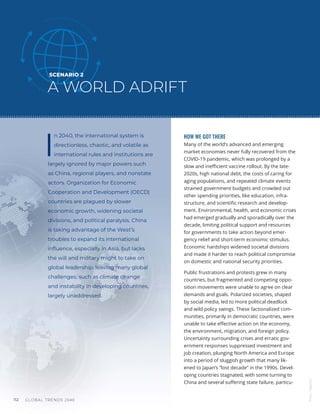
In A World Adrift, the international system
is directionless, chaotic, and volatile as in-
ternational rules and institutions are largely
ignored by major powers like China, regional
players, and nonstate actors. Organization
for Economic Cooperation and Development
(OECD) countries are plagued by slower eco-
nomic growth, widening societal divisions, and
political paralysis. China is taking advantage of
the West’s troubles to expand its international
influence, especially in Asia, but Beijing lacks
the will and military might to take on global
leadership, leaving many global challenges,
such as climate change and instability in devel-
oping countries, largely unaddressed.
In Competitive Coexistence, the United
States and China have prioritized economic
growth and restored a robust trading rela-
tionship, but this economic interdependence
exists alongside competition over political
influence, governance models, technological
dominance, and strategic advantage. The risk
of major war is low, and international coopera-
tion and technological innovation make global
problems manageable over the near term for
advanced economies, but longer term climate
challenges remain.
In Separate Silos, the world is fragmented
into several economic and security blocs of
varying size and strength, centered on the
United States, China, the European Union
(EU), Russia, and a couple of regional powers;
these blocs are focused on self-sufficiency,
resiliency, and defense. Information flows
within separate cyber-sovereign enclaves,
supply chains are reoriented, and internation-
al trade is disrupted. Vulnerable developing
countries are caught in the middle with some
on the verge of becoming failed states. Global
problems, notably climate change, are spottily
addressed, if at all.
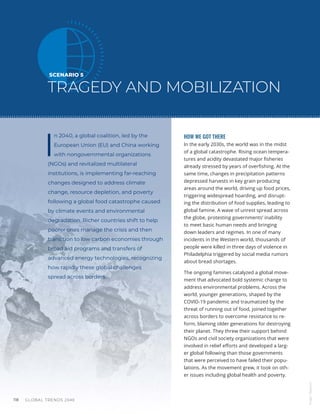
In Tragedy and Mobilization, a global coa-
lition, led by the EU and China working with
nongovernmental organizations and revital-
ized multilateral institutions, is implementing
far-reaching changes designed to address cli-
mate change, resource depletion, and poverty
following a global food catastrophe caused
by climate events and environmental degra-
dation. Richer countries shift to help poorer
ones manage the crisis and then transition
to low carbon economies through broad aid
programs and transfers of advanced energy
technologies, recognizing how rapidly these
global challenges spread across borders.
GLOBAL TRENDS 2040
10
A MORE CONTESTED WORLD 11
T
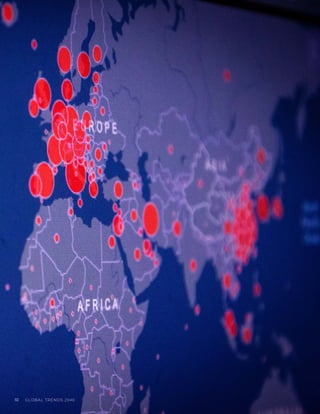
HE COVID-19 PANDEMIC EMERGED GLOBALLY IN 2020, WREAKING HAVOC ACROSS
THE WORLD, KILLING MORE THAN 2.5 MILLION PEOPLE AS OF EARLY 2021, DEVAS-
TATING FAMILIES AND COMMUNITIES, AND DISRUPTING ECONOMIES AND POLITI-
CAL DYNAMICS WITHIN AND BETWEEN COUNTRIES. PREVIOUS GLOBAL TRENDS EDITIONS
FORECASTED THE POTENTIAL FOR NEW DISEASES AND EVEN IMAGINED SCENARIOS WITH
A PANDEMIC, BUT WE LACKED A FULL PICTURE OF THE BREADTH AND DEPTH OF ITS
disruptive potential. COVID-19 has shaken long-held assumptions about resilience and adaptation
and created new uncertainties about the economy, governance, geopolitics, and technology.
To understand and assess the impact of this crisis, we examined and debated a broad range of
our assumptions and assessments related to key global trends. We asked a series of questions:
Which existing trends will endure, which trends are accelerating or decelerating because of the
pandemic, and where are we likely to experience fundamental, systemic shifts? Are the disrup-
tions temporary or could the pandemic unleash new forces to shape the future? Much like the
terrorist attacks of 11 September 2001, the COVID-19 pandemic is likely to produce some changes
that will be felt for years to come and change the way we live, work, and govern domestically and
internationally. How great these will be, however, is very much in question.
ACCELERATING, SHARPENING SOME TRENDS
The pandemic and corresponding national responses appear to be honing and accelerating
several trends that were already underway before the outbreak. COVID-19 brought global health
and healthcare issues into sharp relief, exposed and in some cases widened social fissures,
underscored vast disparities in healthcare access and infrastructure, and interrupted efforts to
combat other diseases. The pandemic also highlighted weaknesses in the international coordina-
tion on health crises and the mismatch between existing institutions, funding levels, and future
health challenges.
The COVID-19 Factor: Expanding Uncertainty
Giacomo
Carra
/
Unsplash
GLOBAL TRENDS 2040
12
Catalyzing Economic Trends. Lockdowns,
quarantines, and the closing of international
borders have catalyzed some pre-existing
economic trends, including diversification
in global supply chains, increased national
debt, and greater government intervention in
economies. Moving forward, the character of
globalization may retain some of the changes
from this crisis period, and debt, particularly
for developing economies, will strain national
capacities for many years.
Reinforcing Nationalism and Polarization.
Nationalism and polarization have been on
the rise in many countries, especially exclu-
sionary nationalism. Efforts to contain and
manage the virus have reinforced nationalist
trends globally as some states turned inward
to protect their citizens and sometimes cast
blame on marginalized groups. The response
to the pandemic has fueled partisanship and
polarization in many countries as groups argue
over the best way to respond and seek scape-
goats to blame for spreading the virus and for
slow responses.
Deepening Inequality. The disproportionate
economic impact of COVID-19 on low-income
earners has caused them to fall further behind.
When COVID-19 is finally controlled, many fam-
ilies are likely to have experienced further set-
backs, especially those working in the service
or informal sectors or who left the workforce
to provide dependent care—predominantly
women. The pandemic has exposed the digital
divide within and between countries while
spurring efforts to improve Internet access.
Straining Governance. The pandemic is
straining government capacity for services and
contributing to already low levels of trust in
institutions in countries that have not effec-
tively handled the response. The pandemic
is exacerbating the confusing and polarized
information environment that is undermining
public confidence in health authorities, particu-
larly in open societies. Illiberal regimes in some
countries are using the pandemic as a pretext
to more severely crack down on dissent and
restrict civic freedoms, conditions that may
outlive the disease.
Highlighting Failed International Cooper-
ation. The COVID-19 pandemic exposed the
weaknesses and political cleavages in interna-
tional institutions, such as the World Health
Organization (WHO) and United Nations, and
called into question countries’ ability and will-
ingness to cooperate multilaterally to address
common challenges beyond infectious disease,
particularly climate change. The WHO, which
has faced significant funding difficulties and
resistance to mandatory surveillance regimes,
is facing its gravest shock in nearly two de-
cades. The crisis, however, may ultimately lead
actors to make deeper reforms, standardize
data collection and sharing, and forge new
public-private partnerships.
Elevating the Role of Nonstate Actors. Non-
state actors, ranging from the Gates Founda-
tion to private companies, have been crucial to
vaccine research or retrofitting equipment to
mass produce medical supplies and personal
protective equipment. Nonstate networks will
complement national and intergovernmental
action in future health crises, including early
warning, treatment, facilitation of data-sharing,
and vaccine development.
WHILE OTHERS DECELERATE OR REVERSE
COVID-19 is slowing and possibly reversing
some longstanding trends in human develop-
ment, especially the reduction of poverty and
disease and closing gender inequality gaps.
The longest lasting reversals may be in poverty
reduction across Africa, Latin America, and
South Asia, followed by losses in gender equal-
ity. The resources devoted to fighting COVID-19
and social restrictions could reverse years of
progress against malaria, measles, polio, and
other infectious diseases by consuming key
financial, material, and personnel resources.
The COVID-19 emergency may bring regions
together in ways that previous crises have not.
A MORE CONTESTED WORLD 13
Although European countries early in the crisis
imposed restrictions on border traffic and ex-
ports of critical medical supplies, the European
Union has rallied around an economic rescue
package and other emergency measures that
could bolster the European integration project
going forward. COVID-19 could also lead to re-
direction of national budgets toward pandemic
response and economic recovery, diverting
funds from defense expenditures, foreign aid,
and infrastructure programs in some coun-
tries, at least in the near term.
MORE QUESTIONS THAN ANSWERS
The unanticipated second- and third-order
effects of the COVID-19 pandemic have re-
minded us how uncertain the future is—both
in the long and short term. As researchers
and analysts, we must be ever vigilant, asking
better questions, frequently challenging our
assumptions, checking our biases, and looking
for weak signals of change. We need to expect
the unexpected and apply the lessons of this
pandemic to our craft in the future.
 
Photo
/
Bigstock
Setting the Parameters
14
D
emographic, environmental, economic, and technological devel-
opments will shape the contours of the world we will live in during
coming decades. These structural forces—both individually and col-
lectively—will offer new benefits and opportunities for individuals, communities,
and governments in every region to improve how we live, work, and prosper. In
addition, the acceleration and intersection of these trends are fostering new or
more intense challenges, straining the capacity of societies and governments to
manage and adapt.
After several decades of extraordinary gains in human development, many
countries are likely to struggle to build on and even sustain these successes be-
cause moving beyond the basics in education and healthcare is harder, especial-
ly with larger populations and tighter resources. In addition, the physical effects
of more extreme weather events, hotter temperatures, changing precipitation
patterns, and rising sea levels will touch all countries but disproportionately will
hurt the developing world and poorer regions. The pace and reach of technolog-
STRUCTURAL FORCES
Image
/
Bigstock
A MORE CONTESTED WORLD 15
ical developments during this period are likely to increase and accelerate, transforming and
improving a range of human experiences and capabilities while also creating new tensions
and disruptions within and between societies, industries, and states. During the next two
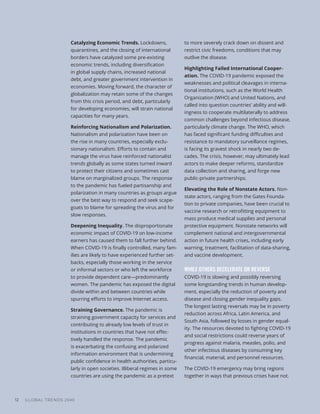
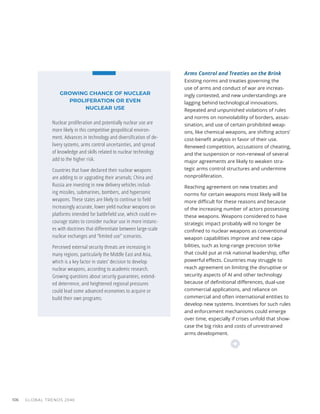
decades, several global economic trends, including rising sovereign debt, new employment
disruptions, a more complex and fragmented trading environment, and the rise of power-
ful companies, are likely to
shape conditions within and
between states.
These structural drivers may
redound in unpredictable
ways, affording some coun-
tries the opportunity to rise
to these challenges and
even prosper, while others,
burdened by a confluence of
less supportive trends, will
struggle. Shifting global de-
mographic trends almost cer-
tainly will aggravate dispari-
ties in economic and political
opportunity within and between countries, strain governance, and fuel pressure for global
migration during the next 20 years—a pressure that will increase friction between states.
State and nonstate rivals will compete for dominance in science and technology with poten-
tially cascading risks and implications globally for economic, military, diplomatic, and societal
security. Many governments may find they have reduced flexibility as they navigate greater
debt burdens, diverse trading rules, and a broader range of powerful state and corporate
actors exerting influence. Meanwhile, Asian economies appear poised to continue decades of
growth, at least through 2030, and are looking to use their economic and population size to
influence international institutions and rules.
DEMOGRAPHICS AND HUMAN DEVELOPMENT
ENVIRONMENT
Photos
|
Bigstock
|
Pexels
|
Chuttersnap
/
Unslpash
ECONOMICS
TECHNOLOGY
16
DEMOGRAPHICS AND
HUMAN DEVELOPMENT
Key Takeaways
Slowing population growth and a rising global median age are presenting poten-
tial economic opportunities for some developing economies, but rapidly aging
and contracting populations in some developed economies and China will weigh
on economic growth.
Relatively poor countries in Sub-Saharan Africa and South Asia will account for al-
most all global population growth during the next two decades and will be rapidly
urbanizing at the same time, most likely overwhelming their capacity to provide
the infrastructure and education systems necessary to fully harness their econom-
ic growth potential.
During the next two decades, demographic shifts and economic incentives are
likely to increase pressure for migration out of developing countries, mostly from
Sub-Saharan Africa, and primarily into aging, developed countries. Conflict and
climate disruptions will compound these broader migration trends.
These demographic and human development trends will put pressure on gov-
ernments to increase public investment and control immigration, potentially fuel
instability in some countries, contribute to a rising Asia, and add to the agenda of
already strained international development institutions.
STRUCTURAL FORCES
Photo
/
Bigstock
A MORE CONTESTED WORLD 17
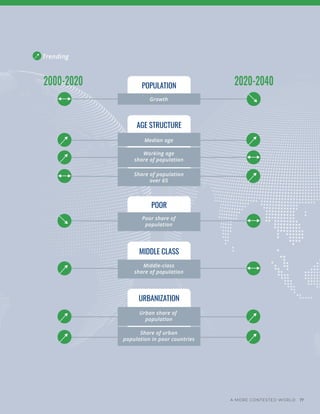
POPULATION
Growth
Trending
AGE STRUCTURE
Median age
POOR
Poor share of
population
MIDDLE CLASS
Middle-class
share of population
URBANIZATION
Urban share of
population
Share of urban
population in poor countries
Working age
share of population
Share of population
over 65
2000-2020 2020-2040
GLOBAL TRENDS 2040
18
A
s birth rates remain low and
the median age rises, most
developed and many emerging
economies will see their
populations peak and then start
to shrink by 2040.
SLOWING POPULATION GROWTH,
AGING POPULATIONS
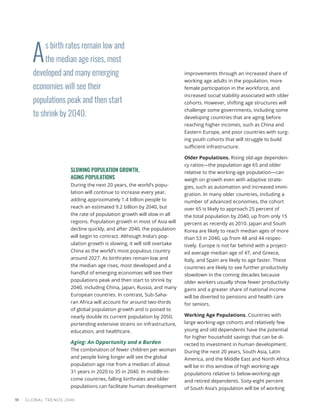
During the next 20 years, the world’s popu-
lation will continue to increase every year,
adding approximately 1.4 billion people to
reach an estimated 9.2 billion by 2040, but
the rate of population growth will slow in all
regions. Population growth in most of Asia will
decline quickly, and after 2040, the population
will begin to contract. Although India’s pop-
ulation growth is slowing, it will still overtake
China as the world’s most populous country
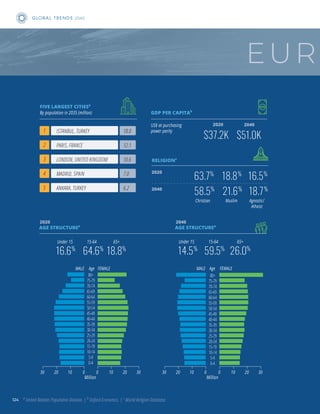
around 2027. As birthrates remain low and
the median age rises, most developed and a
handful of emerging economies will see their
populations peak and then start to shrink by
2040, including China, Japan, Russia, and many
European countries. In contrast, Sub-Saha-
ran Africa will account for around two-thirds
of global population growth and is poised to
nearly double its current population by 2050,
portending extensive strains on infrastructure,
education, and healthcare.
Aging: An Opportunity and a Burden
The combination of fewer children per woman
and people living longer will see the global
population age rise from a median of about
31 years in 2020 to 35 in 2040. In middle-in-
come countries, falling birthrates and older
populations can facilitate human development
improvements through an increased share of
working age adults in the population, more
female participation in the workforce, and
increased social stability associated with older
cohorts. However, shifting age structures will
challenge some governments, including some
developing countries that are aging before
reaching higher incomes, such as China and
Eastern Europe, and poor countries with surg-
ing youth cohorts that will struggle to build
sufficient infrastructure.
Older Populations. Rising old-age dependen-
cy ratios—the population age 65 and older
relative to the working-age population—can
weigh on growth even with adaptive strate-
gies, such as automation and increased immi-
gration. In many older countries, including a
number of advanced economies, the cohort
over 65 is likely to approach 25 percent of
the total population by 2040, up from only 15
percent as recently as 2010. Japan and South
Korea are likely to reach median ages of more
than 53 in 2040, up from 48 and 44 respec-
tively. Europe is not far behind with a project-
ed average median age of 47, and Greece,
Italy, and Spain are likely to age faster. These
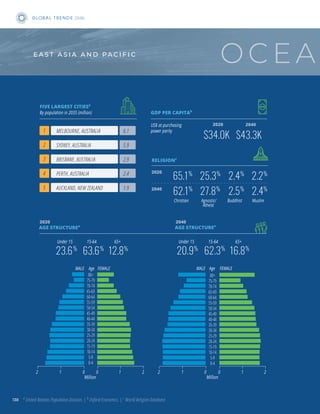
countries are likely to see further productivity
slowdown in the coming decades because
older workers usually show fewer productivity
gains and a greater share of national income
will be diverted to pensions and health care
for seniors.
Working Age Populations. Countries with
large working-age cohorts and relatively few
young and old dependents have the potential
for higher household savings that can be di-
rected to investment in human development.
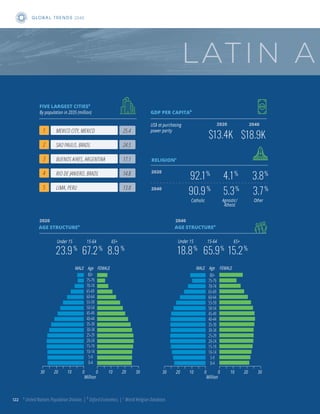
During the next 20 years, South Asia, Latin
America, and the Middle East and North Africa
will be in this window of high working-age
populations relative to below-working-age
and retired dependents. Sixty-eight percent
of South Asia’s population will be of working
SUB-SAHARAN AFRICA LIKELY TO DOMINATE
POPULATION GROWTH IN COMING DECADES
WORLD POPULATION: ANNUAL CHANGE BY REGION, 1951-2100
Source: United Nations Population Division.
-20
0
20
40
60
80
100
120
2100
90
80
70
60
50
40
30
20
10
2000
90
80
70
60
1951
UN estimate UN forecast
(medium
scenario)
Latin America and Caribbean
Europe, North America,
and Russia/FSU
East Asia, Southeast Asia,
and Oceania
South Asia
Sub-Sarahan Africa
Middle East and North Africa
1988, peak year of
added population,
93 million
Million persons
A MORE CONTESTED WORLD 19
age in 2040, up from an already elevated 66
percent in 2020. Latin America and the Middle
East and North Africa probably will also benefit
from peak working-age population propor-
tions of above 65 percent in the coming 20
years. These opportunities for higher poten-
tial economic growth will occur only if those
workers are adequately trained and can find
jobs. South Asia’s ongoing challenges in job
creation, technology adoption, and skills train-
ing suggest that it will have difficulties fully
leveraging its potential labor force.
Youthful Populations. During the next two
decades, most countries with large youth pop-
ulations will be challenged to meet the basic
needs of their populations, particularly in light
of the social volatility often associated with
youth bulges. In Sub-Saharan Africa, the me-
dian age is likely to rise only slightly to 22 by
2040, still well short of the median age thresh-
old of 30 which is often associated with higher
levels of human development. More than
one-third of Sub-Saharan Africa’s population
will be younger than 15 in 2040, compared
with only 14 percent of the population in East
Asia. Other populous countries that most likely
will still be below the median age threshold in
2040 are Afghanistan, Egypt, and Pakistan.
URBANIZATION CHANGING DEVELOPMENT NEEDS
During the next 20 years, the success or failure
of cities will shape opportunities and quality of
life for a growing share of the world’s popula-
tion. The urban population share is expected
to rise from 56 percent in 2020 to nearly two-
thirds by 2040, with nearly all of the growth
in the developing world. Globally, large cities
of more than 1 million residents have been
growing at twice the rate of the overall pop-
ulation, and nearly 30 percent of the world’s
GLOBAL TRENDS 2040
20
URBANIZATION BY COUNTRY
INCOME LEVEL
Source: United Nations.
Percent share of global urban population
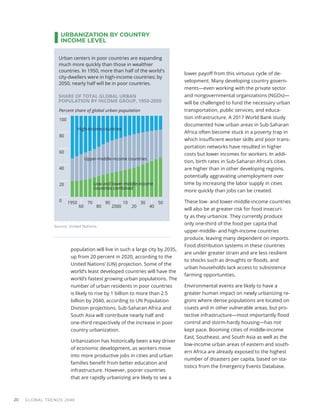
Urban centers in poor countries are expanding
much more quickly than those in wealthier
countries. In 1950, more than half of the world's
city-dwellers were in high-income countries; by
2050, nearly half will be in poor countries.
SHARE OF TOTAL GLOBAL URBAN
POPULATION BY INCOME GROUP, 1950-2050
0
20
40
60
80
100
50
40
30
20
10
2000
90
80
70
60
1950
High-income countries
Upper-middle-income countries
Low and lower-middle-income
countries combined
population will live in such a large city by 2035,
up from 20 percent in 2020, according to the
United Nations’ (UN) projection. Some of the
world’s least developed countries will have the
world’s fastest growing urban populations. The
number of urban residents in poor countries
is likely to rise by 1 billion to more than 2.5
billion by 2040, according to UN Population
Division projections. Sub-Saharan Africa and
South Asia will contribute nearly half and
one-third respectively of the increase in poor
country urbanization.
Urbanization has historically been a key driver
of economic development, as workers move
into more productive jobs in cities and urban
families benefit from better education and
infrastructure. However, poorer countries
that are rapidly urbanizing are likely to see a
lower payoff from this virtuous cycle of de-
velopment. Many developing country govern-
ments—even working with the private sector
and nongovernmental organizations (NGOs)—
will be challenged to fund the necessary urban
transportation, public services, and educa-
tion infrastructure. A 2017 World Bank study
documented how urban areas in Sub-Saharan
Africa often become stuck in a poverty trap in
which insufficient worker skills and poor trans-
portation networks have resulted in higher
costs but lower incomes for workers. In addi-
tion, birth rates in Sub-Saharan Africa’s cities
are higher than in other developing regions,
potentially aggravating unemployment over
time by increasing the labor supply in cities
more quickly than jobs can be created.
These low- and lower-middle-income countries
will also be at greater risk for food insecuri-
ty as they urbanize. They currently produce
only one-third of the food per capita that
upper-middle- and high-income countries
produce, leaving many dependent on imports.
Food distribution systems in these countries
are under greater strain and are less resilient
to shocks such as droughts or floods, and
urban households lack access to subsistence
farming opportunities.
Environmental events are likely to have a
greater human impact on newly urbanizing re-
gions where dense populations are located on
coasts and in other vulnerable areas, but pro-
tective infrastructure—most importantly flood
control and storm-hardy housing—has not
kept pace. Booming cities of middle-income
East, Southeast, and South Asia as well as the
low-income urban areas of eastern and south-
ern Africa are already exposed to the highest
number of disasters per capita, based on sta-
tistics from the Emergency Events Database.
PROGRESS ON HUMAN DEVELOPMENT
Source: United Nations Population
Division and Pardee Center
University of Denver.
Source: IHME and Pardee Center
University of Denver.
1
Sub-Saharan Africa is also included in low- and middle-income countries’ data.
Source: Barro-Lee and Pardee
Center University of Denver.
Sub-
Saharan
Africa1
High
income
High
income
High
income
Low and
middle income
Low and
middle income
Low and
middle
income
Number
of births
Deaths as a percent
of live births
Percent of
all adults
BIRTHS PER WOMAN OF CHILD-
BEARING AGE (TOTAL FERTILITY
RATE), 1960-2040
INFANT DEATHS IN THE
FIRST YEAR, 1960-2040
SECONDARY EDUCATION
COMPLETION RATES,
1960-2040
0
1
2
3
4
5
6
7
40
20
2000
80
1960 0
5
10
15
20
40
20
2000
80
1960 0
20
40
60
80
100
40
20
2000
80
1960
Sub-Saharan
Africa1
Sub-Saharan
Africa1
A MORE CONTESTED WORLD 21
ASSOCIATED HUMAN DEVELOPMENT CHALLENGES
Many countries will struggle to build on or
even sustain decades of significant improve-
ments in education, health, and poverty re-
duction. During the past 20 years, at least 1.2
billion people were lifted out of poverty—that
is their income surpassed $3.20 a day, which
is equivalent to the average poverty line in
low-income countries. In addition, nearly 1.5
billion reached the middle-class income level
of at least $10 a day through a virtuous cycle
of economic growth and human develop-
ment in every region. Basic improvements in
healthcare, education, and gender equality
generated rising per capita incomes and, in
turn, the fiscal capacity for households and
governments to fund further improvements,
especially in less developed countries.
However, sustained progress in some coun-
tries is likely to be more difficult during the
coming two decades, particularly given the
potential for slower and uneven economic
growth. Many of the next levels of human
development, including secondary and
higher education and digital skills training,
networked and efficient urban infrastructure,
and improved opportunities for women and
minority groups, require overcoming social
impediments, improving political stabili-
ty, and increasing government or private
Yannis
H
/
Unsplash
GLOBAL TRENDS 2040
22
investment in public services. In much of
the developing world, initial gains in human
development focused on moving people out
of subsistence farming into wage-earning jobs
and making basic progress on health, educa-
tion, and gender equality. In middle-income
countries, these easier targets have already
been achieved—infant mortality, for example,
is minimal and almost everyone receives pri-
mary education—but complex new challeng-
es, such as pollution and noncommunicable
disease, are arising. Given the rapid expansion
of middle-income households during the past
two decades, governments may struggle to
meet the needs and expectations of a more
urbanized, connected, and vastly expanded
global middle class.
Progress for Women. The world has seen
remarkable progress in women’s basic health
and education in recent decades as well as
an expansion of legal rights in many coun-
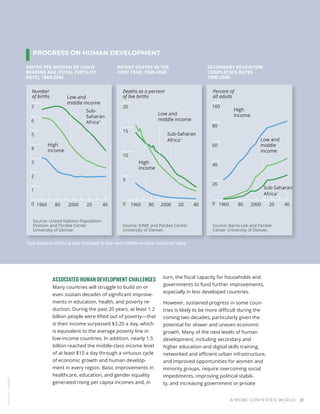
tries. Birthrates in most developing econo-
mies dropped to less than three children per
woman of child-bearing age by 2020, and
the age of first birth has risen, increasing the
opportunities for education and work outside
the home. Sub-Saharan Africa continues to
be the greatest outlier on this metric: birth-
rates have decreased in recent years but still
averaged 4.9 in 2020 and are likely to remain
high. Maternal mortality has been reduced by
more than one-third during the past 20 years,
with South Asia accounting for most of the im-
provement. Most developing economies have
rapidly reduced the gap in educational attain-
ment for girls, although the average number
of years of education for girls is still only 81
percent of the years for boys across Sub-Saha-
ran Africa, a gap between that region and the
rest of the developing world that is unlikely to
close during the next two decades.
The patriarchal societies of the South Asia
region and the Arab states exhibit the greatest
gaps in overall gender equality in the home,
at the workplace, and for medical care, and
this shortfall is likely to continue for the next
20 years. Although women are the primary
producers of food globally, they have limited
or no rights to land ownership in many parts
of the world. Subordination of women to men
regardless of educational level is enshrined in
family law in many parts of the Middle East,
South Asia, and Sub-Saharan Africa. According
to a 2020 UN review, women held only 25 per-
cent of seats in national legislatures in 2020—
although that is twice the level in 2000—held
one quarter of corporate managerial posi-
tions, and accounted for less than one-tenth of
chief executive officers of major companies.
Improved Childhood Survival and Welfare.
In many countries the past two decades saw
rapid advances in reducing malnutrition and
infant mortality, which is mostly because of
decreases in preventable communicable dis-
ease; there is little room for further dramatic
improvements on this front. Progress will be
especially slow in areas where conflict and cri-
sis are on the rise. In the 1960s, 13 percent of
infants died in the first year of life throughout
the developing world; today it averages just
over 3 percent in the developing world. The
region with the greatest continuing challeng-
es is Sub-Saharan Africa, where 5 percent of
infants die within the first year, in large part
because poverty and communicable disease
rates remain high.
Expanding Access to Education. Educa-
tional attainment is an extremely powerful,
slow-moving driver of human development,
with expanding education contributing to
lifetime expected earnings. Globally, the pro-
FUTURE GLOBAL HEALTH CHALLENGES
Advances in basic healthcare during the past few decades, such as wider availability of medicines and vac-
cines and improvements in medical procedures, have reduced disease, improved overall health outcomes,
and extended longevity for large numbers of people globally. During the next two decades, however, several
health challenges are likely to persist and expand, in part because of population growth, urbanization, and
antimicrobial resistance.
Stalled Progress on Combating Infectious Disease
International progress against tuberculosis and malaria has stalled in recent years. From 2015-19, the num-
ber of cases of drug-resistant tuberculosis worldwide increased, and malaria cases declined just 2 percent,
compared to 27 percent in the preceding 15 years, in part because of the leveling of international investments.
Looking forward, longstanding, emerging, and re-emerging infectious diseases will continue to endanger
individuals and communities. The incidence of new pandemics also is likely to grow due to increased risk of new
animal pathogens infecting humans and factors that enable spread, such as human mobility and population
density.
Growing Antimicrobial Resistance
Resistance to antibiotic treatment is rising globally, due in part to overuse and misuse of antibiotics in livestock
and antimicrobials in human medicine. Drug-resistant infections cause more than half a million deaths annual-
ly, and the cumulative economic cost could reach $100 trillion between 2020 and 2050 because of productivity
loss and the high cost of extended hospital stays or treatment.
Rising Levels of Noncommunicable Disease
Noncommunicable diseases now cause the majority of deaths worldwide—principally because of diabetes,
cardiovascular disease, cancer, and chronic respiratory conditions such as asthma. Health experts project that
by 2040, noncommunicable diseases could cause 80 percent of deaths in low-income countries, up from 25
percent in 1990, due in part to longer life expectancies but also to poor nutrition, pollution, and tobacco use.
In many countries, health systems are not adequately equipped to respond to this shift, which could increase
human suffering. Periods of economic slowdown exacerbate those risks by straining public health systems and
putting downward pressure on foreign assistance and private health investments.
Increasing Strains on Mental Health, Especially Among Youth
Mental health and substance abuse disorders increased 13 percent during the past decade, principally because
of increases in population and life expectancy but also because of the disproportionate prevalence of mental
illness among adolescents. Currently, between 10 and 20 percent of children and adolescents globally suffer
from mental health disorders, and suicide is the third leading cause of death among people between 15 and
19 years old.
Health experts project that the economic cost of mental illness worldwide could exceed $16 trillion during the
next 20 years, with much of the economic burden resulting from lost income and productivity as a result of
chronic disability and premature death. Preliminary research suggests that because of the pandemic, people in
every region will experience increased rates of mental distress caused by economic losses and social isolation
stress disorder.
Vera
Davidova
/
Unsplash
A MORE CONTESTED WORLD 23
GLOBAL TRENDS 2040
24
portion of adults who have completed primary
education reached 81 percent in 2020, reflect-
ing a rapid increase across most regions and
income groups since the 1960s. This level of
attainment varies across developing countries,
from up to 92 percent of all adults in develop-
ing countries in Latin America, East Asia and
Pacific, and Europe down to only 60 percent in
Sub-Saharan Africa.
Expanding access to secondary education,
however, is likely to be harder for developing
countries because of its relatively higher costs,
higher dropout rates as some students choose
work over education, and cultural factors such
as early marriage that pull women away from
formal education. Educating a majority of
the workforce to the secondary school level
has historically been a driver for countries to
achieve upper-middle-income status. Cur-
rently, this majority threshold is reached in
developing countries in Europe and Central
Asia, East Asia and the Pacific, and Latin Amer-
ica, but only a quarter of the Sub-Saharan
workforce has a secondary school education.
Moreover, Sub-Saharan Africa is not likely to
reach the threshold during the coming two
decades because government, religious, and
other private sector investment will struggle to
keep up with population growth. This struggle
will also dampen economic growth as workers,
particularly those who choose early entry into
the workforce over education, will lack the
skills for higher paying jobs. South Asia is mak-
ing better progress than Sub-Saharan Africa
on this front and has the potential to reach the
key development threshold for secondary edu-
cation by around 2040.
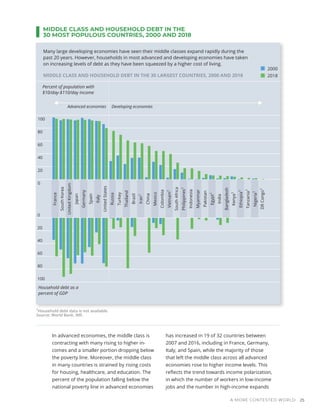
RISING, SHIFTING GLOBAL MIDDLE CLASSES
Globally, the number of households falling
into a broad definition of the middle class
has soared in the past two decades, raising
expectations for continued improvements. In
2020, approximately 36 percent of the global
population was in the middle class with annual
incomes of $4,000-$40,000, up 13 percent-
age points from 2000, judging from a World
Bank database of income surveys. The largest
growth in middle-class populations during
2000-18 (the latest survey data available) by
percentage of population occurred in Russia,
Turkey, Thailand, Brazil, Iran, China, Mexico,
and Vietnam, in descending order.
During the next two decades, the middle class
is unlikely to grow at a similar pace, and devel-
oping-country middle-income cohorts could
well perceive that their progress is slowing.
Across many countries, the high per capita in-
come growth of the past 20 years is unlikely to
be repeated, as global productivity growth falls
and the working-age population boom ends
in most regions. Global models of household
income suggest that, under a baseline scenar-
io, the middle class share of the global popula-
tion will largely remain stable during the next
twenty years, although this outcome will be
contingent on social and political dynamics.
East Asia, and to a lesser extent South Asia,
appear better positioned to achieve further in-
creases in per capita income relative to other
regions, thereby reducing to some extent their
income, education, and life expectancy gap
with advanced economies. These regions ben-
efit from effective education systems, general-
ly stable social networks, and competent gov-
ernance. On the other hand, some developing
countries, including several in Latin America,
are at high risk of falling into the middle-in-
come trap in which inflation of take-home pay
outpaces worker productivity, leading to a
stagnation of economic growth. The problems
in Latin America’s outlook stem in part from
poor infrastructure and technology adoption
and inadequate education systems.
A MORE CONTESTED WORLD 25
0
20
40
60
80
100
MIDDLE CLASS AND HOUSEHOLD DEBT IN THE
30 MOST POPULOUS COUNTRIES, 2000 AND 2018
1
Household debt data is not available.
Source: World Bank, IMF.
2018
2000
Percent of population with
$10/day-$110/day income
Household debt as a
percent of GDP
Many large developing economies have seen their middle classes expand rapidly during the
past 20 years. However, households in most advanced and developing economies have taken
on increasing levels of debt as they have been squeezed by a higher cost of living.
MIDDLE CLASS AND HOUSEHOLD DEBT IN THE 30 LARGEST COUNTRIES, 2000 AND 2018
France
South
Korea
United
Kingdom
Japan
Germany
Spain
Italy
United
States
Russia
Turkey
Thailand
Brazil
Iran
1
China
Mexico
Colombia
Vietnam
1
South
Africa
Philippines
1
Indonesia
Myanmar
Pakistan
Egypt
1
India
Bangladesh
Kenya
1
Ethiopia
1
Tanzania
1
Nigeria
1
DR
Congo
1
Advanced economies Developing economies
0
20
40
60
80
100
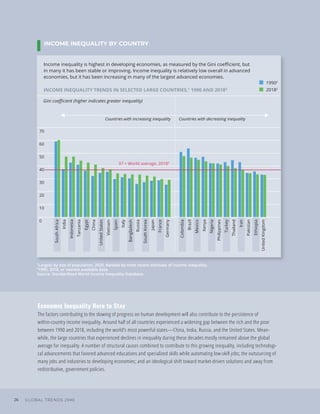
In advanced economies, the middle class is
contracting with many rising to higher in-
comes and a smaller portion dropping below
the poverty line. Moreover, the middle class
in many countries is strained by rising costs
for housing, healthcare, and education. The
percent of the population falling below the
national poverty line in advanced economies
has increased in 19 of 32 countries between
2007 and 2016, including in France, Germany,
Italy, and Spain, while the majority of those
that left the middle class across all advanced
economies rose to higher income levels. This
reflects the trend towards income polarization,
in which the number of workers in low-income
jobs and the number in high-income expands
0
10
20
30
40
50
60
70
INCOME INEQUALITY BY COUNTRY
1
Largest by size of population, 2020. Ranked by most recent estimate of income inequality.
2
1990, 2018, or nearest available data.
Source: Standardized World Income Inequality Database.
20182
19902
Gini coefficient (higher indicates greater inequality)
Income inequality is highest in developing economies, as measured by the Gini coefficient, but
in many it has been stable or improving. Income inequality is relatively low overall in advanced
economies, but it has been increasing in many of the largest advanced economies.
INCOME INEQUALITY TRENDS IN SELECTED LARGE COUNTRIES,1
1990 AND 20182
South
Africa
India
Indonesia
Tanzania
Egypt
China
United
States
Vietnam
Spain
Italy
Bangladesh
Russia
South
Korea
Japan
France
Germany
Colombia
Brazil
Mexico
Kenya
Nigeria
Philippines
Turkey
Thailand
Iran
Pakistan
Ethiopia
United
Kingdom
Countries with increasing inequality Countries with decreasing inequality
37 = World average, 20182
GLOBAL TRENDS 2040
26
Economic Inequality Here to Stay
The factors contributing to the slowing of progress on human development will also contribute to the persistence of
within-country income inequality. Around half of all countries experienced a widening gap between the rich and the poor
between 1990 and 2018, including the world’s most powerful states—China, India, Russia, and the United States. Mean-
while, the large countries that experienced declines in inequality during these decades mostly remained above the global
average for inequality. A number of structural causes combined to contribute to this growing inequality, including technologi-
cal advancements that favored advanced educations and specialized skills while automating low-skill jobs; the outsourcing of
many jobs and industries to developing economies; and an ideological shift toward market-driven solutions and away from
redistributive, government policies.
A MORE CONTESTED WORLD 27
at the same time. Most high-skill workers
probably will continue to benefit from work-
place technology, while middle-skill workers
doing repetitive tasks that can be automated
will face declining wages and job losses. Even
some workers in high paid professions may
see their earnings challenged by artificial
intelligence (AI) and machine learning. House-
hold debt has already soared across advanced
economies in recent years because of these in-
come strains and higher costs for healthcare,
housing, and education.
MIGRATION: PEOPLE ON THE MOVE
Demographic trends and economic incentives
will continue to drive large-scale migration
during the next two decades. Although there
is little certainty about the level of migration
as government policies fluctuate, the push and
pull factors for cross-border movements of
people will endure globally—feeding debates
in destination countries over migration and
aggravating social divisions in some areas.
The past 20 years saw a large increase in
cross-border migration, not only in absolute
numbers but also as a percent of the global
population. More than 270 million persons
in 2020 were living in a country to which
they had migrated, 100 million more than in
2000, representing an increase of more than
half a percent of the global population. Most
migrants left their homes to pursue better
economic prospects, but tens of millions were
fleeing conflict, crime, religious and social
repression, and natural disasters.
For the vast majority of migrants who are
workers, migration flows clearly reflect wage
differentials between countries—the flows
are from smaller, middle-income economies
to larger, high-income economies. Almost
two-thirds of migrants in 2019 originated from
middle-income economies, and more than
half migrated to high income countries for
higher pay and to send remittances home. The
fastest growth in emigration begins at around
$4,000 per capita GDP, the point at which peo-
ple have reached lower-middle-income and
can afford to travel, and then begins to slow
when per capita GDP reaches $10,000-$12,000
where people are nearing the World Bank’s
definition of high income, making employment
opportunities at home more attractive.
Looking forward, rapid population growth al-
most certainly will add to existing push factors
in Sub-Saharan Africa, while many other devel-
oping countries are nearing the end of peak
emigration. The population in the middle-in-
come migration window of $4,000 to $10,000-
$12,000 peaked around 2010 for several
regions, including Latin America, Central Asia,
and parts of Eastern Europe. East Asia, South-
east Asia, and South Asia are also nearing or
past the strongest period for this income push
factor, but the percent of the population in
Sub-Saharan Africa in this income window will
continue to rise during the next 20 years.
Greater need for workers in aging countries
is a growing pull factor in European and Asian
countries. European countries had the largest
total number of cross-border immigrants at
the end of 2019 at nearly 70 million, according
to 2020 UN statistics. One-third came from
Eastern Europe, which had a working-age
population that was peaking just as advanced
European economies were beginning to
rapidly age. Aging European countries and
Japan are expanding policies that provide visas
for workers.
During the coming 20 years, people fleeing di-
sasters and conflict will continue to contribute
to migration flows. UN and NGO data show
that domestic civil and political turmoil have
pushed 80 million people out of their homes
GLOBAL TRENDS 2040
28
as of yearend 2019, of which about a third
have migrated to other countries.
BROADER IMPLICATIONS AND DISRUPTIONS
These demographic and human development
trends will put pressure on governments to
increase public investment and manage immi-
gration, lead to instability in some countries, in
some ways contribute to a rising Asia, and add
to the agenda of already strained international
development institutions.
Setbacks for Women, Children, and
Minorities. The current pandemic exempli-
fies the fragility of progress against poverty
in some regions and the potential for regres-
sion for women, minority groups, and others
lower in economic, political, and social stat-
ure. Although so far mortality in low-income
countries, outside Latin America, has been
lower than in the advanced economies, the
economic impacts have been severe. Beyond
overwhelmed healthcare systems and the
negative impact on income for millions of the
near poor, broader disruptions include lack of
or limited education and the diversion of med-
ical resources from other priorities, including
vaccinations and maternal health.
Growing Pressure For Public Investment.
Growing populations, especially middle classes
in developing countries, are putting increased
pressure on governments for the provision of
public goods, such as affordable housing, ed-
ucation, healthcare, and infrastructure. Poorly
governed urban areas, especially those with
access to infrastructure such as international
ports or airports, are also ideal habitats for
organized crime syndicates.
Double-Edged Sword For Political Stability.
Older populations tend to be less violent and
ideologically extreme, thus reducing the risk
of internal armed conflict. East Asia and Latin
America will have a median age above 30, sug-
gesting a potential for greater social stability.
Such populations also have strong preferenc-
es for democracy; where authoritarian re-
gimes remain, instability from so-called color
revolutions is likely to persist. In addition,
in countries with fast growing and youthful
populations, the growing gap between the ex-
pectations of growing urban cohorts and their
governments’ ability to provide for their edu-
cation, healthcare, and job opportunities has
the potential to increase political instability. In
such countries, recruitment to radical extrem-
ist movements will be a major risk as well.
Increased Debate Over Migration. Immi-
grants can help developed economies miti-
gate the downsides of an aging population by
improving economic productivity, providing
services, and expanding the tax base. How-
ever, countervailing pressures such as strong
cultural preferences for maintaining national
identity and ethnic homogeneity could con-
tinue to fuel an antimigrant backlash in many
developed countries and increasingly in some
developing and middle-income countries
with declining workforces, such as China. As a
result, many are likely to choose technological
innovation and automation and limit migration
to highly skilled labor. Within and between
countries, debates and division will continue
over how much migration to allow and how to
control flows.
Some Shifts Could Benefit A Rising East.
Many developing countries in Asia will either
gain potential advantages from demographic
trends or are relatively well positioned to over-
come demographic headwinds. As a result per
capita incomes and human development lev-
els probably will rise more in Asia than in any
other region. Most Asian countries will con-
Photo
/
Shutterstock
A MORE CONTESTED WORLD 29
tinue to have large working-age populations,
high secondary-level graduation rates, and, for
many, substantial investments in health and
infrastructure that bolster levels of well-be-
ing. The greatest variable is likely to be how
China handles the demographic crunch it will
see during the next two decades—the deep
decline in fertility from its one-child policy has
already halted the growth of its labor force
and will saddle it with a doubling of its pop-
ulation over 65 during the next two decades
to nearly 350 million, the largest by far of any
country. Even if the Chinese workforce is able
to rise closer to advanced-economy produc-
tivity levels through improved training and
automation, China remains in danger of hitting
a middle-income trap by the 2030s, which may
challenge domestic stability.
Strained International Development
Institutions. International institutions fo-
cused on human development will face a more
complicated operating environment as de-
mands for their coordination efforts grow. Any
increase in humanitarian and refugee crises
stemming from natural and human-created
causes will divert international resources from
efforts to make systemic improvements in
poverty and disease. The likely failure of many
countries to meet the UN’s 2030 Sustainable
Development Goals will have the largest
impact on middle-income societies where
populations that have recently emerged out
of poverty are demanding progress toward
next levels of education, medical care, and
environmental quality. Traditional providers of
development assistance might not be able to
keep up with needs. Shortfalls in multilateral
development assistance could facilitate plans
by China and other countries to gain advan-
tage from financing critical urban infrastruc-
ture in developing countries.
ENVIRONMENT
STRUCTURAL FORCES
Photo
/
Pexels
30
Key Takeaways
During the next 20 years, the physical effects from climate change of higher tem-
peratures, sea level rise, and extreme weather events will impact every country.
The costs and challenges will disproportionately fall on the developing world, in-
tersecting with environmental degradation to intensify risks to food, water, health,
and energy security.
There will be increased emphasis on mitigating greenhouse gas emissions to
achieve net zero with new energy technologies and carbon dioxide removal
techniques to meet the Paris Agreement goal of limiting warming to 1.5 degrees
Celsius. However, as the world gets closer to exceeding 1.5°C—probably within the
next 20 years—calls will increase for geoengineering research and possible deploy-
ment to cool the planet, despite possibly dire consequences.
Debate will increase over how and how fast the world should reach net zero as
countries face hard choices over how to implement drastic emissions cuts and
adaptive measures. Neither the burdens nor the benefits will be evenly distributed
within or between countries, heightening competition, contributing to instability,
straining military readiness, and encouraging political discord.
CLIMATE
CHANGE
ERODING
HUMAN
SECURITY
INSTABILITY
CONFLICT
MITIGATION
ADAPTATION
ENERGY
TECHNOLOGIES
ENVIRONMENTAL
DEGRADATION
SIMULTANEOUS DRIVERS
POLICY ACTIVITY
KEY CHA LLE NGE S / U NC E RT AI NT I E S
Pace Unequal
burdens
Societal and
government change
Geoengineering
Food, water, energy security
Human health
More migration
Loss of natural capital
Higher temperatures
Melting Arctic
Extreme weather
Sea level rise
Land degradation
Water misuse
Pollution
A MORE CONTESTED WORLD 31
CLIMATE CHANGE HERE AND INTENSIFYING
We are living in a world already affected by
climate change caused by growing human-in-
duced concentrations of greenhouse gases in
the atmosphere. The world has warmed on
average 1.1 degrees Celsius since the late 19th
century, causing diminished glaciers and ice
caps, higher sea levels, more intense storms
and heat waves, and a more acidic ocean,
according to the Intergovernmental Panel on
Climate Change. The past 10 years were the
hottest on record, and every decade since
the 1960s has been hotter than the previ-
ous one. On the current path, it is probable
that within the next 20 years global warming
will surpass 1.5°C while heading toward 2°C
possibly by mid-century. Cumulative emis-
sions already in the atmosphere will drive
temperature increases in the next two de-
cades even if emissions were to reach net zero
immediately, according to the US National
Climate Assessment.
Physical Effects
The physical effects of a changing climate are
likely to gradually intensify during the next two
decades compared to the catastrophic impacts
modeled for the latter half of the century,
should temperature rise continue unabated.
No country or region will be immune from the
physical effects of climate change and envi-
ronmental degradation, but the impact will
vary—some regions will even see some mar-
ginal benefits in the form of longer growing
seasons. In general, developing countries will
suffer more as they lack the capacity to adapt
to climate change and on average are more
highly exposed to its effects.
Melting Arctic and Sea Level Rise. Tempera-
tures are warming at three times the global
average in the Arctic largely as a result of feed-
back loops from melting ice and snow cover.
This has caused mass loss from ice sheets and
glaciers as well as reductions in sea ice extent
T
he past ten years was the
hottest on record, and every
decade since the 1960s has been
hotter than the previous one.
GLOBAL RISE IN CARBON DIOXIDE
AND AVERAGE TEMPERATURE
1880 1900 1920
+1.0
+1.2
Average surface temperature
in degrees Celsius
+0.8
+0.6
+0.4
+0.2
0
-0.2
GLOBAL TRENDS 2040
32
Willian
Justen
de
Vasconcellos
/
Unsplash
1940 1960 1980 2000 2020
Atmospheric CO2 concentrations
in parts per million
400
420
380
360
340
320
300
280
This graph illustrates the
change in global carbon dioxide
concentrations in atmospheric
parts per million and in global
surface temperature in degrees
Celsius relative to pre-Industrial
average temperatures. Nineteen of
the 20 warmest years have
occurred since 2001, and 2020 tied
for the hottest year on record.
Source: NASA GISS, NOAA NCEI, ESRL. https://medialibrary.climatecentral.org/
resources/national-and-global-emissions-sources-2020.
TEMPERATURE
CARBON
DIOXIDE
A MORE CONTESTED WORLD 33
and thickness. Globally, the sea level has risen
an average of 8 to 9 inches since the late 19th
century; estimates of rise in the next 20 years
range from another 3 to 14 inches, which
would create additional problems for low lying
coastal cities and islands. On land, thawing
permafrost is likely to cause increasing dam-
age to infrastructure, including transportation
systems, pipelines, and power plants.
More Intense Heat Waves. Outside the Arc-
tic, the fastest warming is projected to occur
in central and eastern North America, central
Europe, the Mediterranean region (including
southern Europe, northern Africa and the Near
East), western and central Asia, and southern
Africa. The tropics especially are expected to
experience widespread extreme heatwaves.
Extreme Weather and Weather Patterns.
Warming temperatures are likely to create the
atmospheric conditions for more intense and
in some cases, more frequent natural disas-
ters, including stronger hurricane-strength
storms, coastal flooding, storm surges, and
droughts. Traditional weather patterns are
also changing—for example, dry areas are ex-
pected to become drier, wet areas will become
wetter, and precipitation will be less frequent
but more intense in some areas.
ADDING TO ENVIRONMENTAL DEGRADATION
During the next two decades, population
growth, rapid urbanization, and poor land
and resource management will increasingly
intersect with and exacerbate climate change
effects in many countries, particularly in the
developing world. With coastal cities growing,
more people than ever will be threatened by a
combination of storm surges and sea level rise
that worsen existing coastal erosion.
Land Degradation. The expansion and un-
sustainable management of agriculture and
forestry practices degrade land, and both con-
tribute to and intensify the effects of climate
change. A 2019 study found that global defor-
estation and land degradation each contribut-
ed to about 10 percent of all human-induced
greenhouse gas emissions by releasing carbon
stored in the trees and the soil.
Water Misuse. Poor water governance within
and between states will remain the primary
NARROWING CLIMATE
UNCERTAINTIES
Even though the Earth’s climate is an extremely complex,
interconnected system that is sensitive to small chang-
es, increased data collection, computing power, and
sophisticated modeling means that our understanding of
climate change has become increasingly strong. Several
areas of research are attempting to reduce uncertainty:
Attribution: Scientists are improving their ability to
attribute specific events after the fact to climate change.
This nascent field, known as extreme event attribution,
could change how publics perceive the growing threat
and provide a basis for developing countries or impact-
ed communities to claim damages from high emitting
countries or their government.
Feedback Loops: Scientists currently have a difficult
time projecting when and to what extent positive
feedback loops will drive further temperature increases
and risk runaway warming. For example, the loss of
reflective sea ice will reveal more of the ocean surface,
which is dark and absorbs heat faster, in turn causing
even more sea ice to melt. Another concerning feedback
loop is methane, a powerful greenhouse gas that is
released from wetlands, permafrost, and ocean hydrates
in response to increased temperatures.
GLOBAL TRENDS 2040
34
driver of water stress during the next two
decades. As precipitation declines or becomes
more erratic, population growth, economic
development, and continued inefficient irri-
gation and agricultural practices will increase
demand. In many river basins, upstream
countries are building dams and altering water
sources with little or no consultation with their
downstream neighbors, such as the Grand
Ethiopian Renaissance Dam, increasing the
risk of conflict.
Pollution. Although air and water pollution
have decreased in many high-income coun-
tries since a peak in the 20th century, they
continue to grow globally as the number of
middle-income countries has increased; for
instance, 80 percent of industrial and munic-
ipal wastewaters are discharged untreated
into waterways. Similar to other environmen-
tal factors, air pollution and climate change
influence each other through complex interac-
tions in the atmosphere. Climate change will
lead to more stagnation events—stationary
domes of hot air that can cause air pollutants
to get trapped and persist in the lower atmo-
sphere—and will worsen air quality by increas-
ing the frequency of wild fires.
ERODING HUMAN SECURITY
The physical impacts of a warmer world,
combined with environmental degradation,
are likely to lead to an array of human secu-
rity challenges, primarily but not exclusively
in developing countries in the near term.
According to a 2018 study, 36 percent of cities
globally face acute environmental stress from
droughts, floods, and cyclones; climate change
will add to these. These challenges will com-
pound one another in coming years; as ex-
treme events become more intense and more
frequent, societies may struggle to recover
from one event before the next one hits.
Exacerbating Food and Water Insecurity.
Changing precipitation patterns, rising tem-
peratures, increased extreme weather events,
and saltwater intrusion into soil and water
systems from rising seas and storm surges are
likely to exacerbate food and water insecu-
rity in some countries during the next two
decades. Regions that remain dependent on
rain-fed agriculture will be particularly vul-
nerable, such as Sub-Saharan Africa, Central
America, some areas of Argentina and Brazil,
parts of the Andean region, South Asia, and
Australia. By contrast, some higher latitude
regions such as Canada, northern Europe, and
Russia may benefit from global warming by
lengthened growing seasons.
Fisheries are also under threat from severe
overfishing that climate change will further
stress through oxygen depletion, rapid warm-
ing, and ocean acidification. Fishermen have
to go further to catch fewer and smaller fish,
potentially venturing into the territorial waters
of other countries. In addition, warming ocean
temperatures threaten to kill many more coral
reefs—already they have declined by 30 to 50
percent, and at 1.5°C warming, they could de-
cline by 70 to 90 percent—further threatening
fishing and tourism industries.
Threats to Human Health. Decreased water,
air, and food quality, along with changes in
disease vectors and water-borne pathogens,
all threaten human life. Death rates from
pollution vary significantly across the world—
typically highest in middle-income countries
in East and South Asia. In addition, extreme
weather and disasters often kill people and
disrupt health infrastructure and prevent
access to care. Climate change is expected
to change the geographic range and in some
cases frequency of disease outbreaks affecting
humans, animals, and plants, including those
A MORE CONTESTED WORLD 35
that are vector-borne (West Nile, malaria, Den-
gue), waterborne (cholera), airborne (influen-
za, hantavirus), and food-borne (salmonella).
Loss of Biodiversity. The variability among all
living organisms—known as biodiversity—is
declining faster than at any point in human
history, risking food and health security and
undermining global resilience. Warming
temperatures are likely to lead to the extinc-
tion of plants and animals that can no longer
survive in their traditional habitats or shift
quickly to new locations as well as encourage
the spread of invasive species that choke out
native organisms.
Increased Migration. Extreme weather
events increase the risk of more environmen-
tally-induced migration, which usually occurs
within states as affected populations move
to nearby communities, often temporarily.
Climate change probably will exacerbate this
as sea level rise or extreme heat makes certain
locales permanently uninhabitable, although
mainly after 2040, possibly causing permanent
migration and movement to other states.
MITIGATION GAINING TRACTION
Efforts to set a path toward net zero green-
house gas emissions will intensify during the
coming decade and spark increased debate
about how and how soon to achieve this goal.
The 2015 Paris Agreement set a global goal of
limiting warming to less than 2°C, preferably
to 1.5°C, and resulted in countries volunteer-
ing modest targets to reduce or establish a
peak for their emissions. Although developed
country emissions have continued to decline
largely because of increased energy efficien-
cy and use of natural gas, and the COVID-19
pandemic also caused a brief drop in global
emissions—overall emissions have continued
to increase. This trend has led to a growing
number of countries making more ambitious
pledges to become carbon neutral—such as
Chile, the European Union (EU), Japan, New
Zealand, and South Korea by 2050, and China
by 2060.
As climate modeling improves, divisions are
likely to become more pronounced between
those who advocate reaching net zero emis-
sions over decades by transitioning to new
technologies and those who argue that net
zero must be achieved more quickly to pre-
vent the worst outcomes. State pledges factor
in advancements in technologies to mitigate
emissions while boosting economic growth
and assume that the worst effects of climate
change can be avoided through a more
gradual approach. Advocates of faster action
argue that the window to avoid the cataclys-
mic effects is closing and that more dramatic,
immediate behavioral changes are required.
Limiting the global temperature increase to
1.5°C will require unprecedented changes in
energy consumption and production to allow
developing countries to grow their economies
while not offsetting the carbon reductions
from developed countries.
Energy Transition Underway
A critical aspect of the global debate and the
ability to mitigate climate change is the speed
of the transition from fossil fuels to renewable
energy. Even though fossil fuels will continue
to supply the majority of energy needs during
the next 20 years, wind and solar are almost
certain to grow faster than any other energy
source because of technological advances and
falling costs, and nuclear power production
may grow, particularly if new, safer designs
emerge. Increasing energy efficiencies proba-
bly will also reduce the rate of energy demand
growth and the carbon intensity per unit of en-
ergy used. A range of current and future tech-
nological developments—as well as regulatory
and investment choices by governments,
GLOBAL TRENDS 2040
36
Billion tons
ANNUAL TOTAL CO2 EMISSIONS, BY REGION
Source: Carbon Dioxide Information Analysis Center (CDIAC); Global Carbon Project (GCP).
Note: ‘Statistical differences’ included in the GCP dataset is not included here.
OurWorldInData.org/co2-and-other-greenhouse-gas-emissions • CC BY
International transport
Oceania
Asia (excl. China
and India)
China
India
Africa
South America
North America (excl. USA)
United States
Europe (excl. EU-28)
EU-28
1751 1800 1850 1900 1950 2018
35
30
25
20
15
10
5
0
This chart shows CO2 emissions from fossil fuels and cement production only—
land use change is not included.
A MORE CONTESTED WORLD 37
businesses, and consumers—will influence
energy use in buildings, transportation, and
power, which together account for a majority
of global emissions. Many of these technolo-
gies could also contribute to greater energy
resilience and self-sufficiency for states.
Increased Efforts To Remove
Carbon Dioxide
The success of efforts to remove carbon diox-
ide from the atmosphere will also be critical.
The Intergovernmental Panel on Climate
Change estimates that mitigating emissions
alone almost certainly will not be enough to
limit warming to 1.5°C, which increases the im-
portance of technologies that remove carbon
dioxide from the atmosphere to use it or store
it underground. Most of the modeled path-
ways to limit warming to 1.5°C involve a sub-
stantial expansion of carbon dioxide removal
(CDR) primarily through afforestation and
bioenergy with carbon capture and storage
(BECCS). Other technologies being researched
include soil sequestration, ocean fertilization,
and direct air capture. Research into and a
push to deploy BECCS—still a nascent technol-
ogy—almost certainly will increase because
it is one of the few negative emissions tech-
nologies that exist because it uses carbon
dioxide to grow biomass that is converted to
usable energy while storing the carbon dioxide
underground. Currently about 25 commercial-
ly operational CDR projects offset a negligible
amount of yearly emissions, and efforts to
scale up CDR will face policy, technological,
and economic constraints absent market
incentives. More countries may introduce a
carbon tax, or a credit for removing carbon, in
an effort to speed up CDR as well as broaden
adoption of renewable energy technologies.
Complementary Actions on Emissions
Many more actors are likely to join internation-
al and governmental efforts to address climate
KEY EMERGING
ENERGY TECHNOLOGIES
The cost to build and operate new solar photovoltaic and
wind-powered plants is broadly cheaper than equivalent
fossil fuel–fired power plants. Even more efficient, lower cost
renewable technologies, such as perovskite solar cells, are
poised to transform and disrupt energy industries in the next
two decades. Moreover, increasingly connected wind turbine
technology is enabling massive and lower-cost offshore wind
projects worldwide. China is the world’s largest producer and
exporter of solar panels and wind turbines.
Advanced energy storage will be needed to enable more
renewables in grid systems and support broad deployment of
electric vehicles. Lithium-ion batteries have seen large cost re-
duction and performance improvements in recent years, and
investments are also increasing in potentially safer, cheaper,
more powerful, and longer duration alternatives. In the fu-
ture, it is likely that advanced energy storage would allow for
the development of decentralized and autonomous electrical
grids that integrate batteries, renewable power sources, and
electric vehicles and that potentially have no need for backup
from fossil fuels.
Green hydrogen—produced through electrolysis with no
by-products—has the potential to play a greater role in stor-
ing excess solar and wind energy and helping to decarbonize
heating, industry, and heavy transport. The industry is still
in its infancy, but costs are expected to come down because
countries with cheap renewable energy sources are particular-
ly interested in it, such as Chile.
Several companies are developing small modular nuclear
reactors (SMRs), about one-third the size of traditional nu-
clear reactors, which could lead to broader acceptance from
countries traditionally opposed to nuclear projects because
SMRs are smaller and safer. SMRs have the potential to
provide power generation to remote areas, such as in Africa,
which could help developing countries electrify their popula-
tions without increasing emissions. In addition, SMRs—when
combined with solar and wind power—could help solve the
problem of intermittency.
GLOBAL TRENDS 2040
38
and environmental challenges. Action at the
local level has already increased, and a grow-
ing number of companies have pledged to go
carbon neutral. Some large asset managers
have concluded that climate change threat-
ens their long-term returns and are requiring
carbon emissions disclosures from firms in
their portfolios or declining to invest in some
fossil fuel projects. In 2018, nearly 10,000 cities
and municipalities in 128 countries took some
form of climate action, as did 6,225 companies
headquartered in 120 countries, represent-
ing $36.5 trillion in revenue, larger than the
combined gross domestic product (GDP) of the
United States and China. Public-private part-
nerships are becoming a preferred operating
framework, partly a recognition that nonstate
efforts are most effective when linked to
state action.
GROWTH OF RESILIENCE AND ADAPTATION
In addition to efforts to reach net zero emis-
sions, many countries and local communities
will expand investment in adaptive infrastruc-
ture and resilience measures. Some measures
are as inexpensive and simple as restoring
mangrove forests or increasing rainwater stor-
age; others are as complex as building mas-
sive sea walls and planning for the relocation
of large populations. A key challenge for these
efforts will be funding for vulnerable commu-
nities—particularly as governments face com-
peting fiscal and political challenges and have
to choose which communities to support.
Public-private partnerships are innovating
new insurance approaches aimed at building
resilience to climate risks, such as insuring
natural assets like the Mesoamerican reef off
Mexico or index-based weather insurance for
local farmers in Kenya. These approaches rely
on new data and machine learning technolo-
gies—suggesting that as these technologies
advance during the next 20 years, resilience
mechanisms may become more sophisticated.
Calls for Geoengineering
As warming gets closer to exceeding the Paris
Agreement goals, it is increasingly likely that
states and nonstate actors will more aggres-
sively research, test, and possibly deploy geo-
engineering measures—deliberate large-scale
interventions in the earth’s natural systems—
to try to counteract climate change. Current
research is largely focused on solar radiation
management (SRM), an effort to cool the
planet by reflecting the suns energy back into
space. Stratospheric aerosol injection (SAI), a
form of SRM that sprays particles in the strato-
sphere to cause global dimming, has attracted
funding by those who fear the worst of climate
change. Proponents argue that the needed
energy transformation will happen too slowly
and that SAI can buy the planet time because
it is technologically feasible and less expensive
than mitigation.
Current research is almost entirely in comput-
er models with academia, nongovernmental
organizations, and private companies playing
a leading role. However, there will be in-
creased calls for countries to begin engaging
in the dialogue and possibly take leadership to
develop international agreements that could
help set research standards, ensure transpar-
ency in live tests, determine the legal frame-
work around if, how, and when to deploy SRM
technologies, and monitor the effects. The
possibly catastrophic unintended side effects
are not well understood, and some scientists
fear that SRM, while keeping temperatures
down, would create unexpected and devastat-
ing changes in weather systems and rainfall
patterns. Countries and nonstate actors de-
ploying it alone will increase the risk of conflict
and blowback, especially when others blame
A MORE CONTESTED WORLD 39
them for a disaster they believe was caused
by geoengineering.
BROADER IMPLICATIONS AND DISRUPTIONS
In addition to direct physical effects of climate
change, states and societies are likely to be
strained by hard choices and tradeoffs given
the difficulty and costs of drastic emissions
cuts and adaptive measures. The burden
of these steps will not be evenly distributed
within or between states, and the long-term
payoff of mitigation policies runs counter to
political incentives, making it difficult to sus-
tain controversial commitments. The second-
and third-order implications of climate change
will affect human and national security in
several ways.
Drive Societal Cleavages and Political
Movements. Concerns about climate change
have grown across the globe with hundreds
of thousands of protesters—mostly young
people—marching in the streets advocating
for faster change. Policy responses to mitigate
or adapt to climate change also contribute
to political volatility—particularly when they
are linked to broader socio-political inter-
ests—such as the French protests against fuel
price hikes in 2018. In Europe, nationalist and
populist parties have capitalized on public
concerns about the economic hardships
associated with climate mitigation policies,
and they have framed their opposition in
terms of equality and social justice for working
class populations.
Increased Pressure for Global Action.
As warming continues to rise, there will be
more debate and tension among countries
over transparency, cuts, and responsibility.
Developing countries that want the room to
grow their economies and increase emissions
will more forcefully demand that developed
countries provide them with advanced energy
technologies to leapfrog their energy systems
to a low carbon model. In addition, develop-
ing countries will increasingly demand that
developed countries meet their commitments
to provide financing to help vulnerable popu-
lations adapt. Greater demands will be made
on international financing vehicles such as the
Green Climate Fund, which has approved $4
billion worth of adaptation projects.
Heighten Competition. Climate change and
environmental degradation will contribute to
and reflect a more contested geopolitical envi-
ronment. Countries and other actors are likely
to compete over food, mineral, water, and
energy sources made more accessible, more
valuable, or scarcer. Receding Arctic sea ice
is opening new sea routes and opportunities
to access valuable resources there, including
natural gas and oil deposits, rare earth met-
als, and fish stocks. Russia is building more
icebreakers to patrol its northern coastline
and project power as an Arctic leader, and
even non-coastal states like China and India
are seeking to take advantage of shorter trade
routes and resources. In addition, China is try-
ing to boost its international image by claiming
to be a leader on climate diplomacy despite
its growing emissions—already the highest in
the world.
Contribute to Instability and Conflict Risk.
Rarely is climate change the sole or even pri-
mary driver of instability and conflict; however,
certain socio-political and economic contexts
are more vulnerable to climate sparks that
ignite conflict. Countries of particular concern
are those with ethnic or religious polariza-
GLOBAL TRENDS 2040
40
tion; livelihoods highly dependent on natural
resources or agriculture; weak or illegitimate
conflict resolution mechanisms; a history of
violence; and low adaptive capacity. For exam-
ple, an increase in drought or extreme weath-
er may reduce the opportunity cost of joining
armed groups for struggling farmers and herd-
ers, while sectarian elites may advance their
polarizing political goals by exploiting local
grievances exacerbated by climate change.
Strain Military Readiness. While militaries
will continue to adapt and fight in the chang-
ing world, climate effects will strain readiness
and compound fiscal pressures on many
militaries. Storm surges and sea level rise will
force changes to the design and protection of
naval bases and aircraft runways, prolonged
extreme heat will limit training days, and
major storms and floods will force militaries
to divert more resources to disaster relief at
home and abroad.
Increase Pressure on Strained International
Systems. Current international law and coop-
erative bodies are increasingly mismatched
to global climate challenges. For example,
international refugee law does not account for
people displaced by climate change effects.
Many existing organizations designed to help
manage shared resources, such as the Arctic
Council or the Nile Basin Initiative, may be
overwhelmed or sidelined, given their volun-
tary nature and lack of enforcement mecha-
nisms. Also, efforts to develop international
standards or regulations for high-risk activities
like SRM lag behind the technology, increasing
the possibility that countries or individuals will
pursue unilateral action that risk blowback.
ENERGY TRANSITION GEOPOLITICS
AND ECONOMICS
The transition from fossil fuels has the potential to signifi-
cantly reshape geopolitics and economics, depending on
its speed and structure. Petro-states—currently accounting
for 8 percent of world GDP and nearly 900 million citi-
zens—would face major revenue losses in an aggressively
decarbonizing scenario. Those that can more efficiently and
cheaply extract oil or diversify their economies will better
weather the transition.
In addition, the transition will diminish countries’ ability
to use energy as a tool of coercion or statecraft because
energy systems will become more decentralized. Countries
will have decreased leverage in energy markets because
oil and renewables operate differently; the former is an
extracted resource that is traded, whereas the latter is
harnessed by building out domestic infrastructure. As a
result, it will be more difficult for any one country to affect
others’ energy supply. For example, Chinese dominance of
the clean energy equipment market does not allow Beijing
to threaten global energy supplies in the way that control of
the oil markets by the Organization of Petroleum Exporting
Countries once did.
However, a shift to renewable energy will increase compe-
tition over certain minerals, particularly cobalt and lithium
for batteries and rare earths for magnets in electric motors
and generators. As actors race to develop new renewable
energy technology during the next two decades, they will
focus on countries that supply these minerals, such as the
Democratic Republic of the Congo and Bolivia.
Photo
/
Bigstock
A MORE CONTESTED WORLD 41
CHUUTERSNAP
/
Unsplash
42
ECONOMICS
Key Takeaways
During the next two decades, several global economic trends, including rising
national debt, a more complex and fragmented trading environment, the global
spread of trade in services, new employment disruptions, and the continued rise
of powerful firms, are likely to shape conditions within and between states.
Many governments may find they have reduced flexibility as they navigate greater
debt burdens, diverse trading rules, and public pressure to deal with challenges
that range from demographic shifts to climate change.
Asian economies appear poised to continue decades of growth, although poten-
tially at a slower pace. Productivity growth will be a key variable globally; increased
growth rates in the Organization for Economic Cooperation and Development
(OECD) countries would help governments deal with economic, demographic,
and other challenges; and increased growth rate in Asia could help countries avoid
the middle-income trap.
STRUCTURAL FORCES
GOVERNMENTS
CONSTRAINED
NEW LARGE
ECONOMIES EXERTING
INFLUENCE
GLOBALIZATION
DIVERSIFYING
ECONOMIC
ACTIVITY
TILTING TO ASIA
LARGE FIRMS
SHAPING GLOBAL
CONNECTEDNESS
NATIONAL DEBT
RISING
TRADE ENVIRONMENT
FRAGMENTING
EMPLOYMENT DISRUPTIONS
INCREASING
POWERFUL FIRMS
EXPANDING
GLOBAL COMPETITIVENESS
EVOLVING
EVOLVING INTERNATIONAL
ECONOMIC ORDER
GLOBAL
ECONOMY
I M
P L I C A T I O N
S
A MORE CONTESTED WORLD 43
O
ver the next few decades,
the economic costs of
aging will strain public finances
in all G20 economies, unless
difficult decisions are made to
either reduce benefits and/or
raise taxes.
Economic trends during the next two decades
probably will vary more than trends in de-
mography and climate. Economic forecasting
is inherently uncertain and highly connected
to other key trends, including technology, as
well as government policies. In this section, we
focus on several longer term economic trajec-
tories that are creating both opportunities and
challenges for states and nonstate actors.
HIGH NATIONAL DEBT ENDURING, RISING
National debt levels have risen in almost every
country since the 2007-08 global financial
crisis and are likely to continue to face up-
ward pressure through at least 2040. Strong
borrowing in response to the COVID-19 pan-
demic, rising old-age dependency burdens in
most of the largest economies, and increased
demands on governments to spur economic
growth as well as respond to other global chal-
lenges have all contributed to the debt levels.
National debt to gross domestic product (GDP)
ratios were higher in 2019 than in 2008 in
almost 90 percent of advanced economies, in-
cluding the United States and Japan, and leapt
upward in 2020 because of the pandemic and
government responses. Average debt ratios in
emerging markets in 2019 were comparable
to those that prevailed during the debt crisis
wave of the mid-1980s and 1990s. In 2019, the
International Monetary Fund (IMF) assessed
that approximately two-fifths of low-income
developing countries were at high risk of, or
in, debt distress. During the next few decades,
the economic costs of aging will strain public
finances in all G20 economies, unless difficult
decisions are made to reduce benefits or
raise taxes.
Reducing national debt ratios during the next
20 years is likely to be even more challeng-
ing than during the decade that followed the
financial crisis. The cost of providing health-
care and pensions in most of the largest
economies, as well as paying for other social
programs, will remain a drag on discretionary
spending without major productivity gains
or a reduction in the cost of these services.
Slow economic growth in some economies
could reduce tax revenues and impair govern-
ments’ ability to reduce spending because of
the need to invest in economic recovery and
infrastructure or respond to the effects of
climate change.
NATIONAL DEBT AS A
PERCENTAGE OF GDP
0
20
40
60
80
100
120
140
160
Sub-
Saharan
Africa
Middle
East and
Central
Asia
Latin
America
and the
Caribbean
Emerging
and
Developing
Asia
Other
Advanced
Economies
G7
Economies
Percent of GDP
2007 Prefinancial crisis
2010 Post-financial crisis
2019 Pre-COVID-19
2020 Immediate aftermath
of COVID-19
Source: WEO 2020 Database.
GLOBAL TRENDS 2040
44
100% or more
75% - 100%
50% - 75%
25% - 50%
Less than 25%
Not in FM sample
100% or more
75% - 100%
50% - 75%
25% - 50%
Less than 25%
Not in FM sample
NATIONAL DEBT AS A PERCENTAGE OF GDP
Source: International Monetary Fund.
2007 | PRE-GLOBAL FINANCIAL CRISIS
2020 | COVID-19
A MORE CONTESTED WORLD 45
Sustainable for Some, But Others at Height-
ened Risk of Default. A prolonged period of
low interest rates, similar to the post-financial
crisis period, would increase the affordability
of debt for some economies, including ad-
vanced economies in Asia, Europe, and North
America, allowing them to sustain higher
national debt ratios. The world’s major central
banks, including the European Central Bank,
the Federal Reserve, and the Bank of Japan,
have pursued an ultra-low interest rate policy
for at least the past decade, and most econ-
omists expect these countries to be able to
sustain high debt ratios because they have
borrowed in their own currency. Departures
from this policy could increase debt servicing
costs and increase the risks associated with
high debt ratios.
Emerging and developing economies that
have financed at least some of their debt with
external borrowing are at increased risk of
debt distress and could face a debt crisis, even
if global interest rates remain low, because
local currency depreciation and increased
risk premiums could increase servicing
costs. Some governments are likely to face
the choice of reining in public spending and
risking public discontent, or maintaining public
spending, which would further increase debt
burdens and borrowing costs and risk local
currency depreciation. Facing these choices,
some governments are likely to prioritize
spending on domestic issues rather than the
global commons.
DISRUPTIONS IN EMPLOYMENT
The global employment landscape will con-
tinue to shift because of new technologies,
notably automation, online collaboration tools,
artificial intelligence (AI), and perhaps addi-
tive manufacturing. Tasks that once seemed
uniquely suited to human abilities, such as
driving a car or diagnosing a disease, are
already automated or potentially amenable
to automation in the next decade. Studies
have estimated that automation could elim-
inate 9 percent of existing jobs and radical-
ly change approximately one-third in the
next 15 to 20 years. Emerging technologies
will also create jobs and will enable greater
virtual labor mobility through Internet-based
freelance platforms that match customers
with self-employed service providers as
well as speed-of-light commercial data and
software transmission.
Demographics, specifically aging populations,
will promote faster adoption of automation,
even with increases in the retirement age.
Most of today’s largest economies will see
their workforces shrink over the coming two
decades as aging workers retire. South Korea
is projected to lose 23 percent of its work-
ing-age population (age 15-64), Japan 19 per-
cent, southern Europe 17 percent, Germany 13
percent, and China 11 percent during this peri-
od, if the retirement age remains unchanged.
Automation—traditional industrial robots and
AI-powered task automation—almost certainly
will spread quickly as companies look for ways
to replace and augment aging workforces
in these economies. Automation is likely to
spread more slowly in other countries, with
the key being whether it offers cost advantag-
es, including over low-skilled labor.
The number of jobs created by new technolo-
gies is likely to surpass those destroyed during
the next 20 years, judging from past episodes.
One study by the World Economic Forum
estimates that by 2025, automation will have
created 97 million new jobs and displaced 85
million existing jobs. Several factors, including
skills, flexibility, demographic factors, underly-
ing wages, the share of jobs susceptible to au-
tomation, and access to continuing education
could influence how well individual countries
GLOBAL TRENDS 2040
46
COULD 2040 BE JOBLESS?
The breadth and speed at which AI could replace current
jobs raises questions as to whether economies will have the
capacity to generate sufficient new jobs and whether workers
will have the requisite skills for the new jobs created.
During the next few decades, AI appears likely to follow the
trend of previous waves of innovation, resulting in net job cre-
ation over time, but it may lead initially to an overall decline if
jobs disappear faster than new ones are created.
Alternatively, some economists question whether AI could
lead to more continuous disruption to labor markets, as
machines rapidly gain in sophistication, resulting in more
persistent job losses.
are able to adapt to automation. For example,
countries with growing working-age cohorts
are likely to experience more employment
dislocations or downward pressure on wages
than countries with older populations at com-
parable levels of automation.
Automation may affect a growing share of the
workforce. During the past two decades, it has
replaced mostly middle-skill job professions,
such as machine operators, metal workers,
and office clerks. Automation may increasingly
affect more high-income professions, such
as doctors, lawyers, engineers, and university
faculty. Although new jobs will emerge, there
is likely to be a skills mismatch between jobs
lost and jobs created. This mismatch could
lengthen the period of unemployment for
many workers as they attempt to gain the
skills required for newly created jobs, and it
could further skew the distribution of gains.
More youthful economies might be more
agile if they are able to provide the education
needed to properly train new entrants into
the workforce.
MORE FRAGMENTED TRADING ENVIRONMENT
The global trading system is likely to become
even more fragmented during the next two
decades. Since the creation of the World
Trade Organization (WTO) in 1995, little or
no progress has been made toward addi-
tional global trade agreements. Regional and
bilateral trade agreements have proliferated,
further fragmenting the global trading envi-
ronment. Only a single multilateral agreement,
the Trade Facilitation Agreement, has been
completed since the WTO’s inception. Progress
has been limited by fundamental differences
over agricultural trade and related subsidies
and protection of intellectual property rights
among member countries as well as by a wid-
ening divide between developed and develop-
ing countries. Lacking updates, current trade
rules are inadequate for new types of flows,
including e-commerce and other services.
However, barriers to trade in global services,
such as data localization rules, and the contin-
ued desire to protect domestic agriculture are
likely to make future agreements to update
the WTO even more difficult.
As WTO rules become increasingly antiquat-
ed, future regional agreements are likely to
establish new rules and standards, especially
for new types of commercial transactions,
resulting in further fragmentation of global
trade rules. There has been a large increase
in the number of bilateral and regional trade
arrangements since the formation of the WTO,
and more limited progress in sector-specific
agreements. Some of these agreements not
only cover tariffs and market access but also
establish rules and standards in areas not cov-
ered by the WTO or other global multilateral
agreements, such as the digital trade rules in
A MORE CONTESTED WORLD 47
the United States–Mexico-Canada Agreement.
Larger agreements, including the Asia-focused
Regional Comprehensive Economic Partner-
ship (2020), the Comprehensive and Progres-
sive Agreement for Trans Pacific Partnership
(2018), and the Africa Continental Free Trade
Area (2020), are likely to boost regional trade
and could attract more foreign direct invest-
ment to these regions.
Expanding unilateral, often non-tariff trade
restrictions, are likely to further complicate
international trade for governments and the
private sector, limit trade-driven economic
growth, and weaken overall growth. Although
the US-China trade war has garnered head-
lines, many countries have increased their use
of restrictive trade measures during the past
12 years. Between 2008 and 2018, the number
of restrictive trade-related policy measures
implemented globally increased by more than
200 percent compared to the previous decade,
with Latin America and Asia accounting for 30
percent and 40 percent respectively. In the
Asia Pacific region, for example, non-tariffs
measures have increased even as applied tar-
iffs have fallen. With a record number of new
trade barriers in 2019, trade restrictions are
becoming structurally ingrained in the Europe-
an Union’s (EU) trade relations.
A combination of the desire to protect jobs
in the manufacturing sector, concerns about
capturing gains from winner-take-all techno-
logical progress, and a focus on critical inputs,
such as medical equipment and pharmaceu-
tical feedstocks, is likely to further accelerate
the use of protectionist trade policies. The
anticipated increase in job losses in manufac-
turing during the next two decades is likely to
place pressure on governments, particularly
those in advanced and manufacturing-depen-
dent emerging economies, to take protective
actions. In addition, a recognition that technol-
ogies, such as AI, could lead to sustainable first
mover advantages—in which being the first to
market a new product provides a competitive
advantage—might lead some governments to
48
North
America 48
Eurasia
40
Central America
35
Africa
30 Middle East
23
West Asia
27
Oceania
66
South America
101
Europe
92
East Asia
10 Caribbean
REGIONAL TRADE AGREEMENTS IN FORCE
Source: World Trade Organization. Information as of June 2020.
GLOBAL TRENDS 2040
48
intensify their use of trade restrictions as they
jockey for global position. Finally, protecting
critical inputs and strategic supplies, especially
pharmaceuticals in the wake of the pandem-
ic, could lead to greater trade restrictions for
these industries.
China, the EU, Japan, and other economic
powers will also use their leverage to advance
national security goals, further distorting mar-
kets. Since 2008, they already have intensified
their use of trade restrictions and domestic
market regulations for strategic influence.
Looking forward, concerns about privacy and
control of data streams as well as trade in
industrial goods and other technologies are
likely to lead to even more activist trade poli-
cies for broader national security interests.
ECONOMIC CONNECTEDNESS
EVOLVING, DIVERSIFYING
In addition to trade policies, demand for and
the increased ability to deliver services across
borders and the use of e-commerce platform
technologies are likely to further transform
economic connectedness, including the shape
of global value chains, the location of foreign
direct investment, and the composition and
direction of trade. Despite the fragmenta-
tion of the global trading system, trade in a
broad range of services, including financial,
telecommunications, information, tourism,
and others, is poised to increase during the
next two decades. In OECD countries, services
account for roughly 75 percent of GDP and 80
percent of employment, but the current value
of services trade globally is only one-third
of that of manufactured goods, suggesting
that there is significant room for growth. The
WTO’s Global Trade Model estimates that
global trade would grow by around 2 percent-
age points more than baseline growth through
2030 if countries adopted digital technologies,
which would facilitate expansion of services
trade and provide a further boost to continued
growth in economic connectedness.
New Manufacturing Technologies Shifting
Trade. The configuration of global supply
chains in 2020 largely reflected the importance
of economies of scale and labor as a source
of value creation in the manufacturing sector,
leading to the centralization of production in a
few lower wage locations, especially China. A
large increase in the use of digital technologies
UNCERTAIN FUTURE OF MONEY
The financial sector is not immune from the technological
changes that are transforming other industries. Digital
currencies are likely to gain wider acceptance during the
next two decades as the number of central bank digital
currencies increase. China’s central bank launched its
digital currency in 2020, and a consortium of central banks,
working in conjunction with the Bank of International Set-
tlements, is exploring foundational principles for sovereign
digital currencies.
The introduction of privately issued digital currencies, such
as Facebook’s proposed Libra, would further drive accep-
tance of digital currencies. The extent to which privately
issued digital currencies will provide a substitute for the
use of national or regional fiat currencies, including the US
dollar and the euro, to settle transactions will depend on
the regulatory rules that are established.
The US dollar and the euro are also likely to face threats
from other fiat currencies, the potency of which will depend
on changes in the current international financial architecture
and the global importance of international linkages. Pri-
vately issued digital currencies could add complexity to the
conduct of monetary policy by reducing countries’ control
over their exchange rates and money supply.
A MORE CONTESTED WORLD 49
and additive manufacturing might reduce the
importance of economies of scale and labor
as an input and encourage firms to move
more production closer to markets. These new
production technologies could diminish the
attractiveness of locating production in China
and accelerate the rate at which companies
reorient their supply chains.
E-Commerce Platform Economy Firms
Enabling Global Trade. Cloud computing,
automation, big data analytics, AI, and other
information technologies are enabling new
distribution modes that expand access to in-
ternational markets for all sellers but especial-
ly for small and medium-sized enterprises that
have historically faced high foreign market
entry costs. E-commerce platform firms, which
in 2020 included the Chinese firm Alibaba and
America’s Amazon, are creating a marketplace
that matches buyers and sellers independent
of geographic location, providing a compar-
atively low-cost and low-risk way for firms to
enter foreign markets, and increasing interna-
tional trade flows.
E-commerce sales in 2018 were equivalent to
30 percent of global GDP that year, according
to data released in 2020. International e-com-
merce spanned business-to-business and
business-to-consumer sales; approximately 25
percent of all online shoppers made cross-bor-
der purchases in 2018. Looking forward,
increased access to the Internet, falling data
costs, growth in smartphone ownership, and
a shift to online purchases post-pandemic
are likely to result in more e-commerce sales,
with many of these sales taking place on large
global e-commerce platforms.
Multinational “Superstar” Firms Perpetuate
Economic Globalization. Technology and dig-
itization are also transforming the structure of
some industries, increasing the prevalence of
oligopolies and near monopolies and resulting
in global superstar or “winner-take-all” firms.
Global superstar firms are the world’s larg-
est and most profitable across all industries,
including pharmaceuticals, consumer goods,
and information technology. These firms cap-
tured approximately 80 percent of economic
profit among companies with annual revenues
greater than $1 billion in 2017 and earned
approximately 1.6 times more economic profit
than they did in 1997. Superstar firms, while
domiciled in a single country, have sales that
are global, and growth in the size and reach
of these firms is likely to translate into an
increase in economic globalization. The eco-
nomic factors that support the rise of global
superstar firms, including high fixed costs, low
marginal costs, network and platform effects,
and machine learning, are likely to persist
through the next two decades.
Further, as technology, including big data and
machine learning, and intangibles, such as
brand, become increasingly important drivers
of value creation during the next two decades,
the market dominance of superstar firms is
likely to increase. Growth in superstar firms
is also likely to affect the division of economic
gains between and within countries, poten-
tially leading to friction and uneven regulation
as host economies try to capture some of
the value created by these firms. The power
of these firms beyond business—including
control of data and information flows—will en-
courage government efforts to regulate them,
essentially as public utilities, or possibly break
them up.
State Owned Multinationals Continue to
Expand. State-owned multinationals (SOM-
NCs), most of which originated in China, India,
Russia, Saudi Arabia, United Arab Emirates
(UAE), and some EU member countries, almost
certainly will continue to be active participants
in international commerce. Some SOMNCs
GLOBAL TRENDS 2040
50
Photo
/
Bigstock
A MORE CONTESTED WORLD 51
FORECAST SHARE OF WORLD GDP
Percent
EU and UK, 20.5
United States, 24.0
China, 17.9
India, 3.1
Other emerging Asia, 4.2
Source: Oxford Economics.
Rest of
world,
30.3
2020
EU and UK, 16.4
United States, 20.8
China, 22.8
India, 6.1
Other emerging Asia, 6.2
Rest of
world,
27.7
2040
ECONOMIC ACTIVITY FORECAST
TO TILT TO ASIA
2040
Population
Rank
2020
GDP Rank
2040
GDP Rank
Source: Oxford Economics.
1 | INDIA
2 | CHINA
5 | INDONESIA
6 | PAKISTAN
8 | BANGLADESH
14 | PHILIPPINES
15 | JAPAN
16 | VIETNAM
3
1
8
23
28
20
4
24
6
2
16
39
44
34
3
40
ECONOMIC WEIGHT SHIFTING
TO ASIA
0
10
20
30
40
50
60
70
80
Emerging Asia
Advanced Economies
Percent of world GDP
2000
2020
2040
Source: Oxford Economics.
COULD AI BOOST PRODUCTIVITY?
Labor productivity growth has fallen in most economies during
the past two decades even as there have been large advances
in technology. The next wave of technological improvements,
including AI could reverse this trend.
AI might have large effects on productivity during the next
two decades, in line with the delayed nature of productivity
gains from electricity and information technology. The pace of
adoption could also affect productivity gains. According to one
study, AI could boost global GDP by 1.2 percent per year if 70
percent of companies adopted some form of AI by 2030.
Although any gains are likely to be unequally distributed, both
between and within countries, countries that are net gainers
from an AI-induced productivity boost would have expanded
economic opportunities that could allow them to deliver more
services, reduce national debt levels, and finance some of the
costs of an aging population.
Photo
/
Bigstock
GLOBAL TRENDS 2040
52
may distort the global competitive landscape
because of the state support that they receive.
As the competition for technology leadership
intensifies, SOMNCs, including those from
China, could increase their reliance on state
support to capture and lock-in first mover
advantages, prompting private companies
to lobby their governments to intervene on
their behalf.
CONTINUED TILT TOWARD ASIA
Global economic activity has been tilting
toward Asia during the past 40 years, re-
flecting its higher rate of economic growth
in comparison with the rest of the world,
large population, and reduction in grinding
poverty—a trend that almost certainly will
continue through at least 2030 and perhaps
through 2040. Some of the most populous
countries in Asia are positioned to be among
the world’s largest economies by 2040, even
as their per capita income lag behind that of
advanced economies.
Asia’s record growth during the past 40 years
has resulted in a convergence between Asian
standards of living and those of middle- and
even high-income economies. In 2020, China
and other developing Asia countries contrib-
uted 18 percent and 7 percent respectively to
global GDP. If these trends continue, by 2040
developing countries in Asia are projected
to account for approximately 35 percent of
global GDP, with India and China as the largest
contributors at 29 percent of global GDP, ac-
cording to Oxford Economics.
The faster economic growth in Asia could lead
to some of the most populous countries being
among the world’s largest economies by 2040.
For example, faster economic growth in In-
dia—on track to be the most populous country
by 2027—could propel India into the ranks of
the world’s three largest economies. Similarly,
faster growth in Indonesia, the world’s fourth
most populous country, could allow it to break
into the ranks of the top 10 economies by
2040. However, their standards of living or
per capita GDP are likely to remain well below
those of advanced economies.
BROADER IMPLICATIONS AND DISRUPTIONS
The economic environment of the future,
characterized by increasing national debt, a
more complex trading environment, diver-
sified global connections, and employment
disruptions, will increase strains on govern-
ments. Taken together, these trends are likely
Photo
/
Bigstock
A MORE CONTESTED WORLD 53
to shift economic influence to a broader range
of players, including private corporations and
less open economies, led by China.
Straining Contributions to Global
Challenges. High national debt, and associ-
ated debt servicing costs, could restrict the
financial contribution that governments are
able and willing to make toward global public
goods and to address shared challenges,
including global health and climate change.
Wealthy countries might cut back on health
assistance programs—or be unable to expand
them to match population increases in poor
countries. Less investment could delay emis-
sions mitigation measures, and developed
countries could backtrack on commitments to
provide adaptation financing to the develop-
ing world. Slower growth and high debt could
also limit the ability of some governments, in-
cluding those in developing countries most at
risk from the adverse effects of climate, from
investing in adaptation measures to protect
their infrastructure and communities from
extreme weather.
Platformization Spurring Economic Growth.
E-commerce platform firms will not only
sustain globalization by matching customers
and businesses across borders, but they can
also facilitate growth in domestic business by
offering a marketplace for domestic firms and
customers to meet. The rise of e-commerce
platform firms could help spur the growth of
small and medium-sized enterprises, which
have historically made a significant contri-
bution to economic growth and job creation.
These small and medium-sized firms often
face funding constraints, but e-commerce plat-
form firms offer lower customer acquisition
costs and potentially greater market reach
that could reduce costs, increase financing,
and enable faster growth. In developing and
emerging markets, these platform firms could
lower the barriers to entry, help unlock financ-
ing, and provide an avenue to formalization
of the underground economy. Greater regula-
tion of platform firms—particularly by coun-
tries trying to impose trade barriers—might
reduce gains.
Increasing Challenges to International
Economic Governance. The number of large
but still developing economies and their
relative economic weight are likely to increase
during the next 20 years. These economies,
led by China, could increasingly demand more
influence over the direction of economically
focused international organizations, altering
standards and norms to reflect their economic
interests, some of which may be incompati-
ble with the interest of advanced economies.
Other frictions might emerge because these
economies are large in aggregate but still
considered developing based on per capita
GDP, giving them access to concessions from
the IMF, World Bank, and WTO. These ten-
sions could shape the future orientation and
undermine the effectiveness of these orga-
nizations, as well as result in the creation of
more parallel organizations and increase the
influence of developing economies on global
economic rules.
Photo
/
Bigstock
54
TECHNOLOGY
Key Takeaways
During the next two decades, the pace and impact of technological developments
are likely to increase, transforming and improving human experiences and ca-
pabilities and offering the potential to tackle challenges such as aging, climate
change, and low productivity growth, while creating new tensions and disruptions
within and between societies, industries, and states.
The next decades will see increasing global competition for the core elements
of technology supremacy, such as talent, knowledge, and markets, potentially
resulting in new technological leaders or hegemonies.
The race for technological dominance is inextricably intertwined with evolving
geopolitics and the broader US-China rivalry, but at the same time, technolog-
ical advantage will be augmented by companies that have a long-term focus,
resources, and global reach.
Spin off technologies and applications will be available for rapid adoption, en-
abling developing countries to take advantage of the latest core advances, develop
global applications in niche areas, and contribute to global supply chains.
STRUCTURAL FORCES
ADVANCED
COMPUTING
NEW MATERIALS
COMMUNICATION
NETWORKS
HUMAN-MACHINE
INTERFACE
ROBOTICS
INTERNET OF
THINGS
VIRTUAL
REALITY
ARTIFICIAL
INTELLIGENCE
HYPERCONNECTED
WORLD
A MORE CONTESTED WORLD 55
T
he increasing convergence
of seemingly unrelated
fields and the rise of global
competition to generate
and lock in advantage are
accelerating the emergence
of cutting-edge technologies.
GLOBAL TRENDS 2040
56
Assessing technological trends and their
broader implications is challenging because
timelines remain uncertain, the path from
foundational science to a transformational
application can be difficult to discern, and the
connections between a technology and its
potential broader implications can be indirect
and complex. Emerging technologies also raise
myriad ethical, societal, and security ques-
tions—ranging, for example, from who we are
as humans, to our impact on the environment,
to the bounds of acceptable warfare.
TRENDS ACROSS EMERGING TECHNOLOGIES
Multiple trends are shaping the technology
landscape of the next two decades, and while
new technologies will not emerge uniformly
or predictably, they are likely to share some
common drivers and dynamics. The increasing
convergence of seemingly unrelated fields
and the rise of global competition to gener-
ate and lock-in advantage are accelerating
the emergence of cutting-edge technologies.
The diffusion of technological knowledge,
the aggressive setting of standards to favor
one technology solution over another, and
ever shorter product development timelines
will incentivize long-term strategy and rapid
decisionmaking to avoid missteps and falling
behind competitors.
Scientific Convergence Sparking Innova-
tion. The convergence of seemingly unrelated
areas of scientific research and technological
applications is making the rapid development
of novel applications possible, practical, and
useful. For example, the smartphone was
enabled by decades of basic research and
development in electronics, antennas, materi-
als, batteries, telecommunications networks,
and user interfaces. By 2040, the increasing
convergence of technologies, such as artificial
intelligence (AI), high-speed telecommunica-
tions, and biotechnology, will be augmented
by increased understanding of the social and
behavioral sciences to enable rapid break-
throughs and user customized applications
that are far more than the sum of their parts.
Taken together, these technology platforms
can then provide a foundation for rapid
innovation while lowering the barriers to
market entrance.
Growing Competition for Dominance. The
race for technological dominance is inextrica-
bly intertwined with evolving geopolitics and
is increasingly shaped by broader political,
economic, and societal rivalries, particularly
those associated with China’s rise. Amassing
the resources to sustain broad technology
leadership, including the concentration of
human talent, foundational knowledge, and
supply chains, requires decades of long-term
investment and visionary leadership. Those
focusing their resources today are likely to be
the technology leaders of 2040. In open econ-
omies, a mix of private efforts and partner-
ships between governments, private corpo-
rations, and research programs will compete
with state-led economies, which may have
an advantage in directing and concentrating
Photo
/
Bigstock
A MORE CONTESTED WORLD 57
resources, including data access, but may
lack the benefits of more open, creative, and
competitive environments.
Technologies Diffusing Globally. Spin off
technologies and applications are often
available for rapid adoption in nearly every
region of the world, enabling even developing
countries to take advantage of the latest core
advances, develop global applications in niche
areas, or contribute to the supply chains of
more advanced economies. Many states will
seek to accelerate and harness this process,
sponsoring focused efforts, such as regional
alternatives to Silicon Valley or biotechnol-
ogy incubators that will increase the risk of
surprise from novel applications arising from
unexpected locations.
Timelines Shrinking. The time to develop,
deploy, mature, and then retire technologies is
moving from decades to years and sometimes
faster. Multiple actors, including corporations
and states, at the forefront of emerging tech-
nology may deploy and exploit a new technol-
ogy before others get off the starting blocks.
Those trying to catch up, especially in devel-
oping countries, may be increasingly forced to
choose technologies before the implications of
those choices are fully understood, risking in-
vestment in technological dead ends or falling
hopelessly behind. Planned economies may be
able to react faster to emerging technology de-
velopments, potentially at the cost of reduced
technological diversity and efficiency.
TECHNOLOGIES DRIVING TRANSFORMATION
Although technology advances in unpredict-
able ways, shaped by unexpected difficulties
and unanticipated breakthroughs, some
technological areas appear to offer the po-
TRAJECTORY OF ARTIFICIAL INTELLIGENCE
ARTIFICIAL NARROW
INTELLIGENCE
1970 80 90 10
2000 20 30 40 50 60
M
A
C
H
I
N
E
I
N
T
E
L
L
I
G
E
N
C
E
AGI emergence and
capability are unclear
Airplane
autopilot
Antilock
brakes
Email spam
filter
Voice
recognition
Facial
recognition
Autonomous
vehicles
PERFORM ONE SPECIFIC TASK
MATCH OR
EXCEED HUMAN
CAPABILITY AND
INTELLIGENCE
ARTIFICIAL GENERAL
INTELLIGENCE
Artificial intelligence (AI) is the demonstration of cognition
and creative problem solving by machines rather than
humans or animals, ranging from narrow AI, designed to
solve specific problems, to Artificial General Intelligence
(AGI), a system that in the future may match a human
being’s understanding and learning capacity.
GLOBAL TRENDS 2040
58
tential for transformative change and provide
examples of the potential consequences of
new technologies in the coming decades. The
following sections on AI, biotechnology, and
materials and manufacturing—selected after
consultation with technology leaders—high-
light the potential benefits and risks of new
technologies individually and collectively in
creating a future hyperconnected world. Ad-
vances in these areas will combine with other
technologies, such as energy storage, to shape
societies, economies, and perhaps the nature
of power.
Artificial Intelligence
Becoming Mainstream
AI is the demonstration of cognition and cre-
ative problem solving by machines rather than
humans or animals, ranging from narrow AI,
designed to solve specific problems, to Artifi-
cial General Intelligence, a system that in the
future may match or exceed a human being’s
understanding and learning capacity. By 2040,
AI applications, in combination with other
technologies, will benefit almost every aspect
of life, including improved healthcare, safer
and more efficient transportation, personal-
ized education, improved software for ev-
eryday tasks, and increased agricultural crop
yields. Political and business leaders world-
wide are seeking global talent and are pouring
resources into developing AI, hoping to be
among the first to use it to reshape societies,
economies, and even war. Enabled by concur-
rent increases in high-quality data, computing
capability, and high-speed communication
links, AI will challenge leaders to keep pace
and reap the benefits while mitigating harmful
effects, such as threats to privacy and liberty.
Although many new AI developments will be
available globally, there are disproportion-
ate advantages for nations that can afford to
support, develop, and adopt AI now. Wide-
spread adoption of AI, particularly in warfare,
also increases the risk of intentional misuse or
unintended engagement or escalation.
Industry and Labor Transformed. AI will
transform almost all industries and disrupt
the global labor force, creating new job fields,
eliminating others, and driving significant eco-
nomic and social redistributions. Human-ma-
chine teaming will be common for many
future jobs. To harness the advantages of AI
while mitigating unemployment, countries and
corporations will need to focus on education
and retraining their workforce.
Data Will Be King. AI dependent industries
and organizations of the future will require
massive quantities of data to operate efficient-
ly and competitively. Institutions, companies,
and countries already investing in ways to
acquire, classify, store, and monetize data
will have advantages. The unprecedented
amounts of data available in 2040 will provide
valuable insights and capabilities but also
open up access, privacy, ownership, and con-
trol of data as areas of increasing competition
and conflict.
Security and Privacy Reimagined. Current
notions of privacy will continue to evolve, with
individuals needing to share more personal
information for access to applications, and
tracking becoming ubiquitous. Authoritarian
governments are likely to exploit increased
data to monitor and even control their popula-
tions. Moreover, many companies and orga-
nizations will also have powerful tools such as
video manipulation, or deep fakes, to improve
tailored marketing or advance a particular
narrative. Emerging AI applications may also
become potential targets for data manipula-
tion to skew their output.
Ethics of Autonomy. AI’s development and
the level of human involvement in decision-
making, if any, will continue to raise ethical
concerns, and perspectives on ethical obliga-
tions are likely to be differ globally. In addi-
tion, the opaque nature of AI decisionmaking
increases the possibility of unintentional
bias, discrimination, unexpected outcomes,
or intentional misdirection. Cooperation to
advance trustworthy AI, with transparent and
clear decisionmaking processes, may improve
trust and confidence for all parties. Although
many countries will develop strict rules on the
use of personal data, there will be debate on
whether these rules can coexist with the full
realization of AI capabilities.
AI Enhanced Warfare. AI will confer strong
advantages to countries that incorporate AI
into their military systems. AI will enhance the
performance of existing weapons, defenses,
and security systems, both physical and cyber,
while counter-AI techniques, designed to
negate or confuse AI decision making, also are
likely to emerge.
Smart Materials and Manufacturing
Are Building a New World
By 2040, advances in novel materials, cou-
pled with smart manufacturing, will reshape
the production of everything from consumer
goods to high-end military systems, reducing
costs, extending capabilities, shifting supply
chains, and enabling entirely new design
options. The period of rapid change we are
entering is often referred to as a Fourth
A MORE CONTESTED WORLD 59
Industrial Revolution because of its potential
to improve standards of living while possibly
disrupting traditional industries, jobs, supply
chains, and business models.
Materials and manufacturing are inextrica-
bly linked in a long-standing virtuous cycle,
where advances in one drive advances in the
other. Although this cycle alone could contin-
ue to drive progress for decades to come, it
most likely will be accelerated by convergent
advances in high performance computing,
materials modeling, AI, and bio-materials.
Increased connectivity will complement this
growth by allowing advances to be distributed
and accessible across the globe.
Increased Design Options. Additive man-
ufacturing (AM), more commonly known as
3D printing, is being used to fabricate an
increasing variety of materials, from titanium
to explosives, in smaller facilities and with less
expertise, bringing advanced manufacturing
capabilities to small companies and individu-
als worldwide. Despite some technical hurdles
and questions of reliability, AM is driving a rev-
olution in modern manufacturing by enabling
rapid prototyping, highly customized parts, on-
site production, and the fabrication of shapes
that would otherwise be impossible.
Adapting On The Fly. Advances in informa-
tion systems, including computational mod-
eling and machine learning, combined with
advanced physical systems, such as a robust
industrial Internet of Things and advanced
robotics, are likely to enable fully integrated,
collaborative manufacturing systems that
respond in real time to meet changing condi-
tions in the factory, in the supply network, and
in demand.
Design What You Need. Materials today are
undergoing a revolutionary transformation,
shifting from off-the-shelf materials to opti-
mized materials and processes designed for
custom products. Combined with additive
manufacturing, materials-by-design will en-
able great strides in making everything from
airplanes to cell phones stronger, lighter, and
more durable.
Assemble What You Need. The coming
decades will see advances in the development
of new materials with previously unobtainable
properties, enabling previously unreachable
levels of performance for many applications.
Two-dimensional materials, metamaterials,
and programmable matter will have unusu-
al strength, flexibility, conductivity, or other
properties that enable new applications.
Biotechnology Enabling Rapid Innovation
Improved capability to predictably manipulate
biological systems, augmented by advances
in automation, information, and materials
sciences, is spurring unprecedented innova-
tion in health, agriculture, manufacturing, and
cognitive sciences. By 2040, biotechnology
innovations most likely will enable societies
to reduce disease, hunger, and petrochem-
ical dependence and will transform how we
interact with the environment and each other.
Societies will be challenged to harness these
beneficial advancements while addressing the
market, regulatory, safety, and ethical con-
cerns surrounding these technologies—for ex-
ample, genetically modified crops and foods.
Biotechnology is likely to make significant con-
tributions to economic growth during the next
two decades, potentially affecting 20 percent
of global economic activity by 2040, notably
in agriculture and manufacturing, based on
GLOBAL TRENDS 2040
60
BENEFITS AND RISKS OF ADVANCED BIOTECHNOLOGY APPLICATIONS
APPLICATION RISKS
BENEFITS
DIGITAL HEALTH /
PERSONALIZED MEDICINE
ON DEMAND MEDICINE PRODUCTION
BIOPRINTING AND
XENOTRANSPLANTATION
REPRODUCTIVE ENGINEERING
COMPUTER-HUMAN INTERFACES
BIO-MANUFACTURING
SYNTHETIC ORGANISMS
ENVIRONMENTAL RESTORATION
DNA-BASED DATA STORAGE
TRANSFORMED AGRICULTURE AND
FOOD PRODUCTION
Access disparities due to costs or
location. Personal health data misuse
or manipulation.
Disputes over R&D prioritization in
developed vs. developing countries.
Access disparities due to the
high up-front costs.
Ethical and social divides over
applications. Unequal access.
Tensions between augmented and
non-augmented individuals. New
cyber/bio vulnerabilities.
Increased potential for misuse and
workforce restructuring.
Potential for weapons applications or
accidental misuse. Unknown
environmental impacts.
Unintended, potentially global
environmental or public
health consequences.
Increased potential for long-term
social monitoring.
Reduced biodiversity, social tensions
over genetic modification, workforce
and supply chain disruptions.
Misdiagnoses plummet and healthcare
outcomes improve.
Tailored medical treatments using AI to
combine data from genetic sequencing,
diagnostics, and biomonitoring.
Cell-and gene-based therapies, combined
with improvements in drug design and
production, for faster disease response.
Additive manufacturing to “print”
biological parts for medical testing or
tissue replacement, grow human-
compatible organs in animals for
transplantation.
Using genomic technologies to select
and modify human embryos for broad
range of traits and abilities.
Machine augmentation of human
cognitive processes.
Bio-design and production of enhanced
or highly specified materials, medicines
and foods.
Genetically modified organisms and
biological processes create new
materials and medicines.
Large-scale ecological intervention,
through biotechnology, reforestation, or
ocean engineering creates, manipulates,
or rescues damaged environments.
DNA used to encode and store data.
Automated precision production processes
and integrated crop-livestock systems use
genetically altered organisms.
Rapid, more effective
medical treatments.
Reduce delays and rejections of organ
transplants and repairs.
Major reduction in inherited
genetic diseases.
Novel treatments for neurological
disorders. Enhanced cognition and
expanded perception.
Improved speed and reliability in
designing and making novel
materials, medicines.
Ready production of new and novel
molecules, materials and treatments.
Make barren or depleted lands
productive. Mitigate human-induced
and natural threats to the environment.
Practically unlimited capacity for
long-term data storage.
Increased variety of cheaper, more
nutritious foods created with lower
environmental impact.
A MORE CONTESTED WORLD 61
NEW TECHNOLOGIES FUELING SPACE
COMMERCE AND SPARKING COMPETITION
The space landscape in 2040 will combine emerging technology with a maturation of today’s capabili-
ties to help drive commercialization and introduce new applications. Services, such as communications,
navigation, and satellite imagery, will become ubiquitous offering improved capabilities, lower costs, and
increasing efficiencies. The efforts of both government and commercial actors will establish new domains of
space competition, particularly between the United States and China.
Space Exploration Expands
By 2040, an increasing number of countries will be participating in space exploration as part of internation-
al cooperative efforts. By doing so, these countries will acquire national prestige, opportunities for scientific
and technical advancement, and potential economic benefits. Although governments will remain the
primary source of funding to support large-scale space exploration activities, the role of commercial entities
will expand dramatically in most aspects of space activities. Commercial efforts will coexist, and probably
cooperate, with government-funded space programs, advancing space technologies.
China As A Space Power
By 2040, China will be the most significant rival to the United States in space, competing on commercial,
civil, and military fronts. China will continue to pursue a path of space technology development indepen-
dent of that involving the United States and Europe and will have its own set of foreign partners participat-
ing in Chinese-led space activities. Chinese space services, such as the Beidou satellite navigation system,
will be in use around the world as an alternative to Western options.
Space Supporting Government and Military Needs
Enhanced space services and new technology will be available for military applications as well as civil
government and commercial use. National space assets will be particularly coveted as governments remain
concerned about the possibility that commercial or foreign government space services could be denied in
conflict.
On-Orbit Activities Become Routine
By 2040, governments probably will conduct routine on-orbit servicing, assembly, and manufacturing activ-
ities, enabled by advanced autonomy and additive manufacturing, to support national space systems and
international efforts. Commercial companies probably will offer on-orbit services, such as repair, remote
survey, relocation, refueling, and debris removal. On-orbit services will be used to upgrade satellites, ex-
tend their functional lives, and allow for new types of space structures, such as extremely large or complex
instruments, but they may need government support to establish the industry.
AI Goes to Space
AI will allow innovative use of space services by assisting with operation of large satellite constellations and
space situational awareness capabilities. AI will also support the fusion and analysis of enormous volumes
of high-quality, continuously collected data, driven partly by hyperconnected space and ground systems.
GLOBAL TRENDS 2040
62
bioeconomy growth rates relative to gross
domestic product (GDP). In 2019, the United
States estimated its bioeconomy at nearly $1
trillion dollars annually, or approximately 5.1
percent of its total economy, while European
Union and UN estimates from 2017-19, which
apply a broader definition of bioeconomic
activities, show biotech contributing as much
as 10 percent to Europe’s economy.
Hyperconnectivity Uniting and
Separating Societies
By 2040, the world will have orders-of-mag-
nitude more devices, data, and interactions,
linking together all aspects of modern life and
crossing political and societal boundaries. In-
creasing speed and global access will provide
nations, corporations, and even individuals
with services and resources once limited to
prosperous countries. This hyperconnected
world is a future already beginning to emerge;
next generation networks, persistent sensors,
and myriad technologies will fuse together
in a global system with billions of connected
devices. Today’s ubiquitous public cameras,
for example, will lead to tomorrow’s smart
cities, where optical and other sensors com-
bine with AI to monitor people, vehicles, and
infrastructure globally.
By some estimates, the current Internet of
Things, a precursor to a hyperconnected
future, will reach 64 billion objects by 2025,
up from 10 billion in 2018—all monitored in
real time. Looking forward, a hyperconnected
world could support up to 1 million devices
per square kilometer with next generation
cell phone systems (5G), compared with the
60,000 devices currently possible with current
cell networks, with even faster networks on
the horizon. Networked sensors will become
ubiquitous; more than 20 billion devices were
operative in 2020, and with new terrestrial
networks combined with an increase in space-
based services, it is projected that hundreds of
billions and eventually trillions of devices may
be connected globally.
Accelerated Societal Change. Privacy and
anonymity may effectively disappear by choice
or government mandate, as all aspects of
personal and professional lives are tracked
by global networks. Real-time, manufactured
or synthetic media could further distort truth
and reality, destabilizing societies at a scale
and speed that dwarfs current disinformation
challenges. Many types of crimes, particularly
those that can be monitored and attributed
with digital surveillance, will become less com-
mon while new crimes, and potentially new
forms of discrimination, could arise.
New Cybersecurity Paradigms. Greater
connectivity almost certainly will increase the
vulnerability of connected individuals, insti-
tutions and governments as the presence of
hundreds of billions of connected devices vast-
ly increases the cyber-physical attack surface.
In addition, cyber security enforcement based
on geographic borders is likely to become less
relevant in an increasingly global web.
BROADER IMPLICATIONS OF
TECHNOLOGY EVOLUTION
Emerging technologies are rapidly improving
a broad range of human experiences and ca-
pabilities, but at least in the short term, these
same technologies may disrupt longstanding
systems and societal dynamics, forcing individ-
uals, communities, and governments to adjust
and find new ways of living, working, and man-
aging. As with any disruption, some will thrive
whereas others will struggle, potentially facing
increasing inequalities and imbalances. Emerg-
ing technologies are not solely responsible for
the following developments, but they are likely
to aggravate and amplify them.
NASA
/
Unsplash
A MORE CONTESTED WORLD 63
Images
/
Bigstock
Solving Problems Fast. As the global
COVID-19 vaccine development effort has
showcased, technologies—often integrated
in new and imaginative ways—can be quickly
reapplied from their original use to solve crisis
needs. The research that enabled the unprec-
edented and rapid development of effective
COVID-19 vaccines built on decades of foun-
dational investments in the health sciences.
Similarly, challenges decades in the making,
such as climate change, may be moderated
by bringing together suites of technological
solutions that each address one element of a
much larger issue.
Technology as Geopolitical Power. Technol-
ogy is a tool of national power that the United
States has long led through investments in re-
search, innovation, and development. The next
decades will see increasing global competition
for the core elements of technology suprem-
acy, such as talent, knowledge, and markets,
potentially resulting in new technological
leaders or hegemonies in the 2030s. Complex
international supply chains, the global diffu-
sion of innovation, and investments by geopo-
litical rivals could further impede the unilateral
use of technology by nations to achieve their
goals. Conditions are ripe for both greater
international cooperation as well as new types
of multifaceted competition and conflict that
could define the coming era.
Aggravating Social Tensions. The pace of
technological change could increase societal
tensions between those with the access, abili-
ty, and will to adapt and those who are unable
or unwilling to change. With the rapid spread
and adoption of technologies, some individu-
als, communities, and countries could make
rapid advancements while others may be left
behind with little hope of catching up, exacer-
bating inequalities within and between states.
GLOBAL TRENDS 2040
64
Technological adoption also may outpace
ethical maturity and regulation, creating per-
sistent and potentially corrosive social anxiety
and political divisions. These tensions could be
further inflamed by the use of manufactured
or AI targeted messaging such as deep fakes.
Complicating Government-Corporate Re-
lationships. Public-private partnerships for
investment, research, and development have
been critical for attaining many technological
breakthroughs and advantages, but core cor-
porate and national interests do not naturally
align. Large technology companies increasing-
ly have resources, reach, and influence that ri-
vals and even surpasses some states. National
interests in maintaining technological control
and advantage as well as protecting national
security can be at odds with corporate inter-
ests in expanding global market share and
increasing profits.
Disrupting Industries and Jobs. The pace of
technological change, notably developments
in advanced manufacturing, AI, and biotech-
nology, may hasten disruptions to manufac-
turing and global supply chains, eliminating
some modes of production and jobs and
bringing supply chains closer to markets.
Shifting supply chains could disproportionate-
ly affect less advanced economies, while many
new jobs will require workers with improved
or retooled skills.
Enabling Governance, Threatening Free-
dom and Privacy. The technology-saturated
and hyperconnected future will offer leaders
and governments new tools to monitor their
populations, enabling better service provision
and security but also offering greater means
of control. The same technologies that em-
power citizens to communicate, organize, and
monitor their health are providing increasing
amounts of data to governments and the
private sector. Governments, especially au-
thoritarian governments, will exercise unprec-
edented surveillance capabilities to enforce
laws and provide security while tracking and
de-anonymizing citizens and potentially target-
ing individuals.
Stimulating Debates Over Openness. The
prospects of a hyperconnected world will
stimulate debates and divisions within and
between states about the benefits and risks of
open, connected networks. As global networks
become increasingly interconnected, it may
be more difficult to maintain a segregated or
closed system, and efforts to block the broad-
er Internet potentially could irreparably cut off
closed systems from the global economy.
Existential Risks. Technological advanc-
es may increase the number of existential
threats; threats that could damage life on a
global scale challenge our ability to imagine
and comprehend their potential scope and
scale, and they require the development of re-
silient strategies to survive. Technology plays a
role in both generating these existential risks
and in mitigating them. Anthropomorphic
risks include runaway AI, engineered pandem-
ics, nanotechnology weapons, or nuclear war.
Such low-probability, high-impact events are
difficult to forecast and expensive to prepare
for but identifying potential risks and devel-
oping mitigation strategies in advance can
provide some resilience to exogenous shocks.
A MORE CONTESTED WORLD 65
66
W
hile these demographic, environmental, economic, and tech-
nological trends are setting the stage, the story of the next 20
years will be written primarily by the choices made at societal,
state, and international levels. Emerging dynamics at all levels point to greater
debate and contestation. Personal and policy choices will determine the co-
hesiveness of societies, the resilience of states in all regions, and the types of
interactions between states.
In many countries, people are pessimistic about the future and growing more
distrustful of leaders and institutions that they see as unable or unwilling to deal
with disruptive economic, technological, and demographic trends. In response,
people are gravitating to familiar and like-minded groups for community and
security, including ethnic, religious, and cultural identities as well as groupings
around interests and causes. Communities are more fragmented and in conflict;
a cacophony of competing visions, goals, and beliefs are placing greater de-
mands on governments.
EMERGING DYNAMICS
Image
/
Bigstock
A MORE CONTESTED WORLD 67
INTERNATIONAL
At the same time, governments are struggling under mounting pressures and tighter re-
sources, and they are finding it difficult to meet the challenges of a globally interconnected,
technologically advanced, and diverse world. The result is a growing disequilibrium between
public demands and governments’ ability to deliver welfare and security, portending greater
political volatility and increasing risks for democracy. Unmet needs and expectations are en-
couraging a flourishing mar-
ketplace of additional actors
providing governance, secu-
rity, and services, including
nongovernmental organiza-
tions, churches, corporations,
and even criminal organiza-
tions. States that adapt to the
mounting governance chal-
lenges probably will be better
positioned to rebuild trust and
legitimacy.
During the next two decades, power in the international system will evolve to include a
broader set of sources and features with expanding technological, network, and information
power complementing more traditional military and economic power. The rivalry between the
United States and China is likely to set the broad parameters for the geopolitical environment
during the coming decades, forcing starker choices on other actors. States will leverage these
diverse sources of power to jockey over global norms, rules, and institutions, with regional
powers and nonstate actors exerting more influence within individual regions and leading
on issues left unattended by the major powers. The increased competition over internation-
al rules and norms, together with untested technological military advancements, is likely to
undermine global multilateralism, broaden the mismatch between transnational challenges
and institutional arrangements to tackle them, and increase the risk of conflict.
SOCIETAL
STATE
Photos
|
Mauro
Mora
/
Unsplash
|
Bigstock
Mauro
Mora
/
Unsplash
68
SOCIETAL: DISILLUSIONED, INFORMED,
AND DIVIDED
Key Takeaways
Slowing economic growth and gains in human development, coupled with rapid
societal changes, have left large segments of the global population feeling inse-
cure, uncertain about the future, and distrustful of institutions and governments
they view as corrupt or ineffective.
Many people are gravitating toward familiar and like-minded groups for com-
munity and security, including ethnic, religious, and cultural identities as well as
groupings around interests and causes. These groups are more prominent and in
conflict, creating a cacophony of competing visions, goals, and beliefs.
The combination of newly prominent transnational identities, the resurgence
of established allegiances, and a siloed information environment is creat-
ing and exposing fault lines within states, undermining civic nationalism, and
increasing volatility.
Populations in every region are becoming better equipped with the tools, capacity,
and incentive to agitate for social and political change and to demand resources,
services, and recognition from their governments.
EMERGING DYNAMICS
H
Y
P
E
R
C
O
N
N
ECTED INFORMATION
EN
V
I
R
O
N
M
E
N
T
PUBLIC EMPOWERMEN
T
INSECURITY
UNCERTAINTY
IDENTITIES IN
TENSIONS
EXCLUSIONARY V.
CI V IC NATIONALISM
SOCIAL
FRAGMENTATION
INEQUALITY
DISLOCATION ECONOMIC SLOWDOWN
CORRUPTION
PESSIMISM
DISTRUST
National identities under strain
National identities Transnational identities
SOCIETAL
OUTLOOK
A MORE CONTESTED WORLD 69
P
otentially slower economic
growth in coming years
and smaller gains in human
development in many countries
are likely to exacerbate distrust
of institutions and formal
sources of authority for some
members of the public.
RISING PESSIMISM, WAVERING TRUST
Global and local challenges, including econom-
ic strains, demographic shifts, extreme weath-
er events, and rapid technological change, are
increasing perceptions of physical and social
insecurity for much of the world’s population.
The COVID-19 pandemic is intensifying these
economic and social challenges. Many people,
particularly those who are benefiting less than
others in their societies, are increasingly pes-
simistic about their own prospects, frustrated
with government performance, and believe
governments are favoring elites or pursuing
the wrong policies. The economic growth and
rapid improvements in health, education, and
human development of the past few decades
have begun to level off in some regions, and
people are sensitive to the increasing gap
between winners and losers in the globalized
economy and are seeking redress from their
governments. Approximately 1.5 billion people
moved up into the middle class in the past few
decades, but some are beginning to fall back,
including in advanced economies.
Public opinion polls repeatedly have shown
increasing pessimism about the future in
countries of all types around the world, but
especially in advanced and middle-income
economies. According to the 2020 Edelman
Trust Barometer, the majority of respondents
in 15 of 28 countries polled are pessimistic
that they and their families will be better off
in five years, an average increase of 5 percent
from the previous year. Less than a quarter of
those polled in France, Germany, and Japan,
for example, believe they will be better off
in 2025. In coming years, this pessimism is
likely to spread in developing countries with
large youthful populations but with slowing
progress in eradicating poverty and meet-
ing human development needs, particularly
Sub-Saharan Africa.
Potentially slower economic growth in coming
years and smaller gains in human develop-
ment in many countries are likely to exacer-
bate distrust of institutions and formal sources
of authority for some members of the public.
Trust in governments and institutions, which
is highly dependent on perceptions of fairness
and effectiveness, has been consistently low
for the past decade, particularly in middle- to
high-income countries. In a 2020 study of 16
developed countries by Edelman, the portion
of the mass public trusting government since
2012 never exceeded 45 percent, and among
Organization for Economic Cooperation and
Development (OECD) economies, public trust
in government fell in more than half of coun-
tries between 2006 and 2016, according to
separate public opinion polling by Gallup. Of
11 geographically diverse countries analyzed
by Edelman during the COVID-19 pandemic,
pub-lic trust in government increased an
average of 6 percentage points between
January and May 2020, and then it declined an
average of 5 percentage points between May
2020 and January 2021 as governments failed
to contain the coronavirus.
Trust is not uniform across societies. Globally,
trust in institutions among the informed pub-
lic—defined as people who are college edu-
cated, are in the top 25 percent of household
GLOBAL TRENDS 2040
70
TRUST GAP, 2012-21
Source: Richard Edelman,
Twenty Years of Trust, 2020.
Percent trust gap
Average trust gap between informed public and mass public in four key institutions:
business, media, government, and non-governmental organizations.
Informed Public: College-educated
35-64 year-olds in the top 25 percent of
household income and report significant
media consumption and public
engagement.
Mass Public: All population not
including informed public.
0
5
10
15
20
21
2020
19
18
17
16
2015
14
13
2012
income in each market, and exhibit significant
media consumption—has risen during the
past 20 years whereas more than half of the
mass public during the past decade repeat-
edly say the “system” is failing them. The gap
in trust in institutions between the informed
public and the mass public has increased
during the past decade, according to the
Edelman surveys, showing a gap of 5 percent-
age points in 2012 and 16 points in the 2021
report. Similarly, the gap in trust in business
quadrupled during this period.
• Increasing actual or perceived inequality
within countries, particularly in those in
which overall economic growth is slow-
ing, often coincides with declining trust
and rising public dissatisfaction with the
political system. In less-developed coun-
tries, corruption is undermining confi-
dence in government, and people tend
to trust informal institutions more than
government where political power is
concentrated among the wealthy elite.
Corruption is now one of the most dom-
inant factors driving demand for politi-
cal change. According to 2019 polling by
Transparency International, a majority
of respondents across Latin America
(53 percent), the Middle East and North
Africa (65 percent), and Sub-Saharan
Africa (55 percent) said that corruption
is increasing in their region.
• In coming years, advancements in arti-
ficial intelligence (AI), machine learning,
5G, and other technologies that will
expand access to the Internet could
further diminish public trust as people
struggle to determine what is real and
A MORE CONTESTED WORLD 71
SELECTED WORLDWIDE RELIGIOUS COMMITMENT:
PRAYER AND WEALTH
Russia
Source: Pew Research Center surveys 2008-2017. The Age Gap in Religion Around the World.
The data reveals an inverse correlation between religiosity, as measured by the
percent of adults who say they pray daily, and per capita GDP.
Australia
Brazil
Canada
Chile
China
Egypt
Ethiopia
Germany
Greece
Honduras
India
Indonesia
Iran
Israel
Japan
United States
Mexico
Norway
Pakistan
Spain
Sweden
Nigeria
South Africa
Turkey
Uganda
UK
Uruguay
$0K
0
10
20
30
40
50
60
70
80
90
100
10K 20K 30K 40K 50K 60K 70K
2015 per capita GDP (adjusted for purchasing power parity)
Percent of adults who say they pray daily
Photo
/
Bigstock
GLOBAL TRENDS 2040
72
A MORE CONTESTED WORLD 73
Buddhist monks advocating for democracy near
Mandalay, Burma. Religion plays a key organizing
role in some parts of the world, serving as an
important source of legitimacy and authority.
what is rumor or manipulation. In addi-
tion, populations fear the increasingly
pervasive surveillance and monitoring
by governments and fear private cor-
porations seeking control or profit from
their personal information.
IDENTITIES MORE PROMINENT
As trust in governments, elites, and other
established institutions erodes, societies are
likely to fragment further based on identities
and beliefs. People in every region are turn-
ing to familiar and like-minded groups for
community and a sense of security, including
cultural and other subnational identities as
well as transnational groupings and interests.
Identities and affiliations are simultaneously
proliferating and becoming more pronounced.
In turn, this is leading to more influential roles
for identity groups in societal and politi-
cal dynamics but also generating divisions
and contention.
Many people are gravitating to more estab-
lished identities, such as ethnicity and nation-
alism. In some countries, slowing population
growth, increasing migration, and other demo-
graphic shifts are intensifying perceptions of
vulnerability, including a sense of cultural loss.
Many people who feel displaced by rapid so-
cial and economic changes resent violations of
age-old traditions and perceive that others are
benefiting from the system at their expense.
These perceptions also fuel beliefs that eco-
nomic and social change is damaging and that
some leaders are pursuing misguided goals.
Consistent with the growing salience of es-
tablished identities, religion continues to play
important roles in people’s lives, shaping what
they believe, whom they trust, with whom they
congregate, and how they engage publicly.
In developing regions where populations are
growing fastest, including Africa, South Asia,
and parts of Latin America, publics report
greater participation in religious practices,
pointing to the sense of purpose religion pro-
vides. Perceptions of existential threats from
conflict, disease, or other factors also contrib-
ute to higher levels of religiosity.
Many people are emphasizing and organizing
around different aspects of their identities,
including race, gender, and sexual orientation,
as well as around causes and issues, such
as climate change and religious freedom.
The forces of globalization, including greater
mobility, urbanization, and connectivity, are in-
creasing awareness and prominence of a wide
array of constituencies that transcend national
boundaries and are making it easier for peo-
ple to organize around common interests and
values. These identities are playing greater
roles within and between countries as groups
agitate for recognition and specific goals. For
example, a broad global coalition has success-
fully lobbied for public acceptance of and legal
protections for homosexuality worldwide,
including organizing online campaigns and
public events even in socially conservative
countries, such as Iran. Between 2013 and
2019, the percentage of people indicating that
homosexuality should be accepted in society
increased in 21 of 27 geographically diverse
countries, according to the Pew Research Cen-
ter, and 30 countries have legalized same-sex
marriage since 1989.
. . . And in Conflict
The expansion and increasing prominence
of identity groups demanding recognition
and rights are forcing an increase in debate
about the social and economic foundations of
societies. Intensifying and competing identity
dynamics are likely to provoke increasing polit-
ical debate and polarization, societal divisions,
and in some cases, unrest and violence.
•	 Increasing numbers of immigrants,
refugees, and guest workers in many
countries, such as middle-income
countries in Southeast and Central
Europe, are prompting heated debates
about national identity and citizenship
and leading to the emergence of ethnic
nationalist political parties, greater de-
mands for assimilationist policies, and a
decline in support for migrants globally.
•	 The growing recognition and support
for LGBTQ rights are prompting re-
sponses from people in countries in ev-
ery region, such as Brazil, Iran, Nigeria,
and Poland, where some people per-
ceive such movements as an affront to
their deeply held beliefs and corrosive
to their societies. Political and religious
leaders in some countries are advocat-
ing laws restricting LGBTQ rights and
criminalizing homosexuality.
•	 In most countries, progress toward
gender equality has been substantial,
including improving education, health-
care, job opportunities, and leadership
roles, but even in longstanding de-
mocracies, resentment and pushback
remain. The global #MeToo movement
shed light on the breadth of sexual
harassment and sexual assault that
occurs across the world, but still several
countries, such as Hungary and Russia,
have reduced protections for women,
including decriminalizing domestic and
sexual violence.
INFORMATION ENVIRONMENT CONNECTING,
CONFUSING, AND DIVIDING
The exponential growth of the hypercon-
nected information environment is likely to
strengthen and further complicate identity
allegiance and societal dynamics. Social media,
in particular, makes it easier for people to af-
filiate with others around the world who share
common characteristics, views, and beliefs.
Moreover, social media can create echo cham-
bers of like-minded users who share informa-
tion that confirms their existing worldviews
and limits their understanding of alternative
perspectives.
Over time, this dynamic is increasing aware-
ness of and building new connections between
previously isolated groups, while also polar-
izing people’s perceptions of policies, public
institutions, events, moral issues, and societal
trends. Such polarization will lead to a prolifer-
ation of competing, entrenched perspectives,
limiting opportunities for compromise and
decreasing societal cohesion.
During the next 20 years, the algorithms and
social media platforms that curate and distill
massive amounts of data will produce content
that could overtake expertise in shaping the
political and social effects engendered by a
hyperconnected information environment.
Power increasingly will be wielded by the
generators of content as well as the arbiters
of who gets to see it. Social media platforms
will reinforce identity groups, or foster new
and unanticipated groupings, and accelerate
and amplify natural tendencies to associate
with people who share the same views, often
engendering competing visions of the truth
Photo
/
Bigstock
GLOBAL TRENDS 2040
74
about an issue. The platforms will make it eas-
ier for competing opinion leaders—including
from marginalized groups—to publish their
views and debate among themselves, honing
the cohesiveness and “market appeal” of their
messages. This effect is magnified because
people rely on their own identity communities
for information and piggyback on the knowl-
edge of others.
People will also use social identities such as
culture, ethnicity, nationality, and religion as
critical filters for managing information over-
load, potentially further fragmenting national
identities and undermining trust in govern-
ment. These identities provide a sense of be-
longing and reinforce norms about how group
members should behave, rules about whom
to trust, and beliefs about complex issues.
Identity-based violence, including hate and po-
litical crimes, may increasingly be facilitated by
social media. In India, social media and mobile
messaging platforms have become a key force
behind viral falsehoods, such as rumors that
quickly spread among some Hindus regarding
Muslims’ alleged slaughter of cows or posses-
sion of beef, which led to the “cow vigilante”
lynching of Muslims.
Publics increasingly will depend on their
favorite gatekeepers—such as news media
outlets, social media platforms, and trusted
voices of authority—to sift truth from fiction.
Efforts to arbitrate controversial content, such
as flagging or removing demonstrably false
claims, are unlikely to be effective in changing
beliefs and values aligned with one’s closely
held identities, however. Identity-based beliefs
tend to eclipse truth-seeking because of the
overriding need to belong, obtain status,
understand the social world, maintain dignity,
and feel morally justified.
GROWTH IN MOBILE
DIGITAL COMMUNICATION
UNIQUE
MOBILE
SUBSCRIBERS
MOBILE
INTERNET
USERS
Source: Global System for Mobile Communications Association.
2025
2019
2016 4.8B
5.2B
5.8B
2.0B
3.8B
5.0B
A MORE CONTESTED WORLD 75
Markus
Spiske
/
Unsplash
Nighttime traffic in Jakarta. Urbanization will
create greater concentrations of people able to
mobilize around shared grievances.
GLOBAL TRENDS 2040
76
NATIONAL IDENTITIES UNDER STRAIN
In some countries, the contestation among
identities is challenging conceptions of na-
tional identity, which historically have been a
source of state cohesion and national pur-
pose. Nationalism overall has gained strength,
but in some cases, exclusionary forms of
nationalism are gaining prominence and
weakening ideals of civic nationalism. Societies
that are ethnically and culturally diverse may
be more susceptible to challenge. Exclusionary
forms of nationalism have been ascendant in
many regions, especially those experiencing
demographic changes, with slow or stagnant
economic growth and people who fear losing
special status.
•	 Some leaders and regimes are fanning
exclusionary nationalism to promote
their rule and policies. In Burma,
for example, the halting democratic
transition during the past decade and
countrywide poverty increased insecuri-
ties, which helped to intensify Buddhist
nationalism and foster anti-Muslim
sentiments and even violence. Like-
wise, Chinese leaders have tapped
widespread, often xenophobic nation-
alism to build support for policies, such
as an aggressive Chinese posture in
territorial disputes.
•	 In other cases, cultural and economic
insecurity stemming from globaliza-
tion has fueled nationalist forces. For
example, British supporters of Brexit
cited a range of longstanding British
complaints about the European Union,
but most polling indicated that concern
with migration was a key factor driving
the Brexit vote. The migrant crisis in
2015 also prompted a surge in nation-
alist forces in several other European
countries, including France, Germany,
and the Netherlands, where majority
populations fear cultural change and
economic competition.
•	 Some government regimes seek to use
religious and ethnic themes in other
countries to mobilize foreign popular
support for their foreign policy objec-
tives. India’s attempts to export Hindu
nationalism, Turkey’s effort to mobi-
lize the Turkish diaspora in Europe to
amplify Turkey’s influence, and Russia’s
support of Russian Orthodox minori-
ties outside Russia demonstrate ways
in which leaders exploit identities to
achieve foreign policy goals.
PUBLICS MORE EMPOWERED, MORE DEMANDING
During the past few decades, steady economic
improvements and access to technology have
equipped populations in every region with
the resources, time, and tools to channel their
needs and interests into action and to engage
officials and other elites with greater intensity,
frequency, and effectiveness. Populations in
advanced economies already are well posi-
tioned, and those in developing countries
are becoming better equipped to agitate for
change. For example, China’s middle class, de-
fined as those earning between $10 and $110
per day, has grown rapidly from 3.1 percent
A MORE CONTESTED WORLD 77
of the population in 2000 to 52.1 percent in
2018—equivalent to approximately 686 million
people who are better positioned to make
demands on their government.
•	 Publics in most of the world have
grown more prosperous and educated
during the past several decades, and
the corresponding reduction in peo-
ple’s preoccupation with immediate
needs has facilitated a wider scope of
awareness and ambition. With greater
prosperity, people will have more free
time, higher expectations, and better
access to the tools for participation, as
well as increasing concerns about losing
what they have achieved, which is likely
to increase the intensity of political par-
ticipation during the next two decades.
•	 Additionally, the growth in urban
populations in the coming decades will
be most pronounced in parts of the
developing world that also struggle
with the capacity to deliver services and
are host to high percentages of young
people, including Africa and South Asia.
Urbanization is creating concentrated
populations with shared interests and
grievances—the raw ingredients fueling
social movements that can quickly spiral
into protests.
•	 The proliferation of communication
technologies is raising real-time aware-
ness of international trends and events
on the ground and offering people
the tools to organize and spread their
messages. Between 2014 and 2020,
the number of people worldwide using
the Internet grew from 3 billion to 4.54
billion. Mobile Internet penetration is
projected to increase from 49 percent in
2019 to 60.5 percent globally by 2025.
An estimated 800 million more people
will begin using social media platforms
during the next five years, up from 3.6
billion people in 2020.
As people become better equipped and
connected, the intensity of their demands on
governments is likely to grow in every region.
With higher expectations but more vulnerable
conditions, people’s demands on governments
for solutions to growing challenges could be-
come more varied, contradictory, and difficult
to address. These demands are likely to range
across economic, political, and social issues,
with various groups pressing for conflicting
policies—such as protecting key industries
versus reducing greenhouse gas emissions.
Even in countries with strong democracies,
people are likely to turn to mass protests,
boycotts, civil disobedience, and even violence
with increasing frequency, judging from the
rise in public protests during the past decade.
Along with social media, these also will be
the preferred ways to make voices heard in
authoritarian countries. During the next two
decades, these multiple paths for channeling
discontent are likely to present an increasing-
ly potent force with a mix of implications for
social cohesion.
Photo
/
Bigstock
78
STATE: TENSIONS, TURBULENCE,
AND TRANSFORMATION
Key Takeaways
Governments in all regions will face mounting pressures from economic
constraints and a mix of demographic, environmental, and other challenges.
Meanwhile, populations will demand more, and they are empowered to push for
their conflicting goals and priorities.
The relationships between societies and their governments are likely to face
persistent tensions because of a growing mismatch between what publics
expect and what governments deliver. This widening gap portends more
political volatility, risks for democracy, and expanding roles for alternative sources
of governance.
Growing public discontent, if accompanied by a catalyzing crisis and inspired
leadership, could spur significant shifts or transformations in how people govern.
EMERGING DYNAMICS
PUBLIC
DEMANDS
GOVERNMENT
CAPABILITIES
PO
LIT I CAL VOLATILITY
POLARIZATION
DEMOCRACY
AT RISK
ADAPTIVE
GOVERNANCE
RIPE FOR NEW OR
SHIFTING MODELS?
POPULISM
STATE COLLAPSE
EXTREM
E
PROTESTS
INTERNAL CONFLICT
DISEQUILIBRIUM
• Additional nonstate
providers of governance
• Complement and
compete with the state
• Local governance more
consequential
• Disequilibrium could spur
shifts or transformations
in how people govern
• Governments strained
by limited resources
and compounding
pressures from:
— Demographics
— Environment
— Technology
— Economics
• Demanding more
from governments
• More potent
public voice
• Democratic
governance eroding
• Authoritarian regimes
vulnerable as well
A MORE CONTESTED WORLD 79
W
hile populations are
exercising more potent
public voices, governments
will experience mounting
pressure from economic
constraints and a mix of
demographic, environmental,
and other challenges.
GLOBAL TRENDS 2040
80
GROWING MISMATCH BETWEEN PUBLIC DEMANDS
AND GOVERNMENT CAPABILITIES
Over the next two decades, the relationships
between states and their societies in every
region are likely to face persistent tensions
because of a growing mismatch between what
publics need or expect and what governments
can or are willing to deliver. In many countries,
populations with expectations heightened by
previous prosperity are likely to face greater
strains and disruptions from slowing eco-
nomic growth, uncertain job opportunities,
and changing demographics. These popula-
tions also will be better equipped to advocate
for their interests after decades of steady
improvements in education and access to
communication technologies as well as the
greater coherence of like-minded groups.
Although trust in government institutions is
low among the mass public, people are likely
to continue to view the state as ultimately
responsible for addressing their challenges,
and to demand more from their governments
to deliver solutions.
While populations are exercising more potent
public voices, governments will experience
mounting pressure from economic constraints
and a mix of demographic, environmental,
and other challenges. Individually and collec-
tively, these pressures will test states’ capacity
and resilience, deplete budgets, and add to
the complexity of governing.
Demographics and Human Development.
Many countries will struggle to build on or
even sustain the human development suc-
cesses achieved in the past several decades
because of setbacks from the ongoing global
pandemic, slower global economic growth,
the effects of conflict and climate, and more
difficult steps required to meet higher de-
velopment goals. Meanwhile, countries with
aging populations and those with youthful and
growing populations will each face unique sets
of challenges associated with those demo-
graphics. Migration is likely to increase the
salience of identity issues that divide societies
in receiving countries and may fuel ethnic con-
flicts. Rapid urbanization—occurring mostly in
Africa and Asia—will stress governments’ abili-
ty to provide adequate infrastructure, security,
and resources for these growing cities.
Responding to Climate Change and Environ-
mental Degradation will strain governments
in every region. The impact will be partic-
ularly acute in Africa, Asia, and the Middle
East, where governments are already weak,
stressed, or fragile. Wealthy countries will also
increasingly face environmental costs and
even disasters that challenge governments’
responsiveness and resources, potentially
undermining public trust.
Economic Constraints. The expected trend
of slowing economic growth is likely to strain
the resources and capacity of governments
to provide services. Governments are already
saddled with debt on an unprecedented scale.
In addition, rising or persistent inequality
within many states, coupled with corruption,
will threaten people’s faith in government and
trust in one another.
Alfarnas Solkar / Unsplash
Informal settlements in Mumbai, India. Inequality
in many countries will be a key challenge for
governments and a source of discontent
among populations.
Photo
/
Bigstock
A MORE CONTESTED WORLD 81
Technological Change. Governments will be
hard pressed to keep up with the pace of tech-
nological change and implement policies that
harness the benefits and mitigate the risks
and disruptions. Technological advances will
also empower individuals and nonstate actors
to challenge the role of the state in new ways.
In the face of these challenges, existing sys-
tems and models of governance are proving
inadequate to meet the expectations of popu-
lations. The result is a growing disequilibrium
between public demands and governments’
ability to deliver economic opportunity and
security. This public pessimism cuts across
rightwing, leftwing, and centrist governments,
democratic and authoritarian states, and
populist and technocratic administrations. For
instance, in Latin America and the Caribbean,
public opinion surveys in 18 countries showed
a significant decline in satisfaction with how
democracy is performing in their countries
from an average of 59 percent of respondents
in 2010 to 40 percent in 2018. As publics grow
skeptical of existing government systems, gov-
ernments and societies are likely to struggle
to agree on how to adapt or transform to ad-
dress key goals, including advancing economic
opportunities, addressing inequalities, and
reducing crime and corruption.
The nature of these challenges and the gov-
ernment responses will vary across regions
and countries. In South Asia, for instance,
some countries will face a combination of slow
economic growth that is likely to be insuffi-
cient to employ their expanding workforces,
the effects of severe environmental degrada-
tion and climate change, and rising polariza-
tion. Meanwhile European countries are likely
to contend with mounting debt, low produc-
tivity growth, aging and shrinking workforces,
rural-urban divides, and possibly increasing
inequality as well as fractured politics and
debates over economic and fiscal policies at
the national level and in the EU. In China, the
central tension is whether the Chinese Com-
munist Party can maintain control by deliv-
ering a growing economy, public health, and
safety, while repressing dissent. The massive
middle class in China is largely quiescent now;
an economic slowdown could change this.
Many states are likely to remain stuck in an
uneasy disequilibrium in which populations
are unsatisfied with the existing system but
unable to reach consensus on a path for-
ward. A decade ago, the Arab Spring exposed
serious shortcomings in the prevailing political
orders, but in most countries in the region, a
new social contract between state and soci-
ety has yet to emerge. Similar to the Middle
East, other regions could be headed toward
a protracted and tumultuous process in part
because citizens have lost faith in the ability
of government institutions to solve problems.
Even if states improve security and welfare in
the aggregate, these gains and opportunities
may be unevenly distributed, fueling discon-
tent in seemingly more prosperous societies.
For instance, from 2000-2018, Organization
for Economic Cooperation and Development
(OECD) countries experienced overall growth
in employment, but jobs were divided be-
tween high and low wages with little in the
middle, many jobs became increasingly tenu-
ous, and job growth varied significantly across
regions and demographic groups.
POLITICAL VOLATILITY RISING
In coming years, this mismatch between gov-
ernments’ abilities and publics’ expectations
is likely to expand and lead to more political
volatility, including growing polarization and
populism within political systems, waves of
activism and protest movements, and, in the
most extreme cases, violence, internal con-
flict, or even state collapse. Variations in state
capacity, ideology, and prior histories with
mobilization will shape how and when public
discontent translates into political volatility in
each country.
Polarization and Populism. Polarization
along ethnic, religious, and ideological lines is
likely to remain strong, as political leaders and
well-organized groups push a wide variety of
broad goals and approaches that cut across
economic, governance, social, identity, and
international issues. In some countries, such
polarization is likely to increase and reinforce
political dysfunction and gridlock and heighten
risks of political instability. Once established,
severe polarization is difficult to reverse. Pub-
lic dissatisfaction with mainstream politics for
failing to address economic or social grievanc-
es has also led to the global rise in populism
during the past several decades—measured in
both the number of populist leaders in power
and populist party vote shares worldwide.
Although some populists will falter in office,
the populist appeal is likely to endure as long
as dissatisfaction, polarization, and fractured
information landscapes persist. In addition,
populism tends to surge after economic crises
or changes in the ethnic or religious composi-
tion of a society from migration.
Protests. Anti-government protests have
increased globally since 2010, affecting every
regime and government type. Although pro-
tests are a signal of political turbulence, they
can also be a sign of democratic health and a
force for democratization by pressing for ac-
countability and political change. The protest
phenomenon is likely to persist in cycles and
waves because of the enduring nature of the
underlying drivers, including ongoing public
dissatisfaction and desire for systemic change,
GLOBAL TRENDS 2040
82
Protests—seen here in Algeria—have surged
worldwide in the past decade, reflecting public
dissatisfaction on a range of topics including
inequalities, political repression, corruption, and
climate change.
Amine M'Siouri / Pexels
insufficient government responses, and perva-
sive technology to organize protests rapidly.
Political Violence, Internal Conflict, and
State Collapse. During the next two decades,
increased volatility is likely to lead to the
breakdown of political order and outbreak of
political violence in numerous countries, par-
ticularly in the developing world. As of 2020,
1.8 billion people—or 23 percent of the world’s
population—lived in fragile contexts with weak
governance, security, social, environmental,
and economic conditions, according to an
OECD estimate. This number is projected
to grow to 2.2 billion—or 26 percent of the
world’s population—by 2030. These states are
mostly concentrated in Sub-Saharan Africa,
followed by the Middle East and North Africa,
Asia, and Latin America. These areas will also
face an increasing combination of conditions,
including climate change, food insecurity,
youthful and growing populations (in Africa),
and rapid urbanization, that will exacerbate
state fragility. Outbreaks of political violence
or internal conflict are not limited to these
fragile states, however, and are likely to ap-
pear even in historically more stable countries
when political volatility grows severe.
DEMOCRACY UNDER PRESSURE AND
AUTHORITARIAN REGIMES ALSO VULNERABLE
This volatile political climate creates vulner-
abilities for all types of governments, from
established liberal democracies to closed
authoritarian systems. Adaptability and per-
formance are likely to be key factors in the
relative rise and fall of democratic and author-
itarian governance during the next 20 years.
Governments that harness new opportunities,
adapt to rising pressures, manage growing
social fragmentation, and deliver security and
economic prosperity for their populations
will preserve or strengthen their legitimacy,
whereas those that fail will inspire competitors
or demands for alternative models. Democra-
cies will also have the advantage of drawing
legitimacy from the fairness and inclusivity of
their political systems—attributes harder to
achieve in authoritarian systems.
Democracy Eroding
The challenges governments face suggest
there is a high risk that an ongoing trend in
erosion of democratic governance will con-
tinue during at least the next decade and
perhaps longer. This trend has been wide-
spread—seen in established, wealthy, liberal
democracies as well as less mature partial
democracies. Key democratic traits, including
freedom of expression and the press, judicial
independence, and protections for minori-
ties, are deteriorating globally with countries
sliding in the direction of greater authoritari-
anism. The democracy promotion non-govern-
mental organization (NGO) Freedom House
reported that 2020 was the 15th consecutive
year of decline in political rights and civil liber-
ties. Another respected measure of democracy
worldwide, Varieties of Democracy, indicates
that as of 2020, 34 percent of the world’s pop-
ulation were living in countries where dem-
ocratic governance was declining, compared
with 4 percent who were living in countries
that were becoming more democratic.
Several internal and external forces are driving
this democratic erosion. In some Western
democracies, public distrust of the capabil-
ities and policies of established parties and
elites, as well as anxieties about economic
dislocations, status reversals, and immigra-
tion, have fueled the rise of illiberal leaders
who are undermining democratic norms and
institutions and civil liberties. In newer democ-
racies—mostly in the developing world—that
transitioned from authoritarian rule in the
A MORE CONTESTED WORLD 83
1980s and 1990s, a mix of factors has led to
democratic stagnation or backsliding, includ-
ing weak state capacity, tenuous rule of law,
fragile traditions of tolerance for opposition,
high inequality, corruption, and militaries
with a strong role in politics. Externally, China,
Russia and other actors, in varying ways, are
undermining democracies and supporting
illiberal regimes. This support includes sharing
technology and expertise for digital repres-
sion. In particular, some foreign actors are
attempting to undermine public trust in elec-
tions, threatening the viability of democratic
systems. Both internal and external actors are
increasingly manipulating digital information
and spreading disinformation to shape public
views and achieve political objectives.
Looking forward, many democracies are likely
to be vulnerable to further erosion and even
collapse. An academic study of 75 democra-
cies that experienced substantial democratic
decline since 1994 found that 60 of them (or
80 percent) eventually became autocracies.
However, the decline is not inexorable, and
it may ultimately reflect a bad patch in a long
cycle that has seen democracy advance and
retreat, with an overarching trend to more
democracy during the past century. The long-
term legitimacy of democratic systems hinges
on two general conditions: maintaining a fair,
inclusive, and equitable political process and
delivering positive outcomes for populations.
Addressing public concerns about corruption,
elite capture, and inequality can help restore
public trust and strengthen institutional legiti-
GLOBAL TRENDS 2040
84
World average
World average
(population weighted)
DEMOCRATIC GOVERNANCE
DECLINING GLOBALLY
The wave of
democratization that
surged around the world
after the end of the Cold
War has crested, and
aggregate global levels
of democracy have
begun to decline in
recent years.
Source: Varieties of Democracy’s Liberal Democracy Index
measures electoral freedoms, civil liberties, rule of law, and
constraints on the executive branch.
LIBERAL DEMOCRACY INDEX
0
0.1
0.2
0.3
0.4
0.5
20
15
10
05
2000
95
90
85
1980
macy. In addition, providing effective services,
economic stability, and personal security—
historically advantages for democracies—in-
creases public satisfaction. Beyond these basic
governance benchmarks, demonstrating resil-
ience to emerging global challenges will help
restore and maintain public confidence.
Over the long term, the advance or retreat of
democracy will depend in part on the rela-
tive power balance among major powers.
Geopolitical competition, including efforts
to influence or support political outcomes in
other countries, relative success in delivering
economic growth and public goods, and the
extent of ideological contest between the
Western democratic model and China’s tech-
no-authoritarian system, will shape democrat-
ic trends around the world.
Authoritarian Regimes Will
Face Vulnerabilities
Authoritarian regimes will face many of the
same risks as democracies and many may
be less adaptable, making a sudden, violent
change of government after a period of ap-
parent stability more likely. Although authori-
tarian regimes in countries from China to the
Middle East have demonstrated
staying power, they have sig-
nificant structural weaknesses,
including widespread corruption,
overreliance on commodities,
and highly personalist leader-
ship. Public protests are posing
increasing threats to authoritari-
an regimes, toppling 10 regimes
between 2010 and 2017; another
19 regimes were removed in
elections, often held in response
to mass protests. Corruption
was a primary motivation behind
many protests, and authoritar-
ian regimes tend to be more corrupt than
democracies. Authoritarian regimes that rely
on raw commodities to finance their patron-
age networks and fuel their economies will
be vulnerable to fluctuations in commodity
prices, especially if energy transitions depress
oil prices. Personalist authoritarian regimes—
in which power is consolidated in one person
or a small group—tend to be the most corrupt
and erratic in decisionmaking, the least likely
to plan for succession, and the most likely to
start wars and escalate conflicts. Today the
most common form of authoritarian regime is
personalist—rising from 23 percent of dicta-
torships in 1988 to 40 percent in 2016—and
other regimes, including in China and Saudi
Arabia, are moving in that direction.
To try to quell, withstand, or address public
discontent, authoritarian regimes are using
new and traditional forms of coercion, coopta-
tion, and legitimation. Technology has helped
make authoritarian regimes more durable in
recent years, in part because digitization and
communication technologies make surveil-
lance more pervasive and less costly. The flip
side of these technological trends is that they
Ugandan officials operating a facial recognition
surveillance system provided by a Chinese
company.
(@KagutaMuseveni / Twitter)
A MORE CONTESTED WORLD 85
have given populations the tools to circum-
vent digital repression and mobilize dissent.
In addition to repression, regimes will rely on
cooptation to convince critical allies to stay
loyal, but this dynamic depends on more ten-
uous flows of resources. Many authoritarian
governments will seek to build popular legit-
imacy through effective government perfor-
mance and compelling ideologies. With their
centralized power, some authoritarian regimes
have demonstrated faster and more flexible
responses to emerging challenges, but histori-
cally authoritarian governments have suffered
from lack of innovation caused by misalloca-
tion of resources. Authoritarian regimes that
deliver economic opportunities and maintain
security may convince their publics that their
system is better suited to dealing with the
complexity and speed of tomorrow’s world.
ADAPTIVE APPROACHES TO GOVERNANCE: MORE
ACTORS PROVIDING A WIDER RANGE OF SERVICES
As public needs and expectations mount,
there is likely to be a growing shift toward
adaptive approaches to governance that
involve a broader set of actors outside state
institutions delivering welfare and security.
Nonstate actors, including private sector com-
panies, NGOs, civil society groups, religious
organizations, and insurgent and criminal
networks, have long provided governance in
all types of states. These roles are likely to ex-
pand to a wider range of actors and functions
because of a combination of factors including:
the failure of states to provide adequate gov-
ernance; the increasing resources and reach
of the private sector, NGOs, and individuals
because of technology; and the growing com-
plexity and number of public policy challenges
that require multiple stakeholders to address.
This shift is likely to produce some tensions
and growing pains within states, as exempli-
fied by illiberal regimes cracking down on civil
society organizations or democracies seeking
to regulate social media and operations of
some nonstate actors.
Depending on the context and activity, non-
state actors will complement, compete with,
and in some cases replace the state. The
provision of governance outside state insti-
tutions does not necessarily pose a threat to
central governments, nor does it diminish the
overall quality of governance for the popu-
lation. The roles and relationships between
state and nonstate actors will depend on their
relative capacity, penetration, and alignment
with population expectations. From the Middle
East to Africa and Latin America, insurgent
groups and criminal organizations are filling
in the governance gap and at times exploiting
weak governments to expand their influence
by providing employment and social services,
ranging from healthcare and education to
security and trash collection. In other cases
particularly in Africa, international NGOs,
some religiously based, augment the role of
the state by providing health and education
services. During the COVID-19 pandemic,
numerous examples of adaptive governance
have appeared. Corporations, philanthropies,
technology companies, and research and
academic institutions have worked in concert
with governments to produce breakthroughs
at record speeds. Elsewhere, civil society or-
ganizations all over the world have filled gaps
in government responses, providing humani-
tarian relief and welfare services. This role of
nonstate actors in governance extends beyond
providing services; for example, technology
companies wield significant power in their
control over information flows and networks
with the ability to shape political discourse.
GLOBAL TRENDS 2040
86
2010
2020
GOVERNMENT USE OF
DIGITAL TECHNOLOGY
Governments in almost
every region increased
the scope and quality
of online governance
services between
2010-2020, according
to UN data.
0.0
0.2
0.4
0.6
0.8
1.0
Sub-Saharan
Africa
Asia
Pacific
Middle
East &
North Africa
South &
Central Asia
Latin
America &
Caribbean
Eastern
Europe
Western
Europe
North
America
INNOVATION IN GOVERNANCE
States and nonstate actors will look for ways to adapt to
mounting governance challenges, experimenting with novel
tools and techniques for providing security and welfare that
could in turn be adopted around the world. Although trends
in governance innovation are difficult to discern or forecast,
one clear area of innovation will be in the development and
application of technologies to improve the speed, efficiency,
and precision of governance.
• Governments worldwide have increased their use of
technology for service provision and citizen engagement
during the past two decades. While the most proficient
countries for digital governance are largely high-income
countries, the general trend in digital governance extends
across all countries and regions.
• The increasing availability of data about all aspects of
people’s lives—coupled with the artificial intelligence (AI)
technology to analyze it—is making governments more agile
in directing services and providing security. This is a
double-edged sword: the same AI-enabled surveillance
technology that allows governments to diminish crime also
enables them to monitor and repress their populations.
• Given the roles of public and private sectors in technology
development and application, key innovations are likely to
involve both state and nonstate actors. For instance, the
advent of mobile payments and banking systems in Africa
has allowed governments to implement cash transfers and
pay employees more efficiently and reliably.
• Once established, innovative governance approaches are
likely to spread around the world. For example, AI-enabled
surveillance technology has proliferated around the
globe—adopted by at least 74 countries as of 2018—and is
provided by both Chinese and Western companies. Likewise,
successful models gain adherents quickly: at least 40
countries have implemented conditional cash transfer
programs as a development tool, inspired in part by the
success of Brazil’s Bolsa Familia program in the 2000’s in
reducing poverty.
UN Online
Services Index
Frederic
Köberl
/
Unsplash
A MORE CONTESTED WORLD 87
Image
/
Bigstock
Bangkok, Thailand accounts for almost
half of the country’s economic output.
allPhoto Bangkok / Pexels
GLOBAL TRENDS 2040
88
Local Governance More
Consequential
Local governments are also likely
to become increasingly important
sources of governance innovation
because of their ability to solve
problems for their populations.
Local governments generally have
the advantage of proximity to the
problems of their constituents,
legitimacy, accountability, and the
flexibility to customize responses;
they also have less partisanship.
Cities and subnational govern-
ments have greater ability than national gov-
ernments to create and lead multisectoral net-
works involving various levels of government,
private sector, and civil society; these partner-
ships have helped to revitalize some former
industrial cities in the West. Local and city
governments—increasingly organized into net-
works—will take action on international issues
such as climate change and migration, getting
ahead of national governments in some cases.
As urban areas grow in population and as
hubs for economic activity, technology, and
innovation, these local governments are likely
to gain increasing clout vis-a-vis national gov-
ernments. Even in authoritarian regimes, local
governance is likely to be a locus for problem
solving, but with different constraints.
Like national governments, local governments
are likely to face budgetary constraints, par-
ticularly after the COVID-19 crisis. Cities in the
developing world are likely to face significant
financing gaps for infrastructure development
and climate change adaptation. In addition,
urbanization is likely to exacerbate urban-ru-
ral societal divides, while the expanding role
for local and city governance may undermine
policy coherence when local and national
strategies for problem solving diverge.
A MORE CONTESTED WORLD 89
RIPE FOR NEW OR SHIFTING MODELS?
The combination of widespread public discon-
tent and major crises or shocks could create
conditions that are ripe for significant shifts
or transformations in the models, ideologies,
or ways of governing. Historically, ideologi-
cal shifts across regions have taken place at
moments of catastrophic crisis, such as in the
wake of a major war or economic collapse,
because people are more willing to embrace
bold systemic changes to address overarching
problems. However, the emergence of a new
unifying ideology or system—on the scale of
communism or economic liberalism—is rare.
Other stresses, such as another pandemic or
a major environmental catastrophe, that ex-
pose governance shortcomings might create
conditions ripe for new or alternative models
to gain traction if widespread dysfunction
is sustained.
Pervasive discontent and major crises proba-
bly are necessary forcing functions for trans-
formations but not sufficient. Transforming
discontent into something new also requires
the combination of inspiring and unifying
leadership with compelling ideas or ideology
to build political coalitions and garner socie-
tal consensus. Short of a new ideology, new
approaches—or even more combinations or
blends of systems—could occur along several
axes, from centralized to localized governance,
from a strong state role to a strong nonstate
role, from democratic to authoritarian, from
secular to religious, or from nationalist to in-
ternationalist. These shifts or transformations
would spur inevitable contestation between
the constituencies holding onto the old orders
and those embracing the new ones.
The precise nature of these shifts, transforma-
tions, or new models is uncertain and difficult
to foresee. Some potential outcomes include:
cities or subnational regions emerging as the
focal point for governance if populations see
local governments as more trustworthy and
capable of solving problems than national
governments; the private sector and other
nonstate actors overtaking and displacing gov-
ernments as the primary providers of welfare
and security; democracy experiencing a revival
if it proves more adaptive to the coming global
challenges; or the world succumbing to an
authoritarian wave partially inspired by Chi-
na’s model of technology-driven authoritarian
capitalism. Moreover, compelling new gover-
nance models or ideologies that have not yet
been envisioned or identified could emerge
and take hold.
Photo
/
Bigstock
90
INTERNATIONAL: MORE CONTESTED,
UNCERTAIN, AND CONFLICT-PRONE
Key Takeaways
During the next two decades, power in the international system will evolve to
include a broader set of sources and features with expanding technological, net-
work, and information power complementing more traditional military, econom-
ic, and cultural soft power. No single state is likely to be positioned to dominate
across all regions or domains, opening the door for a broader range of actors to
advance their interests.
The United States and China will have the greatest influence on global dynamics,
supporting competing visions of the international system and governance that
reflect their core interests and ideologies. This rivalry will affect most domains,
straining and in some cases reshaping existing alliances, international organiza-
tions, and the norms and rules that have underpinned the international order.
In this more competitive global environment, the risk of interstate conflict is likely
to rise because of advances in technology and an expanding range of targets, new
frontiers for conflict and a greater variety of actors, more difficult deterrence, and a
weakening or a lack of treaties and norms on acceptable use.
EMERGING DYNAMICS
CHANGING
CONSTELLATION OF
POWERFUL ACTORS
INTERNATIONAL
ORDER
LAGGING BEHIND
US CHINA
Global
Intergovernmental
Organizations
EU
INDIA
RUSSIA
REGIONAL
POWERS
NONSTATE
ACTORS
Treaties Alliances
Standards
Norms
VOLATILITY
DISEQUILIBRIUM
H E I G H T E N I N G
UNCERTAINTY
CONFLICT
WTO
SOURCES
OF POWER
A MORE CONTESTED WORLD 91
T
hese power dynamics are
likely to produce a more
volatile and confrontational
geopolitical environment, reshape
multilateralism, and widen the gap
between transnational challenges
and cooperative arrangements to
address them.
GLOBAL TRENDS 2040
92
During the next two decades, the intensity
of competition for global influence is likely
to reach its highest level since the Cold War.
No single state is likely to be positioned to
dominate across all regions or domains, and
a broader range of actors will compete to
advance their ideologies, goals, and inter-
ests. Expanding technological, network, and
information power will complement more
traditional military, economic, and soft power
aspects in the international system. These
power elements, which will be more accessi-
ble to a broader range of actors, are likely to
be concentrated among leaders that develop
these technologies.
These power dynamics are likely to produce a
more volatile and confrontational geopolitical
environment, reshape multilateralism, and
widen the gap between transnational chal-
lenges and cooperative arrangements to ad-
dress them. Rival powers will jockey to shape
global norms, rules, and institutions. The Unit-
ed States, along with its longstanding allies,
and China will have the greatest influence on
global dynamics, supporting competing visions
of the international system and governance
that reflect their core interests and ideologies.
Their rivalry will affect most domains, straining
and in some cases reshaping existing alliances
and international organizations that have un-
derpinned the international order for decades.
Accelerating power shifts—as well as hard-
ening ideological differences and divisions
over governance models—are likely to further
ratchet up competition. The rivalry is unlikely
to resemble the US-Soviet rivalry of the Cold
War, however, because of the greater variety
of actors in the international system that can
shape outcomes, interdependence in various
domains, and fewer exclusive ideological divid-
ing lines. The lack of a preponderant power
or global consensus on some key areas will
offer opportunities for other actors to lead or
pursue their own interests, especially within
their regions. The European Union (EU), India,
Japan, Russia, and the United Kingdom most
likely will also be consequential in shaping
geopolitical and economic outcomes.
This more competitive environment with
rapidly emerging technologies is likely to be
more volatile with a heightened risk of conflict,
at least until states establish new rules, norms,
and boundaries for the more disruptive areas
of competition. States will face a combination
of highly destructive and precise conventional
and strategic weapons, cyber activity targeting
civilian and military infrastructure, and a con-
fusing disinformation environment. Regional
actors, including spoilers such as Iran and
North Korea, will jockey to advance their goals
and interests, bringing more volatility and
uncertainty to the system. At the same time,
states may struggle to establish stable deter-
rence with these new systems, particularly if
the rules and treaties governing them contin-
ue to erode or lag.
CHANGING SOURCES AND
COMPOSITION OF POWER
During the next 20 years, sources of power in
the international system are likely to expand
Photo
/
Bigstock
A MORE CONTESTED WORLD 93
and redistribute. Material power, measured by
the size of a nation’s economy, military, and
population, and its technological development
level, will provide the necessary foundation for
exercising power, but will be insufficient for
securing and maintaining favorable outcomes.
In an even more hyperconnected world, pow-
er will include applying technology, human
capital, information, and network position
to modify and shape the behavior of other
actors, including states, corporations, and
populations. The attractiveness of a country’s
entertainment, sports, tourism, and educa-
tional institutions will also remain important
drivers of its influence. As global challenges
such as extreme weather events and human-
itarian crises intensify, building domestic
resiliency to shocks and systemic changes will
become a more important element of national
power, as will a state’s ability and willingness
to help other countries. In coming years, the
countries and nonstate actors that are best
able to harness and integrate material capabil-
ities with relationships, network centrality, and
resiliency will have the most meaningful and
sustainable influence globally.
Material Power. Military capabilities and
economic size will remain the foundation of
state capacity and power projection, compel-
ling other countries to take a state’s interests
and policies into account. These two areas of
power allow states to maintain their security
and to amass resources that enable other
elements of power.
Technology Power. Technology, particu-
larly military technologies, will continue to
be central to a country’s security and global
influence, but going forward, cutting edge
artificial intelligence (AI), biotechnology, and
data-driven decisionmaking will provide states
with a range of advantages for econom-
ic growth, manufacturing, healthcare, and
societal resiliency. With these technologies,
there will be a first mover advantage, enabling
states and nonstate actors to shape the views
and decisionmaking of populations, to gain
information advantages over competitors, and
to better prepare for future shocks.
Human Capital. Favorable demographics,
including a strong working-age population,
universal basic education, and a concentra-
tion of science, engineering, math, and critical
thinking skills, will provide large advantages
for innovation, technological advancement,
economic growth, and resiliency. Regions
with large working-age populations, including
in Latin America and South Asia, will have
new sources of potential economic strength
if they can improve education, skillsets, and
infrastructure; aging and contracting societies
in Europe and Asia will need to find ways to
augment their workforce to avoid seeing this
element of power weakened.
Networks and Nodes. Control of key sites
of exchange, including telecommunications,
finance, data flows, and manufacturing supply
chains, will give countries and corporations
the ability to gain valuable information, deny
access to rivals, and even coerce behavior.
Many of these networks, which are dispropor-
tionately concentrated in the United States,
Europe, and China, have become entrenched
Photos
/
Bigstock
GLOBAL TRENDS 2040
94
over decades and probably will be difficult to
reconfigure. If China’s technology companies
become co-dominant with US or European
counterparts in some regions or dominate
global 5G telecommunications networks, for
example, Beijing could exploit its privileged
position to access communications or con-
trol data flows. Exercising this form of power
coercively, however, risks triggering a backlash
from other countries, and could diminish the
effectiveness over time.
Information and Influence. Compelling ideas
and narratives can shape the attitudes and
priorities of other actors in the international
system, and they can legitimize the exercise of
other types of power. The soft power attrac-
tiveness of a society, including its culture,
entertainment exports, sports, lifestyles, and
technology innovations, can also capture the
imagination of other populations. Tourism and
education abroad—particularly higher educa-
tion—can increase the attractiveness. From
public diplomacy and media to more covert
influence operations, information technolo-
gies will give governments and other actors
unprecedented abilities to reach directly to
foreign publics and elites to influence opinions
and policies. China and Russia probably will try
to continue targeting domestic audiences in
the United States and Europe, promoting nar-
ratives about Western decline and overreach.
They also are likely to expand in other regions,
for example Africa, where both have already
been active.
Resiliency. As the world has become more
deeply interconnected, systemic shocks are
becoming more common and more intense,
spawning many second-order effects. Govern-
ments that are able to withstand, manage, and
recover from shocks and that have domestic
legitimacy will have better capacity to project
power and influence abroad. Building resilien-
cy, however, depends on a reservoir of trust
within societies and between populations and
leaders, and is likely to be more difficult to
muster as societies become more fractured.
MORE ACTORS ASSERTING AGENCY
As sources of power expand and shift globally,
the actors and the roles they play in shaping
global dynamics will also change. No single
actor will be positioned to dominate across all
regions and in all domains, offering opportuni-
ties for a broader array of actors and increas-
ing competition across all issues. The growing
contest between China and the United States
and its close allies is likely to have the broad-
est and deepest impact on global dynamics, in-
cluding global trade and information flows, the
pace and direction of technological change,
the likelihood and outcome of interstate con-
flicts, and environmental sustainability. Even
under the most modest estimates, Beijing is
poised to continue to make military, economic,
and technological advancements that shift the
geopolitical balance, particularly in Asia.
China Reclaiming Global Power Role
In the next two decades, China almost certain-
ly will look to assert dominance in Asia and
greater influence globally, while trying to avoid
what it views as excessive liabilities in strategi-
cally marginal regions. In Asia, China expects
deference from neighbors on trade, resource
exploitation, and territorial disputes. China is
likely to field military capabilities that put US
and allied forces in the region at heightened
risk and to press US allies and partners to
restrict US basing access. Beijing probably will
tout the benefits of engagement while warning
of severe consequences of defiance. China’s
leaders almost certainly expect Taiwan to
move closer to reunification by 2040, possibly
through sustained and intensive coercion.
A MORE CONTESTED WORLD 95
China will work to solidify its own physical
infrastructure networks, software platforms,
and trade rules, sharpening the global lines of
techno-economic competition and potentially
creating more balkanized systems in some
regions. China is likely to use its infrastructure
and technology-led development programs
to tie countries closer and ensure elites align
with its interests. China probably will continue
to seek to strengthen economic integration
with partners in the Middle East and Indian
Ocean region, expand its economic penetra-
tion in Central Asia and the Arctic, and work
to prevent countervailing coalitions from
emerging. China is looking to expand exports
of sophisticated domestic surveillance tech-
nologies to shore up friendly governments
and create commercial and data-generating
opportunities as well as leverage with client
regimes. China is likely to use its technological
advancements to field a formidable military
in East Asia and other regions but prefers
tailored deployments—mostly in the form of
naval bases—rather than large troop deploy-
ments. At the same time, Beijing probably will
seek to retain some important linkages to US
and Western-led networks, especially in areas
of greater interdependence such as finance
and manufacturing.
China is likely to play a greater role in leading
responses to confronting global challenges
commensurate with its increasing power and
influence, but Beijing will also expect to have
a greater say in prioritizing and shaping those
responses in line with its interests. China
probably will look to other countries to offset
the costs of tackling transnational challenges
in part because Beijing faces growing domestic
problems that will compete for attention and
resources. Potential financial crises, a rapidly
aging workforce, slowing productivity growth,
environmental pressures, and rising labor
costs could challenge the Chinese Communist
Party and undercut its ability to achieve its
goals. China’s aggressive diplomacy and hu-
man rights violations, including suppression of
Muslim and Christian communities, could limit
its influence, particularly its soft power.
Other Major Powers
Other major powers, including Russia, the EU,
Japan, the United Kingdom, and potentially In-
dia, could have more maneuvering room to ex-
ercise influence during the next two decades,
and they are likely to be consequential in
shaping geopolitical and economic outcomes
as well as evolving norms and rules.
Russia is likely to remain a disruptive power
for much or all of the next two decades even
as its material capabilities decline relative
to other major players. Russia’s advantages,
including a sizeable conventional military,
weapons of mass destruction, energy and min-
eral resources, an expansive geography, and a
willingness to use force overseas, will enable
it to continue playing the role of spoiler and
power broker in the post-Soviet space, and at
times farther afield. Moscow most likely will
continue trying to amplify divisions in the West
and to build relationships in Africa, across the
Middle East, and elsewhere. Russia probably
will look for economic opportunity and to es-
tablish a dominant military position in the Arc-
tic as more countries step up their presence in
the region. However, with a poor investment
climate, high reliance on commodities with
potentially volatile prices, and a small econo-
my—projected to be approximately 2 percent
of global gross domestic product (GDP) for
the next two decades—Russia may struggle to
project and maintain influence globally. Pres-
ident Vladimir Putin’s departure from power,
either at the end of his current term in 2024
or later, could more quickly erode Russia’s
geopolitical position, especially if internal
instability ensues. Similarly, a decrease in
Europe’s energy dependence on Russia, either
through renewables or diversifying to other
gas suppliers, would undercut the Kremlin’s
revenue generation and overall capacity, es-
pecially if those decreases could not be offset
with exports to customers in Asia.
The EU’s large market and longstanding lead-
ership on international norms will enable it to
retain significant influence in coming decades,
especially if it can prevent additional mem-
bers from departing and can reach consensus
on a common strategy for navigating global
competition and transnational challenges. The
economic weight of the EU’s single market
almost certainly will continue to give it global
geopolitical clout on trade, sanctions, tech-
nology regulations, and environmental and
investment policies. Countries outside the EU
often model their standards and regulations
on EU policies. European military strength
is likely to fall short of some members’ am-
bitions because of competing priorities and
long-term underinvestment in key capabilities.
European defense expenditures will compete
with other post–COVID-19 fiscal priorities, and
its security initiatives are unlikely to produce
a military capability separate from the North
Atlantic Treaty Organization that can defend
against Russia.
The United Kingdom is likely to continue to
punch above its weight internationally given
its strong military and financial sector and its
global focus. The United Kingdom’s nuclear ca-
pabilities and permanent UN Security Council
membership add to its global influence. Man-
aging the economic and political challenges
posed by its departure from the EU will be the
country’s key challenge; failure could lead to a
splintering of the United Kingdom and leave it
struggling to maintain its global power.
Japan’s highly educated population, techno-
logically innovative economy, and integral
position in trade and supply chain networks
position it to remain a strong power in Asia
and beyond. Japan is likely to remain highly
economically dependent on its largest trading
partner and main regional rival China and a
close ally of the United States while working
to further diversify security and economic
relationships, particularly with Australia, India,
Taiwan, and Vietnam. Japan will also face
mounting demographic and macroeconomic
challenges, including a shrinking labor force—
the oldest of any developed country—with in-
flexible immigration policies, low demand and
economic growth, deflation, declining savings
rates, and increased government debt.
India’s population size—projected to become
the largest in the world by 2027—geography,
strategic arsenal, and economic and techno-
logical potential position it as a potential glob-
al power, but it remains to be seen whether
New Delhi will achieve domestic development
goals to allow it to project influence beyond
South Asia. As China and the United States
compete, India is likely to try to carve out a
more independent role. However, India may
struggle to balance its long-term commit-
ment to strategic autonomy from Western
powers with the need to embed itself more
deeply into multilateral security architectures
to counter a rising China. India faces serious
governance, societal, environmental, and
defense challenges that constrain how much
it can invest in the military and diplomatic
capabilities needed for a more assertive global
foreign policy.
GLOBAL TRENDS 2040
96
Regional Powers Seeking
Greater Influence
In this competitive environment, regional pow-
ers, such as Australia, Brazil, Indonesia, Iran,
Nigeria, Saudi Arabia, Turkey, and the United
Arab Emirates (UAE), probably will seek to take
advantage of new opportunities and to take
on roles previously filled by a major power to
shore up regional stability or gain influence.
This mix of regional powers seeking greater
roles and influence is likely to change during
the next two decades, reflecting opportunities
as well as the changing capabilities and leader-
ship goals of various states. Regional powers
probably will try to play major powers off each
other to maximize rewards while attempting
to avoid being drawn into unwanted conflicts.
They may seek to build their own coalitions
or strengthen regional blocs to project influ-
ence and in some cases, collaborate on global
challenges, but in other cases they may act
more aggressively in conflicts in their region.
Overcoming domestic governance challeng-
es, recovering quickly from the COVID-19
pandemic and other shocks, and managing
relationships with neighbors will be crucial for
converting their key strengths into increased
influence. Some probably will play crucial roles
in tackling challenges at the regional level
including nonstate actor security threats, ter-
rorism, mass migration, and digital privacy.
Nonstate Actors Powerful, Influential
Nonstate actors, such as NGOs, religious
groups, and technology superstar firms, will
have the resources and global reach to build
and promote alternative networks that com-
plement, compete with, or possibly bypass
states. In the past several decades, nonstate
actors and transnational movements have
used growing international connections for
collective action or to influence populations
around the world. In some cases, these actors
can shape or constrain state actions through
lobbying leaders and mobilizing citizens. The
influence of nonstate actors will vary and be
subject to government intervention. China, the
EU, and others are already moving to regu-
late or break up superstar firms, while Beijing
is trying to control or suppress NGOs and
religious organizations. Many nonstate actors
are likely to try to push back on state efforts
to consolidate sovereignty in newer frontiers,
including cyberspace and space.
GEOPOLITICAL COMPETITION INTENSIFYING
AI-POWERED PROPAGANDA
The growth in global digital connectivity, immersive information
technology, and widely accessible digital marketing techniques
opens the potential for greater information influence activities
against almost all societies.
Both states and nonstate actors almost certainly will be able to
use these tools to influence populations, including by ratch-
eting up cognitive manipulation and societal polarization to
shape how people receive, interpret, and act on information.
Countries, including China and Russia, are likely to apply
technological innovations to make their information campaigns
more agile, difficult to detect, and harder to combat, as they
work to gain greater control over media content and means
of dissemination.
Governments and nonstate actors are increasingly able to
exploit consumer behavior data and marketing techniques to
microtarget messages to small audience segments. Propagan-
dists could leverage AI, the Internet of Things, and other tools
to tailor communications to large audiences, anticipate their
reactions, and adapt messaging in near real time.
Behavioral big data, which captures statistical patterns in
human psychology and action, may also enable significant
predictive power and capacity for personalized influence. If
meaningful regulation does not exist, public relations firms
and political consultants can offer disinformation as a regular
service, increasing public distrust in political institutions.
A MORE CONTESTED WORLD 97
GLOBAL TRENDS 2040
98
CONTESTED AND TRANSFORMING
INTERNATIONAL ORDER
As global power continues to shift, many of
the relationships, institutions, and norms that
have largely governed and guided behavior
across issues since the end of the Cold War
are likely to face increasing challenges. Com-
petition in these areas has been on the rise for
years with China, Russia, and other countries
demanding a greater say. Disagreements are
likely to intensify over the mission and conduct
of these institutions and alliances, raising un-
certainty about how well-equipped they will be
to respond to traditional and emerging issues.
Over time, states may even abandon some
aspects of this international order.
Rising and revisionist powers, led by China and
Russia, are seeking to reshape the internation-
al order to be more reflective of their interests
and tolerant of their governing systems. China
and Russia continue to advocate for an order
devoid of Western-origin norms that allows
them to act with impunity at home and in
their perceived spheres of influence. They are
advocating for alternative visions of the role of
the state and human rights and are seeking to
roll back Western influence, but their alter-
native models differ significantly from each
other. Russia is promoting traditional values
and desires a Russian-dominated protectorate
covering much of Eurasia. China seeks growing
global acceptance of its current social sys-
tem—namely the Chinese Communist Party’s
monopoly on power and control over society—
socialist market economy, and preferential
trading system.
Increasing Ideological Competition
The multidimensional rivalry with its contrast-
ing governing systems has the potential to add
ideological dimensions to the power struggle.
Although the evolving geopolitical competi-
tion is unlikely to exhibit the same ideological
intensity as the Cold War, China’s leadership
already perceives it is engaged in a long-term
ideological struggle with the United States.
Ideological contests most often play out in
international organizations, standard-setting
forums, regional development initiatives, and
public diplomacy narratives.
Western democratic governments probably
will contend with more assertive challenges to
the Western-led political order from China and
Russia. Neither has felt secure in an interna-
tional order designed for and dominated by
democratic powers, and they have promoted
a sovereignty-based international order that
protects their absolute authority within their
borders and geographic areas of influence.
China and Russia view the ideas and ideology
space as opportunities to shape the compe-
tition without the need to use military force.
Russia aims to engender cynicism among
foreign audiences, diminish trust in institu-
tions, promote conspiracy theories, and drive
wedges in societies. As countries and nonstate
actors jockey for ideological and narrative su-
premacy, control over digital communications
platforms and other vehicles for dissemination
of information will become more critical.
Relationships Facing More Tradeoffs
In this more competitive geopolitical environ-
ment, many countries would prefer to main-
tain diverse relationships, particularly econom-
ic ties, but over time, actions by China, Russia,
and others may present starker choices over
political, economic, and security priorities and
relationships. Some countries may gravitate
toward looser, more ad hoc arrangements and
partnerships that provide greater flexibility
to balance security concerns with trade and
A MORE CONTESTED WORLD 99
economic interests. Longstanding security
alliances in Europe and Asia are facing growing
strains from a confluence of domestic per-
ceptions of security threats, concerns about
partner reliability, and economic coercion.
That said, if China and Russia continue to
ratchet up pressure, their actions may re-solid-
ify or spawn new security relationships among
democratic and like-minded allies, enabling
them to put aside differences.
China and Russia probably will continue to
shun formal alliances with each other and
most other countries in favor of transac-
tional relationships that allow them to exert
influence and selectively employ economic
and military coercion while avoiding mutual
security entanglements. China and Russia are
likely to remain strongly aligned as long as Xi
and Putin remain in power, but disagreements
over the Arctic and parts of Central Asia may
increase friction as power disparities widen in
coming years.
Contestation Weakening Institutions
Many of the global intergovernmental orga-
nizations that have underpinned the West-
ern-led international order for decades,
including the UN, World Bank, and World
Trade Organization (WTO), are bogged down
by political deadlock, decreasing capacity
relative to worsening transnational challenges,
and increasing country preferences for ad hoc
coalitions and regional organizations. Most of
these organizations are likely to remain diplo-
matic battlegrounds and to become hollowed
out or sidelined by rival powers.
Looking forward, these global institutions are
likely to continue to lack the capacity, mem-
ber buy-in, and resources to help effectively
manage transnational challenges, including
climate change, migration, and economic
crises. In many cases, these challenges exceed
the institutions’ original mandates. Mem-
bers’ rising fiscal challenges could translate
into diminished contributions, and sclerotic
decisionmaking structures and entrenched
interests will limit the ability to reform and
adapt institutions. These institutions probably
will work with and in some cases in parallel
with regional initiatives and other governance
arrangements, such as the epidemic response
in Sub-Saharan Africa, infrastructure financ-
ing in Asia, and artificial intelligence (AI) and
biotechnology governance. The future focus
and effectiveness of established international
organizations depend on the political will of
members to reform and resource the institu-
tions and on the extent to which established
powers accommodate rising powers, particu-
larly China and India. The WTO probably will
face considerable uncertainty about its future
role and capacity to foster greater coopera-
tion and open trade as states become more
protectionist and rival blocs square off against
each other. In contrast, the unique role of the
International Monetary Fund (IMF) and high
demand for IMF conditionality and assistance
in debt restructuring most likely will make it
central to the international system, although
the growth of sovereign debt outside IMF
purview will be a challenge. Similarly, mul-
tistakeholder agreements and organizations
that regulate the global financial, insurance, or
technical systems such as the Basel Accords
and Internet Engineering Task Force are likely
to remain in high demand.
Western leadership of the intergovernmental
organizations may further decline as China
and Russia obstruct Western-led initiatives
and press their own goals. China is working to
GLOBAL TRENDS 2040
100
re-mold existing international institutions to
reflect its development and digital governance
goals and mitigate criticism on human rights
and infrastructure lending while simultane-
ously building its own alternative arrange-
ments to push development, infrastructure
finance, and regional integration, including
the Belt and Road Initiative, New Development
Bank, the Shanghai Cooperation Organization,
and the Regional Comprehensive Economic
Partnership. In the past five years, Moscow
has tried to undermine international efforts to
strengthen safeguards and monitor for chem-
ical weapons and has used the International
Criminal Police Organization (INTERPOL) to
pursue opponents.
Continued underperformance of many of the
global multilateral institutions is likely to shift
some focus to alternative informal, multi-ac-
tor arrangements, such as the G5 Sahel Joint
Force to counter extremists in the Sahel, the
global vaccine alliance, and the global initiative
to bring greater transparency to extractive
industries. Some of these show promise in
filling crucial capacity gaps, but their long-term
impact will depend on marshalling the re-
sources, political buy-in, and leadership from
major and regional powers. Some regions,
particularly Sub-Saharan Africa, Europe, and
Southeast Asia, are likely to continue moves
to strengthen regional organizations and
integration, whereas other regions are likely
to struggle to cooperate because of lingering
inter-state divisions.
Standards as a Battlespace
International standards agreements sup-
port the emergence of new technologies by
reducing market uncertainty and establish-
ing norms. Membership on standard-setting
bodies is increasingly competitive, largely
because of the influence these bodies have on
how and which technologies enter the market,
and thereby, which technology producers gain
advantage. Long dominated by the United
States and its allies, China is now moving
aggressively to play a bigger role in establish-
ing standards on technologies that are likely
to define the next decade and beyond. For
example, international standard-setting bod-
ies will play critical roles in determining future
ethical standards in biotechnology research
and applications, the interface standards for
global communication, and the standards for
intellectual property control.
Competition Over Global Norms
A broad set of actors will increasingly compete
to promote and shape widely shared global
norms ranging from respect for human rights
and democratic institutions to conduct in war-
fare. Some democracies that experienced pop-
ulist backlashes have backed away from their
longstanding roles as champions of norms
protecting civil liberties and individual rights.
At the same time, authoritarian powers, led by
China and Russia, have gained traction as they
continue to emphasize their values and push
back on norms they view as Western-centric—
particularly those that gained currency after
the end of the Cold War, such as exceptions
that allow for interfering in the internal affairs
of member states to defend human rights.
During the next 20 years, this competition
probably will make it harder to maintain com-
mitment to many established norms and to
develop new ones to govern behavior in new
domains, including cyber, space, sea beds,
and the Arctic. Existing institutions and norms
are not well designed for evolving areas such
as biotechnology, cyber, and environmental
response and for the growing number of new
actors operating in space. Many norm-setting
efforts may shift from consensus-based, uni-
OUTLOOK FOR INTERNATIONAL NORMS
Norms least likely
to be contested
Description:
Broadly accepted
by states;
violations widely
condemned
• National
sovereignty
• Territorial integrity
• International
criminal
accountability
for mass atrocities
• Prohibition of
military coups
• Prohibition of
genocide
• Prohibition of
torture
• Right of
self-defense
• Child soldiers
Norms at highest
risk of weakening
globally in the
next decade
Description:
Contravened by at
least one
major power; stalled or
curtailed
implementation
• Arms control and
nonproliferation
• Civil and political
human rights
• Refugee non-
refoulment and
resettlement
• Women’s rights and
reproductive rights
• Open commerce
• Rule of law
• Democratic
institutions
Norms likely
to experience the
most regional
variation
Description:
Disparate acceptance
across different
regions
• Freedom of
navigation
• Intellectual
property rights
• Digital privacy
• Responsibility to
Protect
• LGBTQ protections
• Space traffic
management and
satellite deorbiting
• Environmental
protections
• Conduct in armed
conflict
• Child marriage
Norms in early
development
Description:
Not formally
codified or widely
agreed; future
agreement unclear
• Biotechnology
• Artificial
Intelligence
• Cyber security
and conflict
• Arctic access and
resource extraction
Photo
/
Bigstock
A MORE CONTESTED WORLD 101
GLOBAL TRENDS 2040
102
versal membership institutions to non-global
formats, including smaller and regionally-led
initiatives. Alternatively, new norms might
gain momentum if states collectively perceive
growing risks of unilateral action or if increas-
ingly powerful nonstate actors throw their
weight behind new guidelines, particularly
regarding the use of emerging technologies.
INCREASING RISK OF INTERSTATE CONFLICT
In this more competitive global environment,
the risk of interstate conflict is likely to rise
because of advances in technology and an ex-
panding range of targets, a greater variety of
actors, more difficult dynamics of deterrence,
and weakening or gaps in treaties and norms
on acceptable use. Major power militaries are
likely to seek to avoid high-intensity conflict
and particularly full-scale war because of the
prohibitive cost in resources and lives, but
the risk of such conflicts breaking out through
miscalculation or unwillingness to compro-
mise on core issues is likely to increase.
Changing Character of Conflict
Rapidly advancing technologies, including
hypersonics and AI, are creating new or
enhanced types of weapons systems while of-
fering a wider array of potential targets, across
military and civilian capabilities and including
domestic infrastructure, financial systems,
cyber, and computer networks. These technol-
ogies will give states a broader spectrum of
coercive tools that fall below the level of kinet-
ic attacks, which many states may be likely to
favor as a means of achieving strategic effects
while avoiding the political, economic, and
human costs of direct violence and declaring
hostilities. The result may be further muddied
distinctions between sharpened competition
and conflict, increasing the motivations for
states to establish supremacy at each level of
the escalation ladder.
Better sensors, automation, AI, hypersonic
capabilities, and other advanced technologies
will produce weapons with greater accuracy,
speed, range, and destructive power, changing
the character of conflict during the next 20
years. Although advanced militaries will have
greater access to these advanced capabilities,
some weapons are likely to come within reach
of smaller states and nonstate actors. The
proliferation and diffusion of these systems
over time are likely to make more civilian and
military systems vulnerable, heighten the risk
of escalation, potentially weaken deterrence,
and make combat potentially more deadly,
although not necessarily more decisive. In a
prolonged, large-scale conflict between major
powers, some advanced military technologies
may begin to have a diminishing impact on the
battlefield as expensive and difficult to quickly
replace high-end systems are damaged or de-
stroyed or, in the case of munitions, expended
in combat. Advanced sensors and weapons
will aid in counterinsurgency efforts to identify
and target insurgent forces, but these sys-
tems may not be sufficient to achieve decisive
results given the already asymmetric nature of
such conflicts.
Dominance in major power competition
and more specifically on the battlefield may
increasingly depend on harnessing and pro-
tecting information and connecting military
forces. Belligerents are increasingly likely to
target their adversaries’ computer networks,
critical infrastructure, electromagnetic spec-
trum, financial systems, and assets in space,
threatening communications and undermining
warning functions. The number and quality of
sensors for observation will increase, as will
MAJOR POWER COMPETITION INCREASING THE
LIKELIHOOD OF KINETIC CONFLICT
Unclear rules
and norms
Alternative
non-kinetic
options
Leaders’ fears
Survivable 2nd
strike capability
Declining
deterrence
Heightened
geopolitical
competition
Centralized
decisionmaking
Long-range
weapons
advancements
Murkier
information
environment
Some countervailing factors
may restrain full-scale conflict
in this period.
Geopolitical trends and technology changes are increasing the risk of major power kinetic
conflict through 2040. Non-kinetic actions could escalate—possibly unintentionally—to
active shooting wars among major powers because of weaker rules, greater speed of
engagement, murkier information environment, and new technologies.
>Cyber attacks, information
operations, economic
coercion, and precision use of
force can produce strategic
effects while avoiding costs of
traditional armed conflict
>Leaders fear prohibitive
economic, humanitarian, and
political damage or disruption
>Leaders fear uncontrollable
escalation dynamics and lack
confidence they can deter
retaliation
>Absent major technological
change, potent nuclear
arsenals will leave
deterrence intact; nuclear
war will remain unwinnable
and prohibitively costly
FACTORS THAT INCREASE THE LIKELIHOOD
OF MAJOR POWER CONFLICT
FACTORS THAT COULD REDUCE THE
LIKELIHOOD OF CONFLICT
>Eroding arms control
frameworks
>Weakening
institutions
>Declining hegemonic
security and economic
interdependence
>Growing nationalism
>Decline in democratic
governance and
increased authoritarian
and personalist rule
>Technological change
and accelerated pace
of warfare
>AI decisionmaking
>Misinformation and
disinformation
overtakes or distorts
objective truth
A MORE CONTESTED WORLD 103
the challenges for making sense of and using
information. Some governments will be able
to manipulate information against their rivals
with more precision at scale.
Increasing sensors and connectivity will also
make militaries and governments more
vulnerable to cyber and electromagnetic
attacks. The development of cyber weapons,
doctrine, and procedures in conjunction with
other weapons is likely to mature significant-
ly during the next 20 years, increasing the
consequences of cyber conflict. Countries that
can disperse their networks and important
warfighting assets, shorten decisionmaking
processes, and build in redundancy at every
level are likely to be better positioned for
future conflicts.
Interstate kinetic conflicts—defined as direct
engagement between the military forces of
two or more adversaries in which at least
one participant suffers substantial casualties
or damage—are likely to escalate faster and
with less warning than before, compressing
response times and increasing pressure to
delegate or even automate certain decision-
making. Inexpensive sensors and data analyt-
ics could revolutionize real-time detection and
processing by 2040, but many militaries most
likely will still struggle to distill meanings and
compile options for policymakers without AI
and other algorithmic decisionmaking aids.
This increased speed is likely to heighten the
risk of miscalculation or inadvertent escalation
to full-scale war.
Additional Players
Some state-to-state conflicts and internation-
al interventions in local conflicts are likely to
involve more armed proxies, private military
companies, hackers, and terrorist organiza-
tions as governments seek to reduce risks and
SPECTRUM OF CONFLICT
E
X
A
M
P
L
E
S
O
F
A
C
T
I
V
I
T
I
E
S
This graphic displays increasing levels of conflict from non-violent to strategic weapons.
NON-KINETIC
HYBRID /
INTERMEDIATE
CONVENTIONAL /
STRATEGIC
Information operations
Cyber operations
(non-critical
infrastructure)
Economic coercion
Exercises/tests
Blackmail/bribery
Intelligence collection
Irregular forces
(insurgents, proxies,
terrorists, private
military companies,
maritime militia)
Kinetic sabotage
Cyber attacks (some
critical infrastructure)
Electromagnetic
spectrum interference
Assassination
Regular forces
Embargo/blockade
Attributable weapons
platforms
Catastrophic cyber
attacks (i.e. crippling
strategic command
and control, financial
systems, etc.)
Nuclear weapons and
other WMD
GLOBAL TRENDS 2040
104
INTRASTATE VERSUS INTERSTATE CONFLICT TRENDS
NUMBER OF CONFLICTS, 1946-2019
After several decades of low frequency of interstate conflict, internal conflicts and civil wars
increasingly are taking on international dimensions, as regional and international powers back
different sides and directly contribute troops and materiel. These conflicts could begin to spill
over into more direct, major power conflict, especially as combatants employ new technologies
or techniques. This graphic separates intrastate conflicts, in which there is no interference from
other countries, from internationalized intrastate conflicts—in which at least one side receives
direct support from other governments that actively participate in the conflict.
Source: Uppsala
Conflict Data
Program, 2020.
Internationalized intrastate
Intrastate
Interstate
0
10
20
30
40
50
19
10
2000
90
80
70
60
50
1946
costs for conducting attacks. Proxies and pri-
vate companies can reduce the cost of train-
ing, equipping, and retaining specialized units
and provide manpower for countries with
declining populations. Some groups can more
quickly achieve objectives with smaller foot-
prints and asymmetric techniques. Russia and
Turkey have used private and proxy groups in
conflicts in Libya and Syria, and private firms
have provided a wide range of logistical and
other services for coalition forces in Afghani-
stan, Iraq, and other countries.
More Difficult Deterrence
The introduction of non-kinetic and non-tra-
ditional weapons, new frontiers, and more
players is likely to complicate deterrence
paradigms and blur escalation red lines.
Deterrence strategies rely on the prospect of
harm to persuade an opponent to not engage
in a specified behavior. These strategies have
always been difficult to sustain outside of nu-
clear warfare, and new forms of attack—cyber
and information operations, for example—
will add to the challenge. Compounding the
challenge, many countries lack clear doctrines
for new military capabilities—including con-
ventional, weapons of mass destruction, and
asymmetric—to guide their use and develop
shared understandings for deterrence. Ad-
vancements in conventional and hypersonic
weapons; ballistic missile defense; robotics
and automated systems; intelligence, surveil-
lance, and reconnaissance networks; and long-
range antiship missiles almost certainly will
further complicate deterrence calculations and
could lead to asymmetric retaliation. Leaders
might calculate that they need to strike first in
a crisis to avoid losing advanced weapons to a
surprise attack.
A MORE CONTESTED WORLD 105
Arms Control and Treaties on the Brink
Existing norms and treaties governing the
use of arms and conduct of war are increas-
ingly contested, and new understandings are
lagging behind technological innovations.
Repeated and unpunished violations of rules
and norms on nonviolability of borders, assas-
sination, and use of certain prohibited weap-
ons, like chemical weapons, are shifting actors’
cost-benefit analysis in favor of their use.
Renewed competition, accusations of cheating,
and the suspension or non-renewal of several
major agreements are likely to weaken stra-
tegic arms control structures and undermine
nonproliferation.
Reaching agreement on new treaties and
norms for certain weapons most likely will be
more difficult for these reasons and because
of the increasing number of actors possessing
these weapons. Weapons considered to have
strategic impact probably will no longer be
confined to nuclear weapons as conventional
weapon capabilities improve and new capa-
bilities, such as long-range precision strike
that could put at risk national leadership, offer
powerful effects. Countries may struggle to
reach agreement on limiting the disruptive or
security aspects of AI and other technology
because of definitional differences, dual-use
commercial applications, and reliance on
commercial and often international entities to
develop new systems. Incentives for such rules
and enforcement mechanisms could emerge
over time, especially if crises unfold that show-
case the big risks and costs of unrestrained
arms development.
GROWING CHANCE OF NUCLEAR
PROLIFERATION OR EVEN
NUCLEAR USE
Nuclear proliferation and potentially nuclear use are
more likely in this competitive geopolitical environ-
ment. Advances in technology and diversification of de-
livery systems, arms control uncertainties, and spread
of knowledge and skills related to nuclear technology
add to the higher risk.
Countries that have declared their nuclear weapons
are adding to or upgrading their arsenals; China and
Russia are investing in new delivery vehicles includ-
ing missiles, submarines, bombers, and hypersonic
weapons. These states are likely to continue to field
increasingly accurate, lower yield nuclear weapons on
platforms intended for battlefield use, which could en-
courage states to consider nuclear use in more instanc-
es with doctrines that differentiate between large-scale
nuclear exchanges and “limited use” scenarios.
Perceived external security threats are increasing in
many regions, particularly the Middle East and Asia,
which is a key factor in states’ decision to develop
nuclear weapons, according to academic research.
Growing questions about security guarantees, extend-
ed deterrence, and heightened regional pressures
could lead some advanced economies to acquire or
build their own programs.
GLOBAL TRENDS 2040
106
Photo
/
Bigstock
A MORE CONTESTED WORLD 107
THE FUTURE OF TERRORISM:
DIVERSE ACTORS, FRAYING INTERNATIONAL EFFORTS
T
errorist groups will continue to exploit societal fragmen-
tation and weak governance to push their ideologies and
gain power through violence. During the next 20 years,
regional and intrastate conflicts, demographic pressures,
environmental degradation, and democratic retrenchment
are likely to exacerbate the political, economic, and social
grievances terrorists have long exploited to gain supporters
as well as safe havens to organize, train, and plot. These
accelerants, the intensity and effects of which are likely to
be uneven across different regions and countries, probably
will also foster rural to urban international migration, further
straining state resources and diminishing global and local
counterterrorism efforts.
•	 Global jihadist groups are likely to be the largest, most
persistent transnational threat as well as a threat in their
home regions. They benefit from a coherent ideology that
promises to deliver a millenarian future, from strong orga-
nizational structures, and from the ability to exploit large
areas of ungoverned or poorly governed territory, notably
in Africa, the Middle East, and South Asia.
•	 Extreme “rightwing” and “leftwing” terrorists promoting a
range of issues—racism, environmentalism, and anti-gov-
ernment extremism, for example—may revive in Europe,
Latin America, North America, and perhaps other regions.
•	 Insurgent groups and sectarian conflicts—increasingly
around ethno-nationalist and communal causes—will also
continue to foster terrorism. The specific groups will wax
and wane as some are defeated and others gain power.
Although some groups will aspire to conduct transnational
attacks and maintain cross border connections, most at-
tacks will continue to be perpetrated by local actors against
local targets aimed at achieving local objectives.
•	 Iran’s and Lebanese Hizballah’s efforts to solidify a Shia
“axis of resistance” also might increase the threat of asym-
metric attacks on US, Israeli, Saudi, and others’ interests in
the Middle East.
Technology Evolving Tactics for Terrorists
and Counterterrorism Forces
Most terrorist attacks during the next 20 years probably will
continue to use weapons similar to those currently avail-
able—such as small arms and improvised explosives—be-
cause these are generally sufficient, accessible, and reliable.
However, technological advances, including AI, biotechnology,
and the Internet of Things, may offer opportunities for terror-
ists to conduct high-profile attacks by developing new, more
remote attack methods and to collaborate across borders.
Terrorists will also seek weapons of mass destruction and oth-
er weapons and approaches that will allow them to conduct
spectacular mass casualty attacks. For example, Islamic State
of Iraq and Syria (ISIS) has already launched mustard gas
attacks and uses unmanned aerial vehicles extensively—as
do Iranian-supported Shia militants. Autonomous delivery
vehicles guided with the help of AI systems could enable a
single terrorist to strike dozens of targets in the same inci-
dent. Augmented reality environments could also enable vir-
tual terrorist training camps, connecting experienced plotters
protected by distant sanctuaries with potential operatives.
Technological innovations that expand surveillance capacity
may help governments to combat terrorists despite chal-
lenges posed by poor governance. Governments are likely
to continue dramatically expanding the amount and types
of information they collect as well as the tools to sort and
organize that data. Advances in biometric identification, data
mining, full-motion video analysis, and metadata analysis will
provide governments with improved capabilities to identify
terrorists and plotting. Development of precision long-range
strike capabilities might undermine terrorist safe havens that
are inaccessible to police or infantry forces.
Geopolitics Reshaping Counterterrorism Landscape
Shifting international power dynamics—in particular, the
rise of China and major power competition—are likely to
challenge US-led counterterrorism efforts and may make
it increasingly difficult to forge bilateral partnerships or
multilateral cooperation on traveler data collection and in-
formation-sharing efforts that are key to preventing terrorists
from crossing borders and entering new conflict zones. Poor
countries probably will struggle with homegrown threats,
particularly if international counterterrorism assistance is
more limited. Some countries facing existential threats, such
as insurgencies in which terrorists are active, may choose
to forge non-aggression pacts that leave terrorists free to
organize within their borders and others compelled to submit
to terrorist rule over significant parts of their territory.
108
SCENARIOS FOR 2040
CHARTING THE FUTURE AMID UNCERTAINTY
T
he previous chapters of Global Trends 2040 described how key structural
forces are laying the foundations for our future world, including demo-
graphics, environment, economics, and technology, and then explored
the dynamics emerging within societies, states, and the international system as
communities and leaders respond to and engage with these forces. These sections
point to a world that is increasingly out of balance and contested at every level, but
this trajectory is not set in stone.
To better understand how these conditions might play out differently during the
next 20 years, we developed scenarios describing a range of possible global futures.
Three key questions or uncertainties helped to shape these scenarios.
•	 How severe are the looming global challenges?
•	 How do states and nonstate actors engage in the world, including
focus and type of engagement?
•	 Finally, what do states prioritize for the future?
Image
/
Bigstock
A MORE CONTESTED WORLD 109
Using these questions, we have identified five plausible, distinctive, and illustrative stories of
the future. Each reflects the key themes of shared global challenges, fragmentation, disequi-
librium, adaptation, and greater contestation.
Three of the scenarios portray futures
in which international challenges
become incrementally more severe,
and interactions are largely defined by
the US-China rivalry. In Renaissance of
Democracies, the United States leads a
resurgence of democracies. In A World
Adrift, China is the leading but not
globally dominant state, and in Com-
petitive Coexistence, the United States
and China prosper and compete for
leadership in a bifurcated world.
Two other scenarios depict more radical
change. Both arise from particularly severe global discontinuities, and both defy assumptions
about the global system. The US-China rivalry is less central in these scenarios because both
states are forced to contend with larger, more severe global challenges and find that current
structures are not matched to these challenges. Separate Silos portrays a world in which glo-
balization has broken down, and economic and security blocs emerge to protect states from
mounting threats. Tragedy and Mobilization is a story of bottom-up, revolutionary change
on the heels of devastating global environmental crises.
TRAGEDY AND MOBILIZATION
SEPARATE SILOS
COMPETITIVE COEXISTENCE
A WORLD ADRIFT
RENAISSANCE OF DEMOCRACIES
GLOBAL TRENDS 2040
110
SCENARIO 1
RENAISSANCE OF DEMOCRACIES
I
n 2040, the world is in the midst of a
resurgence of open democracies led by
the United States and its allies. Rapid
technological advancements fostered by
public-private partnerships in the United
States and other democratic societies are
transforming the global economy, raising
incomes, and improving the quality of life
for millions around the globe. The rising
tide of economic growth and technological
achievement enables responses to global
challenges, eases societal divisions,
and renews public trust in democratic
institutions. In contrast, years of increasing
societal controls and monitoring in China
and Russia have stifled innovation as
leading scientists and entrepreneurs
have sought asylum in the United States
and Europe.
HOW WE GOT THERE
The successful development and worldwide
distribution of the COVID-19 vaccine in 2020-21
focused global attention on the importance of
scientific research, innovation, and technolog-
ical development to address emerging global
challenges. Networks of research institutes,
governmental agencies, nongovernmental
organizations, and private corporations operat-
ing in Organization for Economic Cooperation
and Development countries ramped up infor-
mation-sharing and developed coordinated
approaches for research and development
focused on artificial intelligence, biotech, and
other technologies critical to revitalizing econo-
mies and addressing societal needs. During the
succeeding 10 years, these efforts produced a
series of groundbreaking advances, enhancing
productivity and leading to an economic boom.
Technological advances and economic growth
combined to improve government capacity,
enabling democratic governments to deliver
services and provide security more effectively.
With greater resources and improving services,
these democracies launched initiatives to crack
down on corruption, increase transparency, and
improve accountability worldwide, boosting pub-
lic trust. These efforts helped to reverse years
of social fragmentation and to restore a sense
of civic nationalism. The combination of rapid
innovation, a stronger economy, and greater
societal cohesion enabled steady progress on
climate and other challenges. Democratic soci-
eties became more resilient to disinformation
because of greater public awareness and educa-
Photo
/
Bigstock
A MORE CONTESTED WORLD 111
tion initiatives and new technologies that quickly
identify and debunk erroneous information. This
environment restored a culture of vigorous but
civil debate over values, goals, and policies.
In contrast to the culture of collaboration
prevailing in open societies, Russia and China
failed to cultivate the high-tech talent, invest-
ment, and environment necessary to sustain
continuous innovation. For China, the complete
crackdown on Hong Kong in 2022 launched
a decade of even greater digital repression,
limiting any semblance of free expression. While
they remained strategic military powers, both
China and Russia were bogged down by domes-
tic strains. China’s aging population, high public
and private debt, and inefficient state-directed
economic model blocked the country’s transition
to a consumer economy, and by 2029 China was
stuck in the middle-income trap and had alien-
ated populations in developing countries. Russia
declined because of a stagnating workforce,
overreliance on energy exports, and post-Putin
elite infighting.
By the mid-2030s, the United States and its
allies in Europe and Asia were the established
global leaders in several technologies, includ-
ing AI, robotics, the Internet of Things, biotech,
energy storage, and additive manufacturing.
Democracies joined forces to set international
standards to limit the negative consequences of
technologies, including disinformation that had
previously been so divisive in open societies.
Multilateral cooperation spilled over into other
areas, including cyber security, climate change
mitigation, and rules for managing the seabed,
the Arctic, and space.
Technological success fostered a widely per-
ceived view among emerging and developing
countries that democracies were more adapt-
able and resilient and better able to cope with
growing global challenges. Years of unfulfilled
Chinese promises also pushed some of the most
populous countries, including Brazil, Indonesia,
India, and Nigeria, to fully embrace transparent
democracy. The rapid diffusion of advanced
technologies to developing economies enabled
faster than expected improvements in educa-
tion and job skills, building on remote learning
Open, democratic systems proved better able to foster
scientific research and technological innovation, catalyzing an
economic boom. Strong economic growth, in turn, enabled
democracies to meet many domestic needs, address global
challenges, and counter rivals.
The combination of better service provision and anticorruption
efforts helped restore public trust in institutions and eventually
mended many fractured societies. Strong differences in public
preferences and beliefs remained but these were worked
out democratically.
US leadership proved central to multilateral coordination and
focus on global challenges, building on established alliances
and international institutions. A revival in the EU and Unit-
ed Kingdom, spurred on by technological innovation and
economic growth, was key to broader success.
Over time, the combination of severe repression, stalled
economic growth, and mounting demographic pressures
undermined established authoritarian regimes in China and
Russia, making them less predictable and more aggressive in
their neighborhoods.
KEY TAKEAWAYS
platforms developed during the pandemic.
With China’s rise no longer seen as inevitable,
leading states and investors turned to more
rapidly growing economies with robust private
sectors and innovation systems.
Autocratic regimes tried but failed to push
back against the growing strength of demo-
cratic allies. Russia threatened to intervene on
behalf of ethnic Russian minorities in several
of the non-North Atlantic Treaty Organization
(NATO) post-Soviet states, a move widely seen
as a desperate last attempt by Moscow to
divert attention from its domestic problems.
China took threatening steps in the South
China Sea. Both invested in asymmetric weap-
ons systems and disinformation technologies
to counter US advantages while avoiding the
costs of direct violence.
GLOBAL TRENDS 2040
112
SCENARIO 2
A WORLD ADRIFT
I
n 2040, the international system is
directionless, chaotic, and volatile as
international rules and institutions are
largely ignored by major powers such
as China, regional players, and nonstate
actors. Organization for Economic
Cooperation and Development (OECD)
countries are plagued by slower
economic growth, widening societal
divisions, and political paralysis. China
is taking advantage of the West’s
troubles to expand its international
influence, especially in Asia, but lacks
the will and military might to take on
global leadership, leaving many global
challenges, such as climate change
and instability in developing countries,
largely unaddressed.
HOW WE GOT THERE
Many of the world’s advanced and emerging
market economies never fully recovered from the
COVID-19 pandemic, which was prolonged by a
slow and inefficient vaccine rollout. By the late-
2020s, high national debt, the costs of caring for
aging populations, and repeated climate events
strained government budgets and crowded out
other spending priorities, like education, infra-
structure, and scientific research and develop-
ment. Environmental, health, and economic crises
had emerged gradually and sporadically over the
decade, limiting political support and resources
for governments to take action beyond emer-
gency relief and short-term economic stimulus.
Economic hardships widened societal divisions
and made it harder to reach political compromise
on domestic and national security priorities.
Public frustrations and protests grew in many
countries, but fragmented and competing oppo-
sition movements were unable to agree on clear
demands and goals. Polarized societies, shaped
by social media, led to more political deadlock
and wild policy swings. These factionalized com-
munities, primarily in democratic countries, were
unable to take effective action on the economy,
the environment, migration, and foreign policy.
Uncertainty surrounding crises and erratic gov-
ernment responses suppressed investment and
job creation, plunging North America and Europe
into a period of sluggish growth that many lik-
ened to Japan’s “lost decade” in the 1990s. Devel-
oping countries stagnated, with some turning to
China and several suffering state failure, particu-
Photo
/
Bigstock
A MORE CONTESTED WORLD 113
larly in Africa and the Middle East. International
challenges festered, ranging from terrorism to
declining human development. Waves of mi-
grants fled conflict, environmental disaster, and
economic decline and sought entry to wealthier
countries in Europe, Asia, and North America.
During this period, China experienced many of
the same environmental and societal problems
but was better able to adapt because of stronger
social cohesion and trust; agile direction from
centralized authority; a proven ability to deliver
jobs, goods, and services; and a political system
that repressed competing voices. Although to
a lesser degree than the growth in the boom
years of the 1990s and 2000s, domestic demand
generated gross domestic product (GDP) growth
sufficient to allow China to surpass the United
States to become the world’s largest economy by
2030. Huge infrastructure projects aimed at man-
aging the effects of climate change, like the great
Shanghai sea wall, became the envy of the world.
Similar infrastructure development programs and
steady foreign investment and assistance helped
China gain influence in the developing world.
Despite these gains, China continued to focus on
countering perceived security threats around its
periphery and at home. Beijing remained wary
of international entanglements and leadership
roles outside its immediate region. Rather than
attempting to fashion a new global order, China
concentrated on promoting industries and setting
technology standards that advanced its develop-
ment goals.
Many governments were content to profit from
China’s large market and to pocket other benefits,
like Chinese assistance with domestic surveillance
and security systems, but few wanted to live
under a China-led international order. The United
States attempted to preserve ties to remaining
allies in the region, but Japan and South Korea
pursued increasingly independent military mod-
ernization programs and even their own nuclear
weapons programs, in part out of concern about
the reliability of the US security umbrella against
China and North Korea.
By 2035, China’s position in Asia became unassail-
able, especially after it successfully compelled the
Government of Taiwan to come to the table for
talks on unification. The triumph of China’s eco-
nomic and military coercive power was a turning
point for the region, signaling Beijing’s ability to
intimidate a close US partner and forcing China’s
neighbors to worry that the Chinese People’s
Liberation Army would turn its focus to settling
other regional scores. No other states put them-
selves in a position to challenge China’s rise in the
region. Russia generally aligned with China but
became a lesser partner with each passing year.
Although India benefited from growth in Asia, it
could take years for it to be able to take on, much
less contain, its more powerful neighbor.
This is a directionless world in which international rules of
behavior are no longer followed, global cooperation is limited,
and technology fails to provide solutions.
China’s increasingly aggressive moves in Asia elevates the risk
of armed conflict with other regional powers, especially over
critical resources. In contrast, developing countries with large
unemployed youthful populations feel compelled to appease
Chinese demands in hopes of securing much needed invest-
ment and aid.
Regional powers and nonstate actors, including corporations,
have more influence over domains like cyber, space, and other
technologies, but they lack the power to dominate the system.
Weakened rules and lack of multilateral cooperation leave the
world more vulnerable to individual hackers, terrorists, and
criminal groups. Belligerents feel emboldened to pursue their
goals with force, particularly in the Middle East and Africa.
Large global problems, particularly climate change and health
challenges, fester as states lack incentives to pursue collec-
tive actions and instead apply a patchwork of mismatched
approaches. Nonetheless, some states, companies, and
private organizations use the freedom to discover novel ways
to enhance human health and worker productivity and to
experiment with new approaches to economic development
and governance.
KEY TAKEAWAYS
GLOBAL TRENDS 2040
114
SCENARIO 3
COMPETITIVE COEXISTENCE
I
n 2040, the United States and China have
prioritized economic growth and restored
a robust trading relationship, but this
economic interdependence exists alongside
competition over political influence,
governance models, technological
dominance, and strategic advantage. The
risk of major war is low, and international
cooperation and technological innovation
make global problems manageable over
the near term for advanced economies, but
longer term climate challenges remain.
HOW WE GOT THERE
After a slow recovery from the COVID-19 crisis
and an extended US-China trade war, by the
late 2020s, pent-up demand and widespread
popular frustration with underperforming
economies led to a revival in the Organization
for Economic Cooperation and Development
(OECD) countries of market-driven economic
policies to stimulate growth. Meeting in Cana-
da in 2031, the G7 endorsed plans for econom-
ic stimulus payments, liberalized trade and
investment, streamlined taxes, and decreased
regulations. Memories of an overbearing
European Union (EU) having faded, Europeans
agreed to a new round of trade liberalization,
somewhat paradoxically under strengthened
EU institutions. Weakened by years of de-
pressed oil prices, post-Putin Russia supported
the new G7 economic consensus, and emerg-
ing economies, including Brazil and India,
joined with important economic reforms.
China rejected the OECD model and adhered
to its closed state-directed system but priori-
tized economic growth and trade. Beijing and
Washington took steps to stabilize economic
relations, despite their mutual suspicion and
contrasting political-economic models. The
relationship has been fraught with disagree-
ments on core security issues and values,
but seeking relief from the tight trade and
investment restrictions of the 2020s led each
side to conclude that they need each oth-
James
Kenny
/
Unsplash
|
Macau
Photo
Agency
/
Unsplash
A MORE CONTESTED WORLD 115
er to prosper; the two sides agreed in the
2030s to protect their most vital common
economic interests.
China and the United States formed rival “com-
munities of common values” that compete
for markets and resources under opposing
domestic systems, one based on state direc-
tion, autocratic control, and public surveillance
technologies and the other on private enter-
prise, democracy, personal freedom, and open
information flows. The competition somewhat
dampened fragmentation within countries as
populations rallied to support their countries
and leaders. Much of the work of managing
the flow of trade and information was done by
large corporations doing business globally. The
United States, China, and like-minded states
belonging to their respective camps intervened
to prevent small conflicts from escalating to
the point that they would threaten global
economic progress and stability. Nevertheless,
geopolitical competition, such as in the South
China Sea, remained a persistent threat to eco-
nomic relations, and many internal conflicts in
poor countries festered with little international
effort to intervene.
Rising commodity prices and demand for for-
eign workers stimulated an economic recovery
that improved prospects for growing middle
classes in some developing countries. Several
advanced economies with aging populations
set up guest worker programs, filling import-
ant service jobs while reducing uncontrolled
migration using biometric tracking programs.
Rising wages in China led to outsourcing and
income gains in India, Southeast Asia, and
parts of Africa. Nonetheless, large youthful
populations in the developing world, especial-
ly in Africa, did not benefit from the reviving
global economy.
Advances in renewable energy generation and
storage and in carbon capture technologies
dampened the growth of emissions, but not
fast enough to prevent some catastrophic
impacts. Wealthy countries were able to
invest in adaptation measures at home to
protect at risk populations, but developing
countries lagged behind and suffered the
most from increased disasters, presenting
second-order security challenges.
The US-China rivalry and other state-to-state relations are
channeled into competition for markets, resources, and brand
reputation within mutually accepted rules in these areas.
Publics rally around their governments in the competition,
tempering societal fragmentation.
Strengthened economic interdependence lowers the risk
of the major powers pursuing armed conflict; most of them
engage in influence operations, corporate espionage, and
cyber attacks that allow them to achieve goals without risking
destructive wars.
The central security challenge is how to keep the geopolitical
competition between the United States and China from under-
mining the economic cooperation upon which their prosperity
and the global economy depends.
Long-term stability remains at risk from growing climate chal-
lenges that were ignored in favor of near-term economic gains;
technological innovations and economic prosperity have lulled
leaders into believing that they can put off making hard choices
on climate change.
KEY TAKEAWAYS
GLOBAL TRENDS 2040
116
SCENARIO 4
SEPARATE SILOS
I
n 2040, the world is fragmented into
several economic and security blocs of
varying size and strength, centered on
the United States, China, the European
Union (EU), Russia, and a few regional
powers, and focused on self-sufficiency,
resiliency, and defense. Information
flows within separate cyber-sovereign
enclaves, supply chains are reoriented,
and international trade is disrupted.
Vulnerable developing countries are caught
in the middle with some on the verge of
becoming failed states. Global problems,
notably climate change, are spottily
addressed, if at all.
HOW WE GOT THERE
By the early 2030s, cascading global challenges
from decades of job losses in some countries
in part because of globalization, heated trade
disputes, and health and terrorist threats
crossing borders prompted states to raise
barriers and impose trade restrictions to
conserve resources, protect citizens, and pre-
serve domestic industries. Many economists
thought that economic decoupling or separa-
tion could not really happen because of the
extensive interdependence of supply chains,
economies, and technology, but security con-
cerns and governance disputes helped drive
countries to do the unthinkable, despite the
extraordinary costs.
Countries with large domestic markets or
sizeable neighbors successfully redirected
their economies, but many developing econo-
mies with limited resources and market access
were hit hard as both import and export
markets dried up. Economic stagnation fos-
tered widespread insecurity across Africa, the
Middle East, and South Asia, fueling a retreat
to subnational ethnic and religious identities,
strained societies, fragmented states, and
spreading instability. New waves of migrants
headed to the developed world hoping to
escape poverty, poor governance, and increas-
ingly harsh environmental conditions. Their
hopes were dashed when political pushback
prompted destination countries to block
most migration.
A MORE CONTESTED WORLD 117
As physical barriers went up, dependence on
digital commerce and communications soared,
but a combination of information manage-
ment challenges and repeated data security
breaches led those states with strong cyber
controls, like China and Iran, to reinforce their
cyber barricades. Then states that once advo-
cated for an open Internet set up new closed,
protected networks to limit threats and screen
out unwanted ideas. By 2040, only the United
States and a few of its closest allies maintained
the semblance of an open Internet while most
of the world operated behind strong firewalls.
With the trade and financial connections that
defined the prior era of globalization dis-
rupted, economic and security blocs formed
around the United States, China, the EU,
Russia, and India. Smaller powers and other
states joined these blocs for protection, to
pool resources, and to maintain at least some
economic efficiencies. Advances in AI, ener-
gy technologies, and additive manufacturing
helped some states adapt and make the blocs
economically viable, but prices for consumer
goods rose dramatically. States unable to join
a bloc were left behind and cut off.
Security links did not disappear completely.
States threatened by powerful neighbors
sought out security links with other powers for
their own protection or accelerated their own
programs to develop nuclear weapons, as the
ultimate guarantor of their security. Small con-
flicts occurred at the edges of these new blocs,
particularly over scarce resources or emerging
opportunities, like the Arctic and space. Poorer
countries became increasingly unstable,
and with no interest by major powers or the
United Nations in intervening to help restore
order, conflicts became endemic, exacerbat-
ing other problems. Lacking coordinated,
multilateral efforts to mitigate emissions and
address climate changes, little was done to
slow greenhouse gas emissions, and some
states experimented with geoengineering with
disastrous consequences.
Separating economies has dire consequences, including mas-
sive financial losses for countries and corporations, as supply
chains fracture, markets are lost, and once lucrative sectors,
like travel and tourism, decline. The resulting economies are
less vulnerable to future supply chain disruptions but also
less efficient.
Larger countries with abundant resources, few nearby ene-
mies, and defensible borders, such as the United States and
Canada, are better able to adapt than most others. The focus
on self-sufficiency makes some states more resilient even as
others founder.
To maintain domestic stability in this world, states adopt mixed
political models combining elements of democracy and author-
itarianism, increasing surveillance and potentially repression.
Many states turn to exclusionary forms of nationalism to unify
majority populations against perceived foreign enemies.
Unable to attract talent globally or sustain international
collaboration, technological innovation atrophies. Wealthy
countries begin to compensate by shifting resources to
domestic education.
International organizations and collective action to tackle
climate change, healthcare disparities, and poverty falter.
Countries independently adapt to the catastrophic impacts,
significantly increasing the incentive for risky solutions.
Focused on internal security, the world’s larger militaries avoid
direct armed conflict. Rival blocs compete for control over
scarce resources, leading to smaller wars or other means of
diverting attention from domestic problems and rallying public
support against foreign enemies. Nuclear weapons proliferate.
KEY TAKEAWAYS
GLOBAL TRENDS 2040
118
SCENARIO 5
TRAGEDY AND MOBILIZATION
I
n 2040, a global coalition, led by the
European Union (EU) and China working
with nongovernmental organizations
(NGOs) and revitalized multilateral
institutions, is implementing far-reaching
changes designed to address climate
change, resource depletion, and poverty
following a global food catastrophe caused
by climate events and environmental
degradation. Richer countries shift to help
poorer ones manage the crisis and then
transition to low carbon economies through
broad aid programs and transfers of
advanced energy technologies, recognizing
how rapidly these global challenges
spread across borders.
HOW WE GOT THERE
In the early 2030s, the world was in the midst
of a global catastrophe. Rising ocean tempera-
tures and acidity devastated major fisheries
already stressed by years of overfishing. At the
same time, changes in precipitation patterns
depressed harvests in key grain producing
areas around the world, driving up food prices,
triggering widespread hoarding, and disrupt-
ing the distribution of food supplies, leading to
global famine. A wave of unrest spread across
the globe, protesting governments’ inability
to meet basic human needs and bringing
down leaders and regimes. In one of many
incidents in the Western world, thousands of
people were killed in three days of violence in
Philadelphia triggered by social media rumors
about bread shortages.
The ongoing famines catalyzed a global move-
ment that advocated bold systemic change to
address environmental problems. Across the
world, younger generations, shaped by the
COVID-19 pandemic and traumatized by the
threat of running out of food, joined together
across borders to overcome resistance to re-
form, blaming older generations for destroying
their planet. They threw their support behind
NGOs and civil society organizations that were
involved in relief efforts and developed a larg-
er global following than those governments
that were perceived to have failed their popu-
lations. As the movement grew, it took on oth-
er issues including global health and poverty.
Image
/
Bigstock
A MORE CONTESTED WORLD 119
After Green parties swept democratic elections
in several European countries between 2034
and 2036, the EU launched a campaign within
the United Nations (UN) to greatly expand
international aid programs and to set a new
target date for meeting the UN’s Sustainable
Development Goals by 2050. Hurt badly by the
famine and hoping to quell unrest in its major
cities, China announced its support for the EU
effort, which the Chinese Communist Party
portrayed as a new national patriotic mission
and the kind of global restructuring it had long
advocated. Others, including Australia, Can-
ada, and the United States, slowly joined the
movement as environmentally focused parties
gained political strength, winning several
elections, despite strong continued resistance
from some domestic groups arguing that their
countries were better positioned to adapt to a
changing climate and should prioritize domes-
tic industries and constituencies.
The EU initiative resulted in the creation of a
new international organization, the Human
Security Council, in cooperation with develop-
ing countries, which focused on 21st Century
transnational security challenges. Open to
both states and nonstate actors, membership
required a commitment to verifiable actions to
improve food, health, and environmental secu-
rity, even if these were perceived as painful for
wealthier states and groups. Members could
easily be expelled for noncompliance, and face
grassroots, popular backlashes and boycotts,
similar to the Anti-Apartheid Movement of the
last century. By 2038, global attitudes about
the environment and human security were
being transformed by growing recognition of
the unsustainability of past practices.
States and large corporations concentrated
investments to advance technological solu-
tions to food, climate, and health challenges
and to provide essential aid to the hardest hit
populations. Corporate goals expanded to em-
brace serving a wider range of stakeholders,
including customers, employees, suppliers,
and communities.
Not everyone has come on board. Russia and
some states in the Organization of Petro-
leum Exporting Countries resisted change,
and some communities found the new global
ethos threatening to traditional values and
patronage systems. Extremists resorted to
cyber attacks and terrorism to draw attention
to their causes. States with powerful energy
interests, such as Iran, Russia, and some Gulf
Arab states, faced disruptive political move-
ments that threaten to lead to a prolonged
period of political and social conflict.
An existential threat catalyzes a bottom-up social movement
that transforms multilateral cooperation, disrupts economic
incentives, and offers nonstate actors greater influence.
Major power competition among individual states is rechan-
neled to address more pressing global challenges; the geopo-
litical hierarchy is reshuffled, creating once unlikely partner-
ships between progressive European political parties and the
Chinese Communist Party. Europe takes the lead in promoting
sustainable development, while China adopts and promotes
new energy technologies.
Countries beholden to fossil fuel industries are the slowest to
get on board with the global revolution, creating a global back-
lash to their leadership, products, and brands. The second-
and third-order implications of the new political movements
create long-term challenges for their economies.
With broad popular support, NGOs, multilateral organizations,
and activist groups have unprecedented ability to influence
standards, marshal resources, hold violators accountable, and
prod states to act. In some cases, global priorities take prece-
dence over national interests.
KEY TAKEAWAYS
his section of the Global Trends report provides 20-year projections of
key demographic trends in nine regions: Latin America and Caribbean;
Europe; Russia and Eurasia; Middle East and North Africa; Sub-Saharan
Africa; South Asia; Northeast Asia; Southeast Asia; and Oceania. The 20-year
projections include such demographic trends as population growth, rates of
urbanization, median age, gross domestic product (GDP) per capita,
non-communicable disease incidence, and religious affiliation. The graphics
also highlight the state of democracy in each region, its readiness for the
digital economy, and the potential physical effects of climate change over
the next 20 years. We have moderate confidence in our 20-year outlooks for
population growth, age structure, and median age because these measures
are extrapolated directly from existing fertility and mortality rates, as well as
decades of observed population trends. We have a lower degree of confi-
dence in the outlooks for urbanization, GDP per capita, climate change,
digital readiness, and the rise of noncommunicable disease, which can vary
depending on human choices, introducing a greater potential for error.
REGIONAL FORECASTS
GLOB A L T R E N D S 2040
120
Image
|
Chuttersnap
/
Unsplash
a
United Nations Population Division. | b
IHME and Pardee Center University of Denver.
A M O R E C O N T E S T E D W O R L D
TOTAL POPULATION
AND URBANIZATIONa
Sub-Saharan
Africa
Russia and
Eurasia
East Asia
and Pacific:
Northeast
Asia
East Asia
and Pacific:
Southeast
Asia
Europe East Asia
and Pacific:
Oceania
South Asia
Middle East
and North
Africa
Latin
America and
Caribbean
Urban (percent)
Million
Median age (years)
LIFE EXPECTANCY
AND MEDIAN AGEa
Years
NON-COMMUNICABLE
DISEASE INCIDENCEb
NCD incidence per 1,000
61.9
66.9
72.5
75.2 78.2 81.0
72.9
76.0
80.9
83.9
69.8
73.4
74.4
77.5
75.8 79.3 78.6 80.8
18.9 22.1
36.5
40.2 39.4
47.0
30.2
36.0
41.9
46.5
27.5
33.8
27.5
31.9
31.0
37.9
33.7
36.9
2.9 3.2
9.8
11.5
7.2
10.8
4.9
9.0
10.9
4.8
3.7
5.6
4.7
6.8
3.7
5.6
6.3
7.1
1,138
1,814 1,856
2,199
1,678 1,676
295
42 53
669
630
463
651
739
602
633
769
300 41.6
53.1
65.4
64.8
78.0
50.0
61.1
75.3 81.9
34.8
46.0
66.1
71.7
82.4
68.2 70.2
87.4
69.3
2020
2040
COMPARING SELECTED REGIONAL DEMOGRAPHICS
121
GDP PER CAPITAb
$13.4K
92.1%
4.1%
3.8%
90.9%
5.3%
3.7%
Catholic Agnostic/
Atheist
Other
LATIN A
US$ at purchasing
power parity
RELIGIONc
FIVE LARGEST CITIESa
By population in 2035 (million)
1 MEXICO CITY, MEXICO 25.4
2 SAO PAULO, BRAZIL 24.5
3 BUENOS AIRES, ARGENTINA 17.1
4 RIO DE JANIERO, BRAZIL 14.8
5 LIMA, PERU 13.0
2020
2020 2040
$18.9K
2040
2020
2040
0-4
5-9
10-14
15-19
20-24
25-29
30-34
35-39
40-44
45-49
50-54
55-59
60-64
65-69
70-74
75-79
80+
30 20 10 0
Million
Million
0 10 20 30
15-64
65.9%
Under 15
18.8%
65+
15.2%
FEMALE
Age
MALE
a
United Nations Population Division. | b
Oxford Economics. | c
World Religion Database.
AGE STRUCTUREa
AGE STRUCTUREa
GLOB A L T R E N D S 2040
15-64
67.2%
Under 15
23.9%
65+
8.9%
0-4
5-9
10-14
15-19
20-24
25-29
30-34
35-39
40-44
45-49
50-54
55-59
60-64
65-69
70-74
75-79
80+
FEMALE
Age
30 20 10 0 0 10 20 30
MALE
122
TYPES OF
GOVERNMENTSa
READINESS FOR
DIGITAL ECONOMY
AND CARIBBEAN
MERICA
Hold free and fair multiparty elections
and guarantee freedom of speech and
expression. Liberal democracies also
uphold the rule of law and have
constraints on the executive.
Hold free and fair multiparty elections
and guarantee freedom of speech
and expression, but do not uphold
the rule of law and/or do not have
constraints on the executive.
Hold elections but they are not free, fair,
and multiparty, and/or the government
does not guarantee freedom of speech
and expression.
Do not even hold multiparty
elections for the chief executive.
Liberal Democracies
Electoral Democracies
Electoral Autocracies
Closed Autocracies
3
16
5
1
Number of countries Information globalization ratinge
Digital skills of workforce ratingd
A M O R E C O N T E S T E D W O R L D
55.2%
0 100
1 = low high = 100
1 = not at all to a great extent = 7
3.4
83.7
This mapf
illustrates likely changes in maximum temperature,
drought, and hurricane/cyclone activity in 2040—compared to
the 1980-2005 baseline—given conditions specified by the
United Nations’ Intergovernmental Panel on Climate Change
(IPCC) under Representative Concentration Pathway (RCP) 4.5.
While several different temperature measures could have been
used, maximum temperature on the hottest day of the year was
chosen given the severe human, agricultural, and economic costs
associated with heat waves. When combined with longer
droughts, these effects are multiplied.
Internet Users (of population)c
2020 2019b
2040
TEMPERATURE,
DROUGHT, AND
HURRICANE
ACTIVITY
f
Data: Clemens Schwingshackl, Jana Sillman, and the Centre for
International Climate and Environmental Research.
Graphic: Pardee Center University of Denver.
b
2019 or latest available data.
c
International Telecommunication Union.
d
World Economic Forum.
e
KOF Globalization Index.
a
Varieties of Democracy, 2020. The
number of countries included in this
study may not equal the number listed
separately under “Selected Regions
and Countries.
Increase in major
hurricane activity
Increase in the longest annual
drought by 2.5 days or more
Increase in the hottest day
temperature, Celsius
2.5
0
123
$37.2K
63.7%
18.8%
58.5%
21.6%
Christian Muslim
16.5%
18.7%
Agnostic/
Atheist
EUR
US$ at purchasing
power parity
By population in 2035 (million)
1 ISTANBUL, TURKEY 18.0
2 PARIS, FRANCE 12.1
3 LONDON, UNITED KINGDOM 10.6
4 MADRID, SPAIN 7.0
5 ANKARA, TURKEY 6.2
2020
2020 2040
$51.0K
2040
2020
2040
0-4
5-9
10-14
15-19
20-24
25-29
30-34
35-39
40-44
45-49
50-54
55-59
60-64
65-69
70-74
75-79
80+
Million
Million
15-64
59.5%
Under 15
14.5%
65+
26.0%
FEMALE
Age
MALE
GDP PER CAPITAb
RELIGIONc
FIVE LARGEST CITIESa
a
United Nations Population Division. | b
Oxford Economics. | c
World Religion Database.
AGE STRUCTUREa
AGE STRUCTUREa
GLOB A L T R E N D S 2040
15-64
64.6%
Under 15
16.6%
65+
18.8%
0-4
5-9
10-14
15-19
20-24
25-29
30-34
35-39
40-44
45-49
50-54
55-59
60-64
65-69
70-74
75-79
80+
FEMALE
Age
30 20 10 0 0 10 20 30
MALE
30 20 10 0 0 10 20 30
124
OPE
Hold free and fair multiparty elections
and guarantee freedom of speech and
expression. Liberal democracies also
uphold the rule of law and have
constraints on the executive.
Hold free and fair multiparty elections
and guarantee freedom of speech
and expression, but do not uphold
the rule of law and/or do not have
constraints on the executive.
Hold elections but they are not free, fair,
and multiparty, and/or the government
does not guarantee freedom of speech
and expression.
Do not even hold multiparty
elections for the chief executive.
Liberal Democracies
Electoral Democracies
Electoral Autocracies
Closed Autocracies
19
13
3
0
Information globalization ratinge
Digital skills of workforce ratingd
78.0%
0 100
1 = low high = 100
1 = not at all to a great extent = 7
4.5
83.1
TYPES OF
GOVERNMENTSa
READINESS FOR
DIGITAL ECONOMY
Number of countries
This mapf
illustrates likely changes in maximum temperature,
drought, and hurricane/cyclone activity in 2040—compared to
the 1980-2005 baseline—given conditions specified by the
United Nations’ Intergovernmental Panel on Climate Change
(IPCC) under Representative Concentration Pathway (RCP) 4.5.
While several different temperature measures could have been
used, maximum temperature on the hottest day of the year was
chosen given the severe human, agricultural, and economic costs
associated with heat waves. When combined with longer
droughts, these effects are multiplied.
Internet Users (of population)c
2020 2019b
2040
TEMPERATURE,
DROUGHT, AND
HURRICANE
ACTIVITY
f
Data: Clemens Schwingshackl, Jana Sillman, and the Centre for
International Climate and Environmental Research.
Graphic: Pardee Center University of Denver.
b
2019 or latest available data.
c
International Telecommunication Union.
d
World Economic Forum.
e
KOF Globalization Index.
a
Varieties of Democracy, 2020. The
number of countries included in this
study may not equal the number listed
separately under “Selected Regions
and Countries.
Increase in major
hurricane activity
Increase in the longest annual
drought by 2.5 days or more
Increase in the hottest day
temperature, Celsius
2.5
0
A M O R E C O N T E S T E D W O R L D
125
$18.4K
61.3%
32.5%
5.5%
57.6%
38.1%
3.6%
Christian Muslim Agnostic/
Atheist
RUSSIA AN
US$ at purchasing
power parity
By population in 2035 (million)
1 MOSCOW, RUSSIA 12.8
2 SAINT PETERSBURG, RUSSIA 5.6
3 TASHKENT, UZBEKISTAN 3.0
4 KYIV, UKRAINE 3.0
5 BAKU, AZERBAIJAN 2.8
2020
2020 2040
$30.4K
2040
2020
2040
0-4
5-9
10-14
15-19
20-24
25-29
30-34
35-39
40-44
45-49
50-54
55-59
60-64
65-69
70-74
75-79
80+
Million
Million
15-64
64.9%
Under 15
18.0%
65+
17.1%
FEMALE
Age
MALE
GDP PER CAPITAb
RELIGIONc
FIVE LARGEST CITIESa
a
United Nations Population Division. | b
Oxford Economics. | c
World Religion Database.
AGE STRUCTUREa
AGE STRUCTUREa
GLOB A L T R E N D S 2040
15-64
66.0%
Under 15
21.2%
65+
12.8%
0-4
5-9
10-14
15-19
20-24
25-29
30-34
35-39
40-44
45-49
50-54
55-59
60-64
65-69
70-74
75-79
80+
FEMALE
Age
15 10 5 0 0 5 10 15
MALE
15 10 5 0 0 5 10 15
126
D EURASIA
Hold free and fair multiparty elections
and guarantee freedom of speech and
expression. Liberal democracies also
uphold the rule of law and have
constraints on the executive.
Hold free and fair multiparty elections
and guarantee freedom of speech
and expression, but do not uphold
the rule of law and/or do not have
constraints on the executive.
Hold elections but they are not free, fair,
and multiparty, and/or the government
does not guarantee freedom of speech
and expression.
Do not even hold multiparty
elections for the chief executive.
Liberal Democracies
Electoral Democracies
Electoral Autocracies
Closed Autocracies
0
3
8
1
Information globalization ratinge
Digital skills of workforce ratingd
54.7 %
0 100
1 = low high = 100
1 = not at all to a great extent = 7
3.9
79.2
TYPES OF
GOVERNMENTSa
READINESS FOR
DIGITAL ECONOMY
Number of countries
This mapf
illustrates likely changes in maximum temperature,
drought, and hurricane/cyclone activity in 2040—compared to
the 1980-2005 baseline—given conditions specified by the
United Nations’ Intergovernmental Panel on Climate Change
(IPCC) under Representative Concentration Pathway (RCP) 4.5.
While several different temperature measures could have been
used, maximum temperature on the hottest day of the year was
chosen given the severe human, agricultural, and economic costs
associated with heat waves. When combined with longer
droughts, these effects are multiplied.
Internet Users (of population)c
2020 2019b
2040
TEMPERATURE,
DROUGHT, AND
HURRICANE
ACTIVITY
f
Data: Clemens Schwingshackl, Jana Sillman, and the Centre for
International Climate and Environmental Research.
Graphic: Pardee Center University of Denver.
b
2019 or latest available data.
c
International Telecommunication Union.
d
World Economic Forum.
e
KOF Globalization Index.
a
Varieties of Democracy, 2020. The
number of countries included in this
study may not equal the number listed
separately under “Selected Regions
and Countries.
Increase in major
hurricane activity
Increase in the longest annual
drought by 2.5 days or more
Increase in the hottest day
temperature, Celsius
2.5
0
A M O R E C O N T E S T E D W O R L D
127
$15.3K
92.9%
3.9%
93.2%
3.6%
Muslim Christian
1.5%
1.5%
Jewish
MIDDLE EAST &
US$ at purchasing
power parity
By population in 2035 (million)
1 CAIRO, EGYPT 28.5
2 BAGHDAD, IRAQ 10.8
3 TEHRAN, IRAN 10.7
4 RIYADH, SAUDI ARABIA 9.1
5 ALEXANDRIA, EGYPT 7.2
2020
2020 2040
$19.9K
2040
2020
2040
0-4
5-9
10-14
15-19
20-24
25-29
30-34
35-39
40-44
45-49
50-54
55-59
60-64
65-69
70-74
75-79
80+
Million
Million
15-64
66.5%
Under 15
23.6%
65+
9.9%
FEMALE
Age
MALE
GDP PER CAPITAb
RELIGIONc
FIVE LARGEST CITIESa
a
United Nations Population Division. | b
Oxford Economics. | c
World Religion Database.
AGE STRUCTUREa
AGE STRUCTUREa
GLOB A L T R E N D S 2040
15-64
64.8%
Under 15
29.8%
65+
5.4%
0-4
5-9
10-14
15-19
20-24
25-29
30-34
35-39
40-44
45-49
50-54
55-59
60-64
65-69
70-74
75-79
80+
FEMALE
Age
30 20 10 0 0 10 20 30
MALE
30 20 10 0 0 10 20 30
128
NORTH AFRICA
Hold free and fair multiparty elections
and guarantee freedom of speech and
expression. Liberal democracies also
uphold the rule of law and have
constraints on the executive.
Hold free and fair multiparty elections
and guarantee freedom of speech
and expression, but do not uphold
the rule of law and/or do not have
constraints on the executive.
Hold elections but they are not free, fair,
and multiparty, and/or the government
does not guarantee freedom of speech
and expression.
Do not even hold multiparty
elections for the chief executive.
Liberal Democracies
Electoral Democracies
Electoral Autocracies
Closed Autocracies
2
0
5
12
Information globalization ratinge
Digital skills of workforce ratingd
42.9%
0 100
1 = low high = 100
1 = not at all to a great extent = 7
3.6
69.8
TYPES OF
GOVERNMENTSa
READINESS FOR
DIGITAL ECONOMY
Number of countries
This mapf
illustrates likely changes in maximum temperature,
drought, and hurricane/cyclone activity in 2040—compared to
the 1980-2005 baseline—given conditions specified by the
United Nations’ Intergovernmental Panel on Climate Change
(IPCC) under Representative Concentration Pathway (RCP) 4.5.
While several different temperature measures could have been
used, maximum temperature on the hottest day of the year was
chosen given the severe human, agricultural, and economic costs
associated with heat waves. When combined with longer
droughts, these effects are multiplied.
Internet Users (of population)c
2020 2019b
2040
TEMPERATURE,
DROUGHT, AND
HURRICANE
ACTIVITY
f
Data: Clemens Schwingshackl, Jana Sillman, and the Centre for
International Climate and Environmental Research.
Graphic: Pardee Center University of Denver.
b
2019 or latest available data.
c
International Telecommunication Union.
d
World Economic Forum.
e
KOF Globalization Index.
a
Varieties of Democracy, 2020. The
number of countries included in this
study may not equal the number listed
separately under “Selected Regions
and Countries.
Increase in major
hurricane activity
Increase in the longest annual
drought by 2.5 days or more
Increase in the hottest day
temperature, Celsius
2.5
0
A M O R E C O N T E S T E D W O R L D
129
$3.6K
57.2%
32.2%
9.3%
58.1%
33.7%
7.1%
Christian Muslim Ethnic
Religion
SUB-SAHAR
US$ at purchasing
power parity
By population in 2035 (million)
1 KINSHASA, DRC 26.7
2 LAGOS, NIGERIA 24.4
3 LUANDA, ANGOLA 14.5
4 DAR ES SALAAM, TANZANIA 13.4
5 KHARTOUM, SUDAN 9.6
2020
2020 2040
$4.7K
2040
2020
2040
0-4
5-9
10-14
15-19
20-24
25-29
30-34
35-39
40-44
45-49
50-54
55-59
60-64
65-69
70-74
75-79
80+
120 80 40 0
Million
Million
0 40 80 120
15-64
60.0%
Under 15
36.0%
65+
3.9%
FEMALE
Age
MALE
GDP PER CAPITAb
RELIGIONc
FIVE LARGEST CITIESa
a
United Nations Population Division. | b
Oxford Economics. | c
World Religion Database.
AGE STRUCTUREa
AGE STRUCTUREa
GLOB A L T R E N D S 2040
15-64
55.0%
Under 15
42.0%
65+
3.0%
0-4
5-9
10-14
15-19
20-24
25-29
30-34
35-39
40-44
45-49
50-54
55-59
60-64
65-69
70-74
75-79
80+
FEMALE
Age
120 80 40 0 0 40 80 120
MALE
130
AN AFRICA
Hold free and fair multiparty elections
and guarantee freedom of speech and
expression. Liberal democracies also
uphold the rule of law and have
constraints on the executive.
Hold free and fair multiparty elections
and guarantee freedom of speech
and expression, but do not uphold
the rule of law and/or do not have
constraints on the executive.
Hold elections but they are not free, fair,
and multiparty, and/or the government
does not guarantee freedom of speech
and expression.
Do not even hold multiparty
elections for the chief executive.
Liberal Democracies
Electoral Democracies
Electoral Autocracies
Closed Autocracies
1
17
27
5
17.6%
0 100
1 = low high = 100
1 = not at all to a great extent = 7
2.7
61.0
TYPES OF
GOVERNMENTSa
READINESS FOR
DIGITAL ECONOMY
Number of countries
Information globalization ratinge
Digital skills of workforce ratingd
This mapf
illustrates likely changes in maximum temperature,
drought, and hurricane/cyclone activity in 2040—compared to
the 1980-2005 baseline—given conditions specified by the
United Nations’ Intergovernmental Panel on Climate Change
(IPCC) under Representative Concentration Pathway (RCP) 4.5.
While several different temperature measures could have been
used, maximum temperature on the hottest day of the year was
chosen given the severe human, agricultural, and economic costs
associated with heat waves. When combined with longer
droughts, these effects are multiplied.
Internet Users (of population)c
2020 2019b
2040
TEMPERATURE,
DROUGHT, AND
HURRICANE
ACTIVITY
f
Data: Clemens Schwingshackl, Jana Sillman, and the Centre for
International Climate and Environmental Research.
Graphic: Pardee Center University of Denver.
b
2019 or latest available data.
c
International Telecommunication Union.
d
World Economic Forum.
e
KOF Globalization Index.
a
Varieties of Democracy, 2020. The
number of countries included in this
study may not equal the number listed
separately under “Selected Regions
and Countries.
Increase in major
hurricane activity
Increase in the longest annual
drought by 2.5 days or more
Increase in the hottest day
temperature, Celsius
2.5
0
A M O R E C O N T E S T E D W O R L D
131
$5.9K
56.4%
32.1 %
4.1 %
53.9%
34.3%
4.8%
Hindu Muslim Christian
3.0%
2.4%
Ethnic
Religion
SOUTH
US$ at purchasing
power parity
By population in 2035 (million)
1 NEW DELHI, INDIA 43.3
2 DHAKA, BANGLADESH 31.2
3 MUMBAI, INDIA 27.3
4 KARACHI, PAKISTAN 23.1
5 CALCUTTA, INDIA 19.6
2020
2020 2040
$15.7K
2040
2020
2040
0-4
5-9
10-14
15-19
20-24
25-29
30-34
35-39
40-44
45-49
50-54
55-59
60-64
65-69
70-74
75-79
80+
Million
Million
15-64
68.1%
Under 15
21.8%
65+
10.1%
FEMALE
Age
MALE
GDP PER CAPITAb
RELIGIONc
FIVE LARGEST CITIESa
a
United Nations Population Division. | b
Oxford Economics. | c
World Religion Database.
AGE STRUCTUREa
AGE STRUCTUREa
GLOB A L T R E N D S 2040
15-64
66.3%
Under 15
27.6%
65+
6.1%
0-4
5-9
10-14
15-19
20-24
25-29
30-34
35-39
40-44
45-49
50-54
55-59
60-64
65-69
70-74
75-79
80+
FEMALE
Age
100 60
80 40 20 0 0 20 40 60 80 100
MALE
100 60
80 40 20 0 0 20 40 60 80 100
132
ASIA
Hold free and fair multiparty elections
and guarantee freedom of speech and
expression. Liberal democracies also
uphold the rule of law and have
constraints on the executive.
Hold free and fair multiparty elections
and guarantee freedom of speech
and expression, but do not uphold
the rule of law and/or do not have
constraints on the executive.
Hold elections but they are not free, fair,
and multiparty, and/or the government
does not guarantee freedom of speech
and expression.
Do not even hold multiparty
elections for the chief executive.
Liberal Democracies
Electoral Democracies
Electoral Autocracies
Closed Autocracies
0
4
4
0
Information globalization ratinge
Digital skills of workforce ratingd
25.8%
0 100
1 = low high = 100
1 = not at all to a great extent = 7
4.2
72.2
TYPES OF
GOVERNMENTSa
READINESS FOR
DIGITAL ECONOMY
Number of countries
This mapf
illustrates likely changes in maximum temperature,
drought, and hurricane/cyclone activity in 2040—compared to
the 1980-2005 baseline—given conditions specified by the
United Nations’ Intergovernmental Panel on Climate Change
(IPCC) under Representative Concentration Pathway (RCP) 4.5.
While several different temperature measures could have been
used, maximum temperature on the hottest day of the year was
chosen given the severe human, agricultural, and economic costs
associated with heat waves. When combined with longer
droughts, these effects are multiplied.
Internet Users (of population)c
2020 2019b
2040
TEMPERATURE,
DROUGHT, AND
HURRICANE
ACTIVITY
f
Data: Clemens Schwingshackl, Jana Sillman, and the Centre for
International Climate and Environmental Research.
Graphic: Pardee Center University of Denver.
b
2019 or latest available data.
c
International Telecommunication Union.
d
World Economic Forum.
e
KOF Globalization Index.
a
Varieties of Democracy, 2020. The
number of countries included in this
study may not equal the number listed
separately under “Selected Regions
and Countries.
Increase in major
hurricane activity
Increase in the longest annual
drought by 2.5 days or more
Increase in the hottest day
temperature, Celsius
2.5
0
A M O R E C O N T E S T E D W O R L D
133
$19.4K
35.4%
27.2%
19.9%
31.1%
25.9%
21.4%
Agnostic/
Atheist
Chinese Folk
Religion
Buddhist
7.7%
11.6%
Christian
NORTHE
US$ at purchasing
power parity
By population in 2035 (million)
1 TOKYO, JAPAN 36.0
2 SHANGHAI, CHINA 34.3
3 BEIJING, CHINA 25.4
4 CHONGQING, CHINA 20.5
5 OSAKA METROPOLITAN AREA 18.3
2020
2020 2040
$36.7K
2040
2020
2040
0-4
5-9
10-14
15-19
20-24
25-29
30-34
35-39
40-44
45-49
50-54
55-59
60-64
65-69
70-74
75-79
80+
Million
Million
15-64
61.3%
Under 15
14.0%
65+
24.8%
FEMALE
Age
MALE
GDP PER CAPITAb
RELIGIONc
a
United Nations Population Division. | b
Oxford Economics. | c
World Religion Database.
FIVE LARGEST CITIESa
AGE STRUCTUREa
AGE STRUCTUREa
E A S T A S I A A N D P A C I F I C
GLOB A L T R E N D S 2040
15-64
69.5%
Under 15
17.1%
65+
13.4%
0-4
5-9
10-14
15-19
20-24
25-29
30-34
35-39
40-44
45-49
50-54
55-59
60-64
65-69
70-74
75-79
80+
FEMALE
Age
60
80 40 20 0 0 20 40 60 80
MALE
60
80 40 20 0 0 20 40 60 80
134
AST ASIA
Hold free and fair multiparty elections
and guarantee freedom of speech and
expression. Liberal democracies also
uphold the rule of law and have
constraints on the executive.
Hold free and fair multiparty elections
and guarantee freedom of speech
and expression, but do not uphold
the rule of law and/or do not have
constraints on the executive.
This mapf
illustrates likely changes in maximum temperature,
drought, and hurricane/cyclone activity in 2040—compared to
the 1980-2005 baseline—given conditions specified by the
United Nations’ Intergovernmental Panel on Climate Change
(IPCC) under Representative Concentration Pathway (RCP) 4.5.
While several different temperature measures could have been
used, maximum temperature on the hottest day of the year was
chosen given the severe human, agricultural, and economic costs
associated with heat waves. When combined with longer
droughts, these effects are multiplied.
Hold elections but they are not free, fair,
and multiparty, and/or the government
does not guarantee freedom of speech
and expression.
Do not even hold multiparty
elections for the chief executive.
Liberal Democracies
Electoral Democracies
Electoral Autocracies
Closed Autocracies
3
1
0
2
Internet Users (of population)c
Information globalization ratinge
Digital skills of workforce ratingd
55.5%
0 100
1 = low high = 100
1 = not at all to a great extent = 7
4.6
86.3
2020 2019b
2040
TYPES OF
GOVERNMENTSa
READINESS FOR
DIGITAL ECONOMY
TEMPERATURE,
DROUGHT, AND
HURRICANE
ACTIVITY
Number of countries
b
2019 or latest available data.
c
International Telecommunication Union.
d
World Economic Forum.
e
KOF Globalization Index.
f
Data: Clemens Schwingshackl, Jana Sillman, and the Centre for
International Climate and Environmental Research.
Graphic: Pardee Center University of Denver.
a
Varieties of Democracy, 2020. The
number of countries included in this
study may not equal the number listed
separately under “Selected Regions
and Countries.
Increase in major
hurricane activity
Increase in the longest annual
drought by 2.5 days or more
Increase in the hottest day
temperature, Celsius
2.5
0
A M O R E C O N T E S T E D W O R L D
135
$11.8K
37.2%
26.1%
22.9%
37.0%
25.0%
24.8%
Muslim Buddhist Christian
4.4%
3.8%
Ethnic
Religion
SOUTHE
US$ at purchasing
power parity
By population in 2035 (million)
1 MANILA, PHILIPPINES 18.6
2 JAKARTA, INDONESIA 13.7
3 BANGKOK, THAILAND 12.7
4 HO CHI MINH CITY, VIETNAM 12.2
5 KUALA LUMPUR, MALAYSIA 10.5
2020
2020 2040
$24.5K
2040
2020
2040
0-4
5-9
10-14
15-19
20-24
25-29
30-34
35-39
40-44
45-49
50-54
55-59
60-64
65-69
70-74
75-79
80+
Million
Million
15-64
66.0%
Under 15
20.3%
65+
13.7%
FEMALE
Age
MALE
GDP PER CAPITAb
RELIGIONc
FIVE LARGEST CITIESa
a
United Nations Population Division. | b
Oxford Economics. | c
World Religion Database.
AGE STRUCTUREa
AGE STRUCTUREa
E A S T A S I A A N D P A C I F I C
GLOB A L T R E N D S 2040
15-64
67.7%
Under 15
25.2%
65+
7.1%
0-4
5-9
10-14
15-19
20-24
25-29
30-34
35-39
40-44
45-49
50-54
55-59
60-64
65-69
70-74
75-79
80+
FEMALE
Age
30 20 10 0 0 10 20 30
MALE
30 20 10 0 0 10 20 30
136
AST ASIA
Hold free and fair multiparty elections
and guarantee freedom of speech and
expression. Liberal democracies also
uphold the rule of law and have
constraints on the executive.
Hold free and fair multiparty elections
and guarantee freedom of speech
and expression, but do not uphold
the rule of law and/or do not have
constraints on the executive.
Hold elections but they are not free, fair,
and multiparty, and/or the government
does not guarantee freedom of speech
and expression.
Do not even hold multiparty
elections for the chief executive.
Liberal Democracies
Electoral Democracies
Electoral Autocracies
Closed Autocracies
0
2
5
3
Information globalization ratinge
Digital skills of workforce ratingd
36.9%
0 100
1 = low high = 100
1 = not at all to a great extent = 7
4.1
82.9
TYPES OF
GOVERNMENTSa
READINESS FOR
DIGITAL ECONOMY
Number of countries
This mapf
illustrates likely changes in maximum temperature,
drought, and hurricane/cyclone activity in 2040—compared to
the 1980-2005 baseline—given conditions specified by the
United Nations’ Intergovernmental Panel on Climate Change
(IPCC) under Representative Concentration Pathway (RCP) 4.5.
While several different temperature measures could have been
used, maximum temperature on the hottest day of the year was
chosen given the severe human, agricultural, and economic costs
associated with heat waves. When combined with longer
droughts, these effects are multiplied.
Internet Users (of population)c
2020 2019b
2040
TEMPERATURE,
DROUGHT, AND
HURRICANE
ACTIVITY
f
Data: Clemens Schwingshackl, Jana Sillman, and the Centre for
International Climate and Environmental Research.
Graphic: Pardee Center University of Denver.
b
2019 or latest available data.
c
International Telecommunication Union.
d
World Economic Forum.
e
KOF Globalization Index.
a
Varieties of Democracy, 2020. The
number of countries included in this
study may not equal the number listed
separately under “Selected Regions
and Countries.
Increase in major
hurricane activity
Increase in the longest annual
drought by 2.5 days or more
Increase in the hottest day
temperature, Celsius
2.5
0
A M O R E C O N T E S T E D W O R L D
137
$34.0K
25.3%
2.4%
27.8%
2.5%
Agnostic/
Atheist
65.1%
62.1%
Christian Buddhist
2.2%
2.4%
Muslim
OCEA
US$ at purchasing
power parity
By population in 2035 (million)
1 MELBOURNE, AUSTRALIA 6.1
2 SYDNEY, AUSTRALIA 5.9
3 BRISBANE, AUSTRALIA 2.9
4 PERTH, AUSTRALIA 2.4
5 AUCKLAND, NEW ZEALAND 1.9
2020
2020 2040
$43.3K
2040
2020
2040
0-4
5-9
10-14
15-19
20-24
25-29
30-34
35-39
40-44
45-49
50-54
55-59
60-64
65-69
70-74
75-79
80+
Million
Million
15-64
62.3%
Under 15
20.9%
65+
16.8%
FEMALE
Age
MALE
GDP PER CAPITAb
RELIGIONc
FIVE LARGEST CITIESa
a
United Nations Population Division. | b
Oxford Economics. | c
World Religion Database.
AGE STRUCTUREa
AGE STRUCTUREa
E A S T A S I A A N D P A C I F I C
GLOB A L T R E N D S 2040
15-64
63.6%
Under 15
23.6%
65+
12.8%
0-4
5-9
10-14
15-19
20-24
25-29
30-34
35-39
40-44
45-49
50-54
55-59
60-64
65-69
70-74
75-79
80+
FEMALE
Age
2 1 0 0 1 2
MALE
2 1 0 0 1 2
138
NIA
Hold free and fair multiparty elections
and guarantee freedom of speech and
expression. Liberal democracies also
uphold the rule of law and have
constraints on the executive.
Hold free and fair multiparty elections
and guarantee freedom of speech
and expression, but do not uphold
the rule of law and/or do not have
constraints on the executive.
Hold elections but they are not free, fair,
and multiparty, and/or the government
does not guarantee freedom of speech
and expression.
Do not even hold multiparty
elections for the chief executive.
Liberal Democracies
Electoral Democracies
Electoral Autocracies
Closed Autocracies
2
2
2
0
Information globalization ratinge
Digital skills of workforce ratingd
0 100
1 = low high = 100
1 = not at all to a great extent = 7
3.4
TYPES OF
GOVERNMENTSa
READINESS FOR
DIGITAL ECONOMY
Number of countries
87.5
%
60.2
This mapf
illustrates likely changes in maximum temperature,
drought, and hurricane/cyclone activity in 2040—compared to
the 1980-2005 baseline—given conditions specified by the
United Nations’ Intergovernmental Panel on Climate Change
(IPCC) under Representative Concentration Pathway (RCP) 4.5.
While several different temperature measures could have been
used, maximum temperature on the hottest day of the year was
chosen given the severe human, agricultural, and economic costs
associated with heat waves. When combined with longer
droughts, these effects are multiplied.
Internet Users (of population)c
2020 2019b
2040
TEMPERATURE,
DROUGHT, AND
HURRICANE
ACTIVITY
f
Data: Clemens Schwingshackl, Jana Sillman, and the Centre for
International Climate and Environmental Research.
Graphic: Pardee Center University of Denver.
b
2019 or latest available data.
c
International Telecommunication Union.
d
World Economic Forum.
e
KOF Globalization Index.
a
Varieties of Democracy, 2020. The
number of countries included in this
study may not equal the number listed
separately under “Selected Regions
and Countries.
Increase in major
hurricane activity
Increase in the longest annual
drought by 2.5 days or more
Increase in the hottest day
temperature, Celsius
2.5
0
A M O R E C O N T E S T E D W O R L D
139
Sub-Saharan Africa
Russia and Eurasia
East Asia and Pacific
Northeast Asia
Southeast Asia
Europe
Oceania
South Asia
Middle East and North Africa
Latin America and Caribbean
SELECTED REGIONS AND COUNTRIES
China
Japan
Mongolia
North Korea
Republic of Korea
Taiwan
Armenia
Azerbaijan
Belarus
Georgia
Kazakhstan
Kyrgyzstan
Moldova
Russia
Tajikistan
Turkmenistan
Ukraine
Uzbekistan
Afghanistan
Bangladesh
Bhutan
India
Maldives
Nepal
Pakistan
Sri Lanka
Brunei
Burma
Cambodia
Indonesia
Laos
Malaysia
Philippines
Singapore
Thailand
Timor-Leste
Vietnam
Algeria
Bahrain
Egypt
Iran
Iraq
Israel
Jordan
Kuwait
Lebanon
Libya
Morocco
Oman
Palestinian
territories
Qatar
Saudi Arabia
Syria
Tunisia
United Arab Emirates
Yemen
Australia
Cook Islands
Fiji
Kiribati
Marshall Islands
Micronesia,
Federated
States of
Nauru
New Zealand
Niue
Palau
Papua New Guinea
Samoa
Solomon Islands
Tonga
Tuvalu
Vanuatu
Albania
Austria
Belgium
Bosnia and
Herzegovina
Bulgaria
Croatia
Cyprus
Czechia
Denmark
Estonia
Finland
France
Germany
Greece
Hungary
Iceland
Ireland
Italy
Kosovo
Latvia
Lithuania
Luxembourg
North Macedonia
Malta
Montenegro
Netherlands
Norway
Poland
Portugal
Romania
Serbia
Slovakia
Slovenia
Spain
Sweden
Switzerland
Turkey
United Kingdom
Angola
Benin
Botswana
Burkina Faso
Burundi
Cabo Verde
Cameroon
Central African
Republic
Chad
Comoros
Cote d’Ivoire
Congo, Democratic
Republic of the
Congo, Republic
of the
Djibouti
Equatorial Guinea
Eritrea
Eswatini
Ethiopia
Gabon
Gambia, the
Ghana
Guinea
Guinea-Bissau
Kenya
Lesotho
Liberia
Madagascar
Malawi
Mali
Mauritania
Mauritius
Mozambique
Namibia
Niger
Nigeria
Rwanda
Sao Tome
and Principe
Senegal
Seychelles
Sierra Leone
Somalia
South Africa
South Sudan
Sudan
Tanzania
Togo
Uganda
Zambia
Zimbabwe
Antigua and
Barbuda
Argentina
Bahamas, the
Barbados
Belize
Bolivia
Brazil
Chile
Colombia
Costa Rica
Cuba
Dominica
Dominican
Republic
Ecuador
El Salvador
Grenada
Guatemala
Guyana
Haiti
Honduras
Jamaica
Mexico
Nicaragua
Panama
Paraguay
Peru
Saint Kitts and Nevis
Saint Lucia
Saint Vincent and
the Grenadines
Suriname
Trinidad and Tobago
Uruguay
Venezuela
GLOBAL TRENDS 2040
140
TABLE OF GRAPHICS
STRUCTURAL FORCES
Demographics and Human Development
Overview Graphic............................................................................................................................... 17
Sub-Saharan Africa Likely to Dominate Population Growth in Coming Decades ...................... 19
Urbanization by Country Income Level .......................................................................................... 20
Progress on Human Development .................................................................................................. 21
Middle Class and Household Debt in the 30 Most Populous Countries, 2000 and 2018 ......... 25
Income Inequality by Country.......................................................................................................... 26
Environment
Overview Graphic .............................................................................................................................. 31
Global Rise in Carbon Dioxide and Average Temperature ........................................................... 32
Annual Total CO2 Emissions by Region .......................................................................................... 37
Economics
Overview Graphic .............................................................................................................................. 43
National Debt as a Percentage of Gross Domestic Product (GDP) (two charts) ...................44-45
Regional Trade Agreements in Force .............................................................................................. 48
Economic Weight Shifting to Asia .................................................................................................... 51
Forecast Share of World GDP .......................................................................................................... 51
Economic Activity Forecast to Tilt to Asia ....................................................................................... 51
Technology
Overview Graphic .............................................................................................................................. 55
Trajectory of Artificial Intelligence ................................................................................................... 58
Benefits and Risks of Advanced Biotechnology Applications ...................................................... 61
EMERGING DYNAMICS
Societal Dynamics: Disillusioned, Informed, and Divided
Overview Graphic .............................................................................................................................. 69
Trust Gap, 2012-21 ............................................................................................................................ 71
Selected Worldwide Religious Commitment: Prayer and Wealth ................................................ 72
Growth in Mobile Digital Communication ...................................................................................... 75
State Dynamics: Tensions, Turbulence, and Transformation
Overview Graphic .............................................................................................................................. 79
Democratic Governance Declining Globally ................................................................................... 84
Government Use of Digital Technology .......................................................................................... 87
International Dynamics: Growing More Contested, Uncertain, and Conflict Prone
Overview Graphic .............................................................................................................................. 91
Outlook for International Norms .................................................................................................. 101
Major Power Competition Increasing the Likelihood of Kinetic Conflict .................................. 103
Spectrum of Conflict ....................................................................................................................... 104
Intrastate Versus Interstate Conflict Trends ................................................................................ 105
A MORE CONTESTED WORLD 141
GLOBAL TRENDS 2040
142
In researching and drafting Global Trends, the
National Intelligence Council (NIC) received
invaluable support from a broad and diverse
list of contributors, including think tanks,
universities, consultants, business leaders,
individual scholars and experts, students, and
colleagues inside and outside government.
While we cannot thank every contributor,
we would like to acknowledge below
those organizations and individuals whose
contributions were particularly important for
helping shape and refine Global Trends.
Many people contributed to the research
and production of Global Trends. We thank
Terree Haidet for leading our scenarios
development process. SFG is heavily
indebted to the outreach support and can-
do attitude of the NIC’s analytic program
managers from Booz Allen Hamilton. Graphics
maestro Mark Hernandez led the design of
Global Trends cover to cover and patiently
worked with the NIC to produce creative,
detailed, and illustrative graphics and
supplementary materials.
We are indebted to our partners throughout
the US Government, including but not limited
to officers at the Central Intelligence Agency,
Department of State, Department of Energy,
US Agency for International Development,
Department of Treasury, Department of
Defense, National Security Agency, and Office
of the Director of National Intelligence for
the time and expertise that they generously
provided throughout this project. Their
contributions ranged from participation
in expert workshops to reviewing drafts
to drafting specific content for regional
papers, building block research papers, and
Global Trends. The Department of State’s
Bureau of Intelligence and Research played a
particularly prominent role in hosting dozens
of workshops and exchanges with outside
experts, a collaboration that substantially
improved the Global Trends process. We also
deeply appreciate the guidance and support
of Embassy country teams, which provided
their own local and national expertise and
ensured we met with the widest possible
range of informed experts. The NIC is grateful
for many partners, including SAIC, Leidos,
and Centra Technologies for providing key
conference support and convening a series of
analytic simulations, scenario exercises, and
workshops that tackled key uncertainties in
Global Trends.
We wish to thank the Brookings Institution,
Center for a New American Security, Center for
Strategic and International Studies, Council on
Foreign Relations, The Economist Intelligence
Unit, Institute for the Future, International
Institute for Strategic Studies, National
Science Foundation, Oxford Economics,
Pardee Center for International Futures, RAND
Corporation, Royal Institute of International
Affairs, Strategic Business Insights, and The
Conference Board for conducting research and
GT 2040 ACKNOWLEDGEMENTS
Images
/
Bigstock
A MORE CONTESTED WORLD 143
delivering commissioned assessments on key
functional trends and scenarios development.
The NIC benefited from invaluable discussions
with faculty and students at a range of
universities, including Georgetown University,
Johns Hopkins University, Harvard University,
Notre Dame, Stanford University, Tufts
University, the University of Pennsylvania,
the University of Denver, University of Texas
at Austin, and the University of Virginia. We
also received key feedback and insights in
our virtual discussion with students from
universities affiliated with the Intelligence
Community’s Centers for Academic Excellence.
We would also like to thank the Columbia
Heights Educational Campus in Washington,
DC for hosting a conversation with students
about the project early in the process.
Global Trends benefited tremendously from
exchanges with our international foresight
partners, including Canada’s Policy Horizons,
the European Strategy and Policy Analysis
System, Finnish Innovation Fund (SITRA), the
Finnish Prime Minister’s Office and Foreign
Ministry, the Organization for Economic Co-
operation and Development (OECD) Strategic
Foresight Unit, the Swedish Foreign Ministry
and National Defense College, the Singapore
Centre for Strategic Futures, and the UK
Ministry of Defense Development, Concepts,
and Doctrine Centre.
An essential component of this project was
our conversations with audiences all around
the world. We are grateful to the academics,
business leaders, government officials, civil
society organizations, journalists, and futurists
in various corners of the globe who took the
time to share their ideas and perspectives
with us.
We also would like to individually recognize
and thank the following contributors:
Professor John Ikenberry of Princeton
University co-led workshops with SFG on key
questions and provided critical feedback and
support throughout three years of research,
as did fellow scholars in their personal
capacity: Amitav Acharya, Robert Art, Sheri
Berman, Bear Braumoeller, Zach Cooper, Dale
Copeland, Matt Daniels, Henry Farrell, Tanisha
Fazal, Martha Finnemore, Harold James, Robert
Jervis, Miles Kahler, David Kang, Jonathan
Kirchner, Jacob Kirkegaard, Charles Kupchan,
Jeff Legro, Mike Mastanduno, Kate McNamara,
John Mearsheimer, Jonathan Moreno,
Abraham Newman, John Owen, Barry Posen,
Mira Rapp-Hooper, Douglas Rediker, Elizabeth
Saunders, Randy Schweller, Jack Snyder,
Manfred Steger, Constanze Stelzenmueller,
Monica Toft, Jessica Chen Weiss, William
Wohlforth, Tom Wright, Ali Wyne, and Keren
Yarhi-Milo.
GLOBAL TRENDS 2040
144
Many scholars and other experts provided
critical inputs and reviews of early drafts and
outlines, including: Jeff Alsott, Daniel Byman,
Thomas Carothers, Gerald Cohen, David
Dollar, Roz Engel, Steven Feldstein, Martha
Finnemore, Frank Gavin, Jack Goldstone, David
Gordon, Cullen Hendrix, John Ikenberry, Chris
Kirchoff, Linc Krause, Kristin Lord, Michael
Mastanduno, Jason Matheny, John McLaughlin,
Kevin Nealer, Tara O’Toole, Julia Philipps,
Monica Toft, Adam Wasserman, Steve Weber,
and Tom Wright.
Other scholars wrote key papers, organized
workshops, or presented in their individual
capacity on a range of crucial topics, including
Robert Bentley, Sheri Berman, Evan Berry,
Sam Brannan, Hal Brands, Matt Carnes, José
Casanova, Richard Cincotta, Jack Chow, Alan
Cooperman, Keith Darden, Peter Feaver, Erica
Frantz, Francis Fukuyama, Bonnie Glaser,
Jack Goldstone, Anna Grzymala-Busse, Peter
Huybers, Will Inboden, Azza Karam, Rima
Kawas, Jason Klocek, Peter Mandaville, Doug
Mandell, James Manyika, Elizabeth Moore,
DJ Patil, Elizabeth Prodromou, Heidi Crebo-
Rediker, Jennifer Sciubba, Rogers Smith,
Shannon Smith, Kristina Stöeckl, Adam
Wasserman, Erin Wilson, Andreas Wimmer,
Tamara Wittes, and Erol Yayboke.
Sumit Ganguly at the University of Indiana
assembled a team of regional experts who
provided five and 20-year outlooks for Global
Trends: Amitav Acharya, Cornelius Adebahr,
Clement Adibe, Claudia Avellaneda, Neil
DeVotta, Michelle Dunne, Eric Farnsworth,
Timothy Hellwig, Steven Heydemann, Feisal
Amin Istrabadi, Sameer Lalwani, Raúl Madrid,
Saadia Pekkanen, William Reno, Ali Riaz, David
Shambaugh, and Elizabeth Threlkeld.
Images
/
Bigstock
Global Trends 2040
Global Trends 2040
Global Trends 2040
Global Trends 2040

Global Trends 2040

  • 1.
    A MORE CONTESTEDWORLD a A PUBLICATION OF THE NATIONAL INTELLIGENCE COUNCIL A M O R E C O N T E S T E D W O R L D 2040 TRENDS GLOBAL MARCH 2021
  • 2.
  • 3.
    “Intelligence does notclaim infallibility for its prophecies. Intelligence merely holds that the answer which it gives is the most deeply and objectively based and carefully considered estimate.” Sherman Kent Founder of the Office of National Estimates Bastien Herve / Unsplash
  • 4.
  • 5.
    A PUBLICATION OFTH E NA TI ONA L I NTELLI G ENCE COU NCI L A M O R E C O N T E S T E D W O R L D 2040 TRENDS GLOBAL MARCH 2021 NIC 2021-02339 ISBN 978-1-929667-33-8 To view digital version: www.dni.gov/nic/globaltrends
  • 6.
    GLOBAL TRENDS 2040 iv TABLEOF CONTENTS FOREWORD INTRODUCTION 1 | KEY THEMES 6 | EXECUTIVE SUMMARY 11 | THE COVID-19 FACTOR: EXPANDING UNCERTAINTY STRUCTURAL FORCES 16 | DEMOGRAPHICS AND HUMAN DEVELOPMENT 23 | Future Global Health Challenges 30 | ENVIRONMENT 42 | ECONOMICS 54 | TECHNOLOGY EMERGING DYNAMICS 68 | SOCIETAL: DISILLUSIONED, INFORMED, AND DIVIDED 78 | STATE: TENSIONS, TURBULENCE, AND TRANSFORMATION 90 | INTERNATIONAL: MORE CONTESTED, UNCERTAIN, AND CONFLICT PRONE 107 | The Future of Terrorism: Diverse Actors, Fraying International Efforts SCENARIOS FOR 2040 CHARTING THE FUTURE AMID UNCERTAINTY 110 | RENAISSANCE OF DEMOCRACIES 112 | A WORLD ADRIFT 114 | COMPETITIVE COEXISTENCE 116 | SEPARATE SILOS 118 | TRAGEDY AND MOBILIZATION 1 14 v 120 141 142 66 108 REGIONAL FORECASTS TABLE OF GRAPHICS ACKNOWLEDGEMENTS
  • 7.
    A MORE CONTESTEDWORLD v FOREWORD W elcome to the 7th edition of the National Intelligence Council’s Global Trends report. Published every four years since 1997, Global Trends assesses the key trends and uncertainties that will shape the strategic environment for the United States during the next two decades. Global Trends is designed to provide an analytic framework for policymakers early in each administration as they craft national security strategy and navigate an uncertain future. The goal is not to offer a specific prediction of the world in 2040; instead, our intent is to help policymakers and citizens see what may lie beyond the horizon and prepare for an array of possible futures. Each edition of Global Trends is a unique undertaking, as its authors on the National Intel- ligence Council develop a methodology and formulate the analysis. This process involved numerous steps: examining and evaluating previous editions of Global Trends for lessons learned; research and discovery involving widespread consultations, data collection, and commissioned research; synthesizing, outlining, and drafting; and soliciting internal and ex- ternal feedback to revise and sharpen the analysis. A central component of the project has been our conversations with the world outside our security gates. We benefited greatly from ongoing conversations with esteemed academ- ics and researchers across a range of disciplines, anchoring our study in the latest theories and data. We also broadened our contacts to hear diverse perspectives, ranging from high school students in Washington DC, to civil society organizations in Africa, to business lead- ers in Asia, to foresight practitioners in Europe and Asia, to environmental groups in South America. These discussions offered us new ideas and expertise, challenged our assump- tions, and helped us to identify and understand our biases and blind spots. One of the key challenges with a project of this breadth and magnitude is how to organize all the analysis into a story that is coherent, integrated, and forward looking. We constructed this report around two central organizing principles: identifying and assessing broad forces that are shaping the future strategic environment, and then exploring how populations and leaders will act on and respond to the forces. Based on those organizing principles, we built the analysis in three general sections. First, we explore structural forces in four core areas: demographics, environment, economics, and technology. We selected these areas because they are foundational in shaping future FOREWORD Image / Bigstock
  • 8.
    GLOBAL TRENDS 2040 vi dynamicsand relatively universal in scope, and because we can offer projections with a reasonable degree of confidence based on available data and evidence. The second sec- tion examines how these structural forces interact and intersect with other factors to affect emerging dynamics at three levels of analysis: individuals and society, states, and the inter- national system. The analysis in this section involves a higher degree of uncertainty because of the variability of human choices that will be made in the future. We focus on identifying and describing the key emerging dynamics at each level, including what is driving them and how they might evolve over time. Finally, the third section identifies several key uncer- tainties and uses these to create five future scenarios for the world in 2040. These scenarios are not intended to be predictions but to widen the aperture as to the possibilities, exploring various combinations of how the structural forces, emerging dynamics, and key uncertain- ties could play out. When exploring the long-term future, another challenge is choosing which issues to cov- er and emphasize, and which ones to leave out. We focused on global, long-term trends and dynamics that are likely to shape communities, states, and the international system for decades and to present them in a broader context. Accordingly, there is less on other near- term issues and crises. We offer this analysis with humility, knowing that invariably the future will unfold in ways that we have not foreseen. Although Global Trends is necessarily more speculative than most intelligence assessments, we rely on the fundamentals of our analytic tradecraft: we construct arguments that are grounded in data and appropriately caveated; we show our work and explain what we know and do not know; we consider alternative hypotheses and how we could be wrong; and we do not advocate policy positions or preferences. Global Trends reflects the National Intelligence Council’s perspective on these future trends; it does not represent the official, coordinated view of the US Intelligence Community nor US policy. We are proud to publish this report publicly for audiences around the world to read and consider. We hope that it serves as a useful resource and provokes a conversation about our collective future. Finally, a note of gratitude to colleagues on the National Intelligence Council and the wider Intelligence Community who joined in this journey to understand our world, explore the future, and draft this report. The Strategic Futures Group National Intelligence Council March 2021
  • 9.
    A MORE CONTESTEDWORLD 1 Key Themes INTRODUCTION D URING THE PAST YEAR, THE COVID-19 PANDEMIC HAS REMINDED THE WORLD OF ITS FRAGILITY AND DEMONSTRATED THE INHERENT RISKS OF HIGH LEVELS OF IN- TERDEPENDENCE. IN COMING YEARS AND DECADES, THE WORLD WILL FACE MORE INTENSE AND CASCADING GLOBAL CHALLENGES RANGING FROM DISEASE TO CLIMATE CHANGE TO THE DISRUPTIONS FROM NEW TECHNOLOGIES AND FINANCIAL CRISES. These challenges will repeatedly test the resilience and adaptability of communities, states, and the international system, often exceeding the capacity of existing systems and models. This looming disequilibrium between existing and future challenges and the ability of institutions and systems to respond is likely to grow and produce greater contestation at every level. In this more contested world, communities are increasingly fractured as people seek security with like-minded groups based on established and newly prominent identities; states of all types and in all regions are struggling to meet the needs and expectations of more connected, more urban, and more empowered populations; and the international system is more competitive—shaped in part by challenges from a rising China—and at greater risk of conflict as states and nonstate actors exploit new sources of power and erode longstanding norms and institutions that have provided some stability in past decades. These dynamics are not fixed in perpetuity, however, and we envision a variety of plausible scenarios for the world of 2040—from a democratic renais- sance to a transformation in global cooperation spurred by shared tragedy—depending on how these dynamics interact and human choices along the way. Image / Bigstock
  • 10.
    GLOBAL TRENDS 2040 2 FIVETHEMES APPEAR THROUGHOUT THIS REPORT AND UNDERPIN THIS OVERALL THESIS. GLOBAL CHALLENGES First, shared global challenges—in- cluding climate change, disease, financial crises, and technology disruptions—are likely to manifest more frequently and intensely in almost every region and country. These challenges—which often lack a direct human agent or perpetrator—will produce wide- spread strains on states and societies as well as shocks that could be catastrophic. The ongoing COVID-19 pandemic marks the most significant, singular global disruption since World War II, with health, economic, political, and security implications that will ripple for years to come. The effects of climate change and environmental degradation are likely to exacerbate food and water insecurity for poor countries, increase migration, precipitate new health challenges, and contribute to biodi- versity losses. Novel technologies will appear and diffuse faster and faster, disrupting jobs, industries, communities, the nature of power, and what it means to be human. Continued pressure for global migration—as of 2020 more than 270 million persons were living in a country to which they have migrated, 100 million more than in 2000—will strain both origin and destination countries to manage the flow and effects. These challenges will intersect and cascade, including in ways that are difficult to anticipate. National security will require not only defending against armies and arsenals but also withstanding and adapting to these shared global challenges. FRAGMENTATION Second, the difficulty of addressing these transnational challenges is compounded in part by increasing fragmentation within communities, states, and the international system. Paradoxically, as the world has grown more connected through communications technology, trade, and the movement of people, that very connectivity has divided and fragmented people and countries. The hyper- connected information environment, greater urbanization, and interdependent economies mean that most aspects of daily life, including finances, health, and housing, will be more connected all the time. The Internet of Things encompassed 10 billion devices in 2018 and is projected to reach 64 billion by 2025 and possibly many trillions by 2040, all monitored in real time. In turn, this connectivity will help produce new efficiencies, conveniences, and advances in living standards. However, it will also create and exacerbate tensions at all lev- els, from societies divided over core values and goals to regimes that employ digital repression to control populations. As these connections deepen and spread, they are likely to grow in- creasingly fragmented along national, cultural, or political preferences. In addition, people are likely to gravitate to information silos of people who share similar views, reinforcing beliefs and understanding of the truth. Meanwhile, globalization is likely to endure but transform as economic and production networks shift and diversify. All together, these forces por- tend a world that is both inextricably bound by connectivity and fragmenting in different directions. DISEQUILIBRIUM The scale of transnational challenges, and the emerging implications of fragmen- tation, are exceeding the capacity of existing systems and structures, highlighting the third theme: disequilibrium. There is an increasing mismatch at all levels between challenges and needs with the systems and organizations to deal with them. The international system—in- cluding the organizations, alliances, rules, and norms—is poorly set up to address the com- pounding global challenges facing populations. Images / Bigstock
  • 11.
    A MORE CONTESTEDWORLD 3 The COVID-19 pandemic has provided a stark example of the weaknesses in international co- ordination on health crises and the mismatch between existing institutions, funding levels, and future health challenges. Within states and societies, there is likely to be a persistent and growing gap between what people demand and what governments and corporations can deliver. From Beirut to Bogota to Brussels, people are increasingly taking to the streets to express their dissatisfaction with govern- ments’ ability to meet a wide range of needs, agendas, and expectations. As a result of these disequilibriums, old orders—from institutions to norms to types of governance—are strained and in some cases, eroding. And actors at ev- ery level are struggling to agree on new models for how to structure civilization. CONTESTATION A key consequence of greater imbal- ance is greater contestation within communi- ties, states, and the international community. This encompasses rising tensions, division, and competition in societies, states, and at the international level. Many societies are increas- ingly divided among identity affiliations and at risk of greater fracturing. Relationships be- tween societies and governments will be under persistent strain as states struggle to meet rising demands from populations. As a result, politics within states are likely to grow more volatile and contentious, and no region, ide- ology, or governance system seems immune or to have the answers. At the international level, the geopolitical environment will be more competitive—shaped by China’s challenge to the United States and Western-led interna- tional system. Major powers are jockeying to establish and exploit new rules of the road. This contestation is playing out across domains from information and the media to trade and technological innovations. ADAPTATION Finally, adaptation will be both an imperative and a key source of advantage for all actors in this world. Climate change, for ex- ample, will force almost all states and societies to adapt to a warmer planet. Some measures are as inexpensive and simple as restoring mangrove forests or increasing rainwater stor- age; others are as complex as building massive sea walls and planning for the relocation of large populations. Demographic shifts will also require widespread adaption. Countries with highly aged populations like China, Japan, and South Korea, as well as Europe, will face constraints on economic growth in the absence of adaptive strategies, such as automation and increased immigration. Technology will be a key avenue for gaining advantages through ad- aptation. For example, countries that are able to harness productivity boosts from artificial intelligence (AI) will have expanded economic opportunities that could allow governments to deliver more services, reduce national debt, finance some of the costs of an aging popula- tion, and help some emerging countries avoid the middle-income trap. The benefits from technology like AI will be unevenly distributed within and between states, and more broadly, adaptation is likely to reveal and exacerbate inequalities. The most effective states are likely to be those that can build societal consensus and trust toward collective action on adapta- tion and harness the relative expertise, capa- bilities, and relationships of nonstate actors to complement state capacity.
  • 12.
    GLOBAL TRENDS 2040 4 T hisedition of Global Trends constructs its analysis of the future in several stages. First, we examine structural forces in demographics, environment, economics, and technology that shape the contours of our future world. Second, we analyze how these structural forces and other factors—combined with human responses—affect emerging dynamics in societies, states, and the international system. Third, we envision five plausible scenarios for the distant future in 2040. The key themes discussed previously appear across these sections. STRUCTURAL FORCES EMERGING DYNAMICS SCENARIOS FOR 2040 DEMOGRAPHICS AND HUMAN DEVELOPMENT SOCIETAL RENAISSANCE OF DEMOCRACIES Slowing global population growth and a rising median age will help some devel- oping economies, but rapidly aging and contracting populations will weigh on many developed economies. Decades of progress in education, health, and poverty reduction will be difficult to build on or even sustain. Pressure for migration is likely to increase. Many populations are increasingly pessi- mistic and distrustful as they struggle to deal with disruptive economic, techno- logical, and demographic trends. Newly prominent identities, resurgent established allegiances, and a siloed information en- vironment are exposing fault lines within communities and states, undermining civic nationalism, and increasing volatility. Popu- lations are more informed and have greater ability to express their demands. The world is in the midst of a resurgence of open democracies led by the United States and its allies. Rapid technological advancements fostered by public-private partnerships in the United States and other democratic societies are transform- ing the global economy, raising incomes, and improving the quality of life for millions around the globe. In contrast, years of increasing societal controls and monitoring in China and Russia have stifled innovation.
  • 13.
    A MORE CONTESTEDWORLD 5 A WORLD ADRIFT COMPETITIVE COEXISTENCE SEPARATE SILOS TRAGEDY AND MOBILIZATION ENVIRONMENT STATE TECHNOLOGY INTERNATIONAL ECONOMICS GLOBAL TRENDS OVERVIEW The international system is directionless, chaotic, and volatile as international rules and institutions are largely ignored. OECD countries are plagued by slower economic growth, widening societal di- visions, and political paralysis. China is taking advantage of the West’s troubles to expand its international influence. Many global challenges are unaddressed. The United States and China have prioritized economic growth and restored a robust trading relationship, but this economic interdependence exists alongside competition over political influence, gover- nance models, technological dominance, and strategic advantage. The risk of major war is low, and international cooperation and technolog- ical innovation make global problems manageable. The world is fragmented into several economic and security blocs of varying size and strength, centered on the United States, China, the EU, Russia, and a few region- al powers, and focused on self-sufficiency, resiliency, and defense. Information flows within separate cyber-sover- eign enclaves, supply chains are reoriented, and interna- tional trade is disrupted. Vul- nerable developing countries are caught in the middle. A global coalition, led by the EU and China working with NGOs and revitalized multilateral institutions, is implementing far-reaching changes designed to address climate change, resource depletion, and poverty following a global food catastrophe caused by climate events and environ- mental degradation. Richer countries shift to help poorer ones manage the crisis and then transition to low carbon econ- omies through broad aid pro- grams and transfers of advanced energy technologies. Climate change will increasingly ex- acerbate risks to human and national security and force states to make hard choices and tradeoffs. The burdens will be unevenly distributed, height- ening competition, contributing to instability, straining military readiness, and encouraging political movements. Governments will face mounting pres- sures from the combination of economic constraints; demographic, environmen- tal, and other challenges; and more empowered populations. A growing gap between public demands and what gov- ernments can deliver will raise tensions, increase political volatility, and threaten democracy. The mismatch may also spur new or shifting sources and models of governance. The pace and reach of technolog- ical developments will increase, transforming human experiences and capabilities while creating new tensions and disruptions for all ac- tors. Global competition for the core elements of technology supremacy will increase. Spin off technolo- gies and applications will enable rapid adoption. Power in the international system will evolve to include a broader set of sources, but no single state is likely to be positioned to dominate across all regions or domains. The United States and China will have the greatest influ- ence on global dynamics, forcing starker choices on other actors, increasing jockeying over global norms, rules, and institutions, and heightening the risk of interstate conflict. Several global economic trends, including rising national debt, a more complex and fragmented trading environment, the global spread of trade in services, new employment disruptions, and the continued rise of powerful firms, are shaping condi- tions within and between states. Calls for more planning and regulation will intensify, particularly of large platform, e-commerce corporations. Image / Bigstock | Bagir Bahana / Unsplash
  • 14.
    GLOBAL TRENDS 2040 6 STRUCTURALFORCES SETTING THE PARAMETERS Trends in demographics and human develop- ment, environment, economics, and technology are laying the foundation and constructing the bounds of our future world. In some areas, these trends are becoming more intense, such as changes in our climate, the concentration of people in urban areas, and the emergence of new technologies. Trends in other areas are more uncertain—gains in human development and economic growth are likely to slow and may even reverse in some areas, although a mix of factors could change this trajectory. The conver- gence of these trends will offer opportunities for innovation but also will leave some communities and states struggling to cope and adapt. Even apparent progress, such as new and advanced technologies, will be disruptive to many people’s lives and livelihoods, leaving them feeling inse- cure and forcing adaptation. The most certain trends during the next 20 years will be major demographic shifts as global population growth slows and the world rapidly ages. Some developed and emerging economies, including in Europe and East Asia, will grow older faster and face contracting populations, weighing on economic growth. In contrast, some developing countries in Latin America, South Asia, and the Middle East and North Africa benefit from larger working-age populations, offering opportunities for a de- mographic dividend if coupled with improve- ments in infrastructure and skills. Human development, including health, education, and household prosperity, has made historic improvements in every region during the past few decades. Many countries will struggle to build on and even sustain these successes. Past improvements focused on the basics of health, education, and poverty reduction, but the next levels of development are more difficult and face headwinds from the COVID-19 pandem- ic, potentially slower global economic growth, aging populations, and the effects of conflict and climate. These factors will challenge gov- ernments seeking to provide the education and infrastructure needed to improve the produc- tivity of their growing urban middle classes in a 21st century economy. As some countries rise to these challenges and others fall short, shifting global demographic trends almost certainly will aggravate disparities in economic opportunity within and between countries during the next two decades as well as create more pressure for and disputes over migration. In the environment, the physical effects of climate change are likely to intensify during the next two decades, especially in the 2030s. More Executive Summary INTRODUCTION
  • 15.
    A MORE CONTESTEDWORLD 7 extreme storms, droughts, and floods; melting glaciers and ice caps; and rising sea levels will accompany rising temperatures. The impact will disproportionately fall on the developing world and poorer regions and intersect with environmental degradation to create new vulnerabilities and exacerbate existing risks to economic prosperity, food, water, health, and energy security. Governments, societies, and the private sector are likely to expand adaptation and resilience measures to man- age existing threats, but these measures are unlikely to be evenly distributed, leaving some populations behind. Debates will grow over how and how quickly to reach net zero green- house gas emissions. During the next two decades, several global economic trends, including rising national debt, a more complex and fragmented trading environment, a shift in trade, and new employ- ment disruptions are likely to shape conditions within and between states. Many governments may find they have reduced flexibility as they navigate greater debt burdens, diverse trading rules, and a broader array of powerful state and corporate actors exerting influence. Large platform corporations—which provide online markets for large numbers of buyers and sell- er—could drive continued trade globalization and help smaller firms grow and gain access to international markets. These powerful firms are likely to try to exert influence in political and social arenas, efforts that may lead gov- ernments to impose new restrictions. Asian economies appear poised to continue decades of growth through at least 2030, although po- tentially slower. They are unlikely to reach the per capita gross domestic product (GDP) or economic influence of existing advanced econ- omies, including the United States and Europe. Productivity growth remains a key variable; an increase in the rate of growth could alleviate many economic, human development, and other challenges. Technology will offer the potential to mitigate problems, such as climate change and disease, and to create new challenges, such as job displacement. Technologies are being invent- ed, used, spread, and then discarded at ever increasing speeds around the world, and new centers of innovation are emerging. During the next two decades, the pace and reach of technological developments are likely to increase ever faster, transforming a range of human experiences and capabilities while also creating new tensions and disruptions within and between societies, industries, and states. State and nonstate rivals will vie for leadership and dominance in science and technology with potentially cascading risks and implications for economic, military, and societal security. EMERGING DYNAMICS These structural forces, along with other factors, will intersect and interact at the levels of societies, states, and the international system, creating opportunities as well as chal- lenges for communities, institutions, corpo- rations, and governments. These interactions are also likely to produce greater contestation at all levels than has been seen since the end of the Cold War, reflecting differing ideolo- gies as well as contrasting views on the most effective way to organize society and tackle emerging challenges. Within societies, there is increasing fragmen- tation and contestation over economic, cultur- al, and political issues. Decades of steady gains in prosperity and other aspects of human de- velopment have improved lives in every region and raised peoples’ expectations for a better future. As these trends plateau and combine with rapid social and technological changes, Image / Bigstock
  • 16.
    GLOBAL TRENDS 2040 8 largesegments of the global population are becoming wary of institutions and govern- ments that they see as unwilling or unable to address their needs. People are gravitating to familiar and like-minded groups for communi- ty and security, including ethnic, religious, and cultural identities as well as groupings around interests and causes, such as environmental- ism. The combination of newly prominent and diverse identity allegiances and a more siloed information environment is exposing and ag- gravating fault lines within states, undermining civic nationalism, and increasing volatility. At the state level, the relationships between societies and their governments in every region are likely to face persistent strains and tensions because of a growing mismatch be- tween what publics need and expect and what governments can and will deliver. Populations in every region are increasingly equipped with the tools, capacity, and incentive to agitate for their preferred social and political goals and to place more demands on their govern- ments to find solutions. At the same time that populations are increasingly empowered and demanding more, governments are coming under greater pressure from new challenges and more limited resources. This widening gap portends more political volatility, erosion of democracy, and expanding roles for alter- native providers of governance. Over time, these dynamics might open the door to more significant shifts in how people govern. In the international system, no single state is likely to be positioned to dominate across all regions or domains, and a broader range of actors will compete to shape the international system and achieve narrower goals. Acceler- ating shifts in military power, demographics, economic growth, environmental conditions, and technology, as well as hardening divisions over governance models, are likely to further ratchet up competition between China and a Western coalition led by the United States. Rival powers will jockey to shape global norms, rules, and institutions, while regional powers and nonstate actors may exert more influence and lead on issues left unattended by the major powers. These highly varied interactions are likely to produce a more conflict-prone and volatile geopolitical environment, under- mine global multilateralism, and broaden the mismatch between transnational challenges and institutional arrangements to tackle them. ALTERNATIVE SCENARIOS FOR 2040 Human responses to these core drivers and emerging dynamics will determine how the world evolves during the next two decades. Of the many uncertainties about the future, we explored three key questions around condi- tions within specific regions and countries and the policy choices of populations and leaders that will shape the global environment. From these questions, we constructed five scenarios for alternative worlds in the year 2040. • How severe are the looming global challenges? • How do states and nonstate actors en- gage in the world, including focus and type of engagement? • Finally, what do states prioritize for the future? In Renaissance of Democracies, the world is in the midst of a resurgence of open democ- racies led by the United States and its allies. Rapid technological advancements fostered
  • 17.
    A MORE CONTESTEDWORLD 9 by public-private partnerships in the United States and other democratic societies are transforming the global economy, raising incomes, and improving the quality of life for millions around the globe. The rising tide of economic growth and technological achieve- ment enables responses to global challenges, eases societal divisions, and renews public trust in democratic institutions. In contrast, years of increasing societal controls and monitoring in China and Russia have stifled innovation as leading scientists and entrepre- neurs have sought asylum in the United States and Europe. In A World Adrift, the international system is directionless, chaotic, and volatile as in- ternational rules and institutions are largely ignored by major powers like China, regional players, and nonstate actors. Organization for Economic Cooperation and Development (OECD) countries are plagued by slower eco- nomic growth, widening societal divisions, and political paralysis. China is taking advantage of the West’s troubles to expand its international influence, especially in Asia, but Beijing lacks the will and military might to take on global leadership, leaving many global challenges, such as climate change and instability in devel- oping countries, largely unaddressed. In Competitive Coexistence, the United States and China have prioritized economic growth and restored a robust trading rela- tionship, but this economic interdependence exists alongside competition over political influence, governance models, technological dominance, and strategic advantage. The risk of major war is low, and international coopera- tion and technological innovation make global problems manageable over the near term for advanced economies, but longer term climate challenges remain. In Separate Silos, the world is fragmented into several economic and security blocs of varying size and strength, centered on the United States, China, the European Union (EU), Russia, and a couple of regional powers; these blocs are focused on self-sufficiency, resiliency, and defense. Information flows within separate cyber-sovereign enclaves, supply chains are reoriented, and internation- al trade is disrupted. Vulnerable developing countries are caught in the middle with some on the verge of becoming failed states. Global problems, notably climate change, are spottily addressed, if at all. In Tragedy and Mobilization, a global coa- lition, led by the EU and China working with nongovernmental organizations and revital- ized multilateral institutions, is implementing far-reaching changes designed to address cli- mate change, resource depletion, and poverty following a global food catastrophe caused by climate events and environmental degra- dation. Richer countries shift to help poorer ones manage the crisis and then transition to low carbon economies through broad aid programs and transfers of advanced energy technologies, recognizing how rapidly these global challenges spread across borders.
  • 18.
  • 19.
    A MORE CONTESTEDWORLD 11 T HE COVID-19 PANDEMIC EMERGED GLOBALLY IN 2020, WREAKING HAVOC ACROSS THE WORLD, KILLING MORE THAN 2.5 MILLION PEOPLE AS OF EARLY 2021, DEVAS- TATING FAMILIES AND COMMUNITIES, AND DISRUPTING ECONOMIES AND POLITI- CAL DYNAMICS WITHIN AND BETWEEN COUNTRIES. PREVIOUS GLOBAL TRENDS EDITIONS FORECASTED THE POTENTIAL FOR NEW DISEASES AND EVEN IMAGINED SCENARIOS WITH A PANDEMIC, BUT WE LACKED A FULL PICTURE OF THE BREADTH AND DEPTH OF ITS disruptive potential. COVID-19 has shaken long-held assumptions about resilience and adaptation and created new uncertainties about the economy, governance, geopolitics, and technology. To understand and assess the impact of this crisis, we examined and debated a broad range of our assumptions and assessments related to key global trends. We asked a series of questions: Which existing trends will endure, which trends are accelerating or decelerating because of the pandemic, and where are we likely to experience fundamental, systemic shifts? Are the disrup- tions temporary or could the pandemic unleash new forces to shape the future? Much like the terrorist attacks of 11 September 2001, the COVID-19 pandemic is likely to produce some changes that will be felt for years to come and change the way we live, work, and govern domestically and internationally. How great these will be, however, is very much in question. ACCELERATING, SHARPENING SOME TRENDS The pandemic and corresponding national responses appear to be honing and accelerating several trends that were already underway before the outbreak. COVID-19 brought global health and healthcare issues into sharp relief, exposed and in some cases widened social fissures, underscored vast disparities in healthcare access and infrastructure, and interrupted efforts to combat other diseases. The pandemic also highlighted weaknesses in the international coordina- tion on health crises and the mismatch between existing institutions, funding levels, and future health challenges. The COVID-19 Factor: Expanding Uncertainty Giacomo Carra / Unsplash
  • 20.
    GLOBAL TRENDS 2040 12 CatalyzingEconomic Trends. Lockdowns, quarantines, and the closing of international borders have catalyzed some pre-existing economic trends, including diversification in global supply chains, increased national debt, and greater government intervention in economies. Moving forward, the character of globalization may retain some of the changes from this crisis period, and debt, particularly for developing economies, will strain national capacities for many years. Reinforcing Nationalism and Polarization. Nationalism and polarization have been on the rise in many countries, especially exclu- sionary nationalism. Efforts to contain and manage the virus have reinforced nationalist trends globally as some states turned inward to protect their citizens and sometimes cast blame on marginalized groups. The response to the pandemic has fueled partisanship and polarization in many countries as groups argue over the best way to respond and seek scape- goats to blame for spreading the virus and for slow responses. Deepening Inequality. The disproportionate economic impact of COVID-19 on low-income earners has caused them to fall further behind. When COVID-19 is finally controlled, many fam- ilies are likely to have experienced further set- backs, especially those working in the service or informal sectors or who left the workforce to provide dependent care—predominantly women. The pandemic has exposed the digital divide within and between countries while spurring efforts to improve Internet access. Straining Governance. The pandemic is straining government capacity for services and contributing to already low levels of trust in institutions in countries that have not effec- tively handled the response. The pandemic is exacerbating the confusing and polarized information environment that is undermining public confidence in health authorities, particu- larly in open societies. Illiberal regimes in some countries are using the pandemic as a pretext to more severely crack down on dissent and restrict civic freedoms, conditions that may outlive the disease. Highlighting Failed International Cooper- ation. The COVID-19 pandemic exposed the weaknesses and political cleavages in interna- tional institutions, such as the World Health Organization (WHO) and United Nations, and called into question countries’ ability and will- ingness to cooperate multilaterally to address common challenges beyond infectious disease, particularly climate change. The WHO, which has faced significant funding difficulties and resistance to mandatory surveillance regimes, is facing its gravest shock in nearly two de- cades. The crisis, however, may ultimately lead actors to make deeper reforms, standardize data collection and sharing, and forge new public-private partnerships. Elevating the Role of Nonstate Actors. Non- state actors, ranging from the Gates Founda- tion to private companies, have been crucial to vaccine research or retrofitting equipment to mass produce medical supplies and personal protective equipment. Nonstate networks will complement national and intergovernmental action in future health crises, including early warning, treatment, facilitation of data-sharing, and vaccine development. WHILE OTHERS DECELERATE OR REVERSE COVID-19 is slowing and possibly reversing some longstanding trends in human develop- ment, especially the reduction of poverty and disease and closing gender inequality gaps. The longest lasting reversals may be in poverty reduction across Africa, Latin America, and South Asia, followed by losses in gender equal- ity. The resources devoted to fighting COVID-19 and social restrictions could reverse years of progress against malaria, measles, polio, and other infectious diseases by consuming key financial, material, and personnel resources. The COVID-19 emergency may bring regions together in ways that previous crises have not.
  • 21.
    A MORE CONTESTEDWORLD 13 Although European countries early in the crisis imposed restrictions on border traffic and ex- ports of critical medical supplies, the European Union has rallied around an economic rescue package and other emergency measures that could bolster the European integration project going forward. COVID-19 could also lead to re- direction of national budgets toward pandemic response and economic recovery, diverting funds from defense expenditures, foreign aid, and infrastructure programs in some coun- tries, at least in the near term. MORE QUESTIONS THAN ANSWERS The unanticipated second- and third-order effects of the COVID-19 pandemic have re- minded us how uncertain the future is—both in the long and short term. As researchers and analysts, we must be ever vigilant, asking better questions, frequently challenging our assumptions, checking our biases, and looking for weak signals of change. We need to expect the unexpected and apply the lessons of this pandemic to our craft in the future.   Photo / Bigstock
  • 22.
    Setting the Parameters 14 D emographic,environmental, economic, and technological devel- opments will shape the contours of the world we will live in during coming decades. These structural forces—both individually and col- lectively—will offer new benefits and opportunities for individuals, communities, and governments in every region to improve how we live, work, and prosper. In addition, the acceleration and intersection of these trends are fostering new or more intense challenges, straining the capacity of societies and governments to manage and adapt. After several decades of extraordinary gains in human development, many countries are likely to struggle to build on and even sustain these successes be- cause moving beyond the basics in education and healthcare is harder, especial- ly with larger populations and tighter resources. In addition, the physical effects of more extreme weather events, hotter temperatures, changing precipitation patterns, and rising sea levels will touch all countries but disproportionately will hurt the developing world and poorer regions. The pace and reach of technolog- STRUCTURAL FORCES Image / Bigstock
  • 23.
    A MORE CONTESTEDWORLD 15 ical developments during this period are likely to increase and accelerate, transforming and improving a range of human experiences and capabilities while also creating new tensions and disruptions within and between societies, industries, and states. During the next two decades, several global economic trends, including rising sovereign debt, new employment disruptions, a more complex and fragmented trading environment, and the rise of power- ful companies, are likely to shape conditions within and between states. These structural drivers may redound in unpredictable ways, affording some coun- tries the opportunity to rise to these challenges and even prosper, while others, burdened by a confluence of less supportive trends, will struggle. Shifting global de- mographic trends almost cer- tainly will aggravate dispari- ties in economic and political opportunity within and between countries, strain governance, and fuel pressure for global migration during the next 20 years—a pressure that will increase friction between states. State and nonstate rivals will compete for dominance in science and technology with poten- tially cascading risks and implications globally for economic, military, diplomatic, and societal security. Many governments may find they have reduced flexibility as they navigate greater debt burdens, diverse trading rules, and a broader range of powerful state and corporate actors exerting influence. Meanwhile, Asian economies appear poised to continue decades of growth, at least through 2030, and are looking to use their economic and population size to influence international institutions and rules. DEMOGRAPHICS AND HUMAN DEVELOPMENT ENVIRONMENT Photos | Bigstock | Pexels | Chuttersnap / Unslpash ECONOMICS TECHNOLOGY
  • 24.
    16 DEMOGRAPHICS AND HUMAN DEVELOPMENT KeyTakeaways Slowing population growth and a rising global median age are presenting poten- tial economic opportunities for some developing economies, but rapidly aging and contracting populations in some developed economies and China will weigh on economic growth. Relatively poor countries in Sub-Saharan Africa and South Asia will account for al- most all global population growth during the next two decades and will be rapidly urbanizing at the same time, most likely overwhelming their capacity to provide the infrastructure and education systems necessary to fully harness their econom- ic growth potential. During the next two decades, demographic shifts and economic incentives are likely to increase pressure for migration out of developing countries, mostly from Sub-Saharan Africa, and primarily into aging, developed countries. Conflict and climate disruptions will compound these broader migration trends. These demographic and human development trends will put pressure on gov- ernments to increase public investment and control immigration, potentially fuel instability in some countries, contribute to a rising Asia, and add to the agenda of already strained international development institutions. STRUCTURAL FORCES Photo / Bigstock
  • 25.
    A MORE CONTESTEDWORLD 17 POPULATION Growth Trending AGE STRUCTURE Median age POOR Poor share of population MIDDLE CLASS Middle-class share of population URBANIZATION Urban share of population Share of urban population in poor countries Working age share of population Share of population over 65 2000-2020 2020-2040
  • 26.
    GLOBAL TRENDS 2040 18 A sbirth rates remain low and the median age rises, most developed and many emerging economies will see their populations peak and then start to shrink by 2040. SLOWING POPULATION GROWTH, AGING POPULATIONS During the next 20 years, the world’s popu- lation will continue to increase every year, adding approximately 1.4 billion people to reach an estimated 9.2 billion by 2040, but the rate of population growth will slow in all regions. Population growth in most of Asia will decline quickly, and after 2040, the population will begin to contract. Although India’s pop- ulation growth is slowing, it will still overtake China as the world’s most populous country around 2027. As birthrates remain low and the median age rises, most developed and a handful of emerging economies will see their populations peak and then start to shrink by 2040, including China, Japan, Russia, and many European countries. In contrast, Sub-Saha- ran Africa will account for around two-thirds of global population growth and is poised to nearly double its current population by 2050, portending extensive strains on infrastructure, education, and healthcare. Aging: An Opportunity and a Burden The combination of fewer children per woman and people living longer will see the global population age rise from a median of about 31 years in 2020 to 35 in 2040. In middle-in- come countries, falling birthrates and older populations can facilitate human development improvements through an increased share of working age adults in the population, more female participation in the workforce, and increased social stability associated with older cohorts. However, shifting age structures will challenge some governments, including some developing countries that are aging before reaching higher incomes, such as China and Eastern Europe, and poor countries with surg- ing youth cohorts that will struggle to build sufficient infrastructure. Older Populations. Rising old-age dependen- cy ratios—the population age 65 and older relative to the working-age population—can weigh on growth even with adaptive strate- gies, such as automation and increased immi- gration. In many older countries, including a number of advanced economies, the cohort over 65 is likely to approach 25 percent of the total population by 2040, up from only 15 percent as recently as 2010. Japan and South Korea are likely to reach median ages of more than 53 in 2040, up from 48 and 44 respec- tively. Europe is not far behind with a project- ed average median age of 47, and Greece, Italy, and Spain are likely to age faster. These countries are likely to see further productivity slowdown in the coming decades because older workers usually show fewer productivity gains and a greater share of national income will be diverted to pensions and health care for seniors. Working Age Populations. Countries with large working-age cohorts and relatively few young and old dependents have the potential for higher household savings that can be di- rected to investment in human development. During the next 20 years, South Asia, Latin America, and the Middle East and North Africa will be in this window of high working-age populations relative to below-working-age and retired dependents. Sixty-eight percent of South Asia’s population will be of working
  • 27.
    SUB-SAHARAN AFRICA LIKELYTO DOMINATE POPULATION GROWTH IN COMING DECADES WORLD POPULATION: ANNUAL CHANGE BY REGION, 1951-2100 Source: United Nations Population Division. -20 0 20 40 60 80 100 120 2100 90 80 70 60 50 40 30 20 10 2000 90 80 70 60 1951 UN estimate UN forecast (medium scenario) Latin America and Caribbean Europe, North America, and Russia/FSU East Asia, Southeast Asia, and Oceania South Asia Sub-Sarahan Africa Middle East and North Africa 1988, peak year of added population, 93 million Million persons A MORE CONTESTED WORLD 19 age in 2040, up from an already elevated 66 percent in 2020. Latin America and the Middle East and North Africa probably will also benefit from peak working-age population propor- tions of above 65 percent in the coming 20 years. These opportunities for higher poten- tial economic growth will occur only if those workers are adequately trained and can find jobs. South Asia’s ongoing challenges in job creation, technology adoption, and skills train- ing suggest that it will have difficulties fully leveraging its potential labor force. Youthful Populations. During the next two decades, most countries with large youth pop- ulations will be challenged to meet the basic needs of their populations, particularly in light of the social volatility often associated with youth bulges. In Sub-Saharan Africa, the me- dian age is likely to rise only slightly to 22 by 2040, still well short of the median age thresh- old of 30 which is often associated with higher levels of human development. More than one-third of Sub-Saharan Africa’s population will be younger than 15 in 2040, compared with only 14 percent of the population in East Asia. Other populous countries that most likely will still be below the median age threshold in 2040 are Afghanistan, Egypt, and Pakistan. URBANIZATION CHANGING DEVELOPMENT NEEDS During the next 20 years, the success or failure of cities will shape opportunities and quality of life for a growing share of the world’s popula- tion. The urban population share is expected to rise from 56 percent in 2020 to nearly two- thirds by 2040, with nearly all of the growth in the developing world. Globally, large cities of more than 1 million residents have been growing at twice the rate of the overall pop- ulation, and nearly 30 percent of the world’s
  • 28.
    GLOBAL TRENDS 2040 20 URBANIZATIONBY COUNTRY INCOME LEVEL Source: United Nations. Percent share of global urban population Urban centers in poor countries are expanding much more quickly than those in wealthier countries. In 1950, more than half of the world's city-dwellers were in high-income countries; by 2050, nearly half will be in poor countries. SHARE OF TOTAL GLOBAL URBAN POPULATION BY INCOME GROUP, 1950-2050 0 20 40 60 80 100 50 40 30 20 10 2000 90 80 70 60 1950 High-income countries Upper-middle-income countries Low and lower-middle-income countries combined population will live in such a large city by 2035, up from 20 percent in 2020, according to the United Nations’ (UN) projection. Some of the world’s least developed countries will have the world’s fastest growing urban populations. The number of urban residents in poor countries is likely to rise by 1 billion to more than 2.5 billion by 2040, according to UN Population Division projections. Sub-Saharan Africa and South Asia will contribute nearly half and one-third respectively of the increase in poor country urbanization. Urbanization has historically been a key driver of economic development, as workers move into more productive jobs in cities and urban families benefit from better education and infrastructure. However, poorer countries that are rapidly urbanizing are likely to see a lower payoff from this virtuous cycle of de- velopment. Many developing country govern- ments—even working with the private sector and nongovernmental organizations (NGOs)— will be challenged to fund the necessary urban transportation, public services, and educa- tion infrastructure. A 2017 World Bank study documented how urban areas in Sub-Saharan Africa often become stuck in a poverty trap in which insufficient worker skills and poor trans- portation networks have resulted in higher costs but lower incomes for workers. In addi- tion, birth rates in Sub-Saharan Africa’s cities are higher than in other developing regions, potentially aggravating unemployment over time by increasing the labor supply in cities more quickly than jobs can be created. These low- and lower-middle-income countries will also be at greater risk for food insecuri- ty as they urbanize. They currently produce only one-third of the food per capita that upper-middle- and high-income countries produce, leaving many dependent on imports. Food distribution systems in these countries are under greater strain and are less resilient to shocks such as droughts or floods, and urban households lack access to subsistence farming opportunities. Environmental events are likely to have a greater human impact on newly urbanizing re- gions where dense populations are located on coasts and in other vulnerable areas, but pro- tective infrastructure—most importantly flood control and storm-hardy housing—has not kept pace. Booming cities of middle-income East, Southeast, and South Asia as well as the low-income urban areas of eastern and south- ern Africa are already exposed to the highest number of disasters per capita, based on sta- tistics from the Emergency Events Database.
  • 29.
    PROGRESS ON HUMANDEVELOPMENT Source: United Nations Population Division and Pardee Center University of Denver. Source: IHME and Pardee Center University of Denver. 1 Sub-Saharan Africa is also included in low- and middle-income countries’ data. Source: Barro-Lee and Pardee Center University of Denver. Sub- Saharan Africa1 High income High income High income Low and middle income Low and middle income Low and middle income Number of births Deaths as a percent of live births Percent of all adults BIRTHS PER WOMAN OF CHILD- BEARING AGE (TOTAL FERTILITY RATE), 1960-2040 INFANT DEATHS IN THE FIRST YEAR, 1960-2040 SECONDARY EDUCATION COMPLETION RATES, 1960-2040 0 1 2 3 4 5 6 7 40 20 2000 80 1960 0 5 10 15 20 40 20 2000 80 1960 0 20 40 60 80 100 40 20 2000 80 1960 Sub-Saharan Africa1 Sub-Saharan Africa1 A MORE CONTESTED WORLD 21 ASSOCIATED HUMAN DEVELOPMENT CHALLENGES Many countries will struggle to build on or even sustain decades of significant improve- ments in education, health, and poverty re- duction. During the past 20 years, at least 1.2 billion people were lifted out of poverty—that is their income surpassed $3.20 a day, which is equivalent to the average poverty line in low-income countries. In addition, nearly 1.5 billion reached the middle-class income level of at least $10 a day through a virtuous cycle of economic growth and human develop- ment in every region. Basic improvements in healthcare, education, and gender equality generated rising per capita incomes and, in turn, the fiscal capacity for households and governments to fund further improvements, especially in less developed countries. However, sustained progress in some coun- tries is likely to be more difficult during the coming two decades, particularly given the potential for slower and uneven economic growth. Many of the next levels of human development, including secondary and higher education and digital skills training, networked and efficient urban infrastructure, and improved opportunities for women and minority groups, require overcoming social impediments, improving political stabili- ty, and increasing government or private Yannis H / Unsplash
  • 30.
    GLOBAL TRENDS 2040 22 investmentin public services. In much of the developing world, initial gains in human development focused on moving people out of subsistence farming into wage-earning jobs and making basic progress on health, educa- tion, and gender equality. In middle-income countries, these easier targets have already been achieved—infant mortality, for example, is minimal and almost everyone receives pri- mary education—but complex new challeng- es, such as pollution and noncommunicable disease, are arising. Given the rapid expansion of middle-income households during the past two decades, governments may struggle to meet the needs and expectations of a more urbanized, connected, and vastly expanded global middle class. Progress for Women. The world has seen remarkable progress in women’s basic health and education in recent decades as well as an expansion of legal rights in many coun- tries. Birthrates in most developing econo- mies dropped to less than three children per woman of child-bearing age by 2020, and the age of first birth has risen, increasing the opportunities for education and work outside the home. Sub-Saharan Africa continues to be the greatest outlier on this metric: birth- rates have decreased in recent years but still averaged 4.9 in 2020 and are likely to remain high. Maternal mortality has been reduced by more than one-third during the past 20 years, with South Asia accounting for most of the im- provement. Most developing economies have rapidly reduced the gap in educational attain- ment for girls, although the average number of years of education for girls is still only 81 percent of the years for boys across Sub-Saha- ran Africa, a gap between that region and the rest of the developing world that is unlikely to close during the next two decades. The patriarchal societies of the South Asia region and the Arab states exhibit the greatest gaps in overall gender equality in the home, at the workplace, and for medical care, and this shortfall is likely to continue for the next 20 years. Although women are the primary producers of food globally, they have limited or no rights to land ownership in many parts of the world. Subordination of women to men regardless of educational level is enshrined in family law in many parts of the Middle East, South Asia, and Sub-Saharan Africa. According to a 2020 UN review, women held only 25 per- cent of seats in national legislatures in 2020— although that is twice the level in 2000—held one quarter of corporate managerial posi- tions, and accounted for less than one-tenth of chief executive officers of major companies. Improved Childhood Survival and Welfare. In many countries the past two decades saw rapid advances in reducing malnutrition and infant mortality, which is mostly because of decreases in preventable communicable dis- ease; there is little room for further dramatic improvements on this front. Progress will be especially slow in areas where conflict and cri- sis are on the rise. In the 1960s, 13 percent of infants died in the first year of life throughout the developing world; today it averages just over 3 percent in the developing world. The region with the greatest continuing challeng- es is Sub-Saharan Africa, where 5 percent of infants die within the first year, in large part because poverty and communicable disease rates remain high. Expanding Access to Education. Educa- tional attainment is an extremely powerful, slow-moving driver of human development, with expanding education contributing to lifetime expected earnings. Globally, the pro-
  • 31.
    FUTURE GLOBAL HEALTHCHALLENGES Advances in basic healthcare during the past few decades, such as wider availability of medicines and vac- cines and improvements in medical procedures, have reduced disease, improved overall health outcomes, and extended longevity for large numbers of people globally. During the next two decades, however, several health challenges are likely to persist and expand, in part because of population growth, urbanization, and antimicrobial resistance. Stalled Progress on Combating Infectious Disease International progress against tuberculosis and malaria has stalled in recent years. From 2015-19, the num- ber of cases of drug-resistant tuberculosis worldwide increased, and malaria cases declined just 2 percent, compared to 27 percent in the preceding 15 years, in part because of the leveling of international investments. Looking forward, longstanding, emerging, and re-emerging infectious diseases will continue to endanger individuals and communities. The incidence of new pandemics also is likely to grow due to increased risk of new animal pathogens infecting humans and factors that enable spread, such as human mobility and population density. Growing Antimicrobial Resistance Resistance to antibiotic treatment is rising globally, due in part to overuse and misuse of antibiotics in livestock and antimicrobials in human medicine. Drug-resistant infections cause more than half a million deaths annual- ly, and the cumulative economic cost could reach $100 trillion between 2020 and 2050 because of productivity loss and the high cost of extended hospital stays or treatment. Rising Levels of Noncommunicable Disease Noncommunicable diseases now cause the majority of deaths worldwide—principally because of diabetes, cardiovascular disease, cancer, and chronic respiratory conditions such as asthma. Health experts project that by 2040, noncommunicable diseases could cause 80 percent of deaths in low-income countries, up from 25 percent in 1990, due in part to longer life expectancies but also to poor nutrition, pollution, and tobacco use. In many countries, health systems are not adequately equipped to respond to this shift, which could increase human suffering. Periods of economic slowdown exacerbate those risks by straining public health systems and putting downward pressure on foreign assistance and private health investments. Increasing Strains on Mental Health, Especially Among Youth Mental health and substance abuse disorders increased 13 percent during the past decade, principally because of increases in population and life expectancy but also because of the disproportionate prevalence of mental illness among adolescents. Currently, between 10 and 20 percent of children and adolescents globally suffer from mental health disorders, and suicide is the third leading cause of death among people between 15 and 19 years old. Health experts project that the economic cost of mental illness worldwide could exceed $16 trillion during the next 20 years, with much of the economic burden resulting from lost income and productivity as a result of chronic disability and premature death. Preliminary research suggests that because of the pandemic, people in every region will experience increased rates of mental distress caused by economic losses and social isolation stress disorder. Vera Davidova / Unsplash A MORE CONTESTED WORLD 23
  • 32.
    GLOBAL TRENDS 2040 24 portionof adults who have completed primary education reached 81 percent in 2020, reflect- ing a rapid increase across most regions and income groups since the 1960s. This level of attainment varies across developing countries, from up to 92 percent of all adults in develop- ing countries in Latin America, East Asia and Pacific, and Europe down to only 60 percent in Sub-Saharan Africa. Expanding access to secondary education, however, is likely to be harder for developing countries because of its relatively higher costs, higher dropout rates as some students choose work over education, and cultural factors such as early marriage that pull women away from formal education. Educating a majority of the workforce to the secondary school level has historically been a driver for countries to achieve upper-middle-income status. Cur- rently, this majority threshold is reached in developing countries in Europe and Central Asia, East Asia and the Pacific, and Latin Amer- ica, but only a quarter of the Sub-Saharan workforce has a secondary school education. Moreover, Sub-Saharan Africa is not likely to reach the threshold during the coming two decades because government, religious, and other private sector investment will struggle to keep up with population growth. This struggle will also dampen economic growth as workers, particularly those who choose early entry into the workforce over education, will lack the skills for higher paying jobs. South Asia is mak- ing better progress than Sub-Saharan Africa on this front and has the potential to reach the key development threshold for secondary edu- cation by around 2040. RISING, SHIFTING GLOBAL MIDDLE CLASSES Globally, the number of households falling into a broad definition of the middle class has soared in the past two decades, raising expectations for continued improvements. In 2020, approximately 36 percent of the global population was in the middle class with annual incomes of $4,000-$40,000, up 13 percent- age points from 2000, judging from a World Bank database of income surveys. The largest growth in middle-class populations during 2000-18 (the latest survey data available) by percentage of population occurred in Russia, Turkey, Thailand, Brazil, Iran, China, Mexico, and Vietnam, in descending order. During the next two decades, the middle class is unlikely to grow at a similar pace, and devel- oping-country middle-income cohorts could well perceive that their progress is slowing. Across many countries, the high per capita in- come growth of the past 20 years is unlikely to be repeated, as global productivity growth falls and the working-age population boom ends in most regions. Global models of household income suggest that, under a baseline scenar- io, the middle class share of the global popula- tion will largely remain stable during the next twenty years, although this outcome will be contingent on social and political dynamics. East Asia, and to a lesser extent South Asia, appear better positioned to achieve further in- creases in per capita income relative to other regions, thereby reducing to some extent their income, education, and life expectancy gap with advanced economies. These regions ben- efit from effective education systems, general- ly stable social networks, and competent gov- ernance. On the other hand, some developing countries, including several in Latin America, are at high risk of falling into the middle-in- come trap in which inflation of take-home pay outpaces worker productivity, leading to a stagnation of economic growth. The problems in Latin America’s outlook stem in part from poor infrastructure and technology adoption and inadequate education systems.
  • 33.
    A MORE CONTESTEDWORLD 25 0 20 40 60 80 100 MIDDLE CLASS AND HOUSEHOLD DEBT IN THE 30 MOST POPULOUS COUNTRIES, 2000 AND 2018 1 Household debt data is not available. Source: World Bank, IMF. 2018 2000 Percent of population with $10/day-$110/day income Household debt as a percent of GDP Many large developing economies have seen their middle classes expand rapidly during the past 20 years. However, households in most advanced and developing economies have taken on increasing levels of debt as they have been squeezed by a higher cost of living. MIDDLE CLASS AND HOUSEHOLD DEBT IN THE 30 LARGEST COUNTRIES, 2000 AND 2018 France South Korea United Kingdom Japan Germany Spain Italy United States Russia Turkey Thailand Brazil Iran 1 China Mexico Colombia Vietnam 1 South Africa Philippines 1 Indonesia Myanmar Pakistan Egypt 1 India Bangladesh Kenya 1 Ethiopia 1 Tanzania 1 Nigeria 1 DR Congo 1 Advanced economies Developing economies 0 20 40 60 80 100 In advanced economies, the middle class is contracting with many rising to higher in- comes and a smaller portion dropping below the poverty line. Moreover, the middle class in many countries is strained by rising costs for housing, healthcare, and education. The percent of the population falling below the national poverty line in advanced economies has increased in 19 of 32 countries between 2007 and 2016, including in France, Germany, Italy, and Spain, while the majority of those that left the middle class across all advanced economies rose to higher income levels. This reflects the trend towards income polarization, in which the number of workers in low-income jobs and the number in high-income expands
  • 34.
    0 10 20 30 40 50 60 70 INCOME INEQUALITY BYCOUNTRY 1 Largest by size of population, 2020. Ranked by most recent estimate of income inequality. 2 1990, 2018, or nearest available data. Source: Standardized World Income Inequality Database. 20182 19902 Gini coefficient (higher indicates greater inequality) Income inequality is highest in developing economies, as measured by the Gini coefficient, but in many it has been stable or improving. Income inequality is relatively low overall in advanced economies, but it has been increasing in many of the largest advanced economies. INCOME INEQUALITY TRENDS IN SELECTED LARGE COUNTRIES,1 1990 AND 20182 South Africa India Indonesia Tanzania Egypt China United States Vietnam Spain Italy Bangladesh Russia South Korea Japan France Germany Colombia Brazil Mexico Kenya Nigeria Philippines Turkey Thailand Iran Pakistan Ethiopia United Kingdom Countries with increasing inequality Countries with decreasing inequality 37 = World average, 20182 GLOBAL TRENDS 2040 26 Economic Inequality Here to Stay The factors contributing to the slowing of progress on human development will also contribute to the persistence of within-country income inequality. Around half of all countries experienced a widening gap between the rich and the poor between 1990 and 2018, including the world’s most powerful states—China, India, Russia, and the United States. Mean- while, the large countries that experienced declines in inequality during these decades mostly remained above the global average for inequality. A number of structural causes combined to contribute to this growing inequality, including technologi- cal advancements that favored advanced educations and specialized skills while automating low-skill jobs; the outsourcing of many jobs and industries to developing economies; and an ideological shift toward market-driven solutions and away from redistributive, government policies.
  • 35.
    A MORE CONTESTEDWORLD 27 at the same time. Most high-skill workers probably will continue to benefit from work- place technology, while middle-skill workers doing repetitive tasks that can be automated will face declining wages and job losses. Even some workers in high paid professions may see their earnings challenged by artificial intelligence (AI) and machine learning. House- hold debt has already soared across advanced economies in recent years because of these in- come strains and higher costs for healthcare, housing, and education. MIGRATION: PEOPLE ON THE MOVE Demographic trends and economic incentives will continue to drive large-scale migration during the next two decades. Although there is little certainty about the level of migration as government policies fluctuate, the push and pull factors for cross-border movements of people will endure globally—feeding debates in destination countries over migration and aggravating social divisions in some areas. The past 20 years saw a large increase in cross-border migration, not only in absolute numbers but also as a percent of the global population. More than 270 million persons in 2020 were living in a country to which they had migrated, 100 million more than in 2000, representing an increase of more than half a percent of the global population. Most migrants left their homes to pursue better economic prospects, but tens of millions were fleeing conflict, crime, religious and social repression, and natural disasters. For the vast majority of migrants who are workers, migration flows clearly reflect wage differentials between countries—the flows are from smaller, middle-income economies to larger, high-income economies. Almost two-thirds of migrants in 2019 originated from middle-income economies, and more than half migrated to high income countries for higher pay and to send remittances home. The fastest growth in emigration begins at around $4,000 per capita GDP, the point at which peo- ple have reached lower-middle-income and can afford to travel, and then begins to slow when per capita GDP reaches $10,000-$12,000 where people are nearing the World Bank’s definition of high income, making employment opportunities at home more attractive. Looking forward, rapid population growth al- most certainly will add to existing push factors in Sub-Saharan Africa, while many other devel- oping countries are nearing the end of peak emigration. The population in the middle-in- come migration window of $4,000 to $10,000- $12,000 peaked around 2010 for several regions, including Latin America, Central Asia, and parts of Eastern Europe. East Asia, South- east Asia, and South Asia are also nearing or past the strongest period for this income push factor, but the percent of the population in Sub-Saharan Africa in this income window will continue to rise during the next 20 years. Greater need for workers in aging countries is a growing pull factor in European and Asian countries. European countries had the largest total number of cross-border immigrants at the end of 2019 at nearly 70 million, according to 2020 UN statistics. One-third came from Eastern Europe, which had a working-age population that was peaking just as advanced European economies were beginning to rapidly age. Aging European countries and Japan are expanding policies that provide visas for workers. During the coming 20 years, people fleeing di- sasters and conflict will continue to contribute to migration flows. UN and NGO data show that domestic civil and political turmoil have pushed 80 million people out of their homes
  • 36.
    GLOBAL TRENDS 2040 28 asof yearend 2019, of which about a third have migrated to other countries. BROADER IMPLICATIONS AND DISRUPTIONS These demographic and human development trends will put pressure on governments to increase public investment and manage immi- gration, lead to instability in some countries, in some ways contribute to a rising Asia, and add to the agenda of already strained international development institutions. Setbacks for Women, Children, and Minorities. The current pandemic exempli- fies the fragility of progress against poverty in some regions and the potential for regres- sion for women, minority groups, and others lower in economic, political, and social stat- ure. Although so far mortality in low-income countries, outside Latin America, has been lower than in the advanced economies, the economic impacts have been severe. Beyond overwhelmed healthcare systems and the negative impact on income for millions of the near poor, broader disruptions include lack of or limited education and the diversion of med- ical resources from other priorities, including vaccinations and maternal health. Growing Pressure For Public Investment. Growing populations, especially middle classes in developing countries, are putting increased pressure on governments for the provision of public goods, such as affordable housing, ed- ucation, healthcare, and infrastructure. Poorly governed urban areas, especially those with access to infrastructure such as international ports or airports, are also ideal habitats for organized crime syndicates. Double-Edged Sword For Political Stability. Older populations tend to be less violent and ideologically extreme, thus reducing the risk of internal armed conflict. East Asia and Latin America will have a median age above 30, sug- gesting a potential for greater social stability. Such populations also have strong preferenc- es for democracy; where authoritarian re- gimes remain, instability from so-called color revolutions is likely to persist. In addition, in countries with fast growing and youthful populations, the growing gap between the ex- pectations of growing urban cohorts and their governments’ ability to provide for their edu- cation, healthcare, and job opportunities has the potential to increase political instability. In such countries, recruitment to radical extrem- ist movements will be a major risk as well. Increased Debate Over Migration. Immi- grants can help developed economies miti- gate the downsides of an aging population by improving economic productivity, providing services, and expanding the tax base. How- ever, countervailing pressures such as strong cultural preferences for maintaining national identity and ethnic homogeneity could con- tinue to fuel an antimigrant backlash in many developed countries and increasingly in some developing and middle-income countries with declining workforces, such as China. As a result, many are likely to choose technological innovation and automation and limit migration to highly skilled labor. Within and between countries, debates and division will continue over how much migration to allow and how to control flows. Some Shifts Could Benefit A Rising East. Many developing countries in Asia will either gain potential advantages from demographic trends or are relatively well positioned to over- come demographic headwinds. As a result per capita incomes and human development lev- els probably will rise more in Asia than in any other region. Most Asian countries will con-
  • 37.
    Photo / Shutterstock A MORE CONTESTEDWORLD 29 tinue to have large working-age populations, high secondary-level graduation rates, and, for many, substantial investments in health and infrastructure that bolster levels of well-be- ing. The greatest variable is likely to be how China handles the demographic crunch it will see during the next two decades—the deep decline in fertility from its one-child policy has already halted the growth of its labor force and will saddle it with a doubling of its pop- ulation over 65 during the next two decades to nearly 350 million, the largest by far of any country. Even if the Chinese workforce is able to rise closer to advanced-economy produc- tivity levels through improved training and automation, China remains in danger of hitting a middle-income trap by the 2030s, which may challenge domestic stability. Strained International Development Institutions. International institutions fo- cused on human development will face a more complicated operating environment as de- mands for their coordination efforts grow. Any increase in humanitarian and refugee crises stemming from natural and human-created causes will divert international resources from efforts to make systemic improvements in poverty and disease. The likely failure of many countries to meet the UN’s 2030 Sustainable Development Goals will have the largest impact on middle-income societies where populations that have recently emerged out of poverty are demanding progress toward next levels of education, medical care, and environmental quality. Traditional providers of development assistance might not be able to keep up with needs. Shortfalls in multilateral development assistance could facilitate plans by China and other countries to gain advan- tage from financing critical urban infrastruc- ture in developing countries.
  • 38.
    ENVIRONMENT STRUCTURAL FORCES Photo / Pexels 30 Key Takeaways Duringthe next 20 years, the physical effects from climate change of higher tem- peratures, sea level rise, and extreme weather events will impact every country. The costs and challenges will disproportionately fall on the developing world, in- tersecting with environmental degradation to intensify risks to food, water, health, and energy security. There will be increased emphasis on mitigating greenhouse gas emissions to achieve net zero with new energy technologies and carbon dioxide removal techniques to meet the Paris Agreement goal of limiting warming to 1.5 degrees Celsius. However, as the world gets closer to exceeding 1.5°C—probably within the next 20 years—calls will increase for geoengineering research and possible deploy- ment to cool the planet, despite possibly dire consequences. Debate will increase over how and how fast the world should reach net zero as countries face hard choices over how to implement drastic emissions cuts and adaptive measures. Neither the burdens nor the benefits will be evenly distributed within or between countries, heightening competition, contributing to instability, straining military readiness, and encouraging political discord.
  • 39.
    CLIMATE CHANGE ERODING HUMAN SECURITY INSTABILITY CONFLICT MITIGATION ADAPTATION ENERGY TECHNOLOGIES ENVIRONMENTAL DEGRADATION SIMULTANEOUS DRIVERS POLICY ACTIVITY KEYCHA LLE NGE S / U NC E RT AI NT I E S Pace Unequal burdens Societal and government change Geoengineering Food, water, energy security Human health More migration Loss of natural capital Higher temperatures Melting Arctic Extreme weather Sea level rise Land degradation Water misuse Pollution A MORE CONTESTED WORLD 31
  • 40.
    CLIMATE CHANGE HEREAND INTENSIFYING We are living in a world already affected by climate change caused by growing human-in- duced concentrations of greenhouse gases in the atmosphere. The world has warmed on average 1.1 degrees Celsius since the late 19th century, causing diminished glaciers and ice caps, higher sea levels, more intense storms and heat waves, and a more acidic ocean, according to the Intergovernmental Panel on Climate Change. The past 10 years were the hottest on record, and every decade since the 1960s has been hotter than the previ- ous one. On the current path, it is probable that within the next 20 years global warming will surpass 1.5°C while heading toward 2°C possibly by mid-century. Cumulative emis- sions already in the atmosphere will drive temperature increases in the next two de- cades even if emissions were to reach net zero immediately, according to the US National Climate Assessment. Physical Effects The physical effects of a changing climate are likely to gradually intensify during the next two decades compared to the catastrophic impacts modeled for the latter half of the century, should temperature rise continue unabated. No country or region will be immune from the physical effects of climate change and envi- ronmental degradation, but the impact will vary—some regions will even see some mar- ginal benefits in the form of longer growing seasons. In general, developing countries will suffer more as they lack the capacity to adapt to climate change and on average are more highly exposed to its effects. Melting Arctic and Sea Level Rise. Tempera- tures are warming at three times the global average in the Arctic largely as a result of feed- back loops from melting ice and snow cover. This has caused mass loss from ice sheets and glaciers as well as reductions in sea ice extent T he past ten years was the hottest on record, and every decade since the 1960s has been hotter than the previous one. GLOBAL RISE IN CARBON DIOXIDE AND AVERAGE TEMPERATURE 1880 1900 1920 +1.0 +1.2 Average surface temperature in degrees Celsius +0.8 +0.6 +0.4 +0.2 0 -0.2 GLOBAL TRENDS 2040 32
  • 41.
    Willian Justen de Vasconcellos / Unsplash 1940 1960 19802000 2020 Atmospheric CO2 concentrations in parts per million 400 420 380 360 340 320 300 280 This graph illustrates the change in global carbon dioxide concentrations in atmospheric parts per million and in global surface temperature in degrees Celsius relative to pre-Industrial average temperatures. Nineteen of the 20 warmest years have occurred since 2001, and 2020 tied for the hottest year on record. Source: NASA GISS, NOAA NCEI, ESRL. https://medialibrary.climatecentral.org/ resources/national-and-global-emissions-sources-2020. TEMPERATURE CARBON DIOXIDE A MORE CONTESTED WORLD 33
  • 42.
    and thickness. Globally,the sea level has risen an average of 8 to 9 inches since the late 19th century; estimates of rise in the next 20 years range from another 3 to 14 inches, which would create additional problems for low lying coastal cities and islands. On land, thawing permafrost is likely to cause increasing dam- age to infrastructure, including transportation systems, pipelines, and power plants. More Intense Heat Waves. Outside the Arc- tic, the fastest warming is projected to occur in central and eastern North America, central Europe, the Mediterranean region (including southern Europe, northern Africa and the Near East), western and central Asia, and southern Africa. The tropics especially are expected to experience widespread extreme heatwaves. Extreme Weather and Weather Patterns. Warming temperatures are likely to create the atmospheric conditions for more intense and in some cases, more frequent natural disas- ters, including stronger hurricane-strength storms, coastal flooding, storm surges, and droughts. Traditional weather patterns are also changing—for example, dry areas are ex- pected to become drier, wet areas will become wetter, and precipitation will be less frequent but more intense in some areas. ADDING TO ENVIRONMENTAL DEGRADATION During the next two decades, population growth, rapid urbanization, and poor land and resource management will increasingly intersect with and exacerbate climate change effects in many countries, particularly in the developing world. With coastal cities growing, more people than ever will be threatened by a combination of storm surges and sea level rise that worsen existing coastal erosion. Land Degradation. The expansion and un- sustainable management of agriculture and forestry practices degrade land, and both con- tribute to and intensify the effects of climate change. A 2019 study found that global defor- estation and land degradation each contribut- ed to about 10 percent of all human-induced greenhouse gas emissions by releasing carbon stored in the trees and the soil. Water Misuse. Poor water governance within and between states will remain the primary NARROWING CLIMATE UNCERTAINTIES Even though the Earth’s climate is an extremely complex, interconnected system that is sensitive to small chang- es, increased data collection, computing power, and sophisticated modeling means that our understanding of climate change has become increasingly strong. Several areas of research are attempting to reduce uncertainty: Attribution: Scientists are improving their ability to attribute specific events after the fact to climate change. This nascent field, known as extreme event attribution, could change how publics perceive the growing threat and provide a basis for developing countries or impact- ed communities to claim damages from high emitting countries or their government. Feedback Loops: Scientists currently have a difficult time projecting when and to what extent positive feedback loops will drive further temperature increases and risk runaway warming. For example, the loss of reflective sea ice will reveal more of the ocean surface, which is dark and absorbs heat faster, in turn causing even more sea ice to melt. Another concerning feedback loop is methane, a powerful greenhouse gas that is released from wetlands, permafrost, and ocean hydrates in response to increased temperatures. GLOBAL TRENDS 2040 34
  • 43.
    driver of waterstress during the next two decades. As precipitation declines or becomes more erratic, population growth, economic development, and continued inefficient irri- gation and agricultural practices will increase demand. In many river basins, upstream countries are building dams and altering water sources with little or no consultation with their downstream neighbors, such as the Grand Ethiopian Renaissance Dam, increasing the risk of conflict. Pollution. Although air and water pollution have decreased in many high-income coun- tries since a peak in the 20th century, they continue to grow globally as the number of middle-income countries has increased; for instance, 80 percent of industrial and munic- ipal wastewaters are discharged untreated into waterways. Similar to other environmen- tal factors, air pollution and climate change influence each other through complex interac- tions in the atmosphere. Climate change will lead to more stagnation events—stationary domes of hot air that can cause air pollutants to get trapped and persist in the lower atmo- sphere—and will worsen air quality by increas- ing the frequency of wild fires. ERODING HUMAN SECURITY The physical impacts of a warmer world, combined with environmental degradation, are likely to lead to an array of human secu- rity challenges, primarily but not exclusively in developing countries in the near term. According to a 2018 study, 36 percent of cities globally face acute environmental stress from droughts, floods, and cyclones; climate change will add to these. These challenges will com- pound one another in coming years; as ex- treme events become more intense and more frequent, societies may struggle to recover from one event before the next one hits. Exacerbating Food and Water Insecurity. Changing precipitation patterns, rising tem- peratures, increased extreme weather events, and saltwater intrusion into soil and water systems from rising seas and storm surges are likely to exacerbate food and water insecu- rity in some countries during the next two decades. Regions that remain dependent on rain-fed agriculture will be particularly vul- nerable, such as Sub-Saharan Africa, Central America, some areas of Argentina and Brazil, parts of the Andean region, South Asia, and Australia. By contrast, some higher latitude regions such as Canada, northern Europe, and Russia may benefit from global warming by lengthened growing seasons. Fisheries are also under threat from severe overfishing that climate change will further stress through oxygen depletion, rapid warm- ing, and ocean acidification. Fishermen have to go further to catch fewer and smaller fish, potentially venturing into the territorial waters of other countries. In addition, warming ocean temperatures threaten to kill many more coral reefs—already they have declined by 30 to 50 percent, and at 1.5°C warming, they could de- cline by 70 to 90 percent—further threatening fishing and tourism industries. Threats to Human Health. Decreased water, air, and food quality, along with changes in disease vectors and water-borne pathogens, all threaten human life. Death rates from pollution vary significantly across the world— typically highest in middle-income countries in East and South Asia. In addition, extreme weather and disasters often kill people and disrupt health infrastructure and prevent access to care. Climate change is expected to change the geographic range and in some cases frequency of disease outbreaks affecting humans, animals, and plants, including those A MORE CONTESTED WORLD 35
  • 44.
    that are vector-borne(West Nile, malaria, Den- gue), waterborne (cholera), airborne (influen- za, hantavirus), and food-borne (salmonella). Loss of Biodiversity. The variability among all living organisms—known as biodiversity—is declining faster than at any point in human history, risking food and health security and undermining global resilience. Warming temperatures are likely to lead to the extinc- tion of plants and animals that can no longer survive in their traditional habitats or shift quickly to new locations as well as encourage the spread of invasive species that choke out native organisms. Increased Migration. Extreme weather events increase the risk of more environmen- tally-induced migration, which usually occurs within states as affected populations move to nearby communities, often temporarily. Climate change probably will exacerbate this as sea level rise or extreme heat makes certain locales permanently uninhabitable, although mainly after 2040, possibly causing permanent migration and movement to other states. MITIGATION GAINING TRACTION Efforts to set a path toward net zero green- house gas emissions will intensify during the coming decade and spark increased debate about how and how soon to achieve this goal. The 2015 Paris Agreement set a global goal of limiting warming to less than 2°C, preferably to 1.5°C, and resulted in countries volunteer- ing modest targets to reduce or establish a peak for their emissions. Although developed country emissions have continued to decline largely because of increased energy efficien- cy and use of natural gas, and the COVID-19 pandemic also caused a brief drop in global emissions—overall emissions have continued to increase. This trend has led to a growing number of countries making more ambitious pledges to become carbon neutral—such as Chile, the European Union (EU), Japan, New Zealand, and South Korea by 2050, and China by 2060. As climate modeling improves, divisions are likely to become more pronounced between those who advocate reaching net zero emis- sions over decades by transitioning to new technologies and those who argue that net zero must be achieved more quickly to pre- vent the worst outcomes. State pledges factor in advancements in technologies to mitigate emissions while boosting economic growth and assume that the worst effects of climate change can be avoided through a more gradual approach. Advocates of faster action argue that the window to avoid the cataclys- mic effects is closing and that more dramatic, immediate behavioral changes are required. Limiting the global temperature increase to 1.5°C will require unprecedented changes in energy consumption and production to allow developing countries to grow their economies while not offsetting the carbon reductions from developed countries. Energy Transition Underway A critical aspect of the global debate and the ability to mitigate climate change is the speed of the transition from fossil fuels to renewable energy. Even though fossil fuels will continue to supply the majority of energy needs during the next 20 years, wind and solar are almost certain to grow faster than any other energy source because of technological advances and falling costs, and nuclear power production may grow, particularly if new, safer designs emerge. Increasing energy efficiencies proba- bly will also reduce the rate of energy demand growth and the carbon intensity per unit of en- ergy used. A range of current and future tech- nological developments—as well as regulatory and investment choices by governments, GLOBAL TRENDS 2040 36
  • 45.
    Billion tons ANNUAL TOTALCO2 EMISSIONS, BY REGION Source: Carbon Dioxide Information Analysis Center (CDIAC); Global Carbon Project (GCP). Note: ‘Statistical differences’ included in the GCP dataset is not included here. OurWorldInData.org/co2-and-other-greenhouse-gas-emissions • CC BY International transport Oceania Asia (excl. China and India) China India Africa South America North America (excl. USA) United States Europe (excl. EU-28) EU-28 1751 1800 1850 1900 1950 2018 35 30 25 20 15 10 5 0 This chart shows CO2 emissions from fossil fuels and cement production only— land use change is not included. A MORE CONTESTED WORLD 37
  • 46.
    businesses, and consumers—willinfluence energy use in buildings, transportation, and power, which together account for a majority of global emissions. Many of these technolo- gies could also contribute to greater energy resilience and self-sufficiency for states. Increased Efforts To Remove Carbon Dioxide The success of efforts to remove carbon diox- ide from the atmosphere will also be critical. The Intergovernmental Panel on Climate Change estimates that mitigating emissions alone almost certainly will not be enough to limit warming to 1.5°C, which increases the im- portance of technologies that remove carbon dioxide from the atmosphere to use it or store it underground. Most of the modeled path- ways to limit warming to 1.5°C involve a sub- stantial expansion of carbon dioxide removal (CDR) primarily through afforestation and bioenergy with carbon capture and storage (BECCS). Other technologies being researched include soil sequestration, ocean fertilization, and direct air capture. Research into and a push to deploy BECCS—still a nascent technol- ogy—almost certainly will increase because it is one of the few negative emissions tech- nologies that exist because it uses carbon dioxide to grow biomass that is converted to usable energy while storing the carbon dioxide underground. Currently about 25 commercial- ly operational CDR projects offset a negligible amount of yearly emissions, and efforts to scale up CDR will face policy, technological, and economic constraints absent market incentives. More countries may introduce a carbon tax, or a credit for removing carbon, in an effort to speed up CDR as well as broaden adoption of renewable energy technologies. Complementary Actions on Emissions Many more actors are likely to join internation- al and governmental efforts to address climate KEY EMERGING ENERGY TECHNOLOGIES The cost to build and operate new solar photovoltaic and wind-powered plants is broadly cheaper than equivalent fossil fuel–fired power plants. Even more efficient, lower cost renewable technologies, such as perovskite solar cells, are poised to transform and disrupt energy industries in the next two decades. Moreover, increasingly connected wind turbine technology is enabling massive and lower-cost offshore wind projects worldwide. China is the world’s largest producer and exporter of solar panels and wind turbines. Advanced energy storage will be needed to enable more renewables in grid systems and support broad deployment of electric vehicles. Lithium-ion batteries have seen large cost re- duction and performance improvements in recent years, and investments are also increasing in potentially safer, cheaper, more powerful, and longer duration alternatives. In the fu- ture, it is likely that advanced energy storage would allow for the development of decentralized and autonomous electrical grids that integrate batteries, renewable power sources, and electric vehicles and that potentially have no need for backup from fossil fuels. Green hydrogen—produced through electrolysis with no by-products—has the potential to play a greater role in stor- ing excess solar and wind energy and helping to decarbonize heating, industry, and heavy transport. The industry is still in its infancy, but costs are expected to come down because countries with cheap renewable energy sources are particular- ly interested in it, such as Chile. Several companies are developing small modular nuclear reactors (SMRs), about one-third the size of traditional nu- clear reactors, which could lead to broader acceptance from countries traditionally opposed to nuclear projects because SMRs are smaller and safer. SMRs have the potential to provide power generation to remote areas, such as in Africa, which could help developing countries electrify their popula- tions without increasing emissions. In addition, SMRs—when combined with solar and wind power—could help solve the problem of intermittency. GLOBAL TRENDS 2040 38
  • 47.
    and environmental challenges.Action at the local level has already increased, and a grow- ing number of companies have pledged to go carbon neutral. Some large asset managers have concluded that climate change threat- ens their long-term returns and are requiring carbon emissions disclosures from firms in their portfolios or declining to invest in some fossil fuel projects. In 2018, nearly 10,000 cities and municipalities in 128 countries took some form of climate action, as did 6,225 companies headquartered in 120 countries, represent- ing $36.5 trillion in revenue, larger than the combined gross domestic product (GDP) of the United States and China. Public-private part- nerships are becoming a preferred operating framework, partly a recognition that nonstate efforts are most effective when linked to state action. GROWTH OF RESILIENCE AND ADAPTATION In addition to efforts to reach net zero emis- sions, many countries and local communities will expand investment in adaptive infrastruc- ture and resilience measures. Some measures are as inexpensive and simple as restoring mangrove forests or increasing rainwater stor- age; others are as complex as building mas- sive sea walls and planning for the relocation of large populations. A key challenge for these efforts will be funding for vulnerable commu- nities—particularly as governments face com- peting fiscal and political challenges and have to choose which communities to support. Public-private partnerships are innovating new insurance approaches aimed at building resilience to climate risks, such as insuring natural assets like the Mesoamerican reef off Mexico or index-based weather insurance for local farmers in Kenya. These approaches rely on new data and machine learning technolo- gies—suggesting that as these technologies advance during the next 20 years, resilience mechanisms may become more sophisticated. Calls for Geoengineering As warming gets closer to exceeding the Paris Agreement goals, it is increasingly likely that states and nonstate actors will more aggres- sively research, test, and possibly deploy geo- engineering measures—deliberate large-scale interventions in the earth’s natural systems— to try to counteract climate change. Current research is largely focused on solar radiation management (SRM), an effort to cool the planet by reflecting the suns energy back into space. Stratospheric aerosol injection (SAI), a form of SRM that sprays particles in the strato- sphere to cause global dimming, has attracted funding by those who fear the worst of climate change. Proponents argue that the needed energy transformation will happen too slowly and that SAI can buy the planet time because it is technologically feasible and less expensive than mitigation. Current research is almost entirely in comput- er models with academia, nongovernmental organizations, and private companies playing a leading role. However, there will be in- creased calls for countries to begin engaging in the dialogue and possibly take leadership to develop international agreements that could help set research standards, ensure transpar- ency in live tests, determine the legal frame- work around if, how, and when to deploy SRM technologies, and monitor the effects. The possibly catastrophic unintended side effects are not well understood, and some scientists fear that SRM, while keeping temperatures down, would create unexpected and devastat- ing changes in weather systems and rainfall patterns. Countries and nonstate actors de- ploying it alone will increase the risk of conflict and blowback, especially when others blame A MORE CONTESTED WORLD 39
  • 48.
    them for adisaster they believe was caused by geoengineering. BROADER IMPLICATIONS AND DISRUPTIONS In addition to direct physical effects of climate change, states and societies are likely to be strained by hard choices and tradeoffs given the difficulty and costs of drastic emissions cuts and adaptive measures. The burden of these steps will not be evenly distributed within or between states, and the long-term payoff of mitigation policies runs counter to political incentives, making it difficult to sus- tain controversial commitments. The second- and third-order implications of climate change will affect human and national security in several ways. Drive Societal Cleavages and Political Movements. Concerns about climate change have grown across the globe with hundreds of thousands of protesters—mostly young people—marching in the streets advocating for faster change. Policy responses to mitigate or adapt to climate change also contribute to political volatility—particularly when they are linked to broader socio-political inter- ests—such as the French protests against fuel price hikes in 2018. In Europe, nationalist and populist parties have capitalized on public concerns about the economic hardships associated with climate mitigation policies, and they have framed their opposition in terms of equality and social justice for working class populations. Increased Pressure for Global Action. As warming continues to rise, there will be more debate and tension among countries over transparency, cuts, and responsibility. Developing countries that want the room to grow their economies and increase emissions will more forcefully demand that developed countries provide them with advanced energy technologies to leapfrog their energy systems to a low carbon model. In addition, develop- ing countries will increasingly demand that developed countries meet their commitments to provide financing to help vulnerable popu- lations adapt. Greater demands will be made on international financing vehicles such as the Green Climate Fund, which has approved $4 billion worth of adaptation projects. Heighten Competition. Climate change and environmental degradation will contribute to and reflect a more contested geopolitical envi- ronment. Countries and other actors are likely to compete over food, mineral, water, and energy sources made more accessible, more valuable, or scarcer. Receding Arctic sea ice is opening new sea routes and opportunities to access valuable resources there, including natural gas and oil deposits, rare earth met- als, and fish stocks. Russia is building more icebreakers to patrol its northern coastline and project power as an Arctic leader, and even non-coastal states like China and India are seeking to take advantage of shorter trade routes and resources. In addition, China is try- ing to boost its international image by claiming to be a leader on climate diplomacy despite its growing emissions—already the highest in the world. Contribute to Instability and Conflict Risk. Rarely is climate change the sole or even pri- mary driver of instability and conflict; however, certain socio-political and economic contexts are more vulnerable to climate sparks that ignite conflict. Countries of particular concern are those with ethnic or religious polariza- GLOBAL TRENDS 2040 40
  • 49.
    tion; livelihoods highlydependent on natural resources or agriculture; weak or illegitimate conflict resolution mechanisms; a history of violence; and low adaptive capacity. For exam- ple, an increase in drought or extreme weath- er may reduce the opportunity cost of joining armed groups for struggling farmers and herd- ers, while sectarian elites may advance their polarizing political goals by exploiting local grievances exacerbated by climate change. Strain Military Readiness. While militaries will continue to adapt and fight in the chang- ing world, climate effects will strain readiness and compound fiscal pressures on many militaries. Storm surges and sea level rise will force changes to the design and protection of naval bases and aircraft runways, prolonged extreme heat will limit training days, and major storms and floods will force militaries to divert more resources to disaster relief at home and abroad. Increase Pressure on Strained International Systems. Current international law and coop- erative bodies are increasingly mismatched to global climate challenges. For example, international refugee law does not account for people displaced by climate change effects. Many existing organizations designed to help manage shared resources, such as the Arctic Council or the Nile Basin Initiative, may be overwhelmed or sidelined, given their volun- tary nature and lack of enforcement mecha- nisms. Also, efforts to develop international standards or regulations for high-risk activities like SRM lag behind the technology, increasing the possibility that countries or individuals will pursue unilateral action that risk blowback. ENERGY TRANSITION GEOPOLITICS AND ECONOMICS The transition from fossil fuels has the potential to signifi- cantly reshape geopolitics and economics, depending on its speed and structure. Petro-states—currently accounting for 8 percent of world GDP and nearly 900 million citi- zens—would face major revenue losses in an aggressively decarbonizing scenario. Those that can more efficiently and cheaply extract oil or diversify their economies will better weather the transition. In addition, the transition will diminish countries’ ability to use energy as a tool of coercion or statecraft because energy systems will become more decentralized. Countries will have decreased leverage in energy markets because oil and renewables operate differently; the former is an extracted resource that is traded, whereas the latter is harnessed by building out domestic infrastructure. As a result, it will be more difficult for any one country to affect others’ energy supply. For example, Chinese dominance of the clean energy equipment market does not allow Beijing to threaten global energy supplies in the way that control of the oil markets by the Organization of Petroleum Exporting Countries once did. However, a shift to renewable energy will increase compe- tition over certain minerals, particularly cobalt and lithium for batteries and rare earths for magnets in electric motors and generators. As actors race to develop new renewable energy technology during the next two decades, they will focus on countries that supply these minerals, such as the Democratic Republic of the Congo and Bolivia. Photo / Bigstock A MORE CONTESTED WORLD 41
  • 50.
    CHUUTERSNAP / Unsplash 42 ECONOMICS Key Takeaways During thenext two decades, several global economic trends, including rising national debt, a more complex and fragmented trading environment, the global spread of trade in services, new employment disruptions, and the continued rise of powerful firms, are likely to shape conditions within and between states. Many governments may find they have reduced flexibility as they navigate greater debt burdens, diverse trading rules, and public pressure to deal with challenges that range from demographic shifts to climate change. Asian economies appear poised to continue decades of growth, although poten- tially at a slower pace. Productivity growth will be a key variable globally; increased growth rates in the Organization for Economic Cooperation and Development (OECD) countries would help governments deal with economic, demographic, and other challenges; and increased growth rate in Asia could help countries avoid the middle-income trap. STRUCTURAL FORCES
  • 51.
    GOVERNMENTS CONSTRAINED NEW LARGE ECONOMIES EXERTING INFLUENCE GLOBALIZATION DIVERSIFYING ECONOMIC ACTIVITY TILTINGTO ASIA LARGE FIRMS SHAPING GLOBAL CONNECTEDNESS NATIONAL DEBT RISING TRADE ENVIRONMENT FRAGMENTING EMPLOYMENT DISRUPTIONS INCREASING POWERFUL FIRMS EXPANDING GLOBAL COMPETITIVENESS EVOLVING EVOLVING INTERNATIONAL ECONOMIC ORDER GLOBAL ECONOMY I M P L I C A T I O N S A MORE CONTESTED WORLD 43
  • 52.
    O ver the nextfew decades, the economic costs of aging will strain public finances in all G20 economies, unless difficult decisions are made to either reduce benefits and/or raise taxes. Economic trends during the next two decades probably will vary more than trends in de- mography and climate. Economic forecasting is inherently uncertain and highly connected to other key trends, including technology, as well as government policies. In this section, we focus on several longer term economic trajec- tories that are creating both opportunities and challenges for states and nonstate actors. HIGH NATIONAL DEBT ENDURING, RISING National debt levels have risen in almost every country since the 2007-08 global financial crisis and are likely to continue to face up- ward pressure through at least 2040. Strong borrowing in response to the COVID-19 pan- demic, rising old-age dependency burdens in most of the largest economies, and increased demands on governments to spur economic growth as well as respond to other global chal- lenges have all contributed to the debt levels. National debt to gross domestic product (GDP) ratios were higher in 2019 than in 2008 in almost 90 percent of advanced economies, in- cluding the United States and Japan, and leapt upward in 2020 because of the pandemic and government responses. Average debt ratios in emerging markets in 2019 were comparable to those that prevailed during the debt crisis wave of the mid-1980s and 1990s. In 2019, the International Monetary Fund (IMF) assessed that approximately two-fifths of low-income developing countries were at high risk of, or in, debt distress. During the next few decades, the economic costs of aging will strain public finances in all G20 economies, unless difficult decisions are made to reduce benefits or raise taxes. Reducing national debt ratios during the next 20 years is likely to be even more challeng- ing than during the decade that followed the financial crisis. The cost of providing health- care and pensions in most of the largest economies, as well as paying for other social programs, will remain a drag on discretionary spending without major productivity gains or a reduction in the cost of these services. Slow economic growth in some economies could reduce tax revenues and impair govern- ments’ ability to reduce spending because of the need to invest in economic recovery and infrastructure or respond to the effects of climate change. NATIONAL DEBT AS A PERCENTAGE OF GDP 0 20 40 60 80 100 120 140 160 Sub- Saharan Africa Middle East and Central Asia Latin America and the Caribbean Emerging and Developing Asia Other Advanced Economies G7 Economies Percent of GDP 2007 Prefinancial crisis 2010 Post-financial crisis 2019 Pre-COVID-19 2020 Immediate aftermath of COVID-19 Source: WEO 2020 Database. GLOBAL TRENDS 2040 44
  • 53.
    100% or more 75%- 100% 50% - 75% 25% - 50% Less than 25% Not in FM sample 100% or more 75% - 100% 50% - 75% 25% - 50% Less than 25% Not in FM sample NATIONAL DEBT AS A PERCENTAGE OF GDP Source: International Monetary Fund. 2007 | PRE-GLOBAL FINANCIAL CRISIS 2020 | COVID-19 A MORE CONTESTED WORLD 45
  • 54.
    Sustainable for Some,But Others at Height- ened Risk of Default. A prolonged period of low interest rates, similar to the post-financial crisis period, would increase the affordability of debt for some economies, including ad- vanced economies in Asia, Europe, and North America, allowing them to sustain higher national debt ratios. The world’s major central banks, including the European Central Bank, the Federal Reserve, and the Bank of Japan, have pursued an ultra-low interest rate policy for at least the past decade, and most econ- omists expect these countries to be able to sustain high debt ratios because they have borrowed in their own currency. Departures from this policy could increase debt servicing costs and increase the risks associated with high debt ratios. Emerging and developing economies that have financed at least some of their debt with external borrowing are at increased risk of debt distress and could face a debt crisis, even if global interest rates remain low, because local currency depreciation and increased risk premiums could increase servicing costs. Some governments are likely to face the choice of reining in public spending and risking public discontent, or maintaining public spending, which would further increase debt burdens and borrowing costs and risk local currency depreciation. Facing these choices, some governments are likely to prioritize spending on domestic issues rather than the global commons. DISRUPTIONS IN EMPLOYMENT The global employment landscape will con- tinue to shift because of new technologies, notably automation, online collaboration tools, artificial intelligence (AI), and perhaps addi- tive manufacturing. Tasks that once seemed uniquely suited to human abilities, such as driving a car or diagnosing a disease, are already automated or potentially amenable to automation in the next decade. Studies have estimated that automation could elim- inate 9 percent of existing jobs and radical- ly change approximately one-third in the next 15 to 20 years. Emerging technologies will also create jobs and will enable greater virtual labor mobility through Internet-based freelance platforms that match customers with self-employed service providers as well as speed-of-light commercial data and software transmission. Demographics, specifically aging populations, will promote faster adoption of automation, even with increases in the retirement age. Most of today’s largest economies will see their workforces shrink over the coming two decades as aging workers retire. South Korea is projected to lose 23 percent of its work- ing-age population (age 15-64), Japan 19 per- cent, southern Europe 17 percent, Germany 13 percent, and China 11 percent during this peri- od, if the retirement age remains unchanged. Automation—traditional industrial robots and AI-powered task automation—almost certainly will spread quickly as companies look for ways to replace and augment aging workforces in these economies. Automation is likely to spread more slowly in other countries, with the key being whether it offers cost advantag- es, including over low-skilled labor. The number of jobs created by new technolo- gies is likely to surpass those destroyed during the next 20 years, judging from past episodes. One study by the World Economic Forum estimates that by 2025, automation will have created 97 million new jobs and displaced 85 million existing jobs. Several factors, including skills, flexibility, demographic factors, underly- ing wages, the share of jobs susceptible to au- tomation, and access to continuing education could influence how well individual countries GLOBAL TRENDS 2040 46
  • 55.
    COULD 2040 BEJOBLESS? The breadth and speed at which AI could replace current jobs raises questions as to whether economies will have the capacity to generate sufficient new jobs and whether workers will have the requisite skills for the new jobs created. During the next few decades, AI appears likely to follow the trend of previous waves of innovation, resulting in net job cre- ation over time, but it may lead initially to an overall decline if jobs disappear faster than new ones are created. Alternatively, some economists question whether AI could lead to more continuous disruption to labor markets, as machines rapidly gain in sophistication, resulting in more persistent job losses. are able to adapt to automation. For example, countries with growing working-age cohorts are likely to experience more employment dislocations or downward pressure on wages than countries with older populations at com- parable levels of automation. Automation may affect a growing share of the workforce. During the past two decades, it has replaced mostly middle-skill job professions, such as machine operators, metal workers, and office clerks. Automation may increasingly affect more high-income professions, such as doctors, lawyers, engineers, and university faculty. Although new jobs will emerge, there is likely to be a skills mismatch between jobs lost and jobs created. This mismatch could lengthen the period of unemployment for many workers as they attempt to gain the skills required for newly created jobs, and it could further skew the distribution of gains. More youthful economies might be more agile if they are able to provide the education needed to properly train new entrants into the workforce. MORE FRAGMENTED TRADING ENVIRONMENT The global trading system is likely to become even more fragmented during the next two decades. Since the creation of the World Trade Organization (WTO) in 1995, little or no progress has been made toward addi- tional global trade agreements. Regional and bilateral trade agreements have proliferated, further fragmenting the global trading envi- ronment. Only a single multilateral agreement, the Trade Facilitation Agreement, has been completed since the WTO’s inception. Progress has been limited by fundamental differences over agricultural trade and related subsidies and protection of intellectual property rights among member countries as well as by a wid- ening divide between developed and develop- ing countries. Lacking updates, current trade rules are inadequate for new types of flows, including e-commerce and other services. However, barriers to trade in global services, such as data localization rules, and the contin- ued desire to protect domestic agriculture are likely to make future agreements to update the WTO even more difficult. As WTO rules become increasingly antiquat- ed, future regional agreements are likely to establish new rules and standards, especially for new types of commercial transactions, resulting in further fragmentation of global trade rules. There has been a large increase in the number of bilateral and regional trade arrangements since the formation of the WTO, and more limited progress in sector-specific agreements. Some of these agreements not only cover tariffs and market access but also establish rules and standards in areas not cov- ered by the WTO or other global multilateral agreements, such as the digital trade rules in A MORE CONTESTED WORLD 47
  • 56.
    the United States–Mexico-CanadaAgreement. Larger agreements, including the Asia-focused Regional Comprehensive Economic Partner- ship (2020), the Comprehensive and Progres- sive Agreement for Trans Pacific Partnership (2018), and the Africa Continental Free Trade Area (2020), are likely to boost regional trade and could attract more foreign direct invest- ment to these regions. Expanding unilateral, often non-tariff trade restrictions, are likely to further complicate international trade for governments and the private sector, limit trade-driven economic growth, and weaken overall growth. Although the US-China trade war has garnered head- lines, many countries have increased their use of restrictive trade measures during the past 12 years. Between 2008 and 2018, the number of restrictive trade-related policy measures implemented globally increased by more than 200 percent compared to the previous decade, with Latin America and Asia accounting for 30 percent and 40 percent respectively. In the Asia Pacific region, for example, non-tariffs measures have increased even as applied tar- iffs have fallen. With a record number of new trade barriers in 2019, trade restrictions are becoming structurally ingrained in the Europe- an Union’s (EU) trade relations. A combination of the desire to protect jobs in the manufacturing sector, concerns about capturing gains from winner-take-all techno- logical progress, and a focus on critical inputs, such as medical equipment and pharmaceu- tical feedstocks, is likely to further accelerate the use of protectionist trade policies. The anticipated increase in job losses in manufac- turing during the next two decades is likely to place pressure on governments, particularly those in advanced and manufacturing-depen- dent emerging economies, to take protective actions. In addition, a recognition that technol- ogies, such as AI, could lead to sustainable first mover advantages—in which being the first to market a new product provides a competitive advantage—might lead some governments to 48 North America 48 Eurasia 40 Central America 35 Africa 30 Middle East 23 West Asia 27 Oceania 66 South America 101 Europe 92 East Asia 10 Caribbean REGIONAL TRADE AGREEMENTS IN FORCE Source: World Trade Organization. Information as of June 2020. GLOBAL TRENDS 2040 48
  • 57.
    intensify their useof trade restrictions as they jockey for global position. Finally, protecting critical inputs and strategic supplies, especially pharmaceuticals in the wake of the pandem- ic, could lead to greater trade restrictions for these industries. China, the EU, Japan, and other economic powers will also use their leverage to advance national security goals, further distorting mar- kets. Since 2008, they already have intensified their use of trade restrictions and domestic market regulations for strategic influence. Looking forward, concerns about privacy and control of data streams as well as trade in industrial goods and other technologies are likely to lead to even more activist trade poli- cies for broader national security interests. ECONOMIC CONNECTEDNESS EVOLVING, DIVERSIFYING In addition to trade policies, demand for and the increased ability to deliver services across borders and the use of e-commerce platform technologies are likely to further transform economic connectedness, including the shape of global value chains, the location of foreign direct investment, and the composition and direction of trade. Despite the fragmenta- tion of the global trading system, trade in a broad range of services, including financial, telecommunications, information, tourism, and others, is poised to increase during the next two decades. In OECD countries, services account for roughly 75 percent of GDP and 80 percent of employment, but the current value of services trade globally is only one-third of that of manufactured goods, suggesting that there is significant room for growth. The WTO’s Global Trade Model estimates that global trade would grow by around 2 percent- age points more than baseline growth through 2030 if countries adopted digital technologies, which would facilitate expansion of services trade and provide a further boost to continued growth in economic connectedness. New Manufacturing Technologies Shifting Trade. The configuration of global supply chains in 2020 largely reflected the importance of economies of scale and labor as a source of value creation in the manufacturing sector, leading to the centralization of production in a few lower wage locations, especially China. A large increase in the use of digital technologies UNCERTAIN FUTURE OF MONEY The financial sector is not immune from the technological changes that are transforming other industries. Digital currencies are likely to gain wider acceptance during the next two decades as the number of central bank digital currencies increase. China’s central bank launched its digital currency in 2020, and a consortium of central banks, working in conjunction with the Bank of International Set- tlements, is exploring foundational principles for sovereign digital currencies. The introduction of privately issued digital currencies, such as Facebook’s proposed Libra, would further drive accep- tance of digital currencies. The extent to which privately issued digital currencies will provide a substitute for the use of national or regional fiat currencies, including the US dollar and the euro, to settle transactions will depend on the regulatory rules that are established. The US dollar and the euro are also likely to face threats from other fiat currencies, the potency of which will depend on changes in the current international financial architecture and the global importance of international linkages. Pri- vately issued digital currencies could add complexity to the conduct of monetary policy by reducing countries’ control over their exchange rates and money supply. A MORE CONTESTED WORLD 49
  • 58.
    and additive manufacturingmight reduce the importance of economies of scale and labor as an input and encourage firms to move more production closer to markets. These new production technologies could diminish the attractiveness of locating production in China and accelerate the rate at which companies reorient their supply chains. E-Commerce Platform Economy Firms Enabling Global Trade. Cloud computing, automation, big data analytics, AI, and other information technologies are enabling new distribution modes that expand access to in- ternational markets for all sellers but especial- ly for small and medium-sized enterprises that have historically faced high foreign market entry costs. E-commerce platform firms, which in 2020 included the Chinese firm Alibaba and America’s Amazon, are creating a marketplace that matches buyers and sellers independent of geographic location, providing a compar- atively low-cost and low-risk way for firms to enter foreign markets, and increasing interna- tional trade flows. E-commerce sales in 2018 were equivalent to 30 percent of global GDP that year, according to data released in 2020. International e-com- merce spanned business-to-business and business-to-consumer sales; approximately 25 percent of all online shoppers made cross-bor- der purchases in 2018. Looking forward, increased access to the Internet, falling data costs, growth in smartphone ownership, and a shift to online purchases post-pandemic are likely to result in more e-commerce sales, with many of these sales taking place on large global e-commerce platforms. Multinational “Superstar” Firms Perpetuate Economic Globalization. Technology and dig- itization are also transforming the structure of some industries, increasing the prevalence of oligopolies and near monopolies and resulting in global superstar or “winner-take-all” firms. Global superstar firms are the world’s larg- est and most profitable across all industries, including pharmaceuticals, consumer goods, and information technology. These firms cap- tured approximately 80 percent of economic profit among companies with annual revenues greater than $1 billion in 2017 and earned approximately 1.6 times more economic profit than they did in 1997. Superstar firms, while domiciled in a single country, have sales that are global, and growth in the size and reach of these firms is likely to translate into an increase in economic globalization. The eco- nomic factors that support the rise of global superstar firms, including high fixed costs, low marginal costs, network and platform effects, and machine learning, are likely to persist through the next two decades. Further, as technology, including big data and machine learning, and intangibles, such as brand, become increasingly important drivers of value creation during the next two decades, the market dominance of superstar firms is likely to increase. Growth in superstar firms is also likely to affect the division of economic gains between and within countries, poten- tially leading to friction and uneven regulation as host economies try to capture some of the value created by these firms. The power of these firms beyond business—including control of data and information flows—will en- courage government efforts to regulate them, essentially as public utilities, or possibly break them up. State Owned Multinationals Continue to Expand. State-owned multinationals (SOM- NCs), most of which originated in China, India, Russia, Saudi Arabia, United Arab Emirates (UAE), and some EU member countries, almost certainly will continue to be active participants in international commerce. Some SOMNCs GLOBAL TRENDS 2040 50
  • 59.
    Photo / Bigstock A MORE CONTESTEDWORLD 51 FORECAST SHARE OF WORLD GDP Percent EU and UK, 20.5 United States, 24.0 China, 17.9 India, 3.1 Other emerging Asia, 4.2 Source: Oxford Economics. Rest of world, 30.3 2020 EU and UK, 16.4 United States, 20.8 China, 22.8 India, 6.1 Other emerging Asia, 6.2 Rest of world, 27.7 2040 ECONOMIC ACTIVITY FORECAST TO TILT TO ASIA 2040 Population Rank 2020 GDP Rank 2040 GDP Rank Source: Oxford Economics. 1 | INDIA 2 | CHINA 5 | INDONESIA 6 | PAKISTAN 8 | BANGLADESH 14 | PHILIPPINES 15 | JAPAN 16 | VIETNAM 3 1 8 23 28 20 4 24 6 2 16 39 44 34 3 40 ECONOMIC WEIGHT SHIFTING TO ASIA 0 10 20 30 40 50 60 70 80 Emerging Asia Advanced Economies Percent of world GDP 2000 2020 2040 Source: Oxford Economics.
  • 60.
    COULD AI BOOSTPRODUCTIVITY? Labor productivity growth has fallen in most economies during the past two decades even as there have been large advances in technology. The next wave of technological improvements, including AI could reverse this trend. AI might have large effects on productivity during the next two decades, in line with the delayed nature of productivity gains from electricity and information technology. The pace of adoption could also affect productivity gains. According to one study, AI could boost global GDP by 1.2 percent per year if 70 percent of companies adopted some form of AI by 2030. Although any gains are likely to be unequally distributed, both between and within countries, countries that are net gainers from an AI-induced productivity boost would have expanded economic opportunities that could allow them to deliver more services, reduce national debt levels, and finance some of the costs of an aging population. Photo / Bigstock GLOBAL TRENDS 2040 52 may distort the global competitive landscape because of the state support that they receive. As the competition for technology leadership intensifies, SOMNCs, including those from China, could increase their reliance on state support to capture and lock-in first mover advantages, prompting private companies to lobby their governments to intervene on their behalf. CONTINUED TILT TOWARD ASIA Global economic activity has been tilting toward Asia during the past 40 years, re- flecting its higher rate of economic growth in comparison with the rest of the world, large population, and reduction in grinding poverty—a trend that almost certainly will continue through at least 2030 and perhaps through 2040. Some of the most populous countries in Asia are positioned to be among the world’s largest economies by 2040, even as their per capita income lag behind that of advanced economies. Asia’s record growth during the past 40 years has resulted in a convergence between Asian standards of living and those of middle- and even high-income economies. In 2020, China and other developing Asia countries contrib- uted 18 percent and 7 percent respectively to global GDP. If these trends continue, by 2040 developing countries in Asia are projected to account for approximately 35 percent of global GDP, with India and China as the largest contributors at 29 percent of global GDP, ac- cording to Oxford Economics. The faster economic growth in Asia could lead to some of the most populous countries being among the world’s largest economies by 2040. For example, faster economic growth in In- dia—on track to be the most populous country by 2027—could propel India into the ranks of the world’s three largest economies. Similarly, faster growth in Indonesia, the world’s fourth most populous country, could allow it to break into the ranks of the top 10 economies by 2040. However, their standards of living or per capita GDP are likely to remain well below those of advanced economies. BROADER IMPLICATIONS AND DISRUPTIONS The economic environment of the future, characterized by increasing national debt, a more complex trading environment, diver- sified global connections, and employment disruptions, will increase strains on govern- ments. Taken together, these trends are likely
  • 61.
    Photo / Bigstock A MORE CONTESTEDWORLD 53 to shift economic influence to a broader range of players, including private corporations and less open economies, led by China. Straining Contributions to Global Challenges. High national debt, and associ- ated debt servicing costs, could restrict the financial contribution that governments are able and willing to make toward global public goods and to address shared challenges, including global health and climate change. Wealthy countries might cut back on health assistance programs—or be unable to expand them to match population increases in poor countries. Less investment could delay emis- sions mitigation measures, and developed countries could backtrack on commitments to provide adaptation financing to the develop- ing world. Slower growth and high debt could also limit the ability of some governments, in- cluding those in developing countries most at risk from the adverse effects of climate, from investing in adaptation measures to protect their infrastructure and communities from extreme weather. Platformization Spurring Economic Growth. E-commerce platform firms will not only sustain globalization by matching customers and businesses across borders, but they can also facilitate growth in domestic business by offering a marketplace for domestic firms and customers to meet. The rise of e-commerce platform firms could help spur the growth of small and medium-sized enterprises, which have historically made a significant contri- bution to economic growth and job creation. These small and medium-sized firms often face funding constraints, but e-commerce plat- form firms offer lower customer acquisition costs and potentially greater market reach that could reduce costs, increase financing, and enable faster growth. In developing and emerging markets, these platform firms could lower the barriers to entry, help unlock financ- ing, and provide an avenue to formalization of the underground economy. Greater regula- tion of platform firms—particularly by coun- tries trying to impose trade barriers—might reduce gains. Increasing Challenges to International Economic Governance. The number of large but still developing economies and their relative economic weight are likely to increase during the next 20 years. These economies, led by China, could increasingly demand more influence over the direction of economically focused international organizations, altering standards and norms to reflect their economic interests, some of which may be incompati- ble with the interest of advanced economies. Other frictions might emerge because these economies are large in aggregate but still considered developing based on per capita GDP, giving them access to concessions from the IMF, World Bank, and WTO. These ten- sions could shape the future orientation and undermine the effectiveness of these orga- nizations, as well as result in the creation of more parallel organizations and increase the influence of developing economies on global economic rules.
  • 62.
    Photo / Bigstock 54 TECHNOLOGY Key Takeaways During thenext two decades, the pace and impact of technological developments are likely to increase, transforming and improving human experiences and ca- pabilities and offering the potential to tackle challenges such as aging, climate change, and low productivity growth, while creating new tensions and disruptions within and between societies, industries, and states. The next decades will see increasing global competition for the core elements of technology supremacy, such as talent, knowledge, and markets, potentially resulting in new technological leaders or hegemonies. The race for technological dominance is inextricably intertwined with evolving geopolitics and the broader US-China rivalry, but at the same time, technolog- ical advantage will be augmented by companies that have a long-term focus, resources, and global reach. Spin off technologies and applications will be available for rapid adoption, en- abling developing countries to take advantage of the latest core advances, develop global applications in niche areas, and contribute to global supply chains. STRUCTURAL FORCES
  • 63.
  • 64.
    T he increasing convergence ofseemingly unrelated fields and the rise of global competition to generate and lock in advantage are accelerating the emergence of cutting-edge technologies. GLOBAL TRENDS 2040 56 Assessing technological trends and their broader implications is challenging because timelines remain uncertain, the path from foundational science to a transformational application can be difficult to discern, and the connections between a technology and its potential broader implications can be indirect and complex. Emerging technologies also raise myriad ethical, societal, and security ques- tions—ranging, for example, from who we are as humans, to our impact on the environment, to the bounds of acceptable warfare. TRENDS ACROSS EMERGING TECHNOLOGIES Multiple trends are shaping the technology landscape of the next two decades, and while new technologies will not emerge uniformly or predictably, they are likely to share some common drivers and dynamics. The increasing convergence of seemingly unrelated fields and the rise of global competition to gener- ate and lock-in advantage are accelerating the emergence of cutting-edge technologies. The diffusion of technological knowledge, the aggressive setting of standards to favor one technology solution over another, and ever shorter product development timelines will incentivize long-term strategy and rapid decisionmaking to avoid missteps and falling behind competitors. Scientific Convergence Sparking Innova- tion. The convergence of seemingly unrelated areas of scientific research and technological applications is making the rapid development of novel applications possible, practical, and useful. For example, the smartphone was enabled by decades of basic research and development in electronics, antennas, materi- als, batteries, telecommunications networks, and user interfaces. By 2040, the increasing convergence of technologies, such as artificial intelligence (AI), high-speed telecommunica- tions, and biotechnology, will be augmented by increased understanding of the social and behavioral sciences to enable rapid break- throughs and user customized applications that are far more than the sum of their parts. Taken together, these technology platforms can then provide a foundation for rapid innovation while lowering the barriers to market entrance. Growing Competition for Dominance. The race for technological dominance is inextrica- bly intertwined with evolving geopolitics and is increasingly shaped by broader political, economic, and societal rivalries, particularly those associated with China’s rise. Amassing the resources to sustain broad technology leadership, including the concentration of human talent, foundational knowledge, and supply chains, requires decades of long-term investment and visionary leadership. Those focusing their resources today are likely to be the technology leaders of 2040. In open econ- omies, a mix of private efforts and partner- ships between governments, private corpo- rations, and research programs will compete with state-led economies, which may have an advantage in directing and concentrating
  • 65.
    Photo / Bigstock A MORE CONTESTEDWORLD 57 resources, including data access, but may lack the benefits of more open, creative, and competitive environments. Technologies Diffusing Globally. Spin off technologies and applications are often available for rapid adoption in nearly every region of the world, enabling even developing countries to take advantage of the latest core advances, develop global applications in niche areas, or contribute to the supply chains of more advanced economies. Many states will seek to accelerate and harness this process, sponsoring focused efforts, such as regional alternatives to Silicon Valley or biotechnol- ogy incubators that will increase the risk of surprise from novel applications arising from unexpected locations. Timelines Shrinking. The time to develop, deploy, mature, and then retire technologies is moving from decades to years and sometimes faster. Multiple actors, including corporations and states, at the forefront of emerging tech- nology may deploy and exploit a new technol- ogy before others get off the starting blocks. Those trying to catch up, especially in devel- oping countries, may be increasingly forced to choose technologies before the implications of those choices are fully understood, risking in- vestment in technological dead ends or falling hopelessly behind. Planned economies may be able to react faster to emerging technology de- velopments, potentially at the cost of reduced technological diversity and efficiency. TECHNOLOGIES DRIVING TRANSFORMATION Although technology advances in unpredict- able ways, shaped by unexpected difficulties and unanticipated breakthroughs, some technological areas appear to offer the po-
  • 66.
    TRAJECTORY OF ARTIFICIALINTELLIGENCE ARTIFICIAL NARROW INTELLIGENCE 1970 80 90 10 2000 20 30 40 50 60 M A C H I N E I N T E L L I G E N C E AGI emergence and capability are unclear Airplane autopilot Antilock brakes Email spam filter Voice recognition Facial recognition Autonomous vehicles PERFORM ONE SPECIFIC TASK MATCH OR EXCEED HUMAN CAPABILITY AND INTELLIGENCE ARTIFICIAL GENERAL INTELLIGENCE Artificial intelligence (AI) is the demonstration of cognition and creative problem solving by machines rather than humans or animals, ranging from narrow AI, designed to solve specific problems, to Artificial General Intelligence (AGI), a system that in the future may match a human being’s understanding and learning capacity. GLOBAL TRENDS 2040 58 tential for transformative change and provide examples of the potential consequences of new technologies in the coming decades. The following sections on AI, biotechnology, and materials and manufacturing—selected after consultation with technology leaders—high- light the potential benefits and risks of new technologies individually and collectively in creating a future hyperconnected world. Ad- vances in these areas will combine with other technologies, such as energy storage, to shape societies, economies, and perhaps the nature of power. Artificial Intelligence Becoming Mainstream AI is the demonstration of cognition and cre- ative problem solving by machines rather than humans or animals, ranging from narrow AI, designed to solve specific problems, to Artifi- cial General Intelligence, a system that in the future may match or exceed a human being’s understanding and learning capacity. By 2040, AI applications, in combination with other technologies, will benefit almost every aspect of life, including improved healthcare, safer and more efficient transportation, personal- ized education, improved software for ev- eryday tasks, and increased agricultural crop yields. Political and business leaders world- wide are seeking global talent and are pouring resources into developing AI, hoping to be among the first to use it to reshape societies, economies, and even war. Enabled by concur- rent increases in high-quality data, computing capability, and high-speed communication links, AI will challenge leaders to keep pace
  • 67.
    and reap thebenefits while mitigating harmful effects, such as threats to privacy and liberty. Although many new AI developments will be available globally, there are disproportion- ate advantages for nations that can afford to support, develop, and adopt AI now. Wide- spread adoption of AI, particularly in warfare, also increases the risk of intentional misuse or unintended engagement or escalation. Industry and Labor Transformed. AI will transform almost all industries and disrupt the global labor force, creating new job fields, eliminating others, and driving significant eco- nomic and social redistributions. Human-ma- chine teaming will be common for many future jobs. To harness the advantages of AI while mitigating unemployment, countries and corporations will need to focus on education and retraining their workforce. Data Will Be King. AI dependent industries and organizations of the future will require massive quantities of data to operate efficient- ly and competitively. Institutions, companies, and countries already investing in ways to acquire, classify, store, and monetize data will have advantages. The unprecedented amounts of data available in 2040 will provide valuable insights and capabilities but also open up access, privacy, ownership, and con- trol of data as areas of increasing competition and conflict. Security and Privacy Reimagined. Current notions of privacy will continue to evolve, with individuals needing to share more personal information for access to applications, and tracking becoming ubiquitous. Authoritarian governments are likely to exploit increased data to monitor and even control their popula- tions. Moreover, many companies and orga- nizations will also have powerful tools such as video manipulation, or deep fakes, to improve tailored marketing or advance a particular narrative. Emerging AI applications may also become potential targets for data manipula- tion to skew their output. Ethics of Autonomy. AI’s development and the level of human involvement in decision- making, if any, will continue to raise ethical concerns, and perspectives on ethical obliga- tions are likely to be differ globally. In addi- tion, the opaque nature of AI decisionmaking increases the possibility of unintentional bias, discrimination, unexpected outcomes, or intentional misdirection. Cooperation to advance trustworthy AI, with transparent and clear decisionmaking processes, may improve trust and confidence for all parties. Although many countries will develop strict rules on the use of personal data, there will be debate on whether these rules can coexist with the full realization of AI capabilities. AI Enhanced Warfare. AI will confer strong advantages to countries that incorporate AI into their military systems. AI will enhance the performance of existing weapons, defenses, and security systems, both physical and cyber, while counter-AI techniques, designed to negate or confuse AI decision making, also are likely to emerge. Smart Materials and Manufacturing Are Building a New World By 2040, advances in novel materials, cou- pled with smart manufacturing, will reshape the production of everything from consumer goods to high-end military systems, reducing costs, extending capabilities, shifting supply chains, and enabling entirely new design options. The period of rapid change we are entering is often referred to as a Fourth A MORE CONTESTED WORLD 59
  • 68.
    Industrial Revolution becauseof its potential to improve standards of living while possibly disrupting traditional industries, jobs, supply chains, and business models. Materials and manufacturing are inextrica- bly linked in a long-standing virtuous cycle, where advances in one drive advances in the other. Although this cycle alone could contin- ue to drive progress for decades to come, it most likely will be accelerated by convergent advances in high performance computing, materials modeling, AI, and bio-materials. Increased connectivity will complement this growth by allowing advances to be distributed and accessible across the globe. Increased Design Options. Additive man- ufacturing (AM), more commonly known as 3D printing, is being used to fabricate an increasing variety of materials, from titanium to explosives, in smaller facilities and with less expertise, bringing advanced manufacturing capabilities to small companies and individu- als worldwide. Despite some technical hurdles and questions of reliability, AM is driving a rev- olution in modern manufacturing by enabling rapid prototyping, highly customized parts, on- site production, and the fabrication of shapes that would otherwise be impossible. Adapting On The Fly. Advances in informa- tion systems, including computational mod- eling and machine learning, combined with advanced physical systems, such as a robust industrial Internet of Things and advanced robotics, are likely to enable fully integrated, collaborative manufacturing systems that respond in real time to meet changing condi- tions in the factory, in the supply network, and in demand. Design What You Need. Materials today are undergoing a revolutionary transformation, shifting from off-the-shelf materials to opti- mized materials and processes designed for custom products. Combined with additive manufacturing, materials-by-design will en- able great strides in making everything from airplanes to cell phones stronger, lighter, and more durable. Assemble What You Need. The coming decades will see advances in the development of new materials with previously unobtainable properties, enabling previously unreachable levels of performance for many applications. Two-dimensional materials, metamaterials, and programmable matter will have unusu- al strength, flexibility, conductivity, or other properties that enable new applications. Biotechnology Enabling Rapid Innovation Improved capability to predictably manipulate biological systems, augmented by advances in automation, information, and materials sciences, is spurring unprecedented innova- tion in health, agriculture, manufacturing, and cognitive sciences. By 2040, biotechnology innovations most likely will enable societies to reduce disease, hunger, and petrochem- ical dependence and will transform how we interact with the environment and each other. Societies will be challenged to harness these beneficial advancements while addressing the market, regulatory, safety, and ethical con- cerns surrounding these technologies—for ex- ample, genetically modified crops and foods. Biotechnology is likely to make significant con- tributions to economic growth during the next two decades, potentially affecting 20 percent of global economic activity by 2040, notably in agriculture and manufacturing, based on GLOBAL TRENDS 2040 60
  • 69.
    BENEFITS AND RISKSOF ADVANCED BIOTECHNOLOGY APPLICATIONS APPLICATION RISKS BENEFITS DIGITAL HEALTH / PERSONALIZED MEDICINE ON DEMAND MEDICINE PRODUCTION BIOPRINTING AND XENOTRANSPLANTATION REPRODUCTIVE ENGINEERING COMPUTER-HUMAN INTERFACES BIO-MANUFACTURING SYNTHETIC ORGANISMS ENVIRONMENTAL RESTORATION DNA-BASED DATA STORAGE TRANSFORMED AGRICULTURE AND FOOD PRODUCTION Access disparities due to costs or location. Personal health data misuse or manipulation. Disputes over R&D prioritization in developed vs. developing countries. Access disparities due to the high up-front costs. Ethical and social divides over applications. Unequal access. Tensions between augmented and non-augmented individuals. New cyber/bio vulnerabilities. Increased potential for misuse and workforce restructuring. Potential for weapons applications or accidental misuse. Unknown environmental impacts. Unintended, potentially global environmental or public health consequences. Increased potential for long-term social monitoring. Reduced biodiversity, social tensions over genetic modification, workforce and supply chain disruptions. Misdiagnoses plummet and healthcare outcomes improve. Tailored medical treatments using AI to combine data from genetic sequencing, diagnostics, and biomonitoring. Cell-and gene-based therapies, combined with improvements in drug design and production, for faster disease response. Additive manufacturing to “print” biological parts for medical testing or tissue replacement, grow human- compatible organs in animals for transplantation. Using genomic technologies to select and modify human embryos for broad range of traits and abilities. Machine augmentation of human cognitive processes. Bio-design and production of enhanced or highly specified materials, medicines and foods. Genetically modified organisms and biological processes create new materials and medicines. Large-scale ecological intervention, through biotechnology, reforestation, or ocean engineering creates, manipulates, or rescues damaged environments. DNA used to encode and store data. Automated precision production processes and integrated crop-livestock systems use genetically altered organisms. Rapid, more effective medical treatments. Reduce delays and rejections of organ transplants and repairs. Major reduction in inherited genetic diseases. Novel treatments for neurological disorders. Enhanced cognition and expanded perception. Improved speed and reliability in designing and making novel materials, medicines. Ready production of new and novel molecules, materials and treatments. Make barren or depleted lands productive. Mitigate human-induced and natural threats to the environment. Practically unlimited capacity for long-term data storage. Increased variety of cheaper, more nutritious foods created with lower environmental impact. A MORE CONTESTED WORLD 61
  • 70.
    NEW TECHNOLOGIES FUELINGSPACE COMMERCE AND SPARKING COMPETITION The space landscape in 2040 will combine emerging technology with a maturation of today’s capabili- ties to help drive commercialization and introduce new applications. Services, such as communications, navigation, and satellite imagery, will become ubiquitous offering improved capabilities, lower costs, and increasing efficiencies. The efforts of both government and commercial actors will establish new domains of space competition, particularly between the United States and China. Space Exploration Expands By 2040, an increasing number of countries will be participating in space exploration as part of internation- al cooperative efforts. By doing so, these countries will acquire national prestige, opportunities for scientific and technical advancement, and potential economic benefits. Although governments will remain the primary source of funding to support large-scale space exploration activities, the role of commercial entities will expand dramatically in most aspects of space activities. Commercial efforts will coexist, and probably cooperate, with government-funded space programs, advancing space technologies. China As A Space Power By 2040, China will be the most significant rival to the United States in space, competing on commercial, civil, and military fronts. China will continue to pursue a path of space technology development indepen- dent of that involving the United States and Europe and will have its own set of foreign partners participat- ing in Chinese-led space activities. Chinese space services, such as the Beidou satellite navigation system, will be in use around the world as an alternative to Western options. Space Supporting Government and Military Needs Enhanced space services and new technology will be available for military applications as well as civil government and commercial use. National space assets will be particularly coveted as governments remain concerned about the possibility that commercial or foreign government space services could be denied in conflict. On-Orbit Activities Become Routine By 2040, governments probably will conduct routine on-orbit servicing, assembly, and manufacturing activ- ities, enabled by advanced autonomy and additive manufacturing, to support national space systems and international efforts. Commercial companies probably will offer on-orbit services, such as repair, remote survey, relocation, refueling, and debris removal. On-orbit services will be used to upgrade satellites, ex- tend their functional lives, and allow for new types of space structures, such as extremely large or complex instruments, but they may need government support to establish the industry. AI Goes to Space AI will allow innovative use of space services by assisting with operation of large satellite constellations and space situational awareness capabilities. AI will also support the fusion and analysis of enormous volumes of high-quality, continuously collected data, driven partly by hyperconnected space and ground systems. GLOBAL TRENDS 2040 62
  • 71.
    bioeconomy growth ratesrelative to gross domestic product (GDP). In 2019, the United States estimated its bioeconomy at nearly $1 trillion dollars annually, or approximately 5.1 percent of its total economy, while European Union and UN estimates from 2017-19, which apply a broader definition of bioeconomic activities, show biotech contributing as much as 10 percent to Europe’s economy. Hyperconnectivity Uniting and Separating Societies By 2040, the world will have orders-of-mag- nitude more devices, data, and interactions, linking together all aspects of modern life and crossing political and societal boundaries. In- creasing speed and global access will provide nations, corporations, and even individuals with services and resources once limited to prosperous countries. This hyperconnected world is a future already beginning to emerge; next generation networks, persistent sensors, and myriad technologies will fuse together in a global system with billions of connected devices. Today’s ubiquitous public cameras, for example, will lead to tomorrow’s smart cities, where optical and other sensors com- bine with AI to monitor people, vehicles, and infrastructure globally. By some estimates, the current Internet of Things, a precursor to a hyperconnected future, will reach 64 billion objects by 2025, up from 10 billion in 2018—all monitored in real time. Looking forward, a hyperconnected world could support up to 1 million devices per square kilometer with next generation cell phone systems (5G), compared with the 60,000 devices currently possible with current cell networks, with even faster networks on the horizon. Networked sensors will become ubiquitous; more than 20 billion devices were operative in 2020, and with new terrestrial networks combined with an increase in space- based services, it is projected that hundreds of billions and eventually trillions of devices may be connected globally. Accelerated Societal Change. Privacy and anonymity may effectively disappear by choice or government mandate, as all aspects of personal and professional lives are tracked by global networks. Real-time, manufactured or synthetic media could further distort truth and reality, destabilizing societies at a scale and speed that dwarfs current disinformation challenges. Many types of crimes, particularly those that can be monitored and attributed with digital surveillance, will become less com- mon while new crimes, and potentially new forms of discrimination, could arise. New Cybersecurity Paradigms. Greater connectivity almost certainly will increase the vulnerability of connected individuals, insti- tutions and governments as the presence of hundreds of billions of connected devices vast- ly increases the cyber-physical attack surface. In addition, cyber security enforcement based on geographic borders is likely to become less relevant in an increasingly global web. BROADER IMPLICATIONS OF TECHNOLOGY EVOLUTION Emerging technologies are rapidly improving a broad range of human experiences and ca- pabilities, but at least in the short term, these same technologies may disrupt longstanding systems and societal dynamics, forcing individ- uals, communities, and governments to adjust and find new ways of living, working, and man- aging. As with any disruption, some will thrive whereas others will struggle, potentially facing increasing inequalities and imbalances. Emerg- ing technologies are not solely responsible for the following developments, but they are likely to aggravate and amplify them. NASA / Unsplash A MORE CONTESTED WORLD 63
  • 72.
    Images / Bigstock Solving Problems Fast.As the global COVID-19 vaccine development effort has showcased, technologies—often integrated in new and imaginative ways—can be quickly reapplied from their original use to solve crisis needs. The research that enabled the unprec- edented and rapid development of effective COVID-19 vaccines built on decades of foun- dational investments in the health sciences. Similarly, challenges decades in the making, such as climate change, may be moderated by bringing together suites of technological solutions that each address one element of a much larger issue. Technology as Geopolitical Power. Technol- ogy is a tool of national power that the United States has long led through investments in re- search, innovation, and development. The next decades will see increasing global competition for the core elements of technology suprem- acy, such as talent, knowledge, and markets, potentially resulting in new technological leaders or hegemonies in the 2030s. Complex international supply chains, the global diffu- sion of innovation, and investments by geopo- litical rivals could further impede the unilateral use of technology by nations to achieve their goals. Conditions are ripe for both greater international cooperation as well as new types of multifaceted competition and conflict that could define the coming era. Aggravating Social Tensions. The pace of technological change could increase societal tensions between those with the access, abili- ty, and will to adapt and those who are unable or unwilling to change. With the rapid spread and adoption of technologies, some individu- als, communities, and countries could make rapid advancements while others may be left behind with little hope of catching up, exacer- bating inequalities within and between states. GLOBAL TRENDS 2040 64
  • 73.
    Technological adoption alsomay outpace ethical maturity and regulation, creating per- sistent and potentially corrosive social anxiety and political divisions. These tensions could be further inflamed by the use of manufactured or AI targeted messaging such as deep fakes. Complicating Government-Corporate Re- lationships. Public-private partnerships for investment, research, and development have been critical for attaining many technological breakthroughs and advantages, but core cor- porate and national interests do not naturally align. Large technology companies increasing- ly have resources, reach, and influence that ri- vals and even surpasses some states. National interests in maintaining technological control and advantage as well as protecting national security can be at odds with corporate inter- ests in expanding global market share and increasing profits. Disrupting Industries and Jobs. The pace of technological change, notably developments in advanced manufacturing, AI, and biotech- nology, may hasten disruptions to manufac- turing and global supply chains, eliminating some modes of production and jobs and bringing supply chains closer to markets. Shifting supply chains could disproportionate- ly affect less advanced economies, while many new jobs will require workers with improved or retooled skills. Enabling Governance, Threatening Free- dom and Privacy. The technology-saturated and hyperconnected future will offer leaders and governments new tools to monitor their populations, enabling better service provision and security but also offering greater means of control. The same technologies that em- power citizens to communicate, organize, and monitor their health are providing increasing amounts of data to governments and the private sector. Governments, especially au- thoritarian governments, will exercise unprec- edented surveillance capabilities to enforce laws and provide security while tracking and de-anonymizing citizens and potentially target- ing individuals. Stimulating Debates Over Openness. The prospects of a hyperconnected world will stimulate debates and divisions within and between states about the benefits and risks of open, connected networks. As global networks become increasingly interconnected, it may be more difficult to maintain a segregated or closed system, and efforts to block the broad- er Internet potentially could irreparably cut off closed systems from the global economy. Existential Risks. Technological advanc- es may increase the number of existential threats; threats that could damage life on a global scale challenge our ability to imagine and comprehend their potential scope and scale, and they require the development of re- silient strategies to survive. Technology plays a role in both generating these existential risks and in mitigating them. Anthropomorphic risks include runaway AI, engineered pandem- ics, nanotechnology weapons, or nuclear war. Such low-probability, high-impact events are difficult to forecast and expensive to prepare for but identifying potential risks and devel- oping mitigation strategies in advance can provide some resilience to exogenous shocks. A MORE CONTESTED WORLD 65
  • 74.
    66 W hile these demographic,environmental, economic, and tech- nological trends are setting the stage, the story of the next 20 years will be written primarily by the choices made at societal, state, and international levels. Emerging dynamics at all levels point to greater debate and contestation. Personal and policy choices will determine the co- hesiveness of societies, the resilience of states in all regions, and the types of interactions between states. In many countries, people are pessimistic about the future and growing more distrustful of leaders and institutions that they see as unable or unwilling to deal with disruptive economic, technological, and demographic trends. In response, people are gravitating to familiar and like-minded groups for community and security, including ethnic, religious, and cultural identities as well as groupings around interests and causes. Communities are more fragmented and in conflict; a cacophony of competing visions, goals, and beliefs are placing greater de- mands on governments. EMERGING DYNAMICS Image / Bigstock
  • 75.
    A MORE CONTESTEDWORLD 67 INTERNATIONAL At the same time, governments are struggling under mounting pressures and tighter re- sources, and they are finding it difficult to meet the challenges of a globally interconnected, technologically advanced, and diverse world. The result is a growing disequilibrium between public demands and governments’ ability to deliver welfare and security, portending greater political volatility and increasing risks for democracy. Unmet needs and expectations are en- couraging a flourishing mar- ketplace of additional actors providing governance, secu- rity, and services, including nongovernmental organiza- tions, churches, corporations, and even criminal organiza- tions. States that adapt to the mounting governance chal- lenges probably will be better positioned to rebuild trust and legitimacy. During the next two decades, power in the international system will evolve to include a broader set of sources and features with expanding technological, network, and information power complementing more traditional military and economic power. The rivalry between the United States and China is likely to set the broad parameters for the geopolitical environment during the coming decades, forcing starker choices on other actors. States will leverage these diverse sources of power to jockey over global norms, rules, and institutions, with regional powers and nonstate actors exerting more influence within individual regions and leading on issues left unattended by the major powers. The increased competition over internation- al rules and norms, together with untested technological military advancements, is likely to undermine global multilateralism, broaden the mismatch between transnational challenges and institutional arrangements to tackle them, and increase the risk of conflict. SOCIETAL STATE Photos | Mauro Mora / Unsplash | Bigstock
  • 76.
    Mauro Mora / Unsplash 68 SOCIETAL: DISILLUSIONED, INFORMED, ANDDIVIDED Key Takeaways Slowing economic growth and gains in human development, coupled with rapid societal changes, have left large segments of the global population feeling inse- cure, uncertain about the future, and distrustful of institutions and governments they view as corrupt or ineffective. Many people are gravitating toward familiar and like-minded groups for com- munity and security, including ethnic, religious, and cultural identities as well as groupings around interests and causes. These groups are more prominent and in conflict, creating a cacophony of competing visions, goals, and beliefs. The combination of newly prominent transnational identities, the resurgence of established allegiances, and a siloed information environment is creat- ing and exposing fault lines within states, undermining civic nationalism, and increasing volatility. Populations in every region are becoming better equipped with the tools, capacity, and incentive to agitate for social and political change and to demand resources, services, and recognition from their governments. EMERGING DYNAMICS
  • 77.
    H Y P E R C O N N ECTED INFORMATION EN V I R O N M E N T PUBLIC EMPOWERMEN T INSECURITY UNCERTAINTY IDENTITIESIN TENSIONS EXCLUSIONARY V. CI V IC NATIONALISM SOCIAL FRAGMENTATION INEQUALITY DISLOCATION ECONOMIC SLOWDOWN CORRUPTION PESSIMISM DISTRUST National identities under strain National identities Transnational identities SOCIETAL OUTLOOK A MORE CONTESTED WORLD 69
  • 78.
    P otentially slower economic growthin coming years and smaller gains in human development in many countries are likely to exacerbate distrust of institutions and formal sources of authority for some members of the public. RISING PESSIMISM, WAVERING TRUST Global and local challenges, including econom- ic strains, demographic shifts, extreme weath- er events, and rapid technological change, are increasing perceptions of physical and social insecurity for much of the world’s population. The COVID-19 pandemic is intensifying these economic and social challenges. Many people, particularly those who are benefiting less than others in their societies, are increasingly pes- simistic about their own prospects, frustrated with government performance, and believe governments are favoring elites or pursuing the wrong policies. The economic growth and rapid improvements in health, education, and human development of the past few decades have begun to level off in some regions, and people are sensitive to the increasing gap between winners and losers in the globalized economy and are seeking redress from their governments. Approximately 1.5 billion people moved up into the middle class in the past few decades, but some are beginning to fall back, including in advanced economies. Public opinion polls repeatedly have shown increasing pessimism about the future in countries of all types around the world, but especially in advanced and middle-income economies. According to the 2020 Edelman Trust Barometer, the majority of respondents in 15 of 28 countries polled are pessimistic that they and their families will be better off in five years, an average increase of 5 percent from the previous year. Less than a quarter of those polled in France, Germany, and Japan, for example, believe they will be better off in 2025. In coming years, this pessimism is likely to spread in developing countries with large youthful populations but with slowing progress in eradicating poverty and meet- ing human development needs, particularly Sub-Saharan Africa. Potentially slower economic growth in coming years and smaller gains in human develop- ment in many countries are likely to exacer- bate distrust of institutions and formal sources of authority for some members of the public. Trust in governments and institutions, which is highly dependent on perceptions of fairness and effectiveness, has been consistently low for the past decade, particularly in middle- to high-income countries. In a 2020 study of 16 developed countries by Edelman, the portion of the mass public trusting government since 2012 never exceeded 45 percent, and among Organization for Economic Cooperation and Development (OECD) economies, public trust in government fell in more than half of coun- tries between 2006 and 2016, according to separate public opinion polling by Gallup. Of 11 geographically diverse countries analyzed by Edelman during the COVID-19 pandemic, pub-lic trust in government increased an average of 6 percentage points between January and May 2020, and then it declined an average of 5 percentage points between May 2020 and January 2021 as governments failed to contain the coronavirus. Trust is not uniform across societies. Globally, trust in institutions among the informed pub- lic—defined as people who are college edu- cated, are in the top 25 percent of household GLOBAL TRENDS 2040 70
  • 79.
    TRUST GAP, 2012-21 Source:Richard Edelman, Twenty Years of Trust, 2020. Percent trust gap Average trust gap between informed public and mass public in four key institutions: business, media, government, and non-governmental organizations. Informed Public: College-educated 35-64 year-olds in the top 25 percent of household income and report significant media consumption and public engagement. Mass Public: All population not including informed public. 0 5 10 15 20 21 2020 19 18 17 16 2015 14 13 2012 income in each market, and exhibit significant media consumption—has risen during the past 20 years whereas more than half of the mass public during the past decade repeat- edly say the “system” is failing them. The gap in trust in institutions between the informed public and the mass public has increased during the past decade, according to the Edelman surveys, showing a gap of 5 percent- age points in 2012 and 16 points in the 2021 report. Similarly, the gap in trust in business quadrupled during this period. • Increasing actual or perceived inequality within countries, particularly in those in which overall economic growth is slow- ing, often coincides with declining trust and rising public dissatisfaction with the political system. In less-developed coun- tries, corruption is undermining confi- dence in government, and people tend to trust informal institutions more than government where political power is concentrated among the wealthy elite. Corruption is now one of the most dom- inant factors driving demand for politi- cal change. According to 2019 polling by Transparency International, a majority of respondents across Latin America (53 percent), the Middle East and North Africa (65 percent), and Sub-Saharan Africa (55 percent) said that corruption is increasing in their region. • In coming years, advancements in arti- ficial intelligence (AI), machine learning, 5G, and other technologies that will expand access to the Internet could further diminish public trust as people struggle to determine what is real and A MORE CONTESTED WORLD 71
  • 80.
    SELECTED WORLDWIDE RELIGIOUSCOMMITMENT: PRAYER AND WEALTH Russia Source: Pew Research Center surveys 2008-2017. The Age Gap in Religion Around the World. The data reveals an inverse correlation between religiosity, as measured by the percent of adults who say they pray daily, and per capita GDP. Australia Brazil Canada Chile China Egypt Ethiopia Germany Greece Honduras India Indonesia Iran Israel Japan United States Mexico Norway Pakistan Spain Sweden Nigeria South Africa Turkey Uganda UK Uruguay $0K 0 10 20 30 40 50 60 70 80 90 100 10K 20K 30K 40K 50K 60K 70K 2015 per capita GDP (adjusted for purchasing power parity) Percent of adults who say they pray daily Photo / Bigstock GLOBAL TRENDS 2040 72
  • 81.
    A MORE CONTESTEDWORLD 73 Buddhist monks advocating for democracy near Mandalay, Burma. Religion plays a key organizing role in some parts of the world, serving as an important source of legitimacy and authority. what is rumor or manipulation. In addi- tion, populations fear the increasingly pervasive surveillance and monitoring by governments and fear private cor- porations seeking control or profit from their personal information. IDENTITIES MORE PROMINENT As trust in governments, elites, and other established institutions erodes, societies are likely to fragment further based on identities and beliefs. People in every region are turn- ing to familiar and like-minded groups for community and a sense of security, including cultural and other subnational identities as well as transnational groupings and interests. Identities and affiliations are simultaneously proliferating and becoming more pronounced. In turn, this is leading to more influential roles for identity groups in societal and politi- cal dynamics but also generating divisions and contention. Many people are gravitating to more estab- lished identities, such as ethnicity and nation- alism. In some countries, slowing population growth, increasing migration, and other demo- graphic shifts are intensifying perceptions of vulnerability, including a sense of cultural loss. Many people who feel displaced by rapid so- cial and economic changes resent violations of age-old traditions and perceive that others are benefiting from the system at their expense. These perceptions also fuel beliefs that eco- nomic and social change is damaging and that some leaders are pursuing misguided goals. Consistent with the growing salience of es- tablished identities, religion continues to play important roles in people’s lives, shaping what they believe, whom they trust, with whom they congregate, and how they engage publicly. In developing regions where populations are growing fastest, including Africa, South Asia, and parts of Latin America, publics report greater participation in religious practices, pointing to the sense of purpose religion pro- vides. Perceptions of existential threats from conflict, disease, or other factors also contrib- ute to higher levels of religiosity. Many people are emphasizing and organizing around different aspects of their identities, including race, gender, and sexual orientation, as well as around causes and issues, such as climate change and religious freedom. The forces of globalization, including greater mobility, urbanization, and connectivity, are in- creasing awareness and prominence of a wide array of constituencies that transcend national boundaries and are making it easier for peo- ple to organize around common interests and values. These identities are playing greater roles within and between countries as groups agitate for recognition and specific goals. For example, a broad global coalition has success- fully lobbied for public acceptance of and legal protections for homosexuality worldwide, including organizing online campaigns and public events even in socially conservative countries, such as Iran. Between 2013 and 2019, the percentage of people indicating that homosexuality should be accepted in society increased in 21 of 27 geographically diverse countries, according to the Pew Research Cen- ter, and 30 countries have legalized same-sex marriage since 1989.
  • 82.
    . . .And in Conflict The expansion and increasing prominence of identity groups demanding recognition and rights are forcing an increase in debate about the social and economic foundations of societies. Intensifying and competing identity dynamics are likely to provoke increasing polit- ical debate and polarization, societal divisions, and in some cases, unrest and violence. • Increasing numbers of immigrants, refugees, and guest workers in many countries, such as middle-income countries in Southeast and Central Europe, are prompting heated debates about national identity and citizenship and leading to the emergence of ethnic nationalist political parties, greater de- mands for assimilationist policies, and a decline in support for migrants globally. • The growing recognition and support for LGBTQ rights are prompting re- sponses from people in countries in ev- ery region, such as Brazil, Iran, Nigeria, and Poland, where some people per- ceive such movements as an affront to their deeply held beliefs and corrosive to their societies. Political and religious leaders in some countries are advocat- ing laws restricting LGBTQ rights and criminalizing homosexuality. • In most countries, progress toward gender equality has been substantial, including improving education, health- care, job opportunities, and leadership roles, but even in longstanding de- mocracies, resentment and pushback remain. The global #MeToo movement shed light on the breadth of sexual harassment and sexual assault that occurs across the world, but still several countries, such as Hungary and Russia, have reduced protections for women, including decriminalizing domestic and sexual violence. INFORMATION ENVIRONMENT CONNECTING, CONFUSING, AND DIVIDING The exponential growth of the hypercon- nected information environment is likely to strengthen and further complicate identity allegiance and societal dynamics. Social media, in particular, makes it easier for people to af- filiate with others around the world who share common characteristics, views, and beliefs. Moreover, social media can create echo cham- bers of like-minded users who share informa- tion that confirms their existing worldviews and limits their understanding of alternative perspectives. Over time, this dynamic is increasing aware- ness of and building new connections between previously isolated groups, while also polar- izing people’s perceptions of policies, public institutions, events, moral issues, and societal trends. Such polarization will lead to a prolifer- ation of competing, entrenched perspectives, limiting opportunities for compromise and decreasing societal cohesion. During the next 20 years, the algorithms and social media platforms that curate and distill massive amounts of data will produce content that could overtake expertise in shaping the political and social effects engendered by a hyperconnected information environment. Power increasingly will be wielded by the generators of content as well as the arbiters of who gets to see it. Social media platforms will reinforce identity groups, or foster new and unanticipated groupings, and accelerate and amplify natural tendencies to associate with people who share the same views, often engendering competing visions of the truth Photo / Bigstock GLOBAL TRENDS 2040 74
  • 83.
    about an issue.The platforms will make it eas- ier for competing opinion leaders—including from marginalized groups—to publish their views and debate among themselves, honing the cohesiveness and “market appeal” of their messages. This effect is magnified because people rely on their own identity communities for information and piggyback on the knowl- edge of others. People will also use social identities such as culture, ethnicity, nationality, and religion as critical filters for managing information over- load, potentially further fragmenting national identities and undermining trust in govern- ment. These identities provide a sense of be- longing and reinforce norms about how group members should behave, rules about whom to trust, and beliefs about complex issues. Identity-based violence, including hate and po- litical crimes, may increasingly be facilitated by social media. In India, social media and mobile messaging platforms have become a key force behind viral falsehoods, such as rumors that quickly spread among some Hindus regarding Muslims’ alleged slaughter of cows or posses- sion of beef, which led to the “cow vigilante” lynching of Muslims. Publics increasingly will depend on their favorite gatekeepers—such as news media outlets, social media platforms, and trusted voices of authority—to sift truth from fiction. Efforts to arbitrate controversial content, such as flagging or removing demonstrably false claims, are unlikely to be effective in changing beliefs and values aligned with one’s closely held identities, however. Identity-based beliefs tend to eclipse truth-seeking because of the overriding need to belong, obtain status, understand the social world, maintain dignity, and feel morally justified. GROWTH IN MOBILE DIGITAL COMMUNICATION UNIQUE MOBILE SUBSCRIBERS MOBILE INTERNET USERS Source: Global System for Mobile Communications Association. 2025 2019 2016 4.8B 5.2B 5.8B 2.0B 3.8B 5.0B A MORE CONTESTED WORLD 75
  • 84.
    Markus Spiske / Unsplash Nighttime traffic inJakarta. Urbanization will create greater concentrations of people able to mobilize around shared grievances. GLOBAL TRENDS 2040 76 NATIONAL IDENTITIES UNDER STRAIN In some countries, the contestation among identities is challenging conceptions of na- tional identity, which historically have been a source of state cohesion and national pur- pose. Nationalism overall has gained strength, but in some cases, exclusionary forms of nationalism are gaining prominence and weakening ideals of civic nationalism. Societies that are ethnically and culturally diverse may be more susceptible to challenge. Exclusionary forms of nationalism have been ascendant in many regions, especially those experiencing demographic changes, with slow or stagnant economic growth and people who fear losing special status. • Some leaders and regimes are fanning exclusionary nationalism to promote their rule and policies. In Burma, for example, the halting democratic transition during the past decade and countrywide poverty increased insecuri- ties, which helped to intensify Buddhist nationalism and foster anti-Muslim sentiments and even violence. Like- wise, Chinese leaders have tapped widespread, often xenophobic nation- alism to build support for policies, such as an aggressive Chinese posture in territorial disputes. • In other cases, cultural and economic insecurity stemming from globaliza- tion has fueled nationalist forces. For example, British supporters of Brexit cited a range of longstanding British complaints about the European Union, but most polling indicated that concern with migration was a key factor driving the Brexit vote. The migrant crisis in 2015 also prompted a surge in nation- alist forces in several other European countries, including France, Germany, and the Netherlands, where majority populations fear cultural change and economic competition. • Some government regimes seek to use religious and ethnic themes in other countries to mobilize foreign popular support for their foreign policy objec- tives. India’s attempts to export Hindu nationalism, Turkey’s effort to mobi- lize the Turkish diaspora in Europe to amplify Turkey’s influence, and Russia’s support of Russian Orthodox minori- ties outside Russia demonstrate ways in which leaders exploit identities to achieve foreign policy goals. PUBLICS MORE EMPOWERED, MORE DEMANDING During the past few decades, steady economic improvements and access to technology have equipped populations in every region with the resources, time, and tools to channel their needs and interests into action and to engage officials and other elites with greater intensity, frequency, and effectiveness. Populations in advanced economies already are well posi- tioned, and those in developing countries are becoming better equipped to agitate for change. For example, China’s middle class, de- fined as those earning between $10 and $110 per day, has grown rapidly from 3.1 percent
  • 85.
    A MORE CONTESTEDWORLD 77 of the population in 2000 to 52.1 percent in 2018—equivalent to approximately 686 million people who are better positioned to make demands on their government. • Publics in most of the world have grown more prosperous and educated during the past several decades, and the corresponding reduction in peo- ple’s preoccupation with immediate needs has facilitated a wider scope of awareness and ambition. With greater prosperity, people will have more free time, higher expectations, and better access to the tools for participation, as well as increasing concerns about losing what they have achieved, which is likely to increase the intensity of political par- ticipation during the next two decades. • Additionally, the growth in urban populations in the coming decades will be most pronounced in parts of the developing world that also struggle with the capacity to deliver services and are host to high percentages of young people, including Africa and South Asia. Urbanization is creating concentrated populations with shared interests and grievances—the raw ingredients fueling social movements that can quickly spiral into protests. • The proliferation of communication technologies is raising real-time aware- ness of international trends and events on the ground and offering people the tools to organize and spread their messages. Between 2014 and 2020, the number of people worldwide using the Internet grew from 3 billion to 4.54 billion. Mobile Internet penetration is projected to increase from 49 percent in 2019 to 60.5 percent globally by 2025. An estimated 800 million more people will begin using social media platforms during the next five years, up from 3.6 billion people in 2020. As people become better equipped and connected, the intensity of their demands on governments is likely to grow in every region. With higher expectations but more vulnerable conditions, people’s demands on governments for solutions to growing challenges could be- come more varied, contradictory, and difficult to address. These demands are likely to range across economic, political, and social issues, with various groups pressing for conflicting policies—such as protecting key industries versus reducing greenhouse gas emissions. Even in countries with strong democracies, people are likely to turn to mass protests, boycotts, civil disobedience, and even violence with increasing frequency, judging from the rise in public protests during the past decade. Along with social media, these also will be the preferred ways to make voices heard in authoritarian countries. During the next two decades, these multiple paths for channeling discontent are likely to present an increasing- ly potent force with a mix of implications for social cohesion.
  • 86.
    Photo / Bigstock 78 STATE: TENSIONS, TURBULENCE, ANDTRANSFORMATION Key Takeaways Governments in all regions will face mounting pressures from economic constraints and a mix of demographic, environmental, and other challenges. Meanwhile, populations will demand more, and they are empowered to push for their conflicting goals and priorities. The relationships between societies and their governments are likely to face persistent tensions because of a growing mismatch between what publics expect and what governments deliver. This widening gap portends more political volatility, risks for democracy, and expanding roles for alternative sources of governance. Growing public discontent, if accompanied by a catalyzing crisis and inspired leadership, could spur significant shifts or transformations in how people govern. EMERGING DYNAMICS
  • 87.
    PUBLIC DEMANDS GOVERNMENT CAPABILITIES PO LIT I CALVOLATILITY POLARIZATION DEMOCRACY AT RISK ADAPTIVE GOVERNANCE RIPE FOR NEW OR SHIFTING MODELS? POPULISM STATE COLLAPSE EXTREM E PROTESTS INTERNAL CONFLICT DISEQUILIBRIUM • Additional nonstate providers of governance • Complement and compete with the state • Local governance more consequential • Disequilibrium could spur shifts or transformations in how people govern • Governments strained by limited resources and compounding pressures from: — Demographics — Environment — Technology — Economics • Demanding more from governments • More potent public voice • Democratic governance eroding • Authoritarian regimes vulnerable as well A MORE CONTESTED WORLD 79
  • 88.
    W hile populations are exercisingmore potent public voices, governments will experience mounting pressure from economic constraints and a mix of demographic, environmental, and other challenges. GLOBAL TRENDS 2040 80 GROWING MISMATCH BETWEEN PUBLIC DEMANDS AND GOVERNMENT CAPABILITIES Over the next two decades, the relationships between states and their societies in every region are likely to face persistent tensions because of a growing mismatch between what publics need or expect and what governments can or are willing to deliver. In many countries, populations with expectations heightened by previous prosperity are likely to face greater strains and disruptions from slowing eco- nomic growth, uncertain job opportunities, and changing demographics. These popula- tions also will be better equipped to advocate for their interests after decades of steady improvements in education and access to communication technologies as well as the greater coherence of like-minded groups. Although trust in government institutions is low among the mass public, people are likely to continue to view the state as ultimately responsible for addressing their challenges, and to demand more from their governments to deliver solutions. While populations are exercising more potent public voices, governments will experience mounting pressure from economic constraints and a mix of demographic, environmental, and other challenges. Individually and collec- tively, these pressures will test states’ capacity and resilience, deplete budgets, and add to the complexity of governing. Demographics and Human Development. Many countries will struggle to build on or even sustain the human development suc- cesses achieved in the past several decades because of setbacks from the ongoing global pandemic, slower global economic growth, the effects of conflict and climate, and more difficult steps required to meet higher de- velopment goals. Meanwhile, countries with aging populations and those with youthful and growing populations will each face unique sets of challenges associated with those demo- graphics. Migration is likely to increase the salience of identity issues that divide societies in receiving countries and may fuel ethnic con- flicts. Rapid urbanization—occurring mostly in Africa and Asia—will stress governments’ abili- ty to provide adequate infrastructure, security, and resources for these growing cities. Responding to Climate Change and Environ- mental Degradation will strain governments in every region. The impact will be partic- ularly acute in Africa, Asia, and the Middle East, where governments are already weak, stressed, or fragile. Wealthy countries will also increasingly face environmental costs and even disasters that challenge governments’ responsiveness and resources, potentially undermining public trust. Economic Constraints. The expected trend of slowing economic growth is likely to strain the resources and capacity of governments to provide services. Governments are already saddled with debt on an unprecedented scale. In addition, rising or persistent inequality within many states, coupled with corruption, will threaten people’s faith in government and trust in one another.
  • 89.
    Alfarnas Solkar /Unsplash Informal settlements in Mumbai, India. Inequality in many countries will be a key challenge for governments and a source of discontent among populations. Photo / Bigstock A MORE CONTESTED WORLD 81 Technological Change. Governments will be hard pressed to keep up with the pace of tech- nological change and implement policies that harness the benefits and mitigate the risks and disruptions. Technological advances will also empower individuals and nonstate actors to challenge the role of the state in new ways. In the face of these challenges, existing sys- tems and models of governance are proving inadequate to meet the expectations of popu- lations. The result is a growing disequilibrium between public demands and governments’ ability to deliver economic opportunity and security. This public pessimism cuts across rightwing, leftwing, and centrist governments, democratic and authoritarian states, and populist and technocratic administrations. For instance, in Latin America and the Caribbean, public opinion surveys in 18 countries showed a significant decline in satisfaction with how democracy is performing in their countries from an average of 59 percent of respondents in 2010 to 40 percent in 2018. As publics grow skeptical of existing government systems, gov- ernments and societies are likely to struggle to agree on how to adapt or transform to ad- dress key goals, including advancing economic opportunities, addressing inequalities, and reducing crime and corruption. The nature of these challenges and the gov- ernment responses will vary across regions and countries. In South Asia, for instance, some countries will face a combination of slow economic growth that is likely to be insuffi- cient to employ their expanding workforces, the effects of severe environmental degrada- tion and climate change, and rising polariza- tion. Meanwhile European countries are likely to contend with mounting debt, low produc- tivity growth, aging and shrinking workforces, rural-urban divides, and possibly increasing inequality as well as fractured politics and debates over economic and fiscal policies at the national level and in the EU. In China, the central tension is whether the Chinese Com- munist Party can maintain control by deliv- ering a growing economy, public health, and safety, while repressing dissent. The massive middle class in China is largely quiescent now; an economic slowdown could change this. Many states are likely to remain stuck in an uneasy disequilibrium in which populations are unsatisfied with the existing system but unable to reach consensus on a path for- ward. A decade ago, the Arab Spring exposed serious shortcomings in the prevailing political orders, but in most countries in the region, a new social contract between state and soci- ety has yet to emerge. Similar to the Middle East, other regions could be headed toward a protracted and tumultuous process in part because citizens have lost faith in the ability of government institutions to solve problems.
  • 90.
    Even if statesimprove security and welfare in the aggregate, these gains and opportunities may be unevenly distributed, fueling discon- tent in seemingly more prosperous societies. For instance, from 2000-2018, Organization for Economic Cooperation and Development (OECD) countries experienced overall growth in employment, but jobs were divided be- tween high and low wages with little in the middle, many jobs became increasingly tenu- ous, and job growth varied significantly across regions and demographic groups. POLITICAL VOLATILITY RISING In coming years, this mismatch between gov- ernments’ abilities and publics’ expectations is likely to expand and lead to more political volatility, including growing polarization and populism within political systems, waves of activism and protest movements, and, in the most extreme cases, violence, internal con- flict, or even state collapse. Variations in state capacity, ideology, and prior histories with mobilization will shape how and when public discontent translates into political volatility in each country. Polarization and Populism. Polarization along ethnic, religious, and ideological lines is likely to remain strong, as political leaders and well-organized groups push a wide variety of broad goals and approaches that cut across economic, governance, social, identity, and international issues. In some countries, such polarization is likely to increase and reinforce political dysfunction and gridlock and heighten risks of political instability. Once established, severe polarization is difficult to reverse. Pub- lic dissatisfaction with mainstream politics for failing to address economic or social grievanc- es has also led to the global rise in populism during the past several decades—measured in both the number of populist leaders in power and populist party vote shares worldwide. Although some populists will falter in office, the populist appeal is likely to endure as long as dissatisfaction, polarization, and fractured information landscapes persist. In addition, populism tends to surge after economic crises or changes in the ethnic or religious composi- tion of a society from migration. Protests. Anti-government protests have increased globally since 2010, affecting every regime and government type. Although pro- tests are a signal of political turbulence, they can also be a sign of democratic health and a force for democratization by pressing for ac- countability and political change. The protest phenomenon is likely to persist in cycles and waves because of the enduring nature of the underlying drivers, including ongoing public dissatisfaction and desire for systemic change, GLOBAL TRENDS 2040 82 Protests—seen here in Algeria—have surged worldwide in the past decade, reflecting public dissatisfaction on a range of topics including inequalities, political repression, corruption, and climate change. Amine M'Siouri / Pexels
  • 91.
    insufficient government responses,and perva- sive technology to organize protests rapidly. Political Violence, Internal Conflict, and State Collapse. During the next two decades, increased volatility is likely to lead to the breakdown of political order and outbreak of political violence in numerous countries, par- ticularly in the developing world. As of 2020, 1.8 billion people—or 23 percent of the world’s population—lived in fragile contexts with weak governance, security, social, environmental, and economic conditions, according to an OECD estimate. This number is projected to grow to 2.2 billion—or 26 percent of the world’s population—by 2030. These states are mostly concentrated in Sub-Saharan Africa, followed by the Middle East and North Africa, Asia, and Latin America. These areas will also face an increasing combination of conditions, including climate change, food insecurity, youthful and growing populations (in Africa), and rapid urbanization, that will exacerbate state fragility. Outbreaks of political violence or internal conflict are not limited to these fragile states, however, and are likely to ap- pear even in historically more stable countries when political volatility grows severe. DEMOCRACY UNDER PRESSURE AND AUTHORITARIAN REGIMES ALSO VULNERABLE This volatile political climate creates vulner- abilities for all types of governments, from established liberal democracies to closed authoritarian systems. Adaptability and per- formance are likely to be key factors in the relative rise and fall of democratic and author- itarian governance during the next 20 years. Governments that harness new opportunities, adapt to rising pressures, manage growing social fragmentation, and deliver security and economic prosperity for their populations will preserve or strengthen their legitimacy, whereas those that fail will inspire competitors or demands for alternative models. Democra- cies will also have the advantage of drawing legitimacy from the fairness and inclusivity of their political systems—attributes harder to achieve in authoritarian systems. Democracy Eroding The challenges governments face suggest there is a high risk that an ongoing trend in erosion of democratic governance will con- tinue during at least the next decade and perhaps longer. This trend has been wide- spread—seen in established, wealthy, liberal democracies as well as less mature partial democracies. Key democratic traits, including freedom of expression and the press, judicial independence, and protections for minori- ties, are deteriorating globally with countries sliding in the direction of greater authoritari- anism. The democracy promotion non-govern- mental organization (NGO) Freedom House reported that 2020 was the 15th consecutive year of decline in political rights and civil liber- ties. Another respected measure of democracy worldwide, Varieties of Democracy, indicates that as of 2020, 34 percent of the world’s pop- ulation were living in countries where dem- ocratic governance was declining, compared with 4 percent who were living in countries that were becoming more democratic. Several internal and external forces are driving this democratic erosion. In some Western democracies, public distrust of the capabil- ities and policies of established parties and elites, as well as anxieties about economic dislocations, status reversals, and immigra- tion, have fueled the rise of illiberal leaders who are undermining democratic norms and institutions and civil liberties. In newer democ- racies—mostly in the developing world—that transitioned from authoritarian rule in the A MORE CONTESTED WORLD 83
  • 92.
    1980s and 1990s,a mix of factors has led to democratic stagnation or backsliding, includ- ing weak state capacity, tenuous rule of law, fragile traditions of tolerance for opposition, high inequality, corruption, and militaries with a strong role in politics. Externally, China, Russia and other actors, in varying ways, are undermining democracies and supporting illiberal regimes. This support includes sharing technology and expertise for digital repres- sion. In particular, some foreign actors are attempting to undermine public trust in elec- tions, threatening the viability of democratic systems. Both internal and external actors are increasingly manipulating digital information and spreading disinformation to shape public views and achieve political objectives. Looking forward, many democracies are likely to be vulnerable to further erosion and even collapse. An academic study of 75 democra- cies that experienced substantial democratic decline since 1994 found that 60 of them (or 80 percent) eventually became autocracies. However, the decline is not inexorable, and it may ultimately reflect a bad patch in a long cycle that has seen democracy advance and retreat, with an overarching trend to more democracy during the past century. The long- term legitimacy of democratic systems hinges on two general conditions: maintaining a fair, inclusive, and equitable political process and delivering positive outcomes for populations. Addressing public concerns about corruption, elite capture, and inequality can help restore public trust and strengthen institutional legiti- GLOBAL TRENDS 2040 84 World average World average (population weighted) DEMOCRATIC GOVERNANCE DECLINING GLOBALLY The wave of democratization that surged around the world after the end of the Cold War has crested, and aggregate global levels of democracy have begun to decline in recent years. Source: Varieties of Democracy’s Liberal Democracy Index measures electoral freedoms, civil liberties, rule of law, and constraints on the executive branch. LIBERAL DEMOCRACY INDEX 0 0.1 0.2 0.3 0.4 0.5 20 15 10 05 2000 95 90 85 1980
  • 93.
    macy. In addition,providing effective services, economic stability, and personal security— historically advantages for democracies—in- creases public satisfaction. Beyond these basic governance benchmarks, demonstrating resil- ience to emerging global challenges will help restore and maintain public confidence. Over the long term, the advance or retreat of democracy will depend in part on the rela- tive power balance among major powers. Geopolitical competition, including efforts to influence or support political outcomes in other countries, relative success in delivering economic growth and public goods, and the extent of ideological contest between the Western democratic model and China’s tech- no-authoritarian system, will shape democrat- ic trends around the world. Authoritarian Regimes Will Face Vulnerabilities Authoritarian regimes will face many of the same risks as democracies and many may be less adaptable, making a sudden, violent change of government after a period of ap- parent stability more likely. Although authori- tarian regimes in countries from China to the Middle East have demonstrated staying power, they have sig- nificant structural weaknesses, including widespread corruption, overreliance on commodities, and highly personalist leader- ship. Public protests are posing increasing threats to authoritari- an regimes, toppling 10 regimes between 2010 and 2017; another 19 regimes were removed in elections, often held in response to mass protests. Corruption was a primary motivation behind many protests, and authoritar- ian regimes tend to be more corrupt than democracies. Authoritarian regimes that rely on raw commodities to finance their patron- age networks and fuel their economies will be vulnerable to fluctuations in commodity prices, especially if energy transitions depress oil prices. Personalist authoritarian regimes— in which power is consolidated in one person or a small group—tend to be the most corrupt and erratic in decisionmaking, the least likely to plan for succession, and the most likely to start wars and escalate conflicts. Today the most common form of authoritarian regime is personalist—rising from 23 percent of dicta- torships in 1988 to 40 percent in 2016—and other regimes, including in China and Saudi Arabia, are moving in that direction. To try to quell, withstand, or address public discontent, authoritarian regimes are using new and traditional forms of coercion, coopta- tion, and legitimation. Technology has helped make authoritarian regimes more durable in recent years, in part because digitization and communication technologies make surveil- lance more pervasive and less costly. The flip side of these technological trends is that they Ugandan officials operating a facial recognition surveillance system provided by a Chinese company. (@KagutaMuseveni / Twitter) A MORE CONTESTED WORLD 85
  • 94.
    have given populationsthe tools to circum- vent digital repression and mobilize dissent. In addition to repression, regimes will rely on cooptation to convince critical allies to stay loyal, but this dynamic depends on more ten- uous flows of resources. Many authoritarian governments will seek to build popular legit- imacy through effective government perfor- mance and compelling ideologies. With their centralized power, some authoritarian regimes have demonstrated faster and more flexible responses to emerging challenges, but histori- cally authoritarian governments have suffered from lack of innovation caused by misalloca- tion of resources. Authoritarian regimes that deliver economic opportunities and maintain security may convince their publics that their system is better suited to dealing with the complexity and speed of tomorrow’s world. ADAPTIVE APPROACHES TO GOVERNANCE: MORE ACTORS PROVIDING A WIDER RANGE OF SERVICES As public needs and expectations mount, there is likely to be a growing shift toward adaptive approaches to governance that involve a broader set of actors outside state institutions delivering welfare and security. Nonstate actors, including private sector com- panies, NGOs, civil society groups, religious organizations, and insurgent and criminal networks, have long provided governance in all types of states. These roles are likely to ex- pand to a wider range of actors and functions because of a combination of factors including: the failure of states to provide adequate gov- ernance; the increasing resources and reach of the private sector, NGOs, and individuals because of technology; and the growing com- plexity and number of public policy challenges that require multiple stakeholders to address. This shift is likely to produce some tensions and growing pains within states, as exempli- fied by illiberal regimes cracking down on civil society organizations or democracies seeking to regulate social media and operations of some nonstate actors. Depending on the context and activity, non- state actors will complement, compete with, and in some cases replace the state. The provision of governance outside state insti- tutions does not necessarily pose a threat to central governments, nor does it diminish the overall quality of governance for the popu- lation. The roles and relationships between state and nonstate actors will depend on their relative capacity, penetration, and alignment with population expectations. From the Middle East to Africa and Latin America, insurgent groups and criminal organizations are filling in the governance gap and at times exploiting weak governments to expand their influence by providing employment and social services, ranging from healthcare and education to security and trash collection. In other cases particularly in Africa, international NGOs, some religiously based, augment the role of the state by providing health and education services. During the COVID-19 pandemic, numerous examples of adaptive governance have appeared. Corporations, philanthropies, technology companies, and research and academic institutions have worked in concert with governments to produce breakthroughs at record speeds. Elsewhere, civil society or- ganizations all over the world have filled gaps in government responses, providing humani- tarian relief and welfare services. This role of nonstate actors in governance extends beyond providing services; for example, technology companies wield significant power in their control over information flows and networks with the ability to shape political discourse. GLOBAL TRENDS 2040 86
  • 95.
    2010 2020 GOVERNMENT USE OF DIGITALTECHNOLOGY Governments in almost every region increased the scope and quality of online governance services between 2010-2020, according to UN data. 0.0 0.2 0.4 0.6 0.8 1.0 Sub-Saharan Africa Asia Pacific Middle East & North Africa South & Central Asia Latin America & Caribbean Eastern Europe Western Europe North America INNOVATION IN GOVERNANCE States and nonstate actors will look for ways to adapt to mounting governance challenges, experimenting with novel tools and techniques for providing security and welfare that could in turn be adopted around the world. Although trends in governance innovation are difficult to discern or forecast, one clear area of innovation will be in the development and application of technologies to improve the speed, efficiency, and precision of governance. • Governments worldwide have increased their use of technology for service provision and citizen engagement during the past two decades. While the most proficient countries for digital governance are largely high-income countries, the general trend in digital governance extends across all countries and regions. • The increasing availability of data about all aspects of people’s lives—coupled with the artificial intelligence (AI) technology to analyze it—is making governments more agile in directing services and providing security. This is a double-edged sword: the same AI-enabled surveillance technology that allows governments to diminish crime also enables them to monitor and repress their populations. • Given the roles of public and private sectors in technology development and application, key innovations are likely to involve both state and nonstate actors. For instance, the advent of mobile payments and banking systems in Africa has allowed governments to implement cash transfers and pay employees more efficiently and reliably. • Once established, innovative governance approaches are likely to spread around the world. For example, AI-enabled surveillance technology has proliferated around the globe—adopted by at least 74 countries as of 2018—and is provided by both Chinese and Western companies. Likewise, successful models gain adherents quickly: at least 40 countries have implemented conditional cash transfer programs as a development tool, inspired in part by the success of Brazil’s Bolsa Familia program in the 2000’s in reducing poverty. UN Online Services Index Frederic Köberl / Unsplash A MORE CONTESTED WORLD 87
  • 96.
    Image / Bigstock Bangkok, Thailand accountsfor almost half of the country’s economic output. allPhoto Bangkok / Pexels GLOBAL TRENDS 2040 88 Local Governance More Consequential Local governments are also likely to become increasingly important sources of governance innovation because of their ability to solve problems for their populations. Local governments generally have the advantage of proximity to the problems of their constituents, legitimacy, accountability, and the flexibility to customize responses; they also have less partisanship. Cities and subnational govern- ments have greater ability than national gov- ernments to create and lead multisectoral net- works involving various levels of government, private sector, and civil society; these partner- ships have helped to revitalize some former industrial cities in the West. Local and city governments—increasingly organized into net- works—will take action on international issues such as climate change and migration, getting ahead of national governments in some cases. As urban areas grow in population and as hubs for economic activity, technology, and innovation, these local governments are likely to gain increasing clout vis-a-vis national gov- ernments. Even in authoritarian regimes, local governance is likely to be a locus for problem solving, but with different constraints. Like national governments, local governments are likely to face budgetary constraints, par- ticularly after the COVID-19 crisis. Cities in the developing world are likely to face significant financing gaps for infrastructure development and climate change adaptation. In addition, urbanization is likely to exacerbate urban-ru- ral societal divides, while the expanding role for local and city governance may undermine policy coherence when local and national strategies for problem solving diverge.
  • 97.
    A MORE CONTESTEDWORLD 89 RIPE FOR NEW OR SHIFTING MODELS? The combination of widespread public discon- tent and major crises or shocks could create conditions that are ripe for significant shifts or transformations in the models, ideologies, or ways of governing. Historically, ideologi- cal shifts across regions have taken place at moments of catastrophic crisis, such as in the wake of a major war or economic collapse, because people are more willing to embrace bold systemic changes to address overarching problems. However, the emergence of a new unifying ideology or system—on the scale of communism or economic liberalism—is rare. Other stresses, such as another pandemic or a major environmental catastrophe, that ex- pose governance shortcomings might create conditions ripe for new or alternative models to gain traction if widespread dysfunction is sustained. Pervasive discontent and major crises proba- bly are necessary forcing functions for trans- formations but not sufficient. Transforming discontent into something new also requires the combination of inspiring and unifying leadership with compelling ideas or ideology to build political coalitions and garner socie- tal consensus. Short of a new ideology, new approaches—or even more combinations or blends of systems—could occur along several axes, from centralized to localized governance, from a strong state role to a strong nonstate role, from democratic to authoritarian, from secular to religious, or from nationalist to in- ternationalist. These shifts or transformations would spur inevitable contestation between the constituencies holding onto the old orders and those embracing the new ones. The precise nature of these shifts, transforma- tions, or new models is uncertain and difficult to foresee. Some potential outcomes include: cities or subnational regions emerging as the focal point for governance if populations see local governments as more trustworthy and capable of solving problems than national governments; the private sector and other nonstate actors overtaking and displacing gov- ernments as the primary providers of welfare and security; democracy experiencing a revival if it proves more adaptive to the coming global challenges; or the world succumbing to an authoritarian wave partially inspired by Chi- na’s model of technology-driven authoritarian capitalism. Moreover, compelling new gover- nance models or ideologies that have not yet been envisioned or identified could emerge and take hold.
  • 98.
    Photo / Bigstock 90 INTERNATIONAL: MORE CONTESTED, UNCERTAIN,AND CONFLICT-PRONE Key Takeaways During the next two decades, power in the international system will evolve to include a broader set of sources and features with expanding technological, net- work, and information power complementing more traditional military, econom- ic, and cultural soft power. No single state is likely to be positioned to dominate across all regions or domains, opening the door for a broader range of actors to advance their interests. The United States and China will have the greatest influence on global dynamics, supporting competing visions of the international system and governance that reflect their core interests and ideologies. This rivalry will affect most domains, straining and in some cases reshaping existing alliances, international organiza- tions, and the norms and rules that have underpinned the international order. In this more competitive global environment, the risk of interstate conflict is likely to rise because of advances in technology and an expanding range of targets, new frontiers for conflict and a greater variety of actors, more difficult deterrence, and a weakening or a lack of treaties and norms on acceptable use. EMERGING DYNAMICS
  • 99.
    CHANGING CONSTELLATION OF POWERFUL ACTORS INTERNATIONAL ORDER LAGGINGBEHIND US CHINA Global Intergovernmental Organizations EU INDIA RUSSIA REGIONAL POWERS NONSTATE ACTORS Treaties Alliances Standards Norms VOLATILITY DISEQUILIBRIUM H E I G H T E N I N G UNCERTAINTY CONFLICT WTO SOURCES OF POWER A MORE CONTESTED WORLD 91
  • 100.
    T hese power dynamicsare likely to produce a more volatile and confrontational geopolitical environment, reshape multilateralism, and widen the gap between transnational challenges and cooperative arrangements to address them. GLOBAL TRENDS 2040 92 During the next two decades, the intensity of competition for global influence is likely to reach its highest level since the Cold War. No single state is likely to be positioned to dominate across all regions or domains, and a broader range of actors will compete to advance their ideologies, goals, and inter- ests. Expanding technological, network, and information power will complement more traditional military, economic, and soft power aspects in the international system. These power elements, which will be more accessi- ble to a broader range of actors, are likely to be concentrated among leaders that develop these technologies. These power dynamics are likely to produce a more volatile and confrontational geopolitical environment, reshape multilateralism, and widen the gap between transnational chal- lenges and cooperative arrangements to ad- dress them. Rival powers will jockey to shape global norms, rules, and institutions. The Unit- ed States, along with its longstanding allies, and China will have the greatest influence on global dynamics, supporting competing visions of the international system and governance that reflect their core interests and ideologies. Their rivalry will affect most domains, straining and in some cases reshaping existing alliances and international organizations that have un- derpinned the international order for decades. Accelerating power shifts—as well as hard- ening ideological differences and divisions over governance models—are likely to further ratchet up competition. The rivalry is unlikely to resemble the US-Soviet rivalry of the Cold War, however, because of the greater variety of actors in the international system that can shape outcomes, interdependence in various domains, and fewer exclusive ideological divid- ing lines. The lack of a preponderant power or global consensus on some key areas will offer opportunities for other actors to lead or pursue their own interests, especially within their regions. The European Union (EU), India, Japan, Russia, and the United Kingdom most likely will also be consequential in shaping geopolitical and economic outcomes. This more competitive environment with rapidly emerging technologies is likely to be more volatile with a heightened risk of conflict, at least until states establish new rules, norms, and boundaries for the more disruptive areas of competition. States will face a combination of highly destructive and precise conventional and strategic weapons, cyber activity targeting civilian and military infrastructure, and a con- fusing disinformation environment. Regional actors, including spoilers such as Iran and North Korea, will jockey to advance their goals and interests, bringing more volatility and uncertainty to the system. At the same time, states may struggle to establish stable deter- rence with these new systems, particularly if the rules and treaties governing them contin- ue to erode or lag. CHANGING SOURCES AND COMPOSITION OF POWER During the next 20 years, sources of power in the international system are likely to expand
  • 101.
    Photo / Bigstock A MORE CONTESTEDWORLD 93 and redistribute. Material power, measured by the size of a nation’s economy, military, and population, and its technological development level, will provide the necessary foundation for exercising power, but will be insufficient for securing and maintaining favorable outcomes. In an even more hyperconnected world, pow- er will include applying technology, human capital, information, and network position to modify and shape the behavior of other actors, including states, corporations, and populations. The attractiveness of a country’s entertainment, sports, tourism, and educa- tional institutions will also remain important drivers of its influence. As global challenges such as extreme weather events and human- itarian crises intensify, building domestic resiliency to shocks and systemic changes will become a more important element of national power, as will a state’s ability and willingness to help other countries. In coming years, the countries and nonstate actors that are best able to harness and integrate material capabil- ities with relationships, network centrality, and resiliency will have the most meaningful and sustainable influence globally. Material Power. Military capabilities and economic size will remain the foundation of state capacity and power projection, compel- ling other countries to take a state’s interests and policies into account. These two areas of power allow states to maintain their security and to amass resources that enable other elements of power. Technology Power. Technology, particu- larly military technologies, will continue to be central to a country’s security and global influence, but going forward, cutting edge artificial intelligence (AI), biotechnology, and data-driven decisionmaking will provide states with a range of advantages for econom- ic growth, manufacturing, healthcare, and societal resiliency. With these technologies, there will be a first mover advantage, enabling states and nonstate actors to shape the views and decisionmaking of populations, to gain information advantages over competitors, and to better prepare for future shocks. Human Capital. Favorable demographics, including a strong working-age population, universal basic education, and a concentra- tion of science, engineering, math, and critical thinking skills, will provide large advantages for innovation, technological advancement, economic growth, and resiliency. Regions with large working-age populations, including in Latin America and South Asia, will have new sources of potential economic strength if they can improve education, skillsets, and infrastructure; aging and contracting societies in Europe and Asia will need to find ways to augment their workforce to avoid seeing this element of power weakened. Networks and Nodes. Control of key sites of exchange, including telecommunications, finance, data flows, and manufacturing supply chains, will give countries and corporations the ability to gain valuable information, deny access to rivals, and even coerce behavior. Many of these networks, which are dispropor- tionately concentrated in the United States, Europe, and China, have become entrenched
  • 102.
    Photos / Bigstock GLOBAL TRENDS 2040 94 overdecades and probably will be difficult to reconfigure. If China’s technology companies become co-dominant with US or European counterparts in some regions or dominate global 5G telecommunications networks, for example, Beijing could exploit its privileged position to access communications or con- trol data flows. Exercising this form of power coercively, however, risks triggering a backlash from other countries, and could diminish the effectiveness over time. Information and Influence. Compelling ideas and narratives can shape the attitudes and priorities of other actors in the international system, and they can legitimize the exercise of other types of power. The soft power attrac- tiveness of a society, including its culture, entertainment exports, sports, lifestyles, and technology innovations, can also capture the imagination of other populations. Tourism and education abroad—particularly higher educa- tion—can increase the attractiveness. From public diplomacy and media to more covert influence operations, information technolo- gies will give governments and other actors unprecedented abilities to reach directly to foreign publics and elites to influence opinions and policies. China and Russia probably will try to continue targeting domestic audiences in the United States and Europe, promoting nar- ratives about Western decline and overreach. They also are likely to expand in other regions, for example Africa, where both have already been active. Resiliency. As the world has become more deeply interconnected, systemic shocks are becoming more common and more intense, spawning many second-order effects. Govern- ments that are able to withstand, manage, and recover from shocks and that have domestic legitimacy will have better capacity to project power and influence abroad. Building resilien- cy, however, depends on a reservoir of trust within societies and between populations and leaders, and is likely to be more difficult to muster as societies become more fractured. MORE ACTORS ASSERTING AGENCY As sources of power expand and shift globally, the actors and the roles they play in shaping global dynamics will also change. No single actor will be positioned to dominate across all regions and in all domains, offering opportuni- ties for a broader array of actors and increas- ing competition across all issues. The growing contest between China and the United States and its close allies is likely to have the broad- est and deepest impact on global dynamics, in- cluding global trade and information flows, the pace and direction of technological change, the likelihood and outcome of interstate con- flicts, and environmental sustainability. Even under the most modest estimates, Beijing is poised to continue to make military, economic, and technological advancements that shift the geopolitical balance, particularly in Asia. China Reclaiming Global Power Role In the next two decades, China almost certain- ly will look to assert dominance in Asia and greater influence globally, while trying to avoid what it views as excessive liabilities in strategi- cally marginal regions. In Asia, China expects deference from neighbors on trade, resource exploitation, and territorial disputes. China is likely to field military capabilities that put US and allied forces in the region at heightened risk and to press US allies and partners to restrict US basing access. Beijing probably will tout the benefits of engagement while warning of severe consequences of defiance. China’s leaders almost certainly expect Taiwan to move closer to reunification by 2040, possibly through sustained and intensive coercion.
  • 103.
    A MORE CONTESTEDWORLD 95 China will work to solidify its own physical infrastructure networks, software platforms, and trade rules, sharpening the global lines of techno-economic competition and potentially creating more balkanized systems in some regions. China is likely to use its infrastructure and technology-led development programs to tie countries closer and ensure elites align with its interests. China probably will continue to seek to strengthen economic integration with partners in the Middle East and Indian Ocean region, expand its economic penetra- tion in Central Asia and the Arctic, and work to prevent countervailing coalitions from emerging. China is looking to expand exports of sophisticated domestic surveillance tech- nologies to shore up friendly governments and create commercial and data-generating opportunities as well as leverage with client regimes. China is likely to use its technological advancements to field a formidable military in East Asia and other regions but prefers tailored deployments—mostly in the form of naval bases—rather than large troop deploy- ments. At the same time, Beijing probably will seek to retain some important linkages to US and Western-led networks, especially in areas of greater interdependence such as finance and manufacturing. China is likely to play a greater role in leading responses to confronting global challenges commensurate with its increasing power and influence, but Beijing will also expect to have a greater say in prioritizing and shaping those responses in line with its interests. China probably will look to other countries to offset the costs of tackling transnational challenges in part because Beijing faces growing domestic problems that will compete for attention and resources. Potential financial crises, a rapidly aging workforce, slowing productivity growth, environmental pressures, and rising labor costs could challenge the Chinese Communist Party and undercut its ability to achieve its goals. China’s aggressive diplomacy and hu- man rights violations, including suppression of Muslim and Christian communities, could limit its influence, particularly its soft power. Other Major Powers Other major powers, including Russia, the EU, Japan, the United Kingdom, and potentially In- dia, could have more maneuvering room to ex- ercise influence during the next two decades, and they are likely to be consequential in shaping geopolitical and economic outcomes as well as evolving norms and rules. Russia is likely to remain a disruptive power for much or all of the next two decades even as its material capabilities decline relative to other major players. Russia’s advantages, including a sizeable conventional military, weapons of mass destruction, energy and min- eral resources, an expansive geography, and a willingness to use force overseas, will enable it to continue playing the role of spoiler and power broker in the post-Soviet space, and at times farther afield. Moscow most likely will continue trying to amplify divisions in the West and to build relationships in Africa, across the Middle East, and elsewhere. Russia probably will look for economic opportunity and to es- tablish a dominant military position in the Arc- tic as more countries step up their presence in the region. However, with a poor investment climate, high reliance on commodities with potentially volatile prices, and a small econo- my—projected to be approximately 2 percent of global gross domestic product (GDP) for the next two decades—Russia may struggle to project and maintain influence globally. Pres- ident Vladimir Putin’s departure from power, either at the end of his current term in 2024
  • 104.
    or later, couldmore quickly erode Russia’s geopolitical position, especially if internal instability ensues. Similarly, a decrease in Europe’s energy dependence on Russia, either through renewables or diversifying to other gas suppliers, would undercut the Kremlin’s revenue generation and overall capacity, es- pecially if those decreases could not be offset with exports to customers in Asia. The EU’s large market and longstanding lead- ership on international norms will enable it to retain significant influence in coming decades, especially if it can prevent additional mem- bers from departing and can reach consensus on a common strategy for navigating global competition and transnational challenges. The economic weight of the EU’s single market almost certainly will continue to give it global geopolitical clout on trade, sanctions, tech- nology regulations, and environmental and investment policies. Countries outside the EU often model their standards and regulations on EU policies. European military strength is likely to fall short of some members’ am- bitions because of competing priorities and long-term underinvestment in key capabilities. European defense expenditures will compete with other post–COVID-19 fiscal priorities, and its security initiatives are unlikely to produce a military capability separate from the North Atlantic Treaty Organization that can defend against Russia. The United Kingdom is likely to continue to punch above its weight internationally given its strong military and financial sector and its global focus. The United Kingdom’s nuclear ca- pabilities and permanent UN Security Council membership add to its global influence. Man- aging the economic and political challenges posed by its departure from the EU will be the country’s key challenge; failure could lead to a splintering of the United Kingdom and leave it struggling to maintain its global power. Japan’s highly educated population, techno- logically innovative economy, and integral position in trade and supply chain networks position it to remain a strong power in Asia and beyond. Japan is likely to remain highly economically dependent on its largest trading partner and main regional rival China and a close ally of the United States while working to further diversify security and economic relationships, particularly with Australia, India, Taiwan, and Vietnam. Japan will also face mounting demographic and macroeconomic challenges, including a shrinking labor force— the oldest of any developed country—with in- flexible immigration policies, low demand and economic growth, deflation, declining savings rates, and increased government debt. India’s population size—projected to become the largest in the world by 2027—geography, strategic arsenal, and economic and techno- logical potential position it as a potential glob- al power, but it remains to be seen whether New Delhi will achieve domestic development goals to allow it to project influence beyond South Asia. As China and the United States compete, India is likely to try to carve out a more independent role. However, India may struggle to balance its long-term commit- ment to strategic autonomy from Western powers with the need to embed itself more deeply into multilateral security architectures to counter a rising China. India faces serious governance, societal, environmental, and defense challenges that constrain how much it can invest in the military and diplomatic capabilities needed for a more assertive global foreign policy. GLOBAL TRENDS 2040 96
  • 105.
    Regional Powers Seeking GreaterInfluence In this competitive environment, regional pow- ers, such as Australia, Brazil, Indonesia, Iran, Nigeria, Saudi Arabia, Turkey, and the United Arab Emirates (UAE), probably will seek to take advantage of new opportunities and to take on roles previously filled by a major power to shore up regional stability or gain influence. This mix of regional powers seeking greater roles and influence is likely to change during the next two decades, reflecting opportunities as well as the changing capabilities and leader- ship goals of various states. Regional powers probably will try to play major powers off each other to maximize rewards while attempting to avoid being drawn into unwanted conflicts. They may seek to build their own coalitions or strengthen regional blocs to project influ- ence and in some cases, collaborate on global challenges, but in other cases they may act more aggressively in conflicts in their region. Overcoming domestic governance challeng- es, recovering quickly from the COVID-19 pandemic and other shocks, and managing relationships with neighbors will be crucial for converting their key strengths into increased influence. Some probably will play crucial roles in tackling challenges at the regional level including nonstate actor security threats, ter- rorism, mass migration, and digital privacy. Nonstate Actors Powerful, Influential Nonstate actors, such as NGOs, religious groups, and technology superstar firms, will have the resources and global reach to build and promote alternative networks that com- plement, compete with, or possibly bypass states. In the past several decades, nonstate actors and transnational movements have used growing international connections for collective action or to influence populations around the world. In some cases, these actors can shape or constrain state actions through lobbying leaders and mobilizing citizens. The influence of nonstate actors will vary and be subject to government intervention. China, the EU, and others are already moving to regu- late or break up superstar firms, while Beijing is trying to control or suppress NGOs and religious organizations. Many nonstate actors are likely to try to push back on state efforts to consolidate sovereignty in newer frontiers, including cyberspace and space. GEOPOLITICAL COMPETITION INTENSIFYING AI-POWERED PROPAGANDA The growth in global digital connectivity, immersive information technology, and widely accessible digital marketing techniques opens the potential for greater information influence activities against almost all societies. Both states and nonstate actors almost certainly will be able to use these tools to influence populations, including by ratch- eting up cognitive manipulation and societal polarization to shape how people receive, interpret, and act on information. Countries, including China and Russia, are likely to apply technological innovations to make their information campaigns more agile, difficult to detect, and harder to combat, as they work to gain greater control over media content and means of dissemination. Governments and nonstate actors are increasingly able to exploit consumer behavior data and marketing techniques to microtarget messages to small audience segments. Propagan- dists could leverage AI, the Internet of Things, and other tools to tailor communications to large audiences, anticipate their reactions, and adapt messaging in near real time. Behavioral big data, which captures statistical patterns in human psychology and action, may also enable significant predictive power and capacity for personalized influence. If meaningful regulation does not exist, public relations firms and political consultants can offer disinformation as a regular service, increasing public distrust in political institutions. A MORE CONTESTED WORLD 97
  • 106.
    GLOBAL TRENDS 2040 98 CONTESTEDAND TRANSFORMING INTERNATIONAL ORDER As global power continues to shift, many of the relationships, institutions, and norms that have largely governed and guided behavior across issues since the end of the Cold War are likely to face increasing challenges. Com- petition in these areas has been on the rise for years with China, Russia, and other countries demanding a greater say. Disagreements are likely to intensify over the mission and conduct of these institutions and alliances, raising un- certainty about how well-equipped they will be to respond to traditional and emerging issues. Over time, states may even abandon some aspects of this international order. Rising and revisionist powers, led by China and Russia, are seeking to reshape the internation- al order to be more reflective of their interests and tolerant of their governing systems. China and Russia continue to advocate for an order devoid of Western-origin norms that allows them to act with impunity at home and in their perceived spheres of influence. They are advocating for alternative visions of the role of the state and human rights and are seeking to roll back Western influence, but their alter- native models differ significantly from each other. Russia is promoting traditional values and desires a Russian-dominated protectorate covering much of Eurasia. China seeks growing global acceptance of its current social sys- tem—namely the Chinese Communist Party’s monopoly on power and control over society— socialist market economy, and preferential trading system. Increasing Ideological Competition The multidimensional rivalry with its contrast- ing governing systems has the potential to add ideological dimensions to the power struggle. Although the evolving geopolitical competi- tion is unlikely to exhibit the same ideological intensity as the Cold War, China’s leadership already perceives it is engaged in a long-term ideological struggle with the United States. Ideological contests most often play out in international organizations, standard-setting forums, regional development initiatives, and public diplomacy narratives. Western democratic governments probably will contend with more assertive challenges to the Western-led political order from China and Russia. Neither has felt secure in an interna- tional order designed for and dominated by democratic powers, and they have promoted a sovereignty-based international order that protects their absolute authority within their borders and geographic areas of influence. China and Russia view the ideas and ideology space as opportunities to shape the compe- tition without the need to use military force. Russia aims to engender cynicism among foreign audiences, diminish trust in institu- tions, promote conspiracy theories, and drive wedges in societies. As countries and nonstate actors jockey for ideological and narrative su- premacy, control over digital communications platforms and other vehicles for dissemination of information will become more critical. Relationships Facing More Tradeoffs In this more competitive geopolitical environ- ment, many countries would prefer to main- tain diverse relationships, particularly econom- ic ties, but over time, actions by China, Russia, and others may present starker choices over political, economic, and security priorities and relationships. Some countries may gravitate toward looser, more ad hoc arrangements and partnerships that provide greater flexibility to balance security concerns with trade and
  • 107.
    A MORE CONTESTEDWORLD 99 economic interests. Longstanding security alliances in Europe and Asia are facing growing strains from a confluence of domestic per- ceptions of security threats, concerns about partner reliability, and economic coercion. That said, if China and Russia continue to ratchet up pressure, their actions may re-solid- ify or spawn new security relationships among democratic and like-minded allies, enabling them to put aside differences. China and Russia probably will continue to shun formal alliances with each other and most other countries in favor of transac- tional relationships that allow them to exert influence and selectively employ economic and military coercion while avoiding mutual security entanglements. China and Russia are likely to remain strongly aligned as long as Xi and Putin remain in power, but disagreements over the Arctic and parts of Central Asia may increase friction as power disparities widen in coming years. Contestation Weakening Institutions Many of the global intergovernmental orga- nizations that have underpinned the West- ern-led international order for decades, including the UN, World Bank, and World Trade Organization (WTO), are bogged down by political deadlock, decreasing capacity relative to worsening transnational challenges, and increasing country preferences for ad hoc coalitions and regional organizations. Most of these organizations are likely to remain diplo- matic battlegrounds and to become hollowed out or sidelined by rival powers. Looking forward, these global institutions are likely to continue to lack the capacity, mem- ber buy-in, and resources to help effectively manage transnational challenges, including climate change, migration, and economic crises. In many cases, these challenges exceed the institutions’ original mandates. Mem- bers’ rising fiscal challenges could translate into diminished contributions, and sclerotic decisionmaking structures and entrenched interests will limit the ability to reform and adapt institutions. These institutions probably will work with and in some cases in parallel with regional initiatives and other governance arrangements, such as the epidemic response in Sub-Saharan Africa, infrastructure financ- ing in Asia, and artificial intelligence (AI) and biotechnology governance. The future focus and effectiveness of established international organizations depend on the political will of members to reform and resource the institu- tions and on the extent to which established powers accommodate rising powers, particu- larly China and India. The WTO probably will face considerable uncertainty about its future role and capacity to foster greater coopera- tion and open trade as states become more protectionist and rival blocs square off against each other. In contrast, the unique role of the International Monetary Fund (IMF) and high demand for IMF conditionality and assistance in debt restructuring most likely will make it central to the international system, although the growth of sovereign debt outside IMF purview will be a challenge. Similarly, mul- tistakeholder agreements and organizations that regulate the global financial, insurance, or technical systems such as the Basel Accords and Internet Engineering Task Force are likely to remain in high demand. Western leadership of the intergovernmental organizations may further decline as China and Russia obstruct Western-led initiatives and press their own goals. China is working to
  • 108.
    GLOBAL TRENDS 2040 100 re-moldexisting international institutions to reflect its development and digital governance goals and mitigate criticism on human rights and infrastructure lending while simultane- ously building its own alternative arrange- ments to push development, infrastructure finance, and regional integration, including the Belt and Road Initiative, New Development Bank, the Shanghai Cooperation Organization, and the Regional Comprehensive Economic Partnership. In the past five years, Moscow has tried to undermine international efforts to strengthen safeguards and monitor for chem- ical weapons and has used the International Criminal Police Organization (INTERPOL) to pursue opponents. Continued underperformance of many of the global multilateral institutions is likely to shift some focus to alternative informal, multi-ac- tor arrangements, such as the G5 Sahel Joint Force to counter extremists in the Sahel, the global vaccine alliance, and the global initiative to bring greater transparency to extractive industries. Some of these show promise in filling crucial capacity gaps, but their long-term impact will depend on marshalling the re- sources, political buy-in, and leadership from major and regional powers. Some regions, particularly Sub-Saharan Africa, Europe, and Southeast Asia, are likely to continue moves to strengthen regional organizations and integration, whereas other regions are likely to struggle to cooperate because of lingering inter-state divisions. Standards as a Battlespace International standards agreements sup- port the emergence of new technologies by reducing market uncertainty and establish- ing norms. Membership on standard-setting bodies is increasingly competitive, largely because of the influence these bodies have on how and which technologies enter the market, and thereby, which technology producers gain advantage. Long dominated by the United States and its allies, China is now moving aggressively to play a bigger role in establish- ing standards on technologies that are likely to define the next decade and beyond. For example, international standard-setting bod- ies will play critical roles in determining future ethical standards in biotechnology research and applications, the interface standards for global communication, and the standards for intellectual property control. Competition Over Global Norms A broad set of actors will increasingly compete to promote and shape widely shared global norms ranging from respect for human rights and democratic institutions to conduct in war- fare. Some democracies that experienced pop- ulist backlashes have backed away from their longstanding roles as champions of norms protecting civil liberties and individual rights. At the same time, authoritarian powers, led by China and Russia, have gained traction as they continue to emphasize their values and push back on norms they view as Western-centric— particularly those that gained currency after the end of the Cold War, such as exceptions that allow for interfering in the internal affairs of member states to defend human rights. During the next 20 years, this competition probably will make it harder to maintain com- mitment to many established norms and to develop new ones to govern behavior in new domains, including cyber, space, sea beds, and the Arctic. Existing institutions and norms are not well designed for evolving areas such as biotechnology, cyber, and environmental response and for the growing number of new actors operating in space. Many norm-setting efforts may shift from consensus-based, uni-
  • 109.
    OUTLOOK FOR INTERNATIONALNORMS Norms least likely to be contested Description: Broadly accepted by states; violations widely condemned • National sovereignty • Territorial integrity • International criminal accountability for mass atrocities • Prohibition of military coups • Prohibition of genocide • Prohibition of torture • Right of self-defense • Child soldiers Norms at highest risk of weakening globally in the next decade Description: Contravened by at least one major power; stalled or curtailed implementation • Arms control and nonproliferation • Civil and political human rights • Refugee non- refoulment and resettlement • Women’s rights and reproductive rights • Open commerce • Rule of law • Democratic institutions Norms likely to experience the most regional variation Description: Disparate acceptance across different regions • Freedom of navigation • Intellectual property rights • Digital privacy • Responsibility to Protect • LGBTQ protections • Space traffic management and satellite deorbiting • Environmental protections • Conduct in armed conflict • Child marriage Norms in early development Description: Not formally codified or widely agreed; future agreement unclear • Biotechnology • Artificial Intelligence • Cyber security and conflict • Arctic access and resource extraction Photo / Bigstock A MORE CONTESTED WORLD 101
  • 110.
    GLOBAL TRENDS 2040 102 versalmembership institutions to non-global formats, including smaller and regionally-led initiatives. Alternatively, new norms might gain momentum if states collectively perceive growing risks of unilateral action or if increas- ingly powerful nonstate actors throw their weight behind new guidelines, particularly regarding the use of emerging technologies. INCREASING RISK OF INTERSTATE CONFLICT In this more competitive global environment, the risk of interstate conflict is likely to rise because of advances in technology and an ex- panding range of targets, a greater variety of actors, more difficult dynamics of deterrence, and weakening or gaps in treaties and norms on acceptable use. Major power militaries are likely to seek to avoid high-intensity conflict and particularly full-scale war because of the prohibitive cost in resources and lives, but the risk of such conflicts breaking out through miscalculation or unwillingness to compro- mise on core issues is likely to increase. Changing Character of Conflict Rapidly advancing technologies, including hypersonics and AI, are creating new or enhanced types of weapons systems while of- fering a wider array of potential targets, across military and civilian capabilities and including domestic infrastructure, financial systems, cyber, and computer networks. These technol- ogies will give states a broader spectrum of coercive tools that fall below the level of kinet- ic attacks, which many states may be likely to favor as a means of achieving strategic effects while avoiding the political, economic, and human costs of direct violence and declaring hostilities. The result may be further muddied distinctions between sharpened competition and conflict, increasing the motivations for states to establish supremacy at each level of the escalation ladder. Better sensors, automation, AI, hypersonic capabilities, and other advanced technologies will produce weapons with greater accuracy, speed, range, and destructive power, changing the character of conflict during the next 20 years. Although advanced militaries will have greater access to these advanced capabilities, some weapons are likely to come within reach of smaller states and nonstate actors. The proliferation and diffusion of these systems over time are likely to make more civilian and military systems vulnerable, heighten the risk of escalation, potentially weaken deterrence, and make combat potentially more deadly, although not necessarily more decisive. In a prolonged, large-scale conflict between major powers, some advanced military technologies may begin to have a diminishing impact on the battlefield as expensive and difficult to quickly replace high-end systems are damaged or de- stroyed or, in the case of munitions, expended in combat. Advanced sensors and weapons will aid in counterinsurgency efforts to identify and target insurgent forces, but these sys- tems may not be sufficient to achieve decisive results given the already asymmetric nature of such conflicts. Dominance in major power competition and more specifically on the battlefield may increasingly depend on harnessing and pro- tecting information and connecting military forces. Belligerents are increasingly likely to target their adversaries’ computer networks, critical infrastructure, electromagnetic spec- trum, financial systems, and assets in space, threatening communications and undermining warning functions. The number and quality of sensors for observation will increase, as will
  • 111.
    MAJOR POWER COMPETITIONINCREASING THE LIKELIHOOD OF KINETIC CONFLICT Unclear rules and norms Alternative non-kinetic options Leaders’ fears Survivable 2nd strike capability Declining deterrence Heightened geopolitical competition Centralized decisionmaking Long-range weapons advancements Murkier information environment Some countervailing factors may restrain full-scale conflict in this period. Geopolitical trends and technology changes are increasing the risk of major power kinetic conflict through 2040. Non-kinetic actions could escalate—possibly unintentionally—to active shooting wars among major powers because of weaker rules, greater speed of engagement, murkier information environment, and new technologies. >Cyber attacks, information operations, economic coercion, and precision use of force can produce strategic effects while avoiding costs of traditional armed conflict >Leaders fear prohibitive economic, humanitarian, and political damage or disruption >Leaders fear uncontrollable escalation dynamics and lack confidence they can deter retaliation >Absent major technological change, potent nuclear arsenals will leave deterrence intact; nuclear war will remain unwinnable and prohibitively costly FACTORS THAT INCREASE THE LIKELIHOOD OF MAJOR POWER CONFLICT FACTORS THAT COULD REDUCE THE LIKELIHOOD OF CONFLICT >Eroding arms control frameworks >Weakening institutions >Declining hegemonic security and economic interdependence >Growing nationalism >Decline in democratic governance and increased authoritarian and personalist rule >Technological change and accelerated pace of warfare >AI decisionmaking >Misinformation and disinformation overtakes or distorts objective truth A MORE CONTESTED WORLD 103
  • 112.
    the challenges formaking sense of and using information. Some governments will be able to manipulate information against their rivals with more precision at scale. Increasing sensors and connectivity will also make militaries and governments more vulnerable to cyber and electromagnetic attacks. The development of cyber weapons, doctrine, and procedures in conjunction with other weapons is likely to mature significant- ly during the next 20 years, increasing the consequences of cyber conflict. Countries that can disperse their networks and important warfighting assets, shorten decisionmaking processes, and build in redundancy at every level are likely to be better positioned for future conflicts. Interstate kinetic conflicts—defined as direct engagement between the military forces of two or more adversaries in which at least one participant suffers substantial casualties or damage—are likely to escalate faster and with less warning than before, compressing response times and increasing pressure to delegate or even automate certain decision- making. Inexpensive sensors and data analyt- ics could revolutionize real-time detection and processing by 2040, but many militaries most likely will still struggle to distill meanings and compile options for policymakers without AI and other algorithmic decisionmaking aids. This increased speed is likely to heighten the risk of miscalculation or inadvertent escalation to full-scale war. Additional Players Some state-to-state conflicts and internation- al interventions in local conflicts are likely to involve more armed proxies, private military companies, hackers, and terrorist organiza- tions as governments seek to reduce risks and SPECTRUM OF CONFLICT E X A M P L E S O F A C T I V I T I E S This graphic displays increasing levels of conflict from non-violent to strategic weapons. NON-KINETIC HYBRID / INTERMEDIATE CONVENTIONAL / STRATEGIC Information operations Cyber operations (non-critical infrastructure) Economic coercion Exercises/tests Blackmail/bribery Intelligence collection Irregular forces (insurgents, proxies, terrorists, private military companies, maritime militia) Kinetic sabotage Cyber attacks (some critical infrastructure) Electromagnetic spectrum interference Assassination Regular forces Embargo/blockade Attributable weapons platforms Catastrophic cyber attacks (i.e. crippling strategic command and control, financial systems, etc.) Nuclear weapons and other WMD GLOBAL TRENDS 2040 104
  • 113.
    INTRASTATE VERSUS INTERSTATECONFLICT TRENDS NUMBER OF CONFLICTS, 1946-2019 After several decades of low frequency of interstate conflict, internal conflicts and civil wars increasingly are taking on international dimensions, as regional and international powers back different sides and directly contribute troops and materiel. These conflicts could begin to spill over into more direct, major power conflict, especially as combatants employ new technologies or techniques. This graphic separates intrastate conflicts, in which there is no interference from other countries, from internationalized intrastate conflicts—in which at least one side receives direct support from other governments that actively participate in the conflict. Source: Uppsala Conflict Data Program, 2020. Internationalized intrastate Intrastate Interstate 0 10 20 30 40 50 19 10 2000 90 80 70 60 50 1946 costs for conducting attacks. Proxies and pri- vate companies can reduce the cost of train- ing, equipping, and retaining specialized units and provide manpower for countries with declining populations. Some groups can more quickly achieve objectives with smaller foot- prints and asymmetric techniques. Russia and Turkey have used private and proxy groups in conflicts in Libya and Syria, and private firms have provided a wide range of logistical and other services for coalition forces in Afghani- stan, Iraq, and other countries. More Difficult Deterrence The introduction of non-kinetic and non-tra- ditional weapons, new frontiers, and more players is likely to complicate deterrence paradigms and blur escalation red lines. Deterrence strategies rely on the prospect of harm to persuade an opponent to not engage in a specified behavior. These strategies have always been difficult to sustain outside of nu- clear warfare, and new forms of attack—cyber and information operations, for example— will add to the challenge. Compounding the challenge, many countries lack clear doctrines for new military capabilities—including con- ventional, weapons of mass destruction, and asymmetric—to guide their use and develop shared understandings for deterrence. Ad- vancements in conventional and hypersonic weapons; ballistic missile defense; robotics and automated systems; intelligence, surveil- lance, and reconnaissance networks; and long- range antiship missiles almost certainly will further complicate deterrence calculations and could lead to asymmetric retaliation. Leaders might calculate that they need to strike first in a crisis to avoid losing advanced weapons to a surprise attack. A MORE CONTESTED WORLD 105
  • 114.
    Arms Control andTreaties on the Brink Existing norms and treaties governing the use of arms and conduct of war are increas- ingly contested, and new understandings are lagging behind technological innovations. Repeated and unpunished violations of rules and norms on nonviolability of borders, assas- sination, and use of certain prohibited weap- ons, like chemical weapons, are shifting actors’ cost-benefit analysis in favor of their use. Renewed competition, accusations of cheating, and the suspension or non-renewal of several major agreements are likely to weaken stra- tegic arms control structures and undermine nonproliferation. Reaching agreement on new treaties and norms for certain weapons most likely will be more difficult for these reasons and because of the increasing number of actors possessing these weapons. Weapons considered to have strategic impact probably will no longer be confined to nuclear weapons as conventional weapon capabilities improve and new capa- bilities, such as long-range precision strike that could put at risk national leadership, offer powerful effects. Countries may struggle to reach agreement on limiting the disruptive or security aspects of AI and other technology because of definitional differences, dual-use commercial applications, and reliance on commercial and often international entities to develop new systems. Incentives for such rules and enforcement mechanisms could emerge over time, especially if crises unfold that show- case the big risks and costs of unrestrained arms development. GROWING CHANCE OF NUCLEAR PROLIFERATION OR EVEN NUCLEAR USE Nuclear proliferation and potentially nuclear use are more likely in this competitive geopolitical environ- ment. Advances in technology and diversification of de- livery systems, arms control uncertainties, and spread of knowledge and skills related to nuclear technology add to the higher risk. Countries that have declared their nuclear weapons are adding to or upgrading their arsenals; China and Russia are investing in new delivery vehicles includ- ing missiles, submarines, bombers, and hypersonic weapons. These states are likely to continue to field increasingly accurate, lower yield nuclear weapons on platforms intended for battlefield use, which could en- courage states to consider nuclear use in more instanc- es with doctrines that differentiate between large-scale nuclear exchanges and “limited use” scenarios. Perceived external security threats are increasing in many regions, particularly the Middle East and Asia, which is a key factor in states’ decision to develop nuclear weapons, according to academic research. Growing questions about security guarantees, extend- ed deterrence, and heightened regional pressures could lead some advanced economies to acquire or build their own programs. GLOBAL TRENDS 2040 106
  • 115.
    Photo / Bigstock A MORE CONTESTEDWORLD 107 THE FUTURE OF TERRORISM: DIVERSE ACTORS, FRAYING INTERNATIONAL EFFORTS T errorist groups will continue to exploit societal fragmen- tation and weak governance to push their ideologies and gain power through violence. During the next 20 years, regional and intrastate conflicts, demographic pressures, environmental degradation, and democratic retrenchment are likely to exacerbate the political, economic, and social grievances terrorists have long exploited to gain supporters as well as safe havens to organize, train, and plot. These accelerants, the intensity and effects of which are likely to be uneven across different regions and countries, probably will also foster rural to urban international migration, further straining state resources and diminishing global and local counterterrorism efforts. • Global jihadist groups are likely to be the largest, most persistent transnational threat as well as a threat in their home regions. They benefit from a coherent ideology that promises to deliver a millenarian future, from strong orga- nizational structures, and from the ability to exploit large areas of ungoverned or poorly governed territory, notably in Africa, the Middle East, and South Asia. • Extreme “rightwing” and “leftwing” terrorists promoting a range of issues—racism, environmentalism, and anti-gov- ernment extremism, for example—may revive in Europe, Latin America, North America, and perhaps other regions. • Insurgent groups and sectarian conflicts—increasingly around ethno-nationalist and communal causes—will also continue to foster terrorism. The specific groups will wax and wane as some are defeated and others gain power. Although some groups will aspire to conduct transnational attacks and maintain cross border connections, most at- tacks will continue to be perpetrated by local actors against local targets aimed at achieving local objectives. • Iran’s and Lebanese Hizballah’s efforts to solidify a Shia “axis of resistance” also might increase the threat of asym- metric attacks on US, Israeli, Saudi, and others’ interests in the Middle East. Technology Evolving Tactics for Terrorists and Counterterrorism Forces Most terrorist attacks during the next 20 years probably will continue to use weapons similar to those currently avail- able—such as small arms and improvised explosives—be- cause these are generally sufficient, accessible, and reliable. However, technological advances, including AI, biotechnology, and the Internet of Things, may offer opportunities for terror- ists to conduct high-profile attacks by developing new, more remote attack methods and to collaborate across borders. Terrorists will also seek weapons of mass destruction and oth- er weapons and approaches that will allow them to conduct spectacular mass casualty attacks. For example, Islamic State of Iraq and Syria (ISIS) has already launched mustard gas attacks and uses unmanned aerial vehicles extensively—as do Iranian-supported Shia militants. Autonomous delivery vehicles guided with the help of AI systems could enable a single terrorist to strike dozens of targets in the same inci- dent. Augmented reality environments could also enable vir- tual terrorist training camps, connecting experienced plotters protected by distant sanctuaries with potential operatives. Technological innovations that expand surveillance capacity may help governments to combat terrorists despite chal- lenges posed by poor governance. Governments are likely to continue dramatically expanding the amount and types of information they collect as well as the tools to sort and organize that data. Advances in biometric identification, data mining, full-motion video analysis, and metadata analysis will provide governments with improved capabilities to identify terrorists and plotting. Development of precision long-range strike capabilities might undermine terrorist safe havens that are inaccessible to police or infantry forces. Geopolitics Reshaping Counterterrorism Landscape Shifting international power dynamics—in particular, the rise of China and major power competition—are likely to challenge US-led counterterrorism efforts and may make it increasingly difficult to forge bilateral partnerships or multilateral cooperation on traveler data collection and in- formation-sharing efforts that are key to preventing terrorists from crossing borders and entering new conflict zones. Poor countries probably will struggle with homegrown threats, particularly if international counterterrorism assistance is more limited. Some countries facing existential threats, such as insurgencies in which terrorists are active, may choose to forge non-aggression pacts that leave terrorists free to organize within their borders and others compelled to submit to terrorist rule over significant parts of their territory.
  • 116.
    108 SCENARIOS FOR 2040 CHARTINGTHE FUTURE AMID UNCERTAINTY T he previous chapters of Global Trends 2040 described how key structural forces are laying the foundations for our future world, including demo- graphics, environment, economics, and technology, and then explored the dynamics emerging within societies, states, and the international system as communities and leaders respond to and engage with these forces. These sections point to a world that is increasingly out of balance and contested at every level, but this trajectory is not set in stone. To better understand how these conditions might play out differently during the next 20 years, we developed scenarios describing a range of possible global futures. Three key questions or uncertainties helped to shape these scenarios. • How severe are the looming global challenges? • How do states and nonstate actors engage in the world, including focus and type of engagement? • Finally, what do states prioritize for the future? Image / Bigstock
  • 117.
    A MORE CONTESTEDWORLD 109 Using these questions, we have identified five plausible, distinctive, and illustrative stories of the future. Each reflects the key themes of shared global challenges, fragmentation, disequi- librium, adaptation, and greater contestation. Three of the scenarios portray futures in which international challenges become incrementally more severe, and interactions are largely defined by the US-China rivalry. In Renaissance of Democracies, the United States leads a resurgence of democracies. In A World Adrift, China is the leading but not globally dominant state, and in Com- petitive Coexistence, the United States and China prosper and compete for leadership in a bifurcated world. Two other scenarios depict more radical change. Both arise from particularly severe global discontinuities, and both defy assumptions about the global system. The US-China rivalry is less central in these scenarios because both states are forced to contend with larger, more severe global challenges and find that current structures are not matched to these challenges. Separate Silos portrays a world in which glo- balization has broken down, and economic and security blocs emerge to protect states from mounting threats. Tragedy and Mobilization is a story of bottom-up, revolutionary change on the heels of devastating global environmental crises. TRAGEDY AND MOBILIZATION SEPARATE SILOS COMPETITIVE COEXISTENCE A WORLD ADRIFT RENAISSANCE OF DEMOCRACIES
  • 118.
    GLOBAL TRENDS 2040 110 SCENARIO1 RENAISSANCE OF DEMOCRACIES I n 2040, the world is in the midst of a resurgence of open democracies led by the United States and its allies. Rapid technological advancements fostered by public-private partnerships in the United States and other democratic societies are transforming the global economy, raising incomes, and improving the quality of life for millions around the globe. The rising tide of economic growth and technological achievement enables responses to global challenges, eases societal divisions, and renews public trust in democratic institutions. In contrast, years of increasing societal controls and monitoring in China and Russia have stifled innovation as leading scientists and entrepreneurs have sought asylum in the United States and Europe. HOW WE GOT THERE The successful development and worldwide distribution of the COVID-19 vaccine in 2020-21 focused global attention on the importance of scientific research, innovation, and technolog- ical development to address emerging global challenges. Networks of research institutes, governmental agencies, nongovernmental organizations, and private corporations operat- ing in Organization for Economic Cooperation and Development countries ramped up infor- mation-sharing and developed coordinated approaches for research and development focused on artificial intelligence, biotech, and other technologies critical to revitalizing econo- mies and addressing societal needs. During the succeeding 10 years, these efforts produced a series of groundbreaking advances, enhancing productivity and leading to an economic boom. Technological advances and economic growth combined to improve government capacity, enabling democratic governments to deliver services and provide security more effectively. With greater resources and improving services, these democracies launched initiatives to crack down on corruption, increase transparency, and improve accountability worldwide, boosting pub- lic trust. These efforts helped to reverse years of social fragmentation and to restore a sense of civic nationalism. The combination of rapid innovation, a stronger economy, and greater societal cohesion enabled steady progress on climate and other challenges. Democratic soci- eties became more resilient to disinformation because of greater public awareness and educa- Photo / Bigstock
  • 119.
    A MORE CONTESTEDWORLD 111 tion initiatives and new technologies that quickly identify and debunk erroneous information. This environment restored a culture of vigorous but civil debate over values, goals, and policies. In contrast to the culture of collaboration prevailing in open societies, Russia and China failed to cultivate the high-tech talent, invest- ment, and environment necessary to sustain continuous innovation. For China, the complete crackdown on Hong Kong in 2022 launched a decade of even greater digital repression, limiting any semblance of free expression. While they remained strategic military powers, both China and Russia were bogged down by domes- tic strains. China’s aging population, high public and private debt, and inefficient state-directed economic model blocked the country’s transition to a consumer economy, and by 2029 China was stuck in the middle-income trap and had alien- ated populations in developing countries. Russia declined because of a stagnating workforce, overreliance on energy exports, and post-Putin elite infighting. By the mid-2030s, the United States and its allies in Europe and Asia were the established global leaders in several technologies, includ- ing AI, robotics, the Internet of Things, biotech, energy storage, and additive manufacturing. Democracies joined forces to set international standards to limit the negative consequences of technologies, including disinformation that had previously been so divisive in open societies. Multilateral cooperation spilled over into other areas, including cyber security, climate change mitigation, and rules for managing the seabed, the Arctic, and space. Technological success fostered a widely per- ceived view among emerging and developing countries that democracies were more adapt- able and resilient and better able to cope with growing global challenges. Years of unfulfilled Chinese promises also pushed some of the most populous countries, including Brazil, Indonesia, India, and Nigeria, to fully embrace transparent democracy. The rapid diffusion of advanced technologies to developing economies enabled faster than expected improvements in educa- tion and job skills, building on remote learning Open, democratic systems proved better able to foster scientific research and technological innovation, catalyzing an economic boom. Strong economic growth, in turn, enabled democracies to meet many domestic needs, address global challenges, and counter rivals. The combination of better service provision and anticorruption efforts helped restore public trust in institutions and eventually mended many fractured societies. Strong differences in public preferences and beliefs remained but these were worked out democratically. US leadership proved central to multilateral coordination and focus on global challenges, building on established alliances and international institutions. A revival in the EU and Unit- ed Kingdom, spurred on by technological innovation and economic growth, was key to broader success. Over time, the combination of severe repression, stalled economic growth, and mounting demographic pressures undermined established authoritarian regimes in China and Russia, making them less predictable and more aggressive in their neighborhoods. KEY TAKEAWAYS platforms developed during the pandemic. With China’s rise no longer seen as inevitable, leading states and investors turned to more rapidly growing economies with robust private sectors and innovation systems. Autocratic regimes tried but failed to push back against the growing strength of demo- cratic allies. Russia threatened to intervene on behalf of ethnic Russian minorities in several of the non-North Atlantic Treaty Organization (NATO) post-Soviet states, a move widely seen as a desperate last attempt by Moscow to divert attention from its domestic problems. China took threatening steps in the South China Sea. Both invested in asymmetric weap- ons systems and disinformation technologies to counter US advantages while avoiding the costs of direct violence.
  • 120.
    GLOBAL TRENDS 2040 112 SCENARIO2 A WORLD ADRIFT I n 2040, the international system is directionless, chaotic, and volatile as international rules and institutions are largely ignored by major powers such as China, regional players, and nonstate actors. Organization for Economic Cooperation and Development (OECD) countries are plagued by slower economic growth, widening societal divisions, and political paralysis. China is taking advantage of the West’s troubles to expand its international influence, especially in Asia, but lacks the will and military might to take on global leadership, leaving many global challenges, such as climate change and instability in developing countries, largely unaddressed. HOW WE GOT THERE Many of the world’s advanced and emerging market economies never fully recovered from the COVID-19 pandemic, which was prolonged by a slow and inefficient vaccine rollout. By the late- 2020s, high national debt, the costs of caring for aging populations, and repeated climate events strained government budgets and crowded out other spending priorities, like education, infra- structure, and scientific research and develop- ment. Environmental, health, and economic crises had emerged gradually and sporadically over the decade, limiting political support and resources for governments to take action beyond emer- gency relief and short-term economic stimulus. Economic hardships widened societal divisions and made it harder to reach political compromise on domestic and national security priorities. Public frustrations and protests grew in many countries, but fragmented and competing oppo- sition movements were unable to agree on clear demands and goals. Polarized societies, shaped by social media, led to more political deadlock and wild policy swings. These factionalized com- munities, primarily in democratic countries, were unable to take effective action on the economy, the environment, migration, and foreign policy. Uncertainty surrounding crises and erratic gov- ernment responses suppressed investment and job creation, plunging North America and Europe into a period of sluggish growth that many lik- ened to Japan’s “lost decade” in the 1990s. Devel- oping countries stagnated, with some turning to China and several suffering state failure, particu- Photo / Bigstock
  • 121.
    A MORE CONTESTEDWORLD 113 larly in Africa and the Middle East. International challenges festered, ranging from terrorism to declining human development. Waves of mi- grants fled conflict, environmental disaster, and economic decline and sought entry to wealthier countries in Europe, Asia, and North America. During this period, China experienced many of the same environmental and societal problems but was better able to adapt because of stronger social cohesion and trust; agile direction from centralized authority; a proven ability to deliver jobs, goods, and services; and a political system that repressed competing voices. Although to a lesser degree than the growth in the boom years of the 1990s and 2000s, domestic demand generated gross domestic product (GDP) growth sufficient to allow China to surpass the United States to become the world’s largest economy by 2030. Huge infrastructure projects aimed at man- aging the effects of climate change, like the great Shanghai sea wall, became the envy of the world. Similar infrastructure development programs and steady foreign investment and assistance helped China gain influence in the developing world. Despite these gains, China continued to focus on countering perceived security threats around its periphery and at home. Beijing remained wary of international entanglements and leadership roles outside its immediate region. Rather than attempting to fashion a new global order, China concentrated on promoting industries and setting technology standards that advanced its develop- ment goals. Many governments were content to profit from China’s large market and to pocket other benefits, like Chinese assistance with domestic surveillance and security systems, but few wanted to live under a China-led international order. The United States attempted to preserve ties to remaining allies in the region, but Japan and South Korea pursued increasingly independent military mod- ernization programs and even their own nuclear weapons programs, in part out of concern about the reliability of the US security umbrella against China and North Korea. By 2035, China’s position in Asia became unassail- able, especially after it successfully compelled the Government of Taiwan to come to the table for talks on unification. The triumph of China’s eco- nomic and military coercive power was a turning point for the region, signaling Beijing’s ability to intimidate a close US partner and forcing China’s neighbors to worry that the Chinese People’s Liberation Army would turn its focus to settling other regional scores. No other states put them- selves in a position to challenge China’s rise in the region. Russia generally aligned with China but became a lesser partner with each passing year. Although India benefited from growth in Asia, it could take years for it to be able to take on, much less contain, its more powerful neighbor. This is a directionless world in which international rules of behavior are no longer followed, global cooperation is limited, and technology fails to provide solutions. China’s increasingly aggressive moves in Asia elevates the risk of armed conflict with other regional powers, especially over critical resources. In contrast, developing countries with large unemployed youthful populations feel compelled to appease Chinese demands in hopes of securing much needed invest- ment and aid. Regional powers and nonstate actors, including corporations, have more influence over domains like cyber, space, and other technologies, but they lack the power to dominate the system. Weakened rules and lack of multilateral cooperation leave the world more vulnerable to individual hackers, terrorists, and criminal groups. Belligerents feel emboldened to pursue their goals with force, particularly in the Middle East and Africa. Large global problems, particularly climate change and health challenges, fester as states lack incentives to pursue collec- tive actions and instead apply a patchwork of mismatched approaches. Nonetheless, some states, companies, and private organizations use the freedom to discover novel ways to enhance human health and worker productivity and to experiment with new approaches to economic development and governance. KEY TAKEAWAYS
  • 122.
    GLOBAL TRENDS 2040 114 SCENARIO3 COMPETITIVE COEXISTENCE I n 2040, the United States and China have prioritized economic growth and restored a robust trading relationship, but this economic interdependence exists alongside competition over political influence, governance models, technological dominance, and strategic advantage. The risk of major war is low, and international cooperation and technological innovation make global problems manageable over the near term for advanced economies, but longer term climate challenges remain. HOW WE GOT THERE After a slow recovery from the COVID-19 crisis and an extended US-China trade war, by the late 2020s, pent-up demand and widespread popular frustration with underperforming economies led to a revival in the Organization for Economic Cooperation and Development (OECD) countries of market-driven economic policies to stimulate growth. Meeting in Cana- da in 2031, the G7 endorsed plans for econom- ic stimulus payments, liberalized trade and investment, streamlined taxes, and decreased regulations. Memories of an overbearing European Union (EU) having faded, Europeans agreed to a new round of trade liberalization, somewhat paradoxically under strengthened EU institutions. Weakened by years of de- pressed oil prices, post-Putin Russia supported the new G7 economic consensus, and emerg- ing economies, including Brazil and India, joined with important economic reforms. China rejected the OECD model and adhered to its closed state-directed system but priori- tized economic growth and trade. Beijing and Washington took steps to stabilize economic relations, despite their mutual suspicion and contrasting political-economic models. The relationship has been fraught with disagree- ments on core security issues and values, but seeking relief from the tight trade and investment restrictions of the 2020s led each side to conclude that they need each oth- James Kenny / Unsplash | Macau Photo Agency / Unsplash
  • 123.
    A MORE CONTESTEDWORLD 115 er to prosper; the two sides agreed in the 2030s to protect their most vital common economic interests. China and the United States formed rival “com- munities of common values” that compete for markets and resources under opposing domestic systems, one based on state direc- tion, autocratic control, and public surveillance technologies and the other on private enter- prise, democracy, personal freedom, and open information flows. The competition somewhat dampened fragmentation within countries as populations rallied to support their countries and leaders. Much of the work of managing the flow of trade and information was done by large corporations doing business globally. The United States, China, and like-minded states belonging to their respective camps intervened to prevent small conflicts from escalating to the point that they would threaten global economic progress and stability. Nevertheless, geopolitical competition, such as in the South China Sea, remained a persistent threat to eco- nomic relations, and many internal conflicts in poor countries festered with little international effort to intervene. Rising commodity prices and demand for for- eign workers stimulated an economic recovery that improved prospects for growing middle classes in some developing countries. Several advanced economies with aging populations set up guest worker programs, filling import- ant service jobs while reducing uncontrolled migration using biometric tracking programs. Rising wages in China led to outsourcing and income gains in India, Southeast Asia, and parts of Africa. Nonetheless, large youthful populations in the developing world, especial- ly in Africa, did not benefit from the reviving global economy. Advances in renewable energy generation and storage and in carbon capture technologies dampened the growth of emissions, but not fast enough to prevent some catastrophic impacts. Wealthy countries were able to invest in adaptation measures at home to protect at risk populations, but developing countries lagged behind and suffered the most from increased disasters, presenting second-order security challenges. The US-China rivalry and other state-to-state relations are channeled into competition for markets, resources, and brand reputation within mutually accepted rules in these areas. Publics rally around their governments in the competition, tempering societal fragmentation. Strengthened economic interdependence lowers the risk of the major powers pursuing armed conflict; most of them engage in influence operations, corporate espionage, and cyber attacks that allow them to achieve goals without risking destructive wars. The central security challenge is how to keep the geopolitical competition between the United States and China from under- mining the economic cooperation upon which their prosperity and the global economy depends. Long-term stability remains at risk from growing climate chal- lenges that were ignored in favor of near-term economic gains; technological innovations and economic prosperity have lulled leaders into believing that they can put off making hard choices on climate change. KEY TAKEAWAYS
  • 124.
    GLOBAL TRENDS 2040 116 SCENARIO4 SEPARATE SILOS I n 2040, the world is fragmented into several economic and security blocs of varying size and strength, centered on the United States, China, the European Union (EU), Russia, and a few regional powers, and focused on self-sufficiency, resiliency, and defense. Information flows within separate cyber-sovereign enclaves, supply chains are reoriented, and international trade is disrupted. Vulnerable developing countries are caught in the middle with some on the verge of becoming failed states. Global problems, notably climate change, are spottily addressed, if at all. HOW WE GOT THERE By the early 2030s, cascading global challenges from decades of job losses in some countries in part because of globalization, heated trade disputes, and health and terrorist threats crossing borders prompted states to raise barriers and impose trade restrictions to conserve resources, protect citizens, and pre- serve domestic industries. Many economists thought that economic decoupling or separa- tion could not really happen because of the extensive interdependence of supply chains, economies, and technology, but security con- cerns and governance disputes helped drive countries to do the unthinkable, despite the extraordinary costs. Countries with large domestic markets or sizeable neighbors successfully redirected their economies, but many developing econo- mies with limited resources and market access were hit hard as both import and export markets dried up. Economic stagnation fos- tered widespread insecurity across Africa, the Middle East, and South Asia, fueling a retreat to subnational ethnic and religious identities, strained societies, fragmented states, and spreading instability. New waves of migrants headed to the developed world hoping to escape poverty, poor governance, and increas- ingly harsh environmental conditions. Their hopes were dashed when political pushback prompted destination countries to block most migration.
  • 125.
    A MORE CONTESTEDWORLD 117 As physical barriers went up, dependence on digital commerce and communications soared, but a combination of information manage- ment challenges and repeated data security breaches led those states with strong cyber controls, like China and Iran, to reinforce their cyber barricades. Then states that once advo- cated for an open Internet set up new closed, protected networks to limit threats and screen out unwanted ideas. By 2040, only the United States and a few of its closest allies maintained the semblance of an open Internet while most of the world operated behind strong firewalls. With the trade and financial connections that defined the prior era of globalization dis- rupted, economic and security blocs formed around the United States, China, the EU, Russia, and India. Smaller powers and other states joined these blocs for protection, to pool resources, and to maintain at least some economic efficiencies. Advances in AI, ener- gy technologies, and additive manufacturing helped some states adapt and make the blocs economically viable, but prices for consumer goods rose dramatically. States unable to join a bloc were left behind and cut off. Security links did not disappear completely. States threatened by powerful neighbors sought out security links with other powers for their own protection or accelerated their own programs to develop nuclear weapons, as the ultimate guarantor of their security. Small con- flicts occurred at the edges of these new blocs, particularly over scarce resources or emerging opportunities, like the Arctic and space. Poorer countries became increasingly unstable, and with no interest by major powers or the United Nations in intervening to help restore order, conflicts became endemic, exacerbat- ing other problems. Lacking coordinated, multilateral efforts to mitigate emissions and address climate changes, little was done to slow greenhouse gas emissions, and some states experimented with geoengineering with disastrous consequences. Separating economies has dire consequences, including mas- sive financial losses for countries and corporations, as supply chains fracture, markets are lost, and once lucrative sectors, like travel and tourism, decline. The resulting economies are less vulnerable to future supply chain disruptions but also less efficient. Larger countries with abundant resources, few nearby ene- mies, and defensible borders, such as the United States and Canada, are better able to adapt than most others. The focus on self-sufficiency makes some states more resilient even as others founder. To maintain domestic stability in this world, states adopt mixed political models combining elements of democracy and author- itarianism, increasing surveillance and potentially repression. Many states turn to exclusionary forms of nationalism to unify majority populations against perceived foreign enemies. Unable to attract talent globally or sustain international collaboration, technological innovation atrophies. Wealthy countries begin to compensate by shifting resources to domestic education. International organizations and collective action to tackle climate change, healthcare disparities, and poverty falter. Countries independently adapt to the catastrophic impacts, significantly increasing the incentive for risky solutions. Focused on internal security, the world’s larger militaries avoid direct armed conflict. Rival blocs compete for control over scarce resources, leading to smaller wars or other means of diverting attention from domestic problems and rallying public support against foreign enemies. Nuclear weapons proliferate. KEY TAKEAWAYS
  • 126.
    GLOBAL TRENDS 2040 118 SCENARIO5 TRAGEDY AND MOBILIZATION I n 2040, a global coalition, led by the European Union (EU) and China working with nongovernmental organizations (NGOs) and revitalized multilateral institutions, is implementing far-reaching changes designed to address climate change, resource depletion, and poverty following a global food catastrophe caused by climate events and environmental degradation. Richer countries shift to help poorer ones manage the crisis and then transition to low carbon economies through broad aid programs and transfers of advanced energy technologies, recognizing how rapidly these global challenges spread across borders. HOW WE GOT THERE In the early 2030s, the world was in the midst of a global catastrophe. Rising ocean tempera- tures and acidity devastated major fisheries already stressed by years of overfishing. At the same time, changes in precipitation patterns depressed harvests in key grain producing areas around the world, driving up food prices, triggering widespread hoarding, and disrupt- ing the distribution of food supplies, leading to global famine. A wave of unrest spread across the globe, protesting governments’ inability to meet basic human needs and bringing down leaders and regimes. In one of many incidents in the Western world, thousands of people were killed in three days of violence in Philadelphia triggered by social media rumors about bread shortages. The ongoing famines catalyzed a global move- ment that advocated bold systemic change to address environmental problems. Across the world, younger generations, shaped by the COVID-19 pandemic and traumatized by the threat of running out of food, joined together across borders to overcome resistance to re- form, blaming older generations for destroying their planet. They threw their support behind NGOs and civil society organizations that were involved in relief efforts and developed a larg- er global following than those governments that were perceived to have failed their popu- lations. As the movement grew, it took on oth- er issues including global health and poverty. Image / Bigstock
  • 127.
    A MORE CONTESTEDWORLD 119 After Green parties swept democratic elections in several European countries between 2034 and 2036, the EU launched a campaign within the United Nations (UN) to greatly expand international aid programs and to set a new target date for meeting the UN’s Sustainable Development Goals by 2050. Hurt badly by the famine and hoping to quell unrest in its major cities, China announced its support for the EU effort, which the Chinese Communist Party portrayed as a new national patriotic mission and the kind of global restructuring it had long advocated. Others, including Australia, Can- ada, and the United States, slowly joined the movement as environmentally focused parties gained political strength, winning several elections, despite strong continued resistance from some domestic groups arguing that their countries were better positioned to adapt to a changing climate and should prioritize domes- tic industries and constituencies. The EU initiative resulted in the creation of a new international organization, the Human Security Council, in cooperation with develop- ing countries, which focused on 21st Century transnational security challenges. Open to both states and nonstate actors, membership required a commitment to verifiable actions to improve food, health, and environmental secu- rity, even if these were perceived as painful for wealthier states and groups. Members could easily be expelled for noncompliance, and face grassroots, popular backlashes and boycotts, similar to the Anti-Apartheid Movement of the last century. By 2038, global attitudes about the environment and human security were being transformed by growing recognition of the unsustainability of past practices. States and large corporations concentrated investments to advance technological solu- tions to food, climate, and health challenges and to provide essential aid to the hardest hit populations. Corporate goals expanded to em- brace serving a wider range of stakeholders, including customers, employees, suppliers, and communities. Not everyone has come on board. Russia and some states in the Organization of Petro- leum Exporting Countries resisted change, and some communities found the new global ethos threatening to traditional values and patronage systems. Extremists resorted to cyber attacks and terrorism to draw attention to their causes. States with powerful energy interests, such as Iran, Russia, and some Gulf Arab states, faced disruptive political move- ments that threaten to lead to a prolonged period of political and social conflict. An existential threat catalyzes a bottom-up social movement that transforms multilateral cooperation, disrupts economic incentives, and offers nonstate actors greater influence. Major power competition among individual states is rechan- neled to address more pressing global challenges; the geopo- litical hierarchy is reshuffled, creating once unlikely partner- ships between progressive European political parties and the Chinese Communist Party. Europe takes the lead in promoting sustainable development, while China adopts and promotes new energy technologies. Countries beholden to fossil fuel industries are the slowest to get on board with the global revolution, creating a global back- lash to their leadership, products, and brands. The second- and third-order implications of the new political movements create long-term challenges for their economies. With broad popular support, NGOs, multilateral organizations, and activist groups have unprecedented ability to influence standards, marshal resources, hold violators accountable, and prod states to act. In some cases, global priorities take prece- dence over national interests. KEY TAKEAWAYS
  • 128.
    his section ofthe Global Trends report provides 20-year projections of key demographic trends in nine regions: Latin America and Caribbean; Europe; Russia and Eurasia; Middle East and North Africa; Sub-Saharan Africa; South Asia; Northeast Asia; Southeast Asia; and Oceania. The 20-year projections include such demographic trends as population growth, rates of urbanization, median age, gross domestic product (GDP) per capita, non-communicable disease incidence, and religious affiliation. The graphics also highlight the state of democracy in each region, its readiness for the digital economy, and the potential physical effects of climate change over the next 20 years. We have moderate confidence in our 20-year outlooks for population growth, age structure, and median age because these measures are extrapolated directly from existing fertility and mortality rates, as well as decades of observed population trends. We have a lower degree of confi- dence in the outlooks for urbanization, GDP per capita, climate change, digital readiness, and the rise of noncommunicable disease, which can vary depending on human choices, introducing a greater potential for error. REGIONAL FORECASTS GLOB A L T R E N D S 2040 120 Image | Chuttersnap / Unsplash
  • 129.
    a United Nations PopulationDivision. | b IHME and Pardee Center University of Denver. A M O R E C O N T E S T E D W O R L D TOTAL POPULATION AND URBANIZATIONa Sub-Saharan Africa Russia and Eurasia East Asia and Pacific: Northeast Asia East Asia and Pacific: Southeast Asia Europe East Asia and Pacific: Oceania South Asia Middle East and North Africa Latin America and Caribbean Urban (percent) Million Median age (years) LIFE EXPECTANCY AND MEDIAN AGEa Years NON-COMMUNICABLE DISEASE INCIDENCEb NCD incidence per 1,000 61.9 66.9 72.5 75.2 78.2 81.0 72.9 76.0 80.9 83.9 69.8 73.4 74.4 77.5 75.8 79.3 78.6 80.8 18.9 22.1 36.5 40.2 39.4 47.0 30.2 36.0 41.9 46.5 27.5 33.8 27.5 31.9 31.0 37.9 33.7 36.9 2.9 3.2 9.8 11.5 7.2 10.8 4.9 9.0 10.9 4.8 3.7 5.6 4.7 6.8 3.7 5.6 6.3 7.1 1,138 1,814 1,856 2,199 1,678 1,676 295 42 53 669 630 463 651 739 602 633 769 300 41.6 53.1 65.4 64.8 78.0 50.0 61.1 75.3 81.9 34.8 46.0 66.1 71.7 82.4 68.2 70.2 87.4 69.3 2020 2040 COMPARING SELECTED REGIONAL DEMOGRAPHICS 121
  • 130.
    GDP PER CAPITAb $13.4K 92.1% 4.1% 3.8% 90.9% 5.3% 3.7% CatholicAgnostic/ Atheist Other LATIN A US$ at purchasing power parity RELIGIONc FIVE LARGEST CITIESa By population in 2035 (million) 1 MEXICO CITY, MEXICO 25.4 2 SAO PAULO, BRAZIL 24.5 3 BUENOS AIRES, ARGENTINA 17.1 4 RIO DE JANIERO, BRAZIL 14.8 5 LIMA, PERU 13.0 2020 2020 2040 $18.9K 2040 2020 2040 0-4 5-9 10-14 15-19 20-24 25-29 30-34 35-39 40-44 45-49 50-54 55-59 60-64 65-69 70-74 75-79 80+ 30 20 10 0 Million Million 0 10 20 30 15-64 65.9% Under 15 18.8% 65+ 15.2% FEMALE Age MALE a United Nations Population Division. | b Oxford Economics. | c World Religion Database. AGE STRUCTUREa AGE STRUCTUREa GLOB A L T R E N D S 2040 15-64 67.2% Under 15 23.9% 65+ 8.9% 0-4 5-9 10-14 15-19 20-24 25-29 30-34 35-39 40-44 45-49 50-54 55-59 60-64 65-69 70-74 75-79 80+ FEMALE Age 30 20 10 0 0 10 20 30 MALE 122
  • 131.
    TYPES OF GOVERNMENTSa READINESS FOR DIGITALECONOMY AND CARIBBEAN MERICA Hold free and fair multiparty elections and guarantee freedom of speech and expression. Liberal democracies also uphold the rule of law and have constraints on the executive. Hold free and fair multiparty elections and guarantee freedom of speech and expression, but do not uphold the rule of law and/or do not have constraints on the executive. Hold elections but they are not free, fair, and multiparty, and/or the government does not guarantee freedom of speech and expression. Do not even hold multiparty elections for the chief executive. Liberal Democracies Electoral Democracies Electoral Autocracies Closed Autocracies 3 16 5 1 Number of countries Information globalization ratinge Digital skills of workforce ratingd A M O R E C O N T E S T E D W O R L D 55.2% 0 100 1 = low high = 100 1 = not at all to a great extent = 7 3.4 83.7 This mapf illustrates likely changes in maximum temperature, drought, and hurricane/cyclone activity in 2040—compared to the 1980-2005 baseline—given conditions specified by the United Nations’ Intergovernmental Panel on Climate Change (IPCC) under Representative Concentration Pathway (RCP) 4.5. While several different temperature measures could have been used, maximum temperature on the hottest day of the year was chosen given the severe human, agricultural, and economic costs associated with heat waves. When combined with longer droughts, these effects are multiplied. Internet Users (of population)c 2020 2019b 2040 TEMPERATURE, DROUGHT, AND HURRICANE ACTIVITY f Data: Clemens Schwingshackl, Jana Sillman, and the Centre for International Climate and Environmental Research. Graphic: Pardee Center University of Denver. b 2019 or latest available data. c International Telecommunication Union. d World Economic Forum. e KOF Globalization Index. a Varieties of Democracy, 2020. The number of countries included in this study may not equal the number listed separately under “Selected Regions and Countries. Increase in major hurricane activity Increase in the longest annual drought by 2.5 days or more Increase in the hottest day temperature, Celsius 2.5 0 123
  • 132.
    $37.2K 63.7% 18.8% 58.5% 21.6% Christian Muslim 16.5% 18.7% Agnostic/ Atheist EUR US$ atpurchasing power parity By population in 2035 (million) 1 ISTANBUL, TURKEY 18.0 2 PARIS, FRANCE 12.1 3 LONDON, UNITED KINGDOM 10.6 4 MADRID, SPAIN 7.0 5 ANKARA, TURKEY 6.2 2020 2020 2040 $51.0K 2040 2020 2040 0-4 5-9 10-14 15-19 20-24 25-29 30-34 35-39 40-44 45-49 50-54 55-59 60-64 65-69 70-74 75-79 80+ Million Million 15-64 59.5% Under 15 14.5% 65+ 26.0% FEMALE Age MALE GDP PER CAPITAb RELIGIONc FIVE LARGEST CITIESa a United Nations Population Division. | b Oxford Economics. | c World Religion Database. AGE STRUCTUREa AGE STRUCTUREa GLOB A L T R E N D S 2040 15-64 64.6% Under 15 16.6% 65+ 18.8% 0-4 5-9 10-14 15-19 20-24 25-29 30-34 35-39 40-44 45-49 50-54 55-59 60-64 65-69 70-74 75-79 80+ FEMALE Age 30 20 10 0 0 10 20 30 MALE 30 20 10 0 0 10 20 30 124
  • 133.
    OPE Hold free andfair multiparty elections and guarantee freedom of speech and expression. Liberal democracies also uphold the rule of law and have constraints on the executive. Hold free and fair multiparty elections and guarantee freedom of speech and expression, but do not uphold the rule of law and/or do not have constraints on the executive. Hold elections but they are not free, fair, and multiparty, and/or the government does not guarantee freedom of speech and expression. Do not even hold multiparty elections for the chief executive. Liberal Democracies Electoral Democracies Electoral Autocracies Closed Autocracies 19 13 3 0 Information globalization ratinge Digital skills of workforce ratingd 78.0% 0 100 1 = low high = 100 1 = not at all to a great extent = 7 4.5 83.1 TYPES OF GOVERNMENTSa READINESS FOR DIGITAL ECONOMY Number of countries This mapf illustrates likely changes in maximum temperature, drought, and hurricane/cyclone activity in 2040—compared to the 1980-2005 baseline—given conditions specified by the United Nations’ Intergovernmental Panel on Climate Change (IPCC) under Representative Concentration Pathway (RCP) 4.5. While several different temperature measures could have been used, maximum temperature on the hottest day of the year was chosen given the severe human, agricultural, and economic costs associated with heat waves. When combined with longer droughts, these effects are multiplied. Internet Users (of population)c 2020 2019b 2040 TEMPERATURE, DROUGHT, AND HURRICANE ACTIVITY f Data: Clemens Schwingshackl, Jana Sillman, and the Centre for International Climate and Environmental Research. Graphic: Pardee Center University of Denver. b 2019 or latest available data. c International Telecommunication Union. d World Economic Forum. e KOF Globalization Index. a Varieties of Democracy, 2020. The number of countries included in this study may not equal the number listed separately under “Selected Regions and Countries. Increase in major hurricane activity Increase in the longest annual drought by 2.5 days or more Increase in the hottest day temperature, Celsius 2.5 0 A M O R E C O N T E S T E D W O R L D 125
  • 134.
    $18.4K 61.3% 32.5% 5.5% 57.6% 38.1% 3.6% Christian Muslim Agnostic/ Atheist RUSSIAAN US$ at purchasing power parity By population in 2035 (million) 1 MOSCOW, RUSSIA 12.8 2 SAINT PETERSBURG, RUSSIA 5.6 3 TASHKENT, UZBEKISTAN 3.0 4 KYIV, UKRAINE 3.0 5 BAKU, AZERBAIJAN 2.8 2020 2020 2040 $30.4K 2040 2020 2040 0-4 5-9 10-14 15-19 20-24 25-29 30-34 35-39 40-44 45-49 50-54 55-59 60-64 65-69 70-74 75-79 80+ Million Million 15-64 64.9% Under 15 18.0% 65+ 17.1% FEMALE Age MALE GDP PER CAPITAb RELIGIONc FIVE LARGEST CITIESa a United Nations Population Division. | b Oxford Economics. | c World Religion Database. AGE STRUCTUREa AGE STRUCTUREa GLOB A L T R E N D S 2040 15-64 66.0% Under 15 21.2% 65+ 12.8% 0-4 5-9 10-14 15-19 20-24 25-29 30-34 35-39 40-44 45-49 50-54 55-59 60-64 65-69 70-74 75-79 80+ FEMALE Age 15 10 5 0 0 5 10 15 MALE 15 10 5 0 0 5 10 15 126
  • 135.
    D EURASIA Hold freeand fair multiparty elections and guarantee freedom of speech and expression. Liberal democracies also uphold the rule of law and have constraints on the executive. Hold free and fair multiparty elections and guarantee freedom of speech and expression, but do not uphold the rule of law and/or do not have constraints on the executive. Hold elections but they are not free, fair, and multiparty, and/or the government does not guarantee freedom of speech and expression. Do not even hold multiparty elections for the chief executive. Liberal Democracies Electoral Democracies Electoral Autocracies Closed Autocracies 0 3 8 1 Information globalization ratinge Digital skills of workforce ratingd 54.7 % 0 100 1 = low high = 100 1 = not at all to a great extent = 7 3.9 79.2 TYPES OF GOVERNMENTSa READINESS FOR DIGITAL ECONOMY Number of countries This mapf illustrates likely changes in maximum temperature, drought, and hurricane/cyclone activity in 2040—compared to the 1980-2005 baseline—given conditions specified by the United Nations’ Intergovernmental Panel on Climate Change (IPCC) under Representative Concentration Pathway (RCP) 4.5. While several different temperature measures could have been used, maximum temperature on the hottest day of the year was chosen given the severe human, agricultural, and economic costs associated with heat waves. When combined with longer droughts, these effects are multiplied. Internet Users (of population)c 2020 2019b 2040 TEMPERATURE, DROUGHT, AND HURRICANE ACTIVITY f Data: Clemens Schwingshackl, Jana Sillman, and the Centre for International Climate and Environmental Research. Graphic: Pardee Center University of Denver. b 2019 or latest available data. c International Telecommunication Union. d World Economic Forum. e KOF Globalization Index. a Varieties of Democracy, 2020. The number of countries included in this study may not equal the number listed separately under “Selected Regions and Countries. Increase in major hurricane activity Increase in the longest annual drought by 2.5 days or more Increase in the hottest day temperature, Celsius 2.5 0 A M O R E C O N T E S T E D W O R L D 127
  • 136.
    $15.3K 92.9% 3.9% 93.2% 3.6% Muslim Christian 1.5% 1.5% Jewish MIDDLE EAST& US$ at purchasing power parity By population in 2035 (million) 1 CAIRO, EGYPT 28.5 2 BAGHDAD, IRAQ 10.8 3 TEHRAN, IRAN 10.7 4 RIYADH, SAUDI ARABIA 9.1 5 ALEXANDRIA, EGYPT 7.2 2020 2020 2040 $19.9K 2040 2020 2040 0-4 5-9 10-14 15-19 20-24 25-29 30-34 35-39 40-44 45-49 50-54 55-59 60-64 65-69 70-74 75-79 80+ Million Million 15-64 66.5% Under 15 23.6% 65+ 9.9% FEMALE Age MALE GDP PER CAPITAb RELIGIONc FIVE LARGEST CITIESa a United Nations Population Division. | b Oxford Economics. | c World Religion Database. AGE STRUCTUREa AGE STRUCTUREa GLOB A L T R E N D S 2040 15-64 64.8% Under 15 29.8% 65+ 5.4% 0-4 5-9 10-14 15-19 20-24 25-29 30-34 35-39 40-44 45-49 50-54 55-59 60-64 65-69 70-74 75-79 80+ FEMALE Age 30 20 10 0 0 10 20 30 MALE 30 20 10 0 0 10 20 30 128
  • 137.
    NORTH AFRICA Hold freeand fair multiparty elections and guarantee freedom of speech and expression. Liberal democracies also uphold the rule of law and have constraints on the executive. Hold free and fair multiparty elections and guarantee freedom of speech and expression, but do not uphold the rule of law and/or do not have constraints on the executive. Hold elections but they are not free, fair, and multiparty, and/or the government does not guarantee freedom of speech and expression. Do not even hold multiparty elections for the chief executive. Liberal Democracies Electoral Democracies Electoral Autocracies Closed Autocracies 2 0 5 12 Information globalization ratinge Digital skills of workforce ratingd 42.9% 0 100 1 = low high = 100 1 = not at all to a great extent = 7 3.6 69.8 TYPES OF GOVERNMENTSa READINESS FOR DIGITAL ECONOMY Number of countries This mapf illustrates likely changes in maximum temperature, drought, and hurricane/cyclone activity in 2040—compared to the 1980-2005 baseline—given conditions specified by the United Nations’ Intergovernmental Panel on Climate Change (IPCC) under Representative Concentration Pathway (RCP) 4.5. While several different temperature measures could have been used, maximum temperature on the hottest day of the year was chosen given the severe human, agricultural, and economic costs associated with heat waves. When combined with longer droughts, these effects are multiplied. Internet Users (of population)c 2020 2019b 2040 TEMPERATURE, DROUGHT, AND HURRICANE ACTIVITY f Data: Clemens Schwingshackl, Jana Sillman, and the Centre for International Climate and Environmental Research. Graphic: Pardee Center University of Denver. b 2019 or latest available data. c International Telecommunication Union. d World Economic Forum. e KOF Globalization Index. a Varieties of Democracy, 2020. The number of countries included in this study may not equal the number listed separately under “Selected Regions and Countries. Increase in major hurricane activity Increase in the longest annual drought by 2.5 days or more Increase in the hottest day temperature, Celsius 2.5 0 A M O R E C O N T E S T E D W O R L D 129
  • 138.
    $3.6K 57.2% 32.2% 9.3% 58.1% 33.7% 7.1% Christian Muslim Ethnic Religion SUB-SAHAR US$at purchasing power parity By population in 2035 (million) 1 KINSHASA, DRC 26.7 2 LAGOS, NIGERIA 24.4 3 LUANDA, ANGOLA 14.5 4 DAR ES SALAAM, TANZANIA 13.4 5 KHARTOUM, SUDAN 9.6 2020 2020 2040 $4.7K 2040 2020 2040 0-4 5-9 10-14 15-19 20-24 25-29 30-34 35-39 40-44 45-49 50-54 55-59 60-64 65-69 70-74 75-79 80+ 120 80 40 0 Million Million 0 40 80 120 15-64 60.0% Under 15 36.0% 65+ 3.9% FEMALE Age MALE GDP PER CAPITAb RELIGIONc FIVE LARGEST CITIESa a United Nations Population Division. | b Oxford Economics. | c World Religion Database. AGE STRUCTUREa AGE STRUCTUREa GLOB A L T R E N D S 2040 15-64 55.0% Under 15 42.0% 65+ 3.0% 0-4 5-9 10-14 15-19 20-24 25-29 30-34 35-39 40-44 45-49 50-54 55-59 60-64 65-69 70-74 75-79 80+ FEMALE Age 120 80 40 0 0 40 80 120 MALE 130
  • 139.
    AN AFRICA Hold freeand fair multiparty elections and guarantee freedom of speech and expression. Liberal democracies also uphold the rule of law and have constraints on the executive. Hold free and fair multiparty elections and guarantee freedom of speech and expression, but do not uphold the rule of law and/or do not have constraints on the executive. Hold elections but they are not free, fair, and multiparty, and/or the government does not guarantee freedom of speech and expression. Do not even hold multiparty elections for the chief executive. Liberal Democracies Electoral Democracies Electoral Autocracies Closed Autocracies 1 17 27 5 17.6% 0 100 1 = low high = 100 1 = not at all to a great extent = 7 2.7 61.0 TYPES OF GOVERNMENTSa READINESS FOR DIGITAL ECONOMY Number of countries Information globalization ratinge Digital skills of workforce ratingd This mapf illustrates likely changes in maximum temperature, drought, and hurricane/cyclone activity in 2040—compared to the 1980-2005 baseline—given conditions specified by the United Nations’ Intergovernmental Panel on Climate Change (IPCC) under Representative Concentration Pathway (RCP) 4.5. While several different temperature measures could have been used, maximum temperature on the hottest day of the year was chosen given the severe human, agricultural, and economic costs associated with heat waves. When combined with longer droughts, these effects are multiplied. Internet Users (of population)c 2020 2019b 2040 TEMPERATURE, DROUGHT, AND HURRICANE ACTIVITY f Data: Clemens Schwingshackl, Jana Sillman, and the Centre for International Climate and Environmental Research. Graphic: Pardee Center University of Denver. b 2019 or latest available data. c International Telecommunication Union. d World Economic Forum. e KOF Globalization Index. a Varieties of Democracy, 2020. The number of countries included in this study may not equal the number listed separately under “Selected Regions and Countries. Increase in major hurricane activity Increase in the longest annual drought by 2.5 days or more Increase in the hottest day temperature, Celsius 2.5 0 A M O R E C O N T E S T E D W O R L D 131
  • 140.
    $5.9K 56.4% 32.1 % 4.1 % 53.9% 34.3% 4.8% HinduMuslim Christian 3.0% 2.4% Ethnic Religion SOUTH US$ at purchasing power parity By population in 2035 (million) 1 NEW DELHI, INDIA 43.3 2 DHAKA, BANGLADESH 31.2 3 MUMBAI, INDIA 27.3 4 KARACHI, PAKISTAN 23.1 5 CALCUTTA, INDIA 19.6 2020 2020 2040 $15.7K 2040 2020 2040 0-4 5-9 10-14 15-19 20-24 25-29 30-34 35-39 40-44 45-49 50-54 55-59 60-64 65-69 70-74 75-79 80+ Million Million 15-64 68.1% Under 15 21.8% 65+ 10.1% FEMALE Age MALE GDP PER CAPITAb RELIGIONc FIVE LARGEST CITIESa a United Nations Population Division. | b Oxford Economics. | c World Religion Database. AGE STRUCTUREa AGE STRUCTUREa GLOB A L T R E N D S 2040 15-64 66.3% Under 15 27.6% 65+ 6.1% 0-4 5-9 10-14 15-19 20-24 25-29 30-34 35-39 40-44 45-49 50-54 55-59 60-64 65-69 70-74 75-79 80+ FEMALE Age 100 60 80 40 20 0 0 20 40 60 80 100 MALE 100 60 80 40 20 0 0 20 40 60 80 100 132
  • 141.
    ASIA Hold free andfair multiparty elections and guarantee freedom of speech and expression. Liberal democracies also uphold the rule of law and have constraints on the executive. Hold free and fair multiparty elections and guarantee freedom of speech and expression, but do not uphold the rule of law and/or do not have constraints on the executive. Hold elections but they are not free, fair, and multiparty, and/or the government does not guarantee freedom of speech and expression. Do not even hold multiparty elections for the chief executive. Liberal Democracies Electoral Democracies Electoral Autocracies Closed Autocracies 0 4 4 0 Information globalization ratinge Digital skills of workforce ratingd 25.8% 0 100 1 = low high = 100 1 = not at all to a great extent = 7 4.2 72.2 TYPES OF GOVERNMENTSa READINESS FOR DIGITAL ECONOMY Number of countries This mapf illustrates likely changes in maximum temperature, drought, and hurricane/cyclone activity in 2040—compared to the 1980-2005 baseline—given conditions specified by the United Nations’ Intergovernmental Panel on Climate Change (IPCC) under Representative Concentration Pathway (RCP) 4.5. While several different temperature measures could have been used, maximum temperature on the hottest day of the year was chosen given the severe human, agricultural, and economic costs associated with heat waves. When combined with longer droughts, these effects are multiplied. Internet Users (of population)c 2020 2019b 2040 TEMPERATURE, DROUGHT, AND HURRICANE ACTIVITY f Data: Clemens Schwingshackl, Jana Sillman, and the Centre for International Climate and Environmental Research. Graphic: Pardee Center University of Denver. b 2019 or latest available data. c International Telecommunication Union. d World Economic Forum. e KOF Globalization Index. a Varieties of Democracy, 2020. The number of countries included in this study may not equal the number listed separately under “Selected Regions and Countries. Increase in major hurricane activity Increase in the longest annual drought by 2.5 days or more Increase in the hottest day temperature, Celsius 2.5 0 A M O R E C O N T E S T E D W O R L D 133
  • 142.
    $19.4K 35.4% 27.2% 19.9% 31.1% 25.9% 21.4% Agnostic/ Atheist Chinese Folk Religion Buddhist 7.7% 11.6% Christian NORTHE US$ atpurchasing power parity By population in 2035 (million) 1 TOKYO, JAPAN 36.0 2 SHANGHAI, CHINA 34.3 3 BEIJING, CHINA 25.4 4 CHONGQING, CHINA 20.5 5 OSAKA METROPOLITAN AREA 18.3 2020 2020 2040 $36.7K 2040 2020 2040 0-4 5-9 10-14 15-19 20-24 25-29 30-34 35-39 40-44 45-49 50-54 55-59 60-64 65-69 70-74 75-79 80+ Million Million 15-64 61.3% Under 15 14.0% 65+ 24.8% FEMALE Age MALE GDP PER CAPITAb RELIGIONc a United Nations Population Division. | b Oxford Economics. | c World Religion Database. FIVE LARGEST CITIESa AGE STRUCTUREa AGE STRUCTUREa E A S T A S I A A N D P A C I F I C GLOB A L T R E N D S 2040 15-64 69.5% Under 15 17.1% 65+ 13.4% 0-4 5-9 10-14 15-19 20-24 25-29 30-34 35-39 40-44 45-49 50-54 55-59 60-64 65-69 70-74 75-79 80+ FEMALE Age 60 80 40 20 0 0 20 40 60 80 MALE 60 80 40 20 0 0 20 40 60 80 134
  • 143.
    AST ASIA Hold freeand fair multiparty elections and guarantee freedom of speech and expression. Liberal democracies also uphold the rule of law and have constraints on the executive. Hold free and fair multiparty elections and guarantee freedom of speech and expression, but do not uphold the rule of law and/or do not have constraints on the executive. This mapf illustrates likely changes in maximum temperature, drought, and hurricane/cyclone activity in 2040—compared to the 1980-2005 baseline—given conditions specified by the United Nations’ Intergovernmental Panel on Climate Change (IPCC) under Representative Concentration Pathway (RCP) 4.5. While several different temperature measures could have been used, maximum temperature on the hottest day of the year was chosen given the severe human, agricultural, and economic costs associated with heat waves. When combined with longer droughts, these effects are multiplied. Hold elections but they are not free, fair, and multiparty, and/or the government does not guarantee freedom of speech and expression. Do not even hold multiparty elections for the chief executive. Liberal Democracies Electoral Democracies Electoral Autocracies Closed Autocracies 3 1 0 2 Internet Users (of population)c Information globalization ratinge Digital skills of workforce ratingd 55.5% 0 100 1 = low high = 100 1 = not at all to a great extent = 7 4.6 86.3 2020 2019b 2040 TYPES OF GOVERNMENTSa READINESS FOR DIGITAL ECONOMY TEMPERATURE, DROUGHT, AND HURRICANE ACTIVITY Number of countries b 2019 or latest available data. c International Telecommunication Union. d World Economic Forum. e KOF Globalization Index. f Data: Clemens Schwingshackl, Jana Sillman, and the Centre for International Climate and Environmental Research. Graphic: Pardee Center University of Denver. a Varieties of Democracy, 2020. The number of countries included in this study may not equal the number listed separately under “Selected Regions and Countries. Increase in major hurricane activity Increase in the longest annual drought by 2.5 days or more Increase in the hottest day temperature, Celsius 2.5 0 A M O R E C O N T E S T E D W O R L D 135
  • 144.
    $11.8K 37.2% 26.1% 22.9% 37.0% 25.0% 24.8% Muslim Buddhist Christian 4.4% 3.8% Ethnic Religion SOUTHE US$at purchasing power parity By population in 2035 (million) 1 MANILA, PHILIPPINES 18.6 2 JAKARTA, INDONESIA 13.7 3 BANGKOK, THAILAND 12.7 4 HO CHI MINH CITY, VIETNAM 12.2 5 KUALA LUMPUR, MALAYSIA 10.5 2020 2020 2040 $24.5K 2040 2020 2040 0-4 5-9 10-14 15-19 20-24 25-29 30-34 35-39 40-44 45-49 50-54 55-59 60-64 65-69 70-74 75-79 80+ Million Million 15-64 66.0% Under 15 20.3% 65+ 13.7% FEMALE Age MALE GDP PER CAPITAb RELIGIONc FIVE LARGEST CITIESa a United Nations Population Division. | b Oxford Economics. | c World Religion Database. AGE STRUCTUREa AGE STRUCTUREa E A S T A S I A A N D P A C I F I C GLOB A L T R E N D S 2040 15-64 67.7% Under 15 25.2% 65+ 7.1% 0-4 5-9 10-14 15-19 20-24 25-29 30-34 35-39 40-44 45-49 50-54 55-59 60-64 65-69 70-74 75-79 80+ FEMALE Age 30 20 10 0 0 10 20 30 MALE 30 20 10 0 0 10 20 30 136
  • 145.
    AST ASIA Hold freeand fair multiparty elections and guarantee freedom of speech and expression. Liberal democracies also uphold the rule of law and have constraints on the executive. Hold free and fair multiparty elections and guarantee freedom of speech and expression, but do not uphold the rule of law and/or do not have constraints on the executive. Hold elections but they are not free, fair, and multiparty, and/or the government does not guarantee freedom of speech and expression. Do not even hold multiparty elections for the chief executive. Liberal Democracies Electoral Democracies Electoral Autocracies Closed Autocracies 0 2 5 3 Information globalization ratinge Digital skills of workforce ratingd 36.9% 0 100 1 = low high = 100 1 = not at all to a great extent = 7 4.1 82.9 TYPES OF GOVERNMENTSa READINESS FOR DIGITAL ECONOMY Number of countries This mapf illustrates likely changes in maximum temperature, drought, and hurricane/cyclone activity in 2040—compared to the 1980-2005 baseline—given conditions specified by the United Nations’ Intergovernmental Panel on Climate Change (IPCC) under Representative Concentration Pathway (RCP) 4.5. While several different temperature measures could have been used, maximum temperature on the hottest day of the year was chosen given the severe human, agricultural, and economic costs associated with heat waves. When combined with longer droughts, these effects are multiplied. Internet Users (of population)c 2020 2019b 2040 TEMPERATURE, DROUGHT, AND HURRICANE ACTIVITY f Data: Clemens Schwingshackl, Jana Sillman, and the Centre for International Climate and Environmental Research. Graphic: Pardee Center University of Denver. b 2019 or latest available data. c International Telecommunication Union. d World Economic Forum. e KOF Globalization Index. a Varieties of Democracy, 2020. The number of countries included in this study may not equal the number listed separately under “Selected Regions and Countries. Increase in major hurricane activity Increase in the longest annual drought by 2.5 days or more Increase in the hottest day temperature, Celsius 2.5 0 A M O R E C O N T E S T E D W O R L D 137
  • 146.
    $34.0K 25.3% 2.4% 27.8% 2.5% Agnostic/ Atheist 65.1% 62.1% Christian Buddhist 2.2% 2.4% Muslim OCEA US$ atpurchasing power parity By population in 2035 (million) 1 MELBOURNE, AUSTRALIA 6.1 2 SYDNEY, AUSTRALIA 5.9 3 BRISBANE, AUSTRALIA 2.9 4 PERTH, AUSTRALIA 2.4 5 AUCKLAND, NEW ZEALAND 1.9 2020 2020 2040 $43.3K 2040 2020 2040 0-4 5-9 10-14 15-19 20-24 25-29 30-34 35-39 40-44 45-49 50-54 55-59 60-64 65-69 70-74 75-79 80+ Million Million 15-64 62.3% Under 15 20.9% 65+ 16.8% FEMALE Age MALE GDP PER CAPITAb RELIGIONc FIVE LARGEST CITIESa a United Nations Population Division. | b Oxford Economics. | c World Religion Database. AGE STRUCTUREa AGE STRUCTUREa E A S T A S I A A N D P A C I F I C GLOB A L T R E N D S 2040 15-64 63.6% Under 15 23.6% 65+ 12.8% 0-4 5-9 10-14 15-19 20-24 25-29 30-34 35-39 40-44 45-49 50-54 55-59 60-64 65-69 70-74 75-79 80+ FEMALE Age 2 1 0 0 1 2 MALE 2 1 0 0 1 2 138
  • 147.
    NIA Hold free andfair multiparty elections and guarantee freedom of speech and expression. Liberal democracies also uphold the rule of law and have constraints on the executive. Hold free and fair multiparty elections and guarantee freedom of speech and expression, but do not uphold the rule of law and/or do not have constraints on the executive. Hold elections but they are not free, fair, and multiparty, and/or the government does not guarantee freedom of speech and expression. Do not even hold multiparty elections for the chief executive. Liberal Democracies Electoral Democracies Electoral Autocracies Closed Autocracies 2 2 2 0 Information globalization ratinge Digital skills of workforce ratingd 0 100 1 = low high = 100 1 = not at all to a great extent = 7 3.4 TYPES OF GOVERNMENTSa READINESS FOR DIGITAL ECONOMY Number of countries 87.5 % 60.2 This mapf illustrates likely changes in maximum temperature, drought, and hurricane/cyclone activity in 2040—compared to the 1980-2005 baseline—given conditions specified by the United Nations’ Intergovernmental Panel on Climate Change (IPCC) under Representative Concentration Pathway (RCP) 4.5. While several different temperature measures could have been used, maximum temperature on the hottest day of the year was chosen given the severe human, agricultural, and economic costs associated with heat waves. When combined with longer droughts, these effects are multiplied. Internet Users (of population)c 2020 2019b 2040 TEMPERATURE, DROUGHT, AND HURRICANE ACTIVITY f Data: Clemens Schwingshackl, Jana Sillman, and the Centre for International Climate and Environmental Research. Graphic: Pardee Center University of Denver. b 2019 or latest available data. c International Telecommunication Union. d World Economic Forum. e KOF Globalization Index. a Varieties of Democracy, 2020. The number of countries included in this study may not equal the number listed separately under “Selected Regions and Countries. Increase in major hurricane activity Increase in the longest annual drought by 2.5 days or more Increase in the hottest day temperature, Celsius 2.5 0 A M O R E C O N T E S T E D W O R L D 139
  • 148.
    Sub-Saharan Africa Russia andEurasia East Asia and Pacific Northeast Asia Southeast Asia Europe Oceania South Asia Middle East and North Africa Latin America and Caribbean SELECTED REGIONS AND COUNTRIES China Japan Mongolia North Korea Republic of Korea Taiwan Armenia Azerbaijan Belarus Georgia Kazakhstan Kyrgyzstan Moldova Russia Tajikistan Turkmenistan Ukraine Uzbekistan Afghanistan Bangladesh Bhutan India Maldives Nepal Pakistan Sri Lanka Brunei Burma Cambodia Indonesia Laos Malaysia Philippines Singapore Thailand Timor-Leste Vietnam Algeria Bahrain Egypt Iran Iraq Israel Jordan Kuwait Lebanon Libya Morocco Oman Palestinian territories Qatar Saudi Arabia Syria Tunisia United Arab Emirates Yemen Australia Cook Islands Fiji Kiribati Marshall Islands Micronesia, Federated States of Nauru New Zealand Niue Palau Papua New Guinea Samoa Solomon Islands Tonga Tuvalu Vanuatu Albania Austria Belgium Bosnia and Herzegovina Bulgaria Croatia Cyprus Czechia Denmark Estonia Finland France Germany Greece Hungary Iceland Ireland Italy Kosovo Latvia Lithuania Luxembourg North Macedonia Malta Montenegro Netherlands Norway Poland Portugal Romania Serbia Slovakia Slovenia Spain Sweden Switzerland Turkey United Kingdom Angola Benin Botswana Burkina Faso Burundi Cabo Verde Cameroon Central African Republic Chad Comoros Cote d’Ivoire Congo, Democratic Republic of the Congo, Republic of the Djibouti Equatorial Guinea Eritrea Eswatini Ethiopia Gabon Gambia, the Ghana Guinea Guinea-Bissau Kenya Lesotho Liberia Madagascar Malawi Mali Mauritania Mauritius Mozambique Namibia Niger Nigeria Rwanda Sao Tome and Principe Senegal Seychelles Sierra Leone Somalia South Africa South Sudan Sudan Tanzania Togo Uganda Zambia Zimbabwe Antigua and Barbuda Argentina Bahamas, the Barbados Belize Bolivia Brazil Chile Colombia Costa Rica Cuba Dominica Dominican Republic Ecuador El Salvador Grenada Guatemala Guyana Haiti Honduras Jamaica Mexico Nicaragua Panama Paraguay Peru Saint Kitts and Nevis Saint Lucia Saint Vincent and the Grenadines Suriname Trinidad and Tobago Uruguay Venezuela GLOBAL TRENDS 2040 140
  • 149.
    TABLE OF GRAPHICS STRUCTURALFORCES Demographics and Human Development Overview Graphic............................................................................................................................... 17 Sub-Saharan Africa Likely to Dominate Population Growth in Coming Decades ...................... 19 Urbanization by Country Income Level .......................................................................................... 20 Progress on Human Development .................................................................................................. 21 Middle Class and Household Debt in the 30 Most Populous Countries, 2000 and 2018 ......... 25 Income Inequality by Country.......................................................................................................... 26 Environment Overview Graphic .............................................................................................................................. 31 Global Rise in Carbon Dioxide and Average Temperature ........................................................... 32 Annual Total CO2 Emissions by Region .......................................................................................... 37 Economics Overview Graphic .............................................................................................................................. 43 National Debt as a Percentage of Gross Domestic Product (GDP) (two charts) ...................44-45 Regional Trade Agreements in Force .............................................................................................. 48 Economic Weight Shifting to Asia .................................................................................................... 51 Forecast Share of World GDP .......................................................................................................... 51 Economic Activity Forecast to Tilt to Asia ....................................................................................... 51 Technology Overview Graphic .............................................................................................................................. 55 Trajectory of Artificial Intelligence ................................................................................................... 58 Benefits and Risks of Advanced Biotechnology Applications ...................................................... 61 EMERGING DYNAMICS Societal Dynamics: Disillusioned, Informed, and Divided Overview Graphic .............................................................................................................................. 69 Trust Gap, 2012-21 ............................................................................................................................ 71 Selected Worldwide Religious Commitment: Prayer and Wealth ................................................ 72 Growth in Mobile Digital Communication ...................................................................................... 75 State Dynamics: Tensions, Turbulence, and Transformation Overview Graphic .............................................................................................................................. 79 Democratic Governance Declining Globally ................................................................................... 84 Government Use of Digital Technology .......................................................................................... 87 International Dynamics: Growing More Contested, Uncertain, and Conflict Prone Overview Graphic .............................................................................................................................. 91 Outlook for International Norms .................................................................................................. 101 Major Power Competition Increasing the Likelihood of Kinetic Conflict .................................. 103 Spectrum of Conflict ....................................................................................................................... 104 Intrastate Versus Interstate Conflict Trends ................................................................................ 105 A MORE CONTESTED WORLD 141
  • 150.
    GLOBAL TRENDS 2040 142 Inresearching and drafting Global Trends, the National Intelligence Council (NIC) received invaluable support from a broad and diverse list of contributors, including think tanks, universities, consultants, business leaders, individual scholars and experts, students, and colleagues inside and outside government. While we cannot thank every contributor, we would like to acknowledge below those organizations and individuals whose contributions were particularly important for helping shape and refine Global Trends. Many people contributed to the research and production of Global Trends. We thank Terree Haidet for leading our scenarios development process. SFG is heavily indebted to the outreach support and can- do attitude of the NIC’s analytic program managers from Booz Allen Hamilton. Graphics maestro Mark Hernandez led the design of Global Trends cover to cover and patiently worked with the NIC to produce creative, detailed, and illustrative graphics and supplementary materials. We are indebted to our partners throughout the US Government, including but not limited to officers at the Central Intelligence Agency, Department of State, Department of Energy, US Agency for International Development, Department of Treasury, Department of Defense, National Security Agency, and Office of the Director of National Intelligence for the time and expertise that they generously provided throughout this project. Their contributions ranged from participation in expert workshops to reviewing drafts to drafting specific content for regional papers, building block research papers, and Global Trends. The Department of State’s Bureau of Intelligence and Research played a particularly prominent role in hosting dozens of workshops and exchanges with outside experts, a collaboration that substantially improved the Global Trends process. We also deeply appreciate the guidance and support of Embassy country teams, which provided their own local and national expertise and ensured we met with the widest possible range of informed experts. The NIC is grateful for many partners, including SAIC, Leidos, and Centra Technologies for providing key conference support and convening a series of analytic simulations, scenario exercises, and workshops that tackled key uncertainties in Global Trends. We wish to thank the Brookings Institution, Center for a New American Security, Center for Strategic and International Studies, Council on Foreign Relations, The Economist Intelligence Unit, Institute for the Future, International Institute for Strategic Studies, National Science Foundation, Oxford Economics, Pardee Center for International Futures, RAND Corporation, Royal Institute of International Affairs, Strategic Business Insights, and The Conference Board for conducting research and GT 2040 ACKNOWLEDGEMENTS Images / Bigstock
  • 151.
    A MORE CONTESTEDWORLD 143 delivering commissioned assessments on key functional trends and scenarios development. The NIC benefited from invaluable discussions with faculty and students at a range of universities, including Georgetown University, Johns Hopkins University, Harvard University, Notre Dame, Stanford University, Tufts University, the University of Pennsylvania, the University of Denver, University of Texas at Austin, and the University of Virginia. We also received key feedback and insights in our virtual discussion with students from universities affiliated with the Intelligence Community’s Centers for Academic Excellence. We would also like to thank the Columbia Heights Educational Campus in Washington, DC for hosting a conversation with students about the project early in the process. Global Trends benefited tremendously from exchanges with our international foresight partners, including Canada’s Policy Horizons, the European Strategy and Policy Analysis System, Finnish Innovation Fund (SITRA), the Finnish Prime Minister’s Office and Foreign Ministry, the Organization for Economic Co- operation and Development (OECD) Strategic Foresight Unit, the Swedish Foreign Ministry and National Defense College, the Singapore Centre for Strategic Futures, and the UK Ministry of Defense Development, Concepts, and Doctrine Centre. An essential component of this project was our conversations with audiences all around the world. We are grateful to the academics, business leaders, government officials, civil society organizations, journalists, and futurists in various corners of the globe who took the time to share their ideas and perspectives with us. We also would like to individually recognize and thank the following contributors: Professor John Ikenberry of Princeton University co-led workshops with SFG on key questions and provided critical feedback and support throughout three years of research, as did fellow scholars in their personal capacity: Amitav Acharya, Robert Art, Sheri Berman, Bear Braumoeller, Zach Cooper, Dale Copeland, Matt Daniels, Henry Farrell, Tanisha Fazal, Martha Finnemore, Harold James, Robert Jervis, Miles Kahler, David Kang, Jonathan Kirchner, Jacob Kirkegaard, Charles Kupchan, Jeff Legro, Mike Mastanduno, Kate McNamara, John Mearsheimer, Jonathan Moreno, Abraham Newman, John Owen, Barry Posen, Mira Rapp-Hooper, Douglas Rediker, Elizabeth Saunders, Randy Schweller, Jack Snyder, Manfred Steger, Constanze Stelzenmueller, Monica Toft, Jessica Chen Weiss, William Wohlforth, Tom Wright, Ali Wyne, and Keren Yarhi-Milo.
  • 152.
    GLOBAL TRENDS 2040 144 Manyscholars and other experts provided critical inputs and reviews of early drafts and outlines, including: Jeff Alsott, Daniel Byman, Thomas Carothers, Gerald Cohen, David Dollar, Roz Engel, Steven Feldstein, Martha Finnemore, Frank Gavin, Jack Goldstone, David Gordon, Cullen Hendrix, John Ikenberry, Chris Kirchoff, Linc Krause, Kristin Lord, Michael Mastanduno, Jason Matheny, John McLaughlin, Kevin Nealer, Tara O’Toole, Julia Philipps, Monica Toft, Adam Wasserman, Steve Weber, and Tom Wright. Other scholars wrote key papers, organized workshops, or presented in their individual capacity on a range of crucial topics, including Robert Bentley, Sheri Berman, Evan Berry, Sam Brannan, Hal Brands, Matt Carnes, José Casanova, Richard Cincotta, Jack Chow, Alan Cooperman, Keith Darden, Peter Feaver, Erica Frantz, Francis Fukuyama, Bonnie Glaser, Jack Goldstone, Anna Grzymala-Busse, Peter Huybers, Will Inboden, Azza Karam, Rima Kawas, Jason Klocek, Peter Mandaville, Doug Mandell, James Manyika, Elizabeth Moore, DJ Patil, Elizabeth Prodromou, Heidi Crebo- Rediker, Jennifer Sciubba, Rogers Smith, Shannon Smith, Kristina Stöeckl, Adam Wasserman, Erin Wilson, Andreas Wimmer, Tamara Wittes, and Erol Yayboke. Sumit Ganguly at the University of Indiana assembled a team of regional experts who provided five and 20-year outlooks for Global Trends: Amitav Acharya, Cornelius Adebahr, Clement Adibe, Claudia Avellaneda, Neil DeVotta, Michelle Dunne, Eric Farnsworth, Timothy Hellwig, Steven Heydemann, Feisal Amin Istrabadi, Sameer Lalwani, Raúl Madrid, Saadia Pekkanen, William Reno, Ali Riaz, David Shambaugh, and Elizabeth Threlkeld. Images / Bigstock