DTMS Case
Analysis –
SHEIN
sunlee
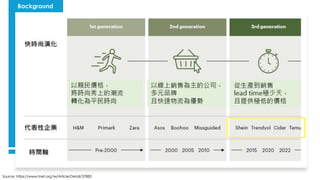
Background
Source: https://www.tnet.org.tw/Article/Detail/37883
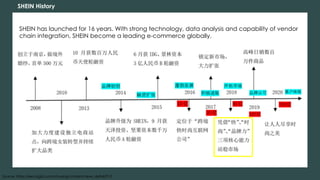
Source: https://ee.ckgsb.com/chuang/content/news_detail/912
SHEIN History
SHEIN has launched for 16 years. With strong technology, data analysis and capability of vendor
chain integration, SHEIN become a leading e-commerce globally.
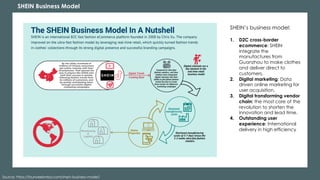
SHEIN’s business model:
1. D2C cross-border
ecommerce: SHEIN
integrate the
manufactures from
Guanzhou to make clothes
and deliver direct to
customers.
2. Digital marketing: Data
driven online marketing for
user acquisition.
3. Digital transforming vendor
chain: the most core of the
revolution to shorten the
innovation and lead time.
4. Outstanding user
experience: International
delivery in high efficiency
SHEIN Business Model
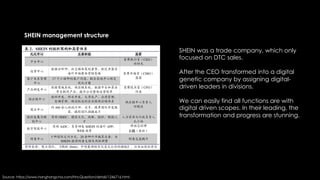
SHEIN was a trade company, which only
focused on DTC sales.
After the CEO transformed into a digital
genetic company by assigning digital-
driven leaders in divisions.
We can easily find all functions are with
digital driven scopes. In their leading, the
transformation and progress are stunning.
SHEIN management structure
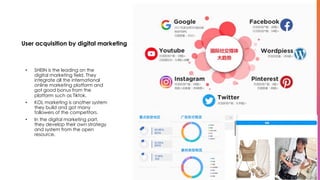
• SHEIN is the leading on the
digital marketing field. They
integrate all the international
online marketing platform and
got good bonus from the
platform such as Tiktok.
• KOL marketing is another system
they build and got many
followers of the competitors.
• In the digital marketing part,
they develop their own strategy
and system from the open
resource.
User acquisition by digital marketing
Source:
https://www.stcn.com/article/detail/1129197.html#:~:text=%E5%85%B6%E4%BE%9D%E6%89%98%E7
%BD%91%E7%AB%99%E4%B8%BA%E5%AE%A2%E6%88%B7,%E4%B8%BA6%2D9%E4%B8%AA%E6%9C%
88%E3%80%82
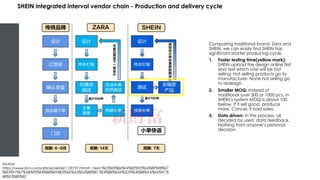
SHEIN integrated interval vendor chain - Production and delivery cycle
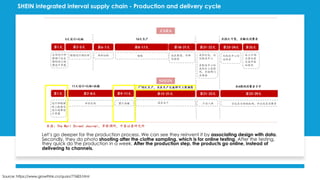
Comparing traditional brand, Zara and
SHEIN, we can easily find SHEIN has
significant shorter producing cycle.
1. Faster testing time(yellow mark):
SHEIN upload the design online first
and test which one will be hot
selling. Hot selling products go to
manufacturer. None hot selling go
to redesign.
2. Smaller MOQ: Instead of
traditional over 500 or 1000 pcs, in
SHEIN’s system MOQ is about 100
below. If if sell good, produce
more. Cancel, if bad sales.
3. Data driven: In the process, all
decided by users' data feedback.
Nothing from anyone’s personal
decision.
Source: https://www.growthhk.cn/quan/77683.html
Let’s go deeper for the production process. We can see they reinvent it by associating design with data.
Secondly, they do photo shooting after the clothe sampling, which is for online testing. After the testing,
they quick do the production in a week. After the production step, the products go online, instead of
delivering to channels.
SHEIN integrated interval supply chain - Production and delivery cycle
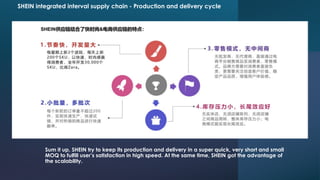
Sum it up, SHEIN try to keep its production and delivery in a super quick, very short and small
MOQ to fulfill user’s satisfaction in high speed. At the same time, SHEIN got the advantage of
the scalability.
SHEIN user experience optimizing
strategy
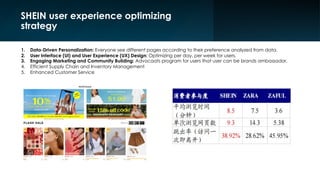
1. Data-Driven Personalization: Everyone see different pages according to their preference analyzed from data.
2. User Interface (UI) and User Experience (UX) Design: Optimizing per day, per week for users.
3. Engaging Marketing and Community Building: Advocaats program for users that user can be brands ambassador.
4. Efficient Supply Chain and Inventory Management
5. Enhanced Customer Service
Summary: SHEIN Growth Wheel
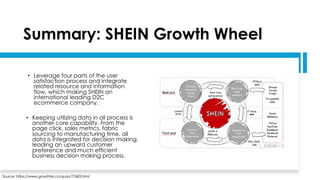
• Leverage four parts of the user
satisfaction process and integrate
related resource and information
flow, which making SHEIN an
international leading D2C
ecommerce company.
• Keeping utilizing data in all process is
another core capability. From the
page click, sales metrics, fabric
sourcing to manufacturing time, all
data is integrated for decision making,
leading an upward customer
preference and much efficient
business decision making process.
Source: https://www.growthhk.cn/quan/77683.html
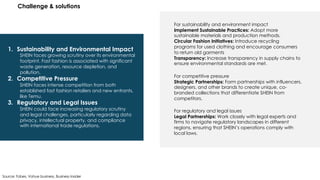
Challenge & solutions
1. Sustainability and Environmental Impact
SHEIN faces growing scrutiny over its environmental
footprint. Fast fashion is associated with significant
waste generation, resource depletion, and
pollution.
2. Competitive Pressure
SHEIN faces intense competition from both
established fast fashion retailers and new entrants,
like Temu.
3. Regulatory and Legal Issues
SHEIN could face increasing regulatory scrutiny
and legal challenges, particularly regarding data
privacy, intellectual property, and compliance
with international trade regulations.
Source: Fobes, Vohue business, Business insider
For sustainability and environment impact
Implement Sustainable Practices: Adopt more
sustainable materials and production methods.
Circular Fashion Initiatives: Introduce recycling
programs for used clothing and encourage consumers
to return old garments
Transparency: Increase transparency in supply chains to
ensure environmental standards are met.
For competitive pressure
Strategic Partnerships: Form partnerships with influencers,
designers, and other brands to create unique, co-
branded collections that differentiate SHEIN from
competitors.
For regulatory and legal issues
Legal Partnerships: Work closely with legal experts and
firms to navigate regulatory landscapes in different
regions, ensuring that SHEIN’s operations comply with
local laws.
Thank you

2024 case study-SHEIN Analysis-Final.pdf

  • 1.
  • 2.
  • 3.
    Source: https://ee.ckgsb.com/chuang/content/news_detail/912 SHEIN History SHEINhas launched for 16 years. With strong technology, data analysis and capability of vendor chain integration, SHEIN become a leading e-commerce globally.
  • 4.
    SHEIN’s business model: 1.D2C cross-border ecommerce: SHEIN integrate the manufactures from Guanzhou to make clothes and deliver direct to customers. 2. Digital marketing: Data driven online marketing for user acquisition. 3. Digital transforming vendor chain: the most core of the revolution to shorten the innovation and lead time. 4. Outstanding user experience: International delivery in high efficiency SHEIN Business Model
  • 5.
    SHEIN was atrade company, which only focused on DTC sales. After the CEO transformed into a digital genetic company by assigning digital- driven leaders in divisions. We can easily find all functions are with digital driven scopes. In their leading, the transformation and progress are stunning. SHEIN management structure
  • 6.
    • SHEIN isthe leading on the digital marketing field. They integrate all the international online marketing platform and got good bonus from the platform such as Tiktok. • KOL marketing is another system they build and got many followers of the competitors. • In the digital marketing part, they develop their own strategy and system from the open resource. User acquisition by digital marketing
  • 7.
    Source: https://www.stcn.com/article/detail/1129197.html#:~:text=%E5%85%B6%E4%BE%9D%E6%89%98%E7 %BD%91%E7%AB%99%E4%B8%BA%E5%AE%A2%E6%88%B7,%E4%B8%BA6%2D9%E4%B8%AA%E6%9C% 88%E3%80%82 SHEIN integrated intervalvendor chain - Production and delivery cycle Comparing traditional brand, Zara and SHEIN, we can easily find SHEIN has significant shorter producing cycle. 1. Faster testing time(yellow mark): SHEIN upload the design online first and test which one will be hot selling. Hot selling products go to manufacturer. None hot selling go to redesign. 2. Smaller MOQ: Instead of traditional over 500 or 1000 pcs, in SHEIN’s system MOQ is about 100 below. If if sell good, produce more. Cancel, if bad sales. 3. Data driven: In the process, all decided by users' data feedback. Nothing from anyone’s personal decision.
  • 8.
    Source: https://www.growthhk.cn/quan/77683.html Let’s godeeper for the production process. We can see they reinvent it by associating design with data. Secondly, they do photo shooting after the clothe sampling, which is for online testing. After the testing, they quick do the production in a week. After the production step, the products go online, instead of delivering to channels. SHEIN integrated interval supply chain - Production and delivery cycle
  • 9.
    SHEIN integrated intervalsupply chain - Production and delivery cycle Sum it up, SHEIN try to keep its production and delivery in a super quick, very short and small MOQ to fulfill user’s satisfaction in high speed. At the same time, SHEIN got the advantage of the scalability.
  • 10.
    SHEIN user experienceoptimizing strategy 1. Data-Driven Personalization: Everyone see different pages according to their preference analyzed from data. 2. User Interface (UI) and User Experience (UX) Design: Optimizing per day, per week for users. 3. Engaging Marketing and Community Building: Advocaats program for users that user can be brands ambassador. 4. Efficient Supply Chain and Inventory Management 5. Enhanced Customer Service
  • 11.
    Summary: SHEIN GrowthWheel • Leverage four parts of the user satisfaction process and integrate related resource and information flow, which making SHEIN an international leading D2C ecommerce company. • Keeping utilizing data in all process is another core capability. From the page click, sales metrics, fabric sourcing to manufacturing time, all data is integrated for decision making, leading an upward customer preference and much efficient business decision making process. Source: https://www.growthhk.cn/quan/77683.html
  • 12.
    Challenge & solutions 1.Sustainability and Environmental Impact SHEIN faces growing scrutiny over its environmental footprint. Fast fashion is associated with significant waste generation, resource depletion, and pollution. 2. Competitive Pressure SHEIN faces intense competition from both established fast fashion retailers and new entrants, like Temu. 3. Regulatory and Legal Issues SHEIN could face increasing regulatory scrutiny and legal challenges, particularly regarding data privacy, intellectual property, and compliance with international trade regulations. Source: Fobes, Vohue business, Business insider For sustainability and environment impact Implement Sustainable Practices: Adopt more sustainable materials and production methods. Circular Fashion Initiatives: Introduce recycling programs for used clothing and encourage consumers to return old garments Transparency: Increase transparency in supply chains to ensure environmental standards are met. For competitive pressure Strategic Partnerships: Form partnerships with influencers, designers, and other brands to create unique, co- branded collections that differentiate SHEIN from competitors. For regulatory and legal issues Legal Partnerships: Work closely with legal experts and firms to navigate regulatory landscapes in different regions, ensuring that SHEIN’s operations comply with local laws.
  • 13.