MEETINGS
One of the Major Oral Communication Area for you
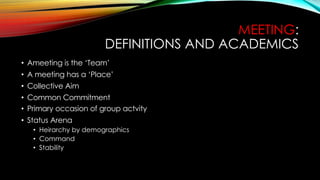
MEETING:
DEFINITIONS AND ACADEMICS
• Ameeting is the ‘Team’
• A meeting has a ‘Place’
• Collective Aim
• Common Commitment
• Primary occasion of group actvity
• Status Arena
• Heirarchy by demographics
• Command
• Stability
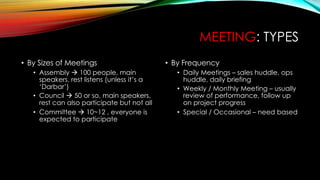
MEETING: TYPES
• By Sizes of Meetings
• Assembly à 100 people, main
speakers, rest listens (unless it’s a
‘Darbar’)
• Council à 50 or so, main speakers,
rest can also participate but not all
• Committee à 10~12 , everyone is
expected to participate
• By Frequency
• Daily Meetings – sales huddle, ops
huddle, daily briefing
• Weekly / Monthly Meeting – usually
review of performance, follow up
on project progress
• Special / Occasional – need based
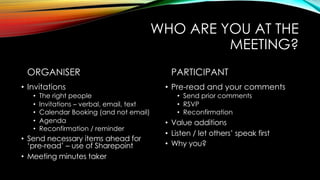
WHO ARE YOU AT THE
MEETING?
ORGANISER
• Invitations
• The right people
• Invitations – verbal, email, text
• Calendar Booking (and not email)
• Agenda
• Reconfirmation / reminder
• Send necessary items ahead for
‘pre-read’ – use of Sharepoint
• Meeting minutes taker
PARTICIPANT
• Pre-read and your comments
• Send prior comments
• RSVP
• Reconfirmation
• Value additions
• Listen / let others’ speak first
• Why you?
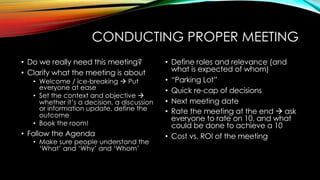
CONDUCTING PROPER MEETING
• Do we really need this meeting?
• Clarify what the meeting is about
• Welcome / ice-breaking à Put
everyone at ease
• Set the context and objective à
whether it’s a decision, a discussion
or information update, define the
outcome
• Book the room!
• Follow the Agenda
• Make sure people understand the
‘What’ and ‘Why’ and ‘Whom’
• Define roles and relevance (and
what is expected of whom)
• “Parking Lot”
• Quick re-cap of decisions
• Next meeting date
• Rate the meeting at the end à ask
everyone to rate on 10, and what
could be done to achieve a 10
• Cost vs. ROI of the meeting
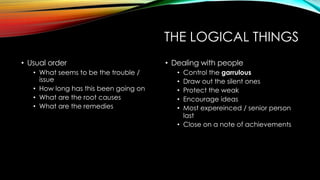
THE LOGICAL THINGS
• Usual order
• What seems to be the trouble /
issue
• How long has this been going on
• What are the root causes
• What are the remedies
• Dealing with people
• Control the garrulous
• Draw out the silent ones
• Protect the weak
• Encourage ideas
• Most expereinced / senior person
last
• Close on a note of achievements
LEAD BY
EXAMPLES
Starting on time
One hour meeting finished in 55 min
BASIC MEETING ETIQUETTES
• Please no excuse for being late
• Introduce everyone (if needed / applicable)
• No Mobile Phones please
• Pay attention
• Ask if you are doing a recording
• Eating / drinking norms
• Do not interrupt – ask questions once one is done
CHALLENGES AND MISTAKES
• Star item can be introduced to carry the meeting over the attention lag
that sets in after the first 15 to 20 minutes of the meeting
• Some items unite the meeting in a common front while others divide the
member one from another.
• Dwell too long on trivial but urgent items, to the exclusion of subjects of
fundamental importance whose significance is long-term rather than
immediate
• Don’t go beyond 2 hours
• When to serve food?
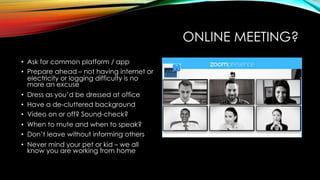
ONLINE MEETING?
• Ask for common platform / app
• Prepare ahead – not having internet or
electricity or logging difficulty is no
more an excuse
• Dress as you’d be dressed at office
• Have a de-cluttered background
• Video on or off? Sound-check?
• When to mute and when to speak?
• Don’t leave without informing others
• Never mind your pet or kid – we all
know you are working from home
FOLLOW UP!
Meeting Minutes
NEXT: FORMAL COMMUNICATION
PRESENTATION
See you on Sunday, April 10th, 2022

20220403 Managerial Communication Lecture 10.pdf

  • 1.
    MEETINGS One of theMajor Oral Communication Area for you
  • 2.
    MEETING: DEFINITIONS AND ACADEMICS •Ameeting is the ‘Team’ • A meeting has a ‘Place’ • Collective Aim • Common Commitment • Primary occasion of group actvity • Status Arena • Heirarchy by demographics • Command • Stability
  • 3.
    MEETING: TYPES • BySizes of Meetings • Assembly à 100 people, main speakers, rest listens (unless it’s a ‘Darbar’) • Council à 50 or so, main speakers, rest can also participate but not all • Committee à 10~12 , everyone is expected to participate • By Frequency • Daily Meetings – sales huddle, ops huddle, daily briefing • Weekly / Monthly Meeting – usually review of performance, follow up on project progress • Special / Occasional – need based
  • 4.
    WHO ARE YOUAT THE MEETING? ORGANISER • Invitations • The right people • Invitations – verbal, email, text • Calendar Booking (and not email) • Agenda • Reconfirmation / reminder • Send necessary items ahead for ‘pre-read’ – use of Sharepoint • Meeting minutes taker PARTICIPANT • Pre-read and your comments • Send prior comments • RSVP • Reconfirmation • Value additions • Listen / let others’ speak first • Why you?
  • 5.
    CONDUCTING PROPER MEETING •Do we really need this meeting? • Clarify what the meeting is about • Welcome / ice-breaking à Put everyone at ease • Set the context and objective à whether it’s a decision, a discussion or information update, define the outcome • Book the room! • Follow the Agenda • Make sure people understand the ‘What’ and ‘Why’ and ‘Whom’ • Define roles and relevance (and what is expected of whom) • “Parking Lot” • Quick re-cap of decisions • Next meeting date • Rate the meeting at the end à ask everyone to rate on 10, and what could be done to achieve a 10 • Cost vs. ROI of the meeting
  • 6.
    THE LOGICAL THINGS •Usual order • What seems to be the trouble / issue • How long has this been going on • What are the root causes • What are the remedies • Dealing with people • Control the garrulous • Draw out the silent ones • Protect the weak • Encourage ideas • Most expereinced / senior person last • Close on a note of achievements
  • 7.
    LEAD BY EXAMPLES Starting ontime One hour meeting finished in 55 min
  • 8.
    BASIC MEETING ETIQUETTES •Please no excuse for being late • Introduce everyone (if needed / applicable) • No Mobile Phones please • Pay attention • Ask if you are doing a recording • Eating / drinking norms • Do not interrupt – ask questions once one is done
  • 9.
    CHALLENGES AND MISTAKES •Star item can be introduced to carry the meeting over the attention lag that sets in after the first 15 to 20 minutes of the meeting • Some items unite the meeting in a common front while others divide the member one from another. • Dwell too long on trivial but urgent items, to the exclusion of subjects of fundamental importance whose significance is long-term rather than immediate • Don’t go beyond 2 hours • When to serve food?
  • 10.
    ONLINE MEETING? • Askfor common platform / app • Prepare ahead – not having internet or electricity or logging difficulty is no more an excuse • Dress as you’d be dressed at office • Have a de-cluttered background • Video on or off? Sound-check? • When to mute and when to speak? • Don’t leave without informing others • Never mind your pet or kid – we all know you are working from home
  • 11.
  • 12.
    NEXT: FORMAL COMMUNICATION PRESENTATION Seeyou on Sunday, April 10th, 2022