Open Science in Horizon
Europe: publications &
Open Research Europe
Victoria Tsoukala, PhD
European Commission, Directorate-General for Research & Innovation,
Unit ‘Open Science’ Veranstaltungsreihe KoWi Vernetzt: Open Access
in Horizon Europe und Open Research Europe
September 7th, 2021
• Open science has the potential to increase
• Quality & efficiency of R&I, if all the produced results are shared, made reusable, and if
their reproducibility is improved
• Creativity, through collective intelligence and cross-disciplinary research that does not
require laborious data wrangling
• Trust in the science system, by engaging both researchers & citizens
Why do we need Open Science?
Open Science in Horizon
Europe: key elements
“Open science” means an approach to the scientific process based on open
cooperative work, tools and diffusing knowledge
(Horizon Europe Regulation and Model Grant Agreement)
The concepts of Open Science, Open Innovation, Open to the World should ensure
excellence and impact of the Union´s investment in research and innovation, while
safeguarding the Union´s interests
(Recital 7, Horizon Europe Regulation)
The work programme may provide for additional incentives or obligations for adhering
to open science practices
(Article 39, Horizon Europe Regulation)
Open Science in Horizon Europe
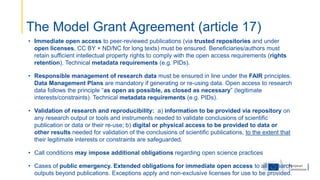
The Model Grant Agreement (article 17)
• Immediate open access to peer-reviewed publications (via trusted repositories and under
open licenses, CC BY + ND/NC for long texts) must be ensured. Beneficiaries/authors must
retain sufficient intellectual property rights to comply with the open access requirements (rights
retention). Technical metadata requirements (e.g. PIDs).
• Responsible management of research data must be ensured in line under the FAIR principles.
Data Management Plans are mandatory if generating or re-using data. Open access to research
data follows the principle “as open as possible, as closed as necessary” (legitimate
interests/constraints). Technical metadata requirements (e.g. PIDs).
• Validation of research and reproducibility: a) information to be provided via repository on
any research output or tools and instruments needed to validate conclusions of scientific
publication or data or their re-use; b) digital or physical access to be provided to data or
other results needed for validation of the conclusions of scientific publications, to the extent that
their legitimate interests or constraints are safeguarded.
• Call conditions may impose additional obligations regarding open science practices
• Cases of public emergency. Extended obligations for immediate open access to all research
outputs beyond publications. Exceptions apply and non-exclusive licenses for use to be provided.
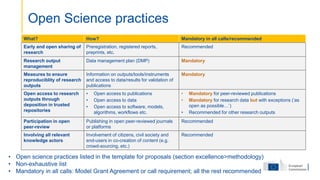
What? How? Mandatory in all calls/recommended
Early and open sharing of
research
Preregistration, registered reports,
preprints, etc.
Recommended
Research output
management
Data management plan (DMP) Mandatory
Measures to ensure
reproduciblity of research
outputs
Information on outputs/tools/instruments
and access to data/results for validation of
publications
Mandatory
Open access to research
outputs through
deposition in trusted
repositories
• Open access to publications
• Open access to data
• Open access to software, models,
algorithms, workflows etc.
• Mandatory for peer-reviewed publications
• Mandatory for research data but with exceptions (‘as
open as possible…’)
• Recommended for other research outputs
Participation in open
peer-review
Publishing in open peer-reviewed journals
or platforms
Recommended
Involving all relevant
knowledge actors
Involvement of citizens, civil society and
end-users in co-creation of content (e.g.
crowd-sourcing, etc.)
Recommended
Open Science practices
• Open science practices listed in the template for proposals (section excellence>methodology)
• Non-exhaustive list
• Mandatory in all calls: Model Grant Agreement or call requirement; all the rest recommended
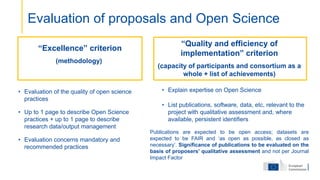
“Excellence” criterion
(methodology)
• Evaluation of the quality of open science
practices
• Up to 1 page to describe Open Science
practices + up to 1 page to describe
research data/output management
• Evaluation concerns mandatory and
recommended practices
“Quality and efficiency of
implementation” criterion
(capacity of participants and consortium as a
whole + list of achievements)
• Explain expertise on Open Science
• List publications, software, data, etc, relevant to the
project with qualitative assessment and, where
available, persistent identifiers
Publications are expected to be open access; datasets are
expected to be FAIR and ‘as open as possible, as closed as
necessary‘. Significance of publications to be evaluated on the
basis of proposers’ qualitative assessment and not per Journal
Impact Factor
Evaluation of proposals and Open Science
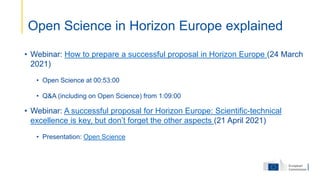
• Webinar: How to prepare a successful proposal in Horizon Europe (24 March
2021)
• Open Science at 00:53:00
• Q&A (including on Open Science) from 1:09:00
• Webinar: A successful proposal for Horizon Europe: Scientific-technical
excellence is key, but don’t forget the other aspects (21 April 2021)
• Presentation: Open Science
Open Science in Horizon Europe explained
MGA
• Horizon Europe Grant Agreement (article 17, p. 107)
Guidance on open science in Horizon Europe
• Horizon Europe Annotated Model Grant Agreement (p.154 ff.)
• Horizon Europe Data Management Plan Template (under reference documents of the
Funding and Tenders portal).
• Horizon Europe Programme Guide (p. 38 ff. with extensive analysis of open science practices
and the evaluation process; good for POs and for evaluators)
Resources
Open Research Europe (ORE)
The open access publishing platform for Horizon 2020 and Horizon
Europe beneficiaries
Why Open Research Europe?
• Support our open access policy and beneficiary capacity to adhere to it and also enables
publishing post-grant
• Leading by example in operationalising open science principles within scientific publishing
and enabling the European Research Area
• Contribute to transparency and cost-effectiveness and explore sustainable open access
publishing business models
What is Open Research Europe?
• A peer-reviewed publishing platform. Not a repository. Post-publication peer-review model.
First you publish, then review takes place. Publication and review reports open access under
CC BY licenses
Open Research Europe
• High-quality, reliable and efficient publishing venue for EU research
• High scientific standards, and swift and transparent processes
• Oversight by an independent Scientific Advisory Board covering STM, Social Sciences
and Humanities
• Implements open science practices and advances the European Research Area
• No cost to authors/beneficiaries
• No administrative burden either
• Venue where grantees can publish post-grant the results of their work, while
respecting their open access obligations
• Is not (and never will be) an obligation to use!
Main assets of ORE
• Original articles for review
• i.e. stemming from Horizon 2020-funded research and Horizon Europe
and not submitted or published elsewhere
• It is not a repository
• All scientific areas of Horizon 2020 and Horizon Europe covered; specific
policies and guidelines
• Immediate open access, with content licensed for re-use
• Open peer review (i.e. open reviewer identities, published reviews, post-
publication comments)
The publishing service (1/2)
• Diversity of metrics at article level
• Explicit, accessible and transparent on business processes and publication
policies (all published on the site for everyone to see)
• Other funders do this as well, such as the Wellcome Trust (Wellcome Open
Research) and others
• Publisher F1000 was awarded a tender after a public competition for 5.8
million euros and is the service provider for the ORE infrastructure and
publishing services.
The publishing service (2/2)
At least one author must be involved in a running or finished Horizon
2020/Europe project from the European Commission and the article must be a
result of that project. The article must be original work.
Currently unable to publish:
• JRC when outside of Horizon 2020/Europe
• Euratom (different Framework Programme with a different Treaty)
• Cascading grants (e.g. COST beneficiaries)
The Commission is currently addressing the issue with its legal department
Who can publish?
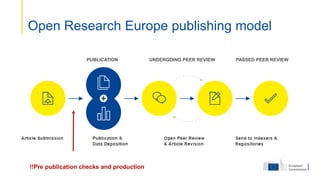
Open Research Europe publishing model
PUBLICATION UNDERGOING PEER REVIEW PASSED PEER REVIEW
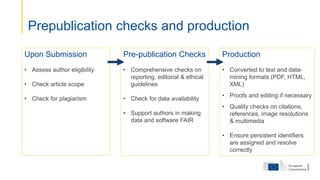
!!Pre publication checks and production
Upon Submission
• Assess author eligibility
• Check article scope
• Check for plagiarism
Pre-publication Checks
• Comprehensive checks on
reporting, editorial & ethical
guidelines
• Check for data availability
• Support authors in making
data and software FAIR
Production
• Converted to text and data-
mining formats (PDF, HTML,
XML)
• Proofs and editing if necessary
• Quality checks on citations,
references, image resolutions
& multimedia
• Ensure persistent identifiers
are assigned and resolve
correctly
Prepublication checks and production
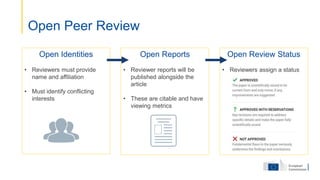
Open Identities
• Reviewers must provide
name and affiliation
• Must identify conflicting
interests
Open Reports
• Reviewer reports will be
published alongside the
article
• These are citable and have
viewing metrics
Open Review Status
• Reviewers assign a status
Open Peer Review
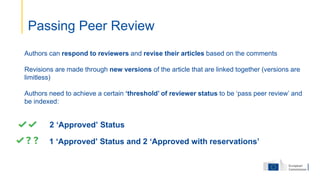
Authors can respond to reviewers and revise their articles based on the comments
Revisions are made through new versions of the article that are linked together (versions are
limitless)
Authors need to achieve a certain ‘threshold’ of reviewer status to be ‘pass peer review’ and
be indexed:
Passing Peer Review
2 ‘Approved’ Status
1 ‘Approved’ Status and 2 ‘Approved with reservations’
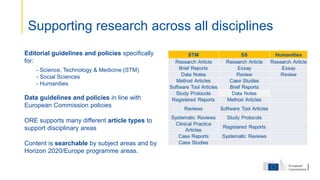
Editorial guidelines and policies specifically
for:
- Science, Technology & Medicine (STM)
- Social Sciences
- Humanities
Data guidelines and policies in line with
European Commission policies
ORE supports many different article types to
support disciplinary areas
Content is searchable by subject areas and by
Horizon 2020/Europe programme areas.
Supporting research across all disciplines
• https://open-research-europe.ec.europa.eu/
• https://open-research-europe.ec.europa.eu/about
• https://open-research-europe.ec.europa.eu/faqs
• Open Research Europe infographic
• Open Research Europe playlist in DG R& I Youtube channel
• @OpenResearch_EU Twitter account
ORE resources
Thank you
© European Union 2021
Reuse of this presentation authorised
under the CC BY 4.0 license.

2021 09 kowi_tsoukala final

  • 1.
    Open Science inHorizon Europe: publications & Open Research Europe Victoria Tsoukala, PhD European Commission, Directorate-General for Research & Innovation, Unit ‘Open Science’ Veranstaltungsreihe KoWi Vernetzt: Open Access in Horizon Europe und Open Research Europe September 7th, 2021
  • 2.
    • Open sciencehas the potential to increase • Quality & efficiency of R&I, if all the produced results are shared, made reusable, and if their reproducibility is improved • Creativity, through collective intelligence and cross-disciplinary research that does not require laborious data wrangling • Trust in the science system, by engaging both researchers & citizens Why do we need Open Science?
  • 3.
    Open Science inHorizon Europe: key elements
  • 4.
    “Open science” meansan approach to the scientific process based on open cooperative work, tools and diffusing knowledge (Horizon Europe Regulation and Model Grant Agreement) The concepts of Open Science, Open Innovation, Open to the World should ensure excellence and impact of the Union´s investment in research and innovation, while safeguarding the Union´s interests (Recital 7, Horizon Europe Regulation) The work programme may provide for additional incentives or obligations for adhering to open science practices (Article 39, Horizon Europe Regulation) Open Science in Horizon Europe
  • 5.
    The Model GrantAgreement (article 17) • Immediate open access to peer-reviewed publications (via trusted repositories and under open licenses, CC BY + ND/NC for long texts) must be ensured. Beneficiaries/authors must retain sufficient intellectual property rights to comply with the open access requirements (rights retention). Technical metadata requirements (e.g. PIDs). • Responsible management of research data must be ensured in line under the FAIR principles. Data Management Plans are mandatory if generating or re-using data. Open access to research data follows the principle “as open as possible, as closed as necessary” (legitimate interests/constraints). Technical metadata requirements (e.g. PIDs). • Validation of research and reproducibility: a) information to be provided via repository on any research output or tools and instruments needed to validate conclusions of scientific publication or data or their re-use; b) digital or physical access to be provided to data or other results needed for validation of the conclusions of scientific publications, to the extent that their legitimate interests or constraints are safeguarded. • Call conditions may impose additional obligations regarding open science practices • Cases of public emergency. Extended obligations for immediate open access to all research outputs beyond publications. Exceptions apply and non-exclusive licenses for use to be provided.
  • 6.
    What? How? Mandatoryin all calls/recommended Early and open sharing of research Preregistration, registered reports, preprints, etc. Recommended Research output management Data management plan (DMP) Mandatory Measures to ensure reproduciblity of research outputs Information on outputs/tools/instruments and access to data/results for validation of publications Mandatory Open access to research outputs through deposition in trusted repositories • Open access to publications • Open access to data • Open access to software, models, algorithms, workflows etc. • Mandatory for peer-reviewed publications • Mandatory for research data but with exceptions (‘as open as possible…’) • Recommended for other research outputs Participation in open peer-review Publishing in open peer-reviewed journals or platforms Recommended Involving all relevant knowledge actors Involvement of citizens, civil society and end-users in co-creation of content (e.g. crowd-sourcing, etc.) Recommended Open Science practices • Open science practices listed in the template for proposals (section excellence>methodology) • Non-exhaustive list • Mandatory in all calls: Model Grant Agreement or call requirement; all the rest recommended
  • 7.
    “Excellence” criterion (methodology) • Evaluationof the quality of open science practices • Up to 1 page to describe Open Science practices + up to 1 page to describe research data/output management • Evaluation concerns mandatory and recommended practices “Quality and efficiency of implementation” criterion (capacity of participants and consortium as a whole + list of achievements) • Explain expertise on Open Science • List publications, software, data, etc, relevant to the project with qualitative assessment and, where available, persistent identifiers Publications are expected to be open access; datasets are expected to be FAIR and ‘as open as possible, as closed as necessary‘. Significance of publications to be evaluated on the basis of proposers’ qualitative assessment and not per Journal Impact Factor Evaluation of proposals and Open Science
  • 8.
    • Webinar: Howto prepare a successful proposal in Horizon Europe (24 March 2021) • Open Science at 00:53:00 • Q&A (including on Open Science) from 1:09:00 • Webinar: A successful proposal for Horizon Europe: Scientific-technical excellence is key, but don’t forget the other aspects (21 April 2021) • Presentation: Open Science Open Science in Horizon Europe explained
  • 9.
    MGA • Horizon EuropeGrant Agreement (article 17, p. 107) Guidance on open science in Horizon Europe • Horizon Europe Annotated Model Grant Agreement (p.154 ff.) • Horizon Europe Data Management Plan Template (under reference documents of the Funding and Tenders portal). • Horizon Europe Programme Guide (p. 38 ff. with extensive analysis of open science practices and the evaluation process; good for POs and for evaluators) Resources
  • 10.
    Open Research Europe(ORE) The open access publishing platform for Horizon 2020 and Horizon Europe beneficiaries
  • 11.
    Why Open ResearchEurope? • Support our open access policy and beneficiary capacity to adhere to it and also enables publishing post-grant • Leading by example in operationalising open science principles within scientific publishing and enabling the European Research Area • Contribute to transparency and cost-effectiveness and explore sustainable open access publishing business models What is Open Research Europe? • A peer-reviewed publishing platform. Not a repository. Post-publication peer-review model. First you publish, then review takes place. Publication and review reports open access under CC BY licenses Open Research Europe
  • 12.
    • High-quality, reliableand efficient publishing venue for EU research • High scientific standards, and swift and transparent processes • Oversight by an independent Scientific Advisory Board covering STM, Social Sciences and Humanities • Implements open science practices and advances the European Research Area • No cost to authors/beneficiaries • No administrative burden either • Venue where grantees can publish post-grant the results of their work, while respecting their open access obligations • Is not (and never will be) an obligation to use! Main assets of ORE
  • 13.
    • Original articlesfor review • i.e. stemming from Horizon 2020-funded research and Horizon Europe and not submitted or published elsewhere • It is not a repository • All scientific areas of Horizon 2020 and Horizon Europe covered; specific policies and guidelines • Immediate open access, with content licensed for re-use • Open peer review (i.e. open reviewer identities, published reviews, post- publication comments) The publishing service (1/2)
  • 14.
    • Diversity ofmetrics at article level • Explicit, accessible and transparent on business processes and publication policies (all published on the site for everyone to see) • Other funders do this as well, such as the Wellcome Trust (Wellcome Open Research) and others • Publisher F1000 was awarded a tender after a public competition for 5.8 million euros and is the service provider for the ORE infrastructure and publishing services. The publishing service (2/2)
  • 15.
    At least oneauthor must be involved in a running or finished Horizon 2020/Europe project from the European Commission and the article must be a result of that project. The article must be original work. Currently unable to publish: • JRC when outside of Horizon 2020/Europe • Euratom (different Framework Programme with a different Treaty) • Cascading grants (e.g. COST beneficiaries) The Commission is currently addressing the issue with its legal department Who can publish?
  • 16.
    Open Research Europepublishing model PUBLICATION UNDERGOING PEER REVIEW PASSED PEER REVIEW !!Pre publication checks and production
  • 17.
    Upon Submission • Assessauthor eligibility • Check article scope • Check for plagiarism Pre-publication Checks • Comprehensive checks on reporting, editorial & ethical guidelines • Check for data availability • Support authors in making data and software FAIR Production • Converted to text and data- mining formats (PDF, HTML, XML) • Proofs and editing if necessary • Quality checks on citations, references, image resolutions & multimedia • Ensure persistent identifiers are assigned and resolve correctly Prepublication checks and production
  • 18.
    Open Identities • Reviewersmust provide name and affiliation • Must identify conflicting interests Open Reports • Reviewer reports will be published alongside the article • These are citable and have viewing metrics Open Review Status • Reviewers assign a status Open Peer Review
  • 19.
    Authors can respondto reviewers and revise their articles based on the comments Revisions are made through new versions of the article that are linked together (versions are limitless) Authors need to achieve a certain ‘threshold’ of reviewer status to be ‘pass peer review’ and be indexed: Passing Peer Review 2 ‘Approved’ Status 1 ‘Approved’ Status and 2 ‘Approved with reservations’
  • 20.
    Editorial guidelines andpolicies specifically for: - Science, Technology & Medicine (STM) - Social Sciences - Humanities Data guidelines and policies in line with European Commission policies ORE supports many different article types to support disciplinary areas Content is searchable by subject areas and by Horizon 2020/Europe programme areas. Supporting research across all disciplines
  • 21.
    • https://open-research-europe.ec.europa.eu/ • https://open-research-europe.ec.europa.eu/about •https://open-research-europe.ec.europa.eu/faqs • Open Research Europe infographic • Open Research Europe playlist in DG R& I Youtube channel • @OpenResearch_EU Twitter account ORE resources
  • 22.
    Thank you © EuropeanUnion 2021 Reuse of this presentation authorised under the CC BY 4.0 license.