VISION
2020
12 INNOVATIONS & MEGA TRENDS TOWARDS THE
COMING DECADE
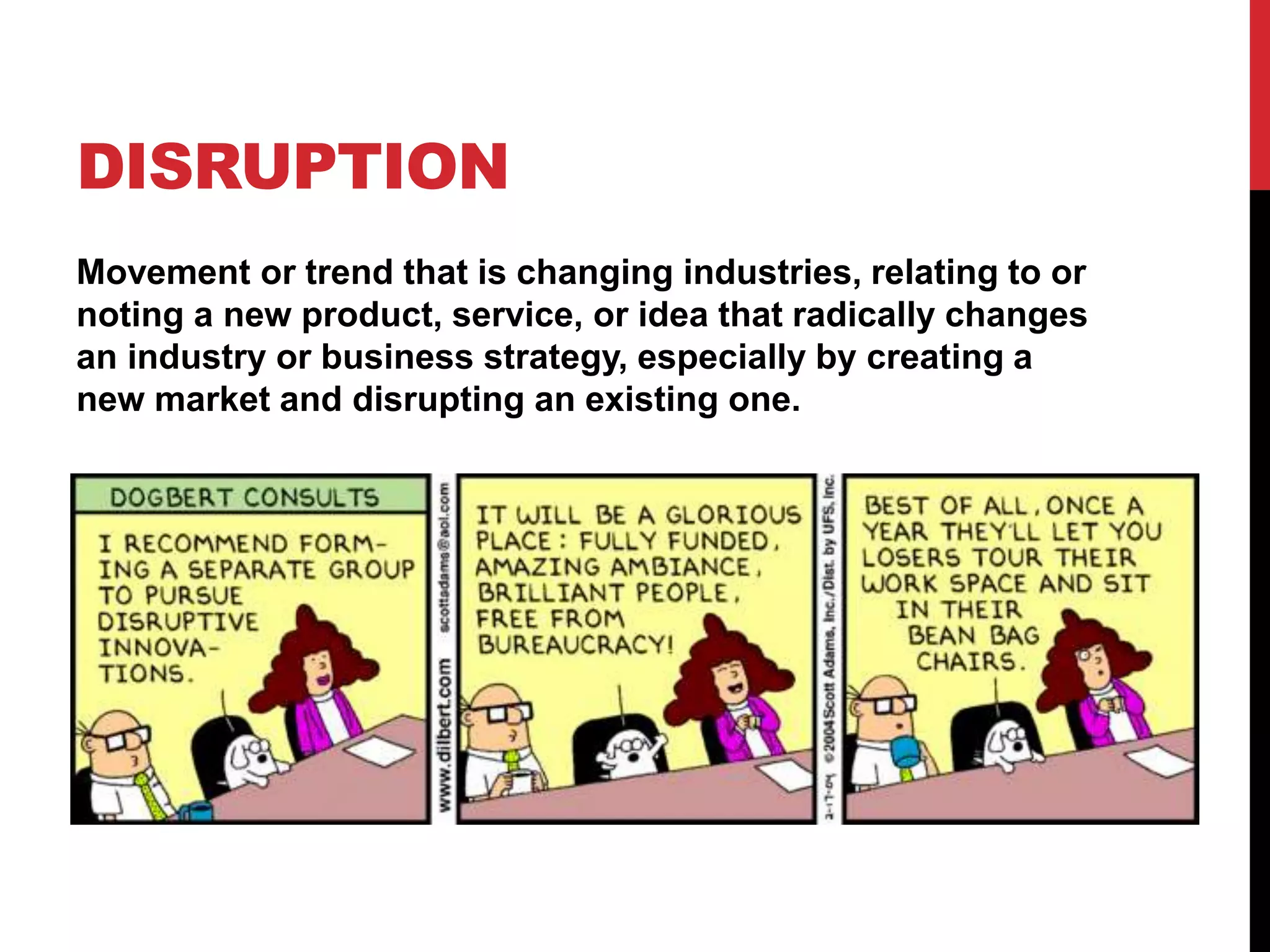
DISRUPTION
Movement or trend that is changing industries, relating to or
noting a new product, service, or idea that radically changes
an industry or business strategy, especially by creating a
new market and disrupting an existing one.
INNOVATION
TRANSLATION - The process of translating an idea or
invention into a good or service that creates value or for
which customers will pay. To be called an innovation, an idea
must be replicable at an economical cost and must satisfy a
specific need.
INNOVATION - involves deliberate application of information,
imagination and initiative in deriving greater or different
values from resources, and includes all processes by which
new ideas are generated and converted into useful products.
SATISFACTION - In business, innovation results when ideas
are applied by a individual, company, or other entity to
further satisfy the needs and expectations of consumers.
TREND
PATTERN – A gradual change in a condition, output, or
process, or an average or general tendency of a series of
data points to move in a certain direction over time.
TO FOLLOW - Not only be aware of what is currently
happening, but be astute enough to predict what is going to
happen in the future.
TO LEAD - To have access to, and be able to base decisions
upon, contextual information central to the consumer and
marketplace for the product, service or concept in mind.
CONTEXT
BACKGROUND - Context is most purely the background,
environment, framework, setting, or situation surrounding a
previous or current event, occurrence, or timeframe.
RESEARCH - Context is the information necessary to
correctly interpret anything from a word or phrase, or a
concept or trend that could otherwise be interpreted in a
number of different ways.
MEANING - When you say something is out of context you
basically mean it's out of place.
To be successful we must be IN context.
INNOVATION PROCESS
CURRENT SITUATION
DRIVERS – FROM PRESENT ENABLERS TO PAST CONEXT
DEMOGRAPHY • PSYCHOLOGY • BEHAVIOR
CREATIVE IDEATION • CREATING VALUE
RESOURCES • SOURCING • PRODUCTION
MARKETING • ADVERTISING • PR
MERCHANDISING • DIRECT MARKETING • SALES
DELIVERY • SERVICE
REINFORCEMENT • RELATIONSIP BUILDING
TREND 1 – THE SHARING
ECONOMY
Peer 2 Peer “P2P” or Collaborative Consumption in
Transport, Hospitality, Product, and more… (Uber, AirBnB,
YoooWe)
Travis Kalanick’s idea of progress is simple and sweeping:
transportation as ubiquitous and reliable as running water,
everywhere, for everyone. And as part of that vision, he
expects to change the way cities operate.
TREND 1 – THE
SHARING ECONOMY
The Numbers
Uber is likely the fastest-growing startup in history and
definitely the most valuable at $62.5 billion, a figure that is
quickly approaching the market capitalization of Volkswagen,
the largest automaker on earth. It has 1.1 million active drivers
(which it defines as independent contractors who have offered
at least one trip in the past week) in 361 cities—nearly 100 of
which Uber expanded to in 2015.
The Challenge
While at the same democratizing the labor market, Uber and
other similar CC concepts are fairly typical examples of what
disruptive technologies can do to labor. From English textile
workers to travel agents, new technology destroys job
categories at the same time as it creates them.
TREND 2 – FREE FOR SERVICE
Providers and publics are accessing information,
entertainment, and other content and services at no direct
cost (price for access or usage) to users to an extent not
seen before.
This trend has been empowered by mass access to and
adoption of online tools and destinations, and serves as a
major disruptor to the entertainment, content and services
industries including music, movies, literature, and
communications (‘VOIP’ – Skype, Face Time etc.)
The Drivers
Mobility and the applications and tools that drive it have
driven consumers to become increasingly unwilling to pay
for access and use across entire business categories, those
businesses directly impacted must quickly adopt alternative
means of generating revenue in support of providing those
very same services or products.
Niklas Zennstrom - Look for when the environment is
changing — the big shift now is mobile Internet. It’s really
happening big-time. The way you interact with services
on a smart phone compared to the Web is quite different,
so there’s a huge opportunity.
TREND 2 – FREE FOR SERVICE
The Challenge
The trick here is to try to figure out the thing that’s
unexpected. When we started Skype, if you look at analyst
reports, no one forecasted it as a big business. Also when
Google started, it was not fashionable to be in search. It’s not
trying to do the obvious – that’s the hard part. You have to
figure out what it is – you have to stumble on it.
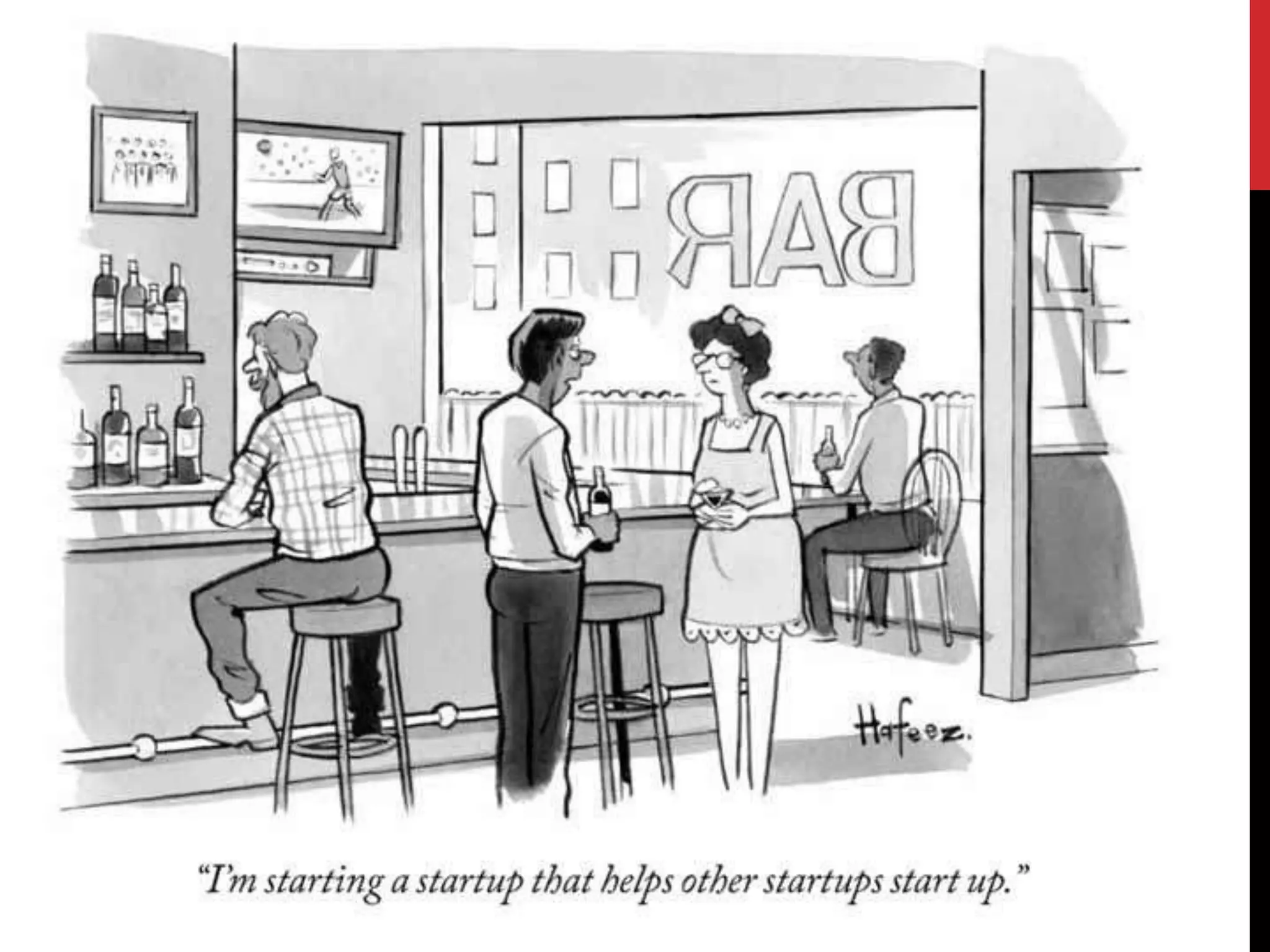
TREND 3 – ENTREPRENEURS &
STARTUP
Entrepreneurship & Small Business… Traditional Business
Makes a Comeback with personalization and the web as
catalysts.
Two Harvard Business School graduates started Birchbox in 2010
as a monthly subscription service that delivers personalized
selections of beauty products to your door. Today, that concept
has grown into an offline store in Manhattan and online service in
Canada, as well as a women's magazine and lifestyle guide for
men.
That combination, along with Barna and Beauchamp's
business smarts, catapulted Birchbox to an April 2014
valuation of $485 million. They've sent out millions of boxes
so far and have even expanded across the ocean to five
European countries.
TREND 3 – ENTREPRENEURS &
STARTUP
The Numbers
In the US, Startup activity saw the largest annual increase in 20
years. Denmark is a hub for cutting edge companies in a variety
of different industries. We are considered one of the European
Union’s top clusters regarding Life Science, ICT, Design and
Clean Tech & Sustainable Energy.
The Challenge
Eighty percent of new entrepreneurs previously held jobs - more than
last year but still lower than historical norms. There are now 310
entrepreneurs for every 100,000 adults in the U.S., which translates
into 530,000 new business owners every month, the report says.
"Entrepreneurship in all its forms will continue to be essential to
rising standards of living and expanding economic opportunity."
TREND 4 – THE SLOW
MOVEMENT
Be on the lookout for handmade, small batch, artisan and
stone-ground products embodying crafting techniques long
revered by some consumers from Cuisine, Beverages, and
Fashion.
Originally unique to the Specialty Gourmet universe, regional
artisanal products are making their mark in all channels as
entrepreneurs continue adapting small-scale production to supply
retail stores – without losing quality.
Brands that stay dedicated to their home state are popping up
more and more, answering growing consumer demand for foods
that also match production values important to them: low carbon
footprint, organic, biodynamic, even Certified B Corporations™.
TREND 4 – THE SLOW
MOVEMENT
The Numbers (Apparel Industry Example)
According to author Lucy Siegle's "To Die For: Is Fashion
Wearing out the World?" Americans purchase, on average,
68 pieces of clothing and eight pairs of shoes annually.
That's about 25 billion garments each year, well more than
the 7.3 billion people who inhabit the planet.
The Challenge
Educate, inspire, and influence change in the fashion
industry by encouraging consumers to slow down and make
more conscious consumption decisions. From McDonalds to
H&M this trend promises to challenge the well established
business models of companies for whom volume sales has
been key.
TREND 5 – MICRO-MARKETS &
SEGMENTATION – BIG DATA
Diversity, Pride & Product Development
The advent of the internet and mobile communications was
foreseen as a great equalizer, necessitating a broad industry
move towards standardization. The trend towards consumer
tastes becoming more common never came to be, in fact, the
reverse effect has been a hallmark of the internet and mobile.
Quantifying Factor…
- Demography as an Anchor
Qualifying Factors…
- Psychology as context and message driver
- Behavior as attraction and permission
TREND 5 – MICRO-MARKETS &
SEGMENTATION – SMALL DATA
TREND 6 – INTEREST BASED
MEDIA
Interest (Instagram) Media Overtakes Social (Facebook) in
Effective Business Communications.
Ariana Huffington – The Huffington Post - The Huffington Post is
the Tesla of media because it is the closest thing to a traditional
entity that sprang into being, seemingly out of nowhere and very
quickly forced the industry to question a lot of long-held
assumptions. Among those assumptions were the following: No
one of any quality would write for free, Users wouldn’t want a
news aggregator, A new entity couldn’t build a large audience,
Viral content can’t be treated like a science, A viral-media site
couldn’t evolve.
All of this helped The Huffington Post build what became a $315-
million organization in a little more than 5 years, right under the
noses of the largest and world’s most well-funded media entities.
TREND 6 – INTEREST BASED
MEDIA
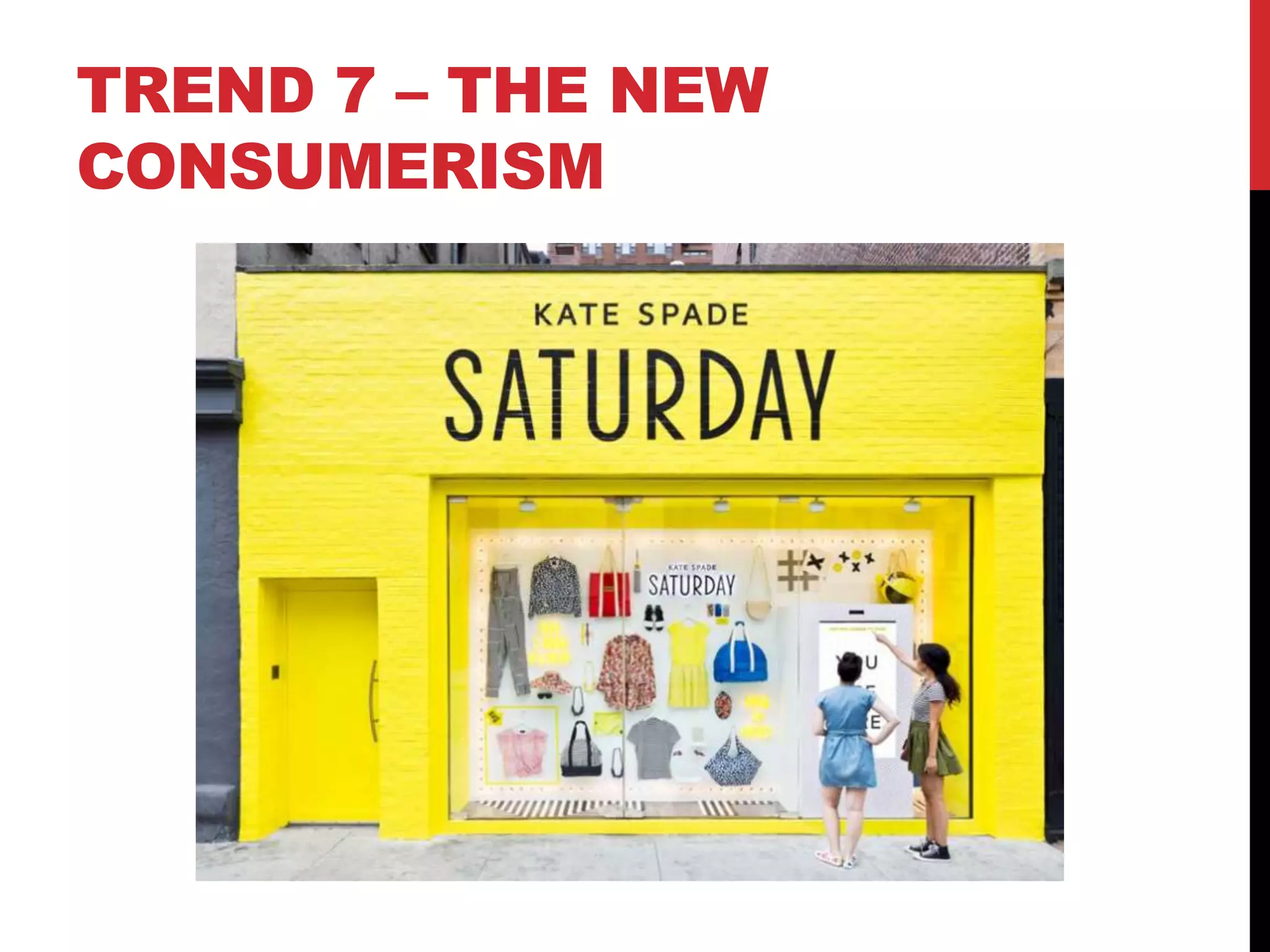
TREND 7 – THE NEW
CONSUMERISM
Consumer as a Marketing Force – Affinity, Advocacy & C to C
Marketing (Instagram, Yelp, Trip Advisor, Pinterest)
Individualism – Expression as the Driving Force in Brand &
Product Selection
Customization – Demand and Access (e.g. Emerging
Technology 3D Printing)
Dynamic shift from Trinkets and Trash to Treasure – Made in
China, Home Goods, Fast Fashion are on their way out, the
great recession changed buyer behavior)
Limited lines, specialty, and collaborations (adding depth and
breadth to consumer choice)
Immediate Gratification – Drone Delivery to 3D Printing (Nike &
Adidas)
TREND 7 – THE NEW
CONSUMERISM
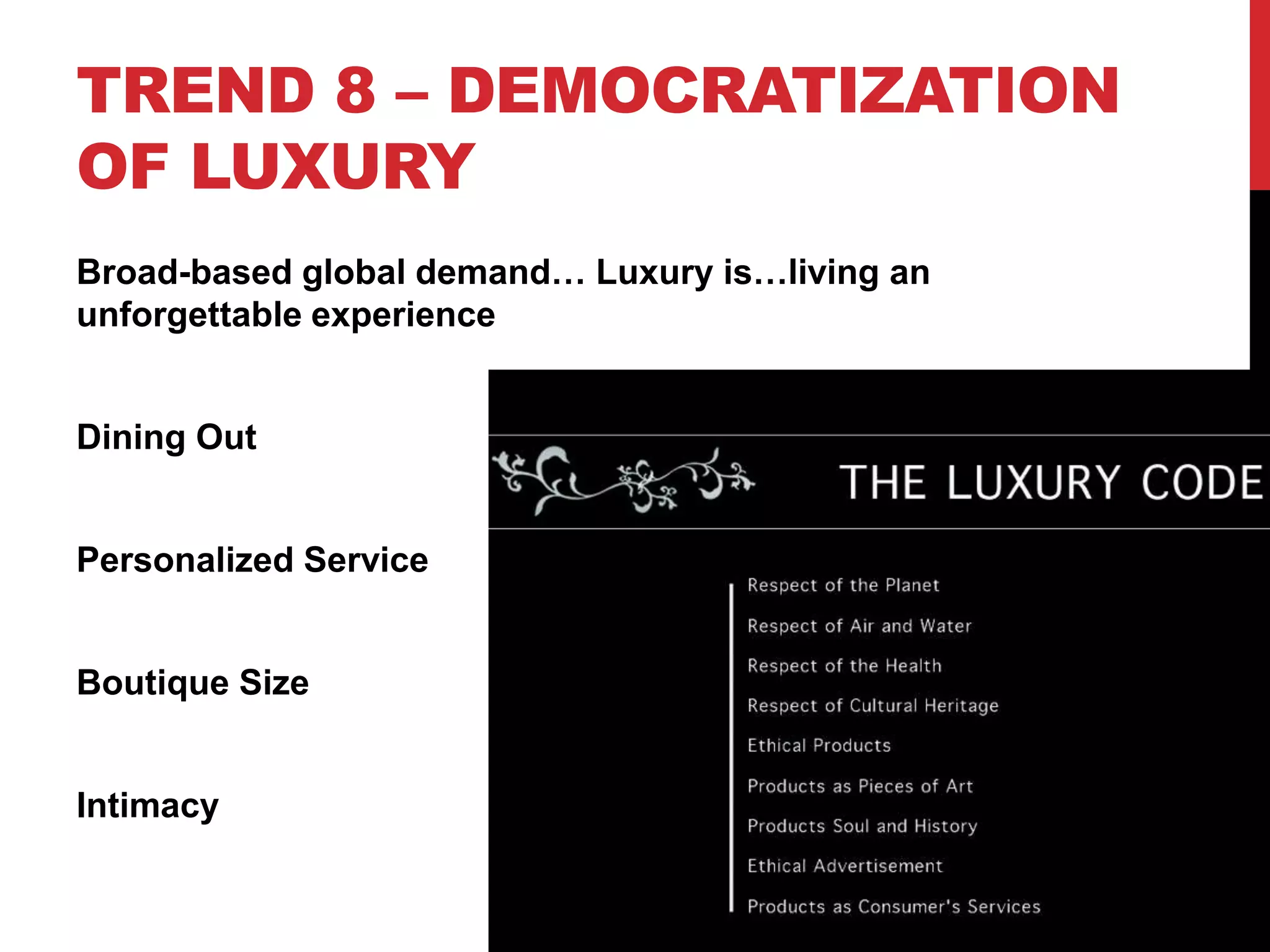
TREND 8 – DEMOCRATIZATION
OF LUXURY
Broad-based global demand… Luxury is…living an
unforgettable experience
Dining Out
Personalized Service
Boutique Size
Intimacy
TREND 8 – DEMOCRATIZATION
OF LUXURY
TREND 9 – LIFESTYLE
Small Living – Simplicity & Small Become the New
‘Conscious’ OR ‘Simple’ Status Symbols
Urbanization – Historic Migration to Cities and Urban Centers
Escape to the Wilds – The New Pioneers & Explorers
TREND 9 – LIFESTYLE
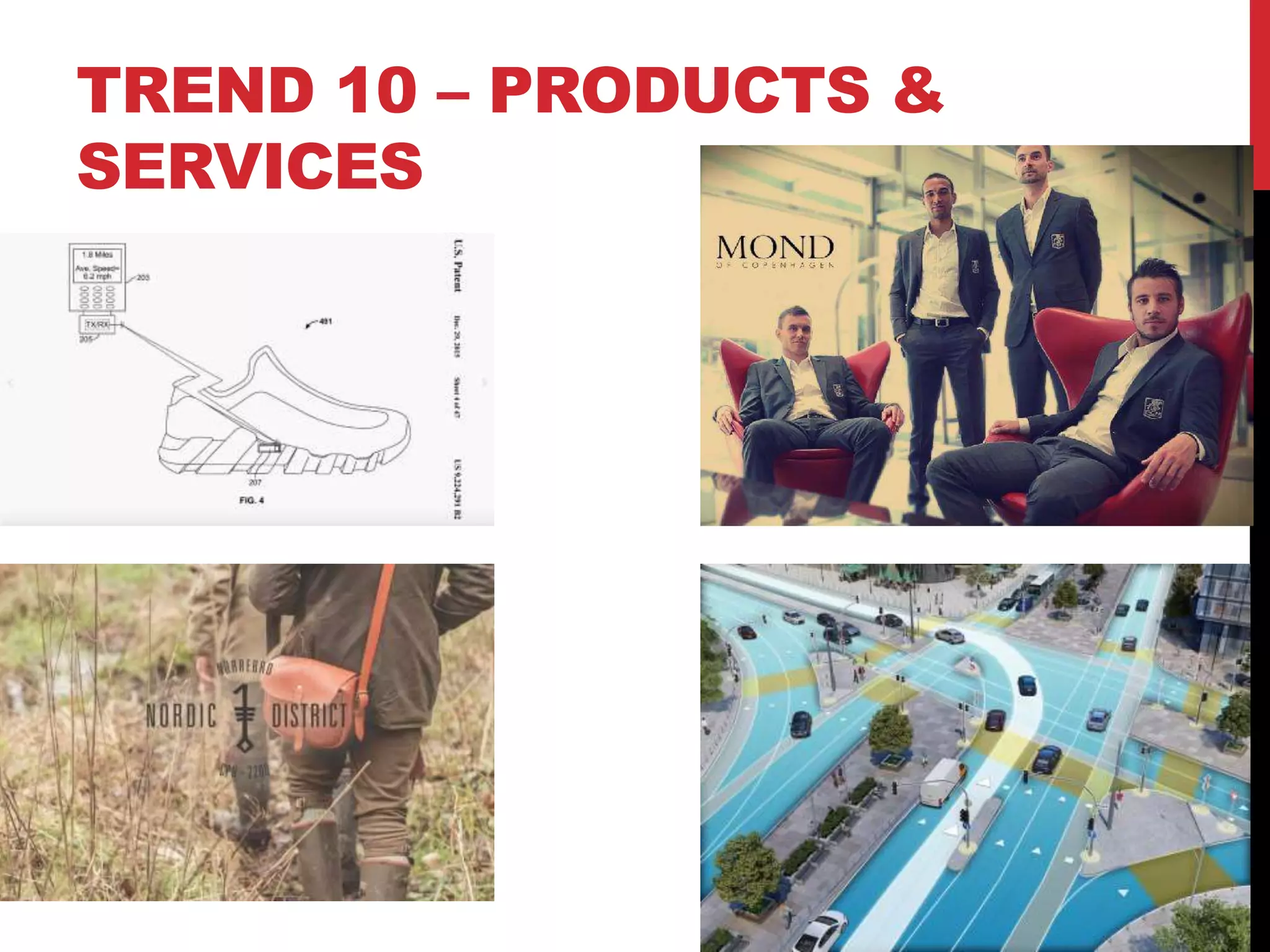
TREND 10 – PRODUCTS &
SERVICES
Customization – Micro Sourcing & Manufacture, Crowd Funded Sales,
Capsule Collections
Authenticity – Brand & Product Meaning, Context, Construct &
Communications
Handcraft – On-Shoring, Craft Movement, Makers & Merchants Enabling
their Sales (Etsy, Big Cartel, etc.)
Smart Products – smart shoes, smart cars, smart appliances, smart
homes (Internet of Things – maturity of web communications – we’re
busy, our homes, appliances, and transportation must and will get
smarter and help us fill in the gaps. (Consumer)
Industry 4.0 (similar to the consumer market above) but targeted to
assist business (smart warehouses, logistics, supply chain, production
– robotics, communications)
Wearable tech – music, data, communications, perhaps migrating to
implants
TREND 10 – PRODUCTS &
SERVICES
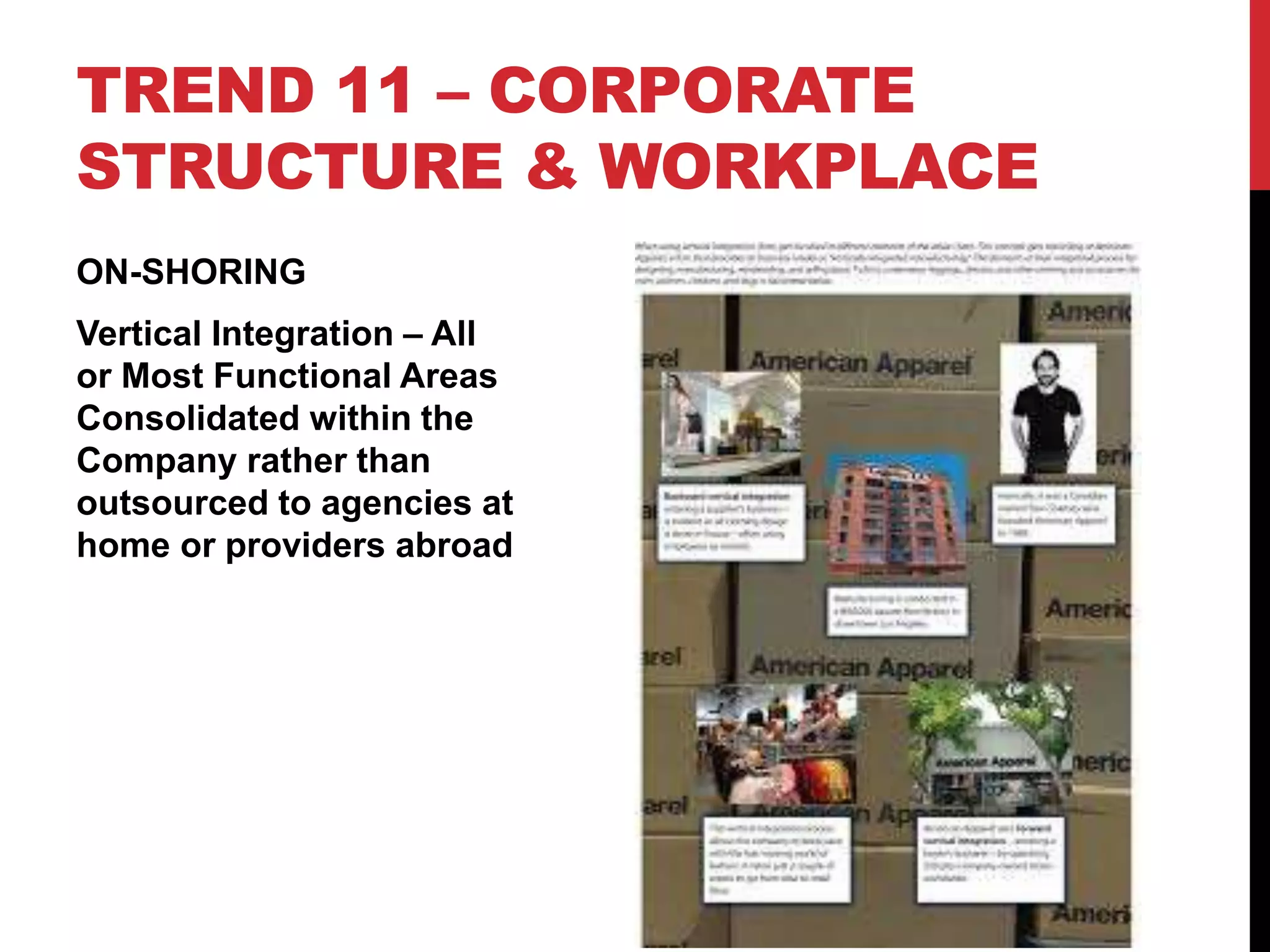
TREND 11 – CORPORATE
STRUCTURE & WORKPLACE
ON-SHORING
Vertical Integration – All
or Most Functional Areas
Consolidated within the
Company rather than
outsourced to agencies at
home or providers abroad
TREND 11 – CORPORATE
STRUCTURE & WORKPLACE
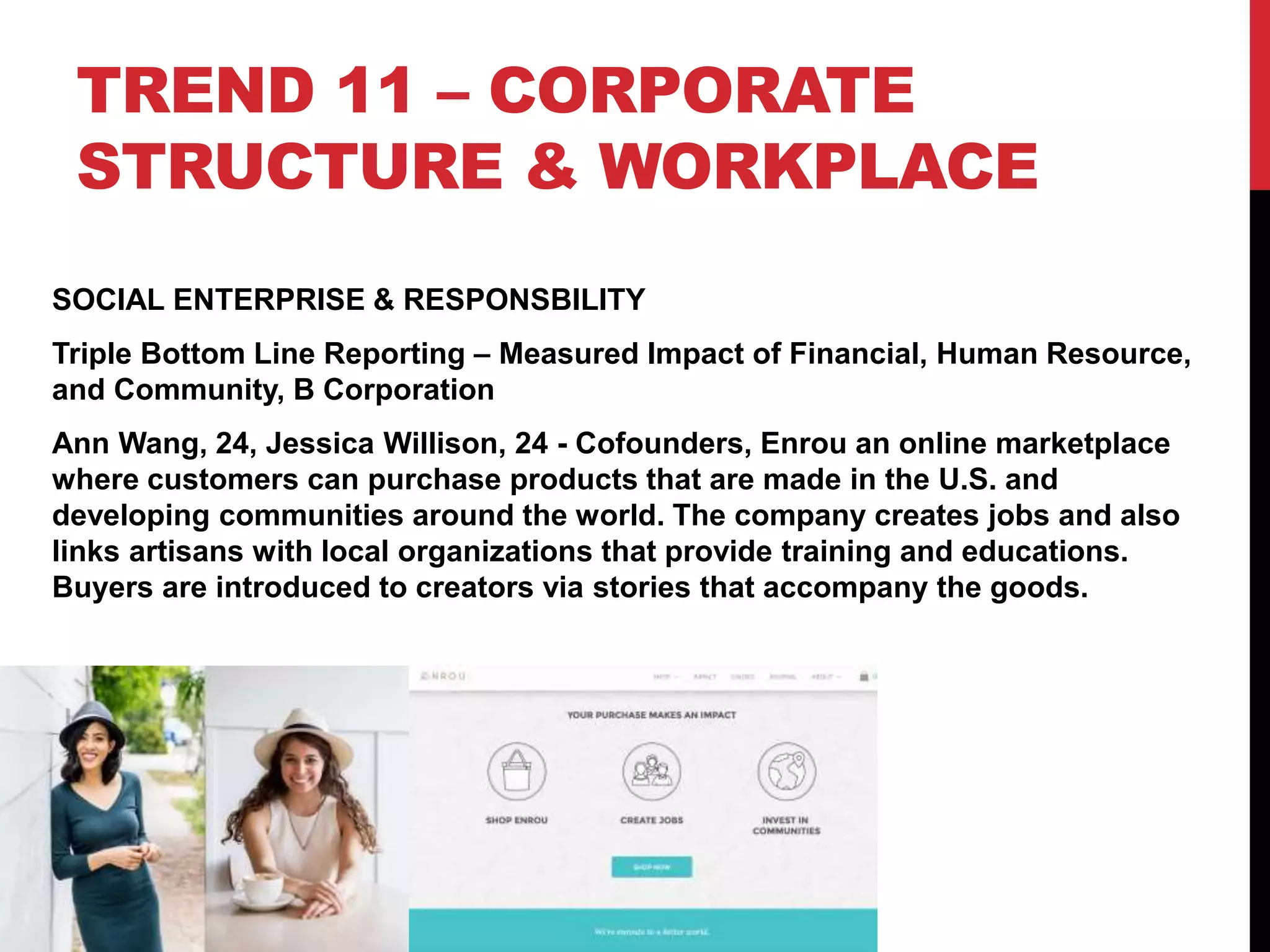
SOCIAL ENTERPRISE & RESPONSBILITY
Triple Bottom Line Reporting – Measured Impact of Financial, Human Resource,
and Community, B Corporation
Ann Wang, 24, Jessica Willison, 24 - Cofounders, Enrou an online marketplace
where customers can purchase products that are made in the U.S. and
developing communities around the world. The company creates jobs and also
links artisans with local organizations that provide training and educations.
Buyers are introduced to creators via stories that accompany the goods.
CROWD MEETS COMPANY
Co-Working & Incubation – The Sharing Economy
Meets the Workplace – Agilent Growth
TREND 12 – RETAIL &
MERCHANDISING
OMNICHANNEL - Click to Brick / Omni Channel – Bridging the
Digital Divide Between Consumer & Seller. Technology Meets
Storefront – Integrate Online Virtual with In-Store Experience
Angela Ahrendts - To her, the store is a "big giant product" in itself,"
and she says it has evolved in a similar way as the iPhone and Mac,
and gotten "sleeker and smarter" over the years. But, she wonders:
"How do we get our kids who prefer no human interaction into these
stores?” The company is now working to better unite its online and
offline experience. Ahrendts also wants to re-center the physical
experience around particular "passion points." Next - "The Avenue,"
which has Apple’s accessories repositioned from the wall into an
experience that feels more akin to walking down the street of a "small
town and looking into each window.”
TREND 12 – RETAIL &
MERCHANDISING

2020 VISION INNOVATION V1

  • 1.
    VISION 2020 12 INNOVATIONS &MEGA TRENDS TOWARDS THE COMING DECADE
  • 2.
    DISRUPTION Movement or trendthat is changing industries, relating to or noting a new product, service, or idea that radically changes an industry or business strategy, especially by creating a new market and disrupting an existing one.
  • 3.
    INNOVATION TRANSLATION - Theprocess of translating an idea or invention into a good or service that creates value or for which customers will pay. To be called an innovation, an idea must be replicable at an economical cost and must satisfy a specific need. INNOVATION - involves deliberate application of information, imagination and initiative in deriving greater or different values from resources, and includes all processes by which new ideas are generated and converted into useful products. SATISFACTION - In business, innovation results when ideas are applied by a individual, company, or other entity to further satisfy the needs and expectations of consumers.
  • 4.
    TREND PATTERN – Agradual change in a condition, output, or process, or an average or general tendency of a series of data points to move in a certain direction over time. TO FOLLOW - Not only be aware of what is currently happening, but be astute enough to predict what is going to happen in the future. TO LEAD - To have access to, and be able to base decisions upon, contextual information central to the consumer and marketplace for the product, service or concept in mind.
  • 5.
    CONTEXT BACKGROUND - Contextis most purely the background, environment, framework, setting, or situation surrounding a previous or current event, occurrence, or timeframe. RESEARCH - Context is the information necessary to correctly interpret anything from a word or phrase, or a concept or trend that could otherwise be interpreted in a number of different ways. MEANING - When you say something is out of context you basically mean it's out of place. To be successful we must be IN context.
  • 6.
    INNOVATION PROCESS CURRENT SITUATION DRIVERS– FROM PRESENT ENABLERS TO PAST CONEXT DEMOGRAPHY • PSYCHOLOGY • BEHAVIOR CREATIVE IDEATION • CREATING VALUE RESOURCES • SOURCING • PRODUCTION MARKETING • ADVERTISING • PR MERCHANDISING • DIRECT MARKETING • SALES DELIVERY • SERVICE REINFORCEMENT • RELATIONSIP BUILDING
  • 7.
    TREND 1 –THE SHARING ECONOMY Peer 2 Peer “P2P” or Collaborative Consumption in Transport, Hospitality, Product, and more… (Uber, AirBnB, YoooWe) Travis Kalanick’s idea of progress is simple and sweeping: transportation as ubiquitous and reliable as running water, everywhere, for everyone. And as part of that vision, he expects to change the way cities operate.
  • 8.
    TREND 1 –THE SHARING ECONOMY The Numbers Uber is likely the fastest-growing startup in history and definitely the most valuable at $62.5 billion, a figure that is quickly approaching the market capitalization of Volkswagen, the largest automaker on earth. It has 1.1 million active drivers (which it defines as independent contractors who have offered at least one trip in the past week) in 361 cities—nearly 100 of which Uber expanded to in 2015. The Challenge While at the same democratizing the labor market, Uber and other similar CC concepts are fairly typical examples of what disruptive technologies can do to labor. From English textile workers to travel agents, new technology destroys job categories at the same time as it creates them.
  • 9.
    TREND 2 –FREE FOR SERVICE Providers and publics are accessing information, entertainment, and other content and services at no direct cost (price for access or usage) to users to an extent not seen before. This trend has been empowered by mass access to and adoption of online tools and destinations, and serves as a major disruptor to the entertainment, content and services industries including music, movies, literature, and communications (‘VOIP’ – Skype, Face Time etc.)
  • 10.
    The Drivers Mobility andthe applications and tools that drive it have driven consumers to become increasingly unwilling to pay for access and use across entire business categories, those businesses directly impacted must quickly adopt alternative means of generating revenue in support of providing those very same services or products. Niklas Zennstrom - Look for when the environment is changing — the big shift now is mobile Internet. It’s really happening big-time. The way you interact with services on a smart phone compared to the Web is quite different, so there’s a huge opportunity.
  • 11.
    TREND 2 –FREE FOR SERVICE The Challenge The trick here is to try to figure out the thing that’s unexpected. When we started Skype, if you look at analyst reports, no one forecasted it as a big business. Also when Google started, it was not fashionable to be in search. It’s not trying to do the obvious – that’s the hard part. You have to figure out what it is – you have to stumble on it.
  • 12.
    TREND 3 –ENTREPRENEURS & STARTUP Entrepreneurship & Small Business… Traditional Business Makes a Comeback with personalization and the web as catalysts. Two Harvard Business School graduates started Birchbox in 2010 as a monthly subscription service that delivers personalized selections of beauty products to your door. Today, that concept has grown into an offline store in Manhattan and online service in Canada, as well as a women's magazine and lifestyle guide for men. That combination, along with Barna and Beauchamp's business smarts, catapulted Birchbox to an April 2014 valuation of $485 million. They've sent out millions of boxes so far and have even expanded across the ocean to five European countries.
  • 14.
    TREND 3 –ENTREPRENEURS & STARTUP The Numbers In the US, Startup activity saw the largest annual increase in 20 years. Denmark is a hub for cutting edge companies in a variety of different industries. We are considered one of the European Union’s top clusters regarding Life Science, ICT, Design and Clean Tech & Sustainable Energy. The Challenge Eighty percent of new entrepreneurs previously held jobs - more than last year but still lower than historical norms. There are now 310 entrepreneurs for every 100,000 adults in the U.S., which translates into 530,000 new business owners every month, the report says. "Entrepreneurship in all its forms will continue to be essential to rising standards of living and expanding economic opportunity."
  • 15.
    TREND 4 –THE SLOW MOVEMENT Be on the lookout for handmade, small batch, artisan and stone-ground products embodying crafting techniques long revered by some consumers from Cuisine, Beverages, and Fashion. Originally unique to the Specialty Gourmet universe, regional artisanal products are making their mark in all channels as entrepreneurs continue adapting small-scale production to supply retail stores – without losing quality. Brands that stay dedicated to their home state are popping up more and more, answering growing consumer demand for foods that also match production values important to them: low carbon footprint, organic, biodynamic, even Certified B Corporations™.
  • 16.
    TREND 4 –THE SLOW MOVEMENT The Numbers (Apparel Industry Example) According to author Lucy Siegle's "To Die For: Is Fashion Wearing out the World?" Americans purchase, on average, 68 pieces of clothing and eight pairs of shoes annually. That's about 25 billion garments each year, well more than the 7.3 billion people who inhabit the planet. The Challenge Educate, inspire, and influence change in the fashion industry by encouraging consumers to slow down and make more conscious consumption decisions. From McDonalds to H&M this trend promises to challenge the well established business models of companies for whom volume sales has been key.
  • 17.
    TREND 5 –MICRO-MARKETS & SEGMENTATION – BIG DATA Diversity, Pride & Product Development The advent of the internet and mobile communications was foreseen as a great equalizer, necessitating a broad industry move towards standardization. The trend towards consumer tastes becoming more common never came to be, in fact, the reverse effect has been a hallmark of the internet and mobile. Quantifying Factor… - Demography as an Anchor Qualifying Factors… - Psychology as context and message driver - Behavior as attraction and permission
  • 18.
    TREND 5 –MICRO-MARKETS & SEGMENTATION – SMALL DATA
  • 19.
    TREND 6 –INTEREST BASED MEDIA Interest (Instagram) Media Overtakes Social (Facebook) in Effective Business Communications. Ariana Huffington – The Huffington Post - The Huffington Post is the Tesla of media because it is the closest thing to a traditional entity that sprang into being, seemingly out of nowhere and very quickly forced the industry to question a lot of long-held assumptions. Among those assumptions were the following: No one of any quality would write for free, Users wouldn’t want a news aggregator, A new entity couldn’t build a large audience, Viral content can’t be treated like a science, A viral-media site couldn’t evolve. All of this helped The Huffington Post build what became a $315- million organization in a little more than 5 years, right under the noses of the largest and world’s most well-funded media entities.
  • 20.
    TREND 6 –INTEREST BASED MEDIA
  • 21.
    TREND 7 –THE NEW CONSUMERISM Consumer as a Marketing Force – Affinity, Advocacy & C to C Marketing (Instagram, Yelp, Trip Advisor, Pinterest) Individualism – Expression as the Driving Force in Brand & Product Selection Customization – Demand and Access (e.g. Emerging Technology 3D Printing) Dynamic shift from Trinkets and Trash to Treasure – Made in China, Home Goods, Fast Fashion are on their way out, the great recession changed buyer behavior) Limited lines, specialty, and collaborations (adding depth and breadth to consumer choice) Immediate Gratification – Drone Delivery to 3D Printing (Nike & Adidas)
  • 22.
    TREND 7 –THE NEW CONSUMERISM
  • 23.
    TREND 8 –DEMOCRATIZATION OF LUXURY Broad-based global demand… Luxury is…living an unforgettable experience Dining Out Personalized Service Boutique Size Intimacy
  • 24.
    TREND 8 –DEMOCRATIZATION OF LUXURY
  • 25.
    TREND 9 –LIFESTYLE Small Living – Simplicity & Small Become the New ‘Conscious’ OR ‘Simple’ Status Symbols Urbanization – Historic Migration to Cities and Urban Centers Escape to the Wilds – The New Pioneers & Explorers
  • 26.
    TREND 9 –LIFESTYLE
  • 27.
    TREND 10 –PRODUCTS & SERVICES Customization – Micro Sourcing & Manufacture, Crowd Funded Sales, Capsule Collections Authenticity – Brand & Product Meaning, Context, Construct & Communications Handcraft – On-Shoring, Craft Movement, Makers & Merchants Enabling their Sales (Etsy, Big Cartel, etc.) Smart Products – smart shoes, smart cars, smart appliances, smart homes (Internet of Things – maturity of web communications – we’re busy, our homes, appliances, and transportation must and will get smarter and help us fill in the gaps. (Consumer) Industry 4.0 (similar to the consumer market above) but targeted to assist business (smart warehouses, logistics, supply chain, production – robotics, communications) Wearable tech – music, data, communications, perhaps migrating to implants
  • 28.
    TREND 10 –PRODUCTS & SERVICES
  • 29.
    TREND 11 –CORPORATE STRUCTURE & WORKPLACE ON-SHORING Vertical Integration – All or Most Functional Areas Consolidated within the Company rather than outsourced to agencies at home or providers abroad
  • 30.
    TREND 11 –CORPORATE STRUCTURE & WORKPLACE SOCIAL ENTERPRISE & RESPONSBILITY Triple Bottom Line Reporting – Measured Impact of Financial, Human Resource, and Community, B Corporation Ann Wang, 24, Jessica Willison, 24 - Cofounders, Enrou an online marketplace where customers can purchase products that are made in the U.S. and developing communities around the world. The company creates jobs and also links artisans with local organizations that provide training and educations. Buyers are introduced to creators via stories that accompany the goods.
  • 31.
    CROWD MEETS COMPANY Co-Working& Incubation – The Sharing Economy Meets the Workplace – Agilent Growth
  • 32.
    TREND 12 –RETAIL & MERCHANDISING OMNICHANNEL - Click to Brick / Omni Channel – Bridging the Digital Divide Between Consumer & Seller. Technology Meets Storefront – Integrate Online Virtual with In-Store Experience Angela Ahrendts - To her, the store is a "big giant product" in itself," and she says it has evolved in a similar way as the iPhone and Mac, and gotten "sleeker and smarter" over the years. But, she wonders: "How do we get our kids who prefer no human interaction into these stores?” The company is now working to better unite its online and offline experience. Ahrendts also wants to re-center the physical experience around particular "passion points." Next - "The Avenue," which has Apple’s accessories repositioned from the wall into an experience that feels more akin to walking down the street of a "small town and looking into each window.”
  • 33.
    TREND 12 –RETAIL & MERCHANDISING