Michelle Li
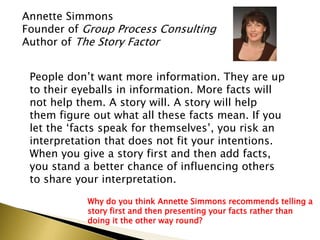
Annette Simmons
Founder of Group Process Consulting
Author of The Story Factor
People don’t want more information. They are up
to their eyeballs in information. More facts will
not help them. A story will. A story will help
them figure out what all these facts mean. If you
let the ‘facts speak for themselves’, you risk an
interpretation that does not fit your intentions.
When you give a story first and then add facts,
you stand a better chance of influencing others
to share your interpretation.
Why do you think Annette Simmons recommends telling a
story first and then presenting your facts rather than
doing it the other way round?
A story we told is a great way to arouse the
interest of the audience. By the end of the
story, they are ready, if they haven’t already
partially worked it out for themselves, to hear
what the key message is and what facts and
figures back it up. But, if you give them the
facts first, then they already know why you’re
telling your story before you begin. You have
spoilt the element of surprise. You’re no
longer exploiting your audience’s natural
curiosity to see the pieces fall into place.
You’ve deprived them of their “Aha!” moment.
An anecdote is a true story about your own
life. How can this be even more effective than
a story about someone else?
True stories have a special appeal of their
own. If you tell a joke or a story about
someone else, then it had better be good or
your audience will wonder why you wasted
their time telling it. But when you tell an
anecdote, it’s a window onto your
experience and personality. As long as the
story is relevant and not too long, you’ll
have your audience’s attention. And if your
anecdote reminds them of similar
experiences they’ve had themselves, so
much the better!
The first presenter is talking to a group of young
entrepreneurs in Singapore.
How does her story help her to build rapport with
her audience?
The presenter begins by confessing to a failure that
turned out well in the end. Asian audiences
generally appreciate some sign of humility,
especially in the young, so this is an effective
opening strategy. Then she goes on to show that
she started her business with next to nothing,
working out of her apartment with no staff, and still
managed to succeed. The audience laughs because
it’s something they can relate to, being young
aspiring entrepreneurs themselves. This is a good
example of a “bonding story”. In effect, the speaker
is saying to the audience: “I know what it’s like to
be in your position, but it worked for me, and, if
you work hard, it can work for you too”.
The second presenter is an Argentinian Customer
Relationship Management (CRM) specialist
addressing an international group of hotel
managers.
How does he use statistics and humor to make his
point?
The story of the guest satisfaction questionnaires is
something any hotel manager can relate to. So the
presenter begins with the familiar. He then does two
things. First, he surprised his audience with some
unexpected statistics. These turn a simple anecdote
into a revealing piece of market research. From these
statistics he draw his conclusion – customer
satisfaction is not the same as customer loyalty. And
to underline the validity of his conclusion he then
draws an analogy between customers and life
partners by asking his audience a direct question,
which is also a joke. When they laugh at the joke,
they are, in a way, also accepting that the point he is
making is true - a clever use of humor to persuade.
The third presenter is a German business school
professor talking at an international HR directors’
conference.
What makes his story so effective?
The subject of hiring more mature job applicants, who may
have been out of the workforce for a while, is a potentially
sensitive one. Such people may have a great deal of
experience, but a lot of it could be out of date. When you
hire college-leavers they know they have a lot to learn. But
the older applicant may think they know it already, so they
may have to “unlearn” a lot of old skills before they can
even start to learn new ones. In that sense, they could be
harder to train than young recruits. So the speaker cleverly
uses the self-effacing story of his own attempt to relearn
tennis after 20 years to soften his message about
recruiting older people. He does not himself work in HR,
but he knows that an audience of HR directors is probably
going to consist of slightly unfit middle-aged people like
himself. So his anecdote also helps to break down any
possible resistance to a professor trying to tell executives
how to do their job.
What key skills does a storyteller need?
Let your voice reflect the emotions in the story
Quote actual conversations.
Use gestures to illustrate the story.
Exaggerate your descriptions a little.
Draw interesting comparisons.
Stick to present tenses for greater impact.
Involve the audience as you speak.

2018.01.03 storytelling 2

  • 1.
  • 2.
    Annette Simmons Founder ofGroup Process Consulting Author of The Story Factor People don’t want more information. They are up to their eyeballs in information. More facts will not help them. A story will. A story will help them figure out what all these facts mean. If you let the ‘facts speak for themselves’, you risk an interpretation that does not fit your intentions. When you give a story first and then add facts, you stand a better chance of influencing others to share your interpretation. Why do you think Annette Simmons recommends telling a story first and then presenting your facts rather than doing it the other way round?
  • 3.
    A story wetold is a great way to arouse the interest of the audience. By the end of the story, they are ready, if they haven’t already partially worked it out for themselves, to hear what the key message is and what facts and figures back it up. But, if you give them the facts first, then they already know why you’re telling your story before you begin. You have spoilt the element of surprise. You’re no longer exploiting your audience’s natural curiosity to see the pieces fall into place. You’ve deprived them of their “Aha!” moment.
  • 4.
    An anecdote isa true story about your own life. How can this be even more effective than a story about someone else?
  • 5.
    True stories havea special appeal of their own. If you tell a joke or a story about someone else, then it had better be good or your audience will wonder why you wasted their time telling it. But when you tell an anecdote, it’s a window onto your experience and personality. As long as the story is relevant and not too long, you’ll have your audience’s attention. And if your anecdote reminds them of similar experiences they’ve had themselves, so much the better!
  • 6.
    The first presenteris talking to a group of young entrepreneurs in Singapore. How does her story help her to build rapport with her audience?
  • 7.
    The presenter beginsby confessing to a failure that turned out well in the end. Asian audiences generally appreciate some sign of humility, especially in the young, so this is an effective opening strategy. Then she goes on to show that she started her business with next to nothing, working out of her apartment with no staff, and still managed to succeed. The audience laughs because it’s something they can relate to, being young aspiring entrepreneurs themselves. This is a good example of a “bonding story”. In effect, the speaker is saying to the audience: “I know what it’s like to be in your position, but it worked for me, and, if you work hard, it can work for you too”.
  • 8.
    The second presenteris an Argentinian Customer Relationship Management (CRM) specialist addressing an international group of hotel managers. How does he use statistics and humor to make his point?
  • 9.
    The story ofthe guest satisfaction questionnaires is something any hotel manager can relate to. So the presenter begins with the familiar. He then does two things. First, he surprised his audience with some unexpected statistics. These turn a simple anecdote into a revealing piece of market research. From these statistics he draw his conclusion – customer satisfaction is not the same as customer loyalty. And to underline the validity of his conclusion he then draws an analogy between customers and life partners by asking his audience a direct question, which is also a joke. When they laugh at the joke, they are, in a way, also accepting that the point he is making is true - a clever use of humor to persuade.
  • 10.
    The third presenteris a German business school professor talking at an international HR directors’ conference. What makes his story so effective?
  • 11.
    The subject ofhiring more mature job applicants, who may have been out of the workforce for a while, is a potentially sensitive one. Such people may have a great deal of experience, but a lot of it could be out of date. When you hire college-leavers they know they have a lot to learn. But the older applicant may think they know it already, so they may have to “unlearn” a lot of old skills before they can even start to learn new ones. In that sense, they could be harder to train than young recruits. So the speaker cleverly uses the self-effacing story of his own attempt to relearn tennis after 20 years to soften his message about recruiting older people. He does not himself work in HR, but he knows that an audience of HR directors is probably going to consist of slightly unfit middle-aged people like himself. So his anecdote also helps to break down any possible resistance to a professor trying to tell executives how to do their job.
  • 12.
    What key skillsdoes a storyteller need?
  • 13.
    Let your voicereflect the emotions in the story Quote actual conversations. Use gestures to illustrate the story. Exaggerate your descriptions a little. Draw interesting comparisons. Stick to present tenses for greater impact. Involve the audience as you speak.