INNOVATION
Scorecard
2018
INNOVATION Scorecard 1
Contents
WELCOME LETTERS 									 3
EXECUTIVE SUMMARY									 8
	Overview										 9
	Rankings by Category								 12
		Best & Brightest								 14
		Fast Internet								 15
		Grants Advanced Degrees						 16
		Tech Workforce								 17
		Tax Friendly									 18
		Attracts Investment							 19
		Entrepreneurial Activity							 20
		Ridesharing									 21
		Short-Term Rentals							 22
		Innovation-Friendly Sustainable Policies 				 23
		Self-Driving Vehicles							 24
		Drones					 				 25
STATE PROFILES										 27
METHODOLOGY										 128
ACKNOWLEDGMENTS									 133
INNOVATION Scorecard 3
Letters
WELCOME
4
Four years ago, we launched our Innovation Scorecard to identify states that
are promoting technological progress, creating good jobs for talented men and
women and improving the quality of life for people across the United States.
Since then, we’ve seen time and again that people benefit when policy-
makers adopt forward-thinking attitudes, take a light-handed approach to
rulemaking, and collaborate with businesses in crafting regulation to
govern the emerging technologies that will change our lives.
This year, 12 states have earned our highest honor, being named Innovation
Champions. The list includes one newcomer, Pennsylvania, which enjoyed
significantly increased job growth. After sliding in the rankings in 2017,
Arizona and Kansas once again earned Innovation Champion status this
year, with improvements in internet speed, job growth and the shares of
their populations with advanced degrees.
Across the country, policymakers continue to grapple with new technolo-
gies that herald revolutionary changes in how we move and interact with
the world around us. In the past year, several states set new guidelines for
self-driving vehicles. Some states have opened their roads to testing and
developing systems that will bring about a new wave of mobility, providing
safe and unprecedented transportation options for the elderly and disabled,
while others have simply slammed on the brakes.
Other legislators set their sights on the sky, passing new laws that allow
people to use drones for commercial operations. And once again, legislators
in other states have saddled the technology with burdensome rules that
keep it stuck on the ground.
welcome.
INNOVATION Scorecard 5
Our rankings encompass a state’s scores
in each of 12 quantitative and qualitative
categories, including whether or not a
state has a law prohibiting discrimina-
tion on the basis of sexual orientation
and gender identity, the percentage of
the population with an advanced
degree, the amount of venture capital
and R&D money spent there and the
number of households with high-speed
internet connections.
This year we upped the ante for socially
transformative technologies, dividing
the sharing economy into distinct Short-
Term Rentals and Ridesharing categories.
Similarly, Self-Driving Vehicles and Drones became their own independent
categories.
But in 2018, as in years past, the Innovation Scorecard evaluates all 50 states,
identifying those with policies that impede progress, and those with policies
that allow innovators to thrive. Read this year’s report to see how well your
state is welcoming the developments that will make all our lives better.
Gary Shapiro
President and CEO,
Consumer Technology Association (CTA)™
6
Michigan’s status as the national Comeback State has a lot to do with the
way we have leveraged our assets, particularly those in the technology field.
With the advancements happening in technology across our nation today,
we have a lot to be proud of. But as technology rapidly evolves, states need
to be proactive to stay ahead.
There are a number of states that are or were in the same place Michigan
was when I took office in 2011. During that time, Michigan’s economy was at
an all-time low. The Lost Decade took a toll on our state, but with Relentless
Positive Action and a renewed focus on making our government work for
our residents, we have officially come back.
Since I took office, we have created more than 540,000 new private-sector
jobs. While just over a quarter of these have been in the manufacturing
sector, Michigan has seen great growth in the tech sector, particularly in
Detroit, as well as in West Michigan.
With the boost in our jobs market came a new set of problems — a talent
shortage across multiple industries that threatens our state’s economic re-
covery. That is why I recently proposed the Marshall Plan for Talent.
Through this initiative, Michigan is reinventing the way we develop, attract and
invest in talent within Science, Technology, Engineering and Math (STEM)
fields. We’re working to help Michiganders fill high-tech, high-salary and
in-demand jobs as the IT and computer science fields continue rapid growth
through our state. This plan will invest $100 million over five years in innovative
programs to revolutionize our talent and education systems.
dear reader,
INNOVATION Scorecard 7
Michigan has earned the top-tier title of
Innovation Champion four years run-
ning. We have used the CTA Innovation
Scorecard to help us evaluate ourselves
on what we excel at and where we still
need improvements. From 2017 to 2018,
we improved our grades in Entrepre-
neurial Activity and Tax Friendliness by
a half letter grade.
I invite you to take a close look at your
own state’s Innovation Scorecard. The
information within can help you trans-
form your state and help your residents
reach their fullest potential.
Rick Snyder
Governor,
Michigan
8
Summary
EXECUTIVE
INNOVATION Scorecard 9
Overview
Innovation starts with a seed of an idea. It takes an entrepreneur with vision and cour-
age to make that seed blossom into a business that enriches our lives or even provides
for our livelihood.
But ideas can only take root in welcoming environments. States where leaders rec-
ognize the transformative power of innovation, and allow entrepreneurs to test new
technologies and new business models, create more robust economic growth, more
high-quality jobs and more livable cities. These states are fostering new technologies
such as drones and self-driving vehicles, welcoming new business models including
ridesharing and short-term rental platforms, and empowering their citizens with the
right skills to work in a range of emerging fields.
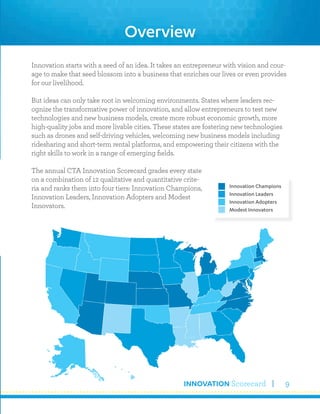
The annual CTA Innovation Scorecard grades every state
on a combination of 12 qualitative and quantitative crite-
ria and ranks them into four tiers: Innovation Champions,
Innovation Leaders, Innovation Adopters and Modest
Innovators.
Innovation Champions
Modest Innovators
Innovation Adopters
Innovation Leaders
10
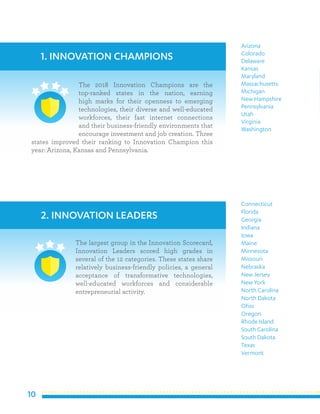
The 2018 Innovation Champions are the
top-ranked states in the nation, earning
high marks for their openness to emerging
technologies, their diverse and well-educated
workforces, their fast internet connections
and their business-friendly environments that
encourage investment and job creation. Three
states improved their ranking to Innovation Champion this
year: Arizona, Kansas and Pennsylvania.
Arizona
Colorado
Delaware
Kansas
Maryland
Massachusetts
Michigan
New Hampshire
Pennsylvania
Utah
Virginia
Washington
Connecticut
Florida
Georgia
Indiana
Iowa
Maine
Minnesota
Missouri
Nebraska
New Jersey
New York
North Carolina
North Dakota
Ohio
Oregon
Rhode Island
South Carolina
South Dakota
Texas
Vermont
1. INNOVATION CHAMPIONS
2. INNOVATION LEADERS
The largest group in the Innovation Scorecard,
Innovation Leaders scored high grades in
several of the 12 categories. These states share
relatively business-friendly policies, a general
acceptance of transformative technologies,
well-educated workforces and considerable
entrepreneurial activity.
INNOVATION Scorecard 11
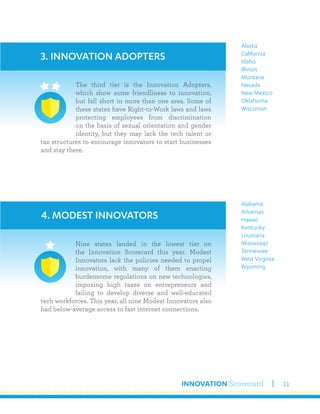
The third tier is the Innovation Adopters,
which show some friendliness to innovation,
but fall short in more than one area. Some of
these states have Right-to-Work laws and laws
protecting employees from discrimination
on the basis of sexual orientation and gender
identity, but they may lack the tech talent or
tax structures to encourage innovators to start businesses
and stay there.
Alaska
California
Idaho
Illinois
Montana
Nevada
New Mexico
Oklahoma
Wisconsin
Alabama
Arkansas
Hawaii
Kentucky
Louisiana
Mississippi
Tennessee
West Virginia
Wyoming
3. INNOVATION ADOPTERS
4. MODEST INNOVATORS
Nine states landed in the lowest tier on
the Innovation Scorecard this year. Modest
Innovators lack the policies needed to propel
innovation, with many of them enacting
burdensome regulations on new technologies,
imposing high taxes on entrepreneurs and
failing to develop diverse and well-educated
tech workforces. This year, all nine Modest Innovators also
had below-average access to fast internet connections.
12
Rankings By Category
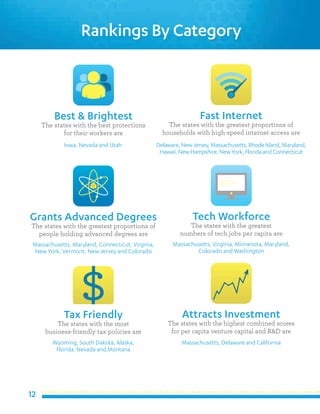
Best & Brightest
The states with the best protections
for their workers are
Iowa, Nevada and Utah
Fast Internet
The states with the greatest proportions of
households with high-speed internet access are
Delaware,NewJersey,Massachusetts,RhodeIsland,Maryland,
Hawaii,NewHampshire,NewYork,FloridaandConnecticut
Grants Advanced Degrees
The states with the greatest proportions of
people holding advanced degrees are
Massachusetts, Maryland, Connecticut, Virginia,
New York, Vermont, New Jersey and Colorado
Tech Workforce
The states with the greatest
numbers of tech jobs per capita are
Massachusetts, Virginia, Minnesota, Maryland,
Colorado and Washington
Tax Friendly
The states with the most
business-friendly tax policies are
Wyoming, South Dakota, Alaska,
Florida, Nevada and Montana
Attracts Investment
The states with the highest combined scores
for per capita venture capital and R&D are
Massachusetts, Delaware and California
INNOVATION Scorecard 13
Rankings By Category
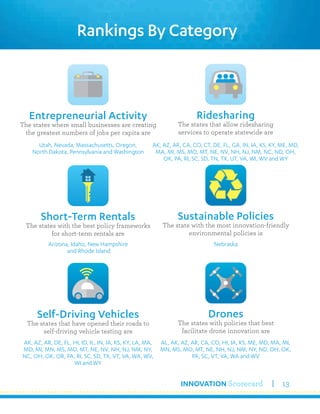
Entrepreneurial Activity
The states where small businesses are creating
the greatest numbers of jobs per capita are
Utah, Nevada, Massachusetts, Oregon,
North Dakota, Pennsylvania and Washington
Ridesharing
The states that allow ridesharing
services to operate statewide are
AK, AZ, AR, CA, CO, CT, DE, FL, GA, IN, IA, KS, KY, ME, MD,
MA, MI, MS, MO, MT, NE, NV, NH, NJ, NM, NC, ND, OH,
OK, PA, RI, SC, SD, TN, TX, UT, VA, WI, WV and WY
Short-Term Rentals
The states with the best policy frameworks
for short-term rentals are
Arizona, Idaho, New Hampshire
and Rhode Island
Sustainable Policies
The state with the most innovation-friendly
environmental policies is
Nebraska
Self-Driving Vehicles
The states that have opened their roads to
self-driving vehicle testing are
AK, AZ, AR, DE, FL, HI, ID, IL, IN, IA, KS, KY, LA, MA,
MD, MI, MN, MS, MO, MT, NE, NV, NH, NJ, NM, NY,
NC, OH, OK, OR, PA, RI, SC, SD, TX, VT, VA, WA, WV,
WI and WY
Drones
The states with policies that best
facilitate drone innovation are
AL, AK, AZ, AR, CA, CO, HI, IA, KS, ME, MD, MA, MI,
MN, MS, MO, MT, NE, NH, NJ, NM, NY, ND, OH, OK,
PA, SC, VT, VA, WA and WV
14
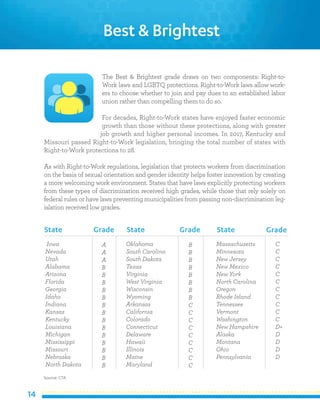
The Best & Brightest grade draws on two components: Right-to-
Work laws and LGBTQ protections. Right-to-Work laws allow work-
ers to choose whether to join and pay dues to an established labor
union rather than compelling them to do so.
For decades, Right-to-Work states have enjoyed faster economic
growth than those without these protections, along with greater
job growth and higher personal incomes. In 2017, Kentucky and
Missouri passed Right-to-Work legislation, bringing the total number of states with
Right-to-Work protections to 28.
As with Right-to-Work regulations, legislation that protects workers from discrimination
on the basis of sexual orientation and gender identity helps foster innovation by creating
a more welcoming work environment. States that have laws explicitly protecting workers
from these types of discrimination received high grades, while those that rely solely on
federal rules or have laws preventing municipalities from passing non-discrimination leg-
islation received low grades.
  Iowa
 Nevada
 Utah
 Alabama
 Arizona
 Florida
 Georgia
 Idaho
 Indiana
 Kansas
 Kentucky
 Louisiana
 Michigan
 Mississippi
 Missouri
 Nebraska
 North Dakota
 Oklahoma
 South Carolina
 South Dakota
 Texas
 Virginia
 West Virginia
 Wisconsin
 Wyoming
 Arkansas
 California
 Colorado
 Connecticut
 Delaware
 Hawaii
 Illinois
 Maine
 Maryland
 Massachusetts
 Minnesota
 New Jersey
 New Mexico
 New York
 North Carolina
 Oregon
 Rhode Island
 Tennessee
 Vermont
 Washington
 New Hampshire
 Alaska
 Montana
 Ohio
 Pennsylvania
A
A
A
B
B
B
B
B
B
B
B
B
B
B
B
B
B
B
B
B
B
B
B
B
B
C
C
C
C
C
C
C
C
C
C
C
C
C
C
C
C
C
C
C
C
D+
D
D
D
D
State Grade State Grade State Grade
Source: CTA
Best & Brightest
INNOVATION Scorecard 15
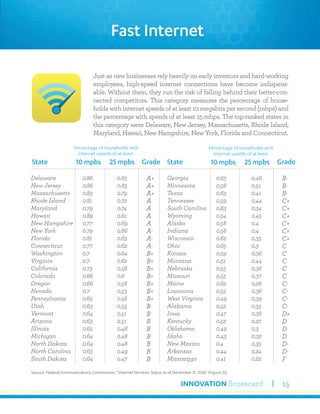
Just as new businesses rely heavily on early investors and hard-working
employees, high-speed internet connections have become indispens-
able. Without them, they run the risk of falling behind their better-con-
nected competitors. This category measures the percentage of house-
holds with internet speeds of at least 10 megabits per second (mbps) and
the percentage with speeds of at least 25 mbps. The top-ranked states in
this category were Delaware, New Jersey, Massachusetts, Rhode Island,
Maryland, Hawaii, New Hampshire, New York, Florida and Connecticut.
Source: Federal Communications Commission, “Internet Services: Status as of December 31, 2016” (Figure 32)
Fast Internet
Delaware
New Jersey
Massachusetts
Rhode Island
Maryland
Hawaii
New Hampshire
New York
Florida
Connecticut
Washington
Virginia
California
Colorado
Oregon
Nevada
Pennsylvania
Utah
Vermont
Arizona
Illinois
Michigan
North Dakota
North Carolina
South Dakota
A+
A+
A+
A
A
A
A
A-
A-
A-
B+
B+
B+
B+
B+
B+
B+
B
B
B
B
B
B
B
B
State Grade
0.83
0.83
0.79
0.72
0.74
0.61
0.69
0.66
0.63
0.62
0.64
0.62
0.56
0.6
0.58
0.53
0.58
0.55
0.51
0.51
0.48
0.48
0.48
0.49
0.47
0.86
0.86
0.83
0.81
0.79
0.89
0.77
0.79
0.81
0.77
0.7
0.7
0.73
0.66
0.66
0.7
0.65
0.63
0.64
0.63
0.65
0.64
0.64
0.63
0.64
Georgia
Minnesota
Texas
Tennessee
South Carolina
Wyoming
Alaska
Indiana
Wisconsin
Ohio
Kansas
Montana
Nebraska
Missouri
Maine
Louisiana
West Virginia
Alabama
Iowa
Kentucky
Oklahoma
Idaho
New Mexico
Arkansas
Mississippi
B-
B-
B-
C+
C+
C+
C+
C+
C+
C
C
C
C
C
C-
C-
C-
C-
D+
D
D
D
D-
D-
F
State Grade
0.46
0.51
0.41
0.44
0.34
0.45
0.4
0.4
0.35
0.3
0.36
0.44
0.38
0.37
0.28
0.36
0.39
0.35
0.38
0.27
0.3
0.32
0.35
0.24
0.22
0.63
0.58
0.63
0.59
0.63
0.54
0.58
0.58
0.62
0.65
0.59
0.51
0.55
0.55
0.62
0.55
0.49
0.52
0.47
0.52
0.49
0.43
0.4
0.44
0.41
Percentage of households with
internet speeds of at least:
10 mpbs 25 mpbs
Percentage of households with
internet speeds of at least:
10 mpbs 25 mpbs
16
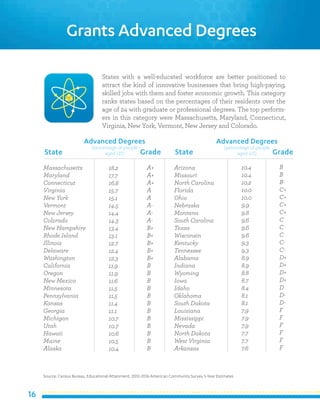
States with a well-educated workforce are better positioned to
attract the kind of innovative businesses that bring high-paying,
skilled jobs with them and foster economic growth. This category
ranks states based on the percentages of their residents over the
age of 24 with graduate or professional degrees. The top perform-
ers in this category were Massachusetts, Maryland, Connecticut,
Virginia, New York, Vermont, New Jersey and Colorado.
Grants Advanced Degrees
Advanced Degrees
(percentage of people
aged ≥25) Grade State Grade
Massachusetts
Maryland
Connecticut
Virginia
New York
Vermont
New Jersey
Colorado
New Hampshire
Rhode Island
Illinois
Delaware
Washington
California
Oregon
New Mexico
Minnesota
Pennsylvania
Kansas
Georgia
Michigan
Utah
Hawaii
Maine
Alaska
A+
A+
A+
A
A
A-
A-
A-
B+
B+
B+
B+
B+
B
B
B
B
B
B
B
B
B
B
B
B
Arizona
Missouri
North Carolina
Florida
Ohio
Nebraska
Montana
South Carolina
Texas
Wisconsin
Kentucky
Tennessee
Alabama
Indiana
Wyoming
Iowa
Idaho
Oklahoma
South Dakota
Louisiana
Mississippi
Nevada
North Dakota
West Virginia
Arkansas
B
B
B-
C+
C+
C+
C+
C
C
C
C-
C-
D+
D+
D+
D+
D
D-
D-
F
F
F
F
F
F
18.2
17.7
16.8
15.7
15.1
14.5
14.4
14.3
13.4
13.1
12.7
12.4
12.3
11.9
11.9
11.6
11.5
11.5
11.4
11.1
10.7
10.7
10.6
10.5
10.4
10.4
10.4
10.2
10.0
10.0
9.9
9.8
9.6
9.6
9.6
9.3
9.3
8.9
8.9
8.8
8.7
8.4
8.1
8.1
7.9
7.9
7.9
7.7
7.7
7.6
Source: Census Bureau, Educational Attainment, 2012-2016 American Community Survey 5-Year Estimates
State
Advanced Degrees
(percentage of people
aged ≥25)
INNOVATION Scorecard 17
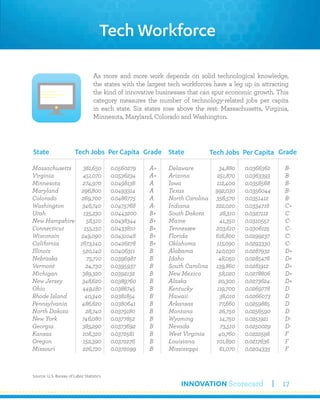
As more and more work depends on solid technological knowledge,
the states with the largest tech workforces have a leg up in attracting
the kind of innovative businesses that can spur economic growth. This
category measures the number of technology-related jobs per capita
in each state. Six states rose above the rest: Massachusetts, Virginia,
Minnesota, Maryland, Colorado and Washington.
Tech Workforce
Massachusetts
Virginia
Minnesota
Maryland
Colorado
Washington
Utah
New Hampshire
Connecticut
Wisconsin
California
Illinois
Nebraska
Vermont
Michigan
New Jersey
Ohio
Rhode Island
Pennsylvania
North Dakota
New York
Georgia
Kansas
Oregon
Missouri
A+
A+
A
A
A
A-
B+
B+
B+
B+
B+
B
B
B
B
B
B
B
B
B
B
B
B
B
B
State Tech Jobs Grade
0.0560279
0.0536234
0.0498138
0.0493314
0.0486775
0.0475768
0.0443200
0.0438344
0.0433810
0.0431048
0.0426278
0.0406311
0.0396987
0.0395937
0.0392132
0.0389760
0.0386745
0.0381854
0.0380641
0.0379180
0.0377852
0.0373692
0.0372581
0.0372276
0.0372099
Per Capita
381,650
451,070
274,970
296,800
269,700
346,740
135,230
58,510
155,150
249,090
1673,140
520,140
75,710
24,730
389,320
348,620
449,180
40,340
486,620
28,740
746,080
385,290
108,320
152,390
226,720
Delaware
Arizona
Iowa
Texas
North Carolina
Indiana
South Dakota
Maine
Tennessee
Florida
Oklahoma
Alabama
Idaho
South Carolina
New Mexico
Alaska
Kentucky
Hawaii
Arkansas
Montana
Wyoming
Nevada
West Virginia
Louisiana
Mississippi
B-
B-
B-
B-
B-
C+
C
C-
C-
C-
C-
D+
D+
D+
D+
D+
D
D
D
D
D-
D-
F
F
F
State Tech Jobs Grade
0.0366362
0.0363393
0.0358568
0.0356044
0.0351412
0.0334718
0.0327112
0.0310557
0.0306125
0.0299237
0.0293330
0.0287932
0.0285478
0.0281912
0.0278806
0.0273624
0.0269778
0.0266073
0.0259885
0.0256590
0.0251921
0.0250029
0.0222598
0.0217636
0.0204335
Per Capita
34,880
251,870
112,400
992,030
356,570
222,020
28,310
41,350
203,610
616,800
115,090
140,030
48,050
139,860
58,020
20,300
119,700
38,010
77,660
26,750
14,750
73,510
40,760
101,890
61,070
Source: U.S. Bureau of Labor Statistics
18
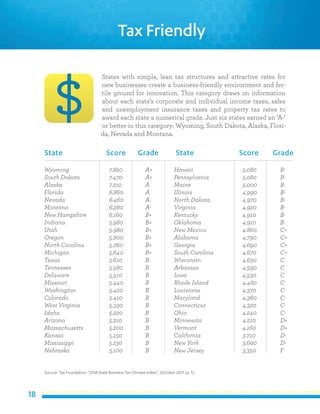
States with simple, lean tax structures and attractive rates for
new businesses create a business-friendly environment and fer-
tile ground for innovation. This category draws on information
about each state’s corporate and individual income taxes, sales
and unemployment insurance taxes and property tax rates to
award each state a numerical grade. Just six states earned an ‘A-’
or better in this category: Wyoming, South Dakota, Alaska, Flori-
da, Nevada and Montana.
Source: Tax Foundation “2018 State Business Tax Climate Index”, October 2017 (p. 5)
Tax Friendly
Wyoming
South Dakota
Alaska
Florida
Nevada
Montana
New Hampshire
Indiana
Utah
Oregon
North Carolina
Michigan
Texas
Tennessee
Delaware
Missouri
Washington
Colorado
West Virginia
Idaho
Arizona
Massachusetts
Kansas
Mississippi
Nebraska
A+
A+
A
A
A-
A-
B+
B+
B+
B+
B+
B+
B
B
B
B
B
B
B
B
B
B
B
B
B
State Score Grade
7.820
7.470
7.210
6.860
6.460
6.280
6.160
5.980
5.980
5.800
5.760
5.640
5.610
5.580
5.510
5.440
5.420
5.410
5.330
5.220
5.210
5.200
5.150
5.130
5.100
Hawaii
Pennsylvania
Maine
Illinois
North Dakota
Virginia
Kentucky
Oklahoma
New Mexico
Alabama
Georgia
South Carolina
Wisconsin
Arkansas
Iowa
Rhode Island
Louisiana
Maryland
Connecticut
Ohio
Minnesota
Vermont
California
New York
New Jersey
B-
B-
B-
B-
B-
B-
B-
B-
C+
C+
C+
C+
C
C
C
C
C-
C-
C-
C-
D+
D+
D-
D-
F
State Score Grade
5.080
5.080
5.000
4.990
4.970
4.920
4.910
4.910
4.860
4.790
4.690
4.670
4.630
4.590
4.530
4.480
4.370
4.360
4.320
4.240
4.210
4.160
3.710
3.600
3.350
INNOVATION Scorecard 19
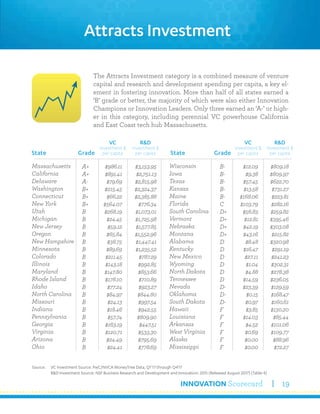
The Attracts Investment category is a combined measure of venture
capital and research and development spending per capita, a key el-
ement in fostering innovation. More than half of all states earned a
‘B’ grade or better, the majority of which were also either Innovation
Champions or Innovation Leaders. Only three earned an ‘A-’ or high-
er in this category, including perennial VC powerhouse California
and East Coast tech hub Massachusetts.
Attracts Investment
Massachusetts
California
Delaware
Washington
Connecticut
New York
Utah
Michigan
New Jersey
Oregon
New Hampshire
Minnesota
Colorado
Illinois
Maryland
Rhode Island
Idaho
North Carolina
Missouri
Indiana
Pennsylvania
Georgia
Virginia
Arizona
Ohio
State
VC
investment $
per capitaGrade
A+
A+
A-
B+
B+
B+
B
B
B
B
B
B
B
B
B
B
B
B
B
B
B
B
B
B
B
Wisconsin
Iowa
Texas
Kansas
Maine
Florida
South Carolina
Vermont
Nebraska
Montana
Alabama
Kentucky
New Mexico
Wyoming
North Dakota
Tennessee
Nevada
Oklahoma
South Dakota
Hawaii
Louisiana
Arkansas
West Virginia
Alaska
Mississippi
State Grade
B-
B-
B-
B-
B-
C
D+
D+
D+
D+
D
D
D
D
D
D
D-
D-
D-
F
F
F
F
F
F
$986.11
$891.41
$79.69
$215.45
$66.22
$564.07
$268.19
$24.45
$59.12
$65.84
$38.75
$89.69
$211.45
$143.18
$147.80
$178.10
$77.24
$84.97
$24.13
$18.46
$57.74
$163.19
$120.71
$24.49
$24.41
R&D
investment $
per capita
$3,153.95
$2,751.13
$2,815.98
$2,324.37
$2,385.88
$776.34
$1,073.01
$1,725.98
$1,577.85
$1,552.96
$1,447.41
$1,235.52
$787.29
$992.85
$853.66
$710.89
$923.27
$844.80
$997.54
$942.55
$809.90
$447.51
$533.30
$795.69
$778.69
VC
investment $
per capita
$12.09
$9.38
$57.45
$13.58
$168.06
$103.79
$56.83
$12.81
$42.19
$43.16
$8.48
$16.47
$27.11
$1.04
$4.88
$14.59
$23.39
$0.15
$0.97
$3.85
$14.03
$4.52
$0.69
$0.00
$0.00
R&D
investment $
per capita
$809.18
$809.97
$622.70
$731.27
$223.81
$282.16
$259.82
$395.46
$303.08
$215.82
$320.98
$291.19
$241.23
$302.31
$278.38
$236.05
$129.59
$168.47
$160.61
$130.20
$85.44
$101.06
$109.77
$88.96
$72.27
Source:	 VC Investment Source: PwC/NVCA MoneyTree Data, Q1’17 through Q4'17
	 R&D Investment Source: NSF Business Research and Development and Innovation: 2015 (Released August 2017) (Table 4)
20
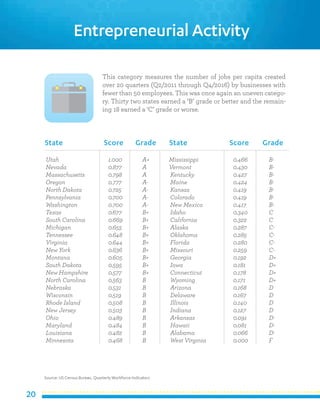
This category measures the number of jobs per capita created
over 20 quarters (Q2/2011 through Q4/2016) by businesses with
fewer than 50 employees. This was once again an uneven catego-
ry. Thirty two states earned a ‘B’ grade or better and the remain-
ing 18 earned a ‘C’ grade or worse.
Source: US Census Bureau, Quarterly Workforce Indicators
Entrepreneurial Activity
 Utah
 Nevada
 Massachusetts
 Oregon
 North Dakota
 Pennsylvania
 Washington
 Texas
 South Carolina
 Michigan
 Tennessee
 Virginia
 New York
 Montana
 South Dakota
 New Hampshire
 North Carolina
 Nebraska
 Wisconsin
 Rhode Island
 New Jersey
 Ohio
 Maryland
 Louisiana
 Minnesota
 
A+
A
A
A-
A-
A-
A-
B+
B+
B+
B+
B+
B+
B+
B+
B+
B
B
B
B
B
B
B
B
B
State Score Grade
Mississippi
Vermont
 Kentucky
 Maine
 Kansas
 Colorado
 New Mexico
 Idaho
 California
 Alaska
 Oklahoma
 Florida
 Missouri
 Georgia
 Iowa
 Connecticut
 Wyoming
 Arizona
 Delaware
 Illinois
 Indiana
 Arkansas
 Hawaii
 Alabama
 West Virginia
B-
B-
B-
B-
B-
B-
B-
C
C
C-
C-
C-
C-
D+
D+
D+
D+
D
D
D
D
D-
D-
D-
F
State Score Grade
1.000
0.877
0.798
0.777
0.725
0.700
0.700
0.677
0.669
0.655
0.648
0.644
0.636
0.605
0.595
0.577
0.563
0.531
0.519
0.508
0.503
0.489
0.484
0.482
0.468
0.466
0.430
0.427
0.424
0.419
0.419
0.417
0.340
0.322
0.287
0.285
0.280
0.259
0.192
0.181
0.178
0.171
0.168
0.167
0.140
0.127
0.091
0.081
0.066
0.000
INNOVATION Scorecard 21
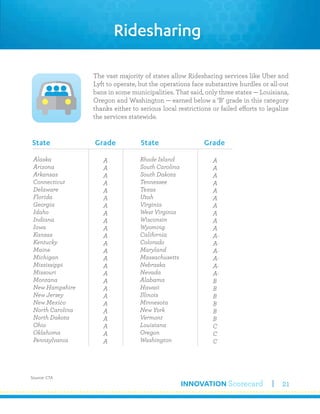
The vast majority of states allow Ridesharing services like Uber and
Lyft to operate, but the operations face substantive hurdles or all-out
bans in some municipalities. That said, only three states — Louisiana,
Oregon and Washington — earned below a ‘B’ grade in this category
thanks either to serious local restrictions or failed efforts to legalize
the services statewide.
Source: CTA
Ridesharing
 Alaska
 Arizona
 Arkansas
 Connecticut
 Delaware
 Florida
 Georgia
 Idaho
 Indiana
 Iowa
 Kansas
 Kentucky
 Maine
 Michigan
 Mississippi
 Missouri
 Montana
 New Hampshire
 New Jersey
 New Mexico
 North Carolina
 North Dakota
 Ohio
 Oklahoma
 Pennsylvania
 Rhode Island
 South Carolina
 South Dakota
 Tennessee
 Texas
 Utah
 Virginia
 West Virginia
 Wisconsin
 Wyoming
 California
 Colorado
 Maryland
 Massachusetts
 Nebraska
 Nevada
 Alabama
 Hawaii
 Illinois
 Minnesota
 New York
 Vermont
 Louisiana
 Oregon
 Washington
A
A
A
A
A
A
A
A
A
A
A
A
A
A
A
A
A
A
A
A
A
A
A
A
A
A
A
A
A
A
A
A
A
A
A
A-
A-
A-
A-
A-
A-
B
B
B
B
B
B
C
C
C
State Grade State Grade
22
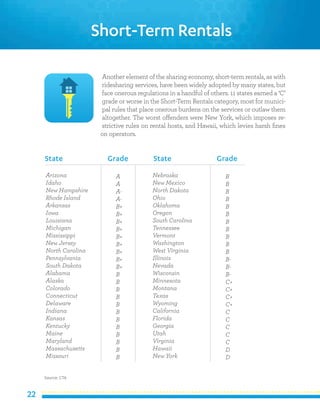
Another element of the sharing economy, short-term rentals, as with
ridesharing services, have been widely adopted by many states, but
face onerous regulations in a handful of others. 11 states earned a ‘C’
grade or worse in the Short-Term Rentals category, most for munici-
pal rules that place onerous burdens on the services or outlaw them
altogether. The worst offenders were New York, which imposes re-
strictive rules on rental hosts, and Hawaii, which levies harsh fines
on operators.
Short-Term Rentals
 Arizona
 Idaho
 New Hampshire
 Rhode Island
 Arkansas
 Iowa
 Louisiana
 Michigan
 Mississippi
 New Jersey
 North Carolina
 Pennsylvania
 South Dakota
 Alabama
 Alaska
 Colorado
 Connecticut
 Delaware
 Indiana
 Kansas
 Kentucky
 Maine
 Maryland
 Massachusetts
 Missouri
 Nebraska
 New Mexico
 North Dakota
 Ohio
 Oklahoma
 Oregon
 South Carolina
 Tennessee
 Vermont
 Washington
 West Virginia
 Illinois
 Nevada
 Wisconsin
 Minnesota
 Montana
 Texas
 Wyoming
 California
 Florida
 Georgia
 Utah
 Virginia
 Hawaii
 New York
A
A
A-
A-
B+
B+
B+
B+
B+
B+
B+
B+
B+
B
B
B
B
B
B
B
B
B
B
B
B
B
B
B
B
B
B
B
B
B
B
B
B-
B-
B-
C+
C+
C+
C+
C
C
C
C
C
D
D
State Grade State Grade
Source: CTA
INNOVATION Scorecard 23
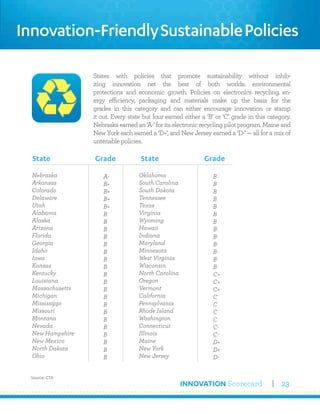
States with policies that promote sustainability without inhib-
iting innovation net the best of both worlds: environmental
protections and economic growth. Policies on electronics recycling, en-
ergy efficiency, packaging and materials make up the basis for the
grades in this category and can either encourage innovation or stamp
it out. Every state but four earned either a ‘B’ or ‘C’ grade in this category.
Nebraska earned an ‘A-’ for its electronic recycling pilot program. Maine and
New York each earned a ‘D+’, and New Jersey earned a ‘D-’ — all for a mix of
untenablepolicies.
Innovation-FriendlySustainablePolicies
Nebraska
Arkansas
Colorado
Delaware
Utah
Alabama
Alaska
Arizona
Florida
Georgia
Idaho
Iowa
Kansas
Kentucky
Louisiana
Massachusetts
Michigan
Mississippi
Missouri
Montana
Nevada
New Hampshire
New Mexico
North Dakota
Ohio
Oklahoma
South Carolina
South Dakota
Tennessee
Texas
Virginia
Wyoming
Hawaii
Indiana
Maryland
Minnesota
West Virginia
Wisconsin
North Carolina
Oregon
Vermont
California
Pennsylvania
Rhode Island
Washington
Connecticut
Illinois
Maine
New York
New Jersey
A-
B+
B+
B+
B+
B
B
B
B
B
B
B
B
B
B
B
B
B
B
B
B
B
B
B
B
B
B
B
B
B
B
B
B-
B-
B-
B-
B-
B-
C+
C+
C+
C
C
C
C
C-
C-
D+
D+
D-
State Grade State Grade
Source: CTA
24
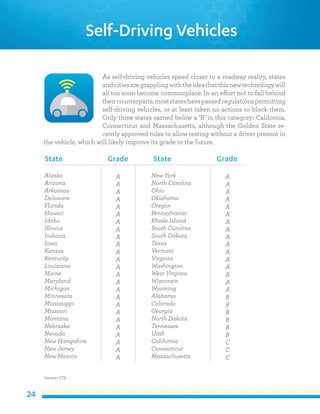
As self-driving vehicles speed closer to a roadway reality, states
andcitiesaregrapplingwiththeideathatthisnewtechnologywill
all too soon become commonplace. In an effort not to fall behind
theircounterparts,moststateshavepassedregulationspermitting
self-driving vehicles, or at least taken no actions to block them.
Only three states earned below a ‘B’ in this category: California,
Connecticut and Massachusetts, although the Golden State re-
cently approved rules to allow testing without a driver present in
the vehicle, which will likely improve its grade in the future.
Source: CTA
Self-Driving Vehicles
Alaska
Arizona
Arkansas
Delaware
Florida
Hawaii
Idaho
Illinois
Indiana
Iowa
Kansas
Kentucky
Louisiana
Maine
Maryland
Michigan
Minnesota
Mississippi
Missouri
Montana
Nebraska
Nevada
New Hampshire
New Jersey
New Mexico
New York
North Carolina
Ohio
Oklahoma
Oregon
Pennsylvania
Rhode Island
South Carolina
South Dakota
Texas
Vermont
Virginia
Washington
West Virginia
Wisconsin
Wyoming
Alabama
Colorado
Georgia
North Dakota
Tennessee
Utah
California
Connecticut
Massachusetts
A
A
A
A
A
A
A
A
A
A
A
A
A
A
A
A
A
A
A
A
A
A
A
A
A
A
A
A
A
A
A
A
A
A
A
A
A
A
A
A
A
B
B
B
B
B
B
C
C
C
State Grade State Grade
INNOVATION Scorecard 25
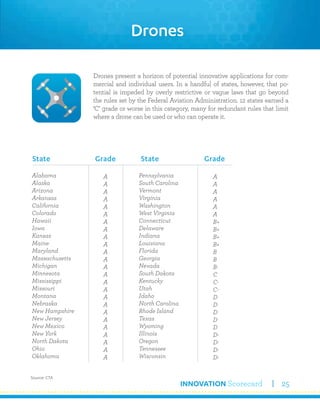
Drones present a horizon of potential innovative applications for com-
mercial and individual users. In a handful of states, however, that po-
tential is impeded by overly restrictive or vague laws that go beyond
the rules set by the Federal Aviation Administration. 12 states earned a
‘C’ grade or worse in this category, many for redundant rules that limit
where a drone can be used or who can operate it.
Source: CTA
Drones
Alabama
Alaska
Arizona
Arkansas
California
Colorado
Hawaii
Iowa
Kansas
Maine
Maryland
Massachusetts
Michigan
Minnesota
Mississippi
Missouri
Montana
Nebraska
New Hampshire
New Jersey
New Mexico
New York
North Dakota
Ohio
Oklahoma
Pennsylvania
South Carolina
Vermont
Virginia
Washington
West Virginia
Connecticut
Delaware
Indiana
Louisiana
Florida
Georgia
Nevada
South Dakota
Kentucky
Utah
Idaho
North Carolina
Rhode Island
Texas
Wyoming
Illinois
Oregon
Tennessee
Wisconsin
A
A
A
A
A
A
A
A
A
A
A
A
A
A
A
A
A
A
A
A
A
A
A
A
A
A
A
A
A
A
A
B+
B+
B+
B+
B
B
B-
C
C-
C-
D
D
D
D
D
D-
D-
D-
D-
State Grade State Grade
International INNOVATION Scorecard 27
Profiles
STATE
28
Using education to bring innovation
to life
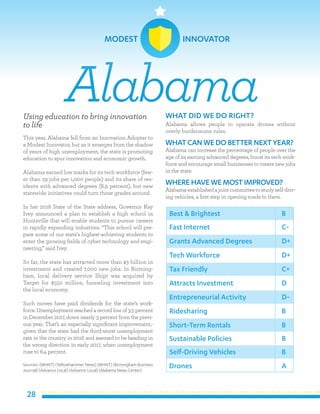
This year, Alabama fell from an Innovation Adopter to
a Modest Innovator, but as it emerges from the shadow
of years of high unemployment, the state is promoting
education to spur innovation and economic growth.
Alabama earned low marks for its tech workforce (few-
er than 29 jobs per 1,000 people) and its share of res-
idents with advanced degrees (8.9 percent), but new
statewide initiatives could turn those grades around.
In her 2018 State of the State address, Governor Kay
Ivey announced a plan to establish a high school in
Huntsville that will enable students to pursue careers
in rapidly expanding industries. “This school will pre-
pare some of our state’s highest-achieving students to
enter the growing fields of cyber technology and engi-
neering,” said Ivey.
So far, the state has attracted more than $3 billion in
investment and created 7,000 new jobs. In Birming-
ham, local delivery service Shipt was acquired by
Target for $550 million, funneling investment into
the local economy.
Such moves have paid dividends for the state’s work-
force. Unemployment reached a record low of 3.5 percent
in December 2017, down nearly 3 percent from the previ-
ous year. That’s an especially significant improvement,-
given that the state had the third-worst unemployment
rate in the country in 2016 and seemed to be heading in
the wrong direction in early 2017, when unemployment
rose to 6.4 percent.
Sources: (WHNT) (Yellowhammer News) (WHNT) (Birmingham Business
Journal) (Advance Local) (Advance Local) (Alabama News Center)
WHAT DID WE DO RIGHT?
Alabama allows people to operate drones without
overly burdensome rules.
WHATCAN WE DO BETTER NEXT YEAR?
Alabama can increase the percentage of people over the
age of 24 earning advanced degrees, boost its tech work-
force and encourage small businesses to create new jobs
in the state.
WHERE HAVE WE MOSTIMPROVED?
Alabamaestablishedajointcommitteetostudyself-driv-
ing vehicles, a first step in opening roads to them.
Alabama
MODEST INNOVATOR
Best & Brightest
Fast Internet
Grants Advanced Degrees
Tech Workforce
Tax Friendly
Attracts Investment
Entrepreneurial Activity
Ridesharing
Short-Term Rentals
Sustainable Policies
B
C-
D+
D+
C+
D
D-
B
B
B
Self-Driving Vehicles
Drones
B
A
INNOVATION Scorecard 29
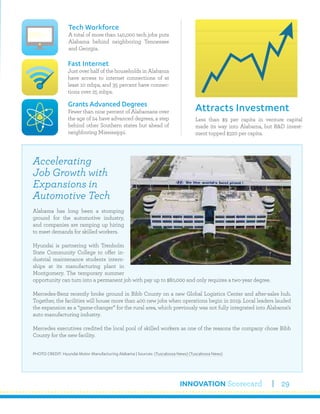
Less than $9 per capita in venture capital
made its way into Alabama, but R&D invest-
ment topped $320 per capita.
Attracts InvestmentGrants Advanced Degrees
Fewer than nine percent of Alabamans over
the age of 24 have advanced degrees, a step
behind other Southern states but ahead of
neighboring Mississippi.
Tech Workforce
A total of more than 140,000 tech jobs puts
Alabama behind neighboring Tennessee
and Georgia.
Fast Internet
Just over half of the households in Alabama
have access to internet connections of at
least 10 mbps, and 35 percent have connec-
tions over 25 mbps.
Accelerating
Job Growth with
Expansions in
Automotive Tech
Alabama has long been a stomping
ground for the automotive industry,
and companies are ramping up hiring
to meet demands for skilled workers.
Hyundai is partnering with Trenholm
State Community College to offer in-
dustrial maintenance students intern-
ships at its manufacturing plant in
Montgomery. The temporary summer
opportunity can turn into a permanent job with pay up to $80,000 and only requires a two-year degree.
Mercedes-Benz recently broke ground in Bibb County on a new Global Logistics Center and after-sales hub.
Together, the facilities will house more than 400 new jobs when operations begin in 2019. Local leaders lauded
the expansion as a “game-changer” for the rural area, which previously was not fully integrated into Alabama’s
auto manufacturing industry.
Mercedes executives credited the local pool of skilled workers as one of the reasons the company chose Bibb
County for the new facility.
PHOTO CREDIT: Hyundai Motor Manufacturing Alabama | Sources: (Tuscaloosa News) (Tuscaloosa News)
30
Vast state, sizable challenges
Spanning two time zones and the largest geographical
area in the country, Alaska’s sheer size poses challeng-
es for residents and businesses looking to stay con-
nected.
The state — which improved from a Modest Innovator
to an Innovation Adopter this year — continues to fall
behind the Federal Communication Commission’s goal
of bringing 25 mbps broadband connections to every
American. Alaska’s internet connectivity lags most in
rural areas, where 65 percent of residents get speeds be-
low 25 mbps.
But groups are turning their attention to the problem:
Alaska’s largest telecommunications and technology
company, GCI, recently upgraded wireless services for
a handful of municipalities.
“To deliver service successfully across Alaska, you have
to be willing to use every tool in your toolkit — and you
need a pretty big toolkit,” said Heather Handyside, se-
nior director of corporate communications for the com-
pany. “Alaska’s tough terrain, vast distances and heavily
regulated land require our team to be creative when we
upgrade our networks.”
Rural residents will likely see improved connections as
well, thanks to an expansion by telephone and internet
service provider Alaska Communications. The compa-
ny recently announced plans to expand wireless connec-
tions on the Kenai Peninsula over the next eight years.
Sources: (FCC) (GCI) (Peninsula Clarion)
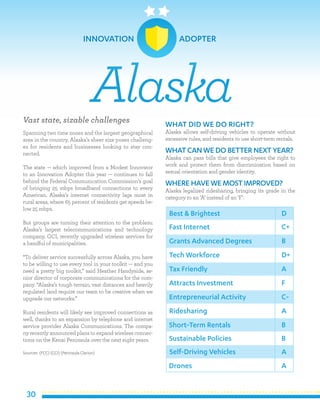
WHAT DID WE DO RIGHT?
Alaska allows self-driving vehicles to operate without
excessive rules, and residents to use short-term rentals.
WHATCAN WE DO BETTER NEXT YEAR?
Alaska can pass bills that give employees the right to
work and protect them from discrimination based on
sexual orientation and gender identity.
WHERE HAVE WE MOSTIMPROVED?
Alaska legalized ridesharing, bringing its grade in the
category to an ‘A’ instead of an ‘F’.
Alaska
Best & Brightest
Fast Internet
Grants Advanced Degrees
Tech Workforce
Tax Friendly
Attracts Investment
Entrepreneurial Activity
Ridesharing
Short-Term Rentals
Sustainable Policies
D
C+
B
D+
A
F
C-
A
B
B
Self-Driving Vehicles
Drones
A
A
INNOVATION 	 ADOPTER
INNOVATION Scorecard 31
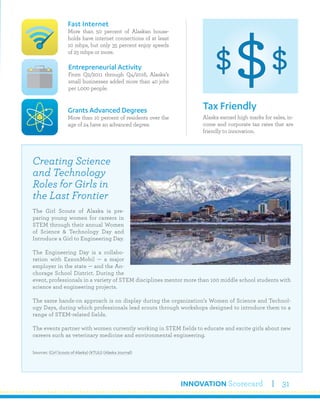
Alaska earned high marks for sales, in-
come and corporate tax rates that are
friendly to innovation.
Tax Friendly
Fast Internet
More than 50 percent of Alaskan house-
holds have internet connections of at least
10 mbps, but only 35 percent enjoy speeds
of 25 mbps or more.
Grants Advanced Degrees
More than 10 percent of residents over the
age of 24 have an advanced degree.
Entrepreneurial Activity
From Q2/2011 through Q4/2016, Alaska’s
small businesses added more than 40 jobs
per 1,000 people.
Creating Science
and Technology
Roles for Girls in
the Last Frontier
The Girl Scouts of Alaska is pre-
paring young women for careers in
STEM through their annual Women
of Science & Technology Day and
Introduce a Girl to Engineering Day.
The Engineering Day is a collabo-
ration with ExxonMobil — a major
employer in the state — and the An-
chorage School District. During the
event, professionals in a variety of STEM disciplines mentor more than 100 middle school students with
science and engineering projects.
The same hands-on approach is on display during the organization’s Women of Science and Technol-
ogy Days, during which professionals lead scouts through workshops designed to introduce them to a
range of STEM-related fields.
The events partner with women currently working in STEM fields to educate and excite girls about new
careers such as veterinary medicine and environmental engineering.
Sources: (Girl Scouts of Alaska) (KTUU) (Alaska Journal)
32
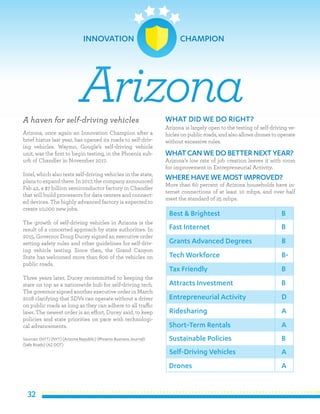
A haven for self-driving vehicles
Arizona, once again an Innovation Champion after a
brief hiatus last year, has opened its roads to self-driv-
ing vehicles. Waymo, Google’s self-driving vehicle
unit, was the first to begin testing, in the Phoenix sub-
urb of Chandler in November 2017.
Intel, which also tests self-driving vehicles in the state,
plans to expand there. In 2017, the company announced
Fab 42, a $7 billion semiconductor factory in Chandler
that will build processors for data centers and connect-
ed devices. The highly advanced factory is expected to
create 10,000 new jobs.
The growth of self-driving vehicles in Arizona is the
result of a concerted approach by state authorities. In
2015, Governor Doug Ducey signed an executive order
setting safety rules and other guidelines for self-driv-
ing vehicle testing. Since then, the Grand Canyon
State has welcomed more than 600 of the vehicles on
public roads.
Three years later, Ducey recommitted to keeping the
state on top as a nationwide hub for self-driving tech.
The governor signed another executive order in March
2018 clarifying that SDVs can operate without a driver
on public roads as long as they can adhere to all traffic
laws. The newest order is an effort, Ducey said, to keep
policies and state priorities on pace with technologi-
cal advancements.
Sources: (NYT) (NYT) (Arizona Republic) (Phoenix Business Journal)
(Safe Roads) (AZ DOT)
WHAT DID WE DO RIGHT?
Arizona is largely open to the testing of self-driving ve-
hicles on public roads, and also allows drones to operate
without excessive rules.
WHATCAN WE DO BETTER NEXT YEAR?
Arizona’s low rate of job creation leaves it with room
for improvement in Entrepreneurial Activity.
WHERE HAVE WE MOSTIMPROVED?
More than 60 percent of Arizona households have in-
ternet connections of at least 10 mbps, and over half
meet the standard of 25 mbps.
Best & Brightest
Fast Internet
Grants Advanced Degrees
Tech Workforce
Tax Friendly
Attracts Investment
Entrepreneurial Activity
Ridesharing
Short-Term Rentals
Sustainable Policies
B
B
B
B-
B
B
D
A
A
B
Self-Driving Vehicles
Drones
A
A
Arizona
INNOVATION 	 CHAMPION
INNOVATION Scorecard 33
Grants Advanced Degrees
More than 10 percent of people over the age
of 24 have an advanced degree, a step above
most other states.
Tech Workforce
With more than 251,000 tech jobs, the tech
workforce in Arizona accounts for more
than 36 jobs per 1,000 people.
Attracts Investment
Venture capital investment reached $24.49
per capita and R&D spending topped out at
more than $795 per capita.
Morethan60percentofArizonahouse-
holds have access to internet connec-
tions of at least 10 mbps, and 51 percent
enjoy speeds of 25 mbps or more.
Fast Internet
Building a Big
Factory to Make a
Smaller Chip — and
Create Thousands
of New Jobs
The Phoenix metro area is welcom-
ing a rush of new tech jobs.
Amazon is revamping its 10-year-
old fulfillment center and opening a
new facility, adding 1,000 new jobs
in the process. The company already
counts 6,000 Arizona workers spread
throughout four fulfillment centers on its payroll.
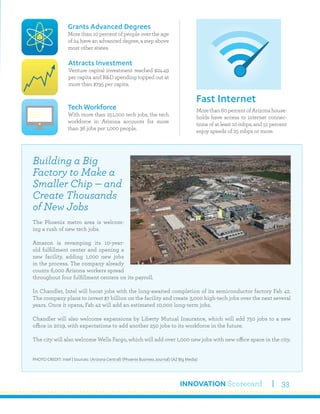
In Chandler, Intel will boost jobs with the long-awaited completion of its semiconductor factory Fab 42.
The company plans to invest $7 billion on the facility and create 3,000 high-tech jobs over the next several
years. Once it opens, Fab 42 will add an estimated 10,000 long-term jobs.
Chandler will also welcome expansions by Liberty Mutual Insurance, which will add 750 jobs to a new
office in 2019, with expectations to add another 250 jobs to its workforce in the future.
The city will also welcome Wells Fargo, which will add over 1,000 new jobs with new office space in the city.
PHOTO CREDIT: Intel | Sources: (Arizona Central) (Phoenix Business Journal) (AZ Big Media)
34
Sowing the seeds for homegrown
startups
Arkansas is home to established Fortune 500 power-
houses, and it is also spawning startups to serve them.
In Fayetteville, in the northwest corner of the state,
Walmart and Tyson have invested in emerging tech-
nologies companies in retail, food and logistics.
In 2017, the state legislature passed a law green light-
ing driver-assisted truck platooning, which allows a
convoy of connected vehicles to operate with the lead
vehicle controlling the others. Arkansas is one of only
nine states that have approved commercial use of the
technology, which proponents say could make large
vehicles more fuel efficient and ease traffic congestion.
State leaders also maintained their focus on keeping
homegrown talent flowing into the state’s tech sec-
tor. A 2014 bill made the Natural State the first in the
nation to require all public and charter high schools
to teach computer science, after which the number of
students taking courses in the subject leapt 260 per-
cent in a year. In 2018, more than 6,100 students were
enrolled in the classes.
And in 2018 the state expanded its branch of the
Environmental and Spatial Technology Initiative, a
hands-on education program that gives students ex-
perience with high-end technology in a variety of
professions. The latest expansion adds cybersecurity
training to the options available to students, building
on course offerings that already include video and au-
dio editing and community mapping.
Sources: (Arkansas EDC) (GovTech) (Wired) (KSLA) (Time)
(East Initiative) (Arkansas Online)
WHAT DID WE DO RIGHT?
Arkansas continued to split the costs of electronics re-
cycling between government and industry.
WHATCAN WE DO BETTER NEXT YEAR?
Arkansas can increase its internet speeds, and the per-
centage of residents with advanced degrees, in which
it currently ranks last.
WHERE HAVE WE MOSTIMPROVED?
Ridesharing services are now legal across Arkansas,
and Uber expanded its presence in the state in 2017.
Arkansas
Best & Brightest
Fast Internet
Grants Advanced Degrees
Tech Workforce
Tax Friendly
Attracts Investment
Entrepreneurial Activity
Ridesharing
Short-Term Rentals
Sustainable Policies
C
D-
F
D
C
F
D-
A
B+
B+
Self-Driving Vehicles
Drones
A
A
MODEST INNOVATOR
INNOVATION Scorecard 35
Arkansas permits operators to fly drones
without overly restrictive regulations.
Drones
Tech Workforce
Arkansas has only 78,000 tech jobs, few-
er than every neighboring state except
Mississippi.
Ridesharing
Ridesharing is legal across Arkansas with-
out undue regulatory burdens.
Short-Term Rentals
Arkansas reached a tax agreement with
Airbnb that allows the platform to collect
taxes for hosts and remit them to the state.
Telecom Brings
Hundreds of New
Jobs to Little Rock
North Little Rock’s tech workforce is
growing thanks to telecommunica-
tions company First Orion’s decision
to locate its global headquarters in
the city.
First Orion, which produces call
transparency software to identify
scam and other unwanted phone
calls, will hire 200 people to staff its
60,000-square-foot center. “Central
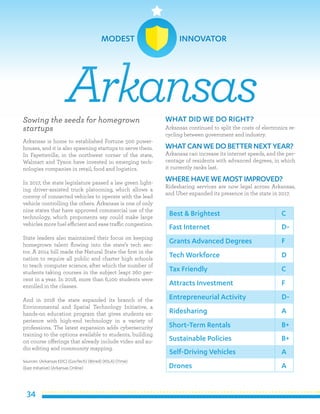
Arkansas is an inspirng place for us to be,” said First Orion CEO Charles D. Morgan. “Not only is First
Orion building technology, but we are also building careers.”
The headquarters will anchor the as-yet-unfinished Argenta Plaza, a communal space city leaders hope
will revitalize the downtown area and attract a new wave of businesses.
“We believe the Argenta Plaza will be a community where big, brave ideas are given the chance to grow
unfettered. First Orion is a shining example of our state’s best and brightest creating technologies that
make the world a better place,” said North Little Rock Mayor Joe Smith.
Sources: (Area Development) (Area Development)
36
The south will rise again?
Silicon Valley has long been the global hub for up-and-
coming technologies, and a magnet for venture capital
— in which it comes in second only to Massachusetts.
Now, southern California is making a bid to attract the
talent that currently flocks to the Bay Area. The “Sili-
con Beach” region is home to outposts for tech giants
Facebook, Google and Snap Inc., the parent company
of Snapchat, but its lags its northern counterpart when
it comes to the pool of educated workers.
Southern California universities are looking to change
that. In 2017, the University of California Los Angeles
announced the creation of the Silicon Beach Innovation
Lab, designed to help its students find paths into high-
tech companies regardless of prior experience in tech.
“We have a huge number of students who are current-
ly employed in another industry and want to change
careers — people who might have been doing some-
thing else but want to learn coding or cybersecurity,”
said Bruce Huang, director of the digital technology
department for UCLA Extension.
Nearby, Loyola Marymount University focuses its ef-
forts on combining southern California’s traditional
industries with regional startups. LMU, which bills it-
self as “the University of Silicon Beach”, plans to open
a 50,000-square foot campus in the heart of the region
to foster collaboration between its film and television
students and tech firms seeking creative talent.
Sources: (LA Times) (UCLA) (LMU) (Daily Breeze)
WHAT DID WE DO RIGHT?
California boasts $890 per capita in VC, and state
regulators eased restrictions to allow testing of self-
driving vehicles without a driver on public roads.
WHATCAN WE DO BETTER NEXT YEAR?
California can lower corporate taxes and lighten reg-
ulations on businesses.
WHERE HAVE WE MOSTIMPROVED?
As of 2017, California allows rideshare drivers to operate
anywhere in the state under a single business license.
California
Best & Brightest
Fast Internet
Grants Advanced Degrees
Tech Workforce
Tax Friendly
Attracts Investment
Entrepreneurial Activity
Ridesharing
Short-Term Rentals
Sustainable Policies
C
B+
B
B+
D-
A+
C
A-
C
C
Self-Driving Vehicles
Drones
C
A
INNOVATION 	 ADOPTER
INNOVATION Scorecard 37
More than 70 percent of households
have access to internet connections of
at least 10 mbps, and 56 percent enjoy
speeds of 25 mbps or more.
Fast Internet
Entrepreneurial Activity
Small businesses added more than 1.7 mil-
lion new jobs from Q2/2011 to the Q4/2016,
a rate of about 44 new jobs per 1,000 people.
Grants Advanced Degrees
Nearly 12 percent of residents over the age
of 24 have an advanced degree.
Tech Workforce
Driven by major hubs including Silicon Valley,
California boasts more than 1.6 million tech
jobs, or about 42.63 jobs per 1,000 people.
The Golden State
Aims to Stay on Top
in Tech with STEM
Education Push
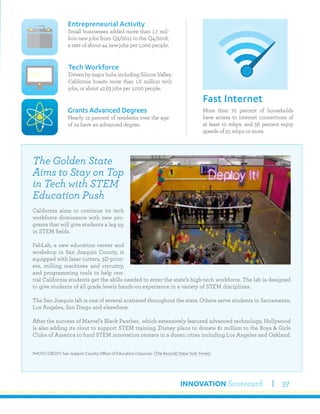
California aims to continue its tech
workforce dominance with new pro-
grams that will give students a leg up
in STEM fields.
FabLab, a new education center and
workshop in San Joaquin County, is
equipped with laser cutters, 3D print-
ers, milling machines and circuitry,
and programming tools to help cen-
tral California students get the skills needed to enter the state’s high-tech workforce. The lab is designed
to give students of all grade levels hands-on experience in a variety of STEM disciplines.
The San Joaquin lab is one of several scattered throughout the state. Others serve students in Sacramento,
Los Angeles, San Diego and elsewhere.
After the success of Marvel’s Black Panther, which extensively featured advanced technology, Hollywood
is also adding its clout to support STEM training. Disney plans to donate $1 million to the Boys & Girls
Clubs of America to fund STEM innovation centers in a dozen cities including Los Angeles and Oakland.
PHOTO CREDIT: San Joaquin County Office of Education | Sources: (The Record) (New York Times)
38
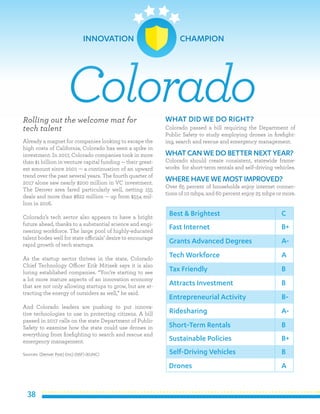
Rolling out the welcome mat for
tech talent
Already a magnet for companies looking to escape the
high costs of California, Colorado has seen a spike in
investment. In 2017, Colorado companies took in more
than $1 billion in venture capital funding — their great-
est amount since 2001 — a continuation of an upward
trend over the past several years. The fourth quarter of
2017 alone saw nearly $200 million in VC investment.
The Denver area fared particularly well, netting 155
deals and more than $822 million — up from $554 mil-
lion in 2016.
Colorado’s tech sector also appears to have a bright
future ahead, thanks to a substantial science and engi-
neering workforce. The large pool of highly-educated
talent bodes well for state officials’ desire to encourage
rapid growth of tech startups.
As the startup sector thrives in the state, Colorado
Chief Technology Officer Erik Mitisek says it is also
luring established companies. “You’re starting to see
a lot more mature aspects of an innovation economy
that are not only allowing startups to grow, but are at-
tracting the energy of outsiders as well,” he said.
And Colorado leaders are pushing to put innova-
tive technologies to use in protecting citizens. A bill
passed in 2017 calls on the state Department of Public
Safety to examine how the state could use drones in
everything from firefighting to search and rescue and
emergency management.
Sources: (Denver Post) (Inc) (NSF) (KUNC)
WHAT DID WE DO RIGHT?
Colorado passed a bill requiring the Department of
Public Safety to study employing drones in firefight-
ing, search and rescue and emergency management.
WHATCAN WE DO BETTER NEXT YEAR?
Colorado should create consistent, statewide frame-
works for short-term rentals and self-driving vehicles.
WHERE HAVE WE MOSTIMPROVED?
Over 65 percent of households enjoy internet connec-
tions of 10 mbps, and 60 percent enjoy 25 mbps or more.
Colorado
Best & Brightest
Fast Internet
Grants Advanced Degrees
Tech Workforce
Tax Friendly
Attracts Investment
Entrepreneurial Activity
Ridesharing
Short-Term Rentals
Sustainable Policies
C
B+
A-
A
B
B
B-
A-
B
B+
Self-Driving Vehicles
Drones
B
A
INNOVATION 	 CHAMPION
INNOVATION Scorecard 39
Colorado employs 269,700 tech work-
ers — 48.68 per 1,000 people.
Tech Workforce
Grants Advanced Degrees
Colorado ranks near the top in Grants Ad-
vanced Degrees, with over 14 percent of res-
idents over the age of 24 holding advanced
degrees.
Attracts Investment
Roughly $1.2 billion in VC investment trans-
lates to more than $211 per capita, placing
Colorado above most other states.
Self-Driving Vehicles
State law allows the use of self-driving vehi-
cles, as long as the systems conform to state
and federal transportation rules.
Transit System for
the Future Delivers
Jobs to the Rockies
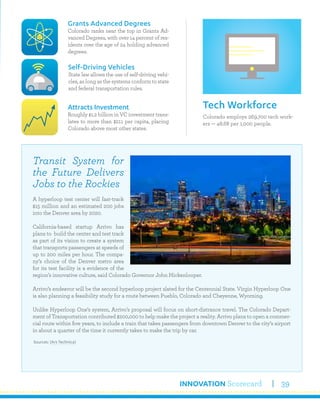
A hyperloop test center will fast-track
$15 million and an estimated 200 jobs
into the Denver area by 2020.
California-based startup Arrivo has
plans to build the center and test track
as part of its vision to create a system
that transports passengers at speeds of
up to 200 miles per hour. The compa-
ny’s choice of the Denver metro area
for its test facility is a evidence of the
region’s innovative culture, said Colorado Governor John Hickenlooper.
Arrivo’s endeavor will be the second hyperloop project slated for the Centennial State. Virgin Hyperloop One
is also planning a feasibility study for a route between Pueblo, Colorado and Cheyenne, Wyoming.
Unlike Hyperloop One’s system, Arrivo’s proposal will focus on short-distrance travel. The Colorado Depart-
ment of Transportation contributed $200,000 to help make the project a reality. Arrivo plans to open a commer-
cial route within five years, to include a train that takes passengers from downtown Denver to the city’s airport
in about a quarter of the time it currently takes to make the trip by car.
Sources: (Ars Technica)
40
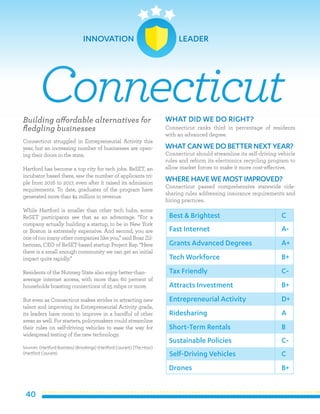
Building affordable alternatives for
fledgling businesses
Connecticut struggled in Entrepreneurial Activity this
year, but an increasing number of businesses are open-
ing their doors in the state.
Hartford has become a top city for tech jobs. ReSET, an
incubator based there, saw the number of applicants tri-
ple from 2016 to 2017, even after it raised its admission
requirements. To date, graduates of the program have
generated more than $4 million in revenue.
While Hartford is smaller than other tech hubs, some
ReSET participants see that as an advantage. “For a
company actually building a startup, to be in New York
or Boston is extremely expensive. And second, you are
one of too many other companies like you,” said Boaz Zil-
berman, CEO of ReSET-based startup Project Ray. “Here
there is a small enough community we can get an initial
impact quite rapidly.”
Residents of the Nutmeg State also enjoy better-than-
average internet access, with more than 60 percent of
households boasting connections of 25 mbps or more.
But even as Connecticut makes strides in attracting new
talent and improving its Entrepreneurial Activity grade,
its leaders have room to improve in a handful of other
areas as well. For starters, policymakers could streamline
their rules on self-driving vehicles to ease the way for
widespread testing of the new technology.
Sources: (Hartford Business) (Brookings) (Hartford Courant) (The Hour)
(Hartford Courant)
WHAT DID WE DO RIGHT?
Connecticut ranks third in percentage of residents
with an advanced degree.
WHATCAN WE DO BETTER NEXT YEAR?
Connecticut should streamline its self-driving vehicle
rules and reform its electronics recycling program to
allow market forces to make it more cost-effective.
WHERE HAVE WE MOSTIMPROVED?
Connecticut passed comprehensive statewide ride-
sharing rules addressing insurance requirements and
hiring practices.
Connecticut
Best & Brightest
Fast Internet
Grants Advanced Degrees
Tech Workforce
Tax Friendly
Attracts Investment
Entrepreneurial Activity
Ridesharing
Short-Term Rentals
Sustainable Policies
C
A-
A+
B+
C-
B+
D+
A
B
C-
Self-Driving Vehicles
Drones
C
B+
INNOVATION LEADER
INNOVATION Scorecard 41
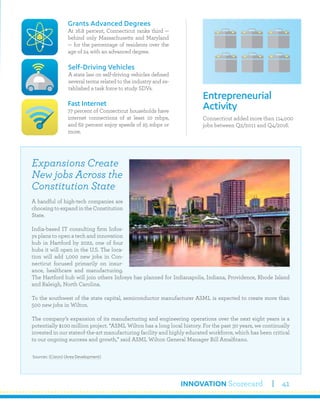
Connecticut added more than 114,000
jobs between Q2/2011 and Q4/2016.
Entrepreneurial
Activity
Grants Advanced Degrees
At 16.8 percent, Connecticut ranks third —
behind only Massachusetts and Maryland
— for the percentage of residents over the
age of 24 with an advanced degree.
Fast Internet
77 percent of Connecticut households have
internet connections of at least 10 mbps,
and 62 percent enjoy speeds of 25 mbps or
more. 
Self-Driving Vehicles
A state law on self-driving vehicles defined
several terms related to the industry and es-
tablished a task force to study SDVs.
Expansions Create
New jobs Across the
Constitution State
A handful of high-tech companies are
choosing to expand in the Constitution
State.
India-based IT consulting firm Infos-
ys plans to open a tech and innovation
hub in Hartford by 2022, one of four
hubs it will open in the U.S. The loca-
tion will add 1,000 new jobs in Con-
necticut focused primarily on insur-
ance, healthcare and manufacturing.
The Hartford hub will join others Infosys has planned for Indianapolis, Indiana, Providence, Rhode Island
and Raleigh, North Carolina.
To the southwest of the state capital, semiconductor manufacturer ASML is expected to create more than
500 new jobs in Wilton.
The company’s expansion of its manufacturing and engineering operations over the next eight years is a
potentially $100 million project. “ASML Wilton has a long local history. For the past 30 years, we continually
invested in our stateof-the-art manufacturing facility and highly educated workforce, which has been critical
to our ongoing success and growth,” said ASML Wilton General Manager Bill Amalfitano.
Sources: (Cision) (Area Development)
42
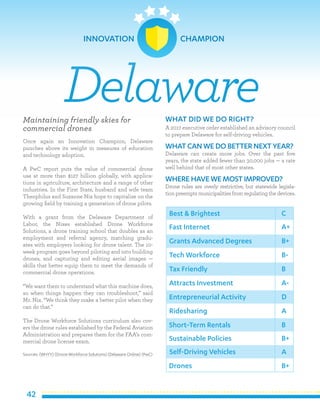
Maintaining friendly skies for
commercial drones
Once again an Innovation Champion, Delaware
punches above its weight in measures of education
and technology adoption.
A PwC report puts the value of commercial drone
use at more than $127 billion globally, with applica-
tions in agriculture, architecture and a range of other
industries. In the First State, husband and wife team
Theophilus and Suzanne Nix hope to capitalize on the
growing field by training a generation of drone pilots.
With a grant from the Delaware Department of
Labor, the Nixes established Drone Workforce
Solutions, a drone training school that doubles as an
employment and referral agency, matching gradu-
ates with employers looking for drone talent. The 10-
week program goes beyond piloting and into building
drones, and capturing and editing aerial images —
skills that better equip them to meet the demands of
commercial drone operations.
“We want them to understand what this machine does,
so when things happen they can troubleshoot,” said
Mr. Nix. “We think they make a better pilot when they
can do that.”
The Drone Workforce Solutions curriculum also cov-
ers the drone rules established by the Federal Aviation
Administration and prepares them for the FAA’s com-
mercial drone license exam.
Sources: (WHYY) (Drone Workforce Solutions) (Delaware Online) (PwC)
WHAT DID WE DO RIGHT?
A 2017 executive order established an advisory council
to prepare Delaware for self-driving vehicles.
WHATCAN WE DO BETTER NEXT YEAR?
Delaware can create more jobs. Over the past five
years, the state added fewer than 30,000 jobs — a rate
well behind that of most other states.
WHERE HAVE WE MOSTIMPROVED?
Drone rules are overly restrictive, but statewide legisla-
tion preempts municipalities from regulating the devices.
Delaware
Best & Brightest
Fast Internet
Grants Advanced Degrees
Tech Workforce
Tax Friendly
Attracts Investment
Entrepreneurial Activity
Ridesharing
Short-Term Rentals
Sustainable Policies
C
A+
B+
B-
B
A-
D
A
B
B+
Self-Driving Vehicles
Drones
A
B+
INNOVATION 	 CHAMPION
INNOVATION Scorecard 43
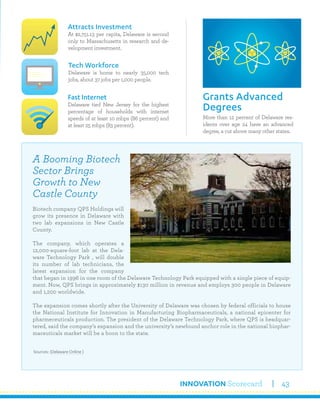
More than 12 percent of Delaware res-
idents over age 24 have an advanced
degree, a cut above many other states.
Grants Advanced
Degrees
Attracts Investment
At $2,751.13 per capita, Delaware is second
only to Massachusetts in research and de-
velopment investment.
Fast Internet
Delaware tied New Jersey for the highest
percentage of households with internet
speeds of at least 10 mbps (86 percent) and
at least 25 mbps (83 percent).
Tech Workforce
Delaware is home to nearly 35,000 tech
jobs, about 37 jobs per 1,000 people.
A Booming Biotech
Sector Brings
Growth to New
Castle County
Biotech company QPS Holdings will
grow its presence in Delaware with
two lab expansions in New Castle
County.
The company, which operates a
12,000-square-foot lab at the Dela-
ware Technology Park , will double
its number of lab technicians, the
latest expansion for the company
that began in 1996 in one room of the Delaware Technology Park equipped with a single piece of equip-
ment. Now, QPS brings in approximately $130 million in revenue and employs 300 people in Delaware
and 1,200 worldwide.
The expansion comes shortly after the University of Delaware was chosen by federal officials to house
the National Institute for Innovation in Manufacturing Biopharmaceuticals, a national epicenter for
pharmeceuticals production. The president of the Delaware Technology Park, where QPS is headquar-
tered, said the company’s expansion and the university’s newfound anchor role in the national biophar-
maceuticals market will be a boon to the state.
Sources: (Delaware Online )
44
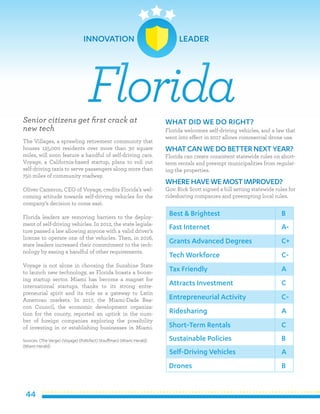
Senior citizens get first crack at
new tech
The Villages, a sprawling retirement community that
houses 125,000 residents over more than 30 square
miles, will soon feature a handful of self-driving cars.
Voyage, a California-based startup, plans to roll out
self-driving taxis to serve passengers along more than
750 miles of community roadway.
Oliver Cameron, CEO of Voyage, credits Florida’s wel-
coming attitude towards self-driving vehicles for the
company’s decision to come east.
Florida leaders are removing barriers to the deploy-
ment of self-driving vehicles. In 2012, the state legisla-
ture passed a law allowing anyone with a valid driver’s
license to operate one of the vehicles. Then, in 2016,
state leaders increased their commitment to the tech-
nology by easing a handful of other requirements.
Voyage is not alone in choosing the Sunshine State
to launch new technology, as Florida boasts a boom-
ing startup sector. Miami has become a magnet for
international startups, thanks to its strong entre-
preneurial spirit and its role as a gateway to Latin
American markets. In 2017, the Miami-Dade Bea-
con Council, the economic development organiza-
tion for the county, reported an uptick in the num-
ber of foreign companies exploring the possibility
of investing in or establishing businesses in Miami.
Sources: (The Verge) (Voyage) (Politifact) (Kauffman) (Miami Herald)
(Miami Herald)
WHAT DID WE DO RIGHT?
Florida welcomes self-driving vehicles, and a law that
went into effect in 2017 allows commercial drone use.
WHATCAN WE DO BETTER NEXT YEAR?
Florida can create consistent statewide rules on short-
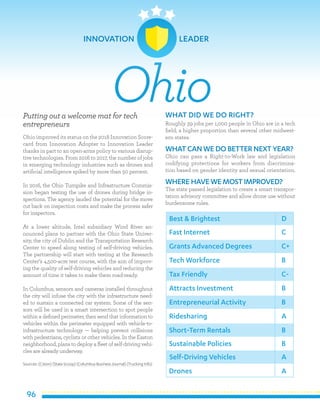
term rentals and preempt municipalities from regulat-
ing the properties.
WHERE HAVE WE MOSTIMPROVED?
Gov. Rick Scott signed a bill setting statewide rules for
ridesharing companies and preempting local rules.
Florida
Best & Brightest
Fast Internet
Grants Advanced Degrees
Tech Workforce
Tax Friendly
Attracts Investment
Entrepreneurial Activity
Ridesharing
Short-Term Rentals
Sustainable Policies
B
A-
C+
C-
A
C
C-
A
C
B
Self-Driving Vehicles
Drones
A
B
INNOVATION LEADER
INNOVATION Scorecard 45
Florida is a Right-to-Work state, but
lacks a state law protecting workers
from discrimination on the basis of
sexual orientation or gender identity.
Best & Brightest
Grants Advanced Degrees
10 percent of Florida residents over the age
of 24 have advanced degrees, a rate on par
with that of most other states.
Fast Internet
More than 80 percent of Floridian house-
holds have internet connections of at least
10 mbps, and 63 percent enjoy speeds of 25
mbps or more.
Tech Workforce
Florida’s tech workforce accounts for fewer
than 30 jobs per 1,000 people, placing it a
step behind many other states.
College to Offer Free
Hands-on Courses
in Technology Skills
A partnership between nonprofit
Generation and Miami Dade College
will give Floridians free 16-week IT
course. Students can earn up to two
IT certificates and 12 college credits.
The program, which is geared toward
the unemployed and underemployed,
grew out of a federal grant program
announced by the White House in
2015 to train young people in tech
professions.
Students take classes that cover technical and practical lessons, and incorporate hands-on learning from
IT professionals. In addition to the technical skills needed for their new professions, the program teaches
soft skills to help them land jobs and succeed in the workplace. As soon as they finish the program, grad-
uates are ready to take on jobs as IT help desk staff or network administartors.
So far, the program has an 88 percent graduation rate and has sent about 75 percent, or 115 graduates, into
the workforce, at companies including Apple, GE and Mastercard.
PHOTO CREDIT: Miami Dade College | Sources: (WLRN) (The Idea Center)
46
Atlanta attracts tech expansions
Tech talent finds a welcome home in the Peach State.
Commercial real estate company CBRE ranks Atlanta
ninth on its list of best markets for tech talent, citing the
city’s 46.7 percent growth in tech jobs since 2010.
PSA, parent company of French automotive brands
Peugeot and Citroën, plans to open its North American
operations base in Atlanta.
PSA North America President Larry Dominique said
the company chose Atlanta for the expansion because
the city bridges the gap between technology develop-
ment and a humming car culture. The expansion will
further add to Georgia’s sizeable tech workforce — al-
ready more than 385,000 jobs — beginning with tech
hires to push the company’s Free2Move app in the U.S.
PSA is hardly alone in looking to Atlanta. Las
Vegas-based data center company Switch is opening
its own million-square foot center in Atlanta — a multi-
billion-dollar investment in the area — and Google in-
vested $300 million to expand its own data center in
2015.
But while Georgia as a whole earned respectable scores
for welcoming new technologies, it still has room for im-
provement in the Short-Term Rentals category. While
short-term rentals are operational across the state, mu-
nicipal regulations in Savannah present significant hur-
dles to rental services like Airbnb and VRBO.
Sources: (Hypeotamus) (Atlanta Journal-Constitution)
(Atlanta Journal-Constitution) (Atlanta Journal-Constitution)
(Atlanta Journal-Constitution)
WHAT DID WE DO RIGHT?
In 2017, Georgia passed a law to test driver-assistive
truck platooning, but testing faces some restrictions.
WHATCAN WE DO BETTER NEXT YEAR?
Georgia can create more new jobs and make short-
term rentals legal statewide.
WHERE HAVE WE MOSTIMPROVED?
Georgia took in more than $160 per capita in venture
capital funding in 2017, a 151 percent increase over
2016 that brings the state’s total haul above $1 billion.
Georgia
Best & Brightest
Fast Internet
Grants Advanced Degrees
Tech Workforce
Tax Friendly
Attracts Investment
Entrepreneurial Activity
Ridesharing
Short-Term Rentals
Sustainable Policies
B
B-
B
B
C+
B
D+
A
C
B
Self-Driving Vehicles
Drones
B
B
INNOVATION LEADER
INNOVATION Scorecard 47
More than 60 percent of Georgia
households have internet connections
of at least 10 mbps, and 46 percent en-
joy speeds of 25 mbps or more.
Fast Internet
Attracts Investment
Georgia attracted more than $163 per capita
in venture capital in 2017, and $447 in R&D
investment.
Tech Workforce
Georgia has roughly 37 tech jobs per 1,000
people, more than several of its neighbors.
Grants Advanced Degrees
11 percent of Georgia residents over the age
of 24 have an advanced degree, a greater
share than many other states.
Atlanta, a Rising
Tech Hub, Lures Big
Expansions
Recent hiring by Atlanta companies is
helping cement the city’s role as a re-
gional tech hub.
IT management consulting firm
CapTechplanstoadd100jobstoitsnew
office located in the city’s tallest build-
ing. “CapTech is excited to contribute
to Atlanta’s boom in tech job creation,”
said Boyd Christain, CapTech’s Atlanta
office lead.
Privacy software company OneTrust will create 500 jobs in Atlanta in an expansion that brings along a $5 million
investment. “Having previously built two successful technology companies in this city, I believe Atlanta has the
top technology talent pool for building a leading, successful software company to serve our global customer base”
said OneTrust Co-chairman Alan Dabbiere.
The expansions are part of a larger statewide trend. Georgia has added more than 6,000 tech jobs since 2016 and
attracted more than $600 million as the result of tech companies expanding or relocating to the southern state.
PHOTO CREDIT: Connor.Carey, Wikimedia Commons | Sources: (Business Facilities) (Business Facilities)
48
Launching conservation efforts with
aerial help
Nearly nine million people visited Hawaii in 2016, drawn
by the island state’s tropical waters and splendid vistas. To
help mitigate the environmental pressures of tourism and
development, and to ensure that future visitors continue
to enjoy the state’s diverse flora and fauna, researchers are
turning to drones.
Conservationists with the National Tropical Botanical
Garden used a drone to find a critically endangered plant
species in a 1,000-acre preserve. The Laukahi plant, an
important medicinal herb in traditional Hawaiian culture,
was grazed nearly to extinction by goats imported to the
island. With the help of a drone, researchers found 10 addi-
tional Laukahi plants. “It’s amazing how much of a game
changer this is for field botanists. Discovering a popula-
tion like this would usually take days of searching under
life-threatening conditions, but this happened in 20 min-
utes,” said Merlin Edmonds, an NTBG conservationist.
Researchers at the University of Hawaii’s Applied Re-
search Lab are in the midst of a study to expand the use of
drones even further. Thanks in part to a grant from NASA,
the university is working to improve drone reliability and
discover new applications for the technology. Staff at the
institution have already set their sights on drones for envi-
ronmental and invasive species studies.
In other areas, alas, Hawaii earns poorer marks. The state
receivedan‘F’inAttractsInvestmentthisyear,withamea-
ger $3.85 in venture capital funding per capita and $130.20
per capita in R&D investment.
Sources: (Hawaii News Now) (The Verge) (KHON2) (NTBG)
WHAT DID WE DO RIGHT?
In 2017, the Governor signed an executive order wel-
coming self-driving vehicles on public roads.
WHATCAN WE DO BETTER NEXT YEAR?
Hawaii needs to attract more venture capital, and regu-
lators should also remove requirements that short-term
rental services share data with the state.
WHERE HAVE WE MOSTIMPROVED?
At89percent,Hawaiihasthehighestproportionofhouse-
holds with access to internet speeds of at least 10 mbps.
Hawaii
Best & Brightest
Fast Internet
Grants Advanced Degrees
Tech Workforce
Tax Friendly
Attracts Investment
Entrepreneurial Activity
Ridesharing
Short-Term Rentals
Sustainable Policies
C
A
B
D
B-
F
D-
B
D
B-
Self-Driving Vehicles
Drones
A
A
MODEST INNOVATOR
INNOVATION Scorecard 49
Hawaii’s tech workforce accounts for
only 27 jobs per 1,000 people, fewer
than most states.
Tech Workforce
Grants Advanced Degrees
Nearly 11 percent of Hawaiians over the age
of 24 have an advanced degree.
Tax Friendly
Hawaii ranks in the middle of the pack in
measures of tax friendliness.
Sustainable Policies
Hawaii improved its electronics recycling
law in 2015, but mandates for television
manufacturers fail to factor in the decreas-
ing weights of the devices.
New Solar Deal Will
Power As Many As
1,000 Green Jobs
A trans-pacific deal between two solar
power companies will bring a surge of
new jobs to Hawaii.
Haleakala Solar, the third-largest solar
services provider in the state, was ac-
quired by California-based Petersen-
Dean Roofing & Solar.
The move will bring an estimated
1,000 new jobs to the Aloha State in
the next two years. Hawaii already boasts some of the highest rates of adoption for renewable energy and has
a mandate for 100 percent renewable energy by 2045.
“Solar is a critical part of the state’s energy portfolio. The islands are a virtual incubator for all new technol-
ogy,” said Gary Liardon, the PetersenDean executive leading the transition.
Before the March 2018 deal, Haleakala Solar employed 125 people and operated on three islands. The move
will substantially boost its workforce, grow its business on the Mainland and begin work on a fourth island
by the end of the year.
Sources: (Pacific Business News) (Maui News)
50
Building out STEM education to
keep pace with booming growth
Idaho was the nation’s fastest-growing state in 2016 — the
Census Bureau shows its population increased by 2.2 per-
cent — and the state’s tech workforce is growing, too.
Though its Tech Workforce grade does not yet reflect the
state’s progress, Idaho scored a major increase in tech-
nology jobs. The Gem State nonetheless faces the chal-
lenge of keeping up with demand for workers to fill tech
positions: In 2017, according to the director of the Idaho
STEM Action Center, 7,000 STEM jobs in the state went
unfilled — twice as many as in the year before. By 2024,
the deficit could reach 36,000.
State officials hope more funding for STEM programs
willfixthat.GovernorButchOtter’s2019budgetincluded
$1 million to expand post-secondary training programs
at six technical colleges around the state to prepare stu-
dents to enter seven high-demand fields.
The 2019 budget also set aside $2 million for a STEM Ac-
tion Center initiative, which will funnel financial support
into regional STEM fairs, grants for computer science ac-
tivities at public schools and professional development
for STEM teachers.
And the K-12 STEM branch of the Idaho National Labora-
tory is lending a hand. The INL offers funding to schools
to train teachers in STEM subjects, promotes computer
science education for students and awards grants for
STEM-centered projects to give students around the
state easy access to hands-on programs.
Sources: (Census) (Idaho Statesman) (Department of Energy)
WHAT DID WE DO RIGHT?
Idaho invested more than $920 per capita in research
and development, well ahead of most other states.
WHATCAN WE DO BETTER NEXT YEAR?
Idaho can lift overly burdensome and duplicative laws
on drone operation.
WHERE HAVE WE MOSTIMPROVED?
Idaho is now home to more than 48,000 technology jobs,
a step ahead of neighboring Montana and Wyoming.
Idaho
Best & Brightest
Fast Internet
Grants Advanced Degrees
Tech Workforce
Tax Friendly
Attracts Investment
Entrepreneurial Activity
Ridesharing
Short-Term Rentals
Sustainable Policies
B
D
D
D+
B
B
C
A
A
B
Self-Driving Vehicles
Drones
A
D
INNOVATION 	 ADOPTER
INNOVATION Scorecard 51
In 2016, Idaho passed a bill legaliz-
ing short-term rentals and permitting
companies to collect and remit taxes
for them.
Short-Term Rentals
Tax Friendly
With moderate property taxes and a corpo-
rate tax rate of 7.4 percent, Idaho scores bet-
ter than most states.
Best & Brightest
Though a Right-to-Work state, Idaho lacks a
statelawtoprotectworkersfromdiscrimination
basedonsexualorientationorgenderidentity.
Grants Advanced Degrees
Only 9 percent of Idahoans over age 24
have an advanced degree, a smaller share
than most other states.
New Kind of Power
Plant for Safer,
More Affordable
Nuclear Energy
Idaho Falls will be the first city to
host a power plant using new mod-
ular technology developed by NuS-
cale Power.
The plant at Idaho National Lab will
fuel more than 1,200 construction
jobs and add 400 permanent jobs to
the local workforce after it opens in
2026. “Of course we have the world’s
expertise in nuclear energy right here in our backyard,” said Jackie Flowers, general manager of Idaho
Falls Power. “And so for us it’s an opportunity to maintain that leadership role in advancing nuclear
generation, tap into that intellectual talent that we already have.”
The Oregon-based company hopes to turn the lagging tide of the nuclear power industry with its mod-
ular reactors, which are safer, nimbler and more affordable than traditional models.
Modular reactors can be built piece by piece in a factory and assembled onsite, and allow the reactors
to go online incrementally rather than waiting until an entire power plant is completed.
PHOTO CREDIT: Idaho National Laboratory | Sources: (Local News 8) (Washington Post)
52
The tech industry breathes life into
the Windy City
Illinois fell from an Innovation Leader to an Innova-
tion Adopter this year, but Chicago’s tech boom con-
tinues. Pharmacy giant Walgreens announced plans
to double the number of employees in its tech office,
which oversees the systems responsible for store oper-
ation nationwide.
Chicago’s well-educated workforce is a bright spot in
the Land of Lincoln, and shows no signs of slowing
down after two decades of growth. From 1990 to 2010,
the share of 24-year-old Chicagoans with bachelor’s
degrees jumped from 19 to 33 percent, and those num-
bers continue to climb.
In the city’s South Loop, the University of Illinois, the
University of Chicago and Northwestern University
will team up on the Discovery Partners Institute, a
center dedicated to training and retaining tech talent.
“It’s an attempt to really take advantage of the assets
that the state and the city have to accelerate econom-
ic development,” says University of Illinois President
Timothy Killeen, an accomplished scientist, “and to
provide opportunities for our students to stay in the
state and for innovations to flow into our economy.”
The 62-acre center will link researchers, students and
private companies in specialized research projects on
areas including Big Data, agriculture and health.
Sources: (Manhattan Institute) (Chicago Magazine) (Chicago Tribune)
(Chicago Tribune) (University of Illinois)
WHAT DID WE DO RIGHT?
Illinois boasts a higher percentage of residents with ad-
vanced degrees than most other states.
WHATCAN WE DO BETTER NEXT YEAR?
Illinois should overturn state laws that allow local au-
thorities to restrict drones — regulations better left to
the FAA, which has jurisdiction to govern airspace.
WHERE HAVE WE MOSTIMPROVED?
Illinois passed a bill to prevent local governments
from prohibiting the use of self-driving vehicles.
Illinois
Best & Brightest
Fast Internet
Grants Advanced Degrees
Tech Workforce
Tax Friendly
Attracts Investment
Entrepreneurial Activity
Ridesharing
Short-Term Rentals
Sustainable Policies
C
B
B+
B
B-
B
D
B
B-
C-
Self-Driving Vehicles
Drones
A
D-
INNOVATION 	 ADOPTER
INNOVATION Scorecard 53
With more than 520,000 tech jobs —
about 41 per 1,000 people — Illinois
outpaces many other states.
Tech Workforce
Fast Internet
65 percent of Illinois households have in-
ternet connections of at least 10 mbps, and
nearly half enjoy speeds of at least 25 mbps.
Short-Term Rentals
Short-term rentals are banned in some ar-
eas of Chicago, a major market.
Entrepreneurial Activity
From Q2/2011 to Q4/2016, Illinois small
businesses added nearly 29 net jobs per
1,000 residents.
Chicago Connects
Students to Startups,
and Teaches Them
to Design and Code
New Apps
In Chicago, a handful of new initia-
tives will give students a chance to
get ahead in tech fields.
The University of Illinois plans to
build the Discovery Partners Insti-
tute, a research center serving 2,000
students and faculty members, in
partnership with the University of Chicago, Northwestern University and the Israeli government. The $1.2
billion center will enable students to conduct research while working for local startups.
Apple has also announced a citywide rollout of its “Everyone Can Code” program to teach Swift, its
programming language, to high school students. The effort is a partnership with the Mayor’s office,
Chicago Public Schools, City Colleges of Chicago and a handful of nonprofits and private businesses.
The program also includes after-school coding clubs for students, which will provide instruction in de-
signing and prototyping new apps.
PHOTO CREDIT: Apple | Sources: (Daily Illini) (Apple)
54
A Midwestern manufacturing hub
sets its sights on technology
Indiana continues to transform itself from a manufactur-
ing powerhouse into a new tech economy. Agribusiness
companies contribute more than $31 billion in annual
revenue to the state, accounting for more than 100,000
jobs, and they are increasingly turning to tech workers to
support modern farming practices.
One ag-tech startup, The Bee Corp., is riding that wave,
with a $225,000 National Science Foundation grant. The
buzzworthy company produces a beehive monitoring
system that enables beekeepers to study hive health
amid a dramatic decline in bee numbers.
The state is also keeping pace with new tech growth by
opening a 25,000-square foot Internet of Things lab. The
facility in Fisher, a suburb of Indianapolis, is designed to
attract IoT businesses to the state, where leaders hope
to put students, startups and companies under the same
roof to develop sensors and other IoT devices.
Indianapolis as a whole is hitting its stride. Between 2013
and 2015, the area saw a 13.9 percent increase in tech jobs
— outpacing even San Francisco and Silicon Valley. In
2017, the California-based cloud computing company
Salesforce announced plans to add another 800 employ-
ees to its office in the city, where it already employs 1,600.
The Hoosier State has room to improve, however, in how
it handles short-term rentals. In 2017, a statewide bill pro-
tectingtheservicesfailed,allowingtheplatformstooper-
ate but leaving them subject to varying municipal rules.
Sources: (Indy Star) (TechCrunch) (NYT) (U.S. News & World Report)
(Chief Executive) (IU) (Bee Corp.) (Indiana IOT)
WHAT DID WE DO RIGHT?
Indiana allows ridesharing statewide and does not
place specific restrictions on self-driving vehicles.
WHATCAN WE DO BETTER NEXT YEAR?
Indiana should lift its burdensome and duplicative
drone laws, and pass a bill that narrowly failed this year
to protect short-term rentals from municipal rules.
WHERE HAVE WE MOSTIMPROVED?
The Hoosier State saw generous inflows of venture
capital funding, amounting to about $18.50 per capita.
Indiana
Best & Brightest
Fast Internet
Grants Advanced Degrees
Tech Workforce
Tax Friendly
Attracts Investment
Entrepreneurial Activity
Ridesharing
Short-Term Rentals
Sustainable Policies
B
C+
D+
C+
B+
B
D
A
B
B-
Self-Driving Vehicles
Drones
A
B+
INNOVATION LEADER
INNOVATION Scorecard 55
Indiana allows self-driving vehi-
cles, imposing no rules other than
those set by the National Highway
Transportation Safety Administration.
Self-Driving Vehicles
Tech Workforce
Indiana’s growing tech workforce account-
ed for more than 222,000 jobs — roughly 33
jobs per 1,000 people.
Fast Internet
Nearly 60 percent of Indiana households
have internet connections of at least 10
mbps,and40percentenjoy25mbpsormore.
Best & Brightest
IndianaisaRight-to-Workstatebutlacksalaw
protectingworkersfromdiscriminationonthe
basisofsexualorientationorgenderidentity.
Creating New Tech
Jobs and New Tech
Training in the
Hoosier State
An Indian tech company has given
Indianapolis a shot in the arm with
the promise of up to 2,000 new high-
skilled jobs.
In May 2017, India-based technology
consulting firm Infosys Ltd. leased a
35,000-square foot space at the down-
town OneAmerica Tower to open its
first U.S. hub in Indianapolis. The
company plans to open other hubs in cities around the country, including Raleigh, North Carolina and
Providence, Rhode Island.
Infosys said it plans to open a total of four locations in the U.S., and that its Indianapolis office will focus on
sectors including artificial intelligence, machine learning and emerging digital tech. To meet that goal, the
company will hire up to 2,000 experienced professionals and newly-graduated tech talent to fill positions
ranging from developers and analysts to digital architects and domain consultants.
Infosys plans to hire 500 Indiana workers by the end of 2018, and will partner with Indiana universities to
give students the training necessary to create a healthy pipeline of tech talent in the Hoosier State.
Sources: (Indianapolis Business Journal) (Indianapolis Star)
56
An agricultural powerhouse adopts
sky-high tech to improve crop yields
Agriculture has long been a staple of Iowa’s economy,
but high-flying technologies are giving farmers there a
new competitive edge.
Iowa farmers are increasingly making use of drones to
manage their land and improve crop yields.
With bird’s-eye views of their fields, farmers can track
flooding and crop development, identifying trouble-
some patterns before they become problematic. Ad-
vanced drones equipped with sensors can also identify
crops under duress by monitoring the plants’ colors.
Farmers can then combine the data they gather by
drone with harvest maps and information on soil types
to stitch together comprehensive pictures of their farm-
lands and, if necessary, make adjustments for specific
conditions.
In 2017, the Iowa state legislature examined a bill that
would revise some drones rules to balance potential
business applications with privacy concerns. The state
earned an ‘A’ in the Drones category this year.
Meanwhile, thanks to regulatory progress that gave the
sharing economy a shot in the arm in the state’s more
densely populated areas, Iowa improved its Short-Term
Rentals grade to a ‘B+’. The state Department of Reve-
nue reached an agreement with short-term rental plat-
forms that made the tech companies — rather than the
rental hosts themselves — responsible for collecting
and remitting hotel taxes to the state.
Sources: (Des Moines Register) (Auvsi) (The Gazette) (AG Web)
WHAT DID WE DO RIGHT?
Iowa has a Right-to-Work law and it also protects workers
from discrimination on the basis of sexual orientation
and gender identity.
WHATCAN WE DO BETTER NEXT YEAR?
Iowa can increase the percentage of households with
internet connections of at least 25 mbps.
WHERE HAVE WE MOSTIMPROVED?
An agreement between the state and short-term rental
platforms frees Iowan hosts from collecting hotel taxes.
Iowa
Best & Brightest
Fast Internet
Grants Advanced Degrees
Tech Workforce
Tax Friendly
Attracts Investment
Entrepreneurial Activity
Ridesharing
Short-Term Rentals
Sustainable Policies
A
D+
D+
B-
C
B-
D+
A
B+
B
Self-Driving Vehicles
Drones
A
A
INNOVATION LEADER
INNOVATION Scorecard 57
Iowa allows drones to operate state-
wide without overly restrictive rules.
Drones
Short-Term Rentals
In 2017, short-term rental site Airbnb
reached an agreement with the Iowa De-
partment of Revenue to collect and remit
hotel taxes on behalf of their hosts.
Attracts Investment
Though low venture capital spending kept
its grade in the category at a ‘B-’, Iowa spent
nearly $810 per capita on R&D, a 20 percent
year-over-year increase from 2017.
Tech Workforce
Iowa has about 36 tech jobs per capita, plac-
ing it in the top half of states in the Tech
Workforce category.
Iowa STEM
Program Pairs
Teachers and
Businesses for Real-
World Learning
A program in Iowa is giving STEM
school teachers real-world applica-
tions to reinforce their classroom
lessons.
The summer externship — an out-
growth of the Governor’s STEM
Advisory Council — started with 10
teachers in 2009, and has since ballooned to more than six times that. In 2011, the program received a
$1.2 million grant from the National Science Foundation to help expand its reach.
The program enables teachers to offer concrete experience to students who struggle with abstract
STEM concepts, and provides them with the kinds of real-world skills tech companies look for in their
new hires.
It could scarcely come at a better time: Between 2014 and 2015, Iowa saw almost 9,000 STEM jobs
left vacant. That shortage has affected a wide range of industries, including advanced manufacturing,
healthcare, IT and skilled trades.
PHOTO CREDIT: Iowa STEM | Sources: (Des Moines Register)
58
Jumping to the top
Kansas was one of the only states on the Scorecard to
improve its ranking from Innovation Leader to Inno-
vation Champion this year.
Still, wide swaths of the state lack high-speed internet
connections. “The digital divide is holding back small,
rural communities in states like Kansas,” said Janae
Tallbot, director of Russell County Economic Develop-
ment. “Our businesses and our people don’t have the
same connectivity and access to the Internet as urban
population centers, so we can’t compete.”
Connect Americans Now, a nationwide initiative sup-
ported by Microsoft, aims to bring broadband internet
access to rural areas by 2022 using TV “white spaces”
— unused portions of wireless spectrum. The expan-
sion would have wide-reaching implications for rural
residents, including improving access to healthcare.
More than 60 percent of Kansas hospitals are in rural
areas, and the application of telemedicine could save
residents hours-long trips to see specialists.
That reality is already playing out elsewhere in the
state. In late 2017, the Wichita County Health Center
partnered with Avera eCare to launch a telemedicine
service that enables healthcare providers to consult
with emergency room physicians and trauma nurses
at Avera’s South Dakota headquarters. “It gives us the
opportunity to give the most appropriate treatment
as quickly as possible,” says Teresa Clark, CEO of the
Wichita center, “with a specialist right there.”
Sources: (GovTech) (Avera eCare) (KRSL)
WHAT DID WE DO RIGHT?
Kansas City officials postponed a vote that could have
imposed zoning rules on short-term rental owners.
The platforms are otherwise operational statewide.
WHATCAN WE DO BETTER NEXT YEAR?
Kansas should increase its internet speeds. Relatively
few households have connections of at least 25 mbps.
WHERE HAVE WE MOSTIMPROVED?
Kansas is now home to more than 100,000 tech jobs,
roughly 22 per 1,000 people.
Kansas
Best & Brightest
Fast Internet
Grants Advanced Degrees
Tech Workforce
Tax Friendly
Attracts Investment
Entrepreneurial Activity
Ridesharing
Short-Term Rentals
Sustainable Policies
B
C
B
B
B
B-
B-
A
B
B
Self-Driving Vehicles
Drones
A
A
INNOVATION 	 CHAMPION
INNOVATION Scorecard 59
Ridesharing operates freely through-
out Kansas without restrictive rules.
Ridesharing
Grants Advanced Degrees
With 11.4 percent of Kansans holding ad-
vanced degrees, the state tops many others
in the category.
Tax Friendly
At 7 percent, Kansas’ top corporate tax rate
is moderate, and its other taxes allow busi-
nesses to operate without major difficulties.
Attracts Investment
In 2017, Kansas attracted $13.58 per capita in
VC investment — a 210-percent year-over-
year increase — and more than $730 per capi-
ta in research and development funding.
Kansas Pairs
Education with
Business Growth to
Foster Local Talent
An expansion by Wichita’s largest em-
ployer will bring new investment and
new jobs to the city.
Spirit AeroSystems plans to hire 1,000
workers over the next two years and in-
vest $1 billion over the next five.
Most of the positions will require tech-
nical training, and to fill them, the com-
pany is casting a wide net, considering applicants ranging all the way from high school students to retirees.
Wichita State University Campus of Applied Sciences and Technology, a local technical college, has revamped
its programs to offer students training to help fill the new jobs.
High school students in the city can also earn credit for sheet metal training courses and, upon graduation, be-
come eligible to go straight into jobs at Spirit.
“We are expanding and accelerating non-traditional opportunities to create a pipeline to meet that need both
today and in the future,” said Sheree Utash, president of WSU Tech.
PHOTO CREDIT: WSU Tech | Sources: (Wichita Eagle) (Wichita Business Journal) (Wichita Eagle)
60
Preparing the next generation of
tech talent in the Bluegrass State
Louisville leaders hoping to beef up the city’s tech tal-
ent are starting a number of new initiatives.
One program will train youth in computer coding in an
effort to prepare high school students for entry-level
programming positions. Software development com-
pany InterApt launched the effort with the local non-
profit Transform Education Kentucky with the aim of
providing students with free training. Graduates will
be qualified to fill the 10,000 technology job openings
Louisville expects to have available by 2020.
InterApt is also supporting another state program
— a joint initiative of the Kentucky Department of
Education and the Kentucky Labor Cabinet called
Tech Ready Apprentices for Careers in Kentucky
(TRACK) — to train students and enlarge the pool of
skilled workers. Employers who participate in the pro-
gram can accept students who complete the course
into Registered Apprentice positions.
Farther south in the state, the Paducah Public School
District plans a 75,000-square foot innovation hub to
give its students access to training in STEM fields
such as engineering and information technology as
well as skilled crafts including welding and carpentry.
The $16.3 million hub will house classes including en-
gineering, IT, automotive technology and health sci-
ence. And, after the students have left for the day, the
center will offer night classes for adult learners.
Sources: (WDRB) (WAVE3) (TechRepublic) (WKMS)
WHAT DID WE DO RIGHT?
Kentucky saw more than 50 net jobs created per 1,000
residents from the middle of 2011 to the end of 2016.
WHATCAN WE DO BETTER NEXT YEAR?
A state law limits drone operation in areas where it is
already restricted by the FAA, a redundant rule that
lowers the state’s ‘A’ grade in Drones to a ‘C-’ this year.
WHERE HAVE WE MOSTIMPROVED?
Short-term rentals operate in major markets, and
Airbnb began collecting and remitting taxes in Louisville.
Kentucky
Best & Brightest
Fast Internet
Grants Advanced Degrees
Tech Workforce
Tax Friendly
Attracts Investment
Entrepreneurial Activity
Ridesharing
Short-Term Rentals
Sustainable Policies
B
D
C-
D
B-
D
B-
A
B
B
Self-Driving Vehicles
Drones
A
C-
MODEST INNOVATOR
INNOVATION Scorecard 61
Kentucky saw more than 236,000
net jobs created between Q2/2011
and Q4/2016, about 53 jobs per
1,000 residents.
Entrepreneurial
Activity
Self-Driving Vehicles
Kentuckyimposesnorestrictionsonself-driv-
ingvehiclesotherthantheNationalHighway
Transportation Safety Administration’s rules.
Best & Brightest
Though a Right-to-Work state, Kentucky lacks a
law protecting workers from discrimination on
thebasisofsexualorientationorgenderidentity.
Tech Workforce
Kentucky has about 27 tech jobs per 1,000
people, placing it a step behind other states
in the region.
Training Workers
to Jump from Coal
to Coding in the
Bluegrass State
In a refurbished Coca-Cola bottling
plant, some Kentucky workers are
making an improbable transition
from coal mining to coding.
Software development startup Bit
Source was founded in Pikeville — a
community strained by the eroding
coal industry — to take the same
problem-solving and abstract think-
ing skills needed to run a mine and apply them to coding. “We found out that coal miners are really just
engineers that get dirty,” said Bit Source President Justin Hall.
When Bit Source first advertised, it received 950 applications for only 10 available spots, and the pro-
gram has only continued to grow.
Farther west, the Danish manufacturing company LINAK will add more than 400 jobs to the Kentucky
workforce with a $33 million facility in Jefferson County. The expansion will double LINAK’s presence
in the state, creating jobs for engineers, assemblers and salespeople.
PHOTO CREDIT: U.S. Department of Labor | Sources: (Fast Company) (Courier-Journal)
62
TechfirmssetstheirsightsontheBayou
Louisiana maintained its status as a Modest Innovator
this year. Though the state fell short in areas such as
Tech Workforce, its rating in the category could soon
improve, as companies seeking lower costs of opera-
tion look to expand in new jurisdictions.
The Pelican State’s burgeoning software industry al-
ready contributed $1.5 billion in business to its econ-
omy in 2016. And in 2017 IT company DXC Technol-
ogy announced plans to open a new center in New
Orleans, bringing 2,000 new tech jobs in the area. The
DXC expansion comes four years after IBM opened its
doors in the state.
To meet the demand of companies eyeing expansions,
Louisiana universities are also receiving funding for
improvements to their computer science programs.
The deal to bring DXC to New Orleans, for example,
includes $25 million to help universities, including
Louisiana State University (LSU), to boost the number
of graduate students in their tech programs.
The challenge for Louisiana will be retaining gradu-
ates who receive offers to relocate to better-paying ar-
eas. State officials are optimistic, however, that large
companies equipped to offer higher pay and benefits
could stem the state’s brain drain. “You have a home
court advantage,” said LSU Executive Vice President
and Provost Richard Koubek. “If the pay is fair, and
you’re respecting them and they can live in Louisiana
and it’s a good career growth opportunity, you will
usually win.”
Sources: (Software) (The Advocate) (Business Report)
WHAT DID WE DO RIGHT?
In 2016, New Orleans established a short-term rental
registry. Now, the platforms can operate statewide.
WHATCAN WE DO BETTER NEXT YEAR?
In 2017, a bill to legalize ridesharing statewide was
blocked, lowering the state’s grade from a ‘B-’ to a ‘C’.
WHERE HAVE WE MOSTIMPROVED?
The Louisiana legislature passed a bill codifying the
state’s exclusive authority to regulate drones, supersed-
ing local rules, improving its grade from a ‘D’ to a ‘B+’.
Louisiana
Best & Brightest
Fast Internet
Grants Advanced Degrees
Tech Workforce
Tax Friendly
Attracts Investment
Entrepreneurial Activity
Ridesharing
Short-Term Rentals
Sustainable Policies
B
C-
F
F
C-
F
B
C
B+
B
Self-Driving Vehicles
Drones
A
B+
MODEST INNOVATOR
INNOVATION Scorecard 63
More than half of Louisiana households
have internet connections of at least 10
mbps, and 36 percent enjoy speeds of 25
mbps or more — a step ahead of neighbor-
ing Mississippi and Arkansas.
Fast Internet
Entrepreneurial Activity
Louisiana businesses created 271,209 net
jobs between Q2/2011 and Q4/2016.
Tech Workforce
Tech positions account for more than
100,000 jobs in Louisiana — about 22 per
1,000 people.
Best & Brightest
Though a Right-to-Work state, Louisiana
lacks a law that protects workers from dis-
crimination on the basis of sexual orienta-
tion or gender identity.
A Longstanding
Louisiana Business
Expands its Bayou
Footprint with
a Billion-dollar
Investment
Dow Chemical Company is breath-
ing new life into the Louisiana work-
force with a $2 billion investment
and expansion that will create thou-
sands of construction jobs, more
than 70 new full-time positions with
the company and 470 additional jobs in the surrounding area thanks to the multiplier effect.
Dow has had a presence in Louisiana for over 60 years and the new funds will enable it to grow even
further, opening two new plants and a one million-square foot warehouse.
Virginia-based IT company DXC also plans to create new tech jobs in the Pelican State with plans to set
up shop in New Orleans, in a move that will eventually create 2,000 high-tech jobs.
As part of its plan to expands its Louisiana footprint, DXC will offer $25 million to help Louisiana State
University enlarge and improve its computer science programs.
PHOTO CREDIT: Dow Chemical Company | Sources: (Post South) (Business Report) (Business Report) (The Advocate)
64
New initatives training tomorrow’s
engineers
A new program launched by the University of Maine
aims to ensure that the number of skilled workers in
industries including engineering and cybersecurity
doesn’t drop off precipitously as the state’s population
ages. The Maine Engineering Pathways Program will
try to fill more than 3,000 new engineering positions
that are projected to come to Maine over the next
10 years and replace positions held by retiring baby
boomers in a host of high-demand fields.
The program will launch in Fall 2018 and give students
the chance to graduate in four years with an engineer-
ing degree. Students will be able to start at a smaller
campus and then transfer to either the University of
Maine or the University of Southern Maine to finish
their degree.
Workforce challenges aside, Maine attracted a size-
able amount of venture capital investment — an im-
provement that helped the state improve its Attracts
Investment grade from a ‘D+’ in 2017 to a ‘B-’ in 2018
and jump from an Innovation Adopter to an Innova-
tion Leader.
In 2017, a series of substantial deals for a handful of
companies drew the highest amount of venture capi-
tal into the state in more than 10 years. Portland-based
Vets First Choice, an online system for veterinarians
andpetownerstoorderprescriptions,nabbedthestate’s
largest single deal in 20 years, raising $223 million.
Sources: (Marketplace) (Pen Bay Pilot) (Bangor Daily News)
WHAT DID WE DO RIGHT?
Maine’s income and sales tax policies are generally
friendly to innovation.
WHATCAN WE DO BETTER NEXT YEAR?
The state can change electronics recycling laws to en-
able market forces to dictate e-cycling prices.
WHERE HAVE WE MOSTIMPROVED?
Maine saw more than $168 per capita in VC investment
— a 1,654 percent increase from last year — and spent
$223.81 per capita on research and development.
Maine
Best & Brightest
Fast Internet
Grants Advanced Degrees
Tech Workforce
Tax Friendly
Attracts Investment
Entrepreneurial Activity
Ridesharing
Short-Term Rentals
Sustainable Policies
C
C-
B
C-
B-
B-
B-
A
B
D+
Self-Driving Vehicles
Drones
A
A
INNOVATION LEADER
INNOVATION Scorecard 65
Short-term rentals operate throughout
Maine but face restrictions in Portland,
one of the state’s largest markets.
Short-Term Rentals
Grants Advanced Degrees
More than 10 percent of residents over the
age of 24 have an advanced degree.
Ridesharing
Ridesharing is legal statewide.
Entrepreneurial Activity
A net of about 53 new jobs per 1,000 people
—morethan70,000newjobsoverall— were
created between Q2/2011 and Q4/2016.
Ushering a New
Wave of Talent
into Cyber and
Industrial Jobs
In Maine, the state government is mak-
ing a concerted investment in cyberse-
curity training for young women.
After the CyberStart program backed
by private information security firm
SANS Institute saw female participa-
tion of only five percent, the Maine
Department of Education signed on as
part of Girls Go CyberStart — a national
competition to boost interest in cybersecurity among girls through computer game competitions.
Vocational schools are also getting a boost. Educate Maine — an advocacy group dedicated to doubling the
number of students enrolled in vocational high schools by 2020 — is partnering with the Maine Chamber of
Commerce to promote technical schools as an alternative to four-year colleges.
As part of the state’s new initiative, vocational schools will receive direct funding from the state’s Department
of Education. Maine educators hope these campuses will play a role in developing the state’s skilled workforce.
One of those schools, the Portland Arts and Technology High School, offers programs in a range of skilled in-
dustires, including automotive tech, health science and manufacturing technology.
PHOTO CREDIT: Portland Arts & Technology High School | Sources: (Bangor Daily News) (The Forecaster)
66
Steering disruptive tech into the
Old Line State
Drone technologies have found a home in Maryland,
with applications to make utility inspections safer and
ease the strain of finding a parking space.
A local utility company is taking advantage of the
state’s welcoming drone policies to keep employees
safely on the ground and off power poles. Baltimore
Gas and Electric Co. launched a pilot program to use
drones to inspect overhead power lines and poles.
Normally workers would climb the poles to complete
the inspections or use binoculars to view lines from
the ground. Now employees are being trained as drone
pilots to fly the devices and carry out the more than
40,000 inspections BGE undertakes each year.
Other disruptive technologies are seeing a similar wel-
come. The state Department of Transportation recent-
ly issued the first permit for the testing of self-driving
vehicles to STEER, a company developing a system of
self-parking cars. The department’s parking lots will
now serve as a laboratory for new advancements.
Venture capital investment and research and develop-
ment spending is also on the rise. From 2016 to 2017,
the amount of VC spending per capita grew by 18 per-
cent to $147.80, and R&D investment saw an increase
as well to nearly $854 in 2017.
Sources: (Baltimore Sun) (Transportation Today)
WHAT DID WE DO RIGHT?
Maryland is home to nearly 300,000 tech jobs.
WHATCAN WE DO BETTER NEXT YEAR?
The state can make tax policies more friendly to busi-
nesses. The state is among the bottom 10 in the Tax
Friendly category.
WHERE HAVE WE MOSTIMPROVED?
Nearly 18 percent of residents over the age of 24 have
an advanced degree — improving Maryland’s grade
from a ‘B’ in 2017 to an ‘A’ in 2018.
Maryland
Best & Brightest
Fast Internet
Grants Advanced Degrees
Tech Workforce
Tax Friendly
Attracts Investment
Entrepreneurial Activity
Ridesharing
Short-Term Rentals
Sustainable Policies
C
A
A+
A
C-
B
B
A-
B
B-
Self-Driving Vehicles
Drones
A
A
INNOVATION 	 CHAMPION
INNOVATION Scorecard 67
Venture capital investment reached
$147.80 per capita, and the state saw
more than $853 per capita spent on
research and development.
Attracts Investment
Fast Internet
79 percent of Maryland households have
internet connections of at least 10 mbps,
and nearly 75 percent enjoy speeds of 25
mbps or more.
Self-Driving Vehicles
Maryland allows the development of
self-driving vehicles without restrictive
rules.
Entrepreneurial Activity
Maryland’s small businesses added more
than 58 jobs per 1,000 people from Q2/2011
through Q4/2016.
Building Bridges
Between Local
Industries and the
Workers they Need
to Grow
A Baltimore County program aims
to match out-of-work Maryland resi-
dents with employers looking to ex-
pand their workforces.
The Job Connector Initiative — sup-
ported by $2.5 million in public funds
— emphasizes the specific advanced
skills local employers need to fill their vacancies.
Baltimore County expects nine industries — including healthcare, financial services, manufacturing, infor-
mation technology and port operations and logistics — to drive 75 percent of the job growth in the area. To
meet their workforce needs, employers in these industries will draw on the program to providing partici-
pants with appropriate training.
Bank of America already plans to add 600 new positions at its Hunt Valley campus — on the heels of an-
other expansion that created 300 new jobs in the area in 2017.
Sources: (Baltimore Sun) (WYPR) (Delaware Business Now)
68
Staying on top with a continued
focus on education
Home to many of the nation’s top universities,
Massachusetts has no shortage of well-educated resi-
dents and earned top marks in our Grants Advanced
Degrees and Tech Workforce categories.
More than 18 percent of Bay State residents over the
age of 24 have an advanced degree, and nearly a quar-
ter of all jobs in the state involve computer science, a
number that is well above the national average.
The state is also adding tech jobs at a high rate. Jobs
that require computer science skills are growing 25
percent faster in Massachusetts than they are nation-
wide.
The consulting firm Accenture recently announced
plans to expand its workforce by more than 25 per-
cent, which will add 400 new tech jobs in Boston by
the end of 2020.
The MIT-backed Woodrow Wilson Academy of
Teaching and Learning helps residents with engi-
neering and physics backgrounds pass those skills
on to a new generation of students. The program es-
chews traditional structures such as term lengths and
incorporates virtual reality to simulate classroom sit-
uations and better prepare teachers.
The academy is designed to entirely reinvent educa-
tional practices in STEM fields and pass on those de-
velopments to teachers around the country.
Sources: (Burning Glass) (Recode) (Boston Globe) (Woodrow Academy)
(Hechinger Report)
WHAT DID WE DO RIGHT?
Massachusetts boasts more than 380,000 tech jobs.
WHATCAN WE DO BETTER NEXT YEAR?
The state can pass Right-to-Work legislation and revisit
a 2016 executive order that restricts SDV testing.
WHERE HAVE WE MOSTIMPROVED?
Massachusetts’s top marks in Entrepreneurial Activi-
ty made it one of the best states for jobs creation per
capita between Q2/2011 and Q4/2016.
Massachusetts
Best & Brightest
Fast Internet
Grants Advanced Degrees
Tech Workforce
Tax Friendly
Attracts Investment
Entrepreneurial Activity
Ridesharing
Short-Term Rentals
Sustainable Policies
C
A+
A+
A+
B
A+
A
A-
B
B
Self-Driving Vehicles
Drones
C
A
INNOVATION 	 CHAMPION
INNOVATION Scorecard 69
Ridesharing is legal in Massachusetts.
Ridesharing
Tax Friendly
Mostly business-friendly tax policies help
offset a relatively high (eight percent) cor-
porate tax rate.
Short-Term Rentals
Short-term rentals are legal statewide, and
the governor and state senate have gener-
ally supported a light-handed approach to
regulations.
Fast Internet
Outpaces many other states in the percent-
age of households with internet speeds of at
least 10 mbps (83 percent) and boasts a sim-
ilarly impressive 79 percent of homes with
internet speeds of at least 25 mbps.
Boston Lures Big
Business and Big
Job Growth to the
Bay State
MassMutual is moving back home
and bulking up its Bay State work-
force in the process.
The life insurance company recently
announced that it will pull up roots in
Connecticut, and in the pro-
cess, bring thousands of jobs to
Massachusetts, where it was founded.
Over the next four years, the company will expand its presence in Massachusetts by approximately 70
percent, adding 1,500 positions to its Springfield workforce and add another 1,000 to its Boston opera-
tions. The $300 million expansion comes with a brand-new Boston campus on Fan Pier expected to be
operational by 2021.
Nearby, Amazon is also making moves to create thousands of new jobs in Seaport Square. The e-com-
merce company is in the process of obtaining a lease for an as-yet-unbuilt 18-story building, where it
could employ up to 2,000 people. This is in addition to the 900 jobs it has already promised to add to its
new Fort Point office in Boston.
Sources: (Cision) (WBUR) (WBUR)
70
The next generation of vehicle tech
comes to the Motor City
For the fourth year in a row, Michigan is a top-tier
Innovation Champion and home to self-driving tech-
nologies.
General Motors revealed plans to field a fully self-
driving vehicle by 2019. The Dearborn-based Ford
recently announced a collaboration with chipmaker
Qualcomm to create an open, cloud-based platform for
vehicles to communicate with everything from stop
lights to bikes. Ford expects all of its new vehicles will
roll off the line equipped with Qualcomm’s connected
car system by 2019.
Michigan businesses are taking advantage of the
state’s healthy commitment to research and develop-
ment investment. The state saw nearly $1,726 per cap-
ita on R&D — among the highest rates of any state —
and saw a seven percent year-over-year increase.
Well-established companies aren’t the only ones mak-
ing development plans in the Great Lakes State. The
number of VC-backed startups spiked 48 percent from
2011 through 2016. In Detroit, that rate is even high-
er. In three years, the number of startups in the Motor
City jumped by 50 percent.
Sources: (Michigan Radio) (Zdnet) (TechCrunch) (The Verge)
WHAT DID WE DO RIGHT?
Michigan allows the development of self-driving vehi-
cles without undue government intervention.
WHATCAN WE DO BETTER NEXT YEAR?
The state has a Right-to-Work law, but lacks legislation
protecting workers from discrimination based on sex-
ual orientation and gender identity.
WHERE HAVE WE MOSTIMPROVED?
Michigan passed a statewide tax agreement with
short-term rental platforms.
Michigan
Best & Brightest
Fast Internet
Grants Advanced Degrees
Tech Workforce
Tax Friendly
Attracts Investment
Entrepreneurial Activity
Ridesharing
Short-Term Rentals
Sustainable Policies
B
B
B
B
B+
B
B+
A
B+
B
Self-Driving Vehicles
Drones
A
A
INNOVATION 	 CHAMPION
INNOVATION Scorecard 71
Short-term rentals operate throughout
Michigan but face challenges in cities
such as Grand Rapids.
Short-Term Rentals
Attracts Investment
Michigan invested more than $1,725 per
capita in research and development, offset-
ting a lackluster showing in VC investment.
Grants Advanced Degrees
A respectable 10.7 percent of residents over
the age of 24 hold an advanced degree.
Fast Internet
Michigan kept pace with other midwest-
ern states, with 64 percent of households
having internet speeds of at least 10 mbps,
and 48 percent having speeds of 25 mbps
or more.
In Motor City,
High School Auto
Shop Students Get
Their Hands on the
Latest Technology
Teenage gearheads have found their
home at Troy High School.
Located a short drive from Detroit,
the school launched an auto technol-
ogy lab that helps students become
certified mechanics before gradua-
tion, with a curriculum geared toward
preparing them for the Student Automotive Service Excellence and Michigan State Mechanic exams.
The updated lab has the feel of a real-world service center, complete with the tools needed to repair mod-
ern cars. “Schools are recognizing the needs of businesses and providing the right learning opportunities
to students,” said Troy School District Superintendent Rich Machesky. “We’re a pipeline to employability,
connecting kids with jobs in much-needed fields.”
The lab grew out of a desire — by both teachers and private companies — to help students succeed in an
industry clamoring for qualified workers. Nationwide, the number of open positions for mechanics is ex-
pected to reach 24,000 annually by 2024.
PHOTO CREDIT: Troy School District | Sources: (Detroit News) (WXYZ)
72
Taking a high-flying approach to
infrastructure
More than 55,000 bridges across the U.S. are in need of
replacing or serious repair, and workers in Minnesota
have an idea to speed up the process.
In 2015, the state began a pilot program using drones
to look for weaknesses in bridges, opting for the ma-
neuverability of the aerial devices over the dangers of
leaving the task to human workers. Now in the final
leg of the pilot program, state officials hope to turn it
into a fully-fledged system for inspecting bridges and
preventing dangerous conditions.
The increased use of drone technology was a natural
outgrowth of the push to improve bridge infrastruc-
ture in Minnesota following the tragic 2007 collapse
of a portion of the I-35 over the Mississippi River.
Camera-equipped aerial drones give workers a bet-
ter view of hard-to-reach places, and the images can
be used to form a 3D model capable of identifying
short-term issues and tracking problems before they
develop. Other drone models are designed to crawl
along walls and into narrow spaces. State officials hope
the use of drones will cut inspection costs by half.
Even as the state welcomes drones with open arms,
other disruptive tech lacks the support of state leaders.
Minnesota lacks a law legalizing ridesharing services
statewide, and authorities should throw their support
behind short-term rentals in cities like Minneapolis.
Sources: (Washington Post) (City Lab) (NPR) (State Scoop)
WHAT DID WE DO RIGHT?
The state supports nearly 275,000 technology jobs, a
per capita rate second only to Virginia.
WHATCAN WE DO BETTER NEXT YEAR?
Minnesota can pass a right-to-work law, support short-
term rentals and pass a statewide ridesharing law.
WHERE HAVE WE MOSTIMPROVED?
Outpaces its neighboring states in the proportion of
residents over the age of 24 with an advanced degree
at 11.5 percent.
Minnesota
Best & Brightest
Fast Internet
Grants Advanced Degrees
Tech Workforce
Tax Friendly
Attracts Investment
Entrepreneurial Activity
Ridesharing
Short-Term Rentals
Sustainable Policies
C
B-
B
A
D+
B
B
B
C+
B-
Self-Driving Vehicles
Drones
A
A
INNOVATION LEADER
INNOVATION Scorecard 73
Nearly 60 percent of households have
internet connections of at least 10
mbps, and more than half have connec-
tions of at least 25 mbps.
Fast Internet
Attracts Investment
Per capita spending of $1,235.52 on R&D in-
vestment beat out the majority of states.
Entrepreneurial Activity
Minnesota businesses created a net of
313,140 new jobs between Q2/2011 and
fourth quarter of 2016, a rate of about 57 jobs
per 1,000 residents.
Tech Workforce
Home to approximately 50 tech jobs per
1,000 residents, the second highest in the
country.
Educating Teachers
to Pass Coding
Skills on to the Next
Generation
Minnesota nonprofit Code Kitty is of-
fering low-cost robotics projects to ele-
mentary school teachers to encourage
young students to learn coding skills.
Code Kitty’s open source software and
hardware uses 3D-printed parts and mi-
crocontrollers to help fourth- and fifth-
grade teachers understand how to teach
computational thinking. The teachers
first construct a robot, and then use that experience to instruct their students. The nonprofit provides interactive
workshops, as well, along with story-based lessons to teach students coding and robotics.
Minnesota is also home to a branch of First Lego League, an international robotics competition for kids, in which
teams of students build and program a robot in one phase of the competition and develop innovative solutions
to an assigned problem in another.
The Land of 10,000 Lakes also hosts Silicon North Stars, a nonprofit launched by a husband-and-wife team Steve
andMaryGroveofGoogle,whichaimstobringhighschoolersfromminorityandunderrepresentedbackgrounds
on tours of Silicon Valley, and which held its first demo day for high school students in 2017.
PHOTO CREDIT: High Tech Kids |Sources: (Tech.mn) (High Tech Kids) (Tech.mn)
74
Building networks to bolster
entrepreneurial success
Once again a Modest Innovator, Mississippi lagged
behind most other states with failing grades in several
categories, including Attracts Investment. But a new
state program hopes to turn that around.
An Entrepreneur in Residence program will pair
Mississippi-grown startups with mentors in hopes
of forging the kinds of connections that can make a
fledgling company succeed. “The Entrepreneur in
Residence program is important because it gives Mis-
sissippi business builders quick access to an experi-
enced, additional perspective on their startup idea and
plans,” said Rich Sun, who is leading business devel-
opment for participating startups. “We expect that this
program will enable Mississippi to produce more suc-
cessful startups and help them achieve their growth
targets.”
Other programs aim to help up-and-coming compa-
nies grow. The University of Southern Mississippi is
home to The Garden, a 521-acre innovation park to
support entrepreneurs developing and testing prod-
ucts.
Within the innovation center, The Accelerator offers
businesses development space and access to profes-
sional advice for tech startups. Like a high-tech nest-
ing doll, the Mississippi Polymer Institute housed
within The Accelerator offers startups access to pro-
totyping and development of polymer-based products.
Sources: (State Scoop) (Innovate Mississippi) (PwC) (USM)
(The Accelerator)
WHAT DID WE DO RIGHT?
In 2017, Mississippi reached an agreement with
Airbnb to collect a seven percent hotel tax from hosts
and pass some of those funds back to the state.
WHATCAN WE DO BETTER NEXT YEAR?
The state can invest in research and development and
promote enrollment towards advanced degrees.
WHERE HAVE WE MOSTIMPROVED?
Mississippi added more than 168,000 jobs between
Q2/2011 and Q4/2016.
Mississippi
Best & Brightest
Fast Internet
Grants Advanced Degrees
Tech Workforce
Tax Friendly
Attracts Investment
Entrepreneurial Activity
Ridesharing
Short-Term Rentals
Sustainable Policies
B
F
F
F
B
F
B-
A
B+
B
Self-Driving Vehicles
Drones
A
A
MODEST INNOVATOR
INNOVATION Scorecard 75
Mississippi has a Right-to-Work law
but lacks legislation protecting work-
ers from discrimination on the basis of
sexual orientation or gender identity.
Best & Brightest
Fast Internet
More than 40 percent of Mississippi house-
holds have internet connections of at least
10 mbps, and 22 percent enjoy speeds of 25
mbps or more.
Self-Driving Vehicles
Mississippi took a hands-off approach to
regulating self-driving vehicles, subjecting
them only to NHTSA’s rules.
Ridesharing
Ridesharing is operational statewide.
Revamping Retail
Space into a
Training Center for
Skilled Workers
Job seekers in the Jackson area will
soon be able to build skills — from
welding to robotics — at a local mall,
thanks to a push from Hinds Com-
munity College.
The college announced plans to
move its workforce training center
to a two-story, 160,000-square foot
area of Metrocenter Mall. “We’ve got
about 80,000 people in the Jackson metro area who could benefit from this kind of help,” said Hinds Com-
munity College President Clyde Muse.
The center will train students taking part in the college’s advanced manufacturing, transportation and
hospitality and tourism courses.
Another Jackson training center — this one for tire manufacturing — is also expected to open soon. The
Continental Tire Employee Training Center will focus on energy efficiency and sustainability. Under the
deal, the company anticipates adding as many as 500 jobs by 2019, when a new plant will be finished, and
to continue hiring through 2028, bringing a total of 2,500 jobs to the state.
PHOTO CREDIT: Gilbert Thompson, Wikimedia Commons | Sources: (Clarion Ledger) (Clarion Ledger)
76
Covering the last mile to connect
rural communities
As in many larger, more sparsely populated states, Mis-
souri struggles to provide rural residents with high-
speed internet connections. Only a third of households
in the state enjoy speeds of at least 25 mbps.
The Missouri Agriculture Department aims to fix that
with Connect MORE. The new initiative will help bridge
the “last mile” in broadband, delivering high-speed inter-
net to rural areas.
Kansas City, meanwhile, continues to burst with growth
intechnologypositions.Between2011and2016,thecity’s
tech workforce grew by 39 percent, adding approximate-
ly 15,000 new jobs. State business leaders credit the city’s
low cost of doing business and programs that funnel tech
talent into its workforce.
A new center at the University of Missouri-Kansas City
will soon help local companies meet the growing de-
mand for tech workers. In December 2017, the university
announced plans for a $32 million computer science fa-
cility — a much-needed expansion of its School of Com-
puting and Engineering, which has seen enrollments
double over the past decade.
Business leaders have praised the project, which is fund-
ed with a combination of public and private donations, as
anecessarystepinmaintainingapipelineofwell-educat-
ed science and technology workers to fuel local growth.
Universityleadershopethecenterwillcontinuetoattract
talentedstudentslookingtohonetheirhigh-techskillsin
a state-of-the-art facility.
Sources: (FCC) (MORE) (St. Louis Today) (Missouri Partnership) (KCUR)
WHAT DID WE DO RIGHT?
Missouri state law focuses on voluntary computer re-
cycling programs.
WHATCAN WE DO BETTER NEXT YEAR?
The state can do more to create new jobs.
WHERE HAVE WE MOSTIMPROVED?
A 2017 vote passed Right-to-Work legislation, but the
law will now face the voters in a November 2018 veto
referendum. The state also legalized ridesharing state-
wide.
Missouri
Best & Brightest
Fast Internet
Grants Advanced Degrees
Tech Workforce
Tax Friendly
Attracts Investment
Entrepreneurial Activity
Ridesharing
Short-Term Rentals
Sustainable Policies
B
C
B
B
B
B
C-
A
B
B
Self-Driving Vehicles
Drones
A
A
INNOVATION LEADER
INNOVATION Scorecard 77
The state has a relatively low (6.25
percent) corporate tax rate and busi-
ness-friendly property and unemploy-
ment insurance tax rates.
Tax Friendly
Attracts Investment
The state saw nearly $1,000 per capita spent
on R&D, an impressive sum that offset the
state’s lackluster flow of VC investment.
Tech Workforce
Missouri boasts 37.21 tech jobs per 1,000
residents.
Grants Advanced Degrees
More than 10 percent of residents over the
age of 24 have an advanced degree.
A Bioscience Surge
Launches a Fresh
Wave of High-
Tech Hiring in the
Gateway City
St. Louis saw its number of tech jobs
increase by 6,200 in only four years
— and by 2,000 in 2016 alone.
The growth comes primarily from
a mix of large healthcare and bio-
science companies — a third of new
ventures in the state are in health-
care — and expanding tech companies including Square and Answers.com.
In Kansas City, Honeywell Federal Manufacturing & Technologies hired 600 people in 2017 — mostly
engineers — and it plans to hire another 450 this year to meet its manufacturing needs.
Executives at the company, which opened its doors in the region in 1949, said hiring will likely remain
steady over the next several years as workers retire and need to be replaced at the facility. “We not only
need new people to work here, but we need to transfer a lot of that knowledge, experience and mission
focus into the newer employees,” said John Ricciardelli, president of Honeywell Federal Manufacturing
& Technology.
Sources: (REBusiness) (Kansas City Business Journal)
78
Drones take to the skies — and the
mines — in the Big Sky Country
Home to glacial lakes and soaring peaks, Montana has
scenery that has been millennia in the making. Now
brand-new technologies are making it easier to man-
age and sustain the Big Sky Country.
In central Montana, researchers are using drones to
help save prairie dogs from deadly plague outbreaks
that can decimate an entire colony in less than a month.
Operators fly the drones over prairie dog colonies and
drop peanut butter pellets, delivering treats infused
with vaccines to protect them from a deadly disease.
These efforts go hand-in-hand with ensuring the sur-
vival of the endangered black-footed ferrets that feed
on the prairie dogs. Using drones, conservationists can
vaccinate up to 4,000 prairie dogs a day, covering more
ground than using traditional methods.
To the west, another set of drone operators is turning
its attention 100 feet below the ground to protect the
state’s miners and underground construction workers.
In the nation’s only underground mine research lab,
students at Montana Tech are testing devices specially
equipped to find potentially unstable areas that are in-
accessible to human workers.
Montana’s top marks in the Drones category, however,
are offset by its lackluster grades elsewhere, including
in Short-Term Rentals. The state lacks statewide regu-
lations for short-term rental operations and, as a result,
the services face harmful restrictions at the local level.
Sources: (MTPR) (NBC Montana)
WHAT DID WE DO RIGHT?
Montana has common-sense regulations that don’t un-
duly restrict drone use.
WHATCAN WE DO BETTER NEXT YEAR?
The state can pass a Right-to-Work law and a bill to
protect workers from discrimination based on gender
identity or sexual orientation.
WHERE HAVE WE MOSTIMPROVED?
Montana attracted $45 million in VC and spent rough-
ly $216 per capita in R&D investment.
Montana
Best & Brightest
Fast Internet
Grants Advanced Degrees
Tech Workforce
Tax Friendly
Attracts Investment
Entrepreneurial Activity
Ridesharing
Short-Term Rentals
Sustainable Policies
D
C
C+
D
A-
D+
B+
A
C+
B
Self-Driving Vehicles
Drones
A
A
INNOVATION 	 ADOPTER
INNOVATION Scorecard 79
Montana saw 71,349 net jobs created
between Q2/2011 and Q4/2016, a rate
of 68.44 jobs per 1,000 residents.
Entrepreneurial
Activity
Fast Internet
Over half of Montana households have in-
ternet connections of at least 10 mbps, and
44 percent enjoy speeds of 25 mbps or more.
Tax Friendly
Business-friendly sales and property taxes
complement a relatively low corporate tax
rate of 6.75 percent.
Ridesharing
Ridesharing is operational statewide.
A Plan for Medical
Innovation Aims
to Spur Rural
Advancement
Two Butte natives are launching the
nation’s first independently-owned,
non-profit medical training center
dedicated to rural health care.
The $35 million Praxis Center for In-
novative Learning will be equipped
to train up to 4,000 medical profes-
sionals with virtual reality scenarios
and imaging simulators. The center
will also add 70 new jobs to the local workforce.
The facility will have recording equipment in each room to enable trainees to watch and evaluate simula-
tions. The founders of the center have plans to offer distance-education opportunities and other courses
for healthcare professionals, as well.
In addition, the center will host a conference center and accelerator with more than two dozen offices for
local startups. Those businesses will be paired with mentoring opportunities in IT, accounting and other
areas. “The goal, of course, is to spin them off into our economy to create more businesses in Butte,” said
Co-founder Ray Rogers.
PHOTO CREDIT: Jasperado, Flickr | Sources: (Montana Standard)
80
Less is more for one surgical startup
A two-pound robot developed by a Nebraska medical
startup could replace devices a thousand times its size
and improve surgical care for patients.
Lincoln-based Virtual Incision was founded by a Uni-
versity of Nebraska-Lincoln engineering professor
and the chief of minimally invasive surgery at Univer-
sity of Nebraska Medical Center.
From its launch in 2006, the company began develop-
ing a robot that can perform minimally invasive co-
lon surgery, procedures performed more than 600,000
times a year in the U.S.
The device makes an incision a fraction of the size of
those made using traditional surgical techniques, dra-
matically reducing hospital stays for patients follow-
ing a procedure. Equipped with medical instruments, a
TV camera and lights, the device is controlled remote-
ly by a surgeon, and images can be streamed to other
physicians for real-time consultation.
In 2017, the company secured $18 million in invest-
ment. It plans to use the money for manufacturing and
Food & Drug Administration trials.
The robot has already been used in human trials in
Paraguay. Company leaders hope to see it in use in the
U.S. by late 2019. Meanwhile, Virtual Incision’s found-
ers say the technology could be adapted for a range of
minimally invasive procedures.
Sources: (Sages) (Silicon Prairie News) (Omaha World Herald)
(Daily Nebraskan)
WHAT DID WE DO RIGHT?
Nebraska’s small businesses added 62 jobs per 1,000
people from Q2/2011 through Q4/2016.
WHATCAN WE DO BETTER NEXT YEAR?
Nebraska can improve VC investment, which fell 111
percent year-over-year to $42.19 per capita, and bulk up
R&D spending from $303.08 per capita.
WHERE HAVE WE MOSTIMPROVED?
State and industry collaborated on an electronics recy-
clingpilotproject,analternativetogovernmentmandates.
Nebraska
Best & Brightest
Fast Internet
Grants Advanced Degrees
Tech Workforce
Tax Friendly
Attracts Investment
Entrepreneurial Activity
Ridesharing
Short-Term Rentals
Sustainable Policies
B
C
C+
B
B
D+
B
A-
B
A-
Self-Driving Vehicles
Drones
A
A
INNOVATION LEADER
INNOVATION Scorecard 81
Nebraska has about 40 tech jobs per
1,000 residents, which is on the higher
end regionally.
Tech Workforce
Fast Internet
At 55 percent, the proportion of Nebraska
households with internet connections of at
least 10 mbps is on par with several neigh-
boring states, and 38 percent enjoy speeds
of 25 mbps or more.
Short-Term Rentals
In 2017, Nebraska regulators tried to legal-
ize short-term rentals throughout the state
but the efforts have stalled.
Best & Brightest
Nebraska is a Right-to-Work state but lacks a
law protecting workers from discrimination on
thebasisofsexualorientationorgenderidentity.
Global Payments
Build on Local
Talent — And Spur
Hiring — in Omaha
Global payments business i2c Inc.
plans to open an operations center
with a staff of 300 new employees in
Omaha. Over four years, the center
is expected to invest $30 million in
the city.
Executives at the California-based
company chose the Nebraskan city
for its pool of fintech talent, and it
aims to fill positions including IT, account management and operations. “Omaha could not have been a
better choice,” said Peg Johnson, EVP of Global Client Success. “We have highly qualified, fintech-sav-
vy personnel here.”
The Nebraskan city already boasts a number of other payments technology businesses, and in 2017,
trade publication Bank Innovation ranked it among the top five fintech hubs in the United States.
The move by i2c comes shortly after Omaha leaders signed a $35-million economic development plan to
bring more jobs and prosperity to the city. The plan earmarks $16 million to encourage business growth
and another $7.6 million for programs including job training and student career experiences.
Sources: (Cision) (Omaha World-Herald) (Nebraska Tech) (Omaha World-Herald)
82
Tech companies bet big on the
Silver State
After unemployment in Reno peaked at 14 percent in
2011, Nevada Governor Brian Sandoval signed a bill
to diversify the state economy, which has historically
relied heavily on gambling and tourism. Now Reno is
putting Nevada on the technological map and prov-
ing to be an attractive host for high-tech companies.
In 2013, electric automobile manufacturer Tesla be-
gan construction there on what will become the larg-
est factory in the world, employing approximately
6,500 people.
Welcoming Tesla into the western half of the state
has spurred changes for local college students, too.
At the company’s request, the University of Nevada
at Reno created two new minors: battery engineering
and manufacturing quality. College administrators
hope the new programs will keep students in the area
after graduation by preparing them for work at the
Tesla plant.
Statewide, however, there’s still work to be done to
boost Nevada’s Grants Advanced Degrees score.
Less than eight percent of the state population over
the age of 24 has an advanced degree — one of the
lowest proportions of any state.
In 2017, Google bought more than 1,200 acres at the
Tahoe Reno Industrial Center to develop a future
data center. Panasonic, which already operates in a
space at the Industrial Center, was on track to hire
3,000 new workers in 2017.
Sources: (Bloomberg) (NNBW)
WHAT DID WE DO RIGHT?
NevadaisoneofonlyahandfulofstateswithbothaRight-
to-Worklawandalawprotectingworkersfromdiscrimina-
tion based on sexual orientation and gender identity.
WHATCAN WE DO BETTER NEXT YEAR?
The state can encourage students to pursue advanced
degrees.
WHERE HAVE WE MOSTIMPROVED?
A state bill defined self-driving vehicle terms and al-
lows the use of driver-assistive platooning systems.
Nevada
Best & Brightest
Fast Internet
Grants Advanced Degrees
Tech Workforce
Tax Friendly
Attracts Investment
Entrepreneurial Activity
Ridesharing
Short-Term Rentals
Sustainable Policies
A
B+
F
D-
A-
D-
A
A-
B-
B
Self-Driving Vehicles
Drones
A
B-
INNOVATION 	 ADOPTER
INNOVATION Scorecard 83
Nevada has largely business-friendly
income and property tax policies and
levies a Gross Receipts Tax in place of
a corporate income tax.
Tax Friendly
Fast Internet
At 70 percent, the proportion of Nevada
households with internet connections of
at least 10 mbps is higher than most other
states, and 53 percent enjoy speeds of 25
mbps or more.
Entrepreneurial Activity
From Q2/2011 to Q4/2016, Nevada created
92 net jobs per 1,000 residents, for a total
net of 269,257 jobs.
Short-Term Rentals
Short-term rentals operate throughout Ne-
vada but face some restrictions in Las Ve-
gas, a major market.
Tech Companies
Stake Their
Claim with
Northern Nevada
Gigafactory
Northern Nevada is fast becoming
a magnet for tech jobs. Electric car
company Tesla chose the area for
its $5 billion “Gigafactory” and as of
late 2017 hired roughly 1,400 people
to work there. The company hopes to
bring that to an estimated 6,500 em-
ployees by 2024.
The need to fill those jobs has spurred training programs in the area. Truckee Meadows Community Col-
lege, with a campus just north of Reno, has partnered with Tesla and Panasonic to prepare students to
work at the Gigafactory. Students there will learn robotics and other skills to meet the growing demand
for advanced manufacturing workers.
In addition, a new apprenticeship program at Truckee Meadows will help train workers in fields ranging
from manufacturing to healthcare. Employment development board Workforce Connections is sponsor-
ing the program, which will give apprenticeship opportunities to more than 600 students. The initiative
has already garnered private-sector buy in, with a promise from Panasonic to hire 500 apprentices.
PHOTO CREDIT: Planet Labs, Wikimedia Commons | Sources: (Las Vegas Review-Journal) (KUNR) (Las Vegas Review-Journal)
84
The Silicon Millyard puts New
Hampshire on the high-tech map
The same spaces that once housed thousands of textile
workers in Manchester are now attracting a new kind of
talent — tech companies. Once a global textile capital,
the Manchester Millyard is now home to dozens of tech
operations, including Texas Instruments and Autodesk,
a 3-D graphics software company. Located a short dis-
tance from Harvard, MIT and Dartmouth, the “Silicon
Millyard” has attracted both corporate giants and small
companies looking to grow.
Manchester is also benefiting from its proximity to
Massachusetts tech hubs in Boston and Cambridge,
and a relatively low cost of living and real estate. Com-
panies ranging from 3D modelers to biotech firms are
giving the city a closer look.
“We saw the writing on the wall, with the outer Boston
suburbs being unsustainable and all these tech com-
panies moving downtown and overfishing the pool of
talent,” said Jeremy Hitchcock, founder of Dyn, one of
Manchester Millyard’s newest residents. Since two New
Hampshire natives founded the company — which mon-
itors internet performance for global brands including
Twitter, Netflix and Pfizer — in 2014 with only a handful
of employees, Dyn has grown to employ 350 people and
was acquired by Oracle in 2016.
The Department of Defense also recently chose the
Manchester area for an $80-million, five-year project to
create a development center for biofabrication of hu-
man tissue. Once it’s operational, the Advanced Regen-
erative Manufacturing Institute could bring in as much
as $200 million in investments from companies, educa-
tional institutions and other partners.
Sources: (Politico) (NYT) (Oracle) (ARMI)
WHAT DID WE DO RIGHT?
Nearly 80 percent of households enjoy internet speeds
of at least 10 mbps, and 69 percent have broadband.
WHATCAN WE DO BETTER NEXT YEAR?
The state protects workers from discrimination based on
sexual orientation but should enact protections against
gender identity discrimination. That, along with a Right-
to-Work law, would improve its ‘D+’ in Best & Brightest.
WHERE HAVE WE MOSTIMPROVED?
The state passed a law limiting rules local govern-
ments can impose on short-term rentals.
NewHampshire
Best & Brightest
Fast Internet
Grants Advanced Degrees
Tech Workforce
Tax Friendly
Attracts Investment
Entrepreneurial Activity
Ridesharing
Short-Term Rentals
Sustainable Policies
D+
A
B+
B+
B+
B
B+
A
A-
B
Self-Driving Vehicles
Drones
A
A
INNOVATION 	 CHAMPION
INNOVATION Scorecard 85
State regulations allow self-driving
vehicles to operate under NHTSA
guidelines.
Self-Driving Vehicles
Attracts Investment
The state attracted nearly $39 per capita in
venture capital and invested an impressive
$1,447.41 per capita in R&D.
Tech Workforce
Tech jobs account for nearly 44 jobs per
1,000 people, a ratio higher than most
neighboring states.
Entrepreneurial Activity
NewHampshirebusinessesaddedabout66
new jobs per 1,000 residents from Q2/2011
to Q4/2016, for a total of 88,105 jobs.
STEM Subjects
Take Flight in New
Hampshire as
Students Use Drones
to Learn Them
Nashua High School North students
can look forward to flying drones for
class credit.
Thanks to a $10,000 grant from the
state Department of Education, the
Girls in STEAM class pairs STEM
instruction with the arts, attracting
students who might not otherwise be drawn to the subjects and teaching them how to use drones for
aerial photography and video. Despite the name, the class is open to students of both genders.
In the class, which is currently a pilot program, students will learn the skills needed to pass the FAA
exam for remote pilot certification. If the trial run succeeds, it will be implemented as a full class at both
Nashua High School North and Nashua High School South in the fall of 2019.
“The drones are a new technology that offer new kinds of career opportunities,” said Rick Spitz, owner
of SI Drones, which will partner with the campus to launch the class. “We believe this might be the first
school in the state to offer a full-blown course rather than summer seminars or camps involving drones.”
PHOTO CREDIT: John Phelan, Wikimedia Commons | Sources: (Union Leader)
86
Addressing the threat of brain drain
New Jersey was one of a handful of states on the 2018
U.S. Innovation Scorecard to improve its rank, rising
from Innovation Adopter to Innovation Leader. That
jump was supported by solid grades in most categories,
most notably Fast Internet and Grants Advanced De-
grees.
The Garden State tied Delaware for the highest score
in Fast Internet: 86 percent of its households have in-
ternet connections of at least 10 mbps, and a remark-
able 83 percent enjoy speeds of 25 mbps or more.
And with more than 14 percent of New Jersey residents
holdinggraduateorprofessionaldegrees,thestateoutper-
formed all but four others in Grants Advanced Degrees.
The state’s tech workforce saw a steep decline during
the recession but has been on a steady upward trend
since 2012. Despite those promising trends, the state
faces challenges in keeping homegrown talent from
leaving for other locales. While its tech industry is
growing, the workers needed to fill those jobs are in-
creasingly flocking to other states. From 2007 to 2014,
more than 800,000 millennials left the state.
That data spurred the state’s business community and
academics to determine how to retain and attract young
talent to the state. Early proposals include efforts to off-
set the state’s high tuition costs with financial aid for
graduating New Jersey high school seniors to attend
school in-state. “There’s tremendous innovation going
on in higher education in the state of New Jersey, but
we’re not shining enough of a light on it,” said Nicole
Sandelier, a New Jersey policy analyst.
Sources: (Comptia) (Press of Atlantic City) (NJB Magazine)
WHAT DID WE DO RIGHT?
Nearly 90 percent of households have internet speeds
of at least 10 mbps.
WHATCAN WE DO BETTER NEXT YEAR?
The state’s Innovation-Friendly grade was hurt by unrealis-
tice-wasterecyclinggoalsandanunevenlyappliedlawthat
amountstoastatetakeoverofaprivately-managedsystem.
WHERE HAVE WE MOSTIMPROVED?
A 2017 law legalized rideshare services, improving the
state’s grade from a ‘B’ in 2017.
NewJersey
Best & Brightest
Fast Internet
Grants Advanced Degrees
Tech Workforce
Tax Friendly
Attracts Investment
Entrepreneurial Activity
Ridesharing
Short-Term Rentals
Sustainable Policies
C
A+
A-
B
F
B
B
A
B+
D-
Self-Driving Vehicles
Drones
A
A
INNOVATION LEADER
INNOVATION Scorecard 87
New Jersey outpaces most other states
in Grants Advanced Degrees, with 14.4
percent of its residents holding diplo-
mas from graduate programs.
Grants Advanced
Degrees
Fast Internet
New Jersey topped most other states in
Fast Internet with 86 percent of households
having access to internet speeds of at least
10 mbps and 83 percent having broadband
speeds of at least 25 mbps.
Tech Workforce
Roughly 39 jobs per 1,000 people are in the
tech industry, a step ahead of many other
states.
Entrepreneurial Activity
Small businesses created just under 60 jobs
per 1,000 people between Q2/2011 and the
end of 2016.
Automating Order
Fulfillment, Without
Displacing Factory
Workers
Workers have long worried about au-
tomation costing them their jobs. But
in New Jersey, one company is flip-
ping the script.
When bulk shopping company Boxed
installed three-story robots to auto-
mate work at its Garden State fulfill-
ment center, it no longer needed the
work of more than 100 employees,
but rather than slashing payroll, the startup kept everyone on staff by retraining its workers for other
positions, such as customer service or machine operation. The startup also turned many of its temps into
full-time employees, boosting their salaries by 13 percent.
A recent report from the Organization for Economic Cooperation and Development (OECD) found that 14
percent of jobs in OECD countries, including the U.S., are “highly automatable.” In the United States, the
report estimates that 13 million jobs are at risk from automation. But companies such as Boxed are show-
ing how automation can be a win-win for businesses and workers. If the process goes well in New Jersey,
the company plans to retrain employees at its centers in Georgia, Texas and Nevada.
PHOTO CREDIT: Ben Fox Rubin, CNET | Source: (Fortune)
88
Opening the doors to technology
companies, big and small
New Mexico improved its overall rank on the 2018
U.S. Innovation Scorecard from Modest Innovator to
Innovation Adopter, and a series of developments to
support the state’s tech industry could help it continue
to rise.
In 2017, Facebook announced plans to expand its in-
vestment in a data center in Los Lunas from $250 mil-
lion to $1 billion. The 2.8 million-square foot facility
will eventually span six buildings.
Defense contractor Raytheon has also invested in the
state, opening a new facility to manufacture telemetry
and other systems. And automotive glass manufactur-
er Safelite added 1,000 jobs and a new contact center
in Rio Ranchero.
The state government isn’t leaving all the growth to na-
tionally-known firms. In 2018, Governor Susana Marti-
nez announced a Small Business Innovation Research
grant of $250,000 to help small businesses, particular-
ly those in tech, grow and succeed. In its first round,
the fund supported an educational software developer,
a startup that develops hydrogen fuel cells and a com-
pany developing antibody engineering solutions.
“New Mexico is well-positioned to be a hub for high-
tech jobs tied to new products and technology, and
building on this opportunity is vital to continuing to
build on our momentum as one of the fastest-growing
economies in the country,” said Gov. Martinez.
Sources: (Chief Executive) (LC Sun)
WHAT DID WE DO RIGHT?
New Mexico gained a net of 59.71 jobs per 1,000 people
from Q2/2011 to Q4/2016.
WHATCAN WE DO BETTER NEXT YEAR?
Fewer than 40 percent of households have internet
speeds of at least 10 mbps — behind almost every oth-
er state in the nation.
WHERE HAVE WE MOSTIMPROVED?
Over 11 percent of residents over the age of 24 have an
advanced degree — a step ahead of neighboring states.
NewMexico
Best & Brightest
Fast Internet
Grants Advanced Degrees
Tech Workforce
Tax Friendly
Attracts Investment
Entrepreneurial Activity
Ridesharing
Short-Term Rentals
Sustainable Policies
C
D-
B
D+
C+
D
B-
A
B
B
Self-Driving Vehicles
Drones
A
A
INNOVATION 	 ADOPTER
INNOVATION Scorecard 89
State officials have expressed strong
support for widespread drone use.
Drones
Ridesharing
Ridesharing is legal throughout the state.
Grants Advanced Degrees
A respectable 11.6 percent of New Mexicans
age 25 and older have an advanced degree.
Self-Driving Vehicles
Self-driving vehicles operate freely in New
Mexico, save for rules established by the
National Highway Transportation Safety
Administration.
Large and Small
Companies Find
New Reasons
to Operate in
the Land of
Enchantment
New Mexico’s dedicated efforts to court
major tech businesses have also spurred
growth among the smaller companies
thatarealreadylocatedthere.“Since2011,
we’veenactedmajorreformstomakeNew
Mexicoagreatplacetodobusiness,”says
Governor Susana Martinez. “Now we’re seeing the results.”
In Los Lunas, part of the Albuquerque Metropolitan Statistical Area, Facebook plans to open a data center
spanning six buildings and creating approximately 300 new jobs. Completion of the centers will require
an estimated 1,000 construction workers.
In Albuquerque, a $550,000 grant will fund as many as 80 new jobs at the herbal supply and vitamin com-
pany Vitality Works. CEO Mitch Coven told Business First he credited the state’s new markets tax credits
as well as its Job Training Incentive Program and Local Economic Development Act (LEDA). And in
Alamogordo, PreCheck, Inc., which provides background checks for healthcare companies, will use
$100,000 from a LEDA grant to add 30 positions to its payroll.
Sources: (GovTech) (Albuquerque Business First) (Area Development)
90
Putting talent to good use in the
Empire State
New York improved from an Innovation Adopter in 2017
to an Innovation Leader in the 2018 Scorecard, boosting
its scores in the Tax Friendly and Attracts Investment
categories.
The latter grade was helped by a steady stream of in-
vestment capital flowing into the state’s tech businesses
in particular. In 2016, 421 new companies reeled in $9.5
billion in funding, and 109 exits earned an estimated $5
billion.
And as the tech sector continues to grow, a handful of
programs are preparing new workers to take tech jobs
and keeping experienced employees in skilled positions
to train new talent.
Coworking space company WeWork runs its Access
Labs Initiative in New York, offering coding classes to
local students, and it recently launched a scholarship
to make the training accessible to low-income students.
In addition to offering the program, which cuts tuition
in half for 20 students, WeWork partnered with educa-
tion technology company 2U Inc. to give 10 Access Labs
graduates paid apprenticeships in the tech industry.
For workers at the other end of their careers, a Colum-
bia University initiative puts the spotlight on companies
hiring and retaining senior employees in New York City.
Now in its third year, the Age Smart Employer Awards
initiative researches the best practices for doing just that.
From 2016 to 2017, the number of businesses competing
for recognition as part of the initiative doubled to 100.
Sources: (Forbes) (New York Business Journal) (NYT)
WHAT DID WE DO RIGHT?
New York ranked in the top five states for Grants
Advanced Degrees thanks to the 15.1 percent of resi-
dents over the age of 24 with an advanced degree.
WHATCAN WE DO BETTER NEXT YEAR?
New York can improve rules on short-term rentals and
remove a requirement for police supervision during
SDV testing.
WHERE HAVE WE MOSTIMPROVED?
New York set statewide rules for ridesharing services.
NewYork
Best & Brightest
Fast Internet
Grants Advanced Degrees
Tech Workforce
Tax Friendly
Attracts Investment
Entrepreneurial Activity
Ridesharing
Short-Term Rentals
Sustainable Policies
C
A-
A
B
D-
B+
B+
B
D
D+
Self-Driving Vehicles
Drones
A
A
INNOVATION LEADER
INNOVATION Scorecard 91
New York boasts roughly 38 jobs per
1,000 people in the tech industry, a step
ahead of most other states.
Tech Workforce
Entrepreneurial Activity
Small businesses added roughly 71 jobs per
1,000 people to the state’s workforce from
early 2011 through 2016.
Attracts Investment
New York attracted more than $564 per cap-
ita in VC investment and spent $776.34 per
capita on research and development.
Fast Internet
79 percent of New York households have
internet connections of at least 10 mbps,
and more than 65 percent enjoy speeds of
at least 25 mbps.
High Schools
Partner with Local
Businesses to Train
a New Wave of
Skilled Workers
Brooklyn’s Pathways in Technology
Early College High School (P-TECH)
gives students a chance to earn their
diploma and an associate’s degree in
a STEM field at the same time.
In collaboration with IBM, P-TECH
started in New York in 2011 with an
inaugural class of 104 students, and has since expanded to almost 100 school locations nationwide.
The Brooklyn program’s graduation rate is four times the national average, with alumni ready to join
subsequent higher education programs or move directly into the workforce. P-TECH uses partnerships
with local businesses to pair in-classroom learning with mentoring, site visits and internships.
Once students complete three years of education and take at least one college course, they are eligible
for internships with IBM or other program partners. In six years or less, students can earn their associ-
ate’s degrees in applied science, engineering, computers or other STEM-related fields and move on to
fill in-demand positions in a range of industries.
PHOTO CREDIT: Jon Simon, Feature Photo Service for IBM | Sources: (IBM) (P-TECH New York)
92
A race to keep up with breakneck
tech growth
A repeat Innovation Leader, North Carolina faces an
enviable problem: how to handle the rapid growth of
its technology industry. In 2017, North Carolina’s tech
sector took off, adding 2,500 new businesses and grow-
ing by 28 percent over the course of the year, double
the national rate.
Even as state leaders celebrate the industry’s growth
and the economic impacts that accompany it, they’re
grappling with a new problem — growing a workforce
that can meet the demands of the tech sector. “When
I’m talking to CEOs who are considering expanding or
relocating jobs to North Carolina, they want to know if
we’ve got the educated workforce that can do the jobs
they want to create. We want to make sure we have
the workforce needed to meet those hiring demands,”
Governor Roy Cooper said in an address to the North
Carolina Business Committee for Education in 2017.
Colleges like North Carolina Central University are
working on ideas to help meet those demands. Cam-
pus administrators are developing plans for students
that directly respond to what local businesses say they
need. And their efforts have proven fruitful — nearly
80 percent of the university’s graduates remain in the
surrounding county.
Other universities around the state are taking a sim-
ilarly proactive approach, making inroads with the
businesses around them to feed the demands for
skilled employees.
Sources: (WRAL) (WRAL) (Star News)
WHAT DID WE DO RIGHT?
The state addressed self-driving vehicles with a new,
commonsense law that establishes rules for operating
fully self-driving vehicles on state highways.
WHATCAN WE DO BETTER NEXT YEAR?
North Carolina can remove duplicative commercial
drone rules that overlap with federal guidelines.
WHERE HAVE WE MOSTIMPROVED?
The state now boasts a sizeable percentage of house-
holds enjoying internet speeds of at least 10 mbps.
NorthCarolina
Best & Brightest
Fast Internet
Grants Advanced Degrees
Tech Workforce
Tax Friendly
Attracts Investment
Entrepreneurial Activity
Ridesharing
Short-Term Rentals
Sustainable Policies
C
B
B-
B-
B+
B
B
A
B+
C+
Self-Driving Vehicles
Drones
A
D
INNOVATION LEADER
INNOVATION Scorecard 93
Saw a net increase of 658,177 jobs from
Q2/2011 to Q4/2016, a rate of about 65
jobs per 1,000 residents.
Entrepreneurial
Activity
Short-Term Rentals
Short-term rentals are generally allowed,
and companies can collect and remit taxes,
but cities such as Asheville impose onerous
regulations.
Grants Advanced Degrees
Slightly more than 10 percent of residents
over the age of 24 have an advanced degree.
Ridesharing
Ridesharing operates freely throughout
North Carolina.
Laying Out the
Welcome Mat for
Job Seekers in the
Tar Heel State
Charlotte and Raleigh both ranked
among Glassdoor’s top 25 cities for
jobs.
And Raleigh’s tech workforce con-
tinues to grow, with India-based
software company Infosys planning
to hire 2,000 workers there by 2021.
The new innovation hub will focus
on development in artificial intelli-
gence, machine learning and data analytics.
Infosys will partner with the North Carolina Community College System to customize the curriculum
used to fill the skilled positions for which it hires at its Raleigh center. That program will also include
pre-employement training to teach students important soft skills.
And North Carolina will offer another $3 million in funds to help Infosys train its Tar Heel State resi-
dents. “Our top-flight workforce, commitment to education, and exceptional quality of life help busi-
nesses of all sizes recruit and retain excellent employees,” says Governor Roy Cooper.
Sources: (The News & Observer) (Infosys)
94
A testing ground for drone
development
North Dakota fell from an Innovation Champion to an
Innovation Leader and faces many of the same chal-
lenges as other states with large rural areas: internet
access and lack of investment.
But the state is a step ahead when it comes to drones. In
2013, its Commerce Department was one of six organiza-
tions chosen by the Federal Aviation Administration to
take part in a drone testing program that eased restric-
tions in designated areas. That waiver made North Dako-
ta an attractive option for companies and organizations
looking to put their aerial tech through real-world paces
without jumping through regulatory hoops.
Now, the state is a nexus for drone development. The
Northern Plains test site attracts small operations, global
companies and academic research. North Dakota college
students are developing their own innovations, such as a
drone that can save power by perching itself on a bridge
like a bird. Farmers also use drones to monitor some of
the state’s 39 million acres of agricultural land.
“This industry is moving at the speed of technology, not
bureaucracy,” said Nick Flom, director of the Northern
Plains Unmanned Aircraft Systems Test Site in Grand
Forks.
The interest in drones has even caught on with North
Dakota’s high school students. Williston High School
administrators are developing a drone aviation pro-
gram that gives students an opportunity to become
certified drone operators.
Sources: (Fortune) (USA Today) (Williston Herald)
WHAT DID WE DO RIGHT?
In 2017, North Dakota passed a bill requiring the state
Department of Transportation to study how existing
laws should apply to self-driving vehicles.
WHATCAN WE DO BETTER NEXT YEAR?
North Dakota was one of the worst performers in
Grants Advanced Degrees, with less than eight per-
cent of its population holding an advanced degree.
WHERE HAVE WE MOSTIMPROVED?
Ridesharing is legal statewide.
NorthDakota
Best & Brightest
Fast Internet
Grants Advanced Degrees
Tech Workforce
Tax Friendly
Attracts Investment
Entrepreneurial Activity
Ridesharing
Short-Term Rentals
Sustainable Policies
B
B
F
B
B-
D
A-
A
B
B
Self-Driving Vehicles
Drones
B
A
INNOVATION LEADER
INNOVATION Scorecard 95
Nearly 65 percent of households in
North Dakota have internet connec-
tions of at least 10 mbps, and 48 per-
cent enjoy speeds of 25 mbps or more.
Fast Internet
Entrepreneurial Activity
Small businesses added jobs at a faster rate
than those in nearly every other state, creat-
ing nearly 79 new positions per 1,000 peo-
ple from Q2/2011 through Q4/2016.
Tax Friendly
Despite low marks for income and sales tax
policies, North Dakota boasts a relatively
business-friendly top corporate tax rate of
4.31 percent.
Tech Workforce
Nearly 38 jobs per 1,000 people are in the
tech industry, outpacing many other states.
Ramping Up
STEM Training
for Students in the
Roughrider State
Two STEM-focused programs are
cultivating new interest in coding
and engineering among students in
North Dakota.
The state Department of Public In-
struction will partner with Microsoft
to expand the company’s Technology
Education and Literacy in Schools
program throughout the state. The
initiative, currently underway at just one high school in North Dakota, pairs computer science profes-
sionals with high school teachers to offer computer science classes. The Microsoft program also helps
students expand their skills outside the classroom with hackathons and summer internships.
In Fargo, North Dakota State University partnered with PODS Game Design to teach a handful of middle
schoolers and high schoolers the coding and computing skills necessary to design video games. A week-
long workshop on the NDSU campus gave students the chance to develop their own video games and
submit the finished products to the national Scholastic Art and Writing Awards competition. PODS will
continue encouraging students to learn game design with a host of classes throughout 2018, including
classes at elementary schools.
PHOTO CREDIT: Brianna.glaus, Wikimedia Commons | Sources: (West Fargo Pioneer) (WDAY)
96
Putting out a welcome mat for tech
entrepreneurs
Ohio improved its status on the 2018 Innovation Score-
card from Innovation Adopter to Innovation Leader
thanks in part to an open-arms policy to various disrup-
tive technologies. From 2016 to 2017, the number of jobs
in emerging technology industries such as drones and
artificial intelligence spiked by more than 50 percent.
In 2016, the Ohio Turnpike and Infrastructure Commis-
sion began testing the use of drones during bridge in-
spections. The agency lauded the potential for the move
cut back on inspection costs and make the process safer
for inspectors.
At a lower altitude, Intel subsidiary Wind River an-
nounced plans to partner with the Ohio State Univer-
sity, the city of Dublin and the Transportation Research
Center to speed along testing of self-driving vehicles.
The partnership will start with testing at the Research
Center’s 4,500-acre test course, with the aim of improv-
ing the quality of self-driving vehicles and reducing the
amount of time it takes to make them road-ready.
In Columbus, sensors and cameras installed throughout
the city will infuse the city with the infrastructure need-
ed to sustain a connected car system. Some of the sen-
sors will be used in a smart intersection to spot people
within a defined perimeter, then send that information to
vehicles within the perimeter equipped with vehicle-to-
infrastructure technology — helping prevent collisions
with pedestrians, cyclists or other vehicles. In the Easton
neighborhood, plans to deploy a fleet of self-driving vehi-
cles are already underway.
Sources: (Cision) (StateScoop)(ColumbusBusinessJournal)(TruckingInfo)
WHAT DID WE DO RIGHT?
Roughly 39 jobs per 1,000 people in Ohio are in a tech
field, a higher proportion than several other midwest-
ern states.
WHATCAN WE DO BETTER NEXT YEAR?
Ohio can pass a Right-to-Work law and legislation
codifying protections for workers from discrimina-
tion based on gender identity and sexual orientation.
WHERE HAVE WE MOSTIMPROVED?
The state passed legislation to create a smart transpor-
tation advisory committee and allow drone use without
burdensome rules.
Ohio
Best & Brightest
Fast Internet
Grants Advanced Degrees
Tech Workforce
Tax Friendly
Attracts Investment
Entrepreneurial Activity
Ridesharing
Short-Term Rentals
Sustainable Policies
D
C
C+
B
C-
B
B
A
B
B
Self-Driving Vehicles
Drones
A
A
INNOVATION LEADER
INNOVATION Scorecard 97
Ohio lured less than $25 per capita in
venture capital spending but invested
more than $778 per capita in research
and development.
Attracts Investment
Self-Driving Vehicles
A new bill established a smart transporta-
tion advisory committee. Partially self-driv-
ing vehicles are already in use in cities in-
cluding Columbus.
Tech Workforce
Ohio counts approximately 39 technology
jobs per 1,000 residents in its workforce.
Entrepreneurial Activity
Small businesses in the state created a net
of about 59 jobs per 1,000 residents be-
tween Q2/2011 and Q4/2016, for a total of
679,312 jobs.
In Local Expansion,
International
Innovators sets
Their Sights on
Columbus
The global tech business is making a
local impact in Columbus, where the
consulting firm Accenture will open a
new innovation hub.
The center promises 200 new high-
tech jobs and an expanded apprentice-
ship program that will offer training to
under-represented groups to enable them to take positions in the digital economy. Accenture already employs
more than 750 people in Columbus, and its newest center is the third of 10 new innovation facilities it plans to
build across the country.
City leaders lauded the expansion as a boon for the city. “We are thrilled to see Accenture expand its commit-
ment to the Columbus business and technology community with a new innovation hub,” said Columbus Mayor
Andrew J. Ginther. “And we are equally pleased by the opportunities they are bringing to our highly skilled
workforce, with 200 jobs and much-needed apprenticeships.”
The hub will be located in Columbus’ popular Arena District.
Sources: (10TV) (Business Wire) (Accenture)
98
The Sooner State fights connectivity
challenges
Oklahoma’s rankings reflect the perennial challenge
of large rural states — keeping residents connected.
Only 30 percent of all households have internet access
at speeds of 25 mbps or more.
Officials are hoping a state program will connect more
residents to broadband services. Following a year-long
study, the Oklahoma Community Anchor Network re-
ceived nearly $74 million in federal funding to build
more than 1,000 miles of broadband infrastructure.
When the project is finished, the network will bridge
the middle mile between anchor institutions and
underserved communities across the state, which is es-
pecially important for education and healthcare provid-
ers.
The state is well on its way to preparing for improved
connectivity in medicine. A new law passed in late
2017 established specific regulations for telemedicine
operations, allowing doctors to connect with patients
remotely.
Despite its challenges in getting more Oklahomans
online, the state is building on its role as a hub for avi-
ation to position itself as a new center for drone devel-
opment. California-based drone developer Kratos De-
fense & Security Solutions announced in January 2018
that it would be opening an 8,000-square foot design
and production center in Oklahoma City, with plans to
expand the facility to 75,000 square feet in the future.
Sources: (OklahomaBroadband)(Healthcare Law Today)(JournalRecord)
WHAT DID WE DO RIGHT?
The state’s electronics recycling law focuses on volun-
tary computer recycling programs.
WHATCAN WE DO BETTER NEXT YEAR?
Oklahoma can try to attract more venture capital in-
vestment and spend more on research and develop-
ment.
WHERE HAVE WE MOSTIMPROVED?
The state now allows self-driving vehicles to operate-
without burdensome restrictions.
Oklahoma
Best & Brightest
Fast Internet
Grants Advanced Degrees
Tech Workforce
Tax Friendly
Attracts Investment
Entrepreneurial Activity
Ridesharing
Short-Term Rentals
Sustainable Policies
B
D
D-
C-
B-
D-
C-
A
B
B
Self-Driving Vehicles
Drones
A
A
INNOVATION 	 ADOPTER
INNOVATION Scorecard 99
Short-term rentals operate throughout
Oklahoma but face restrictions in ma-
jor markets including Oklahoma City.
Short-Term Rentals
Ridesharing
Ridesharing operates freely throughout
Oklahoma.
Best & Brightest
Oklahoma has Right-to-Work legislation
but lacks a state statute to protect workers
from discrimination based on sexual orien-
tation and gender identity.
Fast Internet
Nearly 50 percent of Oklahoma households
have internet connections of at least 10
mbps, but only 30 percent enjoy speeds of
25 mbps or more.
Building Bridges
with Business
Partners to Fill
a Skills Gap
in Advanced
Manufacturing
Tulsa Tech’s first corporate partnership
will bring a new manufacturing pro-
gram and more workforce training op-
tions to a high school in the city.
The program teaches Glenpool Public
School students the skills they need to take advanced manufacturing positions in automated design, robotics and
welding, where businesses in the area have had difficulty finding qualified applicants.
“Our region’s business community is experiencing a skills gap regarding their current and future workforce,” says
Steve Tiger, superintendent and CEO of Tulsa Tech. “This partnership is a tremendous example of education and
business partnering in a meaningful way to improve the situation.”
The university is also coordinating with Tulsa-based AAON, which produces industrial and commercial heating,
ventilationandairconditioningequipmentandemploysnearly1,700peopleinthearea.AAONwillgive$100,000
to fund the initiative and plans to open a 134,000-square foot research and development lab in Tulsa in 2018.
PHOTO CREDIT: Rwttc, Wikimedia Commons | Sources: (Tulsa World)
100
The Silicon Forest looks to education
to keep pace with job boom
Sandwiched between Silicon Valley and Seattle, Ore-
gon is on track to continue its technology job boom,
and state leaders are scrambling to ensure that most of
the positions are filled by Oregonians. Currently about
25 percent of all jobs in the tech industry are filled by
an out-of-state hire.
Governor Kate Brown addressed the issue in her 2018
State of the State speech, announcing a $300 million
program to fund technical education classes. Future
Oregon Ready will add hands-on learning opportuni-
ties to public school districts and foster apprentice-
ships in high-demand industries such as technology.
“It is clear there is a gap between the skills Oregon’s
workers have and the skills that our growing business-
es need,” Gov. Brown said.
Other agencies are helping to fill the gap. A partner-
ship between the Technology Association of Oregon
and a handful of state Workforce Development Boards
aims to create a Talent Strategy Plan that will lead to
a steady pipeline of tech talent. The plan will build on
buy-in from leaders in tech and non-tech industries
looking to fill high-tech jobs. “What’s encouraging is
that it’s the companies themselves that are wanting to
lean in and move faster and harder to create a more
inclusive tech ecosystem,” said Reese Lord, tech sector
lead for the Columbia-Willamette Workforce Collabo-
rative.
Sources: (Portland Tribune) (Portland Business Journal)
WHAT DID WE DO RIGHT?
From Q2/2011 to Q4/2016, Oregon added more than
340,000 jobs at small firms.
WHATCAN WE DO BETTER NEXT YEAR?
Oregan can change a 2017 law on drones that “annoy,”
which creates confusion about safe drone operation.
WHERE HAVE WE MOSTIMPROVED?
Oregon bumped up its grade in Innovation-Friend-
ly Sustainable Policies from a ‘C’ last year by setting
achievable e-waste targets.
Oregon
Best & Brightest
Fast Internet
Grants Advanced Degrees
Tech Workforce
Tax Friendly
Attracts Investment
Entrepreneurial Activity
Ridesharing
Short-Term Rentals
Sustainable Policies
C
B+
B
B
B+
B
A-
C
B
C+
Self-Driving Vehicles
Drones
A
D-
INNOVATION LEADER
INNOVATION Scorecard 101
Nearly 12 percent of residents over the
age of 24 have an advanced degree.
Grants Advanced
Degrees
Best & Brightest
A state law protects workers from discrim-
ination based on sexual orientation and
gender identity, but the state lacks a Right-
to-Work law.
Tech Workforce
Oregon has more than 152,000 tech jobs
among its workforce, a rate of about 37.23
per 1,000 people.
Fast Internet
In Oregon, 63 percent of households have
access to internet speeds of at least 10 mbps
and 56 percent have access to broadband
that meets the FCC standard of 25 mbps.
In the Pacific
Northwest, a Global
Tech Boom Makes
a Big Impact on
Local Communities
Central Oregon is the fastest grow-
ing region in the state, thanks to
some of the largest tech companies
in the world.
In late 2017, Facebook announced
plans to expand its Prineville data
center by more than 80 percent. The
project will add nearly 1 million square feet to the campus and enlarge its 200-person tech workforce.
Meanwhile in Bend, Oregon State University is spending $39 million to expand its campus. OSU’s new
“STEAM building” will include classrooms, labs and maker space for a number of programs, including
kinesiology and outdoor products. The new building will also allow the university to launch an engi-
neering program with tracks for students to become mechanical, electrical and industrial engineers.
“The tech, brewing and aviation sectors are all in need of highly skilled workers in the region,” says
Kelly Sparks, associate vice president of finance and strategic planning at the campus. “We want to help
ensure that the region has a balanced economy that’s not just based on timber and tourism.”
PHOTO CREDIT: Facebook | Sources: (Portland Business Journal) (Portland Business Journal)
102
A newly minted Champion readies
for continued tech growth
One of a handful of states to improve its rank from In-
novation Leader in 2017, Pennsylvania ascended to Inno-
vation Champion on the 2018 U.S. Innovation Scorecard.
That jump was helped by the more than 970,00 jobs the
state added from Q2/2011 to Q4/2016.
Cities around the state are also welcoming a growing
tech industry presence. Apple chose the Harrisburg Area
Community College as one of six colleges to roll out an
appdevelopmentcurriculumtopreparestudentsforcod-
ing jobs. In Philadelphia, nearly a quarter of all tech com-
panies said they plan to add at least one full-time worker
in 2018, a seven percent increase from the year before.
The state’s existing tech workers are putting their skills
to use in designing and building innovative devices. A
team of researchers at the University of Pennsylvania de-
veloped drones that can collaborate with each other to
carry payloads in factories, expanding the possibility of
using drones simultaneously to carry heavy objects. The
system uses a single camera and a series of sensors that
communicate among the devices to carry a heavy pay-
load evenly between the two drones, allowing the drones
to autonomously cooperate and coordinate with each
other.
To keep its top-ranked position Pennsylvania should
pass a Right-to-Work law and legislation protecting
workers from discrimination based on sexual orientation
and gender identity.
Sources: (Penn Live) (Digital Trends) (Philly Voice)
WHAT DID WE DO RIGHT?
The state allows short-term rentals and ridesharing to op-
erate without burdensome rules.
WHATCAN WE DO BETTER NEXT YEAR?
Pennsylvania can improve a burdensome electronics
recycling law with guidelines less open to arbitrary in-
terpretations by regulators.
WHERE HAVE WE MOSTIMPROVED?
The state surged in Entrepreneurial Activity, thanks to
nearly one million new jobs over the past five years.
Pennsylvania
Best & Brightest
Fast Internet
Grants Advanced Degrees
Tech Workforce
Tax Friendly
Attracts Investment
Entrepreneurial Activity
Ridesharing
Short-Term Rentals
Sustainable Policies
D
B+
B
B
B-
B
A-
A
B+
C
Self-Driving Vehicles
Drones
A
A
INNOVATION 	 CHAMPION
INNOVATION Scorecard 103
Pennsylvania netted nearly one mil-
lion new jobs at small firms between
Q2/2011 and Q4/2016.
Entrepreneurial
Activity
Attracts Investment
Pennsylvania saw an impressive $809.90 in
R&D spending per capita.
Fast Internet
65 percent of Pennsylvania households have
internet connections of at least 10 mbps, and
58 percent enjoy speeds of 25 mbps or more.
Tech Workforce
The number of tech jobs topped 486,000, a
rate of more than 38 per 1,000 people.
Bringing New
Technologies
and New Jobs to
Old Industries in
Pennsylvania
Technology is breathing new life
into traditional industries in rural
Pennsylvania.
Students at the SUN Area Technical
Institute are using a virtual reality
simulator to get a leg up in metal arc
welding. The VR program can ana-
lyze and score students’ performance. The institute also prepares students for jobs in metal and wood
working with tools that are already in use at manufacturing facilities throughout the region.
Mined Minds, a free coding class created by the family member of a Pennsylvania coal worker, helps
retrain local miners for new jobs. In 2015, the nonprofit launched its first class for 10 students, and it now
employs six former students as part-time developers and has partnered with the Community College of
Allegheny County to expand the school’s course offerings.
“I was skeptical at first,” said one former student. “Computer coding is probably one of the best things
that ever came to this community in a long time.”
PHOTO CREDIT: Jonathan Graham , Mined Minds | Sources: (Daily Item) (CNN)
104
Laying the groundwork for a
self-driving vehicle rollout
State leaders in Rhode Island recently increased their
efforts to attract companies developing innovative tech.
The state’s Department of Transportation announced
in January 2018 it would launch a pilot program to get
self-driving vehicles on Rhode Island’s roadways. The
Transportation Innovation Partnership (TRIP) aims to
allow private sector companies to develop and deploy
SDV tech, with an eye to incorporating it into the exist-
ing state transportation system.
The TRIP’s announcement came months after the
Rhode Island Department of Transportation put out
a request for proposals from companies interested in
testing their vehicles on Rhode Island roadways. De-
partment officials believe these measures will help keep
the state at the cutting edge of technology and ready
to take advantage of the safety and mobility improve-
ments SDVs have to offer.
The TRIP program — which incorporates cyber securi-
ty, safety and sustainability goals — seeks to leverage
the self-driving vehicle industry to bring new jobs to the
state. “We want Rhode Island to really be prepared for,
rather than be reactive, to the changes,” said Christos
Xenophontos, assistant director for the department.
Rhode Island also took near-top marks in Fast Internet,
beating all but three states in the category. Over 80 per-
cent of households in the state have internet connec-
tions of at least 10 mbps, and 72 percent enjoy speeds of
25 mbps or more.
Sources: (RI DOT) (Patch) (Ecori)
WHAT DID WE DO RIGHT?
More than 80 percent of households enjoy internet
speeds of at least 10 mbps.
WHATCAN WE DO BETTER NEXT YEAR?
The state can ease regulations that overly restrict drone
operators.
WHERE HAVE WE MOSTIMPROVED?
The state attracted more than $178 per capita in ven-
ture capital — a 775-percent year-over-year increase that
brought the state’s grade up from a ‘C+.’
RhodeIsland
Best & Brightest
Fast Internet
Grants Advanced Degrees
Tech Workforce
Tax Friendly
Attracts Investment
Entrepreneurial Activity
Ridesharing
Short-Term Rentals
Sustainable Policies
C
A
B+
B
C
B
B
A
A-
C
Self-Driving Vehicles
Drones
A
D
INNOVATION LEADER
INNOVATION Scorecard 105
Ridesharing operates around the state
largely free of burdensome regulation.
Ridesharing
Grants Advanced Degrees
More than 13 percent of residents over the
age of 24 have a diploma from an advanced
program, outpacing most other states.
Entrepreneurial Activity
Small businesses added more than 60 jobs
per 1,000 people.
Tech Workforce
The state has an impressive share of tech-
nology jobs, with 38.19 per 1,000 people.
A Public Push
with Private Help
Propels Innovation
and Job Growth in
the Ocean State
In Rhode Island, a handful of new pub-
lic and private endeavors are helping
the state develop its highly-skilled
workforce.
In the high school districts of
Westerly, Providence and Newport, stu-
dents have the opportunity to take part
in a pilot program called Pathways in Technology Early College High School.
The program gives students the chance to earn a high school diploma and an associate’s degree in a handful
of skilled fields — simultaneously. The districts are working with local industry to develop programs that
meet workforce demands, and businesses, in turn, provide mentoring for the students.
The Ocean State’s tech workforce will get another boost with IT consulting firm Infosys, which plans to open
a new design and innovation hub in Providence. The facility will bring 500 new jobs in the next five years.
The Rhode Island Department of Commerce estimates that the company will generate $18 million in revenue
for the state over the next 12 years.
Sources: (Providence Journal) (Infosys)
106
Sustaining growth in the Palmetto
State
In recent years, South Carolina’s tech industry has
grown faster than the national average, and all signs
point to continued growth. The state climbed a rung
to Innovation Leader on the 2018 Scorecard.
In 2016, South Carolina’s tech sector grew by 3.3 per-
cent over the year before, and the number of tech
companies opening their doors in the Palmetto State
jumped by nearly four percent, second only to Oregon.
Organizations in the state hope to keep growing. Since
its inception in 2006, the SC Launch program has fun-
neled more than $40 million into innovation sector
companies.
Charleston, in particular, is becoming a major tech hub
thanks in part to a population boom that has drawn
talent and investors. Since the Charleston Digital Cor-
ridor launched in 2001 to support and attract startups,
more than 80 companies have set up shop in the city.
In 2017, Good Growth Capital opened in Charleston
to support startups in South Carolina and nearby ar-
eas. The $20-million fund, started by two New York
and Boston transplants, has already helped finance
Charleston startups including Questis, a financial
software company.
Despite those promising trends, the state lagged be-
hind its counterparts in the overall number of tech
jobs per capita and has a disappointing 9.6 percent of
residents over the age of 24 with an advanced degree
Sources: (Post and Courier) (SCRA) (VentureBeat) (Questis)
WHAT DID WE DO RIGHT?
South Carolina is a Right-to-Work state, and workers are
protected from discrimination based on sexual orienta-
tion or gender identity by federal statute.
WHATCAN WE DO BETTER NEXT YEAR?
Thestatecanbuildatechpipelineforstudents.SouthCarolina
isamongthebottom10statesintechjobspercapita(28.19).
WHERE HAVE WE MOSTIMPROVED?
A law passed in 2017 eases restrictions to on driver-as-
sistive truck platoon testing.
SouthCarolina
Best & Brightest
Fast Internet
Grants Advanced Degrees
Tech Workforce
Tax Friendly
Attracts Investment
Entrepreneurial Activity
Ridesharing
Short-Term Rentals
Sustainable Policies
B
C+
C
D+
C+
D+
B+
A
B
B
Self-Driving Vehicles
Drones
A
A
INNOVATION LEADER
INNOVATION Scorecard 107
More than 60 percent of households
have internet connections of at least
10 mbps, and more than a third enjoy
speeds of 25 mbps or more.
Fast Internet
Ridesharing
Ridesharing services operate freely
throughout South Carolina.
Short-Term Rentals
Short-term rentals are allowed throughout
South Carolina, and companies can collect
and remit taxes on behalf of hosts. However,
zoning and regulatory issues in the city of
Charleston pose challenges.
Entrepreneurial Activity
Small-firm job creation, at about 73.85 net
jobs per 1,000 residents, is on par with most
other states.
Connected Home
Technologies Cut
Energy Usage and
Create Hundreds of
Jobs in Charleston
The Charleston-area workforce will
receive 60 new employees thanks to
Heatworks Technologies’ announce-
ment that it will expand its opera-
tions and increase production.
The Mount Pleasant-based startup
produces tankless water heaters that
connect to smartphones, allowing users adjust their water temperatures remotely. Company leaders said
their aim is to give users more detailed control over their water heaters, and reduce energy consumption.
In January, the growing startup’s MODEL 3 Water Heater was selected as a CES 2018 Innovations Award
Honoree. The growth is significant for Heatworks which, prior to the announcement, employed roughly a
dozen workers.
As part of its expansion, Heatworks will relocate to a larger site and bring its corporate and laboratory
spaces together at a single, larger facility just north of Charleston.
PHOTO CREDIT: Khanrak, Wikimedia Commons | Sources: (Post and Courier)
108
Bringing farming up to speed for
the next generation of talent
South Dakota is now looking to technology to bolster
its largest economic sector, agriculture, and create
a pipeline of talent that will drive innovation in the
Mount Rushmore State.
South Dakota State University will be home to the
country’s first precision agriculture facility. The
$55-million center will bring together faculty in agri-
cultural and biosystems engineering, agronomy, horti-
culture and plant science to train students to use tech
such as drones to advance the state’s agriculture in-
dustry.
The center is a step toward creating the type of work-
force the state’s agricultural industry will need to keep
up with competition. “With more and more complicat-
ed technology, we need a more developed workforce
who understand the challenges of precision ag. Work-
force development is important to the progression of
the state,” said Sarah Waltner, director of operations
for the Sioux Falls-based Raven Industries, one of the
backers of the university’s facility.
Beyond the agricultural sector, the state as a whole
was second only to Wyoming in the Tax Friendly cat-
egory, thanks to its lack of a corporate income tax or
income tax on wages. That business-friendly climate
is a healthy one for small businesses, which added
nearly 68 jobs per 1,000 people from Q2/2011 through
Q4/2016.
Sources: (Precision Ag) (SDSU Collegian) (Silicon Prairie News)
WHAT DID WE DO RIGHT?
Short-term rentals are largely operational and operators
have a tax agreement with the Department of Revenue.
WHATCAN WE DO BETTER NEXT YEAR?
A 2017 drone law set operational restrictions already
covered under existing statutes, a set of redundant rules
that dropped the state’s grade in Drones from an ‘A’.
WHERE HAVE WE MOSTIMPROVED?
Over 60 percent of South Dakota households have internet
speedsofatleast10mbps,and47percentenjoy25mbpsormore.
SouthDakota
Best & Brightest
Fast Internet
Grants Advanced Degrees
Tech Workforce
Tax Friendly
Attracts Investment
Entrepreneurial Activity
Ridesharing
Short-Term Rentals
Sustainable Policies
B
B
D-
C
A+
D-
B+
A
B+
B
Self-Driving Vehicles
Drones
A
C
INNOVATION LEADER
INNOVATION Scorecard 109
The state has Right-to-Work legislation
but lacks state rules protecting workers
from discrimination based on sexual
orientation or gender identity.
Best & Brightest
Tax Friendly
South Dakota is among the best performers
because of its business-friendly climate and
tax friendly policies.
Entrepreneurial Activity
Small businesses created roughly 67.56 jobs
per 1,000 people in South Dakota, putting
the state in the top 15 for Entrepreneurial
Activity.
Ridesharing
The state supreme court struck down a law
requiring out-of-state companies to remit
South Dakota sales tax on in-state transac-
tions, a welcome move for ridesharing.
Turning to New
Tech for Innovation
in a Longstanding
Mount Rushmore
State Industry
The South Dakota School of Mines
and Technology is partnering with a
Rapid City High School to give stu-
dents an introduction to advanced
manufacturing.
The program, which will integrate
the high school students’ education
with college engineering programs and the South Dakota workforce, grew out of a meeting between a
Rapid City teacher and a School of Mines engineering instructor.
In the “modern revival of shop class,” students at Stevens High School learn the basics of operating
mills and manual machinery, using 3D printers, and designing software. The high school course closely
mirrors what first-year students at the School of Mines are learning and creates a smoother transition
for students from high school into early college, said Aaron Lalley, a mechanical engineering instructor
at the South Dakota campus.
The School for Mines hopes to expand the program into other Rapid City schools in the future.
PHOTO CREDIT: South Dakota School of Mines & Technology | Sources: (SDBP)
110
Eyeing infrastructure expansion to
keep pace with tech competition
Tennessee repeated as a Modest Innovator in the 2018
U.S. Innovation Scorecard, but efforts to expand high-
speed internet around the state and a developing start-
up scene are promising improvements.
One of many states undertaking infrastructure expan-
sions to meet the FCC’s 25 mbps standard for broad-
band, Tennessee passed the Broadband Accessibility
Act in 2017. The new law sets aside $45 million over
three years to fund internet service in underserved
communities and creates a tax credit to entice service
providers to install infrastructure in economically
challenged counties. The law also loosens qualifica-
tions for broadband service providers and sets aside
funds to teach digital literacy skills.
In Chattanooga, which has had a citywide gigabit
network since 2010, an expansion to a 10 gigabit net-
work in 2015 was the next step in bolstering the rap-
idly growing startup sector. “The Southeast cannot
be the place for low-skilled, low-education, low-wage
jobs. If we are, we’ll perish. The innovation jobs of the
future have to account for at least a sector of our econ-
omy. Places like Atlanta, Chattanooga, and Nashville
are working hard to develop that,” said Chattanooga
Mayor Andy Berke.
The city has also added an Innovation District that
groups startups, nonprofits and government to help
create of a new wave of successful startups.
Sources: (Tennessee) (Fortune)
WHAT DID WE DO RIGHT?
From 2011 through 2016, small businesses created
more than 72 jobs per 1,000 people.
WHATCAN WE DO BETTER NEXT YEAR?
Tennessee can cut redundant rules that prohibit drones
nearcriticalinfrastructure,alreadycoveredbyexistinglaw.
WHERE HAVE WE MOSTIMPROVED?
Despite some onerous notification requirements, a 2017
state law permits the testing of driver-assisted platoon-
ing systems on public streets and highways.
Tennessee
Best & Brightest
Fast Internet
Grants Advanced Degrees
Tech Workforce
Tax Friendly
Attracts Investment
Entrepreneurial Activity
Ridesharing
Short-Term Rentals
Sustainable Policies
C
C+
C-
C-
B
D
B+
A
B
B
Self-Driving Vehicles
Drones
B
D-
MODEST INNOVATOR
INNOVATION Scorecard 111
Tech jobs account for 30.61 position
per 1,000 people in Tennessee.
Tech Workforce
Ridesharing
Ridesharing is legal in Tennessee.
Grants Advanced Degrees
Just over nine percent of residents over the
age of 24 have an advanced degree.
Entrepreneurial Activity
About 72.10 jobs per capita were created at
Tennessee firms employing fewer than 50
people between Q2/2011 and fourth quar-
ter of 2016, for a total of 479,569 jobs.
Courting Businesses
to Create New
Opportunities
in Advanced
Manufacturing
The leading producer of structural
steel pallet rack systems, Frazier In-
dustrial Company, is investing more
than $17 million in Dyer County to
build a new manufacturing center in
Tennessee.
The plant will create 120 new jobs in
the process. “In Tennessee, we are known for our highly skilled workforce, especially in the manufactur-
ing sector,” says Governor Bill Haslam, “and it means a great deal that Frazier will be adding even more
jobs to this steadily growing sector.”
The New Jersey company is taking advantage of a sales incentive passed by the state General As-
sembly, designed to make Tennessee more attractive to manufacturing companies than more expen-
sive states. “When a company like Frazier chooses Tennessee as the location for its new manufactur-
ing facility,” says Tennessee Department of Economic and Community Development Commissioner
Bob Rolfe, “it speaks volumes to our strong business climate and optimal location that makes our state
a great place for companies to grow and succeed.”
Source: (Business Facilities)
112
Smoothing the road for self-driving
vehicle development
Texas has made a concerted effort in recent years to en-
tice tech talent and businesses out of California. Now, it’s
making a play to best the Golden State when it comes to
self-driving vehicles. Self-driving vehicles have cruised
roads in Austin since 2015, and self-driving shuttles made
their debut in Arlington’s entertainment district in 2017.
More recently, in October 2017, self-driving trucks built
by startup Embark began hauling cargo from El Paso to
Palm Springs, California.
Still in a pilot program stage, the trucks have a human
at the wheel. But in 2017, Governor Abbott signed a bill
specifically authorizing testing on public roads without a
driver in the car, and state leaders are looking at how data
sharing could help make widespread use of self-driving
vehicles a reality. Embark will field an SDV fleet to ferry
smart fridges and other appliances to their destinations.
“You think about how you drive these days using Waze,
Google Maps or whatnot, what we see is a future where
everyone involved in transportation — from you and I in
the vehicle to emergency responders to the folks who are
actually developing the automated vehicles — is using
and sharing data,” said Tom Bamonte, program manager
for automated vehicles at the North Central Texas Coun-
cil of Governments.
Whenitcomestootherdisruptivetech,however,theLone
Star State is less welcoming. Texas has several laws that
ban drone use near critical infrastructure — such as oil
and gas drilling sites and cattle feeding lots. Such regula-
tions are better covered by federal jurisdiction.
Sources: (Wired) (Washington Post) (Texas Tribune) (Fort Worth-
Star-Telegram) (Dallas Morning News)
WHAT DID WE DO RIGHT?
A state bill allows the use of connected braking systems,
whichautomaticallyslowcarsinafleetifaleadcarbrakes.
WHATCAN WE DO BETTER NEXT YEAR?
Texas can ease restrictions on drones and short-term
rentals. Short-term rentals are operational but face
significant hurdles in Austin and San Antonio.
WHERE HAVE WE MOSTIMPROVED?
A state law legalized ridesharing statewide and pre-
empts restrictive regulations in cities including Aus-
tin, improving the state’s grade from a ‘C’ in 2017.
Texas
Best & Brightest
Fast Internet
Grants Advanced Degrees
Tech Workforce
Tax Friendly
Attracts Investment
Entrepreneurial Activity
Ridesharing
Short-Term Rentals
Sustainable Policies
B
B-
C
B-
B
B-
B+
A
C+
B
Self-Driving Vehicles
Drones
A
D
INNOVATION LEADER
INNOVATION Scorecard 113
Electronics recycling laws and their im-
plementation by state regulators have
evolved over the years to keep pace with
industry change. Still, recycling electron-
ics has become increasingly burdensome.
Sustainable Policies
Entrepreneurial Activity
More than two million new jobs were cre-
ated at firms with fewer than 50 employees
between Q2/2011 and Q4/2016, for a per
capita rate of roughly 74.56 new jobs per
1,000 residents.
Fast Internet
Over 60 percent of Texan households have
internet connections of at least 10 mbps, and
41 percent enjoy speeds of 25 mbps or more.
Attracts Investment
Texas drew more than $57 per capita in ven-
turecapitalandspentmorethan$622percap-
ita in research-and-development investment.
In Northeast Texas,
Girl Scouts Get a
Leg Up in STEM
Subjects
Thousands of Girl Scouts in the Lone
Star State will have a new way to ex-
plore STEM subjects outdoors.
The STEM Center of Excellence at
Camp Whispering Cedars is the latest
endeavor by the Girl Scouts of North-
east Texas to promote science, technol-
ogy, engineering and math education
for girls from kindergarten through
high school.
The 92-acre campus on the outskirts of Dallas is equipped with a range of features, each designed to tie into a
STEM field. A ropes course will be used to teach physics, and an archery range will offer real-world examples of
motion and energy concepts.
The camp is designed to prepare girls and young women to meet a booming demand for workers in STEM fields.
“If we don’t prepare girls now for these jobs, they will miss out on these opportunities to reach their full potential
for themselves and our community,” said Jennifer Bartkowski, CEO of Girl Scouts of Northeast Texas.
PHOTO CREDIT: Girl Scouts of Northeast Texas | Source: (Dallas Business Journal)
114
A launchpad for fast-growing tech
companies
Home to the most unicorns per capita in the country
and the fifth most overall, Utah now rivals the coastal
tech powerhouses for top-dollar valuations.
Four private companies valued at $1 billion or more —
tech education company Pluralsight and data analyt-
ics companies Qualtrics, Domo and InsideSales.com
— are based in Utah and, in total, are worth at least $7.5
billion. This number is surpassed only by California,
New York, Massachusetts and Illinois.
Other Utah firms are knocking on the billion-dollar
door. For two consecutive years, a Utah-based company
has has made it to Forbes’ list of the “next” unicorns.
On this year’s list, Orem-based Jive Communications
offers cloud-based VoIP that could become the future
of business phone systems.
But the state’s tech scene is far from top-heavy. The
Mountain West Capital Network, a networking organi-
zation for entrepreneurs, names the 100 fastest-grow-
ing companies in the state every year, and the 2017 list
was packed with tech innovators.
The top companies include the makers of an automat-
ed harvester for sod farming, a software company help-
ing businesses manage their printers and a network of
low-cost transportation options that bring patients to
healthcare providers.
Sources: (CB Insights) (NYT) (MWCN)
WHAT DID WE DO RIGHT?
Utah is one of the few states with both a right-to-work
law and legislation protecting workers from discrimina-
tion based on sexual orientation and gender identity.
WHATCAN WE DO BETTER NEXT YEAR?
Current state law prevents local legislators from passing
rulesondrones,butplacesoperationallimitsondroneuse.
WHERE HAVE WE MOSTIMPROVED?
Utah saw the highest per-capita job growth from early
2011 to late 2016 of any state.
Utah
Best & Brightest
Fast Internet
Grants Advanced Degrees
Tech Workforce
Tax Friendly
Attracts Investment
Entrepreneurial Activity
Ridesharing
Short-Term Rentals
Sustainable Policies
A
B
B
B+
B+
B
A+
A
C
B+
Self-Driving Vehicles
Drones
B
C-
INNOVATION 	 CHAMPION
INNOVATION Scorecard 115
Outpaced every other state in the per cap-
ita rate of job creation from Q2/2011 to
Q4/2016,withmorethan102jobspercapita.
Entrepreneurial
Activity
Attracts Investment
Utah attracted more than $268 per capita in
VC funding and spent more than $1,073 per
capita on R&D.
Grants Advanced Degrees
Nearly 11 percent of residents over the age
of 24 have an advanced degree.
Fast Internet
Nearly two-thirds of Utah households have
internet connections of at least 10 mbps,
and more than half enjoy speeds of 25 mbps
or more.
A Golden State
Transplant
Expands its
Footprint in the
Beehive State
Cybersecurity firm Centrify is ex-
panding its presence in Utah, add-
ing 200 engineering jobs over the
next five years. The California-based
company, which currently operates
an office in the Salt Lake City area,
offers security services for cloud
computing networks.
Centrify has had a foothold in Utah since 2014, when it first began hiring customer support and sales
development employees there. Now company leaders say the state’s pool of well-educated workers has
enticed the Golden State company to expand still further with new engineering teams.
Centrify CEO Tom Kemp credits Utah’s skilled workforce as a major reason for its expansion there.
“Creating jobs is the cornerstone for strengthening our national economy,” said Kemp. “As we grow, we
need to attract the best talent available, and Utah has very skilled candidates to enhance our product
innovation and leadership.”
PHOTO CREDIT: Skyguy414, Wikimedia Commons | Sources: (Utah Business)
116
Stoking innovation in the northeast
Several initiatives are taking aim at innovation to ex-
pand Vermont’s tech sector and prepare it for rapidly
developing industries. In 2016, the city of Burlington
was named a White House TechHire community, a
campaign to expand small tech sectors around the U.S.
by accelerating training for local workers. In Burling-
ton, that means a partnership between the municipal
government, local accelerator BTV Unite, Vermont
companies and universities to train and employ a total
of 400 workers by 2020.
As a whole, the Green Mountain State punches well
above its weight in Grants Advanced Degrees, thanks
to the 14.5 percent of its population over the age of 24
with a graduate or professional degree.
While Vermont has yet to see widespread testing of
self-driving vehicles, officials at its Agency of Trans-
portation are taking steps to increase the profile of the
technology within the government.
The state’s rural areas could become ripe SDV test-
ing grounds — or so officials hope. “We have 8,000
miles of gravel roads, and so we need to build our own
confidence that these vehicles are going to work for
us,” said Joe Seagale, policy, planning and research
director for the Agency of Transportation. “We want
residents, businesses and visitors to benefit from the
technology as soon as possible, and the testing can
help get it deployed here maybe sooner than it would
otherwise.”
Sources: (Vermont Technology Alliance) (Vermont Business Magazine)
(BTV Ignite) (VPR)
WHAT DID WE DO RIGHT?
Vermont ranked among the top 10 states in Grants
Advanced Degrees.
WHATCAN WE DO BETTER NEXT YEAR?
Vermont lags behind most other states in VC invest-
ment and R&D spending per capita, where the state saw
a 39-percent decrease year-over-year to $395.46.
WHERE HAVE WE MOSTIMPROVED?
A new bill requires the Department of Transportation
to hold a meeting of experts on topics related to SDVs.
Vermont
Best & Brightest
Fast Internet
Grants Advanced Degrees
Tech Workforce
Tax Friendly
Attracts Investment
Entrepreneurial Activity
Ridesharing
Short-Term Rentals
Sustainable Policies
C
B
A-
B
D+
D+
B-
B
B
C+
Self-Driving Vehicles
Drones
A
A
INNOVATION LEADER
INNOVATION Scorecard 117
Vermont lacks Right-to-Work legisla-
tion, but does have state protections for
workers from discrimination based on
sexual orientation and gender identity.
Best & Brightest
Fast Internet
64 percent of Vermont households have in-
ternet connections of at least 10 mbps, and
51 percent enjoy speeds of 25 mbps or more.
Tech Workforce
Vermont boasts roughly 40 technology jobs
per 1,000 residents in the state.
Entrepreneurial Activity
Vermont’s small businesses created 53.50
new jobs per 1,000 people from Q2/2011
through Q4/2016.
TheGreenMountain
State Lays the
Foundation for a
New Generation of
Skilled Workers
Vermont policymakers are empow-
ering business groups to fill holes
in the state’s workforce by training
high school students to take in-de-
mand jobs.
The state Department of Labor gave
the Rutland Region Workforce In-
vestment Board and Rutland Economic Development Corp a $185,000 grant to launch Real Careers @
Rutland County.
The program will train high school students in high-demand fields such as health care, transportation
and logistics, and manufacturing.
Logic Supply — an industrial computer company that counts NASA and General Electric as clients
— will also expand its presence in South Burlington. The company received a Vermont Employment
Growth Incentive Award and approval for another training program grant, helping it to expand its pay-
roll by 83 positions by the end of 2020.
Sources: (Burlington Free Press) (Rutland Herald)
118
Turning a skilled workforce into a
thriving tech sector
A four-time Innovation Champion, Virginia boasts the
second-largest per capita tech workforce in the coun-
try, second only to Massachusetts.
Though the Washington, DC metro area tends to get
the lion’s share of attention, startup communities in
Charlottesville and Richmond are also thriving. Light-
house Labs, a Richmond-based startup accelerator,
was named one of the top 30accelerators in the coun-
try in 2017 by the Seed Accelerator Rankings Project.
Lighthouse provides mentorship, funding and connec-
tions for Central Virginia startups — all while taking
no equity — and its 27 alumni companies have raised
more than $9.5 million in just four years.
Virginia also has one of the most educated workforc-
es in the country: 15.7 percent of residents over the
age of 24 have an advanced degree. The University
of Virginia (UVA) helps provide support and funding
opportunities for budding entrepreneurs in the stu-
dent body and local community. Charlottesville-based
HackCville offers 10-week classes to any UVA student
or Charlottesville resident in subjects ranging from
software development to data science to social entre-
preneurship.
Nevertheless, Virginia has room to improve in a hand-
ful of categories, including Short-Term Rentals. Local
authorities are allowed under current law to set short-
term rental rules, a practice that would be improved
with consistent, statewide regulations.
Sources: (Bloomberg) (Migration Policy)(Lighthouse Labs)(SeedRankings)
(UVA)(Hackville) (UVA)
WHAT DID WE DO RIGHT?
Virginia ranks in the top five states for Grants Advanced
Degrees.
WHATCAN WE DO BETTER NEXT YEAR?
Per capita, VC investment grew to $120.71, a nearly
69-percent year-over-year increase, but R&D investment
dropped by 9 percent year-over-year to $533.30.
WHERE HAVE WE MOSTIMPROVED?
Business-friendly policies improved the state’s grade
in the Tax Friendly category from a ‘C+’ to a ‘B-’.
Virginia
Best & Brightest
Fast Internet
Grants Advanced Degrees
Tech Workforce
Tax Friendly
Attracts Investment
Entrepreneurial Activity
Ridesharing
Short-Term Rentals
Sustainable Policies
B
B+
A
A+
B-
B
B+
A
C
B
Self-Driving Vehicles
Drones
A
A
INNOVATION 	 CHAMPION
INNOVATION Scorecard 119
Nearly 16 percent of Virginians over
the age of 24 have an advanced degree,
ranking the state in the top five in the
category.
Grants Advanced
Degrees
Ridesharing
A 2017 law removed several rideshare-
specific vehicle requirements for drivers.
Drones
The Virginia legislature passed com-
mon-sense regulations on drone use that
encourage innovation.
Fast Internet
70 percent of households have internet con-
nections of at least 10 mbps, and 62 percent
enjoy speeds of 25 mbps or more.
Equipping Teachers
to Train the Next
Generation of
Computer Science
Employees
Virginia’s computer science indus-
try is growing at an astonishing four
times the national average. To en-
sure that students are ready to meet
that demand, a Richmond-based
non-profit is trying to make comput-
er science education more common-
place in the state.
Launched in 2014, CodeVA combines teacher training, district outreach and legislative efforts to expand
Virginia’s computer science programs. So far CodeVA’s workshops, which are led by current Virginia
school teachers, have trained more than 1,700 teachers. The nonprofit offers workshops for instructors
of all grade levels, from kindergarten through high school.
In 2016, Virginia became the first state in the country to pass a law requiring every child in the state to
receive K-12 computer science classes. In 2017, the state also passed a bill to require Northern Virginia
Community College to offer computer science training and professional development opportunities for
public school teachers.
PHOTO CREDIT: Virginia Department of Education | Sources: (CodeVA) (CodeVA) (Virginia LIS)
120
Building on a history of robust tech
talent
More than 30 years after Microsoft put down its roots
in Redmond, new companies are continuing to grow
Washington’s tech workforce — one of the largest per
capita in the country.
Blokable, a Seattle startup founded by a former Ama-
zon manager, makes high-tech, compact housing mod-
ules that start at $58,000. The units can be customized
and stacked on top of each other, helping meet de-
mand in urban areas where housing stock is limited
and expensive.
Vicis, co-founded by a University of Washington neu-
rology professor, is on a mission to make football safer.
The company redesigned the football helmet from the
ground up to better protect players from head injury.
The new helmet is now being used in college football
and by the National Football League.
Washington’s strong research universities have long
played a role in cultivating innovation. Since 1981, the
Washington Research Organization has invested in
the commercialization of new ideas based on the most
promising research projects at state universities. Last
year, the organization upped its game, investing even
more money into more early-stage ideas. The CoMo-
tion Innovation Fund, a partnership between the WRO
and the University of Washington, will invest $1 mil-
lion per year in awards of up to $40,000 per project —
money that can help bridge the gap between academic
grants and VC investment.
Sources: (Curbed) (Geekwire) (Seattle Business Magazine) (UW)
WHAT DID WE DO RIGHT?
Small firms created more than 76 new jobs per 1,000 peo-
ple from Q2/2011 through 2016.
WHATCAN WE DO BETTER NEXT YEAR?
Thestatecanlegalizeridesharingtopreemptlocalrules,which
create hurdles in Seattle., and improve materials restrictions
thatimpedeinnovationanddon’tprotecttheenvironment.
WHERE HAVE WE MOSTIMPROVED?
Anexecutiveorderestablishedaworkinggroupandmandat-
edstateagenciessupporttestingandoperationofSDVs.
Washington
Best & Brightest
Fast Internet
Grants Advanced Degrees
Tech Workforce
Tax Friendly
Attracts Investment
Entrepreneurial Activity
Ridesharing
Short-Term Rentals
Sustainable Policies
C
B+
B+
A-
B
B+
A-
C
B
C
Self-Driving Vehicles
Drones
A
A
INNOVATION 	 CHAMPION
INNOVATION Scorecard 121
Outpaced most other states in Tech
Workforce with roughly 48 tech jobs
per 1,000 people.
Tech Workforce
Grants Advanced Degrees
More than 12 percent of residents over the
age of 24 have a graduate or professional
degree, a step above most other states.
Entrepreneurial Activity
Created a net of 557,396 new jobs at small
firms between Q2/2011 and Q4/2016, a rate
of about 76.48 jobs per 1,000 residents.
Fast Internet
Washingtonreceivedstellarmarksforthe70
percent of households with internet speeds
of at least 10 mbps and the 64 percent with
broadband speeds of 25 mbps or greater.
Manufacturing
Machines in the
Silicon Forest
A Vancouver-based electronic service
manufacturing company is dedicating
its time and resources to combating a
lack of interest in manufacturing jobs.
Silicon Forest Electronics is reaching
out to young professionals to convince
them that lucrative opportunities are
available in the field. Jay Schmidt,
executive vice president and general
manager, proudly cites a recent stand-
out employee. “In less than 24 months, he’s gone from not knowing anything in our industry to becoming
one of our key manufacturing technicians.”
At the same time, state groups are building on legacy industries to bring in new blood. When it needed
workers experienced with industrial machinery, automation and robotics, the aerospace giant Boeing turned
to the Washington State Center of Excellence for Aerospace and Advanced Manufacturing. At the time, the
state’s community colleges weren’t even offering those courses. “We brought in subject matter experts and
looked at the curriculum and relied on our industry partners to vet it,” said Mary Kaye Bredeson, executive
director of the center. “Then we applied for a Department of Labor TechHire grant and received just under
$4 million to build that capacity.”
Sources: (Area Development)
122
Wild, wonderful and welcoming
new technologies
As a Modest Innovator, West Virginia has room for im-
provement in several categories. But when it comes to
public policy, the state is among the country’s leaders
for encouraging emerging technologies and new busi-
ness models.
West Virginia earned an ‘A’ in three categories that
measure legislative support for new technologies.
The state has no significant restrictions on the use
of drones, the testing of development of self-driving
vehicles and ridesharing services operate free of bur-
densome restrictions.
At the Southern West Virginia Community and Tech-
nical College, students can learn how to apply drone
tech to real-life business needs such as surveying coal
piles at nearby mines. It’s also one of only two places
in the state where students can earn an FAA certifica-
tion to fly drones for commercial purposes.
The LaunchLab Network, a startup resource center at
West Virginia University, recently received a federal
grant to continue its work helping student-entrepre-
neurs bring their ideas to life. Those students have
access to a wide network of services at WVU, from a
patent application advisory center to the West Virgin-
ia Manufacturing Extension Partnership. These young
innovators are creating a new kind of economy in West
Virginia, adapting the old to the new and building a
bridge to the future.
Sources: (WVU) (Herald Dispatch)
WHAT DID WE DO RIGHT?
Ridesharing is legal across West Virginia.
WHATCAN WE DO BETTER NEXT YEAR?
West Virginia can increase the number of residents
with advanced degrees, which currently stands at
just 7.7 percent. The state can also promote tech jobs,
which are only 22.25 per 1,000 people.
WHERE HAVE WE MOSTIMPROVED?
Nearly half of households in the state now have inter-
net connections of at least 10 mbps.
WestVirginia
Best & Brightest
Fast Internet
Grants Advanced Degrees
Tech Workforce
Tax Friendly
Attracts Investment
Entrepreneurial Activity
Ridesharing
Short-Term Rentals
Sustainable Policies
B
C-
F
F
B
F
F
A
B
B-
Self-Driving Vehicles
Drones
A
A
MODEST INNOVATOR
INNOVATION Scorecard 123
West Virginia has largely business-
friendly tax policies and a reasonable
corporate tax rate of 6.5 percent.
Tax Friendly
Best & Brightest
WestVirginiaisaRight-to-Workstatebutdoes
not protect workers from discrimination on the
basisofsexualorientationorgenderidentity.
Drones
West Virginia restricts operators from flying
dronestoaidinhuntingandfishing,butother-
wiseallowsthetechnologywithoutlimitation.
Short-Term Rentals
Short-term rentals can operate but there is
no statewide legal framework.
Green Energy
Offers a New Path
Forward — and
New Jobs — to West
Virginian Coal
Communities
As coal jobs in West Virginia disap-
pear, one entrepreneur hopes solar
energy project can bring new life
into the communities hit hardest.
In 2014, 31-year-old entrepreneur
Dan Conant returned from Vermont to his hometown of Shepherdstown to start Solar Holler, a solar
installation company. “It’s important we diversify quickly so young folks don’t have to move away,”
Conant says. “The state is experiencing a serious brain drain.”
In 2016, West Virginia had close to 400 solar-related jobs. Despite a lack of state government support
for the solar industry — which grew by 25 percent nationwide from 2015 to 2016 — more companies are
creating solar jobs to keep young workers in-state.
As part of his efforts, Conant partners with the Coalfield Development Corp, a nonprofit that offers paid
apprenticeships and trains workers for new jobs, including installing solar panels and other electrical
equipment.
PHOTO CREDIT: Tiia Monto, Wikimedia Commons | Sources: (The Guardian)
124
Madison makes its mark with support
for up-and-coming companies
Madison, home to the flagship campus of the University
of Wisconsin, has long been an economic bright spot
for the state. Now in its 15th year of awarding funding,
connections, and opportunities to entrepreneurs from
across the state, The Governor’s Business Plan Con-
test is run there by the Wisconsin Technology Council.
Contest finalists have raised more than $200 million in
funding overall, with many scoring successes in every-
thing from cancer detection to craft beer production.
Last year’s winner was Northern Star Fire, a manufac-
turer of an electronic compass that guides firefighters
through difficult conditions. The compass — developed
by a former firefighter — is installed inside the breath-
ing equipment to help navigate burning buildings even
in zero-visibility conditions.
The capital city isn’t the only area of note in the Bad-
ger State, however. Fewer than 100 miles to the east, the
city of Mount Pleasant is making state history with the
largest development deal ever recorded in Wisconsin.
Under the deal, Foxconn Technology Group will build a
$10 billion flat-screen plant. The 25 million-square foot
facility will house up to 13,000 new jobs and produce
liquid crystal displays.
As part of the agreement, Racine County will dedicate
nearly $6 million to workforce development efforts, in-
cluding apprenticeship programs in advanced manu-
facturing and other trades. Officials hope those efforts
will create a pipeline of skilled workers to fill the posi-
tions at Foxconn and its suppliers.
Sources: (CBRE) (USA Today) (BPC) (Journal Sentinel) (Journal Sentinel)
WHAT DID WE DO RIGHT?
Wisconsin added 61 jobs per 1,000 people from
Q2/2011 to Q4/2016.
WHATCAN WE DO BETTER NEXT YEAR?
Wisconsin can remove restrictions on drones, includ-
ing limitations on where operators can fly the devices.
WHERE HAVE WE MOSTIMPROVED?
An executive order creating a steering committee to ad-
vise the governor on promoting the testing and devel-
opment of SDVs is a step in the right direction.
Wisconsin
Best & Brightest
Fast Internet
Grants Advanced Degrees
Tech Workforce
Tax Friendly
Attracts Investment
Entrepreneurial Activity
Ridesharing
Short-Term Rentals
Sustainable Policies
B
C+
C
B+
C
B-
B
A
B-
B-
Self-Driving Vehicles
Drones
A
D-
INNOVATION 	 ADOPTER
INNOVATION Scorecard 125
Wisconsin boasts roughly 43 tech jobs
per 1,000 residents, for a total of almost
250,000.
Tech Workforce
Fast Internet
More than 60 percent of Wisconsin house-
holds have internet connections of at least
10 mbps and more than 33 percent have
connections of at least 25 mbps.
Grants Advanced Degrees
Nearly 10 percent of Wisconsinites over the
age of 24 have an advanced degree.
Best & Brightest
Wisconsin lacks legislation that protects
workers from discrimination on the basis of
sexual orientation and gender identity but
does have a Right-to-Work law.
Making History,
Flatscreens, and
Thousands of New
Factory Jobs in the
Badger State
In late 2017, Foxconn Technology
Group landed the biggest develop-
ment deal in Wisconsin history.
Thanks to more than $760 million
in incentives from the local govern-
ment, the facility should generate a
minimum of $1.4 billion in taxable
revenue by 2023.
Foxconn plans to build its 25-million-square foot plant in Mount Pleasant, on roughly 1,200 acres near the
borders of Racine and Kenosha counties. The flatscreen plant could create as many as 13,000 new jobs for
the state.
As part of the agreement, Racine County will spend $5.75 million over five years on workforce develop-
ment, including apprenticeship programs in advanced manufacturing and other trades. The programs are
designed to help Foxconn meet the demand for workers, in addition to the employees that suppliers will
need to keep up.
PHOTO CREDIT: Alinghi3, English Wikipedia | Sources: (Journal Sentinel)
126
State leaders field plans to support
innovation
The least populous state in the nation — and one of the
only ones to fall all the way from Innovation Leader to
Modest Innovator on the 2018 Scorecard — Wyoming
has several new initiatives to support innovation and
diversify an economy dominated by mining.
In 2016, Governor Matt Mead created the Economically
Needed Diversity Options for Wyoming council to re-
search ways in which the state can broaden its economy.
In early 2018, Gov. Mead signed executive orders to in-
crease the number of residents earning advanced degrees
and promote the use of local technologies in government.
In 2017, Microsoft announced TechSpark, a multi-
million-dollar program to make tech investments in Wy-
oming and five other states. Microsoft plans to expand
rural broadband access in target communities by partner-
ing with telecom companies on more affordable alterna-
tives to fiber optic delivery systems.
Meanwhile, Wyoming offers one of the lowest tax bur-
dens in the country, which benefits companies such as
LogiLube. The fledgling business makes Internet of
Things (IoT) sensors that provide real-time data for oil
and gas producers. LogiLube was started with the help
of the University of Wyoming’s Technology Business
Center, which incubates local startups and supports
entrepreneurs. The company is now expanding its cus-
tomer base to the growing wind energy sector, where
detecting problems early is critical because wind tur-
bines are difficult to access.
Sources: (UWYO) (Star Tribune) (U.S. News & World Report)
(Billings Gazette) (ENDOW) (BEA)
WHAT DID WE DO RIGHT?
Wyoming led the country for its Tax Friendly policies.
WHATCAN WE DO BETTER NEXT YEAR?
A 2017 law allows Wyoming authorities to develop
their own drone rules and imposes multiple restrictions
on drone operations, bringing the state’s grade down
sharply from an ‘A’ in 2017 to a ‘D’ in 2018.
WHERE HAVE WE MOSTIMPROVED?
The Wyoming legislature passed a bill legalizing ride-
sharing statewide.
Wyoming
Best & Brightest
Fast Internet
Grants Advanced Degrees
Tech Workforce
Tax Friendly
Attracts Investment
Entrepreneurial Activity
Ridesharing
Short-Term Rentals
Sustainable Policies
B
C+
D+
D-
A+
D
D+
A
C+
B
Self-Driving Vehicles
Drones
A
D
MODEST INNOVATOR
INNOVATION Scorecard 127
Wyoming ranks first in the nation for
its tax policies.
Tax Friendly
Ridesharing
A 2017 law legalized ridesharing in the state.
Fast Internet
More than half of households have internet
connections of at least 10 mbps, and 45 per-
cent have connections of at least 25 mbps.
Best & Brightest
Wyoming has a Right-to-Work law but no
state legislation protecting workers from
discrimination based on gender identity or
sexual orientation.
Sparking New
Innovation in Rural
Communities of the
Cowboy State
Wyoming policymakers, including
Governor Matt Mead, are pushing to
increase support for computer science
education. In October 2017, an educa-
tion committee of the state legislature
recommended that high school stu-
dents be allowed to count computer
science credits toward their science re-
quirements for graduation.
“No matter if you’re a construction worker or working in a store, or an attorney or engineer or working in a coal
mine, you’re not just going to need to know how to use your smartphone and computer,” said state superinten-
dent of public instruction Jillian Balow. “You’re going to have to solve problems with technology.”
And now the Cowboy State has a new computer science program to help make its students more competitive in
tech fields. Cheyenne is one of six cities participating in Microsoft’s TechSpark, an initiative to give rural schools
a boost in tech. The southern Wyoming city was an ideal candidate for the program, thanks to its proximity to a
Microsoft data center, and the fact that it closely resembles other rural areas attempting to keep pace with their
urban counterparts in computer science training, said Cheyenne TechSpark manager Dennis Ellis.
PHOTO CREDIT: Microsoft | Sources: (Wyoming Tribune Eagle) (Sweet Water Now)
128
METHODOLOGY
INNOVATION Scorecard 129
Methodology
CTA’s Innovation Scorecard is formulated using 12 complementary factors that,
in combination, indicate how strongly a state supports innovation. Some of these
factors relate to individuals in a state, while others address corporations doing busi-
ness or employing people there, and others concern the legislative and regulatory
environments. All third-party sources and state policy inputs reflect the newest in-
formation available as of December 31, 2017. Please email comments and feedback
to scorecard@CTA.tech.
BEST & BRIGHTEST
Grades in the Best & Brightest category reflect state Right-to-Work (RTW) and
LGBTQ non-discrimination laws. The RTW component, using data sourced from
MultiState Associates, a state and local government relations firm, is bimodal and
assigns an ‘A+’ grade to states that allow workers to decide whether to join and pay
dues to an established labor union, and an ‘F’ grade to those states that do allow
such union security agreements requiring workers to participate in unions. CTA
staff assign grades for LGBTQ non-discrimination laws using data from the Move-
ment Advancement Project. The combined normalized scores are assigned letter
grades from ‘A+’ to ‘F’.
FAST INTERNET
The Fast Internet category grades states based on two components: the percentage
of households with internet speeds of at least 10 megabits per second (mbps) and
the percentage with internet speeds of at least 25 mbps. This category features data
from the Federal Communications Commission’s Internet Access Service Report as
of December 2016. States in this category are graded on a curve and assigned letter
grades from ‘A+’ to ‘F’.
GRANTS ADVANCED DEGREES
The Grants Advanced Degrees category measures the percentage of a state’s pop-
ulation age 25 years and older with a graduate or professional degree. Data for this
category is provided by the United States Census Bureau’s American Community
Survey (2016).
130
Methodology
TECH WORKFORCE
The Tech Workforce category measures the per capita number of technology-
related jobs in a state. CTA staff select a subset of American Community Survey
occupational codes (ACS OCC) that represent technology-related occupations and
calculate aggregate employment per state for all of these categories combined. Nu-
merical data for this category is supplied by the U.S. Bureau of Labor Statistics as of
May 2016. States in this category are graded on a curve and assigned letter grades
from ‘A+’ to ‘F’.
TAX FRIENDLY
The Tax Friendly category uses data from the Tax Foundation’s 2018 State
Business Tax Climate Index to reward simple, lean tax structures that offer
attractive rates to new businesses, encouraging investment and job creation.
A state’s Tax Friendly grade is derived from numerical scoring data including
corporate and individual income tax, sales tax, unemployment insurance tax and
property tax rates. States in this category are graded on a curve and assigned
letter grades from ‘A+’ to ‘F’.
ATTRACTS INVESTMENT
The Attracts Investment category is a two-part measure encompassing both
the level of venture capital investment in a state and government and corporate
R&D. Each component of the state score is normalized to a scale from zero to
one. Normalized category scores are then added together such that each score
component comprises 50 percent of the Attracts Investment score. Venture
capital investment data for this category was provided by the PwC/CB Insights
MoneyTree™ Report for the periods Q1 2017 through Q4 2017. R&D investment
data for this category was provided by the National Science Foundation’s Busi-
ness Research and Development and Innovation: 2015 (Table 4). The combined
normalized scores are graded on a curve and assigned letter grades from ‘A+’ to ‘F’.
INNOVATION Scorecard 131
Methodology
ENTREPRENEURIAL ACTIVITY
The Entrepreneurial Activity category uses Quarterly Workforce Indicators data
provided by the U.S. Census Bureau. Grades in this category reflect a normalized
score based on the number of net new jobs per capita created by firms with fewer
than 50 employees from the Q2 2011 through Q4 2016. States in this category are
graded on a curve and assigned letter grades from ‘A+’ to ‘F’.
RIDESHARING
CTA staff assign grades in the Ridesharing category based on state and municipal
laws and regulations affecting Ridesharing services. States earned a grade based
on whether regulations allow rideshare services to operate unencumbered, place
local restrictions on the services, or prohibit them altogether. The normalized
scores are assigned letter grades from ‘A+’ to ‘F’.
SHORT-TERM RENTALS
CTA staff assign grades in the Short-Term Rentals category based on laws and
regulations affecting short-term rental services. States earned a grade based on
whether regulations allow short-term rentals to operate unencumbered, place local
restrictions on the services or prohibit them altogether. The normalized scores are
assigned letter grades from ‘A+’ to ‘F’.
INNOVATION-FRIENDLY SUSTAINABLE POLICIES
CTA staff assign grades in the Innovation-Friendly Sustainable Policies category
on the basis of the unique legislative, regulatory and marketplace realities in each
state. For example, an electronics recycling law can inhibit, support or be neutral
with respect to innovation in protecting the environment, depending on the specif-
ics of the law and how it is implemented.
132
Methodology
SELF-DRIVING VEHICLES
CTA staff assign grades in the Self-Driving Vehicles category on the basis of state
laws and regulations that affect consumer use of self-driving vehicles. Not every
state has enacted policies relating to SDVs, but states were assigned a grade based
on the ease of developing this emerging technology. The combined normalized
scores are assigned letter grades from ‘A+’ to ‘F’.
DRONES
CTA staff assign grades in the Drones category on the basis of state laws and reg-
ulations that affect consumer use of drone technology. Not every state has enacted
policies relating to drones, but states were assigned a grade based on the ease of
developing and deploying this emerging technology. The combined normalized
scores are assigned letter grades from ‘A+’ to ‘F’.
OVERALL GRADE
The overall Innovation Scorecard grade captures a state’s overall support for inno-
vation based on the criteria above. Each criterion receives equal weight in the final
scoring formula. Final composite scores are then graded on a curve to determine
which of the four tiers a state will be ranked in — Modest Innovator, Innovation
Adopter, Innovation Leader or Innovation Champion.
INNOVATION Scorecard 133
133
ACKNOWLEDGMENTS
134
Acknowledgments
Producing the annual Innovation Scorecard is a great and growing challenge.
I would like to thank Izzy Santa, Bronwyn Flores, and Johannah O’Keefe for
bringing this continually evolving project to fruition for the fourth year in a row.
The 2018 U.S. Innovation Scorecard encompasses a vast amount of data and
legislative research on everything from electronics recycling to self-driving
vehicles, and from sharing economy platforms to laws protecting people against
discrimination on the basis of sexual orientation and gender identity. For that,
I sincerely thank Walter Alcorn, Jamie Boone, Doug Johnson, Michael Hayes,
Katie Reilly, Maya Sharma and Nathan Trail from our government affairs team.
Thanks also to Jack Cutts and Angela Titone on our research team for working
tirelessly to identify the latest data and crunch the numbers that constitute the
basis for all 600 grades in this year’s Scorecard.
A special thanks to Iambic and our consultants — David Donadio, Jonathan
Wilkenfeld, Cynthia Washicko, Daniel Jackson and Lindsey Burrows — for writing
and designing this latest iteration and developing a dynamic new website to
showcase the finished product.
Another genuine thanks to the CTA volunteer leadership for embracing and
funding this project.
And, finally, a wholehearted thank you to all our member companies, who lend
their support to CTA year after year as we advocate state regulations that will
promote innovation and benefit us all.
We take full responsibility for any mistakes in the 2018 Scorecard and welcome
your feedback at scorecard@CTA.tech as we prepare for the 2019 edition.
Gary Shapiro
President and CEO,
Consumer Technology Association (CTA)TM
2018 US Innovation Scorecard

2018 US Innovation Scorecard

  • 1.
  • 3.
    INNOVATION Scorecard 1 Contents WELCOMELETTERS 3 EXECUTIVE SUMMARY 8 Overview 9 Rankings by Category 12 Best & Brightest 14 Fast Internet 15 Grants Advanced Degrees 16 Tech Workforce 17 Tax Friendly 18 Attracts Investment 19 Entrepreneurial Activity 20 Ridesharing 21 Short-Term Rentals 22 Innovation-Friendly Sustainable Policies 23 Self-Driving Vehicles 24 Drones 25 STATE PROFILES 27 METHODOLOGY 128 ACKNOWLEDGMENTS 133
  • 5.
  • 6.
    4 Four years ago,we launched our Innovation Scorecard to identify states that are promoting technological progress, creating good jobs for talented men and women and improving the quality of life for people across the United States. Since then, we’ve seen time and again that people benefit when policy- makers adopt forward-thinking attitudes, take a light-handed approach to rulemaking, and collaborate with businesses in crafting regulation to govern the emerging technologies that will change our lives. This year, 12 states have earned our highest honor, being named Innovation Champions. The list includes one newcomer, Pennsylvania, which enjoyed significantly increased job growth. After sliding in the rankings in 2017, Arizona and Kansas once again earned Innovation Champion status this year, with improvements in internet speed, job growth and the shares of their populations with advanced degrees. Across the country, policymakers continue to grapple with new technolo- gies that herald revolutionary changes in how we move and interact with the world around us. In the past year, several states set new guidelines for self-driving vehicles. Some states have opened their roads to testing and developing systems that will bring about a new wave of mobility, providing safe and unprecedented transportation options for the elderly and disabled, while others have simply slammed on the brakes. Other legislators set their sights on the sky, passing new laws that allow people to use drones for commercial operations. And once again, legislators in other states have saddled the technology with burdensome rules that keep it stuck on the ground. welcome.
  • 7.
    INNOVATION Scorecard 5 Ourrankings encompass a state’s scores in each of 12 quantitative and qualitative categories, including whether or not a state has a law prohibiting discrimina- tion on the basis of sexual orientation and gender identity, the percentage of the population with an advanced degree, the amount of venture capital and R&D money spent there and the number of households with high-speed internet connections. This year we upped the ante for socially transformative technologies, dividing the sharing economy into distinct Short- Term Rentals and Ridesharing categories. Similarly, Self-Driving Vehicles and Drones became their own independent categories. But in 2018, as in years past, the Innovation Scorecard evaluates all 50 states, identifying those with policies that impede progress, and those with policies that allow innovators to thrive. Read this year’s report to see how well your state is welcoming the developments that will make all our lives better. Gary Shapiro President and CEO, Consumer Technology Association (CTA)™
  • 8.
    6 Michigan’s status asthe national Comeback State has a lot to do with the way we have leveraged our assets, particularly those in the technology field. With the advancements happening in technology across our nation today, we have a lot to be proud of. But as technology rapidly evolves, states need to be proactive to stay ahead. There are a number of states that are or were in the same place Michigan was when I took office in 2011. During that time, Michigan’s economy was at an all-time low. The Lost Decade took a toll on our state, but with Relentless Positive Action and a renewed focus on making our government work for our residents, we have officially come back. Since I took office, we have created more than 540,000 new private-sector jobs. While just over a quarter of these have been in the manufacturing sector, Michigan has seen great growth in the tech sector, particularly in Detroit, as well as in West Michigan. With the boost in our jobs market came a new set of problems — a talent shortage across multiple industries that threatens our state’s economic re- covery. That is why I recently proposed the Marshall Plan for Talent. Through this initiative, Michigan is reinventing the way we develop, attract and invest in talent within Science, Technology, Engineering and Math (STEM) fields. We’re working to help Michiganders fill high-tech, high-salary and in-demand jobs as the IT and computer science fields continue rapid growth through our state. This plan will invest $100 million over five years in innovative programs to revolutionize our talent and education systems. dear reader,
  • 9.
    INNOVATION Scorecard 7 Michiganhas earned the top-tier title of Innovation Champion four years run- ning. We have used the CTA Innovation Scorecard to help us evaluate ourselves on what we excel at and where we still need improvements. From 2017 to 2018, we improved our grades in Entrepre- neurial Activity and Tax Friendliness by a half letter grade. I invite you to take a close look at your own state’s Innovation Scorecard. The information within can help you trans- form your state and help your residents reach their fullest potential. Rick Snyder Governor, Michigan
  • 10.
  • 11.
    INNOVATION Scorecard 9 Overview Innovationstarts with a seed of an idea. It takes an entrepreneur with vision and cour- age to make that seed blossom into a business that enriches our lives or even provides for our livelihood. But ideas can only take root in welcoming environments. States where leaders rec- ognize the transformative power of innovation, and allow entrepreneurs to test new technologies and new business models, create more robust economic growth, more high-quality jobs and more livable cities. These states are fostering new technologies such as drones and self-driving vehicles, welcoming new business models including ridesharing and short-term rental platforms, and empowering their citizens with the right skills to work in a range of emerging fields. The annual CTA Innovation Scorecard grades every state on a combination of 12 qualitative and quantitative crite- ria and ranks them into four tiers: Innovation Champions, Innovation Leaders, Innovation Adopters and Modest Innovators. Innovation Champions Modest Innovators Innovation Adopters Innovation Leaders
  • 12.
    10 The 2018 InnovationChampions are the top-ranked states in the nation, earning high marks for their openness to emerging technologies, their diverse and well-educated workforces, their fast internet connections and their business-friendly environments that encourage investment and job creation. Three states improved their ranking to Innovation Champion this year: Arizona, Kansas and Pennsylvania. Arizona Colorado Delaware Kansas Maryland Massachusetts Michigan New Hampshire Pennsylvania Utah Virginia Washington Connecticut Florida Georgia Indiana Iowa Maine Minnesota Missouri Nebraska New Jersey New York North Carolina North Dakota Ohio Oregon Rhode Island South Carolina South Dakota Texas Vermont 1. INNOVATION CHAMPIONS 2. INNOVATION LEADERS The largest group in the Innovation Scorecard, Innovation Leaders scored high grades in several of the 12 categories. These states share relatively business-friendly policies, a general acceptance of transformative technologies, well-educated workforces and considerable entrepreneurial activity.
  • 13.
    INNOVATION Scorecard 11 Thethird tier is the Innovation Adopters, which show some friendliness to innovation, but fall short in more than one area. Some of these states have Right-to-Work laws and laws protecting employees from discrimination on the basis of sexual orientation and gender identity, but they may lack the tech talent or tax structures to encourage innovators to start businesses and stay there. Alaska California Idaho Illinois Montana Nevada New Mexico Oklahoma Wisconsin Alabama Arkansas Hawaii Kentucky Louisiana Mississippi Tennessee West Virginia Wyoming 3. INNOVATION ADOPTERS 4. MODEST INNOVATORS Nine states landed in the lowest tier on the Innovation Scorecard this year. Modest Innovators lack the policies needed to propel innovation, with many of them enacting burdensome regulations on new technologies, imposing high taxes on entrepreneurs and failing to develop diverse and well-educated tech workforces. This year, all nine Modest Innovators also had below-average access to fast internet connections.
  • 14.
    12 Rankings By Category Best& Brightest The states with the best protections for their workers are Iowa, Nevada and Utah Fast Internet The states with the greatest proportions of households with high-speed internet access are Delaware,NewJersey,Massachusetts,RhodeIsland,Maryland, Hawaii,NewHampshire,NewYork,FloridaandConnecticut Grants Advanced Degrees The states with the greatest proportions of people holding advanced degrees are Massachusetts, Maryland, Connecticut, Virginia, New York, Vermont, New Jersey and Colorado Tech Workforce The states with the greatest numbers of tech jobs per capita are Massachusetts, Virginia, Minnesota, Maryland, Colorado and Washington Tax Friendly The states with the most business-friendly tax policies are Wyoming, South Dakota, Alaska, Florida, Nevada and Montana Attracts Investment The states with the highest combined scores for per capita venture capital and R&D are Massachusetts, Delaware and California
  • 15.
    INNOVATION Scorecard 13 RankingsBy Category Entrepreneurial Activity The states where small businesses are creating the greatest numbers of jobs per capita are Utah, Nevada, Massachusetts, Oregon, North Dakota, Pennsylvania and Washington Ridesharing The states that allow ridesharing services to operate statewide are AK, AZ, AR, CA, CO, CT, DE, FL, GA, IN, IA, KS, KY, ME, MD, MA, MI, MS, MO, MT, NE, NV, NH, NJ, NM, NC, ND, OH, OK, PA, RI, SC, SD, TN, TX, UT, VA, WI, WV and WY Short-Term Rentals The states with the best policy frameworks for short-term rentals are Arizona, Idaho, New Hampshire and Rhode Island Sustainable Policies The state with the most innovation-friendly environmental policies is Nebraska Self-Driving Vehicles The states that have opened their roads to self-driving vehicle testing are AK, AZ, AR, DE, FL, HI, ID, IL, IN, IA, KS, KY, LA, MA, MD, MI, MN, MS, MO, MT, NE, NV, NH, NJ, NM, NY, NC, OH, OK, OR, PA, RI, SC, SD, TX, VT, VA, WA, WV, WI and WY Drones The states with policies that best facilitate drone innovation are AL, AK, AZ, AR, CA, CO, HI, IA, KS, ME, MD, MA, MI, MN, MS, MO, MT, NE, NH, NJ, NM, NY, ND, OH, OK, PA, SC, VT, VA, WA and WV
  • 16.
    14 The Best &Brightest grade draws on two components: Right-to- Work laws and LGBTQ protections. Right-to-Work laws allow work- ers to choose whether to join and pay dues to an established labor union rather than compelling them to do so. For decades, Right-to-Work states have enjoyed faster economic growth than those without these protections, along with greater job growth and higher personal incomes. In 2017, Kentucky and Missouri passed Right-to-Work legislation, bringing the total number of states with Right-to-Work protections to 28. As with Right-to-Work regulations, legislation that protects workers from discrimination on the basis of sexual orientation and gender identity helps foster innovation by creating a more welcoming work environment. States that have laws explicitly protecting workers from these types of discrimination received high grades, while those that rely solely on federal rules or have laws preventing municipalities from passing non-discrimination leg- islation received low grades.   Iowa  Nevada  Utah  Alabama  Arizona  Florida  Georgia  Idaho  Indiana  Kansas  Kentucky  Louisiana  Michigan  Mississippi  Missouri  Nebraska  North Dakota  Oklahoma  South Carolina  South Dakota  Texas  Virginia  West Virginia  Wisconsin  Wyoming  Arkansas  California  Colorado  Connecticut  Delaware  Hawaii  Illinois  Maine  Maryland  Massachusetts  Minnesota  New Jersey  New Mexico  New York  North Carolina  Oregon  Rhode Island  Tennessee  Vermont  Washington  New Hampshire  Alaska  Montana  Ohio  Pennsylvania A A A B B B B B B B B B B B B B B B B B B B B B B C C C C C C C C C C C C C C C C C C C C D+ D D D D State Grade State Grade State Grade Source: CTA Best & Brightest
  • 17.
    INNOVATION Scorecard 15 Justas new businesses rely heavily on early investors and hard-working employees, high-speed internet connections have become indispens- able. Without them, they run the risk of falling behind their better-con- nected competitors. This category measures the percentage of house- holds with internet speeds of at least 10 megabits per second (mbps) and the percentage with speeds of at least 25 mbps. The top-ranked states in this category were Delaware, New Jersey, Massachusetts, Rhode Island, Maryland, Hawaii, New Hampshire, New York, Florida and Connecticut. Source: Federal Communications Commission, “Internet Services: Status as of December 31, 2016” (Figure 32) Fast Internet Delaware New Jersey Massachusetts Rhode Island Maryland Hawaii New Hampshire New York Florida Connecticut Washington Virginia California Colorado Oregon Nevada Pennsylvania Utah Vermont Arizona Illinois Michigan North Dakota North Carolina South Dakota A+ A+ A+ A A A A A- A- A- B+ B+ B+ B+ B+ B+ B+ B B B B B B B B State Grade 0.83 0.83 0.79 0.72 0.74 0.61 0.69 0.66 0.63 0.62 0.64 0.62 0.56 0.6 0.58 0.53 0.58 0.55 0.51 0.51 0.48 0.48 0.48 0.49 0.47 0.86 0.86 0.83 0.81 0.79 0.89 0.77 0.79 0.81 0.77 0.7 0.7 0.73 0.66 0.66 0.7 0.65 0.63 0.64 0.63 0.65 0.64 0.64 0.63 0.64 Georgia Minnesota Texas Tennessee South Carolina Wyoming Alaska Indiana Wisconsin Ohio Kansas Montana Nebraska Missouri Maine Louisiana West Virginia Alabama Iowa Kentucky Oklahoma Idaho New Mexico Arkansas Mississippi B- B- B- C+ C+ C+ C+ C+ C+ C C C C C C- C- C- C- D+ D D D D- D- F State Grade 0.46 0.51 0.41 0.44 0.34 0.45 0.4 0.4 0.35 0.3 0.36 0.44 0.38 0.37 0.28 0.36 0.39 0.35 0.38 0.27 0.3 0.32 0.35 0.24 0.22 0.63 0.58 0.63 0.59 0.63 0.54 0.58 0.58 0.62 0.65 0.59 0.51 0.55 0.55 0.62 0.55 0.49 0.52 0.47 0.52 0.49 0.43 0.4 0.44 0.41 Percentage of households with internet speeds of at least: 10 mpbs 25 mpbs Percentage of households with internet speeds of at least: 10 mpbs 25 mpbs
  • 18.
    16 States with awell-educated workforce are better positioned to attract the kind of innovative businesses that bring high-paying, skilled jobs with them and foster economic growth. This category ranks states based on the percentages of their residents over the age of 24 with graduate or professional degrees. The top perform- ers in this category were Massachusetts, Maryland, Connecticut, Virginia, New York, Vermont, New Jersey and Colorado. Grants Advanced Degrees Advanced Degrees (percentage of people aged ≥25) Grade State Grade Massachusetts Maryland Connecticut Virginia New York Vermont New Jersey Colorado New Hampshire Rhode Island Illinois Delaware Washington California Oregon New Mexico Minnesota Pennsylvania Kansas Georgia Michigan Utah Hawaii Maine Alaska A+ A+ A+ A A A- A- A- B+ B+ B+ B+ B+ B B B B B B B B B B B B Arizona Missouri North Carolina Florida Ohio Nebraska Montana South Carolina Texas Wisconsin Kentucky Tennessee Alabama Indiana Wyoming Iowa Idaho Oklahoma South Dakota Louisiana Mississippi Nevada North Dakota West Virginia Arkansas B B B- C+ C+ C+ C+ C C C C- C- D+ D+ D+ D+ D D- D- F F F F F F 18.2 17.7 16.8 15.7 15.1 14.5 14.4 14.3 13.4 13.1 12.7 12.4 12.3 11.9 11.9 11.6 11.5 11.5 11.4 11.1 10.7 10.7 10.6 10.5 10.4 10.4 10.4 10.2 10.0 10.0 9.9 9.8 9.6 9.6 9.6 9.3 9.3 8.9 8.9 8.8 8.7 8.4 8.1 8.1 7.9 7.9 7.9 7.7 7.7 7.6 Source: Census Bureau, Educational Attainment, 2012-2016 American Community Survey 5-Year Estimates State Advanced Degrees (percentage of people aged ≥25)
  • 19.
    INNOVATION Scorecard 17 Asmore and more work depends on solid technological knowledge, the states with the largest tech workforces have a leg up in attracting the kind of innovative businesses that can spur economic growth. This category measures the number of technology-related jobs per capita in each state. Six states rose above the rest: Massachusetts, Virginia, Minnesota, Maryland, Colorado and Washington. Tech Workforce Massachusetts Virginia Minnesota Maryland Colorado Washington Utah New Hampshire Connecticut Wisconsin California Illinois Nebraska Vermont Michigan New Jersey Ohio Rhode Island Pennsylvania North Dakota New York Georgia Kansas Oregon Missouri A+ A+ A A A A- B+ B+ B+ B+ B+ B B B B B B B B B B B B B B State Tech Jobs Grade 0.0560279 0.0536234 0.0498138 0.0493314 0.0486775 0.0475768 0.0443200 0.0438344 0.0433810 0.0431048 0.0426278 0.0406311 0.0396987 0.0395937 0.0392132 0.0389760 0.0386745 0.0381854 0.0380641 0.0379180 0.0377852 0.0373692 0.0372581 0.0372276 0.0372099 Per Capita 381,650 451,070 274,970 296,800 269,700 346,740 135,230 58,510 155,150 249,090 1673,140 520,140 75,710 24,730 389,320 348,620 449,180 40,340 486,620 28,740 746,080 385,290 108,320 152,390 226,720 Delaware Arizona Iowa Texas North Carolina Indiana South Dakota Maine Tennessee Florida Oklahoma Alabama Idaho South Carolina New Mexico Alaska Kentucky Hawaii Arkansas Montana Wyoming Nevada West Virginia Louisiana Mississippi B- B- B- B- B- C+ C C- C- C- C- D+ D+ D+ D+ D+ D D D D D- D- F F F State Tech Jobs Grade 0.0366362 0.0363393 0.0358568 0.0356044 0.0351412 0.0334718 0.0327112 0.0310557 0.0306125 0.0299237 0.0293330 0.0287932 0.0285478 0.0281912 0.0278806 0.0273624 0.0269778 0.0266073 0.0259885 0.0256590 0.0251921 0.0250029 0.0222598 0.0217636 0.0204335 Per Capita 34,880 251,870 112,400 992,030 356,570 222,020 28,310 41,350 203,610 616,800 115,090 140,030 48,050 139,860 58,020 20,300 119,700 38,010 77,660 26,750 14,750 73,510 40,760 101,890 61,070 Source: U.S. Bureau of Labor Statistics
  • 20.
    18 States with simple,lean tax structures and attractive rates for new businesses create a business-friendly environment and fer- tile ground for innovation. This category draws on information about each state’s corporate and individual income taxes, sales and unemployment insurance taxes and property tax rates to award each state a numerical grade. Just six states earned an ‘A-’ or better in this category: Wyoming, South Dakota, Alaska, Flori- da, Nevada and Montana. Source: Tax Foundation “2018 State Business Tax Climate Index”, October 2017 (p. 5) Tax Friendly Wyoming South Dakota Alaska Florida Nevada Montana New Hampshire Indiana Utah Oregon North Carolina Michigan Texas Tennessee Delaware Missouri Washington Colorado West Virginia Idaho Arizona Massachusetts Kansas Mississippi Nebraska A+ A+ A A A- A- B+ B+ B+ B+ B+ B+ B B B B B B B B B B B B B State Score Grade 7.820 7.470 7.210 6.860 6.460 6.280 6.160 5.980 5.980 5.800 5.760 5.640 5.610 5.580 5.510 5.440 5.420 5.410 5.330 5.220 5.210 5.200 5.150 5.130 5.100 Hawaii Pennsylvania Maine Illinois North Dakota Virginia Kentucky Oklahoma New Mexico Alabama Georgia South Carolina Wisconsin Arkansas Iowa Rhode Island Louisiana Maryland Connecticut Ohio Minnesota Vermont California New York New Jersey B- B- B- B- B- B- B- B- C+ C+ C+ C+ C C C C C- C- C- C- D+ D+ D- D- F State Score Grade 5.080 5.080 5.000 4.990 4.970 4.920 4.910 4.910 4.860 4.790 4.690 4.670 4.630 4.590 4.530 4.480 4.370 4.360 4.320 4.240 4.210 4.160 3.710 3.600 3.350
  • 21.
    INNOVATION Scorecard 19 TheAttracts Investment category is a combined measure of venture capital and research and development spending per capita, a key el- ement in fostering innovation. More than half of all states earned a ‘B’ grade or better, the majority of which were also either Innovation Champions or Innovation Leaders. Only three earned an ‘A-’ or high- er in this category, including perennial VC powerhouse California and East Coast tech hub Massachusetts. Attracts Investment Massachusetts California Delaware Washington Connecticut New York Utah Michigan New Jersey Oregon New Hampshire Minnesota Colorado Illinois Maryland Rhode Island Idaho North Carolina Missouri Indiana Pennsylvania Georgia Virginia Arizona Ohio State VC investment $ per capitaGrade A+ A+ A- B+ B+ B+ B B B B B B B B B B B B B B B B B B B Wisconsin Iowa Texas Kansas Maine Florida South Carolina Vermont Nebraska Montana Alabama Kentucky New Mexico Wyoming North Dakota Tennessee Nevada Oklahoma South Dakota Hawaii Louisiana Arkansas West Virginia Alaska Mississippi State Grade B- B- B- B- B- C D+ D+ D+ D+ D D D D D D D- D- D- F F F F F F $986.11 $891.41 $79.69 $215.45 $66.22 $564.07 $268.19 $24.45 $59.12 $65.84 $38.75 $89.69 $211.45 $143.18 $147.80 $178.10 $77.24 $84.97 $24.13 $18.46 $57.74 $163.19 $120.71 $24.49 $24.41 R&D investment $ per capita $3,153.95 $2,751.13 $2,815.98 $2,324.37 $2,385.88 $776.34 $1,073.01 $1,725.98 $1,577.85 $1,552.96 $1,447.41 $1,235.52 $787.29 $992.85 $853.66 $710.89 $923.27 $844.80 $997.54 $942.55 $809.90 $447.51 $533.30 $795.69 $778.69 VC investment $ per capita $12.09 $9.38 $57.45 $13.58 $168.06 $103.79 $56.83 $12.81 $42.19 $43.16 $8.48 $16.47 $27.11 $1.04 $4.88 $14.59 $23.39 $0.15 $0.97 $3.85 $14.03 $4.52 $0.69 $0.00 $0.00 R&D investment $ per capita $809.18 $809.97 $622.70 $731.27 $223.81 $282.16 $259.82 $395.46 $303.08 $215.82 $320.98 $291.19 $241.23 $302.31 $278.38 $236.05 $129.59 $168.47 $160.61 $130.20 $85.44 $101.06 $109.77 $88.96 $72.27 Source: VC Investment Source: PwC/NVCA MoneyTree Data, Q1’17 through Q4'17 R&D Investment Source: NSF Business Research and Development and Innovation: 2015 (Released August 2017) (Table 4)
  • 22.
    20 This category measuresthe number of jobs per capita created over 20 quarters (Q2/2011 through Q4/2016) by businesses with fewer than 50 employees. This was once again an uneven catego- ry. Thirty two states earned a ‘B’ grade or better and the remain- ing 18 earned a ‘C’ grade or worse. Source: US Census Bureau, Quarterly Workforce Indicators Entrepreneurial Activity  Utah  Nevada  Massachusetts  Oregon  North Dakota  Pennsylvania  Washington  Texas  South Carolina  Michigan  Tennessee  Virginia  New York  Montana  South Dakota  New Hampshire  North Carolina  Nebraska  Wisconsin  Rhode Island  New Jersey  Ohio  Maryland  Louisiana  Minnesota   A+ A A A- A- A- A- B+ B+ B+ B+ B+ B+ B+ B+ B+ B B B B B B B B B State Score Grade Mississippi Vermont  Kentucky  Maine  Kansas  Colorado  New Mexico  Idaho  California  Alaska  Oklahoma  Florida  Missouri  Georgia  Iowa  Connecticut  Wyoming  Arizona  Delaware  Illinois  Indiana  Arkansas  Hawaii  Alabama  West Virginia B- B- B- B- B- B- B- C C C- C- C- C- D+ D+ D+ D+ D D D D D- D- D- F State Score Grade 1.000 0.877 0.798 0.777 0.725 0.700 0.700 0.677 0.669 0.655 0.648 0.644 0.636 0.605 0.595 0.577 0.563 0.531 0.519 0.508 0.503 0.489 0.484 0.482 0.468 0.466 0.430 0.427 0.424 0.419 0.419 0.417 0.340 0.322 0.287 0.285 0.280 0.259 0.192 0.181 0.178 0.171 0.168 0.167 0.140 0.127 0.091 0.081 0.066 0.000
  • 23.
    INNOVATION Scorecard 21 Thevast majority of states allow Ridesharing services like Uber and Lyft to operate, but the operations face substantive hurdles or all-out bans in some municipalities. That said, only three states — Louisiana, Oregon and Washington — earned below a ‘B’ grade in this category thanks either to serious local restrictions or failed efforts to legalize the services statewide. Source: CTA Ridesharing  Alaska  Arizona  Arkansas  Connecticut  Delaware  Florida  Georgia  Idaho  Indiana  Iowa  Kansas  Kentucky  Maine  Michigan  Mississippi  Missouri  Montana  New Hampshire  New Jersey  New Mexico  North Carolina  North Dakota  Ohio  Oklahoma  Pennsylvania  Rhode Island  South Carolina  South Dakota  Tennessee  Texas  Utah  Virginia  West Virginia  Wisconsin  Wyoming  California  Colorado  Maryland  Massachusetts  Nebraska  Nevada  Alabama  Hawaii  Illinois  Minnesota  New York  Vermont  Louisiana  Oregon  Washington A A A A A A A A A A A A A A A A A A A A A A A A A A A A A A A A A A A A- A- A- A- A- A- B B B B B B C C C State Grade State Grade
  • 24.
    22 Another element ofthe sharing economy, short-term rentals, as with ridesharing services, have been widely adopted by many states, but face onerous regulations in a handful of others. 11 states earned a ‘C’ grade or worse in the Short-Term Rentals category, most for munici- pal rules that place onerous burdens on the services or outlaw them altogether. The worst offenders were New York, which imposes re- strictive rules on rental hosts, and Hawaii, which levies harsh fines on operators. Short-Term Rentals  Arizona  Idaho  New Hampshire  Rhode Island  Arkansas  Iowa  Louisiana  Michigan  Mississippi  New Jersey  North Carolina  Pennsylvania  South Dakota  Alabama  Alaska  Colorado  Connecticut  Delaware  Indiana  Kansas  Kentucky  Maine  Maryland  Massachusetts  Missouri  Nebraska  New Mexico  North Dakota  Ohio  Oklahoma  Oregon  South Carolina  Tennessee  Vermont  Washington  West Virginia  Illinois  Nevada  Wisconsin  Minnesota  Montana  Texas  Wyoming  California  Florida  Georgia  Utah  Virginia  Hawaii  New York A A A- A- B+ B+ B+ B+ B+ B+ B+ B+ B+ B B B B B B B B B B B B B B B B B B B B B B B B- B- B- C+ C+ C+ C+ C C C C C D D State Grade State Grade Source: CTA
  • 25.
    INNOVATION Scorecard 23 Stateswith policies that promote sustainability without inhib- iting innovation net the best of both worlds: environmental protections and economic growth. Policies on electronics recycling, en- ergy efficiency, packaging and materials make up the basis for the grades in this category and can either encourage innovation or stamp it out. Every state but four earned either a ‘B’ or ‘C’ grade in this category. Nebraska earned an ‘A-’ for its electronic recycling pilot program. Maine and New York each earned a ‘D+’, and New Jersey earned a ‘D-’ — all for a mix of untenablepolicies. Innovation-FriendlySustainablePolicies Nebraska Arkansas Colorado Delaware Utah Alabama Alaska Arizona Florida Georgia Idaho Iowa Kansas Kentucky Louisiana Massachusetts Michigan Mississippi Missouri Montana Nevada New Hampshire New Mexico North Dakota Ohio Oklahoma South Carolina South Dakota Tennessee Texas Virginia Wyoming Hawaii Indiana Maryland Minnesota West Virginia Wisconsin North Carolina Oregon Vermont California Pennsylvania Rhode Island Washington Connecticut Illinois Maine New York New Jersey A- B+ B+ B+ B+ B B B B B B B B B B B B B B B B B B B B B B B B B B B B- B- B- B- B- B- C+ C+ C+ C C C C C- C- D+ D+ D- State Grade State Grade Source: CTA
  • 26.
    24 As self-driving vehiclesspeed closer to a roadway reality, states andcitiesaregrapplingwiththeideathatthisnewtechnologywill all too soon become commonplace. In an effort not to fall behind theircounterparts,moststateshavepassedregulationspermitting self-driving vehicles, or at least taken no actions to block them. Only three states earned below a ‘B’ in this category: California, Connecticut and Massachusetts, although the Golden State re- cently approved rules to allow testing without a driver present in the vehicle, which will likely improve its grade in the future. Source: CTA Self-Driving Vehicles Alaska Arizona Arkansas Delaware Florida Hawaii Idaho Illinois Indiana Iowa Kansas Kentucky Louisiana Maine Maryland Michigan Minnesota Mississippi Missouri Montana Nebraska Nevada New Hampshire New Jersey New Mexico New York North Carolina Ohio Oklahoma Oregon Pennsylvania Rhode Island South Carolina South Dakota Texas Vermont Virginia Washington West Virginia Wisconsin Wyoming Alabama Colorado Georgia North Dakota Tennessee Utah California Connecticut Massachusetts A A A A A A A A A A A A A A A A A A A A A A A A A A A A A A A A A A A A A A A A A B B B B B B C C C State Grade State Grade
  • 27.
    INNOVATION Scorecard 25 Dronespresent a horizon of potential innovative applications for com- mercial and individual users. In a handful of states, however, that po- tential is impeded by overly restrictive or vague laws that go beyond the rules set by the Federal Aviation Administration. 12 states earned a ‘C’ grade or worse in this category, many for redundant rules that limit where a drone can be used or who can operate it. Source: CTA Drones Alabama Alaska Arizona Arkansas California Colorado Hawaii Iowa Kansas Maine Maryland Massachusetts Michigan Minnesota Mississippi Missouri Montana Nebraska New Hampshire New Jersey New Mexico New York North Dakota Ohio Oklahoma Pennsylvania South Carolina Vermont Virginia Washington West Virginia Connecticut Delaware Indiana Louisiana Florida Georgia Nevada South Dakota Kentucky Utah Idaho North Carolina Rhode Island Texas Wyoming Illinois Oregon Tennessee Wisconsin A A A A A A A A A A A A A A A A A A A A A A A A A A A A A A A B+ B+ B+ B+ B B B- C C- C- D D D D D D- D- D- D- State Grade State Grade
  • 29.
  • 30.
    28 Using education tobring innovation to life This year, Alabama fell from an Innovation Adopter to a Modest Innovator, but as it emerges from the shadow of years of high unemployment, the state is promoting education to spur innovation and economic growth. Alabama earned low marks for its tech workforce (few- er than 29 jobs per 1,000 people) and its share of res- idents with advanced degrees (8.9 percent), but new statewide initiatives could turn those grades around. In her 2018 State of the State address, Governor Kay Ivey announced a plan to establish a high school in Huntsville that will enable students to pursue careers in rapidly expanding industries. “This school will pre- pare some of our state’s highest-achieving students to enter the growing fields of cyber technology and engi- neering,” said Ivey. So far, the state has attracted more than $3 billion in investment and created 7,000 new jobs. In Birming- ham, local delivery service Shipt was acquired by Target for $550 million, funneling investment into the local economy. Such moves have paid dividends for the state’s work- force. Unemployment reached a record low of 3.5 percent in December 2017, down nearly 3 percent from the previ- ous year. That’s an especially significant improvement,- given that the state had the third-worst unemployment rate in the country in 2016 and seemed to be heading in the wrong direction in early 2017, when unemployment rose to 6.4 percent. Sources: (WHNT) (Yellowhammer News) (WHNT) (Birmingham Business Journal) (Advance Local) (Advance Local) (Alabama News Center) WHAT DID WE DO RIGHT? Alabama allows people to operate drones without overly burdensome rules. WHATCAN WE DO BETTER NEXT YEAR? Alabama can increase the percentage of people over the age of 24 earning advanced degrees, boost its tech work- force and encourage small businesses to create new jobs in the state. WHERE HAVE WE MOSTIMPROVED? Alabamaestablishedajointcommitteetostudyself-driv- ing vehicles, a first step in opening roads to them. Alabama MODEST INNOVATOR Best & Brightest Fast Internet Grants Advanced Degrees Tech Workforce Tax Friendly Attracts Investment Entrepreneurial Activity Ridesharing Short-Term Rentals Sustainable Policies B C- D+ D+ C+ D D- B B B Self-Driving Vehicles Drones B A
  • 31.
    INNOVATION Scorecard 29 Lessthan $9 per capita in venture capital made its way into Alabama, but R&D invest- ment topped $320 per capita. Attracts InvestmentGrants Advanced Degrees Fewer than nine percent of Alabamans over the age of 24 have advanced degrees, a step behind other Southern states but ahead of neighboring Mississippi. Tech Workforce A total of more than 140,000 tech jobs puts Alabama behind neighboring Tennessee and Georgia. Fast Internet Just over half of the households in Alabama have access to internet connections of at least 10 mbps, and 35 percent have connec- tions over 25 mbps. Accelerating Job Growth with Expansions in Automotive Tech Alabama has long been a stomping ground for the automotive industry, and companies are ramping up hiring to meet demands for skilled workers. Hyundai is partnering with Trenholm State Community College to offer in- dustrial maintenance students intern- ships at its manufacturing plant in Montgomery. The temporary summer opportunity can turn into a permanent job with pay up to $80,000 and only requires a two-year degree. Mercedes-Benz recently broke ground in Bibb County on a new Global Logistics Center and after-sales hub. Together, the facilities will house more than 400 new jobs when operations begin in 2019. Local leaders lauded the expansion as a “game-changer” for the rural area, which previously was not fully integrated into Alabama’s auto manufacturing industry. Mercedes executives credited the local pool of skilled workers as one of the reasons the company chose Bibb County for the new facility. PHOTO CREDIT: Hyundai Motor Manufacturing Alabama | Sources: (Tuscaloosa News) (Tuscaloosa News)
  • 32.
    30 Vast state, sizablechallenges Spanning two time zones and the largest geographical area in the country, Alaska’s sheer size poses challeng- es for residents and businesses looking to stay con- nected. The state — which improved from a Modest Innovator to an Innovation Adopter this year — continues to fall behind the Federal Communication Commission’s goal of bringing 25 mbps broadband connections to every American. Alaska’s internet connectivity lags most in rural areas, where 65 percent of residents get speeds be- low 25 mbps. But groups are turning their attention to the problem: Alaska’s largest telecommunications and technology company, GCI, recently upgraded wireless services for a handful of municipalities. “To deliver service successfully across Alaska, you have to be willing to use every tool in your toolkit — and you need a pretty big toolkit,” said Heather Handyside, se- nior director of corporate communications for the com- pany. “Alaska’s tough terrain, vast distances and heavily regulated land require our team to be creative when we upgrade our networks.” Rural residents will likely see improved connections as well, thanks to an expansion by telephone and internet service provider Alaska Communications. The compa- ny recently announced plans to expand wireless connec- tions on the Kenai Peninsula over the next eight years. Sources: (FCC) (GCI) (Peninsula Clarion) WHAT DID WE DO RIGHT? Alaska allows self-driving vehicles to operate without excessive rules, and residents to use short-term rentals. WHATCAN WE DO BETTER NEXT YEAR? Alaska can pass bills that give employees the right to work and protect them from discrimination based on sexual orientation and gender identity. WHERE HAVE WE MOSTIMPROVED? Alaska legalized ridesharing, bringing its grade in the category to an ‘A’ instead of an ‘F’. Alaska Best & Brightest Fast Internet Grants Advanced Degrees Tech Workforce Tax Friendly Attracts Investment Entrepreneurial Activity Ridesharing Short-Term Rentals Sustainable Policies D C+ B D+ A F C- A B B Self-Driving Vehicles Drones A A INNOVATION ADOPTER
  • 33.
    INNOVATION Scorecard 31 Alaskaearned high marks for sales, in- come and corporate tax rates that are friendly to innovation. Tax Friendly Fast Internet More than 50 percent of Alaskan house- holds have internet connections of at least 10 mbps, but only 35 percent enjoy speeds of 25 mbps or more. Grants Advanced Degrees More than 10 percent of residents over the age of 24 have an advanced degree. Entrepreneurial Activity From Q2/2011 through Q4/2016, Alaska’s small businesses added more than 40 jobs per 1,000 people. Creating Science and Technology Roles for Girls in the Last Frontier The Girl Scouts of Alaska is pre- paring young women for careers in STEM through their annual Women of Science & Technology Day and Introduce a Girl to Engineering Day. The Engineering Day is a collabo- ration with ExxonMobil — a major employer in the state — and the An- chorage School District. During the event, professionals in a variety of STEM disciplines mentor more than 100 middle school students with science and engineering projects. The same hands-on approach is on display during the organization’s Women of Science and Technol- ogy Days, during which professionals lead scouts through workshops designed to introduce them to a range of STEM-related fields. The events partner with women currently working in STEM fields to educate and excite girls about new careers such as veterinary medicine and environmental engineering. Sources: (Girl Scouts of Alaska) (KTUU) (Alaska Journal)
  • 34.
    32 A haven forself-driving vehicles Arizona, once again an Innovation Champion after a brief hiatus last year, has opened its roads to self-driv- ing vehicles. Waymo, Google’s self-driving vehicle unit, was the first to begin testing, in the Phoenix sub- urb of Chandler in November 2017. Intel, which also tests self-driving vehicles in the state, plans to expand there. In 2017, the company announced Fab 42, a $7 billion semiconductor factory in Chandler that will build processors for data centers and connect- ed devices. The highly advanced factory is expected to create 10,000 new jobs. The growth of self-driving vehicles in Arizona is the result of a concerted approach by state authorities. In 2015, Governor Doug Ducey signed an executive order setting safety rules and other guidelines for self-driv- ing vehicle testing. Since then, the Grand Canyon State has welcomed more than 600 of the vehicles on public roads. Three years later, Ducey recommitted to keeping the state on top as a nationwide hub for self-driving tech. The governor signed another executive order in March 2018 clarifying that SDVs can operate without a driver on public roads as long as they can adhere to all traffic laws. The newest order is an effort, Ducey said, to keep policies and state priorities on pace with technologi- cal advancements. Sources: (NYT) (NYT) (Arizona Republic) (Phoenix Business Journal) (Safe Roads) (AZ DOT) WHAT DID WE DO RIGHT? Arizona is largely open to the testing of self-driving ve- hicles on public roads, and also allows drones to operate without excessive rules. WHATCAN WE DO BETTER NEXT YEAR? Arizona’s low rate of job creation leaves it with room for improvement in Entrepreneurial Activity. WHERE HAVE WE MOSTIMPROVED? More than 60 percent of Arizona households have in- ternet connections of at least 10 mbps, and over half meet the standard of 25 mbps. Best & Brightest Fast Internet Grants Advanced Degrees Tech Workforce Tax Friendly Attracts Investment Entrepreneurial Activity Ridesharing Short-Term Rentals Sustainable Policies B B B B- B B D A A B Self-Driving Vehicles Drones A A Arizona INNOVATION CHAMPION
  • 35.
    INNOVATION Scorecard 33 GrantsAdvanced Degrees More than 10 percent of people over the age of 24 have an advanced degree, a step above most other states. Tech Workforce With more than 251,000 tech jobs, the tech workforce in Arizona accounts for more than 36 jobs per 1,000 people. Attracts Investment Venture capital investment reached $24.49 per capita and R&D spending topped out at more than $795 per capita. Morethan60percentofArizonahouse- holds have access to internet connec- tions of at least 10 mbps, and 51 percent enjoy speeds of 25 mbps or more. Fast Internet Building a Big Factory to Make a Smaller Chip — and Create Thousands of New Jobs The Phoenix metro area is welcom- ing a rush of new tech jobs. Amazon is revamping its 10-year- old fulfillment center and opening a new facility, adding 1,000 new jobs in the process. The company already counts 6,000 Arizona workers spread throughout four fulfillment centers on its payroll. In Chandler, Intel will boost jobs with the long-awaited completion of its semiconductor factory Fab 42. The company plans to invest $7 billion on the facility and create 3,000 high-tech jobs over the next several years. Once it opens, Fab 42 will add an estimated 10,000 long-term jobs. Chandler will also welcome expansions by Liberty Mutual Insurance, which will add 750 jobs to a new office in 2019, with expectations to add another 250 jobs to its workforce in the future. The city will also welcome Wells Fargo, which will add over 1,000 new jobs with new office space in the city. PHOTO CREDIT: Intel | Sources: (Arizona Central) (Phoenix Business Journal) (AZ Big Media)
  • 36.
    34 Sowing the seedsfor homegrown startups Arkansas is home to established Fortune 500 power- houses, and it is also spawning startups to serve them. In Fayetteville, in the northwest corner of the state, Walmart and Tyson have invested in emerging tech- nologies companies in retail, food and logistics. In 2017, the state legislature passed a law green light- ing driver-assisted truck platooning, which allows a convoy of connected vehicles to operate with the lead vehicle controlling the others. Arkansas is one of only nine states that have approved commercial use of the technology, which proponents say could make large vehicles more fuel efficient and ease traffic congestion. State leaders also maintained their focus on keeping homegrown talent flowing into the state’s tech sec- tor. A 2014 bill made the Natural State the first in the nation to require all public and charter high schools to teach computer science, after which the number of students taking courses in the subject leapt 260 per- cent in a year. In 2018, more than 6,100 students were enrolled in the classes. And in 2018 the state expanded its branch of the Environmental and Spatial Technology Initiative, a hands-on education program that gives students ex- perience with high-end technology in a variety of professions. The latest expansion adds cybersecurity training to the options available to students, building on course offerings that already include video and au- dio editing and community mapping. Sources: (Arkansas EDC) (GovTech) (Wired) (KSLA) (Time) (East Initiative) (Arkansas Online) WHAT DID WE DO RIGHT? Arkansas continued to split the costs of electronics re- cycling between government and industry. WHATCAN WE DO BETTER NEXT YEAR? Arkansas can increase its internet speeds, and the per- centage of residents with advanced degrees, in which it currently ranks last. WHERE HAVE WE MOSTIMPROVED? Ridesharing services are now legal across Arkansas, and Uber expanded its presence in the state in 2017. Arkansas Best & Brightest Fast Internet Grants Advanced Degrees Tech Workforce Tax Friendly Attracts Investment Entrepreneurial Activity Ridesharing Short-Term Rentals Sustainable Policies C D- F D C F D- A B+ B+ Self-Driving Vehicles Drones A A MODEST INNOVATOR
  • 37.
    INNOVATION Scorecard 35 Arkansaspermits operators to fly drones without overly restrictive regulations. Drones Tech Workforce Arkansas has only 78,000 tech jobs, few- er than every neighboring state except Mississippi. Ridesharing Ridesharing is legal across Arkansas with- out undue regulatory burdens. Short-Term Rentals Arkansas reached a tax agreement with Airbnb that allows the platform to collect taxes for hosts and remit them to the state. Telecom Brings Hundreds of New Jobs to Little Rock North Little Rock’s tech workforce is growing thanks to telecommunica- tions company First Orion’s decision to locate its global headquarters in the city. First Orion, which produces call transparency software to identify scam and other unwanted phone calls, will hire 200 people to staff its 60,000-square-foot center. “Central Arkansas is an inspirng place for us to be,” said First Orion CEO Charles D. Morgan. “Not only is First Orion building technology, but we are also building careers.” The headquarters will anchor the as-yet-unfinished Argenta Plaza, a communal space city leaders hope will revitalize the downtown area and attract a new wave of businesses. “We believe the Argenta Plaza will be a community where big, brave ideas are given the chance to grow unfettered. First Orion is a shining example of our state’s best and brightest creating technologies that make the world a better place,” said North Little Rock Mayor Joe Smith. Sources: (Area Development) (Area Development)
  • 38.
    36 The south willrise again? Silicon Valley has long been the global hub for up-and- coming technologies, and a magnet for venture capital — in which it comes in second only to Massachusetts. Now, southern California is making a bid to attract the talent that currently flocks to the Bay Area. The “Sili- con Beach” region is home to outposts for tech giants Facebook, Google and Snap Inc., the parent company of Snapchat, but its lags its northern counterpart when it comes to the pool of educated workers. Southern California universities are looking to change that. In 2017, the University of California Los Angeles announced the creation of the Silicon Beach Innovation Lab, designed to help its students find paths into high- tech companies regardless of prior experience in tech. “We have a huge number of students who are current- ly employed in another industry and want to change careers — people who might have been doing some- thing else but want to learn coding or cybersecurity,” said Bruce Huang, director of the digital technology department for UCLA Extension. Nearby, Loyola Marymount University focuses its ef- forts on combining southern California’s traditional industries with regional startups. LMU, which bills it- self as “the University of Silicon Beach”, plans to open a 50,000-square foot campus in the heart of the region to foster collaboration between its film and television students and tech firms seeking creative talent. Sources: (LA Times) (UCLA) (LMU) (Daily Breeze) WHAT DID WE DO RIGHT? California boasts $890 per capita in VC, and state regulators eased restrictions to allow testing of self- driving vehicles without a driver on public roads. WHATCAN WE DO BETTER NEXT YEAR? California can lower corporate taxes and lighten reg- ulations on businesses. WHERE HAVE WE MOSTIMPROVED? As of 2017, California allows rideshare drivers to operate anywhere in the state under a single business license. California Best & Brightest Fast Internet Grants Advanced Degrees Tech Workforce Tax Friendly Attracts Investment Entrepreneurial Activity Ridesharing Short-Term Rentals Sustainable Policies C B+ B B+ D- A+ C A- C C Self-Driving Vehicles Drones C A INNOVATION ADOPTER
  • 39.
    INNOVATION Scorecard 37 Morethan 70 percent of households have access to internet connections of at least 10 mbps, and 56 percent enjoy speeds of 25 mbps or more. Fast Internet Entrepreneurial Activity Small businesses added more than 1.7 mil- lion new jobs from Q2/2011 to the Q4/2016, a rate of about 44 new jobs per 1,000 people. Grants Advanced Degrees Nearly 12 percent of residents over the age of 24 have an advanced degree. Tech Workforce Driven by major hubs including Silicon Valley, California boasts more than 1.6 million tech jobs, or about 42.63 jobs per 1,000 people. The Golden State Aims to Stay on Top in Tech with STEM Education Push California aims to continue its tech workforce dominance with new pro- grams that will give students a leg up in STEM fields. FabLab, a new education center and workshop in San Joaquin County, is equipped with laser cutters, 3D print- ers, milling machines and circuitry, and programming tools to help cen- tral California students get the skills needed to enter the state’s high-tech workforce. The lab is designed to give students of all grade levels hands-on experience in a variety of STEM disciplines. The San Joaquin lab is one of several scattered throughout the state. Others serve students in Sacramento, Los Angeles, San Diego and elsewhere. After the success of Marvel’s Black Panther, which extensively featured advanced technology, Hollywood is also adding its clout to support STEM training. Disney plans to donate $1 million to the Boys & Girls Clubs of America to fund STEM innovation centers in a dozen cities including Los Angeles and Oakland. PHOTO CREDIT: San Joaquin County Office of Education | Sources: (The Record) (New York Times)
  • 40.
    38 Rolling out thewelcome mat for tech talent Already a magnet for companies looking to escape the high costs of California, Colorado has seen a spike in investment. In 2017, Colorado companies took in more than $1 billion in venture capital funding — their great- est amount since 2001 — a continuation of an upward trend over the past several years. The fourth quarter of 2017 alone saw nearly $200 million in VC investment. The Denver area fared particularly well, netting 155 deals and more than $822 million — up from $554 mil- lion in 2016. Colorado’s tech sector also appears to have a bright future ahead, thanks to a substantial science and engi- neering workforce. The large pool of highly-educated talent bodes well for state officials’ desire to encourage rapid growth of tech startups. As the startup sector thrives in the state, Colorado Chief Technology Officer Erik Mitisek says it is also luring established companies. “You’re starting to see a lot more mature aspects of an innovation economy that are not only allowing startups to grow, but are at- tracting the energy of outsiders as well,” he said. And Colorado leaders are pushing to put innova- tive technologies to use in protecting citizens. A bill passed in 2017 calls on the state Department of Public Safety to examine how the state could use drones in everything from firefighting to search and rescue and emergency management. Sources: (Denver Post) (Inc) (NSF) (KUNC) WHAT DID WE DO RIGHT? Colorado passed a bill requiring the Department of Public Safety to study employing drones in firefight- ing, search and rescue and emergency management. WHATCAN WE DO BETTER NEXT YEAR? Colorado should create consistent, statewide frame- works for short-term rentals and self-driving vehicles. WHERE HAVE WE MOSTIMPROVED? Over 65 percent of households enjoy internet connec- tions of 10 mbps, and 60 percent enjoy 25 mbps or more. Colorado Best & Brightest Fast Internet Grants Advanced Degrees Tech Workforce Tax Friendly Attracts Investment Entrepreneurial Activity Ridesharing Short-Term Rentals Sustainable Policies C B+ A- A B B B- A- B B+ Self-Driving Vehicles Drones B A INNOVATION CHAMPION
  • 41.
    INNOVATION Scorecard 39 Coloradoemploys 269,700 tech work- ers — 48.68 per 1,000 people. Tech Workforce Grants Advanced Degrees Colorado ranks near the top in Grants Ad- vanced Degrees, with over 14 percent of res- idents over the age of 24 holding advanced degrees. Attracts Investment Roughly $1.2 billion in VC investment trans- lates to more than $211 per capita, placing Colorado above most other states. Self-Driving Vehicles State law allows the use of self-driving vehi- cles, as long as the systems conform to state and federal transportation rules. Transit System for the Future Delivers Jobs to the Rockies A hyperloop test center will fast-track $15 million and an estimated 200 jobs into the Denver area by 2020. California-based startup Arrivo has plans to build the center and test track as part of its vision to create a system that transports passengers at speeds of up to 200 miles per hour. The compa- ny’s choice of the Denver metro area for its test facility is a evidence of the region’s innovative culture, said Colorado Governor John Hickenlooper. Arrivo’s endeavor will be the second hyperloop project slated for the Centennial State. Virgin Hyperloop One is also planning a feasibility study for a route between Pueblo, Colorado and Cheyenne, Wyoming. Unlike Hyperloop One’s system, Arrivo’s proposal will focus on short-distrance travel. The Colorado Depart- ment of Transportation contributed $200,000 to help make the project a reality. Arrivo plans to open a commer- cial route within five years, to include a train that takes passengers from downtown Denver to the city’s airport in about a quarter of the time it currently takes to make the trip by car. Sources: (Ars Technica)
  • 42.
    40 Building affordable alternativesfor fledgling businesses Connecticut struggled in Entrepreneurial Activity this year, but an increasing number of businesses are open- ing their doors in the state. Hartford has become a top city for tech jobs. ReSET, an incubator based there, saw the number of applicants tri- ple from 2016 to 2017, even after it raised its admission requirements. To date, graduates of the program have generated more than $4 million in revenue. While Hartford is smaller than other tech hubs, some ReSET participants see that as an advantage. “For a company actually building a startup, to be in New York or Boston is extremely expensive. And second, you are one of too many other companies like you,” said Boaz Zil- berman, CEO of ReSET-based startup Project Ray. “Here there is a small enough community we can get an initial impact quite rapidly.” Residents of the Nutmeg State also enjoy better-than- average internet access, with more than 60 percent of households boasting connections of 25 mbps or more. But even as Connecticut makes strides in attracting new talent and improving its Entrepreneurial Activity grade, its leaders have room to improve in a handful of other areas as well. For starters, policymakers could streamline their rules on self-driving vehicles to ease the way for widespread testing of the new technology. Sources: (Hartford Business) (Brookings) (Hartford Courant) (The Hour) (Hartford Courant) WHAT DID WE DO RIGHT? Connecticut ranks third in percentage of residents with an advanced degree. WHATCAN WE DO BETTER NEXT YEAR? Connecticut should streamline its self-driving vehicle rules and reform its electronics recycling program to allow market forces to make it more cost-effective. WHERE HAVE WE MOSTIMPROVED? Connecticut passed comprehensive statewide ride- sharing rules addressing insurance requirements and hiring practices. Connecticut Best & Brightest Fast Internet Grants Advanced Degrees Tech Workforce Tax Friendly Attracts Investment Entrepreneurial Activity Ridesharing Short-Term Rentals Sustainable Policies C A- A+ B+ C- B+ D+ A B C- Self-Driving Vehicles Drones C B+ INNOVATION LEADER
  • 43.
    INNOVATION Scorecard 41 Connecticutadded more than 114,000 jobs between Q2/2011 and Q4/2016. Entrepreneurial Activity Grants Advanced Degrees At 16.8 percent, Connecticut ranks third — behind only Massachusetts and Maryland — for the percentage of residents over the age of 24 with an advanced degree. Fast Internet 77 percent of Connecticut households have internet connections of at least 10 mbps, and 62 percent enjoy speeds of 25 mbps or more.  Self-Driving Vehicles A state law on self-driving vehicles defined several terms related to the industry and es- tablished a task force to study SDVs. Expansions Create New jobs Across the Constitution State A handful of high-tech companies are choosing to expand in the Constitution State. India-based IT consulting firm Infos- ys plans to open a tech and innovation hub in Hartford by 2022, one of four hubs it will open in the U.S. The loca- tion will add 1,000 new jobs in Con- necticut focused primarily on insur- ance, healthcare and manufacturing. The Hartford hub will join others Infosys has planned for Indianapolis, Indiana, Providence, Rhode Island and Raleigh, North Carolina. To the southwest of the state capital, semiconductor manufacturer ASML is expected to create more than 500 new jobs in Wilton. The company’s expansion of its manufacturing and engineering operations over the next eight years is a potentially $100 million project. “ASML Wilton has a long local history. For the past 30 years, we continually invested in our stateof-the-art manufacturing facility and highly educated workforce, which has been critical to our ongoing success and growth,” said ASML Wilton General Manager Bill Amalfitano. Sources: (Cision) (Area Development)
  • 44.
    42 Maintaining friendly skiesfor commercial drones Once again an Innovation Champion, Delaware punches above its weight in measures of education and technology adoption. A PwC report puts the value of commercial drone use at more than $127 billion globally, with applica- tions in agriculture, architecture and a range of other industries. In the First State, husband and wife team Theophilus and Suzanne Nix hope to capitalize on the growing field by training a generation of drone pilots. With a grant from the Delaware Department of Labor, the Nixes established Drone Workforce Solutions, a drone training school that doubles as an employment and referral agency, matching gradu- ates with employers looking for drone talent. The 10- week program goes beyond piloting and into building drones, and capturing and editing aerial images — skills that better equip them to meet the demands of commercial drone operations. “We want them to understand what this machine does, so when things happen they can troubleshoot,” said Mr. Nix. “We think they make a better pilot when they can do that.” The Drone Workforce Solutions curriculum also cov- ers the drone rules established by the Federal Aviation Administration and prepares them for the FAA’s com- mercial drone license exam. Sources: (WHYY) (Drone Workforce Solutions) (Delaware Online) (PwC) WHAT DID WE DO RIGHT? A 2017 executive order established an advisory council to prepare Delaware for self-driving vehicles. WHATCAN WE DO BETTER NEXT YEAR? Delaware can create more jobs. Over the past five years, the state added fewer than 30,000 jobs — a rate well behind that of most other states. WHERE HAVE WE MOSTIMPROVED? Drone rules are overly restrictive, but statewide legisla- tion preempts municipalities from regulating the devices. Delaware Best & Brightest Fast Internet Grants Advanced Degrees Tech Workforce Tax Friendly Attracts Investment Entrepreneurial Activity Ridesharing Short-Term Rentals Sustainable Policies C A+ B+ B- B A- D A B B+ Self-Driving Vehicles Drones A B+ INNOVATION CHAMPION
  • 45.
    INNOVATION Scorecard 43 Morethan 12 percent of Delaware res- idents over age 24 have an advanced degree, a cut above many other states. Grants Advanced Degrees Attracts Investment At $2,751.13 per capita, Delaware is second only to Massachusetts in research and de- velopment investment. Fast Internet Delaware tied New Jersey for the highest percentage of households with internet speeds of at least 10 mbps (86 percent) and at least 25 mbps (83 percent). Tech Workforce Delaware is home to nearly 35,000 tech jobs, about 37 jobs per 1,000 people. A Booming Biotech Sector Brings Growth to New Castle County Biotech company QPS Holdings will grow its presence in Delaware with two lab expansions in New Castle County. The company, which operates a 12,000-square-foot lab at the Dela- ware Technology Park , will double its number of lab technicians, the latest expansion for the company that began in 1996 in one room of the Delaware Technology Park equipped with a single piece of equip- ment. Now, QPS brings in approximately $130 million in revenue and employs 300 people in Delaware and 1,200 worldwide. The expansion comes shortly after the University of Delaware was chosen by federal officials to house the National Institute for Innovation in Manufacturing Biopharmaceuticals, a national epicenter for pharmeceuticals production. The president of the Delaware Technology Park, where QPS is headquar- tered, said the company’s expansion and the university’s newfound anchor role in the national biophar- maceuticals market will be a boon to the state. Sources: (Delaware Online )
  • 46.
    44 Senior citizens getfirst crack at new tech The Villages, a sprawling retirement community that houses 125,000 residents over more than 30 square miles, will soon feature a handful of self-driving cars. Voyage, a California-based startup, plans to roll out self-driving taxis to serve passengers along more than 750 miles of community roadway. Oliver Cameron, CEO of Voyage, credits Florida’s wel- coming attitude towards self-driving vehicles for the company’s decision to come east. Florida leaders are removing barriers to the deploy- ment of self-driving vehicles. In 2012, the state legisla- ture passed a law allowing anyone with a valid driver’s license to operate one of the vehicles. Then, in 2016, state leaders increased their commitment to the tech- nology by easing a handful of other requirements. Voyage is not alone in choosing the Sunshine State to launch new technology, as Florida boasts a boom- ing startup sector. Miami has become a magnet for international startups, thanks to its strong entre- preneurial spirit and its role as a gateway to Latin American markets. In 2017, the Miami-Dade Bea- con Council, the economic development organiza- tion for the county, reported an uptick in the num- ber of foreign companies exploring the possibility of investing in or establishing businesses in Miami. Sources: (The Verge) (Voyage) (Politifact) (Kauffman) (Miami Herald) (Miami Herald) WHAT DID WE DO RIGHT? Florida welcomes self-driving vehicles, and a law that went into effect in 2017 allows commercial drone use. WHATCAN WE DO BETTER NEXT YEAR? Florida can create consistent statewide rules on short- term rentals and preempt municipalities from regulat- ing the properties. WHERE HAVE WE MOSTIMPROVED? Gov. Rick Scott signed a bill setting statewide rules for ridesharing companies and preempting local rules. Florida Best & Brightest Fast Internet Grants Advanced Degrees Tech Workforce Tax Friendly Attracts Investment Entrepreneurial Activity Ridesharing Short-Term Rentals Sustainable Policies B A- C+ C- A C C- A C B Self-Driving Vehicles Drones A B INNOVATION LEADER
  • 47.
    INNOVATION Scorecard 45 Floridais a Right-to-Work state, but lacks a state law protecting workers from discrimination on the basis of sexual orientation or gender identity. Best & Brightest Grants Advanced Degrees 10 percent of Florida residents over the age of 24 have advanced degrees, a rate on par with that of most other states. Fast Internet More than 80 percent of Floridian house- holds have internet connections of at least 10 mbps, and 63 percent enjoy speeds of 25 mbps or more. Tech Workforce Florida’s tech workforce accounts for fewer than 30 jobs per 1,000 people, placing it a step behind many other states. College to Offer Free Hands-on Courses in Technology Skills A partnership between nonprofit Generation and Miami Dade College will give Floridians free 16-week IT course. Students can earn up to two IT certificates and 12 college credits. The program, which is geared toward the unemployed and underemployed, grew out of a federal grant program announced by the White House in 2015 to train young people in tech professions. Students take classes that cover technical and practical lessons, and incorporate hands-on learning from IT professionals. In addition to the technical skills needed for their new professions, the program teaches soft skills to help them land jobs and succeed in the workplace. As soon as they finish the program, grad- uates are ready to take on jobs as IT help desk staff or network administartors. So far, the program has an 88 percent graduation rate and has sent about 75 percent, or 115 graduates, into the workforce, at companies including Apple, GE and Mastercard. PHOTO CREDIT: Miami Dade College | Sources: (WLRN) (The Idea Center)
  • 48.
    46 Atlanta attracts techexpansions Tech talent finds a welcome home in the Peach State. Commercial real estate company CBRE ranks Atlanta ninth on its list of best markets for tech talent, citing the city’s 46.7 percent growth in tech jobs since 2010. PSA, parent company of French automotive brands Peugeot and Citroën, plans to open its North American operations base in Atlanta. PSA North America President Larry Dominique said the company chose Atlanta for the expansion because the city bridges the gap between technology develop- ment and a humming car culture. The expansion will further add to Georgia’s sizeable tech workforce — al- ready more than 385,000 jobs — beginning with tech hires to push the company’s Free2Move app in the U.S. PSA is hardly alone in looking to Atlanta. Las Vegas-based data center company Switch is opening its own million-square foot center in Atlanta — a multi- billion-dollar investment in the area — and Google in- vested $300 million to expand its own data center in 2015. But while Georgia as a whole earned respectable scores for welcoming new technologies, it still has room for im- provement in the Short-Term Rentals category. While short-term rentals are operational across the state, mu- nicipal regulations in Savannah present significant hur- dles to rental services like Airbnb and VRBO. Sources: (Hypeotamus) (Atlanta Journal-Constitution) (Atlanta Journal-Constitution) (Atlanta Journal-Constitution) (Atlanta Journal-Constitution) WHAT DID WE DO RIGHT? In 2017, Georgia passed a law to test driver-assistive truck platooning, but testing faces some restrictions. WHATCAN WE DO BETTER NEXT YEAR? Georgia can create more new jobs and make short- term rentals legal statewide. WHERE HAVE WE MOSTIMPROVED? Georgia took in more than $160 per capita in venture capital funding in 2017, a 151 percent increase over 2016 that brings the state’s total haul above $1 billion. Georgia Best & Brightest Fast Internet Grants Advanced Degrees Tech Workforce Tax Friendly Attracts Investment Entrepreneurial Activity Ridesharing Short-Term Rentals Sustainable Policies B B- B B C+ B D+ A C B Self-Driving Vehicles Drones B B INNOVATION LEADER
  • 49.
    INNOVATION Scorecard 47 Morethan 60 percent of Georgia households have internet connections of at least 10 mbps, and 46 percent en- joy speeds of 25 mbps or more. Fast Internet Attracts Investment Georgia attracted more than $163 per capita in venture capital in 2017, and $447 in R&D investment. Tech Workforce Georgia has roughly 37 tech jobs per 1,000 people, more than several of its neighbors. Grants Advanced Degrees 11 percent of Georgia residents over the age of 24 have an advanced degree, a greater share than many other states. Atlanta, a Rising Tech Hub, Lures Big Expansions Recent hiring by Atlanta companies is helping cement the city’s role as a re- gional tech hub. IT management consulting firm CapTechplanstoadd100jobstoitsnew office located in the city’s tallest build- ing. “CapTech is excited to contribute to Atlanta’s boom in tech job creation,” said Boyd Christain, CapTech’s Atlanta office lead. Privacy software company OneTrust will create 500 jobs in Atlanta in an expansion that brings along a $5 million investment. “Having previously built two successful technology companies in this city, I believe Atlanta has the top technology talent pool for building a leading, successful software company to serve our global customer base” said OneTrust Co-chairman Alan Dabbiere. The expansions are part of a larger statewide trend. Georgia has added more than 6,000 tech jobs since 2016 and attracted more than $600 million as the result of tech companies expanding or relocating to the southern state. PHOTO CREDIT: Connor.Carey, Wikimedia Commons | Sources: (Business Facilities) (Business Facilities)
  • 50.
    48 Launching conservation effortswith aerial help Nearly nine million people visited Hawaii in 2016, drawn by the island state’s tropical waters and splendid vistas. To help mitigate the environmental pressures of tourism and development, and to ensure that future visitors continue to enjoy the state’s diverse flora and fauna, researchers are turning to drones. Conservationists with the National Tropical Botanical Garden used a drone to find a critically endangered plant species in a 1,000-acre preserve. The Laukahi plant, an important medicinal herb in traditional Hawaiian culture, was grazed nearly to extinction by goats imported to the island. With the help of a drone, researchers found 10 addi- tional Laukahi plants. “It’s amazing how much of a game changer this is for field botanists. Discovering a popula- tion like this would usually take days of searching under life-threatening conditions, but this happened in 20 min- utes,” said Merlin Edmonds, an NTBG conservationist. Researchers at the University of Hawaii’s Applied Re- search Lab are in the midst of a study to expand the use of drones even further. Thanks in part to a grant from NASA, the university is working to improve drone reliability and discover new applications for the technology. Staff at the institution have already set their sights on drones for envi- ronmental and invasive species studies. In other areas, alas, Hawaii earns poorer marks. The state receivedan‘F’inAttractsInvestmentthisyear,withamea- ger $3.85 in venture capital funding per capita and $130.20 per capita in R&D investment. Sources: (Hawaii News Now) (The Verge) (KHON2) (NTBG) WHAT DID WE DO RIGHT? In 2017, the Governor signed an executive order wel- coming self-driving vehicles on public roads. WHATCAN WE DO BETTER NEXT YEAR? Hawaii needs to attract more venture capital, and regu- lators should also remove requirements that short-term rental services share data with the state. WHERE HAVE WE MOSTIMPROVED? At89percent,Hawaiihasthehighestproportionofhouse- holds with access to internet speeds of at least 10 mbps. Hawaii Best & Brightest Fast Internet Grants Advanced Degrees Tech Workforce Tax Friendly Attracts Investment Entrepreneurial Activity Ridesharing Short-Term Rentals Sustainable Policies C A B D B- F D- B D B- Self-Driving Vehicles Drones A A MODEST INNOVATOR
  • 51.
    INNOVATION Scorecard 49 Hawaii’stech workforce accounts for only 27 jobs per 1,000 people, fewer than most states. Tech Workforce Grants Advanced Degrees Nearly 11 percent of Hawaiians over the age of 24 have an advanced degree. Tax Friendly Hawaii ranks in the middle of the pack in measures of tax friendliness. Sustainable Policies Hawaii improved its electronics recycling law in 2015, but mandates for television manufacturers fail to factor in the decreas- ing weights of the devices. New Solar Deal Will Power As Many As 1,000 Green Jobs A trans-pacific deal between two solar power companies will bring a surge of new jobs to Hawaii. Haleakala Solar, the third-largest solar services provider in the state, was ac- quired by California-based Petersen- Dean Roofing & Solar. The move will bring an estimated 1,000 new jobs to the Aloha State in the next two years. Hawaii already boasts some of the highest rates of adoption for renewable energy and has a mandate for 100 percent renewable energy by 2045. “Solar is a critical part of the state’s energy portfolio. The islands are a virtual incubator for all new technol- ogy,” said Gary Liardon, the PetersenDean executive leading the transition. Before the March 2018 deal, Haleakala Solar employed 125 people and operated on three islands. The move will substantially boost its workforce, grow its business on the Mainland and begin work on a fourth island by the end of the year. Sources: (Pacific Business News) (Maui News)
  • 52.
    50 Building out STEMeducation to keep pace with booming growth Idaho was the nation’s fastest-growing state in 2016 — the Census Bureau shows its population increased by 2.2 per- cent — and the state’s tech workforce is growing, too. Though its Tech Workforce grade does not yet reflect the state’s progress, Idaho scored a major increase in tech- nology jobs. The Gem State nonetheless faces the chal- lenge of keeping up with demand for workers to fill tech positions: In 2017, according to the director of the Idaho STEM Action Center, 7,000 STEM jobs in the state went unfilled — twice as many as in the year before. By 2024, the deficit could reach 36,000. State officials hope more funding for STEM programs willfixthat.GovernorButchOtter’s2019budgetincluded $1 million to expand post-secondary training programs at six technical colleges around the state to prepare stu- dents to enter seven high-demand fields. The 2019 budget also set aside $2 million for a STEM Ac- tion Center initiative, which will funnel financial support into regional STEM fairs, grants for computer science ac- tivities at public schools and professional development for STEM teachers. And the K-12 STEM branch of the Idaho National Labora- tory is lending a hand. The INL offers funding to schools to train teachers in STEM subjects, promotes computer science education for students and awards grants for STEM-centered projects to give students around the state easy access to hands-on programs. Sources: (Census) (Idaho Statesman) (Department of Energy) WHAT DID WE DO RIGHT? Idaho invested more than $920 per capita in research and development, well ahead of most other states. WHATCAN WE DO BETTER NEXT YEAR? Idaho can lift overly burdensome and duplicative laws on drone operation. WHERE HAVE WE MOSTIMPROVED? Idaho is now home to more than 48,000 technology jobs, a step ahead of neighboring Montana and Wyoming. Idaho Best & Brightest Fast Internet Grants Advanced Degrees Tech Workforce Tax Friendly Attracts Investment Entrepreneurial Activity Ridesharing Short-Term Rentals Sustainable Policies B D D D+ B B C A A B Self-Driving Vehicles Drones A D INNOVATION ADOPTER
  • 53.
    INNOVATION Scorecard 51 In2016, Idaho passed a bill legaliz- ing short-term rentals and permitting companies to collect and remit taxes for them. Short-Term Rentals Tax Friendly With moderate property taxes and a corpo- rate tax rate of 7.4 percent, Idaho scores bet- ter than most states. Best & Brightest Though a Right-to-Work state, Idaho lacks a statelawtoprotectworkersfromdiscrimination basedonsexualorientationorgenderidentity. Grants Advanced Degrees Only 9 percent of Idahoans over age 24 have an advanced degree, a smaller share than most other states. New Kind of Power Plant for Safer, More Affordable Nuclear Energy Idaho Falls will be the first city to host a power plant using new mod- ular technology developed by NuS- cale Power. The plant at Idaho National Lab will fuel more than 1,200 construction jobs and add 400 permanent jobs to the local workforce after it opens in 2026. “Of course we have the world’s expertise in nuclear energy right here in our backyard,” said Jackie Flowers, general manager of Idaho Falls Power. “And so for us it’s an opportunity to maintain that leadership role in advancing nuclear generation, tap into that intellectual talent that we already have.” The Oregon-based company hopes to turn the lagging tide of the nuclear power industry with its mod- ular reactors, which are safer, nimbler and more affordable than traditional models. Modular reactors can be built piece by piece in a factory and assembled onsite, and allow the reactors to go online incrementally rather than waiting until an entire power plant is completed. PHOTO CREDIT: Idaho National Laboratory | Sources: (Local News 8) (Washington Post)
  • 54.
    52 The tech industrybreathes life into the Windy City Illinois fell from an Innovation Leader to an Innova- tion Adopter this year, but Chicago’s tech boom con- tinues. Pharmacy giant Walgreens announced plans to double the number of employees in its tech office, which oversees the systems responsible for store oper- ation nationwide. Chicago’s well-educated workforce is a bright spot in the Land of Lincoln, and shows no signs of slowing down after two decades of growth. From 1990 to 2010, the share of 24-year-old Chicagoans with bachelor’s degrees jumped from 19 to 33 percent, and those num- bers continue to climb. In the city’s South Loop, the University of Illinois, the University of Chicago and Northwestern University will team up on the Discovery Partners Institute, a center dedicated to training and retaining tech talent. “It’s an attempt to really take advantage of the assets that the state and the city have to accelerate econom- ic development,” says University of Illinois President Timothy Killeen, an accomplished scientist, “and to provide opportunities for our students to stay in the state and for innovations to flow into our economy.” The 62-acre center will link researchers, students and private companies in specialized research projects on areas including Big Data, agriculture and health. Sources: (Manhattan Institute) (Chicago Magazine) (Chicago Tribune) (Chicago Tribune) (University of Illinois) WHAT DID WE DO RIGHT? Illinois boasts a higher percentage of residents with ad- vanced degrees than most other states. WHATCAN WE DO BETTER NEXT YEAR? Illinois should overturn state laws that allow local au- thorities to restrict drones — regulations better left to the FAA, which has jurisdiction to govern airspace. WHERE HAVE WE MOSTIMPROVED? Illinois passed a bill to prevent local governments from prohibiting the use of self-driving vehicles. Illinois Best & Brightest Fast Internet Grants Advanced Degrees Tech Workforce Tax Friendly Attracts Investment Entrepreneurial Activity Ridesharing Short-Term Rentals Sustainable Policies C B B+ B B- B D B B- C- Self-Driving Vehicles Drones A D- INNOVATION ADOPTER
  • 55.
    INNOVATION Scorecard 53 Withmore than 520,000 tech jobs — about 41 per 1,000 people — Illinois outpaces many other states. Tech Workforce Fast Internet 65 percent of Illinois households have in- ternet connections of at least 10 mbps, and nearly half enjoy speeds of at least 25 mbps. Short-Term Rentals Short-term rentals are banned in some ar- eas of Chicago, a major market. Entrepreneurial Activity From Q2/2011 to Q4/2016, Illinois small businesses added nearly 29 net jobs per 1,000 residents. Chicago Connects Students to Startups, and Teaches Them to Design and Code New Apps In Chicago, a handful of new initia- tives will give students a chance to get ahead in tech fields. The University of Illinois plans to build the Discovery Partners Insti- tute, a research center serving 2,000 students and faculty members, in partnership with the University of Chicago, Northwestern University and the Israeli government. The $1.2 billion center will enable students to conduct research while working for local startups. Apple has also announced a citywide rollout of its “Everyone Can Code” program to teach Swift, its programming language, to high school students. The effort is a partnership with the Mayor’s office, Chicago Public Schools, City Colleges of Chicago and a handful of nonprofits and private businesses. The program also includes after-school coding clubs for students, which will provide instruction in de- signing and prototyping new apps. PHOTO CREDIT: Apple | Sources: (Daily Illini) (Apple)
  • 56.
    54 A Midwestern manufacturinghub sets its sights on technology Indiana continues to transform itself from a manufactur- ing powerhouse into a new tech economy. Agribusiness companies contribute more than $31 billion in annual revenue to the state, accounting for more than 100,000 jobs, and they are increasingly turning to tech workers to support modern farming practices. One ag-tech startup, The Bee Corp., is riding that wave, with a $225,000 National Science Foundation grant. The buzzworthy company produces a beehive monitoring system that enables beekeepers to study hive health amid a dramatic decline in bee numbers. The state is also keeping pace with new tech growth by opening a 25,000-square foot Internet of Things lab. The facility in Fisher, a suburb of Indianapolis, is designed to attract IoT businesses to the state, where leaders hope to put students, startups and companies under the same roof to develop sensors and other IoT devices. Indianapolis as a whole is hitting its stride. Between 2013 and 2015, the area saw a 13.9 percent increase in tech jobs — outpacing even San Francisco and Silicon Valley. In 2017, the California-based cloud computing company Salesforce announced plans to add another 800 employ- ees to its office in the city, where it already employs 1,600. The Hoosier State has room to improve, however, in how it handles short-term rentals. In 2017, a statewide bill pro- tectingtheservicesfailed,allowingtheplatformstooper- ate but leaving them subject to varying municipal rules. Sources: (Indy Star) (TechCrunch) (NYT) (U.S. News & World Report) (Chief Executive) (IU) (Bee Corp.) (Indiana IOT) WHAT DID WE DO RIGHT? Indiana allows ridesharing statewide and does not place specific restrictions on self-driving vehicles. WHATCAN WE DO BETTER NEXT YEAR? Indiana should lift its burdensome and duplicative drone laws, and pass a bill that narrowly failed this year to protect short-term rentals from municipal rules. WHERE HAVE WE MOSTIMPROVED? The Hoosier State saw generous inflows of venture capital funding, amounting to about $18.50 per capita. Indiana Best & Brightest Fast Internet Grants Advanced Degrees Tech Workforce Tax Friendly Attracts Investment Entrepreneurial Activity Ridesharing Short-Term Rentals Sustainable Policies B C+ D+ C+ B+ B D A B B- Self-Driving Vehicles Drones A B+ INNOVATION LEADER
  • 57.
    INNOVATION Scorecard 55 Indianaallows self-driving vehi- cles, imposing no rules other than those set by the National Highway Transportation Safety Administration. Self-Driving Vehicles Tech Workforce Indiana’s growing tech workforce account- ed for more than 222,000 jobs — roughly 33 jobs per 1,000 people. Fast Internet Nearly 60 percent of Indiana households have internet connections of at least 10 mbps,and40percentenjoy25mbpsormore. Best & Brightest IndianaisaRight-to-Workstatebutlacksalaw protectingworkersfromdiscriminationonthe basisofsexualorientationorgenderidentity. Creating New Tech Jobs and New Tech Training in the Hoosier State An Indian tech company has given Indianapolis a shot in the arm with the promise of up to 2,000 new high- skilled jobs. In May 2017, India-based technology consulting firm Infosys Ltd. leased a 35,000-square foot space at the down- town OneAmerica Tower to open its first U.S. hub in Indianapolis. The company plans to open other hubs in cities around the country, including Raleigh, North Carolina and Providence, Rhode Island. Infosys said it plans to open a total of four locations in the U.S., and that its Indianapolis office will focus on sectors including artificial intelligence, machine learning and emerging digital tech. To meet that goal, the company will hire up to 2,000 experienced professionals and newly-graduated tech talent to fill positions ranging from developers and analysts to digital architects and domain consultants. Infosys plans to hire 500 Indiana workers by the end of 2018, and will partner with Indiana universities to give students the training necessary to create a healthy pipeline of tech talent in the Hoosier State. Sources: (Indianapolis Business Journal) (Indianapolis Star)
  • 58.
    56 An agricultural powerhouseadopts sky-high tech to improve crop yields Agriculture has long been a staple of Iowa’s economy, but high-flying technologies are giving farmers there a new competitive edge. Iowa farmers are increasingly making use of drones to manage their land and improve crop yields. With bird’s-eye views of their fields, farmers can track flooding and crop development, identifying trouble- some patterns before they become problematic. Ad- vanced drones equipped with sensors can also identify crops under duress by monitoring the plants’ colors. Farmers can then combine the data they gather by drone with harvest maps and information on soil types to stitch together comprehensive pictures of their farm- lands and, if necessary, make adjustments for specific conditions. In 2017, the Iowa state legislature examined a bill that would revise some drones rules to balance potential business applications with privacy concerns. The state earned an ‘A’ in the Drones category this year. Meanwhile, thanks to regulatory progress that gave the sharing economy a shot in the arm in the state’s more densely populated areas, Iowa improved its Short-Term Rentals grade to a ‘B+’. The state Department of Reve- nue reached an agreement with short-term rental plat- forms that made the tech companies — rather than the rental hosts themselves — responsible for collecting and remitting hotel taxes to the state. Sources: (Des Moines Register) (Auvsi) (The Gazette) (AG Web) WHAT DID WE DO RIGHT? Iowa has a Right-to-Work law and it also protects workers from discrimination on the basis of sexual orientation and gender identity. WHATCAN WE DO BETTER NEXT YEAR? Iowa can increase the percentage of households with internet connections of at least 25 mbps. WHERE HAVE WE MOSTIMPROVED? An agreement between the state and short-term rental platforms frees Iowan hosts from collecting hotel taxes. Iowa Best & Brightest Fast Internet Grants Advanced Degrees Tech Workforce Tax Friendly Attracts Investment Entrepreneurial Activity Ridesharing Short-Term Rentals Sustainable Policies A D+ D+ B- C B- D+ A B+ B Self-Driving Vehicles Drones A A INNOVATION LEADER
  • 59.
    INNOVATION Scorecard 57 Iowaallows drones to operate state- wide without overly restrictive rules. Drones Short-Term Rentals In 2017, short-term rental site Airbnb reached an agreement with the Iowa De- partment of Revenue to collect and remit hotel taxes on behalf of their hosts. Attracts Investment Though low venture capital spending kept its grade in the category at a ‘B-’, Iowa spent nearly $810 per capita on R&D, a 20 percent year-over-year increase from 2017. Tech Workforce Iowa has about 36 tech jobs per capita, plac- ing it in the top half of states in the Tech Workforce category. Iowa STEM Program Pairs Teachers and Businesses for Real- World Learning A program in Iowa is giving STEM school teachers real-world applica- tions to reinforce their classroom lessons. The summer externship — an out- growth of the Governor’s STEM Advisory Council — started with 10 teachers in 2009, and has since ballooned to more than six times that. In 2011, the program received a $1.2 million grant from the National Science Foundation to help expand its reach. The program enables teachers to offer concrete experience to students who struggle with abstract STEM concepts, and provides them with the kinds of real-world skills tech companies look for in their new hires. It could scarcely come at a better time: Between 2014 and 2015, Iowa saw almost 9,000 STEM jobs left vacant. That shortage has affected a wide range of industries, including advanced manufacturing, healthcare, IT and skilled trades. PHOTO CREDIT: Iowa STEM | Sources: (Des Moines Register)
  • 60.
    58 Jumping to thetop Kansas was one of the only states on the Scorecard to improve its ranking from Innovation Leader to Inno- vation Champion this year. Still, wide swaths of the state lack high-speed internet connections. “The digital divide is holding back small, rural communities in states like Kansas,” said Janae Tallbot, director of Russell County Economic Develop- ment. “Our businesses and our people don’t have the same connectivity and access to the Internet as urban population centers, so we can’t compete.” Connect Americans Now, a nationwide initiative sup- ported by Microsoft, aims to bring broadband internet access to rural areas by 2022 using TV “white spaces” — unused portions of wireless spectrum. The expan- sion would have wide-reaching implications for rural residents, including improving access to healthcare. More than 60 percent of Kansas hospitals are in rural areas, and the application of telemedicine could save residents hours-long trips to see specialists. That reality is already playing out elsewhere in the state. In late 2017, the Wichita County Health Center partnered with Avera eCare to launch a telemedicine service that enables healthcare providers to consult with emergency room physicians and trauma nurses at Avera’s South Dakota headquarters. “It gives us the opportunity to give the most appropriate treatment as quickly as possible,” says Teresa Clark, CEO of the Wichita center, “with a specialist right there.” Sources: (GovTech) (Avera eCare) (KRSL) WHAT DID WE DO RIGHT? Kansas City officials postponed a vote that could have imposed zoning rules on short-term rental owners. The platforms are otherwise operational statewide. WHATCAN WE DO BETTER NEXT YEAR? Kansas should increase its internet speeds. Relatively few households have connections of at least 25 mbps. WHERE HAVE WE MOSTIMPROVED? Kansas is now home to more than 100,000 tech jobs, roughly 22 per 1,000 people. Kansas Best & Brightest Fast Internet Grants Advanced Degrees Tech Workforce Tax Friendly Attracts Investment Entrepreneurial Activity Ridesharing Short-Term Rentals Sustainable Policies B C B B B B- B- A B B Self-Driving Vehicles Drones A A INNOVATION CHAMPION
  • 61.
    INNOVATION Scorecard 59 Ridesharingoperates freely through- out Kansas without restrictive rules. Ridesharing Grants Advanced Degrees With 11.4 percent of Kansans holding ad- vanced degrees, the state tops many others in the category. Tax Friendly At 7 percent, Kansas’ top corporate tax rate is moderate, and its other taxes allow busi- nesses to operate without major difficulties. Attracts Investment In 2017, Kansas attracted $13.58 per capita in VC investment — a 210-percent year-over- year increase — and more than $730 per capi- ta in research and development funding. Kansas Pairs Education with Business Growth to Foster Local Talent An expansion by Wichita’s largest em- ployer will bring new investment and new jobs to the city. Spirit AeroSystems plans to hire 1,000 workers over the next two years and in- vest $1 billion over the next five. Most of the positions will require tech- nical training, and to fill them, the com- pany is casting a wide net, considering applicants ranging all the way from high school students to retirees. Wichita State University Campus of Applied Sciences and Technology, a local technical college, has revamped its programs to offer students training to help fill the new jobs. High school students in the city can also earn credit for sheet metal training courses and, upon graduation, be- come eligible to go straight into jobs at Spirit. “We are expanding and accelerating non-traditional opportunities to create a pipeline to meet that need both today and in the future,” said Sheree Utash, president of WSU Tech. PHOTO CREDIT: WSU Tech | Sources: (Wichita Eagle) (Wichita Business Journal) (Wichita Eagle)
  • 62.
    60 Preparing the nextgeneration of tech talent in the Bluegrass State Louisville leaders hoping to beef up the city’s tech tal- ent are starting a number of new initiatives. One program will train youth in computer coding in an effort to prepare high school students for entry-level programming positions. Software development com- pany InterApt launched the effort with the local non- profit Transform Education Kentucky with the aim of providing students with free training. Graduates will be qualified to fill the 10,000 technology job openings Louisville expects to have available by 2020. InterApt is also supporting another state program — a joint initiative of the Kentucky Department of Education and the Kentucky Labor Cabinet called Tech Ready Apprentices for Careers in Kentucky (TRACK) — to train students and enlarge the pool of skilled workers. Employers who participate in the pro- gram can accept students who complete the course into Registered Apprentice positions. Farther south in the state, the Paducah Public School District plans a 75,000-square foot innovation hub to give its students access to training in STEM fields such as engineering and information technology as well as skilled crafts including welding and carpentry. The $16.3 million hub will house classes including en- gineering, IT, automotive technology and health sci- ence. And, after the students have left for the day, the center will offer night classes for adult learners. Sources: (WDRB) (WAVE3) (TechRepublic) (WKMS) WHAT DID WE DO RIGHT? Kentucky saw more than 50 net jobs created per 1,000 residents from the middle of 2011 to the end of 2016. WHATCAN WE DO BETTER NEXT YEAR? A state law limits drone operation in areas where it is already restricted by the FAA, a redundant rule that lowers the state’s ‘A’ grade in Drones to a ‘C-’ this year. WHERE HAVE WE MOSTIMPROVED? Short-term rentals operate in major markets, and Airbnb began collecting and remitting taxes in Louisville. Kentucky Best & Brightest Fast Internet Grants Advanced Degrees Tech Workforce Tax Friendly Attracts Investment Entrepreneurial Activity Ridesharing Short-Term Rentals Sustainable Policies B D C- D B- D B- A B B Self-Driving Vehicles Drones A C- MODEST INNOVATOR
  • 63.
    INNOVATION Scorecard 61 Kentuckysaw more than 236,000 net jobs created between Q2/2011 and Q4/2016, about 53 jobs per 1,000 residents. Entrepreneurial Activity Self-Driving Vehicles Kentuckyimposesnorestrictionsonself-driv- ingvehiclesotherthantheNationalHighway Transportation Safety Administration’s rules. Best & Brightest Though a Right-to-Work state, Kentucky lacks a law protecting workers from discrimination on thebasisofsexualorientationorgenderidentity. Tech Workforce Kentucky has about 27 tech jobs per 1,000 people, placing it a step behind other states in the region. Training Workers to Jump from Coal to Coding in the Bluegrass State In a refurbished Coca-Cola bottling plant, some Kentucky workers are making an improbable transition from coal mining to coding. Software development startup Bit Source was founded in Pikeville — a community strained by the eroding coal industry — to take the same problem-solving and abstract think- ing skills needed to run a mine and apply them to coding. “We found out that coal miners are really just engineers that get dirty,” said Bit Source President Justin Hall. When Bit Source first advertised, it received 950 applications for only 10 available spots, and the pro- gram has only continued to grow. Farther west, the Danish manufacturing company LINAK will add more than 400 jobs to the Kentucky workforce with a $33 million facility in Jefferson County. The expansion will double LINAK’s presence in the state, creating jobs for engineers, assemblers and salespeople. PHOTO CREDIT: U.S. Department of Labor | Sources: (Fast Company) (Courier-Journal)
  • 64.
    62 TechfirmssetstheirsightsontheBayou Louisiana maintained itsstatus as a Modest Innovator this year. Though the state fell short in areas such as Tech Workforce, its rating in the category could soon improve, as companies seeking lower costs of opera- tion look to expand in new jurisdictions. The Pelican State’s burgeoning software industry al- ready contributed $1.5 billion in business to its econ- omy in 2016. And in 2017 IT company DXC Technol- ogy announced plans to open a new center in New Orleans, bringing 2,000 new tech jobs in the area. The DXC expansion comes four years after IBM opened its doors in the state. To meet the demand of companies eyeing expansions, Louisiana universities are also receiving funding for improvements to their computer science programs. The deal to bring DXC to New Orleans, for example, includes $25 million to help universities, including Louisiana State University (LSU), to boost the number of graduate students in their tech programs. The challenge for Louisiana will be retaining gradu- ates who receive offers to relocate to better-paying ar- eas. State officials are optimistic, however, that large companies equipped to offer higher pay and benefits could stem the state’s brain drain. “You have a home court advantage,” said LSU Executive Vice President and Provost Richard Koubek. “If the pay is fair, and you’re respecting them and they can live in Louisiana and it’s a good career growth opportunity, you will usually win.” Sources: (Software) (The Advocate) (Business Report) WHAT DID WE DO RIGHT? In 2016, New Orleans established a short-term rental registry. Now, the platforms can operate statewide. WHATCAN WE DO BETTER NEXT YEAR? In 2017, a bill to legalize ridesharing statewide was blocked, lowering the state’s grade from a ‘B-’ to a ‘C’. WHERE HAVE WE MOSTIMPROVED? The Louisiana legislature passed a bill codifying the state’s exclusive authority to regulate drones, supersed- ing local rules, improving its grade from a ‘D’ to a ‘B+’. Louisiana Best & Brightest Fast Internet Grants Advanced Degrees Tech Workforce Tax Friendly Attracts Investment Entrepreneurial Activity Ridesharing Short-Term Rentals Sustainable Policies B C- F F C- F B C B+ B Self-Driving Vehicles Drones A B+ MODEST INNOVATOR
  • 65.
    INNOVATION Scorecard 63 Morethan half of Louisiana households have internet connections of at least 10 mbps, and 36 percent enjoy speeds of 25 mbps or more — a step ahead of neighbor- ing Mississippi and Arkansas. Fast Internet Entrepreneurial Activity Louisiana businesses created 271,209 net jobs between Q2/2011 and Q4/2016. Tech Workforce Tech positions account for more than 100,000 jobs in Louisiana — about 22 per 1,000 people. Best & Brightest Though a Right-to-Work state, Louisiana lacks a law that protects workers from dis- crimination on the basis of sexual orienta- tion or gender identity. A Longstanding Louisiana Business Expands its Bayou Footprint with a Billion-dollar Investment Dow Chemical Company is breath- ing new life into the Louisiana work- force with a $2 billion investment and expansion that will create thou- sands of construction jobs, more than 70 new full-time positions with the company and 470 additional jobs in the surrounding area thanks to the multiplier effect. Dow has had a presence in Louisiana for over 60 years and the new funds will enable it to grow even further, opening two new plants and a one million-square foot warehouse. Virginia-based IT company DXC also plans to create new tech jobs in the Pelican State with plans to set up shop in New Orleans, in a move that will eventually create 2,000 high-tech jobs. As part of its plan to expands its Louisiana footprint, DXC will offer $25 million to help Louisiana State University enlarge and improve its computer science programs. PHOTO CREDIT: Dow Chemical Company | Sources: (Post South) (Business Report) (Business Report) (The Advocate)
  • 66.
    64 New initatives trainingtomorrow’s engineers A new program launched by the University of Maine aims to ensure that the number of skilled workers in industries including engineering and cybersecurity doesn’t drop off precipitously as the state’s population ages. The Maine Engineering Pathways Program will try to fill more than 3,000 new engineering positions that are projected to come to Maine over the next 10 years and replace positions held by retiring baby boomers in a host of high-demand fields. The program will launch in Fall 2018 and give students the chance to graduate in four years with an engineer- ing degree. Students will be able to start at a smaller campus and then transfer to either the University of Maine or the University of Southern Maine to finish their degree. Workforce challenges aside, Maine attracted a size- able amount of venture capital investment — an im- provement that helped the state improve its Attracts Investment grade from a ‘D+’ in 2017 to a ‘B-’ in 2018 and jump from an Innovation Adopter to an Innova- tion Leader. In 2017, a series of substantial deals for a handful of companies drew the highest amount of venture capi- tal into the state in more than 10 years. Portland-based Vets First Choice, an online system for veterinarians andpetownerstoorderprescriptions,nabbedthestate’s largest single deal in 20 years, raising $223 million. Sources: (Marketplace) (Pen Bay Pilot) (Bangor Daily News) WHAT DID WE DO RIGHT? Maine’s income and sales tax policies are generally friendly to innovation. WHATCAN WE DO BETTER NEXT YEAR? The state can change electronics recycling laws to en- able market forces to dictate e-cycling prices. WHERE HAVE WE MOSTIMPROVED? Maine saw more than $168 per capita in VC investment — a 1,654 percent increase from last year — and spent $223.81 per capita on research and development. Maine Best & Brightest Fast Internet Grants Advanced Degrees Tech Workforce Tax Friendly Attracts Investment Entrepreneurial Activity Ridesharing Short-Term Rentals Sustainable Policies C C- B C- B- B- B- A B D+ Self-Driving Vehicles Drones A A INNOVATION LEADER
  • 67.
    INNOVATION Scorecard 65 Short-termrentals operate throughout Maine but face restrictions in Portland, one of the state’s largest markets. Short-Term Rentals Grants Advanced Degrees More than 10 percent of residents over the age of 24 have an advanced degree. Ridesharing Ridesharing is legal statewide. Entrepreneurial Activity A net of about 53 new jobs per 1,000 people —morethan70,000newjobsoverall— were created between Q2/2011 and Q4/2016. Ushering a New Wave of Talent into Cyber and Industrial Jobs In Maine, the state government is mak- ing a concerted investment in cyberse- curity training for young women. After the CyberStart program backed by private information security firm SANS Institute saw female participa- tion of only five percent, the Maine Department of Education signed on as part of Girls Go CyberStart — a national competition to boost interest in cybersecurity among girls through computer game competitions. Vocational schools are also getting a boost. Educate Maine — an advocacy group dedicated to doubling the number of students enrolled in vocational high schools by 2020 — is partnering with the Maine Chamber of Commerce to promote technical schools as an alternative to four-year colleges. As part of the state’s new initiative, vocational schools will receive direct funding from the state’s Department of Education. Maine educators hope these campuses will play a role in developing the state’s skilled workforce. One of those schools, the Portland Arts and Technology High School, offers programs in a range of skilled in- dustires, including automotive tech, health science and manufacturing technology. PHOTO CREDIT: Portland Arts & Technology High School | Sources: (Bangor Daily News) (The Forecaster)
  • 68.
    66 Steering disruptive techinto the Old Line State Drone technologies have found a home in Maryland, with applications to make utility inspections safer and ease the strain of finding a parking space. A local utility company is taking advantage of the state’s welcoming drone policies to keep employees safely on the ground and off power poles. Baltimore Gas and Electric Co. launched a pilot program to use drones to inspect overhead power lines and poles. Normally workers would climb the poles to complete the inspections or use binoculars to view lines from the ground. Now employees are being trained as drone pilots to fly the devices and carry out the more than 40,000 inspections BGE undertakes each year. Other disruptive technologies are seeing a similar wel- come. The state Department of Transportation recent- ly issued the first permit for the testing of self-driving vehicles to STEER, a company developing a system of self-parking cars. The department’s parking lots will now serve as a laboratory for new advancements. Venture capital investment and research and develop- ment spending is also on the rise. From 2016 to 2017, the amount of VC spending per capita grew by 18 per- cent to $147.80, and R&D investment saw an increase as well to nearly $854 in 2017. Sources: (Baltimore Sun) (Transportation Today) WHAT DID WE DO RIGHT? Maryland is home to nearly 300,000 tech jobs. WHATCAN WE DO BETTER NEXT YEAR? The state can make tax policies more friendly to busi- nesses. The state is among the bottom 10 in the Tax Friendly category. WHERE HAVE WE MOSTIMPROVED? Nearly 18 percent of residents over the age of 24 have an advanced degree — improving Maryland’s grade from a ‘B’ in 2017 to an ‘A’ in 2018. Maryland Best & Brightest Fast Internet Grants Advanced Degrees Tech Workforce Tax Friendly Attracts Investment Entrepreneurial Activity Ridesharing Short-Term Rentals Sustainable Policies C A A+ A C- B B A- B B- Self-Driving Vehicles Drones A A INNOVATION CHAMPION
  • 69.
    INNOVATION Scorecard 67 Venturecapital investment reached $147.80 per capita, and the state saw more than $853 per capita spent on research and development. Attracts Investment Fast Internet 79 percent of Maryland households have internet connections of at least 10 mbps, and nearly 75 percent enjoy speeds of 25 mbps or more. Self-Driving Vehicles Maryland allows the development of self-driving vehicles without restrictive rules. Entrepreneurial Activity Maryland’s small businesses added more than 58 jobs per 1,000 people from Q2/2011 through Q4/2016. Building Bridges Between Local Industries and the Workers they Need to Grow A Baltimore County program aims to match out-of-work Maryland resi- dents with employers looking to ex- pand their workforces. The Job Connector Initiative — sup- ported by $2.5 million in public funds — emphasizes the specific advanced skills local employers need to fill their vacancies. Baltimore County expects nine industries — including healthcare, financial services, manufacturing, infor- mation technology and port operations and logistics — to drive 75 percent of the job growth in the area. To meet their workforce needs, employers in these industries will draw on the program to providing partici- pants with appropriate training. Bank of America already plans to add 600 new positions at its Hunt Valley campus — on the heels of an- other expansion that created 300 new jobs in the area in 2017. Sources: (Baltimore Sun) (WYPR) (Delaware Business Now)
  • 70.
    68 Staying on topwith a continued focus on education Home to many of the nation’s top universities, Massachusetts has no shortage of well-educated resi- dents and earned top marks in our Grants Advanced Degrees and Tech Workforce categories. More than 18 percent of Bay State residents over the age of 24 have an advanced degree, and nearly a quar- ter of all jobs in the state involve computer science, a number that is well above the national average. The state is also adding tech jobs at a high rate. Jobs that require computer science skills are growing 25 percent faster in Massachusetts than they are nation- wide. The consulting firm Accenture recently announced plans to expand its workforce by more than 25 per- cent, which will add 400 new tech jobs in Boston by the end of 2020. The MIT-backed Woodrow Wilson Academy of Teaching and Learning helps residents with engi- neering and physics backgrounds pass those skills on to a new generation of students. The program es- chews traditional structures such as term lengths and incorporates virtual reality to simulate classroom sit- uations and better prepare teachers. The academy is designed to entirely reinvent educa- tional practices in STEM fields and pass on those de- velopments to teachers around the country. Sources: (Burning Glass) (Recode) (Boston Globe) (Woodrow Academy) (Hechinger Report) WHAT DID WE DO RIGHT? Massachusetts boasts more than 380,000 tech jobs. WHATCAN WE DO BETTER NEXT YEAR? The state can pass Right-to-Work legislation and revisit a 2016 executive order that restricts SDV testing. WHERE HAVE WE MOSTIMPROVED? Massachusetts’s top marks in Entrepreneurial Activi- ty made it one of the best states for jobs creation per capita between Q2/2011 and Q4/2016. Massachusetts Best & Brightest Fast Internet Grants Advanced Degrees Tech Workforce Tax Friendly Attracts Investment Entrepreneurial Activity Ridesharing Short-Term Rentals Sustainable Policies C A+ A+ A+ B A+ A A- B B Self-Driving Vehicles Drones C A INNOVATION CHAMPION
  • 71.
    INNOVATION Scorecard 69 Ridesharingis legal in Massachusetts. Ridesharing Tax Friendly Mostly business-friendly tax policies help offset a relatively high (eight percent) cor- porate tax rate. Short-Term Rentals Short-term rentals are legal statewide, and the governor and state senate have gener- ally supported a light-handed approach to regulations. Fast Internet Outpaces many other states in the percent- age of households with internet speeds of at least 10 mbps (83 percent) and boasts a sim- ilarly impressive 79 percent of homes with internet speeds of at least 25 mbps. Boston Lures Big Business and Big Job Growth to the Bay State MassMutual is moving back home and bulking up its Bay State work- force in the process. The life insurance company recently announced that it will pull up roots in Connecticut, and in the pro- cess, bring thousands of jobs to Massachusetts, where it was founded. Over the next four years, the company will expand its presence in Massachusetts by approximately 70 percent, adding 1,500 positions to its Springfield workforce and add another 1,000 to its Boston opera- tions. The $300 million expansion comes with a brand-new Boston campus on Fan Pier expected to be operational by 2021. Nearby, Amazon is also making moves to create thousands of new jobs in Seaport Square. The e-com- merce company is in the process of obtaining a lease for an as-yet-unbuilt 18-story building, where it could employ up to 2,000 people. This is in addition to the 900 jobs it has already promised to add to its new Fort Point office in Boston. Sources: (Cision) (WBUR) (WBUR)
  • 72.
    70 The next generationof vehicle tech comes to the Motor City For the fourth year in a row, Michigan is a top-tier Innovation Champion and home to self-driving tech- nologies. General Motors revealed plans to field a fully self- driving vehicle by 2019. The Dearborn-based Ford recently announced a collaboration with chipmaker Qualcomm to create an open, cloud-based platform for vehicles to communicate with everything from stop lights to bikes. Ford expects all of its new vehicles will roll off the line equipped with Qualcomm’s connected car system by 2019. Michigan businesses are taking advantage of the state’s healthy commitment to research and develop- ment investment. The state saw nearly $1,726 per cap- ita on R&D — among the highest rates of any state — and saw a seven percent year-over-year increase. Well-established companies aren’t the only ones mak- ing development plans in the Great Lakes State. The number of VC-backed startups spiked 48 percent from 2011 through 2016. In Detroit, that rate is even high- er. In three years, the number of startups in the Motor City jumped by 50 percent. Sources: (Michigan Radio) (Zdnet) (TechCrunch) (The Verge) WHAT DID WE DO RIGHT? Michigan allows the development of self-driving vehi- cles without undue government intervention. WHATCAN WE DO BETTER NEXT YEAR? The state has a Right-to-Work law, but lacks legislation protecting workers from discrimination based on sex- ual orientation and gender identity. WHERE HAVE WE MOSTIMPROVED? Michigan passed a statewide tax agreement with short-term rental platforms. Michigan Best & Brightest Fast Internet Grants Advanced Degrees Tech Workforce Tax Friendly Attracts Investment Entrepreneurial Activity Ridesharing Short-Term Rentals Sustainable Policies B B B B B+ B B+ A B+ B Self-Driving Vehicles Drones A A INNOVATION CHAMPION
  • 73.
    INNOVATION Scorecard 71 Short-termrentals operate throughout Michigan but face challenges in cities such as Grand Rapids. Short-Term Rentals Attracts Investment Michigan invested more than $1,725 per capita in research and development, offset- ting a lackluster showing in VC investment. Grants Advanced Degrees A respectable 10.7 percent of residents over the age of 24 hold an advanced degree. Fast Internet Michigan kept pace with other midwest- ern states, with 64 percent of households having internet speeds of at least 10 mbps, and 48 percent having speeds of 25 mbps or more. In Motor City, High School Auto Shop Students Get Their Hands on the Latest Technology Teenage gearheads have found their home at Troy High School. Located a short drive from Detroit, the school launched an auto technol- ogy lab that helps students become certified mechanics before gradua- tion, with a curriculum geared toward preparing them for the Student Automotive Service Excellence and Michigan State Mechanic exams. The updated lab has the feel of a real-world service center, complete with the tools needed to repair mod- ern cars. “Schools are recognizing the needs of businesses and providing the right learning opportunities to students,” said Troy School District Superintendent Rich Machesky. “We’re a pipeline to employability, connecting kids with jobs in much-needed fields.” The lab grew out of a desire — by both teachers and private companies — to help students succeed in an industry clamoring for qualified workers. Nationwide, the number of open positions for mechanics is ex- pected to reach 24,000 annually by 2024. PHOTO CREDIT: Troy School District | Sources: (Detroit News) (WXYZ)
  • 74.
    72 Taking a high-flyingapproach to infrastructure More than 55,000 bridges across the U.S. are in need of replacing or serious repair, and workers in Minnesota have an idea to speed up the process. In 2015, the state began a pilot program using drones to look for weaknesses in bridges, opting for the ma- neuverability of the aerial devices over the dangers of leaving the task to human workers. Now in the final leg of the pilot program, state officials hope to turn it into a fully-fledged system for inspecting bridges and preventing dangerous conditions. The increased use of drone technology was a natural outgrowth of the push to improve bridge infrastruc- ture in Minnesota following the tragic 2007 collapse of a portion of the I-35 over the Mississippi River. Camera-equipped aerial drones give workers a bet- ter view of hard-to-reach places, and the images can be used to form a 3D model capable of identifying short-term issues and tracking problems before they develop. Other drone models are designed to crawl along walls and into narrow spaces. State officials hope the use of drones will cut inspection costs by half. Even as the state welcomes drones with open arms, other disruptive tech lacks the support of state leaders. Minnesota lacks a law legalizing ridesharing services statewide, and authorities should throw their support behind short-term rentals in cities like Minneapolis. Sources: (Washington Post) (City Lab) (NPR) (State Scoop) WHAT DID WE DO RIGHT? The state supports nearly 275,000 technology jobs, a per capita rate second only to Virginia. WHATCAN WE DO BETTER NEXT YEAR? Minnesota can pass a right-to-work law, support short- term rentals and pass a statewide ridesharing law. WHERE HAVE WE MOSTIMPROVED? Outpaces its neighboring states in the proportion of residents over the age of 24 with an advanced degree at 11.5 percent. Minnesota Best & Brightest Fast Internet Grants Advanced Degrees Tech Workforce Tax Friendly Attracts Investment Entrepreneurial Activity Ridesharing Short-Term Rentals Sustainable Policies C B- B A D+ B B B C+ B- Self-Driving Vehicles Drones A A INNOVATION LEADER
  • 75.
    INNOVATION Scorecard 73 Nearly60 percent of households have internet connections of at least 10 mbps, and more than half have connec- tions of at least 25 mbps. Fast Internet Attracts Investment Per capita spending of $1,235.52 on R&D in- vestment beat out the majority of states. Entrepreneurial Activity Minnesota businesses created a net of 313,140 new jobs between Q2/2011 and fourth quarter of 2016, a rate of about 57 jobs per 1,000 residents. Tech Workforce Home to approximately 50 tech jobs per 1,000 residents, the second highest in the country. Educating Teachers to Pass Coding Skills on to the Next Generation Minnesota nonprofit Code Kitty is of- fering low-cost robotics projects to ele- mentary school teachers to encourage young students to learn coding skills. Code Kitty’s open source software and hardware uses 3D-printed parts and mi- crocontrollers to help fourth- and fifth- grade teachers understand how to teach computational thinking. The teachers first construct a robot, and then use that experience to instruct their students. The nonprofit provides interactive workshops, as well, along with story-based lessons to teach students coding and robotics. Minnesota is also home to a branch of First Lego League, an international robotics competition for kids, in which teams of students build and program a robot in one phase of the competition and develop innovative solutions to an assigned problem in another. The Land of 10,000 Lakes also hosts Silicon North Stars, a nonprofit launched by a husband-and-wife team Steve andMaryGroveofGoogle,whichaimstobringhighschoolersfromminorityandunderrepresentedbackgrounds on tours of Silicon Valley, and which held its first demo day for high school students in 2017. PHOTO CREDIT: High Tech Kids |Sources: (Tech.mn) (High Tech Kids) (Tech.mn)
  • 76.
    74 Building networks tobolster entrepreneurial success Once again a Modest Innovator, Mississippi lagged behind most other states with failing grades in several categories, including Attracts Investment. But a new state program hopes to turn that around. An Entrepreneur in Residence program will pair Mississippi-grown startups with mentors in hopes of forging the kinds of connections that can make a fledgling company succeed. “The Entrepreneur in Residence program is important because it gives Mis- sissippi business builders quick access to an experi- enced, additional perspective on their startup idea and plans,” said Rich Sun, who is leading business devel- opment for participating startups. “We expect that this program will enable Mississippi to produce more suc- cessful startups and help them achieve their growth targets.” Other programs aim to help up-and-coming compa- nies grow. The University of Southern Mississippi is home to The Garden, a 521-acre innovation park to support entrepreneurs developing and testing prod- ucts. Within the innovation center, The Accelerator offers businesses development space and access to profes- sional advice for tech startups. Like a high-tech nest- ing doll, the Mississippi Polymer Institute housed within The Accelerator offers startups access to pro- totyping and development of polymer-based products. Sources: (State Scoop) (Innovate Mississippi) (PwC) (USM) (The Accelerator) WHAT DID WE DO RIGHT? In 2017, Mississippi reached an agreement with Airbnb to collect a seven percent hotel tax from hosts and pass some of those funds back to the state. WHATCAN WE DO BETTER NEXT YEAR? The state can invest in research and development and promote enrollment towards advanced degrees. WHERE HAVE WE MOSTIMPROVED? Mississippi added more than 168,000 jobs between Q2/2011 and Q4/2016. Mississippi Best & Brightest Fast Internet Grants Advanced Degrees Tech Workforce Tax Friendly Attracts Investment Entrepreneurial Activity Ridesharing Short-Term Rentals Sustainable Policies B F F F B F B- A B+ B Self-Driving Vehicles Drones A A MODEST INNOVATOR
  • 77.
    INNOVATION Scorecard 75 Mississippihas a Right-to-Work law but lacks legislation protecting work- ers from discrimination on the basis of sexual orientation or gender identity. Best & Brightest Fast Internet More than 40 percent of Mississippi house- holds have internet connections of at least 10 mbps, and 22 percent enjoy speeds of 25 mbps or more. Self-Driving Vehicles Mississippi took a hands-off approach to regulating self-driving vehicles, subjecting them only to NHTSA’s rules. Ridesharing Ridesharing is operational statewide. Revamping Retail Space into a Training Center for Skilled Workers Job seekers in the Jackson area will soon be able to build skills — from welding to robotics — at a local mall, thanks to a push from Hinds Com- munity College. The college announced plans to move its workforce training center to a two-story, 160,000-square foot area of Metrocenter Mall. “We’ve got about 80,000 people in the Jackson metro area who could benefit from this kind of help,” said Hinds Com- munity College President Clyde Muse. The center will train students taking part in the college’s advanced manufacturing, transportation and hospitality and tourism courses. Another Jackson training center — this one for tire manufacturing — is also expected to open soon. The Continental Tire Employee Training Center will focus on energy efficiency and sustainability. Under the deal, the company anticipates adding as many as 500 jobs by 2019, when a new plant will be finished, and to continue hiring through 2028, bringing a total of 2,500 jobs to the state. PHOTO CREDIT: Gilbert Thompson, Wikimedia Commons | Sources: (Clarion Ledger) (Clarion Ledger)
  • 78.
    76 Covering the lastmile to connect rural communities As in many larger, more sparsely populated states, Mis- souri struggles to provide rural residents with high- speed internet connections. Only a third of households in the state enjoy speeds of at least 25 mbps. The Missouri Agriculture Department aims to fix that with Connect MORE. The new initiative will help bridge the “last mile” in broadband, delivering high-speed inter- net to rural areas. Kansas City, meanwhile, continues to burst with growth intechnologypositions.Between2011and2016,thecity’s tech workforce grew by 39 percent, adding approximate- ly 15,000 new jobs. State business leaders credit the city’s low cost of doing business and programs that funnel tech talent into its workforce. A new center at the University of Missouri-Kansas City will soon help local companies meet the growing de- mand for tech workers. In December 2017, the university announced plans for a $32 million computer science fa- cility — a much-needed expansion of its School of Com- puting and Engineering, which has seen enrollments double over the past decade. Business leaders have praised the project, which is fund- ed with a combination of public and private donations, as anecessarystepinmaintainingapipelineofwell-educat- ed science and technology workers to fuel local growth. Universityleadershopethecenterwillcontinuetoattract talentedstudentslookingtohonetheirhigh-techskillsin a state-of-the-art facility. Sources: (FCC) (MORE) (St. Louis Today) (Missouri Partnership) (KCUR) WHAT DID WE DO RIGHT? Missouri state law focuses on voluntary computer re- cycling programs. WHATCAN WE DO BETTER NEXT YEAR? The state can do more to create new jobs. WHERE HAVE WE MOSTIMPROVED? A 2017 vote passed Right-to-Work legislation, but the law will now face the voters in a November 2018 veto referendum. The state also legalized ridesharing state- wide. Missouri Best & Brightest Fast Internet Grants Advanced Degrees Tech Workforce Tax Friendly Attracts Investment Entrepreneurial Activity Ridesharing Short-Term Rentals Sustainable Policies B C B B B B C- A B B Self-Driving Vehicles Drones A A INNOVATION LEADER
  • 79.
    INNOVATION Scorecard 77 Thestate has a relatively low (6.25 percent) corporate tax rate and busi- ness-friendly property and unemploy- ment insurance tax rates. Tax Friendly Attracts Investment The state saw nearly $1,000 per capita spent on R&D, an impressive sum that offset the state’s lackluster flow of VC investment. Tech Workforce Missouri boasts 37.21 tech jobs per 1,000 residents. Grants Advanced Degrees More than 10 percent of residents over the age of 24 have an advanced degree. A Bioscience Surge Launches a Fresh Wave of High- Tech Hiring in the Gateway City St. Louis saw its number of tech jobs increase by 6,200 in only four years — and by 2,000 in 2016 alone. The growth comes primarily from a mix of large healthcare and bio- science companies — a third of new ventures in the state are in health- care — and expanding tech companies including Square and Answers.com. In Kansas City, Honeywell Federal Manufacturing & Technologies hired 600 people in 2017 — mostly engineers — and it plans to hire another 450 this year to meet its manufacturing needs. Executives at the company, which opened its doors in the region in 1949, said hiring will likely remain steady over the next several years as workers retire and need to be replaced at the facility. “We not only need new people to work here, but we need to transfer a lot of that knowledge, experience and mission focus into the newer employees,” said John Ricciardelli, president of Honeywell Federal Manufacturing & Technology. Sources: (REBusiness) (Kansas City Business Journal)
  • 80.
    78 Drones take tothe skies — and the mines — in the Big Sky Country Home to glacial lakes and soaring peaks, Montana has scenery that has been millennia in the making. Now brand-new technologies are making it easier to man- age and sustain the Big Sky Country. In central Montana, researchers are using drones to help save prairie dogs from deadly plague outbreaks that can decimate an entire colony in less than a month. Operators fly the drones over prairie dog colonies and drop peanut butter pellets, delivering treats infused with vaccines to protect them from a deadly disease. These efforts go hand-in-hand with ensuring the sur- vival of the endangered black-footed ferrets that feed on the prairie dogs. Using drones, conservationists can vaccinate up to 4,000 prairie dogs a day, covering more ground than using traditional methods. To the west, another set of drone operators is turning its attention 100 feet below the ground to protect the state’s miners and underground construction workers. In the nation’s only underground mine research lab, students at Montana Tech are testing devices specially equipped to find potentially unstable areas that are in- accessible to human workers. Montana’s top marks in the Drones category, however, are offset by its lackluster grades elsewhere, including in Short-Term Rentals. The state lacks statewide regu- lations for short-term rental operations and, as a result, the services face harmful restrictions at the local level. Sources: (MTPR) (NBC Montana) WHAT DID WE DO RIGHT? Montana has common-sense regulations that don’t un- duly restrict drone use. WHATCAN WE DO BETTER NEXT YEAR? The state can pass a Right-to-Work law and a bill to protect workers from discrimination based on gender identity or sexual orientation. WHERE HAVE WE MOSTIMPROVED? Montana attracted $45 million in VC and spent rough- ly $216 per capita in R&D investment. Montana Best & Brightest Fast Internet Grants Advanced Degrees Tech Workforce Tax Friendly Attracts Investment Entrepreneurial Activity Ridesharing Short-Term Rentals Sustainable Policies D C C+ D A- D+ B+ A C+ B Self-Driving Vehicles Drones A A INNOVATION ADOPTER
  • 81.
    INNOVATION Scorecard 79 Montanasaw 71,349 net jobs created between Q2/2011 and Q4/2016, a rate of 68.44 jobs per 1,000 residents. Entrepreneurial Activity Fast Internet Over half of Montana households have in- ternet connections of at least 10 mbps, and 44 percent enjoy speeds of 25 mbps or more. Tax Friendly Business-friendly sales and property taxes complement a relatively low corporate tax rate of 6.75 percent. Ridesharing Ridesharing is operational statewide. A Plan for Medical Innovation Aims to Spur Rural Advancement Two Butte natives are launching the nation’s first independently-owned, non-profit medical training center dedicated to rural health care. The $35 million Praxis Center for In- novative Learning will be equipped to train up to 4,000 medical profes- sionals with virtual reality scenarios and imaging simulators. The center will also add 70 new jobs to the local workforce. The facility will have recording equipment in each room to enable trainees to watch and evaluate simula- tions. The founders of the center have plans to offer distance-education opportunities and other courses for healthcare professionals, as well. In addition, the center will host a conference center and accelerator with more than two dozen offices for local startups. Those businesses will be paired with mentoring opportunities in IT, accounting and other areas. “The goal, of course, is to spin them off into our economy to create more businesses in Butte,” said Co-founder Ray Rogers. PHOTO CREDIT: Jasperado, Flickr | Sources: (Montana Standard)
  • 82.
    80 Less is morefor one surgical startup A two-pound robot developed by a Nebraska medical startup could replace devices a thousand times its size and improve surgical care for patients. Lincoln-based Virtual Incision was founded by a Uni- versity of Nebraska-Lincoln engineering professor and the chief of minimally invasive surgery at Univer- sity of Nebraska Medical Center. From its launch in 2006, the company began develop- ing a robot that can perform minimally invasive co- lon surgery, procedures performed more than 600,000 times a year in the U.S. The device makes an incision a fraction of the size of those made using traditional surgical techniques, dra- matically reducing hospital stays for patients follow- ing a procedure. Equipped with medical instruments, a TV camera and lights, the device is controlled remote- ly by a surgeon, and images can be streamed to other physicians for real-time consultation. In 2017, the company secured $18 million in invest- ment. It plans to use the money for manufacturing and Food & Drug Administration trials. The robot has already been used in human trials in Paraguay. Company leaders hope to see it in use in the U.S. by late 2019. Meanwhile, Virtual Incision’s found- ers say the technology could be adapted for a range of minimally invasive procedures. Sources: (Sages) (Silicon Prairie News) (Omaha World Herald) (Daily Nebraskan) WHAT DID WE DO RIGHT? Nebraska’s small businesses added 62 jobs per 1,000 people from Q2/2011 through Q4/2016. WHATCAN WE DO BETTER NEXT YEAR? Nebraska can improve VC investment, which fell 111 percent year-over-year to $42.19 per capita, and bulk up R&D spending from $303.08 per capita. WHERE HAVE WE MOSTIMPROVED? State and industry collaborated on an electronics recy- clingpilotproject,analternativetogovernmentmandates. Nebraska Best & Brightest Fast Internet Grants Advanced Degrees Tech Workforce Tax Friendly Attracts Investment Entrepreneurial Activity Ridesharing Short-Term Rentals Sustainable Policies B C C+ B B D+ B A- B A- Self-Driving Vehicles Drones A A INNOVATION LEADER
  • 83.
    INNOVATION Scorecard 81 Nebraskahas about 40 tech jobs per 1,000 residents, which is on the higher end regionally. Tech Workforce Fast Internet At 55 percent, the proportion of Nebraska households with internet connections of at least 10 mbps is on par with several neigh- boring states, and 38 percent enjoy speeds of 25 mbps or more. Short-Term Rentals In 2017, Nebraska regulators tried to legal- ize short-term rentals throughout the state but the efforts have stalled. Best & Brightest Nebraska is a Right-to-Work state but lacks a law protecting workers from discrimination on thebasisofsexualorientationorgenderidentity. Global Payments Build on Local Talent — And Spur Hiring — in Omaha Global payments business i2c Inc. plans to open an operations center with a staff of 300 new employees in Omaha. Over four years, the center is expected to invest $30 million in the city. Executives at the California-based company chose the Nebraskan city for its pool of fintech talent, and it aims to fill positions including IT, account management and operations. “Omaha could not have been a better choice,” said Peg Johnson, EVP of Global Client Success. “We have highly qualified, fintech-sav- vy personnel here.” The Nebraskan city already boasts a number of other payments technology businesses, and in 2017, trade publication Bank Innovation ranked it among the top five fintech hubs in the United States. The move by i2c comes shortly after Omaha leaders signed a $35-million economic development plan to bring more jobs and prosperity to the city. The plan earmarks $16 million to encourage business growth and another $7.6 million for programs including job training and student career experiences. Sources: (Cision) (Omaha World-Herald) (Nebraska Tech) (Omaha World-Herald)
  • 84.
    82 Tech companies betbig on the Silver State After unemployment in Reno peaked at 14 percent in 2011, Nevada Governor Brian Sandoval signed a bill to diversify the state economy, which has historically relied heavily on gambling and tourism. Now Reno is putting Nevada on the technological map and prov- ing to be an attractive host for high-tech companies. In 2013, electric automobile manufacturer Tesla be- gan construction there on what will become the larg- est factory in the world, employing approximately 6,500 people. Welcoming Tesla into the western half of the state has spurred changes for local college students, too. At the company’s request, the University of Nevada at Reno created two new minors: battery engineering and manufacturing quality. College administrators hope the new programs will keep students in the area after graduation by preparing them for work at the Tesla plant. Statewide, however, there’s still work to be done to boost Nevada’s Grants Advanced Degrees score. Less than eight percent of the state population over the age of 24 has an advanced degree — one of the lowest proportions of any state. In 2017, Google bought more than 1,200 acres at the Tahoe Reno Industrial Center to develop a future data center. Panasonic, which already operates in a space at the Industrial Center, was on track to hire 3,000 new workers in 2017. Sources: (Bloomberg) (NNBW) WHAT DID WE DO RIGHT? NevadaisoneofonlyahandfulofstateswithbothaRight- to-Worklawandalawprotectingworkersfromdiscrimina- tion based on sexual orientation and gender identity. WHATCAN WE DO BETTER NEXT YEAR? The state can encourage students to pursue advanced degrees. WHERE HAVE WE MOSTIMPROVED? A state bill defined self-driving vehicle terms and al- lows the use of driver-assistive platooning systems. Nevada Best & Brightest Fast Internet Grants Advanced Degrees Tech Workforce Tax Friendly Attracts Investment Entrepreneurial Activity Ridesharing Short-Term Rentals Sustainable Policies A B+ F D- A- D- A A- B- B Self-Driving Vehicles Drones A B- INNOVATION ADOPTER
  • 85.
    INNOVATION Scorecard 83 Nevadahas largely business-friendly income and property tax policies and levies a Gross Receipts Tax in place of a corporate income tax. Tax Friendly Fast Internet At 70 percent, the proportion of Nevada households with internet connections of at least 10 mbps is higher than most other states, and 53 percent enjoy speeds of 25 mbps or more. Entrepreneurial Activity From Q2/2011 to Q4/2016, Nevada created 92 net jobs per 1,000 residents, for a total net of 269,257 jobs. Short-Term Rentals Short-term rentals operate throughout Ne- vada but face some restrictions in Las Ve- gas, a major market. Tech Companies Stake Their Claim with Northern Nevada Gigafactory Northern Nevada is fast becoming a magnet for tech jobs. Electric car company Tesla chose the area for its $5 billion “Gigafactory” and as of late 2017 hired roughly 1,400 people to work there. The company hopes to bring that to an estimated 6,500 em- ployees by 2024. The need to fill those jobs has spurred training programs in the area. Truckee Meadows Community Col- lege, with a campus just north of Reno, has partnered with Tesla and Panasonic to prepare students to work at the Gigafactory. Students there will learn robotics and other skills to meet the growing demand for advanced manufacturing workers. In addition, a new apprenticeship program at Truckee Meadows will help train workers in fields ranging from manufacturing to healthcare. Employment development board Workforce Connections is sponsor- ing the program, which will give apprenticeship opportunities to more than 600 students. The initiative has already garnered private-sector buy in, with a promise from Panasonic to hire 500 apprentices. PHOTO CREDIT: Planet Labs, Wikimedia Commons | Sources: (Las Vegas Review-Journal) (KUNR) (Las Vegas Review-Journal)
  • 86.
    84 The Silicon Millyardputs New Hampshire on the high-tech map The same spaces that once housed thousands of textile workers in Manchester are now attracting a new kind of talent — tech companies. Once a global textile capital, the Manchester Millyard is now home to dozens of tech operations, including Texas Instruments and Autodesk, a 3-D graphics software company. Located a short dis- tance from Harvard, MIT and Dartmouth, the “Silicon Millyard” has attracted both corporate giants and small companies looking to grow. Manchester is also benefiting from its proximity to Massachusetts tech hubs in Boston and Cambridge, and a relatively low cost of living and real estate. Com- panies ranging from 3D modelers to biotech firms are giving the city a closer look. “We saw the writing on the wall, with the outer Boston suburbs being unsustainable and all these tech com- panies moving downtown and overfishing the pool of talent,” said Jeremy Hitchcock, founder of Dyn, one of Manchester Millyard’s newest residents. Since two New Hampshire natives founded the company — which mon- itors internet performance for global brands including Twitter, Netflix and Pfizer — in 2014 with only a handful of employees, Dyn has grown to employ 350 people and was acquired by Oracle in 2016. The Department of Defense also recently chose the Manchester area for an $80-million, five-year project to create a development center for biofabrication of hu- man tissue. Once it’s operational, the Advanced Regen- erative Manufacturing Institute could bring in as much as $200 million in investments from companies, educa- tional institutions and other partners. Sources: (Politico) (NYT) (Oracle) (ARMI) WHAT DID WE DO RIGHT? Nearly 80 percent of households enjoy internet speeds of at least 10 mbps, and 69 percent have broadband. WHATCAN WE DO BETTER NEXT YEAR? The state protects workers from discrimination based on sexual orientation but should enact protections against gender identity discrimination. That, along with a Right- to-Work law, would improve its ‘D+’ in Best & Brightest. WHERE HAVE WE MOSTIMPROVED? The state passed a law limiting rules local govern- ments can impose on short-term rentals. NewHampshire Best & Brightest Fast Internet Grants Advanced Degrees Tech Workforce Tax Friendly Attracts Investment Entrepreneurial Activity Ridesharing Short-Term Rentals Sustainable Policies D+ A B+ B+ B+ B B+ A A- B Self-Driving Vehicles Drones A A INNOVATION CHAMPION
  • 87.
    INNOVATION Scorecard 85 Stateregulations allow self-driving vehicles to operate under NHTSA guidelines. Self-Driving Vehicles Attracts Investment The state attracted nearly $39 per capita in venture capital and invested an impressive $1,447.41 per capita in R&D. Tech Workforce Tech jobs account for nearly 44 jobs per 1,000 people, a ratio higher than most neighboring states. Entrepreneurial Activity NewHampshirebusinessesaddedabout66 new jobs per 1,000 residents from Q2/2011 to Q4/2016, for a total of 88,105 jobs. STEM Subjects Take Flight in New Hampshire as Students Use Drones to Learn Them Nashua High School North students can look forward to flying drones for class credit. Thanks to a $10,000 grant from the state Department of Education, the Girls in STEAM class pairs STEM instruction with the arts, attracting students who might not otherwise be drawn to the subjects and teaching them how to use drones for aerial photography and video. Despite the name, the class is open to students of both genders. In the class, which is currently a pilot program, students will learn the skills needed to pass the FAA exam for remote pilot certification. If the trial run succeeds, it will be implemented as a full class at both Nashua High School North and Nashua High School South in the fall of 2019. “The drones are a new technology that offer new kinds of career opportunities,” said Rick Spitz, owner of SI Drones, which will partner with the campus to launch the class. “We believe this might be the first school in the state to offer a full-blown course rather than summer seminars or camps involving drones.” PHOTO CREDIT: John Phelan, Wikimedia Commons | Sources: (Union Leader)
  • 88.
    86 Addressing the threatof brain drain New Jersey was one of a handful of states on the 2018 U.S. Innovation Scorecard to improve its rank, rising from Innovation Adopter to Innovation Leader. That jump was supported by solid grades in most categories, most notably Fast Internet and Grants Advanced De- grees. The Garden State tied Delaware for the highest score in Fast Internet: 86 percent of its households have in- ternet connections of at least 10 mbps, and a remark- able 83 percent enjoy speeds of 25 mbps or more. And with more than 14 percent of New Jersey residents holdinggraduateorprofessionaldegrees,thestateoutper- formed all but four others in Grants Advanced Degrees. The state’s tech workforce saw a steep decline during the recession but has been on a steady upward trend since 2012. Despite those promising trends, the state faces challenges in keeping homegrown talent from leaving for other locales. While its tech industry is growing, the workers needed to fill those jobs are in- creasingly flocking to other states. From 2007 to 2014, more than 800,000 millennials left the state. That data spurred the state’s business community and academics to determine how to retain and attract young talent to the state. Early proposals include efforts to off- set the state’s high tuition costs with financial aid for graduating New Jersey high school seniors to attend school in-state. “There’s tremendous innovation going on in higher education in the state of New Jersey, but we’re not shining enough of a light on it,” said Nicole Sandelier, a New Jersey policy analyst. Sources: (Comptia) (Press of Atlantic City) (NJB Magazine) WHAT DID WE DO RIGHT? Nearly 90 percent of households have internet speeds of at least 10 mbps. WHATCAN WE DO BETTER NEXT YEAR? The state’s Innovation-Friendly grade was hurt by unrealis- tice-wasterecyclinggoalsandanunevenlyappliedlawthat amountstoastatetakeoverofaprivately-managedsystem. WHERE HAVE WE MOSTIMPROVED? A 2017 law legalized rideshare services, improving the state’s grade from a ‘B’ in 2017. NewJersey Best & Brightest Fast Internet Grants Advanced Degrees Tech Workforce Tax Friendly Attracts Investment Entrepreneurial Activity Ridesharing Short-Term Rentals Sustainable Policies C A+ A- B F B B A B+ D- Self-Driving Vehicles Drones A A INNOVATION LEADER
  • 89.
    INNOVATION Scorecard 87 NewJersey outpaces most other states in Grants Advanced Degrees, with 14.4 percent of its residents holding diplo- mas from graduate programs. Grants Advanced Degrees Fast Internet New Jersey topped most other states in Fast Internet with 86 percent of households having access to internet speeds of at least 10 mbps and 83 percent having broadband speeds of at least 25 mbps. Tech Workforce Roughly 39 jobs per 1,000 people are in the tech industry, a step ahead of many other states. Entrepreneurial Activity Small businesses created just under 60 jobs per 1,000 people between Q2/2011 and the end of 2016. Automating Order Fulfillment, Without Displacing Factory Workers Workers have long worried about au- tomation costing them their jobs. But in New Jersey, one company is flip- ping the script. When bulk shopping company Boxed installed three-story robots to auto- mate work at its Garden State fulfill- ment center, it no longer needed the work of more than 100 employees, but rather than slashing payroll, the startup kept everyone on staff by retraining its workers for other positions, such as customer service or machine operation. The startup also turned many of its temps into full-time employees, boosting their salaries by 13 percent. A recent report from the Organization for Economic Cooperation and Development (OECD) found that 14 percent of jobs in OECD countries, including the U.S., are “highly automatable.” In the United States, the report estimates that 13 million jobs are at risk from automation. But companies such as Boxed are show- ing how automation can be a win-win for businesses and workers. If the process goes well in New Jersey, the company plans to retrain employees at its centers in Georgia, Texas and Nevada. PHOTO CREDIT: Ben Fox Rubin, CNET | Source: (Fortune)
  • 90.
    88 Opening the doorsto technology companies, big and small New Mexico improved its overall rank on the 2018 U.S. Innovation Scorecard from Modest Innovator to Innovation Adopter, and a series of developments to support the state’s tech industry could help it continue to rise. In 2017, Facebook announced plans to expand its in- vestment in a data center in Los Lunas from $250 mil- lion to $1 billion. The 2.8 million-square foot facility will eventually span six buildings. Defense contractor Raytheon has also invested in the state, opening a new facility to manufacture telemetry and other systems. And automotive glass manufactur- er Safelite added 1,000 jobs and a new contact center in Rio Ranchero. The state government isn’t leaving all the growth to na- tionally-known firms. In 2018, Governor Susana Marti- nez announced a Small Business Innovation Research grant of $250,000 to help small businesses, particular- ly those in tech, grow and succeed. In its first round, the fund supported an educational software developer, a startup that develops hydrogen fuel cells and a com- pany developing antibody engineering solutions. “New Mexico is well-positioned to be a hub for high- tech jobs tied to new products and technology, and building on this opportunity is vital to continuing to build on our momentum as one of the fastest-growing economies in the country,” said Gov. Martinez. Sources: (Chief Executive) (LC Sun) WHAT DID WE DO RIGHT? New Mexico gained a net of 59.71 jobs per 1,000 people from Q2/2011 to Q4/2016. WHATCAN WE DO BETTER NEXT YEAR? Fewer than 40 percent of households have internet speeds of at least 10 mbps — behind almost every oth- er state in the nation. WHERE HAVE WE MOSTIMPROVED? Over 11 percent of residents over the age of 24 have an advanced degree — a step ahead of neighboring states. NewMexico Best & Brightest Fast Internet Grants Advanced Degrees Tech Workforce Tax Friendly Attracts Investment Entrepreneurial Activity Ridesharing Short-Term Rentals Sustainable Policies C D- B D+ C+ D B- A B B Self-Driving Vehicles Drones A A INNOVATION ADOPTER
  • 91.
    INNOVATION Scorecard 89 Stateofficials have expressed strong support for widespread drone use. Drones Ridesharing Ridesharing is legal throughout the state. Grants Advanced Degrees A respectable 11.6 percent of New Mexicans age 25 and older have an advanced degree. Self-Driving Vehicles Self-driving vehicles operate freely in New Mexico, save for rules established by the National Highway Transportation Safety Administration. Large and Small Companies Find New Reasons to Operate in the Land of Enchantment New Mexico’s dedicated efforts to court major tech businesses have also spurred growth among the smaller companies thatarealreadylocatedthere.“Since2011, we’veenactedmajorreformstomakeNew Mexicoagreatplacetodobusiness,”says Governor Susana Martinez. “Now we’re seeing the results.” In Los Lunas, part of the Albuquerque Metropolitan Statistical Area, Facebook plans to open a data center spanning six buildings and creating approximately 300 new jobs. Completion of the centers will require an estimated 1,000 construction workers. In Albuquerque, a $550,000 grant will fund as many as 80 new jobs at the herbal supply and vitamin com- pany Vitality Works. CEO Mitch Coven told Business First he credited the state’s new markets tax credits as well as its Job Training Incentive Program and Local Economic Development Act (LEDA). And in Alamogordo, PreCheck, Inc., which provides background checks for healthcare companies, will use $100,000 from a LEDA grant to add 30 positions to its payroll. Sources: (GovTech) (Albuquerque Business First) (Area Development)
  • 92.
    90 Putting talent togood use in the Empire State New York improved from an Innovation Adopter in 2017 to an Innovation Leader in the 2018 Scorecard, boosting its scores in the Tax Friendly and Attracts Investment categories. The latter grade was helped by a steady stream of in- vestment capital flowing into the state’s tech businesses in particular. In 2016, 421 new companies reeled in $9.5 billion in funding, and 109 exits earned an estimated $5 billion. And as the tech sector continues to grow, a handful of programs are preparing new workers to take tech jobs and keeping experienced employees in skilled positions to train new talent. Coworking space company WeWork runs its Access Labs Initiative in New York, offering coding classes to local students, and it recently launched a scholarship to make the training accessible to low-income students. In addition to offering the program, which cuts tuition in half for 20 students, WeWork partnered with educa- tion technology company 2U Inc. to give 10 Access Labs graduates paid apprenticeships in the tech industry. For workers at the other end of their careers, a Colum- bia University initiative puts the spotlight on companies hiring and retaining senior employees in New York City. Now in its third year, the Age Smart Employer Awards initiative researches the best practices for doing just that. From 2016 to 2017, the number of businesses competing for recognition as part of the initiative doubled to 100. Sources: (Forbes) (New York Business Journal) (NYT) WHAT DID WE DO RIGHT? New York ranked in the top five states for Grants Advanced Degrees thanks to the 15.1 percent of resi- dents over the age of 24 with an advanced degree. WHATCAN WE DO BETTER NEXT YEAR? New York can improve rules on short-term rentals and remove a requirement for police supervision during SDV testing. WHERE HAVE WE MOSTIMPROVED? New York set statewide rules for ridesharing services. NewYork Best & Brightest Fast Internet Grants Advanced Degrees Tech Workforce Tax Friendly Attracts Investment Entrepreneurial Activity Ridesharing Short-Term Rentals Sustainable Policies C A- A B D- B+ B+ B D D+ Self-Driving Vehicles Drones A A INNOVATION LEADER
  • 93.
    INNOVATION Scorecard 91 NewYork boasts roughly 38 jobs per 1,000 people in the tech industry, a step ahead of most other states. Tech Workforce Entrepreneurial Activity Small businesses added roughly 71 jobs per 1,000 people to the state’s workforce from early 2011 through 2016. Attracts Investment New York attracted more than $564 per cap- ita in VC investment and spent $776.34 per capita on research and development. Fast Internet 79 percent of New York households have internet connections of at least 10 mbps, and more than 65 percent enjoy speeds of at least 25 mbps. High Schools Partner with Local Businesses to Train a New Wave of Skilled Workers Brooklyn’s Pathways in Technology Early College High School (P-TECH) gives students a chance to earn their diploma and an associate’s degree in a STEM field at the same time. In collaboration with IBM, P-TECH started in New York in 2011 with an inaugural class of 104 students, and has since expanded to almost 100 school locations nationwide. The Brooklyn program’s graduation rate is four times the national average, with alumni ready to join subsequent higher education programs or move directly into the workforce. P-TECH uses partnerships with local businesses to pair in-classroom learning with mentoring, site visits and internships. Once students complete three years of education and take at least one college course, they are eligible for internships with IBM or other program partners. In six years or less, students can earn their associ- ate’s degrees in applied science, engineering, computers or other STEM-related fields and move on to fill in-demand positions in a range of industries. PHOTO CREDIT: Jon Simon, Feature Photo Service for IBM | Sources: (IBM) (P-TECH New York)
  • 94.
    92 A race tokeep up with breakneck tech growth A repeat Innovation Leader, North Carolina faces an enviable problem: how to handle the rapid growth of its technology industry. In 2017, North Carolina’s tech sector took off, adding 2,500 new businesses and grow- ing by 28 percent over the course of the year, double the national rate. Even as state leaders celebrate the industry’s growth and the economic impacts that accompany it, they’re grappling with a new problem — growing a workforce that can meet the demands of the tech sector. “When I’m talking to CEOs who are considering expanding or relocating jobs to North Carolina, they want to know if we’ve got the educated workforce that can do the jobs they want to create. We want to make sure we have the workforce needed to meet those hiring demands,” Governor Roy Cooper said in an address to the North Carolina Business Committee for Education in 2017. Colleges like North Carolina Central University are working on ideas to help meet those demands. Cam- pus administrators are developing plans for students that directly respond to what local businesses say they need. And their efforts have proven fruitful — nearly 80 percent of the university’s graduates remain in the surrounding county. Other universities around the state are taking a sim- ilarly proactive approach, making inroads with the businesses around them to feed the demands for skilled employees. Sources: (WRAL) (WRAL) (Star News) WHAT DID WE DO RIGHT? The state addressed self-driving vehicles with a new, commonsense law that establishes rules for operating fully self-driving vehicles on state highways. WHATCAN WE DO BETTER NEXT YEAR? North Carolina can remove duplicative commercial drone rules that overlap with federal guidelines. WHERE HAVE WE MOSTIMPROVED? The state now boasts a sizeable percentage of house- holds enjoying internet speeds of at least 10 mbps. NorthCarolina Best & Brightest Fast Internet Grants Advanced Degrees Tech Workforce Tax Friendly Attracts Investment Entrepreneurial Activity Ridesharing Short-Term Rentals Sustainable Policies C B B- B- B+ B B A B+ C+ Self-Driving Vehicles Drones A D INNOVATION LEADER
  • 95.
    INNOVATION Scorecard 93 Sawa net increase of 658,177 jobs from Q2/2011 to Q4/2016, a rate of about 65 jobs per 1,000 residents. Entrepreneurial Activity Short-Term Rentals Short-term rentals are generally allowed, and companies can collect and remit taxes, but cities such as Asheville impose onerous regulations. Grants Advanced Degrees Slightly more than 10 percent of residents over the age of 24 have an advanced degree. Ridesharing Ridesharing operates freely throughout North Carolina. Laying Out the Welcome Mat for Job Seekers in the Tar Heel State Charlotte and Raleigh both ranked among Glassdoor’s top 25 cities for jobs. And Raleigh’s tech workforce con- tinues to grow, with India-based software company Infosys planning to hire 2,000 workers there by 2021. The new innovation hub will focus on development in artificial intelli- gence, machine learning and data analytics. Infosys will partner with the North Carolina Community College System to customize the curriculum used to fill the skilled positions for which it hires at its Raleigh center. That program will also include pre-employement training to teach students important soft skills. And North Carolina will offer another $3 million in funds to help Infosys train its Tar Heel State resi- dents. “Our top-flight workforce, commitment to education, and exceptional quality of life help busi- nesses of all sizes recruit and retain excellent employees,” says Governor Roy Cooper. Sources: (The News & Observer) (Infosys)
  • 96.
    94 A testing groundfor drone development North Dakota fell from an Innovation Champion to an Innovation Leader and faces many of the same chal- lenges as other states with large rural areas: internet access and lack of investment. But the state is a step ahead when it comes to drones. In 2013, its Commerce Department was one of six organiza- tions chosen by the Federal Aviation Administration to take part in a drone testing program that eased restric- tions in designated areas. That waiver made North Dako- ta an attractive option for companies and organizations looking to put their aerial tech through real-world paces without jumping through regulatory hoops. Now, the state is a nexus for drone development. The Northern Plains test site attracts small operations, global companies and academic research. North Dakota college students are developing their own innovations, such as a drone that can save power by perching itself on a bridge like a bird. Farmers also use drones to monitor some of the state’s 39 million acres of agricultural land. “This industry is moving at the speed of technology, not bureaucracy,” said Nick Flom, director of the Northern Plains Unmanned Aircraft Systems Test Site in Grand Forks. The interest in drones has even caught on with North Dakota’s high school students. Williston High School administrators are developing a drone aviation pro- gram that gives students an opportunity to become certified drone operators. Sources: (Fortune) (USA Today) (Williston Herald) WHAT DID WE DO RIGHT? In 2017, North Dakota passed a bill requiring the state Department of Transportation to study how existing laws should apply to self-driving vehicles. WHATCAN WE DO BETTER NEXT YEAR? North Dakota was one of the worst performers in Grants Advanced Degrees, with less than eight per- cent of its population holding an advanced degree. WHERE HAVE WE MOSTIMPROVED? Ridesharing is legal statewide. NorthDakota Best & Brightest Fast Internet Grants Advanced Degrees Tech Workforce Tax Friendly Attracts Investment Entrepreneurial Activity Ridesharing Short-Term Rentals Sustainable Policies B B F B B- D A- A B B Self-Driving Vehicles Drones B A INNOVATION LEADER
  • 97.
    INNOVATION Scorecard 95 Nearly65 percent of households in North Dakota have internet connec- tions of at least 10 mbps, and 48 per- cent enjoy speeds of 25 mbps or more. Fast Internet Entrepreneurial Activity Small businesses added jobs at a faster rate than those in nearly every other state, creat- ing nearly 79 new positions per 1,000 peo- ple from Q2/2011 through Q4/2016. Tax Friendly Despite low marks for income and sales tax policies, North Dakota boasts a relatively business-friendly top corporate tax rate of 4.31 percent. Tech Workforce Nearly 38 jobs per 1,000 people are in the tech industry, outpacing many other states. Ramping Up STEM Training for Students in the Roughrider State Two STEM-focused programs are cultivating new interest in coding and engineering among students in North Dakota. The state Department of Public In- struction will partner with Microsoft to expand the company’s Technology Education and Literacy in Schools program throughout the state. The initiative, currently underway at just one high school in North Dakota, pairs computer science profes- sionals with high school teachers to offer computer science classes. The Microsoft program also helps students expand their skills outside the classroom with hackathons and summer internships. In Fargo, North Dakota State University partnered with PODS Game Design to teach a handful of middle schoolers and high schoolers the coding and computing skills necessary to design video games. A week- long workshop on the NDSU campus gave students the chance to develop their own video games and submit the finished products to the national Scholastic Art and Writing Awards competition. PODS will continue encouraging students to learn game design with a host of classes throughout 2018, including classes at elementary schools. PHOTO CREDIT: Brianna.glaus, Wikimedia Commons | Sources: (West Fargo Pioneer) (WDAY)
  • 98.
    96 Putting out awelcome mat for tech entrepreneurs Ohio improved its status on the 2018 Innovation Score- card from Innovation Adopter to Innovation Leader thanks in part to an open-arms policy to various disrup- tive technologies. From 2016 to 2017, the number of jobs in emerging technology industries such as drones and artificial intelligence spiked by more than 50 percent. In 2016, the Ohio Turnpike and Infrastructure Commis- sion began testing the use of drones during bridge in- spections. The agency lauded the potential for the move cut back on inspection costs and make the process safer for inspectors. At a lower altitude, Intel subsidiary Wind River an- nounced plans to partner with the Ohio State Univer- sity, the city of Dublin and the Transportation Research Center to speed along testing of self-driving vehicles. The partnership will start with testing at the Research Center’s 4,500-acre test course, with the aim of improv- ing the quality of self-driving vehicles and reducing the amount of time it takes to make them road-ready. In Columbus, sensors and cameras installed throughout the city will infuse the city with the infrastructure need- ed to sustain a connected car system. Some of the sen- sors will be used in a smart intersection to spot people within a defined perimeter, then send that information to vehicles within the perimeter equipped with vehicle-to- infrastructure technology — helping prevent collisions with pedestrians, cyclists or other vehicles. In the Easton neighborhood, plans to deploy a fleet of self-driving vehi- cles are already underway. Sources: (Cision) (StateScoop)(ColumbusBusinessJournal)(TruckingInfo) WHAT DID WE DO RIGHT? Roughly 39 jobs per 1,000 people in Ohio are in a tech field, a higher proportion than several other midwest- ern states. WHATCAN WE DO BETTER NEXT YEAR? Ohio can pass a Right-to-Work law and legislation codifying protections for workers from discrimina- tion based on gender identity and sexual orientation. WHERE HAVE WE MOSTIMPROVED? The state passed legislation to create a smart transpor- tation advisory committee and allow drone use without burdensome rules. Ohio Best & Brightest Fast Internet Grants Advanced Degrees Tech Workforce Tax Friendly Attracts Investment Entrepreneurial Activity Ridesharing Short-Term Rentals Sustainable Policies D C C+ B C- B B A B B Self-Driving Vehicles Drones A A INNOVATION LEADER
  • 99.
    INNOVATION Scorecard 97 Ohiolured less than $25 per capita in venture capital spending but invested more than $778 per capita in research and development. Attracts Investment Self-Driving Vehicles A new bill established a smart transporta- tion advisory committee. Partially self-driv- ing vehicles are already in use in cities in- cluding Columbus. Tech Workforce Ohio counts approximately 39 technology jobs per 1,000 residents in its workforce. Entrepreneurial Activity Small businesses in the state created a net of about 59 jobs per 1,000 residents be- tween Q2/2011 and Q4/2016, for a total of 679,312 jobs. In Local Expansion, International Innovators sets Their Sights on Columbus The global tech business is making a local impact in Columbus, where the consulting firm Accenture will open a new innovation hub. The center promises 200 new high- tech jobs and an expanded apprentice- ship program that will offer training to under-represented groups to enable them to take positions in the digital economy. Accenture already employs more than 750 people in Columbus, and its newest center is the third of 10 new innovation facilities it plans to build across the country. City leaders lauded the expansion as a boon for the city. “We are thrilled to see Accenture expand its commit- ment to the Columbus business and technology community with a new innovation hub,” said Columbus Mayor Andrew J. Ginther. “And we are equally pleased by the opportunities they are bringing to our highly skilled workforce, with 200 jobs and much-needed apprenticeships.” The hub will be located in Columbus’ popular Arena District. Sources: (10TV) (Business Wire) (Accenture)
  • 100.
    98 The Sooner Statefights connectivity challenges Oklahoma’s rankings reflect the perennial challenge of large rural states — keeping residents connected. Only 30 percent of all households have internet access at speeds of 25 mbps or more. Officials are hoping a state program will connect more residents to broadband services. Following a year-long study, the Oklahoma Community Anchor Network re- ceived nearly $74 million in federal funding to build more than 1,000 miles of broadband infrastructure. When the project is finished, the network will bridge the middle mile between anchor institutions and underserved communities across the state, which is es- pecially important for education and healthcare provid- ers. The state is well on its way to preparing for improved connectivity in medicine. A new law passed in late 2017 established specific regulations for telemedicine operations, allowing doctors to connect with patients remotely. Despite its challenges in getting more Oklahomans online, the state is building on its role as a hub for avi- ation to position itself as a new center for drone devel- opment. California-based drone developer Kratos De- fense & Security Solutions announced in January 2018 that it would be opening an 8,000-square foot design and production center in Oklahoma City, with plans to expand the facility to 75,000 square feet in the future. Sources: (OklahomaBroadband)(Healthcare Law Today)(JournalRecord) WHAT DID WE DO RIGHT? The state’s electronics recycling law focuses on volun- tary computer recycling programs. WHATCAN WE DO BETTER NEXT YEAR? Oklahoma can try to attract more venture capital in- vestment and spend more on research and develop- ment. WHERE HAVE WE MOSTIMPROVED? The state now allows self-driving vehicles to operate- without burdensome restrictions. Oklahoma Best & Brightest Fast Internet Grants Advanced Degrees Tech Workforce Tax Friendly Attracts Investment Entrepreneurial Activity Ridesharing Short-Term Rentals Sustainable Policies B D D- C- B- D- C- A B B Self-Driving Vehicles Drones A A INNOVATION ADOPTER
  • 101.
    INNOVATION Scorecard 99 Short-termrentals operate throughout Oklahoma but face restrictions in ma- jor markets including Oklahoma City. Short-Term Rentals Ridesharing Ridesharing operates freely throughout Oklahoma. Best & Brightest Oklahoma has Right-to-Work legislation but lacks a state statute to protect workers from discrimination based on sexual orien- tation and gender identity. Fast Internet Nearly 50 percent of Oklahoma households have internet connections of at least 10 mbps, but only 30 percent enjoy speeds of 25 mbps or more. Building Bridges with Business Partners to Fill a Skills Gap in Advanced Manufacturing Tulsa Tech’s first corporate partnership will bring a new manufacturing pro- gram and more workforce training op- tions to a high school in the city. The program teaches Glenpool Public School students the skills they need to take advanced manufacturing positions in automated design, robotics and welding, where businesses in the area have had difficulty finding qualified applicants. “Our region’s business community is experiencing a skills gap regarding their current and future workforce,” says Steve Tiger, superintendent and CEO of Tulsa Tech. “This partnership is a tremendous example of education and business partnering in a meaningful way to improve the situation.” The university is also coordinating with Tulsa-based AAON, which produces industrial and commercial heating, ventilationandairconditioningequipmentandemploysnearly1,700peopleinthearea.AAONwillgive$100,000 to fund the initiative and plans to open a 134,000-square foot research and development lab in Tulsa in 2018. PHOTO CREDIT: Rwttc, Wikimedia Commons | Sources: (Tulsa World)
  • 102.
    100 The Silicon Forestlooks to education to keep pace with job boom Sandwiched between Silicon Valley and Seattle, Ore- gon is on track to continue its technology job boom, and state leaders are scrambling to ensure that most of the positions are filled by Oregonians. Currently about 25 percent of all jobs in the tech industry are filled by an out-of-state hire. Governor Kate Brown addressed the issue in her 2018 State of the State speech, announcing a $300 million program to fund technical education classes. Future Oregon Ready will add hands-on learning opportuni- ties to public school districts and foster apprentice- ships in high-demand industries such as technology. “It is clear there is a gap between the skills Oregon’s workers have and the skills that our growing business- es need,” Gov. Brown said. Other agencies are helping to fill the gap. A partner- ship between the Technology Association of Oregon and a handful of state Workforce Development Boards aims to create a Talent Strategy Plan that will lead to a steady pipeline of tech talent. The plan will build on buy-in from leaders in tech and non-tech industries looking to fill high-tech jobs. “What’s encouraging is that it’s the companies themselves that are wanting to lean in and move faster and harder to create a more inclusive tech ecosystem,” said Reese Lord, tech sector lead for the Columbia-Willamette Workforce Collabo- rative. Sources: (Portland Tribune) (Portland Business Journal) WHAT DID WE DO RIGHT? From Q2/2011 to Q4/2016, Oregon added more than 340,000 jobs at small firms. WHATCAN WE DO BETTER NEXT YEAR? Oregan can change a 2017 law on drones that “annoy,” which creates confusion about safe drone operation. WHERE HAVE WE MOSTIMPROVED? Oregon bumped up its grade in Innovation-Friend- ly Sustainable Policies from a ‘C’ last year by setting achievable e-waste targets. Oregon Best & Brightest Fast Internet Grants Advanced Degrees Tech Workforce Tax Friendly Attracts Investment Entrepreneurial Activity Ridesharing Short-Term Rentals Sustainable Policies C B+ B B B+ B A- C B C+ Self-Driving Vehicles Drones A D- INNOVATION LEADER
  • 103.
    INNOVATION Scorecard 101 Nearly12 percent of residents over the age of 24 have an advanced degree. Grants Advanced Degrees Best & Brightest A state law protects workers from discrim- ination based on sexual orientation and gender identity, but the state lacks a Right- to-Work law. Tech Workforce Oregon has more than 152,000 tech jobs among its workforce, a rate of about 37.23 per 1,000 people. Fast Internet In Oregon, 63 percent of households have access to internet speeds of at least 10 mbps and 56 percent have access to broadband that meets the FCC standard of 25 mbps. In the Pacific Northwest, a Global Tech Boom Makes a Big Impact on Local Communities Central Oregon is the fastest grow- ing region in the state, thanks to some of the largest tech companies in the world. In late 2017, Facebook announced plans to expand its Prineville data center by more than 80 percent. The project will add nearly 1 million square feet to the campus and enlarge its 200-person tech workforce. Meanwhile in Bend, Oregon State University is spending $39 million to expand its campus. OSU’s new “STEAM building” will include classrooms, labs and maker space for a number of programs, including kinesiology and outdoor products. The new building will also allow the university to launch an engi- neering program with tracks for students to become mechanical, electrical and industrial engineers. “The tech, brewing and aviation sectors are all in need of highly skilled workers in the region,” says Kelly Sparks, associate vice president of finance and strategic planning at the campus. “We want to help ensure that the region has a balanced economy that’s not just based on timber and tourism.” PHOTO CREDIT: Facebook | Sources: (Portland Business Journal) (Portland Business Journal)
  • 104.
    102 A newly mintedChampion readies for continued tech growth One of a handful of states to improve its rank from In- novation Leader in 2017, Pennsylvania ascended to Inno- vation Champion on the 2018 U.S. Innovation Scorecard. That jump was helped by the more than 970,00 jobs the state added from Q2/2011 to Q4/2016. Cities around the state are also welcoming a growing tech industry presence. Apple chose the Harrisburg Area Community College as one of six colleges to roll out an appdevelopmentcurriculumtopreparestudentsforcod- ing jobs. In Philadelphia, nearly a quarter of all tech com- panies said they plan to add at least one full-time worker in 2018, a seven percent increase from the year before. The state’s existing tech workers are putting their skills to use in designing and building innovative devices. A team of researchers at the University of Pennsylvania de- veloped drones that can collaborate with each other to carry payloads in factories, expanding the possibility of using drones simultaneously to carry heavy objects. The system uses a single camera and a series of sensors that communicate among the devices to carry a heavy pay- load evenly between the two drones, allowing the drones to autonomously cooperate and coordinate with each other. To keep its top-ranked position Pennsylvania should pass a Right-to-Work law and legislation protecting workers from discrimination based on sexual orientation and gender identity. Sources: (Penn Live) (Digital Trends) (Philly Voice) WHAT DID WE DO RIGHT? The state allows short-term rentals and ridesharing to op- erate without burdensome rules. WHATCAN WE DO BETTER NEXT YEAR? Pennsylvania can improve a burdensome electronics recycling law with guidelines less open to arbitrary in- terpretations by regulators. WHERE HAVE WE MOSTIMPROVED? The state surged in Entrepreneurial Activity, thanks to nearly one million new jobs over the past five years. Pennsylvania Best & Brightest Fast Internet Grants Advanced Degrees Tech Workforce Tax Friendly Attracts Investment Entrepreneurial Activity Ridesharing Short-Term Rentals Sustainable Policies D B+ B B B- B A- A B+ C Self-Driving Vehicles Drones A A INNOVATION CHAMPION
  • 105.
    INNOVATION Scorecard 103 Pennsylvanianetted nearly one mil- lion new jobs at small firms between Q2/2011 and Q4/2016. Entrepreneurial Activity Attracts Investment Pennsylvania saw an impressive $809.90 in R&D spending per capita. Fast Internet 65 percent of Pennsylvania households have internet connections of at least 10 mbps, and 58 percent enjoy speeds of 25 mbps or more. Tech Workforce The number of tech jobs topped 486,000, a rate of more than 38 per 1,000 people. Bringing New Technologies and New Jobs to Old Industries in Pennsylvania Technology is breathing new life into traditional industries in rural Pennsylvania. Students at the SUN Area Technical Institute are using a virtual reality simulator to get a leg up in metal arc welding. The VR program can ana- lyze and score students’ performance. The institute also prepares students for jobs in metal and wood working with tools that are already in use at manufacturing facilities throughout the region. Mined Minds, a free coding class created by the family member of a Pennsylvania coal worker, helps retrain local miners for new jobs. In 2015, the nonprofit launched its first class for 10 students, and it now employs six former students as part-time developers and has partnered with the Community College of Allegheny County to expand the school’s course offerings. “I was skeptical at first,” said one former student. “Computer coding is probably one of the best things that ever came to this community in a long time.” PHOTO CREDIT: Jonathan Graham , Mined Minds | Sources: (Daily Item) (CNN)
  • 106.
    104 Laying the groundworkfor a self-driving vehicle rollout State leaders in Rhode Island recently increased their efforts to attract companies developing innovative tech. The state’s Department of Transportation announced in January 2018 it would launch a pilot program to get self-driving vehicles on Rhode Island’s roadways. The Transportation Innovation Partnership (TRIP) aims to allow private sector companies to develop and deploy SDV tech, with an eye to incorporating it into the exist- ing state transportation system. The TRIP’s announcement came months after the Rhode Island Department of Transportation put out a request for proposals from companies interested in testing their vehicles on Rhode Island roadways. De- partment officials believe these measures will help keep the state at the cutting edge of technology and ready to take advantage of the safety and mobility improve- ments SDVs have to offer. The TRIP program — which incorporates cyber securi- ty, safety and sustainability goals — seeks to leverage the self-driving vehicle industry to bring new jobs to the state. “We want Rhode Island to really be prepared for, rather than be reactive, to the changes,” said Christos Xenophontos, assistant director for the department. Rhode Island also took near-top marks in Fast Internet, beating all but three states in the category. Over 80 per- cent of households in the state have internet connec- tions of at least 10 mbps, and 72 percent enjoy speeds of 25 mbps or more. Sources: (RI DOT) (Patch) (Ecori) WHAT DID WE DO RIGHT? More than 80 percent of households enjoy internet speeds of at least 10 mbps. WHATCAN WE DO BETTER NEXT YEAR? The state can ease regulations that overly restrict drone operators. WHERE HAVE WE MOSTIMPROVED? The state attracted more than $178 per capita in ven- ture capital — a 775-percent year-over-year increase that brought the state’s grade up from a ‘C+.’ RhodeIsland Best & Brightest Fast Internet Grants Advanced Degrees Tech Workforce Tax Friendly Attracts Investment Entrepreneurial Activity Ridesharing Short-Term Rentals Sustainable Policies C A B+ B C B B A A- C Self-Driving Vehicles Drones A D INNOVATION LEADER
  • 107.
    INNOVATION Scorecard 105 Ridesharingoperates around the state largely free of burdensome regulation. Ridesharing Grants Advanced Degrees More than 13 percent of residents over the age of 24 have a diploma from an advanced program, outpacing most other states. Entrepreneurial Activity Small businesses added more than 60 jobs per 1,000 people. Tech Workforce The state has an impressive share of tech- nology jobs, with 38.19 per 1,000 people. A Public Push with Private Help Propels Innovation and Job Growth in the Ocean State In Rhode Island, a handful of new pub- lic and private endeavors are helping the state develop its highly-skilled workforce. In the high school districts of Westerly, Providence and Newport, stu- dents have the opportunity to take part in a pilot program called Pathways in Technology Early College High School. The program gives students the chance to earn a high school diploma and an associate’s degree in a handful of skilled fields — simultaneously. The districts are working with local industry to develop programs that meet workforce demands, and businesses, in turn, provide mentoring for the students. The Ocean State’s tech workforce will get another boost with IT consulting firm Infosys, which plans to open a new design and innovation hub in Providence. The facility will bring 500 new jobs in the next five years. The Rhode Island Department of Commerce estimates that the company will generate $18 million in revenue for the state over the next 12 years. Sources: (Providence Journal) (Infosys)
  • 108.
    106 Sustaining growth inthe Palmetto State In recent years, South Carolina’s tech industry has grown faster than the national average, and all signs point to continued growth. The state climbed a rung to Innovation Leader on the 2018 Scorecard. In 2016, South Carolina’s tech sector grew by 3.3 per- cent over the year before, and the number of tech companies opening their doors in the Palmetto State jumped by nearly four percent, second only to Oregon. Organizations in the state hope to keep growing. Since its inception in 2006, the SC Launch program has fun- neled more than $40 million into innovation sector companies. Charleston, in particular, is becoming a major tech hub thanks in part to a population boom that has drawn talent and investors. Since the Charleston Digital Cor- ridor launched in 2001 to support and attract startups, more than 80 companies have set up shop in the city. In 2017, Good Growth Capital opened in Charleston to support startups in South Carolina and nearby ar- eas. The $20-million fund, started by two New York and Boston transplants, has already helped finance Charleston startups including Questis, a financial software company. Despite those promising trends, the state lagged be- hind its counterparts in the overall number of tech jobs per capita and has a disappointing 9.6 percent of residents over the age of 24 with an advanced degree Sources: (Post and Courier) (SCRA) (VentureBeat) (Questis) WHAT DID WE DO RIGHT? South Carolina is a Right-to-Work state, and workers are protected from discrimination based on sexual orienta- tion or gender identity by federal statute. WHATCAN WE DO BETTER NEXT YEAR? Thestatecanbuildatechpipelineforstudents.SouthCarolina isamongthebottom10statesintechjobspercapita(28.19). WHERE HAVE WE MOSTIMPROVED? A law passed in 2017 eases restrictions to on driver-as- sistive truck platoon testing. SouthCarolina Best & Brightest Fast Internet Grants Advanced Degrees Tech Workforce Tax Friendly Attracts Investment Entrepreneurial Activity Ridesharing Short-Term Rentals Sustainable Policies B C+ C D+ C+ D+ B+ A B B Self-Driving Vehicles Drones A A INNOVATION LEADER
  • 109.
    INNOVATION Scorecard 107 Morethan 60 percent of households have internet connections of at least 10 mbps, and more than a third enjoy speeds of 25 mbps or more. Fast Internet Ridesharing Ridesharing services operate freely throughout South Carolina. Short-Term Rentals Short-term rentals are allowed throughout South Carolina, and companies can collect and remit taxes on behalf of hosts. However, zoning and regulatory issues in the city of Charleston pose challenges. Entrepreneurial Activity Small-firm job creation, at about 73.85 net jobs per 1,000 residents, is on par with most other states. Connected Home Technologies Cut Energy Usage and Create Hundreds of Jobs in Charleston The Charleston-area workforce will receive 60 new employees thanks to Heatworks Technologies’ announce- ment that it will expand its opera- tions and increase production. The Mount Pleasant-based startup produces tankless water heaters that connect to smartphones, allowing users adjust their water temperatures remotely. Company leaders said their aim is to give users more detailed control over their water heaters, and reduce energy consumption. In January, the growing startup’s MODEL 3 Water Heater was selected as a CES 2018 Innovations Award Honoree. The growth is significant for Heatworks which, prior to the announcement, employed roughly a dozen workers. As part of its expansion, Heatworks will relocate to a larger site and bring its corporate and laboratory spaces together at a single, larger facility just north of Charleston. PHOTO CREDIT: Khanrak, Wikimedia Commons | Sources: (Post and Courier)
  • 110.
    108 Bringing farming upto speed for the next generation of talent South Dakota is now looking to technology to bolster its largest economic sector, agriculture, and create a pipeline of talent that will drive innovation in the Mount Rushmore State. South Dakota State University will be home to the country’s first precision agriculture facility. The $55-million center will bring together faculty in agri- cultural and biosystems engineering, agronomy, horti- culture and plant science to train students to use tech such as drones to advance the state’s agriculture in- dustry. The center is a step toward creating the type of work- force the state’s agricultural industry will need to keep up with competition. “With more and more complicat- ed technology, we need a more developed workforce who understand the challenges of precision ag. Work- force development is important to the progression of the state,” said Sarah Waltner, director of operations for the Sioux Falls-based Raven Industries, one of the backers of the university’s facility. Beyond the agricultural sector, the state as a whole was second only to Wyoming in the Tax Friendly cat- egory, thanks to its lack of a corporate income tax or income tax on wages. That business-friendly climate is a healthy one for small businesses, which added nearly 68 jobs per 1,000 people from Q2/2011 through Q4/2016. Sources: (Precision Ag) (SDSU Collegian) (Silicon Prairie News) WHAT DID WE DO RIGHT? Short-term rentals are largely operational and operators have a tax agreement with the Department of Revenue. WHATCAN WE DO BETTER NEXT YEAR? A 2017 drone law set operational restrictions already covered under existing statutes, a set of redundant rules that dropped the state’s grade in Drones from an ‘A’. WHERE HAVE WE MOSTIMPROVED? Over 60 percent of South Dakota households have internet speedsofatleast10mbps,and47percentenjoy25mbpsormore. SouthDakota Best & Brightest Fast Internet Grants Advanced Degrees Tech Workforce Tax Friendly Attracts Investment Entrepreneurial Activity Ridesharing Short-Term Rentals Sustainable Policies B B D- C A+ D- B+ A B+ B Self-Driving Vehicles Drones A C INNOVATION LEADER
  • 111.
    INNOVATION Scorecard 109 Thestate has Right-to-Work legislation but lacks state rules protecting workers from discrimination based on sexual orientation or gender identity. Best & Brightest Tax Friendly South Dakota is among the best performers because of its business-friendly climate and tax friendly policies. Entrepreneurial Activity Small businesses created roughly 67.56 jobs per 1,000 people in South Dakota, putting the state in the top 15 for Entrepreneurial Activity. Ridesharing The state supreme court struck down a law requiring out-of-state companies to remit South Dakota sales tax on in-state transac- tions, a welcome move for ridesharing. Turning to New Tech for Innovation in a Longstanding Mount Rushmore State Industry The South Dakota School of Mines and Technology is partnering with a Rapid City High School to give stu- dents an introduction to advanced manufacturing. The program, which will integrate the high school students’ education with college engineering programs and the South Dakota workforce, grew out of a meeting between a Rapid City teacher and a School of Mines engineering instructor. In the “modern revival of shop class,” students at Stevens High School learn the basics of operating mills and manual machinery, using 3D printers, and designing software. The high school course closely mirrors what first-year students at the School of Mines are learning and creates a smoother transition for students from high school into early college, said Aaron Lalley, a mechanical engineering instructor at the South Dakota campus. The School for Mines hopes to expand the program into other Rapid City schools in the future. PHOTO CREDIT: South Dakota School of Mines & Technology | Sources: (SDBP)
  • 112.
    110 Eyeing infrastructure expansionto keep pace with tech competition Tennessee repeated as a Modest Innovator in the 2018 U.S. Innovation Scorecard, but efforts to expand high- speed internet around the state and a developing start- up scene are promising improvements. One of many states undertaking infrastructure expan- sions to meet the FCC’s 25 mbps standard for broad- band, Tennessee passed the Broadband Accessibility Act in 2017. The new law sets aside $45 million over three years to fund internet service in underserved communities and creates a tax credit to entice service providers to install infrastructure in economically challenged counties. The law also loosens qualifica- tions for broadband service providers and sets aside funds to teach digital literacy skills. In Chattanooga, which has had a citywide gigabit network since 2010, an expansion to a 10 gigabit net- work in 2015 was the next step in bolstering the rap- idly growing startup sector. “The Southeast cannot be the place for low-skilled, low-education, low-wage jobs. If we are, we’ll perish. The innovation jobs of the future have to account for at least a sector of our econ- omy. Places like Atlanta, Chattanooga, and Nashville are working hard to develop that,” said Chattanooga Mayor Andy Berke. The city has also added an Innovation District that groups startups, nonprofits and government to help create of a new wave of successful startups. Sources: (Tennessee) (Fortune) WHAT DID WE DO RIGHT? From 2011 through 2016, small businesses created more than 72 jobs per 1,000 people. WHATCAN WE DO BETTER NEXT YEAR? Tennessee can cut redundant rules that prohibit drones nearcriticalinfrastructure,alreadycoveredbyexistinglaw. WHERE HAVE WE MOSTIMPROVED? Despite some onerous notification requirements, a 2017 state law permits the testing of driver-assisted platoon- ing systems on public streets and highways. Tennessee Best & Brightest Fast Internet Grants Advanced Degrees Tech Workforce Tax Friendly Attracts Investment Entrepreneurial Activity Ridesharing Short-Term Rentals Sustainable Policies C C+ C- C- B D B+ A B B Self-Driving Vehicles Drones B D- MODEST INNOVATOR
  • 113.
    INNOVATION Scorecard 111 Techjobs account for 30.61 position per 1,000 people in Tennessee. Tech Workforce Ridesharing Ridesharing is legal in Tennessee. Grants Advanced Degrees Just over nine percent of residents over the age of 24 have an advanced degree. Entrepreneurial Activity About 72.10 jobs per capita were created at Tennessee firms employing fewer than 50 people between Q2/2011 and fourth quar- ter of 2016, for a total of 479,569 jobs. Courting Businesses to Create New Opportunities in Advanced Manufacturing The leading producer of structural steel pallet rack systems, Frazier In- dustrial Company, is investing more than $17 million in Dyer County to build a new manufacturing center in Tennessee. The plant will create 120 new jobs in the process. “In Tennessee, we are known for our highly skilled workforce, especially in the manufactur- ing sector,” says Governor Bill Haslam, “and it means a great deal that Frazier will be adding even more jobs to this steadily growing sector.” The New Jersey company is taking advantage of a sales incentive passed by the state General As- sembly, designed to make Tennessee more attractive to manufacturing companies than more expen- sive states. “When a company like Frazier chooses Tennessee as the location for its new manufactur- ing facility,” says Tennessee Department of Economic and Community Development Commissioner Bob Rolfe, “it speaks volumes to our strong business climate and optimal location that makes our state a great place for companies to grow and succeed.” Source: (Business Facilities)
  • 114.
    112 Smoothing the roadfor self-driving vehicle development Texas has made a concerted effort in recent years to en- tice tech talent and businesses out of California. Now, it’s making a play to best the Golden State when it comes to self-driving vehicles. Self-driving vehicles have cruised roads in Austin since 2015, and self-driving shuttles made their debut in Arlington’s entertainment district in 2017. More recently, in October 2017, self-driving trucks built by startup Embark began hauling cargo from El Paso to Palm Springs, California. Still in a pilot program stage, the trucks have a human at the wheel. But in 2017, Governor Abbott signed a bill specifically authorizing testing on public roads without a driver in the car, and state leaders are looking at how data sharing could help make widespread use of self-driving vehicles a reality. Embark will field an SDV fleet to ferry smart fridges and other appliances to their destinations. “You think about how you drive these days using Waze, Google Maps or whatnot, what we see is a future where everyone involved in transportation — from you and I in the vehicle to emergency responders to the folks who are actually developing the automated vehicles — is using and sharing data,” said Tom Bamonte, program manager for automated vehicles at the North Central Texas Coun- cil of Governments. Whenitcomestootherdisruptivetech,however,theLone Star State is less welcoming. Texas has several laws that ban drone use near critical infrastructure — such as oil and gas drilling sites and cattle feeding lots. Such regula- tions are better covered by federal jurisdiction. Sources: (Wired) (Washington Post) (Texas Tribune) (Fort Worth- Star-Telegram) (Dallas Morning News) WHAT DID WE DO RIGHT? A state bill allows the use of connected braking systems, whichautomaticallyslowcarsinafleetifaleadcarbrakes. WHATCAN WE DO BETTER NEXT YEAR? Texas can ease restrictions on drones and short-term rentals. Short-term rentals are operational but face significant hurdles in Austin and San Antonio. WHERE HAVE WE MOSTIMPROVED? A state law legalized ridesharing statewide and pre- empts restrictive regulations in cities including Aus- tin, improving the state’s grade from a ‘C’ in 2017. Texas Best & Brightest Fast Internet Grants Advanced Degrees Tech Workforce Tax Friendly Attracts Investment Entrepreneurial Activity Ridesharing Short-Term Rentals Sustainable Policies B B- C B- B B- B+ A C+ B Self-Driving Vehicles Drones A D INNOVATION LEADER
  • 115.
    INNOVATION Scorecard 113 Electronicsrecycling laws and their im- plementation by state regulators have evolved over the years to keep pace with industry change. Still, recycling electron- ics has become increasingly burdensome. Sustainable Policies Entrepreneurial Activity More than two million new jobs were cre- ated at firms with fewer than 50 employees between Q2/2011 and Q4/2016, for a per capita rate of roughly 74.56 new jobs per 1,000 residents. Fast Internet Over 60 percent of Texan households have internet connections of at least 10 mbps, and 41 percent enjoy speeds of 25 mbps or more. Attracts Investment Texas drew more than $57 per capita in ven- turecapitalandspentmorethan$622percap- ita in research-and-development investment. In Northeast Texas, Girl Scouts Get a Leg Up in STEM Subjects Thousands of Girl Scouts in the Lone Star State will have a new way to ex- plore STEM subjects outdoors. The STEM Center of Excellence at Camp Whispering Cedars is the latest endeavor by the Girl Scouts of North- east Texas to promote science, technol- ogy, engineering and math education for girls from kindergarten through high school. The 92-acre campus on the outskirts of Dallas is equipped with a range of features, each designed to tie into a STEM field. A ropes course will be used to teach physics, and an archery range will offer real-world examples of motion and energy concepts. The camp is designed to prepare girls and young women to meet a booming demand for workers in STEM fields. “If we don’t prepare girls now for these jobs, they will miss out on these opportunities to reach their full potential for themselves and our community,” said Jennifer Bartkowski, CEO of Girl Scouts of Northeast Texas. PHOTO CREDIT: Girl Scouts of Northeast Texas | Source: (Dallas Business Journal)
  • 116.
    114 A launchpad forfast-growing tech companies Home to the most unicorns per capita in the country and the fifth most overall, Utah now rivals the coastal tech powerhouses for top-dollar valuations. Four private companies valued at $1 billion or more — tech education company Pluralsight and data analyt- ics companies Qualtrics, Domo and InsideSales.com — are based in Utah and, in total, are worth at least $7.5 billion. This number is surpassed only by California, New York, Massachusetts and Illinois. Other Utah firms are knocking on the billion-dollar door. For two consecutive years, a Utah-based company has has made it to Forbes’ list of the “next” unicorns. On this year’s list, Orem-based Jive Communications offers cloud-based VoIP that could become the future of business phone systems. But the state’s tech scene is far from top-heavy. The Mountain West Capital Network, a networking organi- zation for entrepreneurs, names the 100 fastest-grow- ing companies in the state every year, and the 2017 list was packed with tech innovators. The top companies include the makers of an automat- ed harvester for sod farming, a software company help- ing businesses manage their printers and a network of low-cost transportation options that bring patients to healthcare providers. Sources: (CB Insights) (NYT) (MWCN) WHAT DID WE DO RIGHT? Utah is one of the few states with both a right-to-work law and legislation protecting workers from discrimina- tion based on sexual orientation and gender identity. WHATCAN WE DO BETTER NEXT YEAR? Current state law prevents local legislators from passing rulesondrones,butplacesoperationallimitsondroneuse. WHERE HAVE WE MOSTIMPROVED? Utah saw the highest per-capita job growth from early 2011 to late 2016 of any state. Utah Best & Brightest Fast Internet Grants Advanced Degrees Tech Workforce Tax Friendly Attracts Investment Entrepreneurial Activity Ridesharing Short-Term Rentals Sustainable Policies A B B B+ B+ B A+ A C B+ Self-Driving Vehicles Drones B C- INNOVATION CHAMPION
  • 117.
    INNOVATION Scorecard 115 Outpacedevery other state in the per cap- ita rate of job creation from Q2/2011 to Q4/2016,withmorethan102jobspercapita. Entrepreneurial Activity Attracts Investment Utah attracted more than $268 per capita in VC funding and spent more than $1,073 per capita on R&D. Grants Advanced Degrees Nearly 11 percent of residents over the age of 24 have an advanced degree. Fast Internet Nearly two-thirds of Utah households have internet connections of at least 10 mbps, and more than half enjoy speeds of 25 mbps or more. A Golden State Transplant Expands its Footprint in the Beehive State Cybersecurity firm Centrify is ex- panding its presence in Utah, add- ing 200 engineering jobs over the next five years. The California-based company, which currently operates an office in the Salt Lake City area, offers security services for cloud computing networks. Centrify has had a foothold in Utah since 2014, when it first began hiring customer support and sales development employees there. Now company leaders say the state’s pool of well-educated workers has enticed the Golden State company to expand still further with new engineering teams. Centrify CEO Tom Kemp credits Utah’s skilled workforce as a major reason for its expansion there. “Creating jobs is the cornerstone for strengthening our national economy,” said Kemp. “As we grow, we need to attract the best talent available, and Utah has very skilled candidates to enhance our product innovation and leadership.” PHOTO CREDIT: Skyguy414, Wikimedia Commons | Sources: (Utah Business)
  • 118.
    116 Stoking innovation inthe northeast Several initiatives are taking aim at innovation to ex- pand Vermont’s tech sector and prepare it for rapidly developing industries. In 2016, the city of Burlington was named a White House TechHire community, a campaign to expand small tech sectors around the U.S. by accelerating training for local workers. In Burling- ton, that means a partnership between the municipal government, local accelerator BTV Unite, Vermont companies and universities to train and employ a total of 400 workers by 2020. As a whole, the Green Mountain State punches well above its weight in Grants Advanced Degrees, thanks to the 14.5 percent of its population over the age of 24 with a graduate or professional degree. While Vermont has yet to see widespread testing of self-driving vehicles, officials at its Agency of Trans- portation are taking steps to increase the profile of the technology within the government. The state’s rural areas could become ripe SDV test- ing grounds — or so officials hope. “We have 8,000 miles of gravel roads, and so we need to build our own confidence that these vehicles are going to work for us,” said Joe Seagale, policy, planning and research director for the Agency of Transportation. “We want residents, businesses and visitors to benefit from the technology as soon as possible, and the testing can help get it deployed here maybe sooner than it would otherwise.” Sources: (Vermont Technology Alliance) (Vermont Business Magazine) (BTV Ignite) (VPR) WHAT DID WE DO RIGHT? Vermont ranked among the top 10 states in Grants Advanced Degrees. WHATCAN WE DO BETTER NEXT YEAR? Vermont lags behind most other states in VC invest- ment and R&D spending per capita, where the state saw a 39-percent decrease year-over-year to $395.46. WHERE HAVE WE MOSTIMPROVED? A new bill requires the Department of Transportation to hold a meeting of experts on topics related to SDVs. Vermont Best & Brightest Fast Internet Grants Advanced Degrees Tech Workforce Tax Friendly Attracts Investment Entrepreneurial Activity Ridesharing Short-Term Rentals Sustainable Policies C B A- B D+ D+ B- B B C+ Self-Driving Vehicles Drones A A INNOVATION LEADER
  • 119.
    INNOVATION Scorecard 117 Vermontlacks Right-to-Work legisla- tion, but does have state protections for workers from discrimination based on sexual orientation and gender identity. Best & Brightest Fast Internet 64 percent of Vermont households have in- ternet connections of at least 10 mbps, and 51 percent enjoy speeds of 25 mbps or more. Tech Workforce Vermont boasts roughly 40 technology jobs per 1,000 residents in the state. Entrepreneurial Activity Vermont’s small businesses created 53.50 new jobs per 1,000 people from Q2/2011 through Q4/2016. TheGreenMountain State Lays the Foundation for a New Generation of Skilled Workers Vermont policymakers are empow- ering business groups to fill holes in the state’s workforce by training high school students to take in-de- mand jobs. The state Department of Labor gave the Rutland Region Workforce In- vestment Board and Rutland Economic Development Corp a $185,000 grant to launch Real Careers @ Rutland County. The program will train high school students in high-demand fields such as health care, transportation and logistics, and manufacturing. Logic Supply — an industrial computer company that counts NASA and General Electric as clients — will also expand its presence in South Burlington. The company received a Vermont Employment Growth Incentive Award and approval for another training program grant, helping it to expand its pay- roll by 83 positions by the end of 2020. Sources: (Burlington Free Press) (Rutland Herald)
  • 120.
    118 Turning a skilledworkforce into a thriving tech sector A four-time Innovation Champion, Virginia boasts the second-largest per capita tech workforce in the coun- try, second only to Massachusetts. Though the Washington, DC metro area tends to get the lion’s share of attention, startup communities in Charlottesville and Richmond are also thriving. Light- house Labs, a Richmond-based startup accelerator, was named one of the top 30accelerators in the coun- try in 2017 by the Seed Accelerator Rankings Project. Lighthouse provides mentorship, funding and connec- tions for Central Virginia startups — all while taking no equity — and its 27 alumni companies have raised more than $9.5 million in just four years. Virginia also has one of the most educated workforc- es in the country: 15.7 percent of residents over the age of 24 have an advanced degree. The University of Virginia (UVA) helps provide support and funding opportunities for budding entrepreneurs in the stu- dent body and local community. Charlottesville-based HackCville offers 10-week classes to any UVA student or Charlottesville resident in subjects ranging from software development to data science to social entre- preneurship. Nevertheless, Virginia has room to improve in a hand- ful of categories, including Short-Term Rentals. Local authorities are allowed under current law to set short- term rental rules, a practice that would be improved with consistent, statewide regulations. Sources: (Bloomberg) (Migration Policy)(Lighthouse Labs)(SeedRankings) (UVA)(Hackville) (UVA) WHAT DID WE DO RIGHT? Virginia ranks in the top five states for Grants Advanced Degrees. WHATCAN WE DO BETTER NEXT YEAR? Per capita, VC investment grew to $120.71, a nearly 69-percent year-over-year increase, but R&D investment dropped by 9 percent year-over-year to $533.30. WHERE HAVE WE MOSTIMPROVED? Business-friendly policies improved the state’s grade in the Tax Friendly category from a ‘C+’ to a ‘B-’. Virginia Best & Brightest Fast Internet Grants Advanced Degrees Tech Workforce Tax Friendly Attracts Investment Entrepreneurial Activity Ridesharing Short-Term Rentals Sustainable Policies B B+ A A+ B- B B+ A C B Self-Driving Vehicles Drones A A INNOVATION CHAMPION
  • 121.
    INNOVATION Scorecard 119 Nearly16 percent of Virginians over the age of 24 have an advanced degree, ranking the state in the top five in the category. Grants Advanced Degrees Ridesharing A 2017 law removed several rideshare- specific vehicle requirements for drivers. Drones The Virginia legislature passed com- mon-sense regulations on drone use that encourage innovation. Fast Internet 70 percent of households have internet con- nections of at least 10 mbps, and 62 percent enjoy speeds of 25 mbps or more. Equipping Teachers to Train the Next Generation of Computer Science Employees Virginia’s computer science indus- try is growing at an astonishing four times the national average. To en- sure that students are ready to meet that demand, a Richmond-based non-profit is trying to make comput- er science education more common- place in the state. Launched in 2014, CodeVA combines teacher training, district outreach and legislative efforts to expand Virginia’s computer science programs. So far CodeVA’s workshops, which are led by current Virginia school teachers, have trained more than 1,700 teachers. The nonprofit offers workshops for instructors of all grade levels, from kindergarten through high school. In 2016, Virginia became the first state in the country to pass a law requiring every child in the state to receive K-12 computer science classes. In 2017, the state also passed a bill to require Northern Virginia Community College to offer computer science training and professional development opportunities for public school teachers. PHOTO CREDIT: Virginia Department of Education | Sources: (CodeVA) (CodeVA) (Virginia LIS)
  • 122.
    120 Building on ahistory of robust tech talent More than 30 years after Microsoft put down its roots in Redmond, new companies are continuing to grow Washington’s tech workforce — one of the largest per capita in the country. Blokable, a Seattle startup founded by a former Ama- zon manager, makes high-tech, compact housing mod- ules that start at $58,000. The units can be customized and stacked on top of each other, helping meet de- mand in urban areas where housing stock is limited and expensive. Vicis, co-founded by a University of Washington neu- rology professor, is on a mission to make football safer. The company redesigned the football helmet from the ground up to better protect players from head injury. The new helmet is now being used in college football and by the National Football League. Washington’s strong research universities have long played a role in cultivating innovation. Since 1981, the Washington Research Organization has invested in the commercialization of new ideas based on the most promising research projects at state universities. Last year, the organization upped its game, investing even more money into more early-stage ideas. The CoMo- tion Innovation Fund, a partnership between the WRO and the University of Washington, will invest $1 mil- lion per year in awards of up to $40,000 per project — money that can help bridge the gap between academic grants and VC investment. Sources: (Curbed) (Geekwire) (Seattle Business Magazine) (UW) WHAT DID WE DO RIGHT? Small firms created more than 76 new jobs per 1,000 peo- ple from Q2/2011 through 2016. WHATCAN WE DO BETTER NEXT YEAR? Thestatecanlegalizeridesharingtopreemptlocalrules,which create hurdles in Seattle., and improve materials restrictions thatimpedeinnovationanddon’tprotecttheenvironment. WHERE HAVE WE MOSTIMPROVED? Anexecutiveorderestablishedaworkinggroupandmandat- edstateagenciessupporttestingandoperationofSDVs. Washington Best & Brightest Fast Internet Grants Advanced Degrees Tech Workforce Tax Friendly Attracts Investment Entrepreneurial Activity Ridesharing Short-Term Rentals Sustainable Policies C B+ B+ A- B B+ A- C B C Self-Driving Vehicles Drones A A INNOVATION CHAMPION
  • 123.
    INNOVATION Scorecard 121 Outpacedmost other states in Tech Workforce with roughly 48 tech jobs per 1,000 people. Tech Workforce Grants Advanced Degrees More than 12 percent of residents over the age of 24 have a graduate or professional degree, a step above most other states. Entrepreneurial Activity Created a net of 557,396 new jobs at small firms between Q2/2011 and Q4/2016, a rate of about 76.48 jobs per 1,000 residents. Fast Internet Washingtonreceivedstellarmarksforthe70 percent of households with internet speeds of at least 10 mbps and the 64 percent with broadband speeds of 25 mbps or greater. Manufacturing Machines in the Silicon Forest A Vancouver-based electronic service manufacturing company is dedicating its time and resources to combating a lack of interest in manufacturing jobs. Silicon Forest Electronics is reaching out to young professionals to convince them that lucrative opportunities are available in the field. Jay Schmidt, executive vice president and general manager, proudly cites a recent stand- out employee. “In less than 24 months, he’s gone from not knowing anything in our industry to becoming one of our key manufacturing technicians.” At the same time, state groups are building on legacy industries to bring in new blood. When it needed workers experienced with industrial machinery, automation and robotics, the aerospace giant Boeing turned to the Washington State Center of Excellence for Aerospace and Advanced Manufacturing. At the time, the state’s community colleges weren’t even offering those courses. “We brought in subject matter experts and looked at the curriculum and relied on our industry partners to vet it,” said Mary Kaye Bredeson, executive director of the center. “Then we applied for a Department of Labor TechHire grant and received just under $4 million to build that capacity.” Sources: (Area Development)
  • 124.
    122 Wild, wonderful andwelcoming new technologies As a Modest Innovator, West Virginia has room for im- provement in several categories. But when it comes to public policy, the state is among the country’s leaders for encouraging emerging technologies and new busi- ness models. West Virginia earned an ‘A’ in three categories that measure legislative support for new technologies. The state has no significant restrictions on the use of drones, the testing of development of self-driving vehicles and ridesharing services operate free of bur- densome restrictions. At the Southern West Virginia Community and Tech- nical College, students can learn how to apply drone tech to real-life business needs such as surveying coal piles at nearby mines. It’s also one of only two places in the state where students can earn an FAA certifica- tion to fly drones for commercial purposes. The LaunchLab Network, a startup resource center at West Virginia University, recently received a federal grant to continue its work helping student-entrepre- neurs bring their ideas to life. Those students have access to a wide network of services at WVU, from a patent application advisory center to the West Virgin- ia Manufacturing Extension Partnership. These young innovators are creating a new kind of economy in West Virginia, adapting the old to the new and building a bridge to the future. Sources: (WVU) (Herald Dispatch) WHAT DID WE DO RIGHT? Ridesharing is legal across West Virginia. WHATCAN WE DO BETTER NEXT YEAR? West Virginia can increase the number of residents with advanced degrees, which currently stands at just 7.7 percent. The state can also promote tech jobs, which are only 22.25 per 1,000 people. WHERE HAVE WE MOSTIMPROVED? Nearly half of households in the state now have inter- net connections of at least 10 mbps. WestVirginia Best & Brightest Fast Internet Grants Advanced Degrees Tech Workforce Tax Friendly Attracts Investment Entrepreneurial Activity Ridesharing Short-Term Rentals Sustainable Policies B C- F F B F F A B B- Self-Driving Vehicles Drones A A MODEST INNOVATOR
  • 125.
    INNOVATION Scorecard 123 WestVirginia has largely business- friendly tax policies and a reasonable corporate tax rate of 6.5 percent. Tax Friendly Best & Brightest WestVirginiaisaRight-to-Workstatebutdoes not protect workers from discrimination on the basisofsexualorientationorgenderidentity. Drones West Virginia restricts operators from flying dronestoaidinhuntingandfishing,butother- wiseallowsthetechnologywithoutlimitation. Short-Term Rentals Short-term rentals can operate but there is no statewide legal framework. Green Energy Offers a New Path Forward — and New Jobs — to West Virginian Coal Communities As coal jobs in West Virginia disap- pear, one entrepreneur hopes solar energy project can bring new life into the communities hit hardest. In 2014, 31-year-old entrepreneur Dan Conant returned from Vermont to his hometown of Shepherdstown to start Solar Holler, a solar installation company. “It’s important we diversify quickly so young folks don’t have to move away,” Conant says. “The state is experiencing a serious brain drain.” In 2016, West Virginia had close to 400 solar-related jobs. Despite a lack of state government support for the solar industry — which grew by 25 percent nationwide from 2015 to 2016 — more companies are creating solar jobs to keep young workers in-state. As part of his efforts, Conant partners with the Coalfield Development Corp, a nonprofit that offers paid apprenticeships and trains workers for new jobs, including installing solar panels and other electrical equipment. PHOTO CREDIT: Tiia Monto, Wikimedia Commons | Sources: (The Guardian)
  • 126.
    124 Madison makes itsmark with support for up-and-coming companies Madison, home to the flagship campus of the University of Wisconsin, has long been an economic bright spot for the state. Now in its 15th year of awarding funding, connections, and opportunities to entrepreneurs from across the state, The Governor’s Business Plan Con- test is run there by the Wisconsin Technology Council. Contest finalists have raised more than $200 million in funding overall, with many scoring successes in every- thing from cancer detection to craft beer production. Last year’s winner was Northern Star Fire, a manufac- turer of an electronic compass that guides firefighters through difficult conditions. The compass — developed by a former firefighter — is installed inside the breath- ing equipment to help navigate burning buildings even in zero-visibility conditions. The capital city isn’t the only area of note in the Bad- ger State, however. Fewer than 100 miles to the east, the city of Mount Pleasant is making state history with the largest development deal ever recorded in Wisconsin. Under the deal, Foxconn Technology Group will build a $10 billion flat-screen plant. The 25 million-square foot facility will house up to 13,000 new jobs and produce liquid crystal displays. As part of the agreement, Racine County will dedicate nearly $6 million to workforce development efforts, in- cluding apprenticeship programs in advanced manu- facturing and other trades. Officials hope those efforts will create a pipeline of skilled workers to fill the posi- tions at Foxconn and its suppliers. Sources: (CBRE) (USA Today) (BPC) (Journal Sentinel) (Journal Sentinel) WHAT DID WE DO RIGHT? Wisconsin added 61 jobs per 1,000 people from Q2/2011 to Q4/2016. WHATCAN WE DO BETTER NEXT YEAR? Wisconsin can remove restrictions on drones, includ- ing limitations on where operators can fly the devices. WHERE HAVE WE MOSTIMPROVED? An executive order creating a steering committee to ad- vise the governor on promoting the testing and devel- opment of SDVs is a step in the right direction. Wisconsin Best & Brightest Fast Internet Grants Advanced Degrees Tech Workforce Tax Friendly Attracts Investment Entrepreneurial Activity Ridesharing Short-Term Rentals Sustainable Policies B C+ C B+ C B- B A B- B- Self-Driving Vehicles Drones A D- INNOVATION ADOPTER
  • 127.
    INNOVATION Scorecard 125 Wisconsinboasts roughly 43 tech jobs per 1,000 residents, for a total of almost 250,000. Tech Workforce Fast Internet More than 60 percent of Wisconsin house- holds have internet connections of at least 10 mbps and more than 33 percent have connections of at least 25 mbps. Grants Advanced Degrees Nearly 10 percent of Wisconsinites over the age of 24 have an advanced degree. Best & Brightest Wisconsin lacks legislation that protects workers from discrimination on the basis of sexual orientation and gender identity but does have a Right-to-Work law. Making History, Flatscreens, and Thousands of New Factory Jobs in the Badger State In late 2017, Foxconn Technology Group landed the biggest develop- ment deal in Wisconsin history. Thanks to more than $760 million in incentives from the local govern- ment, the facility should generate a minimum of $1.4 billion in taxable revenue by 2023. Foxconn plans to build its 25-million-square foot plant in Mount Pleasant, on roughly 1,200 acres near the borders of Racine and Kenosha counties. The flatscreen plant could create as many as 13,000 new jobs for the state. As part of the agreement, Racine County will spend $5.75 million over five years on workforce develop- ment, including apprenticeship programs in advanced manufacturing and other trades. The programs are designed to help Foxconn meet the demand for workers, in addition to the employees that suppliers will need to keep up. PHOTO CREDIT: Alinghi3, English Wikipedia | Sources: (Journal Sentinel)
  • 128.
    126 State leaders fieldplans to support innovation The least populous state in the nation — and one of the only ones to fall all the way from Innovation Leader to Modest Innovator on the 2018 Scorecard — Wyoming has several new initiatives to support innovation and diversify an economy dominated by mining. In 2016, Governor Matt Mead created the Economically Needed Diversity Options for Wyoming council to re- search ways in which the state can broaden its economy. In early 2018, Gov. Mead signed executive orders to in- crease the number of residents earning advanced degrees and promote the use of local technologies in government. In 2017, Microsoft announced TechSpark, a multi- million-dollar program to make tech investments in Wy- oming and five other states. Microsoft plans to expand rural broadband access in target communities by partner- ing with telecom companies on more affordable alterna- tives to fiber optic delivery systems. Meanwhile, Wyoming offers one of the lowest tax bur- dens in the country, which benefits companies such as LogiLube. The fledgling business makes Internet of Things (IoT) sensors that provide real-time data for oil and gas producers. LogiLube was started with the help of the University of Wyoming’s Technology Business Center, which incubates local startups and supports entrepreneurs. The company is now expanding its cus- tomer base to the growing wind energy sector, where detecting problems early is critical because wind tur- bines are difficult to access. Sources: (UWYO) (Star Tribune) (U.S. News & World Report) (Billings Gazette) (ENDOW) (BEA) WHAT DID WE DO RIGHT? Wyoming led the country for its Tax Friendly policies. WHATCAN WE DO BETTER NEXT YEAR? A 2017 law allows Wyoming authorities to develop their own drone rules and imposes multiple restrictions on drone operations, bringing the state’s grade down sharply from an ‘A’ in 2017 to a ‘D’ in 2018. WHERE HAVE WE MOSTIMPROVED? The Wyoming legislature passed a bill legalizing ride- sharing statewide. Wyoming Best & Brightest Fast Internet Grants Advanced Degrees Tech Workforce Tax Friendly Attracts Investment Entrepreneurial Activity Ridesharing Short-Term Rentals Sustainable Policies B C+ D+ D- A+ D D+ A C+ B Self-Driving Vehicles Drones A D MODEST INNOVATOR
  • 129.
    INNOVATION Scorecard 127 Wyomingranks first in the nation for its tax policies. Tax Friendly Ridesharing A 2017 law legalized ridesharing in the state. Fast Internet More than half of households have internet connections of at least 10 mbps, and 45 per- cent have connections of at least 25 mbps. Best & Brightest Wyoming has a Right-to-Work law but no state legislation protecting workers from discrimination based on gender identity or sexual orientation. Sparking New Innovation in Rural Communities of the Cowboy State Wyoming policymakers, including Governor Matt Mead, are pushing to increase support for computer science education. In October 2017, an educa- tion committee of the state legislature recommended that high school stu- dents be allowed to count computer science credits toward their science re- quirements for graduation. “No matter if you’re a construction worker or working in a store, or an attorney or engineer or working in a coal mine, you’re not just going to need to know how to use your smartphone and computer,” said state superinten- dent of public instruction Jillian Balow. “You’re going to have to solve problems with technology.” And now the Cowboy State has a new computer science program to help make its students more competitive in tech fields. Cheyenne is one of six cities participating in Microsoft’s TechSpark, an initiative to give rural schools a boost in tech. The southern Wyoming city was an ideal candidate for the program, thanks to its proximity to a Microsoft data center, and the fact that it closely resembles other rural areas attempting to keep pace with their urban counterparts in computer science training, said Cheyenne TechSpark manager Dennis Ellis. PHOTO CREDIT: Microsoft | Sources: (Wyoming Tribune Eagle) (Sweet Water Now)
  • 130.
  • 131.
    INNOVATION Scorecard 129 Methodology CTA’sInnovation Scorecard is formulated using 12 complementary factors that, in combination, indicate how strongly a state supports innovation. Some of these factors relate to individuals in a state, while others address corporations doing busi- ness or employing people there, and others concern the legislative and regulatory environments. All third-party sources and state policy inputs reflect the newest in- formation available as of December 31, 2017. Please email comments and feedback to scorecard@CTA.tech. BEST & BRIGHTEST Grades in the Best & Brightest category reflect state Right-to-Work (RTW) and LGBTQ non-discrimination laws. The RTW component, using data sourced from MultiState Associates, a state and local government relations firm, is bimodal and assigns an ‘A+’ grade to states that allow workers to decide whether to join and pay dues to an established labor union, and an ‘F’ grade to those states that do allow such union security agreements requiring workers to participate in unions. CTA staff assign grades for LGBTQ non-discrimination laws using data from the Move- ment Advancement Project. The combined normalized scores are assigned letter grades from ‘A+’ to ‘F’. FAST INTERNET The Fast Internet category grades states based on two components: the percentage of households with internet speeds of at least 10 megabits per second (mbps) and the percentage with internet speeds of at least 25 mbps. This category features data from the Federal Communications Commission’s Internet Access Service Report as of December 2016. States in this category are graded on a curve and assigned letter grades from ‘A+’ to ‘F’. GRANTS ADVANCED DEGREES The Grants Advanced Degrees category measures the percentage of a state’s pop- ulation age 25 years and older with a graduate or professional degree. Data for this category is provided by the United States Census Bureau’s American Community Survey (2016).
  • 132.
    130 Methodology TECH WORKFORCE The TechWorkforce category measures the per capita number of technology- related jobs in a state. CTA staff select a subset of American Community Survey occupational codes (ACS OCC) that represent technology-related occupations and calculate aggregate employment per state for all of these categories combined. Nu- merical data for this category is supplied by the U.S. Bureau of Labor Statistics as of May 2016. States in this category are graded on a curve and assigned letter grades from ‘A+’ to ‘F’. TAX FRIENDLY The Tax Friendly category uses data from the Tax Foundation’s 2018 State Business Tax Climate Index to reward simple, lean tax structures that offer attractive rates to new businesses, encouraging investment and job creation. A state’s Tax Friendly grade is derived from numerical scoring data including corporate and individual income tax, sales tax, unemployment insurance tax and property tax rates. States in this category are graded on a curve and assigned letter grades from ‘A+’ to ‘F’. ATTRACTS INVESTMENT The Attracts Investment category is a two-part measure encompassing both the level of venture capital investment in a state and government and corporate R&D. Each component of the state score is normalized to a scale from zero to one. Normalized category scores are then added together such that each score component comprises 50 percent of the Attracts Investment score. Venture capital investment data for this category was provided by the PwC/CB Insights MoneyTree™ Report for the periods Q1 2017 through Q4 2017. R&D investment data for this category was provided by the National Science Foundation’s Busi- ness Research and Development and Innovation: 2015 (Table 4). The combined normalized scores are graded on a curve and assigned letter grades from ‘A+’ to ‘F’.
  • 133.
    INNOVATION Scorecard 131 Methodology ENTREPRENEURIALACTIVITY The Entrepreneurial Activity category uses Quarterly Workforce Indicators data provided by the U.S. Census Bureau. Grades in this category reflect a normalized score based on the number of net new jobs per capita created by firms with fewer than 50 employees from the Q2 2011 through Q4 2016. States in this category are graded on a curve and assigned letter grades from ‘A+’ to ‘F’. RIDESHARING CTA staff assign grades in the Ridesharing category based on state and municipal laws and regulations affecting Ridesharing services. States earned a grade based on whether regulations allow rideshare services to operate unencumbered, place local restrictions on the services, or prohibit them altogether. The normalized scores are assigned letter grades from ‘A+’ to ‘F’. SHORT-TERM RENTALS CTA staff assign grades in the Short-Term Rentals category based on laws and regulations affecting short-term rental services. States earned a grade based on whether regulations allow short-term rentals to operate unencumbered, place local restrictions on the services or prohibit them altogether. The normalized scores are assigned letter grades from ‘A+’ to ‘F’. INNOVATION-FRIENDLY SUSTAINABLE POLICIES CTA staff assign grades in the Innovation-Friendly Sustainable Policies category on the basis of the unique legislative, regulatory and marketplace realities in each state. For example, an electronics recycling law can inhibit, support or be neutral with respect to innovation in protecting the environment, depending on the specif- ics of the law and how it is implemented.
  • 134.
    132 Methodology SELF-DRIVING VEHICLES CTA staffassign grades in the Self-Driving Vehicles category on the basis of state laws and regulations that affect consumer use of self-driving vehicles. Not every state has enacted policies relating to SDVs, but states were assigned a grade based on the ease of developing this emerging technology. The combined normalized scores are assigned letter grades from ‘A+’ to ‘F’. DRONES CTA staff assign grades in the Drones category on the basis of state laws and reg- ulations that affect consumer use of drone technology. Not every state has enacted policies relating to drones, but states were assigned a grade based on the ease of developing and deploying this emerging technology. The combined normalized scores are assigned letter grades from ‘A+’ to ‘F’. OVERALL GRADE The overall Innovation Scorecard grade captures a state’s overall support for inno- vation based on the criteria above. Each criterion receives equal weight in the final scoring formula. Final composite scores are then graded on a curve to determine which of the four tiers a state will be ranked in — Modest Innovator, Innovation Adopter, Innovation Leader or Innovation Champion.
  • 135.
  • 136.
    134 Acknowledgments Producing the annualInnovation Scorecard is a great and growing challenge. I would like to thank Izzy Santa, Bronwyn Flores, and Johannah O’Keefe for bringing this continually evolving project to fruition for the fourth year in a row. The 2018 U.S. Innovation Scorecard encompasses a vast amount of data and legislative research on everything from electronics recycling to self-driving vehicles, and from sharing economy platforms to laws protecting people against discrimination on the basis of sexual orientation and gender identity. For that, I sincerely thank Walter Alcorn, Jamie Boone, Doug Johnson, Michael Hayes, Katie Reilly, Maya Sharma and Nathan Trail from our government affairs team. Thanks also to Jack Cutts and Angela Titone on our research team for working tirelessly to identify the latest data and crunch the numbers that constitute the basis for all 600 grades in this year’s Scorecard. A special thanks to Iambic and our consultants — David Donadio, Jonathan Wilkenfeld, Cynthia Washicko, Daniel Jackson and Lindsey Burrows — for writing and designing this latest iteration and developing a dynamic new website to showcase the finished product. Another genuine thanks to the CTA volunteer leadership for embracing and funding this project. And, finally, a wholehearted thank you to all our member companies, who lend their support to CTA year after year as we advocate state regulations that will promote innovation and benefit us all. We take full responsibility for any mistakes in the 2018 Scorecard and welcome your feedback at scorecard@CTA.tech as we prepare for the 2019 edition. Gary Shapiro President and CEO, Consumer Technology Association (CTA)TM