IMX6 Quad vs APQ 8016
2017/06/27
Alleen Wang
Outline
 IMX6 Introduction
 APQ8016 Introduction
 Hardware comparison
 Software comparison
 Performance comparison
 Power consumption
 Conclusion
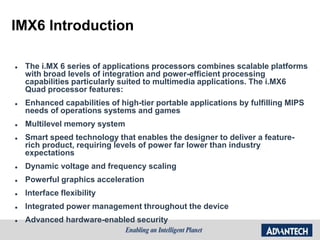
IMX6 Introduction
 The i.MX 6 series of applications processors combines scalable platforms
with broad levels of integration and power-efficient processing
capabilities particularly suited to multimedia applications. The i.MX6
Quad processor features:
 Enhanced capabilities of high-tier portable applications by fulfilling MIPS
needs of operations systems and games
 Multilevel memory system
 Smart speed technology that enables the designer to deliver a feature-
rich product, requiring levels of power far lower than industry
expectations
 Dynamic voltage and frequency scaling
 Powerful graphics acceleration
 Interface flexibility
 Integrated power management throughout the device
 Advanced hardware-enabled security
APQ8016 Introduction
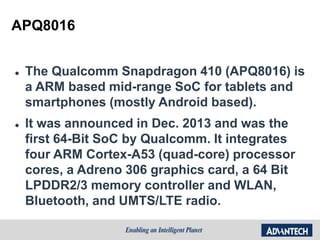
 The Qualcomm Snapdragon 410 (APQ8016) is
a ARM based mid-range SoC for tablets and
smartphones (mostly Android based).
 It was announced in Dec. 2013 and was the
first 64-Bit SoC by Qualcomm. It integrates
four ARM Cortex-A53 (quad-core) processor
cores, a Adreno 306 graphics card, a 64 Bit
LPDDR2/3 memory controller and WLAN,
Bluetooth, and UMTS/LTE radio.
Hardware comparison
 Processors
 Memory support
 Wireless and Network
 Multimedia
 Connectivity
 Configurable
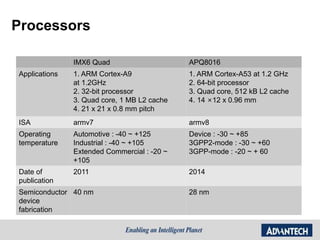
Processors
IMX6 Quad APQ8016
Applications 1. ARM Cortex-A9
at 1.2GHz
2. 32-bit processor
3. Quad core, 1 MB L2 cache
4. 21 x 21 x 0.8 mm pitch
1. ARM Cortex-A53 at 1.2 GHz
2. 64-bit processor
3. Quad core, 512 kB L2 cache
4. 14 ×12 x 0.96 mm
ISA armv7 armv8
Operating
temperature
Automotive : -40 ~ +125
Industrial : -40 ~ +105
Extended Commercial : -20 ~
+105
Device : -30 ~ +85
3GPP2-mode : -30 ~ +60
3GPP-mode : -20 ~ + 60
Date of
publication
2011 2014
Semiconductor
device
fabrication
40 nm 28 nm
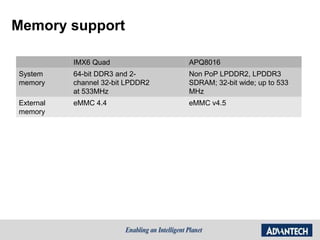
Memory support
IMX6 Quad APQ8016
System
memory
64-bit DDR3 and 2-
channel 32-bit LPDDR2
at 533MHz
Non PoP LPDDR2, LPDDR3
SDRAM; 32-bit wide; up to 533
MHz
External
memory
eMMC 4.4 eMMC v4.5
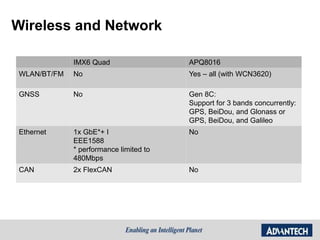
Wireless and Network
IMX6 Quad APQ8016
WLAN/BT/FM No Yes – all (with WCN3620)
GNSS No Gen 8C:
Support for 3 bands concurrently:
GPS, BeiDou, and Glonass or
GPS, BeiDou, and Galileo
Ethernet 1x GbE*+ I
EEE1588
* performance limited to
480Mbps
No
CAN 2x FlexCAN No
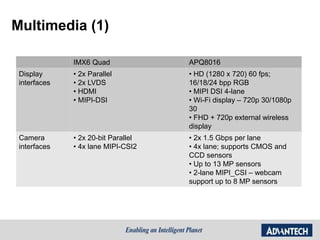
Multimedia (1)
IMX6 Quad APQ8016
Display
interfaces
• 2x Parallel
• 2x LVDS
• HDMI
• MIPI-DSI
• HD (1280 x 720) 60 fps;
16/18/24 bpp RGB
• MIPI DSI 4-lane
• Wi-Fi display – 720p 30/1080p
30
• FHD + 720p external wireless
display
Camera
interfaces
• 2x 20-bit Parallel
• 4x lane MIPI-CSI2
• 2x 1.5 Gbps per lane
• 4x lane; supports CMOS and
CCD sensors
• Up to 13 MP sensors
• 2-lane MIPI_CSI – webcam
support up to 8 MP sensors
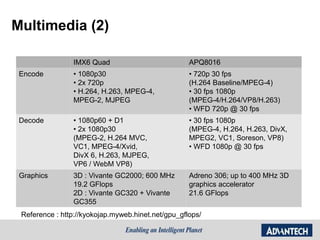
Multimedia (2)
IMX6 Quad APQ8016
Encode • 1080p30
• 2x 720p
• H.264, H.263, MPEG-4,
MPEG-2, MJPEG
• 720p 30 fps
(H.264 Baseline/MPEG-4)
• 30 fps 1080p
(MPEG-4/H.264/VP8/H.263)
• WFD 720p @ 30 fps
Decode • 1080p60 + D1
• 2x 1080p30
(MPEG-2, H.264 MVC,
VC1, MPEG-4/Xvid,
DivX 6, H.263, MJPEG,
VP6 / WebM VP8)
• 30 fps 1080p
(MPEG-4, H.264, H.263, DivX,
MPEG2, VC1, Soreson, VP8)
• WFD 1080p @ 30 fps
Graphics 3D : Vivante GC2000; 600 MHz
19.2 GFlops
2D : Vivante GC320 + Vivante
GC355
Adreno 306; up to 400 MHz 3D
graphics accelerator
21.6 GFlops
Reference : http://kyokojap.myweb.hinet.net/gpu_gflops/
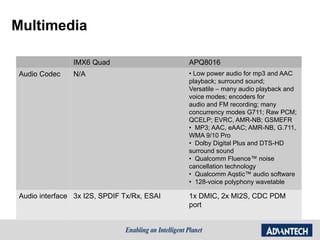
Multimedia (3)
IMX6 Quad APQ8016
Audio Codec N/A • Low power audio for mp3 and AAC
playback; surround sound;
Versatile – many audio playback and
voice modes; encoders for
audio and FM recording; many
concurrency modes G711; Raw PCM;
QCELP; EVRC, AMR-NB; GSMEFR
• MP3; AAC, eAAC; AMR-NB, G.711,
WMA 9/10 Pro
• Dolby Digital Plus and DTS-HD
surround sound
• Qualcomm Fluence™ noise
cancellation technology
• Qualcomm Aqstic™ audio software
• 128-voice polyphony wavetable
Audio interface 3x I2S, SPDIF Tx/Rx, ESAI 1x DMIC, 2x MI2S, CDC PDM
port
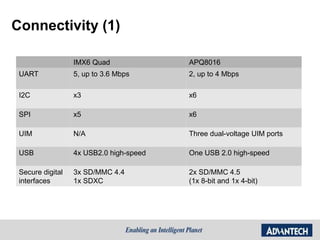
Connectivity (1)
IMX6 Quad APQ8016
UART 5, up to 3.6 Mbps 2, up to 4 Mbps
I2C x3 x6
SPI x5 x6
UIM N/A Three dual-voltage UIM ports
USB 4x USB2.0 high-speed One USB 2.0 high-speed
Secure digital
interfaces
3x SD/MMC 4.4
1x SDXC
2x SD/MMC 4.5
(1x 8-bit and 1x 4-bit)
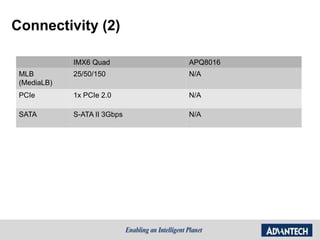
Connectivity (2)
IMX6 Quad APQ8016
MLB
(MediaLB)
25/50/150 N/A
PCIe 1x PCIe 2.0 N/A
SATA S-ATA II 3Gbps N/A
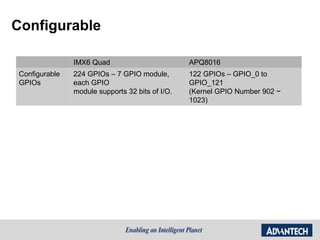
Configurable
IMX6 Quad APQ8016
Configurable
GPIOs
224 GPIOs – 7 GPIO module,
each GPIO
module supports 32 bits of I/O.
122 GPIOs – GPIO_0 to
GPIO_121
(Kernel GPIO Number 902 ~
1023)
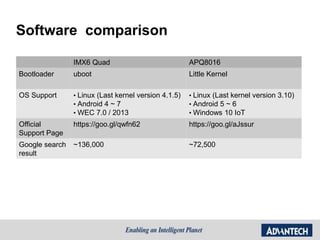
Software comparison
IMX6 Quad APQ8016
Bootloader uboot Little Kernel
OS Support • Linux (Last kernel version 4.1.5)
• Android 4 ~ 7
• WEC 7.0 / 2013
• Linux (Last kernel version 3.10)
• Android 5 ~ 6
• Windows 10 IoT
Official
Support Page
https://goo.gl/qwfn62 https://goo.gl/aJssur
Google search
result
~136,000 ~72,500
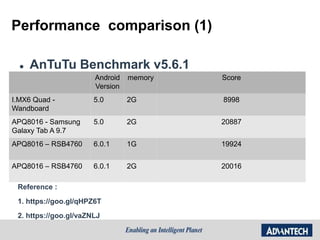
Performance comparison (1)
 AnTuTu Benchmark v5.6.1
Android
Version
memory Score
I.MX6 Quad -
Wandboard
5.0 2G 8998
APQ8016 - Samsung
Galaxy Tab A 9.7
5.0 2G 20887
APQ8016 – RSB4760 6.0.1 1G 19924
APQ8016 – RSB4760 6.0.1 2G 20016
Reference :
1. https://goo.gl/qHPZ6T
2. https://goo.gl/vaZNLJ
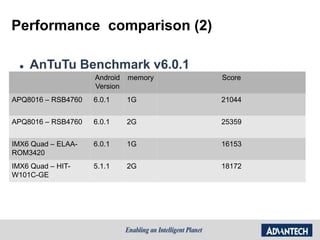
Performance comparison (2)
 AnTuTu Benchmark v6.0.1
Android
Version
memory Score
APQ8016 – RSB4760 6.0.1 1G 21044
APQ8016 – RSB4760 6.0.1 2G 25359
IMX6 Quad – ELAA-
ROM3420
6.0.1 1G 16153
IMX6 Quad – HIT-
W101C-GE
5.1.1 2G 18172
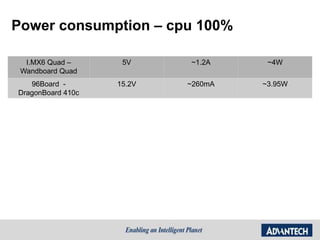
Power consumption – cpu 100%
I.MX6 Quad –
Wandboard Quad
5V ~1.2A ~4W
96Board -
DragonBoard 410c
15.2V ~260mA ~3.95W
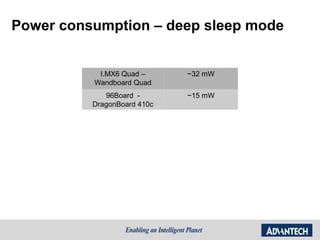
Power consumption – deep sleep mode
I.MX6 Quad –
Wandboard Quad
~32 mW
96Board -
DragonBoard 410c
~15 mW
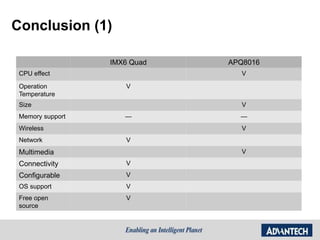
Conclusion (1)
IMX6 Quad APQ8016
CPU effect V
Operation
Temperature
V
Size V
Memory support — —
Wireless V
Network V
Multimedia V
Connectivity V
Configurable V
OS support V
Free open
source
V
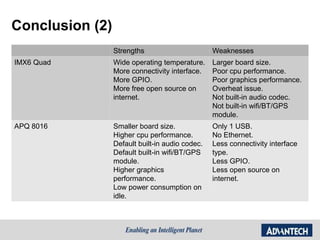
Conclusion (2)
Strengths Weaknesses
IMX6 Quad Wide operating temperature.
More connectivity interface.
More GPIO.
More free open source on
internet.
Larger board size.
Poor cpu performance.
Poor graphics performance.
Overheat issue.
Not built-in audio codec.
Not built-in wifi/BT/GPS
module.
APQ 8016 Smaller board size.
Higher cpu performance.
Default built-in audio codec.
Default built-in wifi/BT/GPS
module.
Higher graphics
performance.
Low power consumption on
idle.
Only 1 USB.
No Ethernet.
Less connectivity interface
type.
Less GPIO.
Less open source on
internet.

20170626 imx6 quad_vs_apq8016

  • 1.
    IMX6 Quad vsAPQ 8016 2017/06/27 Alleen Wang
  • 2.
    Outline  IMX6 Introduction APQ8016 Introduction  Hardware comparison  Software comparison  Performance comparison  Power consumption  Conclusion
  • 3.
    IMX6 Introduction  Thei.MX 6 series of applications processors combines scalable platforms with broad levels of integration and power-efficient processing capabilities particularly suited to multimedia applications. The i.MX6 Quad processor features:  Enhanced capabilities of high-tier portable applications by fulfilling MIPS needs of operations systems and games  Multilevel memory system  Smart speed technology that enables the designer to deliver a feature- rich product, requiring levels of power far lower than industry expectations  Dynamic voltage and frequency scaling  Powerful graphics acceleration  Interface flexibility  Integrated power management throughout the device  Advanced hardware-enabled security
  • 4.
    APQ8016 Introduction  TheQualcomm Snapdragon 410 (APQ8016) is a ARM based mid-range SoC for tablets and smartphones (mostly Android based).  It was announced in Dec. 2013 and was the first 64-Bit SoC by Qualcomm. It integrates four ARM Cortex-A53 (quad-core) processor cores, a Adreno 306 graphics card, a 64 Bit LPDDR2/3 memory controller and WLAN, Bluetooth, and UMTS/LTE radio.
  • 5.
    Hardware comparison  Processors Memory support  Wireless and Network  Multimedia  Connectivity  Configurable
  • 6.
    Processors IMX6 Quad APQ8016 Applications1. ARM Cortex-A9 at 1.2GHz 2. 32-bit processor 3. Quad core, 1 MB L2 cache 4. 21 x 21 x 0.8 mm pitch 1. ARM Cortex-A53 at 1.2 GHz 2. 64-bit processor 3. Quad core, 512 kB L2 cache 4. 14 ×12 x 0.96 mm ISA armv7 armv8 Operating temperature Automotive : -40 ~ +125 Industrial : -40 ~ +105 Extended Commercial : -20 ~ +105 Device : -30 ~ +85 3GPP2-mode : -30 ~ +60 3GPP-mode : -20 ~ + 60 Date of publication 2011 2014 Semiconductor device fabrication 40 nm 28 nm
  • 7.
    Memory support IMX6 QuadAPQ8016 System memory 64-bit DDR3 and 2- channel 32-bit LPDDR2 at 533MHz Non PoP LPDDR2, LPDDR3 SDRAM; 32-bit wide; up to 533 MHz External memory eMMC 4.4 eMMC v4.5
  • 8.
    Wireless and Network IMX6Quad APQ8016 WLAN/BT/FM No Yes – all (with WCN3620) GNSS No Gen 8C: Support for 3 bands concurrently: GPS, BeiDou, and Glonass or GPS, BeiDou, and Galileo Ethernet 1x GbE*+ I EEE1588 * performance limited to 480Mbps No CAN 2x FlexCAN No
  • 9.
    Multimedia (1) IMX6 QuadAPQ8016 Display interfaces • 2x Parallel • 2x LVDS • HDMI • MIPI-DSI • HD (1280 x 720) 60 fps; 16/18/24 bpp RGB • MIPI DSI 4-lane • Wi-Fi display – 720p 30/1080p 30 • FHD + 720p external wireless display Camera interfaces • 2x 20-bit Parallel • 4x lane MIPI-CSI2 • 2x 1.5 Gbps per lane • 4x lane; supports CMOS and CCD sensors • Up to 13 MP sensors • 2-lane MIPI_CSI – webcam support up to 8 MP sensors
  • 10.
    Multimedia (2) IMX6 QuadAPQ8016 Encode • 1080p30 • 2x 720p • H.264, H.263, MPEG-4, MPEG-2, MJPEG • 720p 30 fps (H.264 Baseline/MPEG-4) • 30 fps 1080p (MPEG-4/H.264/VP8/H.263) • WFD 720p @ 30 fps Decode • 1080p60 + D1 • 2x 1080p30 (MPEG-2, H.264 MVC, VC1, MPEG-4/Xvid, DivX 6, H.263, MJPEG, VP6 / WebM VP8) • 30 fps 1080p (MPEG-4, H.264, H.263, DivX, MPEG2, VC1, Soreson, VP8) • WFD 1080p @ 30 fps Graphics 3D : Vivante GC2000; 600 MHz 19.2 GFlops 2D : Vivante GC320 + Vivante GC355 Adreno 306; up to 400 MHz 3D graphics accelerator 21.6 GFlops Reference : http://kyokojap.myweb.hinet.net/gpu_gflops/
  • 11.
    Multimedia (3) IMX6 QuadAPQ8016 Audio Codec N/A • Low power audio for mp3 and AAC playback; surround sound; Versatile – many audio playback and voice modes; encoders for audio and FM recording; many concurrency modes G711; Raw PCM; QCELP; EVRC, AMR-NB; GSMEFR • MP3; AAC, eAAC; AMR-NB, G.711, WMA 9/10 Pro • Dolby Digital Plus and DTS-HD surround sound • Qualcomm Fluence™ noise cancellation technology • Qualcomm Aqstic™ audio software • 128-voice polyphony wavetable Audio interface 3x I2S, SPDIF Tx/Rx, ESAI 1x DMIC, 2x MI2S, CDC PDM port
  • 12.
    Connectivity (1) IMX6 QuadAPQ8016 UART 5, up to 3.6 Mbps 2, up to 4 Mbps I2C x3 x6 SPI x5 x6 UIM N/A Three dual-voltage UIM ports USB 4x USB2.0 high-speed One USB 2.0 high-speed Secure digital interfaces 3x SD/MMC 4.4 1x SDXC 2x SD/MMC 4.5 (1x 8-bit and 1x 4-bit)
  • 13.
    Connectivity (2) IMX6 QuadAPQ8016 MLB (MediaLB) 25/50/150 N/A PCIe 1x PCIe 2.0 N/A SATA S-ATA II 3Gbps N/A
  • 14.
    Configurable IMX6 Quad APQ8016 Configurable GPIOs 224GPIOs – 7 GPIO module, each GPIO module supports 32 bits of I/O. 122 GPIOs – GPIO_0 to GPIO_121 (Kernel GPIO Number 902 ~ 1023)
  • 15.
    Software comparison IMX6 QuadAPQ8016 Bootloader uboot Little Kernel OS Support • Linux (Last kernel version 4.1.5) • Android 4 ~ 7 • WEC 7.0 / 2013 • Linux (Last kernel version 3.10) • Android 5 ~ 6 • Windows 10 IoT Official Support Page https://goo.gl/qwfn62 https://goo.gl/aJssur Google search result ~136,000 ~72,500
  • 16.
    Performance comparison (1) AnTuTu Benchmark v5.6.1 Android Version memory Score I.MX6 Quad - Wandboard 5.0 2G 8998 APQ8016 - Samsung Galaxy Tab A 9.7 5.0 2G 20887 APQ8016 – RSB4760 6.0.1 1G 19924 APQ8016 – RSB4760 6.0.1 2G 20016 Reference : 1. https://goo.gl/qHPZ6T 2. https://goo.gl/vaZNLJ
  • 17.
    Performance comparison (2) AnTuTu Benchmark v6.0.1 Android Version memory Score APQ8016 – RSB4760 6.0.1 1G 21044 APQ8016 – RSB4760 6.0.1 2G 25359 IMX6 Quad – ELAA- ROM3420 6.0.1 1G 16153 IMX6 Quad – HIT- W101C-GE 5.1.1 2G 18172
  • 18.
    Power consumption –cpu 100% I.MX6 Quad – Wandboard Quad 5V ~1.2A ~4W 96Board - DragonBoard 410c 15.2V ~260mA ~3.95W
  • 19.
    Power consumption –deep sleep mode I.MX6 Quad – Wandboard Quad ~32 mW 96Board - DragonBoard 410c ~15 mW
  • 20.
    Conclusion (1) IMX6 QuadAPQ8016 CPU effect V Operation Temperature V Size V Memory support — — Wireless V Network V Multimedia V Connectivity V Configurable V OS support V Free open source V
  • 21.
    Conclusion (2) Strengths Weaknesses IMX6Quad Wide operating temperature. More connectivity interface. More GPIO. More free open source on internet. Larger board size. Poor cpu performance. Poor graphics performance. Overheat issue. Not built-in audio codec. Not built-in wifi/BT/GPS module. APQ 8016 Smaller board size. Higher cpu performance. Default built-in audio codec. Default built-in wifi/BT/GPS module. Higher graphics performance. Low power consumption on idle. Only 1 USB. No Ethernet. Less connectivity interface type. Less GPIO. Less open source on internet.