A MODEST PROGRAM
A PROPOSAL TO REDUCE THE IMPACT OF MALNUTRITION ON A CHILD’S
HEALTH IN RURAL ETHIOPIA
Junhi Chang, Shah Dishant, Aaron Salisbury, Aseel Hazajin, and Sydnee Gowens
Team 4
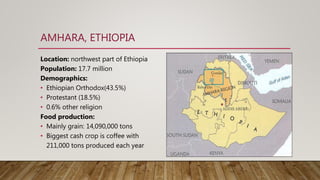
AMHARA, ETHIOPIA
Location: northwest part of Ethiopia
Population: 17.7 million
Demographics:
• Ethiopian Orthodox(43.5%)
• Protestant (18.5%)
• 0.6% other religion
Food production:
• Mainly grain: 14,090,000 tons
• Biggest cash crop is coffee with
211,000 tons produced each year
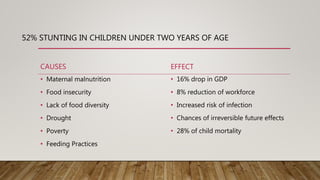
52% STUNTING IN CHILDREN UNDER TWO YEARS OF AGE
CAUSES EFFECT
• Maternal malnutrition
• Food insecurity
• Lack of food diversity
• Drought
• Poverty
• Feeding Practices
• 16% drop in GDP
• 8% reduction of workforce
• Increased risk of infection
• Chances of irreversible future effects
• 28% of child mortality
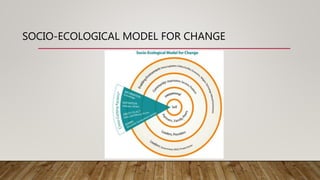
SOCIO-ECOLOGICAL MODEL FOR CHANGE
A MODEST PROGRAM
Recognizing that child malnutrition problems in Amhara, Ethiopia have deep underlying causes
beyond our reach,
Knowing that the region of Amhara, Ethiopia is far too large to be impacted as a whole, YET,
Understanding that positive, sustainable changes can be made at the individual and local levels to
reduce the malicious effects of infant malnutrition in Amhara, Ethiopia,
A MODEST PROGRAM will strive to
Reduce the number of malnourished infants and pregnant/nursing mothers
By implementing sustainable food creation programs and educating mothers on how to take care
of themselves
And thereby reducing the number of infants with stunted growth in the first 1,000 days of their
lives.
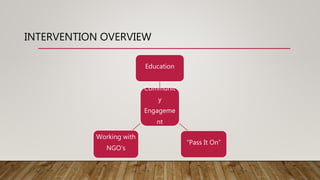
INTERVENTION OVERVIEW
Communit
y
Engageme
nt
Education
“Pass It On”
Working with
NGO’s
EDUCATION
Target Population: Pregnant and New Mothers
Educational Topics: breastfeeding, WASH, cooking classes, overall child-
care
Partners:
• Local Churches
• Women Groups
• Local Outreach Workers
• Other
EDUCATIONAL PROGRAM
• “Mentor Mothers”: respected local elderly women
• Workshops
• Cooking Demonstrations
• How to Breastfeed
• How to handle certain prominent illnesses in the area such as diarrheal
disease
• WASH
• Incentives
• Baby Boxes: blankets, clothes, mosquito nets
• Food Boxes: lentils, flour, faba bean
• Sessions: 2 / Month
CULTURAL TRADITIONS AND EDUCATION
• Each ethnic group in Ethiopia has signature traditional and cultural
stories, dances, and songs, that typically tell stories about tribal
traditions, marriage, reproduction, and other life experiences.
• Through community partnerships, we can develop a dance to tell a
more accurate story of motherhood and pregnancy.
• Start by engaging women’s groups in the community.
• Women groups can help with the creation of new stories or
dances
• Perform at churches, other cultural centers
THE “PASS IT ON” PROGRAM
• On-site sustenance raising program covering many of the base nutrients
mothers need to stay healthy and feed her baby
• Two pillars: animal husbandry and community garden
• Focus on supplementing lacking nutrition in pregnant/nursing mothers
• Missing protein and fat macronutrients from animal husbandry;
supplement lacking micronutrients through community garden
“PASS IT ON”- ANIMAL HUSBANDRY
• Cultivate essential protein and fat supplements in a sustainable, local-economy-
boosting method
• Two animals: Chickens (Rhode Island Reds) and Goats (Savannah)
• Shared traits: cheap to purchase, can be maintained with already available material,
consistent daily sustenance output through eggs and milk
• Chickens: $5 per purchase; output ~270 eggs per year + meat
• Goats: $30 per purchase; output ~ 1800 quarts of milk per year
PASS IT ON – COMMUNITY GARDEN
• Perpetual cultivation of hardy vegetables for community consumption, not export
• Plant requirements: drought-resistant, offers nutrition other than pure carbohydrates,
easy to cultivate, short maturation time
• Two categories: micronutrient focused, macronutrient focused
• Micronutrient: Swiss Chard, Rhubarb, Mustard Greens, Native Fruits (if any)
• Macronutrient: Beans/Lentils, Sweet Potato, Millet, Teff
• Yearly harvest cycle: plant in spring, harvest in fall
WHY THE TITLE “PASS IT ON?”
• Unique program propagation model
• Organization supplies initial seeds/livestock to pilot family/village
• Family/village looks after agriculture and reaps the benefits later in the year
• Organization takes back a set amount of seeds/livestock from the harvest to be supplied t
new pilot family/village, repeat.
• Propagation model:
• Seeds: take back initial amount of seeds as supplied earlier
• Chickens: take back initial amount of laying hens as supplied earlier
• Goats: somewhat more difficult; adjust accordingly
PASS IT ON – PRESERVATION
• Preservation and non-electric “refrigeration” of harvest essential.
• Sweet Potatoes and other roots be kept together with fruit harvest
• Fruits release Ethylene gas that hastens ripening, potatoes - opposite effect
• Preservation of spoilable greens by dry-powdering
• Place Swiss Chards, Mustard Greens, etc. under sunlight covered by mesh, plastic wrap
with holes poked in, or whatever available for drying
• Grind dried vegetables into powder vial pestle and mortal or alternative
• Store powder in any container out in open, add to less nutritious meals to boost nutrition level
• Preservation of meats more difficult
• Legumes and beans less of a worry
PASS IT ON – PITFALLS AND ALTERNATIVES
• Directly targets the mothers, not the babies themselves
• If mother afflicted by disease/complications and unable to nurse, child will not
gain any nutritional benefit
• Separate NGOs that provide baby formula will be reached out to under
necessary circumstances
• Potentially difficult to persuade village to self-consume the harvest rather than
selling it for more profit
• Imperative that village elders/people in charge recognize value of feeding their
needy
• Agriculture is not as easy as everyone makes it out to be.
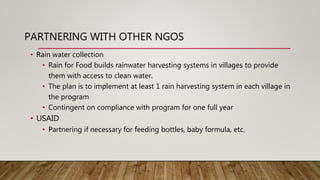
PARTNERING WITH OTHER NGOS
• Rain water collection
• Rain for Food builds rainwater harvesting systems in villages to provide
them with access to clean water.
• The plan is to implement at least 1 rain harvesting system in each village in
the program
• Contingent on compliance with program for one full year
• USAID
• Partnering if necessary for feeding bottles, baby formula, etc.
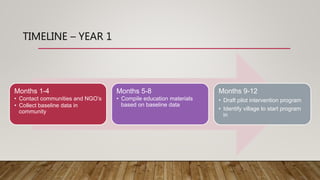
TIMELINE – YEAR 1
Months 1-4
• Contact communities and NGO’s
• Collect baseline data in
community
Months 5-8
• Compile education materials
based on baseline data
Months 9-12
• Draft pilot intervention program
• Identify village to start program
in
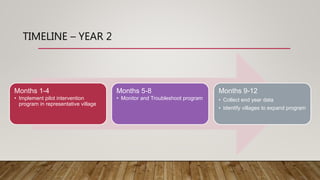
TIMELINE – YEAR 2
Months 1-4
• Implement pilot intervention
program in representative village
Months 5-8
• Monitor and Troubleshoot program
Months 9-12
• Collect end year data
• Identify villages to expand program
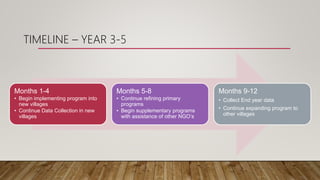
TIMELINE – YEAR 3-5
Months 1-4
• Begin implementing program into
new villages
• Continue Data Collection in new
villages
Months 5-8
• Continue refining primary
programs
• Begin supplementary programs
with assistance of other NGO’s
Months 9-12
• Collect End year data
• Continue expanding program to
other villages
MONITORING AND EVALUATION PLAN
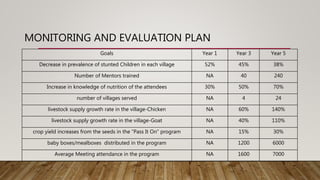
Goals Year 1 Year 3 Year 5
Decrease in prevalence of stunted Children in each village 52% 45% 38%
Number of Mentors trained NA 40 240
Increase in knowledge of nutrition of the attendees 30% 50% 70%
number of villages served NA 4 24
livestock supply growth rate in the village-Chicken NA 60% 140%
livestock supply growth rate in the village-Goat NA 40% 110%
crop yield increases from the seeds in the “Pass It On” program NA 15% 30%
baby boxes/mealboxes distributed in the program NA 1200 6000
Average Meeting attendance in the program NA 1600 7000
BUDGET
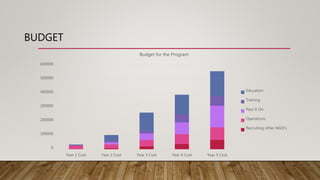
0
100000
200000
300000
400000
500000
600000
Year 1 Cost Year 2 Cost Year 3 Cost Year 4 Cost Year 5 Cost
Budget for the Program
Education
Training
Pass It On
Operations
Recruiting other NGO's
BUDGET PRIORITIES
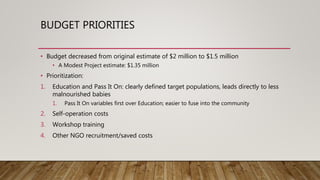
• Budget decreased from original estimate of $2 million to $1.5 million
• A Modest Project estimate: $1.35 million
• Prioritization:
1. Education and Pass It On: clearly defined target populations, leads directly to less
malnourished babies
1. Pass It On variables first over Education; easier to fuse into the community
2. Self-operation costs
3. Workshop training
4. Other NGO recruitment/saved costs
QUESTIONS & COMMENTS

2017 Statewide Case Competition: Team 4 - Third Place (UAB)

  • 1.
    A MODEST PROGRAM APROPOSAL TO REDUCE THE IMPACT OF MALNUTRITION ON A CHILD’S HEALTH IN RURAL ETHIOPIA Junhi Chang, Shah Dishant, Aaron Salisbury, Aseel Hazajin, and Sydnee Gowens Team 4
  • 2.
    AMHARA, ETHIOPIA Location: northwestpart of Ethiopia Population: 17.7 million Demographics: • Ethiopian Orthodox(43.5%) • Protestant (18.5%) • 0.6% other religion Food production: • Mainly grain: 14,090,000 tons • Biggest cash crop is coffee with 211,000 tons produced each year
  • 3.
    52% STUNTING INCHILDREN UNDER TWO YEARS OF AGE CAUSES EFFECT • Maternal malnutrition • Food insecurity • Lack of food diversity • Drought • Poverty • Feeding Practices • 16% drop in GDP • 8% reduction of workforce • Increased risk of infection • Chances of irreversible future effects • 28% of child mortality
  • 4.
  • 5.
    A MODEST PROGRAM Recognizingthat child malnutrition problems in Amhara, Ethiopia have deep underlying causes beyond our reach, Knowing that the region of Amhara, Ethiopia is far too large to be impacted as a whole, YET, Understanding that positive, sustainable changes can be made at the individual and local levels to reduce the malicious effects of infant malnutrition in Amhara, Ethiopia, A MODEST PROGRAM will strive to Reduce the number of malnourished infants and pregnant/nursing mothers By implementing sustainable food creation programs and educating mothers on how to take care of themselves And thereby reducing the number of infants with stunted growth in the first 1,000 days of their lives.
  • 6.
  • 7.
    EDUCATION Target Population: Pregnantand New Mothers Educational Topics: breastfeeding, WASH, cooking classes, overall child- care Partners: • Local Churches • Women Groups • Local Outreach Workers • Other
  • 8.
    EDUCATIONAL PROGRAM • “MentorMothers”: respected local elderly women • Workshops • Cooking Demonstrations • How to Breastfeed • How to handle certain prominent illnesses in the area such as diarrheal disease • WASH • Incentives • Baby Boxes: blankets, clothes, mosquito nets • Food Boxes: lentils, flour, faba bean • Sessions: 2 / Month
  • 9.
    CULTURAL TRADITIONS ANDEDUCATION • Each ethnic group in Ethiopia has signature traditional and cultural stories, dances, and songs, that typically tell stories about tribal traditions, marriage, reproduction, and other life experiences. • Through community partnerships, we can develop a dance to tell a more accurate story of motherhood and pregnancy. • Start by engaging women’s groups in the community. • Women groups can help with the creation of new stories or dances • Perform at churches, other cultural centers
  • 10.
    THE “PASS ITON” PROGRAM • On-site sustenance raising program covering many of the base nutrients mothers need to stay healthy and feed her baby • Two pillars: animal husbandry and community garden • Focus on supplementing lacking nutrition in pregnant/nursing mothers • Missing protein and fat macronutrients from animal husbandry; supplement lacking micronutrients through community garden
  • 11.
    “PASS IT ON”-ANIMAL HUSBANDRY • Cultivate essential protein and fat supplements in a sustainable, local-economy- boosting method • Two animals: Chickens (Rhode Island Reds) and Goats (Savannah) • Shared traits: cheap to purchase, can be maintained with already available material, consistent daily sustenance output through eggs and milk • Chickens: $5 per purchase; output ~270 eggs per year + meat • Goats: $30 per purchase; output ~ 1800 quarts of milk per year
  • 12.
    PASS IT ON– COMMUNITY GARDEN • Perpetual cultivation of hardy vegetables for community consumption, not export • Plant requirements: drought-resistant, offers nutrition other than pure carbohydrates, easy to cultivate, short maturation time • Two categories: micronutrient focused, macronutrient focused • Micronutrient: Swiss Chard, Rhubarb, Mustard Greens, Native Fruits (if any) • Macronutrient: Beans/Lentils, Sweet Potato, Millet, Teff • Yearly harvest cycle: plant in spring, harvest in fall
  • 13.
    WHY THE TITLE“PASS IT ON?” • Unique program propagation model • Organization supplies initial seeds/livestock to pilot family/village • Family/village looks after agriculture and reaps the benefits later in the year • Organization takes back a set amount of seeds/livestock from the harvest to be supplied t new pilot family/village, repeat. • Propagation model: • Seeds: take back initial amount of seeds as supplied earlier • Chickens: take back initial amount of laying hens as supplied earlier • Goats: somewhat more difficult; adjust accordingly
  • 14.
    PASS IT ON– PRESERVATION • Preservation and non-electric “refrigeration” of harvest essential. • Sweet Potatoes and other roots be kept together with fruit harvest • Fruits release Ethylene gas that hastens ripening, potatoes - opposite effect • Preservation of spoilable greens by dry-powdering • Place Swiss Chards, Mustard Greens, etc. under sunlight covered by mesh, plastic wrap with holes poked in, or whatever available for drying • Grind dried vegetables into powder vial pestle and mortal or alternative • Store powder in any container out in open, add to less nutritious meals to boost nutrition level • Preservation of meats more difficult • Legumes and beans less of a worry
  • 15.
    PASS IT ON– PITFALLS AND ALTERNATIVES • Directly targets the mothers, not the babies themselves • If mother afflicted by disease/complications and unable to nurse, child will not gain any nutritional benefit • Separate NGOs that provide baby formula will be reached out to under necessary circumstances • Potentially difficult to persuade village to self-consume the harvest rather than selling it for more profit • Imperative that village elders/people in charge recognize value of feeding their needy • Agriculture is not as easy as everyone makes it out to be.
  • 16.
    PARTNERING WITH OTHERNGOS • Rain water collection • Rain for Food builds rainwater harvesting systems in villages to provide them with access to clean water. • The plan is to implement at least 1 rain harvesting system in each village in the program • Contingent on compliance with program for one full year • USAID • Partnering if necessary for feeding bottles, baby formula, etc.
  • 17.
    TIMELINE – YEAR1 Months 1-4 • Contact communities and NGO’s • Collect baseline data in community Months 5-8 • Compile education materials based on baseline data Months 9-12 • Draft pilot intervention program • Identify village to start program in
  • 18.
    TIMELINE – YEAR2 Months 1-4 • Implement pilot intervention program in representative village Months 5-8 • Monitor and Troubleshoot program Months 9-12 • Collect end year data • Identify villages to expand program
  • 19.
    TIMELINE – YEAR3-5 Months 1-4 • Begin implementing program into new villages • Continue Data Collection in new villages Months 5-8 • Continue refining primary programs • Begin supplementary programs with assistance of other NGO’s Months 9-12 • Collect End year data • Continue expanding program to other villages
  • 20.
    MONITORING AND EVALUATIONPLAN Goals Year 1 Year 3 Year 5 Decrease in prevalence of stunted Children in each village 52% 45% 38% Number of Mentors trained NA 40 240 Increase in knowledge of nutrition of the attendees 30% 50% 70% number of villages served NA 4 24 livestock supply growth rate in the village-Chicken NA 60% 140% livestock supply growth rate in the village-Goat NA 40% 110% crop yield increases from the seeds in the “Pass It On” program NA 15% 30% baby boxes/mealboxes distributed in the program NA 1200 6000 Average Meeting attendance in the program NA 1600 7000
  • 21.
    BUDGET 0 100000 200000 300000 400000 500000 600000 Year 1 CostYear 2 Cost Year 3 Cost Year 4 Cost Year 5 Cost Budget for the Program Education Training Pass It On Operations Recruiting other NGO's
  • 22.
    BUDGET PRIORITIES • Budgetdecreased from original estimate of $2 million to $1.5 million • A Modest Project estimate: $1.35 million • Prioritization: 1. Education and Pass It On: clearly defined target populations, leads directly to less malnourished babies 1. Pass It On variables first over Education; easier to fuse into the community 2. Self-operation costs 3. Workshop training 4. Other NGO recruitment/saved costs
  • 23.