Federal Aviation
Administration
Helicopter Flight
Data Monitoring
(HFDM) for
ASIAS
Presented to:
Rotor Safety Challenge
Session @ HeliExpo. 2017
Presented By:
Cliff Johnson, Research Program
Manager/Engineer, FAA William J. Hughes
Technical Center, Atlantic City, NJ
Kyle Collins, Ph.D. Principal Investigator,
Georgia Technical University, Atlanta, GA
Keith M Cianfrani, LTC (ret), MAS. RSP,
Helicopter Association International
(HAI)/Florida Institute of Technology (FIT)
Mar. 8, 2017
2Federal Aviation AdministrationAviation Research Division, ANG-E FOR OFFICIAL USE ONLY
Briefing Outline
• Introduction and Overview – ASIAS & HFDM Research
• HFDM Research Team/Partners
• Update on Rotorcraft HFDM Research
– Defining Safety Metrics for Rotorcraft Operations
– HFDM with Data-Enhanced Helicopter Performance Models
– Cockpit Video Data Analysis For Rotorcraft Safety
– Phase of flight and Anomaly detection with Data Mining
– Helicopter Airborne Data Recording and Analysis System (in development)
– HFDM Flight Testing
• Participation in HFDM Research for ASIAS/How it Works/Outreach/Benefits
• Questions?
3Federal Aviation AdministrationAviation Research Division, ANG-E FOR OFFICIAL USE ONLY
ASIAS – Aviation Safety Information
Analysis and Sharing
• Q: What is ASIAS?
• A: The Aviation Safety Information Analysis
and Sharing (ASIAS) program is a collaborative
government and industry initiative to share and
analyze data to proactively discover system
safety concerns before accidents or incidents
occur, leading to timely mitigation and
prevention.
4Federal Aviation AdministrationAviation Research Division, ANG-E FOR OFFICIAL USE ONLY
HFDM Research for ASIAS
What are we doing?
Rotorcraft research is underway to develop more robust helicopter
data and new analytical tools designed for the unique nature of
helicopter operations. HFDM research lays the foundation for
future helicopter data analysis in ASIAS and supports the USHST’s
efforts to reduce the helicopter fatal accident rate. This research will:
• Collect flight data from commercial, government, flight training,
and other large and small operators from various mission
segments to be used for analysis;
• Explore flight data monitoring as a voluntary means to improve
safety across the industry;
• Develop secure, confidential, and protected safety analysis of
aggregate flight data records;
• Support risk mitigation efforts through the ASIAS program.
5Federal Aviation AdministrationAviation Research Division, ANG-E FOR OFFICIAL USE ONLY
HFDM Research for ASIAS
What are we not doing?
Rotorcraft HFDM Research for ASIAS & the ASIAS
Program is not:
• A replacement for an operator’s HFOQA/HFDM
Program or HFOQA/HFDM Vendor’s Service
• An FAA certification program
• An FAA enforcement program
• Mandatory (all participation is voluntary)
6Federal Aviation AdministrationAviation Research Division, ANG-E FOR OFFICIAL USE ONLY
Why Rotorcraft FDM Research
Supporting ASIAS?
2-Mar-17
7Federal Aviation AdministrationAviation Research Division, ANG-E FOR OFFICIAL USE ONLY
U.S. Helicopter Fatal Accident Rate
Flight hours source:
-5 Yr Baseline from FAA's GA & Part 135 Activity
Survey.
-2016 from FAA's Aerospace Forecast FY2016-2036.
Goal by end of CY 2019:
20% reduction from 5 year
baseline
8Federal Aviation AdministrationAviation Research Division, ANG-E FOR OFFICIAL USE ONLY
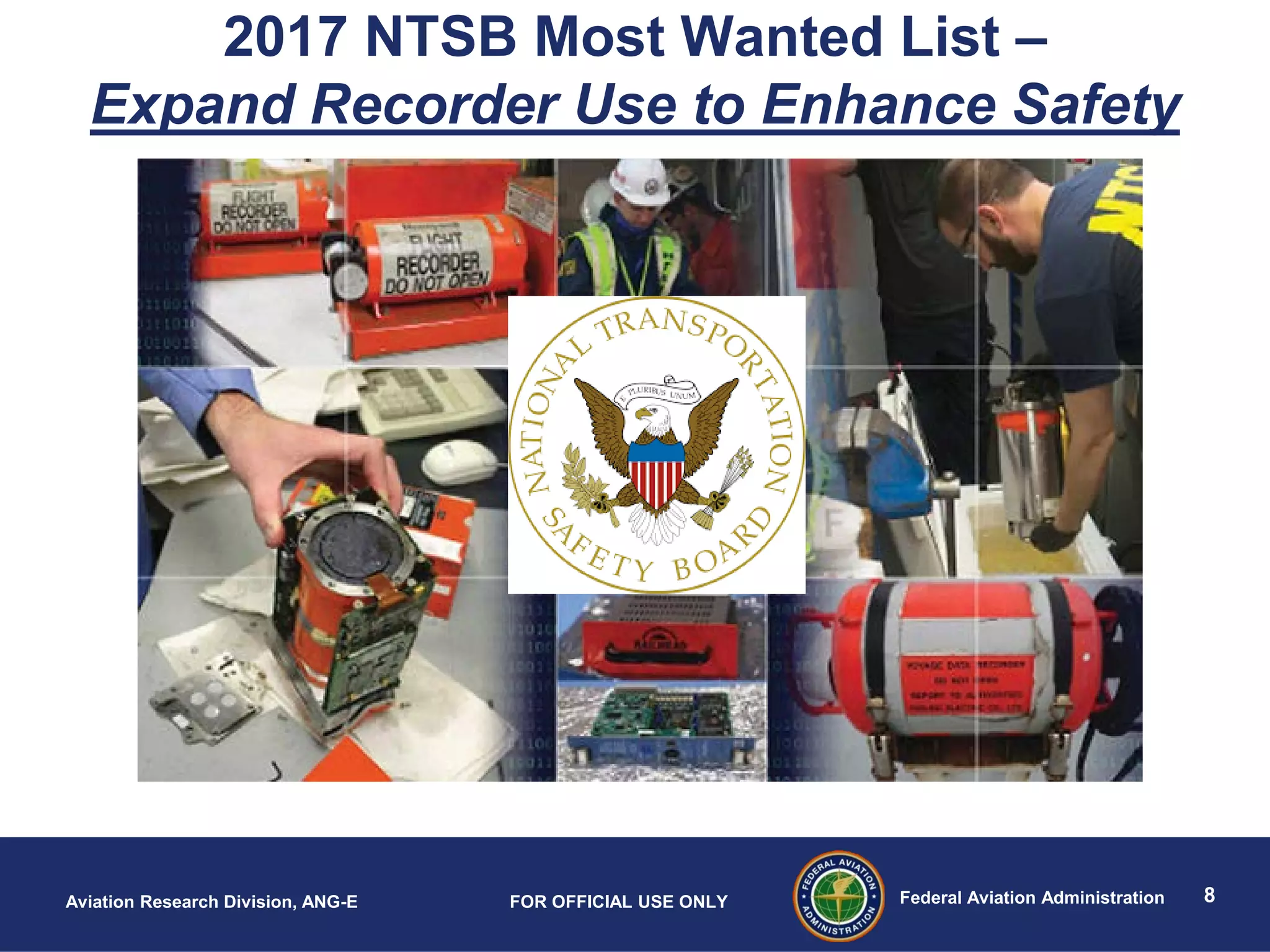
2017 NTSB Most Wanted List –
Expand Recorder Use to Enhance Safety
9Federal Aviation AdministrationAviation Research Division, ANG-E FOR OFFICIAL USE ONLY
But what’s in a Flight Data Recorder/Flight
Data Monitoring System?
• Helicopter Flight Data Recorders/Helicopter Flight Data
Monitoring Devices typically consist of one or more of the
following items:
– Flight Data Recorder
– Audio/Video Sensors
– Attitude and Heading Reference System (AHRS)
– Accelerometers/Gyroscopes
– GPS Inputs
– Avionics (Flight Management System, Air Data Computer, etc.)
Inputs (usually ARINC-429 or ARINC-717)
– Engine/Rotor Inputs/Sensors
10Federal Aviation
Administration
WAAS Alaska WRS Telco Analysis
Helicopter Flight Data Recorder (FDR) –
Standalone device or interfaced with on-board
sensors
Power supply
(aux GPS
signal)
Power
supply
http://www.aircraftspruce.com/catalog/avpages/garminAntenna.php
https://www.appareo.com/aviation/flight-data-monitoring/
ARINC 717/other
standard
FDAU
Microphones
Cockpit camera
North FDS QAR
Engine
monitoring
(Intercom
audio)
GPS Antenna
Satellite
Antenna
GPS/AHRS
http://www.expaircraft.com/freeflight.htm
http://www.northfds.com/products.html
Vision 1000
Tablet
11Federal Aviation
Administration
WAAS Alaska WRS Telco Analysis
Installation Locations - FDR
Safetyplane V4 (Helicom V1) recorder in
cockpit or remotely located
http://easa.europa.eu/system/files/dfu/Final_Report_EASA.2008-7.pdf
https://www.appareo.com/aviation/flight-data-monitoring/vision-1000/
Appareo Vision
1000 mounted in
AS350 cockpit
12Federal Aviation
Administration
WAAS Alaska WRS Telco Analysis
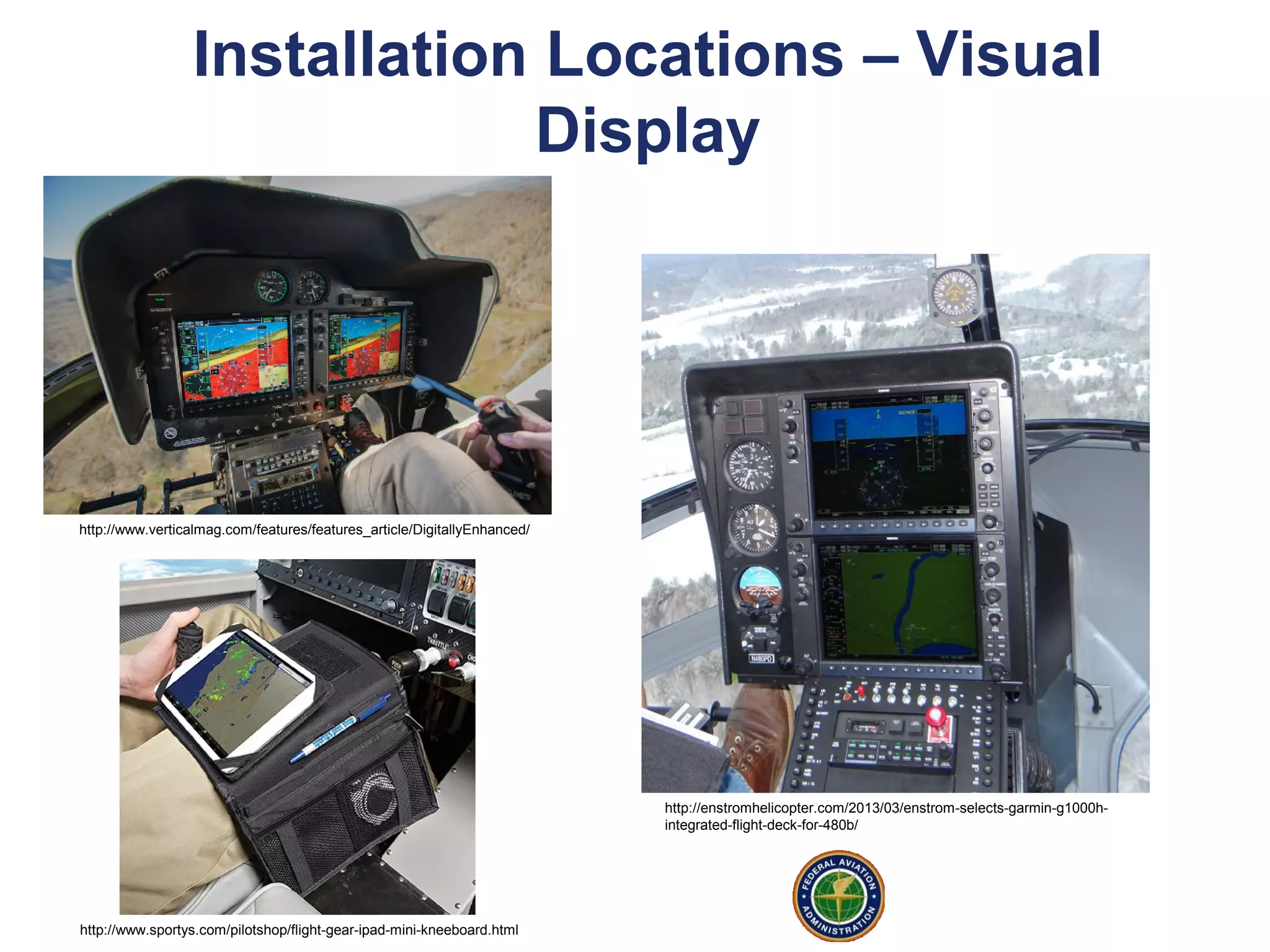
Installation Locations – Visual
Display
http://enstromhelicopter.com/2013/03/enstrom-selects-garmin-g1000h-
integrated-flight-deck-for-480b/
http://www.verticalmag.com/features/features_article/DigitallyEnhanced/
http://www.sportys.com/pilotshop/flight-gear-ipad-mini-kneeboard.html
13Federal Aviation AdministrationAviation Research Division, ANG-E FOR OFFICIAL USE ONLY
Installation Locations – GPS Antenna,
AHRS
http://www.robinsonheli.com/manuals/r22_mm/r22_mm_14.pdf
http://www.grounddatasolutions.com/airbornelaser.html
http://www.arrowaviationco.com/site321.php
Bell 212Bell 412
http://shop.avionics.co.nz/lcr100-stc-bell&view=mobile#container
GPS Antenna
AHRS
GPS Antenna
AHRS
GPS Antenna
14Federal Aviation AdministrationAviation Research Division, ANG-E FOR OFFICIAL USE ONLY
Rotorcraft FDM Research
Supporting ASIAS
15Federal Aviation AdministrationAviation Research Division, ANG-E FOR OFFICIAL USE ONLY
FAA Helicopter
Research Team Members
Prof. Dimitri Mavris – PI
Kyle Collins, Ph.D. – Co-PI
Simon Briceno
Alexia Payan
Hsiang-Jui Chin
Po-Nien Lin
Prof. Karen Marais – PI
Inseok Hwang
Sanghuyn Shin
Prof. Stephen Cusick – PI
Keith Cianfrani
Cliff Johnson – Rotorcraft FDM
Research Task Lead
Lacey Thompson – Ops Research
Analyst
FAA WJHTC Atlantic City, NJ
Alex Alshtein – ASIAS Group Leader
Nicky Armour –
MITRE-CASSD
*Note: MITRE role involves collaboration with research
activities for integration with ASIAS.
Ed DiCampli, Chief Operating Officer
Robert Liguori, IT Consultant
Keith Cianfrani, FDM Specialist/Outreach
Tyler Travis
Lana Manovych
16Federal Aviation AdministrationAviation Research Division, ANG-E FOR OFFICIAL USE ONLY
Helicopter Flight Data Monitoring
Research Partners
Entities Involved:
• USHST
• IHST
• Helicopter Flight Data Monitoring
Manufacturers
• Helicopter Original Equipment
(OEM) Manufacturers
• Helicopter Operators
• Many more, too many to list…
• We highly value, encourage, and
need industry participation in
this effort in order to make it a
success!!!
17Federal Aviation AdministrationAviation Research Division, ANG-E FOR OFFICIAL USE ONLY
Rotorcraft FDM Research
Analysis
Capabilities
Supports the USHST Goal of 20% Reduction in
the Fatal Accident Rate for Helicopters by 2020
 Safety Metrics
 HFDM Analysis
Techniques
 HFDM Modeling
Techniques
 HFDM Cockpit
Audio/Video Analysis
 Data Mining for Safety
Events
 Identification of High-Risk
Safety Events
 Industry Involvement
 Potential Mitigation Partner
 FDM Equipment Working
Group
 Program
Management
 Outreach
 Flight Tests
 HFDM Device
Integration &
Calibration
 Data Analysis
 Modeling &
Simulation
 Outreach
 Data Transcription
 HFDM Research Repository
 HFDM Architecture Design
 HFDM Working Group
18Federal Aviation AdministrationAviation Research Division, ANG-E FOR OFFICIAL USE ONLY
DEFINING SAFETY METRICS FOR
ROTORCRAFT OPERATIONS
19Federal Aviation AdministrationAviation Research Division, ANG-E FOR OFFICIAL USE ONLY
Safety Metrics for Rotorcraft Operations
• Tackled so far:
– Proximity to obstacles
– Proximity to weather
– Autorotation
– Tip over taxi (roll-over)
– Vortex Ring State (VRS)
• In progress:
– Unstabilized approach
– Helipad overrun
– Loss of Tail Rotor
Effectiveness (LTE)
High
Priority
In flight
LOC
Autorotation
Unstabilized
approach
System
failure/malfunctionCFIT
Helipad overrun
Proximity to
Obstacles/Weather/Other aircraft
On the
ground
Roll-over
Medium
priority
In flight LOC
LTE
IMC
Fuel low
Close to
ground
Abnormal runway
contact
Vortex Ring State
Unstabilized
approach
Hard landing
Low
priority
In flight
Bird strike
External load
On the
ground
Runway
incursion/excursion
Abrupt maneuver
20Federal Aviation AdministrationAviation Research Division, ANG-E FOR OFFICIAL USE ONLY
Proximity to Obstacles Safety Metric
FAA Digital Obstacle File (DOF) +
Flight Data Records
Speed vector
Closure speed
Closure Distance
N
E
ϕ
(lat,long)
(lat,long)
Kinematics
Visualization (Multi-Flights)
-84.55 -84.5 -84.45 -84.4 -84.35 -84.3 -84.25
33.76
33.78
33.8
33.82
33.84
33.86
33.88
33.9
33.92
Flight Paths and Location of Time Critical Obstacles
Recording 1
Recording 2
Recording 3
Recording 4
Recording 5
Recording 6
Recording 7
Longitude
Latitude
0.5 1 1.5 2 2.5 3 3.5 4 4.5 5
0
0.5
1
1.5
2
2.5
3
3.5
4
Distribution of Closure Times for Time Critical Obstacles Within the Safety Box
Closure Time
Counts
Display obstacles located within a specified
“closure time” from the helicopter (ex: 5 s)
Location of “time critical” obstacles
Dist. of closure times for “time critical” obst.
Contour lines are closure times
(0 to 30 seconds)
Latitude: 33.85
Longitude: -84.36
Type: Building
Quantity: 1
Height AGL: 355 ft
Lighting: Flood
Marking: None
Closure Time: 4.9 s
ClosureSpeed(kt) Distance to Obstacle (s)
21Federal Aviation AdministrationAviation Research Division, ANG-E FOR OFFICIAL USE ONLY
W th it l l
1 2 3 4 5 6
0
10
20
30
40
50
60
Median, 25th and 75th percentiles of percentage of flight time
spent at each weather severity level for all the flights considered
(outliers are shown as red crosses)
%ofRecordingTime
Weather Severity Level
Weather severity level
0 1 2 3 4 5 6 7
0
10
20
30
40
50
60
%ofRecordingTime
Weather Severity Level
More than ~10 flights
CIWS Weather Severity Levels +
Flight Data Records
Vertical Integrated Liquid water (VIL) 1 2 3 4 5 6
0
10
20
30
40
50
60
Percent of flight time for flight spent at each weather severity level
Recording 1
Recording 2
Recording 3
Recording 4
Recording 5
Recording 6
Recording 7
Recording 8
Weather Severity
Level
%ofRecordingTime
-84.55 -84.5 -84.45 -84.4 -84.35 -84.3 -84.25
33.76
33.78
33.8
33.82
33.84
33.86
33.88
33.9
33.92
Recording 1
Recording 2
Recording 3
Recording 4
Recording 5
Recording 6
Recording 7
Recording 8
Longitude
Latitude
Less than ~10 flights
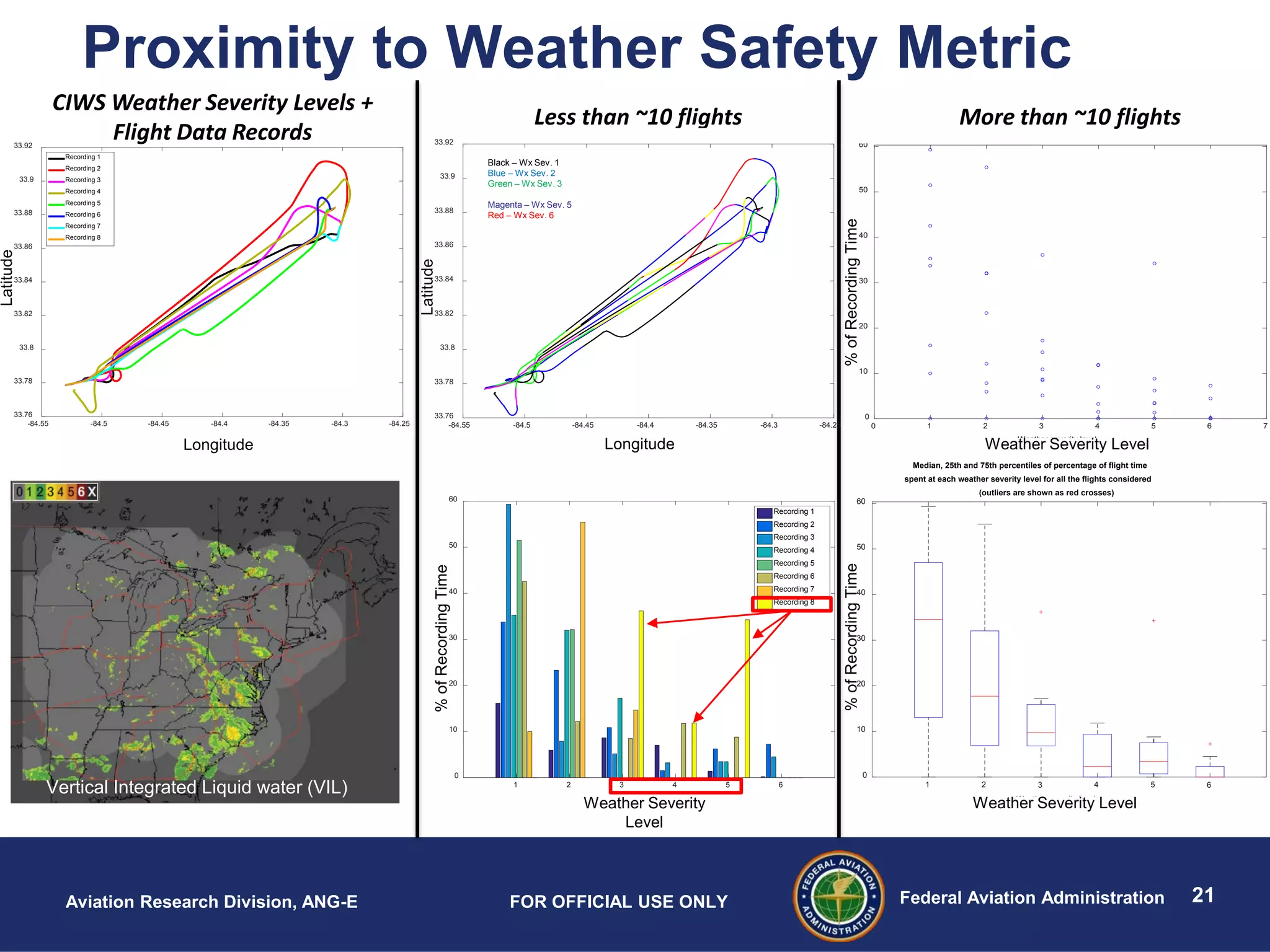
Proximity to Weather Safety Metric
-84.55 -84.5 -84.45 -84.4 -84.35 -84.3 -84.25
33.76
33.78
33.8
33.82
33.84
33.86
33.88
33.9
33.92 Flight #8
Longitude
Latitude
Black – Wx Sev. 1
Blue – Wx Sev. 2
Green – Wx Sev. 3
Yellow – Wx Sev. 4
Magenta – Wx Sev. 5
Red – Wx Sev. 6
22Federal Aviation AdministrationAviation Research Division, ANG-E FOR OFFICIAL USE ONLY
Unstabilized Approach Safety Metric
Dist. of Altitude Deviation Indicator
Altitude Deviation Indicator
Frequency
Approach Angle
Altitude
Vertical Speed
50% of total
path distance
Average location of changes in approach
parameters
Frequency
Start
Ideal profile
Deviation from Ideal Altitude Profile
Altitude(ft)
Path Distance (mile)
Altitude(ft)
Latitude (deg.) Longitude (deg.)
Approach phases identification
Altitude(ft)
Time (min)
Clustering of Approaches by Stability Levels Using Data Mining (k-mean)
Approach Angle Deviation Indicator
AltitudeDeviationIndicator
Identified Approaches
Alt. Profile of Flight Data
(Most Stable)
(Rather sable)
(Less stable)
(Mostly un stable)
23Federal Aviation AdministrationAviation Research Division, ANG-E FOR OFFICIAL USE ONLY
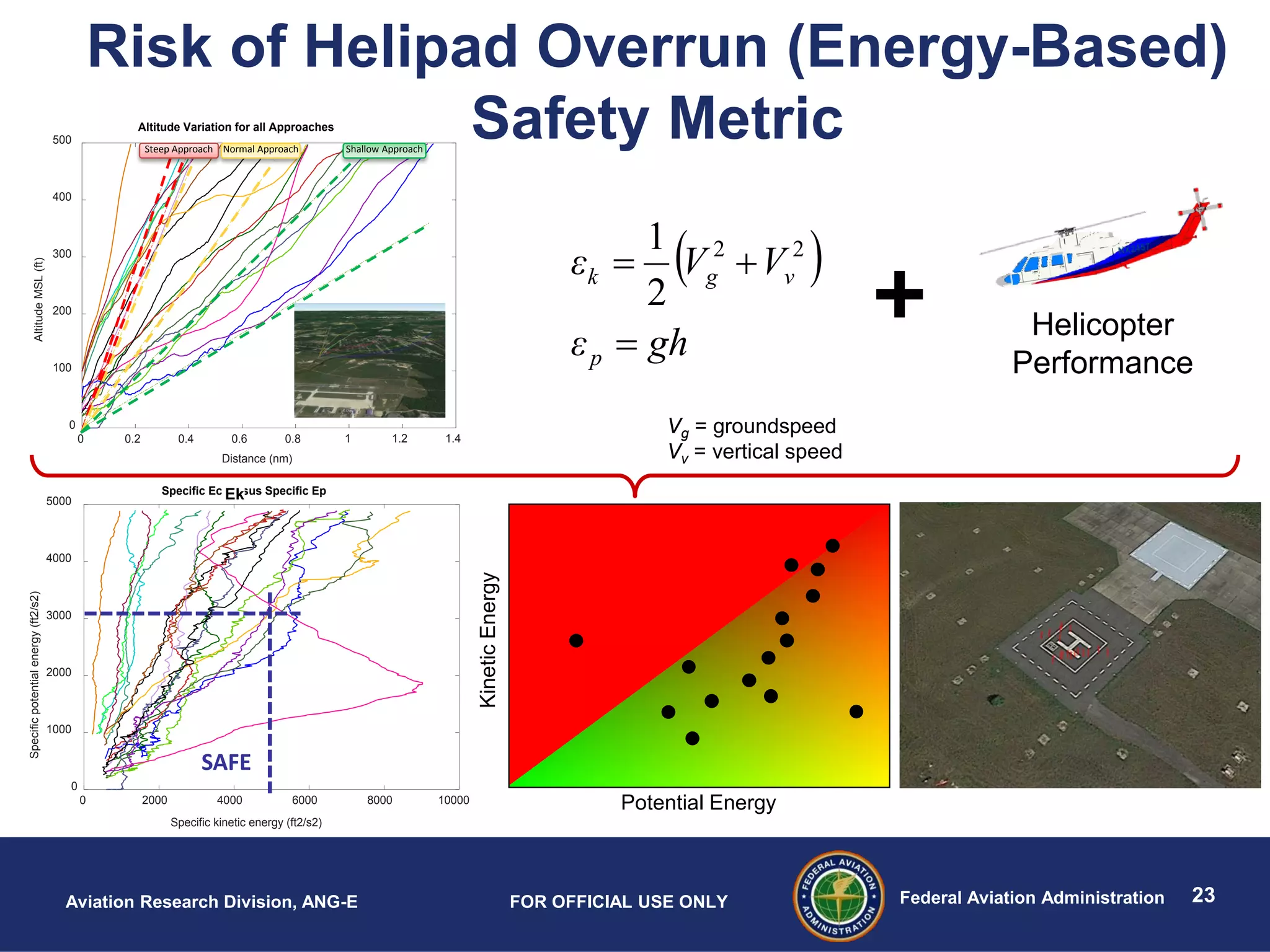
Risk of Helipad Overrun (Energy-Based)
Safety Metric
Distance (nm)
0 0.2 0.4 0.6 0.8 1 1.2 1.4
AltitudeMSL(ft)
0
100
200
300
400
500
Altitude Variation for all Approaches
Steep Approach Normal Approach Shallow Approach
Potential Energy
KineticEnergy
( )
ghε
VVε
p
vgk
=
+= 22
2
1
Helicopter
Performance
Specific kinetic energy (ft2/s2)
0 2000 4000 6000 8000 10000
Specificpotentialenergy(ft2/s2)
0
1000
2000
3000
4000
5000
Specific Ec versus Specific EpEk
Vg = groundspeed
Vv = vertical speed
SAFE
24Federal Aviation AdministrationAviation Research Division, ANG-E FOR OFFICIAL USE ONLY
HFDM WITH DATA-ENHANCED
HELICOPTER PERFORMANCE
MODELS
25Federal Aviation AdministrationAviation Research Division, ANG-E FOR OFFICIAL USE ONLY
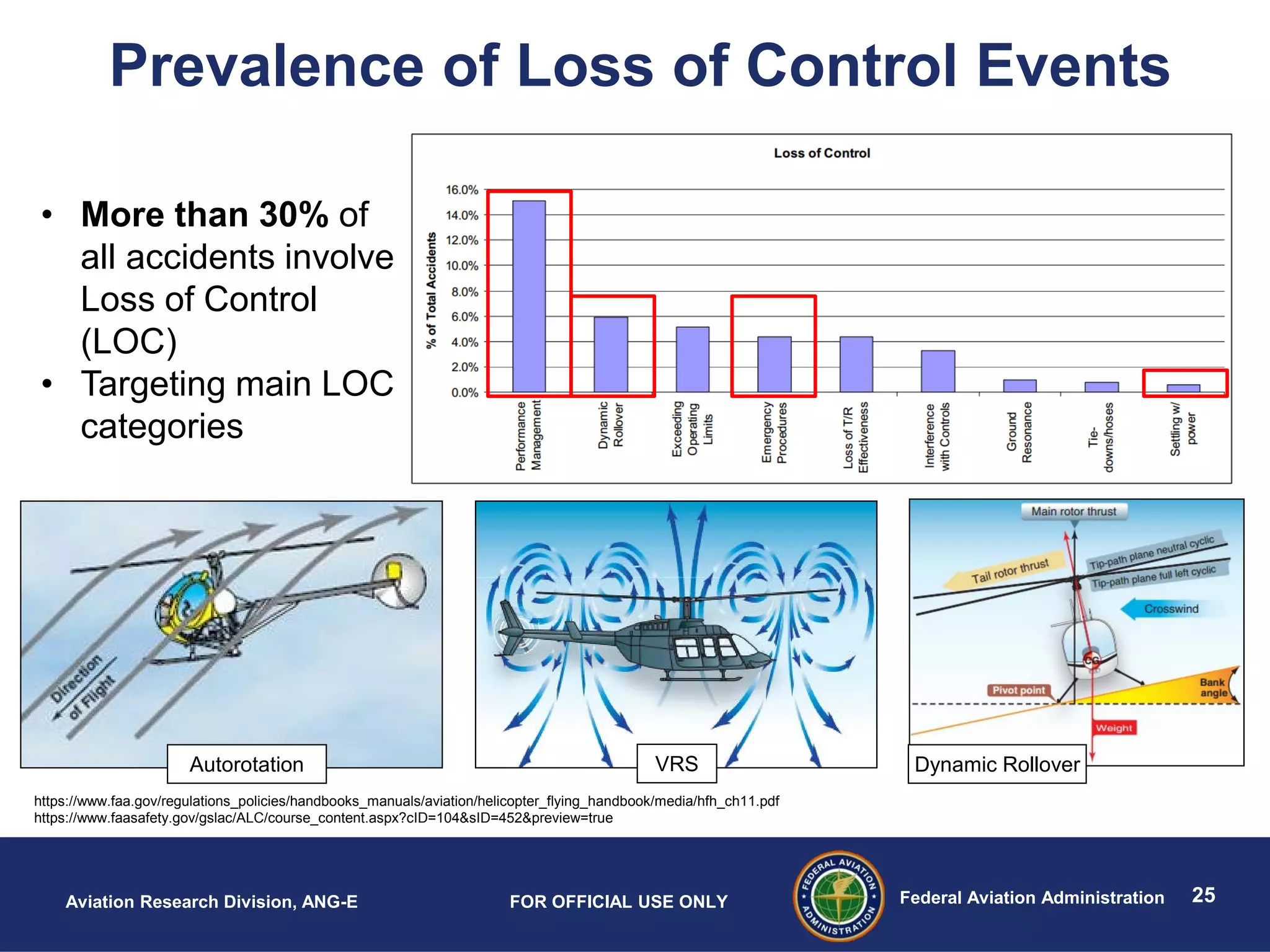
Prevalence of Loss of Control Events
25
https://www.faa.gov/regulations_policies/handbooks_manuals/aviation/helicopter_flying_handbook/media/hfh_ch11.pdf
https://www.faasafety.gov/gslac/ALC/course_content.aspx?cID=104&sID=452&preview=true
• More than 30% of
all accidents involve
Loss of Control
(LOC)
• Targeting main LOC
categories
Autorotation VRS Dynamic Rollover
26Federal Aviation AdministrationAviation Research Division, ANG-E FOR OFFICIAL USE ONLY
Improved Fidelity of Helicopter
Performance Models
Power available
Autorotation possible at these forward
velocities, at the specified descent rate
-Powerrequired+
ΔP
Power required
Increasedescentrate
Autorotation Vortex Ring State Dynamic Roll Over
27Federal Aviation AdministrationAviation Research Division, ANG-E FOR OFFICIAL USE ONLY
Vz/vh
Vx/vh
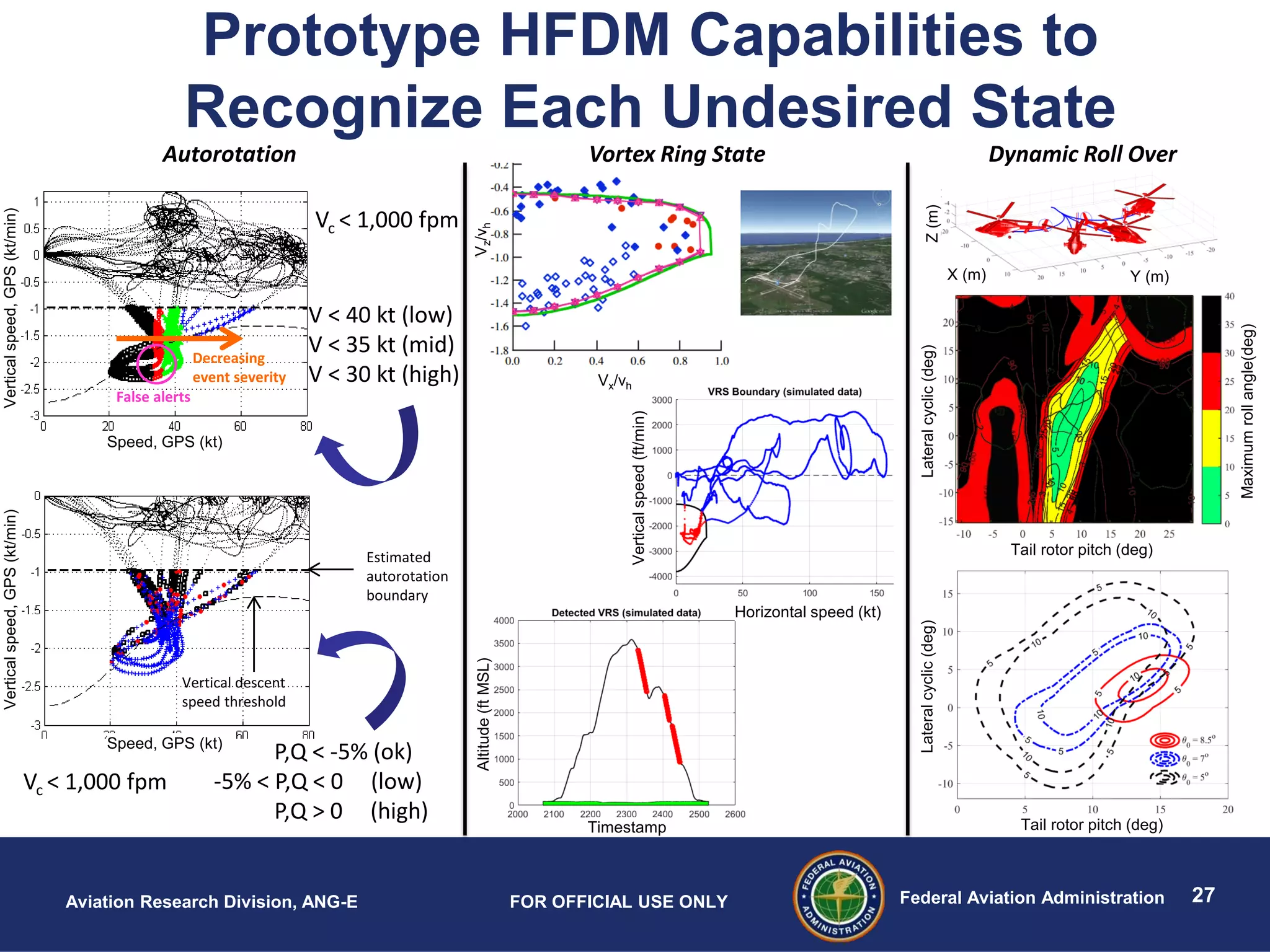
Prototype HFDM Capabilities to
Recognize Each Undesired State
Autorotation Vortex Ring State Dynamic Roll Over
Vc < 1,000 fpm
Speed, GPS (kt)
Verticalspeed,GPS(kt/min)
Speed, GPS (kt)
Verticalspeed,GPS(kt/min)
Tail rotor pitch (deg)
Lateralcyclic(deg)
Tail rotor pitch (deg)
Lateralcyclic(deg)
Maximumrollangle(deg)
Y (m)X (m)
Z(m)
P,Q < -5% (ok)
-5% < P,Q < 0 (low)
P,Q > 0 (high)
Verticalspeed(ft/min)
Horizontal speed (kt)
Timestamp
Altitude(ftMSL)
Horizontal speed (kt)
Vc < 1,000 fpm
V < 40 kt (low)
V < 35 kt (mid)
V < 30 kt (high)
False alerts
Vertical descent
speed threshold
Estimated
autorotation
boundary
Decreasing
event severity
28Federal Aviation AdministrationAviation Research Division, ANG-E FOR OFFICIAL USE ONLY
How? – Improved Fidelity of Helicopter
Performance Models
Autorotation VRS Dynamic Rollover
Actuator disk
Power available
Power required curve
Autorotation possible at these forward
velocities, at the specified descent rate
-Powerrequired+
ΔP
Power required
Increasedescentrate
29Federal Aviation AdministrationAviation Research Division, ANG-E FOR OFFICIAL USE ONLY
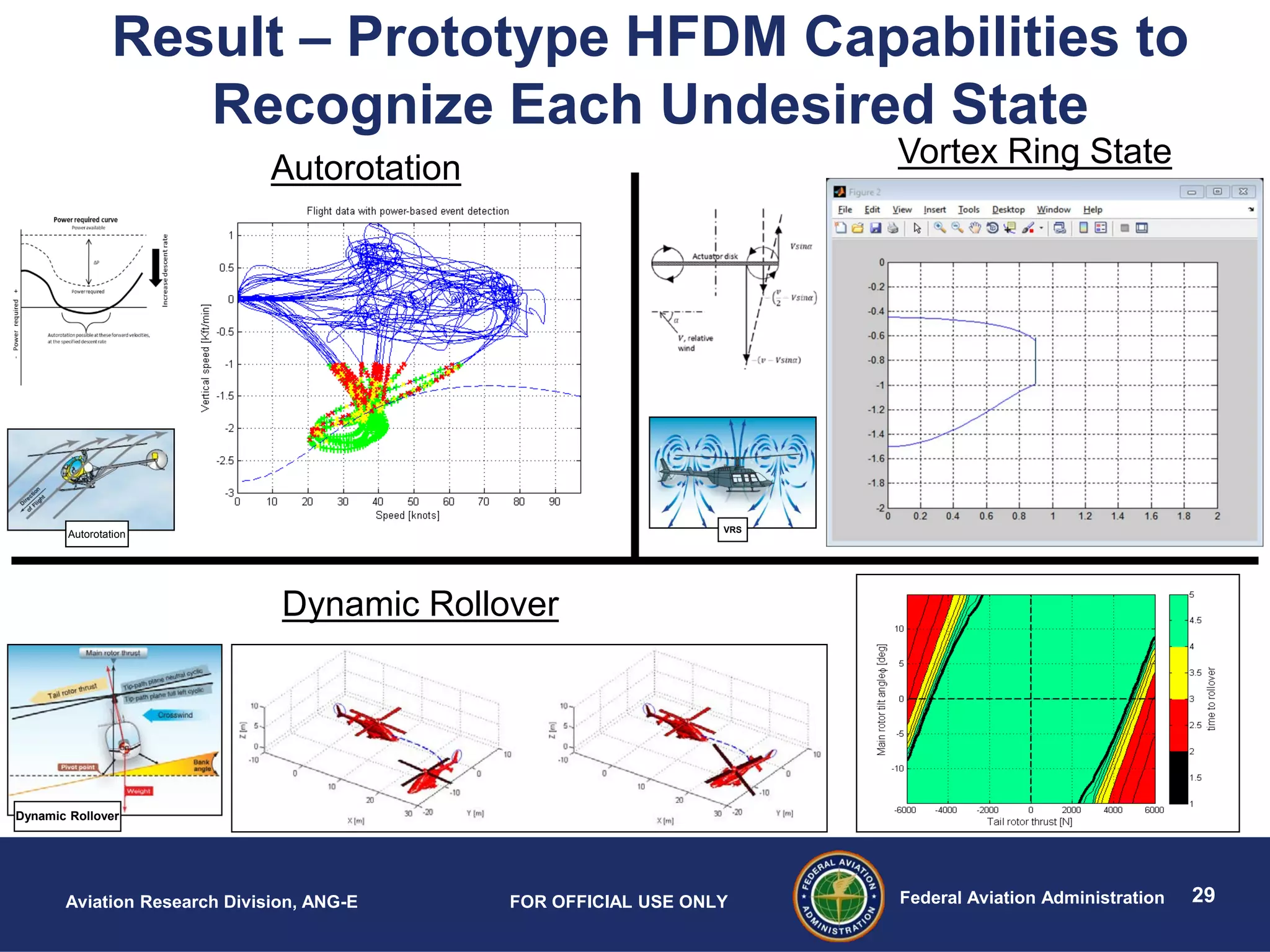
Result – Prototype HFDM Capabilities to
Recognize Each Undesired State
Dynamic Rollover
VRS
Autorotation
Dynamic Rollover
Vortex Ring StateAutorotation
30Federal Aviation AdministrationAviation Research Division, ANG-E FOR OFFICIAL USE ONLY
Future Work
• Enhance existing models
• Tackle other high priority safety
metrics/performance models:
– Proximity to Traffic
– Loss of Tail Rotor Effectiveness (LTE)
– Mast Bumping
– Autorotation Recovery (i.e. Vuichard Technique)
• Integrate HFDM data with Helicopter
Simulators for event playback/training
31Federal Aviation AdministrationAviation Research Division, ANG-E FOR OFFICIAL USE ONLY
PHASE OF FLIGHT AND
ANOMALY DETECTION WITH
DATA MINING
32Federal Aviation AdministrationAviation Research Division, ANG-E FOR OFFICIAL USE ONLY
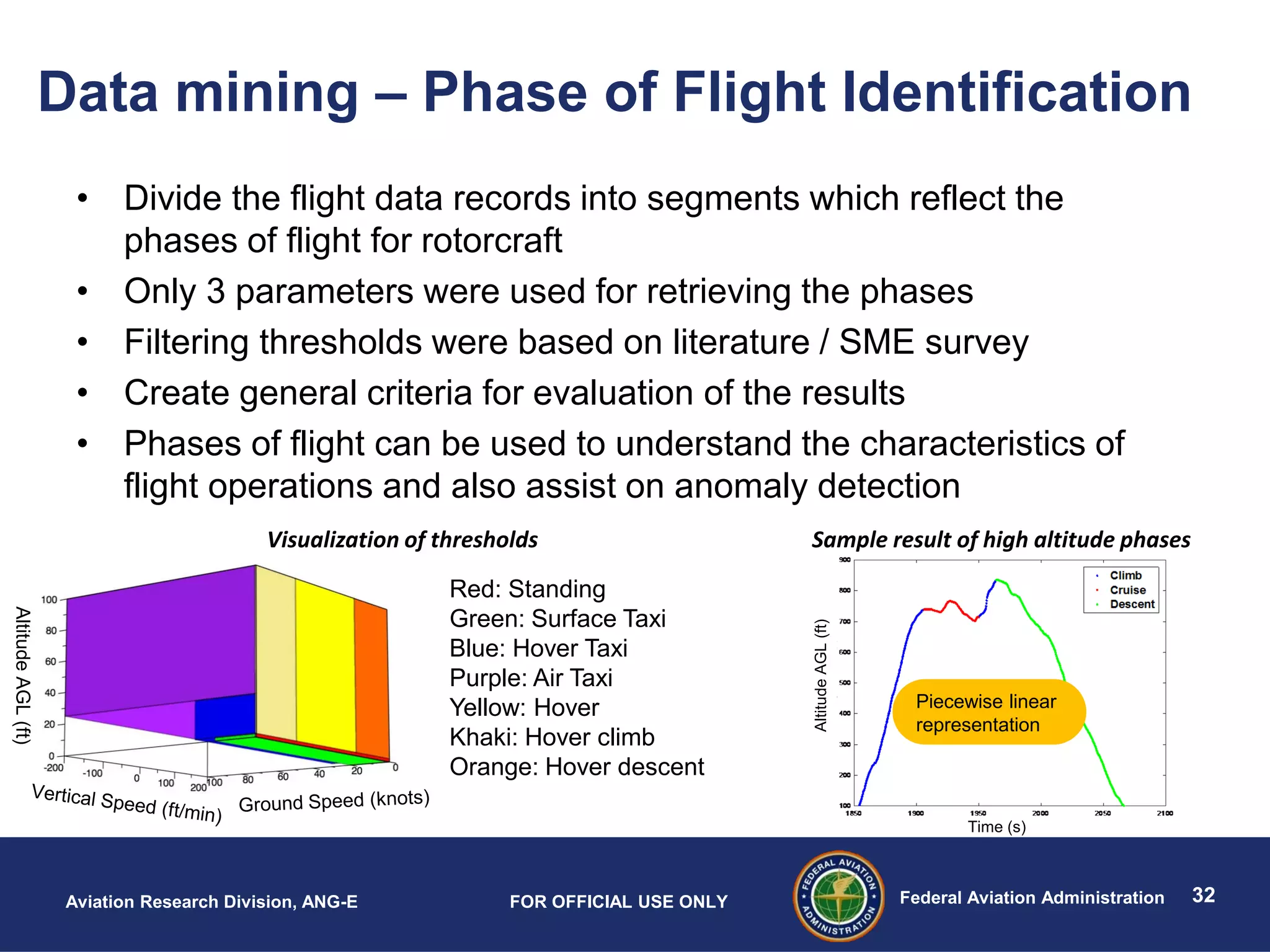
Data mining – Phase of Flight Identification
• Divide the flight data records into segments which reflect the
phases of flight for rotorcraft
• Only 3 parameters were used for retrieving the phases
• Filtering thresholds were based on literature / SME survey
• Create general criteria for evaluation of the results
• Phases of flight can be used to understand the characteristics of
flight operations and also assist on anomaly detection
Visualization of thresholds
AltitudeAGL(ft)
Red: Standing
Green: Surface Taxi
Blue: Hover Taxi
Purple: Air Taxi
Yellow: Hover
Khaki: Hover climb
Orange: Hover descent
Piecewise linear
representation
AltitudeAGL(ft) Time (s)
Sample result of high altitude phases
33Federal Aviation AdministrationAviation Research Division, ANG-E FOR OFFICIAL USE ONLY
COCKPIT AUDIO/VIDEO DATA
ANALYSIS FOR ROTORCRAFT
SAFETY
34Federal Aviation AdministrationAviation Research Division, ANG-E FOR OFFICIAL USE ONLY
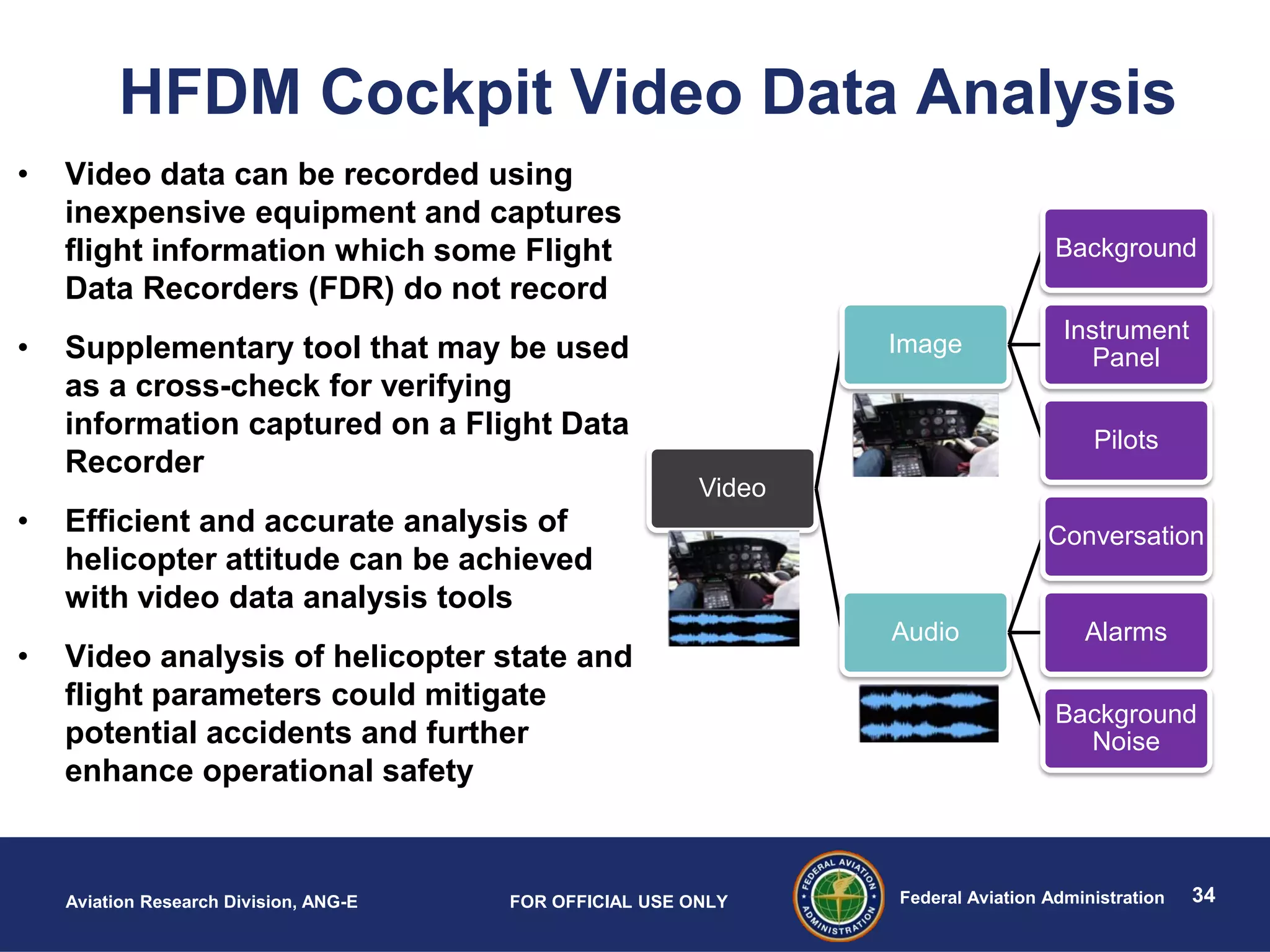
Video
Image
Background
Instrument
Panel
Pilots
Audio
Conversation
Alarms
Background
Noise
HFDM Cockpit Video Data Analysis
• Video data can be recorded using
inexpensive equipment and captures
flight information which some Flight
Data Recorders (FDR) do not record
• Supplementary tool that may be used
as a cross-check for verifying
information captured on a Flight Data
Recorder
• Efficient and accurate analysis of
helicopter attitude can be achieved
with video data analysis tools
• Video analysis of helicopter state and
flight parameters could mitigate
potential accidents and further
enhance operational safety
35Federal Aviation AdministrationAviation Research Division, ANG-E FOR OFFICIAL USE ONLY
Attitude Estimation using Data
Mining
Flight Information Extraction from
Instrument Panel
HFDM Cockpit Video Data
Processing/Analysis
36Federal Aviation AdministrationAviation Research Division, ANG-E FOR OFFICIAL USE ONLY
Audio Data Analysis –
Cockpit Alarm Detection and Identification
• The research team has developed a cockpit alarm detection and
identification algorithm composed of:
– Alarm detection: Short Time Fourier Transform (STFT) to obtain time-
based frequency information and Cumulative Sum Chart (CUSUM) for
statistical change detection
– Alarm identification: Correlation analysis with alarm database
Input:
audio data
Output:
Alarm
types and
occurrence
times
autopilot_disco
dash_MIDDLE
37Federal Aviation AdministrationAviation Research Division, ANG-E FOR OFFICIAL USE ONLY
Audio Data Analysis – Engine/Rotor Noise
• Cockpit audio is analyzed in the frequency domain, correlated with
flight parameters and represented as a statistical model
• The noise profile can be used to estimate engine data (such as
torque and/or rpm)
• If flight data is available, it can be compared with estimates to
identify anomalous behavior
Time (seconds)
1020 1040 1060 1080 1100 1120 1140 1160
%Torque
0
50
100
Flight parameters can be estimated by frequency analysis and the
statistical model
% Torque
20 30 40 50 60 70 80 90 100
Frequency(kHz)
16
18
20
22
24
26
28
30
32
1
2
Expected Noise
Engine has a higher than expected frequency for some
data points
38Federal Aviation AdministrationAviation Research Division, ANG-E FOR OFFICIAL USE ONLY
HADRAS (Helicopter Airborne Data
Recording and Analysis System)
(Note: Proposed Name)
HADRAS
39Federal Aviation AdministrationAviation Research Division, ANG-E FOR OFFICIAL USE ONLY
What is HADRAS?
• MITRE team is working with FAA on
initial HADRAS development
• General Aviation Airborne Recording Device
(GAARD) for Rotorcraft
• Mobile HFDM Device
• Interfaces with portable AHRS units and ADS-B
In devices
• Free Download from App Store on IOS devices
(when completed, exploring Android version as
well)
40Federal Aviation AdministrationAviation Research Division, ANG-E FOR OFFICIAL USE ONLY
‘Start Flight’ Screen Updates
User can select
Airport/Heliport
from the list:
o Provides a combo box
that lists selectable
location IDs of nearby
heliports
41Federal Aviation AdministrationAviation Research Division, ANG-E FOR OFFICIAL USE ONLY
‘Start Flight’ Screen Updates
User can select Mission Segment
from the list:
o Aerial Applications
o Aerial Photography & Filming
o Air Tour, Airborne Law Enforcement
o Corporate & Business Charter Ops
o Electronic News Gathering
o Environmental Survey, External Loads &
Heavy Lift
o Fire Control/Support
o Flight Training
o General Helicopter Ops (Not Mission Specific)
o Helicopter Air Ambulance
o Heli-Skiing, Offshore Ops
o Oil and Gas Support
o PEGASAS Research
o Personal Use
o Pipeline & Power Lines (HCC)
o Unmanned Aerial Systems
o Wildlife Management & Mustering
42Federal Aviation AdministrationAviation Research Division, ANG-E FOR OFFICIAL USE ONLY
‘Active Recording Screen’
Updates
Display Current
Phase of flight:
• Taxi
• Takeoff
• Initial Climb
• Climb
• Cruise
• Descent
• Initial approach
• Final approach
• Landing
• Cruise, etc.
43Federal Aviation AdministrationAviation Research Division, ANG-E FOR OFFICIAL USE ONLY
‘Flight Summary Screen’ Updates
Add ability to edit
departures/arrivals
heliports:
o Provide a combo box that lists
selectable location IDs of
nearby heliports
Add ‘Follow Flight Plan’ check
mark
44Federal Aviation AdministrationAviation Research Division, ANG-E FOR OFFICIAL USE ONLY
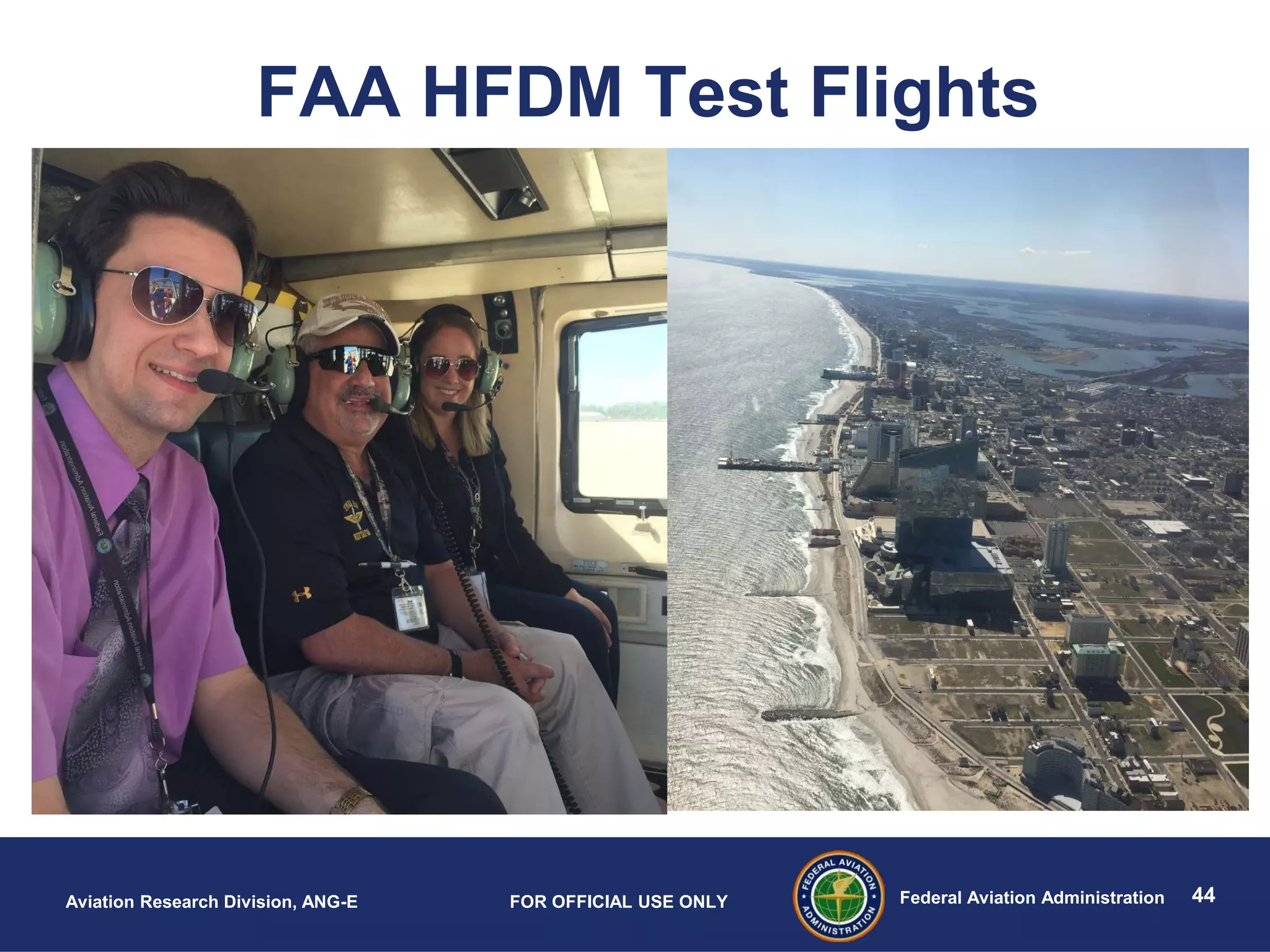
FAA HFDM Test Flights
45Federal Aviation AdministrationAviation Research Division, ANG-E FOR OFFICIAL USE ONLY
FAA R&D Test Flights & Data Analysis
• Test Platform
– FAA’s Sikorsky S-76A Helicopter,
Equipped with ADS-B Out (1090ES)
– Equipped with 8+ representative
HFDM/HFDR Devices from industry today
• Research Goals
– Identify, examine, and install several
different HFDM/HFDR units
– Collect/process data from each
HFDM/HFDR system for different
scenarios/conditions
• Research Outputs
– Helicopter FDM “Truth” Data to be used to
define and validate events, parameters,
exceedances, recording rates, etc. from
anomalous data
– Installation guidelines and optimal locations
for each system
46Federal Aviation AdministrationAviation Research Division, ANG-E FOR OFFICIAL USE ONLY
ROTORCRAFT FDM Repository –
How It Works & Participation
Data Flow Diagram
47Federal Aviation AdministrationAviation Research Division, ANG-E FOR OFFICIAL USE ONLY
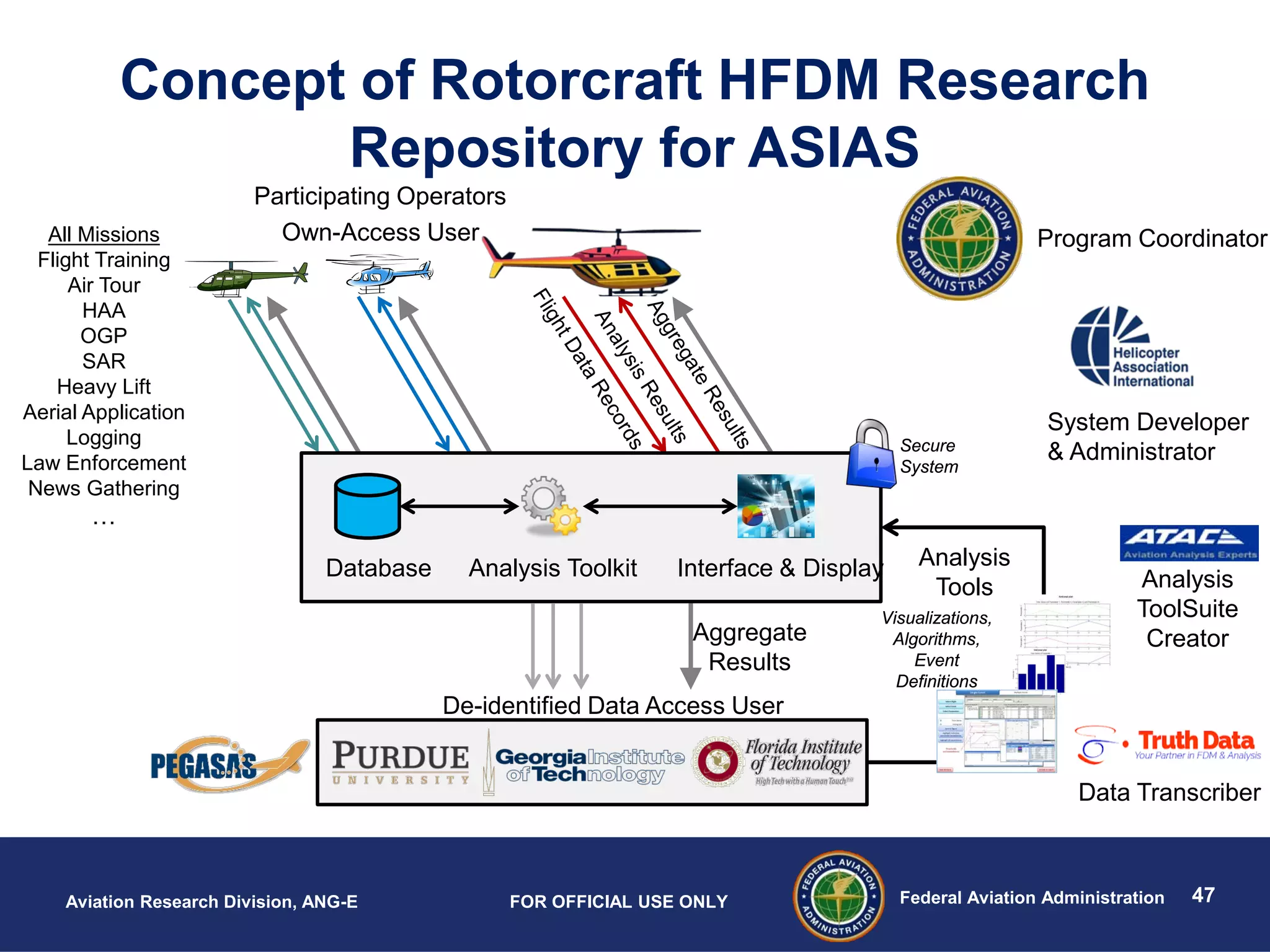
Concept of Rotorcraft HFDM Research
Repository for ASIAS
Participating Operators
Analysis
ToolSuite
Creator
Own-Access User
Aggregate
Results
De-identified Data Access User
Program Coordinator
Database Analysis Toolkit Interface & Display Analysis
Tools
All Missions
Flight Training
Air Tour
HAA
OGP
SAR
Heavy Lift
Aerial Application
Logging
Law Enforcement
News Gathering
…
Visualizations,
Algorithms,
Event
Definitions
Secure
System
System Developer
& Administrator
Data Transcriber
48Federal Aviation AdministrationAviation Research Division, ANG-E FOR OFFICIAL USE ONLY
HFDM Data Processing Architecture
49Federal Aviation AdministrationAviation Research Division, ANG-E FOR OFFICIAL USE ONLY
Helicopter Flight Data Analysis
Conceptual View
FDAU
Microphones
Cockpit camera
QAR
Data acquisition
Data processing
FDR processing computer
Data analysis
50Federal Aviation AdministrationAviation Research Division, ANG-E FOR OFFICIAL USE ONLY
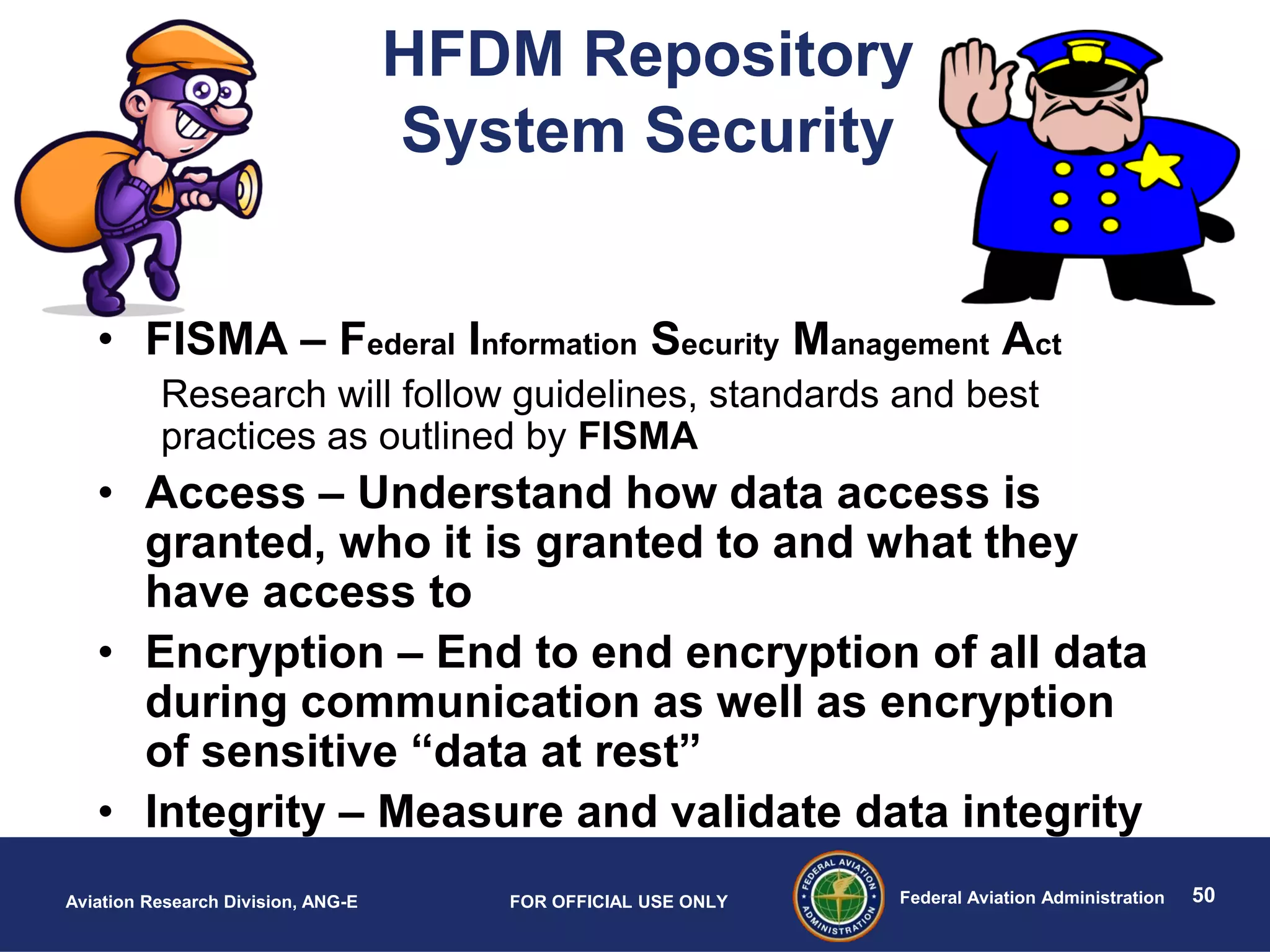
HFDM Repository
System Security
• FISMA – Federal Information Security Management Act
Research will follow guidelines, standards and best
practices as outlined by FISMA
• Access – Understand how data access is
granted, who it is granted to and what they
have access to
• Encryption – End to end encryption of all data
during communication as well as encryption
of sensitive “data at rest”
• Integrity – Measure and validate data integrity
51Federal Aviation AdministrationAviation Research Division, ANG-E FOR OFFICIAL USE ONLY
Rotorcraft HFDM
MOU
 Memorandum of Understanding (MOU)
• Legal document between Operator and HAI
• States what HAI will be responsible for and what Operator
will be responsible for
• Tailorable to each operator
• All information provided is protected from FOIA
• HFDM data de-identified at operator’s facility, point of when
received at HAI
* Separate MOU for FDM equipment usage
52Federal Aviation AdministrationAviation Research Division, ANG-E FOR OFFICIAL USE ONLY
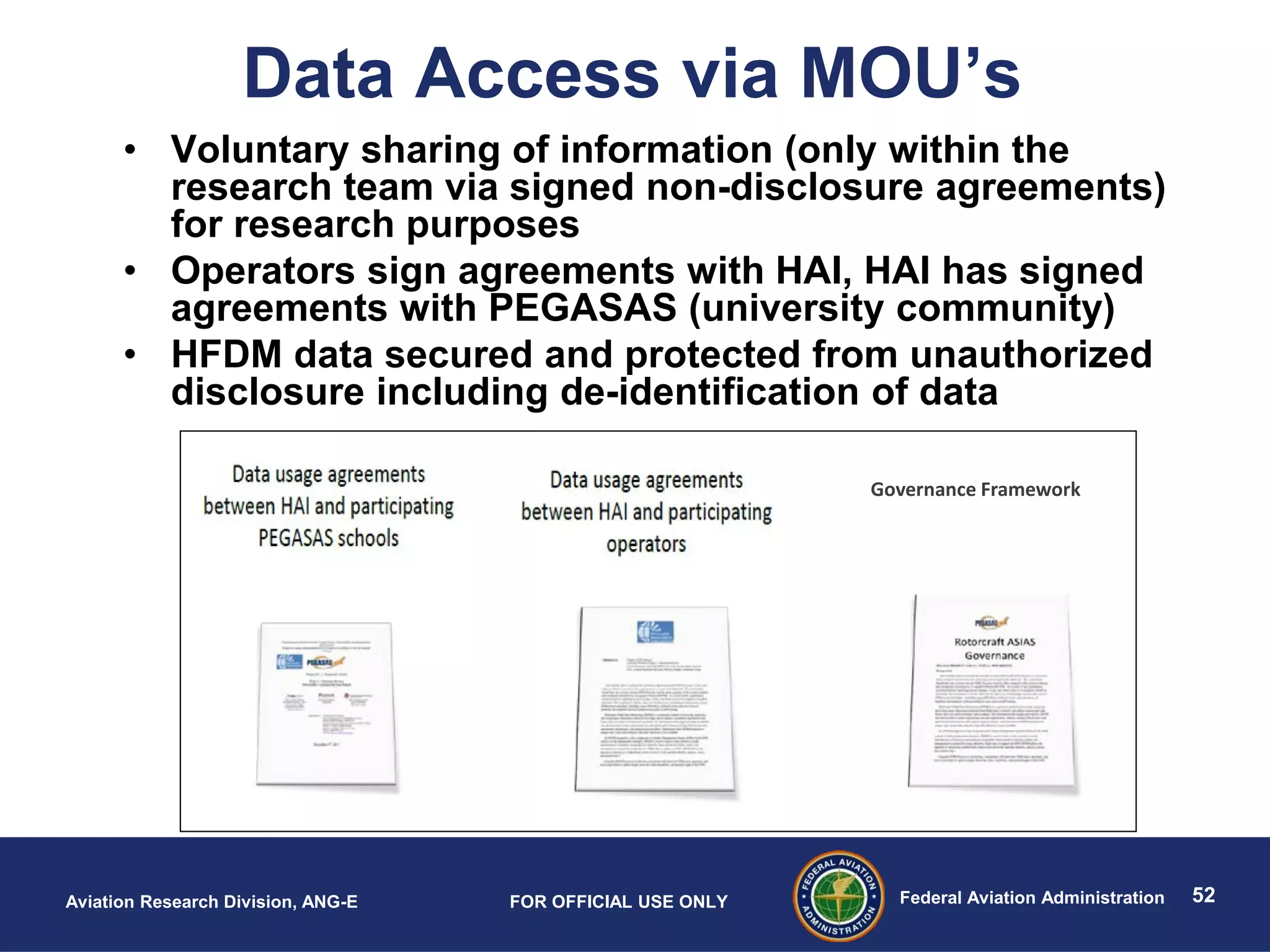
Data Access via MOU’s
• Voluntary sharing of information (only within the
research team via signed non-disclosure agreements)
for research purposes
• Operators sign agreements with HAI, HAI has signed
agreements with PEGASAS (university community)
• HFDM data secured and protected from unauthorized
disclosure including de-identification of data
Governance Framework
53Federal Aviation AdministrationAviation Research Division, ANG-E FOR OFFICIAL USE ONLY
Benefits to Participation
• HFDM research can serve as a central conduit for the
exchange of aviation safety information and
analytical capabilities across the community
– Provides insight into emerging risks that may not have been
detected through the assessment of an individual data
sources
– Data is shared and aggregated among participants to more
clearly see precursors to accidents, increasing its potential
value for analysis-based insight
– Implementation of Safety Enhancements will reduce the
likelihood of possible accidents
54Federal Aviation AdministrationAviation Research Division, ANG-E FOR OFFICIAL USE ONLY
Benefits to Participation
• Opportunity to participate in data collection activities that may lead to safety
enhancements
• Opportunity to participate in industry information sharing activities
• Opportunity to use aggregate data to identify systemic risks (beyond internal
reporting)
• Similar to the CAST model, a collaboration of industry and government experts
provide input on directed studies to solve issues in the NAS. Rotorcraft specific
areas could include:
– Operations around oil rigs
– Electronic news gathering ops
– Helicopter Air Ambulance ops
– Tour operators (traffic conflicts)
• Knowledge of “what you don’t know” (i.e. hidden risks/dangers) only visible via
sharing of information among parties
• Ability to promote increased situational awareness and safety within helicopter
operations
• Incorporate new safety analysis tools into helicopter operations
55Federal Aviation AdministrationAviation Research Division, ANG-E FOR OFFICIAL USE ONLY
How To Participate
• Cliff Johnson - FAA
– Email: charles.c.johnson@faa.gov
– Phone: (609)-485-6181
• LTC (ret) Keith M Cianfrani (HAI/FIT)
– Email: keith.ctr.cianfrani@rotor.com
– Phone: 267-377-5364
• Website: http://hfdm-asias.rotor.com
For More Information, or to Discuss Participation,
Please Contact:
56Federal Aviation AdministrationAviation Research Division, ANG-E FOR OFFICIAL USE ONLY
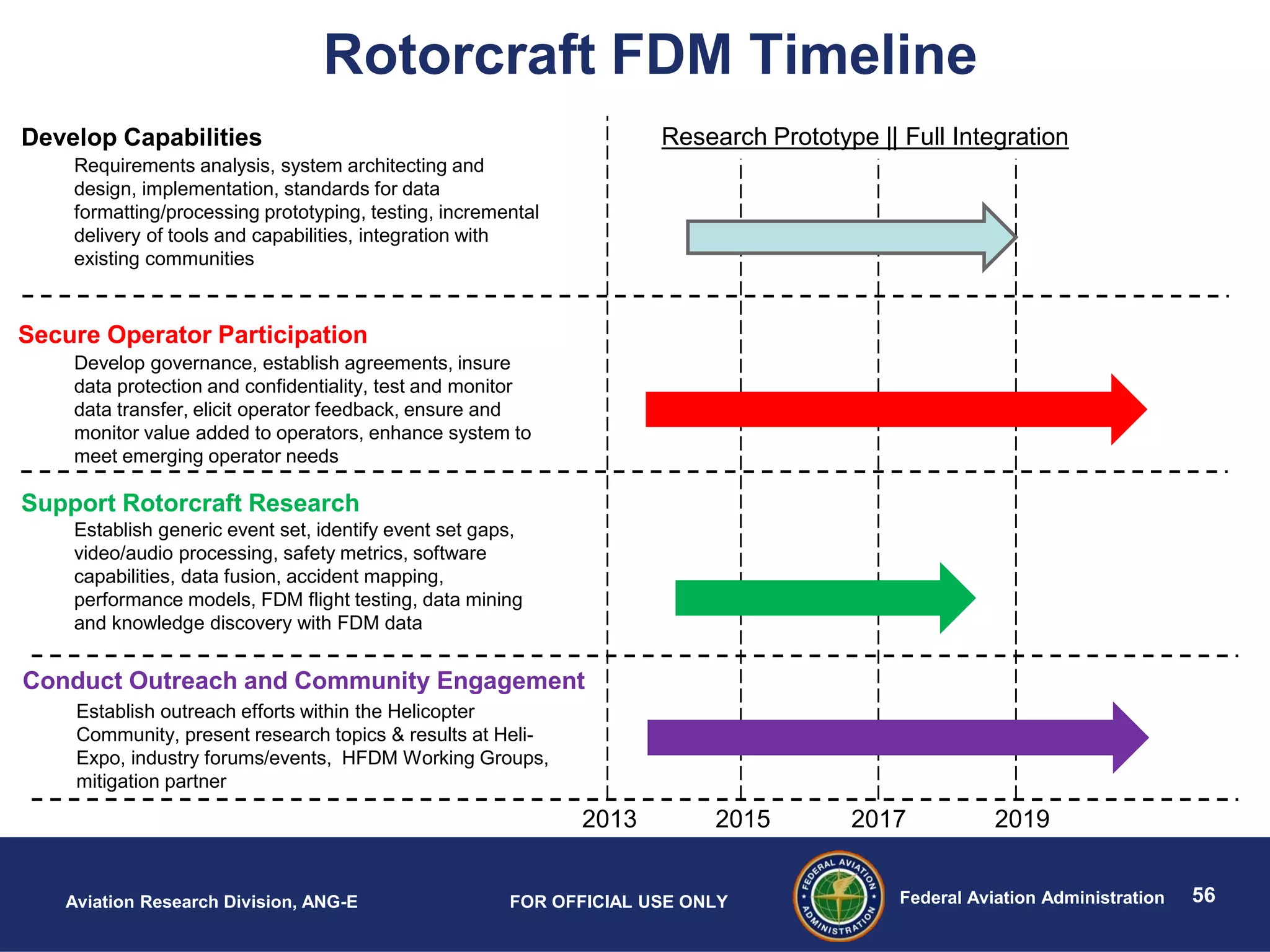
Rotorcraft FDM Timeline
Secure Operator Participation
Develop governance, establish agreements, insure
data protection and confidentiality, test and monitor
data transfer, elicit operator feedback, ensure and
monitor value added to operators, enhance system to
meet emerging operator needs
Develop Capabilities
Requirements analysis, system architecting and
design, implementation, standards for data
formatting/processing prototyping, testing, incremental
delivery of tools and capabilities, integration with
existing communities
Support Rotorcraft Research
Establish generic event set, identify event set gaps,
video/audio processing, safety metrics, software
capabilities, data fusion, accident mapping,
performance models, FDM flight testing, data mining
and knowledge discovery with FDM data
Conduct Outreach and Community Engagement
Establish outreach efforts within the Helicopter
Community, present research topics & results at Heli-
Expo, industry forums/events, HFDM Working Groups,
mitigation partner
2013 2015 2017 2019
Research Prototype || Full Integration
57Federal Aviation AdministrationAviation Research Division, ANG-E FOR OFFICIAL USE ONLY
Questions?

2017 Heli-Expo - Helicopter FDM Research.

  • 1.
    Federal Aviation Administration Helicopter Flight DataMonitoring (HFDM) for ASIAS Presented to: Rotor Safety Challenge Session @ HeliExpo. 2017 Presented By: Cliff Johnson, Research Program Manager/Engineer, FAA William J. Hughes Technical Center, Atlantic City, NJ Kyle Collins, Ph.D. Principal Investigator, Georgia Technical University, Atlanta, GA Keith M Cianfrani, LTC (ret), MAS. RSP, Helicopter Association International (HAI)/Florida Institute of Technology (FIT) Mar. 8, 2017
  • 2.
    2Federal Aviation AdministrationAviationResearch Division, ANG-E FOR OFFICIAL USE ONLY Briefing Outline • Introduction and Overview – ASIAS & HFDM Research • HFDM Research Team/Partners • Update on Rotorcraft HFDM Research – Defining Safety Metrics for Rotorcraft Operations – HFDM with Data-Enhanced Helicopter Performance Models – Cockpit Video Data Analysis For Rotorcraft Safety – Phase of flight and Anomaly detection with Data Mining – Helicopter Airborne Data Recording and Analysis System (in development) – HFDM Flight Testing • Participation in HFDM Research for ASIAS/How it Works/Outreach/Benefits • Questions?
  • 3.
    3Federal Aviation AdministrationAviationResearch Division, ANG-E FOR OFFICIAL USE ONLY ASIAS – Aviation Safety Information Analysis and Sharing • Q: What is ASIAS? • A: The Aviation Safety Information Analysis and Sharing (ASIAS) program is a collaborative government and industry initiative to share and analyze data to proactively discover system safety concerns before accidents or incidents occur, leading to timely mitigation and prevention.
  • 4.
    4Federal Aviation AdministrationAviationResearch Division, ANG-E FOR OFFICIAL USE ONLY HFDM Research for ASIAS What are we doing? Rotorcraft research is underway to develop more robust helicopter data and new analytical tools designed for the unique nature of helicopter operations. HFDM research lays the foundation for future helicopter data analysis in ASIAS and supports the USHST’s efforts to reduce the helicopter fatal accident rate. This research will: • Collect flight data from commercial, government, flight training, and other large and small operators from various mission segments to be used for analysis; • Explore flight data monitoring as a voluntary means to improve safety across the industry; • Develop secure, confidential, and protected safety analysis of aggregate flight data records; • Support risk mitigation efforts through the ASIAS program.
  • 5.
    5Federal Aviation AdministrationAviationResearch Division, ANG-E FOR OFFICIAL USE ONLY HFDM Research for ASIAS What are we not doing? Rotorcraft HFDM Research for ASIAS & the ASIAS Program is not: • A replacement for an operator’s HFOQA/HFDM Program or HFOQA/HFDM Vendor’s Service • An FAA certification program • An FAA enforcement program • Mandatory (all participation is voluntary)
  • 6.
    6Federal Aviation AdministrationAviationResearch Division, ANG-E FOR OFFICIAL USE ONLY Why Rotorcraft FDM Research Supporting ASIAS? 2-Mar-17
  • 7.
    7Federal Aviation AdministrationAviationResearch Division, ANG-E FOR OFFICIAL USE ONLY U.S. Helicopter Fatal Accident Rate Flight hours source: -5 Yr Baseline from FAA's GA & Part 135 Activity Survey. -2016 from FAA's Aerospace Forecast FY2016-2036. Goal by end of CY 2019: 20% reduction from 5 year baseline
  • 8.
    8Federal Aviation AdministrationAviationResearch Division, ANG-E FOR OFFICIAL USE ONLY 2017 NTSB Most Wanted List – Expand Recorder Use to Enhance Safety
  • 9.
    9Federal Aviation AdministrationAviationResearch Division, ANG-E FOR OFFICIAL USE ONLY But what’s in a Flight Data Recorder/Flight Data Monitoring System? • Helicopter Flight Data Recorders/Helicopter Flight Data Monitoring Devices typically consist of one or more of the following items: – Flight Data Recorder – Audio/Video Sensors – Attitude and Heading Reference System (AHRS) – Accelerometers/Gyroscopes – GPS Inputs – Avionics (Flight Management System, Air Data Computer, etc.) Inputs (usually ARINC-429 or ARINC-717) – Engine/Rotor Inputs/Sensors
  • 10.
    10Federal Aviation Administration WAAS AlaskaWRS Telco Analysis Helicopter Flight Data Recorder (FDR) – Standalone device or interfaced with on-board sensors Power supply (aux GPS signal) Power supply http://www.aircraftspruce.com/catalog/avpages/garminAntenna.php https://www.appareo.com/aviation/flight-data-monitoring/ ARINC 717/other standard FDAU Microphones Cockpit camera North FDS QAR Engine monitoring (Intercom audio) GPS Antenna Satellite Antenna GPS/AHRS http://www.expaircraft.com/freeflight.htm http://www.northfds.com/products.html Vision 1000 Tablet
  • 11.
    11Federal Aviation Administration WAAS AlaskaWRS Telco Analysis Installation Locations - FDR Safetyplane V4 (Helicom V1) recorder in cockpit or remotely located http://easa.europa.eu/system/files/dfu/Final_Report_EASA.2008-7.pdf https://www.appareo.com/aviation/flight-data-monitoring/vision-1000/ Appareo Vision 1000 mounted in AS350 cockpit
  • 12.
    12Federal Aviation Administration WAAS AlaskaWRS Telco Analysis Installation Locations – Visual Display http://enstromhelicopter.com/2013/03/enstrom-selects-garmin-g1000h- integrated-flight-deck-for-480b/ http://www.verticalmag.com/features/features_article/DigitallyEnhanced/ http://www.sportys.com/pilotshop/flight-gear-ipad-mini-kneeboard.html
  • 13.
    13Federal Aviation AdministrationAviationResearch Division, ANG-E FOR OFFICIAL USE ONLY Installation Locations – GPS Antenna, AHRS http://www.robinsonheli.com/manuals/r22_mm/r22_mm_14.pdf http://www.grounddatasolutions.com/airbornelaser.html http://www.arrowaviationco.com/site321.php Bell 212Bell 412 http://shop.avionics.co.nz/lcr100-stc-bell&view=mobile#container GPS Antenna AHRS GPS Antenna AHRS GPS Antenna
  • 14.
    14Federal Aviation AdministrationAviationResearch Division, ANG-E FOR OFFICIAL USE ONLY Rotorcraft FDM Research Supporting ASIAS
  • 15.
    15Federal Aviation AdministrationAviationResearch Division, ANG-E FOR OFFICIAL USE ONLY FAA Helicopter Research Team Members Prof. Dimitri Mavris – PI Kyle Collins, Ph.D. – Co-PI Simon Briceno Alexia Payan Hsiang-Jui Chin Po-Nien Lin Prof. Karen Marais – PI Inseok Hwang Sanghuyn Shin Prof. Stephen Cusick – PI Keith Cianfrani Cliff Johnson – Rotorcraft FDM Research Task Lead Lacey Thompson – Ops Research Analyst FAA WJHTC Atlantic City, NJ Alex Alshtein – ASIAS Group Leader Nicky Armour – MITRE-CASSD *Note: MITRE role involves collaboration with research activities for integration with ASIAS. Ed DiCampli, Chief Operating Officer Robert Liguori, IT Consultant Keith Cianfrani, FDM Specialist/Outreach Tyler Travis Lana Manovych
  • 16.
    16Federal Aviation AdministrationAviationResearch Division, ANG-E FOR OFFICIAL USE ONLY Helicopter Flight Data Monitoring Research Partners Entities Involved: • USHST • IHST • Helicopter Flight Data Monitoring Manufacturers • Helicopter Original Equipment (OEM) Manufacturers • Helicopter Operators • Many more, too many to list… • We highly value, encourage, and need industry participation in this effort in order to make it a success!!!
  • 17.
    17Federal Aviation AdministrationAviationResearch Division, ANG-E FOR OFFICIAL USE ONLY Rotorcraft FDM Research Analysis Capabilities Supports the USHST Goal of 20% Reduction in the Fatal Accident Rate for Helicopters by 2020  Safety Metrics  HFDM Analysis Techniques  HFDM Modeling Techniques  HFDM Cockpit Audio/Video Analysis  Data Mining for Safety Events  Identification of High-Risk Safety Events  Industry Involvement  Potential Mitigation Partner  FDM Equipment Working Group  Program Management  Outreach  Flight Tests  HFDM Device Integration & Calibration  Data Analysis  Modeling & Simulation  Outreach  Data Transcription  HFDM Research Repository  HFDM Architecture Design  HFDM Working Group
  • 18.
    18Federal Aviation AdministrationAviationResearch Division, ANG-E FOR OFFICIAL USE ONLY DEFINING SAFETY METRICS FOR ROTORCRAFT OPERATIONS
  • 19.
    19Federal Aviation AdministrationAviationResearch Division, ANG-E FOR OFFICIAL USE ONLY Safety Metrics for Rotorcraft Operations • Tackled so far: – Proximity to obstacles – Proximity to weather – Autorotation – Tip over taxi (roll-over) – Vortex Ring State (VRS) • In progress: – Unstabilized approach – Helipad overrun – Loss of Tail Rotor Effectiveness (LTE) High Priority In flight LOC Autorotation Unstabilized approach System failure/malfunctionCFIT Helipad overrun Proximity to Obstacles/Weather/Other aircraft On the ground Roll-over Medium priority In flight LOC LTE IMC Fuel low Close to ground Abnormal runway contact Vortex Ring State Unstabilized approach Hard landing Low priority In flight Bird strike External load On the ground Runway incursion/excursion Abrupt maneuver
  • 20.
    20Federal Aviation AdministrationAviationResearch Division, ANG-E FOR OFFICIAL USE ONLY Proximity to Obstacles Safety Metric FAA Digital Obstacle File (DOF) + Flight Data Records Speed vector Closure speed Closure Distance N E ϕ (lat,long) (lat,long) Kinematics Visualization (Multi-Flights) -84.55 -84.5 -84.45 -84.4 -84.35 -84.3 -84.25 33.76 33.78 33.8 33.82 33.84 33.86 33.88 33.9 33.92 Flight Paths and Location of Time Critical Obstacles Recording 1 Recording 2 Recording 3 Recording 4 Recording 5 Recording 6 Recording 7 Longitude Latitude 0.5 1 1.5 2 2.5 3 3.5 4 4.5 5 0 0.5 1 1.5 2 2.5 3 3.5 4 Distribution of Closure Times for Time Critical Obstacles Within the Safety Box Closure Time Counts Display obstacles located within a specified “closure time” from the helicopter (ex: 5 s) Location of “time critical” obstacles Dist. of closure times for “time critical” obst. Contour lines are closure times (0 to 30 seconds) Latitude: 33.85 Longitude: -84.36 Type: Building Quantity: 1 Height AGL: 355 ft Lighting: Flood Marking: None Closure Time: 4.9 s ClosureSpeed(kt) Distance to Obstacle (s)
  • 21.
    21Federal Aviation AdministrationAviationResearch Division, ANG-E FOR OFFICIAL USE ONLY W th it l l 1 2 3 4 5 6 0 10 20 30 40 50 60 Median, 25th and 75th percentiles of percentage of flight time spent at each weather severity level for all the flights considered (outliers are shown as red crosses) %ofRecordingTime Weather Severity Level Weather severity level 0 1 2 3 4 5 6 7 0 10 20 30 40 50 60 %ofRecordingTime Weather Severity Level More than ~10 flights CIWS Weather Severity Levels + Flight Data Records Vertical Integrated Liquid water (VIL) 1 2 3 4 5 6 0 10 20 30 40 50 60 Percent of flight time for flight spent at each weather severity level Recording 1 Recording 2 Recording 3 Recording 4 Recording 5 Recording 6 Recording 7 Recording 8 Weather Severity Level %ofRecordingTime -84.55 -84.5 -84.45 -84.4 -84.35 -84.3 -84.25 33.76 33.78 33.8 33.82 33.84 33.86 33.88 33.9 33.92 Recording 1 Recording 2 Recording 3 Recording 4 Recording 5 Recording 6 Recording 7 Recording 8 Longitude Latitude Less than ~10 flights Proximity to Weather Safety Metric -84.55 -84.5 -84.45 -84.4 -84.35 -84.3 -84.25 33.76 33.78 33.8 33.82 33.84 33.86 33.88 33.9 33.92 Flight #8 Longitude Latitude Black – Wx Sev. 1 Blue – Wx Sev. 2 Green – Wx Sev. 3 Yellow – Wx Sev. 4 Magenta – Wx Sev. 5 Red – Wx Sev. 6
  • 22.
    22Federal Aviation AdministrationAviationResearch Division, ANG-E FOR OFFICIAL USE ONLY Unstabilized Approach Safety Metric Dist. of Altitude Deviation Indicator Altitude Deviation Indicator Frequency Approach Angle Altitude Vertical Speed 50% of total path distance Average location of changes in approach parameters Frequency Start Ideal profile Deviation from Ideal Altitude Profile Altitude(ft) Path Distance (mile) Altitude(ft) Latitude (deg.) Longitude (deg.) Approach phases identification Altitude(ft) Time (min) Clustering of Approaches by Stability Levels Using Data Mining (k-mean) Approach Angle Deviation Indicator AltitudeDeviationIndicator Identified Approaches Alt. Profile of Flight Data (Most Stable) (Rather sable) (Less stable) (Mostly un stable)
  • 23.
    23Federal Aviation AdministrationAviationResearch Division, ANG-E FOR OFFICIAL USE ONLY Risk of Helipad Overrun (Energy-Based) Safety Metric Distance (nm) 0 0.2 0.4 0.6 0.8 1 1.2 1.4 AltitudeMSL(ft) 0 100 200 300 400 500 Altitude Variation for all Approaches Steep Approach Normal Approach Shallow Approach Potential Energy KineticEnergy ( ) ghε VVε p vgk = += 22 2 1 Helicopter Performance Specific kinetic energy (ft2/s2) 0 2000 4000 6000 8000 10000 Specificpotentialenergy(ft2/s2) 0 1000 2000 3000 4000 5000 Specific Ec versus Specific EpEk Vg = groundspeed Vv = vertical speed SAFE
  • 24.
    24Federal Aviation AdministrationAviationResearch Division, ANG-E FOR OFFICIAL USE ONLY HFDM WITH DATA-ENHANCED HELICOPTER PERFORMANCE MODELS
  • 25.
    25Federal Aviation AdministrationAviationResearch Division, ANG-E FOR OFFICIAL USE ONLY Prevalence of Loss of Control Events 25 https://www.faa.gov/regulations_policies/handbooks_manuals/aviation/helicopter_flying_handbook/media/hfh_ch11.pdf https://www.faasafety.gov/gslac/ALC/course_content.aspx?cID=104&sID=452&preview=true • More than 30% of all accidents involve Loss of Control (LOC) • Targeting main LOC categories Autorotation VRS Dynamic Rollover
  • 26.
    26Federal Aviation AdministrationAviationResearch Division, ANG-E FOR OFFICIAL USE ONLY Improved Fidelity of Helicopter Performance Models Power available Autorotation possible at these forward velocities, at the specified descent rate -Powerrequired+ ΔP Power required Increasedescentrate Autorotation Vortex Ring State Dynamic Roll Over
  • 27.
    27Federal Aviation AdministrationAviationResearch Division, ANG-E FOR OFFICIAL USE ONLY Vz/vh Vx/vh Prototype HFDM Capabilities to Recognize Each Undesired State Autorotation Vortex Ring State Dynamic Roll Over Vc < 1,000 fpm Speed, GPS (kt) Verticalspeed,GPS(kt/min) Speed, GPS (kt) Verticalspeed,GPS(kt/min) Tail rotor pitch (deg) Lateralcyclic(deg) Tail rotor pitch (deg) Lateralcyclic(deg) Maximumrollangle(deg) Y (m)X (m) Z(m) P,Q < -5% (ok) -5% < P,Q < 0 (low) P,Q > 0 (high) Verticalspeed(ft/min) Horizontal speed (kt) Timestamp Altitude(ftMSL) Horizontal speed (kt) Vc < 1,000 fpm V < 40 kt (low) V < 35 kt (mid) V < 30 kt (high) False alerts Vertical descent speed threshold Estimated autorotation boundary Decreasing event severity
  • 28.
    28Federal Aviation AdministrationAviationResearch Division, ANG-E FOR OFFICIAL USE ONLY How? – Improved Fidelity of Helicopter Performance Models Autorotation VRS Dynamic Rollover Actuator disk Power available Power required curve Autorotation possible at these forward velocities, at the specified descent rate -Powerrequired+ ΔP Power required Increasedescentrate
  • 29.
    29Federal Aviation AdministrationAviationResearch Division, ANG-E FOR OFFICIAL USE ONLY Result – Prototype HFDM Capabilities to Recognize Each Undesired State Dynamic Rollover VRS Autorotation Dynamic Rollover Vortex Ring StateAutorotation
  • 30.
    30Federal Aviation AdministrationAviationResearch Division, ANG-E FOR OFFICIAL USE ONLY Future Work • Enhance existing models • Tackle other high priority safety metrics/performance models: – Proximity to Traffic – Loss of Tail Rotor Effectiveness (LTE) – Mast Bumping – Autorotation Recovery (i.e. Vuichard Technique) • Integrate HFDM data with Helicopter Simulators for event playback/training
  • 31.
    31Federal Aviation AdministrationAviationResearch Division, ANG-E FOR OFFICIAL USE ONLY PHASE OF FLIGHT AND ANOMALY DETECTION WITH DATA MINING
  • 32.
    32Federal Aviation AdministrationAviationResearch Division, ANG-E FOR OFFICIAL USE ONLY Data mining – Phase of Flight Identification • Divide the flight data records into segments which reflect the phases of flight for rotorcraft • Only 3 parameters were used for retrieving the phases • Filtering thresholds were based on literature / SME survey • Create general criteria for evaluation of the results • Phases of flight can be used to understand the characteristics of flight operations and also assist on anomaly detection Visualization of thresholds AltitudeAGL(ft) Red: Standing Green: Surface Taxi Blue: Hover Taxi Purple: Air Taxi Yellow: Hover Khaki: Hover climb Orange: Hover descent Piecewise linear representation AltitudeAGL(ft) Time (s) Sample result of high altitude phases
  • 33.
    33Federal Aviation AdministrationAviationResearch Division, ANG-E FOR OFFICIAL USE ONLY COCKPIT AUDIO/VIDEO DATA ANALYSIS FOR ROTORCRAFT SAFETY
  • 34.
    34Federal Aviation AdministrationAviationResearch Division, ANG-E FOR OFFICIAL USE ONLY Video Image Background Instrument Panel Pilots Audio Conversation Alarms Background Noise HFDM Cockpit Video Data Analysis • Video data can be recorded using inexpensive equipment and captures flight information which some Flight Data Recorders (FDR) do not record • Supplementary tool that may be used as a cross-check for verifying information captured on a Flight Data Recorder • Efficient and accurate analysis of helicopter attitude can be achieved with video data analysis tools • Video analysis of helicopter state and flight parameters could mitigate potential accidents and further enhance operational safety
  • 35.
    35Federal Aviation AdministrationAviationResearch Division, ANG-E FOR OFFICIAL USE ONLY Attitude Estimation using Data Mining Flight Information Extraction from Instrument Panel HFDM Cockpit Video Data Processing/Analysis
  • 36.
    36Federal Aviation AdministrationAviationResearch Division, ANG-E FOR OFFICIAL USE ONLY Audio Data Analysis – Cockpit Alarm Detection and Identification • The research team has developed a cockpit alarm detection and identification algorithm composed of: – Alarm detection: Short Time Fourier Transform (STFT) to obtain time- based frequency information and Cumulative Sum Chart (CUSUM) for statistical change detection – Alarm identification: Correlation analysis with alarm database Input: audio data Output: Alarm types and occurrence times autopilot_disco dash_MIDDLE
  • 37.
    37Federal Aviation AdministrationAviationResearch Division, ANG-E FOR OFFICIAL USE ONLY Audio Data Analysis – Engine/Rotor Noise • Cockpit audio is analyzed in the frequency domain, correlated with flight parameters and represented as a statistical model • The noise profile can be used to estimate engine data (such as torque and/or rpm) • If flight data is available, it can be compared with estimates to identify anomalous behavior Time (seconds) 1020 1040 1060 1080 1100 1120 1140 1160 %Torque 0 50 100 Flight parameters can be estimated by frequency analysis and the statistical model % Torque 20 30 40 50 60 70 80 90 100 Frequency(kHz) 16 18 20 22 24 26 28 30 32 1 2 Expected Noise Engine has a higher than expected frequency for some data points
  • 38.
    38Federal Aviation AdministrationAviationResearch Division, ANG-E FOR OFFICIAL USE ONLY HADRAS (Helicopter Airborne Data Recording and Analysis System) (Note: Proposed Name) HADRAS
  • 39.
    39Federal Aviation AdministrationAviationResearch Division, ANG-E FOR OFFICIAL USE ONLY What is HADRAS? • MITRE team is working with FAA on initial HADRAS development • General Aviation Airborne Recording Device (GAARD) for Rotorcraft • Mobile HFDM Device • Interfaces with portable AHRS units and ADS-B In devices • Free Download from App Store on IOS devices (when completed, exploring Android version as well)
  • 40.
    40Federal Aviation AdministrationAviationResearch Division, ANG-E FOR OFFICIAL USE ONLY ‘Start Flight’ Screen Updates User can select Airport/Heliport from the list: o Provides a combo box that lists selectable location IDs of nearby heliports
  • 41.
    41Federal Aviation AdministrationAviationResearch Division, ANG-E FOR OFFICIAL USE ONLY ‘Start Flight’ Screen Updates User can select Mission Segment from the list: o Aerial Applications o Aerial Photography & Filming o Air Tour, Airborne Law Enforcement o Corporate & Business Charter Ops o Electronic News Gathering o Environmental Survey, External Loads & Heavy Lift o Fire Control/Support o Flight Training o General Helicopter Ops (Not Mission Specific) o Helicopter Air Ambulance o Heli-Skiing, Offshore Ops o Oil and Gas Support o PEGASAS Research o Personal Use o Pipeline & Power Lines (HCC) o Unmanned Aerial Systems o Wildlife Management & Mustering
  • 42.
    42Federal Aviation AdministrationAviationResearch Division, ANG-E FOR OFFICIAL USE ONLY ‘Active Recording Screen’ Updates Display Current Phase of flight: • Taxi • Takeoff • Initial Climb • Climb • Cruise • Descent • Initial approach • Final approach • Landing • Cruise, etc.
  • 43.
    43Federal Aviation AdministrationAviationResearch Division, ANG-E FOR OFFICIAL USE ONLY ‘Flight Summary Screen’ Updates Add ability to edit departures/arrivals heliports: o Provide a combo box that lists selectable location IDs of nearby heliports Add ‘Follow Flight Plan’ check mark
  • 44.
    44Federal Aviation AdministrationAviationResearch Division, ANG-E FOR OFFICIAL USE ONLY FAA HFDM Test Flights
  • 45.
    45Federal Aviation AdministrationAviationResearch Division, ANG-E FOR OFFICIAL USE ONLY FAA R&D Test Flights & Data Analysis • Test Platform – FAA’s Sikorsky S-76A Helicopter, Equipped with ADS-B Out (1090ES) – Equipped with 8+ representative HFDM/HFDR Devices from industry today • Research Goals – Identify, examine, and install several different HFDM/HFDR units – Collect/process data from each HFDM/HFDR system for different scenarios/conditions • Research Outputs – Helicopter FDM “Truth” Data to be used to define and validate events, parameters, exceedances, recording rates, etc. from anomalous data – Installation guidelines and optimal locations for each system
  • 46.
    46Federal Aviation AdministrationAviationResearch Division, ANG-E FOR OFFICIAL USE ONLY ROTORCRAFT FDM Repository – How It Works & Participation Data Flow Diagram
  • 47.
    47Federal Aviation AdministrationAviationResearch Division, ANG-E FOR OFFICIAL USE ONLY Concept of Rotorcraft HFDM Research Repository for ASIAS Participating Operators Analysis ToolSuite Creator Own-Access User Aggregate Results De-identified Data Access User Program Coordinator Database Analysis Toolkit Interface & Display Analysis Tools All Missions Flight Training Air Tour HAA OGP SAR Heavy Lift Aerial Application Logging Law Enforcement News Gathering … Visualizations, Algorithms, Event Definitions Secure System System Developer & Administrator Data Transcriber
  • 48.
    48Federal Aviation AdministrationAviationResearch Division, ANG-E FOR OFFICIAL USE ONLY HFDM Data Processing Architecture
  • 49.
    49Federal Aviation AdministrationAviationResearch Division, ANG-E FOR OFFICIAL USE ONLY Helicopter Flight Data Analysis Conceptual View FDAU Microphones Cockpit camera QAR Data acquisition Data processing FDR processing computer Data analysis
  • 50.
    50Federal Aviation AdministrationAviationResearch Division, ANG-E FOR OFFICIAL USE ONLY HFDM Repository System Security • FISMA – Federal Information Security Management Act Research will follow guidelines, standards and best practices as outlined by FISMA • Access – Understand how data access is granted, who it is granted to and what they have access to • Encryption – End to end encryption of all data during communication as well as encryption of sensitive “data at rest” • Integrity – Measure and validate data integrity
  • 51.
    51Federal Aviation AdministrationAviationResearch Division, ANG-E FOR OFFICIAL USE ONLY Rotorcraft HFDM MOU  Memorandum of Understanding (MOU) • Legal document between Operator and HAI • States what HAI will be responsible for and what Operator will be responsible for • Tailorable to each operator • All information provided is protected from FOIA • HFDM data de-identified at operator’s facility, point of when received at HAI * Separate MOU for FDM equipment usage
  • 52.
    52Federal Aviation AdministrationAviationResearch Division, ANG-E FOR OFFICIAL USE ONLY Data Access via MOU’s • Voluntary sharing of information (only within the research team via signed non-disclosure agreements) for research purposes • Operators sign agreements with HAI, HAI has signed agreements with PEGASAS (university community) • HFDM data secured and protected from unauthorized disclosure including de-identification of data Governance Framework
  • 53.
    53Federal Aviation AdministrationAviationResearch Division, ANG-E FOR OFFICIAL USE ONLY Benefits to Participation • HFDM research can serve as a central conduit for the exchange of aviation safety information and analytical capabilities across the community – Provides insight into emerging risks that may not have been detected through the assessment of an individual data sources – Data is shared and aggregated among participants to more clearly see precursors to accidents, increasing its potential value for analysis-based insight – Implementation of Safety Enhancements will reduce the likelihood of possible accidents
  • 54.
    54Federal Aviation AdministrationAviationResearch Division, ANG-E FOR OFFICIAL USE ONLY Benefits to Participation • Opportunity to participate in data collection activities that may lead to safety enhancements • Opportunity to participate in industry information sharing activities • Opportunity to use aggregate data to identify systemic risks (beyond internal reporting) • Similar to the CAST model, a collaboration of industry and government experts provide input on directed studies to solve issues in the NAS. Rotorcraft specific areas could include: – Operations around oil rigs – Electronic news gathering ops – Helicopter Air Ambulance ops – Tour operators (traffic conflicts) • Knowledge of “what you don’t know” (i.e. hidden risks/dangers) only visible via sharing of information among parties • Ability to promote increased situational awareness and safety within helicopter operations • Incorporate new safety analysis tools into helicopter operations
  • 55.
    55Federal Aviation AdministrationAviationResearch Division, ANG-E FOR OFFICIAL USE ONLY How To Participate • Cliff Johnson - FAA – Email: charles.c.johnson@faa.gov – Phone: (609)-485-6181 • LTC (ret) Keith M Cianfrani (HAI/FIT) – Email: keith.ctr.cianfrani@rotor.com – Phone: 267-377-5364 • Website: http://hfdm-asias.rotor.com For More Information, or to Discuss Participation, Please Contact:
  • 56.
    56Federal Aviation AdministrationAviationResearch Division, ANG-E FOR OFFICIAL USE ONLY Rotorcraft FDM Timeline Secure Operator Participation Develop governance, establish agreements, insure data protection and confidentiality, test and monitor data transfer, elicit operator feedback, ensure and monitor value added to operators, enhance system to meet emerging operator needs Develop Capabilities Requirements analysis, system architecting and design, implementation, standards for data formatting/processing prototyping, testing, incremental delivery of tools and capabilities, integration with existing communities Support Rotorcraft Research Establish generic event set, identify event set gaps, video/audio processing, safety metrics, software capabilities, data fusion, accident mapping, performance models, FDM flight testing, data mining and knowledge discovery with FDM data Conduct Outreach and Community Engagement Establish outreach efforts within the Helicopter Community, present research topics & results at Heli- Expo, industry forums/events, HFDM Working Groups, mitigation partner 2013 2015 2017 2019 Research Prototype || Full Integration
  • 57.
    57Federal Aviation AdministrationAviationResearch Division, ANG-E FOR OFFICIAL USE ONLY Questions?