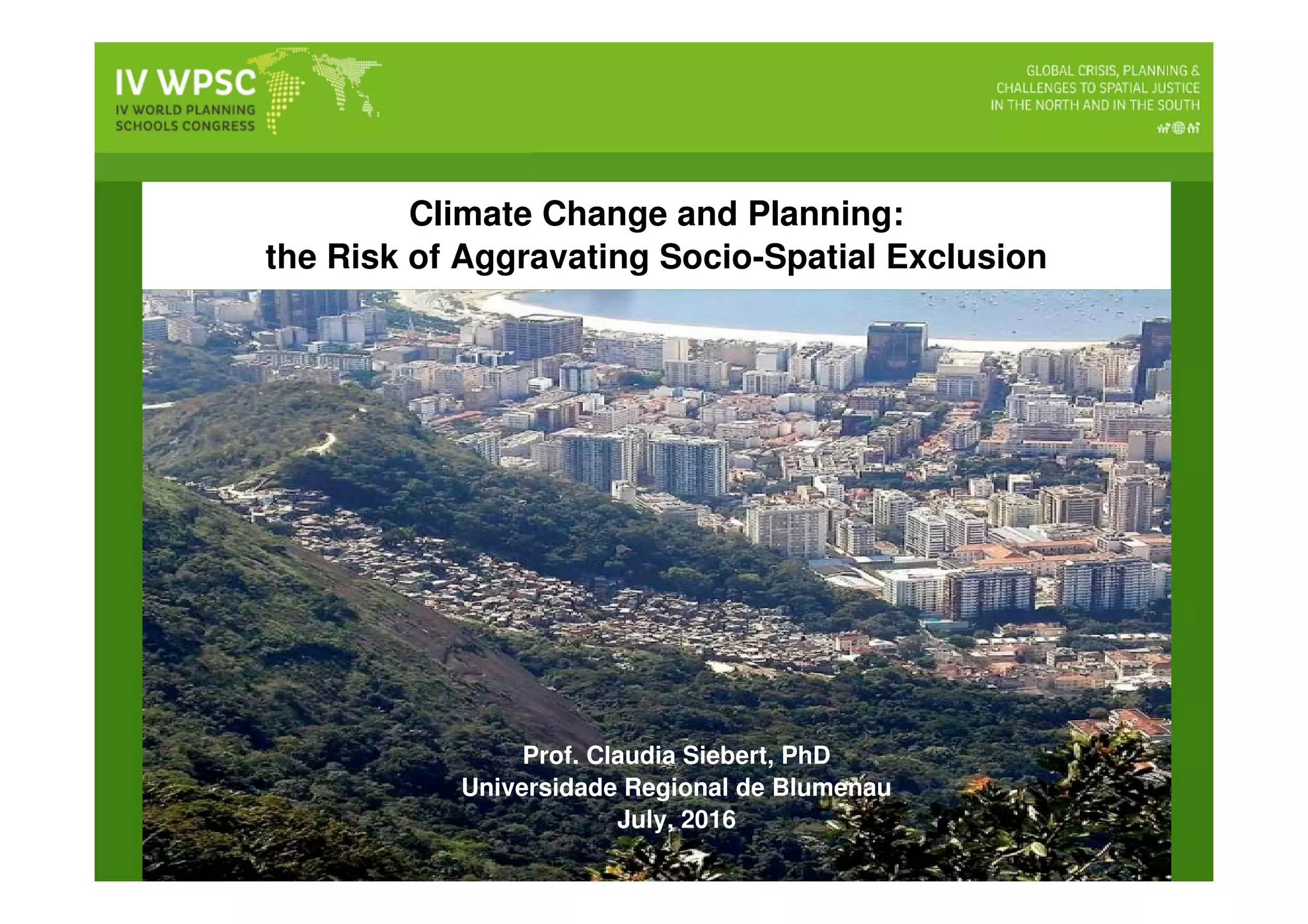
Climate Change and Planning:
the Risk of Aggravating Socio-Spatial Exclusion
Prof. Claudia Siebert, PhD
Universidade Regional de Blumenau
July, 2016
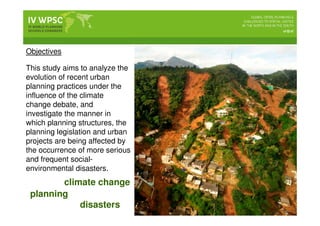
Objectives
This study aims to analyze the
evolution of recent urban
planning practices under the
influence of the climate
change debate, and
investigate the manner in
which planning structures, the
planning legislation and urban
projects are being affected by
the occurrence of more serious
and frequent social-
environmental disasters.
planning
disasters
climate change
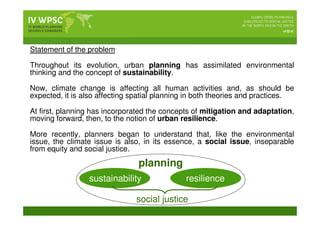
Statement of the problem
Throughout its evolution, urban planning has assimilated environmental
thinking and the concept of sustainability.
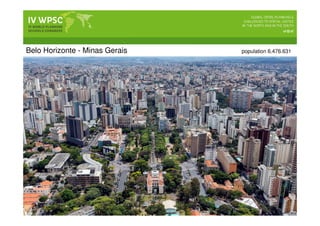
Now, climate change is affecting all human activities and, as should be
expected, it is also affecting spatial planning in both theories and practices.
At first, planning has incorporated the concepts of mitigation and adaptation,
moving forward, then, to the notion of urban resilience.
More recently, planners began to understand that, like the environmental
issue, the climate issue is also, in its essence, a social issue, inseparable
from equity and social justice.
planning
sustainability resilience
social justice
The intensification of extreme weather events and the acceleration of
global climate change add urgency to the environmental debate, bringing
challenges and opportunities that require a temporal and geographic
cross-scale approach to coordinate global and local actions over several
generations.
Climate change, and the adaptations resulting therefrom, tend to
reinforce the concentration of wealth and power, alienating local
populations and increasing their vulnerability.
In a stratified world, with asymmetrical power systems, the lack of
understanding of the consequences of mitigation and adaptation to
climate change may inadvertently reproduce or deepen the damage they
aim to fix.
So that interventions can be locally relevant, adaptation and climate
mitigation should promote environmental justice in the form of rights and
representation - empowerment of local people.
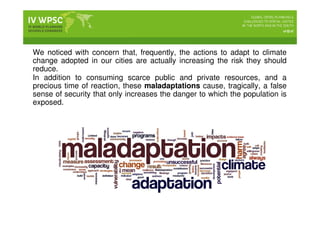
We noticed with concern that, frequently, the actions to adapt to climate
change adopted in our cities are actually increasing the risk they should
reduce.
In addition to consuming scarce public and private resources, and a
precious time of reaction, these maladaptations cause, tragically, a false
sense of security that only increases the danger to which the population is
exposed.
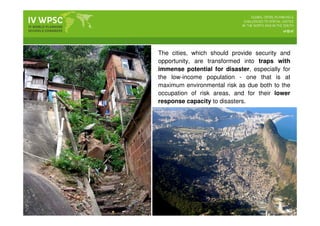
The cities, which should provide security and
opportunity, are transformed into traps with
immense potential for disaster, especially for
the low-income population - one that is at
maximum environmental risk as due both to the
occupation of risk areas, and for their lower
response capacity to disasters.
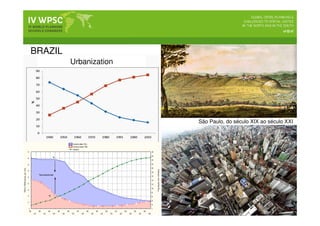
BRAZIL
São Paulo, do século XIX ao século XXI
Urbanization
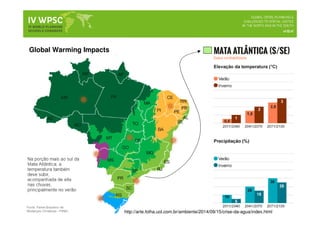
http://arte.folha.uol.com.br/ambiente/2014/09/15/crise-da-agua/index.html
Global Warming Impacts
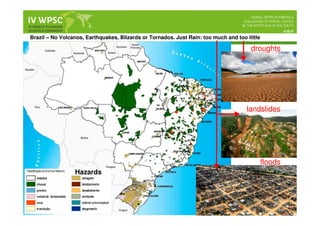
Brazil – No Volcanos, Earthquakes, Blizards or Tornados. Just Rain: too much and too little
droughts
landslides
floods
Hazards
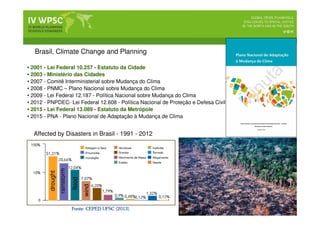
Brasil, Climate Change and Planning
flood
drought
rainstorm
wind
Affected by Disasters in Brasil - 1991 - 2012
• 2001 - Lei Federal 10.257 - Estatuto da Cidade
• 2003 - Ministério das Cidades
• 2007 - Comitê Interministerial sobre Mudança do Clima
• 2008 - PNMC – Plano Nacional sobre Mudança do Clima
• 2009 - Lei Federal 12.187 - Política Nacional sobre Mudança do Clima
• 2012 - PNPDEC- Lei Federal 12.608 - Política Nacional de Proteção e Defesa Civil
• 2015 - Lei Federal 13.089 - Estatuto da Metrópole
• 2015 - PNA - Plano Nacional de Adaptação à Mudança de Clima
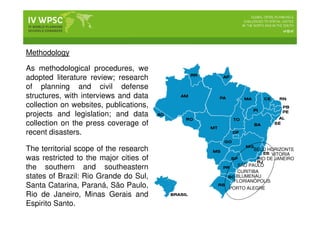
Methodology
As methodological procedures, we
adopted literature review; research
of planning and civil defense
structures, with interviews and data
collection on websites, publications,
projects and legislation; and data
collection on the press coverage of
recent disasters.
The territorial scope of the research
was restricted to the major cities of
the southern and southeastern
states of Brazil: Rio Grande do Sul,
Santa Catarina, Paraná, São Paulo,
Rio de Janeiro, Minas Gerais and
Espirito Santo.
PORTO ALEGRE
FLORIANÓPOLIS
BLUMENAU
CURITIBA
SÃO PAULO
RIO DE JANEIRO
VITORIA
BELO HORIZONTE
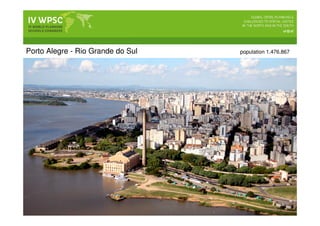
Porto Alegre - Rio Grande do Sul population 1.476.867
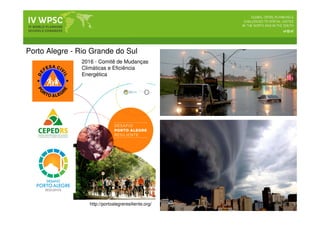
http://portoalegreresiliente.org/
2016 - Comitê de Mudanças
Climáticas e Eficiência
Energética
Porto Alegre - Rio Grande do Sul
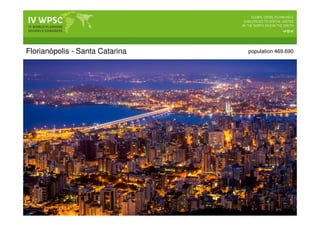
Florianópolis - Santa Catarina population 469.690
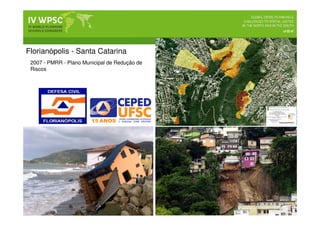
2007 - PMRR - Plano Municipal de Redução de
Riscos
Florianópolis - Santa Catarina
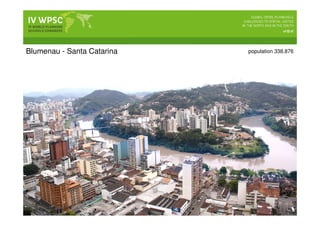
Blumenau - Santa Catarina population 338.876
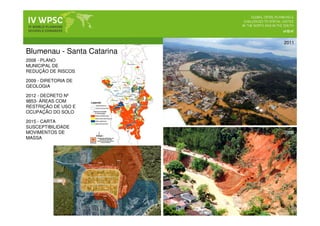
2008
2011
2015 - CARTA
SUSCEPTIBILIDADE
MOVIMENTOS DE
MASSA
2012 - DECRETO Nº
9853- ÁREAS COM
RESTRIÇÃO DE USO E
OCUPAÇÃO DO SOLO
2008 - PLANO
MUNICIPAL DE
REDUÇÃO DE RISCOS
2009 - DIRETORIA DE
GEOLOGIA
Blumenau - Santa Catarina
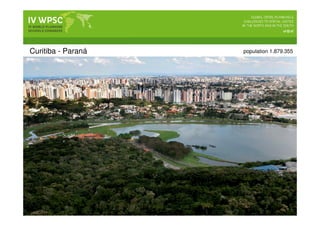
Curitiba - Paraná population 1.879.355
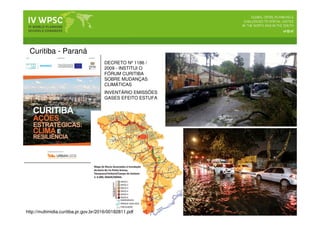
DECRETO Nº 1186 /
2009 - INSTITUI O
FÓRUM CURITIBA
SOBRE MUDANÇAS
CLIMÁTICAS
http://multimidia.curitiba.pr.gov.br/2016/00182811.pdf
INVENTÁRIO EMISSÕES
GASES EFEITO ESTUFA
Curitiba - Paraná
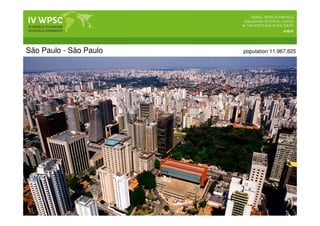
São Paulo - São Paulo population 11.967.825
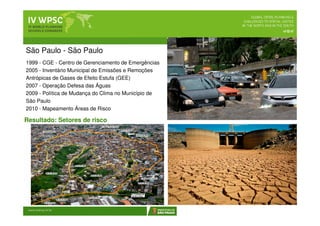
São Paulo - São Paulo
1999 - CGE - Centro de Gerenciamento de Emergências
2005 - Inventário Municipal de Emissões e Remoções
Antrópicas de Gases de Efeito Estufa (GEE)
2007 - Operação Defesa das Águas
2009 - Política de Mudança do Clima no Município de
São Paulo
2010 - Mapeamento Áreas de Risco
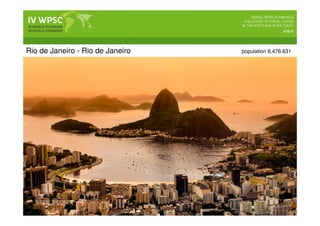
Rio de Janeiro - Rio de Janeiro population 6.476.631
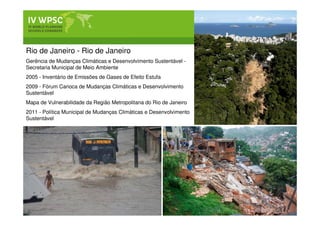
Rio de Janeiro - Rio de Janeiro
Gerência de Mudanças Climáticas e Desenvolvimento Sustentável -
Secretaria Municipal de Meio Ambiente
2005 - Inventário de Emissões de Gases de Efeito Estufa
2009 - Fórum Carioca de Mudanças Climáticas e Desenvolvimento
Sustentável
Mapa de Vulnerabilidade da Região Metropolitana do Rio de Janeiro
2011 - Política Municipal de Mudanças Climáticas e Desenvolvimento
Sustentável
Belo Horizonte - Minas Gerais population 6.476.631
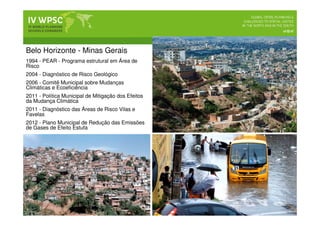
1994 - PEAR - Programa estrutural em Área de
Risco
2004 - Diagnóstico de Risco Geológico
2006 - Comitê Municipal sobre Mudanças
Climáticas e Ecoeficiência
2011 - Política Municipal de Mitigação dos Efeitos
da Mudança Climática
2011 - Diagnóstico das Áreas de Risco Vilas e
Favelas
2012 - Plano Municipal de Redução das Emissões
de Gases de Efeito Estufa
Belo Horizonte - Minas Gerais
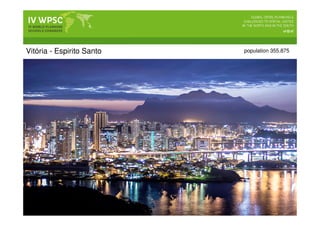
Vitória - Espirito Santo population 355.875
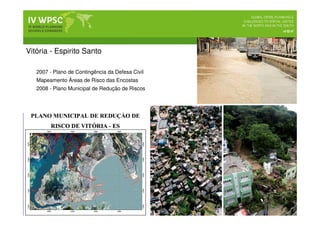
2007 - Plano de Contingência da Defesa Civil
Mapeamento Áreas de Risco das Encostas
2008 - Plano Municipal de Redução de Riscos
Vitória - Espirito Santo
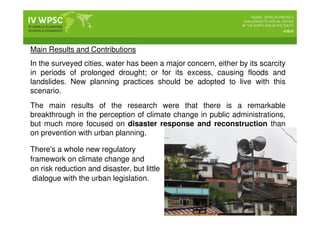
Main Results and Contributions
In the surveyed cities, water has been a major concern, either by its scarcity
in periods of prolonged drought; or for its excess, causing floods and
landslides. New planning practices should be adopted to live with this
scenario.
The main results of the research were that there is a remarkable
breakthrough in the perception of climate change in public administrations,
but much more focused on disaster response and reconstruction than
on prevention with urban planning.
There's a whole new regulatory
framework on climate change and
on risk reduction and disaster, but little
dialogue with the urban legislation.
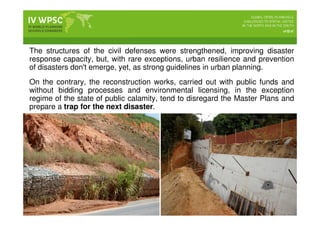
The structures of the civil defenses were strengthened, improving disaster
response capacity, but, with rare exceptions, urban resilience and prevention
of disasters don't emerge, yet, as strong guidelines in urban planning.
On the contrary, the reconstruction works, carried out with public funds and
without bidding processes and environmental licensing, in the exception
regime of the state of public calamity, tend to disregard the Master Plans and
prepare a trap for the next disaster.
The human action must accept that there are limits to the development
and respect the carrying capacity of the natural environment.
Our contribution to the discussion of this issue is to strengthen the alert
to the need to act preventively through urban planning to mitigate
climate change; to adapt cities to the inevitable effects of climate
change and to prevent climate change from generating more exclusion
and socio-spatial segregation.
Mitigation may be sought by reducing the emission of greenhouse
generator gases (eg with multifunctional zoning which reduces
displacement and with priority to public transport and non-motorized
modes) and the increase in wooded areas.
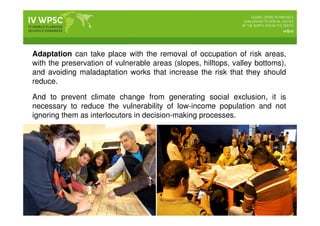
Adaptation can take place with the removal of occupation of risk areas,
with the preservation of vulnerable areas (slopes, hilltops, valley bottoms),
and avoiding maladaptation works that increase the risk that they should
reduce.
And to prevent climate change from generating social exclusion, it is
necessary to reduce the vulnerability of low-income population and not
ignoring them as interlocutors in decision-making processes.
Thank you.
Profa. Dra. Claudia Siebert
www.csiebert-arq.wix.com/csiebert
csiebert.arq@gmail.com

2016 WPSC

  • 1.
    Climate Change andPlanning: the Risk of Aggravating Socio-Spatial Exclusion Prof. Claudia Siebert, PhD Universidade Regional de Blumenau July, 2016
  • 2.
    Objectives This study aimsto analyze the evolution of recent urban planning practices under the influence of the climate change debate, and investigate the manner in which planning structures, the planning legislation and urban projects are being affected by the occurrence of more serious and frequent social- environmental disasters. planning disasters climate change
  • 3.
    Statement of theproblem Throughout its evolution, urban planning has assimilated environmental thinking and the concept of sustainability. Now, climate change is affecting all human activities and, as should be expected, it is also affecting spatial planning in both theories and practices. At first, planning has incorporated the concepts of mitigation and adaptation, moving forward, then, to the notion of urban resilience. More recently, planners began to understand that, like the environmental issue, the climate issue is also, in its essence, a social issue, inseparable from equity and social justice. planning sustainability resilience social justice
  • 4.
    The intensification ofextreme weather events and the acceleration of global climate change add urgency to the environmental debate, bringing challenges and opportunities that require a temporal and geographic cross-scale approach to coordinate global and local actions over several generations. Climate change, and the adaptations resulting therefrom, tend to reinforce the concentration of wealth and power, alienating local populations and increasing their vulnerability. In a stratified world, with asymmetrical power systems, the lack of understanding of the consequences of mitigation and adaptation to climate change may inadvertently reproduce or deepen the damage they aim to fix. So that interventions can be locally relevant, adaptation and climate mitigation should promote environmental justice in the form of rights and representation - empowerment of local people.
  • 5.
    We noticed withconcern that, frequently, the actions to adapt to climate change adopted in our cities are actually increasing the risk they should reduce. In addition to consuming scarce public and private resources, and a precious time of reaction, these maladaptations cause, tragically, a false sense of security that only increases the danger to which the population is exposed.
  • 6.
    The cities, whichshould provide security and opportunity, are transformed into traps with immense potential for disaster, especially for the low-income population - one that is at maximum environmental risk as due both to the occupation of risk areas, and for their lower response capacity to disasters.
  • 7.
    BRAZIL São Paulo, doséculo XIX ao século XXI Urbanization
  • 8.
  • 9.
    Brazil – NoVolcanos, Earthquakes, Blizards or Tornados. Just Rain: too much and too little droughts landslides floods Hazards
  • 10.
    Brasil, Climate Changeand Planning flood drought rainstorm wind Affected by Disasters in Brasil - 1991 - 2012 • 2001 - Lei Federal 10.257 - Estatuto da Cidade • 2003 - Ministério das Cidades • 2007 - Comitê Interministerial sobre Mudança do Clima • 2008 - PNMC – Plano Nacional sobre Mudança do Clima • 2009 - Lei Federal 12.187 - Política Nacional sobre Mudança do Clima • 2012 - PNPDEC- Lei Federal 12.608 - Política Nacional de Proteção e Defesa Civil • 2015 - Lei Federal 13.089 - Estatuto da Metrópole • 2015 - PNA - Plano Nacional de Adaptação à Mudança de Clima
  • 11.
    Methodology As methodological procedures,we adopted literature review; research of planning and civil defense structures, with interviews and data collection on websites, publications, projects and legislation; and data collection on the press coverage of recent disasters. The territorial scope of the research was restricted to the major cities of the southern and southeastern states of Brazil: Rio Grande do Sul, Santa Catarina, Paraná, São Paulo, Rio de Janeiro, Minas Gerais and Espirito Santo. PORTO ALEGRE FLORIANÓPOLIS BLUMENAU CURITIBA SÃO PAULO RIO DE JANEIRO VITORIA BELO HORIZONTE
  • 12.
    Porto Alegre -Rio Grande do Sul population 1.476.867
  • 13.
    http://portoalegreresiliente.org/ 2016 - Comitêde Mudanças Climáticas e Eficiência Energética Porto Alegre - Rio Grande do Sul
  • 14.
    Florianópolis - SantaCatarina population 469.690
  • 15.
    2007 - PMRR- Plano Municipal de Redução de Riscos Florianópolis - Santa Catarina
  • 16.
    Blumenau - SantaCatarina population 338.876
  • 17.
    2008 2011 2015 - CARTA SUSCEPTIBILIDADE MOVIMENTOSDE MASSA 2012 - DECRETO Nº 9853- ÁREAS COM RESTRIÇÃO DE USO E OCUPAÇÃO DO SOLO 2008 - PLANO MUNICIPAL DE REDUÇÃO DE RISCOS 2009 - DIRETORIA DE GEOLOGIA Blumenau - Santa Catarina
  • 18.
    Curitiba - Paranápopulation 1.879.355
  • 19.
    DECRETO Nº 1186/ 2009 - INSTITUI O FÓRUM CURITIBA SOBRE MUDANÇAS CLIMÁTICAS http://multimidia.curitiba.pr.gov.br/2016/00182811.pdf INVENTÁRIO EMISSÕES GASES EFEITO ESTUFA Curitiba - Paraná
  • 20.
    São Paulo -São Paulo population 11.967.825
  • 21.
    São Paulo -São Paulo 1999 - CGE - Centro de Gerenciamento de Emergências 2005 - Inventário Municipal de Emissões e Remoções Antrópicas de Gases de Efeito Estufa (GEE) 2007 - Operação Defesa das Águas 2009 - Política de Mudança do Clima no Município de São Paulo 2010 - Mapeamento Áreas de Risco
  • 22.
    Rio de Janeiro- Rio de Janeiro population 6.476.631
  • 23.
    Rio de Janeiro- Rio de Janeiro Gerência de Mudanças Climáticas e Desenvolvimento Sustentável - Secretaria Municipal de Meio Ambiente 2005 - Inventário de Emissões de Gases de Efeito Estufa 2009 - Fórum Carioca de Mudanças Climáticas e Desenvolvimento Sustentável Mapa de Vulnerabilidade da Região Metropolitana do Rio de Janeiro 2011 - Política Municipal de Mudanças Climáticas e Desenvolvimento Sustentável
  • 24.
    Belo Horizonte -Minas Gerais population 6.476.631
  • 25.
    1994 - PEAR- Programa estrutural em Área de Risco 2004 - Diagnóstico de Risco Geológico 2006 - Comitê Municipal sobre Mudanças Climáticas e Ecoeficiência 2011 - Política Municipal de Mitigação dos Efeitos da Mudança Climática 2011 - Diagnóstico das Áreas de Risco Vilas e Favelas 2012 - Plano Municipal de Redução das Emissões de Gases de Efeito Estufa Belo Horizonte - Minas Gerais
  • 26.
    Vitória - EspiritoSanto population 355.875
  • 27.
    2007 - Planode Contingência da Defesa Civil Mapeamento Áreas de Risco das Encostas 2008 - Plano Municipal de Redução de Riscos Vitória - Espirito Santo
  • 28.
    Main Results andContributions In the surveyed cities, water has been a major concern, either by its scarcity in periods of prolonged drought; or for its excess, causing floods and landslides. New planning practices should be adopted to live with this scenario. The main results of the research were that there is a remarkable breakthrough in the perception of climate change in public administrations, but much more focused on disaster response and reconstruction than on prevention with urban planning. There's a whole new regulatory framework on climate change and on risk reduction and disaster, but little dialogue with the urban legislation.
  • 29.
    The structures ofthe civil defenses were strengthened, improving disaster response capacity, but, with rare exceptions, urban resilience and prevention of disasters don't emerge, yet, as strong guidelines in urban planning. On the contrary, the reconstruction works, carried out with public funds and without bidding processes and environmental licensing, in the exception regime of the state of public calamity, tend to disregard the Master Plans and prepare a trap for the next disaster.
  • 30.
    The human actionmust accept that there are limits to the development and respect the carrying capacity of the natural environment. Our contribution to the discussion of this issue is to strengthen the alert to the need to act preventively through urban planning to mitigate climate change; to adapt cities to the inevitable effects of climate change and to prevent climate change from generating more exclusion and socio-spatial segregation. Mitigation may be sought by reducing the emission of greenhouse generator gases (eg with multifunctional zoning which reduces displacement and with priority to public transport and non-motorized modes) and the increase in wooded areas.
  • 31.
    Adaptation can takeplace with the removal of occupation of risk areas, with the preservation of vulnerable areas (slopes, hilltops, valley bottoms), and avoiding maladaptation works that increase the risk that they should reduce. And to prevent climate change from generating social exclusion, it is necessary to reduce the vulnerability of low-income population and not ignoring them as interlocutors in decision-making processes.
  • 32.
    Thank you. Profa. Dra.Claudia Siebert www.csiebert-arq.wix.com/csiebert csiebert.arq@gmail.com