Reproductions of this material, or any parts of it, should refer to the IMF Statistics Department as the source.
IMF Statistics Department
Andreas Hake
Division Chief, IMF Statistics Department
2016 SDMX Expert Group Meeting
Aguascalientes, Mexico, October 17-20, 2016
1
Making data discoverable in SDMX
Managing metadata with an SDMX registry
IMF Statistics Department
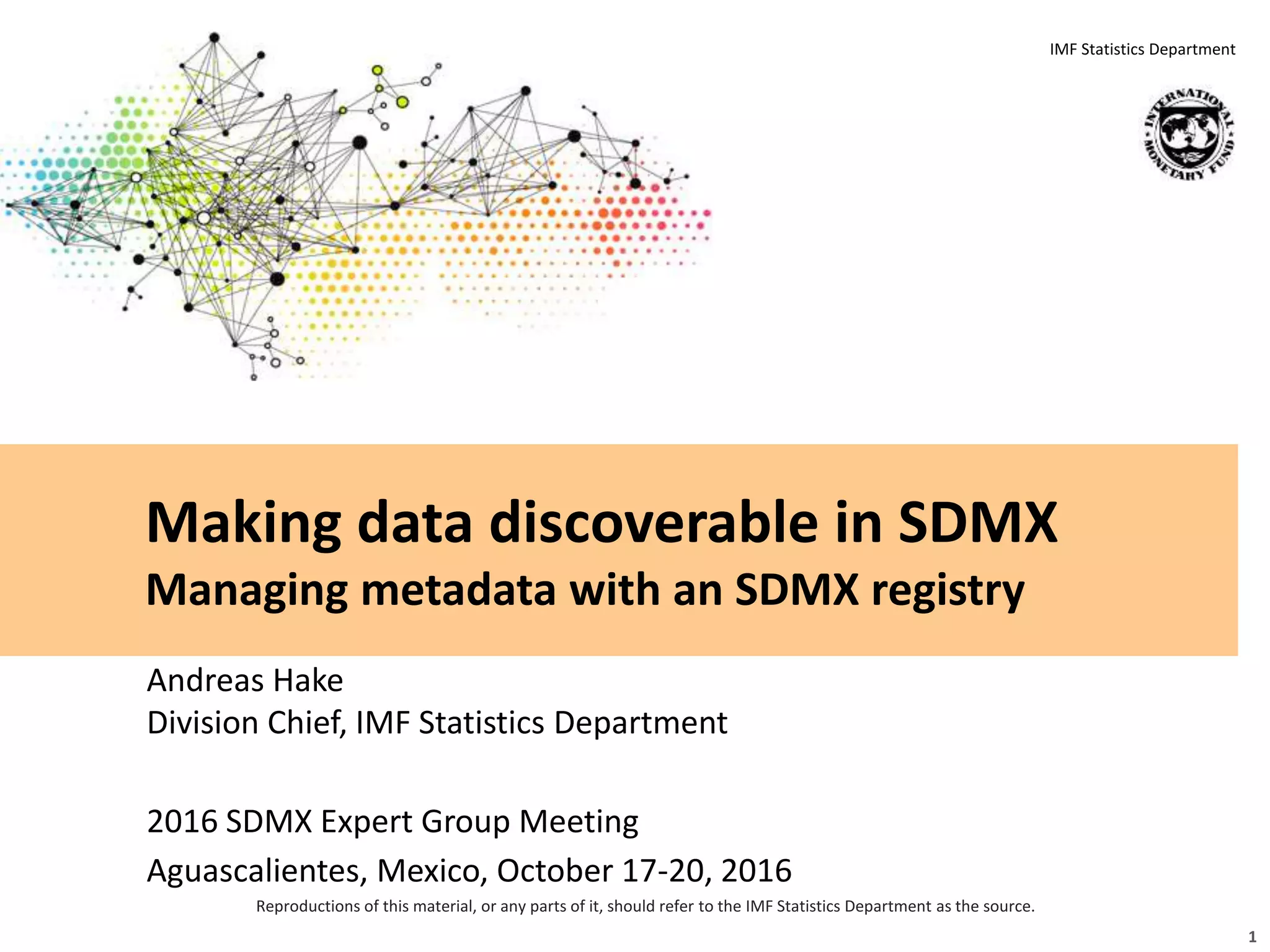
Evolution of data dissemination diagram
2
Human
Readable
Human
Readable
and
Indexed
Human,
Machine
Readable
and
Indexed
Human,
Machine
Readable,
Rich
Metadata-
driven and
Indexed
10/18/2016
IMF Statistics Department
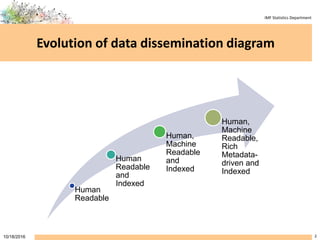
Human Readable Data Dissemination
3
Country 1 Country 2
10/18/2016
IMF Statistics Department
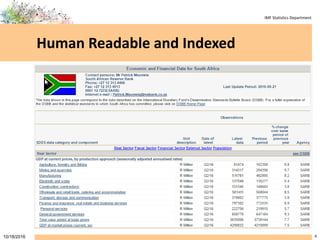
Human Readable and Indexed
410/18/2016
IMF Statistics Department
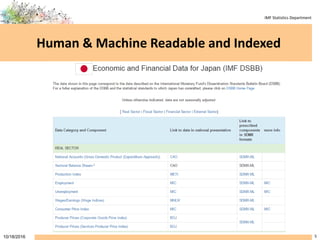
Human & Machine Readable and Indexed
510/18/2016
IMF Statistics Department
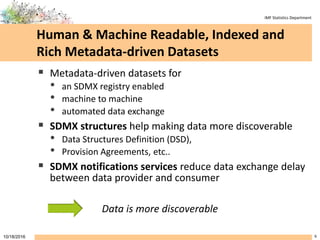
Human & Machine Readable, Indexed and
Rich Metadata-driven Datasets
 Metadata-driven datasets for
• an SDMX registry enabled
• machine to machine
• automated data exchange
 SDMX structures help making data more discoverable
• Data Structures Definition (DSD),
• Provision Agreements, etc..
 SDMX notifications services reduce data exchange delay
between data provider and consumer
Data is more discoverable
610/18/2016
IMF Statistics Department
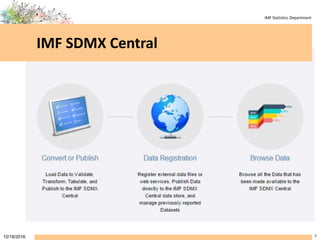
IMF SDMX Central
710/18/2016
IMF Statistics Department
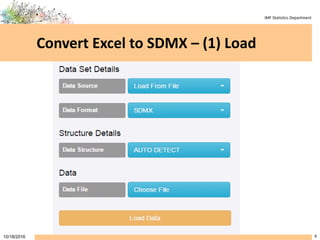
Convert Excel to SDMX – (1) Load
810/18/2016
IMF Statistics Department
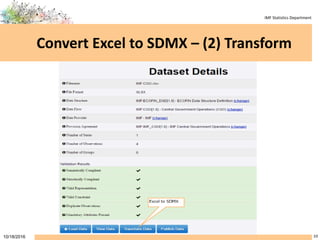
Convert Excel to SDMX – (2) Transform
1010/18/2016
IMF Statistics Department
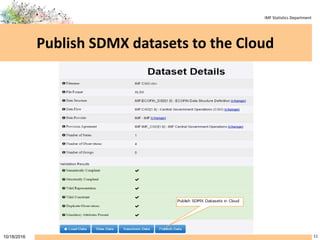
Publish SDMX datasets to the Cloud
1110/18/2016
IMF Statistics Department
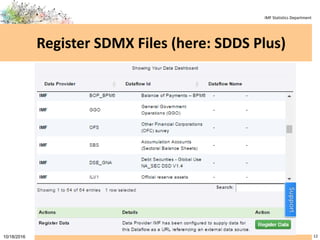
Register SDMX Files (here: SDDS Plus)
1210/18/2016
IMF Statistics Department
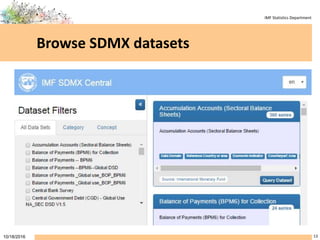
Browse SDMX datasets
1310/18/2016
IMF Statistics Department
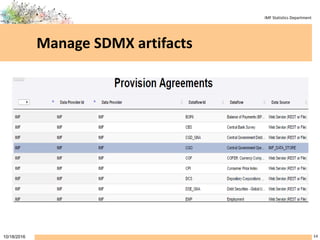
Manage SDMX artifacts
1410/18/2016
IMF Statistics Department
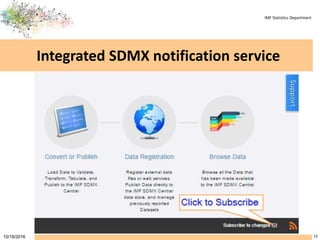
Integrated SDMX notification service
1510/18/2016
IMF Statistics Department
THANK YOU
1610/18/2016
Andreas Hake
ahake@imf.org
+1 (202) 623 8130

2016 SDMX Experts meeting, Making data discoverable in SDMX, Andreas Hake

Editor's Notes

  • #4 For hundreds of years, tables were the main way to disseminate statistical data In the early years of the internet, data came online, but still mainly in tables and other two-dimensional presentations (e.g. charts and maps) These are so popular because they are easy for humans to understand But finding the right table or chart can be tricky… Data dissemination has evolved to a point where rich, metadata-driven discovery can help users (human or machine) find and access data quickly
  • #5 As the internet developed, disseminated datasets became bigger and multidimensional These datasets were indexed in two ways: Internally, so human users could search for the variables of interest Externally, so human users could search for the right datasets The SDDS National Summary Data Page (NSDP) is an example of such an index
  • #6 Implementation of SDMX provides a standard for providing machine readable data Early SDMX versions focused on providing a structure for internal definition of datasets Dissemination mostly by bilateral exchange or posting or hosting datasets
  • #8 More than just a SDMX registry fully integrated, metadata-driven service using the SDMX standard as the foundation enhance data dissemination process building on the SDMX information model used to describe datasets by defining the dimensionality of a dataset allowable content for each of the dimensions Provision agreements are used to define which data complier or agency supplies which data, aiding discovery Registrations can drive notifications, supporting automated machine retrieval of data Human users can browse all datasets registered with SDMX Central, no matter where the SDMX data resides
  • #12 Load Data to Validate, Transform, Publish, Register and Receive SDMX notification