
The healthdata.be project:
Workshop "Clinical Building Blocks“
by NICTIZ & NFU
RIZIV-INAMI, Brussels, 27.10.2015
150min.
Part 1 Part 2
Part 3
healthdata.be
data we care for
healthdata.be
data we care for
Collection of health (care) related data
in Belgium: “AS-IS”
1
2
3
4
5
7
6
Stage
Stage
Stage
Stage
Stage
Stage
Stage
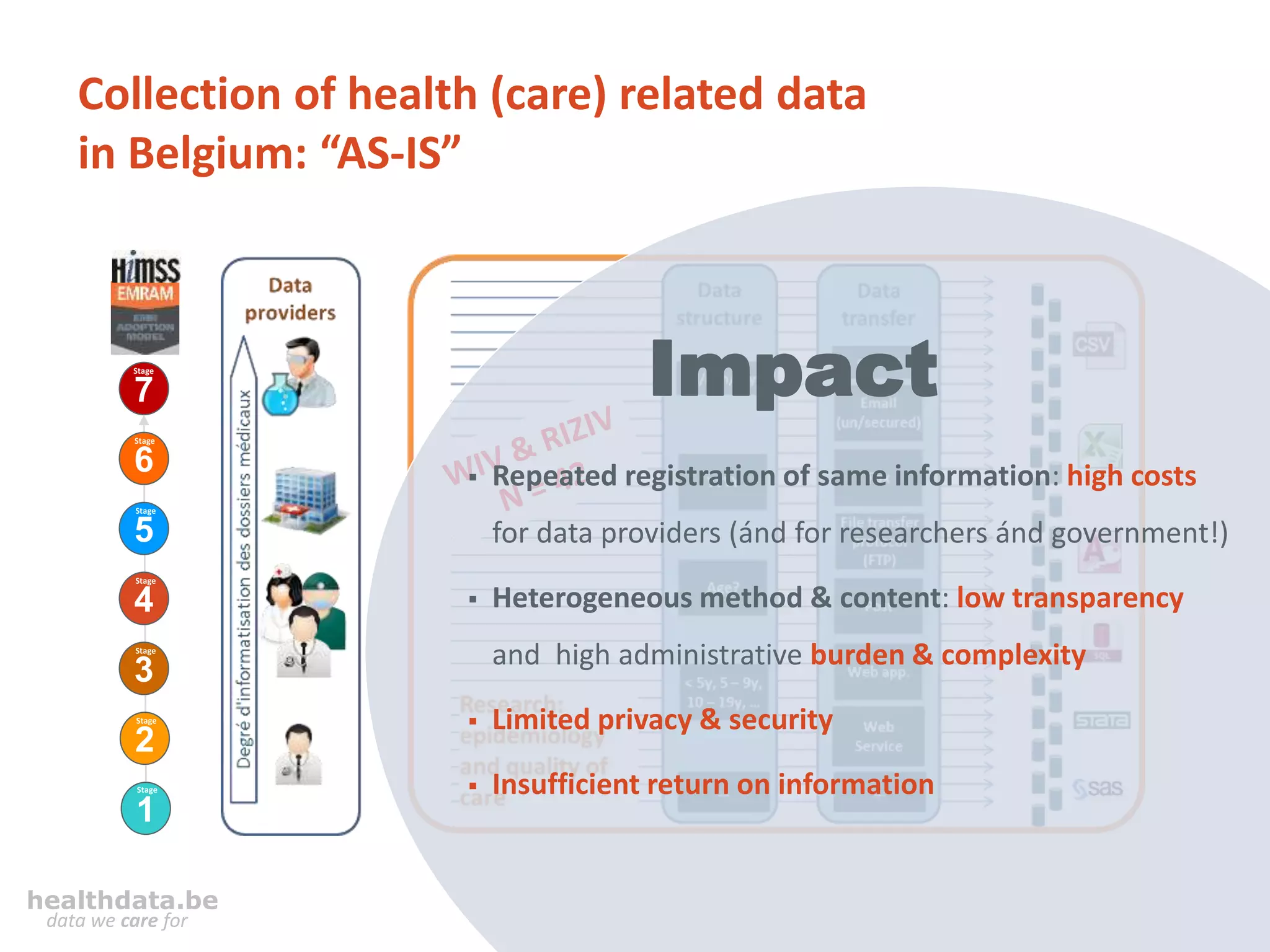
 Repeated registration of same information: high costs
for data providers (ánd for researchers ánd government!)
 Heterogeneous method & content: low transparency
and high administrative burden & complexity
 Limited privacy & security
 Insufficient return on information
Impact
Growing awareness
Milestone Date
1. Van de Sande, et al., Inventory of databases health care, KCE
Reports 30A, Brussels: KCE
2006
2. Belgian Court of Audit, Scientific support of the federal health
policy, BCA Reports, Brussels: BCA
2010
3. Coussée, et al., Charter High-quality recording of data by the
healthcare sector, Brussels; Zorgnet Vlaanderen
2010
4. Actionplan eHealth 2013-2018: Action point 18 “Inventory and
consolidation registers”
2012
5. Law of 5 May 2014: principle of “only once” data collection in
all activities of governemental services and institutes
2014
6. Federal (9.10.2014) coalition agreement prioritizes reduction
of administrative burden of health care professionals: “Only
once”!
2014
healthdata.be
data we care for
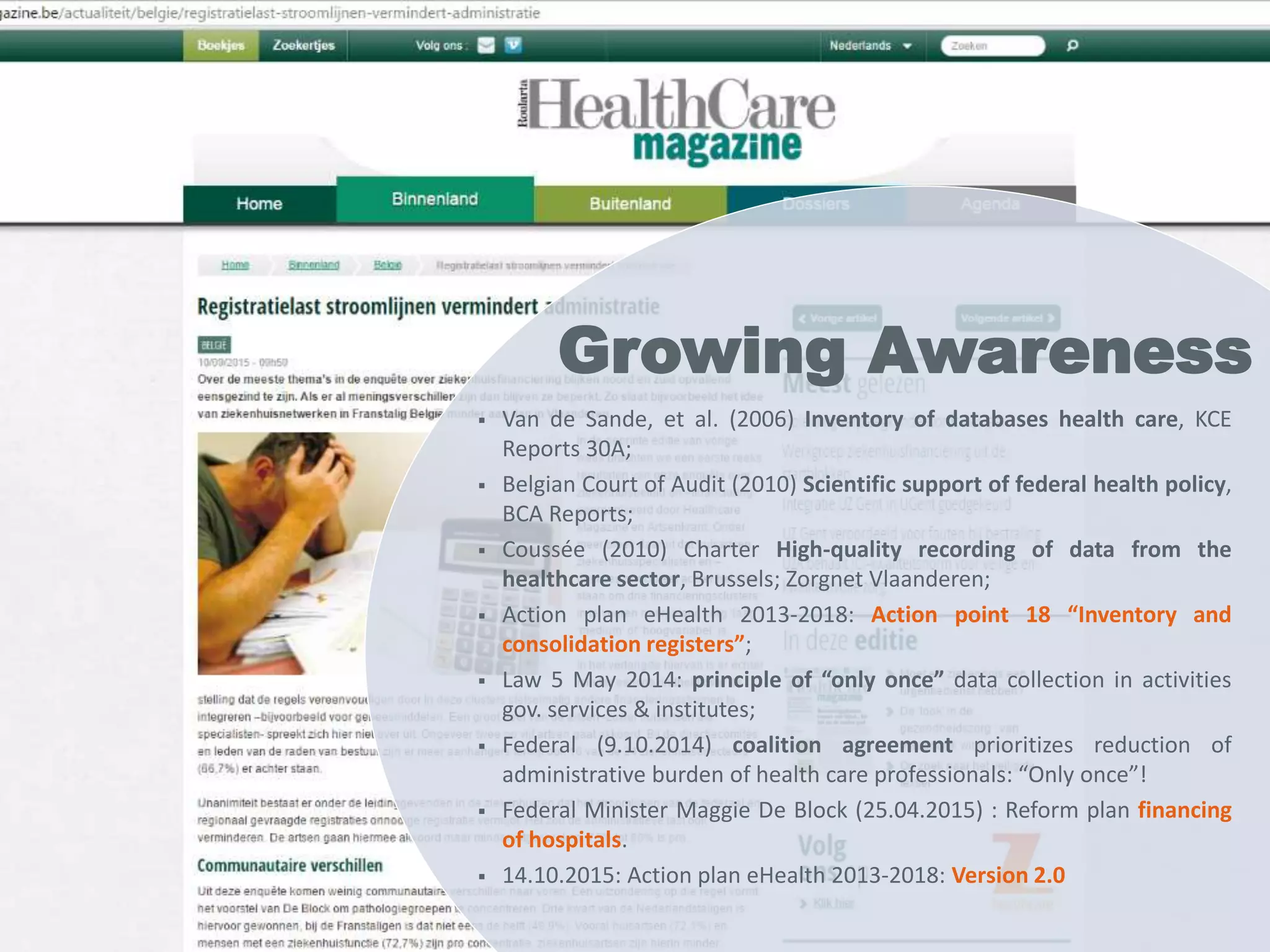
 Van de Sande, et al. (2006) Inventory of databases health care, KCE
Reports 30A;
 Belgian Court of Audit (2010) Scientific support of federal health policy,
BCA Reports;
 Coussée (2010) Charter High-quality recording of data from the
healthcare sector, Brussels; Zorgnet Vlaanderen;
 Action plan eHealth 2013-2018: Action point 18 “Inventory and
consolidation registers”;
 Law 5 May 2014: principle of “only once” data collection in activities
gov. services & institutes;
 Federal (9.10.2014) coalition agreement prioritizes reduction of
administrative burden of health care professionals: “Only once”!
 Federal Minister Maggie De Block (25.04.2015) : Reform plan financing
of hospitals.
 14.10.2015: Action plan eHealth 2013-2018: Version 2.0
Growing Awareness
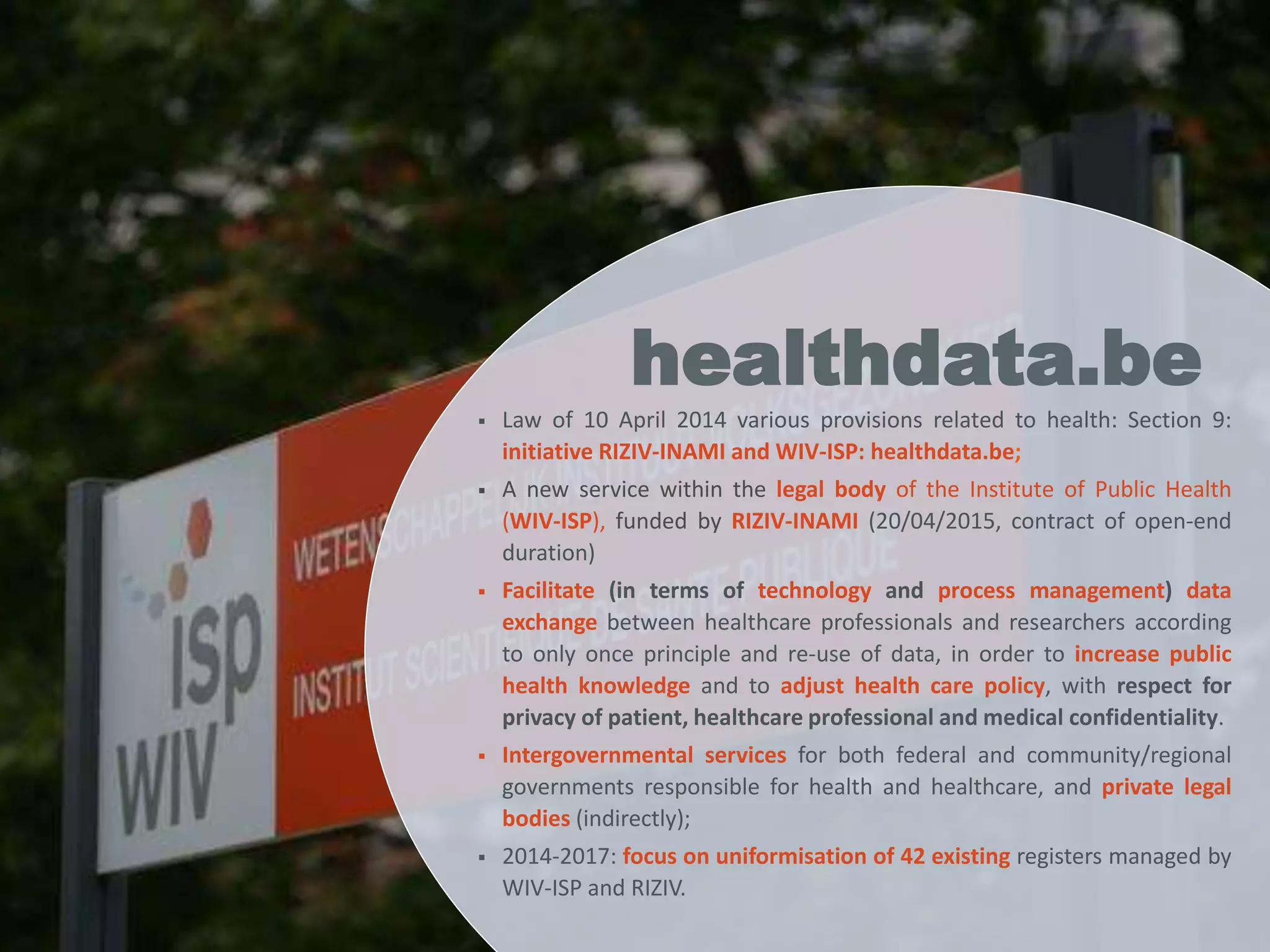
 Law of 10 April 2014 various provisions related to health: Section 9:
initiative RIZIV-INAMI and WIV-ISP: healthdata.be;
 A new service within the legal body of the Institute of Public Health
(WIV-ISP), funded by RIZIV-INAMI (20/04/2015, contract of open-end
duration)
 Facilitate (in terms of technology and process management) data
exchange between healthcare professionals and researchers according
to only once principle and re-use of data, in order to increase public
health knowledge and to adjust health care policy, with respect for
privacy of patient, healthcare professional and medical confidentiality.
 Intergovernmental services for both federal and community/regional
governments responsible for health and healthcare, and private legal
bodies (indirectly);
 2014-2017: focus on uniformisation of 42 existing registers managed by
WIV-ISP and RIZIV.
healthdata.be
7
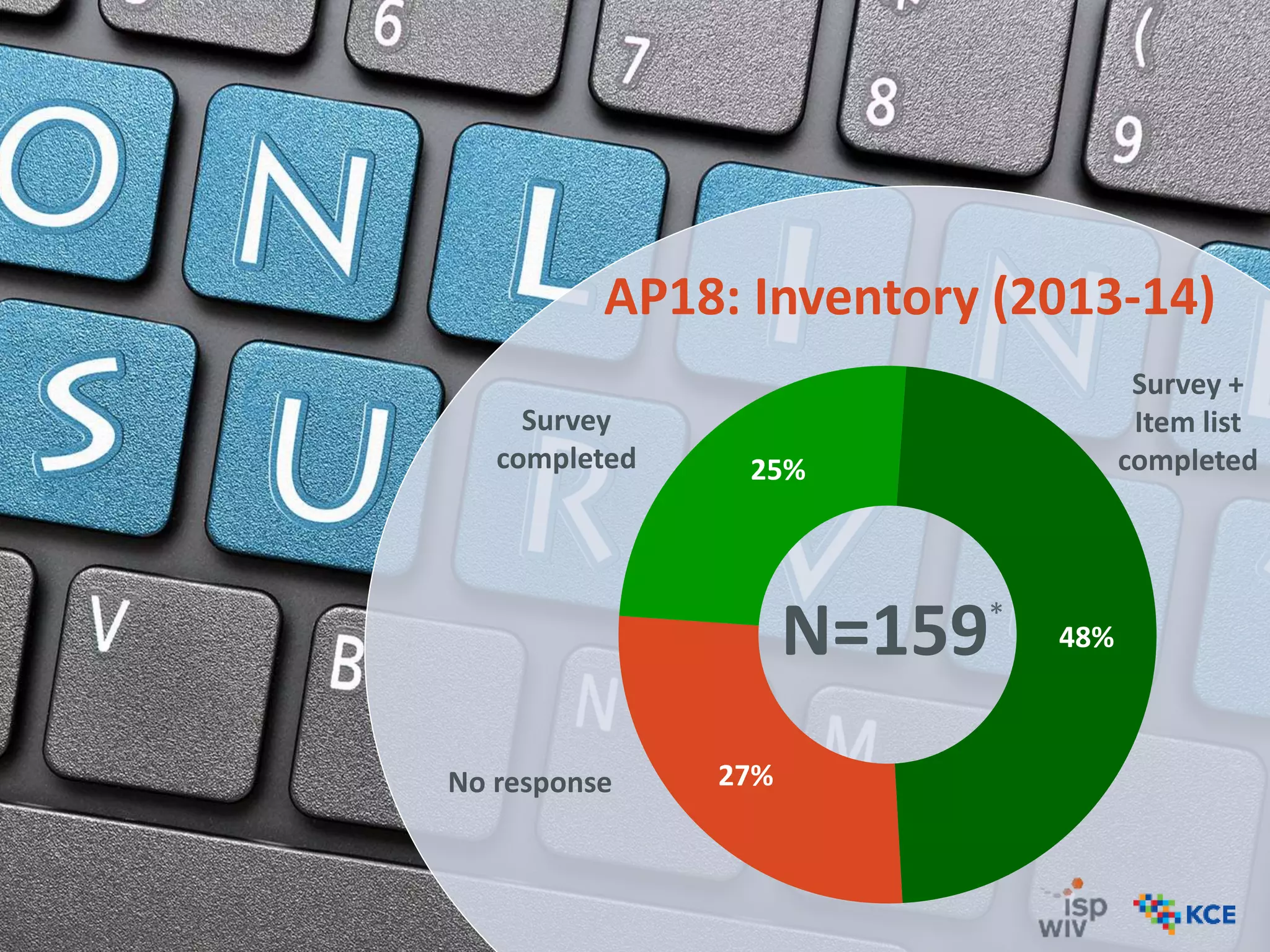
25%
48%
27%
N=159
Survey
completed
Survey +
Item list
completed
No response
*
AP18: Inventory (2013-14)
8
9
Update AP18!
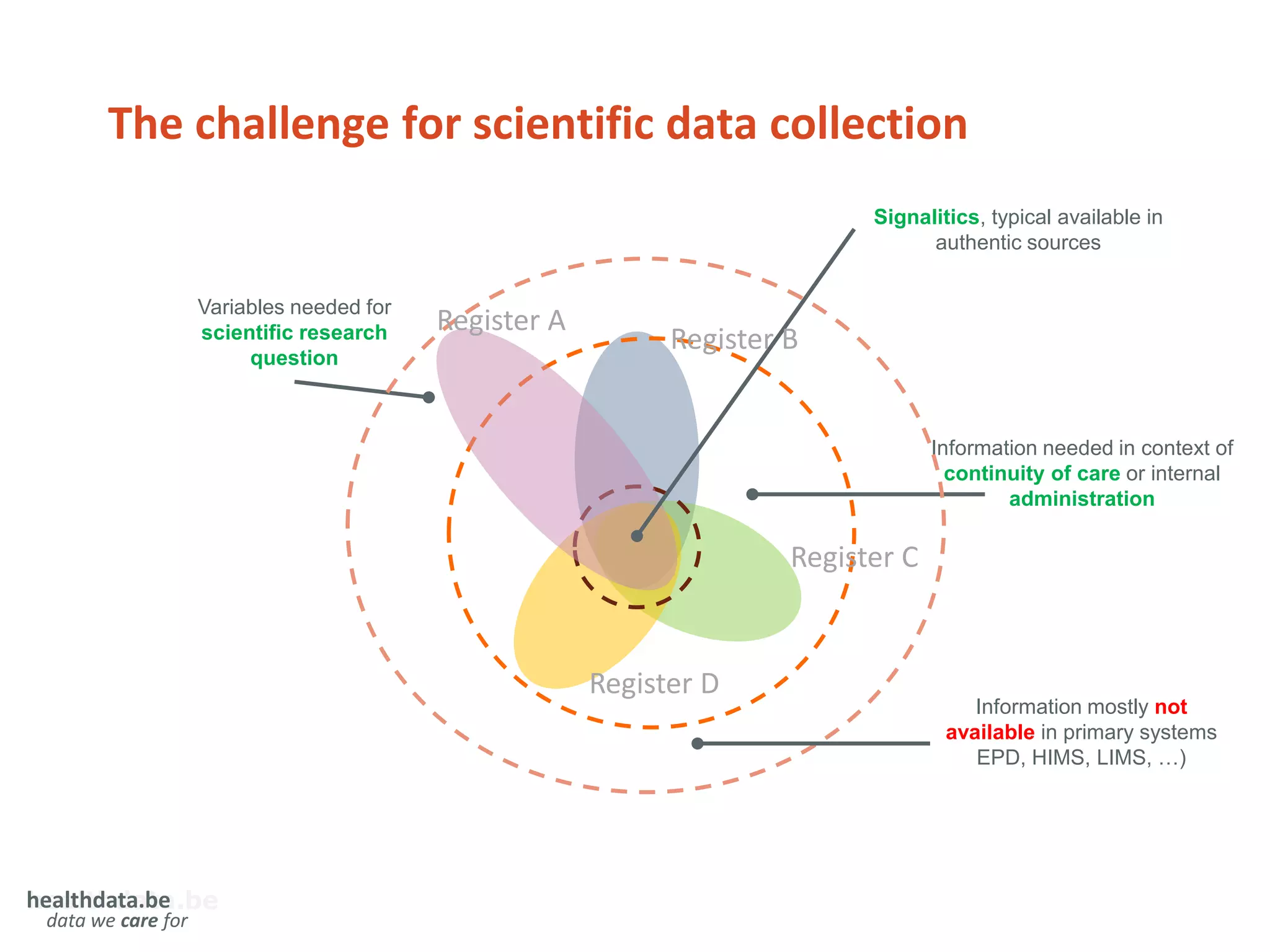
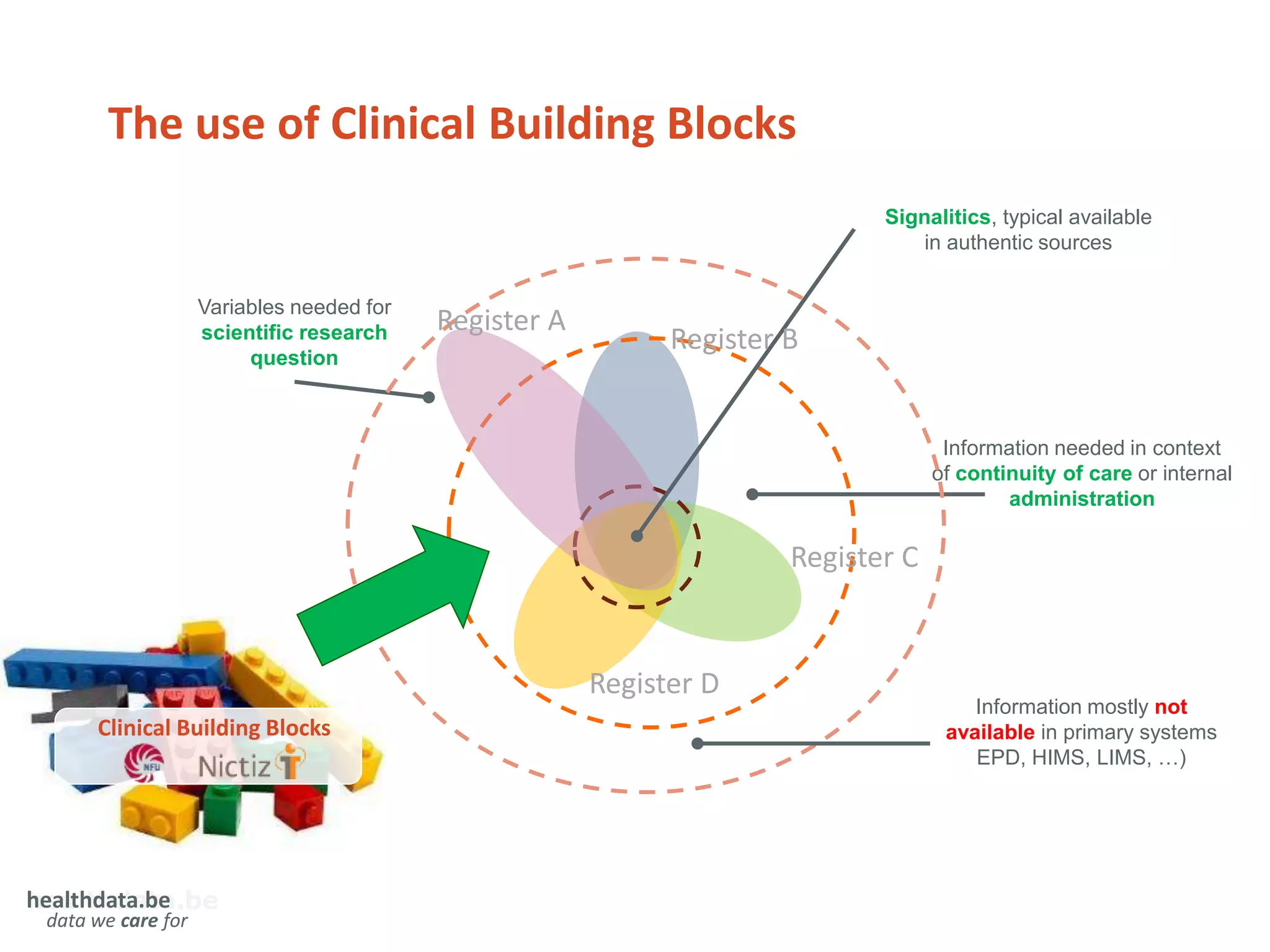
Variables needed for
scientific research
question
healthdata.be
data we care for
Signalitics, typical available in
authentic sources
Information needed in context of
continuity of care or internal
administration
Information mostly not
available in primary systems
EPD, HIMS, LIMS, …)
The challenge for scientific data collection
Register A
Register B
Register C
Register D
healthdata.be
data we care for
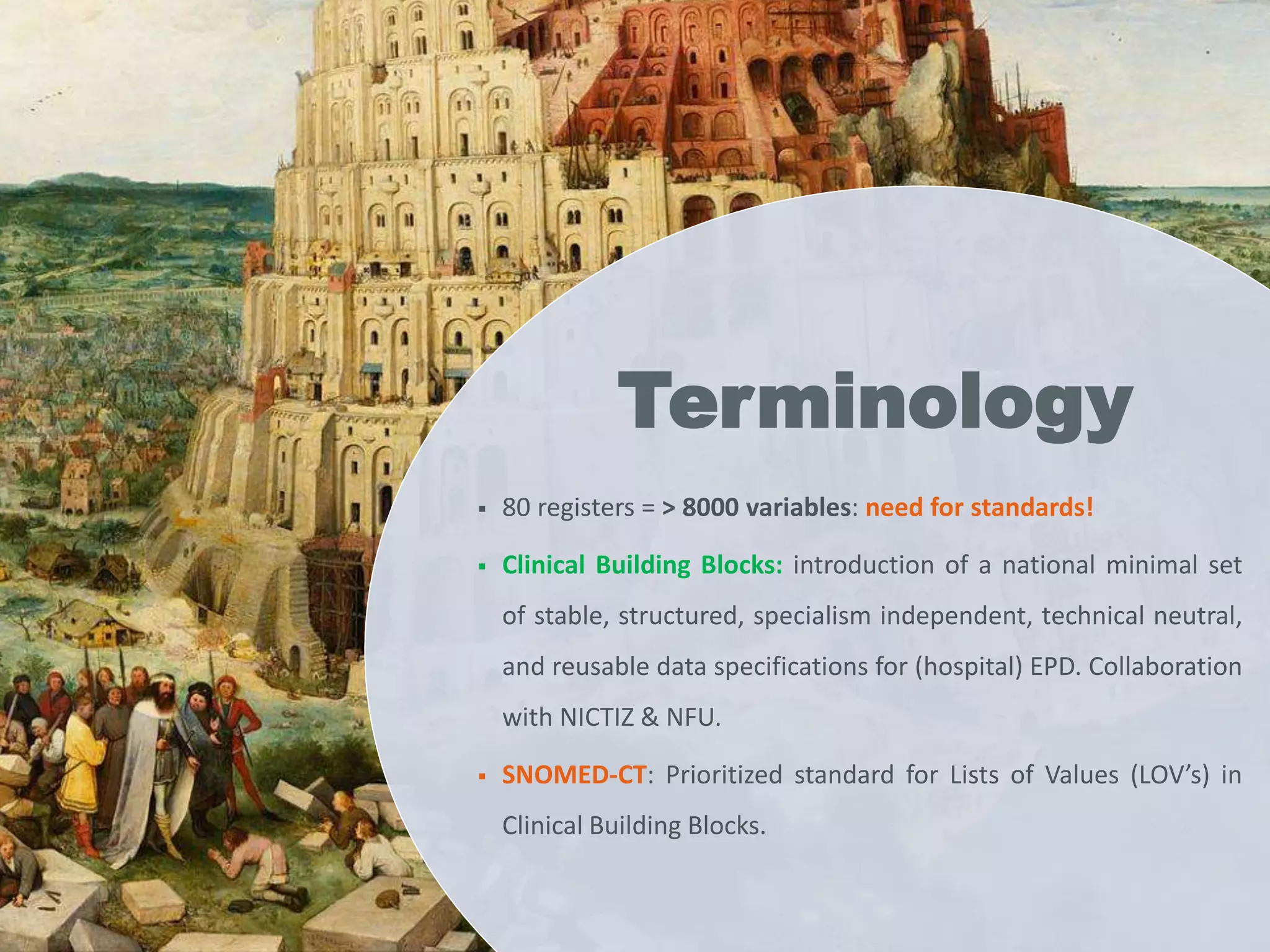
 80 registers = > 8000 variables: need for standards!
 Clinical Building Blocks: introduction of a national minimal set
of stable, structured, specialism independent, technical neutral,
and reusable data specifications for (hospital) EPD. Collaboration
with NICTIZ & NFU.
 SNOMED-CT: Prioritized standard for Lists of Values (LOV’s) in
Clinical Building Blocks.
Terminology
healthdata.be
data we care for
Variables needed for
scientific research
question
healthdata.be
data we care for
Signalitics, typical available
in authentic sources
Information needed in context
of continuity of care or internal
administration
Information mostly not
available in primary systems
EPD, HIMS, LIMS, …)
The use of Clinical Building Blocks
Register A
Register B
Register C
Register D
Clinical Building Blocks
healthdata.be
data we care for
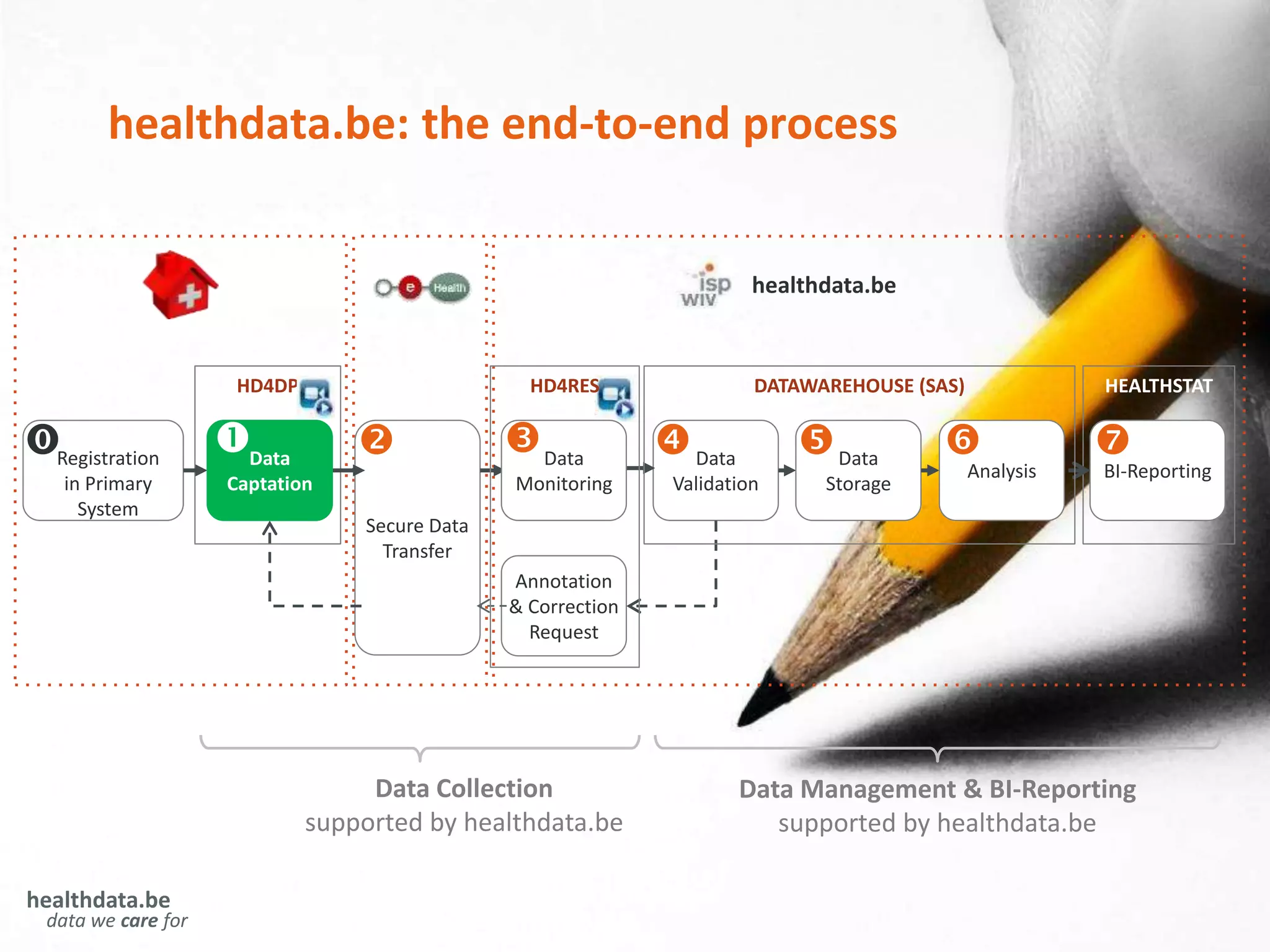
Secure Data
Transfer
Data
Validation
Annotation
& Correction
Request
Data
Storage
BI-Reporting
Registration
in Primary
System
healthdata.be
data we care for
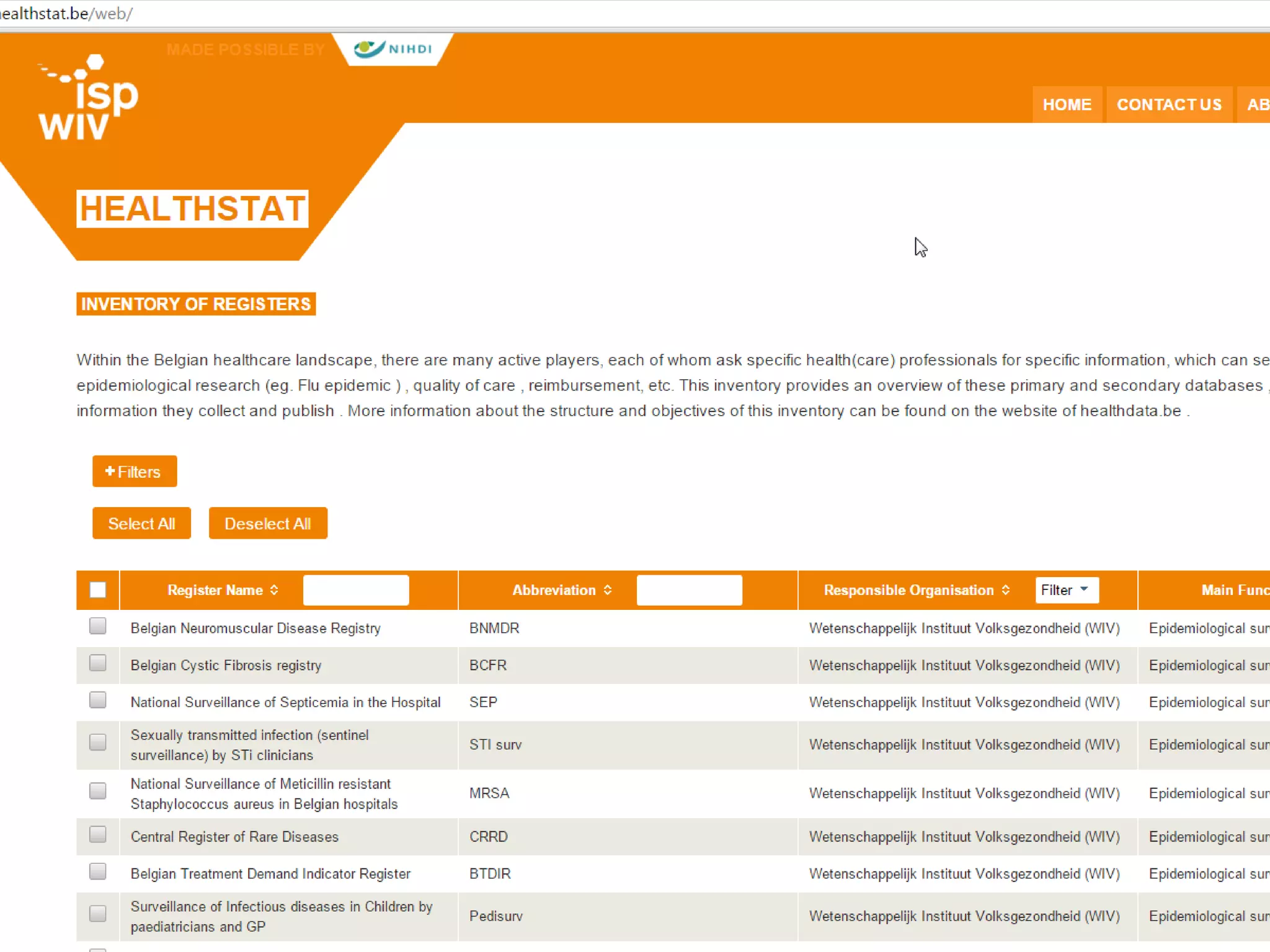
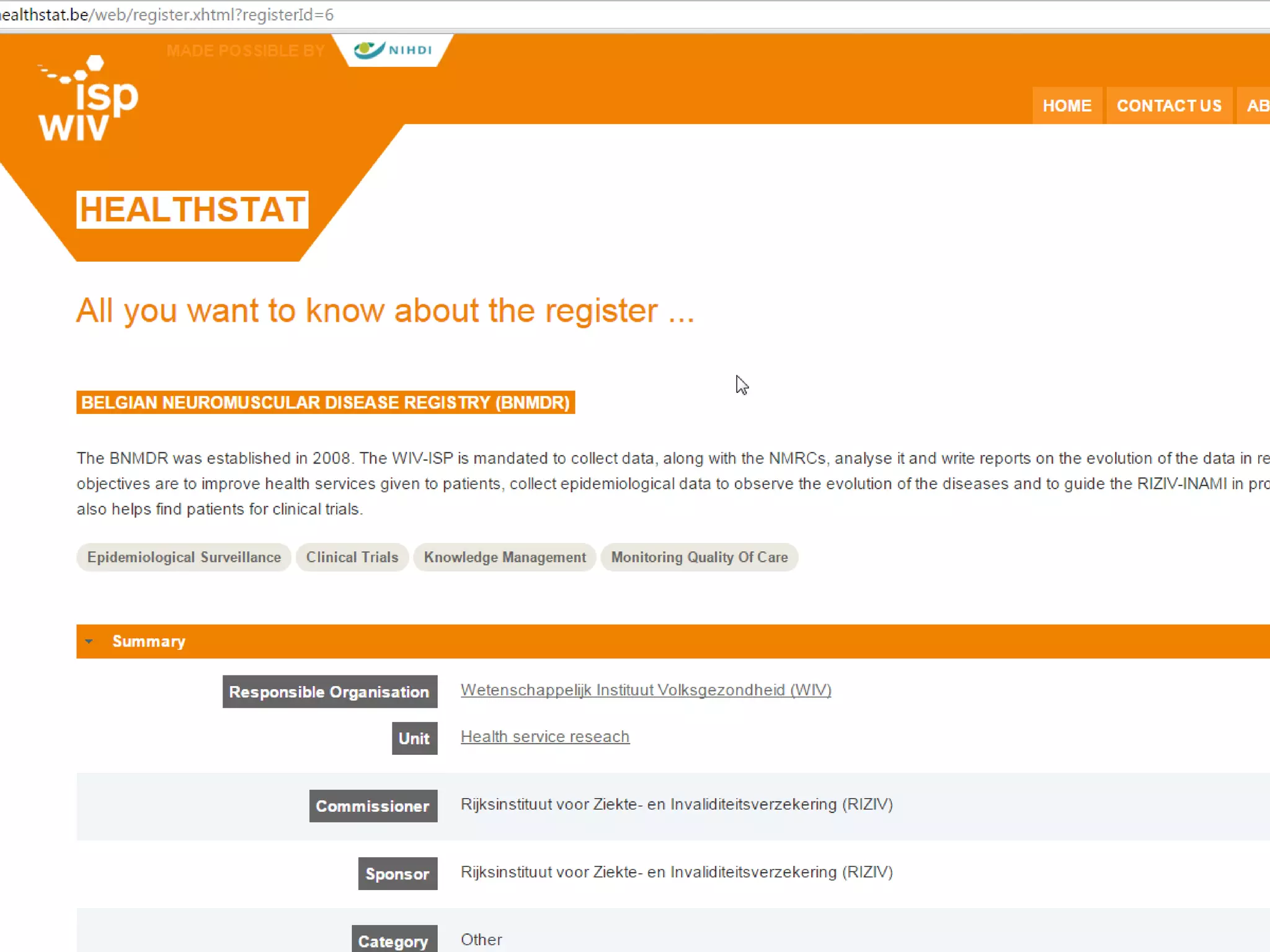
HEALTHSTATHD4DP
Analysis
Data Collection
supported by healthdata.be
Data Management & BI-Reporting
supported by healthdata.be
       
healthdata.be: the end-to-end process
healthdata.be
Data
Captation
Data
Monitoring
HD4RES DATAWAREHOUSE (SAS)
 
Healthdata.be
Catalogue (PROD) with
Registry form definition
Data provider
Sending Data Through an
API & Prefilling Forms for
less Manual Work
Legend
Identifiers (SSIN, RIZIV, …)
Neeadata (internal ID, type data, …)
Medical data
CSV
24/7
HD4DP
and / or


HD4DP : Healthdata for Data Providers
healthdata.be
data we care for



• All manual input remains available
(structured and coded, according to
[inter]national standard) in local
database of DP:
• Import in future upgrade of
EPD/LIMS;
• Re-Use for internal BI & QI
All manual input remains available
(structured and coded, according to
[inter]national standard, based on CBBs)
in local database of DP:
• Import in future upgrade of
EPD/LIMS;
• Re-Use for internal BI & QI
• All manual input remains available
(structured and coded, according to
[inter]national standard) in local
database of DP:
• Import in future upgrade of
EPD/LIMS;
• Re-Use for internal BI & QI
Clinical Building Blocks .BE
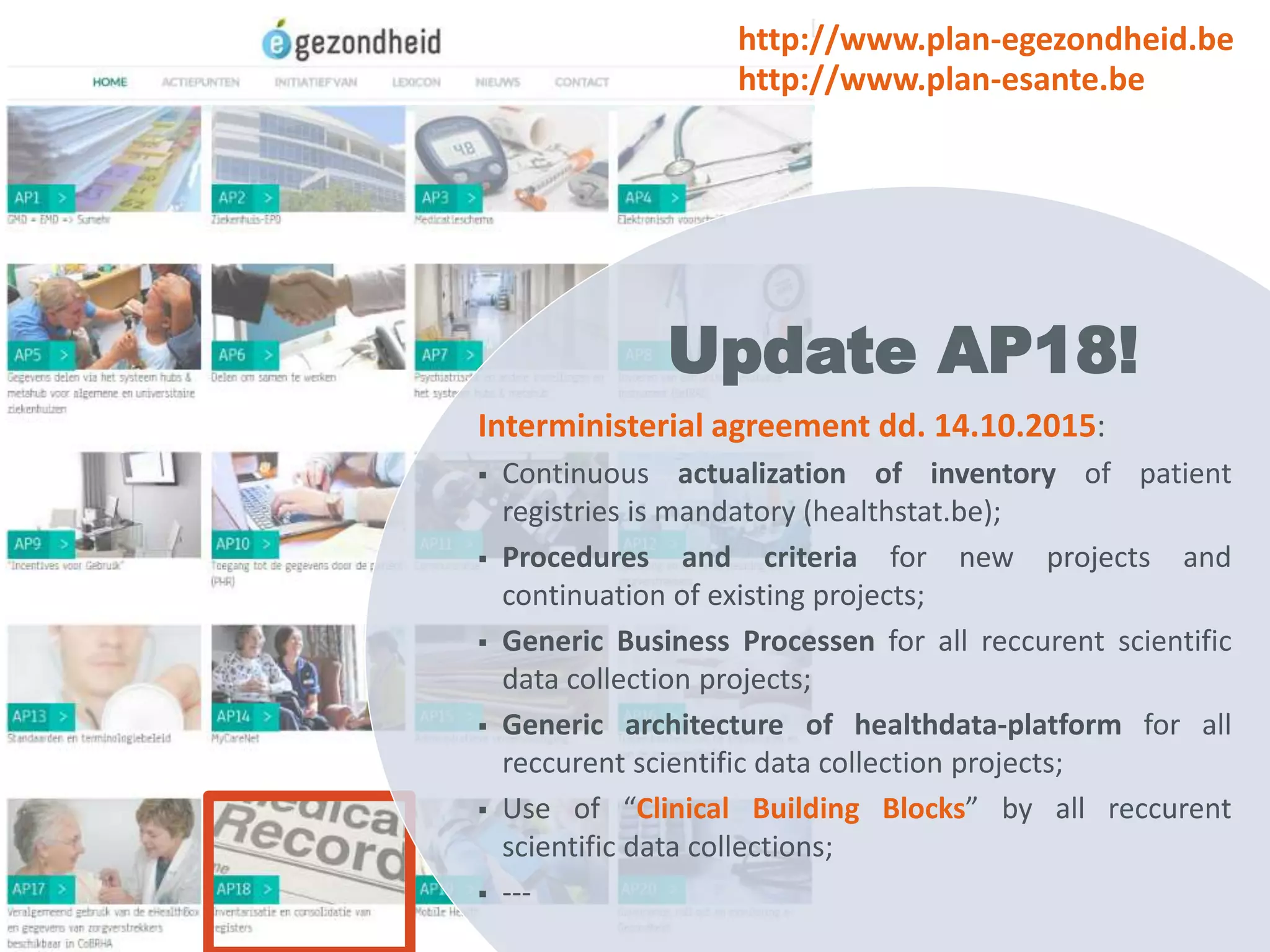
Interministerial agreement dd. 14.10.2015:
 Continuous actualization of inventory of patient
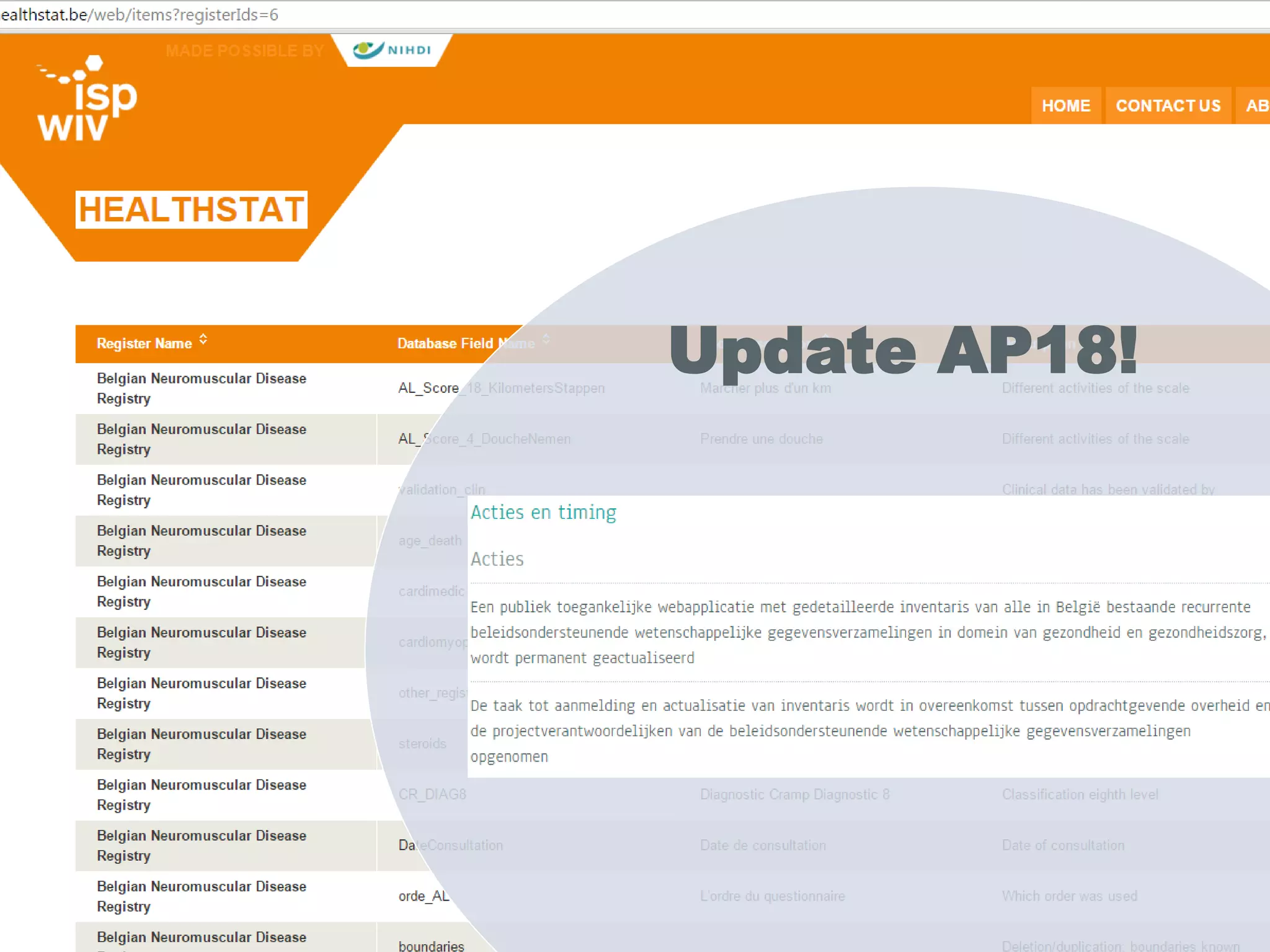
registries is mandatory (healthstat.be);
 Procedures and criteria for new projects and
continuation of existing projects;
 Generic Business Processen for all reccurent scientific
data collection projects;
 Generic architecture of healthdata-platform for all
reccurent scientific data collection projects;
 Use of “Clinical Building Blocks” by all reccurent
scientific data collections;
 ---
Update AP18!
http://www.plan-egezondheid.be
http://www.plan-esante.be
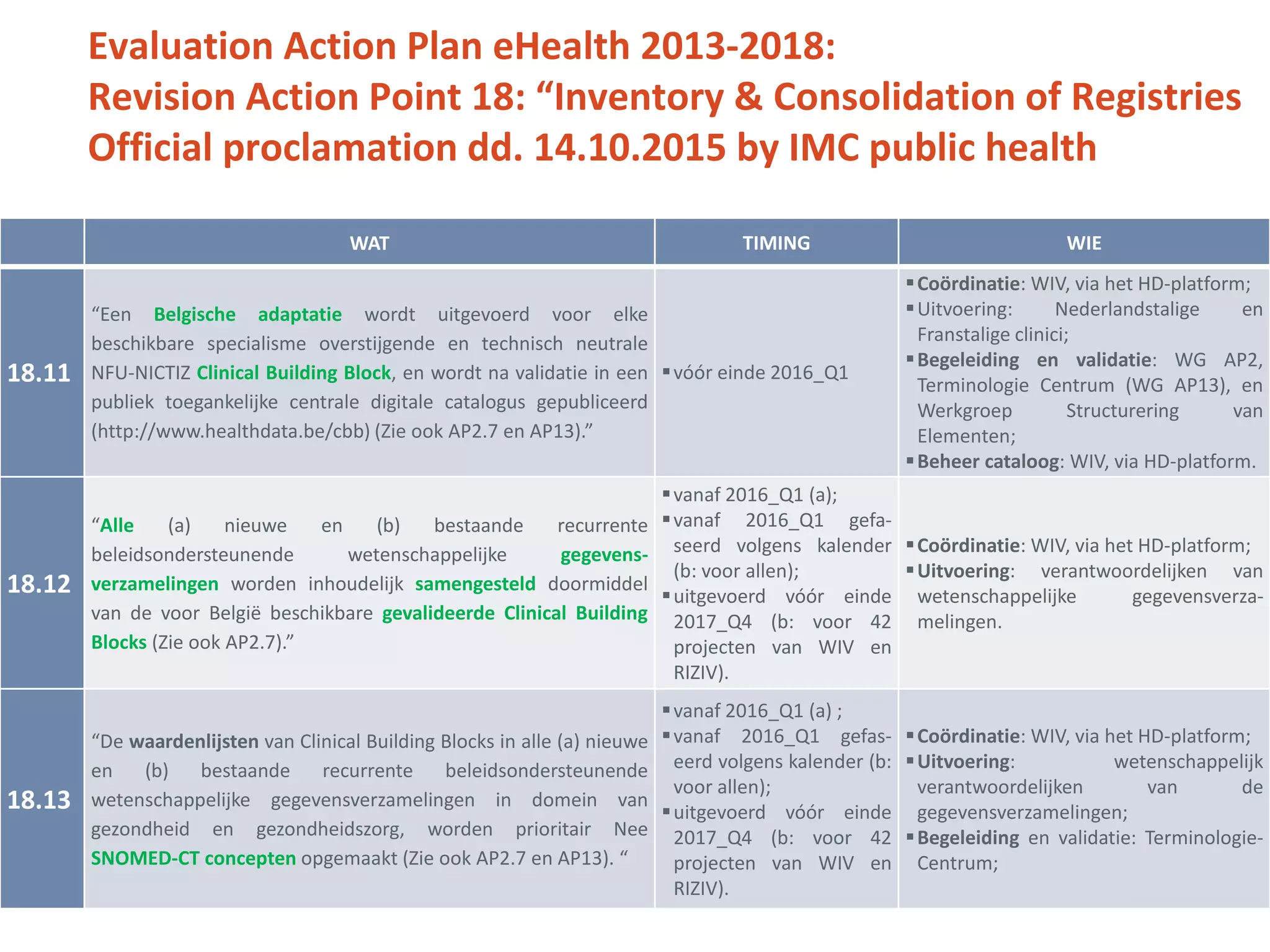
WAT TIMING WIE
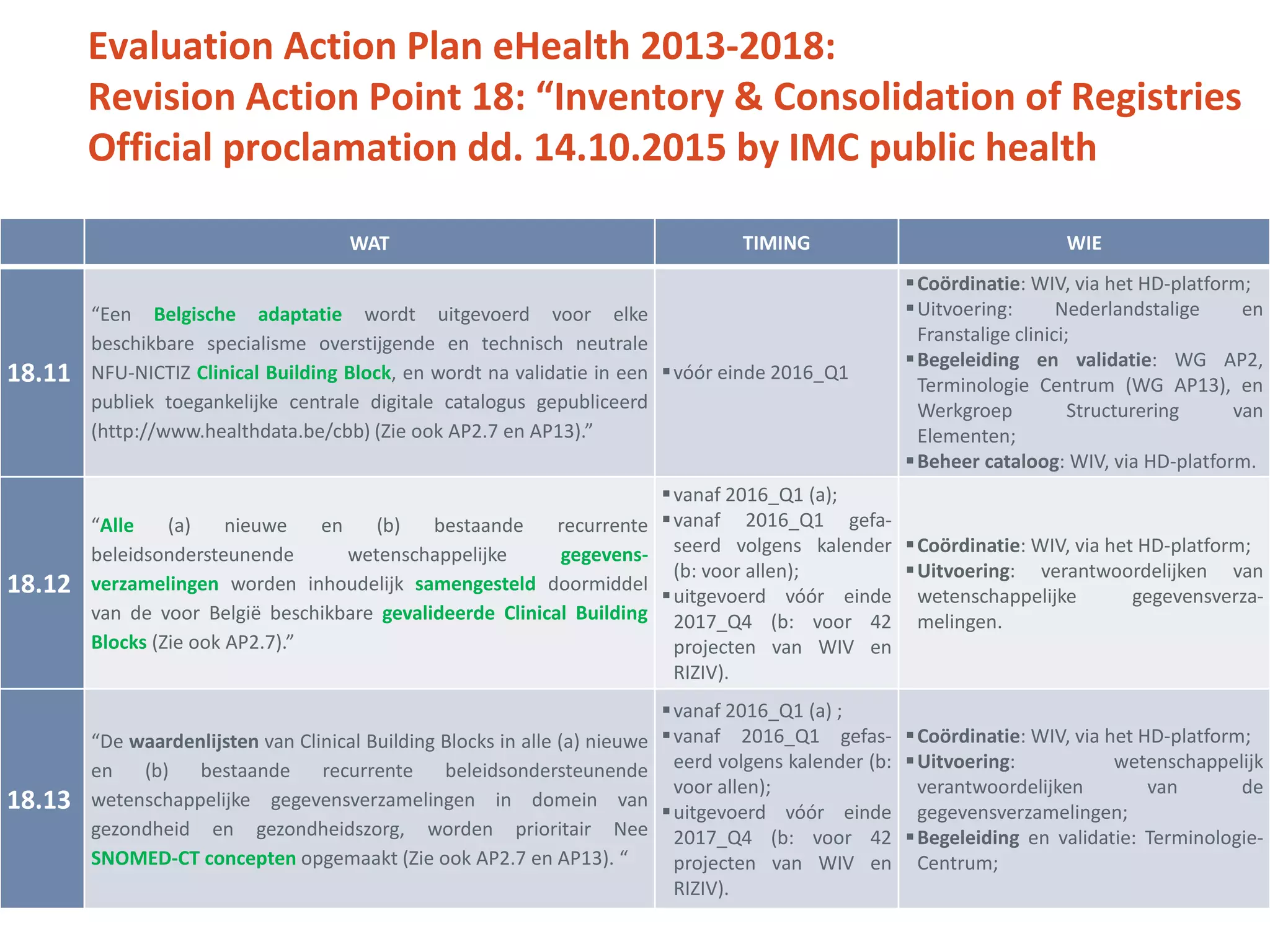
18.11
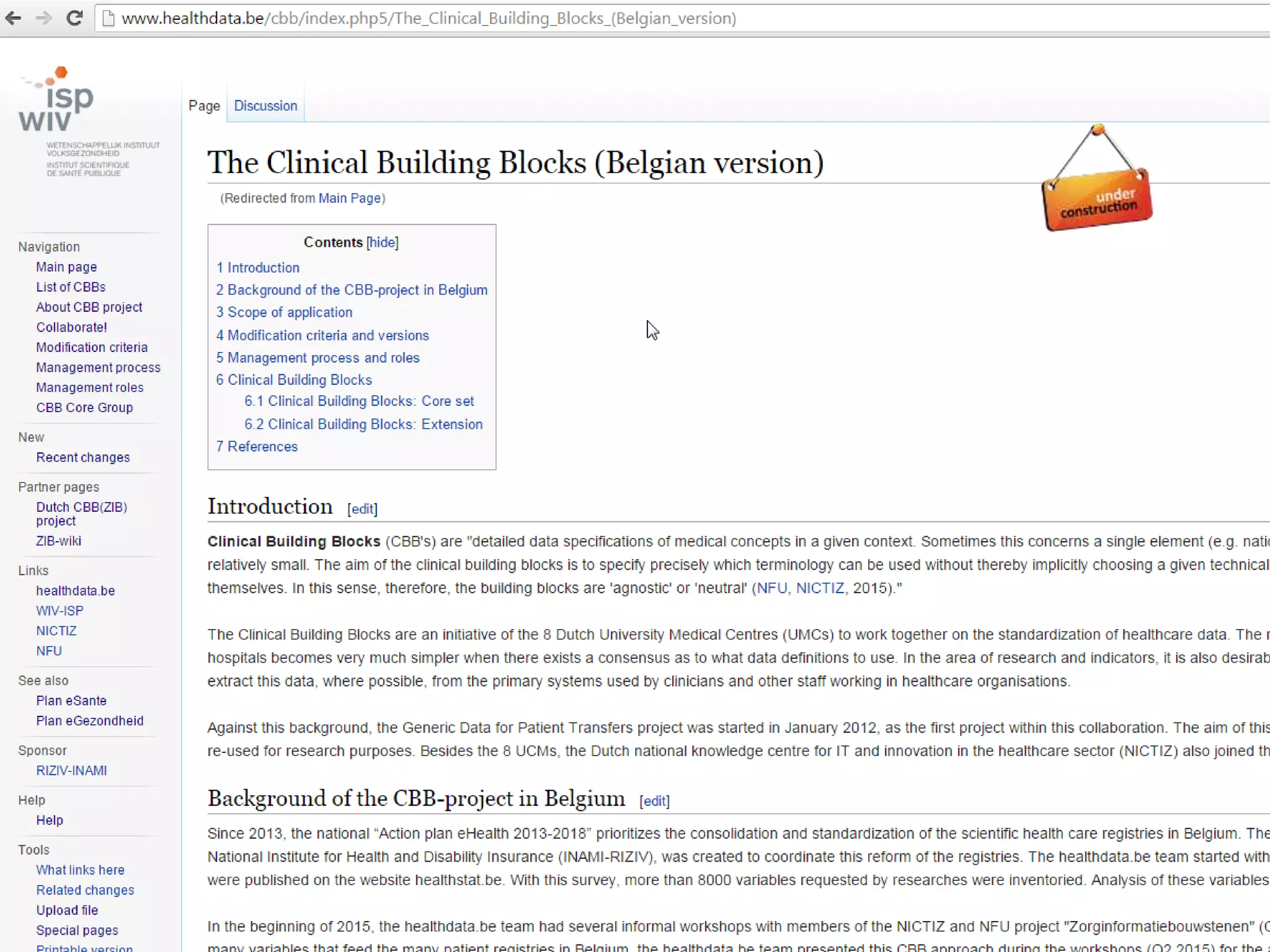
“Een Belgische adaptatie wordt uitgevoerd voor elke
beschikbare specialisme overstijgende en technisch neutrale
NFU-NICTIZ Clinical Building Block, en wordt na validatie in een
publiek toegankelijke centrale digitale catalogus gepubliceerd
(http://www.healthdata.be/cbb) (Zie ook AP2.7 en AP13).”
vóór einde 2016_Q1
Coördinatie: WIV, via het HD-platform;
Uitvoering: Nederlandstalige en
Franstalige clinici;
Begeleiding en validatie: WG AP2,
Terminologie Centrum (WG AP13), en
Werkgroep Structurering van
Elementen;
Beheer cataloog: WIV, via HD-platform.
18.12
“Alle (a) nieuwe en (b) bestaande recurrente
beleidsondersteunende wetenschappelijke gegevens-
verzamelingen worden inhoudelijk samengesteld doormiddel
van de voor België beschikbare gevalideerde Clinical Building
Blocks (Zie ook AP2.7).”
vanaf 2016_Q1 (a);
vanaf 2016_Q1 gefa-
seerd volgens kalender
(b: voor allen);
uitgevoerd vóór einde
2017_Q4 (b: voor 42
projecten van WIV en
RIZIV).
Coördinatie: WIV, via het HD-platform;
Uitvoering: verantwoordelijken van
wetenschappelijke gegevensverza-
melingen.
18.13
“De waardenlijsten van Clinical Building Blocks in alle (a) nieuwe
en (b) bestaande recurrente beleidsondersteunende
wetenschappelijke gegevensverzamelingen in domein van
gezondheid en gezondheidszorg, worden prioritair Nee
SNOMED-CT concepten opgemaakt (Zie ook AP2.7 en AP13). “
vanaf 2016_Q1 (a) ;
vanaf 2016_Q1 gefas-
eerd volgens kalender (b:
voor allen);
uitgevoerd vóór einde
2017_Q4 (b: voor 42
projecten van WIV en
RIZIV).
Coördinatie: WIV, via het HD-platform;
Uitvoering: wetenschappelijk
verantwoordelijken van de
gegevensverzamelingen;
Begeleiding en validatie: Terminologie-
Centrum;
Evaluation Action Plan eHealth 2013-2018:
Revision Action Point 18: “Inventory & Consolidation of Registries
Official proclamation dd. 14.10.2015 by IMC public health
Q&A
healthdata@wiv-isp.be
www.healthdata.be
healthdata be
@healthdatabe
150min.
Part 1 Part 2
Part 3
Clinical Building Blocks
for the standardisation of
patient information for
multiple usage
October 27, 2015
Brussels
WIV-ISP
Michiel Sprenger,
Fred Smeele,
Claartje Hülsmann
the Netherlands’ national institute of
IT in Healthcare (Nictiz)
Us…
• Michiel Sprenger, Senior Adviser
• Fred Smeele, Program Manager
• Claartje Hülsmann, Quality Manager
• Nictiz: national competence centre for
eHealth & interoperability
Theme
Unambiguous and one step
documenting at the
clinical source
Multiple usage
‘Documenting at the Source’
Agenda of presentation
1. Introduction Nictiz, IT in Healthcare in NL
2. Problem recognition and history of our
approach
3. Clinical Building Blocks
4. State of affairs in implementation in NL
5. Governance, development, change
management and maintenance
Agenda of presentation
1. Introduction Nictiz, IT in Healthcare in NL
2. Problem recognition and history of our
approach
3. Clinical Building Blocks
4. State of affairs in implementation in NL
5. Governance, development, change
management and maintenance
Nictiz
• Founded in 2002
• The national competence centre for
health IT
• ~40 people
• 95% financed by ministry of health
• Tasks:
• Define and maintain standards
• Offer knowledge & advice
• Connect people and organizations
• Monitor the development of IT in HC
• No task in IT infrastructure deployment
(since 2011)
26
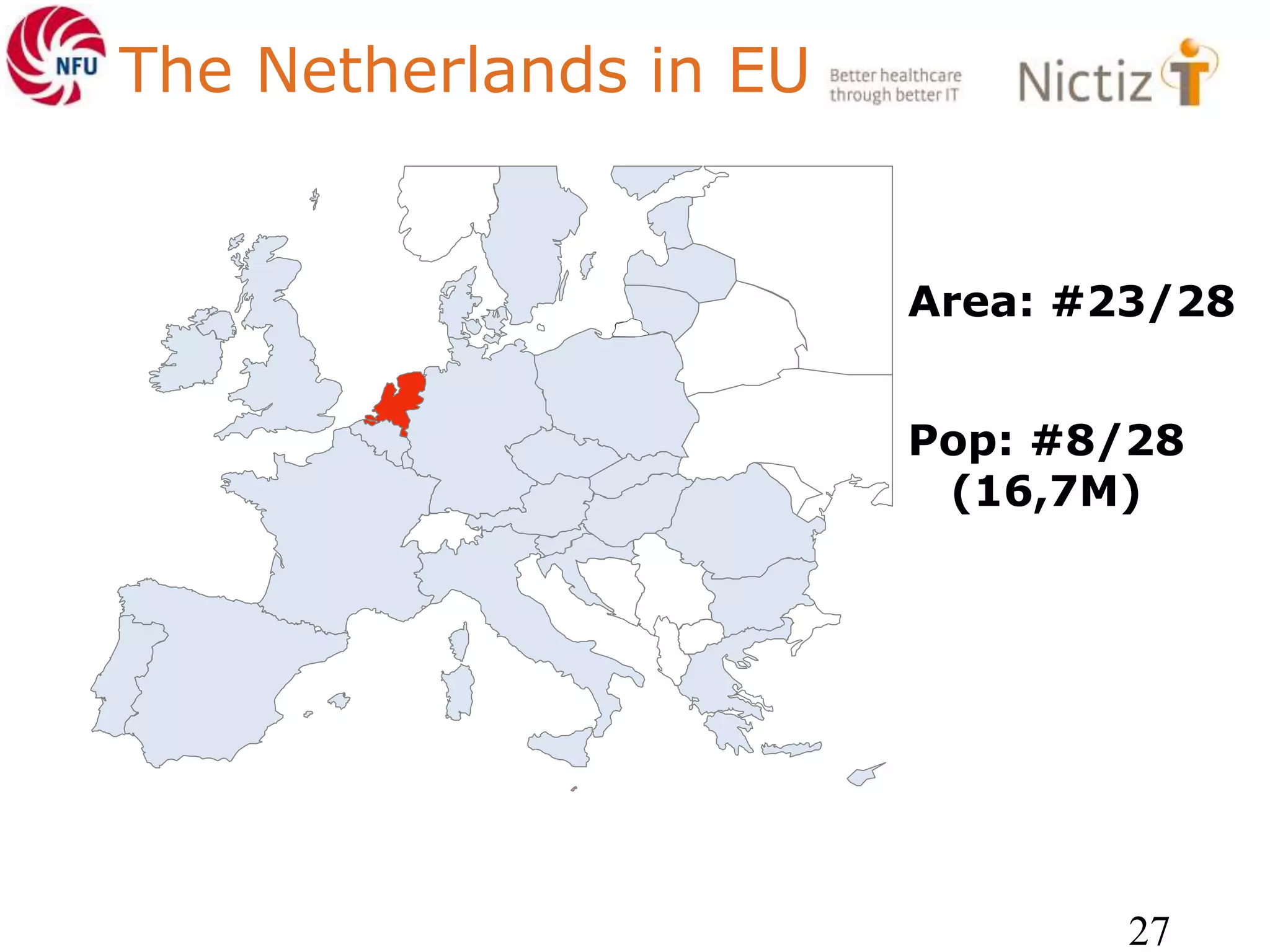
The Netherlands in EU
Area: #23/28
Pop: #8/28
(16,7M)
27
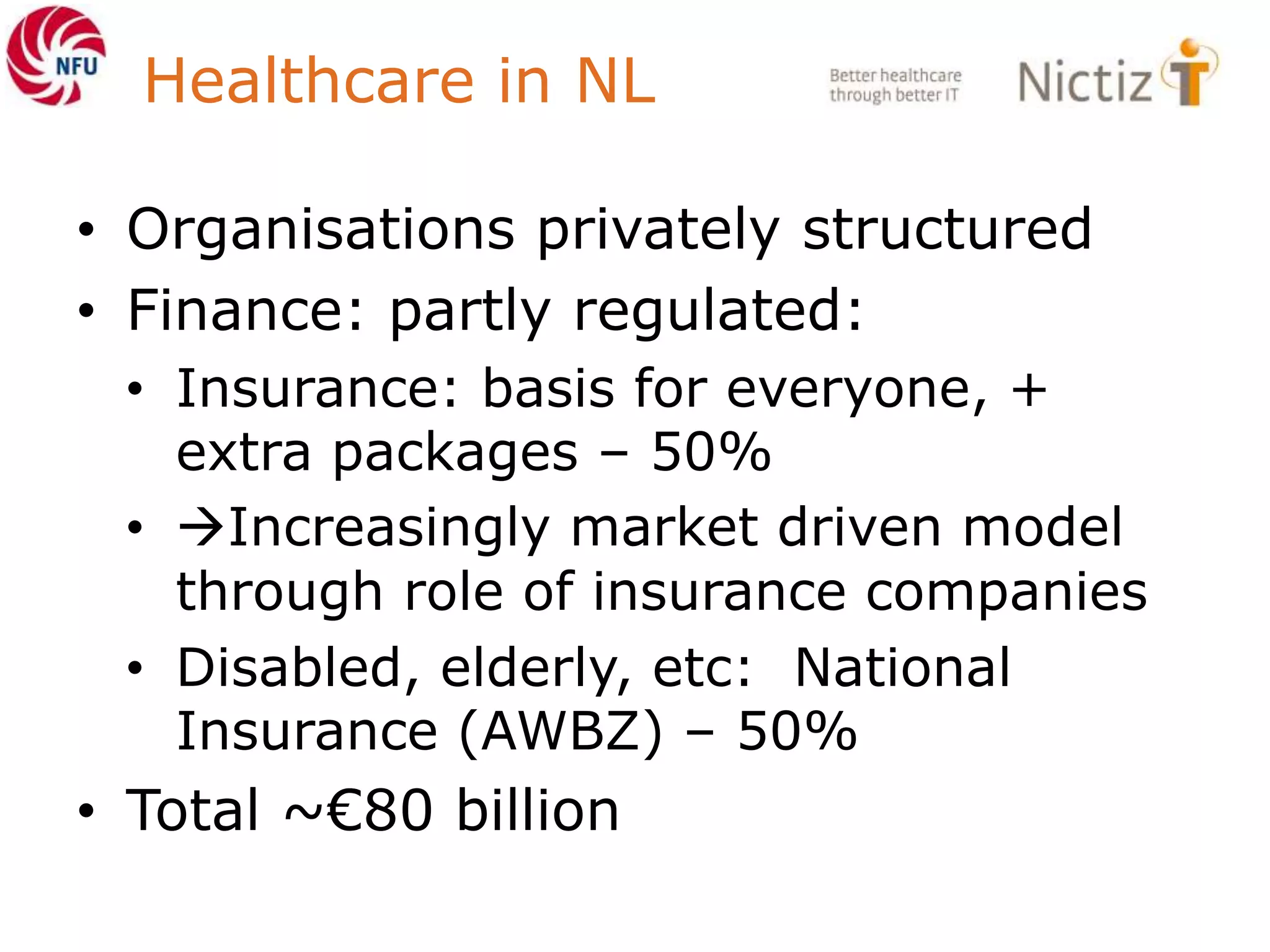
Healthcare in NL
• Organisations privately structured
• Finance: partly regulated:
• Insurance: basis for everyone, +
extra packages – 50%
• Increasingly market driven model
through role of insurance companies
• Disabled, elderly, etc: National
Insurance (AWBZ) – 50%
• Total ~€80 billion
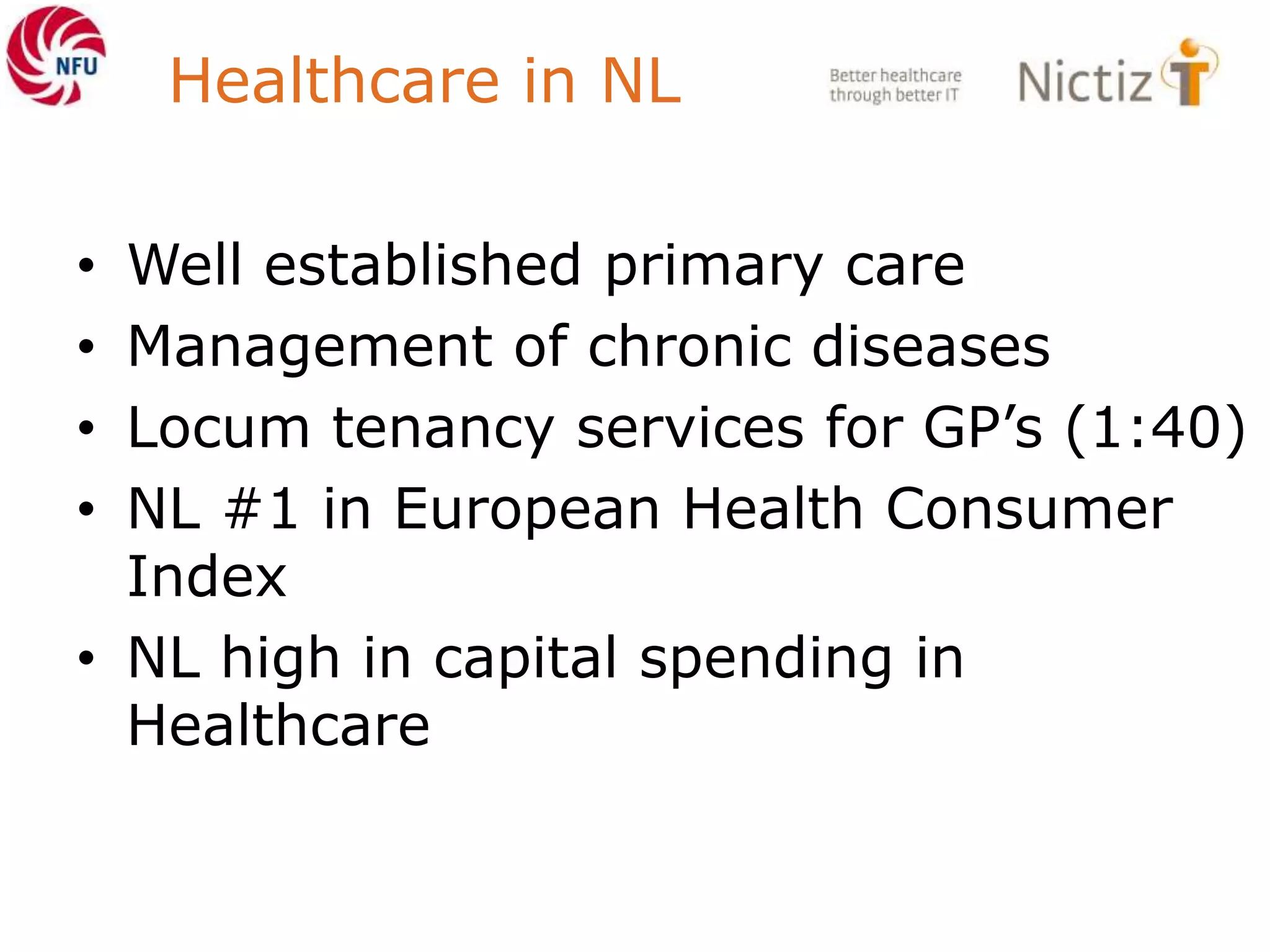
Healthcare in NL
• Well established primary care
• Management of chronic diseases
• Locum tenancy services for GP’s (1:40)
• NL #1 in European Health Consumer
Index
• NL high in capital spending in
Healthcare
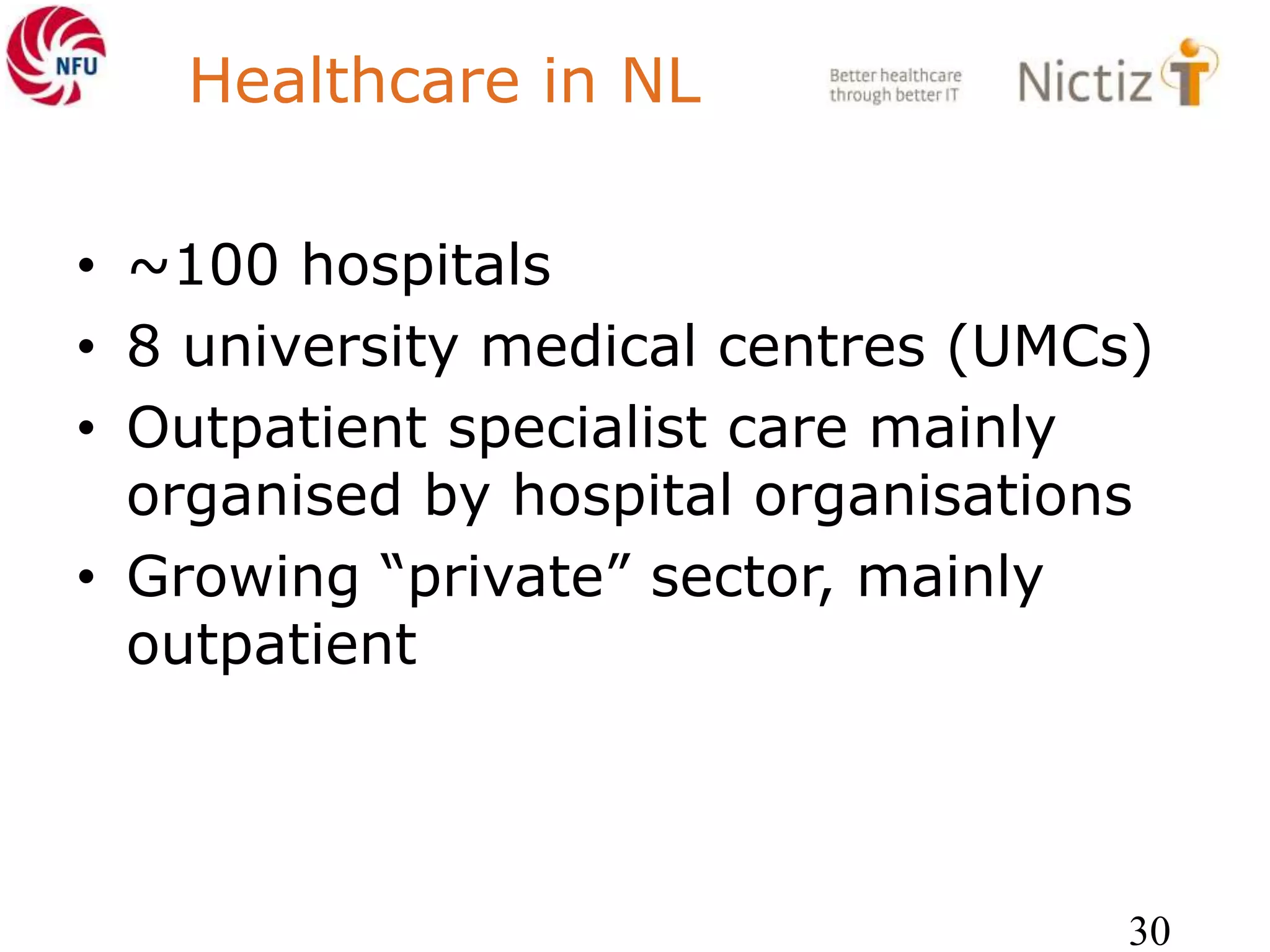
Healthcare in NL
• ~100 hospitals
• 8 university medical centres (UMCs)
• Outpatient specialist care mainly
organised by hospital organisations
• Growing “private” sector, mainly
outpatient
30
Healthcare in NL
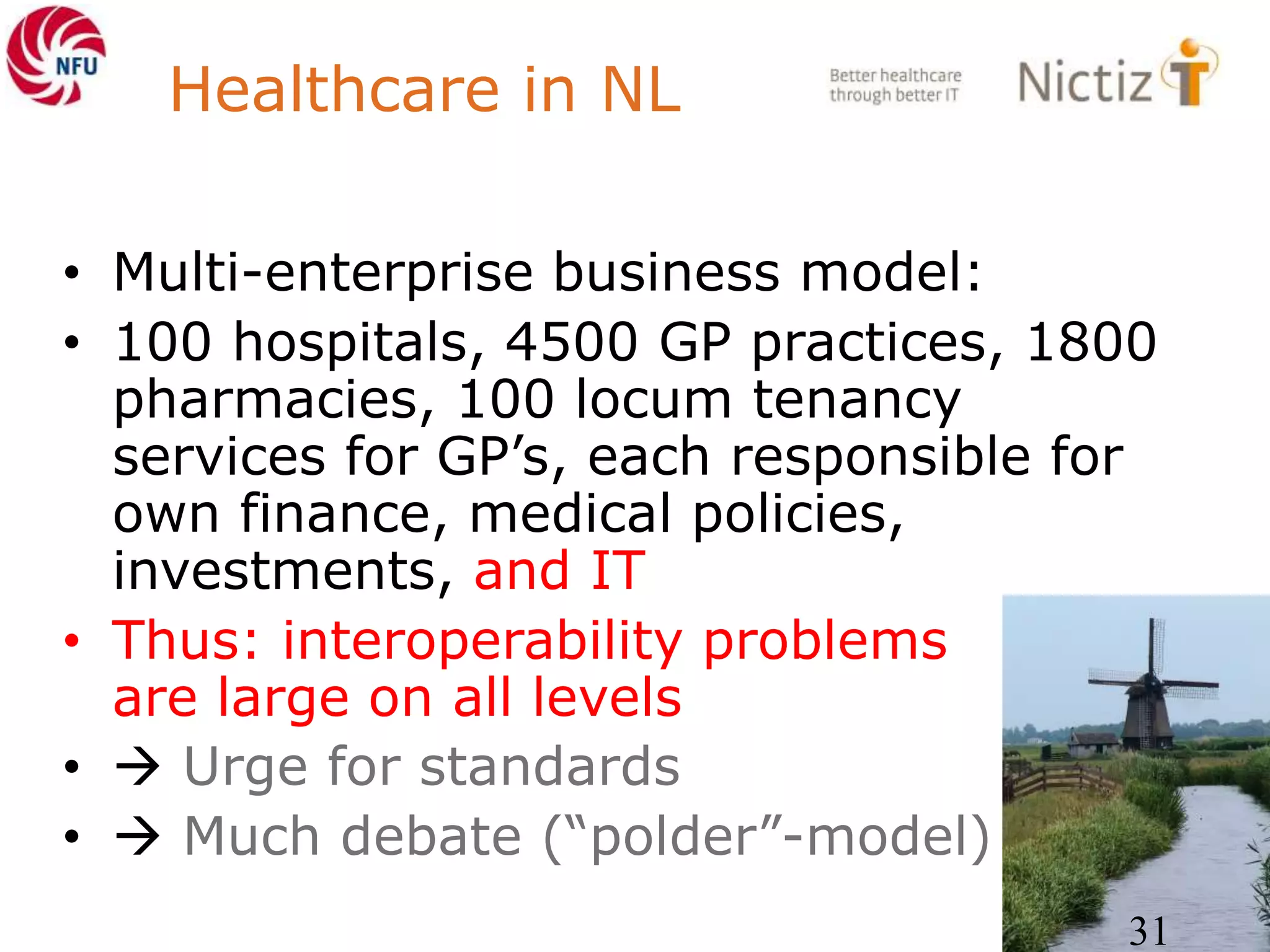
• Multi-enterprise business model:
• 100 hospitals, 4500 GP practices, 1800
pharmacies, 100 locum tenancy
services for GP’s, each responsible for
own finance, medical policies,
investments, and IT
• Thus: interoperability problems
are large on all levels
•  Urge for standards
•  Much debate (“polder”-model)
31
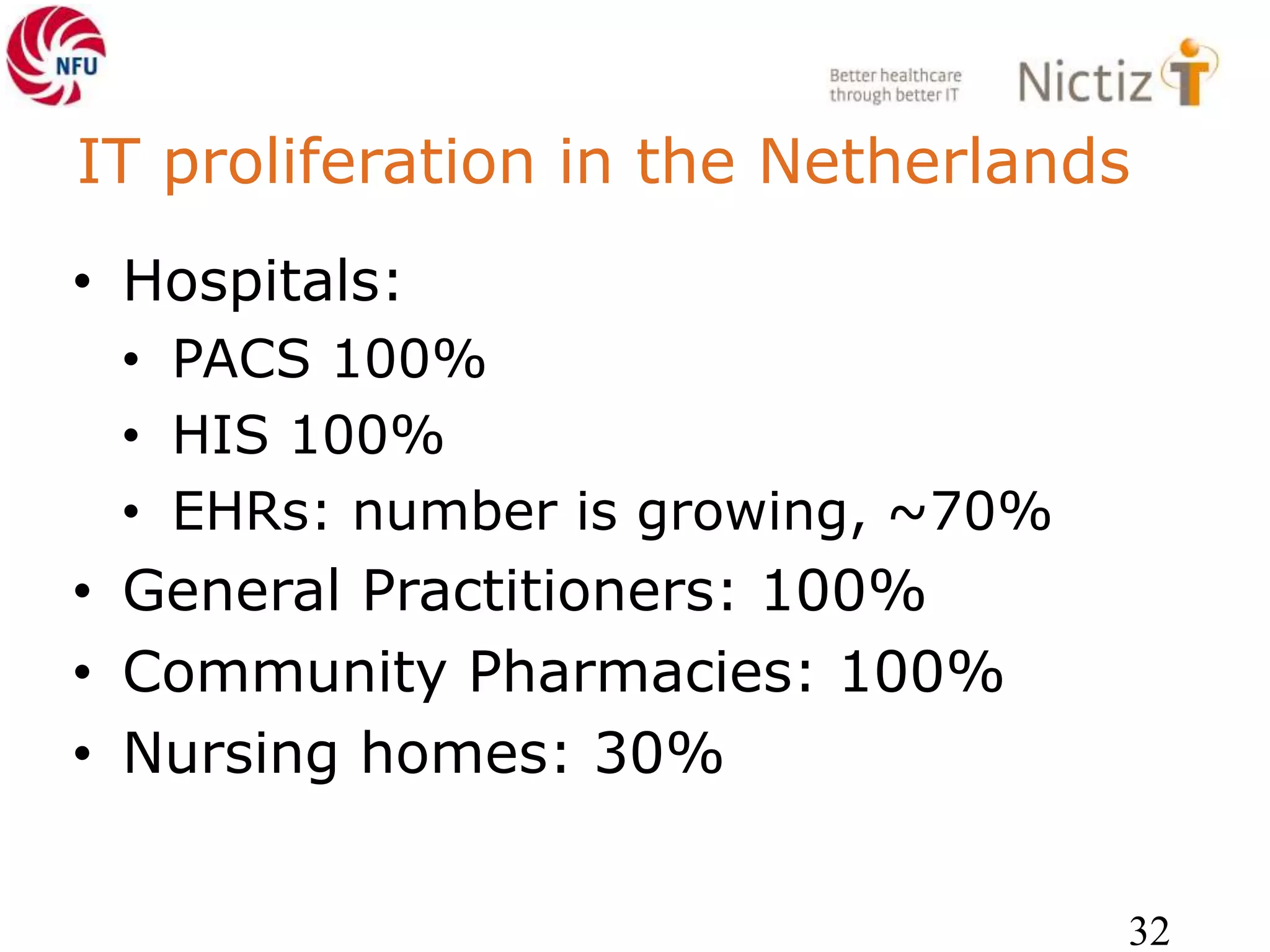
IT proliferation in the Netherlands
• Hospitals:
• PACS 100%
• HIS 100%
• EHRs: number is growing, ~70%
• General Practitioners: 100%
• Community Pharmacies: 100%
• Nursing homes: 30%
32
Agenda of presentation
1. Introduction Nictiz, IT in Healthcare in NL
2. Problem recognition and history of our
approach
3. Clinical Building Blocks
4. State of affairs in implementation in NL
5. Governance, development, change
management and maintenance
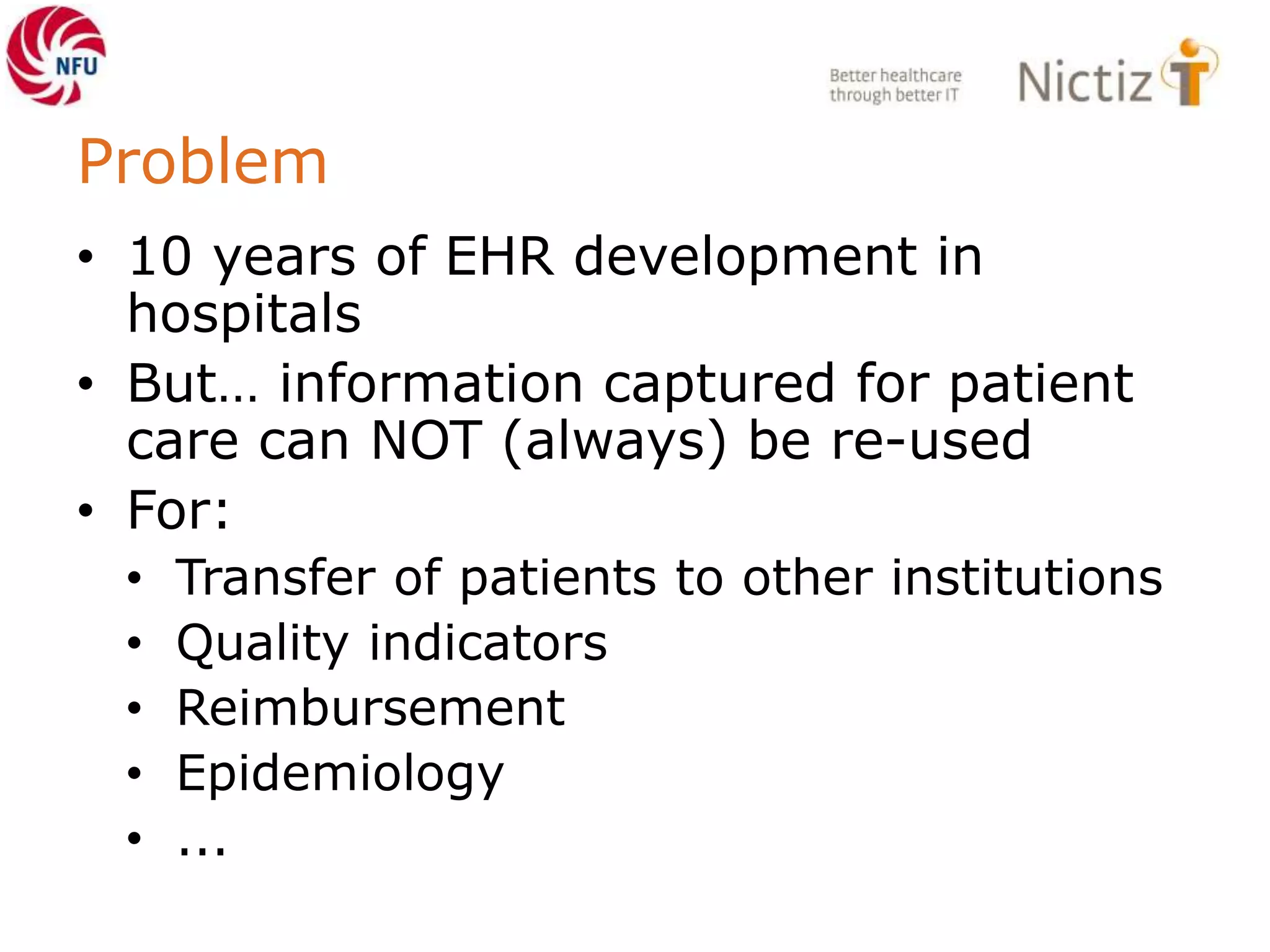
Problem
• 10 years of EHR development in
hospitals
• But… information captured for patient
care can NOT (always) be re-used
• For:
• Transfer of patients to other institutions
• Quality indicators
• Reimbursement
• Epidemiology
• ...
Causes
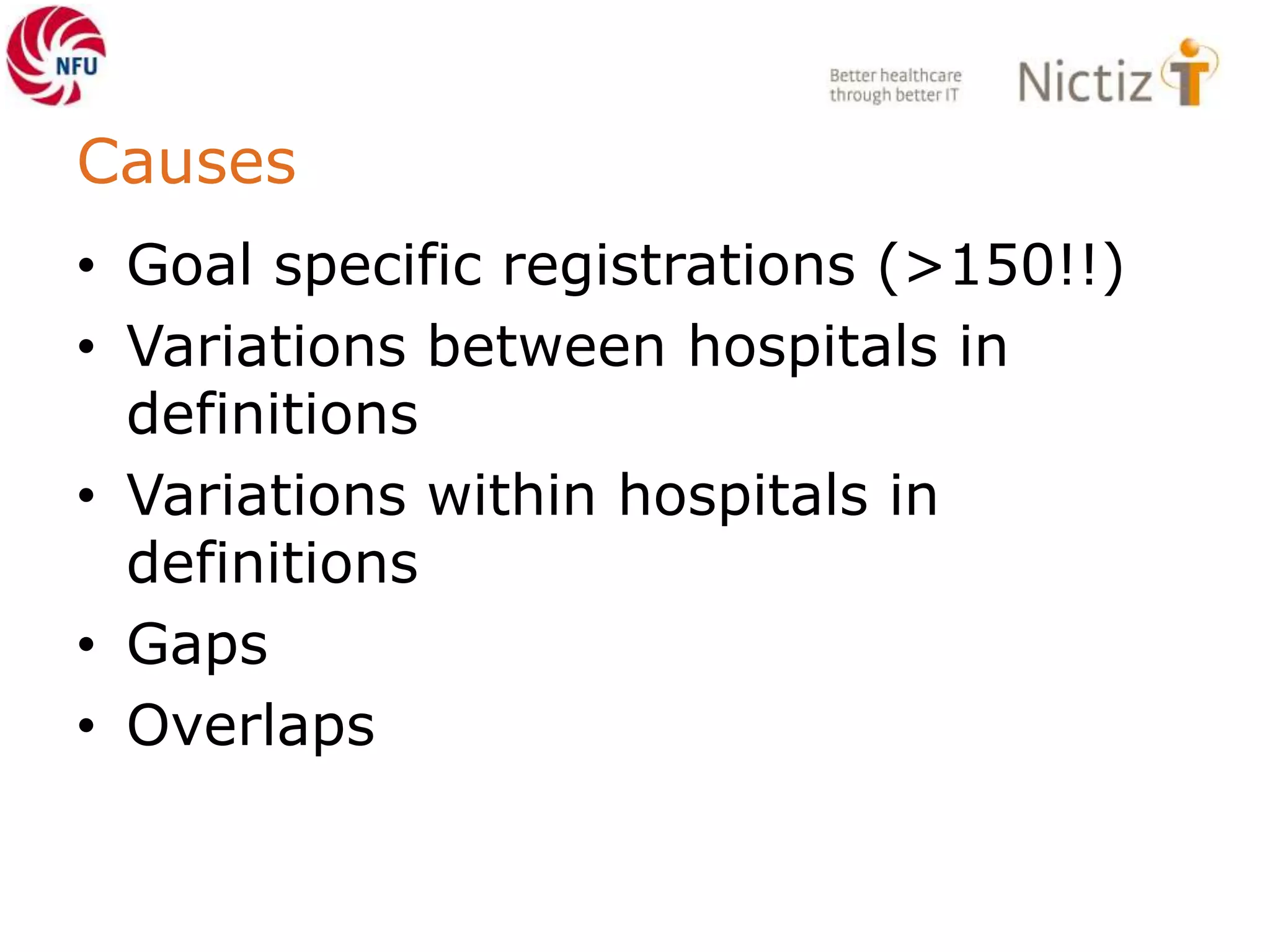
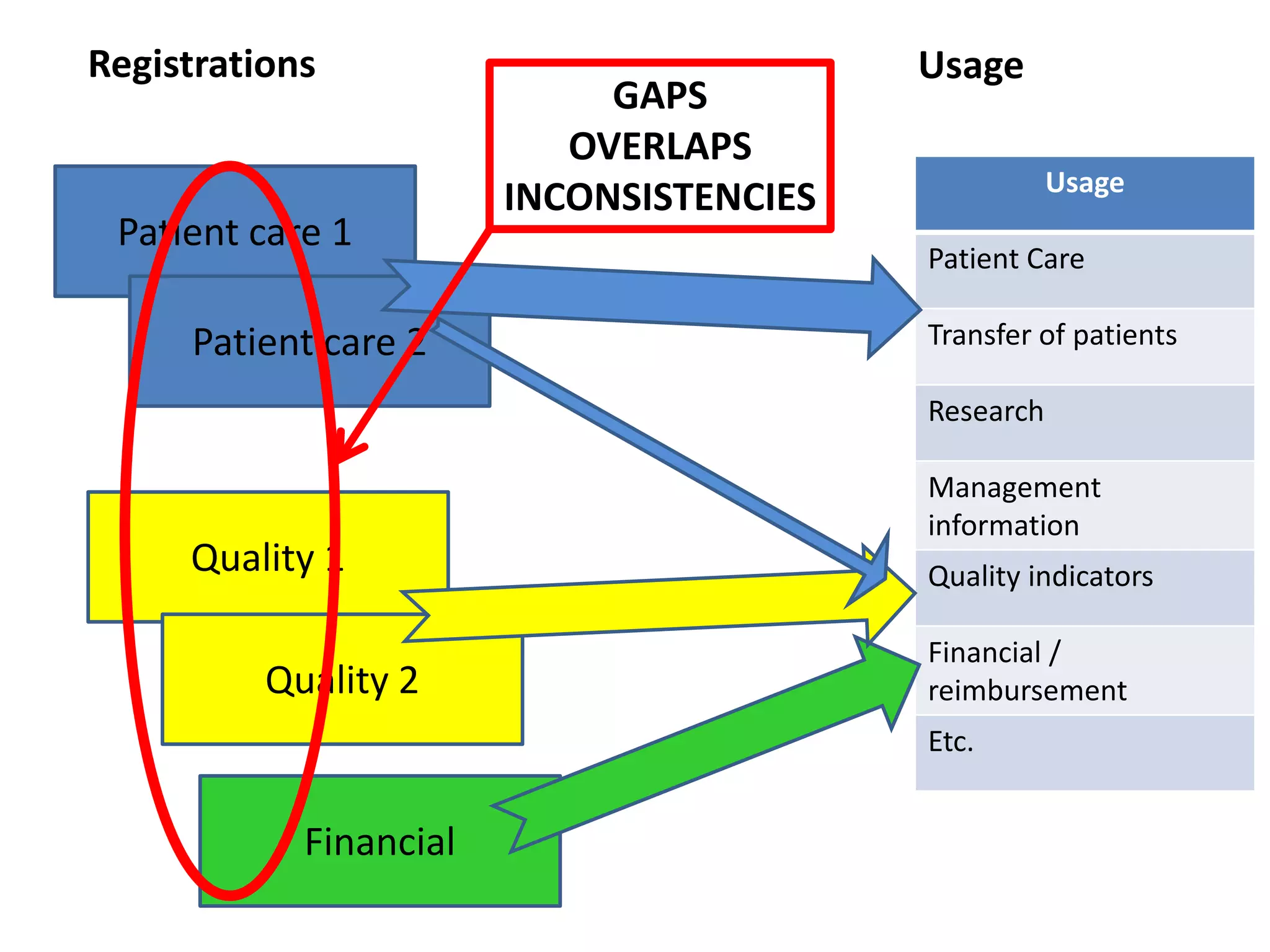
• Goal specific registrations (>150!!)
• Variations between hospitals in
definitions
• Variations within hospitals in
definitions
• Gaps
• Overlaps
Usage
Patient Care
Transfer of patients
Research
Management
information
Quality indicators
Financial /
reimbursement
Etc.
UsageRegistrations
Financial
Quality 1
Quality 2
Patient care 1
Patient care 2
GAPS
OVERLAPS
INCONSISTENCIES
Initiative by
• NFU: the federation of University
Medical Centers (8)
• Nictiz: national competence center
for eHealth and interoperability
• To improve the situation
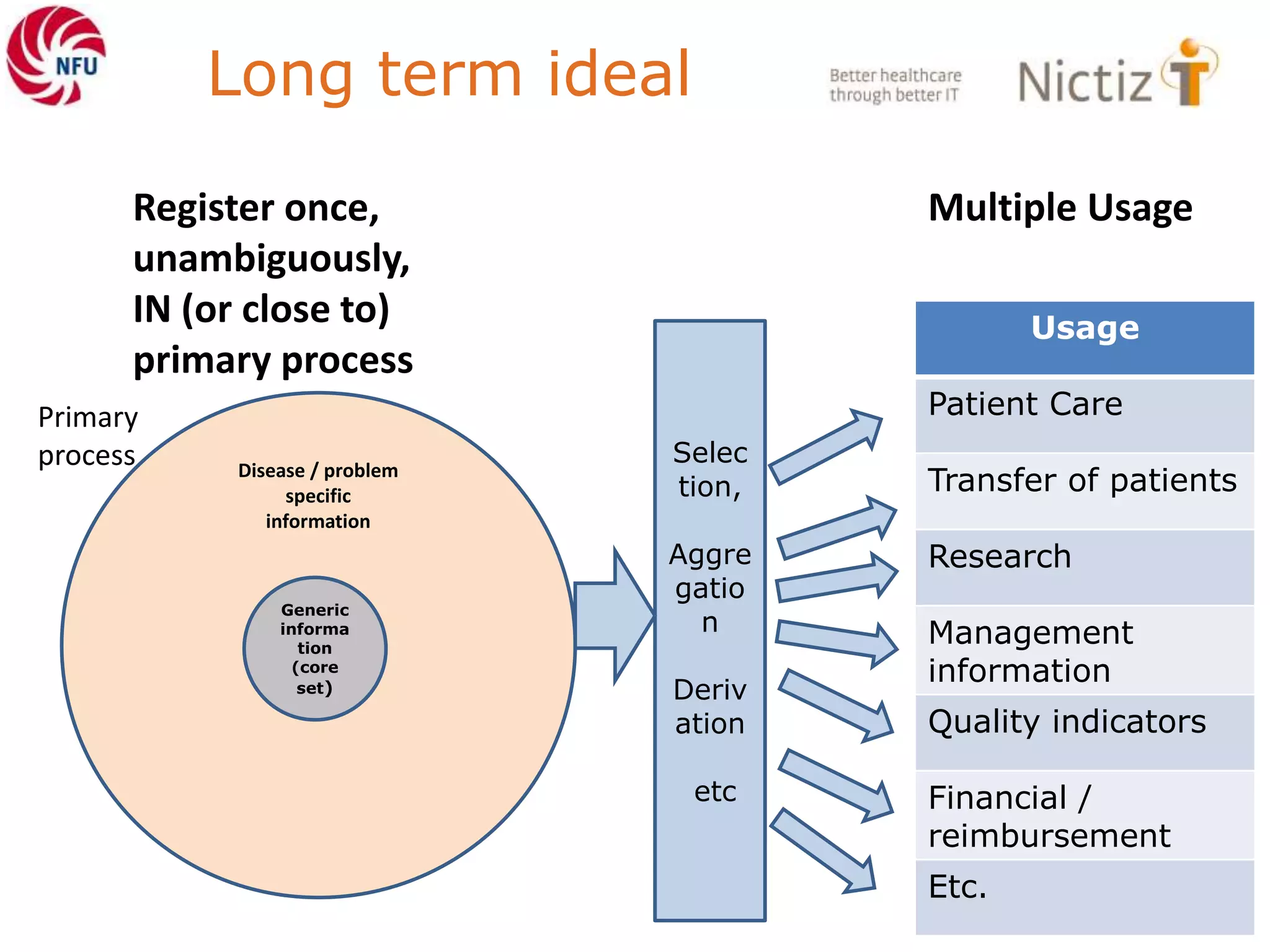
Generic
informa
tion
(core
set)
Disease / problem
specific
information
Usage
Patient Care
Transfer of patients
Research
Management
information
Quality indicators
Financial /
reimbursement
Etc.
Selec
tion,
Aggre
gatio
n
Deriv
ation
etc
Register once,
unambiguously,
IN (or close to)
primary process
Multiple Usage
Primary
process
Long term ideal
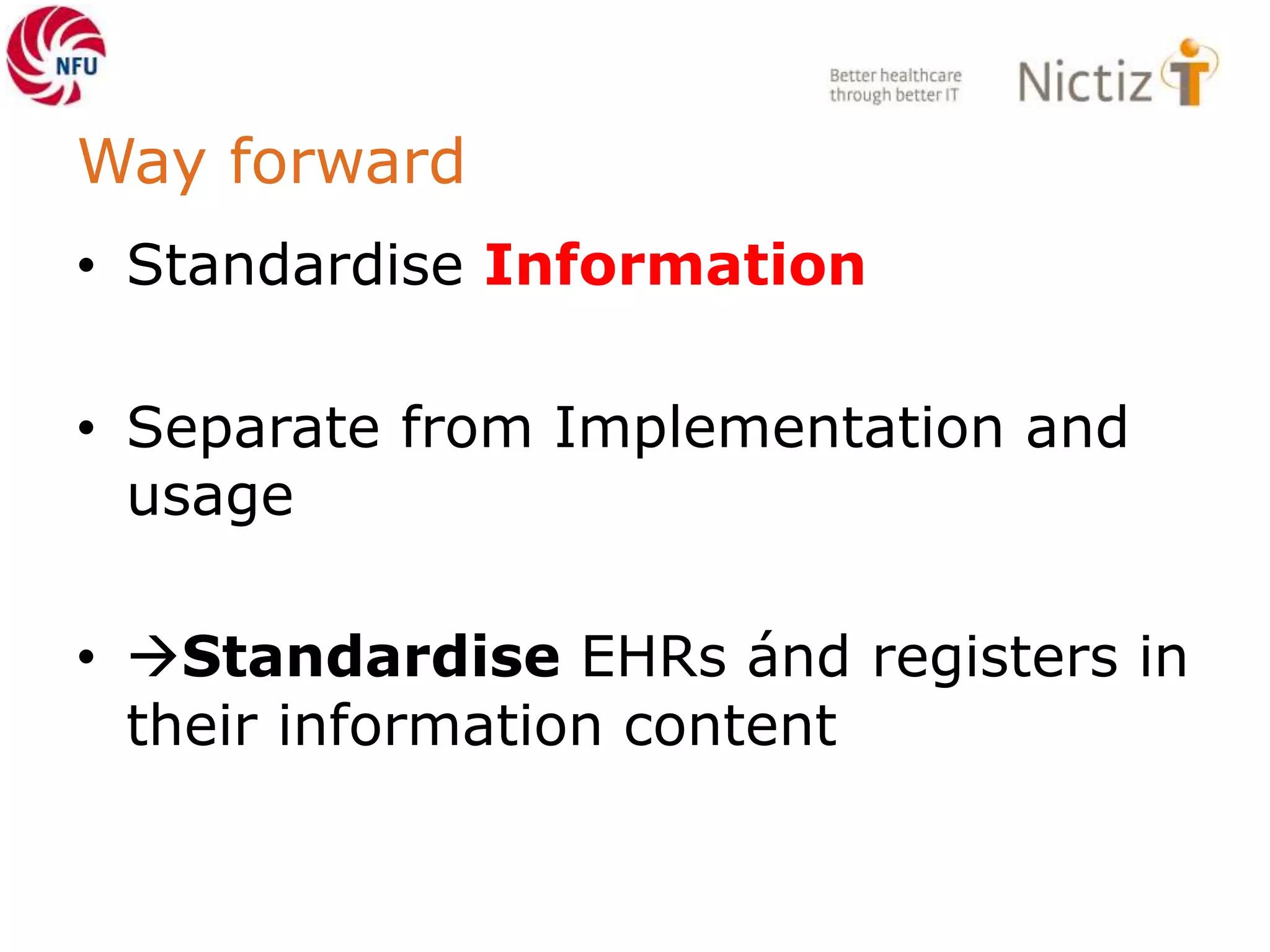
Way forward
• Standardise Information
• Separate from Implementation and
usage
• Standardise EHRs ánd registers in
their information content
Agenda of presentation
1. Introduction Nictiz, IT in Healthcare in NL
2. Problem recognition and history of our
approach
3. Clinical Building Blocks
4. State of affairs in implementation in NL
5. Governance, development, change
management and maintenance
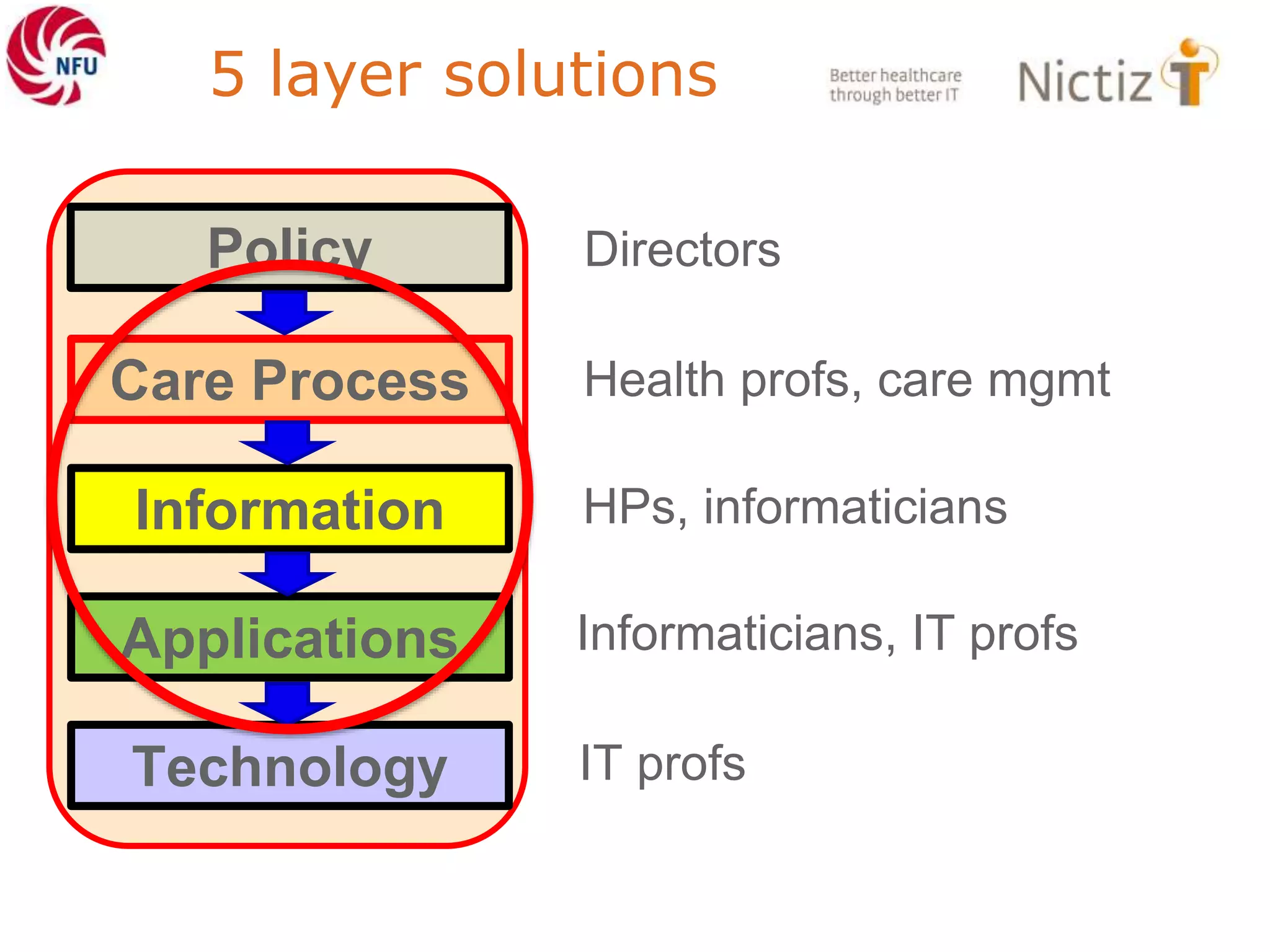
5 layer solutions
Care Process
Information
Applications
Technology
Policy Directors
Health profs, care mgmt
HPs, informaticians
Informaticians, IT profs
IT profs
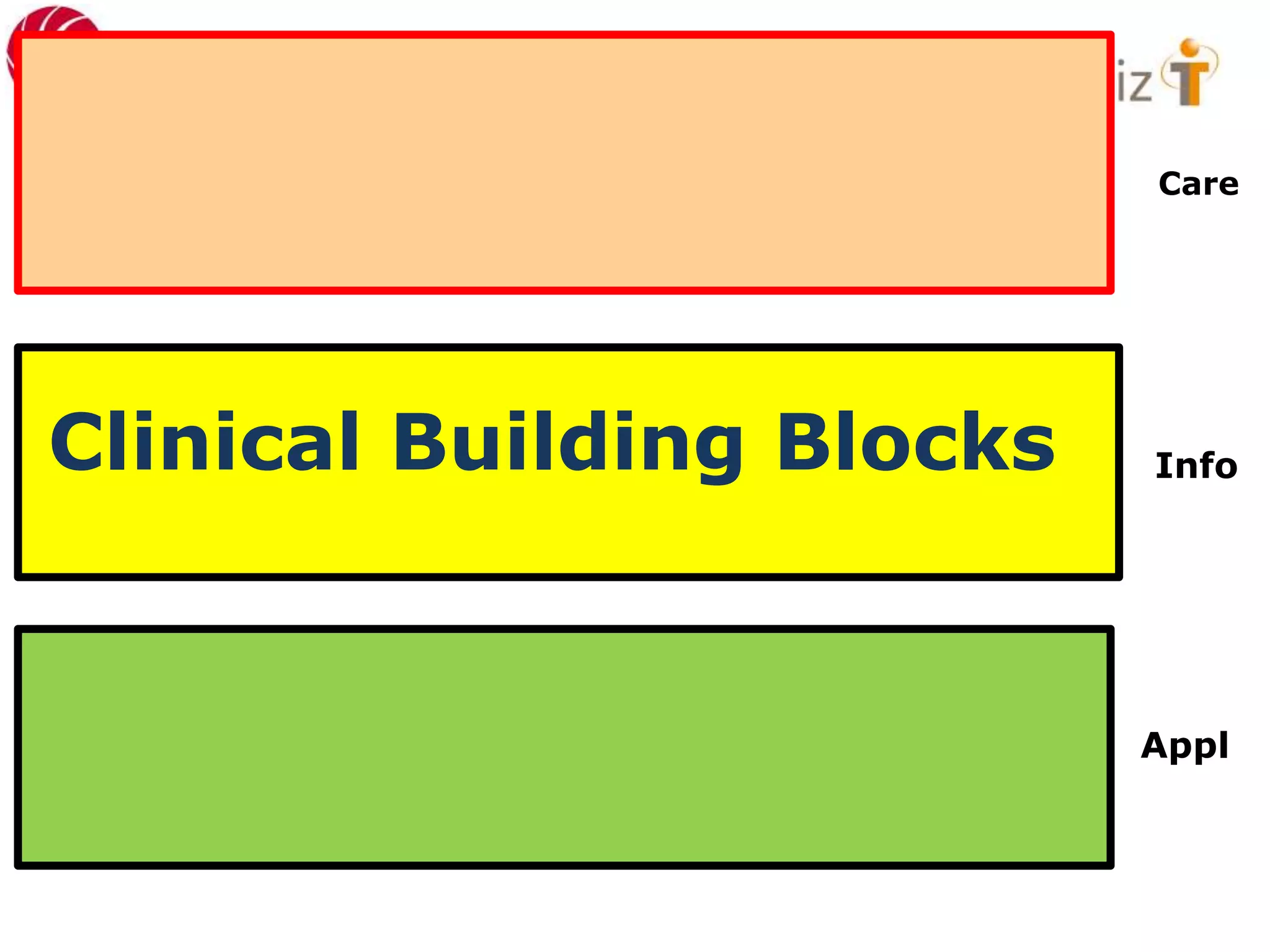
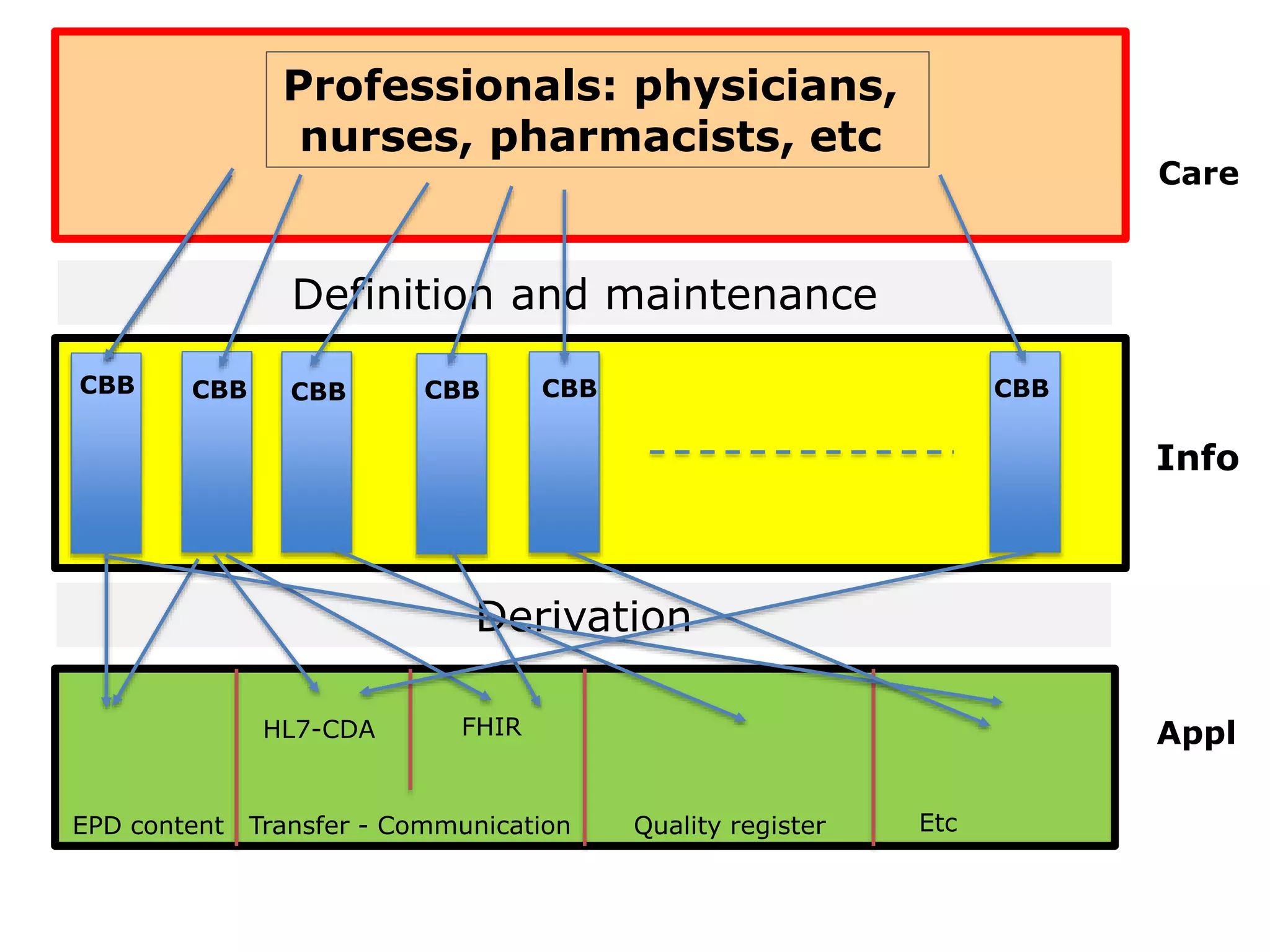
Care
Info
Appl
Clinical Building Blocks
Derivation
Care
Info
Appl
Professionals: physicians,
nurses, pharmacists, etc
EPD content Transfer - Communication Quality register Etc
HL7-CDA FHIR
CBB
Definition and maintenance
CBB CBB CBB CBB CBB
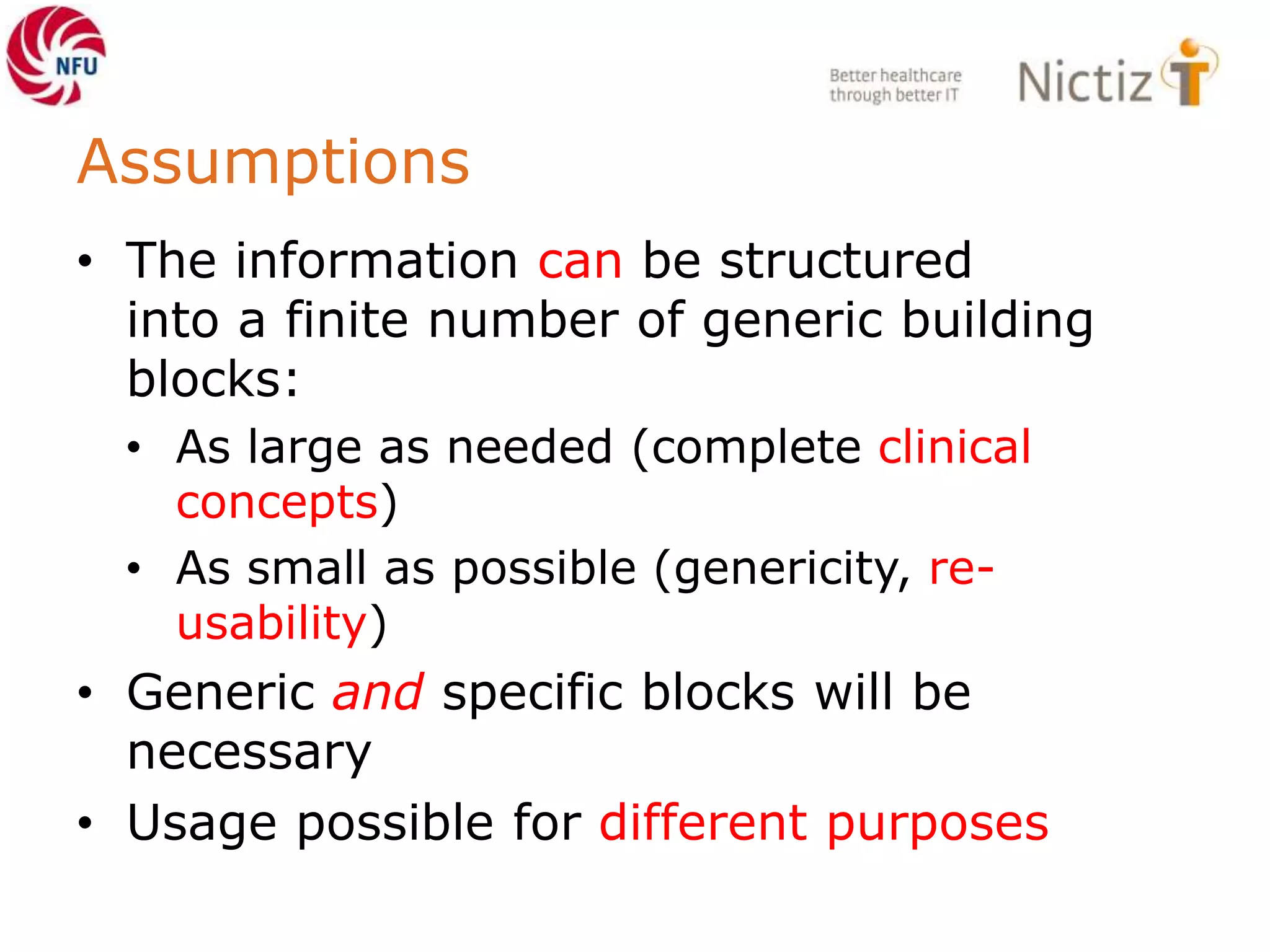
Assumptions
• The information can be structured
into a finite number of generic building
blocks:
• As large as needed (complete clinical
concepts)
• As small as possible (genericity, re-
usability)
• Generic and specific blocks will be
necessary
• Usage possible for different purposes
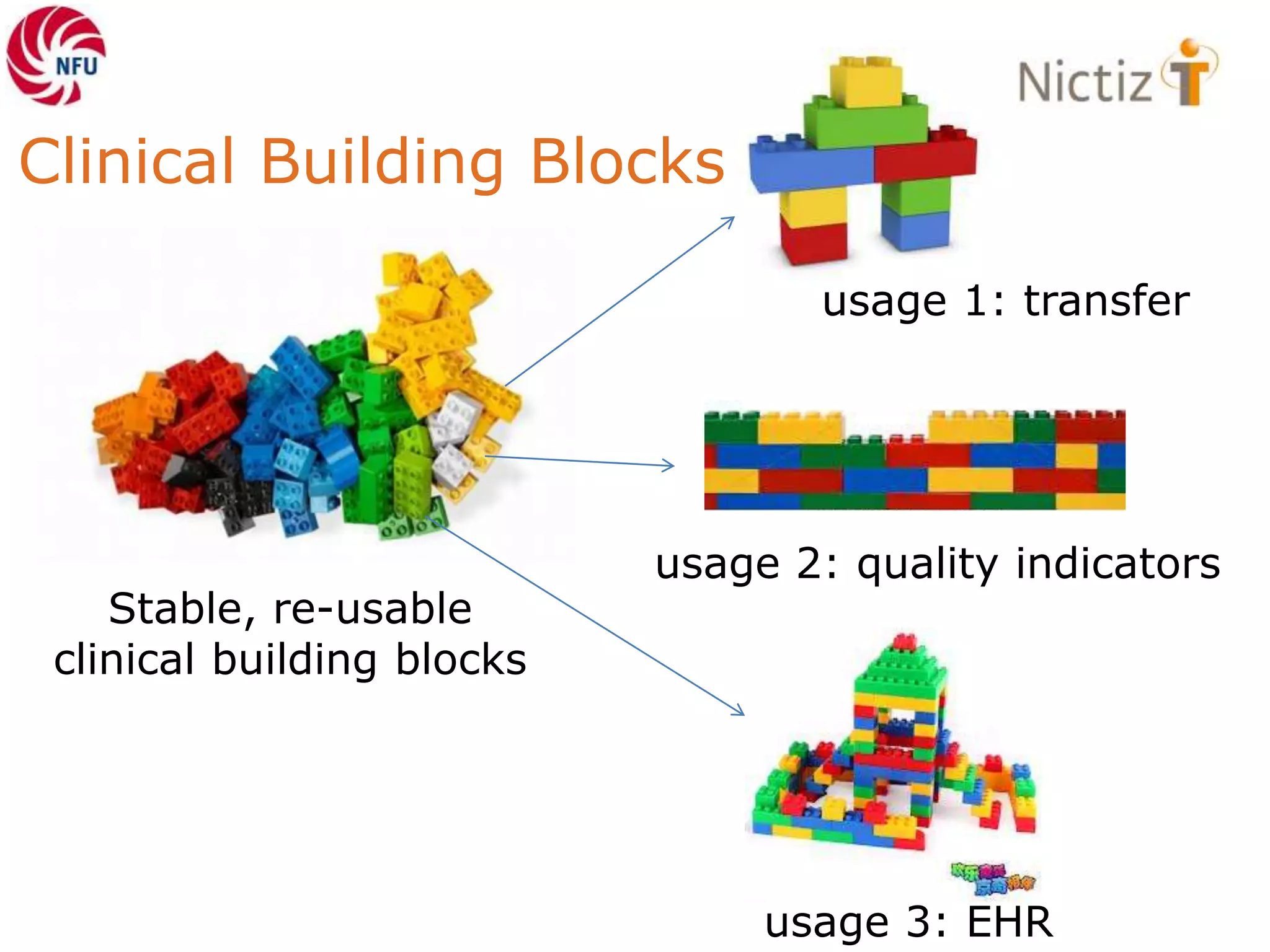
Clinical Building Blocks
Stable, re-usable
clinical building blocks
usage 1: transfer
usage 2: quality indicators
usage 3: EHR
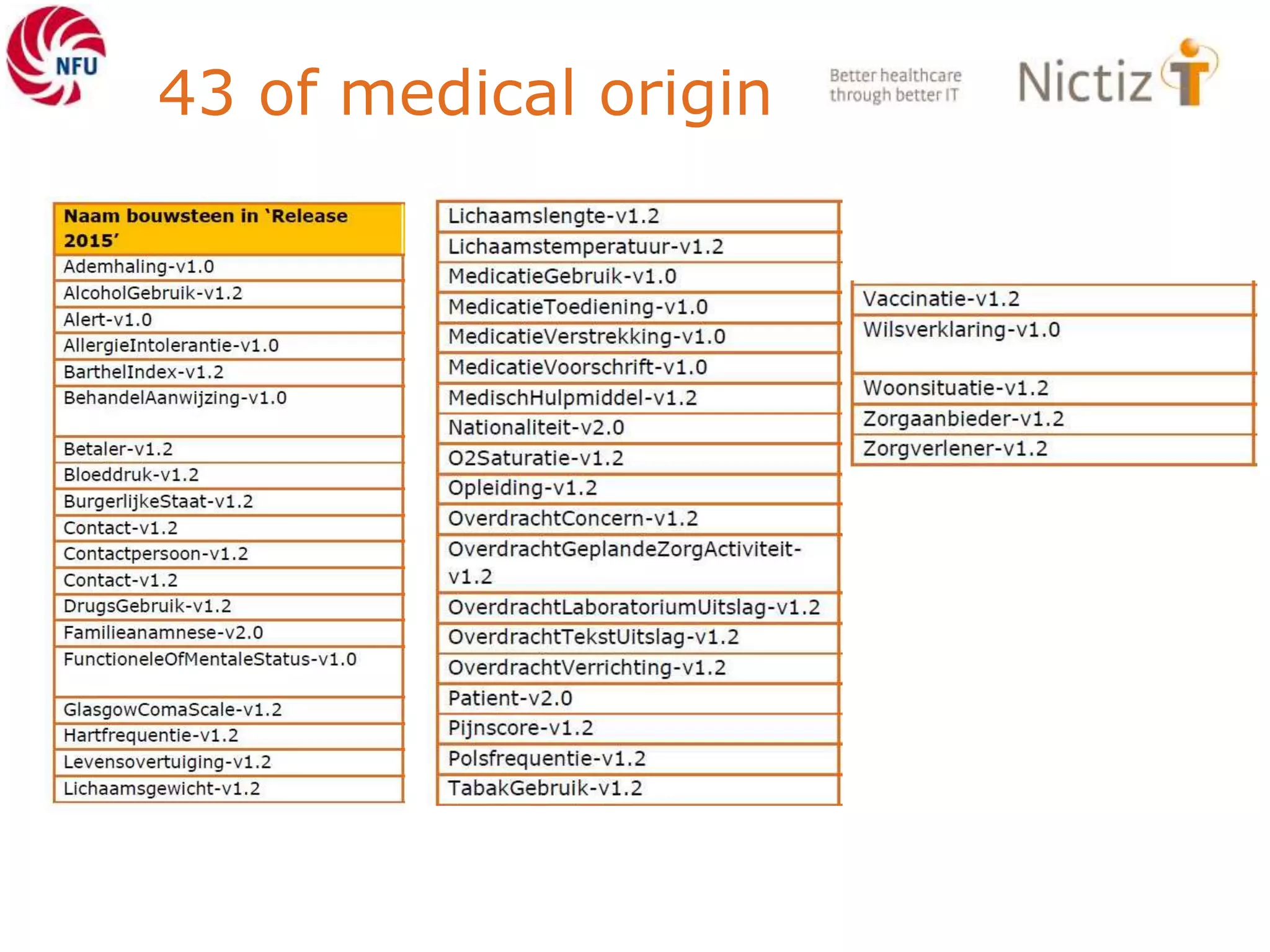
43 of medical origin
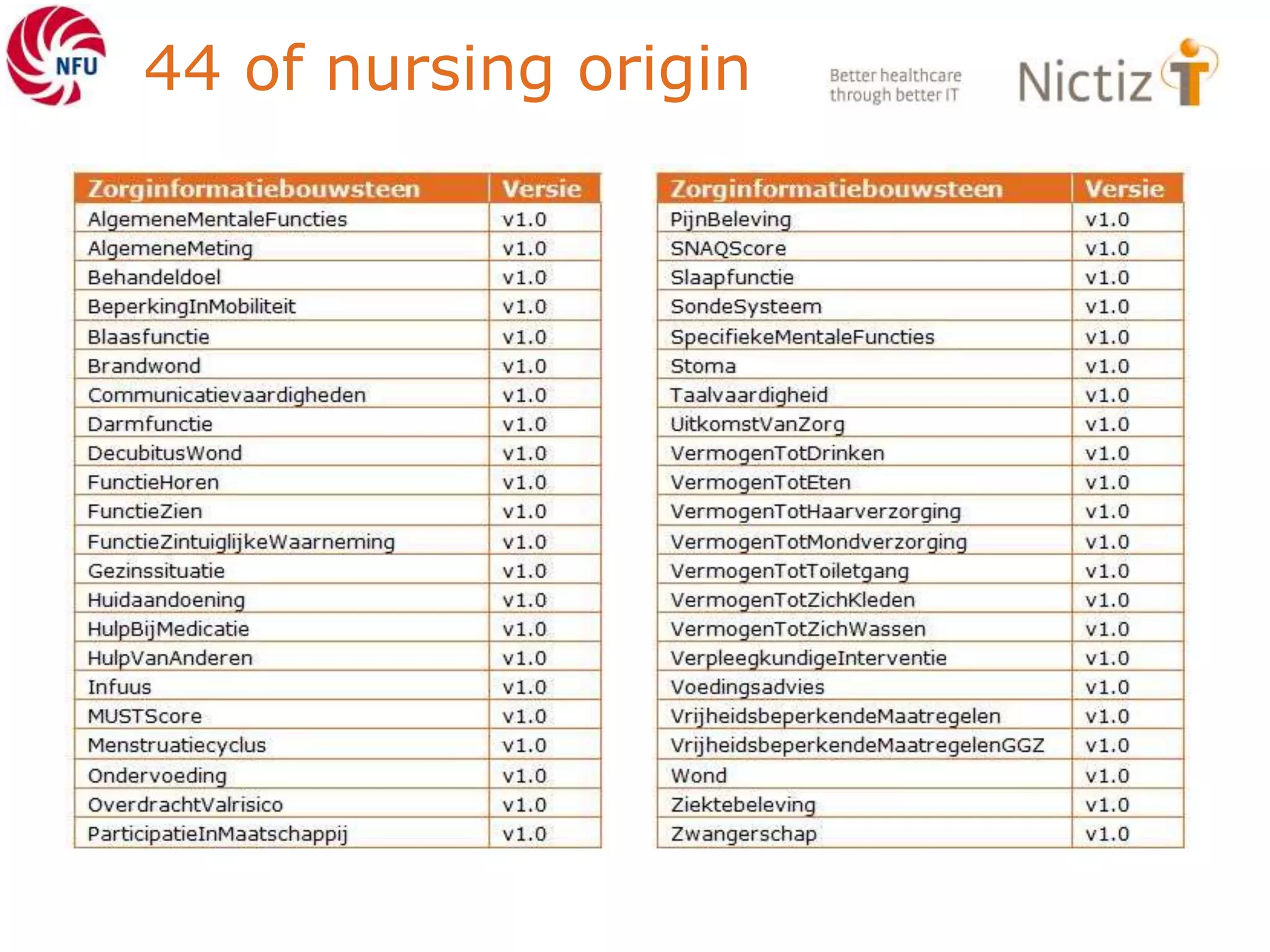
44 of nursing origin
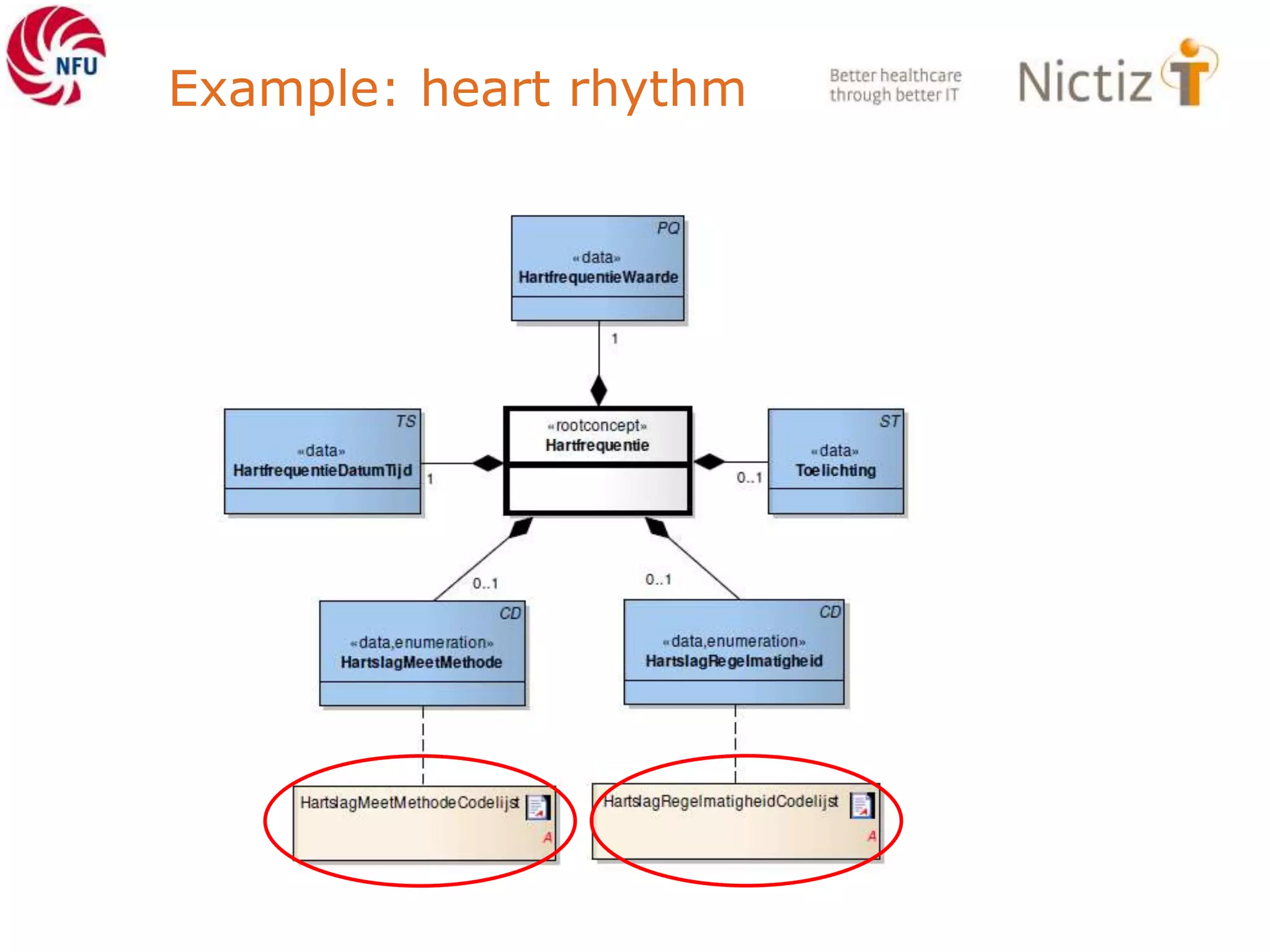
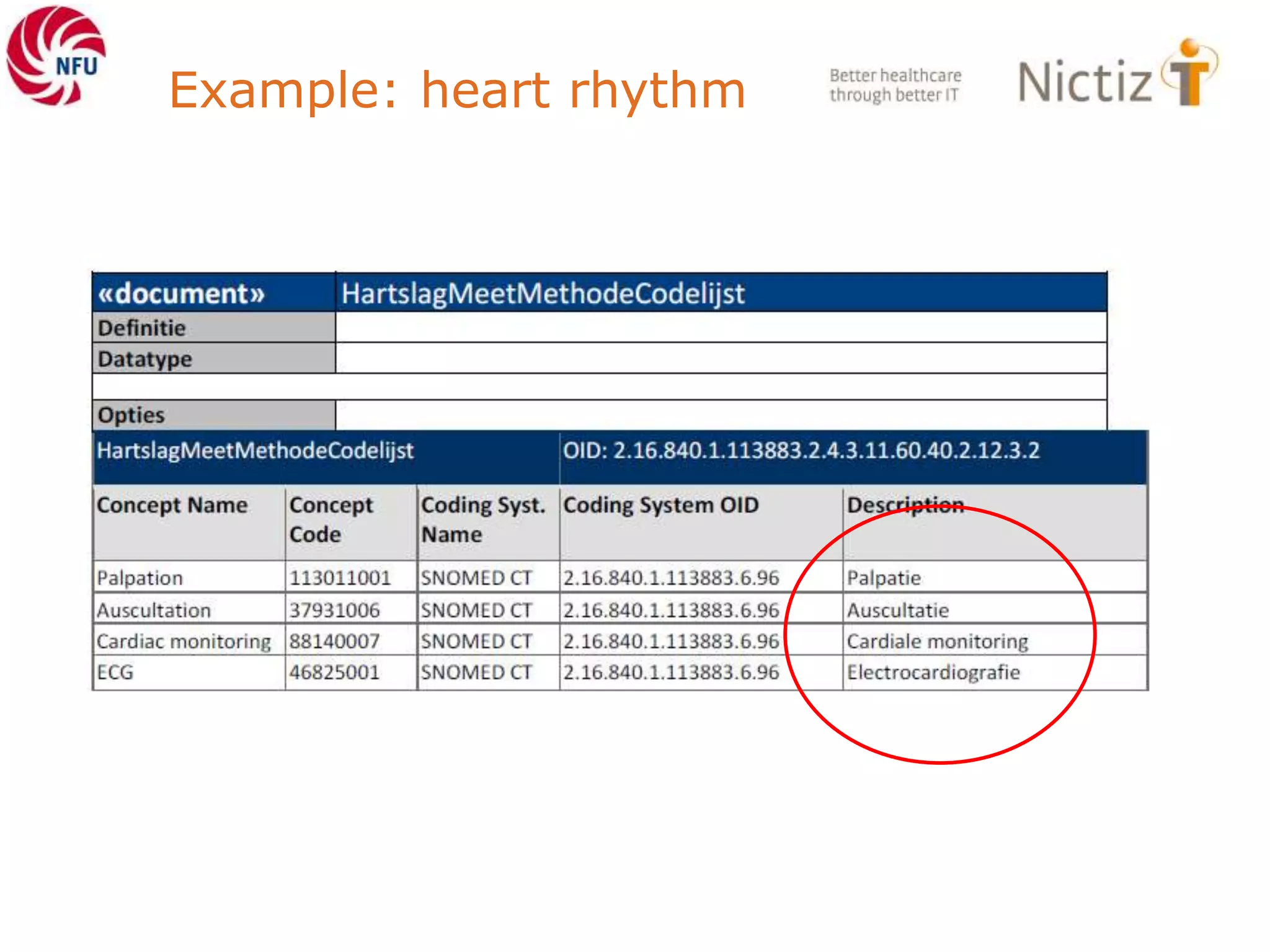
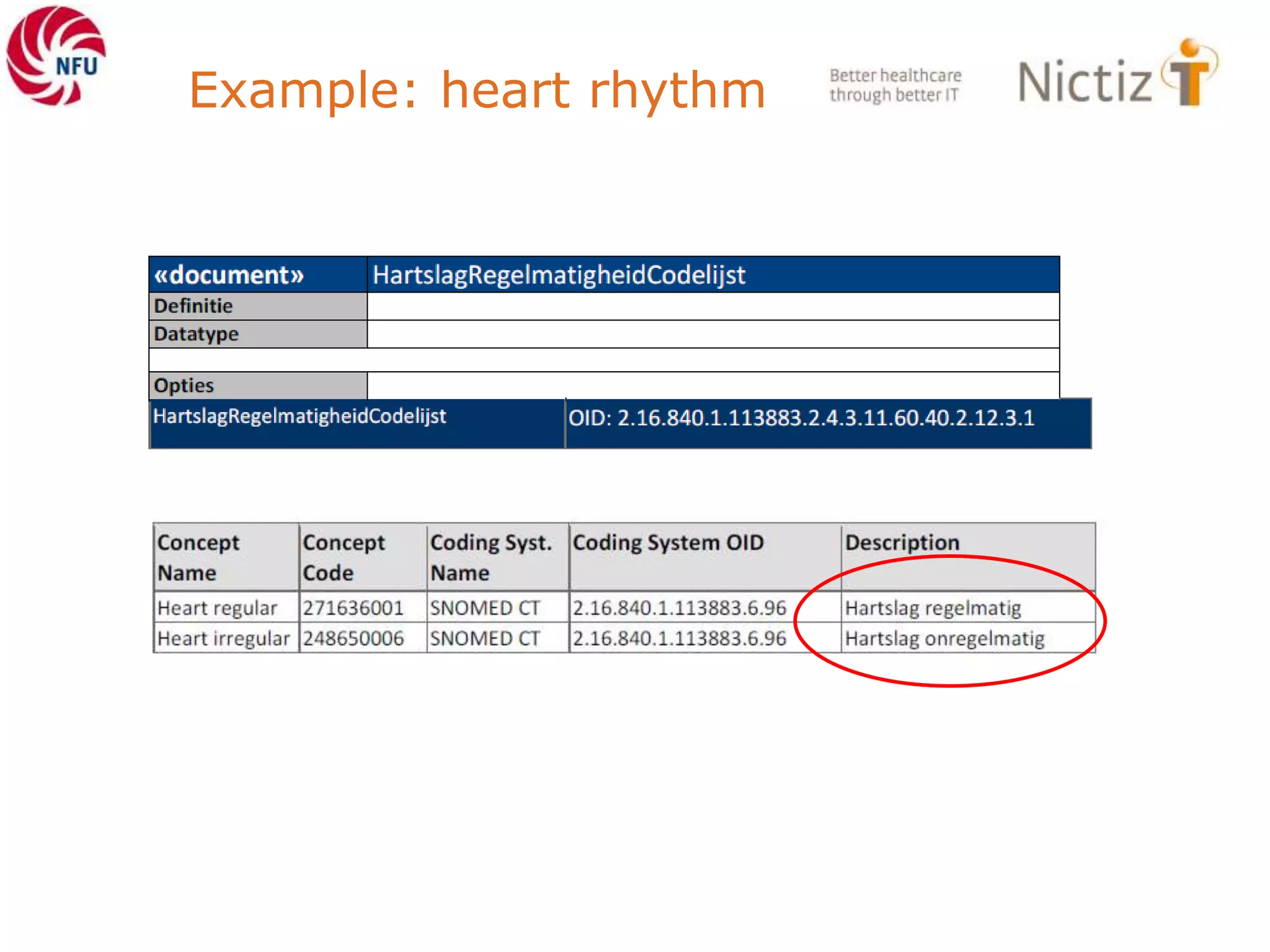
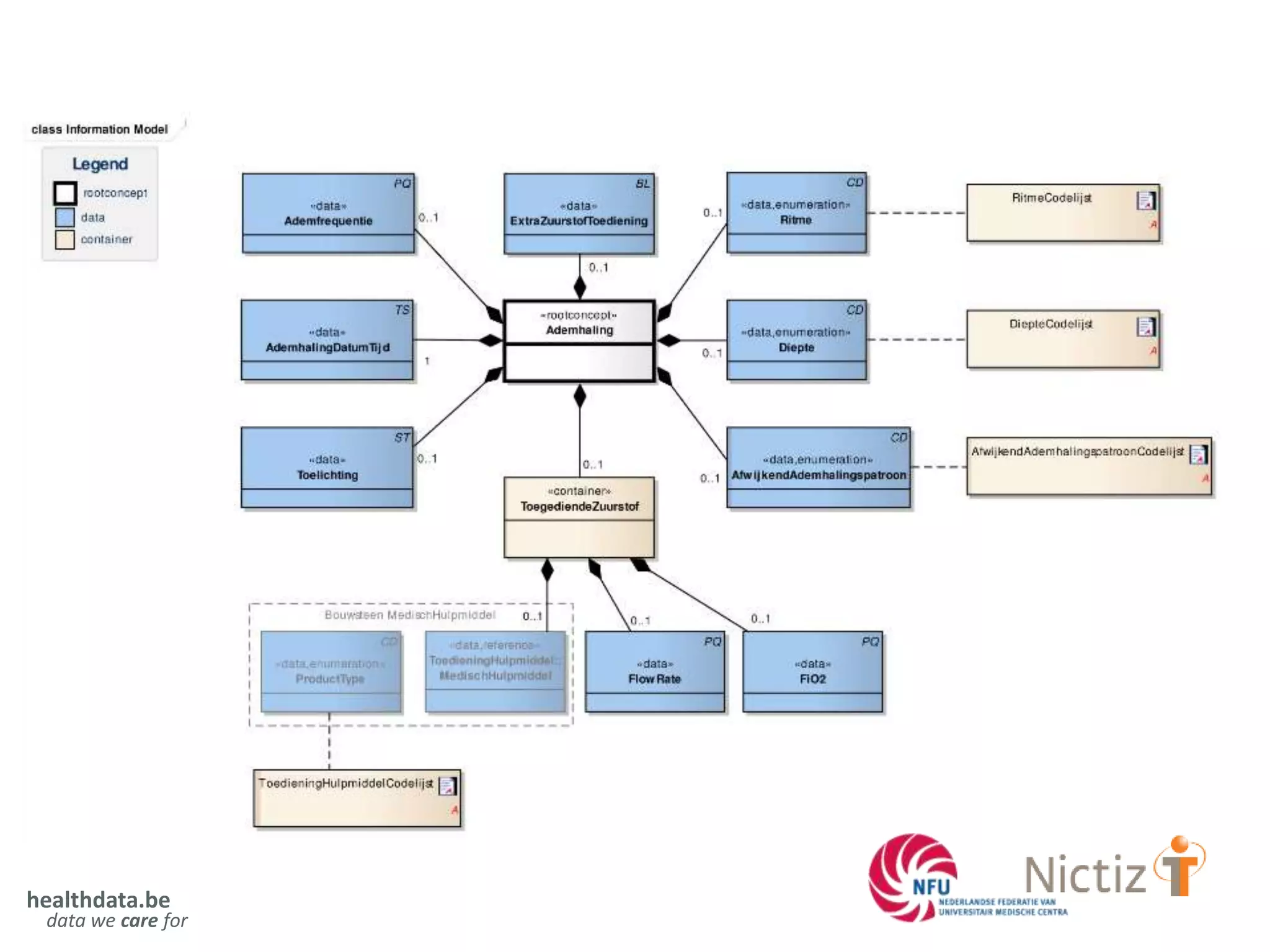
Example: heart rhythm
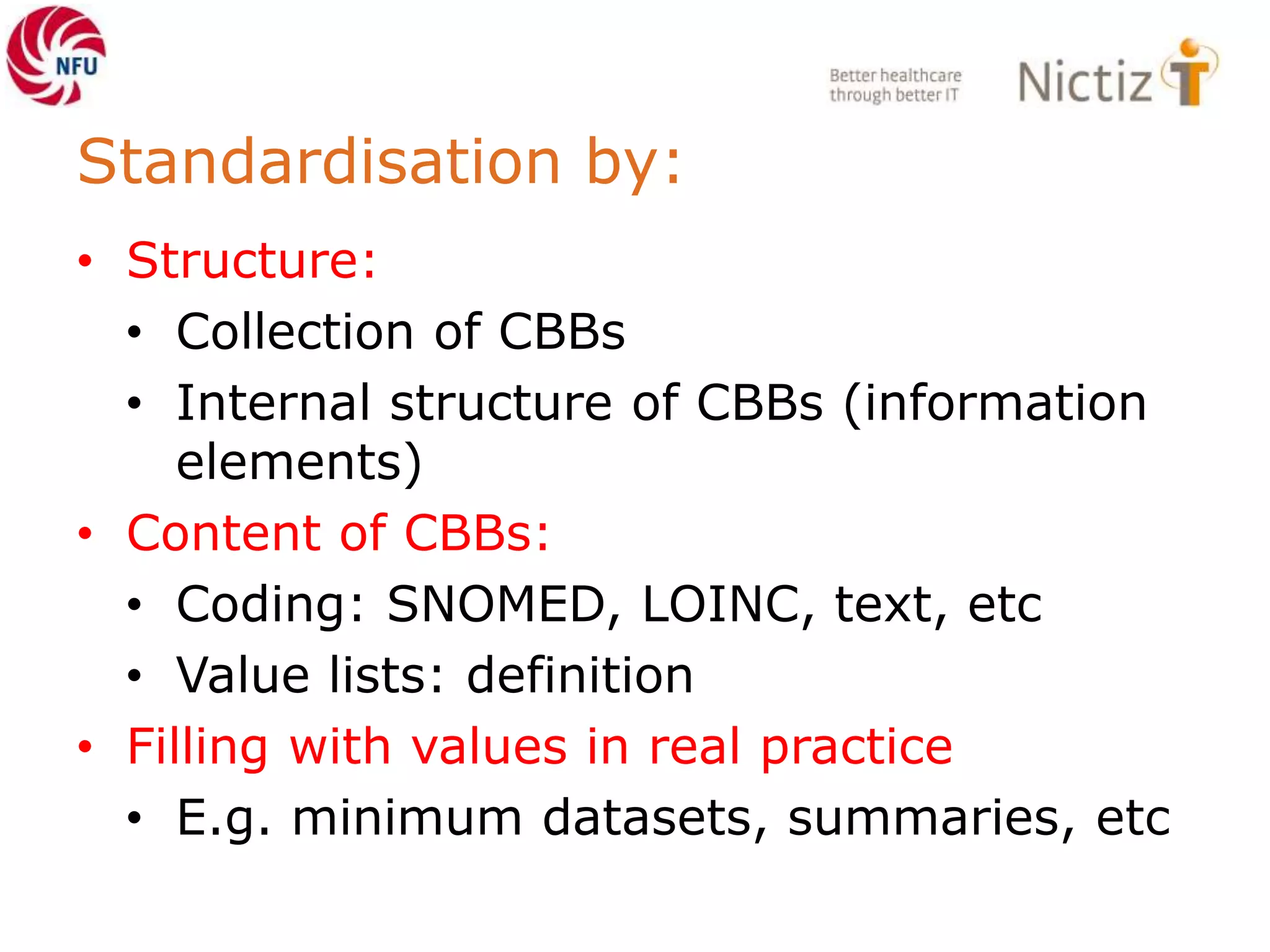
Standardisation by:
• Structure:
• Collection of CBBs
• Internal structure of CBBs (information
elements)
• Content of CBBs:
• Coding: SNOMED, LOINC, text, etc
• Value lists: definition
• Filling with values in real practice
• E.g. minimum datasets, summaries, etc
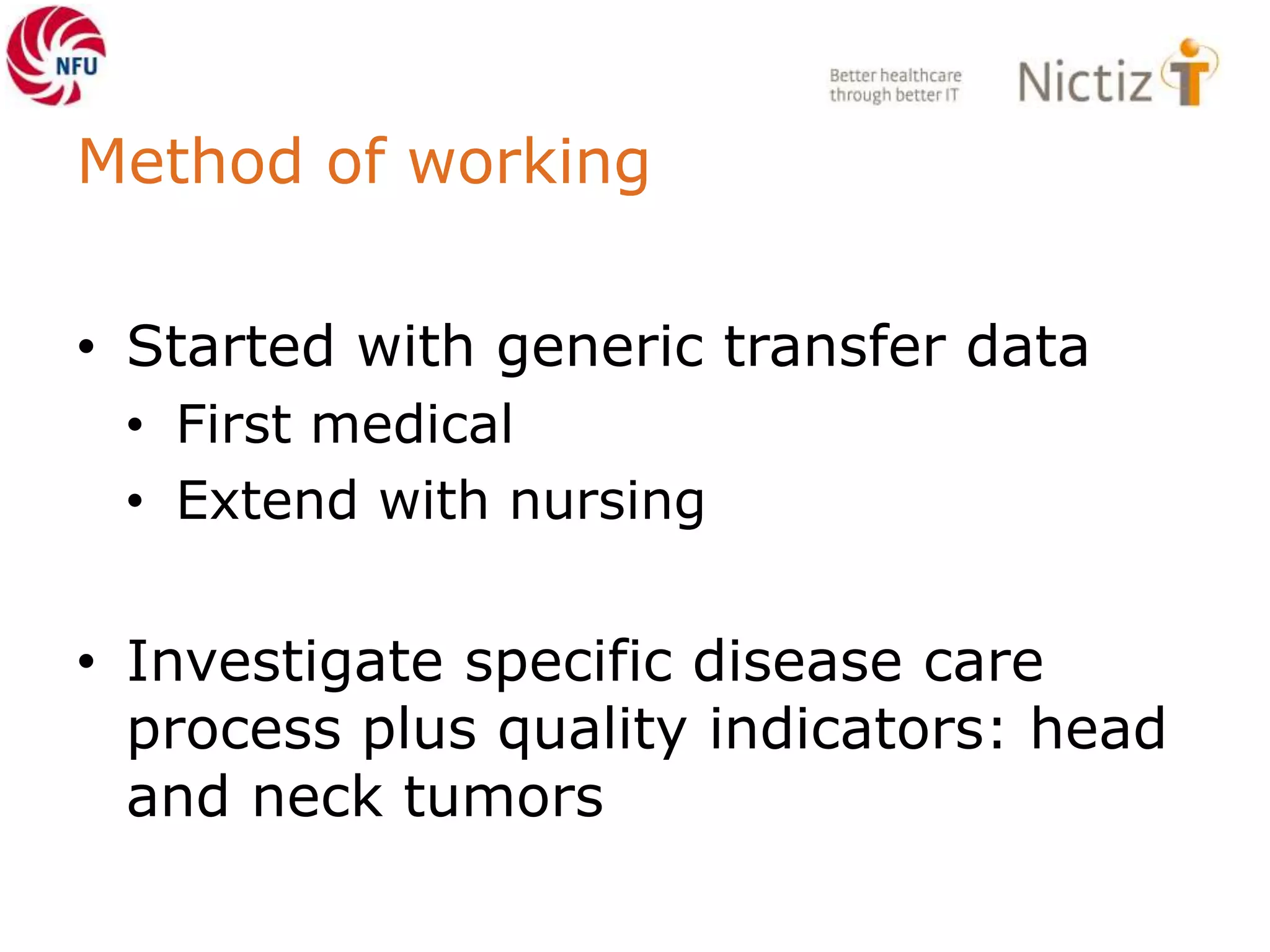
Method of working
• Started with generic transfer data
• First medical
• Extend with nursing
• Investigate specific disease care
process plus quality indicators: head
and neck tumors
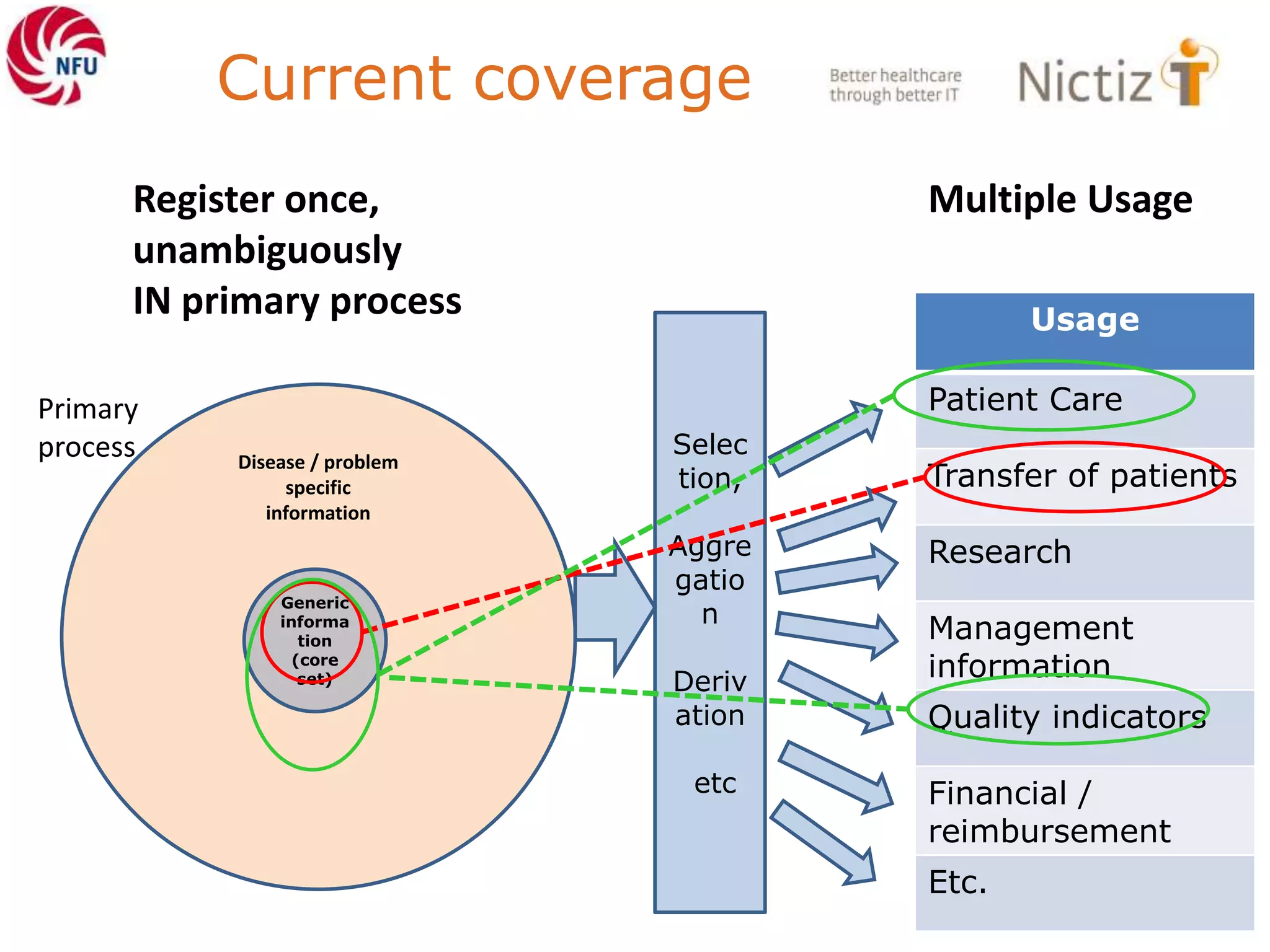
Generic
informa
tion
(core
set)
Disease / problem
specific
information
Usage
Patient Care
Transfer of patients
Research
Management
information
Quality indicators
Financial /
reimbursement
Etc.
Selec
tion,
Aggre
gatio
n
Deriv
ation
etc
Register once,
unambiguously
IN primary process
Multiple Usage
Primary
process
Current coverage
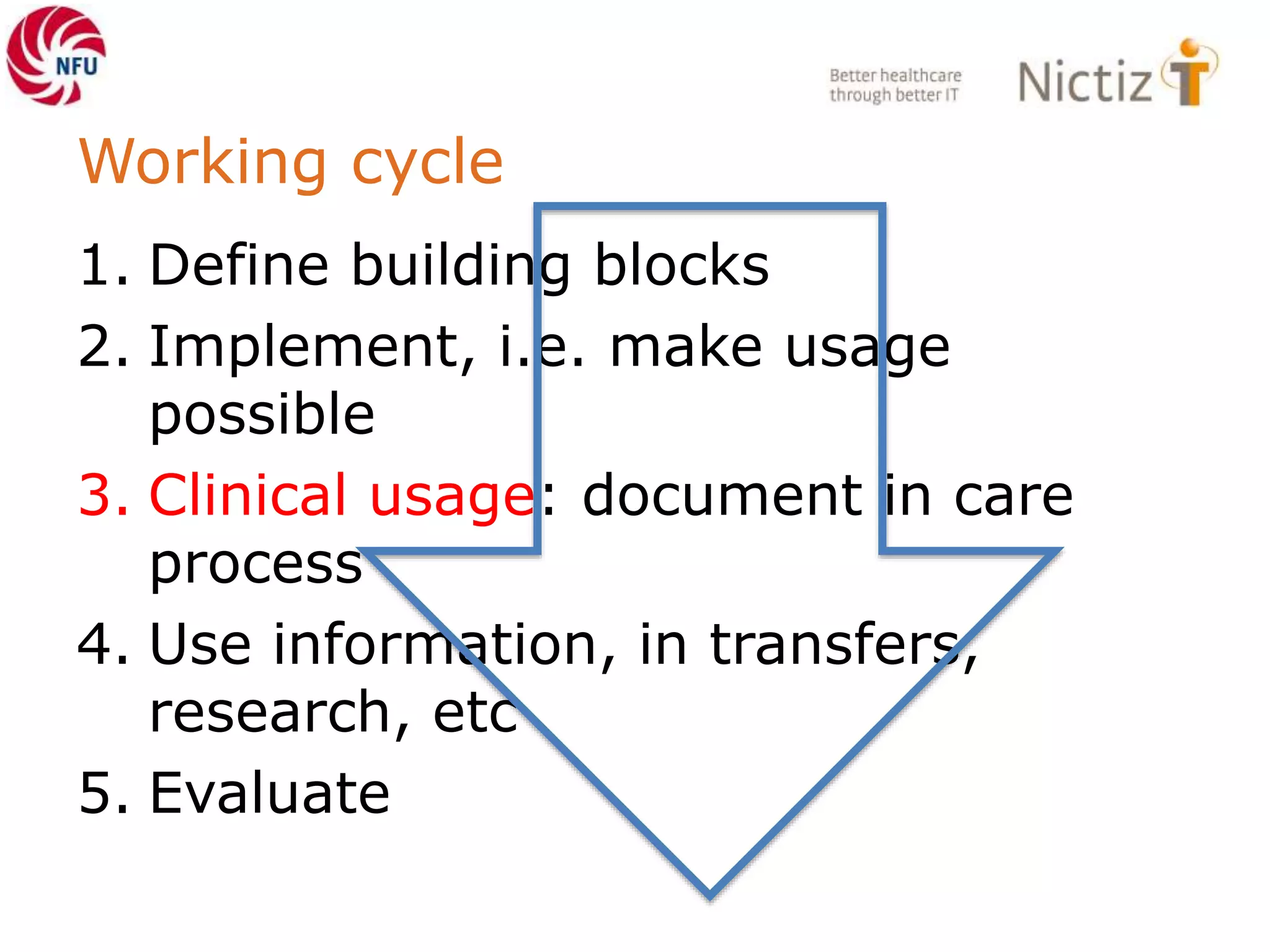
Working cycle
1. Define building blocks
2. Implement, i.e. make usage
possible
3. Clinical usage: document in care
process
4. Use information, in transfers,
research, etc
5. Evaluate
Agenda of presentation
1. Introduction Nictiz, IT in Healthcare in NL
2. Problem recognition and history of our
approach
3. Clinical Building Blocks
4. State of affairs in implementation in NL
5. Governance, development, change
management and maintenance
State of affairs implementation in NL
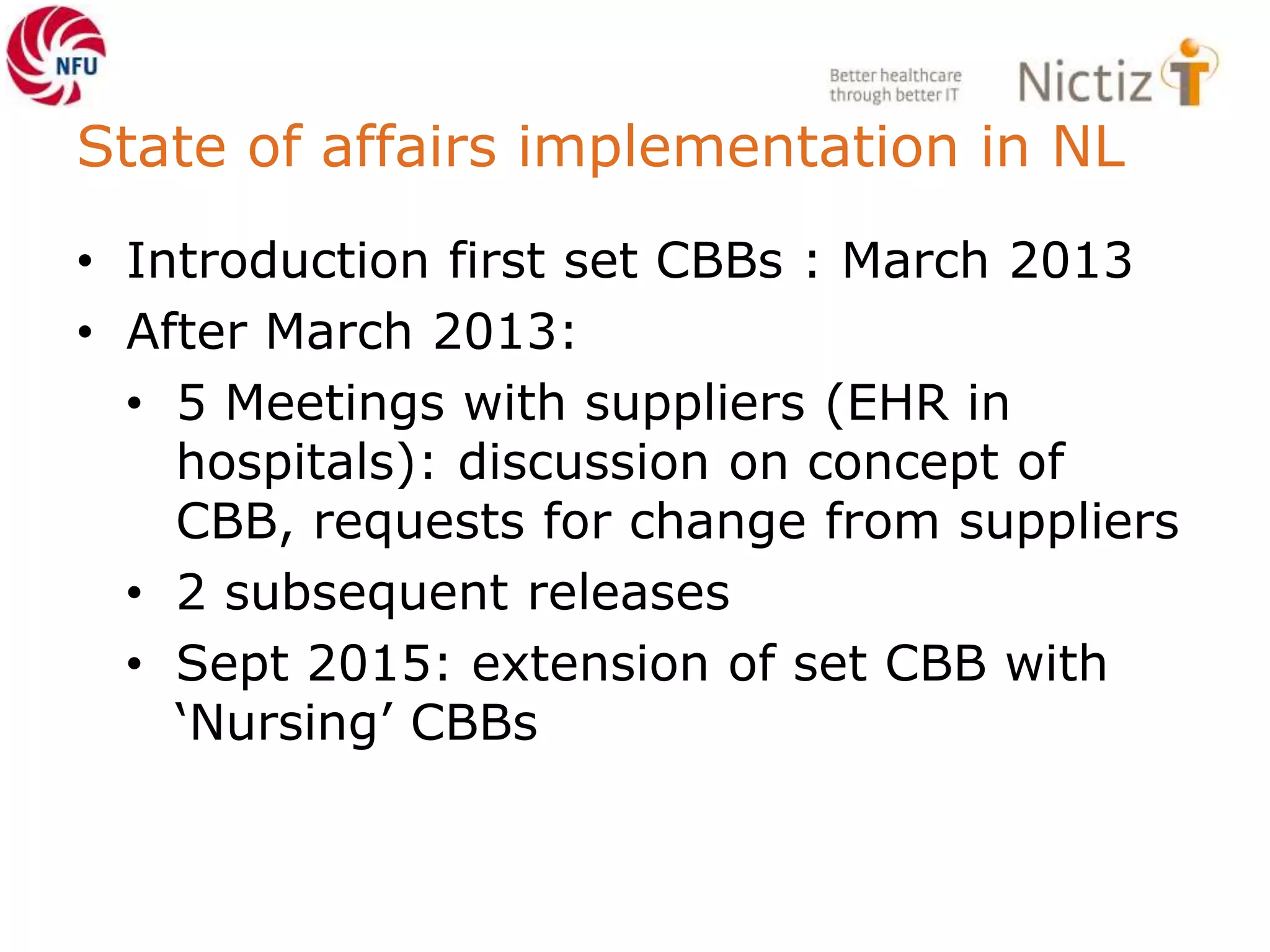
• Introduction first set CBBs : March 2013
• After March 2013:
• 5 Meetings with suppliers (EHR in
hospitals): discussion on concept of
CBB, requests for change from suppliers
• 2 subsequent releases
• Sept 2015: extension of set CBB with
‘Nursing’ CBBs
State of affairs implementation in NL
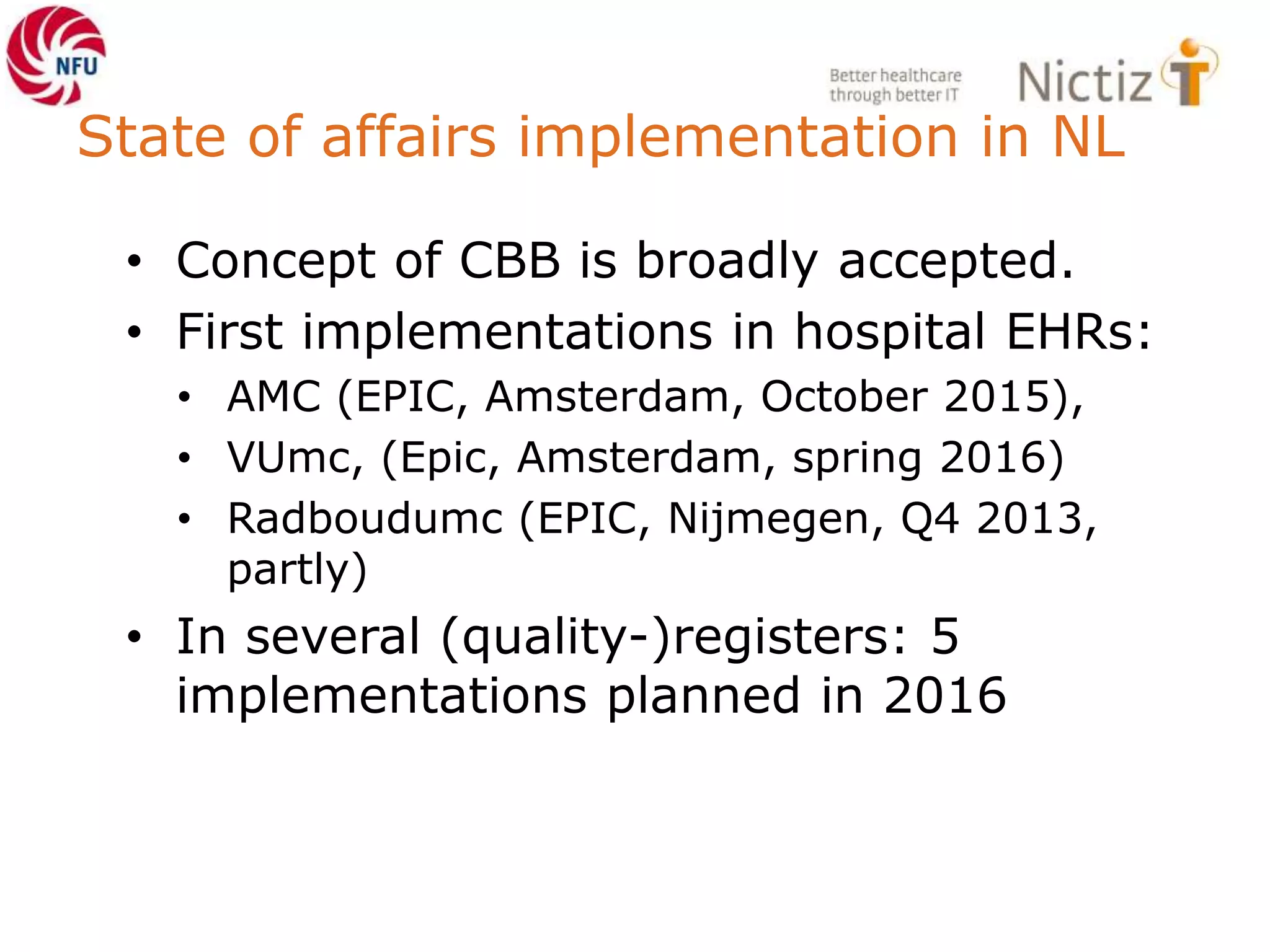
• Concept of CBB is broadly accepted.
• First implementations in hospital EHRs:
• AMC (EPIC, Amsterdam, October 2015),
• VUmc, (Epic, Amsterdam, spring 2016)
• Radboudumc (EPIC, Nijmegen, Q4 2013,
partly)
• In several (quality-)registers: 5
implementations planned in 2016
Agenda of presentation
1. Introduction Nictiz, IT in Healthcare in NL
2. Problem recognition and history of our
approach
3. Clinical Building Blocks
4. State of affairs in implementation in NL
5. Governance, development, change
management and maintenance
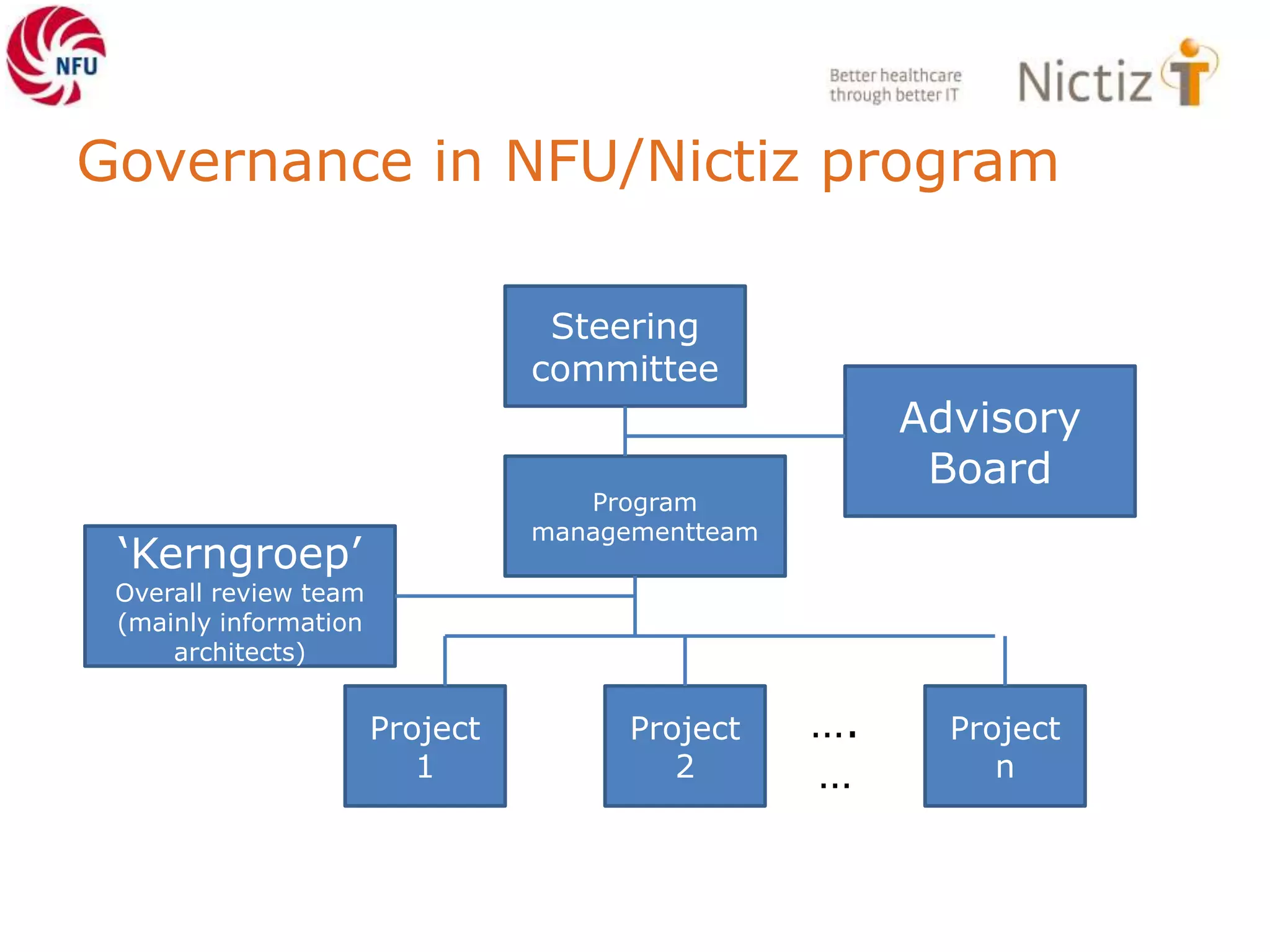
Governance in NFU/Nictiz program
Steering
committee
Program
managementteam
Advisory
Board
‘Kerngroep’
Overall review team
(mainly information
architects)
Project
1
Project
2
Project
n
….
…
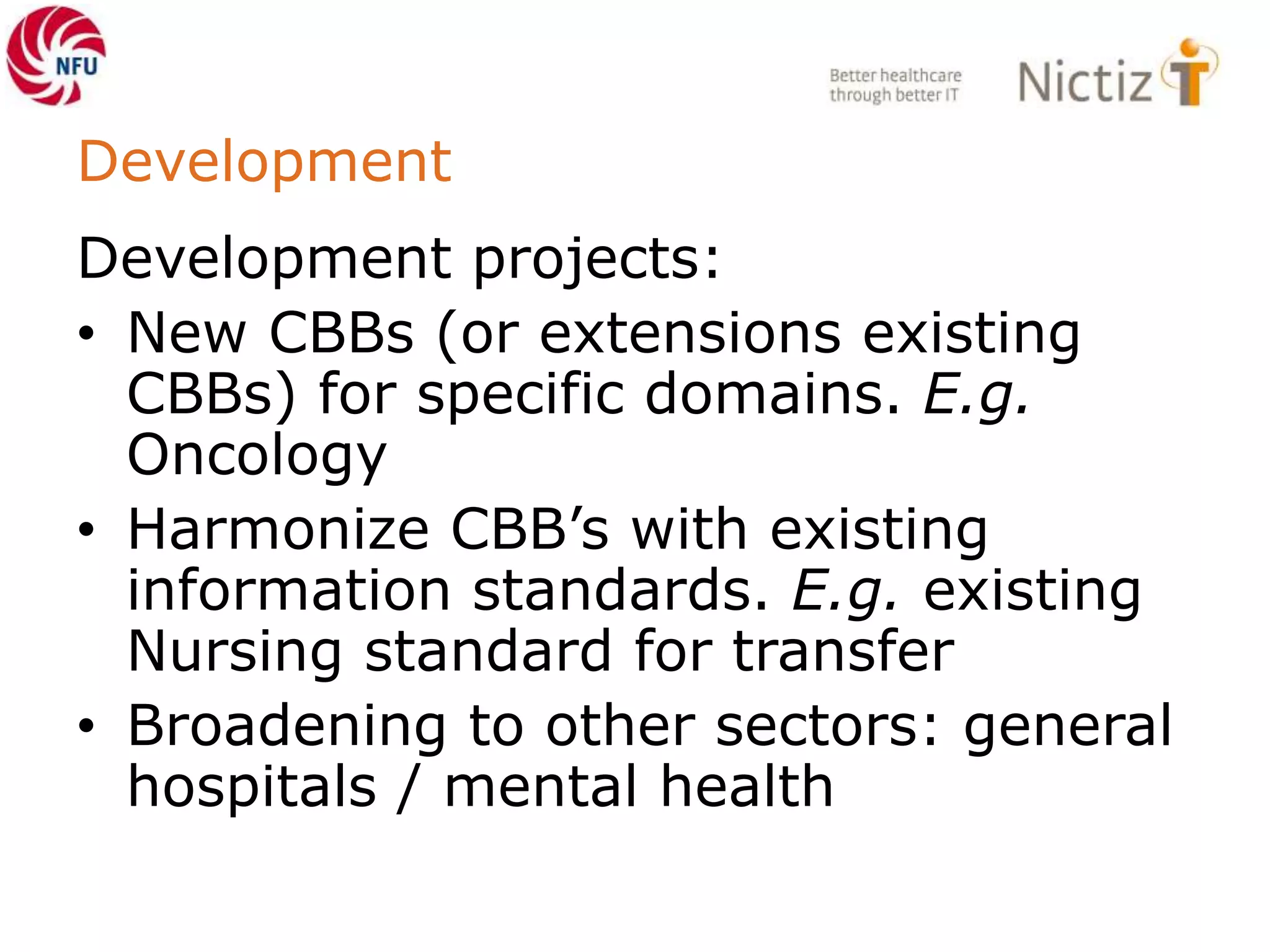
Development
Development projects:
• New CBBs (or extensions existing
CBBs) for specific domains. E.g.
Oncology
• Harmonize CBB’s with existing
information standards. E.g. existing
Nursing standard for transfer
• Broadening to other sectors: general
hospitals / mental health
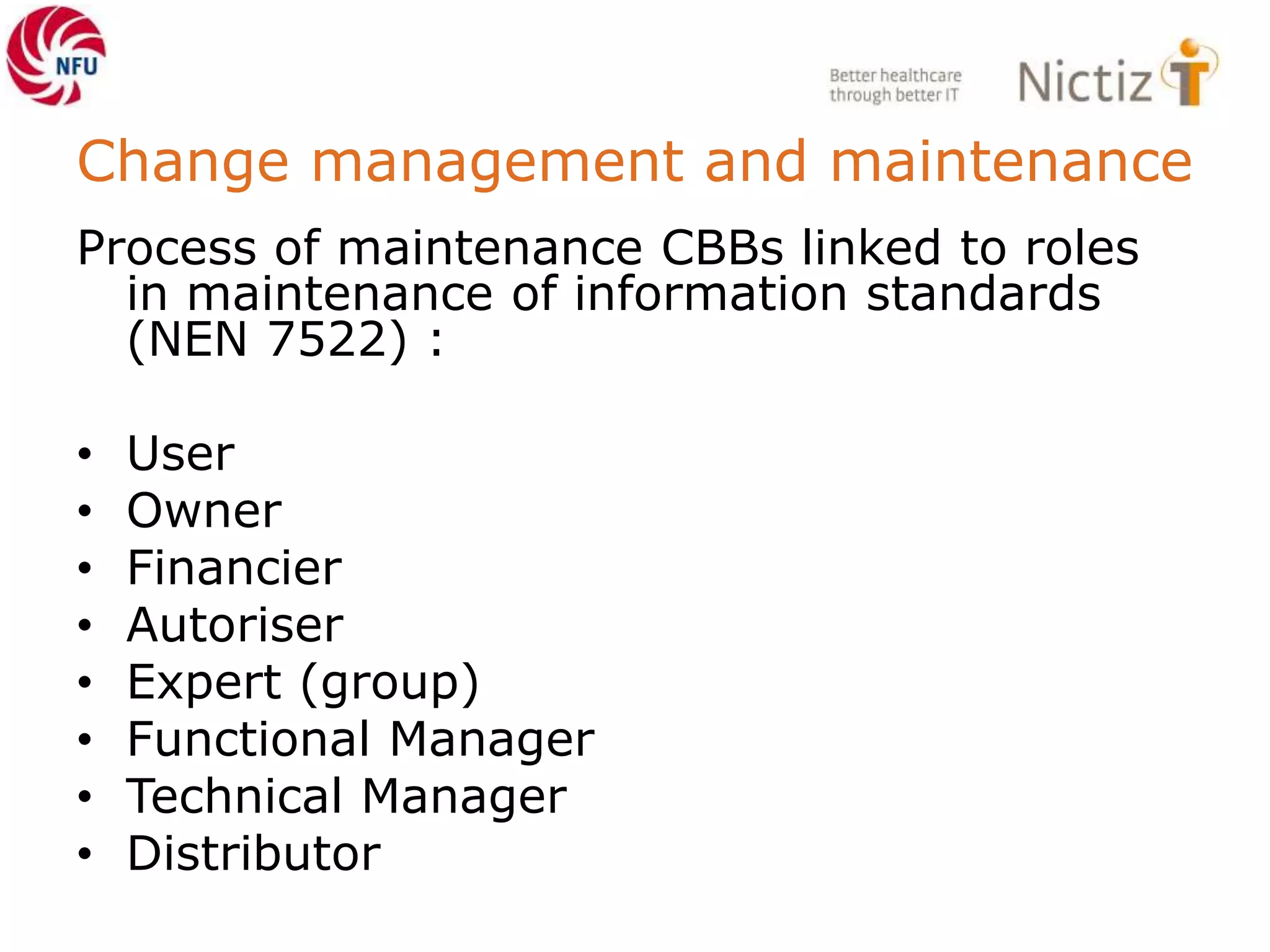
Change management and maintenance
Process of maintenance CBBs linked to roles
in maintenance of information standards
(NEN 7522) :
• User
• Owner
• Financier
• Autoriser
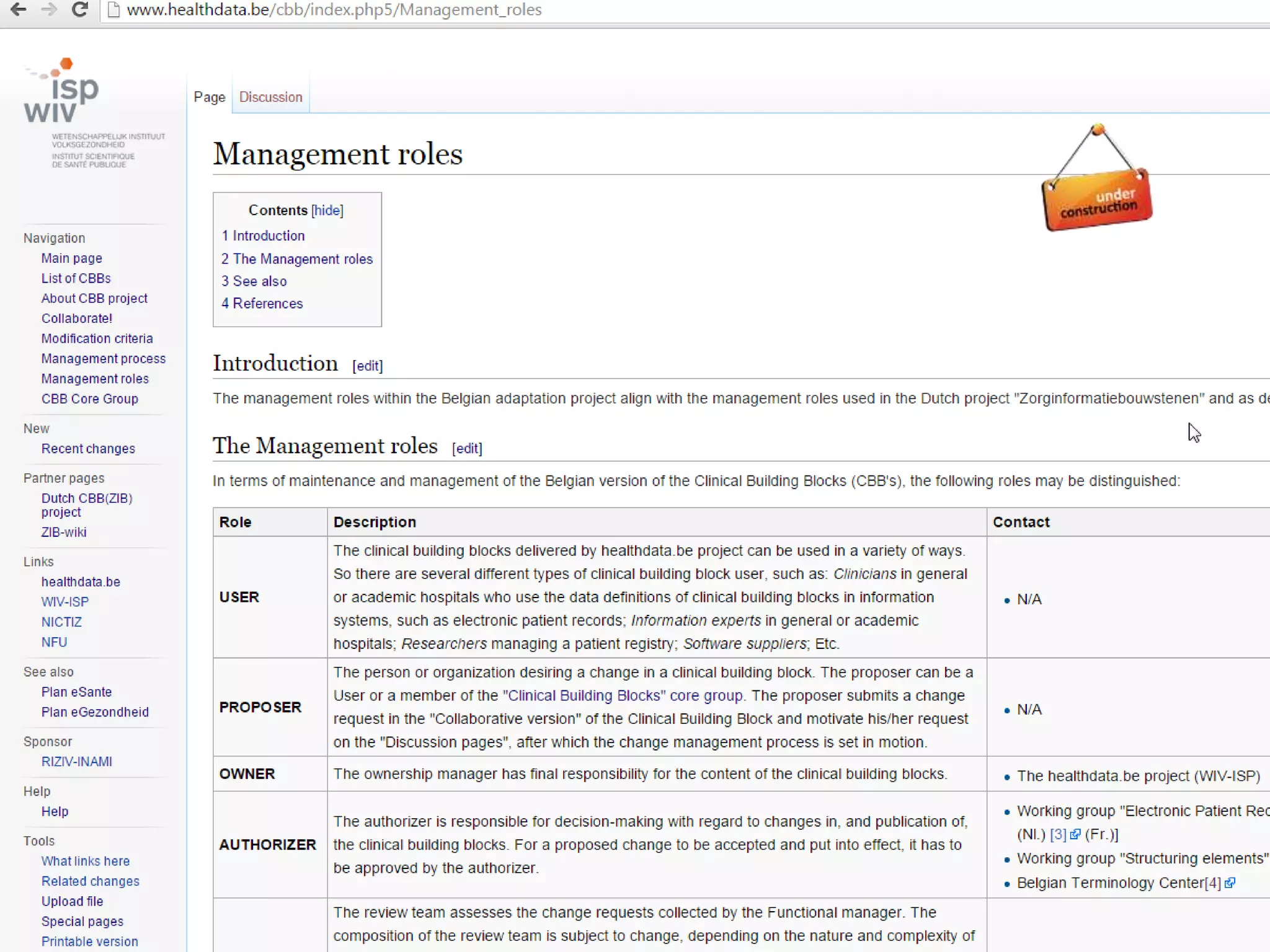
• Expert (group)
• Functional Manager
• Technical Manager
• Distributor
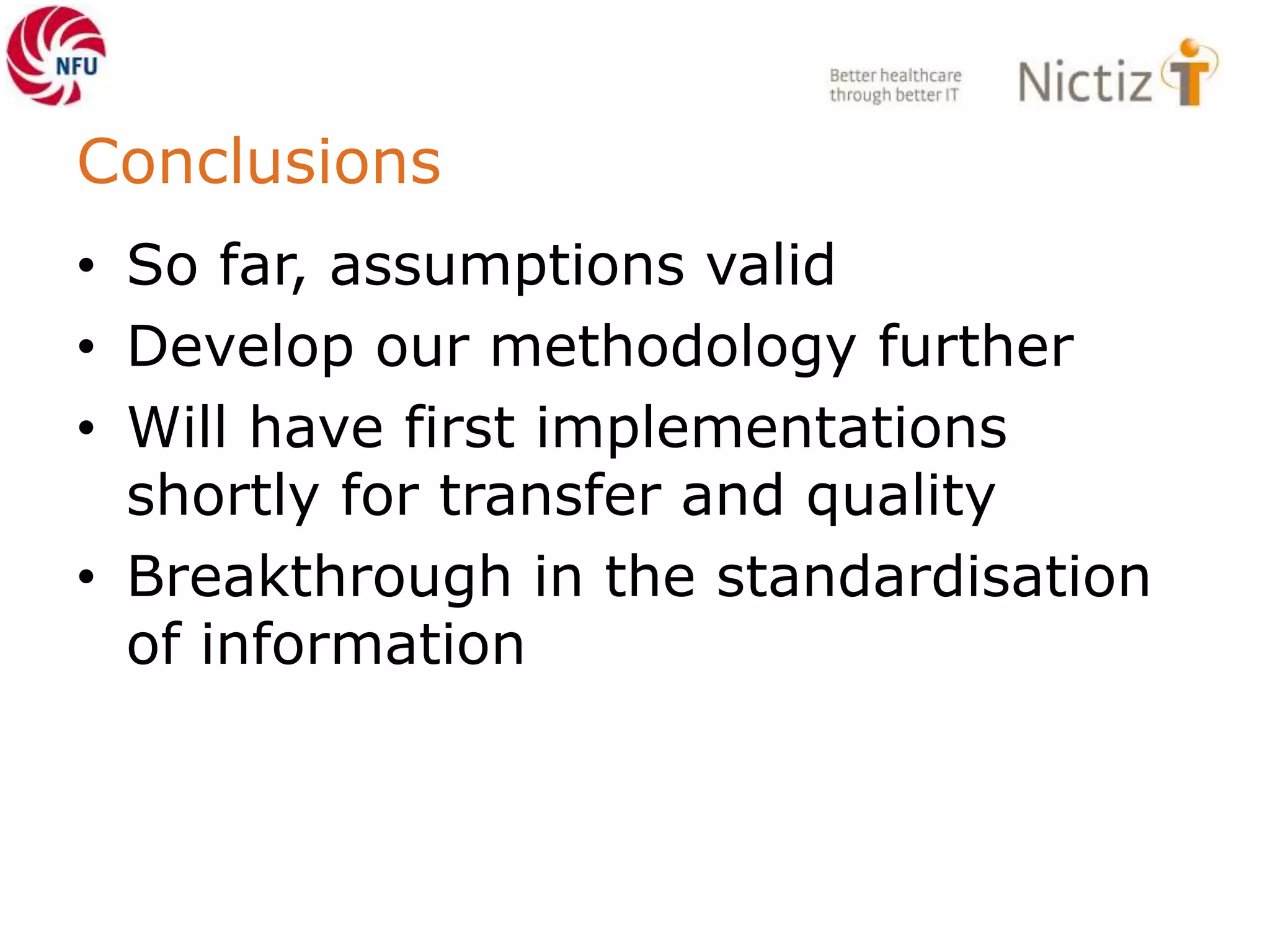
Conclusions
• So far, assumptions valid
• Develop our methodology further
• Will have first implementations
shortly for transfer and quality
• Breakthrough in the standardisation
of information
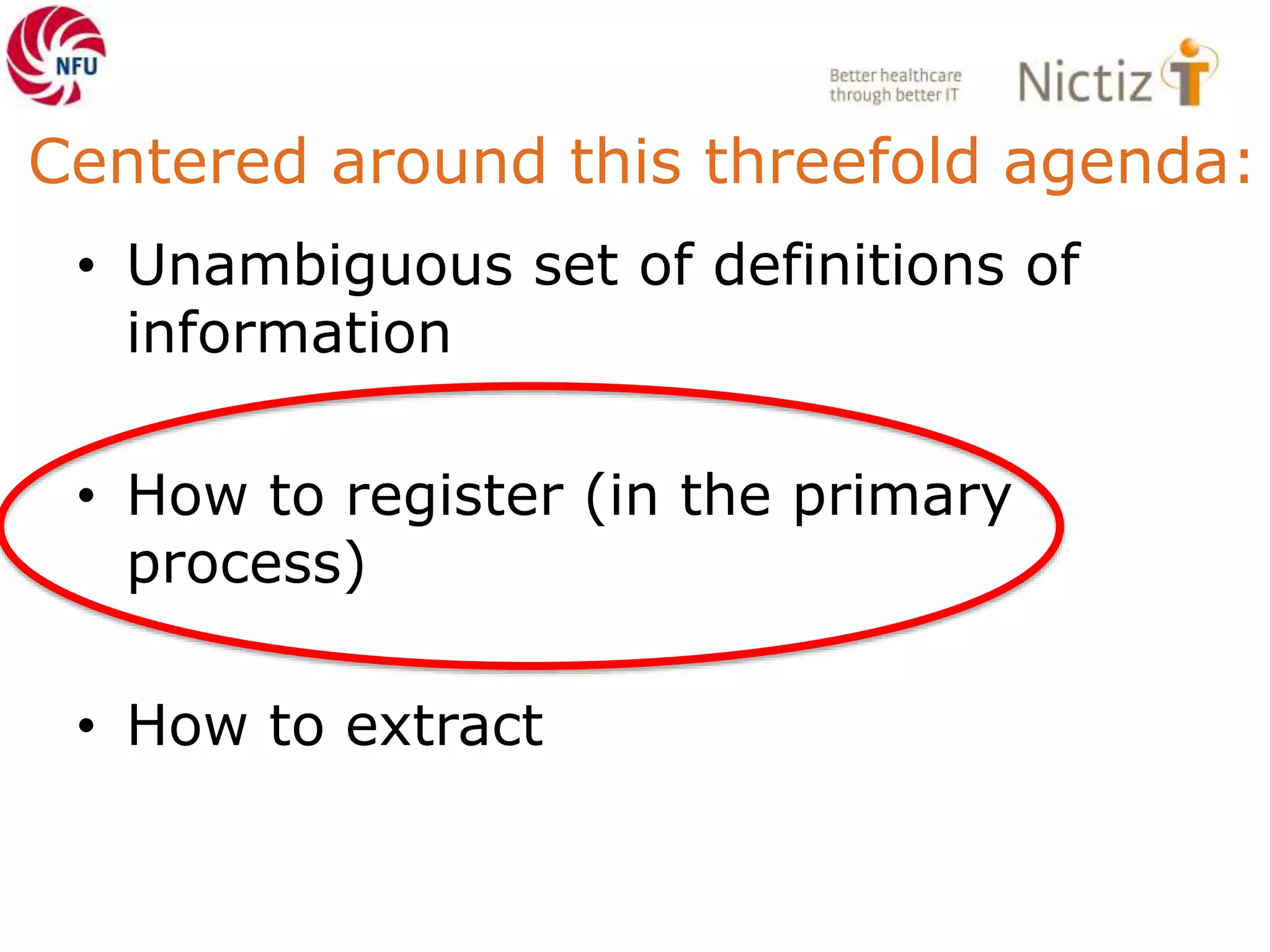
Centered around this threefold agenda:
• Unambiguous set of definitions of
information
• How to register (in the primary
process)
• How to extract
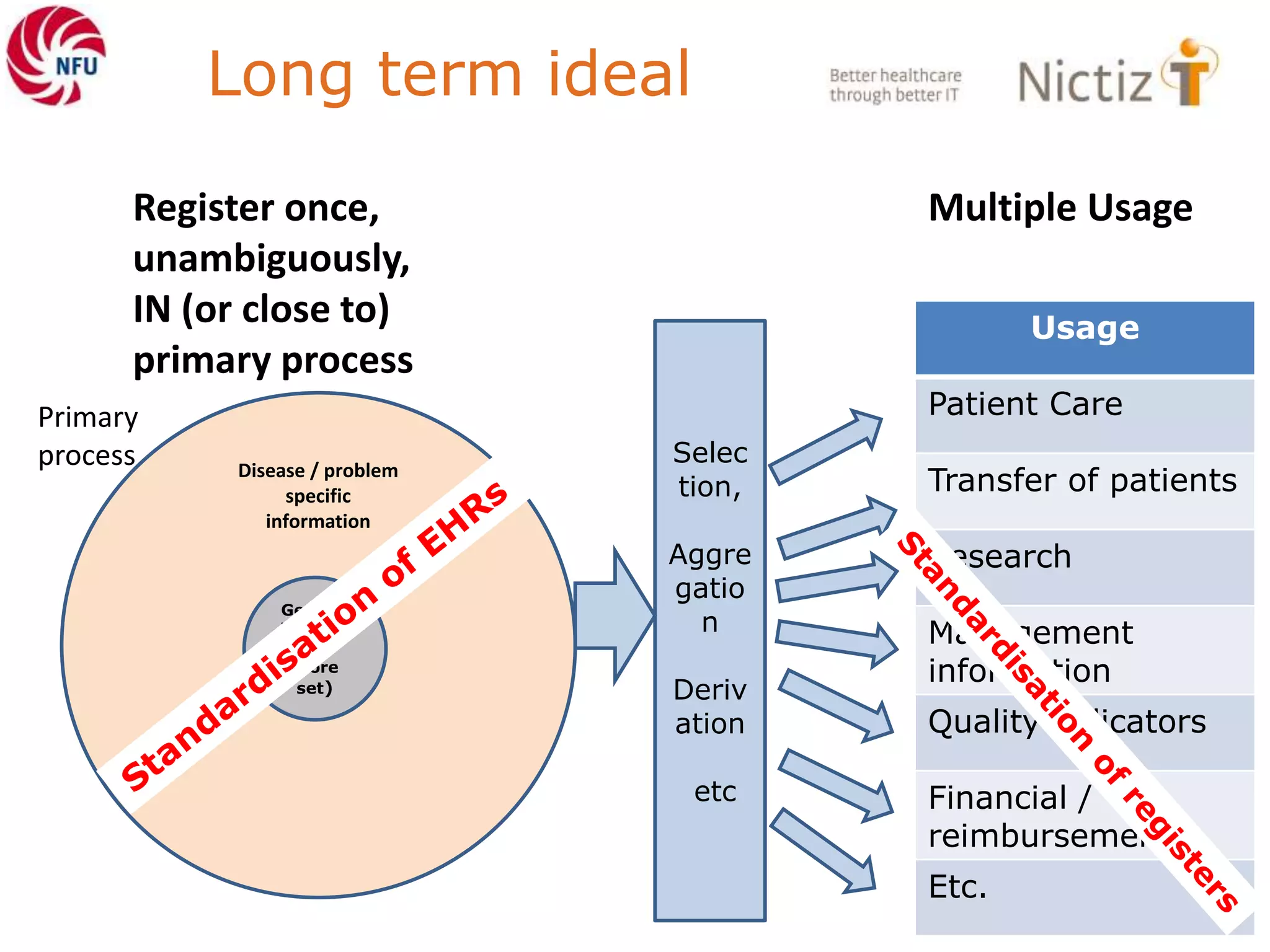
Generic
informa
tion
(core
set)
Disease / problem
specific
information
Usage
Patient Care
Transfer of patients
Research
Management
information
Quality indicators
Financial /
reimbursement
Etc.
Selec
tion,
Aggre
gatio
n
Deriv
ation
etc
Register once,
unambiguously,
IN (or close to)
primary process
Multiple Usage
Primary
process
Long term ideal
further information...
• www.nictiz.nl
• www.nfu.nl
• sprenger@nictiz.nl
• smeele@nictiz.nl
• hulsmann@nictiz.nl
150min.
Part 1 Part 2
Part 3
WAT TIMING WIE
18.11
“Een Belgische adaptatie wordt uitgevoerd voor elke
beschikbare specialisme overstijgende en technisch neutrale
NFU-NICTIZ Clinical Building Block, en wordt na validatie in een
publiek toegankelijke centrale digitale catalogus gepubliceerd
(http://www.healthdata.be/cbb) (Zie ook AP2.7 en AP13).”
vóór einde 2016_Q1
Coördinatie: WIV, via het HD-platform;
Uitvoering: Nederlandstalige en
Franstalige clinici;
Begeleiding en validatie: WG AP2,
Terminologie Centrum (WG AP13), en
Werkgroep Structurering van
Elementen;
Beheer cataloog: WIV, via HD-platform.
18.12
“Alle (a) nieuwe en (b) bestaande recurrente
beleidsondersteunende wetenschappelijke gegevens-
verzamelingen worden inhoudelijk samengesteld doormiddel
van de voor België beschikbare gevalideerde Clinical Building
Blocks (Zie ook AP2.7).”
vanaf 2016_Q1 (a);
vanaf 2016_Q1 gefa-
seerd volgens kalender
(b: voor allen);
uitgevoerd vóór einde
2017_Q4 (b: voor 42
projecten van WIV en
RIZIV).
Coördinatie: WIV, via het HD-platform;
Uitvoering: verantwoordelijken van
wetenschappelijke gegevensverza-
melingen.
18.13
“De waardenlijsten van Clinical Building Blocks in alle (a) nieuwe
en (b) bestaande recurrente beleidsondersteunende
wetenschappelijke gegevensverzamelingen in domein van
gezondheid en gezondheidszorg, worden prioritair Nee
SNOMED-CT concepten opgemaakt (Zie ook AP2.7 en AP13). “
vanaf 2016_Q1 (a) ;
vanaf 2016_Q1 gefas-
eerd volgens kalender (b:
voor allen);
uitgevoerd vóór einde
2017_Q4 (b: voor 42
projecten van WIV en
RIZIV).
Coördinatie: WIV, via het HD-platform;
Uitvoering: wetenschappelijk
verantwoordelijken van de
gegevensverzamelingen;
Begeleiding en validatie: Terminologie-
Centrum;
Evaluation Action Plan eHealth 2013-2018:
Revision Action Point 18: “Inventory & Consolidation of Registries
Official proclamation dd. 14.10.2015 by IMC public health
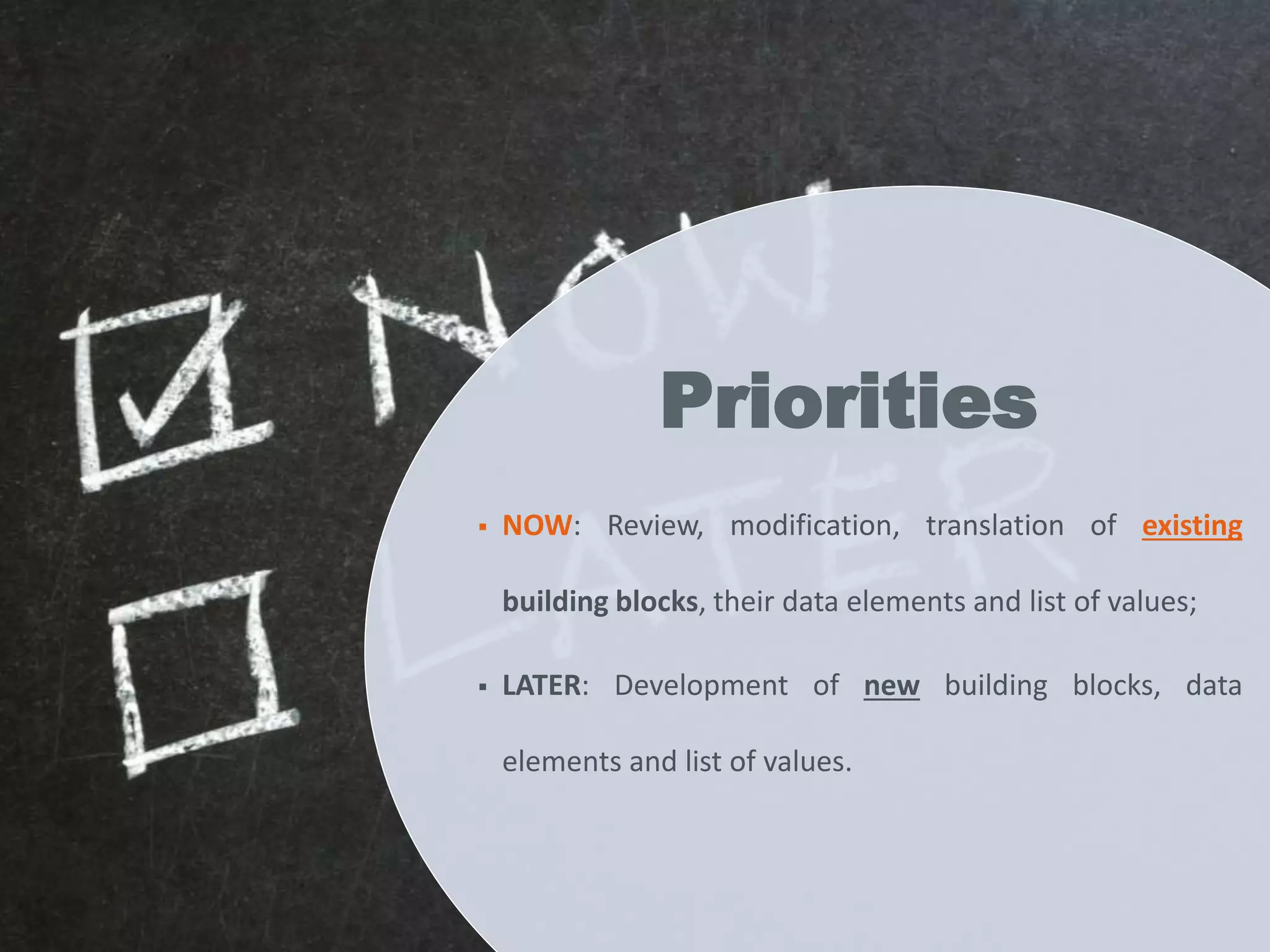
 NOW: Review, modification, translation of existing
building blocks, their data elements and list of values;
 LATER: Development of new building blocks, data
elements and list of values.
Priorities
Your expertise, experience and enthusiasm are most welcome!
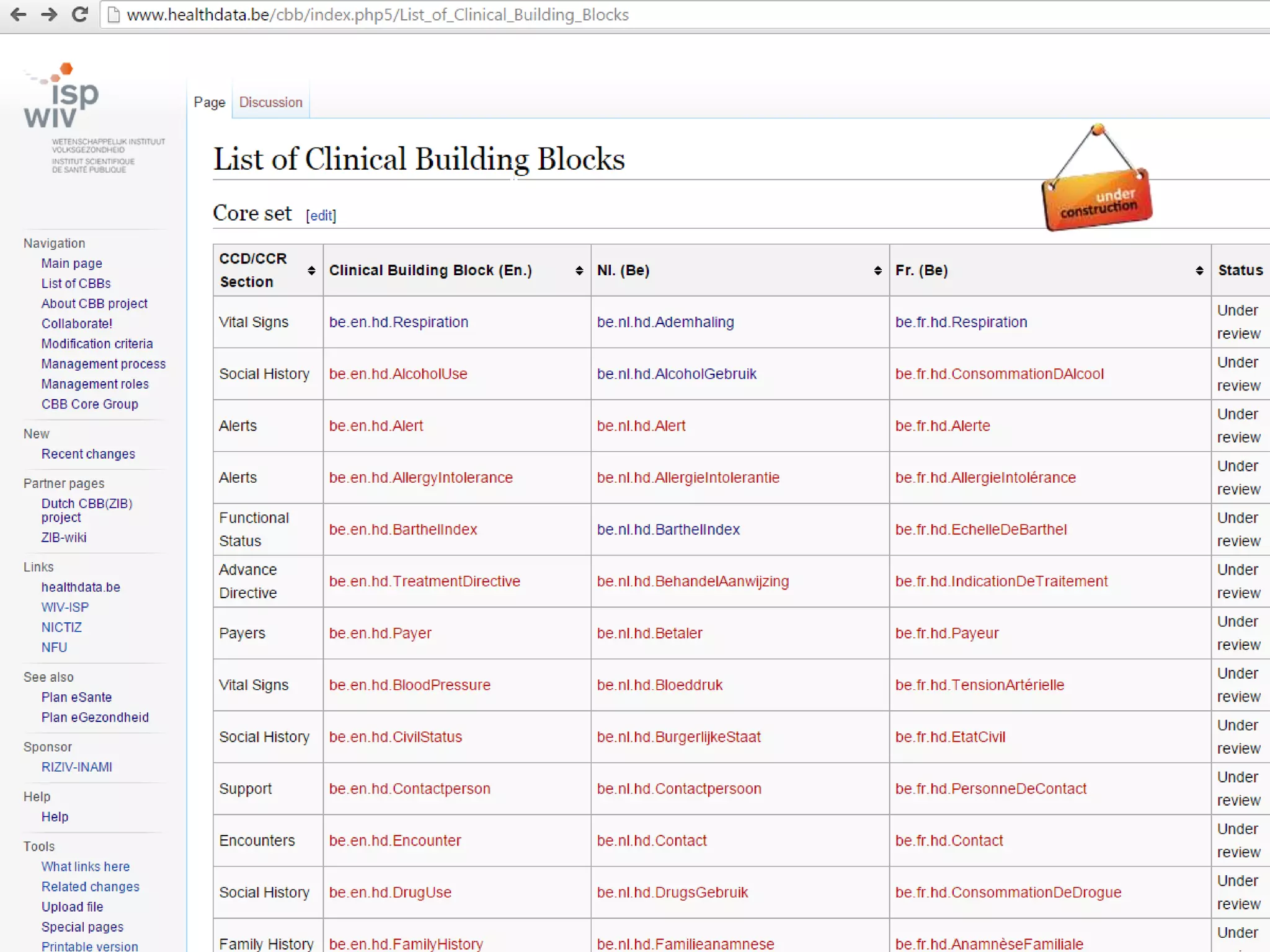
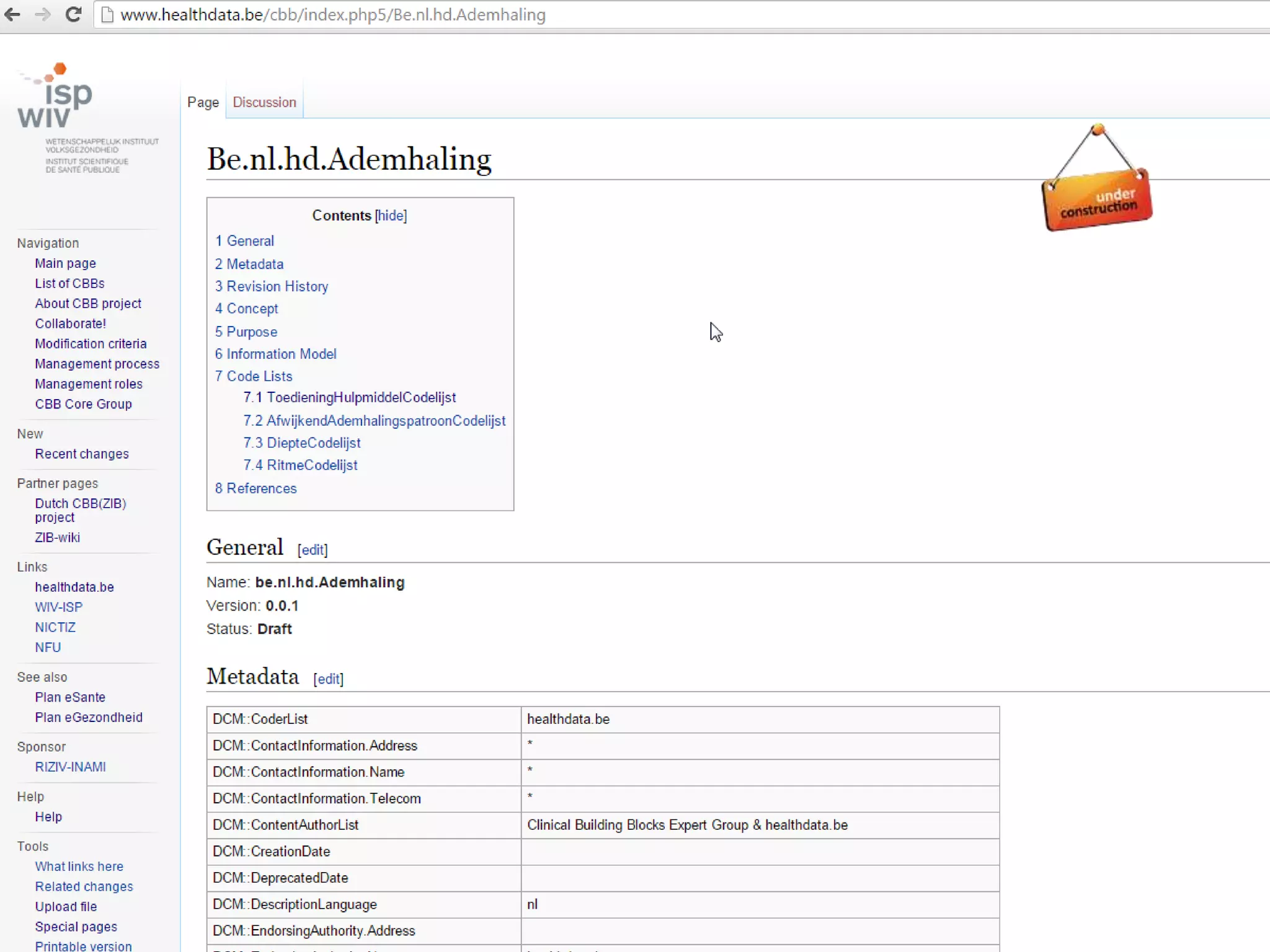
Go to wiki or send email to healthdata@wiv-isp.be
BOB: “Can we build it?”
ALL: “Yes we can!”
Q&A
healthdata@wiv-isp.be
www.healthdata.be
healthdata be
@healthdatabe

20151027 healthdata.be workshop Clinical Building Blocks with NICTIZ and NFU

  • 1.
    The healthdata.be project: Workshop"Clinical Building Blocks“ by NICTIZ & NFU RIZIV-INAMI, Brussels, 27.10.2015
  • 2.
  • 3.
  • 4.
    healthdata.be data we carefor Collection of health (care) related data in Belgium: “AS-IS” 1 2 3 4 5 7 6 Stage Stage Stage Stage Stage Stage Stage  Repeated registration of same information: high costs for data providers (ánd for researchers ánd government!)  Heterogeneous method & content: low transparency and high administrative burden & complexity  Limited privacy & security  Insufficient return on information Impact
  • 5.
    Growing awareness Milestone Date 1.Van de Sande, et al., Inventory of databases health care, KCE Reports 30A, Brussels: KCE 2006 2. Belgian Court of Audit, Scientific support of the federal health policy, BCA Reports, Brussels: BCA 2010 3. Coussée, et al., Charter High-quality recording of data by the healthcare sector, Brussels; Zorgnet Vlaanderen 2010 4. Actionplan eHealth 2013-2018: Action point 18 “Inventory and consolidation registers” 2012 5. Law of 5 May 2014: principle of “only once” data collection in all activities of governemental services and institutes 2014 6. Federal (9.10.2014) coalition agreement prioritizes reduction of administrative burden of health care professionals: “Only once”! 2014 healthdata.be data we care for  Van de Sande, et al. (2006) Inventory of databases health care, KCE Reports 30A;  Belgian Court of Audit (2010) Scientific support of federal health policy, BCA Reports;  Coussée (2010) Charter High-quality recording of data from the healthcare sector, Brussels; Zorgnet Vlaanderen;  Action plan eHealth 2013-2018: Action point 18 “Inventory and consolidation registers”;  Law 5 May 2014: principle of “only once” data collection in activities gov. services & institutes;  Federal (9.10.2014) coalition agreement prioritizes reduction of administrative burden of health care professionals: “Only once”!  Federal Minister Maggie De Block (25.04.2015) : Reform plan financing of hospitals.  14.10.2015: Action plan eHealth 2013-2018: Version 2.0 Growing Awareness
  • 6.
     Law of10 April 2014 various provisions related to health: Section 9: initiative RIZIV-INAMI and WIV-ISP: healthdata.be;  A new service within the legal body of the Institute of Public Health (WIV-ISP), funded by RIZIV-INAMI (20/04/2015, contract of open-end duration)  Facilitate (in terms of technology and process management) data exchange between healthcare professionals and researchers according to only once principle and re-use of data, in order to increase public health knowledge and to adjust health care policy, with respect for privacy of patient, healthcare professional and medical confidentiality.  Intergovernmental services for both federal and community/regional governments responsible for health and healthcare, and private legal bodies (indirectly);  2014-2017: focus on uniformisation of 42 existing registers managed by WIV-ISP and RIZIV. healthdata.be
  • 7.
  • 8.
  • 9.
  • 10.
  • 11.
    Variables needed for scientificresearch question healthdata.be data we care for Signalitics, typical available in authentic sources Information needed in context of continuity of care or internal administration Information mostly not available in primary systems EPD, HIMS, LIMS, …) The challenge for scientific data collection Register A Register B Register C Register D healthdata.be data we care for
  • 12.
     80 registers= > 8000 variables: need for standards!  Clinical Building Blocks: introduction of a national minimal set of stable, structured, specialism independent, technical neutral, and reusable data specifications for (hospital) EPD. Collaboration with NICTIZ & NFU.  SNOMED-CT: Prioritized standard for Lists of Values (LOV’s) in Clinical Building Blocks. Terminology
  • 13.
  • 14.
    Variables needed for scientificresearch question healthdata.be data we care for Signalitics, typical available in authentic sources Information needed in context of continuity of care or internal administration Information mostly not available in primary systems EPD, HIMS, LIMS, …) The use of Clinical Building Blocks Register A Register B Register C Register D Clinical Building Blocks healthdata.be data we care for
  • 15.
    Secure Data Transfer Data Validation Annotation & Correction Request Data Storage BI-Reporting Registration inPrimary System healthdata.be data we care for HEALTHSTATHD4DP Analysis Data Collection supported by healthdata.be Data Management & BI-Reporting supported by healthdata.be         healthdata.be: the end-to-end process healthdata.be Data Captation Data Monitoring HD4RES DATAWAREHOUSE (SAS)  
  • 16.
    Healthdata.be Catalogue (PROD) with Registryform definition Data provider Sending Data Through an API & Prefilling Forms for less Manual Work Legend Identifiers (SSIN, RIZIV, …) Neeadata (internal ID, type data, …) Medical data CSV 24/7 HD4DP and / or   HD4DP : Healthdata for Data Providers healthdata.be data we care for    • All manual input remains available (structured and coded, according to [inter]national standard) in local database of DP: • Import in future upgrade of EPD/LIMS; • Re-Use for internal BI & QI All manual input remains available (structured and coded, according to [inter]national standard, based on CBBs) in local database of DP: • Import in future upgrade of EPD/LIMS; • Re-Use for internal BI & QI • All manual input remains available (structured and coded, according to [inter]national standard) in local database of DP: • Import in future upgrade of EPD/LIMS; • Re-Use for internal BI & QI Clinical Building Blocks .BE
  • 17.
    Interministerial agreement dd.14.10.2015:  Continuous actualization of inventory of patient registries is mandatory (healthstat.be);  Procedures and criteria for new projects and continuation of existing projects;  Generic Business Processen for all reccurent scientific data collection projects;  Generic architecture of healthdata-platform for all reccurent scientific data collection projects;  Use of “Clinical Building Blocks” by all reccurent scientific data collections;  --- Update AP18! http://www.plan-egezondheid.be http://www.plan-esante.be
  • 18.
    WAT TIMING WIE 18.11 “EenBelgische adaptatie wordt uitgevoerd voor elke beschikbare specialisme overstijgende en technisch neutrale NFU-NICTIZ Clinical Building Block, en wordt na validatie in een publiek toegankelijke centrale digitale catalogus gepubliceerd (http://www.healthdata.be/cbb) (Zie ook AP2.7 en AP13).” vóór einde 2016_Q1 Coördinatie: WIV, via het HD-platform; Uitvoering: Nederlandstalige en Franstalige clinici; Begeleiding en validatie: WG AP2, Terminologie Centrum (WG AP13), en Werkgroep Structurering van Elementen; Beheer cataloog: WIV, via HD-platform. 18.12 “Alle (a) nieuwe en (b) bestaande recurrente beleidsondersteunende wetenschappelijke gegevens- verzamelingen worden inhoudelijk samengesteld doormiddel van de voor België beschikbare gevalideerde Clinical Building Blocks (Zie ook AP2.7).” vanaf 2016_Q1 (a); vanaf 2016_Q1 gefa- seerd volgens kalender (b: voor allen); uitgevoerd vóór einde 2017_Q4 (b: voor 42 projecten van WIV en RIZIV). Coördinatie: WIV, via het HD-platform; Uitvoering: verantwoordelijken van wetenschappelijke gegevensverza- melingen. 18.13 “De waardenlijsten van Clinical Building Blocks in alle (a) nieuwe en (b) bestaande recurrente beleidsondersteunende wetenschappelijke gegevensverzamelingen in domein van gezondheid en gezondheidszorg, worden prioritair Nee SNOMED-CT concepten opgemaakt (Zie ook AP2.7 en AP13). “ vanaf 2016_Q1 (a) ; vanaf 2016_Q1 gefas- eerd volgens kalender (b: voor allen); uitgevoerd vóór einde 2017_Q4 (b: voor 42 projecten van WIV en RIZIV). Coördinatie: WIV, via het HD-platform; Uitvoering: wetenschappelijk verantwoordelijken van de gegevensverzamelingen; Begeleiding en validatie: Terminologie- Centrum; Evaluation Action Plan eHealth 2013-2018: Revision Action Point 18: “Inventory & Consolidation of Registries Official proclamation dd. 14.10.2015 by IMC public health
  • 19.
  • 20.
  • 21.
    Clinical Building Blocks forthe standardisation of patient information for multiple usage October 27, 2015 Brussels WIV-ISP Michiel Sprenger, Fred Smeele, Claartje Hülsmann the Netherlands’ national institute of IT in Healthcare (Nictiz)
  • 22.
    Us… • Michiel Sprenger,Senior Adviser • Fred Smeele, Program Manager • Claartje Hülsmann, Quality Manager • Nictiz: national competence centre for eHealth & interoperability
  • 23.
    Theme Unambiguous and onestep documenting at the clinical source Multiple usage ‘Documenting at the Source’
  • 24.
    Agenda of presentation 1.Introduction Nictiz, IT in Healthcare in NL 2. Problem recognition and history of our approach 3. Clinical Building Blocks 4. State of affairs in implementation in NL 5. Governance, development, change management and maintenance
  • 25.
    Agenda of presentation 1.Introduction Nictiz, IT in Healthcare in NL 2. Problem recognition and history of our approach 3. Clinical Building Blocks 4. State of affairs in implementation in NL 5. Governance, development, change management and maintenance
  • 26.
    Nictiz • Founded in2002 • The national competence centre for health IT • ~40 people • 95% financed by ministry of health • Tasks: • Define and maintain standards • Offer knowledge & advice • Connect people and organizations • Monitor the development of IT in HC • No task in IT infrastructure deployment (since 2011) 26
  • 27.
    The Netherlands inEU Area: #23/28 Pop: #8/28 (16,7M) 27
  • 28.
    Healthcare in NL •Organisations privately structured • Finance: partly regulated: • Insurance: basis for everyone, + extra packages – 50% • Increasingly market driven model through role of insurance companies • Disabled, elderly, etc: National Insurance (AWBZ) – 50% • Total ~€80 billion
  • 29.
    Healthcare in NL •Well established primary care • Management of chronic diseases • Locum tenancy services for GP’s (1:40) • NL #1 in European Health Consumer Index • NL high in capital spending in Healthcare
  • 30.
    Healthcare in NL •~100 hospitals • 8 university medical centres (UMCs) • Outpatient specialist care mainly organised by hospital organisations • Growing “private” sector, mainly outpatient 30
  • 31.
    Healthcare in NL •Multi-enterprise business model: • 100 hospitals, 4500 GP practices, 1800 pharmacies, 100 locum tenancy services for GP’s, each responsible for own finance, medical policies, investments, and IT • Thus: interoperability problems are large on all levels •  Urge for standards •  Much debate (“polder”-model) 31
  • 32.
    IT proliferation inthe Netherlands • Hospitals: • PACS 100% • HIS 100% • EHRs: number is growing, ~70% • General Practitioners: 100% • Community Pharmacies: 100% • Nursing homes: 30% 32
  • 33.
    Agenda of presentation 1.Introduction Nictiz, IT in Healthcare in NL 2. Problem recognition and history of our approach 3. Clinical Building Blocks 4. State of affairs in implementation in NL 5. Governance, development, change management and maintenance
  • 34.
    Problem • 10 yearsof EHR development in hospitals • But… information captured for patient care can NOT (always) be re-used • For: • Transfer of patients to other institutions • Quality indicators • Reimbursement • Epidemiology • ...
  • 35.
    Causes • Goal specificregistrations (>150!!) • Variations between hospitals in definitions • Variations within hospitals in definitions • Gaps • Overlaps
  • 36.
    Usage Patient Care Transfer ofpatients Research Management information Quality indicators Financial / reimbursement Etc. UsageRegistrations Financial Quality 1 Quality 2 Patient care 1 Patient care 2 GAPS OVERLAPS INCONSISTENCIES
  • 37.
    Initiative by • NFU:the federation of University Medical Centers (8) • Nictiz: national competence center for eHealth and interoperability • To improve the situation
  • 38.
    Generic informa tion (core set) Disease / problem specific information Usage PatientCare Transfer of patients Research Management information Quality indicators Financial / reimbursement Etc. Selec tion, Aggre gatio n Deriv ation etc Register once, unambiguously, IN (or close to) primary process Multiple Usage Primary process Long term ideal
  • 39.
    Way forward • StandardiseInformation • Separate from Implementation and usage • Standardise EHRs ánd registers in their information content
  • 40.
    Agenda of presentation 1.Introduction Nictiz, IT in Healthcare in NL 2. Problem recognition and history of our approach 3. Clinical Building Blocks 4. State of affairs in implementation in NL 5. Governance, development, change management and maintenance
  • 41.
    5 layer solutions CareProcess Information Applications Technology Policy Directors Health profs, care mgmt HPs, informaticians Informaticians, IT profs IT profs
  • 42.
  • 43.
    Derivation Care Info Appl Professionals: physicians, nurses, pharmacists,etc EPD content Transfer - Communication Quality register Etc HL7-CDA FHIR CBB Definition and maintenance CBB CBB CBB CBB CBB
  • 44.
    Assumptions • The informationcan be structured into a finite number of generic building blocks: • As large as needed (complete clinical concepts) • As small as possible (genericity, re- usability) • Generic and specific blocks will be necessary • Usage possible for different purposes
  • 45.
    Clinical Building Blocks Stable,re-usable clinical building blocks usage 1: transfer usage 2: quality indicators usage 3: EHR
  • 46.
  • 47.
  • 48.
  • 49.
  • 50.
  • 51.
  • 52.
    Standardisation by: • Structure: •Collection of CBBs • Internal structure of CBBs (information elements) • Content of CBBs: • Coding: SNOMED, LOINC, text, etc • Value lists: definition • Filling with values in real practice • E.g. minimum datasets, summaries, etc
  • 53.
    Method of working •Started with generic transfer data • First medical • Extend with nursing • Investigate specific disease care process plus quality indicators: head and neck tumors
  • 54.
    Generic informa tion (core set) Disease / problem specific information Usage PatientCare Transfer of patients Research Management information Quality indicators Financial / reimbursement Etc. Selec tion, Aggre gatio n Deriv ation etc Register once, unambiguously IN primary process Multiple Usage Primary process Current coverage
  • 55.
    Working cycle 1. Definebuilding blocks 2. Implement, i.e. make usage possible 3. Clinical usage: document in care process 4. Use information, in transfers, research, etc 5. Evaluate
  • 56.
    Agenda of presentation 1.Introduction Nictiz, IT in Healthcare in NL 2. Problem recognition and history of our approach 3. Clinical Building Blocks 4. State of affairs in implementation in NL 5. Governance, development, change management and maintenance
  • 57.
    State of affairsimplementation in NL • Introduction first set CBBs : March 2013 • After March 2013: • 5 Meetings with suppliers (EHR in hospitals): discussion on concept of CBB, requests for change from suppliers • 2 subsequent releases • Sept 2015: extension of set CBB with ‘Nursing’ CBBs
  • 58.
    State of affairsimplementation in NL • Concept of CBB is broadly accepted. • First implementations in hospital EHRs: • AMC (EPIC, Amsterdam, October 2015), • VUmc, (Epic, Amsterdam, spring 2016) • Radboudumc (EPIC, Nijmegen, Q4 2013, partly) • In several (quality-)registers: 5 implementations planned in 2016
  • 59.
    Agenda of presentation 1.Introduction Nictiz, IT in Healthcare in NL 2. Problem recognition and history of our approach 3. Clinical Building Blocks 4. State of affairs in implementation in NL 5. Governance, development, change management and maintenance
  • 60.
    Governance in NFU/Nictizprogram Steering committee Program managementteam Advisory Board ‘Kerngroep’ Overall review team (mainly information architects) Project 1 Project 2 Project n …. …
  • 61.
    Development Development projects: • NewCBBs (or extensions existing CBBs) for specific domains. E.g. Oncology • Harmonize CBB’s with existing information standards. E.g. existing Nursing standard for transfer • Broadening to other sectors: general hospitals / mental health
  • 62.
    Change management andmaintenance Process of maintenance CBBs linked to roles in maintenance of information standards (NEN 7522) : • User • Owner • Financier • Autoriser • Expert (group) • Functional Manager • Technical Manager • Distributor
  • 63.
    Conclusions • So far,assumptions valid • Develop our methodology further • Will have first implementations shortly for transfer and quality • Breakthrough in the standardisation of information
  • 64.
    Centered around thisthreefold agenda: • Unambiguous set of definitions of information • How to register (in the primary process) • How to extract
  • 65.
    Generic informa tion (core set) Disease / problem specific information Usage PatientCare Transfer of patients Research Management information Quality indicators Financial / reimbursement Etc. Selec tion, Aggre gatio n Deriv ation etc Register once, unambiguously, IN (or close to) primary process Multiple Usage Primary process Long term ideal
  • 67.
    further information... • www.nictiz.nl •www.nfu.nl • sprenger@nictiz.nl • smeele@nictiz.nl • hulsmann@nictiz.nl
  • 68.
  • 70.
    WAT TIMING WIE 18.11 “EenBelgische adaptatie wordt uitgevoerd voor elke beschikbare specialisme overstijgende en technisch neutrale NFU-NICTIZ Clinical Building Block, en wordt na validatie in een publiek toegankelijke centrale digitale catalogus gepubliceerd (http://www.healthdata.be/cbb) (Zie ook AP2.7 en AP13).” vóór einde 2016_Q1 Coördinatie: WIV, via het HD-platform; Uitvoering: Nederlandstalige en Franstalige clinici; Begeleiding en validatie: WG AP2, Terminologie Centrum (WG AP13), en Werkgroep Structurering van Elementen; Beheer cataloog: WIV, via HD-platform. 18.12 “Alle (a) nieuwe en (b) bestaande recurrente beleidsondersteunende wetenschappelijke gegevens- verzamelingen worden inhoudelijk samengesteld doormiddel van de voor België beschikbare gevalideerde Clinical Building Blocks (Zie ook AP2.7).” vanaf 2016_Q1 (a); vanaf 2016_Q1 gefa- seerd volgens kalender (b: voor allen); uitgevoerd vóór einde 2017_Q4 (b: voor 42 projecten van WIV en RIZIV). Coördinatie: WIV, via het HD-platform; Uitvoering: verantwoordelijken van wetenschappelijke gegevensverza- melingen. 18.13 “De waardenlijsten van Clinical Building Blocks in alle (a) nieuwe en (b) bestaande recurrente beleidsondersteunende wetenschappelijke gegevensverzamelingen in domein van gezondheid en gezondheidszorg, worden prioritair Nee SNOMED-CT concepten opgemaakt (Zie ook AP2.7 en AP13). “ vanaf 2016_Q1 (a) ; vanaf 2016_Q1 gefas- eerd volgens kalender (b: voor allen); uitgevoerd vóór einde 2017_Q4 (b: voor 42 projecten van WIV en RIZIV). Coördinatie: WIV, via het HD-platform; Uitvoering: wetenschappelijk verantwoordelijken van de gegevensverzamelingen; Begeleiding en validatie: Terminologie- Centrum; Evaluation Action Plan eHealth 2013-2018: Revision Action Point 18: “Inventory & Consolidation of Registries Official proclamation dd. 14.10.2015 by IMC public health
  • 74.
     NOW: Review,modification, translation of existing building blocks, their data elements and list of values;  LATER: Development of new building blocks, data elements and list of values. Priorities
  • 76.
    Your expertise, experienceand enthusiasm are most welcome! Go to wiki or send email to healthdata@wiv-isp.be
  • 77.
    BOB: “Can webuild it?” ALL: “Yes we can!”
  • 78.

Editor's Notes

  • #17 An API to open form prefilled with a set existing data API to pass full dataset & receive error message API to pass full dataset & correct messages in form