1


NEW ISSUES IN REFUGEE RESEARCH
Research Paper No.1
Proposal on a constructive alternative
towards the slum and housing crisis
– Refugee-led Settlements Project –
Architect for Aid
Yuri Akiyama-Carrel
March 2015
Copyright rests with the author(s).
Materials may be reproduced and circulated provided that the title, author and source is acknowledged.
The views and opinions expressed in this paper are those of the author(s)
and do not necessarily reflect the official position of Vision First, unless otherwise stated.	
  
2
INDEX
1. Context
1.1 Refugees in illegal slums
1.2 Refugees in guesthouse
1.3 Homeless refugees
1.4 Perfect scenario to lead refugees
into jail
1.5 Avoidable waste of public funds
1.6 Voice of refugees
2. Living Environment
2.1 Global standards on emergency
settlements
2.2 Circumstances of refugees' living
environment in HK
2.2.1 Cases in slums
2.2.2 Cases in dormitories
3. Movements of housing policy
towards slum resolution in Asia
3.1 Slum clearance following forced
eviction (1970's)
3.2 Slum clearance with provision of
public apartment (1970's)
3.3 Slum clearance with provision of
relocation site (1970's)
3.4 Conversion to new housing policy:
provision of individual housing
(1970's-1980's)
3.4.1 Self-help theory
3.4.2 Enabling strategy
3.5 New housing methodologies
based on 'self-help theory' &
'enabling strategy'(1970's-1980's)
3.5.1 Community participation
3.5.2 Community contract
3.5.3 On-site slum upgrading
(1) Land sharing
(2) Public apartment
3.5.4 Off-site relocation
(1) Site and service
(2) Core housing
3.5.5 Land regularisation
3.6 Utilization of private housing
market and housing loan with self-
help construction (1980's)
3.7 Gaps of housing policy between
government and NGOs: re-spread
of slums (1990's)
3.8 Back to 'community-based'
housing policy (Late 1990's)
3.8.1 Mutual-help theory
3.8.2 Enabling strategy
4. Proposal of a constructive alternative
towards slum & housing crisis
4.1 Ordinance background to
unauthorised building works on
'agricultural land'
4.2 Programme detail
4.2.1 PHASE1 Emergency assistance
- slum clearance + guesthouse,
dormitory and emergency shelter
(1) Programme target
(2) Programme methodology
(3) Emergency shelter
4.2.2 PHASE 2 Transitional period -
selection of relocation site and
planning of permanent village
(1) Programme target
(2) Programme methodology
4.2.3 PHASE 3 Permanent assistance
- shift from emergency shelter to
permanent refugee village
(1) Programme target
(2) Programme methodology
(3) Low-cost housing
(4) Working permit within mutual-
help housing construction
programme
5. Conclusion
3
This article explores an overview of current
attitudes towards the slum and housing
crisis where refugees are confronted
without specific options and proposes a
constructive alternative through housing
programme while the permanent
resolution is identified.
Yuri Akiyama-Carrel
1. CONTEXT
In the ‘Asia’s World City’ Hong Kong, the
humanitarian crisis generated refugees
slums that have sprung up since 2006 and
exponentially grown in numbers on
agricultural lots in the rural areas of New
Territories West.
These slums are defined as 'unauthorised
building works (UBWs)' and several
departments of the Hong Kong
government are responsible for the
handling of UBWs; they are the Lands
Department, the Buildings Department
and the Planning Department. However
for the last 10 years the government has
reached yet to a fundamental resolution
towards the crisis that refugees have been
compelled to endure humiliating by all
means of such unsafe unhygienic
unlawful living conditions while the
destitute and suffering refugees residing
have been kept hidden from public view.
First of all, refugees are not economic
migrants but persons who fled from their
country for refuge or safety from war, political
oppression, and religious persecution.
Almost 9,000 refugees in Hong Kong are
prohibited from working and must rely on
a 1,500HK$ monthly rent assistance and
some food provided by the Social Welfare
Department contractor, the International
Social Service (ISS-HK).
Considering the current housing market
in Hong Kong, the 1,500HK$ is evidently
insufficient to find an affordable room.
Refugees must make a hard decision and
mostly end up to be settled in a hut of
illegal slums which the ISS-HK officially
recommends as an rent option is only
available for rent within HK$1,500 assistance.
Otherwise, refugees would be asked
apparently to share a rented
accommodation such as guesthouse or
dormitory, despite many finding this
resolution uncomfortable or impossible.
However some are suffering from
traumas, mental disorders, PTSD often
cased by persecution, are aggravated by
ongoing stress and anxiety. Such forced
cohabitation under lack of privacy is
quite hard to accept as an alternative.
In these circumstances, the government
proactively pushes refugees to slums
through ISS-HK. On the other hand,
dozens of refugees are evicted from illegal
refugee slums while the clampdown on
guesthouses comes at a time. Therefore
refugees have been compelled to suffer
from the circulation of unstable
humiliating living conditions within the
slum and housing crisis. Further it is just
impossible for some refugees who are
currently under medication to move
anywhere without specific place arranged
for the medical and physical conditions.
Refugees are not a temporary ‘problem’
to be fixed with residual humanitarian
assistance, the government has been
certainly demanded the enforcement of
permanent resolution towards the crisis.
4
1.1 REFUGEES IN ILLEGAL SLUMS
The huts in slum are ordinarily structured
by illegal unauthorised materials such as
metal and wood sheets taken from
landfills, and the degraded unlawful
structure is never enough to resist
typhoon, rain, strong wind and fire.
Slum fires have been alarmingly
frequent for the one month. The one that
broke out on 29th
January 2015 left a dead
of a Sri Lankan refugee. Some huts and
all belongings to the households burst into
flames while the acid smoke raced up to
sky turning it black. The Sri Lankan
refugee settled at a hut recommended by
ISS-HK and it’s said the slum fire caused
by a short from degraded electricity wiring
according to interviews to residents in the
slum. The slum fire exposed that these
unlawful unhygienic living conditions
within slums endangers the life of
refugees as human beings.
Affected refugees are gravely concerned
about the prospect of being suddenly
evicted, though they generally appreciate
that short-term discomfort such as
moving to guesthouses or dormitories
is preferable to years of living
dangerously in structures that could as
easily collapse as erupt in a ball of fire.
His death further revealed the dangerous
unauthorised structures erected by a
landlord hell-bent on profiting from rent
paid by ISS-HK, the sloppy management
by caseworkers of ISS-HK with lack of
inspection and outreach, and the evil
slum business between ISS-HK and the
landlord.
1.2 REFUGEES IN GUESTHOUSE
While many refugees are settled in slums,
some kicked out from slums for several
reasons or refuse to settle in slum are
occasionally given alternative temporary
accommodation. It is estimated that
about 300 refugees have been housed in
guesthouses over the past 18 months as
housing prices spiraled beyond reach.
However it has been currently reported
that numbers of refugees settled in
guesthouses have to leave their rooms
and make a hard decision immediately
with unstable unavailable alternatives;
namely whether they miraculously find
and rent accommodation for
1500HK$ or become homeless.
Specific issues in guesthouse are 1)
uncomfortable forced cohabitation by
several individuals in a tiny room
under lack of privacy 2) guesthouse
usually has no cooking facilities and food
supplied by ISS-HK cannot be cooked.
1.3 HOMELESS REFUGEES
It is worth noting that the refugees settled
in the same slum where the deadly fire
broke out had their rent stopped and
faced mass eviction.
The clampdown on guesthouses comes
at a time when dozens of refugees are
evicted from illegal refugee slums
without adequate assistance. About a
hundred refugees have found themselves
in the streets. At least guesthouse rooms
are no longer offered as an alternative to
homeless refugees.
5
1.4 PERFECT SCENARIO TO LEAD
REFUGEES INTO JAIL
Since ISS-HK cut the rent assistance or
paid less than the monthly rent, refugees
are compelled to work illegally to pay the
surplus and utilities while the rent
increased sometimes, and refugees end
up to be jailed. Considering the prohibition
from working and 15 to 22 months jail for
working illegally cased by the rent cut
controlled by ISS-HK, it seems to be a
perfect scenario heading towards ‘refugee
solution’ reflected by a hidden agenda.
1.5 AVOIDABLE PUBLIC FUNDS WASTE
Prior to February 2015, a considerable
number of homeless refugees were
assigned single-occupancy rooms in
guesthouses by ISS-HK when they failed to
find rooms for 1500HK$. Starting second
week in February 2015, refugees were
unceremoniously locked out of guesthouses
after ISS-HK payments were stopped. The
decision is not unreasonable as the
guesthouse solution wasted millions of
dollars that should have been more
prudently allocated.
1.6 VOICE OF REFUGEES
“No refugee wants to live in slums. Were
affordable alternatives available we
would gladly move out of these insanely
dangerous structures.” - RU publically
started early 2nd week in February 2015.
The Government must not deny the
entire group participation in solving the
problems relating to their livelihood
through the prohibition from working that
effectively reduces refugees to ‘children
of the state’.
2. LIVING ENVIRONMENT
For refugees hoping to return to their
hometown one day, the life in simplified
shelter or other countries would be a
temporary accommodation. However
refugees live everyday with feelings of
instability waiting for solutions. Therefore
living environment within refugee
communities should be considered as
an essential factor to bring them hope,
energy and empowerment.
2.1 GLOBAL STANDARDS ON
EMERGENCY SETTLEMETS
The UNHCR Handbook for Emergencies1
establishes technical minimum standards
concerning planning and operation of a
Refugee Camp. The Chapter 12 focuses
particularly on minimum standards of
living environment including shelter,
settlements, sanitation and services.
These are based on the Sphere Project
Handbook2
that is one of the most widely
known and internationally recognized
sets of common principles and universal
minimum standards for the delivery of
quality humanitarian response. The
minimum standards of emergency
settlements are following;
[SHELTER PLANNING]
• Covered living space= 3.5m2 / person
Source) Sphere Handbook, Sphere Project
• Suitableness for seasonal variance
• Privacy and emotional security
6
[SITE SELECTION]
• Size and density = 30-45 m2 / person
• Security and protection
• Land use and land rights
• Accessibility
• Expansion possibility
• Topography
• Drainage
• Soil condition
[SITE PLANNING - MASTER PLAN]
Source) P227 Handbook for Emergencies Third
Edition, February 2007, UNHCR
• Sanitation services
• Infrastructure
• Fire prevention
• Administrative services
• Communal services
[SITE PLANNING - MODULAR PLAN]
Source) P228 Handbook for Emergencies Third
Edition, February 2007, UNHCR
• Land allocation = 45 m2 / plot
• Detail plan of services and
infrastructure
2.2 CIRCUMSTANCES OF REFUGEES’
LIVING ENVIRONMENT IN HK
The use of these minimum standards
should be limited in an emergency
situation only to be protected from the
risk of being homeless or insanity
precarious environment ‘temporally’.
However, it would be useful to understand
the circumstances of living environment
where refugees have settled for years in
Hong Kong by compared with the
minimum standards; namely it is taken for
granted that a living environment towards
semi-term or long-term settlements
should be better than at least the
minimum standards towards temporary
emergency settlements.
The result of outreach and field survey
conducted by the Vision First and the
Refugee Union illustrates the unsafe
unhygienic living environment in slums
and dormitories where dozens of
refugees appeared to have been living.
These living conditions also tarnish
the reputation of Hong Kong and the
appropriateness of such arrangements
should be carefully analysed.
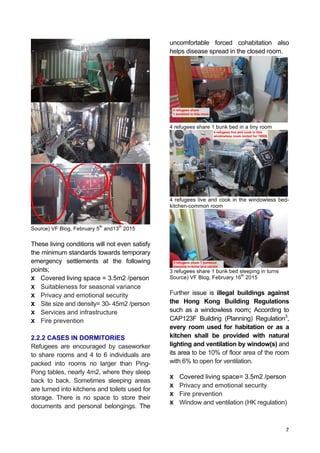
2.2.1 CASES IN SLUMS
The dangerous unauthorised structures
of high-density huts are mostly erected
by illegal materials such as metal and
wood sheets taken from landfills with
services and infrastructure degraded.
These are never enough to resist
typhoon, rain, strong wind, electric leak
and fire, and to secure documents and
personal belongings from the disasters.
7
Source) VF Blog, February 5
th
and13
th
2015
These living conditions will not even satisfy
the minimum standards towards temporary
emergency settlements at the following
points;
X Covered living space = 3.5m2 /person
X Suitableness for seasonal variance
X Privacy and emotional security
X Site size and density= 30- 45m2 /person
X Services and infrastructure
X Fire prevention
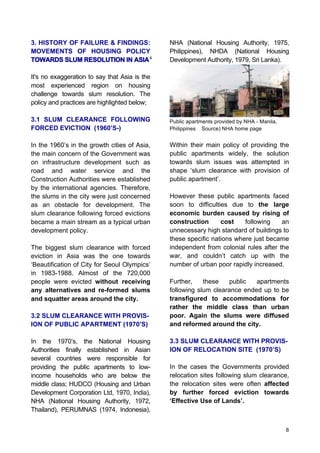
2.2.2 CASES IN DORMITORIES
Refugees are encouraged by caseworker
to share rooms and 4 to 6 individuals are
packed into rooms no larger than Ping-
Pong tables, nearly 4m2, where they sleep
back to back. Sometimes sleeping areas
are turned into kitchens and toilets used for
storage. There is no space to store their
documents and personal belongings. The
uncomfortable forced cohabitation also
helps disease spread in the closed room.
4 refugees share 1 bunk bed in a tiny room
4 refugees live and cook in the windowless bed-
kitchen-common room
3 refugees share 1 bunk bed sleeping in turns
Source) VF Blog, February 16
th
2015
Further issue is illegal buildings against
the Hong Kong Building Regulations
such as a windowless room; According to
CAP123F Building (Planning) Regulation3
,
every room used for habitation or as a
kitchen shall be provided with natural
lighting and ventilation by window(s) and
its area to be 10% of floor area of the room
with 6% to open for ventilation.
X Covered living space= 3.5m2 /person
X Privacy and emotional security
X Fire prevention
X Window and ventilation (HK regulation)
8
3. HISTORY OF FAILURE & FINDINGS:
MOVEMENTS OF HOUSING POLICY
TOWARDS SLUM RESOLUTION IN ASIA
It's no exaggeration to say that Asia is the
most experienced region on housing
challenge towards slum resolution. The
policy and practices are highlighted below;
3.1 SLUM CLEARANCE FOLLOWING
FORCED EVICTION (1960’S-)
In the 1960’s in the growth cities of Asia,
the main concern of the Government was
on infrastructure development such as
road and water service and the
Construction Authorities were established
by the international agencies. Therefore,
the slums in the city were just concerned
as an obstacle for development. The
slum clearance following forced evictions
became a main stream as a typical urban
development policy.
The biggest slum clearance with forced
eviction in Asia was the one towards
‘Beautification of City for Seoul Olympics’
in 1983-1988. Almost of the 720,000
people were evicted without receiving
any alternatives and re-formed slums
and squatter areas around the city.
3.2 SLUM CLEARANCE WITH PROVIS-
ION OF PUBLIC APARTMENT (1970’S)
In the 1970’s, the National Housing
Authorities finally established in Asian
several countries were responsible for
providing the public apartments to low-
income households who are below the
middle class; HUDCO (Housing and Urban
Development Corporation Ltd, 1970, India),
NHA (National Housing Authority, 1972,
Thailand), PERUMNAS (1974, Indonesia),
NHA (National Housing Authority, 1975,
Philippines), NHDA (National Housing
Development Authority, 1979, Sri Lanka).
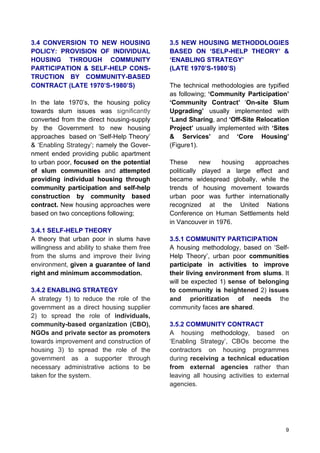
Public apartments provided by NHA - Manila,
Philippines Source) NHA home page
Within their main policy of providing the
public apartments widely, the solution
towards slum issues was attempted in
shape ‘slum clearance with provision of
public apartment’.
However these public apartments faced
soon to difficulties due to the large
economic burden caused by rising of
construction cost following an
unnecessary high standard of buildings to
these specific nations where just became
independent from colonial rules after the
war, and couldn’t catch up with the
number of urban poor rapidly increased.
Further, these public apartments
following slum clearance ended up to be
transfigured to accommodations for
rather the middle class than urban
poor. Again the slums were diffused
and reformed around the city.
3.3 SLUM CLEARANCE WITH PROVIS-
ION OF RELOCATION SITE (1970’S)
In the cases the Governments provided
relocation sites following slum clearance,
the relocation sites were often affected
by further forced eviction towards
‘Effective Use of Lands’.
4
9
3.4 CONVERSION TO NEW HOUSING
POLICY: PROVISION OF INDIVIDUAL
HOUSING THROUGH COMMUNITY
PARTICIPATION & SELF-HELP CONS-
TRUCTION BY COMMUNITY-BASED
CONTRACT (LATE 1970’S-1980’S)
In the late 1970’s, the housing policy
towards slum issues was significantly
converted from the direct housing-supply
by the Government to new housing
approaches based on ‘Self-Help Theory’
& ‘Enabling Strategy’; namely the Gover-
nment ended providing public apartment
to urban poor, focused on the potential
of slum communities and attempted
providing individual housing through
community participation and self-help
construction by community based
contract. New housing approaches were
based on two conceptions following;
3.4.1 SELF-HELP THEORY
A theory that urban poor in slums have
willingness and ability to shake them free
from the slums and improve their living
environment, given a guarantee of land
right and minimum accommodation.
3.4.2 ENABLING STRATEGY
A strategy 1) to reduce the role of the
government as a direct housing supplier
2) to spread the role of individuals,
community-based organization (CBO),
NGOs and private sector as promoters
towards improvement and construction of
housing 3) to spread the role of the
government as a supporter through
necessary administrative actions to be
taken for the system.
3.5 NEW HOUSING METHODOLOGIES
BASED ON ‘SELP-HELP THEORY’ &
‘ENABLING STRATEGY’
(LATE 1970’S-1980’S)
The technical methodologies are typified
as following; ‘Community Participation’
‘Community Contract’ ‘On-site Slum
Upgrading’ usually implemented with
‘Land Sharing, and ‘Off-Site Relocation
Project’ usually implemented with ‘Sites
& Services’ and ‘Core Housing’
(Figure1).
These new housing approaches
politically played a large effect and
became widespread globally, while the
trends of housing movement towards
urban poor was further internationally
recognized at the United Nations
Conference on Human Settlements held
in Vancouver in 1976.
3.5.1 COMMUNITY PARTICIPATION
A housing methodology, based on ‘Self-
Help Theory’, urban poor communities
participate in activities to improve
their living environment from slums. It
will be expected 1) sense of belonging
to community is heightened 2) issues
and prioritization of needs the
community faces are shared.
3.5.2 COMMUNITY CONTRACT
A housing methodology, based on
‘Enabling Strategy’, CBOs become the
contractors on housing programmes
during receiving a technical education
from external agencies rather than
leaving all housing activities to external
agencies.
10
3.5.3 ON-SITE SLUM UPGRADING
A housing methodology to upgrade the
potential of existing urban slums within
onsite without forced eviction.
(1) LAND SHEARING
In the case a slum is formed on the land
owned by government or individuals, a
part of land is given to the slum
community free of charge. ‘Land Sharing’
enables landowner regains land and slum
community ensures a good environment
and land rights through collecting and
rebuilding the disordered slums.
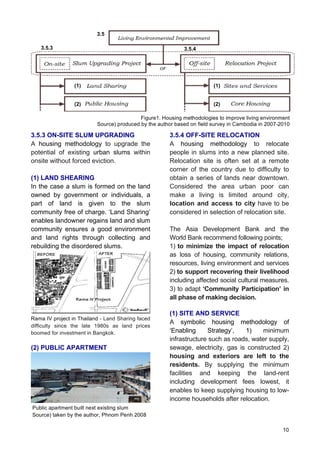
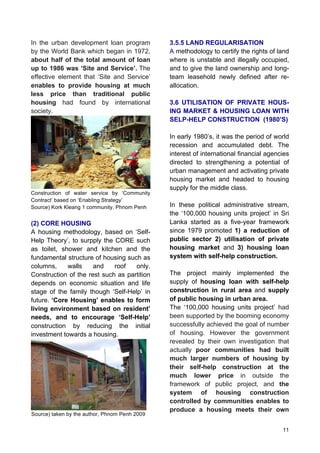
Rama IV project in Thailand - Land Sharing faced
difficulty since the late 1980s as land prices
boomed for investment in Bangkok.
(2) PUBLIC APARTMENT
3.5.4 OFF-SITE RELOCATION 	
 
A housing methodology to relocate
people in slums into a new planned site.
Relocation site is often set at a remote
corner of the country due to difficulty to
obtain a series of lands near downtown.
Considered the area urban poor can
make a living is limited around city,
location and access to city have to be
considered in selection of relocation site.
The Asia Development Bank and the
World Bank recommend following points;	
  
1) to minimize the impact of relocation
as loss of housing, community relations,
resources, living environment and services
2) to support recovering their livelihood
including affected social cultural measures.
3) to adapt ‘Community Participation’ in
all phase of making decision.
	
  
(1) SITE AND SERVICE
A symbolic housing methodology of
‘Enabling Strategy’, 1) minimum
infrastructure such as roads, water supply,
sewage, electricity, gas is constructed 2)
housing and exteriors are left to the
residents. By supplying the minimum
facilities and keeping the land-rent
including development fees lowest, it
enables to keep supplying housing to low-
income households after relocation.
Figure1. Housing methodologies to improve living environment
Source) produced by the author based on field survey in Cambodia in 2007-2010
	
  
3.5.3 3.5.4
(1)
(2)
(1)
(2)
3.5
Public apartment built next existing slum
Source) taken by the author, Phnom Penh 2008
	
  
11
In the urban development loan program
by the World Bank which began in 1972,
about half of the total amount of loan
up to 1986 was ‘Site and Service’. The
effective element that ‘Site and Service’
enables to provide housing at much
less price than traditional public
housing had found by international
society.
	
  
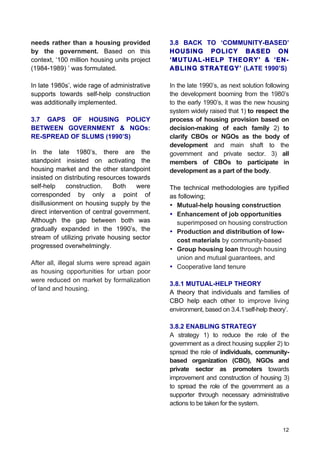
Construction of water service by ‘Community
Contract’ based on ‘Enabling Strategy’
Source) Kork Kleang 1 community, Phnom Penh
	
 
(2) CORE HOUSING
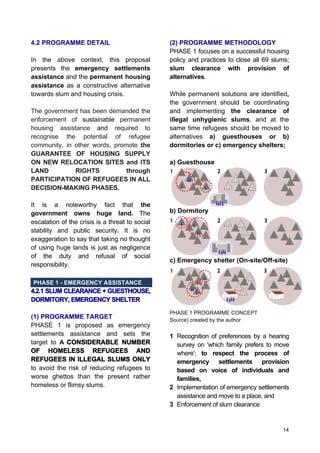
A housing methodology, based on ‘Self-
Help Theory’, to surpply the CORE such
as toilet, shower and kitchen and the
fundamental structure of housing such as
columns, walls and roof only.
Construction of the rest such as partition
depends on economic situation and life
stage of the family though ‘Self-Help’ in
future. ‘Core Housing’ enables to form
living environment based on resident’
needs, and to encourage ‘Self-Help’
construction by reducing the initial
investment towards a housing.
3.5.5 LAND REGULARISATION
A methodology to certify the rights of land
where is unstable and illegally occupied,
and to give the land ownership and long-
team leasehold newly defined after re-
allocation.
3.6 UTILISATION OF PRIVATE HOUS-
ING MARKET & HOUSING LOAN WITH
SELP-HELP CONSTRUCTION (1980’S)
In early 1980’s, it was the period of world
recession and accumulated debt. The
interest of international financial agencies
directed to strengthening a potential of
urban management and activating private
housing market and headed to housing
supply for the middle class.
In these political administrative stream,
the ‘100,000 housing units project’ in Sri
Lanka started as a five-year framework
since 1979 promoted 1) a reduction of
public sector 2) utilisation of private
housing market and 3) housing loan
system with self-help construction.
The project mainly implemented the
supply of housing loan with self-help
construction in rural area and supply
of public housing in urban area.
The ‘100,000 housing units project’ had
been supported by the booming economy
successfully achieved the goal of number
of housing. However the government
revealed by their own investigation that
actually poor communities had built
much larger numbers of housing by
their self-help construction at the
much lower price in outside the
framework of public project, and the
system of housing construction
controlled by communities enables to
produce a housing meets their own
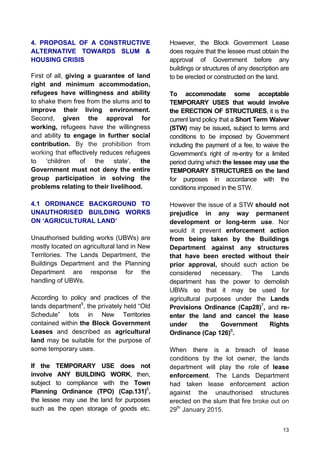
Source) taken by the author, Phnom Penh 2009
	
  
12
needs rather than a housing provided
by the government. Based on this
context, ‘100 million housing units project
(1984-1989) ’ was formulated.
In late 1980s’, wide rage of administrative
supports towards self-help construction
was additionally implemented.
3.7 GAPS OF HOUSING POLICY
BETWEEN GOVERNMENT & NGOs:
RE-SPREAD OF SLUMS (1990’S)
	
  
In the late 1980’s, there are the
standpoint insisted on activating the
housing market and the other standpoint
insisted on distributing resources towards
self-help construction. Both were
corresponded by only a point of
disillusionment on housing supply by the
direct intervention of central government.
Although the gap between both was
gradually expanded in the 1990’s, the
stream of utilizing private housing sector
progressed overwhelmingly.
After all, illegal slums were spread again
as housing opportunities for urban poor
were reduced on market by formalization
of land and housing.
3.8 BACK TO ‘COMMUNITY-BASED’
HOUSING POLICY BASED ON
‘MUTUAL-HELP THEORY’ & ‘EN-
ABLING STRATEGY’ (LATE 1990’S)
In the late 1990’s, as next solution following
the development booming from the 1980’s
to the early 1990’s, it was the new housing
system widely raised that 1) to respect the
process of housing provision based on
decision-making of each family 2) to
clarify CBOs or NGOs as the body of
development and main shaft to the
government and private sector. 3) all
members of CBOs to participate in
development as a part of the body.
The technical methodologies are typified
as following;
• Mutual-help housing construction
• Enhancement of job opportunities
superimposed on housing construction
• Production and distribution of low-
cost materials by community-based
• Group housing loan through housing
union and mutual guarantees, and
• Cooperative land tenure
3.8.1 MUTUAL-HELP THEORY
A theory that individuals and families of
CBO help each other to improve living
environment, based on 3.4.1‘self-help theory’.
3.8.2 ENABLING STRATEGY
A strategy 1) to reduce the role of the
government as a direct housing supplier 2) to
spread the role of individuals, community-
based organization (CBO), NGOs and
private sector as promoters towards
improvement and construction of housing 3)
to spread the role of the government as a
supporter through necessary administrative
actions to be taken for the system.
13
4. PROPOSAL OF A CONSTRUCTIVE
ALTERNATIVE TOWARDS SLUM &
HOUSING CRISIS
First of all, giving a guarantee of land
right and minimum accommodation,
refugees have willingness and ability
to shake them free from the slums and to
improve their living environment.
Second, given the approval for
working, refugees have the willingness
and ability to engage in further social
contribution. By the prohibition from
working that effectively reduces refugees
to ‘children of the state’, the
Government must not deny the entire
group participation in solving the
problems relating to their livelihood.
4.1 ORDINANCE BACKGROUND TO
UNAUTHORISED BUILDING WORKS
ON ‘AGRICULTURAL LAND’
Unauthorised building works (UBWs) are
mostly located on agricultural land in New
Territories. The Lands Department, the
Buildings Department and the Planning
Department are response for the
handling of UBWs.
According to policy and practices of the
lands department5
, the privately held “Old
Schedule” lots in New Territories
contained within the Block Government
Leases and described as agricultural
land may be suitable for the purpose of
some temporary uses.
If the TEMPORARY USE does not
involve ANY BUILDING WORK, then,
subject to compliance with the Town
Planning Ordinance (TPO) (Cap.131)6
,
the lessee may use the land for purposes
such as the open storage of goods etc.
However, the Block Government Lease
does require that the lessee must obtain the
approval of Government before any
buildings or structures of any description are
to be erected or constructed on the land.
To accommodate some acceptable
TEMPORARY USES that would involve
the ERECTION OF STRUCTURES, it is the
current land policy that a Short Term Waiver
(STW) may be issued, subject to terms and
conditions to be imposed by Government
including the payment of a fee, to waive the
Government’s right of re-entry for a limited
period during which the lessee may use the
TEMPORARY STRUCTURES on the land
for purposes in accordance with the
conditions imposed in the STW.
However the issue of a STW should not
prejudice in any way permanent
development or long-term use. Nor
would it prevent enforcement action
from being taken by the Buildings
Department against any structures
that have been erected without their
prior approval, should such action be
considered necessary. The Lands
department has the power to demolish
UBWs so that it may be used for
agricultural purposes under the Lands
Provisions Ordinance (Cap28)7
, and re-
enter the land and cancel the lease
under the Government Rights
Ordinance (Cap 126)8
.
When there is a breach of lease
conditions by the lot owner, the lands
department will play the role of lease
enforcement. The Lands Department
had taken lease enforcement action
against the unauthorised structures
erected on the slum that fire broke out on
29th
January 2015.
14
4.2 PROGRAMME DETAIL
In the above context, this proposal
presents the emergency settlements
assistance and the permanent housing
assistance as a constructive alternative
towards slum and housing crisis.
The government has been demanded the
enforcement of sustainable permanent
housing assistance and required to
recognise the potential of refugee
community, in other words, promote the
GUARANTEE OF HOUSING SUPPLY
ON NEW RELOCATION SITES and ITS
LAND RIGHTS through
PARTICIPATION OF REFUGEES IN ALL
DECISION-MAKING PHASES.
It is a noteworthy fact that the
government owns huge land. The
escalation of the crisis is a threat to social
stability and public security. It is no
exaggeration to say that taking no thought
of using huge lands is just as negligence
of the duty and refusal of social
responsibility.
PHASE 1 - EMERGENCY ASSISTANCE
4.2.1 SLUM CLEARANCE + GUESTHOUSE,
DORMITORY, EMERGENCY SHELTER
(1) PROGRAMME TARGET
PHASE 1 is proposed as emergency
settlements assistance and sets the
target to A CONSIDERABLE NUMBER
OF HOMELESS REFUGEES AND
REFUGEES IN ILLEGAL SLUMS ONLY
to avoid the risk of reducing refugees to
worse ghettos than the present rather
homeless or flimsy slums.
(2) PROGRAMME METHODOLOGY
PHASE 1 focuses on a successful housing
policy and practices to close all 69 slums;
slum clearance with provision of
alternatives.
While permanent solutions are identified,
the government should be coordinating
and implementing the clearance of
illegal unhygienic slums, and at the
same time refugees should be moved to
alternatives a) guesthouses or b)
dormitories or c) emergency shelters;
a) Guesthouse
b) Dormitory
c) Emergency shelter (On-site/Off-site)
PHASE 1 PROGRAMME CONCEPT
Source) created by the author
1 Recognition of preferences by a hearing
survey on 'which family prefers to move
where'; to respect the process of
emergency settlements provision
based on voice of individuals and
families,
2 Implementation of emergency settlements
assistance and move to a place, and
3 Enforcement of slum clearance
15
(3) EMERGENCY SHELTER
As the final aim of UNHCR working in
massive refugee camps in Middle East or
Africa is not promoting camps but closing
camps, the emergency settlements will
not be promoted with the refugee life
in a simplified shelter within this
program. All emergency settlements
assistance is to protect refugees from
the risk ending up to live outside or
insanity pre-carious environment.
C - 1 EMERGENCY SHELTER ON-SITE
(LANDS LEASE ENFORCEMENT HAS TAKEN)
According to the Hong Kong Building
Regulations - CAP123F Building (Planning)
Regulation 50, temporary buildings shall
mean any building for which a permit is
issued on a temporary basis and is
required only for a short time and
constructed of short lived materials.
In existing ordinances, a Short Term Waiver
(STW) may be issued to accommodate
some acceptable TEMPORARY USES that
would involve the ERECTION OF
STRUCTURES on agricultural land. The
provision of emergency shelter on agricultural
land could be an temporary alternative while it
fosters the idea on refugee circumstances
in slum and housing crisis to the local
social and seeks sponsors towards
imposed payment.
Further changes in use of land, are mainly
regulated by the Town Planning Ordinance
(Cap 131), land leases, Buildings
Ordinance (Cap 123) and the deeds of
mutual covenant, might not be impossible
after the Lands Department has taken lease
enforcement action.
C - 2 EMERGENCY SHELTER OFF-SITE
As a pilot programme of emergency
settlements assistance to provide 20
emergency shelters on off-site, the
government proposes and provides some
affordable sites with terms and conditions.
Examples of emergency shelter are
shown following;
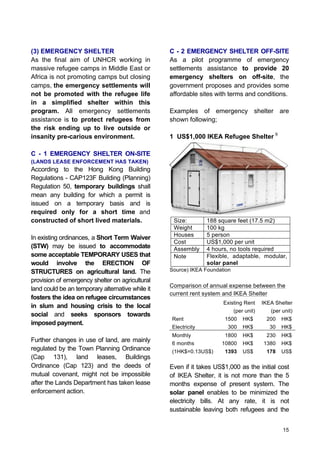
1 US$1,000 IKEA Refugee Shelter 9
Source) IKEA Foundation
Comparison of annual expense between the
current rent system and IKEA Shelter
Existing Rent IKEA Shelter
(per unit) (per unit)
Rent 1500 HK$ 200 HK$
Electricity 300 HK$ 30 HK$
Monthly 1800 HK$ 230 HK$
6 months 10800 HK$ 1380 HK$
(1HK$=0.13US$) 1393 US$ 178 US$
Even if it takes US$1,000 as the initial cost
of IKEA Shelter, it is not more than the 5
months expense of present system. The
solar panel enables to be minimized the
electricity bills. At any rate, it is not
sustainable leaving both refugees and the
Size: 188 square feet (17.5 m2)
Weight 100 kg
Houses 5 person
Cost US$1,000 per unit
Assembly 4 hours, no tools required
Note Flexible, adaptable, modular,
solar panel
16
Hong Kong government a permanent
uncertainty with regards to time and huge
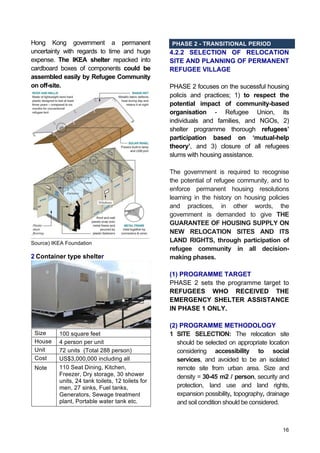
expense. The IKEA shelter repacked into
cardboard boxes of components could be
assembled easily by Refugee Community
on off-site.
Source) IKEA Foundation
2 Container type shelter
PHASE 2 - TRANSITIONAL PERIOD
4.2.2 SELECTION OF RELOCATION
SITE AND PLANNING OF PERMANENT
REFUGEE VILLAGE
PHASE 2 focuses on the sucessful housing
policis and practices; 1) to respect the
potential impact of community-based
organisation - Refugee Union, its
individuals and families, and NGOs, 2)
shelter programme thorough refugees’
participation based on ‘mutual-help
theory’, and 3) closure of all refugees
slums with housing assistance.
The government is required to recognise
the potential of refugee community, and to
enforce permanent housing resolutions
learning in the history on housing policies
and practices, in other words, the
government is demanded to give THE
GUARANTEE OF HOUSING SUPPLY ON
NEW RELOCATION SITES AND ITS
LAND RIGHTS, through participation of
refugee community in all decision-
making phases.
(1) PROGRAMME TARGET
PHASE 2 sets the programme target to
REFUGEES WHO RECEIVED THE
EMERGENCY SHELTER ASSISTANCE
IN PHASE 1 ONLY.
(2) PROGRAMME METHODOLOGY
1 SITE SELECTION: The relocation site
should be selected on appropriate location
considering accessibility to social
services, and avoided to be an isolated
remote site from urban area. Size and
density = 30-45 m2 / person, security and
protection, land use and land rights,
expansion possibility, topography, drainage
and soil condition should be considered.
Size 100 square feet
House 4 person per unit
Unit 72 units (Total 288 person)
Cost US$3,000,000 including all
Note 110 Seat Dining, Kitchen,
Freezer, Dry storage, 30 shower
units, 24 tank toilets, 12 toilets for
men, 27 sinks, Fuel tanks,
Generators, Sewage treatment
plant, Portable water tank etc.
17
2 SITE PLANNING: Assuming the
Government selected an appropriate
site in their own land, site planning
towards permanent refugee village will
be commenced. Sanitation services,
infrastructure, fire prevention,
administrative and communal services
should be planned. The area of open
land should be left as expansion
possibility.
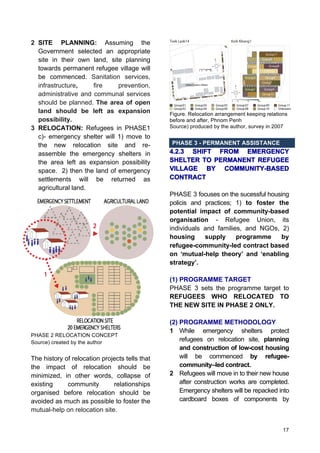
3 RELOCATION: Refugees in PHASE1
c)- emergency shelter will 1) move to
the new relocation site and re-
assemble the emergency shelters in
the area left as expansion possibility
space. 2) then the land of emergency
settlements will be returned as
agricultural land.
PHASE 2 RELOCATION CONCEPT
Source) created by the author
The history of relocation projects tells that
the impact of relocation should be
minimized, in other words, collapse of
existing community relationships
organised before relocation should be
avoided as much as possible to foster the
mutual-help on relocation site.
Figure. Relocation arrangement keeping relations
before and after, Phnom Penh
Source) produced by the author, survey in 2007
PHASE 3 - PERMANENT ASSISTANCE
4.2.3 SHIFT FROM EMERGENCY
SHELTER TO PERMANENT REFUGEE
VILLAGE BY COMMUNITY-BASED
CONTRACT
PHASE 3 focuses on the sucessful housing
policis and practices; 1) to foster the
potential impact of community-based
organisation - Refugee Union, its
individuals and families, and NGOs, 2)
housing supply programme by
refugee-community-led contract based
on ‘mutual-help theory’ and ‘enabling
strategy’.
(1) PROGRAMME TARGET
PHASE 3 sets the programme target to
REFUGEES WHO RELOCATED TO
THE NEW SITE IN PHASE 2 ONLY.
(2) PROGRAMME METHODOLOGY
1 While emergency shelters protect
refugees on relocation site, planning
and construction of low-cost housing
will be commenced by refugee-
community–led contract.
2 Refugees will move in to their new house
after construction works are completed.
Emergency shelters will be repacked into
cardboard boxes of components by
18
refugees, rebuilt and reused at another
emergency settlements.
3 Then the loop of function PHASE 1 – 3
will iterate and spread.
PHASE 3 PROGRAMME CONCEPT
Source) created by the author
(3) LOW-COST HOUSING
Low-cost housing is ‘non-market social
rented intermediate housing’ provided to
specified eligible households whose
needs are not met by the market. Most of
the literature on low-cost housing refers to a
number of forms that exist along a
continuum - from emergency shelters, to
transitional housing, to non-market
rental. The notion of housing affordability
became widespread in the 1980s in Europe
and North America. The low-cost is
reasonably adequate in standard and
location not only by using low-cost materials
but also by constructing through
community-based contract.
The Habitat for Humanity (HFH)10
, an
international NGO founded in 1979, has
been devoted to building ‘simple, decent,
and affordable’ housing. Focusing on its
remarkable system to provide low-cost
housing though community-based
contract, the model of construction process
of low-cost housing is highlighted below;
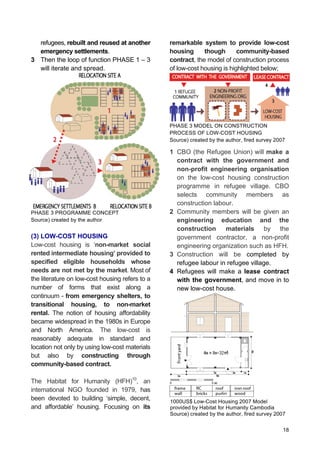
PHASE 3 MODEL ON CONSTRUCTION
PROCESS OF LOW-COST HOUSING
Source) created by the author, fired survey 2007
1 CBO (the Refugee Union) will make a
contract with the government and
non-profit engineering organisation
on the low-cost housing construction
programme in refugee village. CBO
selects community members as
construction labour.
2 Community members will be given an
engineering education and the
construction materials by the
government contractor, a non-profit
engineering organization such as HFH.
3 Construction will be completed by
refugee labour in refugee village.
4 Refugees will make a lease contract
with the government, and move in to
new low-cost house.
1000US$ Low-Cost Housing 2007 Model
provided by Habitat for Humanity Cambodia
Source) created by the author, fired survey 2007
	
  
19
(4) WORKING PERMIT WITHIN
THE MUTUAL-HELP HOUSING
CONSTRUCTION PROGRAMME
By the prohibition from working, the
Government must not deny the entire
group participation in solving the
problems relating to their livelihood
and living environment.
Refugee community will lead and involve
in this refugee village programme as a
decision maker, and will contribute as
planners and construction labour. In other
words, this refugee village programme
could open job opportunities to
refugees through the mutual-help
housing construction and provide
refugees a pilot working permit within
this programme.
5. CONCLUSION
Giving a guarantee of land right and minimum
accommodation, refugees have willingness
and ability to shake them free from the slums
and to improve their living environment.
Given the approval for working, refugees
have the willingness and ability to engage in
further social contribution. Soon refugees will
demonstrate their ability to manage their
livelihood and improve living environment,
while community participation helps the
problems relating to their livelihood solve and
living environment through this programme.
I would greatly appreciate urgent assistance
by the Government and considering this
proposal as one of alternatives towards the
slum and housing crisis in Hong Kong.
Yuri Akiyama-Carrel
yuri.carrel@gmail.com
1 The UN High Commissioner for Refugees,
Handbook for Emergencies Third Edition, February
2007 http://www.unhcr.org/472af2972.html
2 The Sphere Project, Sphere Handbook,
http://www.spherehandbook.org
3 The Building Department (2001), Building
(Planning) Regulation CAP123F reg30 ‘Lighting
and Ventilation of Rooms used for Habitation or
as an Office or Kitchen’
4 Yuri AKIYAMA-CARREL (2010), Study on a
Relocation Project following Forced Migration in
Phnom Penh Cambodia, Chapter 2 P15 – P29
5 The Legislative Council (2005), LC Paper No.
CB(1)1875/04-05(07) Meeting of the Panel on
Planning, Lands and Works on 28 June 2005
http://www.legco.gov.hk/yr0809/english/panels/
dev/papers/dev1125cb1-232-7-e.pdf
6 The Town Planning Board, Town Planning
Ordinance CAP131
http://www.legislation.gov.hk/blis_pdf.nsf/6799165
D2FEE3FA94825755E0033E532/AEA02550B541
AC16482575EE003FB1D8?OpenDocument&bt=0
7 The Land Department, Lands (Miscellaneous
Provisions) Ordinance CAP 28 reg12-13	
  
http://www.legislation.gov.hk/blis_pdf.nsf/6799165
D2FEE3FA94825755E0033E532/0DC8528C353
E7043482575EE00304946?OpenDocument&bt=
0
8 The Government Rights Ordinance CAP 126 reg4
http://www.legislation.gov.hk/blis_pdf.nsf/67991
65D2FEE3FA94825755E0033E532/E87620820
77CEC6C482575EE003F71CF?OpenDocumen
t&bt=0
9 Dezeen, Ikea develops flat-pack refugee shelters
(2013) http://www.dezeen.com/2013/07/03/ikea-
develops-flat-pack-refugee-shelters/
10 Habitat for Humanity International
http://www.habitat.org/eurasia

Refugee-led Settlements Project towards the Slum & Housing Crisis in Hong Kong, 2015, Yuri Akiyama-Carrel

  • 1.
    1                 NEW ISSUES IN REFUGEE RESEARCH Research Paper No.1 Proposal on a constructive alternative towards the slum and housing crisis – Refugee-led Settlements Project – Architect for Aid Yuri Akiyama-Carrel March 2015 Copyright rests with the author(s). Materials may be reproduced and circulated provided that the title, author and source is acknowledged. The views and opinions expressed in this paper are those of the author(s) and do not necessarily reflect the official position of Vision First, unless otherwise stated.  
  • 2.
    2 INDEX 1. Context 1.1 Refugeesin illegal slums 1.2 Refugees in guesthouse 1.3 Homeless refugees 1.4 Perfect scenario to lead refugees into jail 1.5 Avoidable waste of public funds 1.6 Voice of refugees 2. Living Environment 2.1 Global standards on emergency settlements 2.2 Circumstances of refugees' living environment in HK 2.2.1 Cases in slums 2.2.2 Cases in dormitories 3. Movements of housing policy towards slum resolution in Asia 3.1 Slum clearance following forced eviction (1970's) 3.2 Slum clearance with provision of public apartment (1970's) 3.3 Slum clearance with provision of relocation site (1970's) 3.4 Conversion to new housing policy: provision of individual housing (1970's-1980's) 3.4.1 Self-help theory 3.4.2 Enabling strategy 3.5 New housing methodologies based on 'self-help theory' & 'enabling strategy'(1970's-1980's) 3.5.1 Community participation 3.5.2 Community contract 3.5.3 On-site slum upgrading (1) Land sharing (2) Public apartment 3.5.4 Off-site relocation (1) Site and service (2) Core housing 3.5.5 Land regularisation 3.6 Utilization of private housing market and housing loan with self- help construction (1980's) 3.7 Gaps of housing policy between government and NGOs: re-spread of slums (1990's) 3.8 Back to 'community-based' housing policy (Late 1990's) 3.8.1 Mutual-help theory 3.8.2 Enabling strategy 4. Proposal of a constructive alternative towards slum & housing crisis 4.1 Ordinance background to unauthorised building works on 'agricultural land' 4.2 Programme detail 4.2.1 PHASE1 Emergency assistance - slum clearance + guesthouse, dormitory and emergency shelter (1) Programme target (2) Programme methodology (3) Emergency shelter 4.2.2 PHASE 2 Transitional period - selection of relocation site and planning of permanent village (1) Programme target (2) Programme methodology 4.2.3 PHASE 3 Permanent assistance - shift from emergency shelter to permanent refugee village (1) Programme target (2) Programme methodology (3) Low-cost housing (4) Working permit within mutual- help housing construction programme 5. Conclusion
  • 3.
    3 This article exploresan overview of current attitudes towards the slum and housing crisis where refugees are confronted without specific options and proposes a constructive alternative through housing programme while the permanent resolution is identified. Yuri Akiyama-Carrel 1. CONTEXT In the ‘Asia’s World City’ Hong Kong, the humanitarian crisis generated refugees slums that have sprung up since 2006 and exponentially grown in numbers on agricultural lots in the rural areas of New Territories West. These slums are defined as 'unauthorised building works (UBWs)' and several departments of the Hong Kong government are responsible for the handling of UBWs; they are the Lands Department, the Buildings Department and the Planning Department. However for the last 10 years the government has reached yet to a fundamental resolution towards the crisis that refugees have been compelled to endure humiliating by all means of such unsafe unhygienic unlawful living conditions while the destitute and suffering refugees residing have been kept hidden from public view. First of all, refugees are not economic migrants but persons who fled from their country for refuge or safety from war, political oppression, and religious persecution. Almost 9,000 refugees in Hong Kong are prohibited from working and must rely on a 1,500HK$ monthly rent assistance and some food provided by the Social Welfare Department contractor, the International Social Service (ISS-HK). Considering the current housing market in Hong Kong, the 1,500HK$ is evidently insufficient to find an affordable room. Refugees must make a hard decision and mostly end up to be settled in a hut of illegal slums which the ISS-HK officially recommends as an rent option is only available for rent within HK$1,500 assistance. Otherwise, refugees would be asked apparently to share a rented accommodation such as guesthouse or dormitory, despite many finding this resolution uncomfortable or impossible. However some are suffering from traumas, mental disorders, PTSD often cased by persecution, are aggravated by ongoing stress and anxiety. Such forced cohabitation under lack of privacy is quite hard to accept as an alternative. In these circumstances, the government proactively pushes refugees to slums through ISS-HK. On the other hand, dozens of refugees are evicted from illegal refugee slums while the clampdown on guesthouses comes at a time. Therefore refugees have been compelled to suffer from the circulation of unstable humiliating living conditions within the slum and housing crisis. Further it is just impossible for some refugees who are currently under medication to move anywhere without specific place arranged for the medical and physical conditions. Refugees are not a temporary ‘problem’ to be fixed with residual humanitarian assistance, the government has been certainly demanded the enforcement of permanent resolution towards the crisis.
  • 4.
    4 1.1 REFUGEES INILLEGAL SLUMS The huts in slum are ordinarily structured by illegal unauthorised materials such as metal and wood sheets taken from landfills, and the degraded unlawful structure is never enough to resist typhoon, rain, strong wind and fire. Slum fires have been alarmingly frequent for the one month. The one that broke out on 29th January 2015 left a dead of a Sri Lankan refugee. Some huts and all belongings to the households burst into flames while the acid smoke raced up to sky turning it black. The Sri Lankan refugee settled at a hut recommended by ISS-HK and it’s said the slum fire caused by a short from degraded electricity wiring according to interviews to residents in the slum. The slum fire exposed that these unlawful unhygienic living conditions within slums endangers the life of refugees as human beings. Affected refugees are gravely concerned about the prospect of being suddenly evicted, though they generally appreciate that short-term discomfort such as moving to guesthouses or dormitories is preferable to years of living dangerously in structures that could as easily collapse as erupt in a ball of fire. His death further revealed the dangerous unauthorised structures erected by a landlord hell-bent on profiting from rent paid by ISS-HK, the sloppy management by caseworkers of ISS-HK with lack of inspection and outreach, and the evil slum business between ISS-HK and the landlord. 1.2 REFUGEES IN GUESTHOUSE While many refugees are settled in slums, some kicked out from slums for several reasons or refuse to settle in slum are occasionally given alternative temporary accommodation. It is estimated that about 300 refugees have been housed in guesthouses over the past 18 months as housing prices spiraled beyond reach. However it has been currently reported that numbers of refugees settled in guesthouses have to leave their rooms and make a hard decision immediately with unstable unavailable alternatives; namely whether they miraculously find and rent accommodation for 1500HK$ or become homeless. Specific issues in guesthouse are 1) uncomfortable forced cohabitation by several individuals in a tiny room under lack of privacy 2) guesthouse usually has no cooking facilities and food supplied by ISS-HK cannot be cooked. 1.3 HOMELESS REFUGEES It is worth noting that the refugees settled in the same slum where the deadly fire broke out had their rent stopped and faced mass eviction. The clampdown on guesthouses comes at a time when dozens of refugees are evicted from illegal refugee slums without adequate assistance. About a hundred refugees have found themselves in the streets. At least guesthouse rooms are no longer offered as an alternative to homeless refugees.
  • 5.
    5 1.4 PERFECT SCENARIOTO LEAD REFUGEES INTO JAIL Since ISS-HK cut the rent assistance or paid less than the monthly rent, refugees are compelled to work illegally to pay the surplus and utilities while the rent increased sometimes, and refugees end up to be jailed. Considering the prohibition from working and 15 to 22 months jail for working illegally cased by the rent cut controlled by ISS-HK, it seems to be a perfect scenario heading towards ‘refugee solution’ reflected by a hidden agenda. 1.5 AVOIDABLE PUBLIC FUNDS WASTE Prior to February 2015, a considerable number of homeless refugees were assigned single-occupancy rooms in guesthouses by ISS-HK when they failed to find rooms for 1500HK$. Starting second week in February 2015, refugees were unceremoniously locked out of guesthouses after ISS-HK payments were stopped. The decision is not unreasonable as the guesthouse solution wasted millions of dollars that should have been more prudently allocated. 1.6 VOICE OF REFUGEES “No refugee wants to live in slums. Were affordable alternatives available we would gladly move out of these insanely dangerous structures.” - RU publically started early 2nd week in February 2015. The Government must not deny the entire group participation in solving the problems relating to their livelihood through the prohibition from working that effectively reduces refugees to ‘children of the state’. 2. LIVING ENVIRONMENT For refugees hoping to return to their hometown one day, the life in simplified shelter or other countries would be a temporary accommodation. However refugees live everyday with feelings of instability waiting for solutions. Therefore living environment within refugee communities should be considered as an essential factor to bring them hope, energy and empowerment. 2.1 GLOBAL STANDARDS ON EMERGENCY SETTLEMETS The UNHCR Handbook for Emergencies1 establishes technical minimum standards concerning planning and operation of a Refugee Camp. The Chapter 12 focuses particularly on minimum standards of living environment including shelter, settlements, sanitation and services. These are based on the Sphere Project Handbook2 that is one of the most widely known and internationally recognized sets of common principles and universal minimum standards for the delivery of quality humanitarian response. The minimum standards of emergency settlements are following; [SHELTER PLANNING] • Covered living space= 3.5m2 / person Source) Sphere Handbook, Sphere Project • Suitableness for seasonal variance • Privacy and emotional security
  • 6.
    6 [SITE SELECTION] • Sizeand density = 30-45 m2 / person • Security and protection • Land use and land rights • Accessibility • Expansion possibility • Topography • Drainage • Soil condition [SITE PLANNING - MASTER PLAN] Source) P227 Handbook for Emergencies Third Edition, February 2007, UNHCR • Sanitation services • Infrastructure • Fire prevention • Administrative services • Communal services [SITE PLANNING - MODULAR PLAN] Source) P228 Handbook for Emergencies Third Edition, February 2007, UNHCR • Land allocation = 45 m2 / plot • Detail plan of services and infrastructure 2.2 CIRCUMSTANCES OF REFUGEES’ LIVING ENVIRONMENT IN HK The use of these minimum standards should be limited in an emergency situation only to be protected from the risk of being homeless or insanity precarious environment ‘temporally’. However, it would be useful to understand the circumstances of living environment where refugees have settled for years in Hong Kong by compared with the minimum standards; namely it is taken for granted that a living environment towards semi-term or long-term settlements should be better than at least the minimum standards towards temporary emergency settlements. The result of outreach and field survey conducted by the Vision First and the Refugee Union illustrates the unsafe unhygienic living environment in slums and dormitories where dozens of refugees appeared to have been living. These living conditions also tarnish the reputation of Hong Kong and the appropriateness of such arrangements should be carefully analysed. 2.2.1 CASES IN SLUMS The dangerous unauthorised structures of high-density huts are mostly erected by illegal materials such as metal and wood sheets taken from landfills with services and infrastructure degraded. These are never enough to resist typhoon, rain, strong wind, electric leak and fire, and to secure documents and personal belongings from the disasters.
  • 7.
    7 Source) VF Blog,February 5 th and13 th 2015 These living conditions will not even satisfy the minimum standards towards temporary emergency settlements at the following points; X Covered living space = 3.5m2 /person X Suitableness for seasonal variance X Privacy and emotional security X Site size and density= 30- 45m2 /person X Services and infrastructure X Fire prevention 2.2.2 CASES IN DORMITORIES Refugees are encouraged by caseworker to share rooms and 4 to 6 individuals are packed into rooms no larger than Ping- Pong tables, nearly 4m2, where they sleep back to back. Sometimes sleeping areas are turned into kitchens and toilets used for storage. There is no space to store their documents and personal belongings. The uncomfortable forced cohabitation also helps disease spread in the closed room. 4 refugees share 1 bunk bed in a tiny room 4 refugees live and cook in the windowless bed- kitchen-common room 3 refugees share 1 bunk bed sleeping in turns Source) VF Blog, February 16 th 2015 Further issue is illegal buildings against the Hong Kong Building Regulations such as a windowless room; According to CAP123F Building (Planning) Regulation3 , every room used for habitation or as a kitchen shall be provided with natural lighting and ventilation by window(s) and its area to be 10% of floor area of the room with 6% to open for ventilation. X Covered living space= 3.5m2 /person X Privacy and emotional security X Fire prevention X Window and ventilation (HK regulation)
  • 8.
    8 3. HISTORY OFFAILURE & FINDINGS: MOVEMENTS OF HOUSING POLICY TOWARDS SLUM RESOLUTION IN ASIA It's no exaggeration to say that Asia is the most experienced region on housing challenge towards slum resolution. The policy and practices are highlighted below; 3.1 SLUM CLEARANCE FOLLOWING FORCED EVICTION (1960’S-) In the 1960’s in the growth cities of Asia, the main concern of the Government was on infrastructure development such as road and water service and the Construction Authorities were established by the international agencies. Therefore, the slums in the city were just concerned as an obstacle for development. The slum clearance following forced evictions became a main stream as a typical urban development policy. The biggest slum clearance with forced eviction in Asia was the one towards ‘Beautification of City for Seoul Olympics’ in 1983-1988. Almost of the 720,000 people were evicted without receiving any alternatives and re-formed slums and squatter areas around the city. 3.2 SLUM CLEARANCE WITH PROVIS- ION OF PUBLIC APARTMENT (1970’S) In the 1970’s, the National Housing Authorities finally established in Asian several countries were responsible for providing the public apartments to low- income households who are below the middle class; HUDCO (Housing and Urban Development Corporation Ltd, 1970, India), NHA (National Housing Authority, 1972, Thailand), PERUMNAS (1974, Indonesia), NHA (National Housing Authority, 1975, Philippines), NHDA (National Housing Development Authority, 1979, Sri Lanka). Public apartments provided by NHA - Manila, Philippines Source) NHA home page Within their main policy of providing the public apartments widely, the solution towards slum issues was attempted in shape ‘slum clearance with provision of public apartment’. However these public apartments faced soon to difficulties due to the large economic burden caused by rising of construction cost following an unnecessary high standard of buildings to these specific nations where just became independent from colonial rules after the war, and couldn’t catch up with the number of urban poor rapidly increased. Further, these public apartments following slum clearance ended up to be transfigured to accommodations for rather the middle class than urban poor. Again the slums were diffused and reformed around the city. 3.3 SLUM CLEARANCE WITH PROVIS- ION OF RELOCATION SITE (1970’S) In the cases the Governments provided relocation sites following slum clearance, the relocation sites were often affected by further forced eviction towards ‘Effective Use of Lands’. 4
  • 9.
    9 3.4 CONVERSION TONEW HOUSING POLICY: PROVISION OF INDIVIDUAL HOUSING THROUGH COMMUNITY PARTICIPATION & SELF-HELP CONS- TRUCTION BY COMMUNITY-BASED CONTRACT (LATE 1970’S-1980’S) In the late 1970’s, the housing policy towards slum issues was significantly converted from the direct housing-supply by the Government to new housing approaches based on ‘Self-Help Theory’ & ‘Enabling Strategy’; namely the Gover- nment ended providing public apartment to urban poor, focused on the potential of slum communities and attempted providing individual housing through community participation and self-help construction by community based contract. New housing approaches were based on two conceptions following; 3.4.1 SELF-HELP THEORY A theory that urban poor in slums have willingness and ability to shake them free from the slums and improve their living environment, given a guarantee of land right and minimum accommodation. 3.4.2 ENABLING STRATEGY A strategy 1) to reduce the role of the government as a direct housing supplier 2) to spread the role of individuals, community-based organization (CBO), NGOs and private sector as promoters towards improvement and construction of housing 3) to spread the role of the government as a supporter through necessary administrative actions to be taken for the system. 3.5 NEW HOUSING METHODOLOGIES BASED ON ‘SELP-HELP THEORY’ & ‘ENABLING STRATEGY’ (LATE 1970’S-1980’S) The technical methodologies are typified as following; ‘Community Participation’ ‘Community Contract’ ‘On-site Slum Upgrading’ usually implemented with ‘Land Sharing, and ‘Off-Site Relocation Project’ usually implemented with ‘Sites & Services’ and ‘Core Housing’ (Figure1). These new housing approaches politically played a large effect and became widespread globally, while the trends of housing movement towards urban poor was further internationally recognized at the United Nations Conference on Human Settlements held in Vancouver in 1976. 3.5.1 COMMUNITY PARTICIPATION A housing methodology, based on ‘Self- Help Theory’, urban poor communities participate in activities to improve their living environment from slums. It will be expected 1) sense of belonging to community is heightened 2) issues and prioritization of needs the community faces are shared. 3.5.2 COMMUNITY CONTRACT A housing methodology, based on ‘Enabling Strategy’, CBOs become the contractors on housing programmes during receiving a technical education from external agencies rather than leaving all housing activities to external agencies.
  • 10.
    10 3.5.3 ON-SITE SLUMUPGRADING A housing methodology to upgrade the potential of existing urban slums within onsite without forced eviction. (1) LAND SHEARING In the case a slum is formed on the land owned by government or individuals, a part of land is given to the slum community free of charge. ‘Land Sharing’ enables landowner regains land and slum community ensures a good environment and land rights through collecting and rebuilding the disordered slums. Rama IV project in Thailand - Land Sharing faced difficulty since the late 1980s as land prices boomed for investment in Bangkok. (2) PUBLIC APARTMENT 3.5.4 OFF-SITE RELOCATION A housing methodology to relocate people in slums into a new planned site. Relocation site is often set at a remote corner of the country due to difficulty to obtain a series of lands near downtown. Considered the area urban poor can make a living is limited around city, location and access to city have to be considered in selection of relocation site. The Asia Development Bank and the World Bank recommend following points;   1) to minimize the impact of relocation as loss of housing, community relations, resources, living environment and services 2) to support recovering their livelihood including affected social cultural measures. 3) to adapt ‘Community Participation’ in all phase of making decision.   (1) SITE AND SERVICE A symbolic housing methodology of ‘Enabling Strategy’, 1) minimum infrastructure such as roads, water supply, sewage, electricity, gas is constructed 2) housing and exteriors are left to the residents. By supplying the minimum facilities and keeping the land-rent including development fees lowest, it enables to keep supplying housing to low- income households after relocation. Figure1. Housing methodologies to improve living environment Source) produced by the author based on field survey in Cambodia in 2007-2010   3.5.3 3.5.4 (1) (2) (1) (2) 3.5 Public apartment built next existing slum Source) taken by the author, Phnom Penh 2008  
  • 11.
    11 In the urbandevelopment loan program by the World Bank which began in 1972, about half of the total amount of loan up to 1986 was ‘Site and Service’. The effective element that ‘Site and Service’ enables to provide housing at much less price than traditional public housing had found by international society.   Construction of water service by ‘Community Contract’ based on ‘Enabling Strategy’ Source) Kork Kleang 1 community, Phnom Penh (2) CORE HOUSING A housing methodology, based on ‘Self- Help Theory’, to surpply the CORE such as toilet, shower and kitchen and the fundamental structure of housing such as columns, walls and roof only. Construction of the rest such as partition depends on economic situation and life stage of the family though ‘Self-Help’ in future. ‘Core Housing’ enables to form living environment based on resident’ needs, and to encourage ‘Self-Help’ construction by reducing the initial investment towards a housing. 3.5.5 LAND REGULARISATION A methodology to certify the rights of land where is unstable and illegally occupied, and to give the land ownership and long- team leasehold newly defined after re- allocation. 3.6 UTILISATION OF PRIVATE HOUS- ING MARKET & HOUSING LOAN WITH SELP-HELP CONSTRUCTION (1980’S) In early 1980’s, it was the period of world recession and accumulated debt. The interest of international financial agencies directed to strengthening a potential of urban management and activating private housing market and headed to housing supply for the middle class. In these political administrative stream, the ‘100,000 housing units project’ in Sri Lanka started as a five-year framework since 1979 promoted 1) a reduction of public sector 2) utilisation of private housing market and 3) housing loan system with self-help construction. The project mainly implemented the supply of housing loan with self-help construction in rural area and supply of public housing in urban area. The ‘100,000 housing units project’ had been supported by the booming economy successfully achieved the goal of number of housing. However the government revealed by their own investigation that actually poor communities had built much larger numbers of housing by their self-help construction at the much lower price in outside the framework of public project, and the system of housing construction controlled by communities enables to produce a housing meets their own Source) taken by the author, Phnom Penh 2009  
  • 12.
    12 needs rather thana housing provided by the government. Based on this context, ‘100 million housing units project (1984-1989) ’ was formulated. In late 1980s’, wide rage of administrative supports towards self-help construction was additionally implemented. 3.7 GAPS OF HOUSING POLICY BETWEEN GOVERNMENT & NGOs: RE-SPREAD OF SLUMS (1990’S)   In the late 1980’s, there are the standpoint insisted on activating the housing market and the other standpoint insisted on distributing resources towards self-help construction. Both were corresponded by only a point of disillusionment on housing supply by the direct intervention of central government. Although the gap between both was gradually expanded in the 1990’s, the stream of utilizing private housing sector progressed overwhelmingly. After all, illegal slums were spread again as housing opportunities for urban poor were reduced on market by formalization of land and housing. 3.8 BACK TO ‘COMMUNITY-BASED’ HOUSING POLICY BASED ON ‘MUTUAL-HELP THEORY’ & ‘EN- ABLING STRATEGY’ (LATE 1990’S) In the late 1990’s, as next solution following the development booming from the 1980’s to the early 1990’s, it was the new housing system widely raised that 1) to respect the process of housing provision based on decision-making of each family 2) to clarify CBOs or NGOs as the body of development and main shaft to the government and private sector. 3) all members of CBOs to participate in development as a part of the body. The technical methodologies are typified as following; • Mutual-help housing construction • Enhancement of job opportunities superimposed on housing construction • Production and distribution of low- cost materials by community-based • Group housing loan through housing union and mutual guarantees, and • Cooperative land tenure 3.8.1 MUTUAL-HELP THEORY A theory that individuals and families of CBO help each other to improve living environment, based on 3.4.1‘self-help theory’. 3.8.2 ENABLING STRATEGY A strategy 1) to reduce the role of the government as a direct housing supplier 2) to spread the role of individuals, community- based organization (CBO), NGOs and private sector as promoters towards improvement and construction of housing 3) to spread the role of the government as a supporter through necessary administrative actions to be taken for the system.
  • 13.
    13 4. PROPOSAL OFA CONSTRUCTIVE ALTERNATIVE TOWARDS SLUM & HOUSING CRISIS First of all, giving a guarantee of land right and minimum accommodation, refugees have willingness and ability to shake them free from the slums and to improve their living environment. Second, given the approval for working, refugees have the willingness and ability to engage in further social contribution. By the prohibition from working that effectively reduces refugees to ‘children of the state’, the Government must not deny the entire group participation in solving the problems relating to their livelihood. 4.1 ORDINANCE BACKGROUND TO UNAUTHORISED BUILDING WORKS ON ‘AGRICULTURAL LAND’ Unauthorised building works (UBWs) are mostly located on agricultural land in New Territories. The Lands Department, the Buildings Department and the Planning Department are response for the handling of UBWs. According to policy and practices of the lands department5 , the privately held “Old Schedule” lots in New Territories contained within the Block Government Leases and described as agricultural land may be suitable for the purpose of some temporary uses. If the TEMPORARY USE does not involve ANY BUILDING WORK, then, subject to compliance with the Town Planning Ordinance (TPO) (Cap.131)6 , the lessee may use the land for purposes such as the open storage of goods etc. However, the Block Government Lease does require that the lessee must obtain the approval of Government before any buildings or structures of any description are to be erected or constructed on the land. To accommodate some acceptable TEMPORARY USES that would involve the ERECTION OF STRUCTURES, it is the current land policy that a Short Term Waiver (STW) may be issued, subject to terms and conditions to be imposed by Government including the payment of a fee, to waive the Government’s right of re-entry for a limited period during which the lessee may use the TEMPORARY STRUCTURES on the land for purposes in accordance with the conditions imposed in the STW. However the issue of a STW should not prejudice in any way permanent development or long-term use. Nor would it prevent enforcement action from being taken by the Buildings Department against any structures that have been erected without their prior approval, should such action be considered necessary. The Lands department has the power to demolish UBWs so that it may be used for agricultural purposes under the Lands Provisions Ordinance (Cap28)7 , and re- enter the land and cancel the lease under the Government Rights Ordinance (Cap 126)8 . When there is a breach of lease conditions by the lot owner, the lands department will play the role of lease enforcement. The Lands Department had taken lease enforcement action against the unauthorised structures erected on the slum that fire broke out on 29th January 2015.
  • 14.
    14 4.2 PROGRAMME DETAIL Inthe above context, this proposal presents the emergency settlements assistance and the permanent housing assistance as a constructive alternative towards slum and housing crisis. The government has been demanded the enforcement of sustainable permanent housing assistance and required to recognise the potential of refugee community, in other words, promote the GUARANTEE OF HOUSING SUPPLY ON NEW RELOCATION SITES and ITS LAND RIGHTS through PARTICIPATION OF REFUGEES IN ALL DECISION-MAKING PHASES. It is a noteworthy fact that the government owns huge land. The escalation of the crisis is a threat to social stability and public security. It is no exaggeration to say that taking no thought of using huge lands is just as negligence of the duty and refusal of social responsibility. PHASE 1 - EMERGENCY ASSISTANCE 4.2.1 SLUM CLEARANCE + GUESTHOUSE, DORMITORY, EMERGENCY SHELTER (1) PROGRAMME TARGET PHASE 1 is proposed as emergency settlements assistance and sets the target to A CONSIDERABLE NUMBER OF HOMELESS REFUGEES AND REFUGEES IN ILLEGAL SLUMS ONLY to avoid the risk of reducing refugees to worse ghettos than the present rather homeless or flimsy slums. (2) PROGRAMME METHODOLOGY PHASE 1 focuses on a successful housing policy and practices to close all 69 slums; slum clearance with provision of alternatives. While permanent solutions are identified, the government should be coordinating and implementing the clearance of illegal unhygienic slums, and at the same time refugees should be moved to alternatives a) guesthouses or b) dormitories or c) emergency shelters; a) Guesthouse b) Dormitory c) Emergency shelter (On-site/Off-site) PHASE 1 PROGRAMME CONCEPT Source) created by the author 1 Recognition of preferences by a hearing survey on 'which family prefers to move where'; to respect the process of emergency settlements provision based on voice of individuals and families, 2 Implementation of emergency settlements assistance and move to a place, and 3 Enforcement of slum clearance
  • 15.
    15 (3) EMERGENCY SHELTER Asthe final aim of UNHCR working in massive refugee camps in Middle East or Africa is not promoting camps but closing camps, the emergency settlements will not be promoted with the refugee life in a simplified shelter within this program. All emergency settlements assistance is to protect refugees from the risk ending up to live outside or insanity pre-carious environment. C - 1 EMERGENCY SHELTER ON-SITE (LANDS LEASE ENFORCEMENT HAS TAKEN) According to the Hong Kong Building Regulations - CAP123F Building (Planning) Regulation 50, temporary buildings shall mean any building for which a permit is issued on a temporary basis and is required only for a short time and constructed of short lived materials. In existing ordinances, a Short Term Waiver (STW) may be issued to accommodate some acceptable TEMPORARY USES that would involve the ERECTION OF STRUCTURES on agricultural land. The provision of emergency shelter on agricultural land could be an temporary alternative while it fosters the idea on refugee circumstances in slum and housing crisis to the local social and seeks sponsors towards imposed payment. Further changes in use of land, are mainly regulated by the Town Planning Ordinance (Cap 131), land leases, Buildings Ordinance (Cap 123) and the deeds of mutual covenant, might not be impossible after the Lands Department has taken lease enforcement action. C - 2 EMERGENCY SHELTER OFF-SITE As a pilot programme of emergency settlements assistance to provide 20 emergency shelters on off-site, the government proposes and provides some affordable sites with terms and conditions. Examples of emergency shelter are shown following; 1 US$1,000 IKEA Refugee Shelter 9 Source) IKEA Foundation Comparison of annual expense between the current rent system and IKEA Shelter Existing Rent IKEA Shelter (per unit) (per unit) Rent 1500 HK$ 200 HK$ Electricity 300 HK$ 30 HK$ Monthly 1800 HK$ 230 HK$ 6 months 10800 HK$ 1380 HK$ (1HK$=0.13US$) 1393 US$ 178 US$ Even if it takes US$1,000 as the initial cost of IKEA Shelter, it is not more than the 5 months expense of present system. The solar panel enables to be minimized the electricity bills. At any rate, it is not sustainable leaving both refugees and the Size: 188 square feet (17.5 m2) Weight 100 kg Houses 5 person Cost US$1,000 per unit Assembly 4 hours, no tools required Note Flexible, adaptable, modular, solar panel
  • 16.
    16 Hong Kong governmenta permanent uncertainty with regards to time and huge expense. The IKEA shelter repacked into cardboard boxes of components could be assembled easily by Refugee Community on off-site. Source) IKEA Foundation 2 Container type shelter PHASE 2 - TRANSITIONAL PERIOD 4.2.2 SELECTION OF RELOCATION SITE AND PLANNING OF PERMANENT REFUGEE VILLAGE PHASE 2 focuses on the sucessful housing policis and practices; 1) to respect the potential impact of community-based organisation - Refugee Union, its individuals and families, and NGOs, 2) shelter programme thorough refugees’ participation based on ‘mutual-help theory’, and 3) closure of all refugees slums with housing assistance. The government is required to recognise the potential of refugee community, and to enforce permanent housing resolutions learning in the history on housing policies and practices, in other words, the government is demanded to give THE GUARANTEE OF HOUSING SUPPLY ON NEW RELOCATION SITES AND ITS LAND RIGHTS, through participation of refugee community in all decision- making phases. (1) PROGRAMME TARGET PHASE 2 sets the programme target to REFUGEES WHO RECEIVED THE EMERGENCY SHELTER ASSISTANCE IN PHASE 1 ONLY. (2) PROGRAMME METHODOLOGY 1 SITE SELECTION: The relocation site should be selected on appropriate location considering accessibility to social services, and avoided to be an isolated remote site from urban area. Size and density = 30-45 m2 / person, security and protection, land use and land rights, expansion possibility, topography, drainage and soil condition should be considered. Size 100 square feet House 4 person per unit Unit 72 units (Total 288 person) Cost US$3,000,000 including all Note 110 Seat Dining, Kitchen, Freezer, Dry storage, 30 shower units, 24 tank toilets, 12 toilets for men, 27 sinks, Fuel tanks, Generators, Sewage treatment plant, Portable water tank etc.
  • 17.
    17 2 SITE PLANNING:Assuming the Government selected an appropriate site in their own land, site planning towards permanent refugee village will be commenced. Sanitation services, infrastructure, fire prevention, administrative and communal services should be planned. The area of open land should be left as expansion possibility. 3 RELOCATION: Refugees in PHASE1 c)- emergency shelter will 1) move to the new relocation site and re- assemble the emergency shelters in the area left as expansion possibility space. 2) then the land of emergency settlements will be returned as agricultural land. PHASE 2 RELOCATION CONCEPT Source) created by the author The history of relocation projects tells that the impact of relocation should be minimized, in other words, collapse of existing community relationships organised before relocation should be avoided as much as possible to foster the mutual-help on relocation site. Figure. Relocation arrangement keeping relations before and after, Phnom Penh Source) produced by the author, survey in 2007 PHASE 3 - PERMANENT ASSISTANCE 4.2.3 SHIFT FROM EMERGENCY SHELTER TO PERMANENT REFUGEE VILLAGE BY COMMUNITY-BASED CONTRACT PHASE 3 focuses on the sucessful housing policis and practices; 1) to foster the potential impact of community-based organisation - Refugee Union, its individuals and families, and NGOs, 2) housing supply programme by refugee-community-led contract based on ‘mutual-help theory’ and ‘enabling strategy’. (1) PROGRAMME TARGET PHASE 3 sets the programme target to REFUGEES WHO RELOCATED TO THE NEW SITE IN PHASE 2 ONLY. (2) PROGRAMME METHODOLOGY 1 While emergency shelters protect refugees on relocation site, planning and construction of low-cost housing will be commenced by refugee- community–led contract. 2 Refugees will move in to their new house after construction works are completed. Emergency shelters will be repacked into cardboard boxes of components by
  • 18.
    18 refugees, rebuilt andreused at another emergency settlements. 3 Then the loop of function PHASE 1 – 3 will iterate and spread. PHASE 3 PROGRAMME CONCEPT Source) created by the author (3) LOW-COST HOUSING Low-cost housing is ‘non-market social rented intermediate housing’ provided to specified eligible households whose needs are not met by the market. Most of the literature on low-cost housing refers to a number of forms that exist along a continuum - from emergency shelters, to transitional housing, to non-market rental. The notion of housing affordability became widespread in the 1980s in Europe and North America. The low-cost is reasonably adequate in standard and location not only by using low-cost materials but also by constructing through community-based contract. The Habitat for Humanity (HFH)10 , an international NGO founded in 1979, has been devoted to building ‘simple, decent, and affordable’ housing. Focusing on its remarkable system to provide low-cost housing though community-based contract, the model of construction process of low-cost housing is highlighted below; PHASE 3 MODEL ON CONSTRUCTION PROCESS OF LOW-COST HOUSING Source) created by the author, fired survey 2007 1 CBO (the Refugee Union) will make a contract with the government and non-profit engineering organisation on the low-cost housing construction programme in refugee village. CBO selects community members as construction labour. 2 Community members will be given an engineering education and the construction materials by the government contractor, a non-profit engineering organization such as HFH. 3 Construction will be completed by refugee labour in refugee village. 4 Refugees will make a lease contract with the government, and move in to new low-cost house. 1000US$ Low-Cost Housing 2007 Model provided by Habitat for Humanity Cambodia Source) created by the author, fired survey 2007  
  • 19.
    19 (4) WORKING PERMITWITHIN THE MUTUAL-HELP HOUSING CONSTRUCTION PROGRAMME By the prohibition from working, the Government must not deny the entire group participation in solving the problems relating to their livelihood and living environment. Refugee community will lead and involve in this refugee village programme as a decision maker, and will contribute as planners and construction labour. In other words, this refugee village programme could open job opportunities to refugees through the mutual-help housing construction and provide refugees a pilot working permit within this programme. 5. CONCLUSION Giving a guarantee of land right and minimum accommodation, refugees have willingness and ability to shake them free from the slums and to improve their living environment. Given the approval for working, refugees have the willingness and ability to engage in further social contribution. Soon refugees will demonstrate their ability to manage their livelihood and improve living environment, while community participation helps the problems relating to their livelihood solve and living environment through this programme. I would greatly appreciate urgent assistance by the Government and considering this proposal as one of alternatives towards the slum and housing crisis in Hong Kong. Yuri Akiyama-Carrel yuri.carrel@gmail.com 1 The UN High Commissioner for Refugees, Handbook for Emergencies Third Edition, February 2007 http://www.unhcr.org/472af2972.html 2 The Sphere Project, Sphere Handbook, http://www.spherehandbook.org 3 The Building Department (2001), Building (Planning) Regulation CAP123F reg30 ‘Lighting and Ventilation of Rooms used for Habitation or as an Office or Kitchen’ 4 Yuri AKIYAMA-CARREL (2010), Study on a Relocation Project following Forced Migration in Phnom Penh Cambodia, Chapter 2 P15 – P29 5 The Legislative Council (2005), LC Paper No. CB(1)1875/04-05(07) Meeting of the Panel on Planning, Lands and Works on 28 June 2005 http://www.legco.gov.hk/yr0809/english/panels/ dev/papers/dev1125cb1-232-7-e.pdf 6 The Town Planning Board, Town Planning Ordinance CAP131 http://www.legislation.gov.hk/blis_pdf.nsf/6799165 D2FEE3FA94825755E0033E532/AEA02550B541 AC16482575EE003FB1D8?OpenDocument&bt=0 7 The Land Department, Lands (Miscellaneous Provisions) Ordinance CAP 28 reg12-13   http://www.legislation.gov.hk/blis_pdf.nsf/6799165 D2FEE3FA94825755E0033E532/0DC8528C353 E7043482575EE00304946?OpenDocument&bt= 0 8 The Government Rights Ordinance CAP 126 reg4 http://www.legislation.gov.hk/blis_pdf.nsf/67991 65D2FEE3FA94825755E0033E532/E87620820 77CEC6C482575EE003F71CF?OpenDocumen t&bt=0 9 Dezeen, Ikea develops flat-pack refugee shelters (2013) http://www.dezeen.com/2013/07/03/ikea- develops-flat-pack-refugee-shelters/ 10 Habitat for Humanity International http://www.habitat.org/eurasia