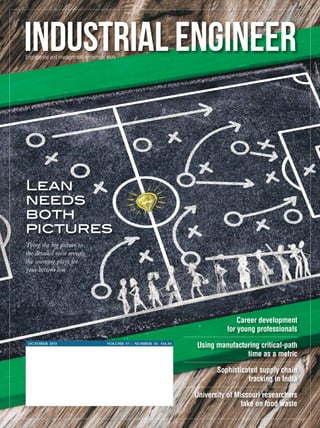
Industrial EngineerEngineering and management systems at work
VOLUME 47 : NUMBER 10: $16.50OCTOBER 2015
Career development
for young professionals
Using manufacturing critical-path
time as a metric
Sophisticated supply chain
tracking in India
University of Missouri researchers
take on food waste
Lean
needs
both
pictures
Tyi g the big picture to
the detailed view reveals
the w g plays for
your bottom li e
48 Industrial Engineer | www.iienet.org/IEmagazine
Parents who tell their children to eat all of the food on their dinner plate now have some
backup, courtesy of agricultural science and industrial engineering.
Beyond the dinner table, it’s also advice that should be considered throughout the
food supply chain. According to the U.S. Department of Agriculture, 31 percent of the
food produced in the U.S. was wasted in 2011, an estimated 59 million metric tons of
food worth about $162 billion. The global percentage is about the same – one-third of
all food produced for human consumption is lost or wasted, as reported by the Food
and Agriculture Organization of the United Nations. And the large variety of this food
waste produces substantial levels of greenhouse gas emissions, harming the environment.
Christine Costello, an assistant research professor at the University of Missouri’s Col-
lege of Agriculture, Food and Natural Resources, has been observing agricultural and
food systems for more than a decade. She has observed that food waste doesn’t just come
from the plates of children who won’t eat their vegetables.
“I’ve been studying agricultural systems and the environmental impact of agriculture
and relating that to food products and also thinking about it from the land cycle analysis
perspective,” Costello said. “One of the things that comes up when you’re studying that
is that we’re wasting this enormous amount of food at all different stages across the supply
chain. I’m looking at all these environmental impacts associated with making the food,
and then we’re wasting 30 percent of it. I'm like, ‘Oh my gosh, that’s crazy.’”
As a civil engineer, Costello said she viewed the environmental costs as a waste man-
agement problem that can lead to issues the average consumer doesn’t consider when
opting to leave leftover food in the garbage or elsewhere. As she was considering this
view, she was introduced to Ron McGarvey, assistant professor at the Harry S. Truman
School of Public Affairs and the Department of Industrial and Manufacturing Systems
Engineering at the University of Missouri.
“My cycle analysis had a lot of overlap with industrial engineers because … there’s an
ISO standard for it,” Costello said. “Ron and I met through mutual friends and started
talking about possible common interests like that. He helped a lot with thinking about
how we would get into campus dining and design a study.”
That study became “Food Waste in Campus Dining Operations: Inventory of Pre-
and Post-Consumer Mass by Food Category, and Estimation of Embodied Greenhouse
Gas Emissions,” co-authored by Costello, McGarvey and Esma Birisci, a doctoral stu-
dent in industrial engineering at the university.
In 2014, the researchers studied food waste among four of the university’s dining fa-
cilities operated by its Campus Dining Services. The study focused on the food services
or consumption stages in the food production cycle. Although food waste can occur at
all phases in the food supply chain, the study suggests that the largest losses in industrial-
ized countries occur at the consumption phase.
And most college students, traditionally, are known to engage in high consumption.
Toxic leftovers
Solutions in practiceS l ti i
case study
October 2015 | Industrial Engineer 49
Hands on
In the study, food waste was
collected from four all-you-
care-to-eat Campus Dining
Services facilities over three
months, from mid-February
to mid-May. Approximately
75 percent of the food served at
the four dining halls is supplied
by a single major food distribu-
tion company.
Pre-consumer food waste
was separated into eight cat-
egories and post-consumer
food waste was separated into
18 categories. According to the
study, food waste in the con-
sumption stage is often catego-
rized as being either pre-con-
sumer or post-consumer waste.
Pre-consumer waste includes
storage loss, preparation loss,
serving loss and overproduction, and was divided
for the study between edible and inedible waste.
Those two categories were broken down further
into grains, fruits and vegetables, meat and protein,
and dairy.
Post-consumer waste typically is defned as food
purchased by a consumer that is not eaten.
In both instances, the edible and inedible por-
tions of the total food were inventoried. In other
words, this is where the study gets icky for student
workers – including two industrial engineering un-
dergraduate students – who were hired to help sort
waste.
“There’s a conveyor belt system where you return
your plate after you’re done eating,” McGarvey said.
“So these kids went in and over a semester they’d
go into different meals, different dining facilities,
they’d take a sample of a hundred plates, they’d
scrape all the food waste off into a bucket.
“It’s really gross, to be honest. It’s just piles of like
half-eaten pieces of bread, or carrots and peas, or
meatloaf, or whatnot. And so they’d separate that
and then weigh it by category.”
Student workers would repeat sorting food waste
from 100 large plates and 100 small plates about 40
times over the course of the semester, McGarvey
said, adding that the post-consumer plates were not
the only source of waste they had to collect.
“There’s also waste in the kitchen, right? The
collection process for that was a little bit different.
Industrial and manufacturing systems engineering students Trevion McGhaw (foreground) and
Nicholas Boshonek sort post-consumer food waste as part of the study.
PhotocourtesyNicholasBenner
Icky shuffe: In fall 2014, students helped replicate the food waste study at the
football stadium. Trevion McGhaw (left) and bioengineering student Thomas
Welby sort food waste from stadium trash cans.
50 Industrial Engineer | www.iienet.org/IEmagazine
casestudy
Instead of having samples of a hun-
dred, the university kitchens already
separate their food waste from the
other waste back in the kitchens.
So for that we had different student
workers take trash cans full of all
the kitchen waste out to one of the
university farms here, and then you
know they would weigh it, they
would dump it out on the ground,
and the separation isn’t quite as easy
for a garbage can full of stuff versus a
sample of a hundred people.”
There’s the beef
According to the study, Campus Din-
ing Services tracks production and
inventory management data using
the CBORD software system. The
research team was able to collect the
total number of customers served and
the weight of total food served across the four Campus Dining
Services dining facilities for each of the breakfast, lunch and
dinner meals.
Costello said that before the study even began, Campus
Dining Services already had been sorting food waste. “Before
we started our project, campus dining was interested in reduc-
ing food waste to some extent, and they went tray-less a few
years ago. And that helped reduce [waste]. You can’t pile stuff
on. You’d have to carry each plate.”
By the end of the three months, about 246.3 tons of food
reached the retail level at the four facilities, but only 13.9 tons
(10.1 tons of edible and 3.8 tons of inedible) were lost as pre-
consumer waste. Over the same time period, an estimated 26.4
tons of post-consumer food waste was generated at these facili-
ties, composed of 21.2 tons of edible and 5.3 tons of inedible.
Fruits and vegetables was the category of food that weighed
the most, followed by grains.
But meat and protein, though not leading in weight to-
tal, was the largest contributor to post-consumer greenhouse
gas emissions with an estimated 34.1 tons of carbon dioxide
equivalent (CO2
e). Over the study period, an estimated 11.1
tons of CO2
e were embodied in the pre-consumer food waste
and 56.1 tons of CO2
e were embodied in post-consumer food
waste for a total of 67.2 tons of CO2
e.
“We try to raise the awareness (about greenhouse gas emis-
sions from food waste), but I think there's probably some
management-slash-engineering solution,” Costello said. “And
there's probably some deeper socio-behavioral psychology
stuff.
“We want to create positive messages that try to help people
and try not to make people feel guilty but just kind of aware so
that they can change things. … This is a tough nut to crack.”
In a second study, McGarvey and Birisci have taken a closer
look into the environmental considerations factored into Cam-
pus Dining Services production policies – specifcally whether
such polices would change for all-you-care-to-eat facilities if
life cycle cost estimates of embodied carbon dioxide were in-
cluded in the disposal costs associated with overproduction.
“There’s a fair amount of pre-consumer waste that occurs in
the kitchen,” McGarvey said. “And you know what goes on
in the kitchen is all industrial engineering. That’s all inventory
and production decisions.
“In fact … we have the executive chef from the univer-
sity come in and speak to our undergraduate operations man-
agement class because I’ve convinced him he is an industrial
engineer. That’s what he does. He’s ordering. He’s managing
inventory.”
Serving meals to college students daily ultimately creates
similar production output challenges found in a number of
different industries, he added.
“Because you don’t know what demand is, and so whether
you’re making newspapers or coffee cups or sloppy joes, you
know, you’re trying to hedge against overproduction and un-
derproduction.”
— David Bra dt
If you have been involved in implementing a project and can share
details,we’dliketointerviewyouforacasestudy.ContactWebManaging
Editor David Brandt at (770) 449-0461, ext. 120, or dbrandt@iienet.org.
Spread the news
This photo shows sorted pre-consumer food waste taken from the Pavilion at Dobbs, one of
the four campus dining facilities involved in the study.

Case Study

  • 1.
    Industrial EngineerEngineering andmanagement systems at work VOLUME 47 : NUMBER 10: $16.50OCTOBER 2015 Career development for young professionals Using manufacturing critical-path time as a metric Sophisticated supply chain tracking in India University of Missouri researchers take on food waste Lean needs both pictures Tyi g the big picture to the detailed view reveals the w g plays for your bottom li e
  • 2.
    48 Industrial Engineer| www.iienet.org/IEmagazine Parents who tell their children to eat all of the food on their dinner plate now have some backup, courtesy of agricultural science and industrial engineering. Beyond the dinner table, it’s also advice that should be considered throughout the food supply chain. According to the U.S. Department of Agriculture, 31 percent of the food produced in the U.S. was wasted in 2011, an estimated 59 million metric tons of food worth about $162 billion. The global percentage is about the same – one-third of all food produced for human consumption is lost or wasted, as reported by the Food and Agriculture Organization of the United Nations. And the large variety of this food waste produces substantial levels of greenhouse gas emissions, harming the environment. Christine Costello, an assistant research professor at the University of Missouri’s Col- lege of Agriculture, Food and Natural Resources, has been observing agricultural and food systems for more than a decade. She has observed that food waste doesn’t just come from the plates of children who won’t eat their vegetables. “I’ve been studying agricultural systems and the environmental impact of agriculture and relating that to food products and also thinking about it from the land cycle analysis perspective,” Costello said. “One of the things that comes up when you’re studying that is that we’re wasting this enormous amount of food at all different stages across the supply chain. I’m looking at all these environmental impacts associated with making the food, and then we’re wasting 30 percent of it. I'm like, ‘Oh my gosh, that’s crazy.’” As a civil engineer, Costello said she viewed the environmental costs as a waste man- agement problem that can lead to issues the average consumer doesn’t consider when opting to leave leftover food in the garbage or elsewhere. As she was considering this view, she was introduced to Ron McGarvey, assistant professor at the Harry S. Truman School of Public Affairs and the Department of Industrial and Manufacturing Systems Engineering at the University of Missouri. “My cycle analysis had a lot of overlap with industrial engineers because … there’s an ISO standard for it,” Costello said. “Ron and I met through mutual friends and started talking about possible common interests like that. He helped a lot with thinking about how we would get into campus dining and design a study.” That study became “Food Waste in Campus Dining Operations: Inventory of Pre- and Post-Consumer Mass by Food Category, and Estimation of Embodied Greenhouse Gas Emissions,” co-authored by Costello, McGarvey and Esma Birisci, a doctoral stu- dent in industrial engineering at the university. In 2014, the researchers studied food waste among four of the university’s dining fa- cilities operated by its Campus Dining Services. The study focused on the food services or consumption stages in the food production cycle. Although food waste can occur at all phases in the food supply chain, the study suggests that the largest losses in industrial- ized countries occur at the consumption phase. And most college students, traditionally, are known to engage in high consumption. Toxic leftovers Solutions in practiceS l ti i case study
  • 3.
    October 2015 |Industrial Engineer 49 Hands on In the study, food waste was collected from four all-you- care-to-eat Campus Dining Services facilities over three months, from mid-February to mid-May. Approximately 75 percent of the food served at the four dining halls is supplied by a single major food distribu- tion company. Pre-consumer food waste was separated into eight cat- egories and post-consumer food waste was separated into 18 categories. According to the study, food waste in the con- sumption stage is often catego- rized as being either pre-con- sumer or post-consumer waste. Pre-consumer waste includes storage loss, preparation loss, serving loss and overproduction, and was divided for the study between edible and inedible waste. Those two categories were broken down further into grains, fruits and vegetables, meat and protein, and dairy. Post-consumer waste typically is defned as food purchased by a consumer that is not eaten. In both instances, the edible and inedible por- tions of the total food were inventoried. In other words, this is where the study gets icky for student workers – including two industrial engineering un- dergraduate students – who were hired to help sort waste. “There’s a conveyor belt system where you return your plate after you’re done eating,” McGarvey said. “So these kids went in and over a semester they’d go into different meals, different dining facilities, they’d take a sample of a hundred plates, they’d scrape all the food waste off into a bucket. “It’s really gross, to be honest. It’s just piles of like half-eaten pieces of bread, or carrots and peas, or meatloaf, or whatnot. And so they’d separate that and then weigh it by category.” Student workers would repeat sorting food waste from 100 large plates and 100 small plates about 40 times over the course of the semester, McGarvey said, adding that the post-consumer plates were not the only source of waste they had to collect. “There’s also waste in the kitchen, right? The collection process for that was a little bit different. Industrial and manufacturing systems engineering students Trevion McGhaw (foreground) and Nicholas Boshonek sort post-consumer food waste as part of the study. PhotocourtesyNicholasBenner Icky shuffe: In fall 2014, students helped replicate the food waste study at the football stadium. Trevion McGhaw (left) and bioengineering student Thomas Welby sort food waste from stadium trash cans.
  • 4.
    50 Industrial Engineer| www.iienet.org/IEmagazine casestudy Instead of having samples of a hun- dred, the university kitchens already separate their food waste from the other waste back in the kitchens. So for that we had different student workers take trash cans full of all the kitchen waste out to one of the university farms here, and then you know they would weigh it, they would dump it out on the ground, and the separation isn’t quite as easy for a garbage can full of stuff versus a sample of a hundred people.” There’s the beef According to the study, Campus Din- ing Services tracks production and inventory management data using the CBORD software system. The research team was able to collect the total number of customers served and the weight of total food served across the four Campus Dining Services dining facilities for each of the breakfast, lunch and dinner meals. Costello said that before the study even began, Campus Dining Services already had been sorting food waste. “Before we started our project, campus dining was interested in reduc- ing food waste to some extent, and they went tray-less a few years ago. And that helped reduce [waste]. You can’t pile stuff on. You’d have to carry each plate.” By the end of the three months, about 246.3 tons of food reached the retail level at the four facilities, but only 13.9 tons (10.1 tons of edible and 3.8 tons of inedible) were lost as pre- consumer waste. Over the same time period, an estimated 26.4 tons of post-consumer food waste was generated at these facili- ties, composed of 21.2 tons of edible and 5.3 tons of inedible. Fruits and vegetables was the category of food that weighed the most, followed by grains. But meat and protein, though not leading in weight to- tal, was the largest contributor to post-consumer greenhouse gas emissions with an estimated 34.1 tons of carbon dioxide equivalent (CO2 e). Over the study period, an estimated 11.1 tons of CO2 e were embodied in the pre-consumer food waste and 56.1 tons of CO2 e were embodied in post-consumer food waste for a total of 67.2 tons of CO2 e. “We try to raise the awareness (about greenhouse gas emis- sions from food waste), but I think there's probably some management-slash-engineering solution,” Costello said. “And there's probably some deeper socio-behavioral psychology stuff. “We want to create positive messages that try to help people and try not to make people feel guilty but just kind of aware so that they can change things. … This is a tough nut to crack.” In a second study, McGarvey and Birisci have taken a closer look into the environmental considerations factored into Cam- pus Dining Services production policies – specifcally whether such polices would change for all-you-care-to-eat facilities if life cycle cost estimates of embodied carbon dioxide were in- cluded in the disposal costs associated with overproduction. “There’s a fair amount of pre-consumer waste that occurs in the kitchen,” McGarvey said. “And you know what goes on in the kitchen is all industrial engineering. That’s all inventory and production decisions. “In fact … we have the executive chef from the univer- sity come in and speak to our undergraduate operations man- agement class because I’ve convinced him he is an industrial engineer. That’s what he does. He’s ordering. He’s managing inventory.” Serving meals to college students daily ultimately creates similar production output challenges found in a number of different industries, he added. “Because you don’t know what demand is, and so whether you’re making newspapers or coffee cups or sloppy joes, you know, you’re trying to hedge against overproduction and un- derproduction.” — David Bra dt If you have been involved in implementing a project and can share details,we’dliketointerviewyouforacasestudy.ContactWebManaging Editor David Brandt at (770) 449-0461, ext. 120, or dbrandt@iienet.org. Spread the news This photo shows sorted pre-consumer food waste taken from the Pavilion at Dobbs, one of the four campus dining facilities involved in the study.