A 
Just 
In 
Time 
Compiler 
for 
CRuby 
CRuby言語処理系向けJITコンパイラ 
Masahiro 
Ide 
Yokohama 
Na=onal 
University 
RubyKaigi 
2014 
2014年9月19日(金) 
1
Outline 
• Ruby 
• Just-­‐In-­‐Time(JIT) 
compiler 
• RuJIT: 
a 
JIT 
compiler 
for 
Ruby 
※あまり実装よりの内容ではありません 
また,CRubyの実装に詳しくない人でも分かる 
内容(にしたつもり)です. 
2
Ruby 
Language 
and 
Implementa=on 
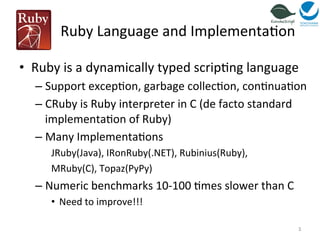
• Ruby 
is 
a 
dynamically 
typed 
scrip=ng 
language 
– Support 
excep=on, 
garbage 
collec=on, 
con=nua=on 
– CRuby 
is 
Ruby 
interpreter 
in 
C 
(de 
facto 
standard 
implementa=on 
of 
Ruby) 
– Many 
Implementa=ons 
JRuby(Java), 
IRonRuby(.NET), 
Rubinius(Ruby), 
MRuby(C), 
Topaz(PyPy) 
– Numeric 
benchmarks 
10-­‐100 
=mes 
slower 
than 
C 
• Need 
to 
improve!!! 
3
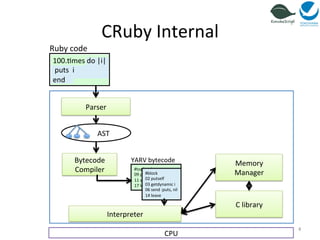
CRuby 
Internal 
YARV 
bytecode 
#toplevel 
09 
putobject 
100 
11 
send 
:=mes, 
block 
17 
leave 
#block 
02 
putself 
03 
getdynamic 
i 
06 
send 
:puts, 
nil 
14 
leave 
Ruby 
code 
100.=mes 
do 
|i| 
puts 
i 
end 
Parser 
AST 
Bytecode 
Compiler 
Interpreter 
Memory 
Manager 
C 
library 
CPU 
4
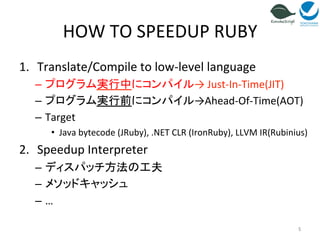
HOW 
TO 
SPEEDUP 
RUBY 
1. Translate/Compile 
to 
low-­‐level 
language 
– プログラム実行中にコンパイル→ 
Just-­‐In-­‐Time(JIT) 
– プログラム実行前にコンパイル→Ahead-­‐Of-­‐Time(AOT) 
– Target 
• Java 
bytecode 
(JRuby), 
.NET 
CLR 
(IronRuby), 
LLVM 
IR(Rubinius) 
2. Speedup 
Interpreter 
– ディスパッチ方法の工夫 
– メソッドキャッシュ 
– … 
5
Outline 
• Ruby 
• Just-­‐In-­‐Time(JIT) 
compiler 
• RuJIT: 
a 
JIT 
compiler 
for 
Ruby 
– Design 
– Usage 
– Current 
status 
6
RuJIT 
• A 
Trace 
based 
JIT 
compiler 
for 
CRuby 
– Like 
Firefox’s 
javascript 
VM 
approach 
• Based 
on 
current 
version 
of 
CRuby 
• Started 
in 
April 
2014 
• More 
Speed, 
Speed, 
Speed 
– … 
but 
maintain 
compa=bility 
with 
current 
Ruby 
7
Implementa=on 
Strategies 
• Objec=ve 
– Improve 
Ruby’s 
performance 
• Development 
policy 
– Low 
development 
cost 
• 1 
person, 
2~3 
month 
– High 
extensibility 
• Easy 
to 
develop 
new 
op=miza=on 
techniques 
– 実用的なソフトウェア 
• いつかRubyのメインラインに 
→この方針に基づいて設計を行っている 
8
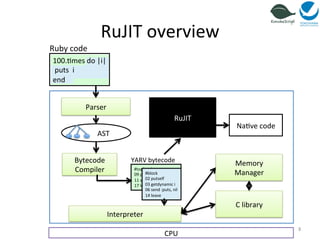
RuJIT 
overview 
RuJIT 
YARV 
bytecode 
#toplevel 
09 
putobject 
100 
11 
send 
:=mes, 
block 
17 
leave 
#block 
02 
putself 
03 
getdynamic 
i 
06 
send 
:puts, 
nil 
14 
leave 
Ruby 
code 
100.=mes 
do 
|i| 
puts 
i 
end 
Parser 
AST 
Bytecode 
Compiler 
Interpreter 
Memory 
Manager 
C 
library 
CPU 
Na=ve 
code 
9
RuJIT 
Design 
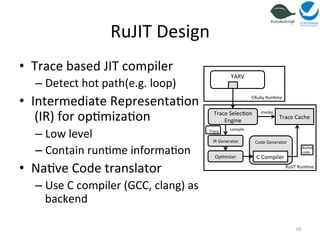
• Trace 
based 
JIT 
compiler 
– Detect 
hot 
path(e.g. 
loop) 
• Intermediate 
Representa=on 
(IR) 
for 
op=miza=on 
– Low 
level 
– Contain 
run=me 
informa=on 
• Na=ve 
Code 
translator 
– Use 
C 
compiler 
(GCC, 
clang) 
as 
backend 
10 
YARV 
Trace 
Selec=on 
Engine 
Trace 
Cache 
RuJIT 
Run=me 
CRuby 
Run=me 
IR 
Generator 
Op=mizer 
invoke 
Code 
Generator 
C 
Compiler 
Na=ve 
code 
Trace 
compile
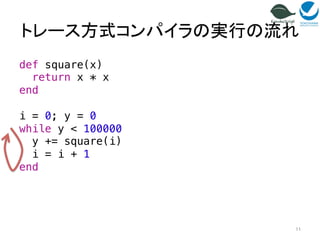
トレース方式コンパイラの実行の流れ 
11 
def square(x)! 
return x * x! 
end! 
! 
i = 0; y = 0! 
while y < 100000! 
y += square(i)! 
i = i + 1! 
end
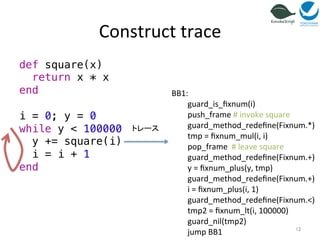
Construct 
trace 
def square(x)! 
return x * x! 
end! 
! 
i = 0; y = 0! 
while y < 100000! 
y += square(i)! 
i = i + 1! 
end 
12 
BB0: 
guard_method_redefine(Fixnum.*) 
guard_method_redefine(Fixnum.+) 
guard_method_redefine(Fixnum.<) 
BB1: 
guard_is_fixnum(i) 
push_frame 
# 
invoke 
square 
guard_method_redefine(Fixnum.*) 
tmp 
= 
fixnum_mul(i, 
i) 
pop_frame 
# 
leave 
square 
guard_method_redefine(Fixnum.+) 
y 
= 
fixnum_plus(y, 
tmp) 
guard_method_redefine(Fixnum.+) 
i 
= 
fixnum_plus(i, 
1) 
guard_method_redefine(Fixnum.<) 
tmp2 
= 
fixnum_lt(i, 
100000) 
guard_nil(tmp2) 
jump 
BB1 
トレース
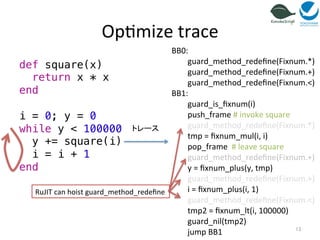
Op=mize 
trace 
def square(x)! 
return x * x! 
end! 
! 
i = 0; y = 0! 
while y < 100000! 
y += square(i)! 
i = i + 1! 
end 
13 
トレース 
BB0: 
guard_method_redefine(Fixnum.*) 
guard_method_redefine(Fixnum.+) 
guard_method_redefine(Fixnum.<) 
BB1: 
guard_is_fixnum(i) 
push_frame 
# 
invoke 
square 
guard_method_redefine(Fixnum.*) 
tmp 
= 
fixnum_mul(i, 
i) 
pop_frame 
# 
leave 
square 
guard_method_redefine(Fixnum.+) 
y 
= 
fixnum_plus(y, 
tmp) 
guard_method_redefine(Fixnum.+) 
i 
= 
fixnum_plus(i, 
1) 
guard_method_redefine(Fixnum.<) 
tmp2 
= 
fixnum_lt(i, 
100000) 
guard_nil(tmp2) 
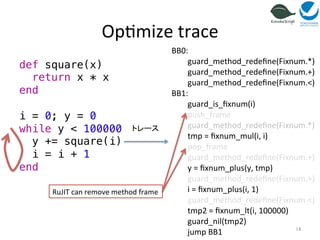
jump 
BB1 
RuJIT 
can 
hoist 
guard_method_redefine
Op=mize 
trace 
def square(x)! 
return x * x! 
end! 
! 
i = 0; y = 0! 
while y < 100000! 
y += square(i)! 
i = i + 1! 
end 
14 
トレース 
BB0: 
guard_method_redefine(Fixnum.*) 
guard_method_redefine(Fixnum.+) 
guard_method_redefine(Fixnum.<) 
BB1: 
guard_is_fixnum(i) 
push_frame 
guard_method_redefine(Fixnum.*) 
tmp 
= 
fixnum_mul(i, 
i) 
pop_frame 
guard_method_redefine(Fixnum.+) 
y 
= 
fixnum_plus(y, 
tmp) 
guard_method_redefine(Fixnum.+) 
i 
= 
fixnum_plus(i, 
1) 
guard_method_redefine(Fixnum.<) 
tmp2 
= 
fixnum_lt(i, 
100000) 
guard_nil(tmp2) 
jump 
BB1 
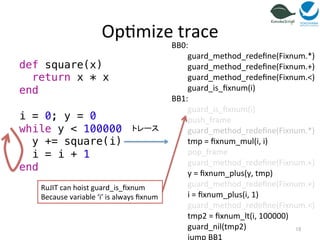
RuJIT 
can 
remove 
method 
frame
Op=mize 
trace 
def square(x)! 
return x * x! 
end! 
! 
i = 0; y = 0! 
while y < 100000! 
y += square(i)! 
i = i + 1! 
end 
15 
トレース 
BB0: 
guard_method_redefine(Fixnum.*) 
guard_method_redefine(Fixnum.+) 
guard_method_redefine(Fixnum.<) 
guard_is_fixnum(i) 
BB1: 
guard_is_fixnum(i) 
push_frame 
guard_method_redefine(Fixnum.*) 
tmp 
= 
fixnum_mul(i, 
i) 
pop_frame 
guard_method_redefine(Fixnum.+) 
y 
= 
fixnum_plus(y, 
tmp) 
guard_method_redefine(Fixnum.+) 
i 
= 
fixnum_plus(i, 
1) 
guard_method_redefine(Fixnum.<) 
tmp2 
= 
fixnum_lt(i, 
100000) 
guard_nil(tmp2) 
jump 
BB1 
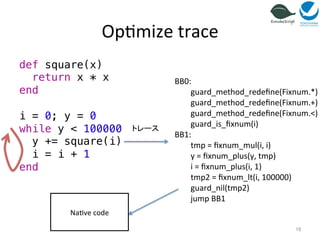
RuJIT 
can 
hoist 
guard_is_fixnum 
Because 
variable 
‘i’ 
is 
always 
fixnum
Op=mize 
trace 
def square(x)! 
return x * x! 
end! 
! 
i = 0; y = 0! 
while y < 100000! 
y += square(i)! 
i = i + 1! 
end 
16 
Na=ve 
code 
BB0: 
guard_method_redefine(Fixnum.*) 
guard_method_redefine(Fixnum.+) 
guard_method_redefine(Fixnum.<) 
guard_is_fixnum(i) 
BB1: 
tmp 
= 
fixnum_mul(i, 
i) 
y 
= 
fixnum_plus(y, 
tmp) 
i 
= 
fixnum_plus(i, 
1) 
tmp2 
= 
fixnum_lt(i, 
100000) 
guard_nil(tmp2) 
jump 
BB1 
トレース
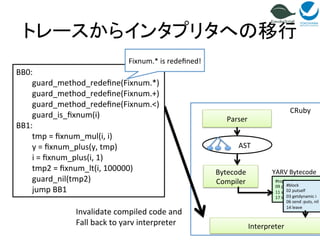
トレースからインタプリタへの移行 
YARV 
Bytecode 
17 
Fixnum.* 
is 
redefined! 
Invalidate 
compiled 
code 
and 
Fall 
back 
to 
yarv 
interpreter 
#toplevel 
09 
putobject 
100 
11 
send 
:=mes, 
block 
17 
leave 
#block 
02 
putself 
03 
getdynamic 
i 
06 
send 
:puts, 
nil 
14 
leave 
Parser 
AST 
Bytecode 
Compiler 
Interpreter 
CRuby 
BB0: 
guard_method_redefine(Fixnum.*) 
guard_method_redefine(Fixnum.+) 
guard_method_redefine(Fixnum.<) 
guard_is_fixnum(i) 
BB1: 
tmp 
= 
fixnum_mul(i, 
i) 
y 
= 
fixnum_plus(y, 
tmp) 
i 
= 
fixnum_plus(i, 
1) 
tmp2 
= 
fixnum_lt(i, 
100000) 
guard_nil(tmp2) 
jump 
BB1
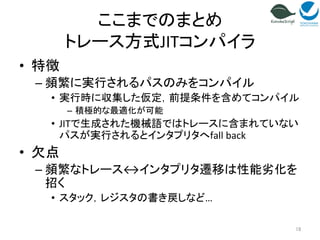
ここまでのまとめ 
トレース方式JITコンパイラ 
• 特徴 
– 頻繁に実行されるパスのみをコンパイル 
• 実行時に収集した仮定,前提条件を含めてコンパイル 
– 積極的な最適化が可能 
• JITで生成された機械語ではトレースに含まれていない 
パスが実行されるとインタプリタへfall 
back 
• 欠点 
– 頻繁なトレース↔インタプリタ遷移は性能劣化を 
招く 
• スタック,レジスタの書き戻しなど… 
18
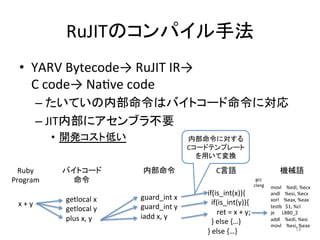
RuJITのコンパイル手法 
• YARV 
Bytecode→ 
RuJIT 
IR→ 
C 
code→ 
Na=ve 
code 
– たいていの内部命令はバイトコード命令に対応 
– JIT内部にアセンブラ不要 
• 開発コスト低い 
19 
バイトコード 
命令 
getlocal 
x 
getlocal 
y 
plus 
x, 
y 
Ruby 
Program 
x 
+ 
y 
内部命令 
guard_int 
x 
guard_int 
y 
iadd 
x, 
y 
C言語 
if(is_int(x)){ 
if(is_int(y)){ 
ret 
= 
x 
+ 
y; 
} 
else 
{…} 
} 
else 
{…} 
機械語 
movl 
%edi, 
%ecx 
andl 
%esi, 
%ecx 
xorl 
%eax, 
%eax 
testb 
$1, 
%cl 
je 
LBB0_2 
addl 
%edi, 
%esi 
movl 
%esi, 
%eax 
内部命令に対する 
Cコードテンプレート 
を用いて変換 
gcc 
clang
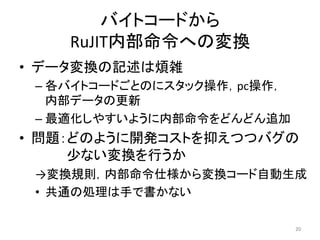
バイトコードから 
RuJIT内部命令への変換 
• データ変換の記述は煩雑 
– 各バイトコードごとのにスタック操作,pc操作, 
内部データの更新 
– 最適化しやすいように内部命令をどんどん追加 
• 問題:どのように開発コストを抑えつつバグの 
少ない変換を行うか 
→変換規則,内部命令仕様から変換コード自動生成 
• 共通の処理は手で書かない 
20
内部命令記述と生成例 
• 生成例 
• 内部命令の変換則 
21 
define FixnumAdd! 
:def :user! 
(LHS:lir_t, RHS:lir_t)! 
! 
emit FixnumAdd if! 
opcode is opt_plus and! 
method_name is "+" and! 
LHS is Fixnum and! 
RHS is Fixnum! 
! 
if ( // rule0 FixnumAdd! 
(opcode == BIN(opt_plus)) &&! 
(ci->mid == idPLUS) &&! 
(ci->argc == 2) &&! 
(Fixnum.“+”は再定義されていない) &&! 
(FIXNUM_P(params[0])) &&! 
(FIXNUM_P(params[1]))! 
) {! 
Emit_GuardMethod(idPLUS);! 
Emit_GuardTypeFixnum(regs[0]);! 
Emit_GuardTypeFixnum(regs[1]);! 
Emit_FixnumAdd(regs[0], 
regs[1]);! 
}
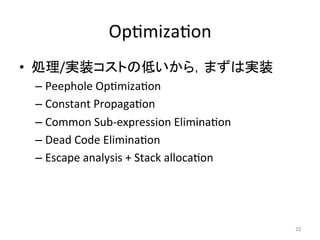
Op=miza=on 
• 処理/実装コストの低いから,まずは実装 
– Peephole 
Op=miza=on 
– Constant 
Propaga=on 
– Common 
Sub-­‐expression 
Elimina=on 
– Dead 
Code 
Elimina=on 
– Escape 
analysis 
+ 
Stack 
alloca=on 
22
Evalua=on 
• 用いたベンチマーク 
– CRuby処理系付属のベンチマーク(の一部) 
• 比較対象 
– CRuby 
(trunk) 
• 環境 
– OSX 
10.9 
– Clang 
3.5 
23
Evalua=on 
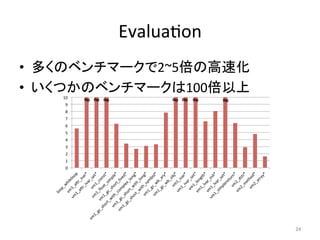
• 多くのベンチマークで2~5倍の高速化 
• いくつかのベンチマークは100倍以上 
24 
10 
9 
8 
7 
6 
5 
4 
3 
2 
1 
0 
〜〜 
〜〜 
〜〜 
〜〜 
〜〜 
〜〜 
〜〜
Evalua=on 
• 変化なし・低速化のケース 
– トレース検出の変更 
– Cで書かれたコードはトレースできない 
Cで定義されているコード 
トレースの検出対応 
できていないケース 
25 
1.2 
1 
0.8 
0.6 
0.4 
0.2 
0 
io_file_create 
io_file_read 
io_file_write 
io_select 
io_select2 
io_select3 
app_factorial 
app_fib
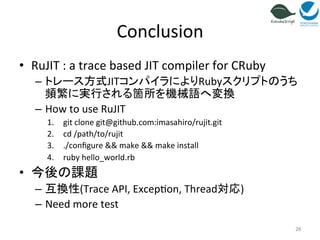
Conclusion 
• RuJIT 
: 
a 
trace 
based 
JIT 
compiler 
for 
CRuby 
– トレース方式JITコンパイラによりRubyスクリプトのうち 
頻繁に実行される箇所を機械語へ変換 
– How 
to 
use 
RuJIT 
1. git 
clone 
git@github.com:imasahiro/rujit.git 
2. cd 
/path/to/rujit 
3. ./configure 
&& 
make 
&& 
make 
install 
4. ruby 
hello_world.rb 
• 今後の課題 
– 互換性(Trace 
API, 
Excep=on, 
Thread対応) 
– Need 
more 
test 
26
FAQ 
• Railsは動く?(もしくは他のrubyプログラムは?) 
– まだ動きません.現在対応中です 
• RuJIT,なんか動きません 
– GithubのIssueに投げてもらえると助かります 
– h~ps://github.com/imasahiro/rujit/issues 
• ◯◯◯との比較は? 
– JRuby, 
Rubinius, 
Topaz, 
mrubyのJIT, 
yarv2llvm, 
CastOff… 
– 現在評価中です 
27

RubyKaigi2014: Just in Time compiler for CRuby

  • 1.
    A Just In Time Compiler for CRuby CRuby言語処理系向けJITコンパイラ Masahiro Ide Yokohama Na=onal University RubyKaigi 2014 2014年9月19日(金) 1
  • 2.
    Outline • Ruby • Just-­‐In-­‐Time(JIT) compiler • RuJIT: a JIT compiler for Ruby ※あまり実装よりの内容ではありません また,CRubyの実装に詳しくない人でも分かる 内容(にしたつもり)です. 2
  • 3.
    Ruby Language and Implementa=on • Ruby is a dynamically typed scrip=ng language – Support excep=on, garbage collec=on, con=nua=on – CRuby is Ruby interpreter in C (de facto standard implementa=on of Ruby) – Many Implementa=ons JRuby(Java), IRonRuby(.NET), Rubinius(Ruby), MRuby(C), Topaz(PyPy) – Numeric benchmarks 10-­‐100 =mes slower than C • Need to improve!!! 3
  • 4.
    CRuby Internal YARV bytecode #toplevel 09 putobject 100 11 send :=mes, block 17 leave #block 02 putself 03 getdynamic i 06 send :puts, nil 14 leave Ruby code 100.=mes do |i| puts i end Parser AST Bytecode Compiler Interpreter Memory Manager C library CPU 4
  • 5.
    HOW TO SPEEDUP RUBY 1. Translate/Compile to low-­‐level language – プログラム実行中にコンパイル→ Just-­‐In-­‐Time(JIT) – プログラム実行前にコンパイル→Ahead-­‐Of-­‐Time(AOT) – Target • Java bytecode (JRuby), .NET CLR (IronRuby), LLVM IR(Rubinius) 2. Speedup Interpreter – ディスパッチ方法の工夫 – メソッドキャッシュ – … 5
  • 6.
    Outline • Ruby • Just-­‐In-­‐Time(JIT) compiler • RuJIT: a JIT compiler for Ruby – Design – Usage – Current status 6
  • 7.
    RuJIT • A Trace based JIT compiler for CRuby – Like Firefox’s javascript VM approach • Based on current version of CRuby • Started in April 2014 • More Speed, Speed, Speed – … but maintain compa=bility with current Ruby 7
  • 8.
    Implementa=on Strategies •Objec=ve – Improve Ruby’s performance • Development policy – Low development cost • 1 person, 2~3 month – High extensibility • Easy to develop new op=miza=on techniques – 実用的なソフトウェア • いつかRubyのメインラインに →この方針に基づいて設計を行っている 8
  • 9.
    RuJIT overview RuJIT YARV bytecode #toplevel 09 putobject 100 11 send :=mes, block 17 leave #block 02 putself 03 getdynamic i 06 send :puts, nil 14 leave Ruby code 100.=mes do |i| puts i end Parser AST Bytecode Compiler Interpreter Memory Manager C library CPU Na=ve code 9
  • 10.
    RuJIT Design •Trace based JIT compiler – Detect hot path(e.g. loop) • Intermediate Representa=on (IR) for op=miza=on – Low level – Contain run=me informa=on • Na=ve Code translator – Use C compiler (GCC, clang) as backend 10 YARV Trace Selec=on Engine Trace Cache RuJIT Run=me CRuby Run=me IR Generator Op=mizer invoke Code Generator C Compiler Na=ve code Trace compile
  • 11.
    トレース方式コンパイラの実行の流れ 11 defsquare(x)! return x * x! end! ! i = 0; y = 0! while y < 100000! y += square(i)! i = i + 1! end
  • 12.
    Construct trace defsquare(x)! return x * x! end! ! i = 0; y = 0! while y < 100000! y += square(i)! i = i + 1! end 12 BB0: guard_method_redefine(Fixnum.*) guard_method_redefine(Fixnum.+) guard_method_redefine(Fixnum.<) BB1: guard_is_fixnum(i) push_frame # invoke square guard_method_redefine(Fixnum.*) tmp = fixnum_mul(i, i) pop_frame # leave square guard_method_redefine(Fixnum.+) y = fixnum_plus(y, tmp) guard_method_redefine(Fixnum.+) i = fixnum_plus(i, 1) guard_method_redefine(Fixnum.<) tmp2 = fixnum_lt(i, 100000) guard_nil(tmp2) jump BB1 トレース
  • 13.
    Op=mize trace defsquare(x)! return x * x! end! ! i = 0; y = 0! while y < 100000! y += square(i)! i = i + 1! end 13 トレース BB0: guard_method_redefine(Fixnum.*) guard_method_redefine(Fixnum.+) guard_method_redefine(Fixnum.<) BB1: guard_is_fixnum(i) push_frame # invoke square guard_method_redefine(Fixnum.*) tmp = fixnum_mul(i, i) pop_frame # leave square guard_method_redefine(Fixnum.+) y = fixnum_plus(y, tmp) guard_method_redefine(Fixnum.+) i = fixnum_plus(i, 1) guard_method_redefine(Fixnum.<) tmp2 = fixnum_lt(i, 100000) guard_nil(tmp2) jump BB1 RuJIT can hoist guard_method_redefine
  • 14.
    Op=mize trace defsquare(x)! return x * x! end! ! i = 0; y = 0! while y < 100000! y += square(i)! i = i + 1! end 14 トレース BB0: guard_method_redefine(Fixnum.*) guard_method_redefine(Fixnum.+) guard_method_redefine(Fixnum.<) BB1: guard_is_fixnum(i) push_frame guard_method_redefine(Fixnum.*) tmp = fixnum_mul(i, i) pop_frame guard_method_redefine(Fixnum.+) y = fixnum_plus(y, tmp) guard_method_redefine(Fixnum.+) i = fixnum_plus(i, 1) guard_method_redefine(Fixnum.<) tmp2 = fixnum_lt(i, 100000) guard_nil(tmp2) jump BB1 RuJIT can remove method frame
  • 15.
    Op=mize trace defsquare(x)! return x * x! end! ! i = 0; y = 0! while y < 100000! y += square(i)! i = i + 1! end 15 トレース BB0: guard_method_redefine(Fixnum.*) guard_method_redefine(Fixnum.+) guard_method_redefine(Fixnum.<) guard_is_fixnum(i) BB1: guard_is_fixnum(i) push_frame guard_method_redefine(Fixnum.*) tmp = fixnum_mul(i, i) pop_frame guard_method_redefine(Fixnum.+) y = fixnum_plus(y, tmp) guard_method_redefine(Fixnum.+) i = fixnum_plus(i, 1) guard_method_redefine(Fixnum.<) tmp2 = fixnum_lt(i, 100000) guard_nil(tmp2) jump BB1 RuJIT can hoist guard_is_fixnum Because variable ‘i’ is always fixnum
  • 16.
    Op=mize trace defsquare(x)! return x * x! end! ! i = 0; y = 0! while y < 100000! y += square(i)! i = i + 1! end 16 Na=ve code BB0: guard_method_redefine(Fixnum.*) guard_method_redefine(Fixnum.+) guard_method_redefine(Fixnum.<) guard_is_fixnum(i) BB1: tmp = fixnum_mul(i, i) y = fixnum_plus(y, tmp) i = fixnum_plus(i, 1) tmp2 = fixnum_lt(i, 100000) guard_nil(tmp2) jump BB1 トレース
  • 17.
    トレースからインタプリタへの移行 YARV Bytecode 17 Fixnum.* is redefined! Invalidate compiled code and Fall back to yarv interpreter #toplevel 09 putobject 100 11 send :=mes, block 17 leave #block 02 putself 03 getdynamic i 06 send :puts, nil 14 leave Parser AST Bytecode Compiler Interpreter CRuby BB0: guard_method_redefine(Fixnum.*) guard_method_redefine(Fixnum.+) guard_method_redefine(Fixnum.<) guard_is_fixnum(i) BB1: tmp = fixnum_mul(i, i) y = fixnum_plus(y, tmp) i = fixnum_plus(i, 1) tmp2 = fixnum_lt(i, 100000) guard_nil(tmp2) jump BB1
  • 18.
    ここまでのまとめ トレース方式JITコンパイラ •特徴 – 頻繁に実行されるパスのみをコンパイル • 実行時に収集した仮定,前提条件を含めてコンパイル – 積極的な最適化が可能 • JITで生成された機械語ではトレースに含まれていない パスが実行されるとインタプリタへfall back • 欠点 – 頻繁なトレース↔インタプリタ遷移は性能劣化を 招く • スタック,レジスタの書き戻しなど… 18
  • 19.
    RuJITのコンパイル手法 • YARV Bytecode→ RuJIT IR→ C code→ Na=ve code – たいていの内部命令はバイトコード命令に対応 – JIT内部にアセンブラ不要 • 開発コスト低い 19 バイトコード 命令 getlocal x getlocal y plus x, y Ruby Program x + y 内部命令 guard_int x guard_int y iadd x, y C言語 if(is_int(x)){ if(is_int(y)){ ret = x + y; } else {…} } else {…} 機械語 movl %edi, %ecx andl %esi, %ecx xorl %eax, %eax testb $1, %cl je LBB0_2 addl %edi, %esi movl %esi, %eax 内部命令に対する Cコードテンプレート を用いて変換 gcc clang
  • 20.
    バイトコードから RuJIT内部命令への変換 •データ変換の記述は煩雑 – 各バイトコードごとのにスタック操作,pc操作, 内部データの更新 – 最適化しやすいように内部命令をどんどん追加 • 問題:どのように開発コストを抑えつつバグの 少ない変換を行うか →変換規則,内部命令仕様から変換コード自動生成 • 共通の処理は手で書かない 20
  • 21.
    内部命令記述と生成例 • 生成例 • 内部命令の変換則 21 define FixnumAdd! :def :user! (LHS:lir_t, RHS:lir_t)! ! emit FixnumAdd if! opcode is opt_plus and! method_name is "+" and! LHS is Fixnum and! RHS is Fixnum! ! if ( // rule0 FixnumAdd! (opcode == BIN(opt_plus)) &&! (ci->mid == idPLUS) &&! (ci->argc == 2) &&! (Fixnum.“+”は再定義されていない) &&! (FIXNUM_P(params[0])) &&! (FIXNUM_P(params[1]))! ) {! Emit_GuardMethod(idPLUS);! Emit_GuardTypeFixnum(regs[0]);! Emit_GuardTypeFixnum(regs[1]);! Emit_FixnumAdd(regs[0], regs[1]);! }
  • 22.
    Op=miza=on • 処理/実装コストの低いから,まずは実装 – Peephole Op=miza=on – Constant Propaga=on – Common Sub-­‐expression Elimina=on – Dead Code Elimina=on – Escape analysis + Stack alloca=on 22
  • 23.
    Evalua=on • 用いたベンチマーク – CRuby処理系付属のベンチマーク(の一部) • 比較対象 – CRuby (trunk) • 環境 – OSX 10.9 – Clang 3.5 23
  • 24.
    Evalua=on • 多くのベンチマークで2~5倍の高速化 • いくつかのベンチマークは100倍以上 24 10 9 8 7 6 5 4 3 2 1 0 〜〜 〜〜 〜〜 〜〜 〜〜 〜〜 〜〜
  • 25.
    Evalua=on • 変化なし・低速化のケース – トレース検出の変更 – Cで書かれたコードはトレースできない Cで定義されているコード トレースの検出対応 できていないケース 25 1.2 1 0.8 0.6 0.4 0.2 0 io_file_create io_file_read io_file_write io_select io_select2 io_select3 app_factorial app_fib
  • 26.
    Conclusion • RuJIT : a trace based JIT compiler for CRuby – トレース方式JITコンパイラによりRubyスクリプトのうち 頻繁に実行される箇所を機械語へ変換 – How to use RuJIT 1. git clone git@github.com:imasahiro/rujit.git 2. cd /path/to/rujit 3. ./configure && make && make install 4. ruby hello_world.rb • 今後の課題 – 互換性(Trace API, Excep=on, Thread対応) – Need more test 26
  • 27.
    FAQ • Railsは動く?(もしくは他のrubyプログラムは?) – まだ動きません.現在対応中です • RuJIT,なんか動きません – GithubのIssueに投げてもらえると助かります – h~ps://github.com/imasahiro/rujit/issues • ◯◯◯との比較は? – JRuby, Rubinius, Topaz, mrubyのJIT, yarv2llvm, CastOff… – 現在評価中です 27