Recommended
PDF
20分くらいでわかった気分になれるC++20コルーチン
PPTX
PDF
PDF
PDF
PDF
PDF
PDF
constexpr関数はコンパイル時処理。これはいい。実行時が霞んで見える。cpuの嬌声が聞こえてきそうだ
PDF
PDF
PDF
PDF
Pythonではじめる OpenAI Gymトレーニング
PDF
組み込み関数(intrinsic)によるSIMD入門
PDF
PDF
【Unite Tokyo 2018】さては非同期だなオメー!async/await完全に理解しよう
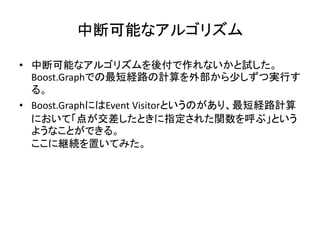
PDF
C++のSTLのコンテナ型を概観する @ Ohotech 特盛 #10(2014.8.30)
PDF
LLVMで遊ぶ(整数圧縮とか、x86向けの自動ベクトル化とか)
PPTX
PPTX
C#や.NET Frameworkがやっていること
PDF
PDF
PDF
2015年度GPGPU実践プログラミング 第12回 偏微分方程式の差分計算
PPTX
PDF
PDF
Pythonの処理系はどのように実装され,どのように動いているのか? 我々はその実態を調査すべくアマゾンへと飛んだ.
PDF
PDF
偶然にも500万個のSSH公開鍵を手に入れた俺たちは
PDF
ARM CPUにおけるSIMDを用いた高速計算入門
PDF
PDF
More Related Content
PDF
20分くらいでわかった気分になれるC++20コルーチン
PPTX
PDF
PDF
PDF
PDF
PDF
PDF
constexpr関数はコンパイル時処理。これはいい。実行時が霞んで見える。cpuの嬌声が聞こえてきそうだ
What's hot
PDF
PDF
PDF
PDF
Pythonではじめる OpenAI Gymトレーニング
PDF
組み込み関数(intrinsic)によるSIMD入門
PDF
PDF
【Unite Tokyo 2018】さては非同期だなオメー!async/await完全に理解しよう
PDF
C++のSTLのコンテナ型を概観する @ Ohotech 特盛 #10(2014.8.30)
PDF
LLVMで遊ぶ(整数圧縮とか、x86向けの自動ベクトル化とか)
PPTX
PPTX
C#や.NET Frameworkがやっていること
PDF
PDF
PDF
2015年度GPGPU実践プログラミング 第12回 偏微分方程式の差分計算
PPTX
PDF
PDF
Pythonの処理系はどのように実装され,どのように動いているのか? 我々はその実態を調査すべくアマゾンへと飛んだ.
PDF
PDF
偶然にも500万個のSSH公開鍵を手に入れた俺たちは
PDF
ARM CPUにおけるSIMDを用いた高速計算入門
Viewers also liked
PDF
PDF
PDF
PDF
PDF
俺的英語・中国語の勉強法を晒してみる 2011 10-12
PDF
Similar to Continuation with Boost.Context
ODP
PDF
PPTX
PDF
Async design with Unity3D
PDF
PDF
PDF
PDF
PDF
PDF
PDF
PDF
PDF
PDF
PDF
PDF
PDF
PDF
Replace Output Iterator and Extend Range JP
PDF
PPTX
More from Akira Takahashi
PPTX
Cpp20 overview language features
PDF
PPTX
PDF
PDF
PDF
PDF
PDF
PDF
error handling using expected
PDF
PDF
PDF
PDF
PDF
C++14 solve explicit_default_constructor
PDF
PDF
PDF
PDF
PDF
PDF
Continuation with Boost.Context 1. Boost.Contextで継続
高橋 晶(Akira Takahashi)
id:faith_and_brave/@cpp_akira
2012/04/08(土) Boost.Contextオンリーイベント
2. 3. 資料などのあるところ
• Boost.Context について調べた – melpon日記
http://d.hatena.ne.jp/melpon/20111213/1323704464
• ドキュメント
http://ok73.ok.funpic.de/boost/libs/context/doc/html/
• ソースコード
https://github.com/ryppl/boost-svn
boost/context以下、およびlibs/context以下にソースコードお
よびサンプル、テストがある。
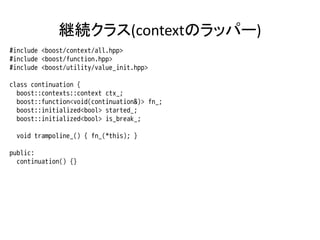
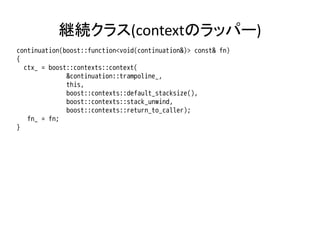
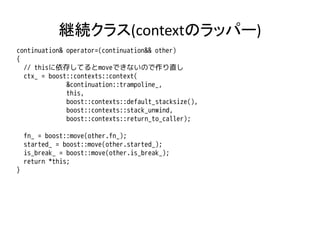
4. 5. 6. 7. 8. 継続クラス(contextのラッパー)
continuation& operator=(continuation&& other)
{
// thisに依存してるとmoveできないので作り直し
ctx_ = boost::contexts::context(
&continuation::trampoline_,
this,
boost::contexts::default_stacksize(),
boost::contexts::stack_unwind,
boost::contexts::return_to_caller);
fn_ = boost::move(other.fn_);
started_ = boost::move(other.started_);
is_break_ = boost::move(other.is_break_);
return *this;
}
9. 継続クラス(contextのラッパー)
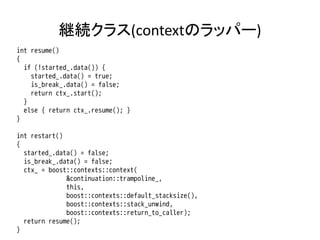
int resume()
{
if (!started_.data()) {
started_.data() = true;
is_break_.data() = false;
return ctx_.start();
}
else { return ctx_.resume(); }
}
int restart()
{
started_.data() = false;
is_break_.data() = false;
ctx_ = boost::contexts::context(
&continuation::trampoline_,
this,
boost::contexts::default_stacksize(),
boost::contexts::stack_unwind,
boost::contexts::return_to_caller);
return resume();
}
10. 継続クラス(contextのラッパー)
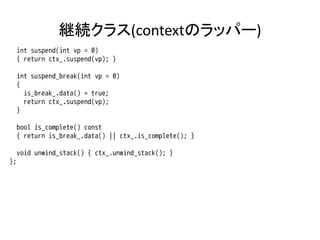
int suspend(int vp = 0)
{ return ctx_.suspend(vp); }
int suspend_break(int vp = 0)
{
is_break_.data() = true;
return ctx_.suspend(vp);
}
bool is_complete() const
{ return is_break_.data() || ctx_.is_complete(); }
void unwind_stack() { ctx_.unwind_stack(); }
};
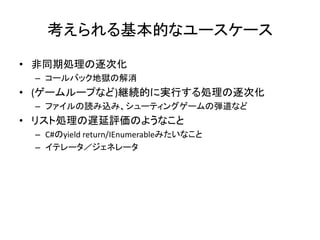
11. 考えられる基本的なユースケース
• 非同期処理の逐次化
– コールバック地獄の解消
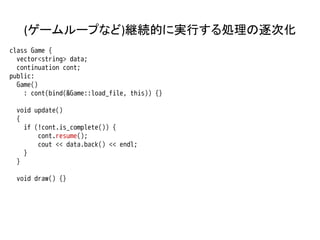
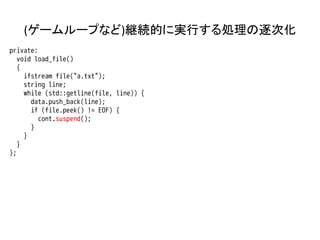
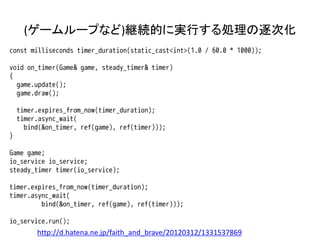
• (ゲームループなど)継続的に実行する処理の逐次化
– ファイルの読み込み、シューティングゲームの弾道など
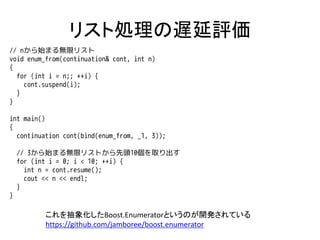
• リスト処理の遅延評価のようなこと
– C#のyield return/IEnumerableみたいなこと
– イテレータ/ジェネレータ
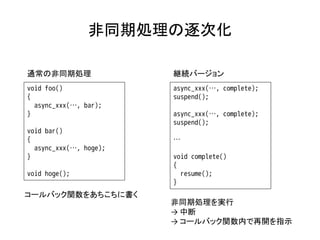
12. 非同期処理の逐次化
通常の非同期処理 継続バージョン
void foo() async_xxx(…, complete);
{ suspend();
async_xxx(…, bar);
} async_xxx(…, complete);
suspend();
void bar()
{ …
async_xxx(…, hoge);
} void complete()
{
void hoge(); resume();
}
コールバック関数をあちこちに書く
非同期処理を実行
→ 中断
→ コールバック関数内で再開を指示
13. 非同期処理の逐次化
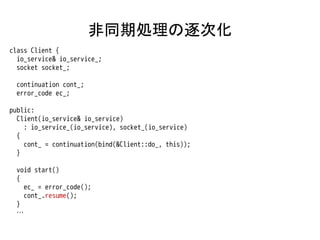
class Client {
io_service& io_service_;
socket socket_;
continuation cont_;
error_code ec_;
public:
Client(io_service& io_service)
: io_service_(io_service), socket_(io_service)
{
cont_ = continuation(bind(&Client::do_, this));
}
void start()
{
ec_ = error_code();
cont_.resume();
}
…
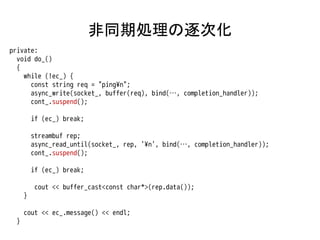
14. 非同期処理の逐次化
private:
void do_()
{
while (!ec_) {
const string req = "ping¥n";
async_write(socket_, buffer(req), bind(…, completion_handler));
cont_.suspend();
if (ec_) break;
streambuf rep;
async_read_until(socket_, rep, '¥n', bind(…, completion_handler));
cont_.suspend();
if (ec_) break;
cout << buffer_cast<const char*>(rep.data());
}
cout << ec_.message() << endl;
}
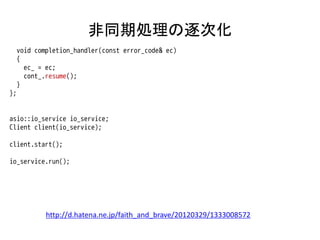
15. 非同期処理の逐次化
void completion_handler(const error_code& ec)
{
ec_ = ec;
cont_.resume();
}
};
asio::io_service io_service;
Client client(io_service);
client.start();
io_service.run();
http://d.hatena.ne.jp/faith_and_brave/20120329/1333008572
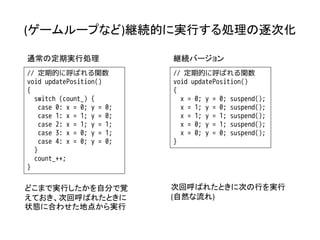
16. (ゲームループなど)継続的に実行する処理の逐次化
通常の定期実行処理 継続バージョン
// 定期的に呼ばれる関数 // 定期的に呼ばれる関数
void updatePosition() void updatePosition()
{ {
switch (count_) { x = 0; y = 0; suspend();
case 0: x = 0; y = 0; x = 1; y = 0; suspend();
case 1: x = 1; y = 0; x = 1; y = 1; suspend();
case 2: x = 1; y = 1; x = 0; y = 1; suspend();
case 3: x = 0; y = 1; x = 0; y = 0; suspend();
case 4: x = 0; y = 0; }
}
count_++;
}
どこまで実行したかを自分で覚 次回呼ばれたときに次の行を実行
えておき、次回呼ばれたときに (自然な流れ)
状態に合わせた地点から実行
17. (ゲームループなど)継続的に実行する処理の逐次化
class Game {
vector<string> data;
continuation cont;
public:
Game()
: cont(bind(&Game::load_file, this)) {}
void update()
{
if (!cont.is_complete()) {
cont.resume();
cout << data.back() << endl;
}
}
void draw() {}
18. (ゲームループなど)継続的に実行する処理の逐次化
private:
void load_file()
{
ifstream file("a.txt");
string line;
while (std::getline(file, line)) {
data.push_back(line);
if (file.peek() != EOF) {
cont.suspend();
}
}
}
};
19. (ゲームループなど)継続的に実行する処理の逐次化
const milliseconds timer_duration(static_cast<int>(1.0 / 60.0 * 1000));
void on_timer(Game& game, steady_timer& timer)
{
game.update();
game.draw();
timer.expires_from_now(timer_duration);
timer.async_wait(
bind(&on_timer, ref(game), ref(timer)));
}
Game game;
io_service io_service;
steady_timer timer(io_service);
timer.expires_from_now(timer_duration);
timer.async_wait(
bind(&on_timer, ref(game), ref(timer)));
io_service.run();
http://d.hatena.ne.jp/faith_and_brave/20120312/1331537869
20. リスト処理の遅延評価
// nから始まる無限リスト
void enum_from(continuation& cont, int n)
{
for (int i = n;; ++i) {
cont.suspend(i);
}
}
int main()
{
continuation cont(bind(enum_from, _1, 3));
// 3から始まる無限リストから先頭10個を取り出す
for (int i = 0; i < 10; ++i) {
int n = cont.resume();
cout << n << endl;
}
}
これを抽象化したBoost.Enumeratorというのが開発されている
https://github.com/jamboree/boost.enumerator
21. 22. class path_history_visitor {
continuation& cont;
public:
typedef boost::on_discover_vertex event_filter;
path_history_visitor(continuation& cont) : cont(cont) {}
template<typename Vertex, typename Graph>
void operator()(Vertex v, const Graph&)
{
std::cout << Names[v] << ' ';
cont.suspend();
}
};
23. int main()
{
const Graph g = make_graph();
const Vertex from = S;
continuation cont = [&](continuation& cont) {
path_history_visitor vis(cont);
boost::dijkstra_shortest_paths(g, from,
boost::visitor(boost::make_dijkstra_visitor(vis)));
};
while (!cont.is_complete()) {
cont.resume();
}
}
ポイントはラムダ式とEvent Visitor。
Event Visitorは、アルゴリズムの中断ポイントを定義するのに使用できる。
ラムダは、既存のプログラムをBoost.Contextで使用できるコンテキストに変換するのに使
用できる。
24. その他
• ambを実装した
https://github.com/faithandbrave/Keizoku/tree/master/amb
• Boost.CoroutineがBoost.Contextで書き直されるらしい
「Boost.Coroutineを用いてステートマシンを解決する – C++Now! 2012」
https://sites.google.com/site/boostjp/cppnow/2012#coroutine
• Scala設計者のMartin Odersky先生が「Observerパターンやめて継続使お
うぜ」という論文を書いてる
「Deprecating the Observer Pattern」
http://lampwww.epfl.ch/~imaier/pub/DeprecatingObserversTR2010.pdf



![class path_history_visitor {
continuation& cont;
public:
typedef boost::on_discover_vertex event_filter;
path_history_visitor(continuation& cont) : cont(cont) {}
template<typename Vertex, typename Graph>
void operator()(Vertex v, const Graph&)
{
std::cout << Names[v] << ' ';
cont.suspend();
}
};](https://image.slidesharecdn.com/boostcontext-120408001955-phpapp02/85/Continuation-with-Boost-Context-22-320.jpg)
 {
path_history_visitor vis(cont);
boost::dijkstra_shortest_paths(g, from,
boost::visitor(boost::make_dijkstra_visitor(vis)));
};
while (!cont.is_complete()) {
cont.resume();
}
}
ポイントはラムダ式とEvent Visitor。
Event Visitorは、アルゴリズムの中断ポイントを定義するのに使用できる。
ラムダは、既存のプログラムをBoost.Contextで使用できるコンテキストに変換するのに使
用できる。](https://image.slidesharecdn.com/boostcontext-120408001955-phpapp02/85/Continuation-with-Boost-Context-23-320.jpg)