acpww.ca
• Imagine: You’re in the hospital, too ill or
hurt to speak for yourself…
• Think: Do you know who would make health
care decisions for you?
• Imagine: Your spouse or partner has had a
stroke and is unable to communicate with
doctors
• Think: Would you know what health care
they would want or not want?
acpww.ca
Advance Care Planning
&
Health Care Consent
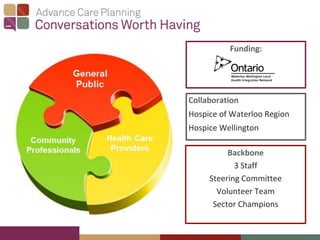
Collaboration
Hospice of Waterloo Region
Hospice Wellington
Backbone
3 Staff
Steering Committee
Volunteer Team
Sector Champions
Funding:
What is Advance Care Planning in
Ontario?
1. Identifying your future Substitute Decision
Maker
2. Having conversations about what is
important to you
Step 1
Identifying your
Substitute Decision Maker
SDM Video
Click here
What do SDMs do?
• Make health care and personal care decisions for
you
• Only make decisions if you DO NOT HAVE CAPACITY
• Have to make the decisions the way YOU would have
made them
• Must use previously expressed wishes
• Act in your best interest
Types of Decisions
1. Long-term care placement
2. Health care decisions
• Consent or refuse tests, procedures, surgery
• Begin or withdraw life-prolonging measures
• Who will provide medical care
• Speaking with health care professionals
• Admit or discharge from medical facility
• Looking at medical information
3. Personal Assistance Services
Scenarios
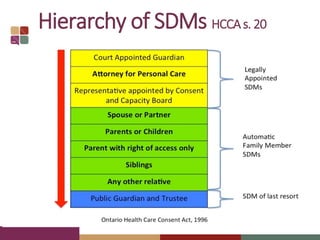
Hierarchy of SDMs HCCAs. 20
Scenario 1
• Bob is 75 and widowed
• He has had a heart attack and is in a coma
• Bob has 4 adult children
• Jane lives with Bob
• Terry lives an hour away
• Mark lives in B.C.
• James lives in England
• The doctor has recommended Bob have bypass
surgery and needs consent
• Who is Bob’s SDM?
Scenario 1 - answer
All 4 adult children are equally ranking
SDMs for Bob
Scenario 2
• Marie is 85 years old and a Long Term Care bed
has become available for her
• The CCAC (now Home and Community Care)
staff does not think Marie has the capacity to
make her own decision to move to LTC
• The Home and Community Care staff turn to her
SDMs to obtain informed consent to admit her
to LTC
Scenario 2 con’t
• Marie’s two adult children are her automatic
SDMs according to the hierarchy
• They cannot agree on the decision
• One says yes and the other says no
• What happens in this case?
Scenario 2 - answer
The health care team will call the
Public Guardian and Trustee
who will make the decision on whether Marie
is admitted to LTC or not
Scenario 3
• Kevin and Sarah are married and have two
teenage daughters
• Ava is 17 years old
• Emma is 14 years old
• Kevin and Sarah get into a car accident and are
both in hospital, unable to make their own
(and each other’s) health care decisions
Scenario 3 con’t
• Kevin and Sarah have both named each other in
their Power of Attorney for Personal Care and
have not named alternates
• Who are Kevin and Sarah’s automatic SDMs?
Scenario 3 - answer
Ava
Advance Care Planning in Ontario
• Does not need to be in writing
• Later wishes, however communicated, expressed while
capable prevail over earlier wishes
• This is true even if the previous wishes were in writing and
the later wishes are oral
• Not only about End-of-Life
• Not about Living Wills or Advance Directives
Step 2
Conversations with Substitute Decision Maker
and other loved ones
Would you…
Let someone make the following
decisions for you WITHOUT your input…
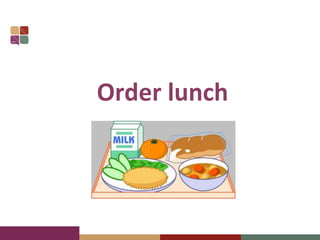
Order lunch
Buy clothes
Choose a vacation
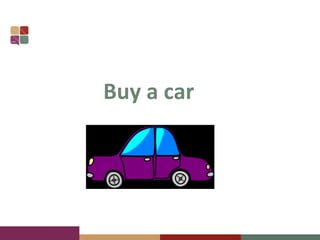
Buy a car
Buy a house
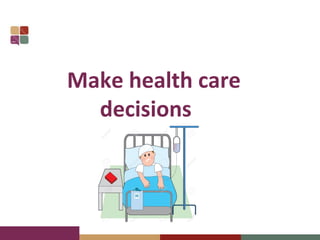
Make health care
decisions
Ideas for how to bring up the
conversation…
Conversation Video
Click here
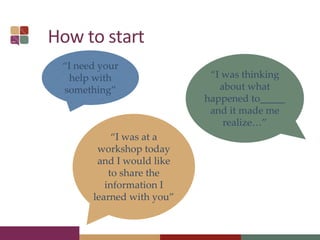
How to start
“I need your
help with
something”
“I was thinking
about what
happened to_____
and it made me
realize…”
“I was at a
workshop today
and I would like
to share the
information I
learned with you”
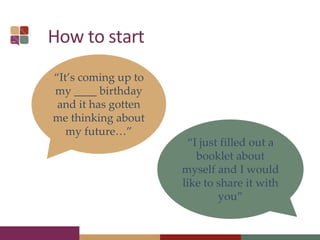
How to start
“It’s coming up to
my ____ birthday
and it has gotten
me thinking about
my future…”
“I just filled out a
booklet about
myself and I would
like to share it with
you”
What to talk about…
Debrief
• How did you feel doing this exercise?
• Do you regularly think about these things
for yourself?
• Have you shared this information with your
SDM?
Examples
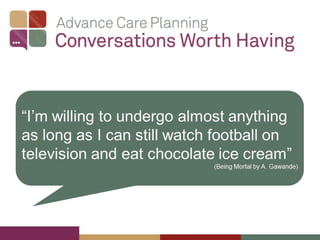
• What are your “football and ice cream” must
haves?
• What is a good day for you?
• Do you want your doctor to focus on
maximizing the quality or quantity of your life
• What matters most about living?
Examples
• Letting SDM and other loved ones know your
wishes, values and beliefs
• What do they need to know about you in order to
make decisions the way you would?
• What brings quality to your life?
• What brings you pleasure and joy?
• What fears do you have about your health?
Examples
• What habits or hobbies make your life worth living?
• What 3 non-medical facts should your doctor know
about you?
• How would you describe yourself to someone who
didn’t know you?
• What do you like to do, who do you like to be with,
etc?
Examples
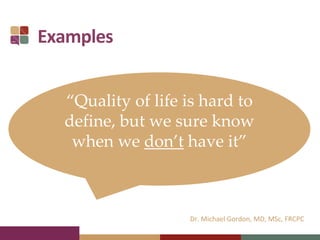
Dr. Michael Gordon, MD, MSc, FRCPC
“Quality of life is hard to
define, but we sure know
when we don’t have it”
Jazz Singer Video
Click here
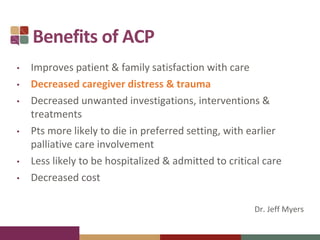
Benefits of ACP
• Improves patient & family satisfaction with care
• Decreased caregiver distress & trauma
• Decreased unwanted investigations, interventions &
treatments
• Pts more likely to die in preferred setting, with earlier
palliative care involvement
• Less likely to be hospitalized & admitted to critical care
• Decreased cost
Dr. Jeff Myers
Advance Care Planning
Worksheet
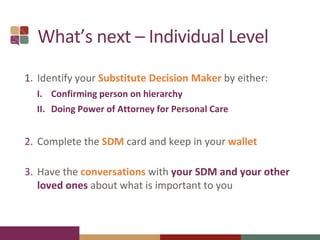
What’s next – Individual Level
1. Identify your Substitute Decision Maker by either:
I. Confirming person on hierarchy
II. Doing Power of Attorney for Personal Care
2. Complete the SDM card and keep in your wallet
3. Have the conversations with your SDM and your other
loved ones about what is important to you
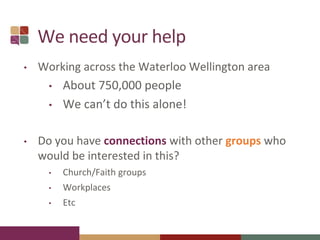
We need your help
• Working across the Waterloo Wellington area
• About 750,000 people
• We can’t do this alone!
• Do you have connections with other groups who
would be interested in this?
• Church/Faith groups
• Workplaces
• Etc
Evaluations
acpww.ca
www.acpww.ca
519-743-4114
jessica@hospicewaterloo.ca
@acpww
Thank you!

Advance Care Planning- WFS

  • 1.
  • 2.
    • Imagine: You’rein the hospital, too ill or hurt to speak for yourself… • Think: Do you know who would make health care decisions for you?
  • 3.
    • Imagine: Yourspouse or partner has had a stroke and is unable to communicate with doctors • Think: Would you know what health care they would want or not want?
  • 4.
  • 5.
    Collaboration Hospice of WaterlooRegion Hospice Wellington Backbone 3 Staff Steering Committee Volunteer Team Sector Champions Funding:
  • 6.
    What is AdvanceCare Planning in Ontario? 1. Identifying your future Substitute Decision Maker 2. Having conversations about what is important to you
  • 7.
  • 8.
  • 9.
    What do SDMsdo? • Make health care and personal care decisions for you • Only make decisions if you DO NOT HAVE CAPACITY • Have to make the decisions the way YOU would have made them • Must use previously expressed wishes • Act in your best interest
  • 10.
    Types of Decisions 1.Long-term care placement 2. Health care decisions • Consent or refuse tests, procedures, surgery • Begin or withdraw life-prolonging measures • Who will provide medical care • Speaking with health care professionals • Admit or discharge from medical facility • Looking at medical information 3. Personal Assistance Services
  • 11.
  • 12.
  • 13.
    Scenario 1 • Bobis 75 and widowed • He has had a heart attack and is in a coma • Bob has 4 adult children • Jane lives with Bob • Terry lives an hour away • Mark lives in B.C. • James lives in England • The doctor has recommended Bob have bypass surgery and needs consent • Who is Bob’s SDM?
  • 14.
    Scenario 1 -answer All 4 adult children are equally ranking SDMs for Bob
  • 15.
    Scenario 2 • Marieis 85 years old and a Long Term Care bed has become available for her • The CCAC (now Home and Community Care) staff does not think Marie has the capacity to make her own decision to move to LTC • The Home and Community Care staff turn to her SDMs to obtain informed consent to admit her to LTC
  • 16.
    Scenario 2 con’t •Marie’s two adult children are her automatic SDMs according to the hierarchy • They cannot agree on the decision • One says yes and the other says no • What happens in this case?
  • 17.
    Scenario 2 -answer The health care team will call the Public Guardian and Trustee who will make the decision on whether Marie is admitted to LTC or not
  • 18.
    Scenario 3 • Kevinand Sarah are married and have two teenage daughters • Ava is 17 years old • Emma is 14 years old • Kevin and Sarah get into a car accident and are both in hospital, unable to make their own (and each other’s) health care decisions
  • 19.
    Scenario 3 con’t •Kevin and Sarah have both named each other in their Power of Attorney for Personal Care and have not named alternates • Who are Kevin and Sarah’s automatic SDMs?
  • 20.
    Scenario 3 -answer Ava
  • 21.
    Advance Care Planningin Ontario • Does not need to be in writing • Later wishes, however communicated, expressed while capable prevail over earlier wishes • This is true even if the previous wishes were in writing and the later wishes are oral • Not only about End-of-Life • Not about Living Wills or Advance Directives
  • 22.
    Step 2 Conversations withSubstitute Decision Maker and other loved ones
  • 23.
    Would you… Let someonemake the following decisions for you WITHOUT your input…
  • 24.
  • 25.
  • 26.
  • 27.
  • 28.
  • 29.
  • 30.
    Ideas for howto bring up the conversation…
  • 31.
  • 32.
    How to start “Ineed your help with something” “I was thinking about what happened to_____ and it made me realize…” “I was at a workshop today and I would like to share the information I learned with you”
  • 33.
    How to start “It’scoming up to my ____ birthday and it has gotten me thinking about my future…” “I just filled out a booklet about myself and I would like to share it with you”
  • 34.
    What to talkabout…
  • 35.
    Debrief • How didyou feel doing this exercise? • Do you regularly think about these things for yourself? • Have you shared this information with your SDM?
  • 36.
    Examples • What areyour “football and ice cream” must haves? • What is a good day for you? • Do you want your doctor to focus on maximizing the quality or quantity of your life • What matters most about living?
  • 37.
    Examples • Letting SDMand other loved ones know your wishes, values and beliefs • What do they need to know about you in order to make decisions the way you would? • What brings quality to your life? • What brings you pleasure and joy? • What fears do you have about your health?
  • 38.
    Examples • What habitsor hobbies make your life worth living? • What 3 non-medical facts should your doctor know about you? • How would you describe yourself to someone who didn’t know you? • What do you like to do, who do you like to be with, etc?
  • 39.
    Examples Dr. Michael Gordon,MD, MSc, FRCPC “Quality of life is hard to define, but we sure know when we don’t have it”
  • 40.
  • 41.
    Benefits of ACP •Improves patient & family satisfaction with care • Decreased caregiver distress & trauma • Decreased unwanted investigations, interventions & treatments • Pts more likely to die in preferred setting, with earlier palliative care involvement • Less likely to be hospitalized & admitted to critical care • Decreased cost Dr. Jeff Myers
  • 42.
  • 43.
    What’s next –Individual Level 1. Identify your Substitute Decision Maker by either: I. Confirming person on hierarchy II. Doing Power of Attorney for Personal Care 2. Complete the SDM card and keep in your wallet 3. Have the conversations with your SDM and your other loved ones about what is important to you
  • 44.
    We need yourhelp • Working across the Waterloo Wellington area • About 750,000 people • We can’t do this alone! • Do you have connections with other groups who would be interested in this? • Church/Faith groups • Workplaces • Etc
  • 45.
  • 46.