Drupal Testing 7 → 8 
DrupalCafe 
20 november 2014 
Hans de Raad
Whoami? 
● Open source business owner: 
– Drupal 
– Kolab 
– OpenSUSE 
● Projectmanagement, security testing, regulatory 
affairs, classical music, etc 
● Happy to be here!
I am not a D8 expert 
● This presentation is based on the input from talks from 
DrupalCon Prague and Amsterdam (and a lot of 
reading). 
● It is also a way for me to explore the new concepts in D8 
– And share my enthousiasm about it! 
● I have a generic programming (mostly PHP and Java) 
background, so programming for Drupal has always felt 
a bit strange (functional → OO). 
– So glad to see that solved in D8!
History of testing in Drupal 
● Since 2007 – Drupal 6 
– SimpleTest and Coder 
● Targeted at local development deployments and 
qa.drupal.org 
● This stimulated a number of best practises 
– The encouragement of adding tests to contrib modules 
– The availability of a testing framework for all developers
Limitations SimpleTest 
● First of all, the project isn't very active anymore. 
● It's not very useful for BDD testing (and AJAX) 
– Basically anything else than PHP function testing. 
● It doesn't really encourage TDD style unit 
testing, it is a bit inbetween TDD and BDD. 
● There aren't very much integration plugins with 
other testing solutions. 
● All in all, it's an aging solution.
Qunit 
● Javascript Unit testing 
● Used by jQuery for its unit tests 
● Drawbacks: 
– JS functions are normally tested within specific 
context 
– Designed to run in a browser 
– It's unit testing in an area (user interface) where 
BDD seems more appropriate.
Testing methodologies 
● Test Driven Development 
● Behavior Driven Development 
● Others? 
– Acceptance Test Driven Development
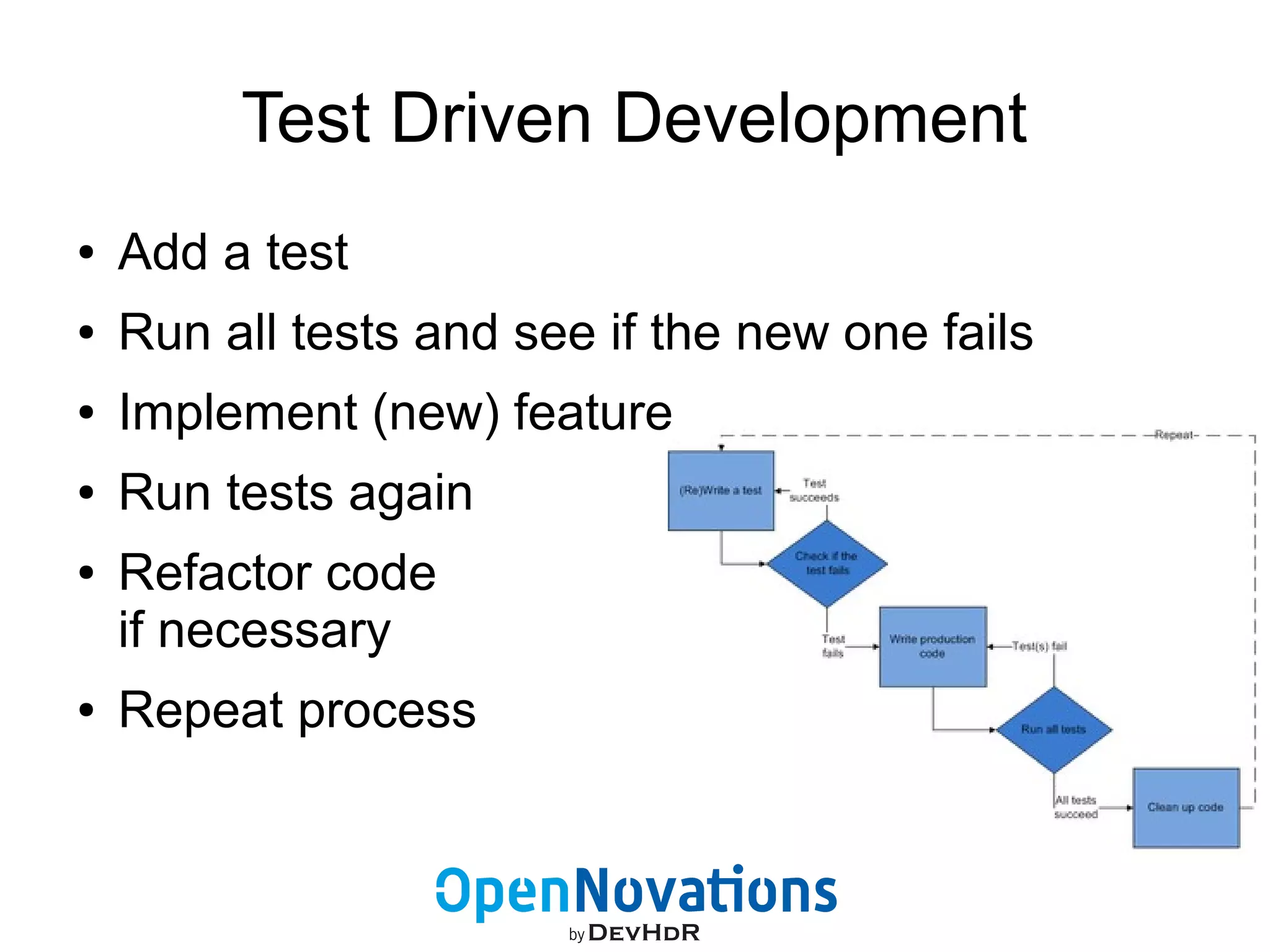
Test Driven Development 
● Definition: 
– Test-driven development (TDD) is a software 
development process that relies on the repetition of 
a very short development cycle: first the developer 
writes an (initially failing) automated test case that 
defines a desired improvement or new function, 
then produces the minimum amount of code to 
pass that test, and finally refactors the new code to 
acceptable standards.
Test Driven Development 
● Add a test 
● Run all tests and see if the new one fails 
● Implement (new) feature 
● Run tests again 
● Refactor code 
if necessary 
● Repeat process
Behaviour Driven Development 
● Definition: 
– In software engineering, behavior-driven development 
(abbreviated BDD) is a software development process 
based on test-driven development (TDD).Behavior-driven 
development combines the general techniques and 
principles of TDD with ideas from domain-driven design and 
object-oriented analysis and design to provide software 
developers and business analysts with shared tools and a 
shared process to collaborate on software development, 
with the aim of delivering "software that matters".
Behaviour Driven Development 
● Behavior-driven development was developed by as a response to the 
issues encountered in test-driven development: 
– Where to start in the process? 
– What to test and what not to test? 
– How much to test in one go? 
– What to call the tests? 
– How to understand why a test fails? 
● Acceptance tests should be written using the standard agile framework 
of a User story: "As a [role] I want [feature] so that [benefit]". 
– Acceptance criteria should be written in terms of scenarios and implemented as 
classes: Given [initial context], when [event occurs], then [ensure some 
outcomes].
BDD: Scenario format 
● Title (one line describing the story) 
– Narrative: 
● As a [role] 
● I want [feature] 
● So that [benefit] 
● Acceptance Criteria: (presented as Scenarios) 
– Scenario 1: Title 
● Given [context] 
– And [some more context]... 
– When [event] 
– Then [outcome] 
– And [another outcome]... 
● Scenario 2: ...
Focus: Acceptance testing 
● A sign of a projects maturity is when testing starts 
to focus on achieving and measuring business 
objectives. 
● That is exactly what is happening now. 
● No client wants to buy a Drupal framework with X 
well configured modules 
– They want a web based (content management) system 
– They want a website.
Focus: Testing business value 
● In traditional testing methodologies the primary 
focus used to be hardcore code tests 
● With Agile development methodologies this is 
changing to incorporate testing for actual 
business value (functionality) 
● This is something you can involve your client 
with (yay!)!
Tools for testing 
● Unit testing 
● Behaviour testing 
● User interaction simulation 
● Visual/optical testing
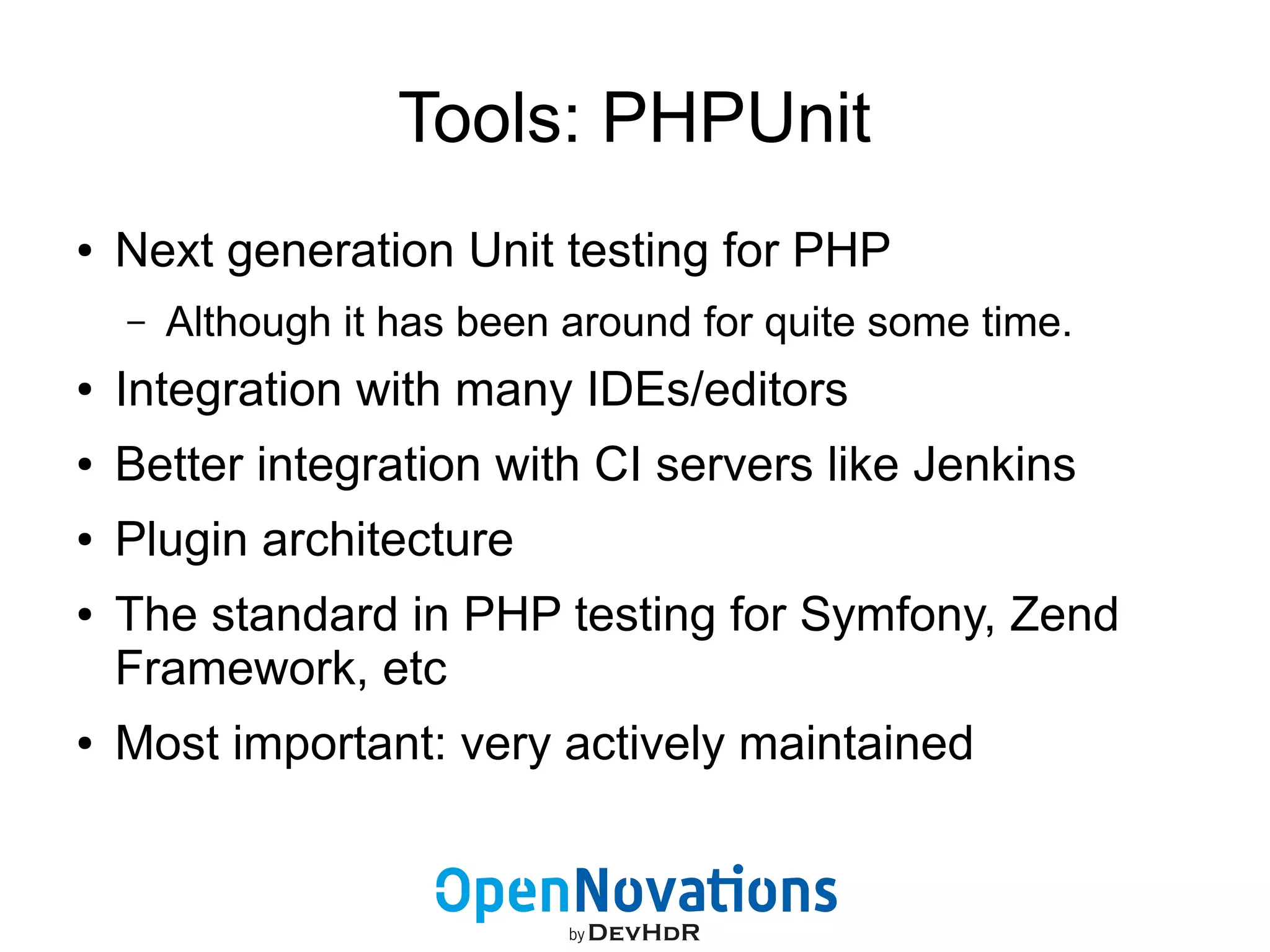
Tools: PHPUnit 
● Next generation Unit testing for PHP 
– Although it has been around for quite some time. 
● Integration with many IDEs/editors 
● Better integration with CI servers like Jenkins 
● Plugin architecture 
● The standard in PHP testing for Symfony, Zend 
Framework, etc 
● Most important: very actively maintained
Tools: PHPUnit how does it work? 
class StackTest extends PHPUnit_Framework_TestCase 
{ 
public function testPushAndPop() 
{ 
$stack = array(); 
$this->assertEquals(0, count($stack)); 
array_push($stack, 'foo'); 
$this->assertEquals('foo', $stack[count($stack)-1]); 
$this->assertEquals(1, count($stack)); 
$this->assertEquals('foo', array_pop($stack)); 
$this->assertEquals(0, count($stack)); 
} 
}
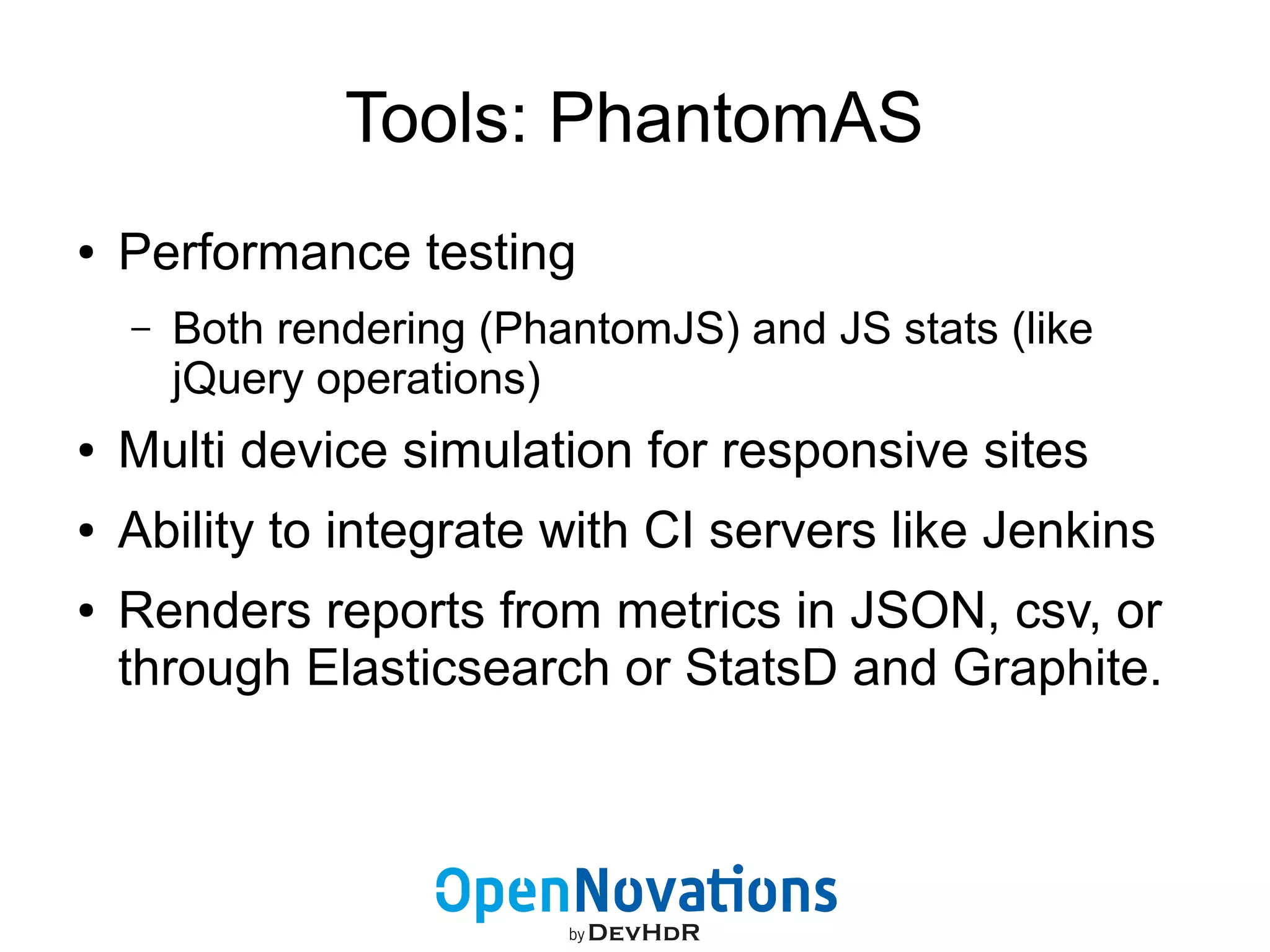
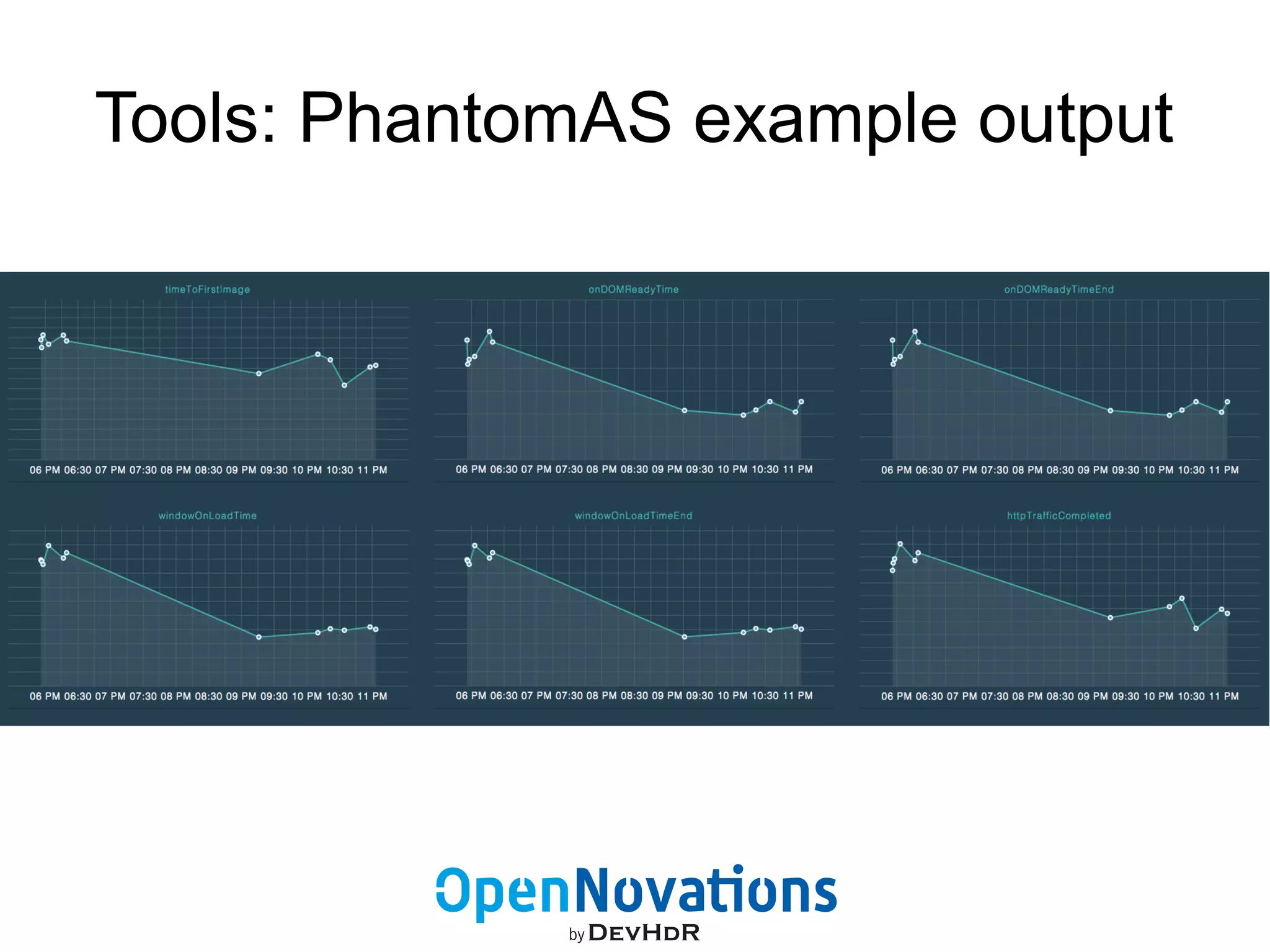
Tools: PhantomAS 
● Performance testing 
– Both rendering (PhantomJS) and JS stats (like 
jQuery operations) 
● Multi device simulation for responsive sites 
● Ability to integrate with CI servers like Jenkins 
● Renders reports from metrics in JSON, csv, or 
through Elasticsearch or StatsD and Graphite.
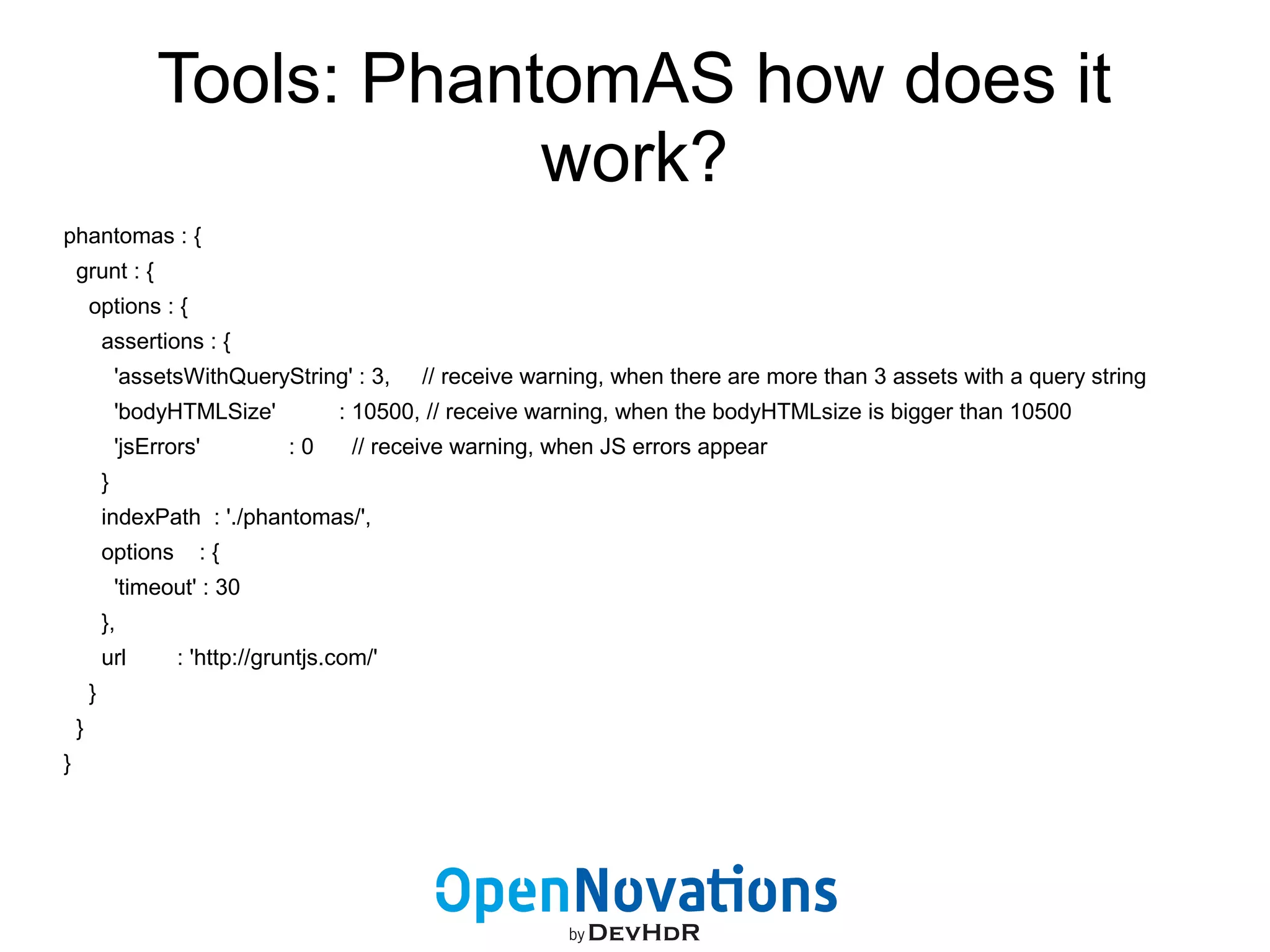
Tools: PhantomAS how does it 
work? 
phantomas : { 
grunt : { 
options : { 
assertions : { 
'assetsWithQueryString' : 3, // receive warning, when there are more than 3 assets with a query string 
'bodyHTMLSize' : 10500, // receive warning, when the bodyHTMLsize is bigger than 10500 
'jsErrors' : 0 // receive warning, when JS errors appear 
} 
indexPath : './phantomas/', 
options : { 
'timeout' : 30 
}, 
url : 'http://gruntjs.com/' 
} 
} 
}
Tools: PhantomAS example output
Tools: Behat and mink 
● BDD testing 
● Drupal extension to Behat 
● Simulates the interaction between application and 
browser (user) 
– It has several drivers: 
● Selenium or the more modern variant Sahi 
● Wunit 
● Etc 
● Module: Drupal Extension (for Behat and Mink)
Tools: Drupal extension to Behat 
and Mink 
From their website: 
● The Drupal Extension to Behat and Mink assists in the 
performance of these common Drupal testing tasks: 
– Set up test data with Drush or the Drupal API 
– Define theme regions and test data appears within them 
– Clear the cache, log out, and other useful steps 
– Detect and discover steps provided by contributed modules 
and themes
Tools: Behat how does it work? 
Feature: Login 
In order to see new personal content 
As a visitor 
I need to log in 
Scenario: Successfully log in 
Given I am on the homepage 
And I fill in "user" with "hans@ilikedrupal.cafe" 
And I fill in "password" with "h3l3m@@lpr1m@" 
And I press "sign in" 
Then I should see "Success!"
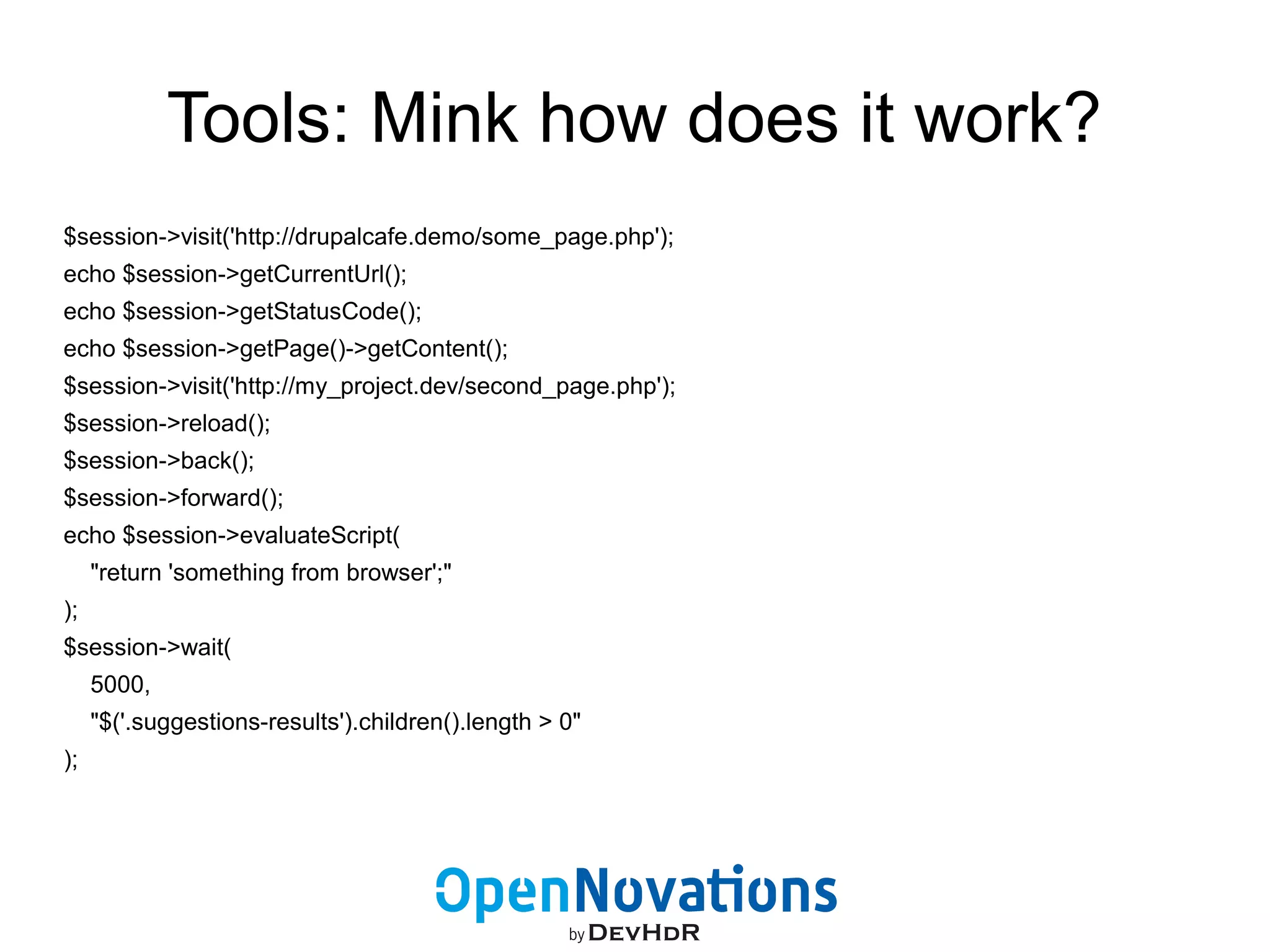
Tools: Mink how does it work? 
$session->visit('http://drupalcafe.demo/some_page.php'); 
echo $session->getCurrentUrl(); 
echo $session->getStatusCode(); 
echo $session->getPage()->getContent(); 
$session->visit('http://my_project.dev/second_page.php'); 
$session->reload(); 
$session->back(); 
$session->forward(); 
echo $session->evaluateScript( 
"return 'something from browser';" 
); 
$session->wait( 
5000, 
"$('.suggestions-results').children().length > 0" 
);
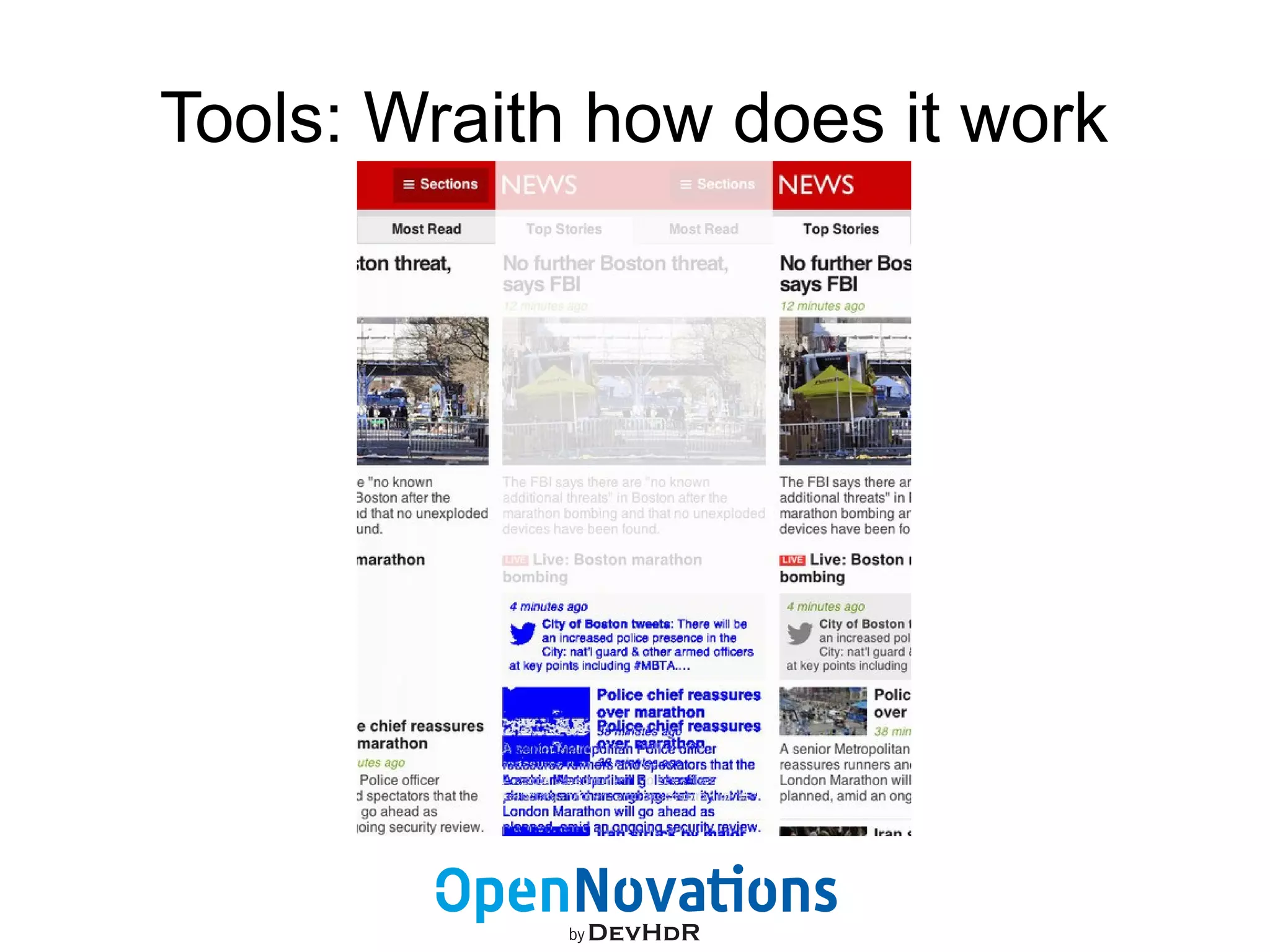
Tools: Wraith 
● Screenshot, or visual diff testing between 2 
domains (production and development) 
● Regression testing of a design/theme 
● Uses Imagemagick and PhantomJS for 
rendering and comparison 
● A bit like the distribution testing tool OpenQA.
Tools: Wraith how does it work
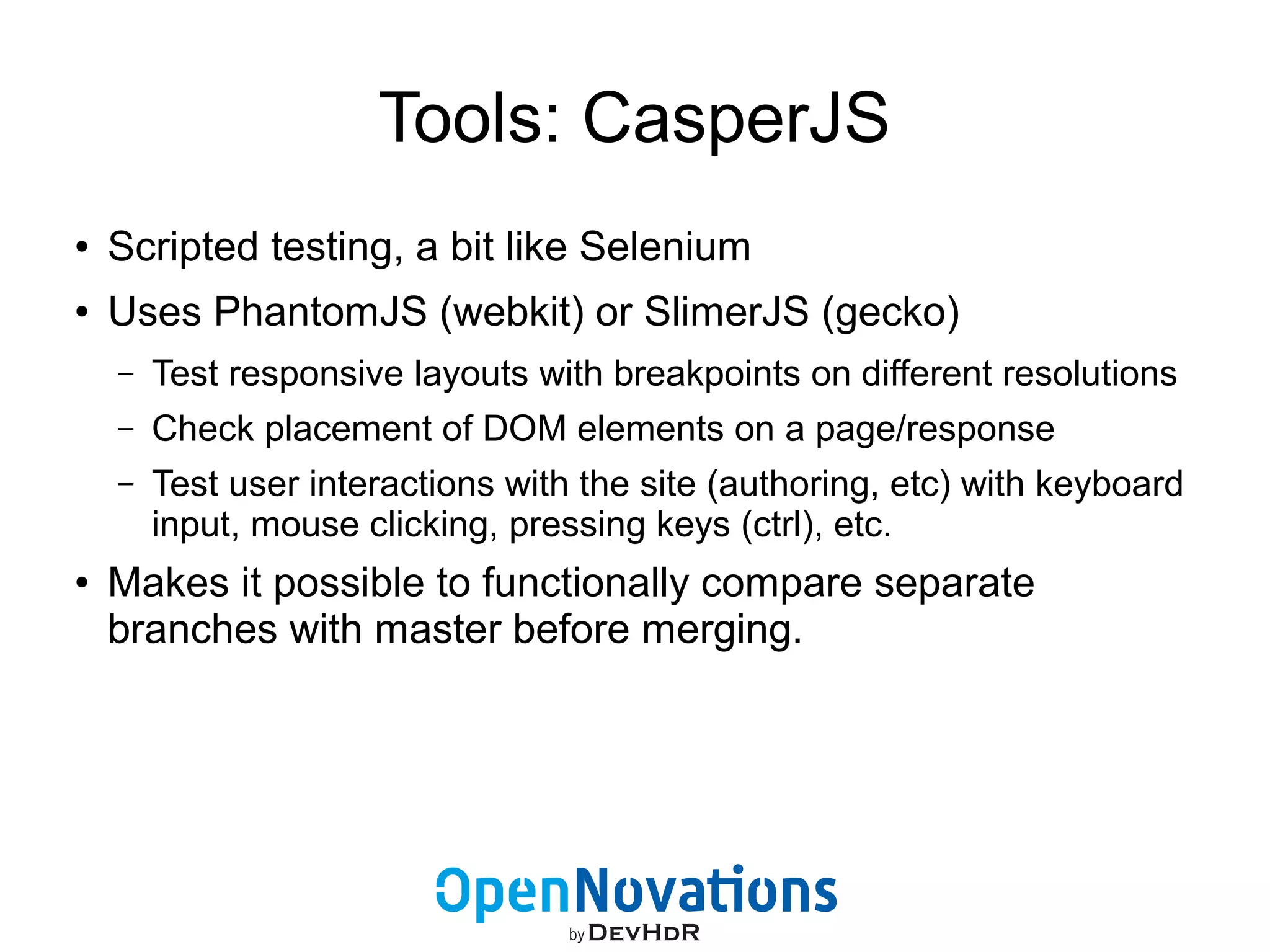
Tools: CasperJS 
● Scripted testing, a bit like Selenium 
● Uses PhantomJS (webkit) or SlimerJS (gecko) 
– Test responsive layouts with breakpoints on different resolutions 
– Check placement of DOM elements on a page/response 
– Test user interactions with the site (authoring, etc) with keyboard 
input, mouse clicking, pressing keys (ctrl), etc. 
● Makes it possible to functionally compare separate 
branches with master before merging.
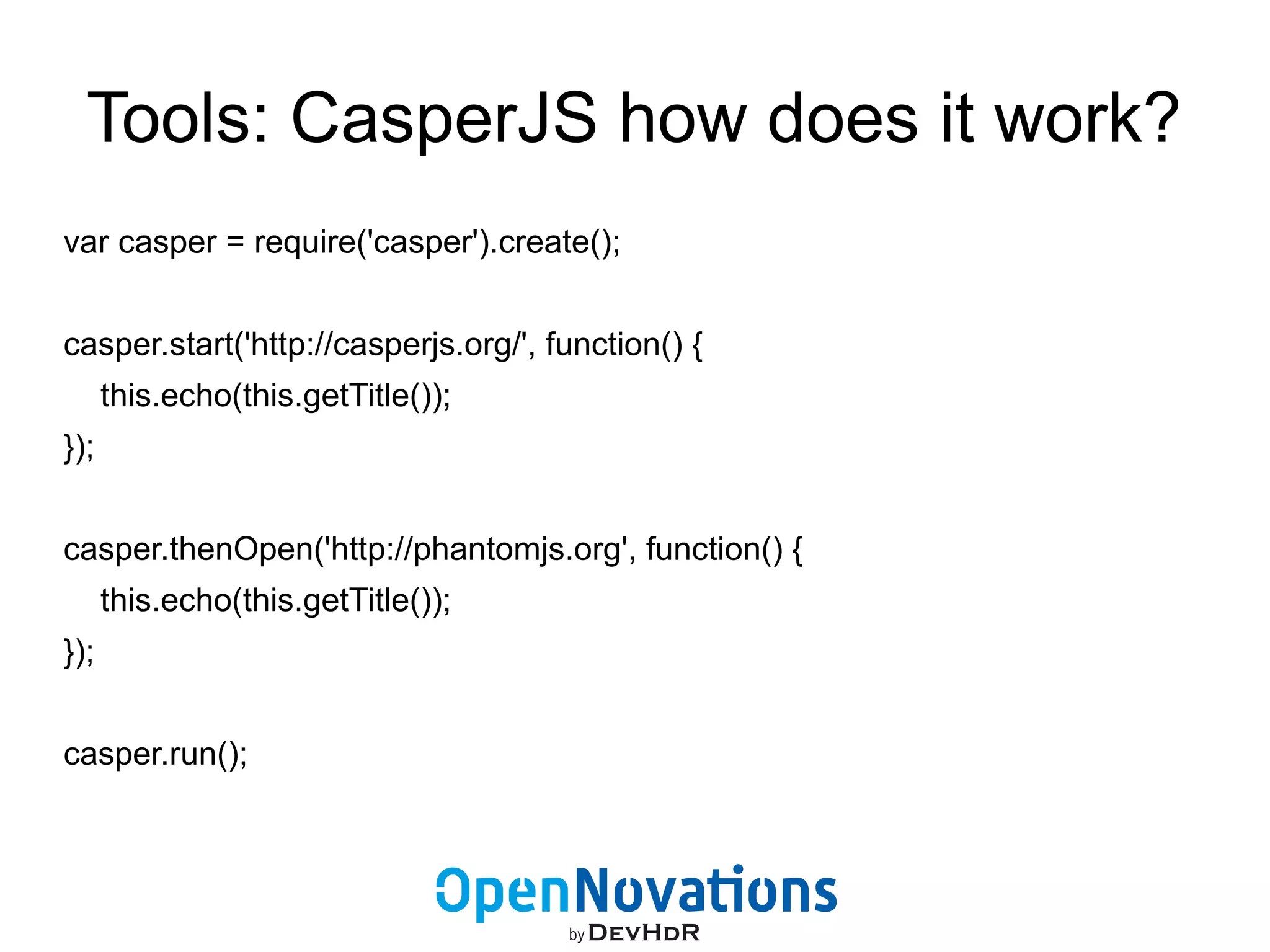
Tools: CasperJS how does it work? 
var casper = require('casper').create(); 
casper.start('http://casperjs.org/', function() { 
this.echo(this.getTitle()); 
}); 
casper.thenOpen('http://phantomjs.org', function() { 
this.echo(this.getTitle()); 
}); 
casper.run();
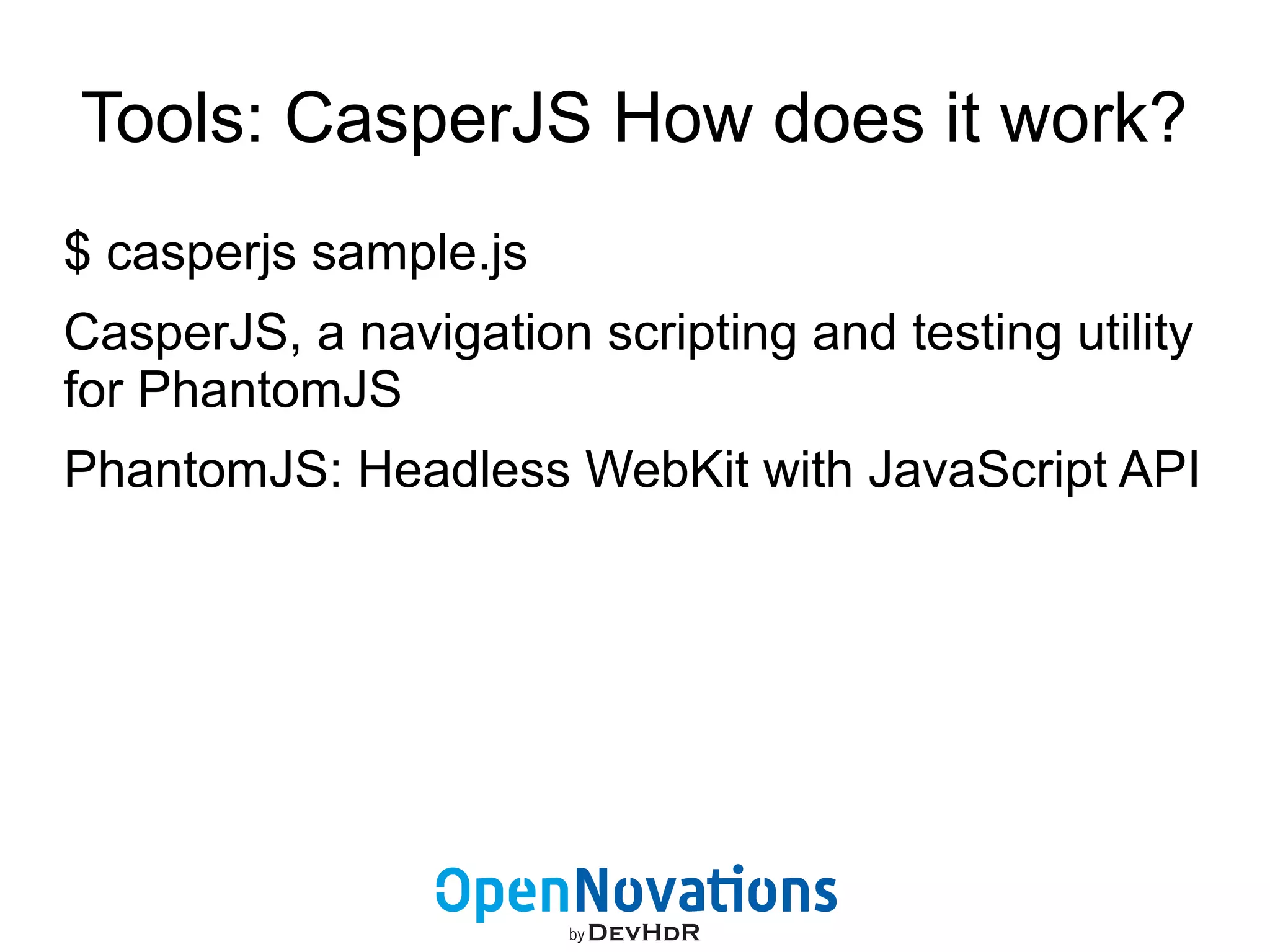
Tools: CasperJS How does it work? 
$ casperjs sample.js 
CasperJS, a navigation scripting and testing utility 
for PhantomJS 
PhantomJS: Headless WebKit with JavaScript API
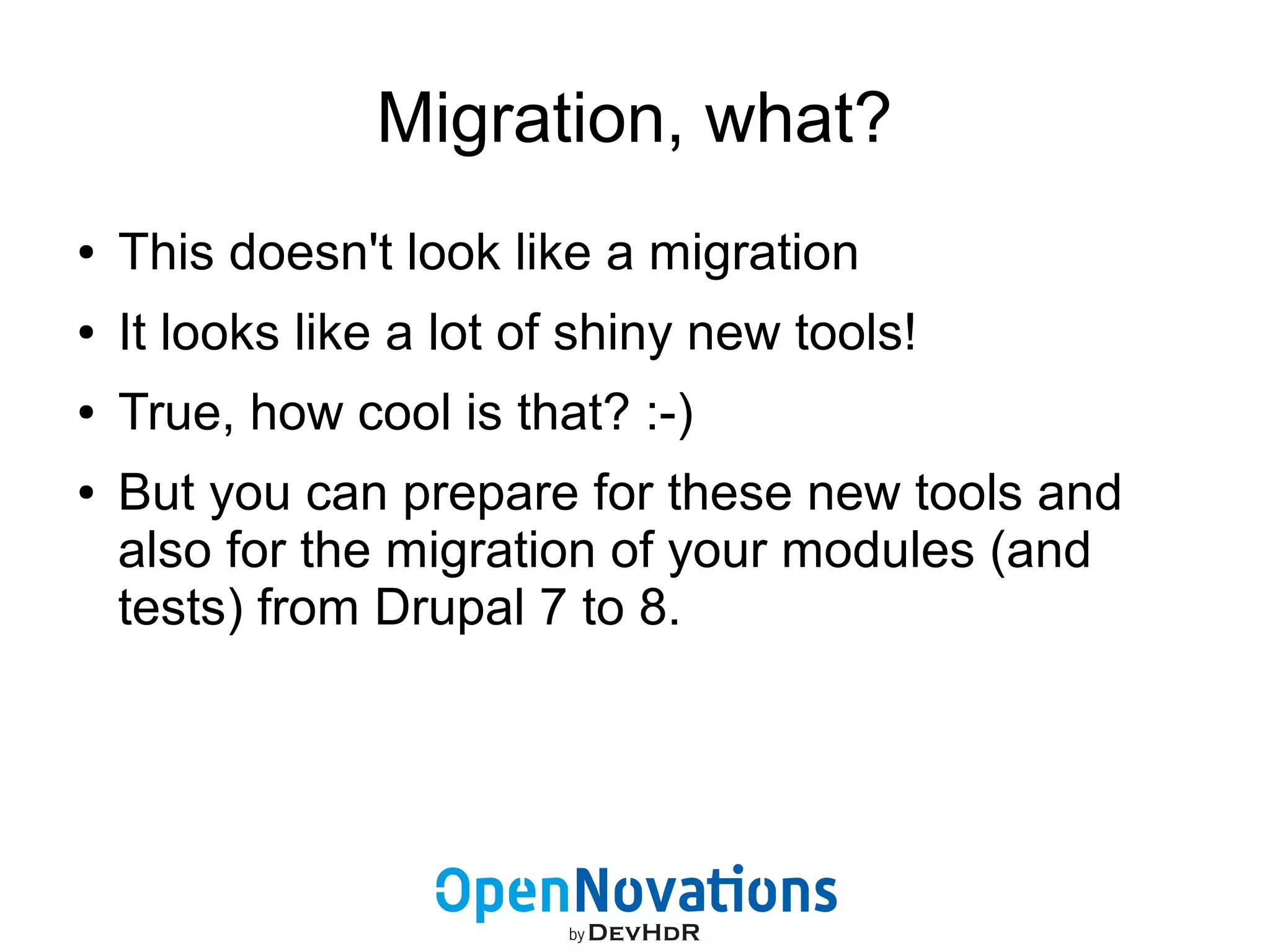
Migration, what? 
● This doesn't look like a migration 
● It looks like a lot of shiny new tools! 
● True, how cool is that? :-) 
● But you can prepare for these new tools and 
also for the migration of your modules (and 
tests) from Drupal 7 to 8.
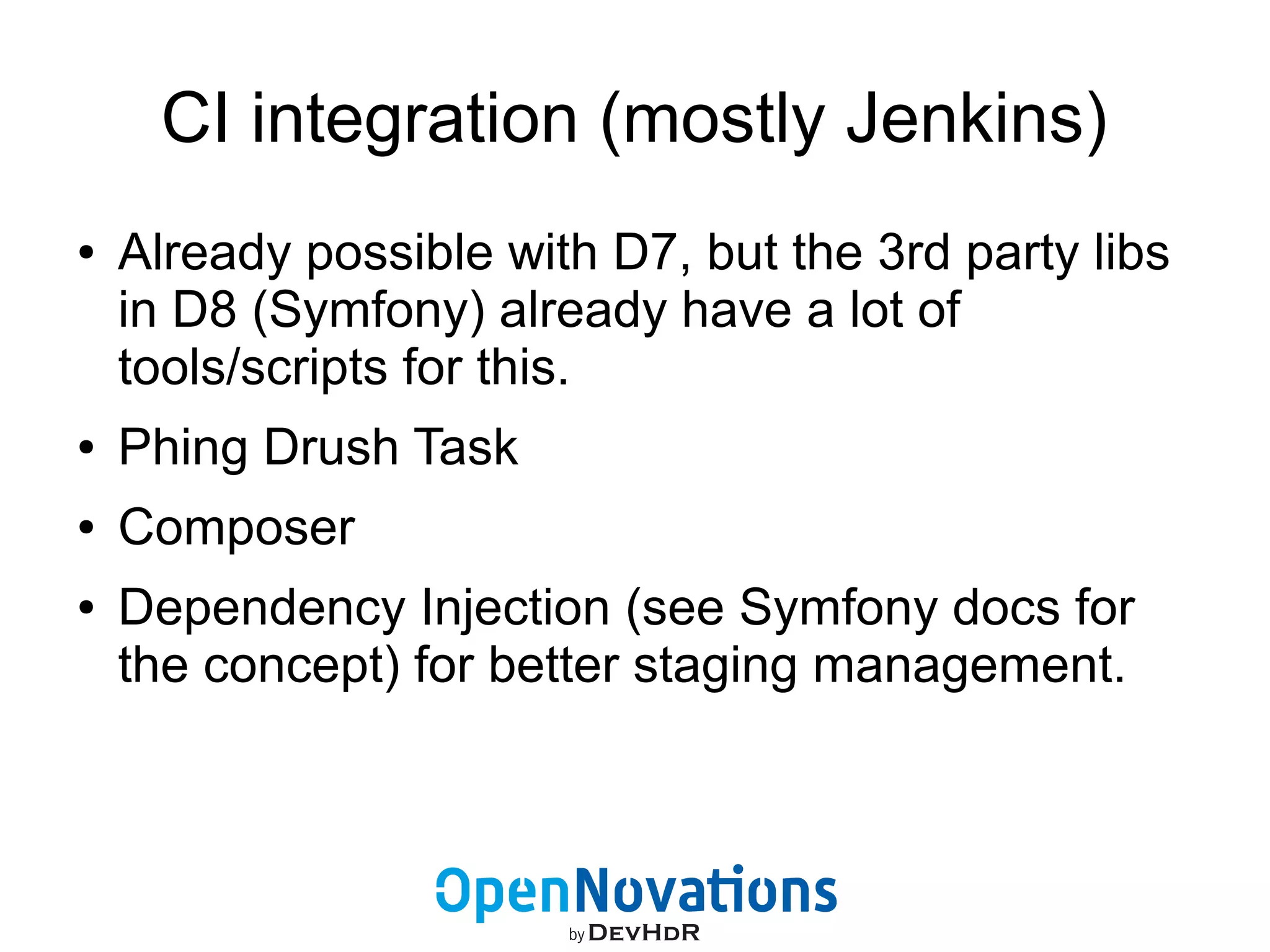
CI integration (mostly Jenkins) 
● Already possible with D7, but the 3rd party libs 
in D8 (Symfony) already have a lot of 
tools/scripts for this. 
● Phing Drush Task 
● Composer 
● Dependency Injection (see Symfony docs for 
the concept) for better staging management.
Configuration Management Initiative 
● How does that relate to testing? 
– Easier staging (OTAP) 
● A LOT easier.... 
– Thanks to separation of configuration and state. 
● Risks? 
– Yes, separate configs could mean different test 
circumstances.
Content Staging Initiative 
● There are multiple categories of content in any website: 
– Highly dynamic (news articles, blogs, products) 
– Medium dynamic (faqs) 
– Semi static (mission statements, organization info, etc) 
● Semi static content is often an integral part of the site design and 
should be tested. 
● In D7 this meant database migrations (painful since both 
configuration, state and content are in the same db). 
● Content Staging Initiative strives to enable some forms of content 
to be stages (OTAP like). 
– Also see Site Preview System module, preparing revisions as staging.
Features module in D8 
● Problem for Features in D7 is that application state, config and 
content are all in DB. 
– Not all of them are easily and reliably exportable for Features. 
● In D8 config is in code (although cached in db). 
● State (ie cron, or import status) is no longer a variable. 
● Content is still entities (DB). 
● Features will be reduced to only export bundled functionality 
(advanced “meta” modules). 
● This reduction of responsibility also makes it easier to test
Write modular (object oriented) code 
● Drupals classical approach is funcitonal 
– Hooks 
● Hooks are tightly coupled into the forms and menu 
system. 
– Not necessarily the best abstraction for functional units. 
● Actually, implementing business logic into hooks is a 
recipe for spaghetti code. 
● Start writing your logic into objects!
X Autoload 
● Add PSR-0 (and 4) style autoloading to Drupal 7! 
– This will be the standard in D8 
● Put your logic into separate classes 
– This results in cleaner implementation code 
– And easier migration to D8, ideally only the hook 
invoking needs to be reimplemented (events). 
– And because of this separation also easier testing! 
● Side effect: 3rd party PHP libraries are much easier 
to use with this.
Composer 
● Management system for 3rd party libs 
● Composer Manager (ie Update manager for 
Composer packages) 
● Composer Autoload (alternative for X Autoload for 
Composer packages) 
● Git wrapper, develop through git, package your 
module as composer package, deploy with 
composer. 
● This is THE way to get off the island!
Additional testing 
● Integrate security testing into the acceptance 
testing with OWASP tools like: 
– ZAP Proxy 
● Finding possible vulnerabilities in user interaction data 
streams. 
● Automated request generation. 
– Sprajax 
● AJAX enabled apps testing.
Any questions? 
¿

2014 11 20 Drupal 7 -> 8 test migratie

  • 1.
    Drupal Testing 7→ 8 DrupalCafe 20 november 2014 Hans de Raad
  • 2.
    Whoami? ● Opensource business owner: – Drupal – Kolab – OpenSUSE ● Projectmanagement, security testing, regulatory affairs, classical music, etc ● Happy to be here!
  • 3.
    I am nota D8 expert ● This presentation is based on the input from talks from DrupalCon Prague and Amsterdam (and a lot of reading). ● It is also a way for me to explore the new concepts in D8 – And share my enthousiasm about it! ● I have a generic programming (mostly PHP and Java) background, so programming for Drupal has always felt a bit strange (functional → OO). – So glad to see that solved in D8!
  • 4.
    History of testingin Drupal ● Since 2007 – Drupal 6 – SimpleTest and Coder ● Targeted at local development deployments and qa.drupal.org ● This stimulated a number of best practises – The encouragement of adding tests to contrib modules – The availability of a testing framework for all developers
  • 5.
    Limitations SimpleTest ●First of all, the project isn't very active anymore. ● It's not very useful for BDD testing (and AJAX) – Basically anything else than PHP function testing. ● It doesn't really encourage TDD style unit testing, it is a bit inbetween TDD and BDD. ● There aren't very much integration plugins with other testing solutions. ● All in all, it's an aging solution.
  • 6.
    Qunit ● JavascriptUnit testing ● Used by jQuery for its unit tests ● Drawbacks: – JS functions are normally tested within specific context – Designed to run in a browser – It's unit testing in an area (user interface) where BDD seems more appropriate.
  • 7.
    Testing methodologies ●Test Driven Development ● Behavior Driven Development ● Others? – Acceptance Test Driven Development
  • 8.
    Test Driven Development ● Definition: – Test-driven development (TDD) is a software development process that relies on the repetition of a very short development cycle: first the developer writes an (initially failing) automated test case that defines a desired improvement or new function, then produces the minimum amount of code to pass that test, and finally refactors the new code to acceptable standards.
  • 9.
    Test Driven Development ● Add a test ● Run all tests and see if the new one fails ● Implement (new) feature ● Run tests again ● Refactor code if necessary ● Repeat process
  • 10.
    Behaviour Driven Development ● Definition: – In software engineering, behavior-driven development (abbreviated BDD) is a software development process based on test-driven development (TDD).Behavior-driven development combines the general techniques and principles of TDD with ideas from domain-driven design and object-oriented analysis and design to provide software developers and business analysts with shared tools and a shared process to collaborate on software development, with the aim of delivering "software that matters".
  • 11.
    Behaviour Driven Development ● Behavior-driven development was developed by as a response to the issues encountered in test-driven development: – Where to start in the process? – What to test and what not to test? – How much to test in one go? – What to call the tests? – How to understand why a test fails? ● Acceptance tests should be written using the standard agile framework of a User story: "As a [role] I want [feature] so that [benefit]". – Acceptance criteria should be written in terms of scenarios and implemented as classes: Given [initial context], when [event occurs], then [ensure some outcomes].
  • 12.
    BDD: Scenario format ● Title (one line describing the story) – Narrative: ● As a [role] ● I want [feature] ● So that [benefit] ● Acceptance Criteria: (presented as Scenarios) – Scenario 1: Title ● Given [context] – And [some more context]... – When [event] – Then [outcome] – And [another outcome]... ● Scenario 2: ...
  • 13.
    Focus: Acceptance testing ● A sign of a projects maturity is when testing starts to focus on achieving and measuring business objectives. ● That is exactly what is happening now. ● No client wants to buy a Drupal framework with X well configured modules – They want a web based (content management) system – They want a website.
  • 14.
    Focus: Testing businessvalue ● In traditional testing methodologies the primary focus used to be hardcore code tests ● With Agile development methodologies this is changing to incorporate testing for actual business value (functionality) ● This is something you can involve your client with (yay!)!
  • 15.
    Tools for testing ● Unit testing ● Behaviour testing ● User interaction simulation ● Visual/optical testing
  • 16.
    Tools: PHPUnit ●Next generation Unit testing for PHP – Although it has been around for quite some time. ● Integration with many IDEs/editors ● Better integration with CI servers like Jenkins ● Plugin architecture ● The standard in PHP testing for Symfony, Zend Framework, etc ● Most important: very actively maintained
  • 17.
    Tools: PHPUnit howdoes it work? class StackTest extends PHPUnit_Framework_TestCase { public function testPushAndPop() { $stack = array(); $this->assertEquals(0, count($stack)); array_push($stack, 'foo'); $this->assertEquals('foo', $stack[count($stack)-1]); $this->assertEquals(1, count($stack)); $this->assertEquals('foo', array_pop($stack)); $this->assertEquals(0, count($stack)); } }
  • 18.
    Tools: PhantomAS ●Performance testing – Both rendering (PhantomJS) and JS stats (like jQuery operations) ● Multi device simulation for responsive sites ● Ability to integrate with CI servers like Jenkins ● Renders reports from metrics in JSON, csv, or through Elasticsearch or StatsD and Graphite.
  • 19.
    Tools: PhantomAS howdoes it work? phantomas : { grunt : { options : { assertions : { 'assetsWithQueryString' : 3, // receive warning, when there are more than 3 assets with a query string 'bodyHTMLSize' : 10500, // receive warning, when the bodyHTMLsize is bigger than 10500 'jsErrors' : 0 // receive warning, when JS errors appear } indexPath : './phantomas/', options : { 'timeout' : 30 }, url : 'http://gruntjs.com/' } } }
  • 20.
  • 21.
    Tools: Behat andmink ● BDD testing ● Drupal extension to Behat ● Simulates the interaction between application and browser (user) – It has several drivers: ● Selenium or the more modern variant Sahi ● Wunit ● Etc ● Module: Drupal Extension (for Behat and Mink)
  • 22.
    Tools: Drupal extensionto Behat and Mink From their website: ● The Drupal Extension to Behat and Mink assists in the performance of these common Drupal testing tasks: – Set up test data with Drush or the Drupal API – Define theme regions and test data appears within them – Clear the cache, log out, and other useful steps – Detect and discover steps provided by contributed modules and themes
  • 23.
    Tools: Behat howdoes it work? Feature: Login In order to see new personal content As a visitor I need to log in Scenario: Successfully log in Given I am on the homepage And I fill in "user" with "hans@ilikedrupal.cafe" And I fill in "password" with "h3l3m@@lpr1m@" And I press "sign in" Then I should see "Success!"
  • 24.
    Tools: Mink howdoes it work? $session->visit('http://drupalcafe.demo/some_page.php'); echo $session->getCurrentUrl(); echo $session->getStatusCode(); echo $session->getPage()->getContent(); $session->visit('http://my_project.dev/second_page.php'); $session->reload(); $session->back(); $session->forward(); echo $session->evaluateScript( "return 'something from browser';" ); $session->wait( 5000, "$('.suggestions-results').children().length > 0" );
  • 25.
    Tools: Wraith ●Screenshot, or visual diff testing between 2 domains (production and development) ● Regression testing of a design/theme ● Uses Imagemagick and PhantomJS for rendering and comparison ● A bit like the distribution testing tool OpenQA.
  • 26.
    Tools: Wraith howdoes it work
  • 27.
    Tools: CasperJS ●Scripted testing, a bit like Selenium ● Uses PhantomJS (webkit) or SlimerJS (gecko) – Test responsive layouts with breakpoints on different resolutions – Check placement of DOM elements on a page/response – Test user interactions with the site (authoring, etc) with keyboard input, mouse clicking, pressing keys (ctrl), etc. ● Makes it possible to functionally compare separate branches with master before merging.
  • 28.
    Tools: CasperJS howdoes it work? var casper = require('casper').create(); casper.start('http://casperjs.org/', function() { this.echo(this.getTitle()); }); casper.thenOpen('http://phantomjs.org', function() { this.echo(this.getTitle()); }); casper.run();
  • 29.
    Tools: CasperJS Howdoes it work? $ casperjs sample.js CasperJS, a navigation scripting and testing utility for PhantomJS PhantomJS: Headless WebKit with JavaScript API
  • 30.
    Migration, what? ●This doesn't look like a migration ● It looks like a lot of shiny new tools! ● True, how cool is that? :-) ● But you can prepare for these new tools and also for the migration of your modules (and tests) from Drupal 7 to 8.
  • 31.
    CI integration (mostlyJenkins) ● Already possible with D7, but the 3rd party libs in D8 (Symfony) already have a lot of tools/scripts for this. ● Phing Drush Task ● Composer ● Dependency Injection (see Symfony docs for the concept) for better staging management.
  • 32.
    Configuration Management Initiative ● How does that relate to testing? – Easier staging (OTAP) ● A LOT easier.... – Thanks to separation of configuration and state. ● Risks? – Yes, separate configs could mean different test circumstances.
  • 33.
    Content Staging Initiative ● There are multiple categories of content in any website: – Highly dynamic (news articles, blogs, products) – Medium dynamic (faqs) – Semi static (mission statements, organization info, etc) ● Semi static content is often an integral part of the site design and should be tested. ● In D7 this meant database migrations (painful since both configuration, state and content are in the same db). ● Content Staging Initiative strives to enable some forms of content to be stages (OTAP like). – Also see Site Preview System module, preparing revisions as staging.
  • 34.
    Features module inD8 ● Problem for Features in D7 is that application state, config and content are all in DB. – Not all of them are easily and reliably exportable for Features. ● In D8 config is in code (although cached in db). ● State (ie cron, or import status) is no longer a variable. ● Content is still entities (DB). ● Features will be reduced to only export bundled functionality (advanced “meta” modules). ● This reduction of responsibility also makes it easier to test
  • 35.
    Write modular (objectoriented) code ● Drupals classical approach is funcitonal – Hooks ● Hooks are tightly coupled into the forms and menu system. – Not necessarily the best abstraction for functional units. ● Actually, implementing business logic into hooks is a recipe for spaghetti code. ● Start writing your logic into objects!
  • 36.
    X Autoload ●Add PSR-0 (and 4) style autoloading to Drupal 7! – This will be the standard in D8 ● Put your logic into separate classes – This results in cleaner implementation code – And easier migration to D8, ideally only the hook invoking needs to be reimplemented (events). – And because of this separation also easier testing! ● Side effect: 3rd party PHP libraries are much easier to use with this.
  • 37.
    Composer ● Managementsystem for 3rd party libs ● Composer Manager (ie Update manager for Composer packages) ● Composer Autoload (alternative for X Autoload for Composer packages) ● Git wrapper, develop through git, package your module as composer package, deploy with composer. ● This is THE way to get off the island!
  • 38.
    Additional testing ●Integrate security testing into the acceptance testing with OWASP tools like: – ZAP Proxy ● Finding possible vulnerabilities in user interaction data streams. ● Automated request generation. – Sprajax ● AJAX enabled apps testing.
  • 39.